EP0762109A2 - Verfahren und Vorrichtung zur Messung der Milchsäure in einem Organismus - Google Patents
Verfahren und Vorrichtung zur Messung der Milchsäure in einem Organismus Download PDFInfo
- Publication number
- EP0762109A2 EP0762109A2 EP96113761A EP96113761A EP0762109A2 EP 0762109 A2 EP0762109 A2 EP 0762109A2 EP 96113761 A EP96113761 A EP 96113761A EP 96113761 A EP96113761 A EP 96113761A EP 0762109 A2 EP0762109 A2 EP 0762109A2
- Authority
- EP
- European Patent Office
- Prior art keywords
- measuring
- light
- lactic acid
- organism
- photoreceiving
- Prior art date
- Legal status (The legal status is an assumption and is not a legal conclusion. Google has not performed a legal analysis and makes no representation as to the accuracy of the status listed.)
- Withdrawn
Links
- JVTAAEKCZFNVCJ-UHFFFAOYSA-N lactic acid Chemical compound CC(O)C(O)=O JVTAAEKCZFNVCJ-UHFFFAOYSA-N 0.000 title claims abstract description 162
- 235000014655 lactic acid Nutrition 0.000 title claims abstract description 81
- 239000004310 lactic acid Substances 0.000 title claims abstract description 81
- 238000000034 method Methods 0.000 title claims description 21
- 239000000523 sample Substances 0.000 claims abstract description 57
- 238000002835 absorbance Methods 0.000 claims abstract description 14
- 238000010521 absorption reaction Methods 0.000 claims abstract description 11
- 230000001678 irradiating effect Effects 0.000 claims description 10
- 238000005259 measurement Methods 0.000 claims description 7
- 230000003287 optical effect Effects 0.000 claims description 7
- 238000003384 imaging method Methods 0.000 claims description 4
- 238000000491 multivariate analysis Methods 0.000 claims description 4
- 238000012545 processing Methods 0.000 abstract description 8
- 239000003153 chemical reaction reagent Substances 0.000 abstract description 5
- 238000000862 absorption spectrum Methods 0.000 description 11
- 238000011088 calibration curve Methods 0.000 description 11
- 230000003595 spectral effect Effects 0.000 description 7
- 238000012628 principal component regression Methods 0.000 description 6
- 239000000243 solution Substances 0.000 description 5
- 239000008280 blood Substances 0.000 description 4
- 210000004369 blood Anatomy 0.000 description 4
- 238000010586 diagram Methods 0.000 description 4
- 238000012314 multivariate regression analysis Methods 0.000 description 4
- 238000003672 processing method Methods 0.000 description 4
- 238000000611 regression analysis Methods 0.000 description 4
- 238000004458 analytical method Methods 0.000 description 3
- 238000007918 intramuscular administration Methods 0.000 description 3
- 238000001228 spectrum Methods 0.000 description 3
- 238000011481 absorbance measurement Methods 0.000 description 2
- 230000000875 corresponding effect Effects 0.000 description 2
- 239000003814 drug Substances 0.000 description 2
- 238000011156 evaluation Methods 0.000 description 2
- 210000003205 muscle Anatomy 0.000 description 2
- 239000013307 optical fiber Substances 0.000 description 2
- 230000035479 physiological effects, processes and functions Effects 0.000 description 2
- 238000004445 quantitative analysis Methods 0.000 description 2
- 239000013076 target substance Substances 0.000 description 2
- 108090000790 Enzymes Proteins 0.000 description 1
- 102000004190 Enzymes Human genes 0.000 description 1
- 102000003855 L-lactate dehydrogenase Human genes 0.000 description 1
- 108700023483 L-lactate dehydrogenases Proteins 0.000 description 1
- 108010073450 Lactate 2-monooxygenase Proteins 0.000 description 1
- 239000007864 aqueous solution Substances 0.000 description 1
- 238000000149 argon plasma sintering Methods 0.000 description 1
- 230000005540 biological transmission Effects 0.000 description 1
- 230000015572 biosynthetic process Effects 0.000 description 1
- 235000009120 camo Nutrition 0.000 description 1
- 244000213578 camo Species 0.000 description 1
- 230000001276 controlling effect Effects 0.000 description 1
- 230000002596 correlated effect Effects 0.000 description 1
- 238000007405 data analysis Methods 0.000 description 1
- 230000034659 glycolysis Effects 0.000 description 1
- 238000009499 grossing Methods 0.000 description 1
- 229910052736 halogen Inorganic materials 0.000 description 1
- 150000002367 halogens Chemical class 0.000 description 1
- 208000015181 infectious disease Diseases 0.000 description 1
- 230000002452 interceptive effect Effects 0.000 description 1
- 150000002500 ions Chemical class 0.000 description 1
- 235000021174 kaiseki Nutrition 0.000 description 1
- 238000012986 modification Methods 0.000 description 1
- 230000004048 modification Effects 0.000 description 1
- 238000010606 normalization Methods 0.000 description 1
- 238000002203 pretreatment Methods 0.000 description 1
- 239000000126 substance Substances 0.000 description 1
- 238000012549 training Methods 0.000 description 1
Images



Classifications
-
- G—PHYSICS
- G01—MEASURING; TESTING
- G01N—INVESTIGATING OR ANALYSING MATERIALS BY DETERMINING THEIR CHEMICAL OR PHYSICAL PROPERTIES
- G01N21/00—Investigating or analysing materials by the use of optical means, i.e. using sub-millimetre waves, infrared, visible or ultraviolet light
- G01N21/17—Systems in which incident light is modified in accordance with the properties of the material investigated
- G01N21/25—Colour; Spectral properties, i.e. comparison of effect of material on the light at two or more different wavelengths or wavelength bands
- G01N21/31—Investigating relative effect of material at wavelengths characteristic of specific elements or molecules, e.g. atomic absorption spectrometry
- G01N21/35—Investigating relative effect of material at wavelengths characteristic of specific elements or molecules, e.g. atomic absorption spectrometry using infrared light
- G01N21/359—Investigating relative effect of material at wavelengths characteristic of specific elements or molecules, e.g. atomic absorption spectrometry using infrared light using near infrared light
-
- A—HUMAN NECESSITIES
- A61—MEDICAL OR VETERINARY SCIENCE; HYGIENE
- A61B—DIAGNOSIS; SURGERY; IDENTIFICATION
- A61B5/00—Measuring for diagnostic purposes; Identification of persons
- A61B5/145—Measuring characteristics of blood in vivo, e.g. gas concentration or pH-value ; Measuring characteristics of body fluids or tissues, e.g. interstitial fluid or cerebral tissue
- A61B5/1455—Measuring characteristics of blood in vivo, e.g. gas concentration or pH-value ; Measuring characteristics of body fluids or tissues, e.g. interstitial fluid or cerebral tissue using optical sensors, e.g. spectral photometrical oximeters
-
- G—PHYSICS
- G01—MEASURING; TESTING
- G01N—INVESTIGATING OR ANALYSING MATERIALS BY DETERMINING THEIR CHEMICAL OR PHYSICAL PROPERTIES
- G01N21/00—Investigating or analysing materials by the use of optical means, i.e. using sub-millimetre waves, infrared, visible or ultraviolet light
- G01N21/17—Systems in which incident light is modified in accordance with the properties of the material investigated
- G01N21/47—Scattering, i.e. diffuse reflection
- G01N21/4795—Scattering, i.e. diffuse reflection spatially resolved investigating of object in scattering medium
-
- G—PHYSICS
- G01—MEASURING; TESTING
- G01N—INVESTIGATING OR ANALYSING MATERIALS BY DETERMINING THEIR CHEMICAL OR PHYSICAL PROPERTIES
- G01N2201/00—Features of devices classified in G01N21/00
- G01N2201/12—Circuits of general importance; Signal processing
- G01N2201/129—Using chemometrical methods
- G01N2201/1293—Using chemometrical methods resolving multicomponent spectra
Definitions
- the present invention relates to a method of and an apparatus for measuring lactic acid in organism in the field of sports medicine or exercise physiology.
- lactic acid accumulates by intramuscular glycolysis as a result of exercise.
- the amount of the accumulating lactic acid is highly correlated with the degree of fatigue, and hence the intravascular concentration of lactic acid which is carried from muscles into the blood is measured as a management index for training in the field of sports medicine or exercise physiology.
- a method of measuring a urogenous lactic acid concentration has been proposed as a method of noninvasively measuring the lactic acid concentration (refer to Japanese Patent Laying-Open Gazette No. 5-3798 (1993).
- an enzyme such as lactate oxidase or lactate dehydrogenase is employed as a reagent.
- the intramuscular lactic acid concentration heterogeneously distributes, local difference of the intramuscular lactic acid concentration cannot be measured by intravascular or urogenous lactic acid measurement.
- An object of the present invention is to provide a method of measuring intravital lactic acid capable of noninvasively measuring difference between lactic acid concentrations which are varied with measured portions with no requirement for a reagent, and an apparatus employed for the method.
- an organism is irradiated with near infrared light, so that the intravital lactic acid concentration is quantitatively analyzed through light which is transmitted/scattered through/from the organism.
- transmitted/scattered means such a phenomenon that light enters a light scattering target substance and goes out from the target substance, and a term “transmitted/scattered light” includes both of the so-called transmitted light going out in the direction of incidence of the light and the so-called reflected light going out in a direction opposite to the direction of incidence.
- a light intensity at a measuring wave length is detected from light transmitted/scattered through/from an organism on the assumption that a wavelength which is subjected to absorption by lactic acid in a near infrared region is the measuring wavelength, so that the intravital lactic acid concentration is quantitatively analyzed on the basis of the light intensity.
- multivariate analysis In order to guide a calibration expression for obtaining a lactic acid concentration from an obtained absorption spectrum, it is necessary to remove interference by another component of an organism measuring portion.
- multivariate regression analysis such as principal component regression analysis (PCR) or partial least square fitting (PLS) is employed for performing data analysis.
- PCR principal component regression analysis
- PLS partial least square fitting
- Regression analysis can be made by employing a number of spectral intensities at once in the multivariate regression analysis, whereby quantitative analysis in higher accuracy is possible as compared with single regression analysis. While multiple regression analysis is most generally employed, a number of samples are necessary and its quantitative analytical accuracy is reduced if correlation between spectral intensities at respective wavenumbers is high.
- PCR which is multivariate regression analysis can intensify spectral intensities in a plurality of wavenumber regions to principal components which are irrelevant to each other while deleting unnecessary noise data, whereby high quantitative analytical accuracy can be attained.
- PLS can also utilize sample concentration data in case of extracting a principal component, whereby high quantitative analytical accuracy can be attained similarly to PCR.
- "Tahenryo Kaiseki” by Kazuo Nakatani, Shinyo-Sha, Japan
- a typical processing method is stored in processing software which is provided on a commercially available near infrared apparatus or the like.
- An example of such commercially available software is "Unscramber" by CAMO Company.
- Typical processing methods are the aforementioned multiple regression analysis, PLS, the principal component regression analysis and the like.
- spectra are pretreated at need. Typical pretreatments are smoothing of spectra, differential and normalization, which are general processing methods.
- the calibration is processing of constructing a numerical relational expression between spectral data and an analytical value of a target characteristic, i.e., a model.
- the model is formed by a statistical technique with analytical values of the samples for forming a calibration curve and the spectral data.
- a calibration curve which is regarded as having sufficient accuracy is employed as a relational expression for predicting the value of the target characteristic from the spectral data in analysis of the unknown sample, for determining the unknown sample concentration.
- light intensities at measuring wavelengths are detected respectively from light transmitted/scattered through/from an organism on the assumption that a plurality of wave lengths subjected to absorption by lactic acid in a near infrared region are the measuring wavelengths, so that the intravital lactic acid concentration is quantitatively analyzed from the light intensities through multivariate analysis.
- the measuring wavelengths are wavelengths whose correlation coefficients R between lactic acid concentrations and absorbance values are at least 0.8, preferably at least 0.9, in aqueous lactic acid solution measurement.
- the measuring wavelengths for lactic acid can be selected from near infrared regions expressed in wavenumbers of 6300 to 5400 cm -1 and 4800 to 4200 cm -1 .
- a laser unit a laser diode or a light emitting diode which emits wavelength light of a near infrared region selected as the measuring wavelength(s) as the light source part, and no spectroscopic part is necessary in this case.
- measuring light of a plurality of wavelengths can be successively generated by providing a plurality of types of laser diodes or light emitting diodes having different emission wavelengths as a light source and successively switching and turning on the same.
- Intravital lactic acid is localized in muscles. Therefore, it is preferable that local distribution of the intravital lactic acid can be measured.
- a plurality of probes are arranged on different measuring portions of an organism respectively for simultaneously irradiating the plurality of measuring portions with the measuring light according to another aspect of the present invention, while the photoreceiving part consists of a plurality of multichannel photoreceiving parts which are arranged on positions corresponding to the respective probes for simultaneously detecting transmitted/scattered light of the measuring light applied from the respective probes, and the apparatus further comprises a display part for imaging and displaying the lactic acid concentrations at the measuring portions calculated by the arithmetic part in response to the measuring portions.
- a set of a probe and a photoreceiving part corresponding thereto are provided and the probe and the photoreceiving part are so supported that the same can scan different measuring portions of an organism while keeping mutual positional relation therebetween, and the apparatus further comprises a memory device for storing the lactic acid concentration of each measuring portion calculated by the arithmetic part, and a display part for imaging and displaying lactic acid concentration distribution on the basis of the data stored in the memory device.
- a single probe and a plurality of photoreceiving parts are arranged on a circumference enclosing an organism, the photoreceiving parts are multichannel photoreceiving parts simultaneously detecting transmitted/scattered light of measuring light which is applied from the probe, the probe and the photoreceiving parts are supported to rotatively move along the circumference, and the apparatus further comprises an image processor for forming a tomographic image by the lactic acid concentration of the organism on the basis of lactic acid data of respective measuring portions calculated by the arithmetic part on the basis of light signals detected by the respective photoreceiving parts and a display part for displaying the tomographic image.
- Fig. 1 illustrates absorption spectra of aqueous lactic acid solutions in a near infrared region.
- the samples are four types of aqueous solutions having concentrations of 100 mM, 200 mM, 300 mM and 400 mM respectively.
- Bands changing absorbance values in proportion to the concentrations are recognized everywhere, to characterize the lactic acid absorption spectra. These bands are expressed in wavenumbers as 6300 to 5400 cm -1 and 4800 to 4200 cm -1 .
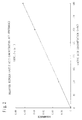
- a calibration curve obtained by plotting the absorbance values at the characteristic absorption wavenumber of 4361.5 cm -1 with respect to the concentrations is that shown in Fig. 2.
- the linearity of the calibration curve shown in Fig. 2 is 0.999967 when expressed in a correlation coefficient R, and this indicates that the same is excellent as a calibration curve.
- Such a calibration curve can be formed in a wavenumber region having a correlation coefficient of at least 0.8, preferably at least 0.9.
- Fig. 3 illustrates results obtained by calculating correlation coefficients R of the absorbance values and the concentrations from the absorption spectra of Fig. 1 as to the respective wavenumbers.
- High correlation coefficients are obtained in a number of wavenumber bands, and a high accuracy calibration expression of lactic acid is obtained when a multivariate analytical operation such as PCR or PLS is performed in the wavenumber regions having high correlation coefficients.
- Fig. 4 illustrates results obtained by primarily differentiating parts of the absorption spectra shown in Fig. 1
- Fig. 5 illustrates results obtained by secondarily differentiating parts of the absorption spectra respectively. Also from the results of the primary and secondary differentials, it is clearly understood that spectral intensities are changed in proportion to the concentrations.
- FIG. 6 schematically illustrates an embodiment of a measuring apparatus for lactic acid in organism according to the present invention.
- a light source part 2 is formed by a halogen lamp or the like which emits light of a plurality of wavelengths of a near infrared region, and a spectroscopic part 8 is provided on an optical path for irradiating an organism measuring portion 1 with measuring light emitted from the light source part 2 for selecting a wavelength which has an excellent correlation coefficient of at least 0.8 or at least 0.9 between a lactic acid concentration and absorbance in an aqueous lactic acid solution and is selected as a measuring wavelength from the measuring light of a plurality of wavelengths emitted from the light source part 2.
- a probe 4 comes into contact with the organism measuring portion 1, for irradiating the organism measuring portion 1 with the measuring light of the wavelength selected at the spectroscopic part 8.
- a photoreceiving part 6 detects transmitted/scattered light of the measuring light which is incident upon the organism measuring portion 1.
- the spectroscopic part 8 is of the so-called prespectroscopic system of performing wavelength selection before the organism measuring portion 1 is irradiated with the measuring light, while the spectroscopic part 8 may alternatively be provided on an optical path for introducing the transmitted light of the measuring light into a photodetector element of the photoreceiving part 6 to be of the so-called postspectroscopic system.
- Numeral 10 denotes a driving part for driving the light source part 2
- numeral 12 denotes a control part for controlling the wave length selection of the spectroscopic part 8
- numeral 14 denotes a signal processing part for converting a light signal detected by the photoreceiving part 6 to absorbance. Operations of the respective parts are controlled by a host computer 16 serving as an arithmetic ⁇ control part, and the concentration of lactic acid is calculated on the basis of a detected transmitted/scattered light intensity. The result of the obtained lactic acid concentration is displayed on a display part 18.
- the spectroscopic part 8 may be a monochromatic spectroscope comprising a prism or a diffraction grating, or a Fourier transform spectrophotometer comprising a Michelson interferometer and a Fourier transform arithmetic part in the arithmetic ⁇ control part 16.
- the spectroscopic part 8 may comprise an AOTF (acousto-optical filter), and a high-speed operation is enabled in this case.
- the spectroscopic part 8 may comprise a plurality of optical filters, for selecting the measuring wavelength by being switched and positioned on the optical path.
- the probe 4 is adapted to guide the measuring light to the organism measuring portion 1 by optical fiber, for example.
- the measuring light is applied from the probe 4, and the light which is transmitted/scattered through/from the organism measuring portion 1 and incident upon the photoreceiving part 6 is strongly scattered by the organism.
- the photoreceiving part 6 preferably comprises an integrating sphere so that the scattered light collected by the integrating sphere is detected.
- the spectroscopic part 8 is necessary when the light source part 2 is formed by a light source such as a lamp emitting light of continuous wavelengths or multiple wavelengths, while the spectroscopic part 8 is unnecessary when the light source part 2 is formed by a laser unit, a laser diode or a light emitting diode emitting single wavelength light.
- the light source part 2 may comprise a laser diode or a light emitting diode, or a plurality of types of laser diodes or light emitting diodes having different light emitting wave lengths. It is possible to irradiate the organism measuring portion 1 with measuring light of specific wavelengths in a successively switched manner by switching and turning on light emission of these laser diodes or the like. Thus, absorbance measurement with multiple wavelengths can be performed without employing the spectroscopic part 8.
- Fig. 7 shows another embodiment. While the transmitted/scattered light of the measuring light from the probe 4 is received by the photoreceiving part 6 in the embodiment shown in Fig. 6, a probe and a photoreceiving part are integrated with each other to form a probe ⁇ photoreceiving part 5 in the embodiment shown in Fig. 7. Transmitted/scattered light of measuring light from the probe ⁇ photoreceiving part 5 is detected by the probe ⁇ photoreceiving part 5.
- Other structure of this embodiment is identical to that shown in Fig. 6.
- FIG. 8 schematically illustrates an embodiment enabling measurement of localized distribution of intravital lactic acid concentrations.
- a plurality of probe ⁇ photoreceiving parts 5-1 to 5-N formed by integrating probes for irradiating an organism 1 with measuring light from a light source and photoreceiving parts for detecting transmitted/scattered light of the measuring light applied from the probes with each other are so provided that the respective probe ⁇ photoreceiving parts 5-1 to 5-N are in contact with and arranged on different places of the organism 1.
- the probe ⁇ photoreceiving parts 5-1 to 5-N comprise optical fiber, and are adapted to irradiate the organism 1 with the measuring light and receive transmitted/scattered light of the measuring light from the organism 1.
- Numeral 20 denotes a unit including the light source, a spectroscopic part for selecting measuring light of a prescribed measuring wavelength from the light emitted from the light source and transmitting the same to the probe ⁇ photoreceiving parts 5-1 to 5-N, a photoreceiving part for detecting the transmitted/scattered light from the organism 1 received by the probe ⁇ photoreceiving parts 5-1 to 5-N, and a data processing part for performing prescribed data processing of converting a light signal detected by the photoreceiving part to absorbance etc.
- the respective places of the organism 1 on which the probe ⁇ photoreceiving parts 5-1 to 5-N are arranged and lactic acid concentrations are associated with each other by a host computer 16 of an arithmetic ⁇ control part, and displayed on a display part 18 as images.
- the photoreceiving part included in the unit 20 is a multichannel photoreceiving part simultaneously detecting the transmitted/scattered light from the organism 1 received by the probe ⁇ photoreceiving parts 5-1 to 5-N, and can measure localized distribution of the lactic acid concentrations in the organism 1 in a short time.
- the probe ⁇ photoreceiving part is movably supported to be capable of scanning different places of the organism 1, while a memory device is necessary for temporarily storing a light signal received in each part with information of the places. Localized distribution of the lactic acid concentrations is obtained from the light signal stored in the memory device, so that the result is displayed on the display part 18.
- Fig. 9A schematically illustrates an embodiment which can obtain a tomographic image of an organism 1 by a lactic acid concentration.
- Fig. 9B illustrates the structure of a portion around the organism 1.
- a probe ⁇ photoreceiving part 5 is supported by a support member 30 on a circumference enclosing the organism 1.
- the support member 30 supports the probe ⁇ photoreceiving part 5 to be slidable in the direction of the organism 1 so that the forward end surface of the probe ⁇ photoreceiving part 5 comes into contact with the organism 1, and to be capable of moving along the periphery of the organism 1 and scanning the same.
- a unit 22 comprises a light source, a spectroscopic part for selecting measuring light of a prescribed measuring wave length from light generated from the light source and transmitting the same to the probe ⁇ photoreceiving part 5, and a photoreceiving part for detecting transmitted/scattered light from the organism 1 received by the probe ⁇ photoreceiving part 5.
- Numeral 24 denotes a data processing ⁇ driving part for driving scanning of the probe ⁇ photoreceiving part 5 by the support member 30 to move along the periphery of the organism 1.
- a tomographic image of the organism 1 by the lactic acid concentration is reconstructed by a host computer 16 of an arithmetic ⁇ control part from data obtained by the probe ⁇ photoreceiving part 5 moving around the organism 1, to be displayed on a display unit 28 through a concentration distribution display part 26.
- a single probe for applying measuring light and a multichannel photoreceiving part having a plurality of photoreceiving elements can be arranged on the support member 30 to enclose the organism 1.
- Transmitted/scattered light of measuring light which is introduced into the organism 1 from the probe is simultaneously detected by the multichannel photoreceiving part around the organism 1. It is possible to reconstruct a tomographic image of the organism 1 by the lactic acid concentration through data obtained by rotating the probe and the multichannel photoreceiving part around the organism 1 by the support member 30.
Landscapes
- Physics & Mathematics (AREA)
- Health & Medical Sciences (AREA)
- Life Sciences & Earth Sciences (AREA)
- General Health & Medical Sciences (AREA)
- Spectroscopy & Molecular Physics (AREA)
- Pathology (AREA)
- Optics & Photonics (AREA)
- Immunology (AREA)
- General Physics & Mathematics (AREA)
- Biochemistry (AREA)
- Analytical Chemistry (AREA)
- Chemical & Material Sciences (AREA)
- Medical Informatics (AREA)
- Animal Behavior & Ethology (AREA)
- Surgery (AREA)
- Public Health (AREA)
- Veterinary Medicine (AREA)
- Molecular Biology (AREA)
- Heart & Thoracic Surgery (AREA)
- Biomedical Technology (AREA)
- Engineering & Computer Science (AREA)
- Biophysics (AREA)
- Investigating Or Analysing Materials By Optical Means (AREA)
Applications Claiming Priority (2)
| Application Number | Priority Date | Filing Date | Title |
|---|---|---|---|
| JP24685195 | 1995-08-30 | ||
| JP246851/95 | 1995-08-30 |
Publications (2)
| Publication Number | Publication Date |
|---|---|
| EP0762109A2 true EP0762109A2 (de) | 1997-03-12 |
| EP0762109A3 EP0762109A3 (de) | 1997-09-17 |
Family
ID=17154663
Family Applications (1)
| Application Number | Title | Priority Date | Filing Date |
|---|---|---|---|
| EP96113761A Withdrawn EP0762109A3 (de) | 1995-08-30 | 1996-08-28 | Verfahren und Vorrichtung zur Messung der Milchsäure in einem Organismus |
Country Status (2)
| Country | Link |
|---|---|
| US (1) | US5757002A (de) |
| EP (1) | EP0762109A3 (de) |
Cited By (4)
| Publication number | Priority date | Publication date | Assignee | Title |
|---|---|---|---|---|
| EP1380253A1 (de) * | 2002-07-08 | 2004-01-14 | Hitachi, Ltd. | Optisches System zur Vermessung des Stoffwechsels des Körpers |
| EP1634061A4 (de) * | 2003-04-30 | 2007-11-21 | Univ Mcgill | Vefahren und system zur messung von lactatspiegeln in vivo |
| CN108061715A (zh) * | 2017-12-14 | 2018-05-22 | 石药银湖制药有限公司 | 一种快速定量评价中药注射液质量稳定性的方法 |
| US10578549B2 (en) | 2012-06-11 | 2020-03-03 | Purac Biochem B.V. | Quantification of lactide amounts in a polymeric matrix |
Families Citing this family (21)
| Publication number | Priority date | Publication date | Assignee | Title |
|---|---|---|---|---|
| US20020177910A1 (en) * | 2000-04-19 | 2002-11-28 | Quarterman John S. | Performance measurement system for large computer network |
| US6898451B2 (en) * | 2001-03-21 | 2005-05-24 | Minformed, L.L.C. | Non-invasive blood analyte measuring system and method utilizing optical absorption |
| US6711426B2 (en) * | 2002-04-09 | 2004-03-23 | Spectros Corporation | Spectroscopy illuminator with improved delivery efficiency for high optical density and reduced thermal load |
| US20080009689A1 (en) * | 2002-04-09 | 2008-01-10 | Benaron David A | Difference-weighted somatic spectroscopy |
| US20070015981A1 (en) * | 2003-08-29 | 2007-01-18 | Benaron David A | Device and methods for the detection of locally-weighted tissue ischemia |
| US7813778B2 (en) * | 2005-07-29 | 2010-10-12 | Spectros Corporation | Implantable tissue ischemia sensor |
| CN101801261B (zh) * | 2007-07-13 | 2013-08-14 | 马萨诸塞大学 | 身体机能监测方法及监测器 |
| US7896498B2 (en) * | 2009-03-30 | 2011-03-01 | Ottawa Hospital Research Institute | Apparatus and method for optical measurements |
| BR112014007584A2 (pt) | 2011-09-28 | 2020-05-05 | Power Fit S.R.L. | medição de ácido lático em fluidos biológicos |
| US9924901B2 (en) | 2014-06-16 | 2018-03-27 | Potomac Health Solutions, Inc. | Methods, media, and apparatus for optimizing physical training based on real-time blood lactate monitoring |
| US10791938B2 (en) | 2015-06-14 | 2020-10-06 | Facense Ltd. | Smartglasses for detecting congestive heart failure |
| US10638938B1 (en) | 2015-06-14 | 2020-05-05 | Facense Ltd. | Eyeglasses to detect abnormal medical events including stroke and migraine |
| US10799122B2 (en) | 2015-06-14 | 2020-10-13 | Facense Ltd. | Utilizing correlations between PPG signals and iPPG signals to improve detection of physiological responses |
| US11154203B2 (en) | 2015-06-14 | 2021-10-26 | Facense Ltd. | Detecting fever from images and temperatures |
| US11103140B2 (en) | 2015-06-14 | 2021-08-31 | Facense Ltd. | Monitoring blood sugar level with a comfortable head-mounted device |
| US10376163B1 (en) | 2015-06-14 | 2019-08-13 | Facense Ltd. | Blood pressure from inward-facing head-mounted cameras |
| US10667697B2 (en) | 2015-06-14 | 2020-06-02 | Facense Ltd. | Identification of posture-related syncope using head-mounted sensors |
| US11064892B2 (en) | 2015-06-14 | 2021-07-20 | Facense Ltd. | Detecting a transient ischemic attack using photoplethysmogram signals |
| US11103139B2 (en) | 2015-06-14 | 2021-08-31 | Facense Ltd. | Detecting fever from video images and a baseline |
| US10349887B1 (en) | 2015-06-14 | 2019-07-16 | Facense Ltd. | Blood pressure measuring smartglasses |
| WO2024034038A1 (ja) | 2022-08-09 | 2024-02-15 | 株式会社フジタ医科器械 | 生体情報検出装置及び生体情報検出方法 |
Citations (1)
| Publication number | Priority date | Publication date | Assignee | Title |
|---|---|---|---|---|
| WO1995004266A1 (en) * | 1993-07-30 | 1995-02-09 | Radiometer Medical A/S | A method and an apparatus for determining the content of a constituent of blood of an individual |
Family Cites Families (13)
| Publication number | Priority date | Publication date | Assignee | Title |
|---|---|---|---|---|
| US4281645A (en) * | 1977-06-28 | 1981-08-04 | Duke University, Inc. | Method and apparatus for monitoring metabolism in body organs |
| EP0063431B1 (de) * | 1981-04-10 | 1987-10-28 | Masaaki Konomi | Spektroskopisches Analysensystem |
| US4805623A (en) * | 1987-09-04 | 1989-02-21 | Vander Corporation | Spectrophotometric method for quantitatively determining the concentration of a dilute component in a light- or other radiation-scattering environment |
| US5361758A (en) * | 1988-06-09 | 1994-11-08 | Cme Telemetrix Inc. | Method and device for measuring concentration levels of blood constituents non-invasively |
| CA2025330C (en) * | 1989-09-18 | 2002-01-22 | David W. Osten | Characterizing biological matter in a dynamic condition using near infrared spectroscopy |
| US5070874A (en) * | 1990-01-30 | 1991-12-10 | Biocontrol Technology, Inc. | Non-invasive determination of glucose concentration in body of patients |
| NZ238717A (en) * | 1990-06-27 | 1994-08-26 | Futrex Inc | Blood glucose level measured by transmitting near-infrared energy through body part |
| JP3107914B2 (ja) * | 1992-07-20 | 2000-11-13 | 浜松ホトニクス株式会社 | 散乱吸収体内部の吸収情報計測装置及び方法 |
| US5433197A (en) * | 1992-09-04 | 1995-07-18 | Stark; Edward W. | Non-invasive glucose measurement method and apparatus |
| US5379764A (en) * | 1992-12-09 | 1995-01-10 | Diasense, Inc. | Non-invasive determination of analyte concentration in body of mammals |
| JPH06245938A (ja) * | 1993-02-23 | 1994-09-06 | Hitachi Ltd | 光計測装置 |
| US5435309A (en) * | 1993-08-10 | 1995-07-25 | Thomas; Edward V. | Systematic wavelength selection for improved multivariate spectral analysis |
| US5459317A (en) * | 1994-02-14 | 1995-10-17 | Ohio University | Method and apparatus for non-invasive detection of physiological chemicals, particularly glucose |
-
1996
- 1996-08-28 EP EP96113761A patent/EP0762109A3/de not_active Withdrawn
- 1996-08-29 US US08/704,987 patent/US5757002A/en not_active Expired - Lifetime
Patent Citations (1)
| Publication number | Priority date | Publication date | Assignee | Title |
|---|---|---|---|---|
| WO1995004266A1 (en) * | 1993-07-30 | 1995-02-09 | Radiometer Medical A/S | A method and an apparatus for determining the content of a constituent of blood of an individual |
Non-Patent Citations (1)
| Title |
|---|
| TAKUO YANO AND MASAMI HARATA: "Prediction of the Concentration of Several Constituents in a Mouse-Mouse Hybridoma Culture by Near Infrared Spectroscopy", JOURNAL OF FERMENTATION AND BIOENGINEERING, vol. 77, no. 6, 1994, pages 659 - 662 * |
Cited By (5)
| Publication number | Priority date | Publication date | Assignee | Title |
|---|---|---|---|---|
| EP1380253A1 (de) * | 2002-07-08 | 2004-01-14 | Hitachi, Ltd. | Optisches System zur Vermessung des Stoffwechsels des Körpers |
| EP1634061A4 (de) * | 2003-04-30 | 2007-11-21 | Univ Mcgill | Vefahren und system zur messung von lactatspiegeln in vivo |
| US10578549B2 (en) | 2012-06-11 | 2020-03-03 | Purac Biochem B.V. | Quantification of lactide amounts in a polymeric matrix |
| EP2859330B1 (de) * | 2012-06-11 | 2022-03-16 | Purac Biochem bv | Quantifizierung von lactidmengen in einer polymermatrix |
| CN108061715A (zh) * | 2017-12-14 | 2018-05-22 | 石药银湖制药有限公司 | 一种快速定量评价中药注射液质量稳定性的方法 |
Also Published As
| Publication number | Publication date |
|---|---|
| US5757002A (en) | 1998-05-26 |
| EP0762109A3 (de) | 1997-09-17 |
Similar Documents
| Publication | Publication Date | Title |
|---|---|---|
| US5757002A (en) | Method of and apparatus for measuring lactic acid in organism | |
| US6061582A (en) | Method and apparatus for non-invasive determination of physiological chemicals, particularly glucose | |
| USRE39672E1 (en) | Method and devices for laser induced fluorescence attenuation spectroscopy | |
| EP1444501B1 (de) | Spektroskopisches flüssigkeitsanalysegerät | |
| EP0317121B1 (de) | Spektroskopische Verfahren und Vorrichtung zur Messung des Zuckergehaltes | |
| EP1250082B1 (de) | Klassifizierung and charakterisierung von gewebe durch merkmale bezüglich adiposegewebe | |
| US6477392B1 (en) | Calibration of near infrared quantitative measurement device using optical measurement cross-products | |
| CA2244111C (en) | Method and apparatus for multi-spectral analysis in noninvasive nir spectroscopy | |
| US7098037B2 (en) | Accommodating subject and instrument variations in spectroscopic determinations | |
| US6232609B1 (en) | Glucose monitoring apparatus and method using laser-induced emission spectroscopy | |
| EP0967478A1 (de) | Nichtinvasives Testverfahren | |
| IL111525A (en) | Method for analyzing glucose in a biological matrix | |
| AU6425899A (en) | Methods and apparatus for tailoring spectroscopic calibration models | |
| JPWO2001075420A1 (ja) | 可視光及び/又は近赤外光を用いた乳房炎の有無を診断する方法及び装置 | |
| US20030098969A1 (en) | Spectroscopic fluid analyzer | |
| CA2597859A1 (en) | Method and apparatus for determining blood analytes | |
| JP4329360B2 (ja) | グルコース濃度の定量装置 | |
| CA2123152A1 (en) | Non-invasive determination of analyte concentration using non-continuous radiation | |
| JPH09126995A (ja) | 生体中の乳酸測定方法及び測定装置 | |
| EP0762108A2 (de) | Verfahren und Vorrichtung zur Messung der Keton-Konzentration in einem Organismus | |
| WO2007060583A2 (en) | Method and apparatus for determining concentrations of analytes in a turbid medium | |
| JPH11178813A (ja) | グルコース濃度の定量方法及びその装置 | |
| JPH09318626A (ja) | 尿中乳酸の測定方法及び装置 | |
| JP4563075B2 (ja) | 血糖値測定装置 | |
| Swatland | Developing a fiber-optic probe to combine subcutaneous fat depth and meat quality measurements |
Legal Events
| Date | Code | Title | Description |
|---|---|---|---|
| PUAI | Public reference made under article 153(3) epc to a published international application that has entered the european phase |
Free format text: ORIGINAL CODE: 0009012 |
|
| AK | Designated contracting states |
Kind code of ref document: A2 Designated state(s): DE FR GB IT |
|
| PUAL | Search report despatched |
Free format text: ORIGINAL CODE: 0009013 |
|
| AK | Designated contracting states |
Kind code of ref document: A3 Designated state(s): DE FR GB IT |
|
| 17P | Request for examination filed |
Effective date: 19980216 |
|
| 17Q | First examination report despatched |
Effective date: 20050421 |
|
| STAA | Information on the status of an ep patent application or granted ep patent |
Free format text: STATUS: THE APPLICATION HAS BEEN WITHDRAWN |
|
| 18W | Application withdrawn |
Effective date: 20060607 |