EP0762289B1 - Méthode et système de contrôle protégé d'accès à des ressources de système dans un système distribué - Google Patents
Méthode et système de contrôle protégé d'accès à des ressources de système dans un système distribué Download PDFInfo
- Publication number
- EP0762289B1 EP0762289B1 EP96306020A EP96306020A EP0762289B1 EP 0762289 B1 EP0762289 B1 EP 0762289B1 EP 96306020 A EP96306020 A EP 96306020A EP 96306020 A EP96306020 A EP 96306020A EP 0762289 B1 EP0762289 B1 EP 0762289B1
- Authority
- EP
- European Patent Office
- Prior art keywords
- server
- target object
- access
- client
- server object
- Prior art date
- Legal status (The legal status is an assumption and is not a legal conclusion. Google has not performed a legal analysis and makes no representation as to the accuracy of the status listed.)
- Expired - Lifetime
Links
Images

Classifications
-
- G—PHYSICS
- G06—COMPUTING OR CALCULATING; COUNTING
- G06F—ELECTRIC DIGITAL DATA PROCESSING
- G06F15/00—Digital computers in general; Data processing equipment in general
-
- G—PHYSICS
- G06—COMPUTING OR CALCULATING; COUNTING
- G06F—ELECTRIC DIGITAL DATA PROCESSING
- G06F21/00—Security arrangements for protecting computers, components thereof, programs or data against unauthorised activity
- G06F21/60—Protecting data
- G06F21/62—Protecting access to data via a platform, e.g. using keys or access control rules
- G06F21/6218—Protecting access to data via a platform, e.g. using keys or access control rules to a system of files or objects, e.g. local or distributed file system or database
-
- G—PHYSICS
- G06—COMPUTING OR CALCULATING; COUNTING
- G06F—ELECTRIC DIGITAL DATA PROCESSING
- G06F2221/00—Indexing scheme relating to security arrangements for protecting computers, components thereof, programs or data against unauthorised activity
- G06F2221/21—Indexing scheme relating to G06F21/00 and subgroups addressing additional information or applications relating to security arrangements for protecting computers, components thereof, programs or data against unauthorised activity
- G06F2221/2113—Multi-level security, e.g. mandatory access control
-
- G—PHYSICS
- G06—COMPUTING OR CALCULATING; COUNTING
- G06F—ELECTRIC DIGITAL DATA PROCESSING
- G06F2221/00—Indexing scheme relating to security arrangements for protecting computers, components thereof, programs or data against unauthorised activity
- G06F2221/21—Indexing scheme relating to G06F21/00 and subgroups addressing additional information or applications relating to security arrangements for protecting computers, components thereof, programs or data against unauthorised activity
- G06F2221/2141—Access rights, e.g. capability lists, access control lists, access tables, access matrices
Definitions
- the method and system of the present invention relates generally to providing security in computer systems and, more particularly, to controlling access to system resources by utilizing a group identity bound to an object reference or capability.
- an object is a component comprising data and operations which can be invoked to manipulate the data.
- the operations also called “methods" are invoked on the object by sending calls to the object.
- Each object has an object type that defines the operations that can be performed on objects of that type.
- One object type may inherit the object operations defined and implemented for other object types.
- client-server computing typically there is a set of computers that can communicate with one another through a network connecting the computers. Some of these computers act as providers of services or functionality to other computers.
- the provider of a service or functionality is known as a "server”, and the consumer of the service or functionality is called a "client”.
- the client-server model also generalizes to the case where distinct programs or processes are running on the same computer and communicating with one another through some protected mechanism and are acting as providers and consumers of functionality.
- servers that provide object oriented interfaces to their clients. These servers support objects consisting of data and the associated software for manipulating the data according to the operations permitted by this type of object. Clients may obtain access to these objects and may execute calls on them by transmitting the calls to the server. At the server these calls are executed via the software associated with the object. The results of these calls are then transmitted back to the client.
- DOE Distributed Objects Environment
- DOE is an object-oriented system, providing remote access from clients to DOE objects.
- Server applications implement DOE objects.
- a DOE server can create an object reference that acts as a pointer to the DOE object.
- a DOE object reference can be passed around between different processes on one machine or between different machines and it will still point to the original object.
- a client application at one location When a client application at one location obtains a DOE object reference, it can send calls (method invocation requests) to the target DOE object. The target DOE object can then execute these calls, possibly updating its internal state (its data) and possibly returning some results to its caller. As part of processing a method invocation, a server can itself invoke other objects, creating a chain of object invocations.
- some servers provide secure access to their objects, so that only appropriately designated users can access the objects.
- a client application wants to access to a secure object, it must establish an authenticated connection to the server which contains the implementation of the secure object. While establishing this connection, the client application must prove to the server which user the client application is representing.
- the client application may be representing the human user Susan. (As part of the business of logging into the client computer the human user purporting to be Susan will probably have had to provide some kind of authenticating information, e.g., a password to the client computer.)
- the server After the authenticated connection has been established, the server will be convinced that the given connection is to an application which has been empowered to represent a given user.
- the server will record the name of this user and will associate this user's name with the given connection.
- the art of establishing authenticated connections is well understood. See for example "Authentication in Distributed Systems: Theory and Practice” by Butler Lampson, Martin Abadi, Michael Burrows and Edward Wobber, ACM Transactions on Computer Systems, 10(4), November 1992.
- the normal DOE model is that clients invoke operations on remote objects.
- the server can require that the request be issued on an authenticated connection and can therefore validate that the client application is representing an authenticated user. The server can then perform a check to see that this authenticated user is really authorized to do the operation.
- Complications arise as soon as the user wants a server to perform some action that requires the server to access some other secure server.
- a user may request a client application to obtain a compound document (e.g., an annual sales report containing spreadsheet graphs and explanatory text), part of which is located on a first server (e.g., the text) and part on a second server (e.g., the graphs).
- the first server can authenticate the requesting user and verify that the user is authorized to make the request.
- the second server must authenticate the first server and must ensure that the first server was granted access by the client or has adequate access permissions to perform its requested action on the object.
- This problem is referred to as the delegation problem. It occurs whenever it is necessary for a client to delegate part of its authority to a server in order to allow it to get its job done.
- US-A-5220604 discloses a method for denying a first group access to a system resource wherein a second group is selected such that the first group is a subgroup of the second group. Access is granted only to those members of the second group who do not derive their membership in the second group through their membership in the first group.
- the present invention is elegant and simple way to solve the problem of securely dealing with access requests from various servers in a distributed computer system with a networked environment, and is more fully described below.
- Embodiments of the present invention provide an improved method and system for securely controlling access to resources in a distributed computer system.
- One embodiment of the present invention stores and binds a group identification with a target object and then uses membership checking to determine whether a client object which requests access to the target object operates on behalf of a user who is a member of this group. In this way, the embodiment avoids performing costly cryptographic operations in order to verify access rights of requesting objects, as was common in some prior art systems.
- a second embodiment of the present invention stores and binds a group identification to a target object reference and then passes the target object reference to client objects in the system. Since the target object reference includes a group identification entry, a first client object is able to determine which other clients in the system are members of the identified group. This determination allows the first client object to pass the target object reference to the other members of the group without first communicating with the server for the target object. In this way, the embodiment avoids the costly transaction costs of communicating with the server for the target object.
- a method is here, and generally, conceived to be a self-consistent sequence of steps leading to a desired result. These steps require physical manipulations of physical quantities. Usually, though not necessarily, these quantities take the form of electrical or magnetic signals capable of being stored, transferred, combined, compared, and otherwise manipulated. It proves convenient at times, principally for reasons of common usage, to refer to these signals as bits, values, elements, symbols, characters, terms, numbers, or the like. It should be borne in mind, however, that all of these and similar terms are to be associated with the appropriate physical quantities and are merely convenient labels applied to these quantities.
- Useful machines for performing the operations of the present invention include general purpose digital computers or similar devices.
- the general purpose computer may be selectively activated or reconfigured by a computer program stored in the computer.
- a special purpose computer may also be used to perform the operations of the present invention.
- use of the methods described and suggested herein is not limited to a particular computer configuration.
- Embodiments of the present invention provide an improved method and system for securely controlling access to resources in a distributed computer system.
- One embodiment of the present invention stores and binds a group identification with a target object and then uses membership checking to determine whether a client object which requests access to the target object operates on behalf of a user who is a member of this group. In this way, the embodiment avoids performing costly cryptographic operations in order to verify access rights of requesting objects, as was common in some prior art systems.
- a second embodiment of the present invention stores and binds a group identification to a target object reference and then passes the target object reference to client objects in the system. Since the target object reference includes a group identification entry, a first client object is able to determine which other clients in the system are members of the identified group. This determination allows the first client object to pass the target object reference to the other members of the group without first communicating with the server for the target object. In this way, the embodiment avoids the costly transaction costs of communicating with the server for the target object.
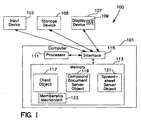
- FIG. 1 is a block diagram of a computer system 100 for practicing the preferred embodiment of the present invention.
- the computer system 100 includes a computer 101, an input device 103, a storage device 105, and a display device 107.
- the display device 107 displays a graphical user interface (GUI) 109.
- GUI graphical user interface
- the GUI presents information through icons, and a user invokes commands by pointing to or manipulating the icons.
- the computer 101 includes a processor 111, a memory 113, and an interface 115 for enabling communication between the processor 111 and peripheral devices such as the input device 103 and the display device 107.
- the computer memory contains a number of items including a client object 117, a compound document server object 119, and a spreadsheet server object 121.
- the contents of the memory 113 will be discussed in more detail below.
- a compound document typically includes both text and graphics.
- An annual sales report which contains charts and graphs depicting yearly sales growth and explanatory text would be implemented as a compound document.
- the charts and graphs are stored under control of a spreadsheet server while the text for the compound document is stored under control of a compound document server, along with a link to the charts and graphs.
- a user or "principal" has successfully logged on to and has acquired credentials for the system 100 and has invoked the client object 117.
- the client object 117 typically corresponds to a process containing a wordprocessing application.
- Principal credentials are then stored with the client object 117 in order to indicate that the object 117 is acting on behalf of the principal.
- the principal is associated with a group of other principals having access privileges on the computer system 100. For example, a salesperson may be associated with a group for the Sales Department. Each group defined in the system 100 has a unique group identifier associated with it.
- a mechanism e.g., mechanism 123 for checking membership credentials should be present to determine whether an object acting on behalf of a principal is or is not a member of a specified group. Any well known method or system for implementing a membership mechanism may be used to implement this aspect of the system 100.
- Figure 2 is a flow diagram illustrating the preferred steps of the first embodiment for securely controlling access to system resources.
- the steps of Figure 2 are typically initiated in response to user input.
- the principal initiates a request on the client 117 to create a spreadsheet (Step 201).
- the client object 117 sends a Create request to the spreadsheet server object (Step 203).
- the request indicates that a spreadsheet object should be instantiated.
- the request also includes the group identifier associated with the user on whose behalf the client object operates.
- the spreadsheet server object receives the request and creates the spreadsheet object (Step 205).
- the spreadsheet server object then stores with the spreadsheet object the group identifier, along with an indication of the access rights the group members have with respect to the spreadsheet object (Step 207).
- the spreadsheet server object generates an unforgeable number and stores the unforgeable number with the spreadsheet object (Step 209).
- the unforgeable number is often called a "capability”. An unforgeable number is one that is computationally difficult to determine.
- the spreadsheet server object then sends to the client object 117, a spreadsheet object reference (Step 211).
- the spreadsheet object reference comprises the previously generated unforgeable number.
- the client object finds a compound document server that operates on behalf of a principal in the group (Step 213).
- the client object sends a request to create a compound document to the compound document server 119 (Step 215).
- the Create request includes an indication that a compound document should be created.
- the Create request also includes the spreadsheet object reference so that the compound document server knows which spreadsheet object to incorporate into its compound document.
- the Create request includes a selected group identifier so that the compound document server can later determine whether a principal requesting access to the compound document is authorized to access the compound document.
- the compound document server creates the compound document and stores the spreadsheet object reference and the group identifier in the compound document (Step 217).
- the compound document server generates an unforgeable number and stores the unforgeable number with the compound document object.
- the compound document server object when presented with the unforgeable number by a client object requesting access to the compound document object, can have some assurance that the requesting client has the authority to access the compound document object.
- the compound document server object 119 then sends to the client object 117, a compound document object reference (Step 219).
- the compound document object reference comprises the unforgeable number generated by the compound document server object.
- the client object sends a print request to the compound document server (Step 221).
- the Print request passes the compound document reference and the identity of the client's principal to the compound document server.
- the client uses any well known authentication mechanism to prove to the compound document server that it has the right to operate on behalf of the client's principal.
- the compound document server is able to determine which compound document to print and can verify that the client object 117 has permission to print the compound document by checking that the authenticated identity belongs to the group specified when the compound document was created, and by comparing the unforgeable number in the object reference with the unforgeable number in the object.
- the compound document server In order to print the compound document, the compound document server needs to have the data associated with the spreadsheet object. So, the compound document server sends a Get Data request to the spreadsheet server (Step 223).
- the Get Data request includes the spreadsheet object reference so that the spreadsheet server knows which spreadsheet object from which to retrieve the data.
- the Get Data request also includes the identity of the principal on whose behalf the compound document server operates.
- the compound document server will authenticate itself to the spreadsheet server (Step 225). Any well known technique for authenticating principals can be used to implement this aspect of applicant's embodiment. If the compound document server is successfully authenticated then the spreadsheet server attempts to determine whether the compound document server has access rights which permit it to retrieve data from the spreadsheet object. To determine access rights the spreadsheet server retrieves the group identifier from the spreadsheet object. The spreadsheet server then sends the group identifier and the authenticated principal identifier to the membership mechanism 123, along with a request to determine whether the authenticated principal is a member of the group with access rights to the spreadsheet object (Step 227). Any well known mechanism for checking group membership may be used to implement this aspect of applicant's embodiment.
- the spreadsheet server makes yet another check to ensure that the compound document is authorized to access the spreadsheet object.
- the spreadsheet server retrieves the unforgeable number from the spreadsheet server reference and compares it to the unforgeable number stored with the spreadsheet server object (in a preferred embodiment this step would preferably be implemented first) (Step 229). If the unforgeable numbers match then the spreadsheet server permits the compound document server to retrieve the necessary data from the spreadsheet object, subject to the access rights stored with the object (Step 231).
- the compound document server sends the compound document data to a print server for printing (Step 233).
- One of the benefits associated with the first embodiment is that no cryptographic operations are needed to determine whether a client who is requesting access to an object is authorized to access the object. Instead, the first embodiment accomplishes this authorization check by maintaining a group identifier in the state data of the spreadsheet object and then using the group identifier to determine whether the requesting client operates on behalf of a user who is a member of the appropriate group. This group membership check is typically less expensive to perform than a cryptographic operation.
- Another advantage of the first embodiment is that the spreadsheet server can determine who has access to a given object just using state data maintained at the spreadsheet object. In other prior art implementations this was not possible because only object references stored access rights information. Access rights information was not stored with the object itself.
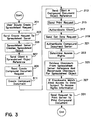
- Figure 3 is a flow diagram illustrating the preferred steps of a second embodiment for securely controlling access to system resources.
- the steps of Figure 3 are typically initiated in response to user input.
- the principal initiates a request on the client 117 to create a spreadsheet (Step 301).
- the client object 117 sends a Create request to the spreadsheet server object (Step 303).
- the request indicates that a spreadsheet object should be instantiated.
- the request also includes the group identifier associated with the principal on whose behalf the compound document server operates.
- the spreadsheet server object receives the request and creates the spreadsheet object (Step 305).
- the spreadsheet server object then sends to the client object 117, a spreadsheet object reference (Step 307).
- the spreadsheet object reference comprises the group identifier sent with the Create request, an entry indicating the access rights privileges of the group, and a spreadsheet object identifier.
- the spreadsheet object reference may be run through a cryptographic one-way hash function to produce a cryptographic checksum on the object reference data.
- the cryptographic checksum is also saved in or associated with the spreadsheet object reference.
- the spreadsheet object reference then has greater protection against forgery.
- the client object sends a request to create a compound document to the compound document server 119 (Step 309).
- the Create request includes an indication that a compound document should be created.
- the Create request also includes the spreadsheet object reference so that the compound document server knows which spreadsheet object to incorporate into its compound document.
- the Create request includes a selected group identifier so that the compound document server can determine whether an object operating on behalf of some principal requesting access to the compound document is authorized to access the compound document.
- the compound document server creates the compound document and stores the spreadsheet object reference in the compound document (Step 311).
- the compound document server object 119 then sends to the client object 117, a compound document object reference (Step 313).
- the compound document object reference comprises the group identifier, an entry which indicates the access rights of those in the group, an identifier for the compound document, and a cryptographic checksum generated by the compound document server during creation of the compound document reference.
- the client object sends a print request to the compound document server (Step 315).
- the Print request passes the compound document reference and the identity of the client's principal to the compound document server.
- the client uses any well known authentication mechanism to prove to the compound server that it has the right to operate on behalf of the client's principal (Step 317). In this way the compound document server understands which compound document to print and can verify that the client object 117 has permission to print the compound document by using a cryptographic checksum as described in more detail below.
- the compound document server In order to print the compound document, the compound document server needs to have the data associated with the spreadsheet object. So, the compound document server sends a Get Data request to the spreadsheet server (Step 319).
- the Get Data request includes the spreadsheet object reference so that the spreadsheet server knows the spreadsheet object from which to retrieve the data.
- the Get Data request also includes the identity of the principal on whose behalf the compound document server operates.
- the spreadsheet server authenticates the compound document server (Step 321). Any well known technique for authenticating principals can be used to implement this aspect of applicant's second embodiment. If the compound document server is successfully authenticated then the spreadsheet server attempts to determine whether the compound document server has access rights which permit it to retrieve data from the spreadsheet object (Step 323). To determine access rights the spreadsheet server retrieves the group identifier associated with the spreadsheet object reference. The spreadsheet server then retrieves the spreadsheet identifier from the spreadsheet object reference. Finally, the spreadsheet server sends the retrieved information to the membership mechanism 123, along with a request to determine whether the authenticated principal is a member of the identified group with access rights to the spreadsheet object. Any well known mechanism for checking group membership may be used to implement this aspect of applicant's second embodiment.
- the spreadsheet server makes yet another check to ensure that the compound document is authorized to access the spreadsheet object.
- the spreadsheet server retrieves the cryptographic checksum from the spreadsheet object reference and then recomputes the cryptographic checksum for the spreadsheet object (Step 325).
- the spreadsheet server compares the retrieved checksum with the recomputed checksum (Step 327). If the checksums match then the spreadsheet server permits the compound document server to retrieve the necessary data from the spreadsheet object, subject to the access rights in the object reference.
- the compound document server sends the compound document data to a print server for printing (Step 331).
- One of the benefits of the second embodiment is that the client object, by maintaining state about which group is authorized to use an object reference and what other members are in the group, can pass that object reference associated with that group to another principal in the group without having to engage in any message exchanges with the server. Avoiding such interactions with the spreadsheet server improves performance and efficiency.
- the group identifier might not only be stored in the object, but also sent with the object reference as a hint to the client. This hint could be used to bypass a message exchange with the server when the object reference is passed to a second client. The first client could check that the second client is in the group. Without this hint, the first client must request the group identifier from the server, which involves a message exchange.
- the server could cache object references with the object when they are presented for use. On a subsequent presentation, the server could check the object reference sent by the client with those in the cache. This means that if the object reference was presented by a different client in the same group, the server need not recompute the cryptographic checksum, which would reduce the computation by the server for that access and hence increase its performance.
Landscapes
- Engineering & Computer Science (AREA)
- Theoretical Computer Science (AREA)
- Physics & Mathematics (AREA)
- General Physics & Mathematics (AREA)
- General Engineering & Computer Science (AREA)
- Computer Hardware Design (AREA)
- General Health & Medical Sciences (AREA)
- Software Systems (AREA)
- Computer Security & Cryptography (AREA)
- Bioethics (AREA)
- Health & Medical Sciences (AREA)
- Databases & Information Systems (AREA)
- Storage Device Security (AREA)
- Computer And Data Communications (AREA)
- Document Processing Apparatus (AREA)
- Multi Processors (AREA)
Claims (19)
- Procédé exécuté dans un système informatique (101) pour contrôler l'accès à des ressources système dans un système informatique réparti, comprenant les étapes consistant à :envoyer une demande (201) d'un objet client (117) à un objet serveur de feuilles de calcul en vue de lier un identifiant de groupe à un objet feuille de calcul ;sous la commande de l'objet serveur de feuilles de calcul,
obtenir un objet feuille de calcul (205) ;
mémoriser l'identifiant de groupe avec l'objet feuille de calcul (207) ;
générer un total de contrôle infalsifiable (209) ;
mémoriser le total de contrôle infalsifiable avec l'objet feuille de calcul (209) ;
envoyer le total de contrôle infalsifiable à l'objet client (211) ; etsous la commande de l'objet client,
envoyer une demande à un objet serveur de documents composés en vue d'imprimer un document composé (215), la demande comportant l'identifiant et le total de contrôle du donneur d'ordre (223) pour le document composé (215), le document composé contenant des liens avec des objets feuilles de calcul et leurs totaux de contrôle infalsifiables respectifs ;sous la commande de l'objet serveur de documents composés (119),
envoyer une demande à l'objet serveur de feuilles de calcul, demandant à l'objet serveur de feuilles de calcul de renvoyer des données de l'objet feuille de calcul, la demande comportant un identifiant de donneur d'ordre et le total de contrôle infalsifiable pour l'objet feuille de calcul ;sous la commande de l'objet serveur de feuilles de calcul,
autoriser ou refuser l'accès à l'objet feuille de calcul en fonction d'une analyse de l'identifiant de donneur d'ordre et de l'identifiant de groupe mémorisés avec l'objet et le total de contrôle (227, 229 et 230). - Procédé exécuté dans un système informatique (101) pour faciliter le contrôle d'accès à des ressources système dans un système informatique réparti, le système informatique réparti comportant un objet client (117), un premier objet serveur, un objet cible et un deuxième objet serveur, chacun des objets appartenant à un ou plusieurs groupes d'objets spécifiés résidant dans le système informatique (101), comprenant les étapes consistant à :sous la commande du premier objet serveur,
mémoriser un identifiant de groupe associé à l'objet cible, l'identifiant de groupe identifiant le groupe d'objets dans le système informatique (101) jouissant de privilèges d'accès à l'objet cible ;sous la commande du deuxième objet serveur,
envoyer une demande d'accès au premier objet serveur, demandant l'accès à l'objet cible, la demande d'accès comportant un identifiant de donneur d'ordre qui identifie un donneur d'ordre au nom duquel le deuxième objet serveur agit ;sous la commande du premier objet serveur,
vérifier que le deuxième objet serveur est autorisé à accéder à l'objet cible à l'aide de l'identifiant de groupe associé à l'objet cible et de l'identifiant de donneur d'ordre contenu dans la demande d'accès émanant du deuxième objet serveur ; et
envoyer une référence d'objet cible à l'objet client (117), la référence d'objet cible indiquant une position de l'objet cible dans le système informatique (101) ;sous la commande de l'objet client (117),
localiser un deuxième serveur objet qui agit au nom d'un membre du groupe auquel l'objet client (117) appartient ; et
envoyer une demande d'obtention au deuxième objet serveur localisé, demandant au deuxième objet serveur d'obtenir un objet conteneur qui référence l'objet cible, la demande d'obtention comportant la référence d'objet cible et un identifiant de groupe qui identifie le groupe auquel l'objet client (117) appartient ;sous la commande du deuxième objet serveur,
obtenir l'objet conteneur auprès du deuxième objet serveur ; et
mémoriser la référence d'objet cible et l'identifiant de groupe dans l'objet conteneur. - Procédé selon la revendication 2, comprenant en outre les étapes consistant à :sous la commande de l'objet client,
envoyer une demande d'utilisation au deuxième objet serveur en vue d'utiliser l'objet conteneur, la demande d'utilisation comportant une référence d'objet conteneur indiquant une position de l'objet conteneur dans le système informatique et un identifiant de donneur d'ordre d'objet client qui identifie un donneur d'ordre opérant l'objet client ; etsous la commande du deuxième objet serveur, envoyer, en réponse à la demande d'utilisation émanant de l'objet client, une demande d'accès au premier objet serveur en vue d'accéder à l'objet cible, la demande d'accès comportant la référence pour l'objet cible et l'identifiant pour le donneur d'ordre au nom duquel le deuxième objet serveur agit. - Procédé selon la revendication 3, comprenant en outre les étapes consistant à :sous la commande du premier objet serveur, authentifier le deuxième objet serveur comme un membre du groupe jouissant de droits d'accès à l'objet cible à l'aide du donneur d'ordre envoyé du deuxième objet serveur au premier objet serveur ; etdéterminer si le deuxième objet serveur est autorisé à accéder à l'objet cible.
- Procédé selon la revendication 4, dans lequel l'étape consistant à déterminer si le deuxième objet serveur est autorisé comprend en outre les étapes consistant à :extraire un nombre infalsifiable mémorisé avec la référence d'objet cible dans la demande d'accès supplémentaire ;comparer le nombre infalsifiable extrait à un nombre infalsifiable mémorisé avec l'objet cible dans le premier objet serveur ; etsi les nombres infalsifiables concordent, autoriser le deuxième objet serveur à accéder à l'objet cible.
- Procédé selon la revendication 2, comprenant en outre les étapes consistant à :sous la commande du premier objet serveur, extraire l'identifiant de groupe de l'objet cible ;envoyer l'identifiant de groupe extrait et l'identifiant de donneur d'ordre du deuxième objet serveur à un mécanisme d'appartenance (123) ;s'il est déterminé que le deuxième objet serveur agit au nom d'un donneur d'ordre qui est un membre du groupe jouissant de droits d'accès à l'objet cible en réponse à la demande d'appartenance, permettre au deuxième objet serveur d'accéder à l'objet cible.
- Procédé selon la revendication 2, comprenant en outre les étapes consistant à :sous la commande de l'objet client, envoyer une demande au premier objet serveur, la demande indiquant que le premier objet serveur doit créer l'objet cible ; etsous la commande du premier objet serveur, créer l'objet cible ; etmémoriser une indication des droits d'accès dont des membres du groupe jouissent vis-à-vis de l'objet cible.
- Système informatique (101) pour faciliter le contrôle d'accès à des ressources système dans un système informatique réparti, le système informatique réparti comportant un objet client (117), un premier objet serveur (121), un objet cible et un deuxième objet serveur (119), chacun des objets appartenant à un ou plusieurs groupes d'objets spécifiés résidant dans le système informatique, dans lequel :le premier objet serveur est configuré pour mémoriser un identifiant de groupe associé à l'objet cible dans le premier objet serveur, l'identifiant de groupe identifiant le groupe d'objets dans le système jouissant de privilèges d'accès à l'objet cible ;le deuxième objet serveur est configuré pour envoyer une demande d'accès au premier objet serveur, demandant l'accès à l'objet cible, la demande d'accès comportant un identifiant de donneur d'ordre qui identifie un donneur d'ordre au nom duquel le deuxième objet serveur agit ;le premier objet serveur est configuré pour vérifier que le deuxième objet serveur est autorisé à accéder à l'objet cible à l'aide de l'identifiant de groupe mémorisé dans l'objet cible et de l'identifiant de donneur d'ordre contenu dans la demande d'accès émanant du deuxième objet serveur ; etenvoyer une référence d'objet cible à l'objet client, la référence d'objet cible indiquant une position de l'objet cible dans le système informatique ;l'objet client est configuré pour localiser un deuxième objet serveur qui agit au nom d'un membre du groupe auquel l'objet client appartient ; etenvoyer une demande d'obtention au deuxième objet serveur localisé, demandant au deuxième objet serveur d'obtenir un objet conteneur qui référence l'objet cible, la demande d'obtention comportant la référence d'objet cible et un identifiant de groupe qui identifie le groupe auquel l'objet client appartient ; etle deuxième objet serveur est configuré pour obtenir l'objet conteneur ; etmémoriser la référence d'objet cible et l'identifiant de groupe dans l'objet conteneur.
- Système selon la revendication 8, comprenant en outre un système dans lequel :l'objet client est configuré pour envoyer une demande d'utilisation au deuxième objet serveur en vue d'utiliser l'objet conteneur, la demande d'utilisation indiquant une position de l'objet conteneur et un identifiant de donneur d'ordre d'objet client qui identifie un donneur d'ordre opérant au nom de l'objet client ; etle deuxième objet serveur est configuré pour envoyer, en réponse à la demande d'utilisation émanant de l'objet client, une demande d'accès au premier objet serveur en vue d'accéder à l'objet cible, la demande d'accès comportant la référence pour l'objet cible et l'identifiant pour le donneur d'ordre au nom duquel le deuxième objet serveur agit.
- Système selon la revendication 9, dans lequel, en outre :le premier objet serveur est configuré pour authentifier le deuxième objet serveur comme un membre du groupe jouissant de droits d'accès à l'objet cible à l'aide de l'identité du donneur d'ordre envoyée du deuxième objet serveur au premier objet serveur ; etdéterminer si le deuxième objet serveur est autorisé à accéder à l'objet cible.
- Système selon la revendication 10, dans lequel l'étape consistant à déterminer si le deuxième objet serveur est autorisé comprend en outre un système pour :extraire un nombre infalsifiable mémorisé avec la référence d'objet cible dans la demande d'accès supplémentaire ;comparer le nombre infalsifiable extrait à un nombre infalsifiable mémorisé avec l'objet cible dans le premier objet serveur ; etsi les nombres infalsifiables concordent, autoriser le deuxième objet serveur à accéder à l'objet cible.
- Système selon la revendication 8, comprenant en outre un système dans lequel :le premier objet serveur est configuré pour extraire l'identifiant de groupe de l'objet cible ;envoyer l'identifiant de groupe extrait et l'identifiant de donneur d'ordre du deuxième objet serveur à un mécanisme d'appartenance (123) ;envoyer une demande d'appartenance pour déterminer si le donneur d'ordre est un membre du groupe jouissant de droits d'accès à l'objet cible ; ets'il est déterminé que le deuxième objet serveur agit au nom d'un donneur d'ordre qui est un membre du groupe jouissant de droits d'accès à l'objet cible en réponse à la demande d'appartenance, permettre au deuxième objet serveur d'accéder à l'objet cible.
- Système selon là revendication 8, dans lequel, en outre :l'objet client est configuré pour envoyer une demande de création au premier objet serveur, la demande indiquant que le premier objet serveur doit créer l'objet cible ; etle premier objet serveur est configuré pour créer l'objet cible ; etmémoriser une indication des droits d'accès dont des membres du groupe jouissent vis-à-vis de l'objet cible.
- Programme informatique pour faciliter le contrôle d'accès à des ressources système dans un système informatique réparti, le système informatique réparti comportant un objet client (117), un premier objet serveur (121), un objet cible et un deuxième objet serveur (119), chacun des objets appartenant à un ou plusieurs groupes d'objets spécifiés résidant dans le système informatique, le programme comprenant :dans lequel les codes sont mémorisés sur un support tangible.un code pour le premier objet serveur configuré pour mémoriser un identifiant de groupe associé à l'objet cible dans le premier objet serveur, l'identifiant de groupe identifiant le groupe d'objets dans le système jouissant de privilèges d'accès à l'objet cible ;un code pour le deuxième objet serveur configuré pourenvoyer une demande d'accès au premier objet serveur, demandant l'accès à l'objet cible, la demande d'accès comportant un identifiant de donneur d'ordre qui identifie un donneur d'ordre au nom duquel le deuxième objet serveur agit ;un code pour le premier objet serveur configuré pour vérifier que le deuxième objet serveur est autorisé à accéder à l'objet cible à l'aide de l'identifiant de groupe mémorisé dans l'objet cible et de l'identifiant de donneur d'ordre contenu dans la demande d'accès émanant du deuxième objet serveur ; etenvoyer une référence d'objet cible à l'objet client, la référence d'objet cible indiquant une position de l'objet cible dans le système informatique ;un code pour l'objet client configuré pour localiser un deuxième objet serveur qui agit au nom d'un membre du groupe auquel l'objet client appartient ; etenvoyer une demande d'obtention au deuxième objet serveur localisé, demandant au deuxième objet serveur d'obtenir un objet conteneur qui référence l'objet cible, la demande d'obtention comportant la référence d'objet cible et un identifiant de groupe qui identifie le groupe auquel l'objet client appartient ; etun code pour le deuxième objet serveur configuré pour
obtenir l'objet conteneur ; etmémoriser la référence d'objet cible et l'identifiant de groupe dans l'objet conteneur ; - Programme selon la revendication 14, comprenant en outre :un code pour l'objet client configuré pour envoyer une demande d'utilisation au deuxième objet serveur en vue d'utiliser l'objet conteneur, la demande d'utilisation comportant une référence d'objet conteneur indiquant une position de l'objet conteneur dans le système informatique et un identifiant du donneur d'ordre de l'objet client ; etun code pour le deuxième objet serveur configuré pour envoyer, en réponse à la demande d'utilisation émanant de l'objet client, une demande d'accès au premier objet serveur en vue d'accéder à l'objet cible, la demande d'accès comportant la référence pour l'objet cible et l'identifiant pour le donneur d'ordre au nom duquel le deuxième objet serveur agit.
- Programme selon la revendication 15, comprenant en outre :un code pour le premier objet serveur configuré pour authentifier le deuxième objet serveur comme un membre du groupe jouissant de droits d'accès à l'objet cible à l'aide de l'identité de l'identifiant de donneur d'ordre envoyée du deuxième objet serveur au premier objet serveur ; etdéterminer si le deuxième objet serveur est autorisé à accéder à l'objet cible.
- Programme selon la revendication 16, dans lequel l'étape consistant à déterminer si le deuxième objet serveur est autorisé comprend en outre un code configuré pour :extraire un nombre infalsifiable mémorisé avec la référence d'objet cible dans la demande d'accès supplémentaire ;comparer le nombre infalsifiable extrait à un nombre infalsifiable mémorisé avec l'objet cible dans le premier objet serveur ; etsi les nombres infalsifiables concordent, autoriser le deuxième objet serveur à accéder à l'objet cible.
- Programme selon la revendication 14, comprenant en outre :un code pour le premier objet serveur configuré pour extraire l'identifiant de groupe de l'objet cible ;envoyer l'identifiant de groupe extrait et l'identifiant de donneur d'ordre du deuxième objet serveur à un mécanisme d'appartenance (123) ;envoyer une demande d'appartenance pour déterminer si le donneur d'ordre est un membre du groupe jouissant de droits d'accès à l'objet cible ; ets'il est déterminé que le deuxième objet serveur agit au nom d'un donneur d'ordre qui est un membre du groupe jouissant de droits d'accès à l'objet cible en réponse à la demande d'appartenance, permettre au deuxième objet serveur d'accéder à l'objet cible.
- Programme selon la revendication 14, comprenant en outre :dans lequel le code pour le premier objet serveur est configuré pour créer l'objet cible ; etun code pour l'objet client configuré pour envoyer une demande de création au premier objet serveur, la demande indiquant que le premier objet serveur doit créer l'objet cible ; et
mémoriser une indication des droits d'accès dont des membres du groupe jouissent vis-à-vis de l'objet cible.
Applications Claiming Priority (2)
| Application Number | Priority Date | Filing Date | Title |
|---|---|---|---|
| US516671 | 1995-08-18 | ||
| US08/516,671 US5742759A (en) | 1995-08-18 | 1995-08-18 | Method and system for facilitating access control to system resources in a distributed computer system |
Publications (3)
| Publication Number | Publication Date |
|---|---|
| EP0762289A2 EP0762289A2 (fr) | 1997-03-12 |
| EP0762289A3 EP0762289A3 (fr) | 1998-03-18 |
| EP0762289B1 true EP0762289B1 (fr) | 2004-07-21 |
Family
ID=24056620
Family Applications (1)
| Application Number | Title | Priority Date | Filing Date |
|---|---|---|---|
| EP96306020A Expired - Lifetime EP0762289B1 (fr) | 1995-08-18 | 1996-08-16 | Méthode et système de contrôle protégé d'accès à des ressources de système dans un système distribué |
Country Status (7)
| Country | Link |
|---|---|
| US (1) | US5742759A (fr) |
| EP (1) | EP0762289B1 (fr) |
| JP (1) | JPH09251425A (fr) |
| KR (1) | KR970012183A (fr) |
| CN (1) | CN1149797A (fr) |
| DE (1) | DE69632938D1 (fr) |
| TW (1) | TW314609B (fr) |
Cited By (1)
| Publication number | Priority date | Publication date | Assignee | Title |
|---|---|---|---|---|
| US8898746B2 (en) | 1997-06-11 | 2014-11-25 | Prism Technologies Llc | Method for managing access to protected computer resources |
Families Citing this family (112)
| Publication number | Priority date | Publication date | Assignee | Title |
|---|---|---|---|---|
| US5757914A (en) * | 1995-10-26 | 1998-05-26 | Sun Microsystems, Inc. | System and method for protecting use of dynamically linked executable modules |
| US6195665B1 (en) * | 1996-03-05 | 2001-02-27 | Tomorrow's Software, L.L.C. | Digital electrical computer apparatus, and methods for making and using the same, for template building, loading, and viewing |
| US6263442B1 (en) * | 1996-05-30 | 2001-07-17 | Sun Microsystems, Inc. | System and method for securing a program's execution in a network environment |
| US5903732A (en) * | 1996-07-03 | 1999-05-11 | Hewlett-Packard Company | Trusted gateway agent for web server programs |
| US6192407B1 (en) | 1996-10-24 | 2001-02-20 | Tumbleweed Communications Corp. | Private, trackable URLs for directed document delivery |
| US5832209A (en) * | 1996-12-11 | 1998-11-03 | Ncr Corporation | System and method for providing object authorization in a distributed computed network |
| US6408336B1 (en) | 1997-03-10 | 2002-06-18 | David S. Schneider | Distributed administration of access to information |
| US5933826A (en) * | 1997-03-21 | 1999-08-03 | Novell, Inc. | Method and apparatus for securing and storing executable content |
| US6029246A (en) * | 1997-03-31 | 2000-02-22 | Symantec Corporation | Network distributed system for updating locally secured objects in client machines |
| US6021496A (en) * | 1997-07-07 | 2000-02-01 | International Business Machines Corporation | User authentication from non-native server domains in a computer network |
| US6138150A (en) * | 1997-09-03 | 2000-10-24 | International Business Machines Corporation | Method for remotely controlling computer resources via the internet with a web browser |
| US6064656A (en) * | 1997-10-31 | 2000-05-16 | Sun Microsystems, Inc. | Distributed system and method for controlling access control to network resources |
| KR100289190B1 (ko) * | 1997-11-24 | 2001-05-02 | 구자홍 | 금융전산망의보안유지방법 |
| US6385728B1 (en) * | 1997-11-26 | 2002-05-07 | International Business Machines Corporation | System, method, and program for providing will-call certificates for guaranteeing authorization for a printer to retrieve a file directly from a file server upon request from a client in a network computer system environment |
| US6141754A (en) * | 1997-11-28 | 2000-10-31 | International Business Machines Corporation | Integrated method and system for controlling information access and distribution |
| GB9725742D0 (en) * | 1997-12-04 | 1998-02-04 | Hewlett Packard Co | Object gateway |
| US6047377A (en) * | 1997-12-11 | 2000-04-04 | Sun Microsystems, Inc. | Typed, parameterized, and extensible access control permissions |
| KR100477840B1 (ko) * | 1997-12-27 | 2005-06-29 | 주식회사 하이닉스반도체 | 반도체장치의장벽금속막형성방법 |
| US7165152B2 (en) * | 1998-06-30 | 2007-01-16 | Emc Corporation | Method and apparatus for managing access to storage devices in a storage system with access control |
| US7756986B2 (en) | 1998-06-30 | 2010-07-13 | Emc Corporation | Method and apparatus for providing data management for a storage system coupled to a network |
| US6453353B1 (en) * | 1998-07-10 | 2002-09-17 | Entrust, Inc. | Role-based navigation of information resources |
| US6205480B1 (en) | 1998-08-19 | 2001-03-20 | Computer Associates Think, Inc. | System and method for web server user authentication |
| US6292798B1 (en) | 1998-09-09 | 2001-09-18 | International Business Machines Corporation | Method and system for controlling access to data resources and protecting computing system resources from unauthorized access |
| US6219786B1 (en) | 1998-09-09 | 2001-04-17 | Surfcontrol, Inc. | Method and system for monitoring and controlling network access |
| US6266774B1 (en) * | 1998-12-08 | 2001-07-24 | Mcafee.Com Corporation | Method and system for securing, managing or optimizing a personal computer |
| US6826692B1 (en) | 1998-12-23 | 2004-11-30 | Computer Associates Think, Inc. | Method and apparatus to permit automated server determination for foreign system login |
| US6901435B1 (en) * | 1999-06-17 | 2005-05-31 | Bmc Software, Inc. | GUI interpretation technology for client/server environment |
| US6845395B1 (en) * | 1999-06-30 | 2005-01-18 | Emc Corporation | Method and apparatus for identifying network devices on a storage network |
| US6665714B1 (en) | 1999-06-30 | 2003-12-16 | Emc Corporation | Method and apparatus for determining an identity of a network device |
| JP3594075B2 (ja) * | 1999-09-24 | 2004-11-24 | 日立ソフトウエアエンジニアリング株式会社 | ユーザ認証方法および装置 |
| JP4359974B2 (ja) | 1999-09-29 | 2009-11-11 | 富士ゼロックス株式会社 | アクセス権限委譲方法 |
| JP2001175467A (ja) * | 1999-12-07 | 2001-06-29 | Kizna.Com Inc | コンピュータのセキュリティー確保方法及びそのプログラムを記録した媒体 |
| US6606659B1 (en) | 2000-01-28 | 2003-08-12 | Websense, Inc. | System and method for controlling access to internet sites |
| US6757291B1 (en) * | 2000-02-10 | 2004-06-29 | Simpletech, Inc. | System for bypassing a server to achieve higher throughput between data network and data storage system |
| US20040088560A1 (en) * | 2000-04-20 | 2004-05-06 | Danks David Hilton | Secure system access |
| US7062541B1 (en) * | 2000-04-27 | 2006-06-13 | International Business Machines Corporation | System and method for transferring related data objects in a distributed data storage environment |
| US7606883B1 (en) | 2000-05-11 | 2009-10-20 | Thomson Licensing | Method and system for controlling and auditing content/service systems |
| US6980972B1 (en) * | 2000-05-11 | 2005-12-27 | Thomson Licensing S.A. | Method and system for controlling and auditing content/service systems |
| DE10028349A1 (de) * | 2000-06-08 | 2001-12-20 | Siemens Ag | Verfahren und Anordnung zur gesicherten Nutzung eines Dienstes |
| US20040073617A1 (en) | 2000-06-19 | 2004-04-15 | Milliken Walter Clark | Hash-based systems and methods for detecting and preventing transmission of unwanted e-mail |
| KR20040005815A (ko) * | 2000-08-04 | 2004-01-16 | 컴퓨터 어소시에이츠 싱크, 인코포레이티드 | 사용자를 웹 서버에 인증시키기 위한 시스템 및 방법 |
| US7072955B1 (en) * | 2000-08-31 | 2006-07-04 | Intel Corporation | Controlling remote storage devices |
| US8037492B2 (en) * | 2000-09-12 | 2011-10-11 | Thomson Licensing | Method and system for video enhancement transport alteration |
| WO2002039306A1 (fr) * | 2000-11-09 | 2002-05-16 | Sri International | Systemes et procedes destines a une utilisation de ressource negociee |
| US20020065874A1 (en) * | 2000-11-29 | 2002-05-30 | Andrew Chien | Method and process for virtualizing network interfaces |
| US20040073530A1 (en) * | 2000-12-06 | 2004-04-15 | David Stringer-Calvert | Information management via delegated control |
| US8566849B2 (en) * | 2000-12-14 | 2013-10-22 | Borland Software Corporation | Name service object clustering |
| US7260636B2 (en) * | 2000-12-22 | 2007-08-21 | Emc Corporation | Method and apparatus for preventing unauthorized access by a network device |
| US20020184535A1 (en) * | 2001-05-30 | 2002-12-05 | Farah Moaven | Method and system for accessing a resource in a computing system |
| US8132250B2 (en) * | 2002-03-08 | 2012-03-06 | Mcafee, Inc. | Message profiling systems and methods |
| US20030172291A1 (en) * | 2002-03-08 | 2003-09-11 | Paul Judge | Systems and methods for automated whitelisting in monitored communications |
| US7458098B2 (en) | 2002-03-08 | 2008-11-25 | Secure Computing Corporation | Systems and methods for enhancing electronic communication security |
| US7693947B2 (en) | 2002-03-08 | 2010-04-06 | Mcafee, Inc. | Systems and methods for graphically displaying messaging traffic |
| US7903549B2 (en) * | 2002-03-08 | 2011-03-08 | Secure Computing Corporation | Content-based policy compliance systems and methods |
| US7124438B2 (en) | 2002-03-08 | 2006-10-17 | Ciphertrust, Inc. | Systems and methods for anomaly detection in patterns of monitored communications |
| US6941467B2 (en) * | 2002-03-08 | 2005-09-06 | Ciphertrust, Inc. | Systems and methods for adaptive message interrogation through multiple queues |
| US7870203B2 (en) | 2002-03-08 | 2011-01-11 | Mcafee, Inc. | Methods and systems for exposing messaging reputation to an end user |
| US8578480B2 (en) | 2002-03-08 | 2013-11-05 | Mcafee, Inc. | Systems and methods for identifying potentially malicious messages |
| US20060015942A1 (en) | 2002-03-08 | 2006-01-19 | Ciphertrust, Inc. | Systems and methods for classification of messaging entities |
| US8561167B2 (en) | 2002-03-08 | 2013-10-15 | Mcafee, Inc. | Web reputation scoring |
| US7694128B2 (en) | 2002-03-08 | 2010-04-06 | Mcafee, Inc. | Systems and methods for secure communication delivery |
| US6678828B1 (en) * | 2002-07-22 | 2004-01-13 | Vormetric, Inc. | Secure network file access control system |
| TW200414737A (en) | 2002-09-27 | 2004-08-01 | Matsushita Electric Industrial Co Ltd | Contents transmission system |
| CN1732452A (zh) * | 2002-10-25 | 2006-02-08 | 贝蒂纳·埃克斯珀顿 | 用于自动启动和访问网络地址和应用程序的系统和方法 |
| US7024689B2 (en) * | 2002-12-13 | 2006-04-04 | Intuit, Inc. | Granting access rights to unattended software |
| US6990502B2 (en) | 2003-02-26 | 2006-01-24 | Microsoft Corporation | Reviewing cached user-group information in connection with issuing a digital rights management (DRM) license for content |
| US9003295B2 (en) * | 2003-03-17 | 2015-04-07 | Leo Martin Baschy | User interface driven access control system and method |
| GB2400699B (en) | 2003-04-17 | 2006-07-05 | Hewlett Packard Development Co | Security data provision method and apparatus and data recovery method and system |
| DE10339436A1 (de) * | 2003-08-24 | 2005-04-07 | Nova Informationstechnik Gmbh | Verfahren und Vorrichtung zum Aufbau eines virtuellen elektronischen Lehrsystems mit individueller interaktiver Kommunikation |
| US7210165B2 (en) * | 2003-10-29 | 2007-04-24 | Microsoft Corporation | Pre-licensing of rights management protected content |
| US20050172149A1 (en) * | 2004-01-29 | 2005-08-04 | Xingjian Xu | Method and system for management of information for access control |
| JP2005260489A (ja) * | 2004-03-10 | 2005-09-22 | Murata Mach Ltd | 電子機器装置 |
| US7797239B2 (en) * | 2004-03-12 | 2010-09-14 | Sybase, Inc. | Hierarchical entitlement system with integrated inheritance and limit checks |
| US8478668B2 (en) * | 2004-03-12 | 2013-07-02 | Sybase, Inc. | Hierarchical entitlement system with integrated inheritance and limit checks |
| JP2005346702A (ja) * | 2004-05-04 | 2005-12-15 | Heidelberger Druckmas Ag | 識別表示装置を備える診断システム |
| US7979699B2 (en) * | 2004-05-19 | 2011-07-12 | Intel Corporation | Processing capacity on demand |
| US8635690B2 (en) | 2004-11-05 | 2014-01-21 | Mcafee, Inc. | Reputation based message processing |
| SE0403133D0 (sv) * | 2004-12-22 | 2004-12-22 | Ericsson Telefon Ab L M | A method and arrangement for providing communication group information to a client |
| US7644086B2 (en) * | 2005-03-29 | 2010-01-05 | Sas Institute Inc. | Computer-implemented authorization systems and methods using associations |
| US7693837B2 (en) * | 2005-04-12 | 2010-04-06 | International Business Machines Corporation | Technique for simplifying the management and control of fine-grained access |
| US9176934B2 (en) | 2005-05-06 | 2015-11-03 | Leo Baschy | User interface for nonuniform access control system and methods |
| US7937480B2 (en) * | 2005-06-02 | 2011-05-03 | Mcafee, Inc. | Aggregation of reputation data |
| US9129088B1 (en) | 2005-06-04 | 2015-09-08 | Leo Martin Baschy | User interface driven access control system and methods for multiple users as one audience |
| JP2007148923A (ja) * | 2005-11-29 | 2007-06-14 | Brother Ind Ltd | 画像形成システム、画像形成用プログラム、管理用プログラム及びクライアント装置 |
| US8818897B1 (en) * | 2005-12-15 | 2014-08-26 | Rockstar Consortium Us Lp | System and method for validation and enforcement of application security |
| US9202068B2 (en) * | 2006-03-29 | 2015-12-01 | Leo M. Baschy | User interface for variable access control system |
| US8615800B2 (en) * | 2006-07-10 | 2013-12-24 | Websense, Inc. | System and method for analyzing web content |
| US8020206B2 (en) * | 2006-07-10 | 2011-09-13 | Websense, Inc. | System and method of analyzing web content |
| NL1032274C2 (nl) * | 2006-08-04 | 2008-02-05 | Rb Holding B V | Werkwijze, datamodel en systeem. |
| US9654495B2 (en) | 2006-12-01 | 2017-05-16 | Websense, Llc | System and method of analyzing web addresses |
| US7779156B2 (en) | 2007-01-24 | 2010-08-17 | Mcafee, Inc. | Reputation based load balancing |
| US8214497B2 (en) | 2007-01-24 | 2012-07-03 | Mcafee, Inc. | Multi-dimensional reputation scoring |
| US8179798B2 (en) * | 2007-01-24 | 2012-05-15 | Mcafee, Inc. | Reputation based connection throttling |
| US7949716B2 (en) | 2007-01-24 | 2011-05-24 | Mcafee, Inc. | Correlation and analysis of entity attributes |
| US8763114B2 (en) | 2007-01-24 | 2014-06-24 | Mcafee, Inc. | Detecting image spam |
| US8015174B2 (en) | 2007-02-28 | 2011-09-06 | Websense, Inc. | System and method of controlling access to the internet |
| CN101276364B (zh) | 2007-03-30 | 2010-12-22 | 阿里巴巴集团控股有限公司 | 一种分布式计算数据合并方法、系统及其装置 |
| CN101119317B (zh) * | 2007-08-31 | 2010-07-21 | 华为技术有限公司 | 分配许可的方法、设备及系统 |
| US20090113537A1 (en) * | 2007-10-30 | 2009-04-30 | James Woo | Proxy authentication server |
| US8185930B2 (en) | 2007-11-06 | 2012-05-22 | Mcafee, Inc. | Adjusting filter or classification control settings |
| US8045458B2 (en) * | 2007-11-08 | 2011-10-25 | Mcafee, Inc. | Prioritizing network traffic |
| US8160975B2 (en) | 2008-01-25 | 2012-04-17 | Mcafee, Inc. | Granular support vector machine with random granularity |
| US8589503B2 (en) | 2008-04-04 | 2013-11-19 | Mcafee, Inc. | Prioritizing network traffic |
| JP5308127B2 (ja) * | 2008-11-17 | 2013-10-09 | 株式会社豊田中央研究所 | 給電システム |
| US8555378B2 (en) * | 2009-03-11 | 2013-10-08 | Sas Institute Inc. | Authorization caching in a multithreaded object server |
| US8886672B2 (en) | 2009-03-12 | 2014-11-11 | International Business Machines Corporation | Providing access in a distributed filesystem |
| AU2010254269A1 (en) | 2009-05-26 | 2011-12-22 | Websense, Inc. | Systems and methods for efficient detection of fingerprinted data and information |
| US8621638B2 (en) | 2010-05-14 | 2013-12-31 | Mcafee, Inc. | Systems and methods for classification of messaging entities |
| US8908743B2 (en) * | 2012-09-26 | 2014-12-09 | Intel Mobile Communications GmbH | Receiver with multi layer interference cancellation |
| US9166979B2 (en) | 2012-10-01 | 2015-10-20 | International Business Machines Corporation | Protecting online meeting access using secure personal universal resource locators |
| BR102012027125A2 (pt) * | 2012-10-23 | 2014-11-25 | Berners Daniel | Sistema e método de gestão empresarial |
| JP5447722B1 (ja) | 2013-07-17 | 2014-03-19 | 富士ゼロックス株式会社 | 情報処理システム及びプログラム |
Family Cites Families (16)
| Publication number | Priority date | Publication date | Assignee | Title |
|---|---|---|---|---|
| US4919545A (en) * | 1988-12-22 | 1990-04-24 | Gte Laboratories Incorporated | Distributed security procedure for intelligent networks |
| US5138712A (en) * | 1989-10-02 | 1992-08-11 | Sun Microsystems, Inc. | Apparatus and method for licensing software on a network of computers |
| US5263165A (en) * | 1990-02-15 | 1993-11-16 | International Business Machines Corporation | System for providing user access control within a distributed data processing system having multiple resource managers |
| US5220604A (en) * | 1990-09-28 | 1993-06-15 | Digital Equipment Corporation | Method for performing group exclusion in hierarchical group structures |
| US5261102A (en) * | 1991-03-28 | 1993-11-09 | International Business Machines Corporation | System for determining direct and indirect user access privileges to data base objects |
| US5204897A (en) * | 1991-06-28 | 1993-04-20 | Digital Equipment Corporation | Management interface for license management system |
| US5276901A (en) * | 1991-12-16 | 1994-01-04 | International Business Machines Corporation | System for controlling group access to objects using group access control folder and group identification as individual user |
| US5421011A (en) * | 1991-12-20 | 1995-05-30 | International Business Machines Corporation | Method and system for access and accounting control in a data processing system by using a single resource account for a user or a group of users |
| US5412717A (en) * | 1992-05-15 | 1995-05-02 | Fischer; Addison M. | Computer system security method and apparatus having program authorization information data structures |
| US5491752A (en) * | 1993-03-18 | 1996-02-13 | Digital Equipment Corporation, Patent Law Group | System for increasing the difficulty of password guessing attacks in a distributed authentication scheme employing authentication tokens |
| US5446903A (en) * | 1993-05-04 | 1995-08-29 | International Business Machines Corporation | Method and apparatus for controlling access to data elements in a data processing system based on status of an industrial process by mapping user's security categories and industrial process steps |
| US5577252A (en) * | 1993-07-28 | 1996-11-19 | Sun Microsystems, Inc. | Methods and apparatus for implementing secure name servers in an object-oriented system |
| US5455953A (en) * | 1993-11-03 | 1995-10-03 | Wang Laboratories, Inc. | Authorization system for obtaining in single step both identification and access rights of client to server directly from encrypted authorization ticket |
| US5475753A (en) * | 1993-11-12 | 1995-12-12 | Matsushita Electric Corporation Of America | Apparatus and method for certifying the delivery of information |
| US5572673A (en) * | 1993-12-01 | 1996-11-05 | Sybase, Inc. | Secure multi-level system for executing stored procedures |
| US5481715A (en) * | 1993-12-15 | 1996-01-02 | Sun Microsystems, Inc. | Method and apparatus for delegated communications in a computer system using trusted deputies |
-
1995
- 1995-08-18 US US08/516,671 patent/US5742759A/en not_active Expired - Lifetime
-
1996
- 1996-08-16 DE DE69632938T patent/DE69632938D1/de not_active Expired - Fee Related
- 1996-08-16 EP EP96306020A patent/EP0762289B1/fr not_active Expired - Lifetime
- 1996-08-17 CN CN96113317A patent/CN1149797A/zh active Pending
- 1996-08-19 JP JP8234642A patent/JPH09251425A/ja active Pending
- 1996-08-19 KR KR1019960034970A patent/KR970012183A/ko not_active Withdrawn
- 1996-10-03 TW TW085112101A patent/TW314609B/zh active
Cited By (4)
| Publication number | Priority date | Publication date | Assignee | Title |
|---|---|---|---|---|
| US8898746B2 (en) | 1997-06-11 | 2014-11-25 | Prism Technologies Llc | Method for managing access to protected computer resources |
| US9369469B2 (en) | 1997-06-11 | 2016-06-14 | Prism Technologies, L.L.C. | Method for managing access to protected computer resources |
| US9413768B1 (en) | 1997-06-11 | 2016-08-09 | Prism Technologies Llc | Method for managing access to protected computer resources |
| US9544314B2 (en) | 1997-06-11 | 2017-01-10 | Prism Technologies Llc | Method for managing access to protected computer resources |
Also Published As
| Publication number | Publication date |
|---|---|
| JPH09251425A (ja) | 1997-09-22 |
| CN1149797A (zh) | 1997-05-14 |
| KR970012183A (ko) | 1997-03-29 |
| EP0762289A3 (fr) | 1998-03-18 |
| DE69632938D1 (de) | 2004-08-26 |
| US5742759A (en) | 1998-04-21 |
| EP0762289A2 (fr) | 1997-03-12 |
| TW314609B (fr) | 1997-09-01 |
Similar Documents
| Publication | Publication Date | Title |
|---|---|---|
| EP0762289B1 (fr) | Méthode et système de contrôle protégé d'accès à des ressources de système dans un système distribué | |
| CA2315212C (fr) | Systeme et procede pour authentifier des composants homologues | |
| US6067623A (en) | System and method for secure web server gateway access using credential transform | |
| US5586260A (en) | Method and apparatus for authenticating a client to a server in computer systems which support different security mechanisms | |
| US6070239A (en) | System and method for executing verifiable programs with facility for using non-verifiable programs from trusted sources | |
| US6668322B1 (en) | Access management system and method employing secure credentials | |
| US6282652B1 (en) | System for separately designating security requirements for methods invoked on a computer | |
| US6311269B2 (en) | Trusted services broker for web page fine-grained security labeling | |
| US8990896B2 (en) | Extensible mechanism for securing objects using claims | |
| US6760844B1 (en) | Secure transactions sessions | |
| Karnik et al. | A security architecture for mobile agents in Ajanta | |
| WO2007125180A1 (fr) | Authentification | |
| WO2005036304A2 (fr) | Serveur de dispositif de mobilite | |
| US20070271618A1 (en) | Securing access to a service data object | |
| Islam et al. | A flexible security system for using Internet content | |
| EP1519540A2 (fr) | Serveur d'appareil de mobilité | |
| US20030236979A1 (en) | Group security objects and concurrent multi-user security objects | |
| Leicher et al. | Implementation of a trusted ticket system | |
| CA2310535A1 (fr) | Gestionnaire de contexte de controleur de voute et methodes d'exploitation permettant de maintenir de maniere securitaire les informations d'etat dans l'intervalle entre des connexions successives d'un fureteur dans un systeme de commerce electronique | |
| US20030236996A1 (en) | Security objects controlling timed access to resources | |
| Beznosov | Object security attributes: Enabling application-specific access control in middleware | |
| Ashley et al. | Applying authorization to intranets: architectures, issues and APIs | |
| De Win et al. | A security architecture for electronic commerce applications | |
| Gidron et al. | Dynamic configuration of access control for mobile components in fargo | |
| Karp et al. | The client utility architecture: the precursor to E-speak |
Legal Events
| Date | Code | Title | Description |
|---|---|---|---|
| PUAI | Public reference made under article 153(3) epc to a published international application that has entered the european phase |
Free format text: ORIGINAL CODE: 0009012 |
|
| AK | Designated contracting states |
Kind code of ref document: A2 Designated state(s): DE FR GB IT |
|
| PUAL | Search report despatched |
Free format text: ORIGINAL CODE: 0009013 |
|
| AK | Designated contracting states |
Kind code of ref document: A3 Designated state(s): DE FR GB IT |
|
| RHK1 | Main classification (correction) |
Ipc: G06F 1/00 |
|
| 17P | Request for examination filed |
Effective date: 19980910 |
|
| 17Q | First examination report despatched |
Effective date: 20001123 |
|
| GRAP | Despatch of communication of intention to grant a patent |
Free format text: ORIGINAL CODE: EPIDOSNIGR1 |
|
| GRAP | Despatch of communication of intention to grant a patent |
Free format text: ORIGINAL CODE: EPIDOSNIGR1 |
|
| GRAS | Grant fee paid |
Free format text: ORIGINAL CODE: EPIDOSNIGR3 |
|
| GRAA | (expected) grant |
Free format text: ORIGINAL CODE: 0009210 |
|
| AK | Designated contracting states |
Kind code of ref document: B1 Designated state(s): DE FR GB IT |
|
| PG25 | Lapsed in a contracting state [announced via postgrant information from national office to epo] |
Ref country code: IT Free format text: LAPSE BECAUSE OF FAILURE TO SUBMIT A TRANSLATION OF THE DESCRIPTION OR TO PAY THE FEE WITHIN THE PRESCRIBED TIME-LIMIT;WARNING: LAPSES OF ITALIAN PATENTS WITH EFFECTIVE DATE BEFORE 2007 MAY HAVE OCCURRED AT ANY TIME BEFORE 2007. THE CORRECT EFFECTIVE DATE MAY BE DIFFERENT FROM THE ONE RECORDED. Effective date: 20040721 Ref country code: FR Free format text: LAPSE BECAUSE OF FAILURE TO SUBMIT A TRANSLATION OF THE DESCRIPTION OR TO PAY THE FEE WITHIN THE PRESCRIBED TIME-LIMIT Effective date: 20040721 |
|
| REG | Reference to a national code |
Ref country code: GB Ref legal event code: FG4D |
|
| REF | Corresponds to: |
Ref document number: 69632938 Country of ref document: DE Date of ref document: 20040826 Kind code of ref document: P |
|
| PG25 | Lapsed in a contracting state [announced via postgrant information from national office to epo] |
Ref country code: GB Free format text: LAPSE BECAUSE OF NON-PAYMENT OF DUE FEES Effective date: 20041021 |
|
| PG25 | Lapsed in a contracting state [announced via postgrant information from national office to epo] |
Ref country code: DE Free format text: LAPSE BECAUSE OF NON-PAYMENT OF DUE FEES Effective date: 20050301 |
|
| PLBE | No opposition filed within time limit |
Free format text: ORIGINAL CODE: 0009261 |
|
| STAA | Information on the status of an ep patent application or granted ep patent |
Free format text: STATUS: NO OPPOSITION FILED WITHIN TIME LIMIT |
|
| GBPC | Gb: european patent ceased through non-payment of renewal fee |
Effective date: 20041021 |
|
| 26N | No opposition filed |
Effective date: 20050422 |
|
| EN | Fr: translation not filed |