EP0762294A2 - Rechnersystem mit genetischen Optimierungstechniken - Google Patents
Rechnersystem mit genetischen Optimierungstechniken Download PDFInfo
- Publication number
- EP0762294A2 EP0762294A2 EP96305462A EP96305462A EP0762294A2 EP 0762294 A2 EP0762294 A2 EP 0762294A2 EP 96305462 A EP96305462 A EP 96305462A EP 96305462 A EP96305462 A EP 96305462A EP 0762294 A2 EP0762294 A2 EP 0762294A2
- Authority
- EP
- European Patent Office
- Prior art keywords
- genotypes
- agent
- pool
- genotype
- genetic optimization
- Prior art date
- Legal status (The legal status is an assumption and is not a legal conclusion. Google has not performed a legal analysis and makes no representation as to the accuracy of the status listed.)
- Granted
Links
Images


Classifications
-
- G—PHYSICS
- G06—COMPUTING OR CALCULATING; COUNTING
- G06N—COMPUTING ARRANGEMENTS BASED ON SPECIFIC COMPUTATIONAL MODELS
- G06N3/00—Computing arrangements based on biological models
- G06N3/02—Neural networks
- G06N3/08—Learning methods
- G06N3/086—Learning methods using evolutionary algorithms, e.g. genetic algorithms or genetic programming
-
- G—PHYSICS
- G06—COMPUTING OR CALCULATING; COUNTING
- G06N—COMPUTING ARRANGEMENTS BASED ON SPECIFIC COMPUTATIONAL MODELS
- G06N3/00—Computing arrangements based on biological models
- G06N3/12—Computing arrangements based on biological models using genetic models
- G06N3/126—Evolutionary algorithms, e.g. genetic algorithms or genetic programming
Definitions
- This invention relates to computer systems for problem solving. More specifically, the invention is concerned with a novel use of genetic optimization techniques in such a system.
- Genetic optimization is a technique for solving complex non-deterministic problems by a process based on evolution and natural selection.
- the parameters to the problem are encoded in data structures that are modelled on chromosomes and genes.
- An individual solution to the problem is represented by a "genotype" that comprises a particular pattern of these chromosomes.
- the genetic optimization process takes a pool of such genotypes and breeds them to make new genetic combinations. It then evaluates each individual for fitness (i.e. how good that particular solution is), and selects the fittest for further breeding. By repeating this process, possibly thousands or millions of times, a very good solution frequently emerges.
- the object of the present invention is to overcome these problems in a novel manner.
- a computer system comprising:
- the genetic optimization agent provides a framework within which a number of different problem-solving techniques can be integrated, in such a way as to achieve synergy between the different techniques.
- FIG. 1 is a block diagram of a computer system embodying the invention.
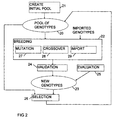
- Figure 2 is a schematic diagram illustrating a genetic optimization agent forming part of the system.
- Figure 3 is a schematic diagram illustrating a mutation operation used by the genetic optimization agent.
- Figure 4 is a schematic diagram illustrating a crossover operation used by the genetic optimization agent.
- Figure 1 shows a computer system 10, comprising a plurality of agents 11-16. These agents may be processes running on separate processors. Alternatively one or more of the agents may run as time-sharing processes on the same processor. The agents can communicate with each other by a message passing mechanism 17, which allows any one of the agents to send a message to any other agent.
- agents 11-16 may be processes running on separate processors. Alternatively one or more of the agents may run as time-sharing processes on the same processor.
- the agents can communicate with each other by a message passing mechanism 17, which allows any one of the agents to send a message to any other agent.
- the system includes at least one genetic optimization agent, capable of solving problems by genetic optimization techniques.
- genetic optimization agent capable of solving problems by genetic optimization techniques.
- the genetic optimization agent will be described in more detail below.
- the system also includes one or more further agents which are capable of solving problems by other (non-genetic) techniques.
- these further agents comprise a simulated annealing agent 13, a constraint logic programming (CLP) agent 14, and a neural network agent 15.
- Simulated annealing, CLP, and neural networks are well-known techniques in the art, and details of these processes do not form any part of the present invention, so that it is not necessary to describe the agents 13-15 in any further detail.
- the system also includes a manual optimization agent 16, which allows a human user to create and to modify solutions manually, as will be described in more detail below.
- each of the agents 11-16 attempts to create possible solutions to a given problem, using its own particular method.
- Each of these possible solutions is encoded in some predetermined manner, for example as a string of bits.
- the encoded solution is referred to as a "genotype".
- All the agents use the same predetermined genotype coding scheme, so that any genotype can be understood by all the agents.
- each genotype may contain coded information representing a particular sequence of collections and deliveries to be performed by each of a number of truck drivers.
- the genetic optimization agent 11 or 12 will now be described in more detail with reference to Figure 2.
- the genetic optimization agent maintains a pool of genotypes 20, representing a current generation of solutions to the problem in question.
- a process 21 creates an initial generation of genotypes, for example by randomization, or by using genotypes stored from a previous run.
- the genetic optimization agent includes a breeding process 22, which processes the genotypes in the pool 20, to produce a set of new genotypes 23.
- Each new genotype passes through a validation process 24 which checks whether the genotype satisfies any problem-specific constraints. For example, in the transport scheduling problem, the validation process may check whether the delivery schedule represented by the genotype would involve a driver working for more than a maximum permitted number of hours. If the genotype does not satisfy the constraints, the validation process performs a "gene-repair" operation, by searching for values which satisfy the constraints. If such values cannot be found, the new genotype is discarded.
- the genetic optimization agent also includes an evaluation process 25, which evaluates the new genotypes, to produce a fitness value for each one, indicating how good a solution the genotype represents.
- the fitness value may represent the efficiency of the delivery schedule represented by the genotype.
- the genetic optimization agent further includes a selection process 26 which selects the best of the genotypes (both from the genotype pool 20 and the new genotype set 23), and places the selected genotypes in the genotype pool. The worst of the genotypes are discarded.
- breeding, validation, evaluation and selection processes are executed cyclically, to produce successive generations of genotypes. This loop continues until some criterion is satisfied, such as one of the following:
- the breeding process 22 comprises a number of operators, including a mutation operator 27, a crossover operator 28, and an import operator 29. Each of these operators has a weighting value associated with it, which determines the probability of using that operator. These weighting values are adjusted for successive generations, so as to increase the probability of use of those operators that produce fitter genotypes.
- the mutation operator 27 takes one of the genotypes from the pool 20, and mutates it in some manner.
- the mutation may consist of inverting a randomly-selected one of its bits.
- Figure 3 shows such a mutation operator applied to a genotype 31, where the fifth bit is selected for inversion.
- the crossover operator 28 selects two of the genotypes from the pool 20 as “parents", and generates two new "offspring” genotypes from these, by swapping part of their genetic information.
- the parents are chosen randomly, with a probability based on their fitness values, so that genotypes with higher fitness values will tend to produce more offspring.
- Figure 4 shows one possible crossover operator applied to two parent genotypes 41,42 to produce two offspring genotypes 43,44.
- a crosspoint 45 is randomly selected, in this example after the fifth bit.
- the first offspring 43 is created by taking the bits of the first parent 41 preceding crosspoint, and the bits of the second parent 42 that follow the crosspoint.
- the second offspring 44 is created by taking the bits of the second parent 42 preceding crosspoint, and the bits of the first parent 41 that follow the crosspoint. It will be appreciated that in practice other forms of crossover operator may be used, depending on the way the genotypes are encoded.
- the import operator 29 sends a message to one of the other agents in the system, requesting it to send the best genotype so far created by that other agent.
- the requested genotype is received, it is validated and added to the set of new genotypes 23 in exactly the same way as locally generated genotypes, produced by the mutation and crossover operators.
- the imported genotype will then be available for further evolution by the genetic optimization agent.
- the manual optimization agent 16 allows the user to select the current best genotype from any of the other agents 11-15, and to display the solution represented by the selected genotype on a screen in some readily-understandable form.
- the agent 16 also allows the user to manipulate the displayed solution, in an attempt to improve it. For example, in the case of the transport scheduling problem, the agent 16 may display the delivery schedule represented by the genotype in the form of a Gantt chart. The user may then modify this Gantt chart, by using a mouse or other pointer device to drag one or more bars on the chart to different locations. When the user has finished, the agent 16 reconverts the modified solution into a genotype, and makes this genotype available for export to the genetic optimization agent. The genetic optimization agent will then import this genotype, validate it, repair it, and add it to the set of new genotypes, as described above.
- the user can browse through the best solutions so far, modify the Gantt chart using his/her skill and experience, and then offer this new genotype up to genetic optimization agent. If the genotype represents a good new starting point, it will then be used by the genetic optimization agent to generate still better solutions.
- the genetic optimization agent will constantly import fit-looking genotypes from other agents and try to evolve them into even fitter individuals. In the meantime, the other agents will be trying to create good solutions their own way. If one of these other agents happens to come up with a particularly brilliant solution very quickly, it offers up this solution to the genetic optimization agent for further refinement. If not, the genetic optimization agent will operate in the normal manner, to generate its own solution.
- the system may include a central pool of genotypes that have been offered for export by the agents. In this case, whenever the genetic optimization agent requires to import a new genotype, it would obtain it from this central pool, rather than from the other agents.
- the system may include a shared evaluation agent, which provides an evaluation service for each of the genetic optimization agents in the system.
- the import operator may import several best genotypes from each other agent (assuming that more than one genotype is available in that other agent).
- Some method such as tagging, may be used to avoid a recently exported genotype being re-imported into the same agent.
- a mechanism may be provided to keep track of the sources of genotypes, so as to keep a history of which technique worked best at what stage of optimization.
Landscapes
- Engineering & Computer Science (AREA)
- Physics & Mathematics (AREA)
- Health & Medical Sciences (AREA)
- Life Sciences & Earth Sciences (AREA)
- Biophysics (AREA)
- Theoretical Computer Science (AREA)
- Bioinformatics & Cheminformatics (AREA)
- Bioinformatics & Computational Biology (AREA)
- Evolutionary Biology (AREA)
- Computational Linguistics (AREA)
- Molecular Biology (AREA)
- Biomedical Technology (AREA)
- Physiology (AREA)
- Data Mining & Analysis (AREA)
- Evolutionary Computation (AREA)
- General Health & Medical Sciences (AREA)
- Artificial Intelligence (AREA)
- Computing Systems (AREA)
- General Engineering & Computer Science (AREA)
- General Physics & Mathematics (AREA)
- Mathematical Physics (AREA)
- Software Systems (AREA)
- Genetics & Genomics (AREA)
- Management, Administration, Business Operations System, And Electronic Commerce (AREA)
- General Factory Administration (AREA)
Applications Claiming Priority (2)
| Application Number | Priority Date | Filing Date | Title |
|---|---|---|---|
| GB9517775 | 1995-08-31 | ||
| GBGB9517775.4A GB9517775D0 (en) | 1995-08-31 | 1995-08-31 | Computer system using genetic optimization techniques |
Publications (3)
| Publication Number | Publication Date |
|---|---|
| EP0762294A2 true EP0762294A2 (de) | 1997-03-12 |
| EP0762294A3 EP0762294A3 (de) | 1997-07-30 |
| EP0762294B1 EP0762294B1 (de) | 2001-05-23 |
Family
ID=10779995
Family Applications (1)
| Application Number | Title | Priority Date | Filing Date |
|---|---|---|---|
| EP96305462A Expired - Lifetime EP0762294B1 (de) | 1995-08-31 | 1996-07-25 | Rechnersystem mit genetischen Optimierungstechniken |
Country Status (6)
| Country | Link |
|---|---|
| US (1) | US5761381A (de) |
| EP (1) | EP0762294B1 (de) |
| JP (2) | JPH09114798A (de) |
| CA (1) | CA2182990A1 (de) |
| DE (1) | DE69612928T2 (de) |
| GB (1) | GB9517775D0 (de) |
Cited By (23)
| Publication number | Priority date | Publication date | Assignee | Title |
|---|---|---|---|---|
| EP1540505A4 (de) * | 2002-08-29 | 2005-12-07 | Gene Network Sciences Inc | Systeme und verfahren zum schliessen auf biologische netzwerke |
| US7222323B2 (en) | 2001-03-03 | 2007-05-22 | Ericsson Ab | Evolutionary programming of configurable logic devices |
| US20100274736A1 (en) * | 2009-04-28 | 2010-10-28 | Genetic Finance Holdings Limited, AMS Trustees Limited | Class-based distributed evolutionary algorithm for asset management and trading |
| CN103294929A (zh) * | 2013-07-01 | 2013-09-11 | 南昌航空大学 | 一种自适应的直接搜索模拟退火算法 |
| US8825560B2 (en) | 2007-11-08 | 2014-09-02 | Genetic Finance (Barbados) Limited | Distributed evolutionary algorithm for asset management and trading |
| US10430429B2 (en) | 2015-09-01 | 2019-10-01 | Cognizant Technology Solutions U.S. Corporation | Data mining management server |
| US11003994B2 (en) | 2017-12-13 | 2021-05-11 | Cognizant Technology Solutions U.S. Corporation | Evolutionary architectures for evolution of deep neural networks |
| US11182677B2 (en) | 2017-12-13 | 2021-11-23 | Cognizant Technology Solutions U.S. Corporation | Evolving recurrent networks using genetic programming |
| US11250328B2 (en) | 2016-10-26 | 2022-02-15 | Cognizant Technology Solutions U.S. Corporation | Cooperative evolution of deep neural network structures |
| US11250314B2 (en) | 2017-10-27 | 2022-02-15 | Cognizant Technology Solutions U.S. Corporation | Beyond shared hierarchies: deep multitask learning through soft layer ordering |
| US11481639B2 (en) | 2019-02-26 | 2022-10-25 | Cognizant Technology Solutions U.S. Corporation | Enhanced optimization with composite objectives and novelty pulsation |
| US11507844B2 (en) | 2017-03-07 | 2022-11-22 | Cognizant Technology Solutions U.S. Corporation | Asynchronous evaluation strategy for evolution of deep neural networks |
| US11527308B2 (en) | 2018-02-06 | 2022-12-13 | Cognizant Technology Solutions U.S. Corporation | Enhanced optimization with composite objectives and novelty-diversity selection |
| US11669716B2 (en) | 2019-03-13 | 2023-06-06 | Cognizant Technology Solutions U.S. Corp. | System and method for implementing modular universal reparameterization for deep multi-task learning across diverse domains |
| US11775841B2 (en) | 2020-06-15 | 2023-10-03 | Cognizant Technology Solutions U.S. Corporation | Process and system including explainable prescriptions through surrogate-assisted evolution |
| US11783195B2 (en) | 2019-03-27 | 2023-10-10 | Cognizant Technology Solutions U.S. Corporation | Process and system including an optimization engine with evolutionary surrogate-assisted prescriptions |
| US12026624B2 (en) | 2019-05-23 | 2024-07-02 | Cognizant Technology Solutions U.S. Corporation | System and method for loss function metalearning for faster, more accurate training, and smaller datasets |
| US12033079B2 (en) | 2018-02-08 | 2024-07-09 | Cognizant Technology Solutions U.S. Corporation | System and method for pseudo-task augmentation in deep multitask learning |
| US12099934B2 (en) | 2020-04-07 | 2024-09-24 | Cognizant Technology Solutions U.S. Corporation | Framework for interactive exploration, evaluation, and improvement of AI-generated solutions |
| US12282845B2 (en) | 2018-11-01 | 2025-04-22 | Cognizant Technology Solutions US Corp. | Multiobjective coevolution of deep neural network architectures |
| US12292944B2 (en) | 2019-09-19 | 2025-05-06 | Cognizant Technology Solutions U.S. Corp. | Loss function optimization using Taylor series expansion |
| US12424335B2 (en) | 2020-07-08 | 2025-09-23 | Cognizant Technology Solutions U.S. Corporation | AI based optimized decision making for epidemiological modeling |
| US12572810B2 (en) | 2021-06-08 | 2026-03-10 | Cognizant Technology Solutions US Corp. | System and method for generating improved prescriptors |
Families Citing this family (38)
| Publication number | Priority date | Publication date | Assignee | Title |
|---|---|---|---|---|
| US6256619B1 (en) * | 1997-12-23 | 2001-07-03 | Caterpillar Inc. | Self optimizing neural network analog data processing system |
| JP2002520695A (ja) * | 1998-07-02 | 2002-07-09 | バイオス グループ リミテッド パートナーシップ | 適応性及び信頼性のあるオペレーション・マネージメントのためのシステム及び方法 |
| US6360259B1 (en) | 1998-10-09 | 2002-03-19 | United Technologies Corporation | Method for optimizing communication speed between processors |
| WO2000036523A1 (en) | 1998-12-15 | 2000-06-22 | Jing Xiao | Method for solving partial constraint satisfaction problems for sequencing tasks |
| US6973560B1 (en) | 1999-07-16 | 2005-12-06 | Lamarck, Inc. | Fault tolerant and combinatorial software environment system, method and medium |
| US6634019B1 (en) | 1999-07-16 | 2003-10-14 | Lamarck, Inc. | Toggling software characteristics in a fault tolerant and combinatorial software environment system, method and medium |
| JP4763112B2 (ja) * | 1999-10-22 | 2011-08-31 | 富士通株式会社 | ハイブリッド型遺伝的アルゴリズムの島モデルによる最適化問題処理方法およびその処理プログラム記録媒体 |
| US7216113B1 (en) * | 2000-03-24 | 2007-05-08 | Symyx Technologies, Inc. | Remote Execution of Materials Library Designs |
| CA2441385A1 (en) * | 2001-04-06 | 2002-10-17 | British Telecommunications Public Limited Company | Method and apparatus for building algorithms |
| US6882988B2 (en) | 2001-10-05 | 2005-04-19 | Rensselaer Polytechnic Institute | System and method for time-efficient distributed search and decision-making using cooperative co-evolutionary algorithms executing in a distributed multi-agent architecture |
| US7444309B2 (en) * | 2001-10-31 | 2008-10-28 | Icosystem Corporation | Method and system for implementing evolutionary algorithms |
| TWI291729B (en) | 2001-11-22 | 2007-12-21 | Semiconductor Energy Lab | A semiconductor fabricating apparatus |
| US7133737B2 (en) * | 2001-11-30 | 2006-11-07 | Semiconductor Energy Laboratory Co., Ltd. | Program for controlling laser apparatus and recording medium for recording program for controlling laser apparatus and capable of being read out by computer |
| KR100967824B1 (ko) * | 2001-11-30 | 2010-07-05 | 가부시키가이샤 한도오따이 에네루기 켄큐쇼 | 반도체장치의 제작방법 |
| US7214573B2 (en) | 2001-12-11 | 2007-05-08 | Semiconductor Energy Laboratory Co., Ltd. | Method of manufacturing a semiconductor device that includes patterning sub-islands |
| JP2007504576A (ja) * | 2003-01-17 | 2007-03-01 | アヤラ,フランシスコ,ジェイ | 人工知能を開発するためのシステム及び方法 |
| US7493295B2 (en) * | 2003-01-17 | 2009-02-17 | Francisco J. Ayala | Method, system and computer program for developing cortical algorithms |
| EP1611546B1 (de) | 2003-04-04 | 2013-01-02 | Icosystem Corporation | Verfahren und systeme zur interaktiven evolutionären datenverarbeitung (iec) |
| EP1649346A2 (de) * | 2003-08-01 | 2006-04-26 | Icosystem Corporation | Verfahren und systeme zum anwenden genetischer operatoren, um systembedingungen zu bestimmen |
| US7356518B2 (en) | 2003-08-27 | 2008-04-08 | Icosystem Corporation | Methods and systems for multi-participant interactive evolutionary computing |
| EP1782285A1 (de) * | 2004-07-06 | 2007-05-09 | Icosystem Corporation | Verfahren und vorrichtungen zur verfeinerung von anfragen unter verwendung von genetischen algorithmen |
| US7707220B2 (en) * | 2004-07-06 | 2010-04-27 | Icosystem Corporation | Methods and apparatus for interactive searching techniques |
| US20060167917A1 (en) * | 2005-01-21 | 2006-07-27 | Solomon Research Llc | System, methods and apparatus for complex behaviors of collectives of intelligent mobile software agents |
| US8112300B2 (en) * | 2005-04-22 | 2012-02-07 | Air Liquide Large Industries U.S. Lp | Production optimizer for supply chain management |
| US7333968B2 (en) * | 2005-08-17 | 2008-02-19 | International Business Machines Corporation | Conditional CSP solving using constraint propagation |
| WO2007035848A2 (en) * | 2005-09-21 | 2007-03-29 | Icosystem Corporation | System and method for aiding product design and quantifying acceptance |
| SG133421A1 (en) * | 2005-12-13 | 2007-07-30 | Singapore Tech Dynamics Pte | Method and apparatus for an algorithm development environment for solving a class of real-life combinatorial optimization problems |
| US7840504B2 (en) * | 2006-05-22 | 2010-11-23 | The Board Of Trustees Of The Leland Stanford Junior University | Learning enhanced simulated annealing |
| WO2008002906A2 (en) * | 2006-06-26 | 2008-01-03 | Icosystem Corporation | Methods and systems for interactive customization of avatars and other animate or inanimate items in video games |
| US7792816B2 (en) * | 2007-02-01 | 2010-09-07 | Icosystem Corporation | Method and system for fast, generic, online and offline, multi-source text analysis and visualization |
| KR20100123817A (ko) * | 2007-11-08 | 2010-11-25 | 제네틱 파이넨스 (바베이도스) 리미티드 | 복잡한 알고리즘들을 수행하기 위한 분산 네트워크 |
| US10438111B2 (en) * | 2016-01-05 | 2019-10-08 | Evolv Technology Solutions, Inc. | Machine learning based webinterface generation and testing system |
| US11403532B2 (en) | 2017-03-02 | 2022-08-02 | Cognizant Technology Solutions U.S. Corporation | Method and system for finding a solution to a provided problem by selecting a winner in evolutionary optimization of a genetic algorithm |
| US10726196B2 (en) | 2017-03-03 | 2020-07-28 | Evolv Technology Solutions, Inc. | Autonomous configuration of conversion code to control display and functionality of webpage portions |
| US11574201B2 (en) | 2018-02-06 | 2023-02-07 | Cognizant Technology Solutions U.S. Corporation | Enhancing evolutionary optimization in uncertain environments by allocating evaluations via multi-armed bandit algorithms |
| US11755979B2 (en) | 2018-08-17 | 2023-09-12 | Evolv Technology Solutions, Inc. | Method and system for finding a solution to a provided problem using family tree based priors in Bayesian calculations in evolution based optimization |
| JP2020052926A (ja) * | 2018-09-28 | 2020-04-02 | マツダ株式会社 | 自動車運行管理システム |
| CN116151526A (zh) * | 2021-11-18 | 2023-05-23 | 英业达科技有限公司 | 排程装置以及方法 |
Family Cites Families (6)
| Publication number | Priority date | Publication date | Assignee | Title |
|---|---|---|---|---|
| US5148513A (en) * | 1988-05-20 | 1992-09-15 | John R. Koza | Non-linear genetic process for use with plural co-evolving populations |
| WO1991014990A1 (en) * | 1990-03-28 | 1991-10-03 | Koza John R | Non-linear genetic algorithms for solving problems by finding a fit composition of functions |
| JPH04223567A (ja) * | 1990-12-26 | 1992-08-13 | Mitsubishi Electric Corp | 情報検索装置 |
| US5485390A (en) * | 1993-11-30 | 1996-01-16 | The United States Of America As Represented By The Secrectary Of The Air Force | Inductive-deductive process design for machined parts |
| US5568590A (en) * | 1993-12-17 | 1996-10-22 | Xaos Tools | Image processing using genetic mutation of neural network parameters |
| US5581657A (en) * | 1994-07-29 | 1996-12-03 | Zerox Corporation | System for integrating multiple genetic algorithm applications |
-
1995
- 1995-08-31 GB GBGB9517775.4A patent/GB9517775D0/en active Pending
-
1996
- 1996-07-25 EP EP96305462A patent/EP0762294B1/de not_active Expired - Lifetime
- 1996-07-25 DE DE69612928T patent/DE69612928T2/de not_active Expired - Lifetime
- 1996-08-08 CA CA002182990A patent/CA2182990A1/en not_active Abandoned
- 1996-08-29 JP JP8228374A patent/JPH09114798A/ja not_active Withdrawn
- 1996-09-01 US US08/691,297 patent/US5761381A/en not_active Expired - Lifetime
-
2006
- 2006-09-12 JP JP2006246259A patent/JP2007018531A/ja not_active Abandoned
Cited By (30)
| Publication number | Priority date | Publication date | Assignee | Title |
|---|---|---|---|---|
| US7222323B2 (en) | 2001-03-03 | 2007-05-22 | Ericsson Ab | Evolutionary programming of configurable logic devices |
| US7512497B2 (en) | 2002-08-29 | 2009-03-31 | Gene Network Sciences, Inc. | Systems and methods for inferring biological networks |
| EP1540505A4 (de) * | 2002-08-29 | 2005-12-07 | Gene Network Sciences Inc | Systeme und verfahren zum schliessen auf biologische netzwerke |
| US8825560B2 (en) | 2007-11-08 | 2014-09-02 | Genetic Finance (Barbados) Limited | Distributed evolutionary algorithm for asset management and trading |
| US8918349B2 (en) | 2007-11-08 | 2014-12-23 | Genetic Finance (Barbados) Limited | Distributed network for performing complex algorithms |
| US20100274736A1 (en) * | 2009-04-28 | 2010-10-28 | Genetic Finance Holdings Limited, AMS Trustees Limited | Class-based distributed evolutionary algorithm for asset management and trading |
| US8768811B2 (en) * | 2009-04-28 | 2014-07-01 | Genetic Finance (Barbados) Limited | Class-based distributed evolutionary algorithm for asset management and trading |
| CN103294929A (zh) * | 2013-07-01 | 2013-09-11 | 南昌航空大学 | 一种自适应的直接搜索模拟退火算法 |
| CN103294929B (zh) * | 2013-07-01 | 2016-10-26 | 南昌航空大学 | 一种自适应的直接搜索模拟退火方法 |
| US11151147B1 (en) | 2015-09-01 | 2021-10-19 | Cognizant Technology Solutions U.S. Corporation | Data mining management server |
| US10430429B2 (en) | 2015-09-01 | 2019-10-01 | Cognizant Technology Solutions U.S. Corporation | Data mining management server |
| US11250328B2 (en) | 2016-10-26 | 2022-02-15 | Cognizant Technology Solutions U.S. Corporation | Cooperative evolution of deep neural network structures |
| US11250327B2 (en) | 2016-10-26 | 2022-02-15 | Cognizant Technology Solutions U.S. Corporation | Evolution of deep neural network structures |
| US11507844B2 (en) | 2017-03-07 | 2022-11-22 | Cognizant Technology Solutions U.S. Corporation | Asynchronous evaluation strategy for evolution of deep neural networks |
| US11250314B2 (en) | 2017-10-27 | 2022-02-15 | Cognizant Technology Solutions U.S. Corporation | Beyond shared hierarchies: deep multitask learning through soft layer ordering |
| US11182677B2 (en) | 2017-12-13 | 2021-11-23 | Cognizant Technology Solutions U.S. Corporation | Evolving recurrent networks using genetic programming |
| US11003994B2 (en) | 2017-12-13 | 2021-05-11 | Cognizant Technology Solutions U.S. Corporation | Evolutionary architectures for evolution of deep neural networks |
| US11030529B2 (en) | 2017-12-13 | 2021-06-08 | Cognizant Technology Solutions U.S. Corporation | Evolution of architectures for multitask neural networks |
| US11527308B2 (en) | 2018-02-06 | 2022-12-13 | Cognizant Technology Solutions U.S. Corporation | Enhanced optimization with composite objectives and novelty-diversity selection |
| US12033079B2 (en) | 2018-02-08 | 2024-07-09 | Cognizant Technology Solutions U.S. Corporation | System and method for pseudo-task augmentation in deep multitask learning |
| US12282845B2 (en) | 2018-11-01 | 2025-04-22 | Cognizant Technology Solutions US Corp. | Multiobjective coevolution of deep neural network architectures |
| US11481639B2 (en) | 2019-02-26 | 2022-10-25 | Cognizant Technology Solutions U.S. Corporation | Enhanced optimization with composite objectives and novelty pulsation |
| US11669716B2 (en) | 2019-03-13 | 2023-06-06 | Cognizant Technology Solutions U.S. Corp. | System and method for implementing modular universal reparameterization for deep multi-task learning across diverse domains |
| US11783195B2 (en) | 2019-03-27 | 2023-10-10 | Cognizant Technology Solutions U.S. Corporation | Process and system including an optimization engine with evolutionary surrogate-assisted prescriptions |
| US12026624B2 (en) | 2019-05-23 | 2024-07-02 | Cognizant Technology Solutions U.S. Corporation | System and method for loss function metalearning for faster, more accurate training, and smaller datasets |
| US12292944B2 (en) | 2019-09-19 | 2025-05-06 | Cognizant Technology Solutions U.S. Corp. | Loss function optimization using Taylor series expansion |
| US12099934B2 (en) | 2020-04-07 | 2024-09-24 | Cognizant Technology Solutions U.S. Corporation | Framework for interactive exploration, evaluation, and improvement of AI-generated solutions |
| US11775841B2 (en) | 2020-06-15 | 2023-10-03 | Cognizant Technology Solutions U.S. Corporation | Process and system including explainable prescriptions through surrogate-assisted evolution |
| US12424335B2 (en) | 2020-07-08 | 2025-09-23 | Cognizant Technology Solutions U.S. Corporation | AI based optimized decision making for epidemiological modeling |
| US12572810B2 (en) | 2021-06-08 | 2026-03-10 | Cognizant Technology Solutions US Corp. | System and method for generating improved prescriptors |
Also Published As
| Publication number | Publication date |
|---|---|
| US5761381A (en) | 1998-06-02 |
| JP2007018531A (ja) | 2007-01-25 |
| GB9517775D0 (en) | 1995-11-01 |
| CA2182990A1 (en) | 1997-03-01 |
| EP0762294B1 (de) | 2001-05-23 |
| DE69612928D1 (de) | 2001-06-28 |
| JPH09114798A (ja) | 1997-05-02 |
| EP0762294A3 (de) | 1997-07-30 |
| DE69612928T2 (de) | 2001-09-27 |
Similar Documents
| Publication | Publication Date | Title |
|---|---|---|
| US5761381A (en) | Computer system using genetic optimization techniques | |
| Man et al. | Genetic algorithms: concepts and designs | |
| Mesghouni et al. | Evolutionary algorithms for job-shop scheduling | |
| Xu et al. | An effective teaching–learning-based optimization algorithm for the flexible job-shop scheduling problem with fuzzy processing time | |
| Karthikeyan et al. | A hybrid discrete firefly algorithm for solving multi-objective flexible job shop scheduling problems | |
| Bagchi | Multiobjective scheduling by genetic algorithms | |
| Berger et al. | A parallel hybrid genetic algorithm for the vehicle routing problem with time windows | |
| Torabi et al. | A hybrid genetic algorithm for the finite horizon economic lot and delivery scheduling in supply chains | |
| Ribeiro et al. | Path-relinking intensification methods for stochastic local search algorithms | |
| EP0465489B1 (de) | Genetische synthese von neuronalen netzwerken | |
| Naderi et al. | Scheduling open shops with parallel machines to minimize total completion time | |
| Defersha et al. | Mathematical model and parallel genetic algorithm for hybrid flexible flowshop lot streaming problem | |
| Wang et al. | A holonic approach to flexible flow shop scheduling under stochastic processing times | |
| Gu et al. | A discrete particle swarm optimization algorithm with adaptive inertia weight for solving multiobjective flexible job-shop scheduling problem | |
| CN112990485A (zh) | 基于强化学习的知识策略选择方法与装置 | |
| Sassi et al. | A decomposition-based artificial bee colony algorithm for the multi-objective flexible jobshop scheduling problem | |
| Biethahn et al. | Combinations of simulation and evolutionary algorithms in management science and economics | |
| CN115545539A (zh) | 基于惩罚因子和启发式搜索的警务人员智能调度方法 | |
| Bierwirth | Adaptive search and the management of logistic systems: Base models for learning agents | |
| Amirthagadeswaran et al. | Improved solutions for job shop scheduling problems through genetic algorithm with a different method of schedule deduction | |
| Mesghouni et al. | Production job-shop scheduling using genetic algorithms | |
| Räihä et al. | Empirical study on the effect of crossover in genetic software architecture synthesis | |
| Azizi et al. | Hybrid simulated annealing in flow shop scheduling: a diversification and intensification approach | |
| JP3623251B2 (ja) | ネットワーク資源分配方法 | |
| Sin | Hybrid Genetic Algorithm with Multiparents Recombination for Job Shop Scheduling Problems |
Legal Events
| Date | Code | Title | Description |
|---|---|---|---|
| PUAI | Public reference made under article 153(3) epc to a published international application that has entered the european phase |
Free format text: ORIGINAL CODE: 0009012 |
|
| AK | Designated contracting states |
Kind code of ref document: A2 Designated state(s): DE FR GB IT |
|
| PUAL | Search report despatched |
Free format text: ORIGINAL CODE: 0009013 |
|
| AK | Designated contracting states |
Kind code of ref document: A3 Designated state(s): DE FR GB IT |
|
| 17P | Request for examination filed |
Effective date: 19971213 |
|
| 17Q | First examination report despatched |
Effective date: 20000321 |
|
| GRAG | Despatch of communication of intention to grant |
Free format text: ORIGINAL CODE: EPIDOS AGRA |
|
| GRAG | Despatch of communication of intention to grant |
Free format text: ORIGINAL CODE: EPIDOS AGRA |
|
| GRAH | Despatch of communication of intention to grant a patent |
Free format text: ORIGINAL CODE: EPIDOS IGRA |
|
| GRAH | Despatch of communication of intention to grant a patent |
Free format text: ORIGINAL CODE: EPIDOS IGRA |
|
| GRAA | (expected) grant |
Free format text: ORIGINAL CODE: 0009210 |
|
| AK | Designated contracting states |
Kind code of ref document: B1 Designated state(s): DE FR GB IT |
|
| PG25 | Lapsed in a contracting state [announced via postgrant information from national office to epo] |
Ref country code: IT Free format text: LAPSE BECAUSE OF FAILURE TO SUBMIT A TRANSLATION OF THE DESCRIPTION OR TO PAY THE FEE WITHIN THE PRESCRIBED TIME-LIMIT;WARNING: LAPSES OF ITALIAN PATENTS WITH EFFECTIVE DATE BEFORE 2007 MAY HAVE OCCURRED AT ANY TIME BEFORE 2007. THE CORRECT EFFECTIVE DATE MAY BE DIFFERENT FROM THE ONE RECORDED. Effective date: 20010523 |
|
| REF | Corresponds to: |
Ref document number: 69612928 Country of ref document: DE Date of ref document: 20010628 |
|
| ET | Fr: translation filed | ||
| REG | Reference to a national code |
Ref country code: GB Ref legal event code: IF02 |
|
| PLBE | No opposition filed within time limit |
Free format text: ORIGINAL CODE: 0009261 |
|
| STAA | Information on the status of an ep patent application or granted ep patent |
Free format text: STATUS: NO OPPOSITION FILED WITHIN TIME LIMIT |
|
| 26N | No opposition filed | ||
| PGFP | Annual fee paid to national office [announced via postgrant information from national office to epo] |
Ref country code: DE Payment date: 20140721 Year of fee payment: 19 |
|
| PGFP | Annual fee paid to national office [announced via postgrant information from national office to epo] |
Ref country code: FR Payment date: 20140721 Year of fee payment: 19 Ref country code: GB Payment date: 20140721 Year of fee payment: 19 |
|
| REG | Reference to a national code |
Ref country code: DE Ref legal event code: R119 Ref document number: 69612928 Country of ref document: DE |
|
| GBPC | Gb: european patent ceased through non-payment of renewal fee |
Effective date: 20150725 |
|
| PG25 | Lapsed in a contracting state [announced via postgrant information from national office to epo] |
Ref country code: GB Free format text: LAPSE BECAUSE OF NON-PAYMENT OF DUE FEES Effective date: 20150725 Ref country code: DE Free format text: LAPSE BECAUSE OF NON-PAYMENT OF DUE FEES Effective date: 20160202 |
|
| REG | Reference to a national code |
Ref country code: FR Ref legal event code: ST Effective date: 20160331 |
|
| PG25 | Lapsed in a contracting state [announced via postgrant information from national office to epo] |
Ref country code: FR Free format text: LAPSE BECAUSE OF NON-PAYMENT OF DUE FEES Effective date: 20150731 |