EP0762357A2 - Procédé et dispositif de marquage d'un produit à élément antivol intégré - Google Patents
Procédé et dispositif de marquage d'un produit à élément antivol intégré Download PDFInfo
- Publication number
- EP0762357A2 EP0762357A2 EP96480093A EP96480093A EP0762357A2 EP 0762357 A2 EP0762357 A2 EP 0762357A2 EP 96480093 A EP96480093 A EP 96480093A EP 96480093 A EP96480093 A EP 96480093A EP 0762357 A2 EP0762357 A2 EP 0762357A2
- Authority
- EP
- European Patent Office
- Prior art keywords
- packaging
- product
- theft
- integrated
- marking device
- Prior art date
- Legal status (The legal status is an assumption and is not a legal conclusion. Google has not performed a legal analysis and makes no representation as to the accuracy of the status listed.)
- Granted
Links
Images
Classifications
-
- G—PHYSICS
- G08—SIGNALLING
- G08B—SIGNALLING SYSTEMS, e.g. PERSONAL CALLING SYSTEMS; ORDER TELEGRAPHS; ALARM SYSTEMS
- G08B13/00—Burglar, theft or intruder alarms
- G08B13/22—Electrical actuation
- G08B13/24—Electrical actuation by interference with electromagnetic field distribution
- G08B13/2402—Electronic Article Surveillance [EAS], i.e. systems using tags for detecting removal of a tagged item from a secure area, e.g. tags for detecting shoplifting
- G08B13/2428—Tag details
- G08B13/2437—Tag layered structure, processes for making layered tags
- G08B13/2445—Tag integrated into item to be protected, e.g. source tagging
-
- B—PERFORMING OPERATIONS; TRANSPORTING
- B65—CONVEYING; PACKING; STORING; HANDLING THIN OR FILAMENTARY MATERIAL
- B65D—CONTAINERS FOR STORAGE OR TRANSPORT OF ARTICLES OR MATERIALS, e.g. BAGS, BARRELS, BOTTLES, BOXES, CANS, CARTONS, CRATES, DRUMS, JARS, TANKS, HOPPERS, FORWARDING CONTAINERS; ACCESSORIES, CLOSURES, OR FITTINGS THEREFOR; PACKAGING ELEMENTS; PACKAGES
- B65D2211/00—Anti-theft means
-
- Y—GENERAL TAGGING OF NEW TECHNOLOGICAL DEVELOPMENTS; GENERAL TAGGING OF CROSS-SECTIONAL TECHNOLOGIES SPANNING OVER SEVERAL SECTIONS OF THE IPC; TECHNICAL SUBJECTS COVERED BY FORMER USPC CROSS-REFERENCE ART COLLECTIONS [XRACs] AND DIGESTS
- Y10—TECHNICAL SUBJECTS COVERED BY FORMER USPC
- Y10S—TECHNICAL SUBJECTS COVERED BY FORMER USPC CROSS-REFERENCE ART COLLECTIONS [XRACs] AND DIGESTS
- Y10S428/00—Stock material or miscellaneous articles
- Y10S428/913—Material designed to be responsive to temperature, light, moisture
-
- Y—GENERAL TAGGING OF NEW TECHNOLOGICAL DEVELOPMENTS; GENERAL TAGGING OF CROSS-SECTIONAL TECHNOLOGIES SPANNING OVER SEVERAL SECTIONS OF THE IPC; TECHNICAL SUBJECTS COVERED BY FORMER USPC CROSS-REFERENCE ART COLLECTIONS [XRACs] AND DIGESTS
- Y10—TECHNICAL SUBJECTS COVERED BY FORMER USPC
- Y10S—TECHNICAL SUBJECTS COVERED BY FORMER USPC CROSS-REFERENCE ART COLLECTIONS [XRACs] AND DIGESTS
- Y10S428/00—Stock material or miscellaneous articles
- Y10S428/916—Fraud or tamper detecting
-
- Y—GENERAL TAGGING OF NEW TECHNOLOGICAL DEVELOPMENTS; GENERAL TAGGING OF CROSS-SECTIONAL TECHNOLOGIES SPANNING OVER SEVERAL SECTIONS OF THE IPC; TECHNICAL SUBJECTS COVERED BY FORMER USPC CROSS-REFERENCE ART COLLECTIONS [XRACs] AND DIGESTS
- Y10—TECHNICAL SUBJECTS COVERED BY FORMER USPC
- Y10T—TECHNICAL SUBJECTS COVERED BY FORMER US CLASSIFICATION
- Y10T428/00—Stock material or miscellaneous articles
- Y10T428/13—Hollow or container type article [e.g., tube, vase, etc.]
- Y10T428/1352—Polymer or resin containing [i.e., natural or synthetic]
-
- Y—GENERAL TAGGING OF NEW TECHNOLOGICAL DEVELOPMENTS; GENERAL TAGGING OF CROSS-SECTIONAL TECHNOLOGIES SPANNING OVER SEVERAL SECTIONS OF THE IPC; TECHNICAL SUBJECTS COVERED BY FORMER USPC CROSS-REFERENCE ART COLLECTIONS [XRACs] AND DIGESTS
- Y10—TECHNICAL SUBJECTS COVERED BY FORMER USPC
- Y10T—TECHNICAL SUBJECTS COVERED BY FORMER US CLASSIFICATION
- Y10T428/00—Stock material or miscellaneous articles
- Y10T428/14—Layer or component removable to expose adhesive
- Y10T428/1414—Ceramic, glass, glasslike, vitreous
-
- Y—GENERAL TAGGING OF NEW TECHNOLOGICAL DEVELOPMENTS; GENERAL TAGGING OF CROSS-SECTIONAL TECHNOLOGIES SPANNING OVER SEVERAL SECTIONS OF THE IPC; TECHNICAL SUBJECTS COVERED BY FORMER USPC CROSS-REFERENCE ART COLLECTIONS [XRACs] AND DIGESTS
- Y10—TECHNICAL SUBJECTS COVERED BY FORMER USPC
- Y10T—TECHNICAL SUBJECTS COVERED BY FORMER US CLASSIFICATION
- Y10T428/00—Stock material or miscellaneous articles
- Y10T428/23—Sheet including cover or casing
- Y10T428/237—Noninterengaged fibered material encased [e.g., mat, batt, etc.]
- Y10T428/238—Metal cover or casing
-
- Y—GENERAL TAGGING OF NEW TECHNOLOGICAL DEVELOPMENTS; GENERAL TAGGING OF CROSS-SECTIONAL TECHNOLOGIES SPANNING OVER SEVERAL SECTIONS OF THE IPC; TECHNICAL SUBJECTS COVERED BY FORMER USPC CROSS-REFERENCE ART COLLECTIONS [XRACs] AND DIGESTS
- Y10—TECHNICAL SUBJECTS COVERED BY FORMER USPC
- Y10T—TECHNICAL SUBJECTS COVERED BY FORMER US CLASSIFICATION
- Y10T428/00—Stock material or miscellaneous articles
- Y10T428/23—Sheet including cover or casing
- Y10T428/239—Complete cover or casing
-
- Y—GENERAL TAGGING OF NEW TECHNOLOGICAL DEVELOPMENTS; GENERAL TAGGING OF CROSS-SECTIONAL TECHNOLOGIES SPANNING OVER SEVERAL SECTIONS OF THE IPC; TECHNICAL SUBJECTS COVERED BY FORMER USPC CROSS-REFERENCE ART COLLECTIONS [XRACs] AND DIGESTS
- Y10—TECHNICAL SUBJECTS COVERED BY FORMER USPC
- Y10T—TECHNICAL SUBJECTS COVERED BY FORMER US CLASSIFICATION
- Y10T428/00—Stock material or miscellaneous articles
- Y10T428/24—Structurally defined web or sheet [e.g., overall dimension, etc.]
- Y10T428/24777—Edge feature
-
- Y—GENERAL TAGGING OF NEW TECHNOLOGICAL DEVELOPMENTS; GENERAL TAGGING OF CROSS-SECTIONAL TECHNOLOGIES SPANNING OVER SEVERAL SECTIONS OF THE IPC; TECHNICAL SUBJECTS COVERED BY FORMER USPC CROSS-REFERENCE ART COLLECTIONS [XRACs] AND DIGESTS
- Y10—TECHNICAL SUBJECTS COVERED BY FORMER USPC
- Y10T—TECHNICAL SUBJECTS COVERED BY FORMER US CLASSIFICATION
- Y10T428/00—Stock material or miscellaneous articles
- Y10T428/24—Structurally defined web or sheet [e.g., overall dimension, etc.]
- Y10T428/24802—Discontinuous or differential coating, impregnation or bond [e.g., artwork, printing, retouched photograph, etc.]
-
- Y—GENERAL TAGGING OF NEW TECHNOLOGICAL DEVELOPMENTS; GENERAL TAGGING OF CROSS-SECTIONAL TECHNOLOGIES SPANNING OVER SEVERAL SECTIONS OF THE IPC; TECHNICAL SUBJECTS COVERED BY FORMER USPC CROSS-REFERENCE ART COLLECTIONS [XRACs] AND DIGESTS
- Y10—TECHNICAL SUBJECTS COVERED BY FORMER USPC
- Y10T—TECHNICAL SUBJECTS COVERED BY FORMER US CLASSIFICATION
- Y10T428/00—Stock material or miscellaneous articles
- Y10T428/24—Structurally defined web or sheet [e.g., overall dimension, etc.]
- Y10T428/24802—Discontinuous or differential coating, impregnation or bond [e.g., artwork, printing, retouched photograph, etc.]
- Y10T428/24917—Discontinuous or differential coating, impregnation or bond [e.g., artwork, printing, retouched photograph, etc.] including metal layer
-
- Y—GENERAL TAGGING OF NEW TECHNOLOGICAL DEVELOPMENTS; GENERAL TAGGING OF CROSS-SECTIONAL TECHNOLOGIES SPANNING OVER SEVERAL SECTIONS OF THE IPC; TECHNICAL SUBJECTS COVERED BY FORMER USPC CROSS-REFERENCE ART COLLECTIONS [XRACs] AND DIGESTS
- Y10—TECHNICAL SUBJECTS COVERED BY FORMER USPC
- Y10T—TECHNICAL SUBJECTS COVERED BY FORMER US CLASSIFICATION
- Y10T428/00—Stock material or miscellaneous articles
- Y10T428/28—Web or sheet containing structurally defined element or component and having an adhesive outermost layer
- Y10T428/2848—Three or more layers
Definitions
- the invention relates to a packaging for a product such as a food product, equipped with an anti-theft marking device, a product contained in such a packaging, as well as a method for anti-theft marking of a product.
- detection installations In order to combat the theft of articles, and in particular small products with high added value, stores have equipped themselves with detection facilities at store entrances and exits. These detection installations generally include a transmitter of a radio control signal, as well as a receiver. Items likely to be stolen are equipped, prior to their sale, with a receiver / transmitter element, generally in the form of a linear or looped wired element. When an article passes near the detection installation, the control signal is received by the receiver / transmitter element. The latter then sends back a detection signal which is perceived by the receiver of the detection installation. The detection of the passage of a marked article is usually manifested by a bell intended to alert the store surveillance personnel.
- the receiver / transmitter element can be in the form of a reduced size box which is fixed to the product by a clamp or by any other means.
- the anti-theft device is then perfectly visible to the potential thief, who can tear it off, possibly even by damaging the product.
- the case gives an often unsightly aesthetic to the item presented for sale.
- the receiver / transmitter element can be arranged on the underside of a self-adhesive label which is affixed to the product.
- the label includes, for example, a barcode or other statement.
- the anti-theft device is thus hidden under the label. But once its true function is known, the label can too easily be torn off or peeled off.
- An example of such an embodiment is described in document EP-A-0 635 811.
- Attempts have also been made to conceal the anti-theft device, for example in a fold of the container or inside the packaging.
- the wire element constituting the anti-theft device is then generally surrounded by an envelope or a sheath of plastic, possibly self-adhesive, which protects it and facilitates handling, in particular cutting and positioning.
- the location of the anti-theft device known the latter can easily be torn off or unstuck, the packaging having been previously opened.
- the detection element has been thought to attach the detection element to the product by concealing it in the packaging during the assembly of the latter, for example under the fixing tabs of a cardboard packaging.
- the detection element is attached to the packaging of the product before or during packaging, therefore from the stage of manufacture of the product and upstream of marketing.
- the anti-theft device is not visible from the outside. However, it can be achieved by dismantling the packaging to discover the location of the detection element. By tearing off or destroying the packaging, the thief then still manages to eliminate the detection element.
- An object of the invention is to remedy the drawbacks of the prior art by proposing packaging for a product, in particular a packaging or a container, equipped with an anti-theft marking device, in which this anti-theft marking device cannot be ruled out, torn off or eliminated, even when the thief has determined his probable or certain location.
- Another object of the invention is to propose a method of marking of a packaging to obtain this result.
- a further object of the invention is to provide packaging fitted with an anti-theft marking device which is simple and inexpensive to manufacture.
- the packaging for a product such as a food product, equipped with an anti-theft marking device is characterized, according to the invention, by the fact that the anti-theft marking device is integrated into the structure of the material of the conditioning during the manufacture of this material.
- the anti-theft device may for example be in the form of a wire element. It is preferably integrated into the primary packaging of the product, that is to say that which is directly in contact with the product, or which is integral with the product.
- the packaging material in which the anti-theft marking device is integrated may be for example a molded mass, or a multilayer film, etc.
- the invention also relates to a product contained in a packaging equipped with an anti-theft marking device according to the invention, as well as a method of anti-theft marking of a product contained in a packaging in which an anti-theft marking device is integrated into the structure of the product packaging material during the manufacture of this material.
- This invention finds its application in the packaging and marketing of all kinds of products, in particular those offered for sale in so-called "self-service" stores.
- the invention obviously applies more particularly to products with high added value, which are already currently generally subject to anti-theft marking.
- the simplicity and the reduced cost of the invention allow its application to be extended to other products and / or other situations.
- the invention is of course also applicable to the manufacture of product packaging materials.
- the invention makes it possible to obtain products equipped with a device fully concealed lock.
- the anti-theft device can thus be larger, better positioned, and therefore more effective in reception / transmission in relation to existing detection installations.
- the aesthetics of the products are no longer deteriorated, the integrated anti-theft device being completely invisible without the intervention of covers, labels, protection of any kind.
- the anti-theft device cannot be removed without destroying the entire primary packaging of the product, making it untransportable or uninteresting.
- the integration of the anti-theft device in the packaging from the manufacturing makes it possible to relieve the commercial network of the work of marking of the items put on sale, as well as the manufacturers, who package their products from containers or packaging already equipped.
- the anti-theft marking operation is considerably simplified, since the anti-theft device can for example be constituted by a single wired element, linear or in a loop, but without an envelope, support or protective or concealment box.
- the operations of cutting and placing the wire element by integration into the packaging material during the manufacture of this material can be fully automated and systematized.
- the invention thus advantageously makes it possible to reduce the costs linked to the organization of the fight against the theft of products at the level of both manufacturing and distribution, as regards anti-theft marking operations.
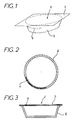
- FIG. 1 represents a container made of plastic material equipped with an anti-theft marking device according to the invention.
- This is a tray 1, for example for a food product, which has an upper opening 2 covered by a cover 3 in the form of a flexible or semi-rigid multilayer metal or plastic film, which is secured to the peripheral edge of the opening 2, so as to hermetically seal the container 1.
- This container is intended to directly contain the food product, that is to say that the tray 1 and the cover 3 are likely to be directly in contact with the food.
- the anti-theft marking device is in the form of a wire element 4 which is integrated into the mass of the material constituting the tray 1.
- the wire element 4 was, during the manufacture of the tray 1, integrated into the mass to be molded before passing into the mold, or else was applied, before molding, on the wall of the mold to the location where you want to integrate it into the tray.
- the wire element 4 constituting the anti-theft marking device is disposed between the layers of the film of the seal 3.
- it was integrated into the multilayer film during the manufacture of this material.
- the container could have the shape of a jar or any other shape adapted to the product that it is intended to contain.
- the packaging could be a packaging consisting of a paper case or a cardboard box.
- the wire element can be embedded in the sheet of paper or cardboard during their manufacture. If it is a paper or a multilayer cardboard, the wire element can be placed inside between the layers, before they are joined together.
Landscapes
- Physics & Mathematics (AREA)
- Automation & Control Theory (AREA)
- Computer Security & Cryptography (AREA)
- Electromagnetism (AREA)
- General Physics & Mathematics (AREA)
- Engineering & Computer Science (AREA)
- Burglar Alarm Systems (AREA)
- Details Of Rigid Or Semi-Rigid Containers (AREA)
- Packages (AREA)
- Wrappers (AREA)
- Manufacture Of Switches (AREA)
- Auxiliary Devices For And Details Of Packaging Control (AREA)
- General Preparation And Processing Of Foods (AREA)
- Cash Registers Or Receiving Machines (AREA)
Abstract
Description
- L'invention concerne un conditionnement pour un produit tel qu'un produit alimentaire, équipé d'un dispositif de marquage antivol, un produit contenu dans un tel conditionnement, ainsi qu'un procédé de marquage antivol d'un produit.
- Afin de lutter contre le vol d'articles, et notamment des produits de petite taille à forte valeur ajoutée, les magasins se sont équipés d'installations de détection aux entrées et sorties du magasin. Ces installations de détection comprennent généralement un émetteur d'un signal radio-électrique de contrôle, ainsi qu'un récepteur. Les articles susceptibles d'être volés sont équipés, préalablement à leur mise en vente, d'un élément récepteur/émetteur, généralement sous la forme d'un élément filaire linéaire ou en boucle. Lors du passage d'un article à proximité de l'installation de détection, le signal de contrôle est reçu par l'élément récepteur/émetteur. Ce dernier émet alors en retour un signal de détection qui est perçu par le récepteur de l'installation de détection. La détection du passage d'un article marqué se manifeste habituellement par une sonnerie destinée à alerter le personnel de surveillance du magasin.
- Jusqu'à présent, on a cherché à équiper d'un dispositif antivol les articles commercialisés en rapportant l'élément récepteur/émetteur sur le conditionnement du produit, c'est-à-dire soit sur l'emballage, soit sur le conteneur lui-même du produit.
Ainsi, l'élément récepteur/émetteur peut se présenter sous la forme d'un boîtier de taille réduite qui est fixé sur le produit par une pince ou par tout autre moyen.
Le dispositif antivol est alors parfaitement visible pour le voleur éventuel, qui peut l'arracher, éventuellement même en détériorant le produit. En outre, le boîtier confère une esthétique souvent disgracieuse à l'article présenté à la vente.
En variante, l'élément récepteur/émetteur peut être disposé en sous-face d'une étiquette autocollante qui est apposée sur le produit. L'étiquette comporte par exemple un code-barre ou une autre mention. Le dispositif antivol est ainsi dissimulé sous l'étiquette. Mais une fois sa fonction véritable connue, l'étiquette peut trop facilement être arrachée ou décollée.
Un exemple d'une telle réalisation est décrit dans le document EP-A-0 635 811.
On a également cherché à dissimuler le dispositif antivol par exemple dans un repli du conteneur ou à l'intérieur de l'emballage. L'élément filaire constituant le dispositif antivol est alors généralement entouré par une enveloppe ou une gaine de plastique éventuellement auto-collante, qui le protège et facilite les manipulations, notamment le découpage et la mise en place. Cependant, une fois l'emplacement du dispositif antivol connu, ce dernier peut facilement être arraché ou décollé, l'emballage ayant été préalablement ouvert.
Un exemple d'une telle réalisation est décrit dans le document FR-A-2 688 483.
Par ailleurs, dans d'autres réalisations, on a pensé de rapporter l'élément de détection sur le produit en le dissimulant dans l'emballage au cours du montage de ce dernier, par exemple sous les pattes de fixation d'un emballage en carton.
Selon une variante, l'élément de détection est rapporté sur le conditionnement du produit avant ou au cours du conditionnement, donc dès le stade de la fabrication du produit et en amont de la commercialisation. Le dispositif antivol n'est pas visible de l'extérieur.
Cependant, on peut parvenir en démontant l'emballage à découvrir l'emplacement de l'élément de détection. En arrachant ou en détruisant l'emballage, le voleur parvient alors encore à éliminer l'élément de détection. - Un but de l'invention est de remédier aux inconvénients de l'art antérieur en proposant un conditionnement pour un produit, notamment un emballage ou un conteneur, équipé d'un dispositif de marquage antivol, dans lequel ce dispositif de marquage antivol ne puisse pas être écarté, arraché ou éliminé, même lorsque le voleur a déterminé son emplacement probable ou certain.
Un autre but de l'invention est de proposer un procédé de marquage d'un conditionnement permettant d'obtenir ce résultat. Un but supplémentaire de l'invention est de fournir des emballages équipés d'un dispositif de marquage antivol qui soient de fabrication simple et peu coûteuse. - A cet effet, le conditionnement pour un produit tel qu'un produit alimentaire, équipé d'un dispositif de marquage antivol, est caractérisé, selon l'invention, par le fait que le dispositif de marquage antivol est intégré dans la structure du matériau du conditionnement au cours de la fabrication de ce matériau.
Le dispositif antivol peut par exemple se présenter sous la forme d'un élément filaire.
Il est de préférence intégré dans le conditionnement premier du produit, c'est-à-dire celui qui est directement en contact avec le produit, ou qui est solidaire du produit.
Le matériau du conditionnement dans lequel le dipositif de marquage antivol est intégré peut être par exemple une masse moulée, ou un film multicouche, etc.
L'invention concerne également un produit contenu dans un conditionnement équipé d'un dispositif de marquage antivol selon l'invention, ainsi qu'un procédé de marquage antivol d'un produit contenu dans un conditionnement dans lequel on intègre un dispositif de marquage antivol dans la structure du matériau du conditionnement du produit au cours de la fabrication de ce matériau. - Cette invention trouve son application dans le conditionnement et la commercialisation de tous genres de produits, notamment ceux mis en vente dans des magasins dits "self-service". L'invention s'applique bien entendu plus particulièrement aux produits à forte valeur ajoutée, qui sont déjà actuellement soumis en général à un marquage antivol. Mais la simplicité et le coût réduit de l'invention permettent une application élargie à d'autres produits et/ou d'autres situations.
L'invention s'applique bien entendu également à la fabrication de matériaux de conditionnement de produits.
L'invention permet d'obtenir des produits équipés d'un dispositif antivol totalement dissimulé.
Le dispositif antivol peut ainsi être plus grand, mieux positionné, et donc plus efficace en réception/émission en relation avec les installations de détection existantes.
L'esthétique des produits n'est plus détériorée, le dispositif antivol intégré étant totalement invisible sans l'intervention de caches, étiquette, protection, d'aucune sorte.
Même lorsque son emplacement est connu, le dispositif antivol ne peut être enlevé sans détruire le conditionnement premier du produit dans sa totalité, le rendant ainsi intransportable ou sans intérêt.
L'intégration du dispositif antivol dans le conditionnement dès la fabrication permet de décharger le réseau commercial du travail de marquage des articles mis en vente, ainsi que les fabricants, qui conditionnent leurs produits à partir de conteneurs ou d'emballages déjà équipés.
L'opération de marquage antivol est considérablement simplifiée, puisque le dispositif antivol peut être par exemple constitué par un élément filaire seul, linéaire ou en boucle, mais sans enveloppe, support ni boîtier de protection ou de dissimulation. Les opérations de découpe et de mise en place de l'élément filaire par intégration dans le matériau de conditionnement au cours de la fabrication de ce matériau peuvent être entièrement automatisées et systématisées.
L'invention permet ainsi avantageusement de réduire les coûts liés à l'organisation de la lutte contre le vol des produits au niveau tant de la fabrication que de la distribution, en ce qui concerne les opérations de marquage antivol. - On comprendra mieux l'invention à la lecture de la description suivante de quelques exemples de réalisation effectuée en référence aux dessins accompagnants parmi lesquels :
- . la figure 1 est une vue en perspective d'un récipient ouvert à opercule, équipé d'un dispositif de marquage antivol selon l'invention ;
- . la figure 2 est une vue en plan et en coupe du récipient de la figure 1 ;
- . la figure 3 est une vue en coupe transversale du récipient à opercule, dans une variante de réalisation de l'invention.
- La figure 1 représente un récipient en matériau plastique équipé d'un dispositif de marquage antivol selon l'invention. Il s'agit ici d'une barquette 1, par exemple pour un produit alimentaire, qui comporte une ouverture supérieure 2 recouverte par un opercule 3 sous la forme d'un film métallique ou plastique multicouche souple ou semi-rigide, qui est solidarisé sur la bordure périphérique de l'ouverture 2, de façon à fermer hermétiquement le récipient 1.
Ce récipient est destiné à contenir directement le produit alimentaire, c'est-à-dire que la barquette 1 et l'opercule 3 sont susceptibles d'être directement en contact avec l'aliment.
Comme cela est visible notamment sur la figure 2, le dispositif de marquage antivol se présente sous la forme d'un élément filaire 4 qui est intégré dans la masse du matériau constituant la barquette 1.
A cet effet, l'élément filaire 4 a été, au cours de la fabrication de la barquette 1, intégré à la masse à mouler avant le passage en moule, ou bien a été appliqué, avant le moulage, sur la paroi du moule à l'emplacement où l'on souhaite l'intégrer dans la barquette.
Selon une variante de réalisation représentée sur la figure 3, l'élément filaire 4 constituant le dispositif de marquage antivol est disposé entre les couches du film de l'opercule 3.
A cet effet, il a été intégré au film multicouche lors de la fabrication de ce matériau.
Cette variante permet de réaliser le marquage antivol selon l'invention pour un coût réduit.
Bien entendu, au lieu d'une barquette, le récipient pourrait présenter la forme d'un bocal ou toute autre forme adaptée au produit qu'il est destiné à contenir.
Egalement, le conditionnement pourrait être un emballage consistant en un étui en papier ou une boîte en carton. Dans ce cas, on peut noyer l'élément filaire dans la feuille de papier ou de carton au cours de leur fabrication. S'il s'agit d'un papier ou d'un carton multicouche, on peut disposer l'élément filaire à l'intérieur entre les couches, avant solidarisation de ces dernières.
Claims (6)
- Conditionnement pour un produit tel qu'un produit alimentaire, équipé d'un dispositif de marquage antivol, caractérisé par le fait que le dispositif de marquage antivol est intégré dans la structure du matériau du conditionnement au cours de la fabrication de ce matériau.
- Conditionnement selon la revendication 1, caractérisé par le fait que le dispositif antivol se présente sous la forme d'un élément filaire.
- Conditionnement selon l'une des revendications 1 ou 2, caractérisé par le fait qu'il est le conditionnement premier du produit, c'est-à-dire, celui qui est directement en contact avec le produit, ou qui est solidaire du produit.
- Conditionnement selon l'une des revendications 1 à 3, caractérisé par le fait que le matériau dans lequel le dispositif de marquage antivol est intégré est une masse moulée.
- Conditionnement selon l'une des revendications 1 à 3, caractérisé par le fait que le matériau dans lequel le dispositif de marquage est intégré est un film multicouches.
- Procédé de marquage antivol d'un produit contenu dans un conditionnement, caractérisé par le fait que l'on intègre un dispositif de marquage antivol dans la structure du matériau du conditionnement du produit au cours de la fabrication de ce matériau.
Applications Claiming Priority (2)
| Application Number | Priority Date | Filing Date | Title |
|---|---|---|---|
| FR9509962A FR2737798B1 (fr) | 1995-08-11 | 1995-08-11 | Conditionnement pour produit a dispositif antivol integre, produit contenu dans un tel conditionnement et procede de marquage antivol integre d'un produit |
| FR9509962 | 1995-08-11 |
Publications (3)
| Publication Number | Publication Date |
|---|---|
| EP0762357A2 true EP0762357A2 (fr) | 1997-03-12 |
| EP0762357A3 EP0762357A3 (fr) | 1997-03-19 |
| EP0762357B1 EP0762357B1 (fr) | 2001-10-24 |
Family
ID=9482018
Family Applications (1)
| Application Number | Title | Priority Date | Filing Date |
|---|---|---|---|
| EP96480093A Expired - Lifetime EP0762357B1 (fr) | 1995-08-11 | 1996-08-06 | Procédé et dispositif de marquage d'un produit à élément antivol intégré |
Country Status (8)
| Country | Link |
|---|---|
| US (1) | US6153287A (fr) |
| EP (1) | EP0762357B1 (fr) |
| JP (1) | JPH09127876A (fr) |
| AT (1) | ATE207644T1 (fr) |
| DE (1) | DE69616219D1 (fr) |
| ES (1) | ES2165483T3 (fr) |
| FR (1) | FR2737798B1 (fr) |
| PT (1) | PT762357E (fr) |
Cited By (3)
| Publication number | Priority date | Publication date | Assignee | Title |
|---|---|---|---|---|
| FR2763042A1 (fr) * | 1997-05-07 | 1998-11-13 | Saplest Productions Sa | Contenant avec protection contre le vol |
| EP0893562A1 (fr) * | 1997-07-24 | 1999-01-27 | Stefil | Dispositif de protection d'objets contre le vol |
| NL1011331C2 (nl) * | 1999-02-18 | 2000-08-22 | Montan Nederland B V | Opberginrichting met beveiligingsmiddelen. |
Families Citing this family (10)
| Publication number | Priority date | Publication date | Assignee | Title |
|---|---|---|---|---|
| FR2762120B1 (fr) * | 1997-04-14 | 1999-07-02 | Gault Et Fremont | Feuille d'emballage integrant un moyen de detection magnetique |
| DE10253567A1 (de) | 2002-11-15 | 2004-05-27 | Linpac Plastics Gmbh | Lagerungsmittel, insbesondere Schale |
| US7528727B2 (en) * | 2005-08-04 | 2009-05-05 | Sonoco Development, Inc. | Tracking device for polymeric packaging |
| USD734149S1 (en) | 2011-09-22 | 2015-07-14 | PBM Nutritionals, LLC | Canister cover |
| USD676739S1 (en) | 2012-04-10 | 2013-02-26 | PBM Nutritionals, LLC | Canister |
| USD675477S1 (en) | 2012-04-10 | 2013-02-05 | PBM Nutritionals, LLC | Canister cover |
| US10139305B2 (en) | 2013-01-24 | 2018-11-27 | PBM Nutritionals, LLC | Apparatus and method for making canister and for detecting leaks for quality assurance |
| US10677886B2 (en) | 2015-01-05 | 2020-06-09 | Locatorx, Inc. | Mini blockchain in a chip device and methods of utilization |
| EP3243190B1 (fr) * | 2015-01-05 | 2020-11-18 | LocatorX, Inc. | Localisateur de ressource global |
| US12272200B2 (en) | 2015-01-05 | 2025-04-08 | Locatorx, Inc. | Solid-state miniature atomic clock and methods of use |
Family Cites Families (6)
| Publication number | Priority date | Publication date | Assignee | Title |
|---|---|---|---|---|
| US4024976A (en) * | 1975-10-30 | 1977-05-24 | Anchor Hocking Corporation | Tamperproof molded package |
| GB2210235A (en) * | 1987-09-24 | 1989-06-01 | Sensormatic Electronics Corp | An article with embedded marker |
| US5081446A (en) * | 1990-09-24 | 1992-01-14 | Checkpoint Systems, Inc. | Security tag for compact disc storage container |
| FR2668483A1 (fr) * | 1990-10-26 | 1992-04-30 | Rhone Poulenc Chimie | Procede de preparation d'aldehydes a partir d'alcools secondaires alpha-trihalogenes. |
| FR2688483A1 (fr) * | 1992-03-16 | 1993-09-17 | Selection Disc Organisation | Etui antivol pour un article contenu dans un boitier plat. |
| DE4242992B4 (de) * | 1992-12-18 | 2004-01-29 | Meto International Gmbh | Anordnung zur Sicherung eines Artikels, insbesondere einer Aufzeichnungsplatte wie eine CD-Platte |
-
1995
- 1995-08-11 FR FR9509962A patent/FR2737798B1/fr not_active Expired - Lifetime
-
1996
- 1996-08-06 EP EP96480093A patent/EP0762357B1/fr not_active Expired - Lifetime
- 1996-08-06 DE DE69616219T patent/DE69616219D1/de not_active Expired - Lifetime
- 1996-08-06 ES ES96480093T patent/ES2165483T3/es not_active Expired - Lifetime
- 1996-08-06 AT AT96480093T patent/ATE207644T1/de not_active IP Right Cessation
- 1996-08-06 PT PT96480093T patent/PT762357E/pt unknown
- 1996-08-09 JP JP8226125A patent/JPH09127876A/ja active Pending
- 1996-08-09 US US08/693,785 patent/US6153287A/en not_active Expired - Lifetime
Cited By (6)
| Publication number | Priority date | Publication date | Assignee | Title |
|---|---|---|---|---|
| FR2763042A1 (fr) * | 1997-05-07 | 1998-11-13 | Saplest Productions Sa | Contenant avec protection contre le vol |
| EP0893562A1 (fr) * | 1997-07-24 | 1999-01-27 | Stefil | Dispositif de protection d'objets contre le vol |
| FR2766581A1 (fr) * | 1997-07-24 | 1999-01-29 | Stefil | Dispositif de protection d'objets contre le vol |
| NL1011331C2 (nl) * | 1999-02-18 | 2000-08-22 | Montan Nederland B V | Opberginrichting met beveiligingsmiddelen. |
| WO2000049619A1 (fr) * | 1999-02-18 | 2000-08-24 | Fountain Technologies B.V. | Dispositif de stockage pourvu d'organes de protection |
| US7458460B2 (en) | 1999-02-18 | 2008-12-02 | Montan Nederland B.V. | Storage device having protective means |
Also Published As
| Publication number | Publication date |
|---|---|
| ATE207644T1 (de) | 2001-11-15 |
| JPH09127876A (ja) | 1997-05-16 |
| ES2165483T3 (es) | 2002-03-16 |
| PT762357E (pt) | 2002-04-29 |
| US6153287A (en) | 2000-11-28 |
| EP0762357A3 (fr) | 1997-03-19 |
| DE69616219D1 (de) | 2001-11-29 |
| FR2737798B1 (fr) | 1997-10-24 |
| FR2737798A1 (fr) | 1997-02-14 |
| EP0762357B1 (fr) | 2001-10-24 |
Similar Documents
| Publication | Publication Date | Title |
|---|---|---|
| EP0762357B1 (fr) | Procédé et dispositif de marquage d'un produit à élément antivol intégré | |
| FR2754375A1 (fr) | Enveloppe de securite pour objets, notamment pour des recipients a dispositif de fermeture, du type constitue par un manchon en matiere plastique thermoretractable equipe d'un element holographique | |
| US8069983B2 (en) | Package for a saw blade | |
| EP0619243A1 (fr) | Dispositif antivol pour récipients munis d'un moyen de bouchage ou de surbouchage | |
| FR2746077A3 (fr) | Procede de protection d'un emballage et de son contenu contre le vol | |
| EP0698561B1 (fr) | Enveloppe d'emballage d'objet réalisée à partir d'un manchon en matière plastique thermorétractable | |
| FR2690138A3 (fr) | Dispositif de fixation d'un article-cadeau sur le col d'une bouteille. | |
| FR2688483A1 (fr) | Etui antivol pour un article contenu dans un boitier plat. | |
| FR2740109A1 (fr) | Couvercle ou manchon, pour bouteille ou recipient, muni d'un marqueur integre pour la surveillance electronique, et leurs procedes de fabrication | |
| FR2723915A1 (fr) | Bande d'arrachage pour emballage d'objet | |
| EP0289551B1 (fr) | Procede de protection d'objects contre le vol et objets proteges selon ce procede | |
| WO1998015469A1 (fr) | Procede de marquage d'objets par transfert a partir d'un manchon en matiere plastique thermoretractable qui est retracte sur l'objet, et manchon destine a la mise en oeuvre dudit procede | |
| FR2628250A1 (fr) | Boitier de cassette video | |
| EP2976272B1 (fr) | Enveloppe de securite apte a assurer une protection anti-ouverture de recipients, objet recouvert d'une telle enveloppe et procede d'inscription d'informations sur une telle enveloppe | |
| FR2688477A3 (fr) | Dispositif de fixation irreversible d'un accessoire sur le col d'une bouteille. | |
| FR2600431A1 (fr) | Dispositif antivol pour des lunettes, notamment a destination des magasins a grande surface | |
| FR2682935A1 (fr) | Temoin d'effraction pour barquettes de conditionnement, barquettes renfermant un tel temoin et applications. | |
| FR2737884A1 (fr) | Emballage en matiere plastique pourvu d'une etiquette et d'au moins un composant prevu pour signaler son vol | |
| FR2608030A1 (fr) | Dispositif de presentation d'articles | |
| FR2787090A1 (fr) | Contenant etanche pour au moins un preservatif | |
| EP2489818B1 (fr) | Dispositif antivol avec pince à sécurité améliorée | |
| EP0401127B1 (fr) | Conditionnement pour casque de protection | |
| EP0311725A1 (fr) | Dispositif antivol pour des lunettes, notamment pour la vente dans des magasins à grande surface | |
| FR2689378A3 (fr) | Récipient formant emballage. | |
| FR2731982A1 (fr) | Emballage avec dispositif de distribution des produits qui y sont contenus |
Legal Events
| Date | Code | Title | Description |
|---|---|---|---|
| PUAI | Public reference made under article 153(3) epc to a published international application that has entered the european phase |
Free format text: ORIGINAL CODE: 0009012 |
|
| PUAL | Search report despatched |
Free format text: ORIGINAL CODE: 0009013 |
|
| AK | Designated contracting states |
Kind code of ref document: A2 Designated state(s): AT BE CH DE DK ES FI FR GB GR IE IT LI LU MC NL PT SE |
|
| AK | Designated contracting states |
Kind code of ref document: A3 Designated state(s): AT BE CH DE DK ES FI FR GB GR IE IT LI LU MC NL PT SE |
|
| RIN1 | Information on inventor provided before grant (corrected) |
Inventor name: GASNIER, YVES, M. |
|
| 17P | Request for examination filed |
Effective date: 19970802 |
|
| 17Q | First examination report despatched |
Effective date: 19971013 |
|
| GRAG | Despatch of communication of intention to grant |
Free format text: ORIGINAL CODE: EPIDOS AGRA |
|
| GRAG | Despatch of communication of intention to grant |
Free format text: ORIGINAL CODE: EPIDOS AGRA |
|
| GRAH | Despatch of communication of intention to grant a patent |
Free format text: ORIGINAL CODE: EPIDOS IGRA |
|
| GRAH | Despatch of communication of intention to grant a patent |
Free format text: ORIGINAL CODE: EPIDOS IGRA |
|
| GRAA | (expected) grant |
Free format text: ORIGINAL CODE: 0009210 |
|
| AK | Designated contracting states |
Kind code of ref document: B1 Designated state(s): AT BE CH DE DK ES FI FR GB GR IE IT LI LU MC NL PT SE |
|
| PG25 | Lapsed in a contracting state [announced via postgrant information from national office to epo] |
Ref country code: NL Free format text: LAPSE BECAUSE OF FAILURE TO SUBMIT A TRANSLATION OF THE DESCRIPTION OR TO PAY THE FEE WITHIN THE PRESCRIBED TIME-LIMIT Effective date: 20011024 Ref country code: IE Free format text: LAPSE BECAUSE OF FAILURE TO SUBMIT A TRANSLATION OF THE DESCRIPTION OR TO PAY THE FEE WITHIN THE PRESCRIBED TIME-LIMIT Effective date: 20011024 Ref country code: GB Free format text: LAPSE BECAUSE OF FAILURE TO SUBMIT A TRANSLATION OF THE DESCRIPTION OR TO PAY THE FEE WITHIN THE PRESCRIBED TIME-LIMIT Effective date: 20011024 Ref country code: FI Free format text: LAPSE BECAUSE OF FAILURE TO SUBMIT A TRANSLATION OF THE DESCRIPTION OR TO PAY THE FEE WITHIN THE PRESCRIBED TIME-LIMIT Effective date: 20011024 Ref country code: AT Free format text: LAPSE BECAUSE OF FAILURE TO SUBMIT A TRANSLATION OF THE DESCRIPTION OR TO PAY THE FEE WITHIN THE PRESCRIBED TIME-LIMIT Effective date: 20011024 |
|
| REF | Corresponds to: |
Ref document number: 207644 Country of ref document: AT Date of ref document: 20011115 Kind code of ref document: T |
|
| REG | Reference to a national code |
Ref country code: CH Ref legal event code: EP |
|
| REG | Reference to a national code |
Ref country code: IE Ref legal event code: FG4D Free format text: FRENCH |
|
| REF | Corresponds to: |
Ref document number: 69616219 Country of ref document: DE Date of ref document: 20011129 |
|
| REG | Reference to a national code |
Ref country code: CH Ref legal event code: NV Representative=s name: PATENTANWAELTE BREITER + WIEDMER AG |
|
| PG25 | Lapsed in a contracting state [announced via postgrant information from national office to epo] |
Ref country code: SE Free format text: LAPSE BECAUSE OF FAILURE TO SUBMIT A TRANSLATION OF THE DESCRIPTION OR TO PAY THE FEE WITHIN THE PRESCRIBED TIME-LIMIT Effective date: 20020124 Ref country code: DK Free format text: LAPSE BECAUSE OF FAILURE TO SUBMIT A TRANSLATION OF THE DESCRIPTION OR TO PAY THE FEE WITHIN THE PRESCRIBED TIME-LIMIT Effective date: 20020124 |
|
| PG25 | Lapsed in a contracting state [announced via postgrant information from national office to epo] |
Ref country code: GR Free format text: LAPSE BECAUSE OF FAILURE TO SUBMIT A TRANSLATION OF THE DESCRIPTION OR TO PAY THE FEE WITHIN THE PRESCRIBED TIME-LIMIT Effective date: 20020125 Ref country code: DE Free format text: LAPSE BECAUSE OF FAILURE TO SUBMIT A TRANSLATION OF THE DESCRIPTION OR TO PAY THE FEE WITHIN THE PRESCRIBED TIME-LIMIT Effective date: 20020125 |
|
| REG | Reference to a national code |
Ref country code: ES Ref legal event code: FG2A Ref document number: 2165483 Country of ref document: ES Kind code of ref document: T3 |
|
| NLV1 | Nl: lapsed or annulled due to failure to fulfill the requirements of art. 29p and 29m of the patents act | ||
| GBV | Gb: ep patent (uk) treated as always having been void in accordance with gb section 77(7)/1977 [no translation filed] |
Effective date: 20011024 |
|
| REG | Reference to a national code |
Ref country code: PT Ref legal event code: SC4A Free format text: AVAILABILITY OF NATIONAL TRANSLATION Effective date: 20020118 |
|
| REG | Reference to a national code |
Ref country code: FR Ref legal event code: CL |
|
| REG | Reference to a national code |
Ref country code: IE Ref legal event code: FD4D |
|
| PLBE | No opposition filed within time limit |
Free format text: ORIGINAL CODE: 0009261 |
|
| STAA | Information on the status of an ep patent application or granted ep patent |
Free format text: STATUS: NO OPPOSITION FILED WITHIN TIME LIMIT |
|
| 26N | No opposition filed | ||
| PG25 | Lapsed in a contracting state [announced via postgrant information from national office to epo] |
Ref country code: MC Free format text: LAPSE BECAUSE OF NON-PAYMENT OF DUE FEES Effective date: 20030301 |
|
| REG | Reference to a national code |
Ref country code: CH Ref legal event code: PFA Owner name: LABEYRIE S.A. Free format text: LABEYRIE S.A.#R.N. 10, ST GEOURS DE MAREMNE#40235 ST VINCENT DE TYROSSE CEDEX (FR) -TRANSFER TO- LABEYRIE S.A.#R.N. 10, ST GEOURS DE MAREMNE#40235 ST VINCENT DE TYROSSE CEDEX (FR) |
|
| REG | Reference to a national code |
Ref country code: CH Ref legal event code: PCAR Free format text: NEW ADDRESS: EIGERSTRASSE 2 POSTFACH, 3000 BERN 14 (CH) |
|
| REG | Reference to a national code |
Ref country code: FR Ref legal event code: PLFP Year of fee payment: 20 |
|
| PGFP | Annual fee paid to national office [announced via postgrant information from national office to epo] |
Ref country code: LU Payment date: 20150813 Year of fee payment: 20 |
|
| PGFP | Annual fee paid to national office [announced via postgrant information from national office to epo] |
Ref country code: CH Payment date: 20150716 Year of fee payment: 20 Ref country code: PT Payment date: 20150713 Year of fee payment: 20 Ref country code: ES Payment date: 20150720 Year of fee payment: 20 |
|
| PGFP | Annual fee paid to national office [announced via postgrant information from national office to epo] |
Ref country code: FR Payment date: 20150709 Year of fee payment: 20 Ref country code: BE Payment date: 20150728 Year of fee payment: 20 |
|
| PGFP | Annual fee paid to national office [announced via postgrant information from national office to epo] |
Ref country code: IT Payment date: 20150810 Year of fee payment: 20 |
|
| REG | Reference to a national code |
Ref country code: CH Ref legal event code: PL |
|
| REG | Reference to a national code |
Ref country code: ES Ref legal event code: FD2A Effective date: 20161125 |
|
| PG25 | Lapsed in a contracting state [announced via postgrant information from national office to epo] |
Ref country code: PT Free format text: LAPSE BECAUSE OF EXPIRATION OF PROTECTION Effective date: 20160817 |
|
| PG25 | Lapsed in a contracting state [announced via postgrant information from national office to epo] |
Ref country code: ES Free format text: LAPSE BECAUSE OF EXPIRATION OF PROTECTION Effective date: 20160807 |