EP0763006B1 - Recuperation de l'acide carboxylique contenu dans une solution organique qui renferme une amine et un activateur d'extraction - Google Patents
Recuperation de l'acide carboxylique contenu dans une solution organique qui renferme une amine et un activateur d'extraction Download PDFInfo
- Publication number
- EP0763006B1 EP0763006B1 EP95920058A EP95920058A EP0763006B1 EP 0763006 B1 EP0763006 B1 EP 0763006B1 EP 95920058 A EP95920058 A EP 95920058A EP 95920058 A EP95920058 A EP 95920058A EP 0763006 B1 EP0763006 B1 EP 0763006B1
- Authority
- EP
- European Patent Office
- Prior art keywords
- enhancer
- solution
- carboxylic acid
- extractant
- aqueous
- Prior art date
- Legal status (The legal status is an assumption and is not a legal conclusion. Google has not performed a legal analysis and makes no representation as to the accuracy of the status listed.)
- Expired - Lifetime
Links
- 239000003623 enhancer Substances 0.000 title claims abstract description 129
- 238000000605 extraction Methods 0.000 title claims abstract description 75
- 150000001412 amines Chemical class 0.000 title claims abstract description 19
- 238000011084 recovery Methods 0.000 title claims abstract description 17
- 150000001732 carboxylic acid derivatives Chemical class 0.000 title claims description 85
- 238000000855 fermentation Methods 0.000 claims abstract description 23
- 230000004151 fermentation Effects 0.000 claims abstract description 23
- 238000000034 method Methods 0.000 claims abstract description 22
- CSCPPACGZOOCGX-UHFFFAOYSA-N Acetone Chemical compound CC(C)=O CSCPPACGZOOCGX-UHFFFAOYSA-N 0.000 claims abstract description 20
- 239000008346 aqueous phase Substances 0.000 claims abstract description 19
- 150000002894 organic compounds Chemical class 0.000 claims abstract description 9
- 239000002253 acid Substances 0.000 claims abstract description 7
- 239000000243 solution Substances 0.000 claims description 86
- XLYOFNOQVPJJNP-UHFFFAOYSA-N water Substances O XLYOFNOQVPJJNP-UHFFFAOYSA-N 0.000 claims description 45
- 230000002378 acidificating effect Effects 0.000 claims description 15
- 238000004821 distillation Methods 0.000 claims description 15
- 239000007864 aqueous solution Substances 0.000 claims description 12
- LFQSCWFLJHTTHZ-UHFFFAOYSA-N Ethanol Chemical compound CCO LFQSCWFLJHTTHZ-UHFFFAOYSA-N 0.000 claims description 8
- 150000001242 acetic acid derivatives Chemical class 0.000 claims description 6
- 238000009835 boiling Methods 0.000 claims description 5
- LRHPLDYGYMQRHN-UHFFFAOYSA-N N-Butanol Chemical compound CCCCO LRHPLDYGYMQRHN-UHFFFAOYSA-N 0.000 claims description 4
- JMMWKPVZQRWMSS-UHFFFAOYSA-N isopropanol acetate Natural products CC(C)OC(C)=O JMMWKPVZQRWMSS-UHFFFAOYSA-N 0.000 claims description 2
- 229940011051 isopropyl acetate Drugs 0.000 claims description 2
- GWYFCOCPABKNJV-UHFFFAOYSA-N isovaleric acid Chemical compound CC(C)CC(O)=O GWYFCOCPABKNJV-UHFFFAOYSA-N 0.000 claims description 2
- 150000001735 carboxylic acids Chemical class 0.000 abstract description 4
- QTBSBXVTEAMEQO-UHFFFAOYSA-M Acetate Chemical compound CC([O-])=O QTBSBXVTEAMEQO-UHFFFAOYSA-M 0.000 abstract 1
- 235000010633 broth Nutrition 0.000 description 31
- KRKNYBCHXYNGOX-UHFFFAOYSA-N citric acid Chemical compound OC(=O)CC(O)(C(O)=O)CC(O)=O KRKNYBCHXYNGOX-UHFFFAOYSA-N 0.000 description 9
- 238000013459 approach Methods 0.000 description 6
- 239000000284 extract Substances 0.000 description 5
- KBPLFHHGFOOTCA-UHFFFAOYSA-N caprylic alcohol Natural products CCCCCCCCO KBPLFHHGFOOTCA-UHFFFAOYSA-N 0.000 description 4
- -1 cycloaliphatic Chemical group 0.000 description 4
- 238000004519 manufacturing process Methods 0.000 description 4
- 239000012071 phase Substances 0.000 description 4
- QTBSBXVTEAMEQO-UHFFFAOYSA-N Acetic acid Chemical compound CC(O)=O QTBSBXVTEAMEQO-UHFFFAOYSA-N 0.000 description 3
- 239000007788 liquid Substances 0.000 description 3
- 239000012074 organic phase Substances 0.000 description 3
- ZWEHNKRNPOVVGH-UHFFFAOYSA-N 2-Butanone Chemical compound CCC(C)=O ZWEHNKRNPOVVGH-UHFFFAOYSA-N 0.000 description 2
- RTZKZFJDLAIYFH-UHFFFAOYSA-N Diethyl ether Chemical compound CCOCC RTZKZFJDLAIYFH-UHFFFAOYSA-N 0.000 description 2
- 230000002411 adverse Effects 0.000 description 2
- 150000001875 compounds Chemical class 0.000 description 2
- 238000010586 diagram Methods 0.000 description 2
- 239000003085 diluting agent Substances 0.000 description 2
- 239000000203 mixture Substances 0.000 description 2
- 238000012546 transfer Methods 0.000 description 2
- DURPTKYDGMDSBL-UHFFFAOYSA-N 1-butoxybutane Chemical compound CCCCOCCCC DURPTKYDGMDSBL-UHFFFAOYSA-N 0.000 description 1
- DKPFZGUDAPQIHT-UHFFFAOYSA-N Butyl acetate Natural products CCCCOC(C)=O DKPFZGUDAPQIHT-UHFFFAOYSA-N 0.000 description 1
- 239000004215 Carbon black (E152) Substances 0.000 description 1
- 150000007513 acids Chemical class 0.000 description 1
- 125000001931 aliphatic group Chemical group 0.000 description 1
- 150000003973 alkyl amines Chemical class 0.000 description 1
- 150000001413 amino acids Chemical class 0.000 description 1
- 125000003118 aryl group Chemical group 0.000 description 1
- 230000001588 bifunctional effect Effects 0.000 description 1
- 229940043232 butyl acetate Drugs 0.000 description 1
- 125000004432 carbon atom Chemical group C* 0.000 description 1
- 239000000470 constituent Substances 0.000 description 1
- 238000002425 crystallisation Methods 0.000 description 1
- 230000008025 crystallization Effects 0.000 description 1
- 238000000354 decomposition reaction Methods 0.000 description 1
- 230000000694 effects Effects 0.000 description 1
- 150000002148 esters Chemical class 0.000 description 1
- 125000000623 heterocyclic group Chemical group 0.000 description 1
- FUZZWVXGSFPDMH-UHFFFAOYSA-N hexanoic acid Chemical compound CCCCCC(O)=O FUZZWVXGSFPDMH-UHFFFAOYSA-N 0.000 description 1
- 229930195733 hydrocarbon Natural products 0.000 description 1
- 150000002430 hydrocarbons Chemical class 0.000 description 1
- 230000007062 hydrolysis Effects 0.000 description 1
- 238000006460 hydrolysis reaction Methods 0.000 description 1
- CBOIHMRHGLHBPB-UHFFFAOYSA-N hydroxymethyl Chemical compound O[CH2] CBOIHMRHGLHBPB-UHFFFAOYSA-N 0.000 description 1
- 238000010348 incorporation Methods 0.000 description 1
- 230000005764 inhibitory process Effects 0.000 description 1
- 150000002576 ketones Chemical class 0.000 description 1
- 238000012986 modification Methods 0.000 description 1
- 230000004048 modification Effects 0.000 description 1
- 239000003607 modifier Substances 0.000 description 1
- TVMXDCGIABBOFY-UHFFFAOYSA-N n-Octanol Natural products CCCCCCCC TVMXDCGIABBOFY-UHFFFAOYSA-N 0.000 description 1
- 230000007935 neutral effect Effects 0.000 description 1
- 150000007524 organic acids Chemical class 0.000 description 1
- 238000004886 process control Methods 0.000 description 1
- 238000005292 vacuum distillation Methods 0.000 description 1
- 239000002699 waste material Substances 0.000 description 1
Images

Classifications
-
- C—CHEMISTRY; METALLURGY
- C07—ORGANIC CHEMISTRY
- C07C—ACYCLIC OR CARBOCYCLIC COMPOUNDS
- C07C51/00—Preparation of carboxylic acids or their salts, halides or anhydrides
- C07C51/42—Separation; Purification; Stabilisation; Use of additives
- C07C51/48—Separation; Purification; Stabilisation; Use of additives by liquid-liquid treatment
-
- B—PERFORMING OPERATIONS; TRANSPORTING
- B01—PHYSICAL OR CHEMICAL PROCESSES OR APPARATUS IN GENERAL
- B01D—SEPARATION
- B01D11/00—Solvent extraction
- B01D11/04—Solvent extraction of solutions which are liquid
- B01D11/0492—Applications, solvents used
Definitions
- the present invention concerns quite generally the recovery of a carboxylic acid from an amine-based, water-immiscible organic extractant solution thereof obtained by liquid-liquid contact extraction of carboxylic acid from an aqueous starting solution.
- carboxylic acid as used herein is to be understood as meaning any aliphatic, cycloaliphatic, aromatic and heterocyclic mono- and polycarboxylic acid and also includes amino acids.
- the amine-based extractant used for the extraction of the starting solution contains (i) a primary, secondary or tertiary long-chain alkyl amine in which the aggregate number of carbon atoms is at least 20; (ii) a liquid hydrocarbon; and (iii) a polar, non-carboxylic organic compound which during the extraction of the carboxylic acid from the aqueous starting solution serves as extraction enhancer.
- One typical, but not exclusive field of application of the invention is the recovery of a carboxylic acid from an aqueous fermentation broth, comprising in a first stage a liquid-liquid contact extraction of the fermentation broth with an extractant of the kind specified and in a second stage back-extraction of the carboxylic acid from the organic extractant solution into an aqueous phase.
- an amine-containing organic extractant is enhanced by the incorporation of a non-carboxylic, neutral, essentially water insoluble polar organic compound, e.g. an alkanol such as n-octanol, a ketone such as butanone, an ester such as butylacetate, an ether such as dibutylether, a bifunctional compound such as CH 3 .CH 2 .CH 2 .CH 2 OCH2.CH 2 OH etc.
- a non-carboxylic, neutral, essentially water insoluble polar organic compound e.g. an alkanol such as n-octanol, a ketone such as butanone, an ester such as butylacetate, an ether such as dibutylether, a bifunctional compound such as CH 3 .CH 2 .CH 2 .CH 2 OCH2.CH 2 OH etc.
- enhancers Such compounds, generally referred to as enhancers, modifiers or active diluents, increase the base strength of the amine in the extractant and thereby facilitate the transfer of carboxylic acid from the starting aqueous solution such as a fermentation broth, into the organic extractant phase.
- the presence of an enhancer shifts the carboxylic acid equilibrium in an aqueous phase/organic extractant phase system in favor of the organic phase.
- This very shifting of equilibrium creates a problem for the back-extraction in that the transfer of the carboxylic acid from the organic to the aqueous phase is inhibited, and this inhibition may occasionally be so pronounced as to render back-extraction of the organic acid with water impractical even at temperatures close to 100°C.
- back-extraction is carried out above the water boiling temperature so as to increase the degree of hydrolysis of the amine-carboxyl complex and thereby provide for an acceptable rate of back-extraction.
- This approach requires operation at above atmospheric pressure which is inconvenient and costly in terms of equipment and process control.
- the enhancer is removed from the organic phase by distillation prior to back-extraction as described in an extensive study "Extraction of Carboxylic Acids with Amine Extractants", Ind. Eng. Chem. Res. 1990, 29 , 1319-1338 in the context of what is described there as “diluent swing".
- This approach requires that the extractant be so composed that the enhancer boils well below all other constituents and that no decomposition of amine, carboxylic acid or enhancer takes place at the distillation temperature. Even where these requirements can be met, costly, energy-consuming vacuum distillation is as a rule required.
- Enhancers act by virtue of the polar group or groups they contain. Thus, in a series of enhancers of the same polarity, such as normal alkanols for example, the enhancement per unit weight of enhancer increases with the decrease in molecular weight. In spite of this obvious advantage of low molecular weight enhancers they are not used and were never proposed for use. The two most likely reasons for this attach to the fact that low molecular weight enhancers are freely or at least partly water miscible. For one, since the enhancer is part of an extractant that by definition is water immiscible it was natural to avoid the inclusion of a water miscible component. Secondly, enhancer reporting to the aqueous residue of extraction constitutes a loss or impose a cost entailing recovery operation.
- a water soluble or partly water-miscible low molecular enhancer can be used; that the excess of such enhancer required during extraction to compensate for losses due to the distribution of enhancer between the two phases, is quite modest; and that as a result such enhancers can be used efficiently. It has further been found that the use of such enhancers in a process of the kind specified minimizes the recovery impeding effect of the enhancer that remains in the extractant solution, and that the enhancer can be recovered from either of the extractant solution and the aqueous phase by conventional means.
- the invention provides a process of recovering a carboxylic acid from an amine-based, water-immiscible organic extractant solution thereof that contains an enhancer, by extraction of the acid into an aqueous phase to yield an aqueous carboxylic acid output solution, which is characterised in that the enhancer is a low molecular, at least partly water-miscible organic compound being a member selected from the group of C 2 -C 5 alkanols, acetates of C 1 -C 3 alkanols and acetone, and enhancer is recovered and recycled.
- Typical examples of enhancers that can be used in accordance with the invention are ethanol, butanol, acetone and isopropylacetate.
- said organic extractant solution is extracted directly with water and enhancer is recovered from the resulting aqueous carboxylic acid output solution.
- enhancer is water soluble at the temperature of operation.
- the process comprises extraction of the extractant solution with an aqueous solution of said carboxylic acid to obtain an aqueous acidic enhancer solution and an enhancer-depleted extractant solution, extraction of carboxylic acid from said enhancer-depleted extractant solution into an aqueous phase, and recovery of enhancer from said aqueous acidic enhancer solution.
- This embodiment is suitable in particular when the invention is practiced with enhancers that at the temperature of operation are only partly water miscible.
- the aqueous carboxylic acid output solution may be combined with the said aqueous acidic enhancer solution to obtain a mixed aqueous solution, from which the enhancer is regained by distillation.
- the said low molecular, at least partly water miscible enhancer used in accordance with the invention is of a kind that is more volatile than water or that forms with water a low-boiling azeotrope.
- the enhancer can be regained from an aqueous acidic enhancer solution by distillation without adversely affecting the carboxylic acid.
- the invention is applicable to advantage in the production of carboxylic acids by fermentation.
- the invention provides a process for the recovery of a carboxylic acid from a fermentation broth which comprises extraction of the fermentation broth with an amine-based, water-immiscible organic extractant that includes an enhancer to yield an extractant solution of carboxylic acid and a residual broth, and back-extraction of carboxylic acid from the extractant solution into an aqueous phase to yield an aqueous carboxylic acid output solution and an extractant raffinate, characterised in that:
- the said aqueous acidic enhancer solution may be combined with the said carboxylic acid output solution to obtain a mixed aqueous solution from which the said first amount of enhancer is regained.
- a process for the recovery of carboxylic acid from a fermentation broth which comprises extraction of the fermentation broth with an amine-based, water-immiscible organic extractant that includes an enhancer to yield an extractant solution of carboxylic acid and a residual broth, and back-extraction of carboxylic acid from the extractant solution into an aqueous phase to yield an aqueous carboxylic acid output solution and an extractant raffinate, characterised in that:
- the preferred enhancer in the foregoing embodiment is ethanol.
- the enhancer in either of these embodiments is of a kind that is more volatile than water or that forms with water a low-boiling azeotrope. In this way enhancer can be regained from the aqueous acidic enhancer solution by distillation without adversely affecting the carboxylic acid.
- the said extractant raffinate in either of the above two embodiments is recycled for the extraction of enhancer from the said residual broth.
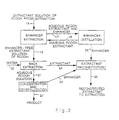
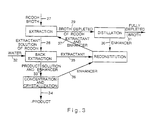
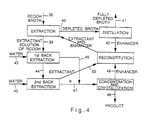
- FIGS. 1, 2, 3 and 4 are block diagrams of four embodiments of the process according to the invention.
- a typical operation for the recovery of a carboxylic acid, for example citric acid, from a fermentation broth is illustrated by way of a block diagram in the annexed drawing.
- a carboxylic acid fermentation broth is charged at 1 into an extractor A where it is extracted with a fully enhanced, amine-based, water immiscible organic extractant containing an excess of an enhancer of at least partial water miscibility so as to compensate for the enhancer that reports to the aqueous phase.
- the resulting extractant solution of carboxylic acid is withdrawn at 2 and charged into an extractor B where it is subjected to extraction with an aqueous carboxylic acid solution for the removal of practically all of the enhancer.
- the remaining, enhancer depleted extractor solution of carboxylic acid is withdrawn at 3 and charged into an extractor C where it is subjected to back-extraction with water introduced at 4.
- the resulting aqueous carboxylic acid solution is withdrawn at 5 and is combined with an aqueous acidic enhancer solution withdrawn from extractor B at 6 to yield a mixed aqueous solution which is fed into a distillation unit F where enhancer is distilled off.
- Part of the residual aqueous carboxylic acid solution is returned at 7 into extractor B, and part is withdrawn at 8 as aqueous carboxylic output solution and charged into a crystallizer G.
- the condensed enhancer that was distilled off in the distillation unit F is introduced at 9 into a mixer unit D where the extractant is reconstituted.
- Extractant raffinate remaining from the back-extraction operation in extractor C is withdrawn at 10 and conducted into an extractor E where it is contacted with residual broth arriving at 11 from the extractor A, whereby extractant that reported to the broth in the course of the extraction operation in extractor A is back-extracted into the extractant.
- the relative proportions of residual broth and extractant raffinate fed into extractor E are so dosed that essentially all of the extractant reports to the organic phase.
- Extractor E Partly reconstituted extractant is withdrawn from extractor E at 12 and charged into a mixer D together with enhancer arriving from distillation unit F at 9, and the so fully reconstituted extractant is withdrawn at 13 and charged into extractor A.
- Product carboxylic acid is withdrawn at 14 and fully depleted broth is withdrawn at 15 as waste.
- distillation of the enhancer in the distillation unit F requires little or even no extra thermal energy beyond that required in any case for concentration and crystallization in crystallizer G.
- the invention provides for the use of soluble enhancers that are highly effective per unit weight, it allows the use of enhancers in proportions that fully maximize extractant strength.
- the enhancement of the acidic extraction from the carboxylic acid fermentation broth fed into extractor A is maximized, which is a significant advantage.
- the resulting aqueous carboxylic acid solution is introduced at 21 into a concentrator and crystallizer unit from where the desired product is withdrawn at 22, and distilled off residual enhancer is withdrawn at 23 and conducted into an extractant reconstitution unit together with enhancer arriving at 25 and concurrently with pure extractant withdrawn at 24 from the back-extraction operation.
- Reconstituted extractant is withdrawn at 26 and recycled to the broth extraction operation.
- back-extraction is assumed to be practiced at a higher temperature than extraction, e.g. in accordance with the teachings in U.S. 4,275,234, and in this case back-extraction is not preceded by separate enhancer extraction.
- an RCOOOH broth is fed at 27 into an extractor unit from which an extractant solution of RCOH is withdrawn at 28 and residual broth depleted of carboxylic acid is withdrawn at 29 into a distillation unit from which enhancer is withdrawn at 30 and depleted broth at 31.
- the extractant carboxylic acid solution withdrawn at 28 is subjected to back-extraction with water arriving at 32.
- the resulting aqueous carboxylic acid product solution that contains enhancer is withdrawn at 33 and residual extractant is withdrawn at 34.
- the carboxylic acid product solution withdrawn at 33 is charged into a concentrator and crystallizer unit from where the product is withdrawn at 34 and distilled off enhancer is withdrawn at 35.
- the enhancer withdrawn at 30 and 36 and the extractant withdrawn at 35 are combined in a reconstitution unit and the reconstituted extract/enhancer mixture is recycled to the extraction operation at 37.
- Fig. 4 The embodiment of Fig. 4 is essentially similar to that of Fig. 3 but here the water back-extraction is conducted in two stages. As shown, fermentation broth arriving at 38 is charged into an extractor where it is subjected to extraction with an enhancer containing extractant. An extractant solution of carboxylic acid is withdrawn at 39 and a depleted broth at 40. The latter is charged into a distillation unit from where a fully depleted broth is withdrawn at 41 and enhancer is withdrawn at 42. The extractant solution of carboxylic acid withdrawn at 39 is charged into a first extractor for the performance of a first back-extraction stage with water arriving at 43.
- Partly depleted carboxylic acid extractant solution is withdrawn at 44 into a second extractor for the performance of a second back extraction stage with water arriving at 45.
- the first aqueous carboxylic acid extract is withdrawn at 46 and the second at 47 and the combined extracts are charged into a concentrator and crystallizer unit from where the product is withdrawn at 48 and additional amounts of distilled enhancer are withdrawn at 49.
- Depleted extractant is withdrawn from the second back-extraction operation at 50 to a reconstitution unit where it is combined with enhancer arriving at 42 and 49, and the reconstituted extractant/enhancer mixture is recycled to the extraction operation.
Landscapes
- Chemical & Material Sciences (AREA)
- Organic Chemistry (AREA)
- Engineering & Computer Science (AREA)
- Oil, Petroleum & Natural Gas (AREA)
- Chemical Kinetics & Catalysis (AREA)
- Organic Low-Molecular-Weight Compounds And Preparation Thereof (AREA)
- Extraction Or Liquid Replacement (AREA)
- Physical Water Treatments (AREA)
- Preparation Of Compounds By Using Micro-Organisms (AREA)
Claims (11)
- Procédé pour récupérer un acide carboxylique d'une solution de ce dernier dans un agent d'extraction organique non miscible à l'eau à base d'amine, qui contient un agent d'activation, par extraction de l'acide en phase aqueuse pour obtenir une solution de sortie aqueuse d'acide carboxylique, caractérisé en ce que l'agent d'activation est un composé organique à bas poids moléculaire au moins partiellement miscible à l'eau, à savoir un membre choisi parmi le groupe comprenant des alcanols en C2-C5, des acétates d'alcanols en C1-C3 et de l'acétone, et on récupère et on recycle l'agent d'activation.
- Procédé selon la revendication 1, dans lequel on extrait ladite solution de l'agent d'extraction organique directement avec de l'eau et on récupère l'agent d'activation de la solution de sortie aqueuse d'acide carboxylique qui en résulte.
- Procédé selon la revendication 1, comprenant l'extraction de la solution de l'agent d'extraction avec une solution aqueuse dudit acide carboxylique pour obtenir une solution aqueuse-acide de l'agent d'activation et une solution d'agent d'extraction appauvrie en agent d'activation, l'extraction de l'acide carboxylique de ladite solution d'agent d'extraction appauvrie en agent d'activation, en phase aqueuse et la récupération de l'agent d'activation de ladite solution aqueuse-acide de l'agent d'activation.
- Procédé selon la revendication 3, dans lequel on combine ladite solution de sortie aqueuse d'acide carboxylique avec ladite solution aqueuse-acide de l'agent d'activation pour obtenir une solution aqueuse mixte dont on récupère l'agent d'activation par distillation.
- Procédé selon l'une quelconque des revendications précédentes, dans lequel ledit agent d'activation. à bas poids moléculaire au moins partiellement miscible à l'eau est du type qui est plus volatil que l'eau ou qui forme avec l'eau un azéotrope à bas point d'ébullition.
- Procédé pour la récupération d'un acide carboxylique d'un bouillon de fermentation, qui comprend l'extraction du bouillon de fermentation avec un agent d'extraction organique non miscible a l'eau à base d'amine qui englobe un agent d'activation pour obtenir une solution d'acide carboxylique dans l'agent d'extraction et un bouillon résiduel, et l'extraction en retour de l'acide carboxylique de la solution d'agent d'extraction en phase aqueuse pour obtenir une solution de sortie aqueuse d'acide carboxylique et un raffinat de l'agent d'extraction, caractérisé en ce que:(i) l'agent d'activation est un composé organique à bas poids moléculaire au moins partiellement miscible à l'eau, à savoir un membre choisi parmi le groupe comprenant des alcanols en C2-C5, des acétates d'alcanols en C1-C3 et de l'acétone;(ii) ledit agent d'activation à bas poids moléculaire au moins partiellement miscible à l'eau est incorporé dans l'agent d'extraction en excès de telle sorte que, au cours de l'extraction du bouillon, une quantité efficace de l'agent d'activation reste dans l'agent d'extraction;(iii) l'extraction en retour de l'acide carboxylique de ladite solution d'agent d'extraction en phase aqueuse est précédée de l'extraction de la solution d'agent d'extraction avec une solution aqueuse dudit acide carboxylique pour obtenir une solution aqueuse-acide de l'agent d'activation et une solution d'agent d'extraction appauvrie en agent d'activation, de cette dernière solution on extrait, dans une étape ultérieure, l'acide carboxylique en phase aqueuse;(iv) on récupère une première quantité de l'agent d'activation à partir de ladite solution acide-aqueuse de l'agent d'activation; et(v) on récupère une seconde quantité de l'agent d'activation dudit bouillon résiduel.
- Procédé selon la revendication 6, dans lequel on combine ladite solution acide-aqueuse de l'agent d'activation avec ladite solution de sortie d'acide carboxylique pour obtenir une solution aqueuse mixte dont on récupère ladite première quantité d'agent d'activation.
- Procédé pour la récupération d'un acide carboxylique d'un bouillon de fermentation, qui comprend l'extraction du bouillon de fermentation avec un agent d'extraction organique non miscible à l'eau à base d'amine, qui englobe un agent d'activation pour obtenir une solution d'acide carboxylique dans l'agent d'extraction et un bouillon résiduel, et l'extraction en retour de l'acide carboxylique de la solution de l'agent d'extraction en phase aqueuse pour obtenir une solution de sortie aqueuse d'acide carboxylique et un raffinat de l'agent d'extraction, caractérisé en ce que:(i) l'agent d'activation est un composé organique à bas poids moléculaire, à savoir un membre choisi parmi le groupe comprenant des alcanols en C2-C5, des acétates L'alcanols en C1-C3 et de l'acétone, et qui est soluble dans l'eau à la température opérationnelle;(ii) on incorpore l'agent d'activation à bas poids moléculaire soluble dans l'eau dans l'agent d'extraction en excès de telle sorte que, au cours de l'extraction du bouillon de fermentation, une quantité efficace de l'agent d'activation reste dans l'agent d'extraction;(iii) on extrait en retour avec de l'eau ladite solution d'acide carboxylique dans l'agent d'extraction pour obtenir une solution de sortie aqueuse de l'acide carboxylique qui contient l'agent d'extraction;(iv) on récupère une première quantité de l'agent d'activation de ladite solution de sortie aqueuse de l'acide carboxylique; et(v) on récupère une seconde quantité de l'agent d'activation dudit bouillon résiduel.
- Procédé selon l'une quelconque des revendications 6 à 8, dans lequel l'agent d'activation à bas poids moléculaire est du type qui est plus volatil que l'eau ou qui forme avec l'eau un azéotrope à bas point d'ébullition.
- Procédé selon l'une quelconque des revendications 6 à 9, dans lequel on recycle ledit raffinat de l'agent d'extraction pour l'extraction de l'agent d'activation dudit bouillon résiduel.
- Procédé selon la revendication 10, dans lequel l'agent d'activation est un membre choisi parmi le groupe constitué par l'éthanol, le butanol, l'acétone et l'acétate d'isopropyle.
Applications Claiming Priority (3)
| Application Number | Priority Date | Filing Date | Title |
|---|---|---|---|
| IL10972494 | 1994-05-23 | ||
| IL10972494A IL109724A (en) | 1994-05-23 | 1994-05-23 | Recovery of carboxylic acid from organic solution that contains an amine and an extraction enhancer |
| PCT/EP1995/001889 WO1995032177A1 (fr) | 1994-05-23 | 1995-05-16 | Recuperation de l'acide carboxylique contenu dans une solution organique qui renferme une amine et un activateur d'extraction |
Publications (2)
| Publication Number | Publication Date |
|---|---|
| EP0763006A1 EP0763006A1 (fr) | 1997-03-19 |
| EP0763006B1 true EP0763006B1 (fr) | 1998-08-12 |
Family
ID=11066151
Family Applications (1)
| Application Number | Title | Priority Date | Filing Date |
|---|---|---|---|
| EP95920058A Expired - Lifetime EP0763006B1 (fr) | 1994-05-23 | 1995-05-16 | Recuperation de l'acide carboxylique contenu dans une solution organique qui renferme une amine et un activateur d'extraction |
Country Status (9)
| Country | Link |
|---|---|
| US (1) | US5780276A (fr) |
| EP (1) | EP0763006B1 (fr) |
| JP (1) | JP3786690B2 (fr) |
| AT (1) | ATE169610T1 (fr) |
| AU (1) | AU691294B2 (fr) |
| CA (1) | CA2189247C (fr) |
| DE (1) | DE69504066T2 (fr) |
| IL (1) | IL109724A (fr) |
| WO (1) | WO1995032177A1 (fr) |
Families Citing this family (20)
| Publication number | Priority date | Publication date | Assignee | Title |
|---|---|---|---|---|
| US5510526A (en) * | 1993-06-29 | 1996-04-23 | Cargill, Incorporated | Lactic acid production, separation and/or recovery process |
| US6187951B1 (en) | 1993-06-29 | 2001-02-13 | Cargill, Incorporated | Lactic acid production, separation and/or recovery process |
| IL121207A (en) * | 1997-06-30 | 2000-10-31 | Staley Mfg Co A E | Liquid-liquid extraction for the recovery of lactic acid with an amine solution in the presence of carbon dioxide |
| US6229046B1 (en) | 1997-10-14 | 2001-05-08 | Cargill, Incorported | Lactic acid processing methods arrangements and products |
| CN100575331C (zh) | 1999-03-11 | 2009-12-30 | 齐凯姆公司 | 一种生产乙醇的方法 |
| US7074603B2 (en) * | 1999-03-11 | 2006-07-11 | Zeachem, Inc. | Process for producing ethanol from corn dry milling |
| US20020102672A1 (en) * | 1999-10-04 | 2002-08-01 | Joseph Mizrahi | Process for producing a purified lactic acid solution |
| ES2302753T5 (es) † | 2000-09-15 | 2011-12-12 | Purac Biochem B.V. | Método para la purificación de un ácido alfa hidroxi a escala industrial. |
| US6509179B1 (en) | 2000-10-12 | 2003-01-21 | Barbara I. Veldhuis-Stribos | Continuous process for preparing lactic acid |
| US6641734B2 (en) * | 2002-01-03 | 2003-11-04 | A. E. Staley Manufacturing Co. | Process for purifying an organic acid |
| DE10301040B4 (de) * | 2003-01-13 | 2005-07-21 | Stockhausen Gmbh | Aufreinigung eines Monomers durch Extraktion mit einem Phasenbildner und Kristallisation |
| MX279852B (es) * | 2004-01-29 | 2010-10-08 | Zeachem Inc | Recuperacion de acidos organicos. |
| MX2009008496A (es) | 2007-02-09 | 2009-08-20 | Zeachem Inc | Metodos de energia eficiente para producir productos. |
| US8252567B2 (en) * | 2008-02-07 | 2012-08-28 | Zeachem, Inc. | Method for the indirect production of butanol and hexanol |
| WO2009117317A1 (fr) * | 2008-03-20 | 2009-09-24 | Tate & Lyle Technology Ltd | Élimination d’acides de solvants amide tertiaire |
| CA2722735A1 (fr) * | 2008-05-07 | 2009-11-12 | Zeachem, Inc. | Recuperation d'acides organiques |
| WO2013159106A1 (fr) * | 2012-04-20 | 2013-10-24 | Zeachem, Inc. | Récupération d'acides organiques dans des solutions diluées de sels |
| TW202104480A (zh) * | 2019-04-03 | 2021-02-01 | 紐西蘭商艾克福特士技術有限公司 | 溶劑乾燥組成物及其製法 |
| MX2022016584A (es) | 2020-07-10 | 2023-03-15 | Aquafortus Tech Limited | Una solucion de recuperacion de sal y procesos de uso de la misma. |
| BR112023000483A2 (pt) | 2020-07-10 | 2023-03-28 | Aquafortus Tech Limited | Solução de secagem de solvente e processos para isso |
Family Cites Families (8)
| Publication number | Priority date | Publication date | Assignee | Title |
|---|---|---|---|---|
| IL39710A (en) * | 1972-06-19 | 1975-04-25 | Imi Inst For Res & Dev | Recovery of acids from aqueous solutions by solvent extraction |
| US4334095A (en) * | 1980-10-06 | 1982-06-08 | Miles Laboratories, Inc. | Extraction of organic acids from aqueous solutions |
| DE3831070A1 (de) * | 1988-09-13 | 1990-03-22 | Basf Ag | Verfahren zur isolierung von 2-keto-polyhdroxy-c(pfeil abwaerts)6(pfeil abwaerts)-carbonsaeuren, insbesondere von 2-keto-l-gulonsaeure aus waessrigen fermentationsaustraegen |
| US5104492A (en) * | 1990-07-11 | 1992-04-14 | The Regents Of The University Of California | Recovery of carboxylic acids from water by precipitation from organic solutions |
| US5412126A (en) * | 1991-04-17 | 1995-05-02 | The Regents Of The University Of California | Carboxylic acid sorption regeneration process |
| US5132456A (en) * | 1991-05-07 | 1992-07-21 | The Regents Of The University Of California | Sorption of carboxylic acid from carboxylic salt solutions at PHS close to or above the pKa of the acid, with regeneration with an aqueous solution of ammonia or low-molecular-weight alkylamine |
| US5510526A (en) * | 1993-06-29 | 1996-04-23 | Cargill, Incorporated | Lactic acid production, separation and/or recovery process |
| US5426219A (en) * | 1993-07-26 | 1995-06-20 | A.E. Staley Manufacturing Co. | Process for recovering organic acids |
-
1994
- 1994-05-23 IL IL10972494A patent/IL109724A/xx not_active IP Right Cessation
-
1995
- 1995-05-16 DE DE69504066T patent/DE69504066T2/de not_active Expired - Fee Related
- 1995-05-16 AT AT95920058T patent/ATE169610T1/de not_active IP Right Cessation
- 1995-05-16 AU AU25654/95A patent/AU691294B2/en not_active Ceased
- 1995-05-16 JP JP53004195A patent/JP3786690B2/ja not_active Expired - Fee Related
- 1995-05-16 WO PCT/EP1995/001889 patent/WO1995032177A1/fr not_active Ceased
- 1995-05-16 US US08/737,792 patent/US5780276A/en not_active Expired - Fee Related
- 1995-05-16 CA CA002189247A patent/CA2189247C/fr not_active Expired - Fee Related
- 1995-05-16 EP EP95920058A patent/EP0763006B1/fr not_active Expired - Lifetime
Also Published As
| Publication number | Publication date |
|---|---|
| DE69504066D1 (de) | 1998-09-17 |
| IL109724A0 (en) | 1994-08-26 |
| JPH10500418A (ja) | 1998-01-13 |
| CA2189247C (fr) | 2005-09-13 |
| AU691294B2 (en) | 1998-05-14 |
| DE69504066T2 (de) | 1998-12-10 |
| EP0763006A1 (fr) | 1997-03-19 |
| JP3786690B2 (ja) | 2006-06-14 |
| WO1995032177A1 (fr) | 1995-11-30 |
| US5780276A (en) | 1998-07-14 |
| CA2189247A1 (fr) | 1995-11-30 |
| ATE169610T1 (de) | 1998-08-15 |
| AU2565495A (en) | 1995-12-18 |
| IL109724A (en) | 1999-11-30 |
Similar Documents
| Publication | Publication Date | Title |
|---|---|---|
| US5780276A (en) | Recovery of carboxylic acid from organic solution that contains an amine and an extraction enhancer | |
| EP1385593B1 (fr) | Procede pour obtenir un acide organique d'un sel d'ammonium d'acide organique, d'un amide d'acide organique, ou d'un complexe d'alkylamine-acide organique | |
| US6472559B2 (en) | Lactic acid production, separation and/or recovery process | |
| US7019170B2 (en) | Process for the recovery of lactic acid by contacting aqueous solutions containing the same with a basic organic extractant | |
| EP1720814B1 (fr) | Procede de recuperation de composes organiques contenus dans des flux aqueux | |
| JP2002539759A (ja) | 酢酸の微生物的製造方法ならびに醗酵ブロスからの酢酸の抽出のための溶媒 | |
| EP0768999B1 (fr) | Recuperation d'acide carboxylique d'une solution organique contenant une amine et un activateur d'extraction | |
| CN107353197A (zh) | 一种提取3‑羟基丙酸的方法 | |
| CN112225634A (zh) | 一种液液萃取-闪蒸分离环己烷和叔丁醇的方法 | |
| CN111518131A (zh) | 一种高纯度奥利司他中间体的制备方法 | |
| CN106431895B (zh) | 分子蒸馏结合萃取用于提取发酵液中乳酸的方法 | |
| US6627768B1 (en) | Process for recovery of acid | |
| EP3672933B1 (fr) | Procédé de récupération d'acides organiques à partir de solutions aqueuses | |
| JP2003511433A5 (fr) | ||
| JPS61176552A (ja) | 脂肪酸の抽出法 | |
| US20250188011A1 (en) | A process for the recovery and separation of fatty acids | |
| DE19747790C1 (de) | Kontinuierliches Verfahren zur Aufkonzentrierung von verdünnten wäßrigen Hydroxycarbonsäure-Lösungen | |
| KR102252883B1 (ko) | 유기산의 정제방법 | |
| King et al. | Regeneration of carboxylic acid extracts | |
| JPH024211B2 (fr) | ||
| CN108623450A (zh) | 一种利用溶剂蒸馏法提取苹果酸或苹果酸盐的方法 | |
| JPH032135B2 (fr) |
Legal Events
| Date | Code | Title | Description |
|---|---|---|---|
| PUAI | Public reference made under article 153(3) epc to a published international application that has entered the european phase |
Free format text: ORIGINAL CODE: 0009012 |
|
| 17P | Request for examination filed |
Effective date: 19961118 |
|
| AK | Designated contracting states |
Kind code of ref document: A1 Designated state(s): AT BE DE FR GB IE IT NL SE |
|
| GRAG | Despatch of communication of intention to grant |
Free format text: ORIGINAL CODE: EPIDOS AGRA |
|
| 17Q | First examination report despatched |
Effective date: 19971201 |
|
| GRAG | Despatch of communication of intention to grant |
Free format text: ORIGINAL CODE: EPIDOS AGRA |
|
| GRAH | Despatch of communication of intention to grant a patent |
Free format text: ORIGINAL CODE: EPIDOS IGRA |
|
| GRAH | Despatch of communication of intention to grant a patent |
Free format text: ORIGINAL CODE: EPIDOS IGRA |
|
| GRAA | (expected) grant |
Free format text: ORIGINAL CODE: 0009210 |
|
| AK | Designated contracting states |
Kind code of ref document: B1 Designated state(s): AT BE DE FR GB IE IT NL SE |
|
| REF | Corresponds to: |
Ref document number: 169610 Country of ref document: AT Date of ref document: 19980815 Kind code of ref document: T |
|
| ITF | It: translation for a ep patent filed | ||
| REF | Corresponds to: |
Ref document number: 69504066 Country of ref document: DE Date of ref document: 19980917 |
|
| REG | Reference to a national code |
Ref country code: IE Ref legal event code: FG4D |
|
| ET | Fr: translation filed | ||
| PGFP | Annual fee paid to national office [announced via postgrant information from national office to epo] |
Ref country code: SE Payment date: 19990421 Year of fee payment: 5 |
|
| PGFP | Annual fee paid to national office [announced via postgrant information from national office to epo] |
Ref country code: IE Payment date: 19990423 Year of fee payment: 5 |
|
| PGFP | Annual fee paid to national office [announced via postgrant information from national office to epo] |
Ref country code: NL Payment date: 19990427 Year of fee payment: 5 |
|
| PLBE | No opposition filed within time limit |
Free format text: ORIGINAL CODE: 0009261 |
|
| STAA | Information on the status of an ep patent application or granted ep patent |
Free format text: STATUS: NO OPPOSITION FILED WITHIN TIME LIMIT |
|
| 26N | No opposition filed | ||
| PG25 | Lapsed in a contracting state [announced via postgrant information from national office to epo] |
Ref country code: IE Free format text: LAPSE BECAUSE OF NON-PAYMENT OF DUE FEES Effective date: 20000516 |
|
| PG25 | Lapsed in a contracting state [announced via postgrant information from national office to epo] |
Ref country code: SE Free format text: LAPSE BECAUSE OF NON-PAYMENT OF DUE FEES Effective date: 20000517 |
|
| PG25 | Lapsed in a contracting state [announced via postgrant information from national office to epo] |
Ref country code: NL Free format text: LAPSE BECAUSE OF NON-PAYMENT OF DUE FEES Effective date: 20001201 |
|
| EUG | Se: european patent has lapsed |
Ref document number: 95920058.5 |
|
| NLV4 | Nl: lapsed or anulled due to non-payment of the annual fee |
Effective date: 20001201 |
|
| REG | Reference to a national code |
Ref country code: IE Ref legal event code: MM4A |
|
| REG | Reference to a national code |
Ref country code: GB Ref legal event code: IF02 |
|
| REG | Reference to a national code |
Ref country code: GB Ref legal event code: 732E |
|
| PG25 | Lapsed in a contracting state [announced via postgrant information from national office to epo] |
Ref country code: IT Free format text: LAPSE BECAUSE OF NON-PAYMENT OF DUE FEES;WARNING: LAPSES OF ITALIAN PATENTS WITH EFFECTIVE DATE BEFORE 2007 MAY HAVE OCCURRED AT ANY TIME BEFORE 2007. THE CORRECT EFFECTIVE DATE MAY BE DIFFERENT FROM THE ONE RECORDED. Effective date: 20050516 |
|
| PGFP | Annual fee paid to national office [announced via postgrant information from national office to epo] |
Ref country code: FR Payment date: 20090518 Year of fee payment: 15 Ref country code: DE Payment date: 20090528 Year of fee payment: 15 Ref country code: AT Payment date: 20090505 Year of fee payment: 15 |
|
| PGFP | Annual fee paid to national office [announced via postgrant information from national office to epo] |
Ref country code: BE Payment date: 20090624 Year of fee payment: 15 |
|
| PGFP | Annual fee paid to national office [announced via postgrant information from national office to epo] |
Ref country code: GB Payment date: 20090528 Year of fee payment: 15 |
|
| BERE | Be: lapsed |
Owner name: *A.E. STALEY MFG CY A DELAWARE CORP. Effective date: 20100531 |
|
| GBPC | Gb: european patent ceased through non-payment of renewal fee |
Effective date: 20100516 |
|
| PG25 | Lapsed in a contracting state [announced via postgrant information from national office to epo] |
Ref country code: AT Free format text: LAPSE BECAUSE OF NON-PAYMENT OF DUE FEES Effective date: 20100516 |
|
| REG | Reference to a national code |
Ref country code: FR Ref legal event code: ST Effective date: 20110131 |
|
| PG25 | Lapsed in a contracting state [announced via postgrant information from national office to epo] |
Ref country code: BE Free format text: LAPSE BECAUSE OF NON-PAYMENT OF DUE FEES Effective date: 20100531 |
|
| PG25 | Lapsed in a contracting state [announced via postgrant information from national office to epo] |
Ref country code: DE Free format text: LAPSE BECAUSE OF NON-PAYMENT OF DUE FEES Effective date: 20101201 |
|
| PG25 | Lapsed in a contracting state [announced via postgrant information from national office to epo] |
Ref country code: FR Free format text: LAPSE BECAUSE OF NON-PAYMENT OF DUE FEES Effective date: 20100531 |
|
| PG25 | Lapsed in a contracting state [announced via postgrant information from national office to epo] |
Ref country code: GB Free format text: LAPSE BECAUSE OF NON-PAYMENT OF DUE FEES Effective date: 20100516 |