EP0763364B1 - Composite absorbant, article absorbant et leurs méthodes de préparation - Google Patents
Composite absorbant, article absorbant et leurs méthodes de préparation Download PDFInfo
- Publication number
- EP0763364B1 EP0763364B1 EP19960306651 EP96306651A EP0763364B1 EP 0763364 B1 EP0763364 B1 EP 0763364B1 EP 19960306651 EP19960306651 EP 19960306651 EP 96306651 A EP96306651 A EP 96306651A EP 0763364 B1 EP0763364 B1 EP 0763364B1
- Authority
- EP
- European Patent Office
- Prior art keywords
- absorbent
- absorbent polymer
- composite
- weight
- cationic
- Prior art date
- Legal status (The legal status is an assumption and is not a legal conclusion. Google has not performed a legal analysis and makes no representation as to the accuracy of the status listed.)
- Expired - Lifetime
Links
- 230000002745 absorbent Effects 0.000 title claims description 403
- 239000002250 absorbent Substances 0.000 title claims description 403
- 239000002131 composite material Substances 0.000 title claims description 170
- 238000000034 method Methods 0.000 title claims description 46
- 238000004519 manufacturing process Methods 0.000 title claims description 15
- 229920000642 polymer Polymers 0.000 claims description 171
- 125000002091 cationic group Chemical group 0.000 claims description 59
- 125000000129 anionic group Chemical group 0.000 claims description 52
- 239000000178 monomer Substances 0.000 claims description 41
- 239000002245 particle Substances 0.000 claims description 33
- 239000011230 binding agent Substances 0.000 claims description 26
- NIXOWILDQLNWCW-UHFFFAOYSA-M Acrylate Chemical compound [O-]C(=O)C=C NIXOWILDQLNWCW-UHFFFAOYSA-M 0.000 claims description 25
- 239000007788 liquid Substances 0.000 claims description 22
- 239000002504 physiological saline solution Substances 0.000 claims description 15
- NIXOWILDQLNWCW-UHFFFAOYSA-N 2-Propenoic acid Natural products OC(=O)C=C NIXOWILDQLNWCW-UHFFFAOYSA-N 0.000 claims description 12
- 229920001519 homopolymer Polymers 0.000 claims description 10
- 229920001577 copolymer Polymers 0.000 claims description 7
- 239000000126 substance Substances 0.000 claims description 7
- 150000003839 salts Chemical class 0.000 claims description 6
- 238000000926 separation method Methods 0.000 claims description 6
- SMZOUWXMTYCWNB-UHFFFAOYSA-N 2-(2-methoxy-5-methylphenyl)ethanamine Chemical compound COC1=CC=C(C)C=C1CCN SMZOUWXMTYCWNB-UHFFFAOYSA-N 0.000 claims description 4
- 150000001412 amines Chemical class 0.000 claims description 4
- 238000000151 deposition Methods 0.000 claims description 4
- 125000004985 dialkyl amino alkyl group Chemical class 0.000 claims description 4
- 239000002994 raw material Substances 0.000 claims description 4
- 229920003020 cross-linked polyethylene Polymers 0.000 claims description 2
- 239000004703 cross-linked polyethylene Substances 0.000 claims description 2
- 150000002466 imines Chemical class 0.000 claims description 2
- 229920000083 poly(allylamine) Polymers 0.000 claims description 2
- 150000003242 quaternary ammonium salts Chemical class 0.000 claims description 2
- 229920002554 vinyl polymer Polymers 0.000 claims description 2
- XLYOFNOQVPJJNP-UHFFFAOYSA-N water Substances O XLYOFNOQVPJJNP-UHFFFAOYSA-N 0.000 description 33
- 239000000243 solution Substances 0.000 description 27
- 229940048053 acrylate Drugs 0.000 description 24
- 239000000835 fiber Substances 0.000 description 22
- -1 wool Polymers 0.000 description 21
- 239000003505 polymerization initiator Substances 0.000 description 18
- 239000004745 nonwoven fabric Substances 0.000 description 14
- FAPWRFPIFSIZLT-UHFFFAOYSA-M Sodium chloride Chemical compound [Na+].[Cl-] FAPWRFPIFSIZLT-UHFFFAOYSA-M 0.000 description 13
- 238000010521 absorption reaction Methods 0.000 description 13
- 230000006835 compression Effects 0.000 description 13
- 238000007906 compression Methods 0.000 description 13
- 239000003431 cross linking reagent Substances 0.000 description 11
- IJGRMHOSHXDMSA-UHFFFAOYSA-N Atomic nitrogen Chemical compound N#N IJGRMHOSHXDMSA-UHFFFAOYSA-N 0.000 description 10
- DNIAPMSPPWPWGF-UHFFFAOYSA-N Propylene glycol Chemical compound CC(O)CO DNIAPMSPPWPWGF-UHFFFAOYSA-N 0.000 description 9
- 229910052757 nitrogen Inorganic materials 0.000 description 9
- CIWBSHSKHKDKBQ-JLAZNSOCSA-N Ascorbic acid Chemical compound OC[C@H](O)[C@H]1OC(=O)C(O)=C1O CIWBSHSKHKDKBQ-JLAZNSOCSA-N 0.000 description 8
- PEDCQBHIVMGVHV-UHFFFAOYSA-N Glycerine Chemical compound OCC(O)CO PEDCQBHIVMGVHV-UHFFFAOYSA-N 0.000 description 8
- ROOXNKNUYICQNP-UHFFFAOYSA-N ammonium persulfate Chemical compound [NH4+].[NH4+].[O-]S(=O)(=O)OOS([O-])(=O)=O ROOXNKNUYICQNP-UHFFFAOYSA-N 0.000 description 8
- 239000000463 material Substances 0.000 description 8
- 239000000123 paper Substances 0.000 description 8
- 229920000728 polyester Polymers 0.000 description 8
- 238000005520 cutting process Methods 0.000 description 7
- 239000000203 mixture Substances 0.000 description 7
- 238000006116 polymerization reaction Methods 0.000 description 7
- 238000005303 weighing Methods 0.000 description 7
- KFZMGEQAYNKOFK-UHFFFAOYSA-N Isopropanol Chemical compound CC(C)O KFZMGEQAYNKOFK-UHFFFAOYSA-N 0.000 description 6
- 150000001875 compounds Chemical class 0.000 description 6
- 230000001747 exhibiting effect Effects 0.000 description 6
- 239000004744 fabric Substances 0.000 description 6
- 230000001939 inductive effect Effects 0.000 description 6
- 230000001590 oxidative effect Effects 0.000 description 6
- 229920001223 polyethylene glycol Polymers 0.000 description 6
- UWFRVQVNYNPBEF-UHFFFAOYSA-N 1-(2,4-dimethylphenyl)propan-1-one Chemical compound CCC(=O)C1=CC=C(C)C=C1C UWFRVQVNYNPBEF-UHFFFAOYSA-N 0.000 description 5
- LCPVQAHEFVXVKT-UHFFFAOYSA-N 2-(2,4-difluorophenoxy)pyridin-3-amine Chemical compound NC1=CC=CN=C1OC1=CC=C(F)C=C1F LCPVQAHEFVXVKT-UHFFFAOYSA-N 0.000 description 5
- HRPVXLWXLXDGHG-UHFFFAOYSA-N Acrylamide Chemical compound NC(=O)C=C HRPVXLWXLXDGHG-UHFFFAOYSA-N 0.000 description 5
- 239000004743 Polypropylene Substances 0.000 description 5
- 229940117913 acrylamide Drugs 0.000 description 5
- 239000004567 concrete Substances 0.000 description 5
- 239000006260 foam Substances 0.000 description 5
- 229920002521 macromolecule Polymers 0.000 description 5
- 229910052751 metal Inorganic materials 0.000 description 5
- 239000002184 metal Substances 0.000 description 5
- 229920001155 polypropylene Polymers 0.000 description 5
- 238000003825 pressing Methods 0.000 description 5
- 238000004080 punching Methods 0.000 description 5
- 238000011084 recovery Methods 0.000 description 5
- CHQMHPLRPQMAMX-UHFFFAOYSA-L sodium persulfate Substances [Na+].[Na+].[O-]S(=O)(=O)OOS([O-])(=O)=O CHQMHPLRPQMAMX-UHFFFAOYSA-L 0.000 description 5
- 238000005507 spraying Methods 0.000 description 5
- 239000000758 substrate Substances 0.000 description 5
- MHAJPDPJQMAIIY-UHFFFAOYSA-N Hydrogen peroxide Chemical compound OO MHAJPDPJQMAIIY-UHFFFAOYSA-N 0.000 description 4
- 239000002211 L-ascorbic acid Substances 0.000 description 4
- 235000000069 L-ascorbic acid Nutrition 0.000 description 4
- 239000004698 Polyethylene Substances 0.000 description 4
- ZJCCRDAZUWHFQH-UHFFFAOYSA-N Trimethylolpropane Chemical compound CCC(CO)(CO)CO ZJCCRDAZUWHFQH-UHFFFAOYSA-N 0.000 description 4
- DAKWPKUUDNSNPN-UHFFFAOYSA-N Trimethylolpropane triacrylate Chemical compound C=CC(=O)OCC(CC)(COC(=O)C=C)COC(=O)C=C DAKWPKUUDNSNPN-UHFFFAOYSA-N 0.000 description 4
- 229910001870 ammonium persulfate Inorganic materials 0.000 description 4
- 239000007864 aqueous solution Substances 0.000 description 4
- 229960005070 ascorbic acid Drugs 0.000 description 4
- 239000012298 atmosphere Substances 0.000 description 4
- ZQMIGQNCOMNODD-UHFFFAOYSA-N diacetyl peroxide Chemical compound CC(=O)OOC(C)=O ZQMIGQNCOMNODD-UHFFFAOYSA-N 0.000 description 4
- 230000000694 effects Effects 0.000 description 4
- 238000004299 exfoliation Methods 0.000 description 4
- 239000011521 glass Substances 0.000 description 4
- 235000011187 glycerol Nutrition 0.000 description 4
- 238000006386 neutralization reaction Methods 0.000 description 4
- 229920000573 polyethylene Polymers 0.000 description 4
- 230000000379 polymerizing effect Effects 0.000 description 4
- 229940096522 trimethylolpropane triacrylate Drugs 0.000 description 4
- LYCAIKOWRPUZTN-UHFFFAOYSA-N Ethylene glycol Chemical compound OCCO LYCAIKOWRPUZTN-UHFFFAOYSA-N 0.000 description 3
- UFHFLCQGNIYNRP-UHFFFAOYSA-N Hydrogen Chemical compound [H][H] UFHFLCQGNIYNRP-UHFFFAOYSA-N 0.000 description 3
- 229920000663 Hydroxyethyl cellulose Polymers 0.000 description 3
- 239000004354 Hydroxyethyl cellulose Substances 0.000 description 3
- 229920002873 Polyethylenimine Polymers 0.000 description 3
- 125000000217 alkyl group Chemical group 0.000 description 3
- 150000003863 ammonium salts Chemical class 0.000 description 3
- 230000009477 glass transition Effects 0.000 description 3
- 235000019447 hydroxyethyl cellulose Nutrition 0.000 description 3
- 230000006872 improvement Effects 0.000 description 3
- WXZMFSXDPGVJKK-UHFFFAOYSA-N pentaerythritol Chemical compound OCC(CO)(CO)CO WXZMFSXDPGVJKK-UHFFFAOYSA-N 0.000 description 3
- 239000000047 product Substances 0.000 description 3
- 238000003892 spreading Methods 0.000 description 3
- 230000007480 spreading Effects 0.000 description 3
- 239000002759 woven fabric Substances 0.000 description 3
- KOMNUTZXSVSERR-UHFFFAOYSA-N 1,3,5-tris(prop-2-enyl)-1,3,5-triazinane-2,4,6-trione Chemical compound C=CCN1C(=O)N(CC=C)C(=O)N(CC=C)C1=O KOMNUTZXSVSERR-UHFFFAOYSA-N 0.000 description 2
- PQUXFUBNSYCQAL-UHFFFAOYSA-N 1-(2,3-difluorophenyl)ethanone Chemical compound CC(=O)C1=CC=CC(F)=C1F PQUXFUBNSYCQAL-UHFFFAOYSA-N 0.000 description 2
- IVIDDMGBRCPGLJ-UHFFFAOYSA-N 2,3-bis(oxiran-2-ylmethoxy)propan-1-ol Chemical compound C1OC1COC(CO)COCC1CO1 IVIDDMGBRCPGLJ-UHFFFAOYSA-N 0.000 description 2
- BJELTSYBAHKXRW-UHFFFAOYSA-N 2,4,6-triallyloxy-1,3,5-triazine Chemical compound C=CCOC1=NC(OCC=C)=NC(OCC=C)=N1 BJELTSYBAHKXRW-UHFFFAOYSA-N 0.000 description 2
- TXBCBTDQIULDIA-UHFFFAOYSA-N 2-[[3-hydroxy-2,2-bis(hydroxymethyl)propoxy]methyl]-2-(hydroxymethyl)propane-1,3-diol Chemical compound OCC(CO)(CO)COCC(CO)(CO)CO TXBCBTDQIULDIA-UHFFFAOYSA-N 0.000 description 2
- NDAJNMAAXXIADY-UHFFFAOYSA-N 2-methylpropanimidamide Chemical compound CC(C)C(N)=N NDAJNMAAXXIADY-UHFFFAOYSA-N 0.000 description 2
- VAPQAGMSICPBKJ-UHFFFAOYSA-N 2-nitroacridine Chemical compound C1=CC=CC2=CC3=CC([N+](=O)[O-])=CC=C3N=C21 VAPQAGMSICPBKJ-UHFFFAOYSA-N 0.000 description 2
- VFXXTYGQYWRHJP-UHFFFAOYSA-N 4,4'-azobis(4-cyanopentanoic acid) Chemical compound OC(=O)CCC(C)(C#N)N=NC(C)(CCC(O)=O)C#N VFXXTYGQYWRHJP-UHFFFAOYSA-N 0.000 description 2
- LFQSCWFLJHTTHZ-UHFFFAOYSA-N Ethanol Chemical compound CCO LFQSCWFLJHTTHZ-UHFFFAOYSA-N 0.000 description 2
- 239000005977 Ethylene Substances 0.000 description 2
- CERQOIWHTDAKMF-UHFFFAOYSA-M Methacrylate Chemical compound CC(=C)C([O-])=O CERQOIWHTDAKMF-UHFFFAOYSA-M 0.000 description 2
- CNCOEDDPFOAUMB-UHFFFAOYSA-N N-Methylolacrylamide Chemical compound OCNC(=O)C=C CNCOEDDPFOAUMB-UHFFFAOYSA-N 0.000 description 2
- 239000002202 Polyethylene glycol Substances 0.000 description 2
- 239000004372 Polyvinyl alcohol Chemical class 0.000 description 2
- 229920001131 Pulp (paper) Polymers 0.000 description 2
- LSNNMFCWUKXFEE-UHFFFAOYSA-N Sulfurous acid Chemical compound OS(O)=O LSNNMFCWUKXFEE-UHFFFAOYSA-N 0.000 description 2
- LXEKPEMOWBOYRF-UHFFFAOYSA-N [2-[(1-azaniumyl-1-imino-2-methylpropan-2-yl)diazenyl]-2-methylpropanimidoyl]azanium;dichloride Chemical compound Cl.Cl.NC(=N)C(C)(C)N=NC(C)(C)C(N)=N LXEKPEMOWBOYRF-UHFFFAOYSA-N 0.000 description 2
- 150000001252 acrylic acid derivatives Chemical class 0.000 description 2
- 239000000853 adhesive Substances 0.000 description 2
- 230000001070 adhesive effect Effects 0.000 description 2
- GZUXJHMPEANEGY-UHFFFAOYSA-N bromomethane Chemical compound BrC GZUXJHMPEANEGY-UHFFFAOYSA-N 0.000 description 2
- 229920002678 cellulose Polymers 0.000 description 2
- 239000001913 cellulose Substances 0.000 description 2
- 238000006243 chemical reaction Methods 0.000 description 2
- 239000003638 chemical reducing agent Substances 0.000 description 2
- 230000000052 comparative effect Effects 0.000 description 2
- 238000004132 cross linking Methods 0.000 description 2
- 230000002950 deficient Effects 0.000 description 2
- 239000008367 deionised water Substances 0.000 description 2
- 229910021641 deionized water Inorganic materials 0.000 description 2
- LSXWFXONGKSEMY-UHFFFAOYSA-N di-tert-butyl peroxide Chemical compound CC(C)(C)OOC(C)(C)C LSXWFXONGKSEMY-UHFFFAOYSA-N 0.000 description 2
- 125000004386 diacrylate group Chemical group 0.000 description 2
- 229910001873 dinitrogen Inorganic materials 0.000 description 2
- 238000001035 drying Methods 0.000 description 2
- 125000003055 glycidyl group Chemical group C(C1CO1)* 0.000 description 2
- 238000010438 heat treatment Methods 0.000 description 2
- 239000000017 hydrogel Substances 0.000 description 2
- 230000002209 hydrophobic effect Effects 0.000 description 2
- 239000007924 injection Substances 0.000 description 2
- 238000002347 injection Methods 0.000 description 2
- QYZFTMMPKCOTAN-UHFFFAOYSA-N n-[2-(2-hydroxyethylamino)ethyl]-2-[[1-[2-(2-hydroxyethylamino)ethylamino]-2-methyl-1-oxopropan-2-yl]diazenyl]-2-methylpropanamide Chemical compound OCCNCCNC(=O)C(C)(C)N=NC(C)(C)C(=O)NCCNCCO QYZFTMMPKCOTAN-UHFFFAOYSA-N 0.000 description 2
- 150000001451 organic peroxides Chemical class 0.000 description 2
- JRKICGRDRMAZLK-UHFFFAOYSA-L persulfate group Chemical group S(=O)(=O)([O-])OOS(=O)(=O)[O-] JRKICGRDRMAZLK-UHFFFAOYSA-L 0.000 description 2
- 230000000704 physical effect Effects 0.000 description 2
- 229920002401 polyacrylamide Polymers 0.000 description 2
- 229920000058 polyacrylate Polymers 0.000 description 2
- 229920000768 polyamine Polymers 0.000 description 2
- 229920002451 polyvinyl alcohol Chemical class 0.000 description 2
- 229920000915 polyvinyl chloride Polymers 0.000 description 2
- 239000004800 polyvinyl chloride Substances 0.000 description 2
- USHAGKDGDHPEEY-UHFFFAOYSA-L potassium persulfate Chemical compound [K+].[K+].[O-]S(=O)(=O)OOS([O-])(=O)=O USHAGKDGDHPEEY-UHFFFAOYSA-L 0.000 description 2
- GHJOIQFPDMIKHT-UHFFFAOYSA-N propane-1,2,3-triol;prop-2-enoic acid Chemical compound OC(=O)C=C.OCC(O)CO GHJOIQFPDMIKHT-UHFFFAOYSA-N 0.000 description 2
- 239000007870 radical polymerization initiator Substances 0.000 description 2
- 238000007717 redox polymerization reaction Methods 0.000 description 2
- 230000000717 retained effect Effects 0.000 description 2
- 229940047670 sodium acrylate Drugs 0.000 description 2
- 239000011780 sodium chloride Substances 0.000 description 2
- 230000008961 swelling Effects 0.000 description 2
- 229920002994 synthetic fiber Polymers 0.000 description 2
- 239000012209 synthetic fiber Substances 0.000 description 2
- VPYJNCGUESNPMV-UHFFFAOYSA-N triallylamine Chemical compound C=CCN(CC=C)CC=C VPYJNCGUESNPMV-UHFFFAOYSA-N 0.000 description 2
- XHGIFBQQEGRTPB-UHFFFAOYSA-N tris(prop-2-enyl) phosphate Chemical compound C=CCOP(=O)(OCC=C)OCC=C XHGIFBQQEGRTPB-UHFFFAOYSA-N 0.000 description 2
- AUZRCMMVHXRSGT-UHFFFAOYSA-N 2-methylpropane-1-sulfonic acid;prop-2-enamide Chemical compound NC(=O)C=C.CC(C)CS(O)(=O)=O AUZRCMMVHXRSGT-UHFFFAOYSA-N 0.000 description 1
- QTBSBXVTEAMEQO-UHFFFAOYSA-M Acetate Chemical compound CC([O-])=O QTBSBXVTEAMEQO-UHFFFAOYSA-M 0.000 description 1
- 229920000178 Acrylic resin Polymers 0.000 description 1
- 239000004925 Acrylic resin Substances 0.000 description 1
- 229920001661 Chitosan Polymers 0.000 description 1
- 229920000742 Cotton Polymers 0.000 description 1
- SJIXRGNQPBQWMK-UHFFFAOYSA-N DEAEMA Natural products CCN(CC)CCOC(=O)C(C)=C SJIXRGNQPBQWMK-UHFFFAOYSA-N 0.000 description 1
- BRLQWZUYTZBJKN-UHFFFAOYSA-N Epichlorohydrin Chemical compound ClCC1CO1 BRLQWZUYTZBJKN-UHFFFAOYSA-N 0.000 description 1
- PIICEJLVQHRZGT-UHFFFAOYSA-N Ethylenediamine Chemical compound NCCN PIICEJLVQHRZGT-UHFFFAOYSA-N 0.000 description 1
- 238000006683 Mannich reaction Methods 0.000 description 1
- CERQOIWHTDAKMF-UHFFFAOYSA-N Methacrylic acid Chemical compound CC(=C)C(O)=O CERQOIWHTDAKMF-UHFFFAOYSA-N 0.000 description 1
- 239000004677 Nylon Substances 0.000 description 1
- 229920003171 Poly (ethylene oxide) Chemical class 0.000 description 1
- 239000004952 Polyamide Substances 0.000 description 1
- 229920005830 Polyurethane Foam Polymers 0.000 description 1
- 229920001328 Polyvinylidene chloride Polymers 0.000 description 1
- 229920000297 Rayon Polymers 0.000 description 1
- 229920002125 Sokalan® Polymers 0.000 description 1
- 229920002472 Starch Polymers 0.000 description 1
- 241001122767 Theaceae Species 0.000 description 1
- 229920002978 Vinylon Polymers 0.000 description 1
- 239000002253 acid Substances 0.000 description 1
- 150000007513 acids Chemical class 0.000 description 1
- 150000001298 alcohols Chemical class 0.000 description 1
- 229910052783 alkali metal Inorganic materials 0.000 description 1
- DIZPMCHEQGEION-UHFFFAOYSA-H aluminium sulfate (anhydrous) Chemical compound [Al+3].[Al+3].[O-]S([O-])(=O)=O.[O-]S([O-])(=O)=O.[O-]S([O-])(=O)=O DIZPMCHEQGEION-UHFFFAOYSA-H 0.000 description 1
- 230000008901 benefit Effects 0.000 description 1
- 230000015572 biosynthetic process Effects 0.000 description 1
- 239000007795 chemical reaction product Substances 0.000 description 1
- NEHMKBQYUWJMIP-NJFSPNSNSA-N chloro(114C)methane Chemical compound [14CH3]Cl NEHMKBQYUWJMIP-NJFSPNSNSA-N 0.000 description 1
- HRYZWHHZPQKTII-UHFFFAOYSA-N chloroethane Chemical compound CCCl HRYZWHHZPQKTII-UHFFFAOYSA-N 0.000 description 1
- WQHCGPGATAYRLN-UHFFFAOYSA-N chloromethane;2-(dimethylamino)ethyl prop-2-enoate Chemical compound ClC.CN(C)CCOC(=O)C=C WQHCGPGATAYRLN-UHFFFAOYSA-N 0.000 description 1
- 238000005056 compaction Methods 0.000 description 1
- 239000007859 condensation product Substances 0.000 description 1
- 230000007812 deficiency Effects 0.000 description 1
- 230000008021 deposition Effects 0.000 description 1
- 238000010586 diagram Methods 0.000 description 1
- 125000004663 dialkyl amino group Chemical class 0.000 description 1
- 235000019441 ethanol Nutrition 0.000 description 1
- 229960003750 ethyl chloride Drugs 0.000 description 1
- 239000002657 fibrous material Substances 0.000 description 1
- 239000008187 granular material Substances 0.000 description 1
- 238000005470 impregnation Methods 0.000 description 1
- 239000010954 inorganic particle Substances 0.000 description 1
- 239000008204 material by function Substances 0.000 description 1
- 238000005259 measurement Methods 0.000 description 1
- 229940102396 methyl bromide Drugs 0.000 description 1
- 230000005012 migration Effects 0.000 description 1
- 238000013508 migration Methods 0.000 description 1
- 238000002156 mixing Methods 0.000 description 1
- 229920001778 nylon Polymers 0.000 description 1
- 239000004584 polyacrylic acid Substances 0.000 description 1
- 229920001281 polyalkylene Polymers 0.000 description 1
- 229920002647 polyamide Polymers 0.000 description 1
- 229920002635 polyurethane Polymers 0.000 description 1
- 239000004814 polyurethane Substances 0.000 description 1
- 239000011496 polyurethane foam Substances 0.000 description 1
- 239000005033 polyvinylidene chloride Substances 0.000 description 1
- 239000000843 powder Substances 0.000 description 1
- UIIIBRHUICCMAI-UHFFFAOYSA-N prop-2-ene-1-sulfonic acid Chemical compound OS(=O)(=O)CC=C UIIIBRHUICCMAI-UHFFFAOYSA-N 0.000 description 1
- 238000010298 pulverizing process Methods 0.000 description 1
- 239000002964 rayon Substances 0.000 description 1
- 239000011541 reaction mixture Substances 0.000 description 1
- 239000011369 resultant mixture Substances 0.000 description 1
- 229910001220 stainless steel Inorganic materials 0.000 description 1
- 239000010935 stainless steel Substances 0.000 description 1
- 239000008107 starch Substances 0.000 description 1
- 235000019698 starch Nutrition 0.000 description 1
- 238000003786 synthesis reaction Methods 0.000 description 1
- 229920003002 synthetic resin Polymers 0.000 description 1
- 239000000057 synthetic resin Substances 0.000 description 1
- NLVXSWCKKBEXTG-UHFFFAOYSA-N vinylsulfonic acid Chemical compound OS(=O)(=O)C=C NLVXSWCKKBEXTG-UHFFFAOYSA-N 0.000 description 1
- 210000002268 wool Anatomy 0.000 description 1
Images
Classifications
-
- A—HUMAN NECESSITIES
- A61—MEDICAL OR VETERINARY SCIENCE; HYGIENE
- A61L—METHODS OR APPARATUS FOR STERILISING MATERIALS OR OBJECTS IN GENERAL; DISINFECTION, STERILISATION OR DEODORISATION OF AIR; CHEMICAL ASPECTS OF BANDAGES, DRESSINGS, ABSORBENT PADS OR SURGICAL ARTICLES; MATERIALS FOR BANDAGES, DRESSINGS, ABSORBENT PADS OR SURGICAL ARTICLES
- A61L15/00—Chemical aspects of, or use of materials for, bandages, dressings or absorbent pads
- A61L15/16—Bandages, dressings or absorbent pads for physiological fluids such as urine or blood, e.g. sanitary towels, tampons
- A61L15/42—Use of materials characterised by their function or physical properties
- A61L15/60—Liquid-swellable gel-forming materials, e.g. super-absorbents
-
- Y—GENERAL TAGGING OF NEW TECHNOLOGICAL DEVELOPMENTS; GENERAL TAGGING OF CROSS-SECTIONAL TECHNOLOGIES SPANNING OVER SEVERAL SECTIONS OF THE IPC; TECHNICAL SUBJECTS COVERED BY FORMER USPC CROSS-REFERENCE ART COLLECTIONS [XRACs] AND DIGESTS
- Y10—TECHNICAL SUBJECTS COVERED BY FORMER USPC
- Y10S—TECHNICAL SUBJECTS COVERED BY FORMER USPC CROSS-REFERENCE ART COLLECTIONS [XRACs] AND DIGESTS
- Y10S428/00—Stock material or miscellaneous articles
- Y10S428/913—Material designed to be responsive to temperature, light, moisture
-
- Y—GENERAL TAGGING OF NEW TECHNOLOGICAL DEVELOPMENTS; GENERAL TAGGING OF CROSS-SECTIONAL TECHNOLOGIES SPANNING OVER SEVERAL SECTIONS OF THE IPC; TECHNICAL SUBJECTS COVERED BY FORMER USPC CROSS-REFERENCE ART COLLECTIONS [XRACs] AND DIGESTS
- Y10—TECHNICAL SUBJECTS COVERED BY FORMER USPC
- Y10T—TECHNICAL SUBJECTS COVERED BY FORMER US CLASSIFICATION
- Y10T428/00—Stock material or miscellaneous articles
- Y10T428/249921—Web or sheet containing structurally defined element or component
- Y10T428/249953—Composite having voids in a component [e.g., porous, cellular, etc.]
- Y10T428/249986—Void-containing component contains also a solid fiber or solid particle
-
- Y—GENERAL TAGGING OF NEW TECHNOLOGICAL DEVELOPMENTS; GENERAL TAGGING OF CROSS-SECTIONAL TECHNOLOGIES SPANNING OVER SEVERAL SECTIONS OF THE IPC; TECHNICAL SUBJECTS COVERED BY FORMER USPC CROSS-REFERENCE ART COLLECTIONS [XRACs] AND DIGESTS
- Y10—TECHNICAL SUBJECTS COVERED BY FORMER USPC
- Y10T—TECHNICAL SUBJECTS COVERED BY FORMER US CLASSIFICATION
- Y10T442/00—Fabric [woven, knitted, or nonwoven textile or cloth, etc.]
- Y10T442/20—Coated or impregnated woven, knit, or nonwoven fabric which is not [a] associated with another preformed layer or fiber layer or, [b] with respect to woven and knit, characterized, respectively, by a particular or differential weave or knit, wherein the coating or impregnation is neither a foamed material nor a free metal or alloy layer
- Y10T442/2762—Coated or impregnated natural fiber fabric [e.g., cotton, wool, silk, linen, etc.]
- Y10T442/277—Coated or impregnated cellulosic fiber fabric
-
- Y—GENERAL TAGGING OF NEW TECHNOLOGICAL DEVELOPMENTS; GENERAL TAGGING OF CROSS-SECTIONAL TECHNOLOGIES SPANNING OVER SEVERAL SECTIONS OF THE IPC; TECHNICAL SUBJECTS COVERED BY FORMER USPC CROSS-REFERENCE ART COLLECTIONS [XRACs] AND DIGESTS
- Y10—TECHNICAL SUBJECTS COVERED BY FORMER USPC
- Y10T—TECHNICAL SUBJECTS COVERED BY FORMER US CLASSIFICATION
- Y10T442/00—Fabric [woven, knitted, or nonwoven textile or cloth, etc.]
- Y10T442/20—Coated or impregnated woven, knit, or nonwoven fabric which is not [a] associated with another preformed layer or fiber layer or, [b] with respect to woven and knit, characterized, respectively, by a particular or differential weave or knit, wherein the coating or impregnation is neither a foamed material nor a free metal or alloy layer
- Y10T442/2861—Coated or impregnated synthetic organic fiber fabric
- Y10T442/2885—Coated or impregnated acrylic fiber fabric
-
- Y—GENERAL TAGGING OF NEW TECHNOLOGICAL DEVELOPMENTS; GENERAL TAGGING OF CROSS-SECTIONAL TECHNOLOGIES SPANNING OVER SEVERAL SECTIONS OF THE IPC; TECHNICAL SUBJECTS COVERED BY FORMER USPC CROSS-REFERENCE ART COLLECTIONS [XRACs] AND DIGESTS
- Y10—TECHNICAL SUBJECTS COVERED BY FORMER USPC
- Y10T—TECHNICAL SUBJECTS COVERED BY FORMER US CLASSIFICATION
- Y10T442/00—Fabric [woven, knitted, or nonwoven textile or cloth, etc.]
- Y10T442/20—Coated or impregnated woven, knit, or nonwoven fabric which is not [a] associated with another preformed layer or fiber layer or, [b] with respect to woven and knit, characterized, respectively, by a particular or differential weave or knit, wherein the coating or impregnation is neither a foamed material nor a free metal or alloy layer
- Y10T442/2861—Coated or impregnated synthetic organic fiber fabric
- Y10T442/2893—Coated or impregnated polyamide fiber fabric
-
- Y—GENERAL TAGGING OF NEW TECHNOLOGICAL DEVELOPMENTS; GENERAL TAGGING OF CROSS-SECTIONAL TECHNOLOGIES SPANNING OVER SEVERAL SECTIONS OF THE IPC; TECHNICAL SUBJECTS COVERED BY FORMER USPC CROSS-REFERENCE ART COLLECTIONS [XRACs] AND DIGESTS
- Y10—TECHNICAL SUBJECTS COVERED BY FORMER USPC
- Y10T—TECHNICAL SUBJECTS COVERED BY FORMER US CLASSIFICATION
- Y10T442/00—Fabric [woven, knitted, or nonwoven textile or cloth, etc.]
- Y10T442/20—Coated or impregnated woven, knit, or nonwoven fabric which is not [a] associated with another preformed layer or fiber layer or, [b] with respect to woven and knit, characterized, respectively, by a particular or differential weave or knit, wherein the coating or impregnation is neither a foamed material nor a free metal or alloy layer
- Y10T442/2861—Coated or impregnated synthetic organic fiber fabric
- Y10T442/291—Coated or impregnated polyolefin fiber fabric
- Y10T442/2918—Polypropylene fiber fabric
Definitions
- This invention relates to a novel absorbent composite, a method for the production thereof, and an absorbent article. More particularly, this invention relates to an absorbent composite which excels in absorbing capacity under pressure, vertical aspiration power, and flexibility and suffers no easy exfoliation of an absorbent polymer, a method for the production thereof, and an absorbent article.
- absorbent sheets of the type which are produced by depositing a monomer on a fibrous substrate by spraying or spreading and then polymerizing the monomer thereby fixing an anionic absorbent polymer so fast on the substrate as to prevent the polymer from being exfoliated from or migrated in the substrate in consequence of the absorption of water have been introduced to the art.
- These absorbent sheets prevent the exfoliation of polymer to a certain extent and enjoy improvement in the ability to retain the shape of sheet. They cannot be applied for actual use, however, because an effort to heighten the glass transition temperature of the absorbent article or absorbent composite and exalt the concentration of the anionic absorbent polymer results in adding to the rigidity of the absorbent article or absorbent composite in spite of an increase in the capacity for absorbing water.
- the absorbent sheet When the method of manufacture mentioned above expects the absorbent sheet to retain flexibility, it has no alternative but to lower the proportion of the absorbent polymer contained in the absorbent sheet.
- the absorbent sheet to be produced therefore, is precluded from acquiring a fully satisfactory capacity for absorbing water by the lower absorbent polymer content in the sheet coupled with the restriction imposed by the fibers of the sheet on the expansion of the absorbent polymer.
- WO94/04351 and WO94/04352 disclose a technique for fixing an absorbent polymer with a binder on a fibrous substrate. This method indeed produces an absorbent sheet in which the absorbent polymer is not restrained from swelling by the fibrous substrate. Since the proportion of the absorbent polymer to be contained in the absorbent sheet has its limit, the absorbent composite which is obtained at all by this method has an insufficient total capacity for absorbing water. The absorbent composite fails to manifest the ability of water absorption as designed because the absorbent polymer which is in a granular form undergoes exfoliation from and migration in the absorbent sheet. When the absorbent composite is used in a disposable diaper and exposed to a vigorous motion such as is often generated by a baby wearing the diaper, it incurs the problem that the absorbent composite will be broken and the diaper will suffer consequent leakage.
- the absorbent polymer is used more often than not in combination with pulp, a substance having a high speed of absorption, because it absorbs bodily humor at a limited speed and does not absorb the bodily humor until it is wetted with the bodily humor.
- pulp in an absorbent article though exhibiting compression and recovery from a bend to a certain extent when it is dry, suffers extreme loss of strength and shows practically no recovery of strength when it is wet.
- the conventional absorbent article therefore, has the problem that when the absorbent article wet with a bodily humor is exposed to complicate stress due to the motion of a human body, the pulp deforms to impart twist and warp to the absorbent article and the bodily humor flows along the twist and induces the absorbent article to suffer from the phenomenon of lateral leakage of liquid. Further, the pulp, when wetted with the bodily humor, incurs a decrease of bulk, with the result that a gap will be formed between the absorbent article and the human body and the phenomenon of leakage will similarly ensue.
- JP-B-03-67,712 discloses a method for incorporating in an absorbent article an absorbent polymer fixed in the shape of a sheet on a supporting member thereby preventing the absorbent particle from being twisted and warped by the stress which is exerted while it is worn by a user.
- the sheet of the absorbent polymer exhibits low expansion anisotropy after absorbing water and remains yet to be improved in the fastness of adhesion between the absorbent article and the human body.
- JP-A-03-162,855 and JP-A-02-289,608 disclose such absorbent articles as use therein cellulose sponge or polyurethane foam possessed of expansion anisotropy and consequently enjoy improvement in speed of absorption and fastness of adhesion to a human body. These methods invariably utilizes the elastic recovery force which the compressed sponge or foam manifests on contacting water.
- the absorbent polymer contained in this absorbent article is utilized only for absorbing and retaining the water temporarily retained on the sponge or foam which is deficient in ability to retain water. It makes virtually no contribution to the expansion of the absorbent article itself.
- the absorbent article therefore, is at a disadvantage in suffering deficiency in the absorbing power under an increased pressure, a quality necessary for such absorbent articles as disposable diapers.
- the present invention produced in view of such problems of the prior art as mentioned above, has for an object thereof the provision of a novel absorbent composite, a method for the production thereof, and an absorbent article.
- Another object of this invention is to provide an absorbent composite which excels in absorbing capacity under pressure, vertical aspiration power, and flexibility and suffers no easy exfoliation of an absorbent polymer, a method for the production thereof, and an absorbent article.
- Yet another object of this invention is to provide a novel absorbent composite which induces no leakage and an absorbent article using the absorbent composite.
- Still another object of this invention is to provide a novel absorbent composite which excels in water absorbing power, water retaining power, and flexibility and possesses the function to expand specifically in one direction and an absorbent article using this absorbent composite.
- this invention concerns an absorbent composite comprising a supporting member, a cross linked cationic absorbent polymer fixed to the supporting member and cross-linked anionic absorbent polymer particles fixed to the cross-linked cationic absorbent polymer through an ionic bond.
- This invention further concerns an absorbent composite wherein the amount of the cationic absorbent polymer is in the range of 1 - 10,000 parts by weight, based on 100 parts by weight of the supporting member and the amount of the anionic absorbent polymer particles is in the range of 10 - 10,000 parts by weight, based on 100 parts by weight of the cationic absorbent polymer.
- This invention further concerns an absorbent composite wherein the supporting member is a fibrous substance.
- This invention further concerns an absorbent composite in the shape of a sheet having a volume of at least 5 cm 3 , a thickness of not less than 0.2 mm, and a density in the range of 0.3 - 1.1 g/cm 3 , and exhibiting a vertical aspiration power of not less than 5 cm, a absorbing capacity under pressure of not less than 20 g/g, and Gurlely stiffness of not more than 1000 mgfN in which the vertical aspiration power is defined as the vertical distance travelled up the sheet by an absorbed liquid in 60 minutes and the absorbing capacity is defined as the amount of liquid absorbed by the sheet under a load of 50 g/cm 3 .
- This invention further concerns an absorbent composite wherein the cross-linked anionic absorbent polymer comprises cross-linked homopolymers or cross-linked copolymer of acrylic acid or salts thereof, and the cross-linked cationic absorbent polymer comprises a cross-linked polyalkylamine, cross-linked polyethylene imine, cross-linked polyvinylamine or cross-linked homopolymers or quaternary ammonium salts of dialkylaminoalkyl(meth)acrylate.
- the cross-linked anionic absorbent polymer comprises cross-linked homopolymers or cross-linked copolymer of acrylic acid or salts thereof
- the cross-linked cationic absorbent polymer comprises a cross-linked polyalkylamine, cross-linked polyethylene imine, cross-linked polyvinylamine or cross-linked homopolymers or quaternary ammonium salts of dialkylaminoalkyl(meth)acrylate.
- This invention further concerns an absorbent composite wherein the proportion of the absorbent polymer is not less than 80% by weight, based on the total weight of said absorbent composite.
- This invention further concerns an absorbent composite containing at least 30% by weight of cross-linked anionic absorbent polymer based on the total weight of the absorbent composite and characterized in that the absorbent composite, on absorbing a liquid, shows a value of not less than 5 for the expansion anisotropy specified by the following formula.
- Expansion anisotropy (Ez/Ex + Ez/Ey)/2 (wherein Ex, Ey, and Ez respectively represent the coefficient of liner expansion in the directions of X axis, Y axis and Z axis).
- This invention further concerns an absorbent composite wherein the cross-linked anionic absorbent polymer is fixed through the medium of the absorbent binder to the supporting member and compressed in the direction of thickness of the absorbent composite.
- This invention further concerns an absorbent composite wherein the cross-linked cationic absorbent binder exhibits a retaining capacity of not less than 5 g/g after undergoing centrifugal separation of physiological saline solution.
- This invention further concerns an absorbent composite wherein the absorbent binder is a cationic absorbent polymer and the absorbent polymer is an anionic absorbent polymer.
- This invention further concerns an absorbent article which comprises an absorbent composite set forth in the preceding inventions.
- This invention further concerns a method for the production of an absorbent composite as described above, which is characterized by depositing a raw material monomer capable of forming a cationic absorbent polymer on a supporting member, polymerizing or polycondensing the raw material monomer thereby fixing a cationic absorbent polymer to the supporting member, and fixing anionic absorbent polymer particles to the cationic absorbent polymer.
- This method further concerns a method for the production of the absorbent composite, wherein the amount of the cationic absorbent polymer is in the range of 1 - 10,000 parts by weight, based on 100 parts by weight of the supporting member and the amount of the anionic absorbent polymer particles is in the range of 10 - 10,000 parts by weight, based on 100 parts by weight of the cationic absorbent polymer.
- This invention further concerns a method for the production of the absorbent composite, wherein the supporting member is a fibrous substance.
- This invention further concerns a method for the production of the absorbent composite, wherein the fibrous substance is a fibrous sheet.
- This invention further concerns a method for the production of the absorbent composite, wherein the anionic absorbent polymer particles are scattered on the fibrous sheet having the cationic absorbent polymer fixed in advance thereon and then the scattered particles are pressed against the fibrous sheet.
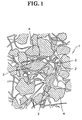
- Fig. 1 is a schematic diagram as an aid in describing the structure of an absorbent composite according to this invention.
- the first absorbent composite of this invention comprises a supporting member and a cationic absorbent polymer and anionic absorbent polymer particles fixed thereto.
- the supporting member to be used in this invention may be in numerous forms such as, for example, foam like foamed polyurethane, powder, granules, sheet, ribbons, fibers, and combinations thereof.
- the form of fibers proves appropriate for the supporting member.
- fibrous supporting member fibrous webs made of natural or synthetic fibers or natural or synthetic pulp, particularly fibrous sheets, are advantageously used.
- the fibrous sheets include woven fabric, non-woven fabric, paper, and knit fabric, for example. Non-woven fabrics made of various kinds of fibrous webs prove advantageous. Fibers of both the hydrophilic and the hydrophobic type are equally usable.
- the hydrophilic fibers include wood pulp, cotton, wool, rayon, acetate, and vinylon, for example.
- the hydrophobic fibers include polyester, acrylic, nylon, polyethylene, polypropylene, and polyvinyl chloride, for example.
- Various mixed fibers formed of the various fibers mentioned above are also usable.
- the fibrous sheets include those of the shape of a tape, for example. Though the tapes of fibrous sheets have no particularly limited thickness, those of a thickness in the range of 0.01 - 100 mm, preferably 0.1 - 10 mm, are appropriately used. Elongates of fibrous sheet can be produced by continuously feeding a fibrous sheet. They allow the absorbent composite contemplated by this invention to be produced with high operational efficiency. Properly, the fibers have a diameter in the range of 0.1 - 1,000 ⁇ m, preferably in the range of 1 - 100 ⁇ m.
- the cationic absorbent polymers which are effectively used in this invention include Mannich reaction products of polyallyl amine, polyalkylene polyamine, polyethylene imine, polyvinyl amine, and poly(meth)acryl amide, homopolymers of poly(meth)acryl amine and dialkylaminoalkyl (meth)acrylate and copolymers thereof with (meth)acryl amide, homopolymers of quaternized ammonium salts of dialkylaminoalkyl (meth)acrylates obtained by the treatment with a halogenated alkyl (such as, for example, methyl chloride, ethyl chloride, or methyl bromide) and copolymers of such homopolymers with a (meth)acrylamide, quaternized ammonium salts of polydialkylallyl amines, polymers of quaternized vinyl-benzyl amines, acetylated chitosan, and condensation products of epichlorohydrin with polyamines or mono
- the binder obtained by adding a cross-linking agent to such a polymer either during or after polymerization and cross-linking the polymer is a polycation possessing numerous cationic groups.
- This binder is advantageously used because it forms a strong ionic bond with an anionic absorbent polymer and retains strong adhesive force after absorbing water and swelling with water.
- the cross-linked polycation proves particularly advantageous when it has a glass transition point which is lower than normal room temperature.
- halogenated alkyl quaternary salts of dialkylamino (meth)acrylates which are effectively used for the production of the polymers mentioned above include the halogenated alkyl quaternary salts of such monomers as N,N'-dimethylaminoethyl (meth)acrylate, N,N-dimethylaminopropyl (meth)acrylate, N,N-diethylaminobutyl (meth)acrylate, N,N-diethylaminoethyl(meth)acrylate, and N,N-diethylaminopropyl(meth)acrylate, for example.
- such a cationic absorbent polymer after polymerization may be applied in a suitable liquid form such as, for example, a solution by means of spraying or spreading to the supporting member and fixed thereto.
- a suitable liquid form such as, for example, a solution by means of spraying or spreading to the supporting member and fixed thereto.
- the fixation of this cationic absorbent polymer to the supporting member is attained by causing a corresponding monomer or a mixture of the monomer to be deposited in the form of an aqueous solution on the supporting member by means of impregnation, for example, and polymerizing or polycondensing the applied layer of the monomer solution.
- the polymerization of the monomer or monomer mixture solution is carried out in the presence of a polymerization initiator at a temperature in the range of 0 - 200°C, preferably 50 - 150°C.
- oxidizing or azo type radical polymerization initiators which are soluble in water or miscible and dispersible in water may be cited.
- the oxidizing polymerization initiators include persulfates such as sodiumpersulfate, potassium persulfate, and ammonium persulfate; hydrogen peroxide; and organic peroxides such as ditertiary butyl peroxide and acetyl peroxide, for example.
- the azo type polymerization initiators include azo compounds such as 2,2'-azobis(2-amidino propane) dihydrochloride, 2,2'-azobis(N,N'-dimethyleneisobutyl amidine) dihydrochloride, and 4,4'-azobis(4-cyanovaleric acid), for example.
- an oxidizing polymerization initiator and an azo type polymerization initiator in combination, use simultaneously a plurality of polymerization initiators selected from the group mentioned above, or use such a polymerization initiator as mixed with such a reducing substance as a sulfite or L-ascorbic acid to effect redox polymerization.
- the polymerization initiator is used in an amount in the range of 0.001 - 10% by weight, preferably 0.01 - 1% by weight, based on the total amount of the monomer.
- the monomer when necessary, incorporates therein a cross-linking agent in an amount in the range of 0.0001 - 10% by weight, preferably 0.01 - 2% by weight, based on the total amount of the monomer.
- the cross-linking agent to be effectively used in this case is a compound which has two or more unsaturated double bonds in the molecular unit thereof.
- N,N'-methylenebis (meth) acryl amide (poly)ethylene glycol di(meth)acrylate, (poly)propylene glycol di(meth)acrylate, trimethylol propane tri(meth)acrylate, trimethylol propane di(meth)acrylate, glycerin tri(meth)acrylate, glycerin acrylate and methacrylate, ethylene oxide-modified trimethylol propane tri(meth)acrylate, pentaerythritol tetra(meth)acrylate, dipentaerythritol hexa(meth)acrylate, triallyl cyanurate, triallyl isocyanurate, triallyl phosphate, triallyl amine, poly(meth)allyloxy alkanes, glycidyl(meth)acrylate, N-methylol acrylamide, (poly)ethylene glycol diglycidyl ether
- the amount of the cationic absorbent polymer to be fixed to the supporting member is in the range of 1 - 10,000 parts by weight, preferably 10 - 5,000 parts by weight, and most preferably 50 - 1,000 parts by weight, based on 100 parts by weight of the supporting member.
- the anionic absorbent polymer to be used in this invention is the homopolymer or copolymer of such a water-soluble ethylenically unsaturated monomer as shown below.
- the monomer acrylic acid, methacrylic acid, 2-(meth)acryloyl ethane sulfonic acid, 2-(meth)acryloyl propane sulfonic acid, 2-(meth)acrylamide-2-methyl propane sulfonic acid, vinyl sulfonic acid, (meth)allyl sulfonic acid, and alkali metal salts and ammonium salts of such acids may be cited.
- These monomers may be used either singly or in the form of a mixture of two or more members. Acrylic acid and salts thereof are preferred examples.
- the monomer when necessary, may incorporate therein a cross-linking agent in an amount in the range of 0.0001 - 10% by weight, preferably 0.01 - 2% by weight.
- the cross-linking agent is a compound having two or more unsaturated double bonds in the molecular unit thereof.
- N,N'-methylenebis(meth)acryl amide (poly)ethylene glycol di(meth)acrylate, (poly)propylene glycol di(meth)acrylate, trimethylol propane tri(meth)acrylate, trimethylol propane di (meth) acrylate, glycerin tri (meth) acrylate, glycerin acrylate and methacrylate, ethylene oxide-modified trimethylol propane tri(meth)acrylate, pentaerythritol tetra(meth)acrylate, dipentaerythritol hexa(meth)acrylate, triallyl cyanurate, triallyl isocyanurate, triallyl phosphate, triallyl amine, poly(meth)allyloxy alkanes, glycidyl(meth)acrylate, N-methylol acrylamide, (poly)ethylene glycol diglycidyl ether,
- the anionic absorbent polymer is obtained by preparatorily polymerizing the corresponding monomer in a polymerization vessel and, when necessary, drying and pulverizing the resultant polymer.
- the monomer or a mixture thereof is prepared in the form of an aqueous solution and then subjected to polymerization in the polymerization vessel in the presence of a polymerization initiator at a temperature in the range of 0 - 200°C, preferably 50 - 150°C.
- oxidizing or azo type radical polymerization initiators which are soluble in water or miscible and dispersible in water may be cited.
- the oxidizing polymerization initiators include persulfates such as sodium persulfate, potassium persulfate, and ammonium persulfate; hydrogen peroxide; and organic peroxides such as ditertiary butyl peroxide and acetyl peroxide, for example.
- the azo type polymerization initiators include azo compounds such as 2,2'-azobis(2-amidinopropane) dihydrochloride, 2,2'-azobis(N,N'-dimethyleneisobutylamidine) dihydrochloride, and 4,4'-azobis(4-cyanovaleric acid), for example.
- an oxidizing polymerization initiator and an azo type polymerization initiator in combination, use simultaneously a plurality of polymerization initiators selected from the group mentioned above, or use such a polymerization initiator as mixed with such a reducing substance as a sulfite or L-ascorbic acid to effect redox polymerization.
- the polymerization initiator is used in an amount in the range of 0.001 - 10% by weight, preferably 0.01 - 1% by weight, based on the total amount of the monomer.
- the anionic absorbent polymer particles consequently obtained have an average particle diameter in the range of 1,000 - 10 ⁇ m, preferably 600 -100 ⁇ m.
- the anionic absorbent polymer particles which are obtained as described above are uniformly dispersed by a suitable means such as scattering on the supporting member to which the cationic absorbent polymer particles have been fixed as described above and then are fixed by such means as pressing to the surface of the cationic absorbent polymer.
- the amount of the anionic absorbent polymer particles to be used for this purpose is in the range of 10 - 10,000 parts by weight, preferably 100 - 1,000 parts by weight, based on 100 parts by weight of the cationic absorbent polymer.
- a cationic absorbent polymer 3 is fixed to the fibers 2 and anionic absorbent polymer particles 4 are fixed through the medium of the cationic absorbent polymer 3 to the fibers 2.
- the first absorbent composite according to this invention is in the form of a sheet having a volume of at least 5 cm 3 , preferably 10 - 200 cm 3 , a thickness of not less than 0.2 mm, preferably 0.5 - 5 mm, and a density in the range of 0.3 - 1.1 g/cm 3 , preferably 0.3 - 1.0 g/cm 3 and exhibiting vertical aspiration power of not less than 5 cm, preferably 6.5 - 10 cm, absorbing capacity under pressure of not less than 20 g/g, preferably 24 - 50 g/g, and Gurley stiffness cf not less than 1000 mgfN, preferably 0 - 500 mgfN.
- the amount of the absorbent polymer (total of cationic absorbent polymer and anionic absorbent polymer) appropriately is not less than 80% by weight, preferably 85 - 99% by weight, based on the amount of the absorbent composite. By setting this amount at a level above 80% by weight, it is made possible to decrease the amount of the supporting member and compact the absorbent composite to be produced.
- the second absorbent composite of this invention is characterized by containing at least 30% by weight of the absorbent polymer based on the total amount of the absorbent composite and exhibiting a value of not less than 3 for the expansion anisotropy specified by the following formula after absorbing a liquid.
- Expansion anisotropy (Ez/Ex + Ez/Ey)/2 (wherein Ex, Ey, and Ez respectively represent coefficient of liner expansion in the directions of X axis, Y axis, and Z axis).
- the expansion anisotropy which is determined by the method to be described herein below is an index of the degree with which a given absorbent composite, after absorbing a liquid, expands in the direction of Z axis relative to the directions of X axis and Y axis.
- the second absorbent composite after absorbing a liquid, exhibits anisotropy in the voluminal expansion, namely expands mainly in the direction of thickness of the composite. Since the absorbent composite, when wetted with a bodily humor, does not decrease but rather increases its bulk, it permits production of an absorbent article which gains in fitness to the contour of a human body and precludes leakage when it is wetted. If the absorbent composite has a number of less than 3 for the expansion anisotropy mentioned above, it will fail to acquire fully satisfactory fitness to the human body. Preferably, the absorbent composite has a number of more than 5 for the expansion anisotropy.
- the second absorbent composite of this invention contains the absorbent polymer in an amount of not less than 30% by weight based on the total weight thereof.
- the absorbent composite is enabled to acquire improved expansion anisotropy and absorbing power and the absorbent article incorporating therein the absorbing composite is enabled to enjoy a decrease in thickness and compaction in bulk.
- the amount of the absorbent polymer is in the range of 80 - 99% by weight.
- the absorbent polymer to be used in this invention comprises an absorbent binder serving the purpose of fixing the absorbent polymer to the supporting member besides the absorbent polymer used in the absorbent composite which will be described in detail herein below.
- cross-linked or not cross-linked hydrophilic natural and synthetic macromolecular compounds can be used.
- the natural macromolecular compounds include starch type and cellulose type compounds, for example.
- the synthetic macromolecular compounds include polyacrylic acid type and polyacrylate type compounds, polyvinyl alcohol type compounds, polyacryl amide type compounds, and polyoxyethylene type compounds, for example.
- polyacrylate type and polyacryl amide type macromolecular compounds prove advantageous.
- the second absorbent composite of this invention for example, is in a structure such that the absorbent polymer is fixed through the medium of the absorbent binder to the supporting member and compressed in the direction of thickness.
- the supporting member preferably has an compression coefficient of elasticity of not less than 60%.
- the supporting member having a three-dimensional backbond structure or an open-cell structure is at an advantage in exhibiting strong recovery power after absorbing water. If the compression coefficient of elasticity is less than 60%, the disadvantage ensues that the supporting member will exhibit weak recovery power after absorbing water and will prevent the absorbent composite from attaining high expansion anisotropy.
- the absorbent binder has close bearing on the flexibility of the absorbent composite because it discharges the part of causing adhesion and fixation of the supporting member, the absorbent polymer, and the binder.
- the binder has flexibility.
- a cross-linked polycondensate having a glass transition point lower than room temperature is advantageously used as the absorbent binder.
- the binder properly is possessed in itself of an ability to expand after absorbing water.
- the absorbent composite to be produced is enabled to acquire improved expansion anisotropy, further attain outstanding water absorbing power, water retaining power, and flexibility and, at the same time, enjoy an increase in the amount of the absorbent polymer used therein and a proportionate decrease in the amount of the supporting member.
- the produced absorbent composite therefore, enjoys a decrease in thickness.
- the absorbent binder properly exhibits a retaining capacity of not less than 5 g/g after the treatment of centrifugal separation of physiological saline solution. This retaining capacity which is determined by a method which will be described in detail herein below is an index for rating the water retaining property of a given absorbent composite.
- the absorbent binder has a retaining capacity of less than 5 g/g, the disadvantage ensues that the absorbent binder will neither allow improvement in expansion anisotropy and absorbing power nor make any contribution to the decrease in thickness of the absorbent composite.
- the cationic absorbent polymer mentioned above is used as the absorbent binder of the quality under discussion.
- the absorbent polymers which are effectively used herein include homopolymers and copolymers of water-soluble ethylenically unsaturated monomers, for example.
- the anionic absorbent polymers mentioned above are used as the monomers for the homopolymers or copolymers.
- the first absorbent composite of this invention As the second absorbent composite of this invention, therefore, the first absorbent composite of this invention described above is appropriately used.
- this second absorbent composite is obtained by further pressing the first absorbent composite or superposing a plurality of first absorbent composites and pressing the superposed layers.
- the superposition of the plurality of absorbent composites is attained by simply pressing the individual layers, their fast union may be accomplished, when necessary, by heating the interfaces of the superposed layers.
- minute hydrophilic fibers are deposited in the proximity of the surface of the absorbent composite.
- the minute hydrophilic fibers effectively used herein include cellulose powder and milled fibers, for example.
- the amount of the minute hydrophilic fibers to be deposited is appropriately in the range of 0.01-5% by weight based on the total weight of the absorbent composite. If the amount of the minute hydrophilic fibers so deposited is less than 0.01% by weight, the effect of the addition of the minute hydrophilic fibers aimed at will not be obtained. If this amount exceeds 5% by weight, the disadvantage ensues that the amount of rewet will increase to the extent of heightening the cost of the absorbent composite.
- the second absorbent composite of this invention has a retaining capacity of not less than 10 g/g after the treatment of centrifugal separation of physiological saline solution mentioned above. If the absorbent composite exhibits retaining capacity less than 10 g/g, the absorbent composite will be deficient in expansion anisotropy and absorbing power and, when used in an absorbent article, will fail to enhance the performance of the absorbent article.
- the second absorbent composite of this invention which has been manufactured by the method described above has a structure such that the absorbent polymer is fixed through the medium of a soft binder possessing ionic adhesive power inside an empty space of the supporting member exhibiting high compression coefficient of elasticity.
- the amount of the absorbent polymer contained in the structure is not less than 30% by weight based on the total weight of the structure.
- the absorbent polymer Since the absorbent polymer is fixed to the supporting member through the medium of the binder, it expands not equally in all the directions but in one fixed direction. Thus, the absorbent composite exhibits expansion anisotropy. Since the expanding power produced in the absorbent composite chiefly originates in the expansion of the absorbent polymer due to its absorption of water, the absorbent composite exhibits fully satisfactory expansion anisotropy and absorbing power even when it is in a high pressed state. In the absorbent composite which is composed of a plurality of compressed layers, the expansion anisotropy is exalted because the phenomenon just mentioned manifests more conspicuously.
- the absorbent article contemplated by this invention has only to comprise a front sheet pervious to liquid, a rear sheet impervious to liquid, and the first or the second absorbent composite mentioned above interposed between the two sheets. It may incorporate therein such other materials as paper, fiber, and inorganic particles in an amount short of impairing the function of the absorbent composite.
- the front sheet imposes no restriction particularly but requires only to be pervious to liquid. Mon-woven fabric, woven fabric, paper, gauze, etc., for example, are usable as materials for the front sheet. Among other materials suggested above, non-woven sheets made of synthetic fibers of polyethylene, polypropylene, polyester, polyamide, etc. are used particularly advantageously.
- the rear sheet imposes no restriction particularly but requires only to be impervious to liquid. Films made of synthetic resins such as of polyethylene, polypropylene, polyvinyl chloride, polyvinylidene chloride, and polyvinyl alcohol are advantageously used as materials for the rear sheet.
- the uses found for the second absorbent composite of this invention are not restricted to such sanitary absorbent articles as mentioned above.
- the second absorbent composite can be applied for such products as functional materials and toys which are capable of making effective use of the expansion anisotropy of the absorbent composite.
- the absorption properties of the absorbent polymers or absorbent composites (or absorbent polymer sheets) which were obtained in the referential examples, working examples, and comparative examples were determined by the following methods.
- This property of absorbent polymer particles or absorbent composite was determined by securing a sample, 0.2 g in weight, placing the sample in a heat-sealed tea bag type pouch of non-woven fabric, 6 cm x 6 cm in area, keeping the pouch containing the sample immersed in physiological saline solution (0.9% Sodium chloride solution) for 30 minutes, then centrifuging (250 G) the wet pouch for 3 minutes thereby expelling excess physiological saline solution, weighing the pouch (W1), and separately repeating the procedure on an empty pouch to find a blank weight (W0).
- the retaining capacity (g/g) was found by subtracting the blank weight (W0) from the sample weight (W1) and dividing the difference by the weight (0.2 g) of the absorbent polymer particles or absorbent composite.
- this property was determined by repeating the procedure mentioned above while punching a sample, 3.1 cm x 3.1 cm, from the absorbent composite, weighing the sample, placing this sample in the bottom part of the acrylic container, and adjusting the load to 50 g/cm 2 .
- This property was determined by punching a sample of the square of 1 inch (2.54 cm x 2.54 cm) from a given absorbent composite, weighing the sample, pouring an aqueous 0.4% saline solution 10 times the weight of the sample into a polypropylene container, 5.5 cm in inside diameter and 1.5 cm in height, placing the square sample in the 0.4% saline solution, and clocking the time (in seconds) required for the solution to be wholly absorbed by the sample (namely until the solution ceased to form a pool on the sample tilted by 45 degrees). The time was reported as the absorption speed.
- This property was determined by cutting a sample of the shape of a ribbon, 2 cm x 10 cm, from a given absorbent composite, suspending this sample vertically so that the leading end thereof would submerge to a depth of 2 mm in the bath of a physiological saline solution, allowing the suspended sample to absorb spontaneously the physiological saline solution vertically through the leading end thereof for 60 minutes, and thereafter measuring the distance (in cm) through which the solution was aspirated. This distance was reported as the vertical aspiration power.
- This property was determined by punching a sample of the shape of a strip, 2.54 cm x 8.89 cm (1 inch x 3.5 inches), from a given absorbent composite and, in a room kept at a temperature of 25°C and a humidity of 50%, tested for flexibility in accordance with the method of determination of Gurley synthesis specified in JIS (Japanese Industrial Standard) L-1096. This sample was dried at a temperature of 70°C for 3 hours and then tested for flexibility by following the same procedure.
- This property of the supporting member of non-woven fabric in a given absorbent component was determined by punching three test pieces, 5 cm x 5 cm, from the supporting member, superposing the three test pieces, measuring the superposed test pieces for thickness (TO) under an initial load of 7 g/cm 2 by means of a compression elasticity tester (pushing metal 5 cm) in conformity with the method specified in JIS L-1096, then allowing the superposed test pieces to stand under a load of 150 g/cm 2 for 1 minute, measuring them for thickness (T1), allowing them to stand under no load for 1 minute, then allowing them to stand under the same load, 7 g/cm 2 , as the initial load, and measuring them for thickness (T2).
- This property was determined by punching a test piece, 5 cm x 5 cm, from a given absorbent composite, measuring the test piece for length in the direction of X axis (X0), length in the direction of Y axis (Y0), and length in the direction of Z axis (Z0), keeping the test piece immersed in a physiological saline solution for 30 minutes, then centrifuging (250 G) the sample for 3 minutes thereby expelling excess physiological saline solution, and measuring the expanded test pieces for lengths of X axis (X1), Y axis (Y1), and Z axis (Z1).
- the expansion anisotropy was calculated in accordance with the following formula.
- This test was carried out by cutting a sample sheet, 15 cm in length x 7 cm in width, from a given absorbent composite, attaching the sample sheet to a surface tilted by 45 degrees, causing physiological saline solution to flow down the sample sheet from the upper end thereof at a rate of 7 ml/second, and allowing the sample sheet to absorb the flowing saline solution, clocking the duration (in seconds) between the time the flow of the saline solution was started and the time the flowing saline solution began to flow out of the lower end of the sample sheet and, at the same time, weighing (g) the saline solution absorbed by the sample sheet meanwhile.
- a simplified absorbent sheet was prepared by cutting a sample sheet, 12 cm x 25 cm, from a given absorbent composite, cutting a sheet of the same size from the non-woven fabric extracted from a disposable infant grade diaper (produced by Procter & Gamble Far East Inc. and marketed under trademark designation of "Pampers"), and superposing the two sheets.
- the simplified absorbent sheet was interposed between two acrylic sheets. The upper of the two superposed acrylic sheets was provided at the position corresponding to the central part of the simplified absorbent sheet with a liquid inlet tube, 23 mm in inside diameter, intended to permit introduction of an absorbent solution to the center of the simplified absorbent sheet.
- the amount of rewet was determined by injecting 50 ml of physiological saline solution three times into the inlet tube at intervals of 30 minutes, removing the upper acrylic sheet 30 minutes after the end of the third injection, mounting a doubled total of 10 kitchen towels (produced by Shinoji Paper Co., Ltd. and marketed under trademark designation of "Nepia") of known black weight on the simplified absorbent sheet, keeping the kitchen towels for one minute under a load exerting a pressure of 57 g/cm 2 thereon, extracting the ten kitchen towels, and weighing them.
- the difference obtained by subtracting the blank weight from the weight obtained at the end of the test was reported as the rewet (g).
- aqueous monomer solution comprising 100 parts of quaternary salt of methyl chloride N,N-dimethylaminoethyl acrylate (aqueous 79% solution), 0.49 part of trimethylol propane triacrylate, 1.2 parts of hydroxyethyl cellulose, 0.29 part of sodium persulfate, and 45.5 parts of deionized water was applied at a rate of 96 g/m 2 to a non-woven polyester fabric, 2 mm in thickness, having a basis weight of 30 g/m 2 and an compression coefficient of elasticity of 72%.
- the non-woven fabric having the aqueous monomer solution deposited thereon was kept for 10 minutes in an atmosphere of nitrogen at 100°C for inducing the monomer to polymerize. Consequently, a cationic absorbent polymer sheet (1) having a cationic absorbent polymer fixed on the non-woven fabric was obtained.
- the cationic absorbent polymer sheet (1) was found to have a retaining capacity of 10 g/g.
- cationic absorbent polymer sheets (2) - (5) were obtained by repeating the procedure of Referential Example 1 while changing the amount of the aqueous monomer solution to be deposited respectively to 690 g/m 2 , 290 g/m 2 , 127 g/m 2 , and 55 g/m 2 . These cationic absorbent polymer sheets were found to have 11 g/g, 9 g/g, 10 g/g, and 3 g/g respectively as the magnitudes of retaining capacity.
- the particles of the hydrogel type polymer were spread on a metal net, 50 mesh, and dried with hot air at 150°C for 90 minutes.
- the dried particles were pulverized with a roll type grinder to obtain anionic absorbent polymer (1) particles, 150 ⁇ m - 850 ⁇ m in diameter.
- the anionic absorbent polymer (1) was found to have a retaining capacity of 35 g/g.
- An anionic absorbent polymer (2) was obtained by mixing 100 parts of the anionic absorbent polymer (1) of Referential Example 6 with an aqueous cross-linking agent solution consisting of 0.5 part of glycerin, 2 parts of water, and 0.5 part of ethyl alcohol and heat-treating the resultant mixture at 196°C for 4 minutes.
- the anionic absorbent polymer (2) was found to have a retaining capacity of 30 g/g and a absorbing capacity under pressure of 28 g/g.
- absorbent polymer foam particles 150 - 850 ⁇ m in particle diameter, were obtained by dissolving 5.2 parts by weight of polyethylene glycol diacrylate as a cross-linking agent in 5500 parts by weight of an aqueous solution of sodium acrylate having a neutralization ratio of 80 mol% (monomer concentration 35%), deaerating the resultant solution with nitrogen gas for 30 minutes, adding 2.8 parts by weight of ammonium persulfate, 0.2 part by weight of 2-2'-azobis (2-methylpropionamidine) dihydro-chloride, and 0.14 part by weight of L-ascorbic acid to the resultant deaerated solution thereby inducing deposition of 2-2'-azobis(2-methylpropionamidine) diacrylate salt, and treating the resultant reaction mixture thereby inducing the monomer to polymerize under the same conditions as in Referential Example 6.
- An anionic absorbent polymer (3) was obtained by cross-linking the absorbent polymer particles in the same manner as in Referential Example 7.
- the anionic absorbent polymer (3) turned out to be foamed particles having a retaining capacity of 40 g/g and a absorbing capacity under pressure of 28 g/g and containing numerous air cells.
- An absorbent composite (1) of this invention was obtained by cutting a section, 10 cm x 30 cm, from the cationic absorbent polymer sheet (1) obtained in Referential Example 1, adding the anionic absorbent polymer (1) of Referential Example 6 to the section throughout the entire volume thereof, and compressing the resultant composite under a pressure of 2 kg/cm 2 .
- the absorbent composite (1) had a basis weight of 410 g/m 2 , a thickness of 0.8 mm, a density of 0.49 g/cm 2 , and a volume of 24 cm 3 and had the anionic absorbent polymer (1) deposited thereon in an amount of 327 g/m 2 .
- An absorbent composite (2) of this invention was obtained by repeating the procedure of Example 1 while using the anionic absorbent polymer (2) of Referential Example 7 instead as an anionic absorbent polymer.
- the absorbent composite had a basis weight of 400 g/m 2 , a thickness of 0.9 mm, a density of 0.46 g/cm 3 , and a volume of 27 cm 3 and had the anionic absorbent polymer (2) deposited thereon in an amount of 317 g/m 2 .
- An absorbent composite (3) of this invention was obtained by repeating the procedure of Example 2 while using the cationic absorbent polymer sheet (2) of Referential Example 2 instead as a cationic absorbent polymer sheet.
- the absorbent composite (3) had a basis weight of 1180 g/m 2 , a thickness of 1.4 mm, a density of 0.84 g/cm 3 , and a volume of 42 cm 3 and had the anionic absorbent polymer (2) deposited thereon in an amount of 770 g/m 2 .
- An absorbent composite (4) of this invention was obtained by repeating the procedure of Example 2 while using the cationic absorbent polymer sheet (3) of Referential Example 3 instead as a cationic absorbent polymer sheet.
- the absorbent composite (4) had a basis weight of 520 g/m 2 , a thickness of 1.1 mm, a density of 0.47 g/cm 3 , and a volume of 33 cm 3 and had the anionic absorbent polymer (2) deposited thereon in an amount of 330 g/m 2 .
- An absorbent composite (5) of this invention was obtained by repeating the procedure of Example 2 while using the cationic absorbent polymer sheet (5) of Referential Example 5 instead as a cationic absorbent polymer sheet.
- the absorbent composite (5) had a basis weight of 210 g/m 2 , a thickness of 0.6 mm, a density of 0.35 g/cm 3 , and a volume of 18 cm 3 and had the anionic absorbent polymer (2) deposited thereon in an amount of 150 g/m 2 .
- aqueous monomer solution consisting of 100 parts of potassium acrylate having a neutralization ratio of 75%, 0.17 part of trimethylol propane triacrylate, 1.24 parts of hydroxyethyl cellulose, 0.29 part of sodium persulfate, and 45.1 parts of water was applied in an amount of 790 g/m 2 to a non-woven polyester fabric having a basis weight of 30 g/m 2 .
- the non-woven fabric having the aqueous monomer solution deposited thereon wad kept in an atmosphere of nitrogen at 120°C for 3 minutes for inducing the monomer to polymerize to obtain an absorbent composite (1) for comparison having an absorbent polymer fixed to the non-woven fabric.
- the absorbent composite (1) for comparison was found to have a retaining capacity of 17 g/g.
- An absorbent composite (2) for comparison was obtained by adding an aqueous cross-linking agent solution consisting of 0.5 part of ethylene glycol diglycidyl ether, 3 parts of water, and 1 part of isopropyl alcohol by spraying to 100 parts of the absorbent composite (1) for comparison obtained in Control 1.
- the absorbent composite (2) for comparison consequently obtained was found to have a retaining capacity of 15 g/g.
- Absorbent articles (1) - (5) of this invention were produced by interposing the absorbent composites (1) - (5) produced in a fixed size of 12 cm x 25 cm in Examples 1 - 5 respectively between a polyethylene film, 12 cm x 25 cm, having a basis weight of 30 g/m 2 and a spun-bond non-woven fabric, 12 cm x 25 cm, made of polypropylene fibers and having a basis weight of 30 g/m 2 (having a sheet of paper, 30 g/m 2 in basis weight, attached to the rear side, namely the absorbent composite side, so as to be used as a surface material on top of the structure to be ultimately formed).
- absorbent articles (1) and (2) for comparison were produced by repeating the same procedure while using the absorbent composites (1) and (2) for comparison instead.
- An absorbent composite (6) of this invention was separately obtained by following the procedure of Example 2.
- the absorbent composite (6) thus obtained had a basis weight of 300 g/m 2 , a thickness of 0.7 mm, a density of 0.43 g/cm 3 , and a volume of 21 cm 3 and had the absorbent polymer particles attached thereto in an amount of 200 g/cm 2 .
- An absorbent composite (7) of this invention was obtained by following the procedure of Example 1 while using the anionic absorbent polymer (3) of Referential Example 8 as an anionic absorbent polymer instead.
- the absorbent composite (7) thus obtained had a basis weight of 300 g/m 2 , a thickness of 0.7 mm, a density of 0.43 g/cm 3 , and a volume of 21 cm 3 and had the anionic absorbent polymer (3) attached thereto in an amount of 200 g/cm 2 .
- An absorbent composite (8) of this invention 1.0 mm in thickness and 0.6 g/cm 3 in density, was produced by superposing two absorbent composites (6) obtained in Example 7, interposing them between acrylic plates, pressing the resultant composite under a pressure of 5 kgf/cm 2 for one minutes with a simplified press, 17 cm in cross section of the working surface, and then applying cellulose powder (produced by Watman Bio Systems Ltd. and marketed under product code of "CF11") to the surface of the compressed composite in an amount of 30 g/m 2 .
- cellulose powder produced by Watman Bio Systems Ltd. and marketed under product code of "CF11
- An absorbent composite (9) of this invention 1.0 mm in thickness and 0.58 g/cm 3 in density, was produced by repeating the procedure of Example 9 while using two absorbent composites (7) obtained in Example 8 instead.
- An absorbent composite (10) of this invention 1.5 mm in thickness and 0.77 g/cm 3 in density, was produced by repeating the procedure of Example 9 while using four absorbent composites (6) obtained in Example 7 instead.
- An absorbent composite (11) of this invention 1.6 mm in thickness and 0.7 g/cm 3 in density, was produced by repeating the procedure of Example 9 while using four absorbent composites (7) obtained in Example 8 instead.
- a cationic absorbent polymer sheet having a cationic absorbent polymer fixed thereto in an amount of 280 g/m 2 was produced by following the procedure of Referential Example 1 while having an absorbent binder polymerized and attached to a non-woven polyester fabric, 120 g/cm 2 in basis weight, 75% in compression coefficient of elasticity, and 8 cm in thickness, instead. Then an absorbent composite (12) of this invention, 1.6 mm in thickness and 0.7 g/cm 3 , was produced by following the procedure of Example 1 while attaching the absorbent polymer particles obtained in Referential Example 7 in an amount of 800 g/m 2 to the cationic absorbent polymer sheet instead.
- aqueous monomer solution consisting of 20 parts by weight of polyethylene imine (aqueous 30% solution) and 0.025 part by weight of ethylene glycol diglycidyl ether was attached in an amount of 417 g/m 2 to a non-woven polyester fabric, 30 g/m 2 in basis weight, 72% in compression coefficient of elasticity, and 2 mm in thickness.
- the non-woven fabric having the aqueous monomer solution attached thereto was kept in an atmosphere of nitrogen at 80°C for 30 minutes to obtain a cationic absorbent polymer sheet having the cationic absorbent polymer fixed on the non-woven fabric.
- the cationic absorbent polymer sheet had the absorbent binder attached thereto in an amount of 125 g/m 2 and a retaining capacity of 5 g/g.
- An absorbent composite was produced by cutting a section, 10 cm x 30 cm in surface area, from the cationic absorbent polymer sheet obtained as described above, adding the anionic absorbent polymer (2) obtained in Referential Example 7 to the cut section throughout the entire surface area, and compressing the resultant composite under a pressure of 2 kg/cm 2 to ensure fast adhesion of the polymer to the cut section.
- the absorbent composite had a basis weight of 317 g/m 2 , a thickness of 0.7 mm, a density of 0.45 g/cm 2 , and a volume of 21 cm 3 and had the anionic absorbent polymer (2) attached thereto in an amount of 162 g/m 2 .
- An absorbent composite (13) of this invention 1.6 mm in thickness and 0.79 g/cm 3 in density, was produced by repeating the procedure of Example 9 while using four absorbent composites.
- An absorbent composite (4) for comparison was produced by cutting a section from a commercially available pulp sponge (produced by Nippon Polyester K.K.), 1.8 mm in thickness and 0.44 g/cm 3 in density.
- aqueous monomer solution consisting of 100 parts by weight of potassium acrylate having a neutralization ratio of 75%, 0.17 part by weight of trimethylol propane triacrylate, 1.24 parts by weight of hydroxyethyl cellulose, 0.29 part by weight of sodium persulfate, and 45.1 parts by weight of deionized water was attached in an amount of 790 g/cm 2 to an non-woven polyester fabric, 30 g/m 2 in basis weight and 72% in compression coefficient of elasticity.
- the non-woven fabric having the aqueous monomer solution attached thereto was kept in an atmosphere of nitrogen at 120°C for 3 minutes for inducing the monomer to polymerize to obtain a supporting member sheet, 17 g/g in retaining capacity, having the absorbent polymer fixed to the non-woven fabric.
- An absorbent composite having a retaining capacity of 15 g/g was obtained by adding an aqueous cross-linking agent solution consisting of 0.5 part by weight of ethylene glycol diglycidyl ether, 3 parts by weight of water, and 1 part by weight of isopropyl alcohol by spraying to 100 parts by weight of the supporting member sheet and heat-treating the resultant composite at 100°C for 30 minutes.
- cellulose powder produced by Watman Bio Systems Ltd. and marketed under product code of "CF11
- the absorbent composite according to this invention has a large absorbing capacity under pressure as described above, it allows provision of such absorbent articles as disposable diapers which suffer leakage of liquid only sparingly. Since it has large vertical aspiration power, it can be applied for absorbent articles such as, for example, disposable diapers. It also possesses ample flexibility (as evinced by small Gurley stiffness). When this absorbent composite is used in such absorbent articles as disposable diapers, the absorbent articles fit well to a human body and do not easily deform or warp. Thus the absorbent articles preclude lateral leakage of liquid and permit the wearers to enjoy good feeling of wearing.
- the absorbent composite suffers no easy separation of the absorbent polymer, it not only excels in shape-retaining property but also permits a conspicuous decrease in the amount of the supporting member such as of fibrous material.
- the supporting member such as of fibrous material.
- the absorbent composite of this invention on absorbing a liquid, expands mainly in the direction of thickness.
- the absorbent article using this absorbent composite therefore, does not decrease but rather increases the bulk thereof after it has absorbed a bodily humor and consequently expanded.
- the absorbed bodily humor adds to the fitness of the article to the human body and promotes the preclusion of the leakage.
Landscapes
- Health & Medical Sciences (AREA)
- Chemical & Material Sciences (AREA)
- Epidemiology (AREA)
- Hematology (AREA)
- Engineering & Computer Science (AREA)
- Materials Engineering (AREA)
- Dispersion Chemistry (AREA)
- Life Sciences & Earth Sciences (AREA)
- Animal Behavior & Ethology (AREA)
- General Health & Medical Sciences (AREA)
- Public Health (AREA)
- Veterinary Medicine (AREA)
- Absorbent Articles And Supports Therefor (AREA)
- Laminated Bodies (AREA)
Claims (16)
- Composite absorbant comprenant un élément support, un polymère absorbant cationique réticulé fixé à l'élément support et des particules de polymère absorbant anionique réticulé fixées au polymère absorbant cationique réticulé par l'intermédiaire d'une liaison ionique.
- Composite absorbant selon la revendication 1, caractérisé en ce que la quantité de polymère absorbant cationique est dans la gamme de 1 à 10 000 parties en poids, basée sur 100 parties en poids de l'élément support et la quantité de particules de polymère absorbant anionique est dans la gamme de 10 à 10 000 parties en poids, basée sur 100 parties en poids du polymère absorbant cationique.
- Composite absorbant selon l'une quelconque des revendications précédentes, caractérisé en ce que l'élément support est une substance fibreuse.
- Composite absorbant selon la revendication 1, caractérisé en ce que le polymère absorbant anionique réticulé comprend des homopolymères réticulés ou un copolymère réticulé d'acide acrylique ou de ses sels, et le polymère absorbant cationique réticulé comprend une polyallylamine réticulée, une polyalkylamine réticulée, une polyéthylèneimine réticulée, une polyvinylamine réticulée ou des homopolymères réticulés ou des sels d'ammonium quaternaire de dialkylaminoalkyl(méth)acrylate.
- Composite absorbant selon la revendication 1, caractérisé en ce que le polymère absorbant cationique réticulé présente une capacité de rétention pas inférieure à 5 g/g après avoir subi une séparation par centrifugation d'une solution saline physiologique.
- Composite absorbant selon la revendication 1, comprenant un polymère absorbant anionique réticulé fixé par l'intermédiaire du milieu d'un liant absorbant à un élément support et comprimé dans la direction de l'épaisseur du composite absorbant et contenant au moins 30 % en poids de polymère absorbant anionique réticulé basés sur le poids total du composite absorbant, caractérisé en ce que le composite absorbant, lors de l'absorption d'un liquide, présente une valeur pas inférieure à 5 en ce qui concerne l'anisotropie de dilatation qui représente le degré de dilatation dans la direction de l'axe Z par rapport aux deux directions de l'axe X et de l'axe Y, et est spécifiée par la formule suivante :
- Composite absorbant selon la revendication 6, caractérisé en ce qu'il contient un polymère absorbant sous forme d'une feuille ayant un volume d'au moins 5 cm3, une épaisseur pas inférieure à 0,2 mm, et une masse volumique dans la gamme de 0,3 à 1,1 g/cm3 ; la feuille possédant un pouvoir d'aspiration verticale pas inférieur à 5 cm, une capacité d'absorption sous pression pas inférieure à 20 g/g, et une rigidité de Gurley ne dépassant pas 1 000 mgfN ; dans lequel le pouvoir d'aspiration verticale est défini comme la distance verticale parcourue vers le haut par un liquide absorbé par la feuille en 60 minutes, et la capacité d'absorption est définie comme la quantité de liquide absorbé par la feuille sous une charge de 50 g/cm2.
- Composite absorbant selon la revendication 6 ou la revendication 7, caractérisé en ce que la proportion du polymère absorbant présent n'est pas inférieure à 80 % en poids, basée sur le poids total du composite absorbant.
- Composite absorbant selon l'une quelconque des revendications 6 à 8, caractérisé en ce que le liant absorbant présente une capacité de rétention pas inférieure à 5 g/g après avoir subi une séparation par centrifugation d'une solution saline physiologique.
- Composite absorbant selon l'une quelconque des revendications 6 à 8, caractérisé en ce que le liant absorbant est un polymère absorbant cationique et le polymère absorbant est un polymère absorbant anionique.
- Article absorbant caractérisé en ce qu'il comprend un composite absorbant selon l'une quelconque des revendications précédentes.
- Procédé pour la préparation d'un composite absorbant, selon la revendication 1, caractérisé par : un dépôt d'un monomère de matière première capable de former un polymère absorbant cationique sur un élément support, une polymérisation ou polycondensation du monomère de matière première, fixant ainsi un polymère absorbant cationique à l'élément support, et une fixation de particules de polymère absorbant anionique au polymère absorbant cationique.
- Procédé selon la revendication 12, caractérisé en ce que la quantité de polymère absorbant cationique est dans la gamme de 1 à 10 000 parties en poids, basée sur 100 parties en poids de l'élément support et la quantité de particules de polymère absorbant anionique est dans la gamme de 10 à 10 000 parties en poids, basée sur 100 parties en poids du polymère absorbant cationique.
- Procédé selon la revendication 12 ou la revendication 13, caractérisé en ce que l'élément support est une substance fibreuse.
- Procédé selon la revendication 14, caractérisé en ce que la substance fibreuse est une feuille fibreuse.
- Procédé selon la revendication 15, caractérisé en ce que les particules de polymère absorbant anionique sont diffusées sur la feuille fibreuse ayant le polymère absorbant cationique fixé à l'avance sur celle-ci, puis les particules diffusées sont pressées contre la feuille fibreuse.
Applications Claiming Priority (6)
| Application Number | Priority Date | Filing Date | Title |
|---|---|---|---|
| JP23735895 | 1995-09-14 | ||
| JP23735895 | 1995-09-14 | ||
| JP237358/95 | 1995-09-14 | ||
| JP183816/96 | 1996-07-12 | ||
| JP18381696 | 1996-07-12 | ||
| JP18381696 | 1996-07-12 |
Publications (3)
| Publication Number | Publication Date |
|---|---|
| EP0763364A2 EP0763364A2 (fr) | 1997-03-19 |
| EP0763364A3 EP0763364A3 (fr) | 2000-03-08 |
| EP0763364B1 true EP0763364B1 (fr) | 2003-07-16 |
Family
ID=26502101
Family Applications (1)
| Application Number | Title | Priority Date | Filing Date |
|---|---|---|---|
| EP19960306651 Expired - Lifetime EP0763364B1 (fr) | 1995-09-14 | 1996-09-13 | Composite absorbant, article absorbant et leurs méthodes de préparation |
Country Status (3)
| Country | Link |
|---|---|
| US (1) | US5853867A (fr) |
| EP (1) | EP0763364B1 (fr) |
| DE (1) | DE69629081T2 (fr) |
Families Citing this family (74)
| Publication number | Priority date | Publication date | Assignee | Title |
|---|---|---|---|---|
| DE69635897T2 (de) * | 1995-11-02 | 2006-10-19 | Nippon Shokubai Co. Ltd. | Wasserabsorbierendes harz, absorbierendes material und verfahren zur herstellung derselben |
| AU5690798A (en) | 1996-12-06 | 1998-06-29 | Weyerhaeuser Company | Unitary stratified composite |
| US20050090789A1 (en) * | 1996-12-06 | 2005-04-28 | Graef Peter A. | Absorbent composite having improved surface dryness |
| US8268424B1 (en) * | 1996-12-13 | 2012-09-18 | Dsg International Limited | Highly absorbent composite compositions, absorbent sheets provided with the compositions, and process for producing the same |
| US5916670A (en) * | 1997-01-17 | 1999-06-29 | Rayonier Inc. | Absorbent material for use in absorbent articles |
| US6485667B1 (en) | 1997-01-17 | 2002-11-26 | Rayonier Products And Financial Services Company | Process for making a soft, strong, absorbent material for use in absorbent articles |
| US5866242A (en) * | 1997-01-17 | 1999-02-02 | Rayonier Inc. | Soft, strong, absorbent material for use in absorbent articles |
| JP2001527476A (ja) * | 1997-05-13 | 2001-12-25 | ウェヤーハウザー・カンパニー | 網状吸収性複合体 |
| JP4087500B2 (ja) * | 1997-06-13 | 2008-05-21 | 株式会社日本触媒 | 吸収性物品の製造方法 |
| US6383960B1 (en) | 1997-10-08 | 2002-05-07 | Kimberly-Clark Worldwide, Inc. | Layered absorbent structure |
| US7855315B2 (en) * | 1997-11-19 | 2010-12-21 | Basf Aktiengesellschaft | Continuous manufacturing of superabsorbent/ion exchange sheet material |
| US6639120B1 (en) | 1997-12-12 | 2003-10-28 | Kimberly-Clark Worldwide, Inc. | Structure having balanced pH profile |
| ZA9810779B (en) | 1997-12-12 | 1999-09-21 | Kimberly Clark Co | Structure having balanced pH profile. |
| US6630054B1 (en) | 1998-03-19 | 2003-10-07 | Weyerhaeuser Company | Methods for forming a fluted composite |
| US6710225B1 (en) | 1998-06-15 | 2004-03-23 | Kimberly-Clark Worldwide, Inc. | Layered absorbent structure with a zoned basis weight |
| WO2000009612A1 (fr) | 1998-08-13 | 2000-02-24 | Nippon Shokubai Co., Ltd. | Composition polymere reticulee gonflant dans l'eau et son procede de production |
| AU3192600A (en) | 1999-03-16 | 2000-10-04 | Mitsubishi Chemical Corporation | Water-absorbing composite and process for continuously producing the same |
| US6867346B1 (en) | 1999-09-21 | 2005-03-15 | Weyerhaeuser Company | Absorbent composite having fibrous bands |
| US6703330B1 (en) | 1999-09-21 | 2004-03-09 | Weyerhaeuser Company | Fluted absorbent composite |
| US6764477B1 (en) | 1999-10-01 | 2004-07-20 | Kimberly-Clark Worldwide, Inc. | Center-fill absorbent article with reusable frame member |
| US6660903B1 (en) | 1999-10-01 | 2003-12-09 | Kimberly-Clark Worldwide, Inc. | Center-fill absorbent article with a central rising member |
| US6492574B1 (en) | 1999-10-01 | 2002-12-10 | Kimberly-Clark Worldwide, Inc. | Center-fill absorbent article with a wicking barrier and central rising member |
| US6700034B1 (en) | 1999-10-01 | 2004-03-02 | Kimberly-Clark Worldwide, Inc. | Absorbent article with unitary absorbent layer for center fill performance |
| US6613955B1 (en) | 1999-10-01 | 2003-09-02 | Kimberly-Clark Worldwide, Inc. | Absorbent articles with wicking barrier cuffs |
| US6486379B1 (en) | 1999-10-01 | 2002-11-26 | Kimberly-Clark Worldwide, Inc. | Absorbent article with central pledget and deformation control |
| US6437214B1 (en) | 2000-01-06 | 2002-08-20 | Kimberly-Clark Worldwide, Inc. | Layered absorbent structure with a zoned basis weight and a heterogeneous layer region |
| US6417425B1 (en) * | 2000-02-01 | 2002-07-09 | Basf Corporation | Absorbent article and process for preparing an absorbent article |
| JP2001295103A (ja) * | 2000-04-12 | 2001-10-26 | Oji Paper Co Ltd | 吸収機能部を備えた衣類 |
| US6887564B2 (en) * | 2000-04-25 | 2005-05-03 | The Procter & Gamble Company | Articles comprising chitosan material and an anionic absorbent gelling material |
| EP2256140A3 (fr) * | 2001-03-13 | 2011-02-16 | Sony Corporation | Absorbant a base de solution d'electrolyte et procede de fabrication de cet absorbant |
| CN1553827A (zh) * | 2001-09-10 | 2004-12-08 | 可乐丽化学株式会社 | 复合粒状体及其制造方法 |
| US6808801B2 (en) * | 2002-07-26 | 2004-10-26 | Kimberly-Clark Worldwide, Inc. | Absorbent article with self-forming absorbent binder layer |
| US6737491B2 (en) * | 2002-07-26 | 2004-05-18 | Kimberly-Clark Worldwide, Inc. | Absorbent binder composition and method of making same |
| US7205259B2 (en) * | 2002-07-26 | 2007-04-17 | Kimberly-Clark Worldwide, Inc. | Absorbent binder desiccant composition and articles incorporating it |
| US6887961B2 (en) * | 2002-07-26 | 2005-05-03 | Kimberly-Clark Worldwide, Inc. | Absorbent binder composition and method of making it |
| US6964803B2 (en) * | 2002-07-26 | 2005-11-15 | Kimberly-Clark Worldwide, Inc. | Absorbent structures with selectively placed flexible absorbent binder |
| US7115321B2 (en) * | 2002-07-26 | 2006-10-03 | Kimberly-Clark Worldwide, Inc. | Absorbent binder coating |
| US6822135B2 (en) * | 2002-07-26 | 2004-11-23 | Kimberly-Clark Worldwide, Inc. | Fluid storage material including particles secured with a crosslinkable binder composition and method of making same |
| MXPA05002256A (es) * | 2002-08-26 | 2005-06-08 | Tyco Healthcare Retail Serv Ag | Nucelo para articulos absorbentes y metodo para elaborar los mismos. |
| US7378566B2 (en) * | 2002-12-13 | 2008-05-27 | Kimberly-Clark Worldwide, Inc. | Absorbent core including folded substrate |
| US7294591B2 (en) * | 2002-12-13 | 2007-11-13 | Kimberly-Clark Worldwide, Inc. | Absorbent composite including a folded substrate and an absorbent adhesive composition |
| DE10315749A1 (de) * | 2003-04-04 | 2004-10-14 | Thüringisches Institut für Textil- und Kunststoff-Forschung (TITK) e.V. | Verfahren zur Herstellung von cellulosischen Formkörpern mit funktionaler Wirkung |
| US8314286B2 (en) * | 2003-05-23 | 2012-11-20 | Mcneil-Ppc, Inc. | Flexible liquid absorbing structure |
| US7696401B2 (en) | 2003-07-31 | 2010-04-13 | Evonik Stockhausen, Inc. | Absorbent materials and absorbent articles incorporating such absorbent materials |
| WO2005018694A1 (fr) * | 2003-08-20 | 2005-03-03 | Tyco Healthcare Retail Services Ag | Noyaux absorbants destines a des articles absorbants et leur procede de production |
| US8173171B2 (en) * | 2003-11-17 | 2012-05-08 | Taiwan Textile Research Institute | Hydrogel microparticle composition, application thereof and method for preparing the same |
| TW200517128A (en) * | 2003-11-17 | 2005-06-01 | China Testile Inst | Micro-particles of hydrogel containing polysaccharide or its derivatives composition and method for preparing the same |
| JP4789809B2 (ja) * | 2004-01-15 | 2011-10-12 | サムスン エレクトロニクス カンパニー リミテッド | ナノ結晶をドーピングしたマトリックス |
| EP1624002B1 (fr) * | 2004-08-07 | 2019-04-03 | The Procter & Gamble Company | Particules de polymères du type superabsorbant avec les fonctionalisants, et un procédé pour leur préparation. |
| TWI353360B (en) | 2005-04-07 | 2011-12-01 | Nippon Catalytic Chem Ind | Production process of polyacrylic acid (salt) wate |
| US8921244B2 (en) | 2005-08-22 | 2014-12-30 | The Procter & Gamble Company | Hydroxyl polymer fiber fibrous structures and processes for making same |
| TW200720347A (en) | 2005-09-30 | 2007-06-01 | Nippon Catalytic Chem Ind | Water-absorbent agent composition and method for manufacturing the same |
| US20070123834A1 (en) * | 2005-11-28 | 2007-05-31 | Kimberly-Clark Worldwide, Inc. | Flexible absorbent article |
| US7335713B2 (en) | 2005-12-02 | 2008-02-26 | Stockhausen, Inc. | Method for preparing a flexible superabsorbent binder polymer composition |
| US7619131B2 (en) | 2005-12-02 | 2009-11-17 | Kimberly-Clark Worldwide, Inc. | Articles comprising transparent/translucent polymer composition |
| US7312286B2 (en) * | 2005-12-02 | 2007-12-25 | Stockhausen, Inc. | Flexible superabsorbent binder polymer composition |
| TWI394789B (zh) | 2005-12-22 | 2013-05-01 | Nippon Catalytic Chem Ind | 吸水性樹脂組成物及其製造方法、吸收性物品 |
| EP1837348B9 (fr) | 2006-03-24 | 2020-01-08 | Nippon Shokubai Co.,Ltd. | Résine absorbant l'eau et son procédé de fabrication |
| US7972986B2 (en) | 2007-07-17 | 2011-07-05 | The Procter & Gamble Company | Fibrous structures and methods for making same |
| US8852474B2 (en) | 2007-07-17 | 2014-10-07 | The Procter & Gamble Company | Process for making fibrous structures |
| US20090022983A1 (en) | 2007-07-17 | 2009-01-22 | David William Cabell | Fibrous structures |
| US10024000B2 (en) | 2007-07-17 | 2018-07-17 | The Procter & Gamble Company | Fibrous structures and methods for making same |
| US8952116B2 (en) | 2009-09-29 | 2015-02-10 | Nippon Shokubai Co., Ltd. | Particulate water absorbent and process for production thereof |
| BR112012010003A2 (pt) * | 2009-11-02 | 2016-03-01 | Procter & Gamble | elementos fibrosos e estruturas fibrosas que empregam os mesmos |
| MX2012005111A (es) | 2009-11-02 | 2012-05-22 | Procter & Gamble | Estructuras fibrosas y metodos para elaborarlas. |
| MX343331B (es) * | 2009-11-02 | 2016-11-01 | The Procter & Gamble Company * | Elementos fibrosos de polipropileno y procesos para elaborarlos. |
| US20110162989A1 (en) * | 2010-01-06 | 2011-07-07 | Ducker Paul M | Ultra thin laminate with particulates in dense packages |
| US9549858B2 (en) | 2010-01-06 | 2017-01-24 | Ching-Yun Morris Yang | Ultra-thin absorbent article |
| JP5770262B2 (ja) | 2010-03-31 | 2015-08-26 | ザ プロクター アンド ギャンブルカンパニー | 繊維性構造体及びその製造方法 |
| US9375507B2 (en) | 2013-04-10 | 2016-06-28 | Evonik Corporation | Particulate superabsorbent polymer composition having improved stability |
| US9302248B2 (en) | 2013-04-10 | 2016-04-05 | Evonik Corporation | Particulate superabsorbent polymer composition having improved stability |
| WO2015102457A1 (fr) * | 2014-01-06 | 2015-07-09 | 한화케미칼 주식회사 | Procédé de préparation d'un polymère superabsorbant |
| JP6572896B2 (ja) | 2014-08-07 | 2019-09-11 | 東洋製罐グループホールディングス株式会社 | 水分バリア性積層体 |
| US20240082815A1 (en) * | 2022-09-14 | 2024-03-14 | General Electric Company | System and method for fluid capture using a cross-linked binder |
Family Cites Families (8)
| Publication number | Priority date | Publication date | Assignee | Title |
|---|---|---|---|---|
| JPH0367712B2 (fr) * | 1980-05-12 | 1991-10-23 | Johnson & Johnson Prod Inc | |
| JP2702772B2 (ja) * | 1989-04-28 | 1998-01-26 | 花王株式会社 | 吸水性ポリウレタンフォーム成形品の製造方法 |
| JPH03162855A (ja) * | 1989-11-21 | 1991-07-12 | Lion Corp | 吸収性物品 |
| US5124188A (en) * | 1990-04-02 | 1992-06-23 | The Procter & Gamble Company | Porous, absorbent, polymeric macrostructures and methods of making the same |
| DE69133620D1 (de) * | 1990-12-21 | 2009-09-10 | Nippon Catalytic Chem Ind | Wasserabsorbierendes Material und Verfahren zu seiner Herstellung sowie wasserabsorbierender Artikel und Verfahren zu seiner Herstellung |
| JP3091249B2 (ja) * | 1991-03-05 | 2000-09-25 | 花王株式会社 | 吸収性物品 |
| EP1219744B1 (fr) * | 1992-08-17 | 2004-10-20 | Weyerhaeuser Company | Liants pour particules |
| US5324561A (en) * | 1992-10-02 | 1994-06-28 | The Procter & Gamble Company | Porous, absorbent macrostructures of bonded absorbent particles surface crosslinked with cationic amino-epichlorohydrin adducts |
-
1996
- 1996-09-13 EP EP19960306651 patent/EP0763364B1/fr not_active Expired - Lifetime
- 1996-09-13 US US08/713,866 patent/US5853867A/en not_active Expired - Lifetime
- 1996-09-13 DE DE1996629081 patent/DE69629081T2/de not_active Expired - Lifetime
Also Published As
| Publication number | Publication date |
|---|---|
| US5853867A (en) | 1998-12-29 |
| DE69629081D1 (de) | 2003-08-21 |
| EP0763364A2 (fr) | 1997-03-19 |
| DE69629081T2 (de) | 2004-05-27 |
| EP0763364A3 (fr) | 2000-03-08 |
Similar Documents
| Publication | Publication Date | Title |
|---|---|---|
| US5853867A (en) | Absorbent composite, method for production thereof, and absorbent article | |
| KR100264483B1 (ko) | 지지체 및 가교결합가능한 하이드로겔 중합체 입자로 형성된 흡수성 복합 구조체 | |
| US5518761A (en) | Absorbent material absorbent article, and method for production thereof | |
| US4235237A (en) | Absorbent open network structure | |
| EP2048184B1 (fr) | Particule de résine absorbant l'eau, son procédé de production et matière absorbante qui l'utilise | |
| FI105564B (fi) | Superabsorboiva polymeeri, jolla on parantuneet absorptio-ominaisuudet | |
| US6514615B1 (en) | Superabsorbent polymers having delayed water absorption characteristics | |
| JP4685332B2 (ja) | 高分子量体含有粘性液の吸収に適した吸水性樹脂、並びにそれを用いた吸収体および吸収性物品 | |
| EP0178175B1 (fr) | Procédé pour absorber et retenir l'urine de manière répétée | |
| JP2003088552A (ja) | 吸収体およびそれを用いた吸収性物品 | |
| JP2005504865A (ja) | モルホリン−2,3−ジオンを用いたヒドロゲルの架橋法 | |
| JP2004522491A (ja) | 吸収性組成物 | |
| EP2588055A1 (fr) | Parties centrales ultraminces absorbant des fluides | |
| WO2004105823A2 (fr) | Structure absorbante haute performance a superabsorbant ajoute a un substrat par polymerisation in situ | |
| KR100323818B1 (ko) | 유체 처리 능력을 개선하기 위한 상이한 하이드로겔-형성 흡수성중합체의 혼합물로부터 제조된 흡수성 거대 구조물 | |
| JP3335843B2 (ja) | 吸収剤組成物および吸収体、並びに、吸収体を含む吸収物品 | |
| JP2000015093A (ja) | 吸収性物品用吸水剤および吸収性物品 | |
| KR940008961B1 (ko) | 체액 흡수 물품 | |
| JP3466318B2 (ja) | 吸水剤組成物およびその製法、並びにこれら吸水剤組成物を含有する吸収物品 | |
| JP4073508B2 (ja) | 吸水性複合体および吸水性物品 | |
| JP2003088551A (ja) | 吸収体およびそれを用いた吸収性物品 | |
| JP3872548B2 (ja) | 吸水性複合体、その製造方法および吸水性物品 | |
| JP2544013B2 (ja) | 吸収体および吸収物品 | |
| WO2022255302A1 (fr) | Feuille absorbant l'eau et article absorbant | |
| JP2683091B2 (ja) | 体液吸収物品 |
Legal Events
| Date | Code | Title | Description |
|---|---|---|---|
| PUAI | Public reference made under article 153(3) epc to a published international application that has entered the european phase |
Free format text: ORIGINAL CODE: 0009012 |
|
| AK | Designated contracting states |
Kind code of ref document: A2 Designated state(s): DE FR GB IT |
|
| 17P | Request for examination filed |
Effective date: 19970906 |
|
| PUAL | Search report despatched |
Free format text: ORIGINAL CODE: 0009013 |
|
| AK | Designated contracting states |
Kind code of ref document: A3 Designated state(s): DE FR GB IT |
|
| 17Q | First examination report despatched |
Effective date: 20010405 |
|
| GRAH | Despatch of communication of intention to grant a patent |
Free format text: ORIGINAL CODE: EPIDOS IGRA |
|
| GRAH | Despatch of communication of intention to grant a patent |
Free format text: ORIGINAL CODE: EPIDOS IGRA |
|
| GRAA | (expected) grant |
Free format text: ORIGINAL CODE: 0009210 |
|
| AK | Designated contracting states |
Designated state(s): DE FR GB IT |
|
| REG | Reference to a national code |
Ref country code: GB Ref legal event code: FG4D |
|
| REF | Corresponds to: |
Ref document number: 69629081 Country of ref document: DE Date of ref document: 20030821 Kind code of ref document: P |
|
| ET | Fr: translation filed | ||
| PLBE | No opposition filed within time limit |
Free format text: ORIGINAL CODE: 0009261 |
|
| STAA | Information on the status of an ep patent application or granted ep patent |
Free format text: STATUS: NO OPPOSITION FILED WITHIN TIME LIMIT |
|
| 26N | No opposition filed |
Effective date: 20040419 |
|
| PGFP | Annual fee paid to national office [announced via postgrant information from national office to epo] |
Ref country code: GB Payment date: 20070912 Year of fee payment: 12 |
|
| PGFP | Annual fee paid to national office [announced via postgrant information from national office to epo] |
Ref country code: IT Payment date: 20070926 Year of fee payment: 12 |
|
| PGFP | Annual fee paid to national office [announced via postgrant information from national office to epo] |
Ref country code: FR Payment date: 20070914 Year of fee payment: 12 |
|
| GBPC | Gb: european patent ceased through non-payment of renewal fee |
Effective date: 20080913 |
|
| REG | Reference to a national code |
Ref country code: FR Ref legal event code: ST Effective date: 20090529 |
|
| PG25 | Lapsed in a contracting state [announced via postgrant information from national office to epo] |
Ref country code: IT Free format text: LAPSE BECAUSE OF NON-PAYMENT OF DUE FEES Effective date: 20080913 |
|
| PG25 | Lapsed in a contracting state [announced via postgrant information from national office to epo] |
Ref country code: FR Free format text: LAPSE BECAUSE OF NON-PAYMENT OF DUE FEES Effective date: 20080930 |
|
| PG25 | Lapsed in a contracting state [announced via postgrant information from national office to epo] |
Ref country code: GB Free format text: LAPSE BECAUSE OF NON-PAYMENT OF DUE FEES Effective date: 20080913 |
|
| REG | Reference to a national code |
Ref country code: DE Ref legal event code: R082 Ref document number: 69629081 Country of ref document: DE Representative=s name: MAI DOERR BESIER PATENTANWAELTE, DE |
|
| PGFP | Annual fee paid to national office [announced via postgrant information from national office to epo] |
Ref country code: DE Payment date: 20130911 Year of fee payment: 18 |
|
| REG | Reference to a national code |
Ref country code: DE Ref legal event code: R119 Ref document number: 69629081 Country of ref document: DE |
|
| PG25 | Lapsed in a contracting state [announced via postgrant information from national office to epo] |
Ref country code: DE Free format text: LAPSE BECAUSE OF NON-PAYMENT OF DUE FEES Effective date: 20150401 |