EP0763609A1 - Procédé et dispositif pour le traitement de produits sous forme de bande en acier inoxydable - Google Patents
Procédé et dispositif pour le traitement de produits sous forme de bande en acier inoxydable Download PDFInfo
- Publication number
- EP0763609A1 EP0763609A1 EP96250179A EP96250179A EP0763609A1 EP 0763609 A1 EP0763609 A1 EP 0763609A1 EP 96250179 A EP96250179 A EP 96250179A EP 96250179 A EP96250179 A EP 96250179A EP 0763609 A1 EP0763609 A1 EP 0763609A1
- Authority
- EP
- European Patent Office
- Prior art keywords
- strip
- electrolyte
- treatment
- stainless steel
- scale
- Prior art date
- Legal status (The legal status is an assumption and is not a legal conclusion. Google has not performed a legal analysis and makes no representation as to the accuracy of the status listed.)
- Granted
Links
- 229910001220 stainless steel Inorganic materials 0.000 title claims abstract description 30
- 239000010935 stainless steel Substances 0.000 title claims abstract description 25
- 238000000034 method Methods 0.000 title claims description 48
- 230000008569 process Effects 0.000 title claims description 29
- 239000003792 electrolyte Substances 0.000 claims abstract description 18
- 238000005422 blasting Methods 0.000 claims abstract description 7
- 239000007788 liquid Substances 0.000 claims abstract description 5
- XLYOFNOQVPJJNP-UHFFFAOYSA-N water Substances O XLYOFNOQVPJJNP-UHFFFAOYSA-N 0.000 claims abstract description 5
- 230000001680 brushing effect Effects 0.000 claims abstract description 4
- 238000000227 grinding Methods 0.000 claims abstract description 4
- 238000005406 washing Methods 0.000 claims abstract 5
- 238000001035 drying Methods 0.000 claims abstract 3
- 239000007921 spray Substances 0.000 claims abstract 2
- 238000004381 surface treatment Methods 0.000 claims abstract 2
- 239000011651 chromium Substances 0.000 claims description 58
- 229910052804 chromium Inorganic materials 0.000 claims description 43
- 238000005554 pickling Methods 0.000 claims description 34
- VYZAMTAEIAYCRO-UHFFFAOYSA-N Chromium Chemical compound [Cr] VYZAMTAEIAYCRO-UHFFFAOYSA-N 0.000 claims description 33
- 238000011282 treatment Methods 0.000 claims description 27
- 229910045601 alloy Inorganic materials 0.000 claims description 12
- 239000000956 alloy Substances 0.000 claims description 12
- 238000004140 cleaning Methods 0.000 claims description 7
- 238000012545 processing Methods 0.000 claims description 5
- 230000010287 polarization Effects 0.000 claims 5
- 238000005452 bending Methods 0.000 claims 3
- FGUUSXIOTUKUDN-IBGZPJMESA-N C1(=CC=CC=C1)N1C2=C(NC([C@H](C1)NC=1OC(=NN=1)C1=CC=CC=C1)=O)C=CC=C2 Chemical compound C1(=CC=CC=C1)N1C2=C(NC([C@H](C1)NC=1OC(=NN=1)C1=CC=CC=C1)=O)C=CC=C2 FGUUSXIOTUKUDN-IBGZPJMESA-N 0.000 claims 1
- 238000005507 spraying Methods 0.000 claims 1
- 238000002161 passivation Methods 0.000 abstract description 6
- 239000007832 Na2SO4 Substances 0.000 abstract 2
- PMZURENOXWZQFD-UHFFFAOYSA-L Sodium Sulfate Chemical compound [Na+].[Na+].[O-]S([O-])(=O)=O PMZURENOXWZQFD-UHFFFAOYSA-L 0.000 abstract 2
- QAOWNCQODCNURD-UHFFFAOYSA-N Sulfuric acid Chemical compound OS(O)(=O)=O QAOWNCQODCNURD-UHFFFAOYSA-N 0.000 abstract 2
- 229910052938 sodium sulfate Inorganic materials 0.000 abstract 2
- 235000011152 sodium sulphate Nutrition 0.000 abstract 2
- 235000011149 sulphuric acid Nutrition 0.000 abstract 2
- 239000003513 alkali Substances 0.000 abstract 1
- 239000010410 layer Substances 0.000 description 85
- XEEYBQQBJWHFJM-UHFFFAOYSA-N Iron Chemical compound [Fe] XEEYBQQBJWHFJM-UHFFFAOYSA-N 0.000 description 33
- 229910052751 metal Inorganic materials 0.000 description 27
- 239000002184 metal Substances 0.000 description 27
- 238000000137 annealing Methods 0.000 description 24
- 239000000463 material Substances 0.000 description 24
- UQSXHKLRYXJYBZ-UHFFFAOYSA-N Iron oxide Chemical compound [Fe]=O UQSXHKLRYXJYBZ-UHFFFAOYSA-N 0.000 description 21
- 239000011159 matrix material Substances 0.000 description 20
- 238000007254 oxidation reaction Methods 0.000 description 16
- 229910052742 iron Inorganic materials 0.000 description 15
- 230000003647 oxidation Effects 0.000 description 15
- 238000005096 rolling process Methods 0.000 description 14
- 229910000831 Steel Inorganic materials 0.000 description 13
- 238000004519 manufacturing process Methods 0.000 description 13
- 239000000047 product Substances 0.000 description 13
- 239000010959 steel Substances 0.000 description 13
- 230000015572 biosynthetic process Effects 0.000 description 12
- QVGXLLKOCUKJST-UHFFFAOYSA-N atomic oxygen Chemical compound [O] QVGXLLKOCUKJST-UHFFFAOYSA-N 0.000 description 11
- 229910052760 oxygen Inorganic materials 0.000 description 11
- 239000001301 oxygen Substances 0.000 description 11
- 230000003746 surface roughness Effects 0.000 description 11
- 239000002253 acid Substances 0.000 description 9
- 229910052596 spinel Inorganic materials 0.000 description 9
- 239000011029 spinel Substances 0.000 description 9
- 235000013980 iron oxide Nutrition 0.000 description 8
- 238000001816 cooling Methods 0.000 description 7
- 238000005098 hot rolling Methods 0.000 description 7
- 230000007797 corrosion Effects 0.000 description 6
- 238000005260 corrosion Methods 0.000 description 6
- 238000009792 diffusion process Methods 0.000 description 6
- 238000005097 cold rolling Methods 0.000 description 5
- 239000007789 gas Substances 0.000 description 5
- 230000001590 oxidative effect Effects 0.000 description 5
- 238000007669 thermal treatment Methods 0.000 description 4
- 229910000859 α-Fe Inorganic materials 0.000 description 4
- PXHVJJICTQNCMI-UHFFFAOYSA-N Nickel Chemical compound [Ni] PXHVJJICTQNCMI-UHFFFAOYSA-N 0.000 description 3
- 150000007513 acids Chemical class 0.000 description 3
- 239000007795 chemical reaction product Substances 0.000 description 3
- 239000013078 crystal Substances 0.000 description 3
- 230000000694 effects Effects 0.000 description 3
- 238000005516 engineering process Methods 0.000 description 3
- 230000035876 healing Effects 0.000 description 3
- 229910052595 hematite Inorganic materials 0.000 description 3
- 239000011019 hematite Substances 0.000 description 3
- VBMVTYDPPZVILR-UHFFFAOYSA-N iron(2+);oxygen(2-) Chemical class [O-2].[Fe+2] VBMVTYDPPZVILR-UHFFFAOYSA-N 0.000 description 3
- LIKBJVNGSGBSGK-UHFFFAOYSA-N iron(3+);oxygen(2-) Chemical compound [O-2].[O-2].[O-2].[Fe+3].[Fe+3] LIKBJVNGSGBSGK-UHFFFAOYSA-N 0.000 description 3
- SZVJSHCCFOBDDC-UHFFFAOYSA-N iron(II,III) oxide Inorganic materials O=[Fe]O[Fe]O[Fe]=O SZVJSHCCFOBDDC-UHFFFAOYSA-N 0.000 description 3
- 230000036961 partial effect Effects 0.000 description 3
- 238000007493 shaping process Methods 0.000 description 3
- 229910000851 Alloy steel Inorganic materials 0.000 description 2
- OKTJSMMVPCPJKN-UHFFFAOYSA-N Carbon Chemical compound [C] OKTJSMMVPCPJKN-UHFFFAOYSA-N 0.000 description 2
- XUIMIQQOPSSXEZ-UHFFFAOYSA-N Silicon Chemical compound [Si] XUIMIQQOPSSXEZ-UHFFFAOYSA-N 0.000 description 2
- 229910052782 aluminium Inorganic materials 0.000 description 2
- XAGFODPZIPBFFR-UHFFFAOYSA-N aluminium Chemical compound [Al] XAGFODPZIPBFFR-UHFFFAOYSA-N 0.000 description 2
- 230000004888 barrier function Effects 0.000 description 2
- 229910052799 carbon Inorganic materials 0.000 description 2
- 230000003111 delayed effect Effects 0.000 description 2
- 230000001419 dependent effect Effects 0.000 description 2
- 208000037265 diseases, disorders, signs and symptoms Diseases 0.000 description 2
- 208000035475 disorder Diseases 0.000 description 2
- 150000002500 ions Chemical class 0.000 description 2
- 239000011572 manganese Substances 0.000 description 2
- 230000007246 mechanism Effects 0.000 description 2
- 229910001092 metal group alloy Inorganic materials 0.000 description 2
- 235000021110 pickles Nutrition 0.000 description 2
- 239000011148 porous material Substances 0.000 description 2
- 239000000843 powder Substances 0.000 description 2
- 230000001681 protective effect Effects 0.000 description 2
- 239000011241 protective layer Substances 0.000 description 2
- 238000001953 recrystallisation Methods 0.000 description 2
- 235000019592 roughness Nutrition 0.000 description 2
- 229910052710 silicon Inorganic materials 0.000 description 2
- 239000010703 silicon Substances 0.000 description 2
- 238000005482 strain hardening Methods 0.000 description 2
- 238000012546 transfer Methods 0.000 description 2
- 208000032544 Cicatrix Diseases 0.000 description 1
- 229910017060 Fe Cr Inorganic materials 0.000 description 1
- 229910002544 Fe-Cr Inorganic materials 0.000 description 1
- PWHULOQIROXLJO-UHFFFAOYSA-N Manganese Chemical compound [Mn] PWHULOQIROXLJO-UHFFFAOYSA-N 0.000 description 1
- 238000005275 alloying Methods 0.000 description 1
- 229910000963 austenitic stainless steel Inorganic materials 0.000 description 1
- 238000010009 beating Methods 0.000 description 1
- 230000008901 benefit Effects 0.000 description 1
- 230000015556 catabolic process Effects 0.000 description 1
- UPHIPHFJVNKLMR-UHFFFAOYSA-N chromium iron Chemical compound [Cr].[Fe] UPHIPHFJVNKLMR-UHFFFAOYSA-N 0.000 description 1
- 238000000576 coating method Methods 0.000 description 1
- 230000007547 defect Effects 0.000 description 1
- 238000006731 degradation reaction Methods 0.000 description 1
- 238000013461 design Methods 0.000 description 1
- 238000011161 development Methods 0.000 description 1
- 238000010586 diagram Methods 0.000 description 1
- 238000004090 dissolution Methods 0.000 description 1
- 230000008030 elimination Effects 0.000 description 1
- 238000003379 elimination reaction Methods 0.000 description 1
- 230000007613 environmental effect Effects 0.000 description 1
- 230000002349 favourable effect Effects 0.000 description 1
- XLYOFNOQVPJJNP-UHFFFAOYSA-M hydroxide Chemical compound [OH-] XLYOFNOQVPJJNP-UHFFFAOYSA-M 0.000 description 1
- 238000001764 infiltration Methods 0.000 description 1
- 230000008595 infiltration Effects 0.000 description 1
- 230000037427 ion transport Effects 0.000 description 1
- JEIPFZHSYJVQDO-UHFFFAOYSA-N iron(III) oxide Inorganic materials O=[Fe]O[Fe]=O JEIPFZHSYJVQDO-UHFFFAOYSA-N 0.000 description 1
- 230000007774 longterm Effects 0.000 description 1
- 229910052748 manganese Inorganic materials 0.000 description 1
- 229910000734 martensite Inorganic materials 0.000 description 1
- 150000001247 metal acetylides Chemical class 0.000 description 1
- 150000002739 metals Chemical class 0.000 description 1
- 239000000203 mixture Substances 0.000 description 1
- 229910052759 nickel Inorganic materials 0.000 description 1
- 150000002927 oxygen compounds Chemical class 0.000 description 1
- 239000002245 particle Substances 0.000 description 1
- 230000008092 positive effect Effects 0.000 description 1
- 238000004886 process control Methods 0.000 description 1
- 238000004064 recycling Methods 0.000 description 1
- 230000009467 reduction Effects 0.000 description 1
- 231100000241 scar Toxicity 0.000 description 1
- 230000037387 scars Effects 0.000 description 1
- 229910052566 spinel group Inorganic materials 0.000 description 1
- 230000006641 stabilisation Effects 0.000 description 1
- 238000011105 stabilization Methods 0.000 description 1
- 229910001256 stainless steel alloy Inorganic materials 0.000 description 1
- 238000009628 steelmaking Methods 0.000 description 1
- 239000000126 substance Substances 0.000 description 1
- 239000002344 surface layer Substances 0.000 description 1
- 238000006557 surface reaction Methods 0.000 description 1
- 238000012360 testing method Methods 0.000 description 1
- 230000036962 time dependent Effects 0.000 description 1
- 230000032258 transport Effects 0.000 description 1
- MTPVUVINMAGMJL-UHFFFAOYSA-N trimethyl(1,1,2,2,2-pentafluoroethyl)silane Chemical compound C[Si](C)(C)C(F)(F)C(F)(F)F MTPVUVINMAGMJL-UHFFFAOYSA-N 0.000 description 1
- 238000011144 upstream manufacturing Methods 0.000 description 1
Images
Classifications
-
- C—CHEMISTRY; METALLURGY
- C25—ELECTROLYTIC OR ELECTROPHORETIC PROCESSES; APPARATUS THEREFOR
- C25F—PROCESSES FOR THE ELECTROLYTIC REMOVAL OF MATERIALS FROM OBJECTS; APPARATUS THEREFOR
- C25F7/00—Constructional parts, or assemblies thereof, of cells for electrolytic removal of material from objects; Servicing or operating
-
- C—CHEMISTRY; METALLURGY
- C25—ELECTROLYTIC OR ELECTROPHORETIC PROCESSES; APPARATUS THEREFOR
- C25F—PROCESSES FOR THE ELECTROLYTIC REMOVAL OF MATERIALS FROM OBJECTS; APPARATUS THEREFOR
- C25F1/00—Electrolytic cleaning, degreasing, pickling or descaling
- C25F1/02—Pickling; Descaling
- C25F1/04—Pickling; Descaling in solution
- C25F1/06—Iron or steel
-
- B—PERFORMING OPERATIONS; TRANSPORTING
- B21—MECHANICAL METAL-WORKING WITHOUT ESSENTIALLY REMOVING MATERIAL; PUNCHING METAL
- B21B—ROLLING OF METAL
- B21B45/00—Devices for surface or other treatment of work, specially combined with or arranged in, or specially adapted for use in connection with, metal-rolling mills
- B21B45/04—Devices for surface or other treatment of work, specially combined with or arranged in, or specially adapted for use in connection with, metal-rolling mills for de-scaling, e.g. by brushing
- B21B45/06—Devices for surface or other treatment of work, specially combined with or arranged in, or specially adapted for use in connection with, metal-rolling mills for de-scaling, e.g. by brushing of strip material
Definitions
- the invention relates to a method and a device for the continuous treatment of annealed and non-annealed hot strip made of stainless steel, in particular with high alloy proportions of chromium from the AISI 300 and 400 series, in a descaling system consisting of scale breakers, spotlights, brushes or the like.
- the oxide layers formed on the surfaces in these scaling processes must be removed again and again in the production process, since such layers in the further production steps, in particular in the shaping rolling steps, are not only extremely undesirable and cumbersome, but also because leaving even the smallest amounts of residual scale on the Steel strip surfaces make it impossible to achieve the desired surface qualities of the steel in the production steps.
- passive layers of the stainless steels which are very efficient with regard to corrosion, consist of only a few atomic layers (1-20 nm) thick oxide and also hydroxide layers in various mixed crystal forms, which only contain the element iron to a small extent and mainly from the chemically very stable oxygen compounds of the for the steels of interest here, the characteristic alloy element is chromium (Cr 2 O 3 ).
- the element chromium in the steel alloy also plays a special role in the individual scaling processes in the course of the production process and thus, of course, also in the techniques for removing the scale layers, which will be discussed further below.
- Stainless steel strip products are subjected to rolling processes in which the strip is forcedly reduced Strip thicknesses to greater lengths, that means that larger surfaces are also rolled out.
- Hot rolling processes Hot rolling processes
- Cold rolling processes If the primary material, for example the slab, is heated to a temperature of around 1,250 ° C for the rolling process, the resulting product is referred to as hot strip; however, if the steel strip is subjected to a rolling process at room temperature, the product is referred to as a cold strip.
- hot strip with larger strip thicknesses with cold strip naturally smaller strip thicknesses, whereby the thickness ranges of the individual production lines can overlap more or less.
- the cold strip is initially produced in several multiple hot-rolling passes and, after a certain strip thickness, in subsequent cold-rolling passes with the desired strip thickness and surface quality.
- the thermal conditions during the shaping hot stitches not only lead to the formation of pronounced scale layers on the steel surfaces, but also to undesired crystal and structure structures of the steel base matrix.
- a thermal treatment is used to create a completely recrystallized structure in hot strip by converting it from austenitic stainless steel (AISI series 300).
- the hot strip has elongated, non-recrystallized grains in the middle and partly over the entire cross section, because due to the high proportion of alloys, recrystallization is delayed so much that it can only partially take place during the rolling process and the subsequent cooling in the coil.
- Soft stabilization is not necessary for stabilized ferritic steels of AISI 409 and 439, for example, which have a ferrite structure in the rolled state (the carbon is stably bound as titanium carbide TiC).
- This annealing process which is necessary for the production of the desired crystal and structural structures of the steel, in which material temperatures of 800 to 900 ° C for ferrites and of up to 1,200 ° C for austenites have to be achieved if continuous ferritic or austenitic structural structures are achieved, leads to further scaling of the steel surfaces.
- the oxide formation with regard to its quality and quantity can be influenced within limits by appropriate process management; this will be discussed later.
- Tinder that is formed on the steel surfaces during hot rolling is referred to as mill scale, and accordingly the scale that forms on the steel surfaces in the aforementioned annealing process is called annealing scale.
- annealing scale Both of the aforementioned types of scale differ in a characteristic manner, the differences having their origin in the initial and boundary conditions in the formation of scale, which will be discussed in more detail below.
- oxides wustite () FeO), magnetite (Fe 3 0 4 ) and / or hematite (Fe 2 0 3 ) are formed depending on the temperature range and oxygen pressure.
- which oxide is stable in equilibrium with the gas phase and what the layer sequence of the oxidation products is can be predicted based on thermodynamic laws and data.
- the growth of the oxide layers is initially determined by surface reactions and is linearly time-dependent. With a larger thickness of the oxide layer, diffusion processes in the oxides determine the speed and the parabolic time law applies. Diffusion in the oxides is possible due to disorder of the ion lattice, vacancies or interstitial atoms.
- Protective oxide layers form the alloy elements chromium, aluminum and silicon.
- the formation of the mixed oxide layer on the metal surface and the associated chromium depletion of the underlying metal matrix can with the high Affinity of chromium can be explained to combine with oxygen to form a stable oxide. It can be seen from thermodynamic stability diagrams that aluminum, silicon, manganese and chromium are oxidized even at very low oxygen pressures and therefore form an oxide layer in atmospheres with a low oxygen content. The oxygen pressures required to form oxide layers on iron and nickel are several powers of ten higher. The oxidation process leads to a sharp gradient in the concentration of chromium in the metal matrix - towards the interface with the oxide phase, which causes chromium to diffuse from the lower layers of the metal matrix towards the interface and the oxidation reaction taking place there.
- the interfaces between the individual phases, the individual oxide phases and the outside atmosphere during the thermal treatment chromium from the near-surface layers of the metal matrix is reinforced towards the other components of the alloy transporting scale layers, thereby reducing the concentration of the alloying element chromium in the layers of the metal base matrix near the surface below the mixed oxide layer formed.
- chromium depletion the layers of the metal base matrix near the surface in which this effect has occurred are referred to as the chromium-depleted zone of the metal matrix.
- a scale layer is formed which consists of two layers - an inner one made of Fe-Cr oxide and an outer one made of Fe oxide.
- the scale thicknesses are in the range of around 1.0 ⁇ m.
- the scale thicknesses are only slightly dependent on the annealing time under these conditions.
- the scale consists essentially of mixed oxide (Cr, Fe) 2 O 3 .
- the scale thicknesses are in the range of a few ⁇ m and depend on the degree of interference.
- the scale consists largely of mixed oxide (Cr, Fe) 2 O 3
- the scale layer grows to a thickness of 5 to 10 ⁇ m.
- the scale consists of (Fe, Cr) 3 O 4 spinel at the phase boundary with the metal and a cover layer made of iron oxide. Above 560 ° C the iron oxide mainly consists of Wüstit FeO; at lower temperatures, the wustite disintegrates into magnetite Fe 3 O 4 and iron particles embedded therein.
- a covering layer of hematite Fe 2 O 3 can preferably form on the strip edges and on the outer and inner turns of the coils. Cracks form in the tinder during cooling.
- the chrome-depleted zone on the belt surface has a thickness of ⁇ 1 ⁇ m; the Cr-rich scale layer has a thickness of around 2 ⁇ m. As the reel temperature drops, the thickness of the Cr-rich scale layer and that of the Cr-depleted layer on the metal surface decrease.
- a surface covered with such hot rolling scale is subjected to long-term annealing (> 20 h) in a bell annealer, diffusion processes lead to an enlargement of the Cr-rich spinel layer at the phase boundary with the metal and to a pronounced Cr depletion on the surface of the metal.
- the thickness of the spinel layer is about 3 ⁇ m; their Cr content is significantly higher than before the annealing treatment.
- the Cr-depleted zone can be up to 5 ⁇ m wide.
- the entire scale layer has a thickness of 10 to 15 ⁇ m. There is often a thin layer of iron (reduced iron oxide) on the oxide layer.
- the total scale layer thickness also increases to 10 to 15 ⁇ m.
- the Cr depletion can only take place to a lesser extent, so that the Cr depleted zone has a thickness of approximately 2 ⁇ m and the amount of Cr enrichment in the oxide layer at the phase boundary with the matrix metal is also lower.
- glow scale layers on hot strip it should be noted that they do not have a continuous mixed oxide layer, as is the case with appropriately annealed cold strip. These scale layers are therefore 10 times thicker than comparable scale layers on cold strip.
- the scale surface of a hot strip annealed in this way shows a high proportion of iron oxides with embedded Cr-rich oxides.
- the chemically very stable mixed oxide layer would be permeable to a pickling attack to remove the scale deposit by acid with an economically interesting pickling rate (oxides only dissolve very slowly in acids or acid mixtures) if an electrolyte connection with the chromium-depleted zone or the basic matrix, the local element necessary for chemical pickling with the scale layers and thus the corresponding potential for rapid dissolution of the chromium-depleted zone or the basic matrix in the acid with the associated infiltration and blasting mechanism for the oxide coatings can be formed.
- the local element happens only very slowly, so that economical pickling rates cannot be achieved with such a hot strip scale in acid.
- such layers of scale on such surfaces are preferably removed by physical processes such as blasting or / and brushing to such an extent that a sufficient free area of chromium-depleted layer or of the base matrix is exposed in order to achieve an economical pickling rate.
- the chromium-depleted layer Since mostly in the mechanical descaling process after hot strip annealing, not only the critical but also a very large area of the chromium-depleted layer or the basic matrix is exposed - moreover, the chromium-depleted layer is not as pronounced as in the case of the cold strip, which Thickness of this layer is therefore not very large, - can be pickled with high pickling rates if the concentration of the individual components in the mixed acid is chosen accordingly.
- Hot strip annealing is performed to recrystallize the metal structure after hot rolling and cooling. This is tantamount to a reduction in the increase in strength values caused by hot rolling and cooling.
- the increase in strength is only 10 to 20%. These materials could be cold worked without an annealing process (50 - 80%). However, the remaining 20% of the AISI 400 series materials must be annealed before cold working.
- this system configuration produces strip with a roughness of 4 - 6 Ra ⁇ m.
- the object of the present invention is to present a method and a system which make it possible to economically pickle stainless steel strip (AISI 300 and 400) -also in material qualities that have to be annealed as hot strip before further treatment, such as Ferrite 430 - to be produced with surface roughnesses of only 1 - 2 ⁇ m Ra and 100% descaling in one pass, depending on the rolling process to reduce 50 - 80% in thickness, to anneal, to descaling and to dress.
- the tape which is 100% scale-free before cold forming, has a passivation layer in order to ensure that the reflection factor is reduced significantly by a good darkening of the surface.
- a system for performing the method according to the invention is protected in claim 7.
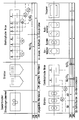
- the descaling system consists of a configuration of known individual units paired with a completely new concept of electrolytic pickling.
- emitters are provided (depending on the strip speed, 1 to n aggregates) in order to generate the free oxide surfaces required for annealed hot strip for the rapid formation of the required potential and thus for economical pickling.
- the electrolytic pickling that follows now offers in its new concept in cells based on the known system of electrolytic pickling with a switching of the current flow Anode length 1/3 cathode length 2/3 to work. The number (n) of cells depends on the belt speed. After these cells, a cell is installed that contains more than two anodes as current feeders. This is followed by a cell that contains only one cathode. This cathode is connected to one of the anodes from the anode cell via a rectifier.
- the strip Under the anode, the strip is cathodic and inevitably has a pH value of approx. 14 on the strip surface, which means that only the gas development is effective as a detachment factor for descaling.
- the tape On the cathodic side, however, the tape is anodic, so that a pH of approx. 0 is established on the tape surface. This corresponds to a 1-molar H 2 SO 4 on the belt. Only this section of the electrolytic pickling is able to ensure descaling down to the pores.
- the entire electrolytic part is run instead of or in addition to Na 2 SO 4 as an electrolyte with an approx. 3 mol-containing H 2 SO 4 in order to increase the gradient of the descaling effect.
- the use of a 3-molar H 2 SO 4 forms a dark-colored passive layer only in the cells arranged after the abrasive devices, in addition to the deep pore descaling.
- the layer thickness of this passive layer is 50-100 nm. In relation to the surface quality of the strip, this does not interfere with the rolling process. However, it has a positive effect on the reflection factor for the glow.
Landscapes
- Chemical & Material Sciences (AREA)
- Engineering & Computer Science (AREA)
- Chemical Kinetics & Catalysis (AREA)
- Electrochemistry (AREA)
- Materials Engineering (AREA)
- Metallurgy (AREA)
- Organic Chemistry (AREA)
- Heat Treatment Of Strip Materials And Filament Materials (AREA)
- Heat Treatment Of Sheet Steel (AREA)
- Cleaning And De-Greasing Of Metallic Materials By Chemical Methods (AREA)
- Cleaning By Liquid Or Steam (AREA)
Applications Claiming Priority (4)
| Application Number | Priority Date | Filing Date | Title |
|---|---|---|---|
| DE19535844 | 1995-09-15 | ||
| DE19535844 | 1995-09-15 | ||
| DE19537501A DE19537501A1 (de) | 1995-09-15 | 1995-09-26 | Verfahren und Anlage zur Herstellung von Banderzeugnissen aus nichtrostendem Stahl |
| DE19537501 | 1995-09-26 |
Publications (2)
| Publication Number | Publication Date |
|---|---|
| EP0763609A1 true EP0763609A1 (fr) | 1997-03-19 |
| EP0763609B1 EP0763609B1 (fr) | 1999-12-15 |
Family
ID=26018960
Family Applications (1)
| Application Number | Title | Priority Date | Filing Date |
|---|---|---|---|
| EP96250179A Expired - Lifetime EP0763609B1 (fr) | 1995-09-15 | 1996-08-19 | Procédé et dispositif pour le traitement de produits sous forme de bande en acier inoxydable |
Country Status (4)
| Country | Link |
|---|---|
| US (1) | US5804056A (fr) |
| EP (1) | EP0763609B1 (fr) |
| JP (1) | JPH09137300A (fr) |
| ES (1) | ES2142018T3 (fr) |
Cited By (6)
| Publication number | Priority date | Publication date | Assignee | Title |
|---|---|---|---|---|
| US6565735B1 (en) | 1998-09-11 | 2003-05-20 | Henkel Kommanditgesellschaft Auf Aktien | Process for electrolytic pickling using nitric acid-free solutions |
| EP2581143B1 (fr) * | 1999-01-26 | 2019-10-30 | Nippon Steel & Sumitomo Metal Corporation | Procédé pour éliminer et empêcher la formation de calamine |
| DE102018219198A1 (de) | 2018-11-12 | 2020-05-14 | Thyssenkrupp Ag | Kathodisches Beizverfahren zur beschleunigten Entzunderung ohne Ausbeizen der Korngrenze |
| DE102018219199A1 (de) | 2018-11-12 | 2020-05-14 | Thyssenkrupp Ag | Anodisches Beizverfahren zur Entzunderung und Verminderung der Korngrenzenoxidation |
| DE102020106353A1 (de) | 2020-03-09 | 2021-09-09 | Thyssenkrupp Steel Europe Ag | Verfahren zum Entzundern eines Stahlbands und Anlage zum Entzundern eines Stahlbands |
| EP4455374A1 (fr) * | 2023-04-24 | 2024-10-30 | ThyssenKrupp Steel Europe AG | Procédé de décapage électrolytique d'un feuillard à chaud |
Families Citing this family (13)
| Publication number | Priority date | Publication date | Assignee | Title |
|---|---|---|---|---|
| SE511777C2 (sv) * | 1998-02-02 | 1999-11-22 | Avesta Sheffield Ab | Metod för behandling av en metallprodukt |
| JP2996245B2 (ja) * | 1998-02-23 | 1999-12-27 | 住友金属工業株式会社 | 酸化スケ―ル層付きマルテンサイト系ステンレス鋼材およびその製造方法 |
| AT407755B (de) | 1998-07-15 | 2001-06-25 | Andritz Patentverwaltung | Verfahren zum beizen von edelstahl |
| AT408451B (de) | 1999-11-18 | 2001-12-27 | Andritz Ag Maschf | Verfahren zur herstellung von edelstahlbändern mit verbesserten oberflächeneigenschaften |
| US6814815B2 (en) | 2003-04-07 | 2004-11-09 | The Material Works, Ltd. | Method of removing scale and inhibiting oxidation in processed sheet metal |
| CN1280445C (zh) * | 2003-07-17 | 2006-10-18 | 住友金属工业株式会社 | 具有耐渗碳性和耐焦化性的不锈钢和不锈钢管 |
| US8278009B2 (en) * | 2004-03-18 | 2012-10-02 | Jfe Steel Corporation | Metallic material for conductive member, separator for fuel cell using the same, and fuel cell using the separator |
| CN108380582A (zh) * | 2018-05-08 | 2018-08-10 | 河南鑫轴传动机械有限公司 | 一种传动轴清洗工艺 |
| WO2021105738A1 (fr) * | 2019-11-25 | 2021-06-03 | Arcelormittal | Décapage électro-assisté de l'acier |
| CN212293834U (zh) * | 2020-04-29 | 2021-01-05 | 中冶南方工程技术有限公司 | 一种节能环保带钢电解酸洗系统 |
| CN113369233A (zh) * | 2021-06-15 | 2021-09-10 | 洛阳市中心医院(郑州大学附属洛阳中心医院) | 一种消毒供应中心用气管内套管清洗装置及方法 |
| KR20240057678A (ko) * | 2022-10-25 | 2024-05-03 | 주식회사 웨스코일렉트로드 | 동박 제조용 양극 재생을 위한 리드물질 제거방법 |
| CN122029307A (zh) * | 2023-10-20 | 2026-05-12 | 杰富意钢铁株式会社 | 钢板的氧化皮除去设备、钢板的制造设备、钢板的氧化皮除去方法及钢板的制造方法 |
Citations (4)
| Publication number | Priority date | Publication date | Assignee | Title |
|---|---|---|---|---|
| EP0235595A2 (fr) * | 1986-03-01 | 1987-09-09 | Hoesch Stahl Aktiengesellschaft | Procédé, installation et dispositif de dégraissage et de nettoyage en continu de bandes de métaux, en particulier de bandes d'acier laminées à froid |
| EP0367112A1 (fr) * | 1988-10-29 | 1990-05-09 | Hitachi, Ltd. | Procédé pour l'enlèvement de battitures d'acier inoxydable et dispositif à cet effet |
| EP0518850A1 (fr) * | 1991-06-10 | 1992-12-16 | Andritz-Patentverwaltungs-Gesellschaft m.b.H. | Procédé et dispositif de décapage électrolytique d'objets conducteurs électriques transportés en continu |
| EP0644276A1 (fr) * | 1993-09-17 | 1995-03-22 | Hitachi, Ltd. | Procédé et dispositif pour la fabrication et le décapage de tôles d'acier laminées à chaud |
Family Cites Families (3)
| Publication number | Priority date | Publication date | Assignee | Title |
|---|---|---|---|---|
| US3338809A (en) * | 1966-06-23 | 1967-08-29 | United States Steel Corp | Method of cleaning ferrous metal strands electrolytically, including moving said strands in a horizontal plane through an electrolyte while under the influence of alternating electrical fields |
| AT391486B (de) * | 1988-09-14 | 1990-10-10 | Andritz Ag Maschf | Verfahren zum elektrolytischen beizen von edelstahlband |
| US5525562A (en) * | 1994-01-25 | 1996-06-11 | Matsushita Electric Industrial Co., Ltd. | Dielectric ceramic compound |
-
1996
- 1996-08-19 EP EP96250179A patent/EP0763609B1/fr not_active Expired - Lifetime
- 1996-08-19 ES ES96250179T patent/ES2142018T3/es not_active Expired - Lifetime
- 1996-09-04 JP JP8253825A patent/JPH09137300A/ja active Pending
- 1996-09-13 US US08/715,394 patent/US5804056A/en not_active Expired - Fee Related
Patent Citations (4)
| Publication number | Priority date | Publication date | Assignee | Title |
|---|---|---|---|---|
| EP0235595A2 (fr) * | 1986-03-01 | 1987-09-09 | Hoesch Stahl Aktiengesellschaft | Procédé, installation et dispositif de dégraissage et de nettoyage en continu de bandes de métaux, en particulier de bandes d'acier laminées à froid |
| EP0367112A1 (fr) * | 1988-10-29 | 1990-05-09 | Hitachi, Ltd. | Procédé pour l'enlèvement de battitures d'acier inoxydable et dispositif à cet effet |
| EP0518850A1 (fr) * | 1991-06-10 | 1992-12-16 | Andritz-Patentverwaltungs-Gesellschaft m.b.H. | Procédé et dispositif de décapage électrolytique d'objets conducteurs électriques transportés en continu |
| EP0644276A1 (fr) * | 1993-09-17 | 1995-03-22 | Hitachi, Ltd. | Procédé et dispositif pour la fabrication et le décapage de tôles d'acier laminées à chaud |
Cited By (7)
| Publication number | Priority date | Publication date | Assignee | Title |
|---|---|---|---|---|
| US6565735B1 (en) | 1998-09-11 | 2003-05-20 | Henkel Kommanditgesellschaft Auf Aktien | Process for electrolytic pickling using nitric acid-free solutions |
| EP2581143B1 (fr) * | 1999-01-26 | 2019-10-30 | Nippon Steel & Sumitomo Metal Corporation | Procédé pour éliminer et empêcher la formation de calamine |
| DE102018219198A1 (de) | 2018-11-12 | 2020-05-14 | Thyssenkrupp Ag | Kathodisches Beizverfahren zur beschleunigten Entzunderung ohne Ausbeizen der Korngrenze |
| DE102018219199A1 (de) | 2018-11-12 | 2020-05-14 | Thyssenkrupp Ag | Anodisches Beizverfahren zur Entzunderung und Verminderung der Korngrenzenoxidation |
| DE102020106353A1 (de) | 2020-03-09 | 2021-09-09 | Thyssenkrupp Steel Europe Ag | Verfahren zum Entzundern eines Stahlbands und Anlage zum Entzundern eines Stahlbands |
| EP3879008A1 (fr) | 2020-03-09 | 2021-09-15 | ThyssenKrupp Steel Europe AG | Procédé de décapage d'une bande d'acier et installation de décapage d'une bande d'acier |
| EP4455374A1 (fr) * | 2023-04-24 | 2024-10-30 | ThyssenKrupp Steel Europe AG | Procédé de décapage électrolytique d'un feuillard à chaud |
Also Published As
| Publication number | Publication date |
|---|---|
| ES2142018T3 (es) | 2000-04-01 |
| EP0763609B1 (fr) | 1999-12-15 |
| US5804056A (en) | 1998-09-08 |
| JPH09137300A (ja) | 1997-05-27 |
Similar Documents
| Publication | Publication Date | Title |
|---|---|---|
| EP0763609B1 (fr) | Procédé et dispositif pour le traitement de produits sous forme de bande en acier inoxydable | |
| DE69516336T2 (de) | Verfahren zur herstellung eines stahlbleches mit hoher korrosionsbeständigkeit | |
| DE69618414T2 (de) | Verfahren zur kontinuierlichen Herstellung in einer Linie von einem aus nichtrostendem Stahl gewalzten Blechband mit verbessertem Oberflächenzustand | |
| EP0770707B1 (fr) | Procédé de fabrication en continu de bandes laminées au froid | |
| DE60315129T2 (de) | Verfahren zur herstellung eines eisenhüttenprodukts aus unlegiertem stahl mit hohem kupfergehalt und danach erhaltenes eisenhüttenprodukt | |
| EP2690183B1 (fr) | Produit plat en acier laminé à chaud et son procédé de fabrication | |
| DE69919031T2 (de) | Verfahren zur herstellung rostfreier stahlbänder und integrierter walzstrasse | |
| EP2235229B9 (fr) | Procédé pour appliquer une couche de protection métallique sur un produit plat en acier laminé à chaud ou à froid contenant 6 - 30% en poids de mn | |
| DE4423664A1 (de) | Verfahren zum Herstellen von kaltgewalzten Stahlbändern aus nichtrostendem Stahl und Metallbändern, insbesondere aus Titanlegierungen | |
| DE69930303T2 (de) | Verfahren zur herstellung von bändern und walzstrasse | |
| DE69206478T2 (de) | Verfahren zum Beizen von metallischen Materialien auf Stahlbasis. | |
| DE69410559T2 (de) | Verfahren und Vorrichtung zur Entzunderung eines heissgewalzten Stahlbandes | |
| DE68912517T2 (de) | Verfahren zum Entzundern von rostfreiem Stahl und Vorrichtung dafür. | |
| DE602005005462T2 (de) | Verfahren zur herstellung von bändern aus austenitischem rostfreiem stahl mit matter oberfläche | |
| DE102010026757B4 (de) | Verfahren und Produktionslinie zum Herstellen eines kaltgewalzten Stahlflachprodukts aus einem nicht rostenden Stahl | |
| WO2015024903A1 (fr) | Procédé permettant de produire un élément structural en acier | |
| DE2601443B2 (de) | Verfahren zur kontinuierlichen Wärmebehandlung von Kaltband | |
| DE10221793C1 (de) | Nichtkornorientiertes Elektroband oder -blech und Verfahren zu seiner Herstellung | |
| EP0708843B1 (fr) | Procede et installation permettant de realiser des ebauches en acier special | |
| DE69932035T2 (de) | Verfahren zur behandlung eines metallproduktes | |
| DE60203733T2 (de) | In-line-verfahren zum rekristallisieren von erstarrten grobbändern in unlegiertem stahl und niedrig legiertem stahl | |
| EP1525060B1 (fr) | Procede et dispositif de fabrication en continu de bandes metalliques | |
| DE60105653T2 (de) | Kontinuierliches elektrolytisches beizen und entzundern von unlegiertem stahl und nichtrostendem stahl | |
| DE1903554B2 (de) | Walz verfahren zum Herstellen eines tiefziehfähigen Stahlbandes | |
| DE19537501A1 (de) | Verfahren und Anlage zur Herstellung von Banderzeugnissen aus nichtrostendem Stahl |
Legal Events
| Date | Code | Title | Description |
|---|---|---|---|
| PUAI | Public reference made under article 153(3) epc to a published international application that has entered the european phase |
Free format text: ORIGINAL CODE: 0009012 |
|
| AK | Designated contracting states |
Kind code of ref document: A1 Designated state(s): DE ES FI FR IT SE |
|
| 17P | Request for examination filed |
Effective date: 19970325 |
|
| 17Q | First examination report despatched |
Effective date: 19980727 |
|
| GRAG | Despatch of communication of intention to grant |
Free format text: ORIGINAL CODE: EPIDOS AGRA |
|
| GRAG | Despatch of communication of intention to grant |
Free format text: ORIGINAL CODE: EPIDOS AGRA |
|
| GRAH | Despatch of communication of intention to grant a patent |
Free format text: ORIGINAL CODE: EPIDOS IGRA |
|
| GRAH | Despatch of communication of intention to grant a patent |
Free format text: ORIGINAL CODE: EPIDOS IGRA |
|
| GRAA | (expected) grant |
Free format text: ORIGINAL CODE: 0009210 |
|
| AK | Designated contracting states |
Kind code of ref document: B1 Designated state(s): DE ES FI FR IT SE |
|
| ET | Fr: translation filed | ||
| REF | Corresponds to: |
Ref document number: 59603912 Country of ref document: DE Date of ref document: 20000120 |
|
| ITF | It: translation for a ep patent filed | ||
| REG | Reference to a national code |
Ref country code: ES Ref legal event code: FG2A Ref document number: 2142018 Country of ref document: ES Kind code of ref document: T3 |
|
| PLBE | No opposition filed within time limit |
Free format text: ORIGINAL CODE: 0009261 |
|
| STAA | Information on the status of an ep patent application or granted ep patent |
Free format text: STATUS: NO OPPOSITION FILED WITHIN TIME LIMIT |
|
| 26N | No opposition filed | ||
| PGFP | Annual fee paid to national office [announced via postgrant information from national office to epo] |
Ref country code: SE Payment date: 20030808 Year of fee payment: 8 Ref country code: FI Payment date: 20030808 Year of fee payment: 8 Ref country code: ES Payment date: 20030808 Year of fee payment: 8 |
|
| PGFP | Annual fee paid to national office [announced via postgrant information from national office to epo] |
Ref country code: FR Payment date: 20030813 Year of fee payment: 8 |
|
| PG25 | Lapsed in a contracting state [announced via postgrant information from national office to epo] |
Ref country code: FI Free format text: LAPSE BECAUSE OF NON-PAYMENT OF DUE FEES Effective date: 20040819 |
|
| PG25 | Lapsed in a contracting state [announced via postgrant information from national office to epo] |
Ref country code: SE Free format text: LAPSE BECAUSE OF NON-PAYMENT OF DUE FEES Effective date: 20040820 Ref country code: ES Free format text: LAPSE BECAUSE OF NON-PAYMENT OF DUE FEES Effective date: 20040820 |
|
| EUG | Se: european patent has lapsed | ||
| PG25 | Lapsed in a contracting state [announced via postgrant information from national office to epo] |
Ref country code: FR Free format text: LAPSE BECAUSE OF NON-PAYMENT OF DUE FEES Effective date: 20050429 |
|
| REG | Reference to a national code |
Ref country code: FR Ref legal event code: ST |
|
| PG25 | Lapsed in a contracting state [announced via postgrant information from national office to epo] |
Ref country code: IT Free format text: LAPSE BECAUSE OF NON-PAYMENT OF DUE FEES;WARNING: LAPSES OF ITALIAN PATENTS WITH EFFECTIVE DATE BEFORE 2007 MAY HAVE OCCURRED AT ANY TIME BEFORE 2007. THE CORRECT EFFECTIVE DATE MAY BE DIFFERENT FROM THE ONE RECORDED. Effective date: 20050819 |
|
| REG | Reference to a national code |
Ref country code: ES Ref legal event code: FD2A Effective date: 20040820 |
|
| PGFP | Annual fee paid to national office [announced via postgrant information from national office to epo] |
Ref country code: DE Payment date: 20060816 Year of fee payment: 11 |
|
| PG25 | Lapsed in a contracting state [announced via postgrant information from national office to epo] |
Ref country code: DE Free format text: LAPSE BECAUSE OF NON-PAYMENT OF DUE FEES Effective date: 20080301 |