EP0763620A2 - Polyurethanfaser enthaltendes Textilmaterial mit verbesserten Absorptions-/Ausdünstungseigenschaften - Google Patents
Polyurethanfaser enthaltendes Textilmaterial mit verbesserten Absorptions-/Ausdünstungseigenschaften Download PDFInfo
- Publication number
- EP0763620A2 EP0763620A2 EP95116163A EP95116163A EP0763620A2 EP 0763620 A2 EP0763620 A2 EP 0763620A2 EP 95116163 A EP95116163 A EP 95116163A EP 95116163 A EP95116163 A EP 95116163A EP 0763620 A2 EP0763620 A2 EP 0763620A2
- Authority
- EP
- European Patent Office
- Prior art keywords
- fibers
- wool
- protein
- wool protein
- textile product
- Prior art date
- Legal status (The legal status is an assumption and is not a legal conclusion. Google has not performed a legal analysis and makes no representation as to the accuracy of the status listed.)
- Granted
Links
Images



Classifications
-
- D—TEXTILES; PAPER
- D06—TREATMENT OF TEXTILES OR THE LIKE; LAUNDERING; FLEXIBLE MATERIALS NOT OTHERWISE PROVIDED FOR
- D06M—TREATMENT, NOT PROVIDED FOR ELSEWHERE IN CLASS D06, OF FIBRES, THREADS, YARNS, FABRICS, FEATHERS OR FIBROUS GOODS MADE FROM SUCH MATERIALS
- D06M11/00—Treating fibres, threads, yarns, fabrics or fibrous goods made from such materials, with inorganic substances or complexes thereof; Such treatment combined with mechanical treatment, e.g. mercerising
- D06M11/32—Treating fibres, threads, yarns, fabrics or fibrous goods made from such materials, with inorganic substances or complexes thereof; Such treatment combined with mechanical treatment, e.g. mercerising with oxygen, ozone, ozonides, oxides, hydroxides or percompounds; Salts derived from anions with an amphoteric element-oxygen bond
- D06M11/50—Treating fibres, threads, yarns, fabrics or fibrous goods made from such materials, with inorganic substances or complexes thereof; Such treatment combined with mechanical treatment, e.g. mercerising with oxygen, ozone, ozonides, oxides, hydroxides or percompounds; Salts derived from anions with an amphoteric element-oxygen bond with hydrogen peroxide or peroxides of metals; with persulfuric, permanganic, pernitric, percarbonic acids or their salts
-
- D—TEXTILES; PAPER
- D06—TREATMENT OF TEXTILES OR THE LIKE; LAUNDERING; FLEXIBLE MATERIALS NOT OTHERWISE PROVIDED FOR
- D06M—TREATMENT, NOT PROVIDED FOR ELSEWHERE IN CLASS D06, OF FIBRES, THREADS, YARNS, FABRICS, FEATHERS OR FIBROUS GOODS MADE FROM SUCH MATERIALS
- D06M15/00—Treating fibres, threads, yarns, fabrics, or fibrous goods made from such materials, with macromolecular compounds; Such treatment combined with mechanical treatment
- D06M15/01—Treating fibres, threads, yarns, fabrics, or fibrous goods made from such materials, with macromolecular compounds; Such treatment combined with mechanical treatment with natural macromolecular compounds or derivatives thereof
- D06M15/03—Polysaccharides or derivatives thereof
-
- D—TEXTILES; PAPER
- D06—TREATMENT OF TEXTILES OR THE LIKE; LAUNDERING; FLEXIBLE MATERIALS NOT OTHERWISE PROVIDED FOR
- D06M—TREATMENT, NOT PROVIDED FOR ELSEWHERE IN CLASS D06, OF FIBRES, THREADS, YARNS, FABRICS, FEATHERS OR FIBROUS GOODS MADE FROM SUCH MATERIALS
- D06M15/00—Treating fibres, threads, yarns, fabrics, or fibrous goods made from such materials, with macromolecular compounds; Such treatment combined with mechanical treatment
- D06M15/01—Treating fibres, threads, yarns, fabrics, or fibrous goods made from such materials, with macromolecular compounds; Such treatment combined with mechanical treatment with natural macromolecular compounds or derivatives thereof
- D06M15/15—Proteins or derivatives thereof
-
- D—TEXTILES; PAPER
- D06—TREATMENT OF TEXTILES OR THE LIKE; LAUNDERING; FLEXIBLE MATERIALS NOT OTHERWISE PROVIDED FOR
- D06M—TREATMENT, NOT PROVIDED FOR ELSEWHERE IN CLASS D06, OF FIBRES, THREADS, YARNS, FABRICS, FEATHERS OR FIBROUS GOODS MADE FROM SUCH MATERIALS
- D06M2101/00—Chemical constitution of the fibres, threads, yarns, fabrics or fibrous goods made from such materials, to be treated
- D06M2101/16—Synthetic fibres, other than mineral fibres
- D06M2101/30—Synthetic polymers consisting of macromolecular compounds obtained otherwise than by reactions only involving carbon-to-carbon unsaturated bonds
- D06M2101/38—Polyurethanes
-
- D—TEXTILES; PAPER
- D06—TREATMENT OF TEXTILES OR THE LIKE; LAUNDERING; FLEXIBLE MATERIALS NOT OTHERWISE PROVIDED FOR
- D06M—TREATMENT, NOT PROVIDED FOR ELSEWHERE IN CLASS D06, OF FIBRES, THREADS, YARNS, FABRICS, FEATHERS OR FIBROUS GOODS MADE FROM SUCH MATERIALS
- D06M2200/00—Functionality of the treatment composition and/or properties imparted to the textile material
-
- Y—GENERAL TAGGING OF NEW TECHNOLOGICAL DEVELOPMENTS; GENERAL TAGGING OF CROSS-SECTIONAL TECHNOLOGIES SPANNING OVER SEVERAL SECTIONS OF THE IPC; TECHNICAL SUBJECTS COVERED BY FORMER USPC CROSS-REFERENCE ART COLLECTIONS [XRACs] AND DIGESTS
- Y10—TECHNICAL SUBJECTS COVERED BY FORMER USPC
- Y10T—TECHNICAL SUBJECTS COVERED BY FORMER US CLASSIFICATION
- Y10T428/00—Stock material or miscellaneous articles
- Y10T428/29—Coated or structually defined flake, particle, cell, strand, strand portion, rod, filament, macroscopic fiber or mass thereof
- Y10T428/2913—Rod, strand, filament or fiber
-
- Y—GENERAL TAGGING OF NEW TECHNOLOGICAL DEVELOPMENTS; GENERAL TAGGING OF CROSS-SECTIONAL TECHNOLOGIES SPANNING OVER SEVERAL SECTIONS OF THE IPC; TECHNICAL SUBJECTS COVERED BY FORMER USPC CROSS-REFERENCE ART COLLECTIONS [XRACs] AND DIGESTS
- Y10—TECHNICAL SUBJECTS COVERED BY FORMER USPC
- Y10T—TECHNICAL SUBJECTS COVERED BY FORMER US CLASSIFICATION
- Y10T428/00—Stock material or miscellaneous articles
- Y10T428/29—Coated or structually defined flake, particle, cell, strand, strand portion, rod, filament, macroscopic fiber or mass thereof
- Y10T428/2913—Rod, strand, filament or fiber
- Y10T428/2933—Coated or with bond, impregnation or core
-
- Y—GENERAL TAGGING OF NEW TECHNOLOGICAL DEVELOPMENTS; GENERAL TAGGING OF CROSS-SECTIONAL TECHNOLOGIES SPANNING OVER SEVERAL SECTIONS OF THE IPC; TECHNICAL SUBJECTS COVERED BY FORMER USPC CROSS-REFERENCE ART COLLECTIONS [XRACs] AND DIGESTS
- Y10—TECHNICAL SUBJECTS COVERED BY FORMER USPC
- Y10T—TECHNICAL SUBJECTS COVERED BY FORMER US CLASSIFICATION
- Y10T428/00—Stock material or miscellaneous articles
- Y10T428/29—Coated or structually defined flake, particle, cell, strand, strand portion, rod, filament, macroscopic fiber or mass thereof
- Y10T428/2913—Rod, strand, filament or fiber
- Y10T428/2933—Coated or with bond, impregnation or core
- Y10T428/2938—Coating on discrete and individual rods, strands or filaments
-
- Y—GENERAL TAGGING OF NEW TECHNOLOGICAL DEVELOPMENTS; GENERAL TAGGING OF CROSS-SECTIONAL TECHNOLOGIES SPANNING OVER SEVERAL SECTIONS OF THE IPC; TECHNICAL SUBJECTS COVERED BY FORMER USPC CROSS-REFERENCE ART COLLECTIONS [XRACs] AND DIGESTS
- Y10—TECHNICAL SUBJECTS COVERED BY FORMER USPC
- Y10T—TECHNICAL SUBJECTS COVERED BY FORMER US CLASSIFICATION
- Y10T428/00—Stock material or miscellaneous articles
- Y10T428/29—Coated or structually defined flake, particle, cell, strand, strand portion, rod, filament, macroscopic fiber or mass thereof
- Y10T428/2913—Rod, strand, filament or fiber
- Y10T428/2933—Coated or with bond, impregnation or core
- Y10T428/2964—Artificial fiber or filament
- Y10T428/2967—Synthetic resin or polymer
-
- Y—GENERAL TAGGING OF NEW TECHNOLOGICAL DEVELOPMENTS; GENERAL TAGGING OF CROSS-SECTIONAL TECHNOLOGIES SPANNING OVER SEVERAL SECTIONS OF THE IPC; TECHNICAL SUBJECTS COVERED BY FORMER USPC CROSS-REFERENCE ART COLLECTIONS [XRACs] AND DIGESTS
- Y10—TECHNICAL SUBJECTS COVERED BY FORMER USPC
- Y10T—TECHNICAL SUBJECTS COVERED BY FORMER US CLASSIFICATION
- Y10T428/00—Stock material or miscellaneous articles
- Y10T428/29—Coated or structually defined flake, particle, cell, strand, strand portion, rod, filament, macroscopic fiber or mass thereof
- Y10T428/2913—Rod, strand, filament or fiber
- Y10T428/2933—Coated or with bond, impregnation or core
- Y10T428/2971—Impregnation
Definitions
- the present invention relates to a modification of fibers or a textile product containing polyurethane fibers. More particularly, it relates to a process for modifying a stuffy feeling caused by a hydrophobic nature of the fibers or textile product in case of contacting directly with skin.
- the hard protein is easily dissolved in water and, therefore, it is highly hydrolyzed and the molecular weight of its peptide becomes considerably small. Accordingly, the hard protein is not much different from the above protein, as far as sweat absorption/exhalation properties are concerned.
- polyurethane fibers are imparted with a wool protein, by which the polyurethane fibers are improved in an affinity with skin and good sweat absorption properties, and the wool protein has a high affinity with polyurethane fibers in comparison with other hydrophobic fibers which constitute a processed yarn, together with polyurethane fibers or which are mixed-woven or knitted together with polyurethane fibers, and the wool protein is selectively adsorbed on polyurethane fibers.
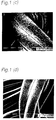
- Figs. 1 (a) to (d) are electron micrographs illustrating a difference in imparting state of a wool protein to polyurethane fibers and nylon.
- Fig. 1 (a) is an electron micrograph illustrating a yarn after subjecting to a wool protein imparting treatment (no preliminary treatment: Example 2, 550X magnification).
- Fig. 1 (d) is an electron micrograph illustrating a non-treated yarn (550X magnification).
- Fig. 2 is a graph illustrating a liquid chromatogram of a wool protein, wherein (a) is a liquid chromatogram of a water-soluble wool protein of the present invention and (b) is that of a protein of which molecular weight is known.
- Figs. 3 (A) and (B) are graphs illustrating a change in temperature and humidity with time between panty hose and skin, as a measure of sweat absorption/exhalation properties on wearing of panty hose.
- Fig. 3 (B) is a graph illustrating test results under a constant temperature (25°C), wherein (a) is the present invention (Example 3) and (b) is Comparative Example 2.
- Fig. 6 is a graph illustrating a comparison in moisture exhalation properties (drying rate) between textile products of the present invention (Example 1) and Comparative Example (Comparative Examples 1 and 2), wherein (a) is Example 1, (b) is Comparative Example 1 and (c) is Comparative Example 2.
- Fig. 7 is a schematic diagram illustrating a method for moisture exhalation properties test.
- Fig. 8 is a graph illustrating a comparison in relation between the surface skin temperature and temperature in clothes on wearing of textile products of the present invention (Example 3) and Comparative Example (Comparative Examples 2), wherein (a) is Example 3 and (b) is Comparative Example 2.
- the present invention relates to fibers or a textile product comprising polyurethane fibers on which a wool protein is imparted.
- the wool protein is a water-soluble wool protein obtained by subjecting a wool to oxidation cleavage in a weak alkaline liquid medium containing an oxidizing agent having a comparatively high concentration.
- the present invention relates to a process for producing fibers or a textile product, which comprises dipping fibers or a textile product containing polyurethane fibers in a water-soluble wool protein solution to selectively adsorb a wool protein on polyurethane fibers.
- the fibers or textile product containing polyurethane fibers are subjected to a preliminary treatment by dipping in a chitosan solution before dipping in a water-soluble protein solution, or chitosan is allowed to be present in the wool protein solution.
- the leg knit using polyurethane fibers is made by mixed-knitting of a remaindered type knit produced by using a processed yarn consisting of polyurethane fibers and nylon or polyester, or such a processed yarn and other synthetic fibers (mainly, nylon or polyester).
- a processed yarn consisting of polyurethane fibers and nylon or polyester, or such a processed yarn and other synthetic fibers (mainly, nylon or polyester).
- this protein is selectively adsorbed on polyurethane fibers (comparatively thick fibers in the electron micrograph) and is hardly adsorbed on nylon or polyester fibers as the other material.
- the solubilization of the wool varies depending on the kind and concentration of the oxidizing agent and kind of the dissolving medium to be used, and the solubilizing time is normally about 0.1 to 1.0 hour.
- the solubilizing time is normally about 0.1 to 1.0 hour.
- the temperature naturally increase to about 100°C when the wool is dipped in it, and the solubilization will be completed within one hour and a non-dissolved material is hardly remained.
- cystine is subjected to oxidation cleavage to form a cysteic acid.
- a sulfoxide group contained in cysteic acid acts as a dissolution point of the protein and, at the same time, it has an ionic bonding-like affinity between a cationic functional group preparation process, the horny protein is not exposed to a crushing chemical change and, therefore, the amino acid composition is almost the same as that of wool fibers.
- Japanese Patent Application KOKAI No. 5-70339 it can also be used as a cosmetic composition and, therefore, it has no problem in safety.
- a pure wool protein can be recovered as a solid (powder).
- the wool protein may be used in the form of solution in the present invention, and it is not necessary to recover it as the solid.
- a wool protein solution is prepared by using an ultrafiltration technique, as a method which is easily derived from the technique disclosed above.
- the treatment due to a preliminary treating agent may be carried out by impregnating a fiber or textile product to be treated with a preliminary treating agent solution before dipping in a wool protein solution and then transferring it to the wool protein solution as it is.
- a preliminary treating agent solution before dipping in a wool protein solution and then transferring it to the wool protein solution as it is.
- the effect of both preliminary treatment and wool protein treatment can be easily obtained only by dipping a product to be treated in a solution containing chitosan and wool protein.
- Chitosan itself can be dissolved in an aqueous citric acid solution (pH 3 to 4) to form an aqueous solution. Chitosan forms a fine suspension with the wool protein in a bath to make the solution cloudy.
- the amount of the preliminary treating agent is preferably 1 to 10% by weight, particularly 2 to 7% by weight, based on the amount of polyurethane fibers (conversion based on chitosan solid content).
- the product obtained by using chitosan alone in the amount defined in the present invention shown no antibacterial properties, but the product obtained by using the wool protein in combination with chitosan has excellent antibacterial properties.
- the details of this mechanism are not apparent, but it is considered that antibacterial properties are obtained when a lot of amino groups are contained in both wool protein and chitosan.
- diisocyanate for example, aromatic diisocyanates such as tolylene diisocyanate (TDI), 4,4-diphenylmethane diisocyanate (MDI), etc.; aliphatic diisocyanates such as hexamethylene diisocyanate, etc.; cyclic aliphatic diisocyanates such as isophorone diisocyanate, etc. are normally used.
- aromatic diisocyanates such as tolylene diisocyanate (TDI), 4,4-diphenylmethane diisocyanate (MDI), etc.
- aliphatic diisocyanates such as hexamethylene diisocyanate, etc.
- cyclic aliphatic diisocyanates such as isophorone diisocyanate, etc.
- the polyurethane fibers are hardly used alone, and used as a processed yarn such as covered yarn wherein other normal fibers, particularly nylon or polyester fibers, are spirally wound on polyurethane. Not only such a processed yarn is used alone, but also it is subjected to mixed-knitting or weaving together with other materials to make a textile product.
- a cover yarn is exclusively made of nylon.
- another material is also exclusively made of nylon.
- Blue dextran 2000 molecular weight: 2,000,000
- Rabbit IgG molecular weight: 160,000
- Bovine Serum Albumin BSA, molecular weight: 67,000
- ⁇ -Chymotrypsin molecular weight: 25,000
- panty hose As the textile product, panty hose according to the following specification were used.
- panty hose 80 kg were refined and dyed according to a usual method, using an Over Mayer dyeing apparatus (a flow chart of a dyeing process in series is shown in Fig. 9).
- the panty hose is dipped into an aqueous solution of a refining agent such as Sunmorl* WX-24 3.5% OWF (available from Nicca Kagaku Co., Ltd.) at 98 °C and kept for 20 minutes; washed by water 4 times with complete substitution of washing water; dipped into an aqueous dyeing auxiliaries (e.g.
- a refining agent such as Sunmorl* WX-24 3.5% OWF (available from Nicca Kagaku Co., Ltd.)
- Sandogen* PLK available from Sandoz
- Clewat* N 2 (Teikoku Kagaku K.K.) 0.2% OWF and ammonium sulfate 3% OWF)
- a dyeing solution e.g. Nylosan* (available from Sandoz) X%)
- heated to 98 °C over 50 minutes and kept at 45 minutes washed 4 times with complete substitution with fresh water, added with aqueous solution of formic acid 0.3% OWF; and then the dyed panty hose is dipped into an aqueous solution of fixing agent (e.g.
- the panty hose subjected to a preliminary treatment with chitosan as described above was treated at a bath ratio of 1:8 at room temperature for 30 minutes in a drum dyeing apparatus equipped with a centrifugal hydroextractor capable of recovering a solution, which contains a solution prepared by diluting the wool protein solution prepared above with water in a ratio of 1:3 and adding 8 g/L of a softener ("Evafanol* N-33" manufactured by Nicca Kagaku Co., Ltd.).
- the treating solution was recovered and the panty hose were taken out from the dyeing apparatus.
- the pickup ratio of the treating solution onto the panty hose was 25% by weight.
- panty hose were further subjected to a steam treatment at a vapor pressure of 0.8 kg/cm 2 for 10 seconds (using "TAS-150” manufactured by Takatori Co., Ltd.), followed by hot-air drying at 110°C for 25 seconds to give a product.
- Example 2 According to the same manner as that described in Example 1 except that the preliminary treatment due to chitosan is not carried out, a treatment of imparting a wool protein to the panty hose was carried out.
- panty hose 80 kg were refined, dyed and subjected to a fix treatment using an Over Mayer dyeing apparatus. and then washed with water and dehydrated using a centrifugal hydroextractor.
- Example 2 According to the same manner as that described in Example 1, a treatment of panty hose was carried out using the wool protein solution recovered in Example 1, repeatedly.
- Example 3 According to the same manner as that described in Example 3 except that a treatment due to chitosan and wool protein was not carried out and a treating solution containing only Evafanol* N-33 as the softener was used, a product subjected to wool protein imparting treatment was obtained.
- panty hose treated with chitosan was obtained.
- Fig. 1 is an electron micrograph illustrating the surface shape thereof.
- Fig. 1 (a) is an electron micrograph illustrating the surface shape of a yarn wherein a wool protein is imparted without subjecting to a preliminary treatment due to chitosan.
- Fig. 1 (b) is an electron micrograph illustrating the surface shape of a yarn wherein a wool protein is imparted after subjecting to the preliminary treatment due to chitosan of Example 1.
- Fig. 1 (c) is an electron micrograph illustrating the surface shape of a yarn obtained after subjecting the yarn of Fig. 1 (b) to a washing treatment.
- Fig. 1 (d) is an electron micrograph illustrating the surface shape of a yarn subjected to no wool protein treatment for comparison. It is confirmed that the wool protein is selectively adsorbed only on the surface of polyurethane fibers by the treatments of Examples 1 and 2, and that the wool protein of panty hose subjected to a preliminary treatment due to chitosan is held after washing.
- panty hose of Example 3 and Comparative Example 2 were used as the sample.
- Fig. 3 (A) is a graph illustrating test results under a constant humidity (70% RH).
- Fig. 3 (B) is a graph illustrating test results under a constant temperature (25°C).
- Example 3 The processed product of Example 3 showed a pleasant effect due to the moisture adsorption effect, but panty hose of Comparative Example 2 afforded a stuffy feeling.
- panty hose of Example 1 and Comparative Example 2 were used as the sample.
- the equilibrium water content of the panty hose of Example 3 of the present invention was 5.0% by weight and that of Comparative Example 2 was 3.9% by weight. It is shown that the textile product of the present invention has a high moisture uptake.
- a test of moisture exhalation properties of panty hose was carried out in a temperature controlling room maintained at 20°C (65% RH) using the apparatus shown in Fig. 7.
- Panty hose were mounted on a retaining mold while stretching to the same size and the resulting sample was placed on a water drop (1 cc, 1 g) formed on a polyvinyl chloride sheet. Immediately after that, a decrease in weight was measured with time. This decrease in weight has a relation with moisture exhalation properties of water to be absorbed into panty host, and the moisture exhalation properties (moisture exhalation rate) were evaluated by the gradient of the graph.
- Example 1 is superior in water absorption/diffusion properties as shown in Table 1 and is also superior in moisture exhalation properties as shown in Fig. 6.
- the sample of Comparative Example 2 is inferior in moisture absorption/diffusion properties (Table 1) and is also inferior in water exhalation properties (Fig. 6).
- the sample of Comparative Example 1 is comparatively superior in moisture absorption/exhalation properties, but is inferior in water exhalation rate to the sample of Example 1.
- the panty hose of Example 1 shows a pleasant wear feeling.
- Panty hose obtained in Examples 1 to 5 and Comparative Examples 1 to 2 were subjected to a washing treatment using the method according to JIS L0217 104. Water absorption properties of the panty hose before and after washing were evaluated by a dropping method defined in JIS L 1018. The results are shown in Table 1.
- the panty hose (Examples 1, 3, 4 and 5) as the textile products of the present invention absorbed water and diffused, rapidly, after washing treatment.
- the panty hose of Example 2 which was not subjected to a preliminary treatment due to chitosan, showed excellent water absorption properties and diffusion properties before washing, but showed no water absorption properties after washing and are liable to repel water.
- the product of Comparative Example 1 was liable to absorb water, but the water absorption properties were low in comparison with Examples 1 to 5.
- the following bacteria were suspended in a sterilized liquid bouillon, and 0.2 ml of the resulting solution (viable microbe cell number: about 410,000) was inoculated on a test piece (0.2 g). After culturing at 37°C for 18 hours, the test piece was removed. The number of viable microbe cells on the test piece before and after culturing was measured, and the increase/decrease ratio, increase/decrease value and difference in increase/decrease ratio of the viable microbe cell number were calculated using the following calculation formula.
- Example 3 shows a large thermolysis effect in comparison with Comparative Example 2. Accordingly, the panty hose of the present invention are pleasant due to the following reason. That is, perspiration is little when it is cold and, therefore, the skin temperature does not decrease due to the thermal effect. On the other hand, perspiration is large when it is hot and, therefore, the skin temperature decreases due to the thermolysis effect.
Landscapes
- Engineering & Computer Science (AREA)
- Textile Engineering (AREA)
- Treatments For Attaching Organic Compounds To Fibrous Goods (AREA)
- Socks And Pantyhose (AREA)
- Polysaccharides And Polysaccharide Derivatives (AREA)
- Polyurethanes Or Polyureas (AREA)
- Artificial Filaments (AREA)
- Yarns And Mechanical Finishing Of Yarns Or Ropes (AREA)
Applications Claiming Priority (3)
| Application Number | Priority Date | Filing Date | Title |
|---|---|---|---|
| JP20436195 | 1995-08-10 | ||
| JP204361/95 | 1995-08-10 | ||
| JP20436195A JP3413315B2 (ja) | 1995-08-10 | 1995-08-10 | 吸汗発散性を改質したポリウレタン繊維含有繊維製品およびその製造法 |
Publications (3)
| Publication Number | Publication Date |
|---|---|
| EP0763620A2 true EP0763620A2 (de) | 1997-03-19 |
| EP0763620A3 EP0763620A3 (de) | 1998-02-04 |
| EP0763620B1 EP0763620B1 (de) | 2004-01-07 |
Family
ID=16489246
Family Applications (1)
| Application Number | Title | Priority Date | Filing Date |
|---|---|---|---|
| EP95116163A Expired - Lifetime EP0763620B1 (de) | 1995-08-10 | 1995-10-13 | Polyurethanfaser enthaltendes Textilmaterial mit verbesserten Absorptions-/Ausdünstungseigenschaften |
Country Status (6)
| Country | Link |
|---|---|
| US (1) | US5622531A (de) |
| EP (1) | EP0763620B1 (de) |
| JP (1) | JP3413315B2 (de) |
| CN (1) | CN1142553A (de) |
| DE (1) | DE69532413T2 (de) |
| TW (1) | TW311954B (de) |
Cited By (5)
| Publication number | Priority date | Publication date | Assignee | Title |
|---|---|---|---|---|
| FR2780073A1 (fr) * | 1998-06-19 | 1999-12-24 | Dim Sa | Textile bio-actif comportant dans ses fibres de la proteine de soie et des microcapsules de produit actif |
| US6497893B1 (en) | 1999-06-30 | 2002-12-24 | Kimberly-Clark Worldwide, Inc. | Silk protein treatment composition and treated substrate for transfer to skin |
| US6500443B1 (en) | 1999-06-30 | 2002-12-31 | Kimberly-Clark Worldwide, Inc. | Delivery of a sacrificial substrate to inhibit protease permeation into skin |
| US6503524B1 (en) | 2000-06-16 | 2003-01-07 | Kimberly-Clark Worldwide, Inc. | Delivery of a skin health benefit agent to a treated substrate for transfer to skin |
| US6506394B1 (en) | 1999-06-30 | 2003-01-14 | Kimberly-Clark Worldwide, Inc. | Delivery of a botanical extract to a treated substrate for transfer to skin |
Families Citing this family (17)
| Publication number | Priority date | Publication date | Assignee | Title |
|---|---|---|---|---|
| JP3481383B2 (ja) | 1996-02-19 | 2003-12-22 | 倉敷紡績株式会社 | 吸汗発散性に優れたポリウレタン繊維含有繊維製品およびその製造方法 |
| CA2251961C (en) * | 1996-04-19 | 2007-03-20 | Idemitsu Petrochemical Company Limited | Surface treatment chemicals, fiber and product treated with the surface treatment chemicals |
| US6899545B2 (en) * | 2003-10-16 | 2005-05-31 | Special Hermetic Products, Inc. | Coupling and method for producing a hermetic seal |
| US20060174420A1 (en) * | 2005-02-08 | 2006-08-10 | Yi Li | Method of treating fabrics and fibres |
| DE102007029533A1 (de) * | 2007-06-25 | 2009-01-02 | Lothar Ernst Wilhelm Weber | Weichspüler für Textilien |
| KR100969041B1 (ko) | 2008-03-25 | 2010-07-09 | 현대자동차주식회사 | 생체질감을 갖는 무용제 폴리우레탄계 인조피혁 및 이의제조방법 |
| US8092551B2 (en) * | 2009-12-10 | 2012-01-10 | Kenneth Dye | Method for producing hosiery with aloe finish |
| CN103397521A (zh) * | 2010-06-25 | 2013-11-20 | 张红雨 | 一种透气面料 |
| JP5031917B1 (ja) * | 2011-04-01 | 2012-09-26 | 飯田繊工株式会社 | 合成繊維材料の製造法 |
| CN103572609B (zh) * | 2012-07-31 | 2016-12-21 | 香港纺织及成衣研发中心有限公司 | 环境友好的纺织品功能增强剂及纺织品处理方法 |
| US11814782B2 (en) * | 2017-05-15 | 2023-11-14 | Shima Seiki Mfg., Ltd. | Surface-processed fiber, method for manufacturing same, thread, and fiber product |
| CN110219175B (zh) * | 2019-06-04 | 2021-12-07 | 海安腾昱智能科技有限公司 | 纤维弹性体二次聚合工艺 |
| CN112406214B (zh) * | 2020-11-16 | 2022-06-14 | 马孔多(北京)文化有限公司 | 一种吸湿排汗纤维面料及其制备方法 |
| CN112458754B (zh) * | 2020-11-27 | 2022-12-23 | 苏州市新桃纺织有限公司 | 一种改性涤锦面料的制备方法 |
| CN113136635A (zh) * | 2021-04-20 | 2021-07-20 | 徐建平 | 一种玉米肽纤维、制备方法及其应用 |
| CN113481644A (zh) * | 2021-06-03 | 2021-10-08 | 王剑 | 一种吸湿隔热烫金面料及其制备方法 |
| CN116043577B (zh) * | 2023-02-14 | 2024-10-18 | 吴江德伊时装面料有限公司 | 一种高密涤纶面料染色与吸湿排汗整理工艺 |
Citations (4)
| Publication number | Priority date | Publication date | Assignee | Title |
|---|---|---|---|---|
| JPH03269172A (ja) | 1990-03-16 | 1991-11-29 | Shinki Sangyo Kk | 繊維品類処理用組成物 |
| JPH04126724A (ja) | 1990-09-17 | 1992-04-27 | Kurabo Ind Ltd | 獣毛の溶解加工法 |
| JPH0570339A (ja) | 1991-03-08 | 1993-03-23 | Kurabo Ind Ltd | 化粧用組成物 |
| US5276138A (en) | 1990-09-17 | 1994-01-04 | Kurashiki Boseki Kabushiki Kaisha | Process for solubilizing animal hair |
Family Cites Families (7)
| Publication number | Priority date | Publication date | Assignee | Title |
|---|---|---|---|---|
| DE16110C (de) * | H. R. P. HOFMANN in Berlin | Verfahren zum Appretiren von Geweben und Gespinnsten jeder Art mit alkalisch bereiteten Lösungen von Seide, Wolle oder Federn | ||
| FR898760A (fr) * | 1943-06-11 | 1945-05-07 | Hannart Freres & Motte Et Marq | Procédé d'amélioration des matières textiles artificielles |
| GB764954A (en) * | 1952-02-27 | 1957-01-02 | Raduner & Company A G | A process for dyeing or printing fibrous material of a thermoplastic synthetic resin |
| CA2037606C (en) * | 1990-03-13 | 2002-06-04 | Yukiatsu Komiya | Polyurethane, elastic polyurethane fiber and polyesterpolycarbonatediol used for the same |
| JP2719440B2 (ja) * | 1990-11-15 | 1998-02-25 | 新紀産業 株式会社 | 繊維品類の処理方法 |
| JPH05117972A (ja) * | 1991-10-23 | 1993-05-14 | Shinki Sangyo Kk | 繊維品類処理用組成物 |
| JP2970794B2 (ja) * | 1992-02-19 | 1999-11-02 | 出光石油化学 株式会社 | 繊維素材生地 |
-
1995
- 1995-08-10 JP JP20436195A patent/JP3413315B2/ja not_active Expired - Fee Related
- 1995-10-13 DE DE69532413T patent/DE69532413T2/de not_active Expired - Lifetime
- 1995-10-13 EP EP95116163A patent/EP0763620B1/de not_active Expired - Lifetime
- 1995-10-13 US US08/542,877 patent/US5622531A/en not_active Expired - Lifetime
- 1995-10-14 TW TW084110824A patent/TW311954B/zh active
- 1995-10-15 CN CN95119943A patent/CN1142553A/zh active Pending
Patent Citations (4)
| Publication number | Priority date | Publication date | Assignee | Title |
|---|---|---|---|---|
| JPH03269172A (ja) | 1990-03-16 | 1991-11-29 | Shinki Sangyo Kk | 繊維品類処理用組成物 |
| JPH04126724A (ja) | 1990-09-17 | 1992-04-27 | Kurabo Ind Ltd | 獣毛の溶解加工法 |
| US5276138A (en) | 1990-09-17 | 1994-01-04 | Kurashiki Boseki Kabushiki Kaisha | Process for solubilizing animal hair |
| JPH0570339A (ja) | 1991-03-08 | 1993-03-23 | Kurabo Ind Ltd | 化粧用組成物 |
Cited By (5)
| Publication number | Priority date | Publication date | Assignee | Title |
|---|---|---|---|---|
| FR2780073A1 (fr) * | 1998-06-19 | 1999-12-24 | Dim Sa | Textile bio-actif comportant dans ses fibres de la proteine de soie et des microcapsules de produit actif |
| US6497893B1 (en) | 1999-06-30 | 2002-12-24 | Kimberly-Clark Worldwide, Inc. | Silk protein treatment composition and treated substrate for transfer to skin |
| US6500443B1 (en) | 1999-06-30 | 2002-12-31 | Kimberly-Clark Worldwide, Inc. | Delivery of a sacrificial substrate to inhibit protease permeation into skin |
| US6506394B1 (en) | 1999-06-30 | 2003-01-14 | Kimberly-Clark Worldwide, Inc. | Delivery of a botanical extract to a treated substrate for transfer to skin |
| US6503524B1 (en) | 2000-06-16 | 2003-01-07 | Kimberly-Clark Worldwide, Inc. | Delivery of a skin health benefit agent to a treated substrate for transfer to skin |
Also Published As
| Publication number | Publication date |
|---|---|
| CN1142553A (zh) | 1997-02-12 |
| DE69532413T2 (de) | 2004-11-11 |
| JP3413315B2 (ja) | 2003-06-03 |
| EP0763620A3 (de) | 1998-02-04 |
| JPH0949171A (ja) | 1997-02-18 |
| TW311954B (de) | 1997-08-01 |
| EP0763620B1 (de) | 2004-01-07 |
| US5622531A (en) | 1997-04-22 |
| DE69532413D1 (de) | 2004-02-12 |
Similar Documents
| Publication | Publication Date | Title |
|---|---|---|
| EP0763620B1 (de) | Polyurethanfaser enthaltendes Textilmaterial mit verbesserten Absorptions-/Ausdünstungseigenschaften | |
| Bajaj | Finishing of textile materials | |
| CN102041680A (zh) | 绦纶仿真丝织物的整理剂及该织物的制备与后处理方法 | |
| EP1703015B1 (de) | Faserbehandlungsflüssigkeit, modifiziertes tuch und verfahren zur herstellung davon | |
| CN111826967B (zh) | 一种人棉织物的免烫染整工艺 | |
| CN113152108A (zh) | 一种护肤凉感芳纶面料及其制备方法 | |
| JP2013133562A (ja) | 消臭性能に優れる布帛 | |
| CN113652870A (zh) | 一种蚕丝蛋白多功能整理剂的制作方法及其在涤纶织物上的应用 | |
| CN116043544B (zh) | 提升面料冷感和抗紫外功能的浸染剂及其制备方法和应用 | |
| JP2002105851A (ja) | 防縮性に優れた獣毛繊維およびその製造方法 | |
| CN117488468B (zh) | 一种保暖透气的贴身服装面料及其制备工艺 | |
| KR100397770B1 (ko) | 화학적으로촉진된단백질어닐링처리방법 | |
| CN112726204A (zh) | 一种长效抗菌毛巾及其制备方法 | |
| CN113249958A (zh) | 一种抗菌复合面料及其制作工艺 | |
| JP3481383B2 (ja) | 吸汗発散性に優れたポリウレタン繊維含有繊維製品およびその製造方法 | |
| JP2004162220A (ja) | 部分酸化獣毛繊維およびそれから得られる繊維製品 | |
| JP2864256B2 (ja) | 耐久性に優れる弾性糸を含む繊維構造物とその製造方法 | |
| CN112458754B (zh) | 一种改性涤锦面料的制备方法 | |
| CN119686116B (zh) | 一种透气凉感舒适面料及其制备工艺 | |
| JPH07300771A (ja) | 形状記憶ウール及びその製造方法 | |
| CN113463392A (zh) | 一种生物质颗粒改性四面弹面料的制备方法 | |
| CN1246522C (zh) | 具有远红外功能针、纺织品浸渍法后整理工艺及其制品 | |
| JPH07300772A (ja) | 絹フィブロイン加工方法 | |
| CN1181794A (zh) | 编织物及其制造方法 | |
| KR960006123B1 (ko) | 투습성 방수포 및 그 제조방법 |
Legal Events
| Date | Code | Title | Description |
|---|---|---|---|
| PUAI | Public reference made under article 153(3) epc to a published international application that has entered the european phase |
Free format text: ORIGINAL CODE: 0009012 |
|
| AK | Designated contracting states |
Kind code of ref document: A2 Designated state(s): DE FR GB IT |
|
| PUAL | Search report despatched |
Free format text: ORIGINAL CODE: 0009013 |
|
| AK | Designated contracting states |
Kind code of ref document: A3 Designated state(s): DE FR GB IT |
|
| 17P | Request for examination filed |
Effective date: 19980623 |
|
| 17Q | First examination report despatched |
Effective date: 19990118 |
|
| GRAH | Despatch of communication of intention to grant a patent |
Free format text: ORIGINAL CODE: EPIDOS IGRA |
|
| GRAS | Grant fee paid |
Free format text: ORIGINAL CODE: EPIDOSNIGR3 |
|
| GRAA | (expected) grant |
Free format text: ORIGINAL CODE: 0009210 |
|
| AK | Designated contracting states |
Kind code of ref document: B1 Designated state(s): DE FR GB IT |
|
| REG | Reference to a national code |
Ref country code: GB Ref legal event code: FG4D |
|
| REF | Corresponds to: |
Ref document number: 69532413 Country of ref document: DE Date of ref document: 20040212 Kind code of ref document: P |
|
| ET | Fr: translation filed | ||
| PLBE | No opposition filed within time limit |
Free format text: ORIGINAL CODE: 0009261 |
|
| STAA | Information on the status of an ep patent application or granted ep patent |
Free format text: STATUS: NO OPPOSITION FILED WITHIN TIME LIMIT |
|
| 26N | No opposition filed |
Effective date: 20041008 |
|
| PGFP | Annual fee paid to national office [announced via postgrant information from national office to epo] |
Ref country code: FR Payment date: 20130830 Year of fee payment: 19 |
|
| PGFP | Annual fee paid to national office [announced via postgrant information from national office to epo] |
Ref country code: DE Payment date: 20131127 Year of fee payment: 19 Ref country code: GB Payment date: 20131025 Year of fee payment: 19 |
|
| PGFP | Annual fee paid to national office [announced via postgrant information from national office to epo] |
Ref country code: IT Payment date: 20131008 Year of fee payment: 19 |
|
| REG | Reference to a national code |
Ref country code: DE Ref legal event code: R119 Ref document number: 69532413 Country of ref document: DE |
|
| GBPC | Gb: european patent ceased through non-payment of renewal fee |
Effective date: 20141013 |
|
| PG25 | Lapsed in a contracting state [announced via postgrant information from national office to epo] |
Ref country code: DE Free format text: LAPSE BECAUSE OF NON-PAYMENT OF DUE FEES Effective date: 20150501 Ref country code: GB Free format text: LAPSE BECAUSE OF NON-PAYMENT OF DUE FEES Effective date: 20141013 |
|
| REG | Reference to a national code |
Ref country code: FR Ref legal event code: ST Effective date: 20150630 |
|
| PG25 | Lapsed in a contracting state [announced via postgrant information from national office to epo] |
Ref country code: IT Free format text: LAPSE BECAUSE OF NON-PAYMENT OF DUE FEES Effective date: 20141013 Ref country code: FR Free format text: LAPSE BECAUSE OF NON-PAYMENT OF DUE FEES Effective date: 20141031 |