EP0764113B1 - Verfahren und system zum bilden von geordneten, abgewogenen und portionierten nahrungsmitteln - Google Patents
Verfahren und system zum bilden von geordneten, abgewogenen und portionierten nahrungsmitteln Download PDFInfo
- Publication number
- EP0764113B1 EP0764113B1 EP95922442A EP95922442A EP0764113B1 EP 0764113 B1 EP0764113 B1 EP 0764113B1 EP 95922442 A EP95922442 A EP 95922442A EP 95922442 A EP95922442 A EP 95922442A EP 0764113 B1 EP0764113 B1 EP 0764113B1
- Authority
- EP
- European Patent Office
- Prior art keywords
- articles
- stations
- conveyor
- article
- carrier
- Prior art date
- Legal status (The legal status is an assumption and is not a legal conclusion. Google has not performed a legal analysis and makes no representation as to the accuracy of the status listed.)
- Expired - Lifetime
Links
Images

Classifications
-
- G—PHYSICS
- G01—MEASURING; TESTING
- G01G—WEIGHING
- G01G19/00—Weighing apparatus or methods adapted for special purposes not provided for in the preceding groups
- G01G19/387—Weighing apparatus or methods adapted for special purposes not provided for in the preceding groups for combinatorial weighing, i.e. selecting a combination of articles whose total weight or number is closest to a desired value
-
- G—PHYSICS
- G01—MEASURING; TESTING
- G01G—WEIGHING
- G01G19/00—Weighing apparatus or methods adapted for special purposes not provided for in the preceding groups
- G01G19/02—Weighing apparatus or methods adapted for special purposes not provided for in the preceding groups for weighing wheeled or rolling bodies, e.g. vehicles
- G01G19/03—Weighing apparatus or methods adapted for special purposes not provided for in the preceding groups for weighing wheeled or rolling bodies, e.g. vehicles for weighing during motion
Definitions
- the present invention relates to a method and a system for forming weighed portions of foodstuff articles arranged in an orderly pattern, e.g. slices of salmon or ham placed in imbricated formation on a carrier plate.
- This kind of grouping or laying out is normally effected purely manually, when the packings are wanted to exhibit a predetermined weight, inasfar as towards the end of the laying out of a portion it may be required to select articles with a noticeable overweight or subweight in order to reach the desired total weight.
- relevant slice cutting machines may be provided with an equipment for automatically laying out the successively cut slices on carrier plates, which are currently displaced for achieving the desired result, but normally this method will be limited to the laying out of a specific number of consecutive slices, whereby the weight of the packings may vary considerably, all according to the size of the slices, which size will normally vary throughout the cuttings of the consecutive foodstuff units.
- the invention when analyzed, can be considered built on the consideration that it is possible to solve one part of the problem or purpose by means of a known distribution technique, viz. a selective supply of single and singularly weighed articles for a current building up, in different receiver stations, of a plurality of article portions with a known or predetermined total weight, while the remaining part of the problem or purpose can be solved, in principle, by using the type of grouping means already mentioned to be known from certain cutting machines, only now being used in the plural in one processing unit, viz. one at each receiver station. It is an essential contribution that the receiver stations are thus used not only for receiving the articles, but also for further individual handling or processing in the separate receiver stations.
- the said technique for the building up of article portions is exercised in so-called 'graders' or batching systems comprising a feeding belt which receives the articles one by one and conveys them over a dynamic weigher, such that each article is weighed while moving and the weighing results are registered in a computer. Thereafter the articles are brought further along a sorting stretch having at one or both sides a row of receiver containers, while above the stretch selectively actuatable ejector or diverter means are provided, which may be controlled by the computer for delivery of specific articles to specific receiver containers.
- the computer will know currently how many articles are present in the single containers, as well as the weight of the collected portions therein, and with the use of suitable control programmes the computer will then be able to join together articles of more or less different weight into single containers such that they summarize into portions of the desired final weight. The portions are let out as soon as they are finished, and the emptied containers may be used again immediately thereafter.
- the flow of articles will be distributed to a number of receiver stations on a weight controlled basis, and the salmon slices mentioned as an example will be good candidates to be portioned out in accordance with this basic principle, already if they could be delivered in unordered heaps, even though they are not particularly easy to handle for a safe and orderly delivery.
- the articles at the single receiver stations may be guided in a well controlled manner for the formation of the desired grouping on a relevant carrier plate, e.g. cardboard pieces as far as the salmon slices are concerned.
- a portioning with imbricated formation may be effected, as by the known cutting machines, by a successive slice delivery to an e.g. stepwise moved carrier plate, with the difference, however, that this motion should not take place with some constant frequency, but in direct dependence of each new article arrival, these arrivals being likely to occur rather irregularly and not regularly as from the cutting machine.
- the carrier plates or supports, on which the slices are caused to be deposited should not necessarily be the final carrier plates as present in the final packings, as the laying out could be done on fixed plate means with a following collective transfer of the slices to the final carrier.
- the system may be programmed to lay out first some transverse rows of small pieces and then some large pieces in one longitudinal row, or one row of large pieces in one direction and another, parallel row of small pieces in the opposite direction, or even large pieces in a star pattern. Normally, however, the straight one row pattern will be preferred.
- US-A-3,820,428 discloses a method and apparatus for producing weight controlled stacks of counted slices cut from a downwardly conveyed food product string, the cut slices falling down to form a stack on a support belonging to a weighing system. Means are provided for removing the stack from the support in response to a weight signal. The slices are not individually weighed or selectively distributed, and they are not arranged in any other pattern, than given by the mere piling by falling onto each other.
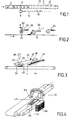
- Fig. 1 shows a feeding belt 2, which, in any suitable manner, is supplied with mutually spaced, single articles 4 desired to be controlled in portions of one or more specified weights.
- the articles thereafter pass over a dynamic weigher 6, where their weight and relative position are registered in a computer 8.
- the articles are then transferred to a longer belt 10, along which there is mounted a row of receiver stations 11, illustrated by partition lines 12 only.
- the computer 8 has an exit control wire 14 with branches 16 to the single receiver stations, this referring to the computer being able to actuate a transfer device at each of the stations 11 for transferring a selected article 4 to just that station.
- the computer holds information of the partial weights hereby delivered to the respective stations and the total article weight present in each station.
- the computer arranges for an emptying of that portion, to an underlying conveyor belt for bringing the portion to a non-illustrated final packing station.
- Articles of a weight making them unsuitable to participate in the portion formation may be let out to the last container or just be moved out over the end of the belt 10, subject to being recirculated.
- these receiver containers should be replaced by local portioning and grouping stations satisfying more basic conditions.
- such means may comprise overhead rollers 20 mounted in a hight displaceable manner in guides 22 and provided with radially displaceable gripping needles 24, which, in the lowered position of the associated roller, protrude downwardly to the top side of the belt 10, while the same needles during the further rotation of the roller in clockwise direction are successively retracted into full retraction at the top side of the roller.
- a longitudinal orientation of the conveyor 28 is shown in dotted lines at 30, conveying obliquely upwardly, whereby the picked up articles 4 can be delivered to upper, receiving grouping stations, without these taking up space between the rollers 20.
- Control means are provided for lowering the relevant rollers at the relevant moments of time for the selective article picking up.
- Fig. 3 illustrates another system for an orderly take up of articles 4 from a conventional belt 10.
- the system comprises an overlying belt 32, which, along a lower stretch 34, runs parallel with and in synchronism with the belt 10.
- the belt 32 may consist of parallel narrow belts, and overhead the stretch 34 is mounted a pressure plate 36 on a piston rod connected to a fixed cylinder 38.
- the belt 32 is provided with suitably interspaced, projecting, hook-like needles 40, which, by means of the pressure plate 36 being forced downwardly, may be forced down into gripping engagement with an article 4 at a front area thereof, whereafter the article, now hanging in the hook 40, is driven upwardly along a forwardly and upwardly inclined belt stretch 42.
- This stretch runs in parallel with a support plate or frame 44, against which the downhanging end of the gripped article will be supported.
- a unit 46 At the top of the stretch 42 is provided a unit 46, which operates to produce a retraction or a rearward pivoting of the needle hook 40, which is thereby rapidly drawn out of its engagement with the front edge area of the article 4.
- Fig. 3 is indicated a preferred arrangement, whereby the part 44 is used for movably supporting a carrier plate 48, which, e.g. from a side position is introduced into a lower start position, in which the top edge of the first article 4 is laid off relatively close to the top edge of this plate.
- a non-illustrated mechanism will serve to shoot the plate 48 a distance upwardly corresponding to the desired length displacement between articles 4 placed with imbricated formation, such that the next and the following articles will be deposited with just the desired positioning on the the plate 48.
- this plate is fully covered, it is moved out in any suitable manner upwardly or laterally, now holding a predetermined total weight of the articles, and then a new carrier plate 48 may be supplied to the support structure 44.
- the totalled portion weight will refer to the weight of the articles 4, without comprising the weight of the carrier plate 48 as forming part of the final packing, i.e. the final weight indication will be highly real.
- the belt 10 is adapted to the purpose in not being smooth as otherwise desirable, e.g. in being granulated or finely perforated, for example consisting of a net material or of thin cords located closely side by side, such that the articles 4 cannot adhere to a smooth surface, from which they would be difficult to lift by suction from above.
- FIG. 4 A possible solution of this category is indicated in Fig. 4, where the net belt 10 passes a row of robot units 50 provided with one or more suction cups 52 which, by actuation of the single robot, may be moved inwardly and downwardly for gripping a selected article 4 passing on the belt, and lifting it off for delivery to a carrier plate 48.
- the robot itself may take care of arranging the successively picked up articles with the desired grouping pattern, but also here it is a possibility that the articles be deposited in a uniform manner on a plate 48, which, on a suitable support is displaced a step for each transfer operation.
- the plate When the plate is filled up it can be discharged via a conveyor 56, whereafter a new plate is supplied from a magazine 58.
- Fig. 5 illustrates another solution of a corresponding type, where at each receiver station there is mounted a transversely oriented belt 60 carrying outwardly projecting suction cups 62, which, in the lower run, are moved first across the belt 10 and then further across a receiver station provided with an inserted carrier plate 48.
- the belt structure 60 can be raised and lowered e.g. by means of cylinders 64, whereby it can be actuated for the discussed selective gripping of article and lifting the same out for deposit on the plate 48.
- cylinders 64 When the latter is displaced stepwise on its support 54 an imbricated grouping is directly achievable, and also here new plate members 48 may be supplied from a magazine 58.
- Fig. 6 illustrates a further and basically different solution principle, by which the main belt conveyor 10 is modified for achieving that it is this conveyor itself which carries out the selective diversion of the articles to the respective receiver stations.
- the conveyor is made of a row of individual conveyor sections 66 which are each - in a manner not further illustrated - operable to be swung down at their front end 66', whereby it is possible for the single sections to effect a selective feeding of articles 4 to respective underlying receiver units 68, which may be units for longitudinal or transverse step displacement of article carrier plates 48, whereby the desired result is directly achievable.
- the segments 66 could be upwardly pivotable as well, for delivery to receivers arranged overhead the belt 10,66, or even both up- and downwardly pivotable to upper and lower stations, respectively; from a capacity point of view this would correspond to a selective double sided delivery from the conveyor shown in Fig. 1.
- the units 66' and even other diverter stations may be arranged with rather small pitch, whereby the sorter capacity for a given total length can be high.
- This may imply that there is correspondingly narrow space for the handling stations, and it could be possible, in that or other cases, to arrange for separate means of transportation from some or all of the receiving stations, e.g. from every second receiver station, to externally placed handling stations. In such stations the conditions will be to some degree the same as in the known cutting devises, viz. in that all arriving slices are destinated for that station; thus, no controllable bypass means should be used.
- Fig. 7 is shown a principally corresponding solution, where the belt 10 currently delivers its flow of articles 4 to a continuing, overlying suction belt 70, which at each receiver station has a piston plate 72 operable by a cylinder 74 or a corresponding moving mechanism so as to screen off the load suction ares of the belt, such that an article can be brought to a coordinated dropping down to an underlying collector unit, which, again, may comprise a mechanism for controlled stepwise displacement of a carrier plate for an article packing.
- the means for stepwise displacing the carrier plates may be controllable in such a manner that the plates are displaced more or less all according to the size of the received articles.
- the plates are displaced more or less all according to the size of the received articles.
- it will be possible, as the need arises, to arrange for a grouping of many small articles of fewer and larger articles for better utilization of the plate.
- differences in size will be detectable through the registered weight, but optionally the dynamic weight 2 may be supplemented or at the extreme even be replaced by a vision unit for detecting the article sizes.
- the invention is not limited to the said basic principle for the build-up of the article portions, viz. the formation of portions with a predetermined weight; by way of example it will also be possible to build up, on selected plates, portions of articles of identical weights. Thereby the different portions may have different weights, but since the total weight of the articles in each portion has been accurately registered by the computer this may used to the effect that at the exit of the single stations or at a common exit from the entire system it will be possible to produce an automatic weight stamping and, optionally, a price stamping on the single packings. Also, it will be possible to effect a stamping indicative of the number of articles in the packings.
- the different stations may operate selectively based on different criteria, e.g. some stations with the forming of portions of large articles up to a predetermined total weight and number of articles, others with articles of different sizes up to a predetermined weight or a predetermined number of articles, and still others with uniform articles to a variable total weight. Additionally, there may be one or more stations dealing with non-current articles, even without any ordered grouping or piling.
- a vision unit for inspecting the articles passing by. If the articles are known to be of exactly the same thickness, it may be superfluous to use a weighing unit in the system, when the weight per area unit is known. With an added vision unit it will be possible to work with different kinds of articles at the same time, even based on different colours.
- the grouping referred to should be understood in a wide sense, as it may also comprise a simple piling or, by way of example, a deposition into sections of an assortment packing.
- the invention will comprise any kind of handling or working of the articles successively delivered to the single stations, irrespectively of their type and the detailed circumstances pertaining to their delivery from the main conveyor belt or a conveyor equivalent therewith.
- the articles will have been supplied according to some relevant criterion, and what is essential is that the batcher or sorter system is utilized for an orderly transfer for the selected articles to the receiver stations, in which the articles - as a consequence of their orderly or well defined transfer - may be handled or further treated by automatically operating means.
- the said stepwise displacement of the carrier plates will not be restricted to a linear movement. According to the desired grouping pattern the movements may be directed in a variety of directions, also rearwardly, laterally and rotationally.
- the support element serving to receive the transferred articles should not necessarily be the final packing carrier plates, as the grouping may be arranged on a support belonging to the handling system, with a subsequent collective transfer of the groups to final carrier plates for incorporation in the packing products. It is even to be aforeseen that the nicely grouped article portions can be delivered to sheet packings without any included carrier plate.
Landscapes
- Physics & Mathematics (AREA)
- General Physics & Mathematics (AREA)
- Specific Conveyance Elements (AREA)
- Branching, Merging, And Special Transfer Between Conveyors (AREA)
- Meat, Egg Or Seafood Products (AREA)
Claims (11)
- Verfahren zum Bilden abgewogener Portionen von Lebensmittelartikeln, die in einem regelmäßigen Muster angeordnet sind, z.B. Scheiben (4) von Lachs oder Schinken, die in einer überlappenden Anordnung auf einer Trägerplatte (38) angeordnet sind, gekennzeichnet durch die Kombination des Bewirkens einer Zufuhr der Artikel (4) zu einer Mehrzahl von Gruppierungsstationen (11), basierend auf einem Vorschubfluß von wechselseitig beabstandeten Artikeln, die nach dem Passieren einer dynamischen Wiegeeinheit (6, 8) und danach in einer Art und Weise kontrolliert durch diese Einheit, selektiv zu den unterschiedlichen Gruppierungsstationen zur Bildung von Artikelgruppen eines bekannten Gesamtgewichts ausgebracht werden und der Verwendung der einzelnen Gruppierungsstationen (11) als Stationen für ein automatisches Auslegen der mehr oder weniger regelmäßig ankommenden Artikel (4) in Portionen mit irgendeiner gewünschten speziellen Gruppierungsanordung der Artikel, wobei die Portionen vorzugsweise auf den Unterstützungsmitteln angeordnet werden, die aus entfernbaren Trägerplatten gebildet werden zur Verwendung in Verkaufspackungen z.B. den Trägerplatten, oder auf Empfängeruntersrützungsmitteln zum kollektiven Transport der Portionen zu packungsbezogenen Trägermitteln.
- System zum Bilden von Artikelportionen durch das Verfahren nach Anspruch 1, umfassend Vorschubfördermittel mit einer dynamischen Wiegeeinheit. einem Sortierungssystem mit einer Mehrzahl Empfängerstationen und mit Mitteln zur selektiven Zufuhr von Artikeln von der dynamischen Wiegeeinheit zu der Mehrzahl der Empfängerstationen für eine gewichtskontrollierte Verbindung von Artikeln in der Empfängerstation, wobei jede dieser Stationen Fördermittel zum aufeinanderfolgenden Empfangen der ankommenden Artikel und Übertragen derselben in einer gleichmäßigen Art und Weise aufweisen, um auf geeigneten Unterstützungsmitteln ausgelegt zu werden.
- System nach Anspruch 2, in dem das Sortierungssystem vom Sortiermaschinen- oder Aufwicklemaschinentyp ist, d. h. mit einem Sortierförderer (10), der sich in Fortsetzung einer Wiegestation (6, 8) erstreckt und dem die aufeinanderfolgend gewogenen Artikel (4) entlang einer Reihe Empfängerstationen (11) vorgeschoben werden, an denen Trennmittel zum selektiven Transport der Artikel auf dem Förderer zu den einzelnen Empfängerstationen (11) vorgesehen sind und in denen die Trennmittel so angepaßt sind, daß sie zum aktiven Greifen der Artikel (4) auf dem Förderer bedienbar sind und die gegriffenen Artikel unabhängig von der Fördererbewegung zu den entsprechenden Fördermitteln versetzen.
- System nach Anspruch 3, in dem die Trennmittel, vorzugsweise als mechanische Greifmittel (20, 22; 40, 42) ausgebildet, angeordnet sind, um die gegriffenen Artikel zu über dem Sortierungsförderer (10) gelegenen Fördermitteln zu fördern.
- System nach Anspruch 3, in dem die Trennmittel, vorzugsweise als Saugnäpfe (52, 62) ausgebildet, angeordnet sind, um die Artikel zu lateral zu dem Sortierungsförderer angeordneten Fördermitteln zu transportieren.
- System nach Anspruch 2, in dem das Sortierungssystem einen unterteilten Förderer (Fig. 6) umfaßt, dessen fortlaufenden Abschnitte individuell drehbar sind um einen selektiven direkten Transport der Artikel zu den Fördermitteln zu ermöglichen.
- System nach Anspruch 6, in dem die Abschnitte (66) abwärts und/oder aufwärts drehbar sind.
- System nach Anspruch 2, in dem das Sortierungssystem eine nach unten gerichtete Förderoberfläche (Fig. 7) umfaßt, gegen die die Artikel durch Saugen gehalten werden, und in dem die Förderoberfläche entlang einer Reihe von darunterliegenden Fördermitteln bewegt wird, zu dem die Artikel durch ein lokales Unterdrücken des Saugens selektiv fallengelassen werden können.
- System nach Anspruch 2, in dem die Unterstützungsmittel ein Magazin (58) für die Trägereinheiten (48) umfassen und Mittel zum Freilassen einer beladenen Trägereinheit und Liefern einer neuen Trägereinheit von dem Magazin in Reaktion/Antwort auf ein Steuersignal von einer Steuereinheit, die mit der Wiegeeinheit verbunden ist.
- System nach Anspruch 2, in dem die Fördermittel arbeiten, um jeden gegriffenen Artikel in einer festen Position relativ zu den darunterliegenden Mitteln zum wirksamen Umsetzen einer Trägereinheit (48), auf der die gegriffenen Artikel aufeinanderfolgend abgelegt werden, zu hinterlegen.
- System nach Anspruch 2, in dem die Fördermittel arbeiten, um jeden gegriffenen Artikel auf einer stationären Trägereinheit (48) in einer Position versetzt zu der Position des vorangegangenen abgelegten Artikels (Fig. 4) abzulegen.
Applications Claiming Priority (4)
| Application Number | Priority Date | Filing Date | Title |
|---|---|---|---|
| DK71694 | 1994-06-17 | ||
| DK71694 | 1994-06-17 | ||
| DK716/94 | 1994-06-17 | ||
| PCT/DK1995/000253 WO1995035238A1 (en) | 1994-06-17 | 1995-06-19 | A method and a system for forming weighed portions of foodstuff articles arranged in an orderly pattern |
Publications (2)
| Publication Number | Publication Date |
|---|---|
| EP0764113A1 EP0764113A1 (de) | 1997-03-26 |
| EP0764113B1 true EP0764113B1 (de) | 1999-02-10 |
Family
ID=8096723
Family Applications (1)
| Application Number | Title | Priority Date | Filing Date |
|---|---|---|---|
| EP95922442A Expired - Lifetime EP0764113B1 (de) | 1994-06-17 | 1995-06-19 | Verfahren und system zum bilden von geordneten, abgewogenen und portionierten nahrungsmitteln |
Country Status (6)
| Country | Link |
|---|---|
| EP (1) | EP0764113B1 (de) |
| AU (1) | AU2733795A (de) |
| DE (1) | DE69507804T2 (de) |
| DK (1) | DK0764113T3 (de) |
| NO (1) | NO310680B1 (de) |
| WO (1) | WO1995035238A1 (de) |
Families Citing this family (17)
| Publication number | Priority date | Publication date | Assignee | Title |
|---|---|---|---|---|
| US6321135B1 (en) * | 1999-07-27 | 2001-11-20 | Marel Hf | Batching of objects |
| AU6985100A (en) * | 1999-09-10 | 2001-04-24 | Scanvaegt International A/S | A grader apparatus |
| AU2003902038A0 (en) * | 2003-04-28 | 2003-05-15 | Mars, Incorporated | Device and method for engaging penetrable items |
| SE0401162L (sv) * | 2004-05-04 | 2005-08-09 | Sverre Stenbom | Förfarande vid packning av livsmedel och sorteringsanordning |
| DE102004056031A1 (de) * | 2004-11-19 | 2006-05-24 | Maja-Maschinenfabrik Hermann Schill Gmbh & Co. Kg | Vorrichtung und Verfahren zum Zusammenstellen von Gegenständen zu einer Gesamtheit mit vorgegebenem Gesamtgewicht |
| ATE410664T1 (de) | 2004-12-10 | 2008-10-15 | Scanvaegt Int As | Verfahren und system zum chargieren von objekten |
| ITBO20050427A1 (it) * | 2005-06-28 | 2006-12-29 | Unitec Srl | Metodo ed impianto per il trasporto e la selezione di prodotti ortofrutticoli |
| DK2018528T3 (en) | 2006-05-19 | 2016-01-11 | Marel As | Method and system for batch formation of objects |
| EP3081315B1 (de) | 2007-02-07 | 2019-03-27 | Marel A/S | Verfahren und system zur sortierung von lebensmittelartikeln |
| US8424430B2 (en) * | 2007-08-09 | 2013-04-23 | Kraft Foods Group Brands Llc | Food product conveyor and handling systems |
| US8002513B2 (en) | 2007-08-09 | 2011-08-23 | Kraft Foods Global Brands Llc | Food product conveyor and handling systems |
| GB2472823A (en) | 2009-08-19 | 2011-02-23 | Valka Ehf | Sorting items into receivers |
| ITTO20110405A1 (it) * | 2011-05-06 | 2012-11-07 | Opm S P A | Impianto di trasferimento per trasferire prodotti tra due linee di trasporto parallele tramite una serie di robot |
| WO2016139611A2 (en) | 2015-03-02 | 2016-09-09 | Valka Ehf | Apparatus for processing and grading food articles and related methods |
| US11357237B2 (en) | 2015-03-02 | 2022-06-14 | Valka Ehf | Apparatus for processing and grading food articles and related methods |
| US11259531B2 (en) | 2015-03-02 | 2022-03-01 | Valka Ehf | Apparatus for processing and grading food articles and related methods |
| GB201906418D0 (en) | 2019-05-07 | 2019-06-19 | Valka Ehf | Conveyor system and method |
Family Cites Families (5)
| Publication number | Priority date | Publication date | Assignee | Title |
|---|---|---|---|---|
| US3820428A (en) * | 1972-09-28 | 1974-06-28 | Wallace G | Method and apparatus for producing weight controlled groups of slicedfood product |
| DE3733945A1 (de) * | 1987-10-07 | 1989-04-20 | Guenther Weber | Verfahren zum transport von geschnittenen produkten von einer schneidemaschine zu einer weiterverarbeitungsstelle |
| FI83059C (fi) * | 1989-09-25 | 1991-05-27 | Fastmeka Oy | Foerfarande och anordning foer maskinell foerpackning av livsmedel, speciellt plaettar, biffar eller motsvarande produkter. |
| US4993211A (en) * | 1989-11-13 | 1991-02-19 | Warner-Lambert Company | Soft chewing gum wrapping machine and method |
| DE4319171A1 (de) * | 1993-06-09 | 1994-12-15 | Dixie Union Verpackungen Gmbh | Vorrichtung zum schindelartigen Anordnen von aufgeschnittenen Gütern |
-
1995
- 1995-06-19 EP EP95922442A patent/EP0764113B1/de not_active Expired - Lifetime
- 1995-06-19 AU AU27337/95A patent/AU2733795A/en not_active Abandoned
- 1995-06-19 DK DK95922442T patent/DK0764113T3/da active
- 1995-06-19 WO PCT/DK1995/000253 patent/WO1995035238A1/en not_active Ceased
- 1995-06-19 DE DE69507804T patent/DE69507804T2/de not_active Expired - Fee Related
-
1996
- 1996-12-16 NO NO19965408A patent/NO310680B1/no unknown
Also Published As
| Publication number | Publication date |
|---|---|
| DE69507804T2 (de) | 1999-09-23 |
| AU2733795A (en) | 1996-01-15 |
| WO1995035238A1 (en) | 1995-12-28 |
| NO965408L (no) | 1997-02-06 |
| DK0764113T3 (da) | 1999-09-20 |
| EP0764113A1 (de) | 1997-03-26 |
| NO310680B1 (no) | 2001-08-13 |
| DE69507804D1 (de) | 1999-03-25 |
| NO965408D0 (no) | 1996-12-16 |
Similar Documents
| Publication | Publication Date | Title |
|---|---|---|
| EP0764113B1 (de) | Verfahren und system zum bilden von geordneten, abgewogenen und portionierten nahrungsmitteln | |
| EP0706479B1 (de) | Verfahren und system zum bilden von abgewogenen mengen von produkten | |
| DK1819994T4 (en) | PROCEDURE AND SYSTEM FOR GROUPING OBJECTS | |
| EP1318089B1 (de) | Fördereinrichtung zum Transferieren von Stapeln von auf einer Kante stehenden Gegenständen | |
| EP1226408B1 (de) | Sortiervorrichtung | |
| US5165218A (en) | Automatic sorting, stacking and packaging apparatus and method | |
| JP7558255B2 (ja) | コンテナに食品アイテムを充填するための方法及び装置 | |
| CA2330850A1 (en) | Method and system for portioning and orientating whole fish or other elongate, non-symetrical articles | |
| US4875571A (en) | Unloading method and apparatus for a cable finishing system | |
| US4090618A (en) | Device for inserting spacing strips between boards to be stacked | |
| JPH06577B2 (ja) | 間欠的間隙のある製品の送り込まれた流れからの製品を溜め連続した流れに統合する装置と方法 | |
| AU2003234367B2 (en) | Sorting apparatus and method | |
| EP0772403B1 (de) | Verfahren und system zur verarbeitung geschnittener nahrungsmittel zur verpackung in abgewogener, ordentlich angeordneter kondition | |
| US20120017538A1 (en) | Modular unit for automatic packaging of food products to be packaged in trays | |
| GB2064144A (en) | Grading eggs by weight | |
| EP0230795A2 (de) | Verfahren und Apparat zum automatischen Verpacken von Würstchen | |
| US3823821A (en) | Method and apparatus for producing weight controlled groups of sliced food product | |
| WO2005123513A1 (en) | An apparatus and method for organizing items, in particular food items | |
| DE68906864D1 (de) | Verfahren und vorrichtung zur entladung und automatischen uebergabe von papierserviettenpackungen von einer herstellungsmaschine zu einer verpackungsmaschine. | |
| EP0421545A1 (de) | Vorrichtung zum automatischen Transferieren von "Pasta" in der Form eines Nestes in Verpackungsbehälter | |
| SE185558C1 (de) | ||
| JPH11258027A (ja) | 物品量り取り装置 | |
| SE505808C2 (sv) | Förfarande och anordning för frammatning av föremål till en bestämd behållare |
Legal Events
| Date | Code | Title | Description |
|---|---|---|---|
| PUAI | Public reference made under article 153(3) epc to a published international application that has entered the european phase |
Free format text: ORIGINAL CODE: 0009012 |
|
| 17P | Request for examination filed |
Effective date: 19970117 |
|
| AK | Designated contracting states |
Kind code of ref document: A1 Designated state(s): BE DE DK FR GB NL |
|
| 17Q | First examination report despatched |
Effective date: 19970620 |
|
| GRAG | Despatch of communication of intention to grant |
Free format text: ORIGINAL CODE: EPIDOS AGRA |
|
| GRAG | Despatch of communication of intention to grant |
Free format text: ORIGINAL CODE: EPIDOS AGRA |
|
| GRAG | Despatch of communication of intention to grant |
Free format text: ORIGINAL CODE: EPIDOS AGRA |
|
| GRAH | Despatch of communication of intention to grant a patent |
Free format text: ORIGINAL CODE: EPIDOS IGRA |
|
| GRAH | Despatch of communication of intention to grant a patent |
Free format text: ORIGINAL CODE: EPIDOS IGRA |
|
| GRAA | (expected) grant |
Free format text: ORIGINAL CODE: 0009210 |
|
| AK | Designated contracting states |
Kind code of ref document: B1 Designated state(s): BE DE DK FR GB NL |
|
| REF | Corresponds to: |
Ref document number: 69507804 Country of ref document: DE Date of ref document: 19990325 |
|
| ET | Fr: translation filed | ||
| REG | Reference to a national code |
Ref country code: DK Ref legal event code: T3 |
|
| PLBE | No opposition filed within time limit |
Free format text: ORIGINAL CODE: 0009261 |
|
| STAA | Information on the status of an ep patent application or granted ep patent |
Free format text: STATUS: NO OPPOSITION FILED WITHIN TIME LIMIT |
|
| 26N | No opposition filed | ||
| REG | Reference to a national code |
Ref country code: GB Ref legal event code: IF02 |
|
| PGFP | Annual fee paid to national office [announced via postgrant information from national office to epo] |
Ref country code: DK Payment date: 20020521 Year of fee payment: 8 |
|
| PGFP | Annual fee paid to national office [announced via postgrant information from national office to epo] |
Ref country code: BE Payment date: 20020617 Year of fee payment: 8 |
|
| PGFP | Annual fee paid to national office [announced via postgrant information from national office to epo] |
Ref country code: GB Payment date: 20020619 Year of fee payment: 8 |
|
| PGFP | Annual fee paid to national office [announced via postgrant information from national office to epo] |
Ref country code: FR Payment date: 20020625 Year of fee payment: 8 |
|
| PGFP | Annual fee paid to national office [announced via postgrant information from national office to epo] |
Ref country code: NL Payment date: 20020628 Year of fee payment: 8 |
|
| PGFP | Annual fee paid to national office [announced via postgrant information from national office to epo] |
Ref country code: DE Payment date: 20020731 Year of fee payment: 8 |
|
| PG25 | Lapsed in a contracting state [announced via postgrant information from national office to epo] |
Ref country code: GB Free format text: LAPSE BECAUSE OF NON-PAYMENT OF DUE FEES Effective date: 20030619 |
|
| PG25 | Lapsed in a contracting state [announced via postgrant information from national office to epo] |
Ref country code: DK Free format text: LAPSE BECAUSE OF NON-PAYMENT OF DUE FEES Effective date: 20030630 Ref country code: BE Free format text: LAPSE BECAUSE OF NON-PAYMENT OF DUE FEES Effective date: 20030630 |
|
| BERE | Be: lapsed |
Owner name: *SCANVAEGT A/S Effective date: 20030630 |
|
| PG25 | Lapsed in a contracting state [announced via postgrant information from national office to epo] |
Ref country code: NL Free format text: LAPSE BECAUSE OF NON-PAYMENT OF DUE FEES Effective date: 20040101 Ref country code: DE Free format text: LAPSE BECAUSE OF NON-PAYMENT OF DUE FEES Effective date: 20040101 |
|
| GBPC | Gb: european patent ceased through non-payment of renewal fee |
Effective date: 20030619 |
|
| PG25 | Lapsed in a contracting state [announced via postgrant information from national office to epo] |
Ref country code: FR Free format text: LAPSE BECAUSE OF NON-PAYMENT OF DUE FEES Effective date: 20040227 |
|
| NLV4 | Nl: lapsed or anulled due to non-payment of the annual fee |
Effective date: 20040101 |
|
| REG | Reference to a national code |
Ref country code: DK Ref legal event code: EBP |
|
| REG | Reference to a national code |
Ref country code: FR Ref legal event code: ST |