EP0764647A1 - Substituierte Xanthine - Google Patents
Substituierte Xanthine Download PDFInfo
- Publication number
- EP0764647A1 EP0764647A1 EP96114577A EP96114577A EP0764647A1 EP 0764647 A1 EP0764647 A1 EP 0764647A1 EP 96114577 A EP96114577 A EP 96114577A EP 96114577 A EP96114577 A EP 96114577A EP 0764647 A1 EP0764647 A1 EP 0764647A1
- Authority
- EP
- European Patent Office
- Prior art keywords
- carbon atoms
- phenyl
- straight
- chain
- branched alkyl
- Prior art date
- Legal status (The legal status is an assumption and is not a legal conclusion. Google has not performed a legal analysis and makes no representation as to the accuracy of the status listed.)
- Ceased
Links
- 125000000217 alkyl group Chemical group 0.000 claims abstract description 121
- 125000001997 phenyl group Chemical group [H]C1=C([H])C([H])=C(*)C([H])=C1[H] 0.000 claims abstract description 110
- 125000003545 alkoxy group Chemical group 0.000 claims abstract description 58
- 125000002023 trifluoromethyl group Chemical group FC(F)(F)* 0.000 claims abstract description 36
- 229910052717 sulfur Inorganic materials 0.000 claims abstract description 35
- 125000003342 alkenyl group Chemical group 0.000 claims abstract description 33
- 125000003118 aryl group Chemical group 0.000 claims abstract description 20
- 125000000753 cycloalkyl group Chemical group 0.000 claims abstract description 20
- 125000005842 heteroatom Chemical group 0.000 claims abstract description 20
- 229910052760 oxygen Inorganic materials 0.000 claims abstract description 16
- 150000003839 salts Chemical class 0.000 claims abstract description 16
- 125000001797 benzyl group Chemical group [H]C1=C([H])C([H])=C(C([H])=C1[H])C([H])([H])* 0.000 claims abstract description 15
- 125000004453 alkoxycarbonyl group Chemical group 0.000 claims abstract description 12
- 125000002252 acyl group Chemical group 0.000 claims abstract description 10
- 125000000623 heterocyclic group Chemical group 0.000 claims abstract description 10
- 125000003178 carboxy group Chemical group [H]OC(*)=O 0.000 claims abstract description 8
- 125000004432 carbon atom Chemical group C* 0.000 claims description 102
- 229910052739 hydrogen Inorganic materials 0.000 claims description 62
- 239000001257 hydrogen Substances 0.000 claims description 60
- 125000002887 hydroxy group Chemical group [H]O* 0.000 claims description 53
- UFHFLCQGNIYNRP-UHFFFAOYSA-N Hydrogen Chemical compound [H][H] UFHFLCQGNIYNRP-UHFFFAOYSA-N 0.000 claims description 46
- PXGOKWXKJXAPGV-UHFFFAOYSA-N Fluorine Chemical compound FF PXGOKWXKJXAPGV-UHFFFAOYSA-N 0.000 claims description 44
- 150000002431 hydrogen Chemical class 0.000 claims description 43
- 150000001875 compounds Chemical class 0.000 claims description 41
- -1 hydroxy, carboxyl Chemical group 0.000 claims description 41
- 239000000460 chlorine Chemical group 0.000 claims description 40
- 125000000113 cyclohexyl group Chemical group [H]C1([H])C([H])([H])C([H])([H])C([H])(*)C([H])([H])C1([H])[H] 0.000 claims description 40
- 125000001511 cyclopentyl group Chemical group [H]C1([H])C([H])([H])C([H])([H])C([H])(*)C1([H])[H] 0.000 claims description 40
- 125000004076 pyridyl group Chemical group 0.000 claims description 38
- 125000001559 cyclopropyl group Chemical group [H]C1([H])C([H])([H])C1([H])* 0.000 claims description 36
- 125000001544 thienyl group Chemical group 0.000 claims description 36
- WKBOTKDWSSQWDR-UHFFFAOYSA-N Bromine atom Chemical group [Br] WKBOTKDWSSQWDR-UHFFFAOYSA-N 0.000 claims description 35
- GDTBXPJZTBHREO-UHFFFAOYSA-N bromine Chemical group BrBr GDTBXPJZTBHREO-UHFFFAOYSA-N 0.000 claims description 34
- 229910052794 bromium Inorganic materials 0.000 claims description 34
- ZAMOUSCENKQFHK-UHFFFAOYSA-N Chlorine atom Chemical group [Cl] ZAMOUSCENKQFHK-UHFFFAOYSA-N 0.000 claims description 32
- 229910052801 chlorine Inorganic materials 0.000 claims description 32
- 239000011737 fluorine Substances 0.000 claims description 32
- 229910052731 fluorine Inorganic materials 0.000 claims description 32
- 125000002541 furyl group Chemical group 0.000 claims description 27
- 238000000034 method Methods 0.000 claims description 24
- 125000000582 cycloheptyl group Chemical group [H]C1([H])C([H])([H])C([H])([H])C([H])([H])C([H])(*)C([H])([H])C1([H])[H] 0.000 claims description 22
- 229910052736 halogen Inorganic materials 0.000 claims description 21
- 150000002367 halogens Chemical group 0.000 claims description 21
- 229910052757 nitrogen Inorganic materials 0.000 claims description 17
- LRFVTYWOQMYALW-UHFFFAOYSA-N 9H-xanthine Chemical class O=C1NC(=O)NC2=C1NC=N2 LRFVTYWOQMYALW-UHFFFAOYSA-N 0.000 claims description 14
- MYMOFIZGZYHOMD-UHFFFAOYSA-N Dioxygen Chemical compound O=O MYMOFIZGZYHOMD-UHFFFAOYSA-N 0.000 claims description 14
- 239000001301 oxygen Substances 0.000 claims description 14
- 125000004434 sulfur atom Chemical group 0.000 claims description 14
- 125000001995 cyclobutyl group Chemical group [H]C1([H])C([H])([H])C([H])(*)C1([H])[H] 0.000 claims description 12
- 229940065721 systemic for obstructive airway disease xanthines Drugs 0.000 claims description 12
- PIGFYZPCRLYGLF-UHFFFAOYSA-N Aluminum nitride Chemical compound [Al]#N PIGFYZPCRLYGLF-UHFFFAOYSA-N 0.000 claims description 10
- 239000002253 acid Substances 0.000 claims description 9
- 239000003814 drug Substances 0.000 claims description 9
- 150000007513 acids Chemical class 0.000 claims description 6
- 239000012442 inert solvent Substances 0.000 claims description 6
- 125000001153 fluoro group Chemical group F* 0.000 claims description 4
- 238000004519 manufacturing process Methods 0.000 claims description 4
- 201000001320 Atherosclerosis Diseases 0.000 claims description 3
- 125000001624 naphthyl group Chemical group 0.000 claims description 3
- 238000002360 preparation method Methods 0.000 claims description 3
- HZAXFHJVJLSVMW-UHFFFAOYSA-N 2-Aminoethan-1-ol Chemical class NCCO HZAXFHJVJLSVMW-UHFFFAOYSA-N 0.000 claims description 2
- 125000004122 cyclic group Chemical group 0.000 claims description 2
- 125000004430 oxygen atom Chemical group O* 0.000 claims description 2
- 239000000546 pharmaceutical excipient Substances 0.000 claims description 2
- VVNCNSJFMMFHPL-VKHMYHEASA-N D-penicillamine Chemical group CC(C)(S)[C@@H](N)C(O)=O VVNCNSJFMMFHPL-VKHMYHEASA-N 0.000 claims 3
- 230000001225 therapeutic effect Effects 0.000 claims 1
- 229940075420 xanthine Drugs 0.000 claims 1
- 125000005843 halogen group Chemical group 0.000 abstract 6
- 125000001072 heteroaryl group Chemical group 0.000 abstract 2
- CMLRJXVVCRHXED-UHFFFAOYSA-N 3-(2,6-dioxo-3,7-dihydropurin-8-yl)-3-phenylpropanoic acid Chemical compound N=1C=2NC(=O)NC(=O)C=2NC=1C(CC(=O)O)C1=CC=CC=C1 CMLRJXVVCRHXED-UHFFFAOYSA-N 0.000 abstract 1
- OKKJLVBELUTLKV-UHFFFAOYSA-N Methanol Chemical compound OC OKKJLVBELUTLKV-UHFFFAOYSA-N 0.000 description 63
- YMWUJEATGCHHMB-UHFFFAOYSA-N Dichloromethane Chemical compound ClCCl YMWUJEATGCHHMB-UHFFFAOYSA-N 0.000 description 62
- XEKOWRVHYACXOJ-UHFFFAOYSA-N Ethyl acetate Chemical compound CCOC(C)=O XEKOWRVHYACXOJ-UHFFFAOYSA-N 0.000 description 45
- RTZKZFJDLAIYFH-UHFFFAOYSA-N Diethyl ether Chemical compound CCOCC RTZKZFJDLAIYFH-UHFFFAOYSA-N 0.000 description 42
- ZMXDDKWLCZADIW-UHFFFAOYSA-N N,N-Dimethylformamide Chemical compound CN(C)C=O ZMXDDKWLCZADIW-UHFFFAOYSA-N 0.000 description 29
- LFQSCWFLJHTTHZ-UHFFFAOYSA-N Ethanol Chemical compound CCO LFQSCWFLJHTTHZ-UHFFFAOYSA-N 0.000 description 24
- ZMANZCXQSJIPKH-UHFFFAOYSA-N Triethylamine Chemical compound CCN(CC)CC ZMANZCXQSJIPKH-UHFFFAOYSA-N 0.000 description 24
- 239000000203 mixture Substances 0.000 description 23
- 239000000126 substance Substances 0.000 description 22
- UFTFJSFQGQCHQW-UHFFFAOYSA-N triformin Chemical compound O=COCC(OC=O)COC=O UFTFJSFQGQCHQW-UHFFFAOYSA-N 0.000 description 19
- HEMHJVSKTPXQMS-UHFFFAOYSA-M Sodium hydroxide Chemical compound [OH-].[Na+] HEMHJVSKTPXQMS-UHFFFAOYSA-M 0.000 description 18
- YXFVVABEGXRONW-UHFFFAOYSA-N Toluene Chemical compound CC1=CC=CC=C1 YXFVVABEGXRONW-UHFFFAOYSA-N 0.000 description 18
- 241001465754 Metazoa Species 0.000 description 16
- QTBSBXVTEAMEQO-UHFFFAOYSA-N Acetic acid Chemical compound CC(O)=O QTBSBXVTEAMEQO-UHFFFAOYSA-N 0.000 description 15
- 239000002585 base Substances 0.000 description 15
- 210000002966 serum Anatomy 0.000 description 15
- 239000000243 solution Substances 0.000 description 15
- 239000003208 petroleum Substances 0.000 description 13
- XLYOFNOQVPJJNP-UHFFFAOYSA-N water Substances O XLYOFNOQVPJJNP-UHFFFAOYSA-N 0.000 description 13
- 241000416162 Astragalus gummifer Species 0.000 description 12
- KWYUFKZDYYNOTN-UHFFFAOYSA-M Potassium hydroxide Chemical compound [OH-].[K+] KWYUFKZDYYNOTN-UHFFFAOYSA-M 0.000 description 12
- WYURNTSHIVDZCO-UHFFFAOYSA-N Tetrahydrofuran Chemical compound C1CCOC1 WYURNTSHIVDZCO-UHFFFAOYSA-N 0.000 description 12
- 229920001615 Tragacanth Polymers 0.000 description 12
- 108010062497 VLDL Lipoproteins Proteins 0.000 description 12
- 239000002904 solvent Substances 0.000 description 12
- 239000000196 tragacanth Substances 0.000 description 12
- 235000010487 tragacanth Nutrition 0.000 description 12
- 229940116362 tragacanth Drugs 0.000 description 12
- 238000012360 testing method Methods 0.000 description 11
- GQHTUMJGOHRCHB-UHFFFAOYSA-N 2,3,4,6,7,8,9,10-octahydropyrimido[1,2-a]azepine Chemical compound C1CCCCN2CCCN=C21 GQHTUMJGOHRCHB-UHFFFAOYSA-N 0.000 description 10
- 102000006991 Apolipoprotein B-100 Human genes 0.000 description 10
- 108010008150 Apolipoprotein B-100 Proteins 0.000 description 10
- HVYWMOMLDIMFJA-DPAQBDIFSA-N cholesterol Chemical compound C1C=C2C[C@@H](O)CC[C@]2(C)[C@@H]2[C@@H]1[C@@H]1CC[C@H]([C@H](C)CCCC(C)C)[C@@]1(C)CC2 HVYWMOMLDIMFJA-DPAQBDIFSA-N 0.000 description 10
- BWHMMNNQKKPAPP-UHFFFAOYSA-L potassium carbonate Chemical compound [K+].[K+].[O-]C([O-])=O BWHMMNNQKKPAPP-UHFFFAOYSA-L 0.000 description 10
- CSCPPACGZOOCGX-UHFFFAOYSA-N Acetone Chemical compound CC(C)=O CSCPPACGZOOCGX-UHFFFAOYSA-N 0.000 description 9
- IAZDPXIOMUYVGZ-UHFFFAOYSA-N Dimethylsulphoxide Chemical compound CS(C)=O IAZDPXIOMUYVGZ-UHFFFAOYSA-N 0.000 description 9
- DGAQECJNVWCQMB-PUAWFVPOSA-M Ilexoside XXIX Chemical compound C[C@@H]1CC[C@@]2(CC[C@@]3(C(=CC[C@H]4[C@]3(CC[C@@H]5[C@@]4(CC[C@@H](C5(C)C)OS(=O)(=O)[O-])C)C)[C@@H]2[C@]1(C)O)C)C(=O)O[C@H]6[C@@H]([C@H]([C@@H]([C@H](O6)CO)O)O)O.[Na+] DGAQECJNVWCQMB-PUAWFVPOSA-M 0.000 description 9
- 150000003626 triacylglycerols Chemical class 0.000 description 9
- JUJWROOIHBZHMG-UHFFFAOYSA-N Pyridine Chemical compound C1=CC=NC=C1 JUJWROOIHBZHMG-UHFFFAOYSA-N 0.000 description 8
- 238000006243 chemical reaction Methods 0.000 description 8
- 230000005764 inhibitory process Effects 0.000 description 8
- 239000000725 suspension Substances 0.000 description 8
- VEXZGXHMUGYJMC-UHFFFAOYSA-N Hydrochloric acid Chemical compound Cl VEXZGXHMUGYJMC-UHFFFAOYSA-N 0.000 description 7
- 241000700159 Rattus Species 0.000 description 7
- 210000004369 blood Anatomy 0.000 description 7
- 239000008280 blood Substances 0.000 description 7
- 238000001819 mass spectrum Methods 0.000 description 7
- 239000002245 particle Substances 0.000 description 7
- 239000011734 sodium Substances 0.000 description 7
- 229910052708 sodium Inorganic materials 0.000 description 7
- WEVYAHXRMPXWCK-UHFFFAOYSA-N Acetonitrile Chemical compound CC#N WEVYAHXRMPXWCK-UHFFFAOYSA-N 0.000 description 6
- UHOVQNZJYSORNB-UHFFFAOYSA-N Benzene Chemical compound C1=CC=CC=C1 UHOVQNZJYSORNB-UHFFFAOYSA-N 0.000 description 6
- KFZMGEQAYNKOFK-UHFFFAOYSA-N Isopropanol Chemical compound CC(C)O KFZMGEQAYNKOFK-UHFFFAOYSA-N 0.000 description 6
- LRHPLDYGYMQRHN-UHFFFAOYSA-N N-Butanol Chemical compound CCCCO LRHPLDYGYMQRHN-UHFFFAOYSA-N 0.000 description 6
- CDBYLPFSWZWCQE-UHFFFAOYSA-L Sodium Carbonate Chemical compound [Na+].[Na+].[O-]C([O-])=O CDBYLPFSWZWCQE-UHFFFAOYSA-L 0.000 description 6
- PMZURENOXWZQFD-UHFFFAOYSA-L Sodium Sulfate Chemical compound [Na+].[Na+].[O-]S([O-])(=O)=O PMZURENOXWZQFD-UHFFFAOYSA-L 0.000 description 6
- QAOWNCQODCNURD-UHFFFAOYSA-N Sulfuric acid Chemical compound OS(O)(=O)=O QAOWNCQODCNURD-UHFFFAOYSA-N 0.000 description 6
- 230000037396 body weight Effects 0.000 description 6
- VLKZOEOYAKHREP-UHFFFAOYSA-N n-Hexane Chemical compound CCCCCC VLKZOEOYAKHREP-UHFFFAOYSA-N 0.000 description 6
- 238000007127 saponification reaction Methods 0.000 description 6
- 230000028327 secretion Effects 0.000 description 6
- 229910052938 sodium sulfate Inorganic materials 0.000 description 6
- 235000011152 sodium sulphate Nutrition 0.000 description 6
- 239000007787 solid Substances 0.000 description 6
- YLQBMQCUIZJEEH-UHFFFAOYSA-N tetrahydrofuran Natural products C=1C=COC=1 YLQBMQCUIZJEEH-UHFFFAOYSA-N 0.000 description 6
- QOSSAOTZNIDXMA-UHFFFAOYSA-N Dicylcohexylcarbodiimide Chemical compound C1CCCCC1N=C=NC1CCCCC1 QOSSAOTZNIDXMA-UHFFFAOYSA-N 0.000 description 5
- PCLIMKBDDGJMGD-UHFFFAOYSA-N N-bromosuccinimide Chemical compound BrN1C(=O)CCC1=O PCLIMKBDDGJMGD-UHFFFAOYSA-N 0.000 description 5
- DTQVDTLACAAQTR-UHFFFAOYSA-N Trifluoroacetic acid Chemical compound OC(=O)C(F)(F)F DTQVDTLACAAQTR-UHFFFAOYSA-N 0.000 description 5
- 235000011054 acetic acid Nutrition 0.000 description 5
- 150000001412 amines Chemical class 0.000 description 5
- 210000004027 cell Anatomy 0.000 description 5
- 239000013078 crystal Substances 0.000 description 5
- 238000001727 in vivo Methods 0.000 description 5
- 239000004006 olive oil Substances 0.000 description 5
- 235000008390 olive oil Nutrition 0.000 description 5
- 229910000027 potassium carbonate Inorganic materials 0.000 description 5
- 239000000047 product Substances 0.000 description 5
- PAMIQIKDUOTOBW-UHFFFAOYSA-N 1-methylpiperidine Chemical compound CN1CCCCC1 PAMIQIKDUOTOBW-UHFFFAOYSA-N 0.000 description 4
- HZNVUJQVZSTENZ-UHFFFAOYSA-N 2,3-dichloro-5,6-dicyano-1,4-benzoquinone Chemical compound ClC1=C(Cl)C(=O)C(C#N)=C(C#N)C1=O HZNVUJQVZSTENZ-UHFFFAOYSA-N 0.000 description 4
- 0 CCC=C(c1c(N2*)nc(*)[n]1C)N(C)C2=* Chemical compound CCC=C(c1c(N2*)nc(*)[n]1C)N(C)C2=* 0.000 description 4
- VTYYLEPIZMXCLO-UHFFFAOYSA-L Calcium carbonate Chemical compound [Ca+2].[O-]C([O-])=O VTYYLEPIZMXCLO-UHFFFAOYSA-L 0.000 description 4
- 241000699800 Cricetinae Species 0.000 description 4
- 102000004895 Lipoproteins Human genes 0.000 description 4
- 108090001030 Lipoproteins Proteins 0.000 description 4
- AFVFQIVMOAPDHO-UHFFFAOYSA-N Methanesulfonic acid Chemical compound CS(O)(=O)=O AFVFQIVMOAPDHO-UHFFFAOYSA-N 0.000 description 4
- YNAVUWVOSKDBBP-UHFFFAOYSA-N Morpholine Chemical compound C1COCCN1 YNAVUWVOSKDBBP-UHFFFAOYSA-N 0.000 description 4
- UIIMBOGNXHQVGW-UHFFFAOYSA-M Sodium bicarbonate Chemical compound [Na+].OC([O-])=O UIIMBOGNXHQVGW-UHFFFAOYSA-M 0.000 description 4
- FZNCGRZWXLXZSZ-CIQUZCHMSA-N Voglibose Chemical compound OCC(CO)N[C@H]1C[C@](O)(CO)[C@@H](O)[C@H](O)[C@H]1O FZNCGRZWXLXZSZ-CIQUZCHMSA-N 0.000 description 4
- 229910052784 alkaline earth metal Inorganic materials 0.000 description 4
- 235000012000 cholesterol Nutrition 0.000 description 4
- 238000004440 column chromatography Methods 0.000 description 4
- 208000029078 coronary artery disease Diseases 0.000 description 4
- 239000003599 detergent Substances 0.000 description 4
- 230000000694 effects Effects 0.000 description 4
- 150000007529 inorganic bases Chemical class 0.000 description 4
- 239000012074 organic phase Substances 0.000 description 4
- 239000003960 organic solvent Substances 0.000 description 4
- 239000002504 physiological saline solution Substances 0.000 description 4
- 239000004033 plastic Substances 0.000 description 4
- 230000000291 postprandial effect Effects 0.000 description 4
- UMJSCPRVCHMLSP-UHFFFAOYSA-N pyridine Natural products COC1=CC=CN=C1 UMJSCPRVCHMLSP-UHFFFAOYSA-N 0.000 description 4
- 238000010992 reflux Methods 0.000 description 4
- 229910000029 sodium carbonate Inorganic materials 0.000 description 4
- 229910000104 sodium hydride Inorganic materials 0.000 description 4
- VZGDMQKNWNREIO-UHFFFAOYSA-N tetrachloromethane Chemical compound ClC(Cl)(Cl)Cl VZGDMQKNWNREIO-UHFFFAOYSA-N 0.000 description 4
- FYSNRJHAOHDILO-UHFFFAOYSA-N thionyl chloride Chemical compound ClS(Cl)=O FYSNRJHAOHDILO-UHFFFAOYSA-N 0.000 description 4
- PYOKUURKVVELLB-UHFFFAOYSA-N trimethyl orthoformate Chemical compound COC(OC)OC PYOKUURKVVELLB-UHFFFAOYSA-N 0.000 description 4
- GPRLSGONYQIRFK-MNYXATJNSA-N triton Chemical compound [3H+] GPRLSGONYQIRFK-MNYXATJNSA-N 0.000 description 4
- RYHBNJHYFVUHQT-UHFFFAOYSA-N 1,4-Dioxane Chemical compound C1COCCO1 RYHBNJHYFVUHQT-UHFFFAOYSA-N 0.000 description 3
- VHYFNPMBLIVWCW-UHFFFAOYSA-N 4-Dimethylaminopyridine Chemical compound CN(C)C1=CC=NC=C1 VHYFNPMBLIVWCW-UHFFFAOYSA-N 0.000 description 3
- HBAQYPYDRFILMT-UHFFFAOYSA-N 8-[3-(1-cyclopropylpyrazol-4-yl)-1H-pyrazolo[4,3-d]pyrimidin-5-yl]-3-methyl-3,8-diazabicyclo[3.2.1]octan-2-one Chemical class C1(CC1)N1N=CC(=C1)C1=NNC2=C1N=C(N=C2)N1C2C(N(CC1CC2)C)=O HBAQYPYDRFILMT-UHFFFAOYSA-N 0.000 description 3
- 102000004190 Enzymes Human genes 0.000 description 3
- 108090000790 Enzymes Proteins 0.000 description 3
- 208000008589 Obesity Diseases 0.000 description 3
- ZLMJMSJWJFRBEC-UHFFFAOYSA-N Potassium Chemical compound [K] ZLMJMSJWJFRBEC-UHFFFAOYSA-N 0.000 description 3
- KEAYESYHFKHZAL-UHFFFAOYSA-N Sodium Chemical compound [Na] KEAYESYHFKHZAL-UHFFFAOYSA-N 0.000 description 3
- 238000010521 absorption reaction Methods 0.000 description 3
- 239000004480 active ingredient Substances 0.000 description 3
- 150000001298 alcohols Chemical class 0.000 description 3
- 229910052783 alkali metal Inorganic materials 0.000 description 3
- 150000008044 alkali metal hydroxides Chemical class 0.000 description 3
- 150000001340 alkali metals Chemical class 0.000 description 3
- 229910001860 alkaline earth metal hydroxide Inorganic materials 0.000 description 3
- RQPZNWPYLFFXCP-UHFFFAOYSA-L barium dihydroxide Chemical compound [OH-].[OH-].[Ba+2] RQPZNWPYLFFXCP-UHFFFAOYSA-L 0.000 description 3
- 229910001863 barium hydroxide Inorganic materials 0.000 description 3
- CODNYICXDISAEA-UHFFFAOYSA-N bromine monochloride Chemical compound BrCl CODNYICXDISAEA-UHFFFAOYSA-N 0.000 description 3
- 125000000484 butyl group Chemical group [H]C([*])([H])C([H])([H])C([H])([H])C([H])([H])[H] 0.000 description 3
- 229950005499 carbon tetrachloride Drugs 0.000 description 3
- 230000015556 catabolic process Effects 0.000 description 3
- 239000003153 chemical reaction reagent Substances 0.000 description 3
- KRKNYBCHXYNGOX-UHFFFAOYSA-N citric acid Chemical compound OC(=O)CC(O)(C(O)=O)CC(O)=O KRKNYBCHXYNGOX-UHFFFAOYSA-N 0.000 description 3
- 229940079593 drug Drugs 0.000 description 3
- 150000002170 ethers Chemical class 0.000 description 3
- 238000009472 formulation Methods 0.000 description 3
- 230000002401 inhibitory effect Effects 0.000 description 3
- 210000005229 liver cell Anatomy 0.000 description 3
- 235000020824 obesity Nutrition 0.000 description 3
- 150000007530 organic bases Chemical class 0.000 description 3
- 239000011591 potassium Substances 0.000 description 3
- 229910052700 potassium Inorganic materials 0.000 description 3
- 239000002244 precipitate Substances 0.000 description 3
- BDERNNFJNOPAEC-UHFFFAOYSA-N propan-1-ol Chemical compound CCCO BDERNNFJNOPAEC-UHFFFAOYSA-N 0.000 description 3
- 239000012312 sodium hydride Substances 0.000 description 3
- IMNIMPAHZVJRPE-UHFFFAOYSA-N triethylenediamine Chemical compound C1CN2CCN1CC2 IMNIMPAHZVJRPE-UHFFFAOYSA-N 0.000 description 3
- MDYZKJNTKZIUSK-UHFFFAOYSA-N tyloxapol Chemical compound O=C.C1CO1.CC(C)(C)CC(C)(C)C1=CC=C(O)C=C1 MDYZKJNTKZIUSK-UHFFFAOYSA-N 0.000 description 3
- VCGRFBXVSFAGGA-UHFFFAOYSA-N (1,1-dioxo-1,4-thiazinan-4-yl)-[6-[[3-(4-fluorophenyl)-5-methyl-1,2-oxazol-4-yl]methoxy]pyridin-3-yl]methanone Chemical compound CC=1ON=C(C=2C=CC(F)=CC=2)C=1COC(N=C1)=CC=C1C(=O)N1CCS(=O)(=O)CC1 VCGRFBXVSFAGGA-UHFFFAOYSA-N 0.000 description 2
- XUFXOAAUWZOOIT-SXARVLRPSA-N (2R,3R,4R,5S,6R)-5-[[(2R,3R,4R,5S,6R)-5-[[(2R,3R,4S,5S,6R)-3,4-dihydroxy-6-methyl-5-[[(1S,4R,5S,6S)-4,5,6-trihydroxy-3-(hydroxymethyl)-1-cyclohex-2-enyl]amino]-2-oxanyl]oxy]-3,4-dihydroxy-6-(hydroxymethyl)-2-oxanyl]oxy]-6-(hydroxymethyl)oxane-2,3,4-triol Chemical compound O([C@H]1O[C@H](CO)[C@H]([C@@H]([C@H]1O)O)O[C@H]1O[C@@H]([C@H]([C@H](O)[C@H]1O)N[C@@H]1[C@@H]([C@@H](O)[C@H](O)C(CO)=C1)O)C)[C@@H]1[C@@H](CO)O[C@@H](O)[C@H](O)[C@H]1O XUFXOAAUWZOOIT-SXARVLRPSA-N 0.000 description 2
- FOZFSEMFCIPOSZ-SPCKQMHLSA-N (2r,3r,4r,5s)-2-(hydroxymethyl)-1-[[(2r,3s,4s,5r,6s)-3,4,5-trihydroxy-6-methoxyoxan-2-yl]methyl]piperidine-3,4,5-triol;trihydrate Chemical compound O.O.O.O[C@H]1[C@H](O)[C@@H](O)[C@@H](OC)O[C@@H]1CN1[C@H](CO)[C@@H](O)[C@H](O)[C@@H](O)C1.O[C@H]1[C@H](O)[C@@H](O)[C@@H](OC)O[C@@H]1CN1[C@H](CO)[C@@H](O)[C@H](O)[C@@H](O)C1 FOZFSEMFCIPOSZ-SPCKQMHLSA-N 0.000 description 2
- QPFMBZIOSGYJDE-UHFFFAOYSA-N 1,1,2,2-tetrachloroethane Chemical compound ClC(Cl)C(Cl)Cl QPFMBZIOSGYJDE-UHFFFAOYSA-N 0.000 description 2
- FCEHBMOGCRZNNI-UHFFFAOYSA-N 1-benzothiophene Chemical compound C1=CC=C2SC=CC2=C1 FCEHBMOGCRZNNI-UHFFFAOYSA-N 0.000 description 2
- OZAIFHULBGXAKX-UHFFFAOYSA-N 2-(2-cyanopropan-2-yldiazenyl)-2-methylpropanenitrile Chemical compound N#CC(C)(C)N=NC(C)(C)C#N OZAIFHULBGXAKX-UHFFFAOYSA-N 0.000 description 2
- FPQQSJJWHUJYPU-UHFFFAOYSA-N 3-(dimethylamino)propyliminomethylidene-ethylazanium;chloride Chemical compound Cl.CCN=C=NCCCN(C)C FPQQSJJWHUJYPU-UHFFFAOYSA-N 0.000 description 2
- BMYNFMYTOJXKLE-UHFFFAOYSA-N 3-azaniumyl-2-hydroxypropanoate Chemical compound NCC(O)C(O)=O BMYNFMYTOJXKLE-UHFFFAOYSA-N 0.000 description 2
- FNLDCZCNGSQKIC-UHFFFAOYSA-N 5,6-diamino-1,3-dimethylpyrimidine-2,4-dione;hydrate Chemical compound O.CN1C(N)=C(N)C(=O)N(C)C1=O FNLDCZCNGSQKIC-UHFFFAOYSA-N 0.000 description 2
- QGZKDVFQNNGYKY-UHFFFAOYSA-N Ammonia Chemical compound N QGZKDVFQNNGYKY-UHFFFAOYSA-N 0.000 description 2
- 208000014644 Brain disease Diseases 0.000 description 2
- HEDRZPFGACZZDS-UHFFFAOYSA-N Chloroform Chemical compound ClC(Cl)Cl HEDRZPFGACZZDS-UHFFFAOYSA-N 0.000 description 2
- XDTMQSROBMDMFD-UHFFFAOYSA-N Cyclohexane Chemical compound C1CCCCC1 XDTMQSROBMDMFD-UHFFFAOYSA-N 0.000 description 2
- QUSNBJAOOMFDIB-UHFFFAOYSA-N Ethylamine Chemical compound CCN QUSNBJAOOMFDIB-UHFFFAOYSA-N 0.000 description 2
- VZCYOOQTPOCHFL-OWOJBTEDSA-N Fumaric acid Chemical compound OC(=O)\C=C\C(O)=O VZCYOOQTPOCHFL-OWOJBTEDSA-N 0.000 description 2
- 102000004366 Glucosidases Human genes 0.000 description 2
- 108010056771 Glucosidases Proteins 0.000 description 2
- 108010013563 Lipoprotein Lipase Proteins 0.000 description 2
- 102000043296 Lipoprotein lipases Human genes 0.000 description 2
- IBAQFPQHRJAVAV-ULAWRXDQSA-N Miglitol Chemical compound OCCN1C[C@H](O)[C@@H](O)[C@H](O)[C@H]1CO IBAQFPQHRJAVAV-ULAWRXDQSA-N 0.000 description 2
- CTQNGGLPUBDAKN-UHFFFAOYSA-N O-Xylene Chemical compound CC1=CC=CC=C1C CTQNGGLPUBDAKN-UHFFFAOYSA-N 0.000 description 2
- 102000003992 Peroxidases Human genes 0.000 description 2
- BHHGXPLMPWCGHP-UHFFFAOYSA-N Phenethylamine Chemical compound NCCC1=CC=CC=C1 BHHGXPLMPWCGHP-UHFFFAOYSA-N 0.000 description 2
- NBIIXXVUZAFLBC-UHFFFAOYSA-N Phosphoric acid Chemical compound OP(O)(O)=O NBIIXXVUZAFLBC-UHFFFAOYSA-N 0.000 description 2
- VYPSYNLAJGMNEJ-UHFFFAOYSA-N Silicium dioxide Chemical compound O=[Si]=O VYPSYNLAJGMNEJ-UHFFFAOYSA-N 0.000 description 2
- 229960002632 acarbose Drugs 0.000 description 2
- XUFXOAAUWZOOIT-UHFFFAOYSA-N acarviostatin I01 Natural products OC1C(O)C(NC2C(C(O)C(O)C(CO)=C2)O)C(C)OC1OC(C(C1O)O)C(CO)OC1OC1C(CO)OC(O)C(O)C1O XUFXOAAUWZOOIT-UHFFFAOYSA-N 0.000 description 2
- 238000007792 addition Methods 0.000 description 2
- 150000001299 aldehydes Chemical class 0.000 description 2
- 239000003513 alkali Substances 0.000 description 2
- 229910000288 alkali metal carbonate Inorganic materials 0.000 description 2
- 150000008041 alkali metal carbonates Chemical class 0.000 description 2
- 150000001342 alkaline earth metals Chemical class 0.000 description 2
- 150000003863 ammonium salts Chemical class 0.000 description 2
- 239000003392 amylase inhibitor Substances 0.000 description 2
- 230000003143 atherosclerotic effect Effects 0.000 description 2
- WPYMKLBDIGXBTP-UHFFFAOYSA-N benzoic acid Chemical compound OC(=O)C1=CC=CC=C1 WPYMKLBDIGXBTP-UHFFFAOYSA-N 0.000 description 2
- 238000009835 boiling Methods 0.000 description 2
- ILAHWRKJUDSMFH-UHFFFAOYSA-N boron tribromide Chemical compound BrB(Br)Br ILAHWRKJUDSMFH-UHFFFAOYSA-N 0.000 description 2
- 229910000019 calcium carbonate Inorganic materials 0.000 description 2
- 150000004649 carbonic acid derivatives Chemical class 0.000 description 2
- 150000001735 carboxylic acids Chemical class 0.000 description 2
- MVPPADPHJFYWMZ-UHFFFAOYSA-N chlorobenzene Chemical compound ClC1=CC=CC=C1 MVPPADPHJFYWMZ-UHFFFAOYSA-N 0.000 description 2
- 229960001701 chloroform Drugs 0.000 description 2
- 239000012228 culture supernatant Substances 0.000 description 2
- 230000018044 dehydration Effects 0.000 description 2
- 238000006297 dehydration reaction Methods 0.000 description 2
- XBDQKXXYIPTUBI-UHFFFAOYSA-N dimethylselenoniopropionate Natural products CCC(O)=O XBDQKXXYIPTUBI-UHFFFAOYSA-N 0.000 description 2
- 208000037265 diseases, disorders, signs and symptoms Diseases 0.000 description 2
- 229950000269 emiglitate Drugs 0.000 description 2
- 150000002148 esters Chemical class 0.000 description 2
- NWWORXYTJRPSMC-QKPAOTATSA-N ethyl 4-[2-[(2r,3r,4r,5s)-3,4,5-trihydroxy-2-(hydroxymethyl)piperidin-1-yl]ethoxy]benzoate Chemical compound C1=CC(C(=O)OCC)=CC=C1OCCN1[C@H](CO)[C@@H](O)[C@H](O)[C@@H](O)C1 NWWORXYTJRPSMC-QKPAOTATSA-N 0.000 description 2
- 229940052308 general anesthetics halogenated hydrocarbons Drugs 0.000 description 2
- 150000008282 halocarbons Chemical class 0.000 description 2
- 150000004678 hydrides Chemical class 0.000 description 2
- 229930195733 hydrocarbon Natural products 0.000 description 2
- 150000002430 hydrocarbons Chemical class 0.000 description 2
- 238000003018 immunoassay Methods 0.000 description 2
- ZXEKIIBDNHEJCQ-UHFFFAOYSA-N isobutanol Chemical compound CC(C)CO ZXEKIIBDNHEJCQ-UHFFFAOYSA-N 0.000 description 2
- 125000001449 isopropyl group Chemical group [H]C([H])([H])C([H])(*)C([H])([H])[H] 0.000 description 2
- JVTAAEKCZFNVCJ-UHFFFAOYSA-N lactic acid Chemical compound CC(O)C(O)=O JVTAAEKCZFNVCJ-UHFFFAOYSA-N 0.000 description 2
- 230000031700 light absorption Effects 0.000 description 2
- 229940098779 methanesulfonic acid Drugs 0.000 description 2
- 229960001110 miglitol Drugs 0.000 description 2
- CTSLXHKWHWQRSH-UHFFFAOYSA-N oxalyl chloride Chemical compound ClC(=O)C(Cl)=O CTSLXHKWHWQRSH-UHFFFAOYSA-N 0.000 description 2
- VLTRZXGMWDSKGL-UHFFFAOYSA-N perchloric acid Chemical compound OCl(=O)(=O)=O VLTRZXGMWDSKGL-UHFFFAOYSA-N 0.000 description 2
- 230000000144 pharmacologic effect Effects 0.000 description 2
- 230000036470 plasma concentration Effects 0.000 description 2
- RPDAUEIUDPHABB-UHFFFAOYSA-N potassium ethoxide Chemical compound [K+].CC[O-] RPDAUEIUDPHABB-UHFFFAOYSA-N 0.000 description 2
- BDAWXSQJJCIFIK-UHFFFAOYSA-N potassium methoxide Chemical compound [K+].[O-]C BDAWXSQJJCIFIK-UHFFFAOYSA-N 0.000 description 2
- LPNYRYFBWFDTMA-UHFFFAOYSA-N potassium tert-butoxide Chemical compound [K+].CC(C)(C)[O-] LPNYRYFBWFDTMA-UHFFFAOYSA-N 0.000 description 2
- 230000035755 proliferation Effects 0.000 description 2
- ZZYXNRREDYWPLN-UHFFFAOYSA-N pyridine-2,3-diamine Chemical compound NC1=CC=CN=C1N ZZYXNRREDYWPLN-UHFFFAOYSA-N 0.000 description 2
- 125000005493 quinolyl group Chemical group 0.000 description 2
- 239000011541 reaction mixture Substances 0.000 description 2
- 229910000030 sodium bicarbonate Inorganic materials 0.000 description 2
- 235000017557 sodium bicarbonate Nutrition 0.000 description 2
- 238000001228 spectrum Methods 0.000 description 2
- KZNICNPSHKQLFF-UHFFFAOYSA-N succinimide Chemical compound O=C1CCC(=O)N1 KZNICNPSHKQLFF-UHFFFAOYSA-N 0.000 description 2
- CZDYPVPMEAXLPK-UHFFFAOYSA-N tetramethylsilane Chemical compound C[Si](C)(C)C CZDYPVPMEAXLPK-UHFFFAOYSA-N 0.000 description 2
- JOXIMZWYDAKGHI-UHFFFAOYSA-N toluene-4-sulfonic acid Chemical compound CC1=CC=C(S(O)(=O)=O)C=C1 JOXIMZWYDAKGHI-UHFFFAOYSA-N 0.000 description 2
- VZCYOOQTPOCHFL-UHFFFAOYSA-N trans-butenedioic acid Natural products OC(=O)C=CC(O)=O VZCYOOQTPOCHFL-UHFFFAOYSA-N 0.000 description 2
- 229960001729 voglibose Drugs 0.000 description 2
- 239000008096 xylene Substances 0.000 description 2
- VCIPQQCYKMORDY-KBYFLBCBSA-N (2r,3r,4s,5s,6r)-2-(hydroxymethyl)-6-[[(2r,3r,4s,5s,6r)-3,4,5-trihydroxy-6-(hydroxymethyl)oxan-2-yl]oxymethyl]piperidine-3,4,5-triol Chemical compound O[C@@H]1[C@@H](O)[C@H](O)[C@@H](CO)N[C@@H]1CO[C@H]1[C@H](O)[C@@H](O)[C@H](O)[C@@H](CO)O1 VCIPQQCYKMORDY-KBYFLBCBSA-N 0.000 description 1
- IJXJGQCXFSSHNL-QMMMGPOBSA-N (R)-(-)-2-Phenylglycinol Chemical compound OC[C@H](N)C1=CC=CC=C1 IJXJGQCXFSSHNL-QMMMGPOBSA-N 0.000 description 1
- UKDOTCFNLHHKOF-FGRDZWBJSA-N (z)-1-chloroprop-1-ene;(z)-1,2-dichloroethene Chemical group C\C=C/Cl.Cl\C=C/Cl UKDOTCFNLHHKOF-FGRDZWBJSA-N 0.000 description 1
- UOCLXMDMGBRAIB-UHFFFAOYSA-N 1,1,1-trichloroethane Chemical compound CC(Cl)(Cl)Cl UOCLXMDMGBRAIB-UHFFFAOYSA-N 0.000 description 1
- WSLDOOZREJYCGB-UHFFFAOYSA-N 1,2-Dichloroethane Chemical compound ClCCCl WSLDOOZREJYCGB-UHFFFAOYSA-N 0.000 description 1
- GIMNFISWKTZFKJ-UHFFFAOYSA-N 1,3-diethyl-7h-purine-2,6-dione Chemical compound O=C1N(CC)C(=O)N(CC)C2=C1NC=N2 GIMNFISWKTZFKJ-UHFFFAOYSA-N 0.000 description 1
- BDNKZNFMNDZQMI-UHFFFAOYSA-N 1,3-diisopropylcarbodiimide Chemical compound CC(C)N=C=NC(C)C BDNKZNFMNDZQMI-UHFFFAOYSA-N 0.000 description 1
- QBPPRVHXOZRESW-UHFFFAOYSA-N 1,4,7,10-tetraazacyclododecane Chemical compound C1CNCCNCCNCCN1 QBPPRVHXOZRESW-UHFFFAOYSA-N 0.000 description 1
- ASOKPJOREAFHNY-UHFFFAOYSA-N 1-Hydroxybenzotriazole Chemical compound C1=CC=C2N(O)N=NC2=C1 ASOKPJOREAFHNY-UHFFFAOYSA-N 0.000 description 1
- WFPMUFXQDKMVCO-UHFFFAOYSA-N 2-(3-chlorophenyl)acetic acid Chemical compound OC(=O)CC1=CC=CC(Cl)=C1 WFPMUFXQDKMVCO-UHFFFAOYSA-N 0.000 description 1
- LBLYYCQCTBFVLH-UHFFFAOYSA-N 2-Methylbenzenesulfonic acid Chemical compound CC1=CC=CC=C1S(O)(=O)=O LBLYYCQCTBFVLH-UHFFFAOYSA-N 0.000 description 1
- NGNBDVOYPDDBFK-UHFFFAOYSA-N 2-[2,4-di(pentan-2-yl)phenoxy]acetyl chloride Chemical compound CCCC(C)C1=CC=C(OCC(Cl)=O)C(C(C)CCC)=C1 NGNBDVOYPDDBFK-UHFFFAOYSA-N 0.000 description 1
- IJXJGQCXFSSHNL-UHFFFAOYSA-N 2-amino-2-phenylethanol Chemical class OCC(N)C1=CC=CC=C1 IJXJGQCXFSSHNL-UHFFFAOYSA-N 0.000 description 1
- CRPFKUKPDCBUIX-UHFFFAOYSA-N 2-ethyl-5-phenyl-1,2-oxazol-2-ium-3-sulfonate Chemical compound [O-]S(=O)(=O)C1=[N+](CC)OC(C=2C=CC=CC=2)=C1 CRPFKUKPDCBUIX-UHFFFAOYSA-N 0.000 description 1
- YEDUAINPPJYDJZ-UHFFFAOYSA-N 2-hydroxybenzothiazole Chemical compound C1=CC=C2SC(O)=NC2=C1 YEDUAINPPJYDJZ-UHFFFAOYSA-N 0.000 description 1
- YOETUEMZNOLGDB-UHFFFAOYSA-N 2-methylpropyl carbonochloridate Chemical compound CC(C)COC(Cl)=O YOETUEMZNOLGDB-UHFFFAOYSA-N 0.000 description 1
- WHNQTHDJEZTVHS-UHFFFAOYSA-N 3-(1,3-benzothiazol-2-yl)propanoic acid Chemical compound C1=CC=C2SC(CCC(=O)O)=NC2=C1 WHNQTHDJEZTVHS-UHFFFAOYSA-N 0.000 description 1
- 229960000549 4-dimethylaminophenol Drugs 0.000 description 1
- HVCNXQOWACZAFN-UHFFFAOYSA-N 4-ethylmorpholine Chemical compound CCN1CCOCC1 HVCNXQOWACZAFN-UHFFFAOYSA-N 0.000 description 1
- UYSUETCFMBIADB-UHFFFAOYSA-N 5,6-diamino-1,3-diethylpyrimidine-2,4-dione Chemical compound CCN1C(N)=C(N)C(=O)N(CC)C1=O UYSUETCFMBIADB-UHFFFAOYSA-N 0.000 description 1
- USJGYWIUZMANTN-UHFFFAOYSA-N 8-[(3-chlorophenyl)methyl]-1,3-dimethyl-7h-purine-2,6-dione Chemical compound N1C=2C(=O)N(C)C(=O)N(C)C=2N=C1CC1=CC=CC(Cl)=C1 USJGYWIUZMANTN-UHFFFAOYSA-N 0.000 description 1
- ZRPZPNYZFSJUPA-UHFFFAOYSA-N ARS-1620 Chemical compound Oc1cccc(F)c1-c1c(Cl)cc2c(ncnc2c1F)N1CCN(CC1)C(=O)C=C ZRPZPNYZFSJUPA-UHFFFAOYSA-N 0.000 description 1
- DLFVBJFMPXGRIB-UHFFFAOYSA-N Acetamide Chemical compound CC(N)=O DLFVBJFMPXGRIB-UHFFFAOYSA-N 0.000 description 1
- 229940122816 Amylase inhibitor Drugs 0.000 description 1
- 206010002091 Anaesthesia Diseases 0.000 description 1
- 239000004475 Arginine Substances 0.000 description 1
- 229930003347 Atropine Natural products 0.000 description 1
- 239000005711 Benzoic acid Substances 0.000 description 1
- 108091003079 Bovine Serum Albumin Proteins 0.000 description 1
- BMTAFVWTTFSTOG-UHFFFAOYSA-N Butylate Chemical compound CCSC(=O)N(CC(C)C)CC(C)C BMTAFVWTTFSTOG-UHFFFAOYSA-N 0.000 description 1
- XAMDGANBXINPSA-UHFFFAOYSA-N Cc(cc1)ccc1-c1nc(N(C)C(N(C)C2=O)=O)c2[nH]1 Chemical compound Cc(cc1)ccc1-c1nc(N(C)C(N(C)C2=O)=O)c2[nH]1 XAMDGANBXINPSA-UHFFFAOYSA-N 0.000 description 1
- 206010008190 Cerebrovascular accident Diseases 0.000 description 1
- 206010053567 Coagulopathies Diseases 0.000 description 1
- 206010010774 Constipation Diseases 0.000 description 1
- FEWJPZIEWOKRBE-JCYAYHJZSA-N Dextrotartaric acid Chemical compound OC(=O)[C@H](O)[C@@H](O)C(O)=O FEWJPZIEWOKRBE-JCYAYHJZSA-N 0.000 description 1
- XBPCUCUWBYBCDP-UHFFFAOYSA-N Dicyclohexylamine Chemical compound C1CCCCC1NC1CCCCC1 XBPCUCUWBYBCDP-UHFFFAOYSA-N 0.000 description 1
- XTHFKEDIFFGKHM-UHFFFAOYSA-N Dimethoxyethane Chemical compound COCCOC XTHFKEDIFFGKHM-UHFFFAOYSA-N 0.000 description 1
- PIICEJLVQHRZGT-UHFFFAOYSA-N Ethylenediamine Chemical compound NCCN PIICEJLVQHRZGT-UHFFFAOYSA-N 0.000 description 1
- 206010019280 Heart failures Diseases 0.000 description 1
- RKUNBYITZUJHSG-UHFFFAOYSA-N Hyosciamin-hydrochlorid Natural products CN1C(C2)CCC1CC2OC(=O)C(CO)C1=CC=CC=C1 RKUNBYITZUJHSG-UHFFFAOYSA-N 0.000 description 1
- 208000035150 Hypercholesterolemia Diseases 0.000 description 1
- ODKSFYDXXFIFQN-BYPYZUCNSA-P L-argininium(2+) Chemical compound NC(=[NH2+])NCCC[C@H]([NH3+])C(O)=O ODKSFYDXXFIFQN-BYPYZUCNSA-P 0.000 description 1
- KDXKERNSBIXSRK-YFKPBYRVSA-N L-lysine Chemical compound NCCCC[C@H](N)C(O)=O KDXKERNSBIXSRK-YFKPBYRVSA-N 0.000 description 1
- KDXKERNSBIXSRK-UHFFFAOYSA-N Lysine Natural products NCCCCC(N)C(O)=O KDXKERNSBIXSRK-UHFFFAOYSA-N 0.000 description 1
- 239000004472 Lysine Substances 0.000 description 1
- VCIPQQCYKMORDY-UHFFFAOYSA-N MDL 25637 Natural products OC1C(O)C(O)C(CO)NC1COC1C(O)C(O)C(O)C(CO)O1 VCIPQQCYKMORDY-UHFFFAOYSA-N 0.000 description 1
- FYYHWMGAXLPEAU-UHFFFAOYSA-N Magnesium Chemical compound [Mg] FYYHWMGAXLPEAU-UHFFFAOYSA-N 0.000 description 1
- 241000699673 Mesocricetus auratus Species 0.000 description 1
- RLAHWVDQYNDAGG-UHFFFAOYSA-N Methanetriol Chemical class OC(O)O RLAHWVDQYNDAGG-UHFFFAOYSA-N 0.000 description 1
- NQTADLQHYWFPDB-UHFFFAOYSA-N N-Hydroxysuccinimide Chemical compound ON1C(=O)CCC1=O NQTADLQHYWFPDB-UHFFFAOYSA-N 0.000 description 1
- PHSPJQZRQAJPPF-UHFFFAOYSA-N N-alpha-Methylhistamine Chemical compound CNCCC1=CN=CN1 PHSPJQZRQAJPPF-UHFFFAOYSA-N 0.000 description 1
- UEEJHVSXFDXPFK-UHFFFAOYSA-N N-dimethylaminoethanol Chemical compound CN(C)CCO UEEJHVSXFDXPFK-UHFFFAOYSA-N 0.000 description 1
- 229910002651 NO3 Inorganic materials 0.000 description 1
- NHNBFGGVMKEFGY-UHFFFAOYSA-N Nitrate Chemical compound [O-][N+]([O-])=O NHNBFGGVMKEFGY-UHFFFAOYSA-N 0.000 description 1
- 102100027069 Odontogenic ameloblast-associated protein Human genes 0.000 description 1
- 101710091533 Odontogenic ameloblast-associated protein Proteins 0.000 description 1
- 241000283973 Oryctolagus cuniculus Species 0.000 description 1
- 206010033645 Pancreatitis Diseases 0.000 description 1
- QGMRQYFBGABWDR-UHFFFAOYSA-M Pentobarbital sodium Chemical compound [Na+].CCCC(C)C1(CC)C(=O)NC(=O)[N-]C1=O QGMRQYFBGABWDR-UHFFFAOYSA-M 0.000 description 1
- OFOBLEOULBTSOW-UHFFFAOYSA-N Propanedioic acid Natural products OC(=O)CC(O)=O OFOBLEOULBTSOW-UHFFFAOYSA-N 0.000 description 1
- 239000012980 RPMI-1640 medium Substances 0.000 description 1
- 241000700157 Rattus norvegicus Species 0.000 description 1
- OCTNNXHKAOLDJL-BMGYQPLYSA-N Salbostatin Chemical compound O[C@H]1[C@H](O)[C@@H](CO)OC[C@@H]1N[C@@H]1[C@H](O)[C@@H](O)[C@H](O)C(CO)=C1 OCTNNXHKAOLDJL-BMGYQPLYSA-N 0.000 description 1
- OCTNNXHKAOLDJL-UHFFFAOYSA-N Salbostatin Natural products OC1C(O)C(CO)OCC1NC1C(O)C(O)C(O)C(CO)=C1 OCTNNXHKAOLDJL-UHFFFAOYSA-N 0.000 description 1
- 208000006011 Stroke Diseases 0.000 description 1
- 238000000692 Student's t-test Methods 0.000 description 1
- FEWJPZIEWOKRBE-UHFFFAOYSA-N Tartaric acid Natural products [H+].[H+].[O-]C(=O)C(O)C(O)C([O-])=O FEWJPZIEWOKRBE-UHFFFAOYSA-N 0.000 description 1
- 208000007536 Thrombosis Diseases 0.000 description 1
- 229930186167 Trestatin Natural products 0.000 description 1
- XSTXAVWGXDQKEL-UHFFFAOYSA-N Trichloroethylene Chemical group ClC=C(Cl)Cl XSTXAVWGXDQKEL-UHFFFAOYSA-N 0.000 description 1
- GSEJCLTVZPLZKY-UHFFFAOYSA-N Triethanolamine Chemical compound OCCN(CCO)CCO GSEJCLTVZPLZKY-UHFFFAOYSA-N 0.000 description 1
- ZBIKORITPGTTGI-UHFFFAOYSA-N [acetyloxy(phenyl)-$l^{3}-iodanyl] acetate Chemical compound CC(=O)OI(OC(C)=O)C1=CC=CC=C1 ZBIKORITPGTTGI-UHFFFAOYSA-N 0.000 description 1
- WJGAPUXHSQQWQF-UHFFFAOYSA-N acetic acid;hydrochloride Chemical compound Cl.CC(O)=O WJGAPUXHSQQWQF-UHFFFAOYSA-N 0.000 description 1
- 125000002777 acetyl group Chemical group [H]C([H])([H])C(*)=O 0.000 description 1
- 239000000443 aerosol Substances 0.000 description 1
- 238000001042 affinity chromatography Methods 0.000 description 1
- 238000007605 air drying Methods 0.000 description 1
- 229910000147 aluminium phosphate Inorganic materials 0.000 description 1
- 229910021529 ammonia Inorganic materials 0.000 description 1
- 230000037005 anaesthesia Effects 0.000 description 1
- 150000008064 anhydrides Chemical class 0.000 description 1
- 230000000879 anti-atherosclerotic effect Effects 0.000 description 1
- ODKSFYDXXFIFQN-UHFFFAOYSA-N arginine Natural products OC(=O)C(N)CCCNC(N)=N ODKSFYDXXFIFQN-UHFFFAOYSA-N 0.000 description 1
- 125000004429 atom Chemical group 0.000 description 1
- RKUNBYITZUJHSG-SPUOUPEWSA-N atropine Chemical compound O([C@H]1C[C@H]2CC[C@@H](C1)N2C)C(=O)C(CO)C1=CC=CC=C1 RKUNBYITZUJHSG-SPUOUPEWSA-N 0.000 description 1
- 229960000396 atropine Drugs 0.000 description 1
- SRSXLGNVWSONIS-UHFFFAOYSA-N benzenesulfonic acid Chemical compound OS(=O)(=O)C1=CC=CC=C1 SRSXLGNVWSONIS-UHFFFAOYSA-N 0.000 description 1
- 229940092714 benzenesulfonic acid Drugs 0.000 description 1
- 235000010233 benzoic acid Nutrition 0.000 description 1
- 239000012964 benzotriazole Substances 0.000 description 1
- 125000003236 benzoyl group Chemical group [H]C1=C([H])C([H])=C(C([H])=C1[H])C(*)=O 0.000 description 1
- 239000011230 binding agent Substances 0.000 description 1
- 230000015572 biosynthetic process Effects 0.000 description 1
- 230000036765 blood level Effects 0.000 description 1
- BRTFVKHPEHKBQF-UHFFFAOYSA-N bromocyclopentane Chemical compound BrC1CCCC1 BRTFVKHPEHKBQF-UHFFFAOYSA-N 0.000 description 1
- 159000000007 calcium salts Chemical class 0.000 description 1
- 229950001261 camiglibose Drugs 0.000 description 1
- 150000001718 carbodiimides Chemical class 0.000 description 1
- 150000001728 carbonyl compounds Chemical class 0.000 description 1
- PFKFTWBEEFSNDU-UHFFFAOYSA-N carbonyldiimidazole Chemical compound C1=CN=CN1C(=O)N1C=CN=C1 PFKFTWBEEFSNDU-UHFFFAOYSA-N 0.000 description 1
- 150000001732 carboxylic acid derivatives Chemical class 0.000 description 1
- 150000001733 carboxylic acid esters Chemical class 0.000 description 1
- 239000000969 carrier Substances 0.000 description 1
- 239000012876 carrier material Substances 0.000 description 1
- 238000005119 centrifugation Methods 0.000 description 1
- 238000000451 chemical ionisation Methods 0.000 description 1
- 238000004587 chromatography analysis Methods 0.000 description 1
- 235000015165 citric acid Nutrition 0.000 description 1
- 230000035602 clotting Effects 0.000 description 1
- 239000000470 constituent Substances 0.000 description 1
- 238000001816 cooling Methods 0.000 description 1
- 125000006547 cyclononyl group Chemical group [H]C1([H])C([H])([H])C([H])([H])C([H])([H])C([H])([H])C([H])(*)C([H])([H])C([H])([H])C1([H])[H] 0.000 description 1
- 125000000640 cyclooctyl group Chemical group [H]C1([H])C([H])([H])C([H])([H])C([H])([H])C([H])(*)C([H])([H])C([H])([H])C1([H])[H] 0.000 description 1
- 229960002887 deanol Drugs 0.000 description 1
- 206010012601 diabetes mellitus Diseases 0.000 description 1
- 239000012973 diazabicyclooctane Substances 0.000 description 1
- FAMRKDQNMBBFBR-BQYQJAHWSA-N diethyl azodicarboxylate Substances CCOC(=O)\N=N\C(=O)OCC FAMRKDQNMBBFBR-BQYQJAHWSA-N 0.000 description 1
- BGRWYRAHAFMIBJ-UHFFFAOYSA-N diisopropylcarbodiimide Natural products CC(C)NC(=O)NC(C)C BGRWYRAHAFMIBJ-UHFFFAOYSA-N 0.000 description 1
- 239000003085 diluting agent Substances 0.000 description 1
- 208000035475 disorder Diseases 0.000 description 1
- 239000002270 dispersing agent Substances 0.000 description 1
- 239000008298 dragée Substances 0.000 description 1
- 239000003651 drinking water Substances 0.000 description 1
- 235000020188 drinking water Nutrition 0.000 description 1
- 239000003995 emulsifying agent Substances 0.000 description 1
- 239000000839 emulsion Substances 0.000 description 1
- CCIVGXIOQKPBKL-UHFFFAOYSA-M ethanesulfonate Chemical compound CCS([O-])(=O)=O CCIVGXIOQKPBKL-UHFFFAOYSA-M 0.000 description 1
- DQYBDCGIPTYXML-UHFFFAOYSA-N ethoxyethane;hydrate Chemical compound O.CCOCC DQYBDCGIPTYXML-UHFFFAOYSA-N 0.000 description 1
- 125000001495 ethyl group Chemical group [H]C([H])([H])C([H])([H])* 0.000 description 1
- FAMRKDQNMBBFBR-UHFFFAOYSA-N ethyl n-ethoxycarbonyliminocarbamate Chemical compound CCOC(=O)N=NC(=O)OCC FAMRKDQNMBBFBR-UHFFFAOYSA-N 0.000 description 1
- 210000003527 eukaryotic cell Anatomy 0.000 description 1
- 239000012894 fetal calf serum Substances 0.000 description 1
- 239000000706 filtrate Substances 0.000 description 1
- 239000006260 foam Substances 0.000 description 1
- 239000001530 fumaric acid Substances 0.000 description 1
- 235000011087 fumaric acid Nutrition 0.000 description 1
- 239000007789 gas Substances 0.000 description 1
- 239000008187 granular material Substances 0.000 description 1
- 150000004820 halides Chemical class 0.000 description 1
- GNOIPBMMFNIUFM-UHFFFAOYSA-N hexamethylphosphoric triamide Chemical compound CN(C)P(=O)(N(C)C)N(C)C GNOIPBMMFNIUFM-UHFFFAOYSA-N 0.000 description 1
- 239000012456 homogeneous solution Substances 0.000 description 1
- 230000007062 hydrolysis Effects 0.000 description 1
- 238000006460 hydrolysis reaction Methods 0.000 description 1
- NPZTUJOABDZTLV-UHFFFAOYSA-N hydroxybenzotriazole Substances O=C1C=CC=C2NNN=C12 NPZTUJOABDZTLV-UHFFFAOYSA-N 0.000 description 1
- 208000006575 hypertriglyceridemia Diseases 0.000 description 1
- 125000002883 imidazolyl group Chemical group 0.000 description 1
- 239000003547 immunosorbent Substances 0.000 description 1
- 239000012535 impurity Substances 0.000 description 1
- 238000000338 in vitro Methods 0.000 description 1
- 125000001041 indolyl group Chemical group 0.000 description 1
- 230000006698 induction Effects 0.000 description 1
- 239000007924 injection Substances 0.000 description 1
- 238000002347 injection Methods 0.000 description 1
- 229910052500 inorganic mineral Inorganic materials 0.000 description 1
- 230000000968 intestinal effect Effects 0.000 description 1
- 238000001990 intravenous administration Methods 0.000 description 1
- 230000000302 ischemic effect Effects 0.000 description 1
- 125000000959 isobutyl group Chemical group [H]C([H])([H])C([H])(C([H])([H])[H])C([H])([H])* 0.000 description 1
- CTAPFRYPJLPFDF-UHFFFAOYSA-N isoxazole Chemical class C=1C=NOC=1 CTAPFRYPJLPFDF-UHFFFAOYSA-N 0.000 description 1
- 210000004731 jugular vein Anatomy 0.000 description 1
- VCMGMSHEPQENPE-UHFFFAOYSA-N ketamine hydrochloride Chemical compound [Cl-].C=1C=CC=C(Cl)C=1C1([NH2+]C)CCCCC1=O VCMGMSHEPQENPE-UHFFFAOYSA-N 0.000 description 1
- 239000004310 lactic acid Substances 0.000 description 1
- 235000014655 lactic acid Nutrition 0.000 description 1
- 239000007788 liquid Substances 0.000 description 1
- 239000011777 magnesium Substances 0.000 description 1
- 229910052749 magnesium Inorganic materials 0.000 description 1
- VZCYOOQTPOCHFL-UPHRSURJSA-N maleic acid Chemical compound OC(=O)\C=C/C(O)=O VZCYOOQTPOCHFL-UPHRSURJSA-N 0.000 description 1
- 239000011976 maleic acid Substances 0.000 description 1
- 238000005259 measurement Methods 0.000 description 1
- 239000002609 medium Substances 0.000 description 1
- 229910052751 metal Inorganic materials 0.000 description 1
- 239000002184 metal Substances 0.000 description 1
- UKVIEHSSVKSQBA-UHFFFAOYSA-N methane;palladium Chemical compound C.[Pd] UKVIEHSSVKSQBA-UHFFFAOYSA-N 0.000 description 1
- QARBMVPHQWIHKH-UHFFFAOYSA-N methanesulfonyl chloride Chemical compound CS(Cl)(=O)=O QARBMVPHQWIHKH-UHFFFAOYSA-N 0.000 description 1
- 125000002496 methyl group Chemical group [H]C([H])([H])* 0.000 description 1
- 125000004170 methylsulfonyl group Chemical group [H]C([H])([H])S(*)(=O)=O 0.000 description 1
- 230000004089 microcirculation Effects 0.000 description 1
- 235000010755 mineral Nutrition 0.000 description 1
- 239000011707 mineral Substances 0.000 description 1
- 125000002757 morpholinyl group Chemical group 0.000 description 1
- 239000012452 mother liquor Substances 0.000 description 1
- YZMHQCWXYHARLS-UHFFFAOYSA-N naphthalene-1,2-disulfonic acid Chemical compound C1=CC=CC2=C(S(O)(=O)=O)C(S(=O)(=O)O)=CC=C21 YZMHQCWXYHARLS-UHFFFAOYSA-N 0.000 description 1
- 229940105631 nembutal Drugs 0.000 description 1
- 231100000252 nontoxic Toxicity 0.000 description 1
- 230000003000 nontoxic effect Effects 0.000 description 1
- 239000003921 oil Substances 0.000 description 1
- 239000012053 oil suspension Substances 0.000 description 1
- 235000019198 oils Nutrition 0.000 description 1
- 230000003287 optical effect Effects 0.000 description 1
- 238000012261 overproduction Methods 0.000 description 1
- 125000002971 oxazolyl group Chemical group 0.000 description 1
- LVSJDHGRKAEGLX-UHFFFAOYSA-N oxolane;2,2,2-trifluoroacetic acid Chemical compound C1CCOC1.OC(=O)C(F)(F)F LVSJDHGRKAEGLX-UHFFFAOYSA-N 0.000 description 1
- FXLOVSHXALFLKQ-UHFFFAOYSA-N p-tolualdehyde Chemical compound CC1=CC=C(C=O)C=C1 FXLOVSHXALFLKQ-UHFFFAOYSA-N 0.000 description 1
- 125000001037 p-tolyl group Chemical group [H]C1=C([H])C(=C([H])C([H])=C1*)C([H])([H])[H] 0.000 description 1
- 230000020477 pH reduction Effects 0.000 description 1
- 239000012188 paraffin wax Substances 0.000 description 1
- 108040007629 peroxidase activity proteins Proteins 0.000 description 1
- 239000012071 phase Substances 0.000 description 1
- UHZYTMXLRWXGPK-UHFFFAOYSA-N phosphorus pentachloride Chemical compound ClP(Cl)(Cl)(Cl)Cl UHZYTMXLRWXGPK-UHFFFAOYSA-N 0.000 description 1
- FAIAAWCVCHQXDN-UHFFFAOYSA-N phosphorus trichloride Chemical compound ClP(Cl)Cl FAIAAWCVCHQXDN-UHFFFAOYSA-N 0.000 description 1
- 239000006187 pill Substances 0.000 description 1
- 125000005936 piperidyl group Chemical group 0.000 description 1
- 229920000137 polyphosphoric acid Polymers 0.000 description 1
- 238000009101 premedication Methods 0.000 description 1
- 230000002265 prevention Effects 0.000 description 1
- 235000019260 propionic acid Nutrition 0.000 description 1
- 125000001436 propyl group Chemical group [H]C([*])([H])C([H])([H])C([H])([H])[H] 0.000 description 1
- 102000004169 proteins and genes Human genes 0.000 description 1
- 108090000623 proteins and genes Proteins 0.000 description 1
- 125000000168 pyrrolyl group Chemical group 0.000 description 1
- IUVKMZGDUIUOCP-BTNSXGMBSA-N quinbolone Chemical compound O([C@H]1CC[C@H]2[C@H]3[C@@H]([C@]4(C=CC(=O)C=C4CC3)C)CC[C@@]21C)C1=CCCC1 IUVKMZGDUIUOCP-BTNSXGMBSA-N 0.000 description 1
- 239000000376 reactant Substances 0.000 description 1
- 229920006395 saturated elastomer Polymers 0.000 description 1
- 239000000741 silica gel Substances 0.000 description 1
- 229910002027 silica gel Inorganic materials 0.000 description 1
- 210000000329 smooth muscle myocyte Anatomy 0.000 description 1
- 238000001179 sorption measurement Methods 0.000 description 1
- 238000010972 statistical evaluation Methods 0.000 description 1
- 238000003756 stirring Methods 0.000 description 1
- 239000000758 substrate Substances 0.000 description 1
- 229960002317 succinimide Drugs 0.000 description 1
- 150000003460 sulfonic acids Chemical class 0.000 description 1
- 239000006228 supernatant Substances 0.000 description 1
- 239000006188 syrup Substances 0.000 description 1
- 235000020357 syrup Nutrition 0.000 description 1
- 239000003826 tablet Substances 0.000 description 1
- 239000011975 tartaric acid Substances 0.000 description 1
- 235000002906 tartaric acid Nutrition 0.000 description 1
- 229950001790 tendamistat Drugs 0.000 description 1
- 108010037401 tendamistate Proteins 0.000 description 1
- JNXWYJWBRZOTAF-UHFFFAOYSA-N tert-butyl 2-(4-methylphenyl)acetate Chemical compound CC1=CC=C(CC(=O)OC(C)(C)C)C=C1 JNXWYJWBRZOTAF-UHFFFAOYSA-N 0.000 description 1
- VQOWAMGSDNVFCV-UHFFFAOYSA-N tert-butyl 2-[4-(bromomethyl)phenyl]-2-cyclopentylacetate Chemical compound C=1C=C(CBr)C=CC=1C(C(=O)OC(C)(C)C)C1CCCC1 VQOWAMGSDNVFCV-UHFFFAOYSA-N 0.000 description 1
- WVUNBBJLJPVTBU-UHFFFAOYSA-N tert-butyl 2-cyclopentyl-2-(4-methylphenyl)acetate Chemical compound C1=CC(C)=CC=C1C(C(=O)OC(C)(C)C)C1CCCC1 WVUNBBJLJPVTBU-UHFFFAOYSA-N 0.000 description 1
- 125000000335 thiazolyl group Chemical group 0.000 description 1
- 125000002088 tosyl group Chemical group [H]C1=C([H])C(=C([H])C([H])=C1C([H])([H])[H])S(*)(=O)=O 0.000 description 1
- DTQVDTLACAAQTR-DYCDLGHISA-N trifluoroacetic acid-d1 Chemical compound [2H]OC(=O)C(F)(F)F DTQVDTLACAAQTR-DYCDLGHISA-N 0.000 description 1
- 230000002792 vascular Effects 0.000 description 1
- 210000003462 vein Anatomy 0.000 description 1
- 238000005406 washing Methods 0.000 description 1
Classifications
-
- C—CHEMISTRY; METALLURGY
- C07—ORGANIC CHEMISTRY
- C07D—HETEROCYCLIC COMPOUNDS
- C07D473/00—Heterocyclic compounds containing purine ring systems
- C07D473/02—Heterocyclic compounds containing purine ring systems with oxygen, sulphur, or nitrogen atoms directly attached in positions 2 and 6
- C07D473/04—Heterocyclic compounds containing purine ring systems with oxygen, sulphur, or nitrogen atoms directly attached in positions 2 and 6 two oxygen atoms
- C07D473/06—Heterocyclic compounds containing purine ring systems with oxygen, sulphur, or nitrogen atoms directly attached in positions 2 and 6 two oxygen atoms with radicals containing only hydrogen and carbon atoms, attached in position 1 or 3
-
- A—HUMAN NECESSITIES
- A61—MEDICAL OR VETERINARY SCIENCE; HYGIENE
- A61P—SPECIFIC THERAPEUTIC ACTIVITY OF CHEMICAL COMPOUNDS OR MEDICINAL PREPARATIONS
- A61P9/00—Drugs for disorders of the cardiovascular system
-
- A—HUMAN NECESSITIES
- A61—MEDICAL OR VETERINARY SCIENCE; HYGIENE
- A61P—SPECIFIC THERAPEUTIC ACTIVITY OF CHEMICAL COMPOUNDS OR MEDICINAL PREPARATIONS
- A61P9/00—Drugs for disorders of the cardiovascular system
- A61P9/10—Drugs for disorders of the cardiovascular system for treating ischaemic or atherosclerotic diseases, e.g. antianginal drugs, coronary vasodilators, drugs for myocardial infarction, retinopathy, cerebrovascula insufficiency, renal arteriosclerosis
-
- C—CHEMISTRY; METALLURGY
- C07—ORGANIC CHEMISTRY
- C07D—HETEROCYCLIC COMPOUNDS
- C07D473/00—Heterocyclic compounds containing purine ring systems
- C07D473/02—Heterocyclic compounds containing purine ring systems with oxygen, sulphur, or nitrogen atoms directly attached in positions 2 and 6
- C07D473/04—Heterocyclic compounds containing purine ring systems with oxygen, sulphur, or nitrogen atoms directly attached in positions 2 and 6 two oxygen atoms
- C07D473/06—Heterocyclic compounds containing purine ring systems with oxygen, sulphur, or nitrogen atoms directly attached in positions 2 and 6 two oxygen atoms with radicals containing only hydrogen and carbon atoms, attached in position 1 or 3
- C07D473/08—Heterocyclic compounds containing purine ring systems with oxygen, sulphur, or nitrogen atoms directly attached in positions 2 and 6 two oxygen atoms with radicals containing only hydrogen and carbon atoms, attached in position 1 or 3 with methyl radicals in positions 1 and 3, e.g. theophylline
Definitions
- the present invention relates to substituted xanthines, processes for their preparation and their use as medicaments, in particular as antiatherosclerotic medicaments.
- substituted xanthines according to the invention can also be present in the form of their salts.
- salts with organic or inorganic bases or acids may be mentioned here.
- Physiologically acceptable salts are preferred in the context of the present invention.
- Physiologically acceptable salts of the compounds according to the invention can be salts of the substances according to the invention with mineral acids, carboxylic acids or sulfonic acids.
- Physiologically acceptable salts of the compounds according to the invention can be salts of the substances according to the invention with mineral acids, carboxylic acids or sulfonic acids.
- particular preference is given to Salts with hydrochloric acid, hydrobromic acid, sulfuric acid, phosphoric acid, methanesulfonic acid, ethanesulfonic acid, toluenesulfonic acid, benzenesulfonic acid, naphthalenedisulfonic acid, acetic acid, propionic acid, lactic acid, tartaric acid, citric acid, fumaric acid, maleic acid or benzoic acid.
- Physiologically acceptable salts can also be metal or ammonium salts of the compounds according to the invention which have a free carboxyl group.
- ammonium salts derived from ammonia or organic amines such as ethylamine, di- or.
- the compounds according to the invention can exist in stereoisomeric forms which either behave like image and mirror image (enantiomers) or do not behave like image and mirror image (diastereomers).
- the invention relates both to the enantiomers or diastereomers and to their respective mixtures. These mixtures of the enantiomers and diastereomers can be separated into the stereoisomerically uniform constituents in a known manner.
- Heterocycle, optionally benzocondensed, in the context of the invention generally represents a saturated or unsaturated 5- to 7-membered, preferably 5- to 6-membered, heterocycle which can contain up to 3 heteroatoms from the S, N and / or O series .
- Examples include: indolyl, quinolyl, benzo [b] thiophene, benzo [b] furanyl, pyridyl, thienyl, furyl, pyrrolyl, thiazolyl, oxazolyl, imidazolyl, morpholinyl or piperidyl. Quinolyl, furyl, pyridyl and thienyl are preferred.
- organic solvents which do not change under the reaction conditions are suitable for the process.
- These preferably include ethers such as diethyl ether, dioxane, tetrahydrofuran, glycol dimethyl ether, or alcohols such as, for example, methanol, ethanol, propanol, isopropanol, butanol, isobutanol or tert.
- inorganic or organic bases can be used as bases for the process.
- bases preferably include alkali metal hydroxides such as sodium hydroxide or potassium hydroxide, alkaline earth metal hydroxides such as barium hydroxide, alkali metal carbonates such as sodium carbonate or potassium carbonate, alkaline earth metal carbonates such as calcium carbonate, or alkali metal or alkaline earth metal alcoholates such as sodium or potassium methoxide, sodium or potassium ethanolate or potassium tert or butyl organic amines (trialkyl (C 1 -C 6 ) amines) such as triethylamine, or heterocycles such as 1,4-diazabicyclo [2.2.2] octane (DABCO), 1,8-diazabicyclo [5.4.0] undec-7-ene ( DBU), pyridine, diaminopyridine, methylpiperidine or morpholine.
- alkali metal hydroxides such as sodium hydroxide or potassium hydroxide
- alkali metals such as sodium or their hydrides such as sodium hydride as bases.
- Sodium hydride, potassium carbonate, triethylamine, pyridine and potassium tert-butoxide, DBU or DABCO are preferred.
- the base is used in an amount of 0.05 mol to 10 mol, preferably 1 mol to 2 mol, based on 1 mol of the compound of the formula (II).
- the processes according to the invention are generally carried out in a temperature range from -30 ° C. to + 100 ° C., preferably from -10 ° C. to + 60 ° C.
- the processes according to the invention are generally carried out at normal pressure. However, it is also possible to carry out the processes under positive or negative pressure (e.g. in a range from 0.5 to 5 bar).
- the carboxylic acid esters are saponified by customary methods, by treating the esters with customary bases in inert solvents.
- the usual inorganic bases are suitable as bases for the saponification. These preferably include alkali metal hydroxides or alkaline earth metal hydroxides such as sodium hydroxide, potassium hydroxide or barium hydroxide, or alkali metal carbonates such as sodium or potassium carbonate or sodium hydrogen carbonate. Sodium hydroxide or potassium hydroxide is particularly preferably used.
- Suitable solvents for the saponification are water or the organic solvents customary for saponification. These preferably include alcohols such as methanol, ethanol, propanol, isopropanol or butanol, or ethers such as tetrahydrofuran or dioxane, or dimethylformamide or dimethyl sulfoxide. Alcohols such as methanol, ethanol, propanol or isopropanol are particularly preferably used. It is also possible to use mixtures of the solvents mentioned.
- the saponification can also be carried out using acids such as, for example, trifluoroacetic acid, acetic acid, hydrochloric acid, hydrobromic acid, methanesulfonic acid, sulfuric acid or perchloric acid, preferably using trifluoroacetic acid.
- acids such as, for example, trifluoroacetic acid, acetic acid, hydrochloric acid, hydrobromic acid, methanesulfonic acid, sulfuric acid or perchloric acid, preferably using trifluoroacetic acid.
- the saponification is generally carried out in a temperature range from 0 ° C. to + 100 ° C., preferably from + 20 ° C. to + 80 ° C.
- the saponification is generally carried out at normal pressure. But it is also possible to work under negative pressure or overpressure (e.g. from 0.5 to 5 bar).
- the base When carrying out the hydrolysis, the base is generally used in an amount of 1 to 3 mol, preferably 1 to 1.5 mol, based on 1 mol of the ester. Molar amounts of the reactants are particularly preferably used.
- Inert organic solvents which do not change under the reaction conditions are suitable as solvents for the reaction with glycinols.
- ethers such as diethyl ether or tetrahydrofuran
- halogenated hydrocarbons such as dichloromethane, trichloromethane, tetrachloromethane, 1,2-dichloroethane, trichloroethane, tetrachloroethane, 1,2-dichloroethylene or trichlorethylene
- hydrocarbons such as benzene, xylene, toluene, hexane, or petroleum nitrate, cyclohexane , Dimethylformamide, acetone, acetonitrile or hexamethylphosphoric triamide. It is also possible to use mixtures of the solvents.
- Dichloromethane, tetrahydrofuran, acetone or dimethylformamide is particularly preferred.
- inorganic or organic bases can be used as bases.
- bases preferably include alkali metal hydroxides such as Examples include sodium hydroxide or potassium hydroxide, alkaline earth metal hydroxides such as barium hydroxide, alkali carbonates such as sodium carbonate or potassium carbonate, alkaline earth carbonates such as calcium carbonate, or alkali or alkaline earth metal alcoholates such as sodium or potassium methoxide, sodium or potassium ethoxide or potassium tert.butylate, or organic amines (trialkyl 1 -C 6 ) amines) such as triethylamine, or heterocycles such as 1,4-diazabicyclo [2.2.2] octane (DABCO), 1,8-diazabicyclo [5.4.0] undec-7-ene (DBU), pyridine, diaminopyridine , Methylpiperidine or morpholine. It is also possible to use alkali metals such as sodium and their hydrides such as sodium hydr
- the base is used in an amount of 1 mol to 5 mol, preferably 1 mol to 3 mol, based on 1 mol of the corresponding carboxylic acid.
- the reaction is generally carried out in a temperature range from 0 ° C. to 150 ° C., preferably from + 20 ° C. to + 110 ° C.
- the reaction can be carried out at normal, elevated or reduced pressure (e.g. 0.5 to 5 bar). Generally one works at normal pressure.
- the reaction with phenylglycinols can optionally also proceed via the activated stage of the acid halides, which can be prepared from the corresponding acids by reaction with thionyl chloride, phosphorus trichloride, phosphorus pentachloride, phosphorus tribromide or oxalyl chloride.
- the bases listed above can optionally also be used as acid-binding auxiliaries.
- Dehydration reagents are also suitable as auxiliaries. These include, for example, carbodiimides such as diisopropylcarbodiimide, dicyclohexylcarbodiimide or N- (3-dimethylaminopropyl) -N'-ethylcarbodiimide hydrochloride or carbonyl compounds such as carbonyldiimidazole or 1,2-oxazolium compounds such as 2-ethyl-5-phenyl-1,2-oxazolium-3- sulfonate or propanephosphonic anhydride or iso-butyl chloroformate or benzotriazolyloxy-tris (dimethylamino) phosphonium hexa-fluorophosphate or phosphoric acid diphenyl ester amide or methane sulfonic acid chloride, optionally in the presence of bases such as triethylamine or N-ethylmorpholine or N-methylpiperidine or dicyclohexy
- the acid-binding agents and dehydration reagents are generally used in an amount of 0.5 to 3 mol, preferably 1 to 1.5 mol, based on 1 mol of the corresponding carboxylic acids.
- the reactions are carried out in a temperature range from 30 ° C. to 160 ° C., preferably at the boiling point of the respective solvent and normal pressure.
- aldehydes of the general formula (V) are known per se or can be prepared by customary methods.
- the compounds of the general formula (Ia) are new and can be prepared by the process described above.
- the compounds of the general formulas (I) and (Ia) according to the invention have an unforeseeable spectrum of pharmacological activity.
- They can be used as active ingredients in medicines to reduce changes in the walls of the vessels and for the treatment of coronary heart diseases, heart failure, brain disorders, ischemic brain diseases, apoplexy, circulatory disorders, microcirculation disorders and thromboses.
- the proliferation of smooth muscle cells also plays a crucial role in the occlusion of vessels.
- the compounds according to the invention are suitable for inhibiting this proliferation and thus preventing atherosclerotic processes.
- the compounds according to the invention are distinguished by a reduction in the ApoB-100-associated lipoproteins (VLDL and its breakdown products, such as, for example, LDL), the ApoB-100, the triglycerides and the cholesterol. They therefore have valuable pharmacological properties that are superior to the prior art.
- the action of the compounds according to the invention initially consists in a reduction or complete inhibition of the formation and / or release of ApoB-100-associated lipoproteins from liver cells, which results in a reduction in the VLDL plasma level.
- This decrease in VLDL must be accompanied by a decrease in the plasma levels of ApoB-100, LDL, triglycerides and cholesterol;
- several of the risk factors mentioned above, which are involved in changes in the vessel wall are reduced at the same time.
- the compounds according to the invention can therefore be used for the prevention and treatment of atherosclerosis, obesity, pancreatitis and constipation.
- the test to detect the inhibition of the release of ApoB-100-associated liproproteins from liver cells was carried out in vitro with cultivated liver cells, preferably with cells from the human line HepG2. These cells are grown under standard conditions in medium for the culture of eukaryotic cells, preferably in RPMI 1640 with 10% fetal calf serum. HepG2 cells synthesize and secrete ApoB-100-associated lipoprotein particles into the culture supernatant, which in principle have a similar structure to the VLDL or LDL particles that can be found in plasma.
- ApoB-100-associated particles are present in the supernatant of Hep-G2 cells, these can bind to the insolubilized Kan-anti-LDL-Ab, and an immune complex is formed which is bound to the plastic surface. Unbound proteins are removed by washing. The immune complex located on the plastic surface is detected with monoclonal antibodies which had been induced and purified against human LDL according to standard conditions. These antibodies were conjugated to the enzyme peroxidase. Peroxidase converts the colorless substrate TMB into a colored product in the presence of H 2 O 2 .
- the specific light absorption at 450 nm is determined, which is a measure of the amount of ApoB-100-associated particles that had been secreted by the HepG2 cells into the culture supernatant.
- the compounds according to the invention inhibit the release of the ApoB-100-associated particles.
- the IC 50 value indicates the substance concentration at which the light absorption is inhibited by 50% compared to the control (solvent control without substance).
- This increase in triglycerides can be used as a measure of the VLDL secretion rate.
- Blood is drawn from the animals by puncturing the retroorbital venous plexus before and one and two hours after application of the detergent. The blood is incubated for two hours at room temperature, then overnight at 4 ° C to complete the clotting. The mixture is then centrifuged at 10,000 g for 5 minutes. The triglyceride concentration in the serum obtained in this way is determined using a modified commercially available enzyme test (Merckotest® Triglyceride No. 14354). 100 ⁇ l serum are mixed with 100 ⁇ l test reagent in 96-well plates and incubated for 10 minutes at room temperature.
- the optical density at a wavelength of 492 nm is determined in an automatic plate reader (SLT-Spectra). Serum samples with too high a triglyceride concentration are diluted with physiological saline. The triglyceride concentration contained in the samples is determined using a standard curve measured in parallel. In this model, test substances are either administered intravenously immediately before application of the detergent or orally or subcutaneously before induction of anesthesia. Table 2 E.g. no. Triton hamster% TG inhibition 2 h after substance Triton hamster% CH inhibition 2 h after substance 129 25% at 6 mg / kg iv 25% at 6 mg / kg iv
- the substances which are to be tested for their triglyceride absorption-inhibiting effect in vivo are administered orally to male Wistar rats with a body weight between 170 and 230 g.
- the animals are divided into groups of 6 animals 18 hours before substance administration and the feed is then withdrawn from them. Drinking water is available to the animals ad libitum.
- the animals in the control groups receive an aqueous tragacanth suspension or a tragacanth suspension containing olive oil.
- the tragacanth olive oil suspension is made with the Ultra-Turrax.
- the substances to be examined are suspended in a corresponding tragacanth olive oil suspension, likewise with the Ultra-Turrax, directly before the substance application.
- the blood samples are centrifuged and, after the serum has been obtained, the triglycerides are determined photometrically using an EPOS analyzer 5060 (Eppendorf Manualbau, Netheler & Hinz GmbH, Hamburg). The trigylcerides are determined fully enzymatically using a commercially available UV test.
- the postprandial increase in serum triglycerides is determined by subtracting the triglyceride value of each animal from its corresponding postprandial triglyceride concentrations (1, 2 and 3 hours after application).
- the differences (in mmol / l) at each point in time (1, 2 and 3 hours) are averaged in the groups, and the mean values of the serum triglyceride increase ( ⁇ TG) of the substance-treated animals are compared with the animals which received only the tragacanth oil suspension .
- the serum triglyceride course of the control animals which only received tragacanth is also calculated.
- the substance effect at each point in time (1, 2 or 3 hours) is determined as follows and stated in ⁇ % of the oil-contaminated control. ⁇ % increase in triglycerides ⁇ TG substance - ⁇ TG Tragacanth control ⁇ TG Oil pollution - ⁇ TG Tragacanth control x 100 Effect of 10 mg test substance / kg body weight po on the increase in triglyceride ( ⁇ %) 2 h after triglyceride exposure in the serum of fasting rats.
- the serum triglyceride increase in fat-laden control animals based on the serum triglyceride level of tragacanth control animals corresponds to 100%.
- n 6 animals per group.
- Substances that statistically significantly (p ⁇ 0.05) decrease the postprandial serum triglyceride increase by at least 30% compared to that of the untreated control group are considered pharmacologically effective.
- Triton WR-1339 The effect of the test substances on VLDL secretion is also examined in the rat.
- rats 500 mg / kg body weight (2.5 ml / kg) Triton WR-1339 dissolved in physiological saline, is administered intravenously into the tail vein.
- Triton WR-1339 inhibits lipoprotein lipase and thus leads to an increase in triglyceride and cholesterol levels by inhibiting VLDL catabolism. These increases can be used as a measure of the VLDL secretion rate.
- Blood is drawn from the animals by puncturing the retroorbital venous plexus before and one and two hours after application of the detergent.
- the blood is incubated for 1 h at room temperature and the serum obtained by centrifugation at 10,000 g for 20 s.
- the triglycerides are then determined photometrically at a wavelength of 540 nm using a commercially available coupled enzyme test (Sigma Diagnostics®, No. 339). The measurement is carried out with With the help of an also coupled enzyme test (Boehringer Mannheim®, No. 1442350) at a wavelength of 546 nm. Samples with triglyceride or cholesterol concentrations that exceed the measuring range of the methods are diluted with physiological saline.
- the respective serum concentrations are determined using standard series measured in parallel. Test substances are administered orally, intravenously or subcutaneously immediately after the triton injection. Table 4 E.g. no. Triton rat% TG inhibition (po) 2 h after substance 112 17.0% at 3 mg / kg (ns) 114 14.1% at 3 mg / kg (ns) 117 25% at 3 mg / kg (ns) 130 36% at 20 mg / kg 136 28% at 3 mg / kg 154 (-4%) at 3 mg / kg (ns) 157 11.3% at 3 mg / kg 169 59.4% at 10 mg / kg 169 41% at 5 mg / kg 169 28% at 3 mg / kg 175 9.8% at 3 mg / kg (ns) 176 6.2% at 3 mg / kg (ns) 227 (-8%) at 3 mg / kg (ns)
- the invention also relates to the combination of substituted xanthines of the general formula (I) with a glucosidase and / or amylase inhibitor for the treatment of familial hyperlipidamias, obesity (obesity) and diabetes mellitus.
- Glucosidase and / or amylase inhibitors in the context of the invention are, for example, acarbose, adiposins, Voglibose, Miglitol, Emiglitate, MDL-25637, Camiglibose, MDL-73945, Tendamistat, AI-3688, Trestatin, Pradimilin-Q and Salbostatin.
- the new active compounds can be converted in a known manner into the customary formulations, such as tablets, dragées, pills, granules, aerosols, syrups, emulsions, suspensions and solutions, using inert, non-toxic, pharmaceutically suitable excipients or solvents.
- the therapeutically active compound should in each case be present in a concentration of about 0.5 to 90% by weight of the total mixture, i.e. in amounts sufficient to achieve the dosage range indicated.
- the formulations are prepared, for example, by stretching the active ingredients with solvents and / or carriers, optionally using emulsifiers and / or dispersants, e.g. if water is used as the diluent, organic solvents can optionally be used as auxiliary solvents.
- the application is carried out in the usual way, preferably orally or parenterally, in particular perlingually or intravenously.
- solutions of the active ingredient can be used using suitable liquid carrier materials.
Landscapes
- Organic Chemistry (AREA)
- Chemical & Material Sciences (AREA)
- Health & Medical Sciences (AREA)
- Engineering & Computer Science (AREA)
- Bioinformatics & Cheminformatics (AREA)
- Nuclear Medicine, Radiotherapy & Molecular Imaging (AREA)
- Public Health (AREA)
- General Chemical & Material Sciences (AREA)
- Heart & Thoracic Surgery (AREA)
- Medicinal Chemistry (AREA)
- Life Sciences & Earth Sciences (AREA)
- Chemical Kinetics & Catalysis (AREA)
- Animal Behavior & Ethology (AREA)
- Pharmacology & Pharmacy (AREA)
- General Health & Medical Sciences (AREA)
- Cardiology (AREA)
- Veterinary Medicine (AREA)
- Urology & Nephrology (AREA)
- Vascular Medicine (AREA)
- Pharmaceuticals Containing Other Organic And Inorganic Compounds (AREA)
Abstract
Description
- Die vorliegende Erfindung betrifft substituierte Xanthine, Verfahren zu ihrer Herstellung und ihre Verwendung als Arzneimittel, insbesondere als antiatherosklerotische Arzneimittel.
- Es ist bekannt, daß erhöhte Blutspiegel von Triglyceriden (Hypertriglyceridämie) und Cholesterin (Hypercholesterinämie) mit der Genese von atherosklerotischen Gefäßwand-Veränderungen und koronaren Herzkrankheiten assoziiert sind.
- Ein deutlich erhöhtes Risiko für die Entwicklung koronarer Herzerkrankungen liegt darüberhinaus vor, wenn diese beiden Risikofaktoren kombiniert auftreten, was wiederum mit einer Überproduktion an Apoliprotein B-100 einhergeht. Es ist daher nach wie vor ein starkes Bedürfnis, wirksame Arzneimittel zur Bekämpfung der Atherosklerose sowie koronarer Herzkrankheiten zur Verfügung zu stellen.
- Die vorliegende Erfindung betrifft substituierte Xanthine der allgemeinen Formel (I)

- A
- für einen Rest der Formel

- R3, R4, R6 und R7
- gleich oder verschieden sind und Wasserstoff, Cycloalkyl mit 3 bis 7 Kohlenstoffatomen oder Aryl mit 6 bis 10 Kohlenstoffatomen bedeuten,
oder geradkettiges oder verzweigtes Alkyl oder Alkenyl mit jeweils bis zu 8 Kohlenstoffatomen bedeuten, die gegebenenfalls durch Halogen, Hydroxy oder Aryl mit 6 bis 10 Kohlenstoffatomen substituiert sind, - T, V, X und Y
- gleich oder verschieden sind und
ein Sauerstoff- oder Schwefelatom bedeuten, - R5 und R8
- gleich oder verschieden sind und
Wasserstoff, Halogen, Cycloalkyl mit 3 bis 8 Kohlenstoffatomen oder geradkettiges oder verzweigtes Alkyl oder Alkenyl mit jeweils bis zu 8 Kohlenstoffatomen bedeuten, die gegebenenfalls durch Cycloalkyl mit 3 bis 8 Kohlenstoffatomen, oder durch einen 5- bis 6-gliedrigen, aromatischen, gegebenenfalls benzokondensierten Heterocyclus mit bis zu 3 Heteroatomen aus der Reihe S, N und/oder O, oder durch Aryl mit 6 bis 10 Kohlenstoffatomen substituiert sind, wobei die Cyclen ihrerseits bis zu 3-fach gleich oder verschieden durch einen 5- bis 6-gliedrigen aromatischen Heterocyclus mit bis zu 3 Heteroatomen aus der Reihe S, H und/oder O, oder durch Phenyl, Benzyl, Halogen, Hydroxy, Carboxyl oder durch geradkettiges oder verzweigtes Alkyl, Alkoxy oder Alkoxycarbonyl mit jeweils bis zu 6 Kohlenstoffatomen substituiert sein können, oder
Aryl mit 6 bis 10 Kohlenstoffatomen oder einen 5- bis 7-gliedrigen aromatischen, gegebenenfalls benzokondensierten Heterocyclus mit bis zu 3 Heteroatomen aus der Reihe S, N und/oder O bedeuten, die gegebenenfalls bis zu 3-fach gleich oder verschieden durch Halogen, Phenyl, Trifluormethyl, Hydroxy, Carboxyl oder durch geradkettiges oder verzweigtes Alkyl, Alkoxy oder Alkoxycarbonyl mit jeweils bis zu 6 Kohlenstoffatomen oder durch eine Gruppe der Formel -(CO)a-NR9R10substituiert sind,
worin - a
- eine Zahl 0 oder 1 bedeutet,
- R9 und R10
- gleich oder verschieden sind und
Wasserstoff, Phenyl oder geradkettiges oder verzweigtes Alkyl oder Acyl mit jeweils bis zu 5 Kohlenstoffatomen bedeuten, - D und E
- gleich oder verschieden sind und
für Wasserstoff, Halogen, Trifluormethyl, Hydroxy, Carboxyl oder für geradkettiges oder verzweigtes Alkyl, Alkoxy oder Alkoxycarbonyl mit jeweils bis zu 6 Kohlenstoffatomen stehen, - R1
- für Wasserstoff oder Cycloalkyl mit 3 bis 8 Kohlenstoffatomen steht, oder für geradkettiges oder verzweigtes Alkyl oder Alkenyl mit jeweils bis zu 8 Kohlenstoffatomen steht, die gegebenenfalls durch Cycloalkyl mit 3 bis 6 Kohlenstoffatomen, Phenyl oder durch einen 5- bis 6-gliedrigen aromatischen Heterocyclus mit bis zu 3 Heteroatomen aus der Reihe S, N und/oder O substituiert sind, oder
für Phenyl oder einen 5- bis 6-gliedrigen aromatischen Heterocylcus mit bis zu 3 Heteroatomen aus der Reihe S, N und/oder O steht, wobei die Ringsysteme gegebenenfalls bis zu 3-fach gleich oder verschieden durch Halogen, Phenyl, Trifluormethyl oder geradkettiges oder verzweigtes Alkyl oder Alkoxy mit jeweils bis zu 5 Kohlenstoffatomen, Hydroxy oder durch eine Gruppe der Formel -NR11R12 substituiert sind,
worin - R11 und R12
- die oben angegebene Bedeutung von R9 und R10 haben und
mit dieser gleich oder verschieden sind, - L
- für ein Sauerstoff- oder Schwefelatom steht,
- R2
- für Mercapto, Hydroxy, geradkettiges oder verzweigtes Alkoxy mit bis zu 8 Kohlenstoffatomen oder für die Gruppe der Formel

worin - R13
- Wasserstoff oder geradkettiges oder verzweigtes Alkyl mit bis zu 4 Kohlenstoffatomen bedeutet,
- R14
- Wasserstoff, Phenyl oder einen 5- bis 6-gliedrigen aromatischen Heterocyclus mit bis zu 3 Heteroatomen aus der Reihe S, N und/oder O bedeutet,
- R15
- Wasserstoff oder geradkettiges oder verzweigtes Alkyl mit bis zu 8 Kohlenstoffatomen bedeutet, das gegebenenfalls durch Hydroxy substituiert ist,
- Die erfindungsgemäßen substituierten Xanthine können auch in Form ihrer Salze vorliegen. Im allgemeinen seien hier Salze mit organischen oder anorganischen Basen oder Säuren genannt.
- Im Rahmen der vorliegenden Erfindung werden physiologisch unbedenkliche Salze bevorzugt. Physiologisch unbedenkliche Salze der erfindungsgemäßen Verbindungen können Salze der erfindungsgemäßen Stoffe mit Mineralsäuren, Carbonsäuren oder Sulfonsäuren sein. Besonders bevorzugt sind z.B. Salze mit Chlorwasserstoffsäure, Bromwasserstoffsäure, Schwefelsäure, Phosphorsäure, Methansulfonsäure, Ethansulfonsäure, Toluolsulfonsäure, Benzolsulfonsäure, Naphthalindisulfonsäure, Essigsäure, Propionsäure, Milchsäure, Weinsäure, Zitronensäure, Fumarsäure, Maleinsäure oder Benzoesäure.
- Physiologisch unbedenkliche Salze können ebenso Metall- oder Ammoniumsalze der erfindungsgemäßen Verbindungen sein, welche eine freie Carboxylgruppe besitzen, sein. Besonders bevorzugt sind z.B. Natrium-, Kalium-, Magnesium- oder Calciumsalze, sowie Ammoniumsalze, die abgeleitet sind von Ammoniak, oder organischen Aminen, wie beispielsweise Ethylamin, Di-bzw. Triethylamin, Di- bzw. Triethanolamin, Dicyclohexylamin, Dimethylaminoethanol, Arginin, Lysin, Ethylendiamin oder 2-Phenylethylamin.
- Die erfindungsgemäßen Verbindungen können in stereoisomeren Formen, die sich entweder wie Bild und Spiegelbild (Enantiomere), oder die sich nicht wie Bild und Spiegelbild (Diastereomere) verhalten, existieren. Die Erfindung betrifft sowohl die Enantiomeren oder Diastereomeren als auch deren jeweiligen Mischungen. Diese Mischungen der Enantiomeren und Diastereomeren lassen sich in bekannter Weise in die stereoisomer einheitlichen Bestandteile trennen.
- Heterocyclus, gegebenenfalls benzokondensiert, steht im Rahmen der Erfindung im allgemeinen für einen gesättigten oder ungesättigten 5- bis 7-gliedrigen, vorzugsweise 5- bis 6-gliedrigen Heterocyclus, der bis zu 3 Heteroatome aus der Reihe S, N und/oder O enthalten kann. Beispielsweise seien genannt: Indolyl, Chinolyl, Benzo[b]thiophen, Benzo[b]furanyl, Pyridyl, Thienyl, Furyl, Pyrrolyl, Thiazolyl, Oxazolyl, Imidazolyl, Morpholinyl oder Piperidyl. Bevorzugt sind Chinolyl, Furyl, Pyridyl und Thienyl.
- Bevorzugt sind Verbindungen der allgemeinen Formel (I),
in welcher - A
- für einen Rest der Formel

- R3, R4, R6 und R7
- gleich oder verschieden sind und
Wasserstoff, Phenyl, Cyclopropyl, Cyclopentyl oder Cyclohexyl bedeuten, oder
geradkettiges oder verzweigtes Alkyl oder Alkenyl mit jeweils bis zu 6 Kohlenstoffatomen bedeuten, die gegebenenfalls durch Fluor, Chlor, Brom, Hydroxy oder Phenyl substituiert sind, - T, V, X und Y
- gleich oder verschieden sind und
ein Sauerstoff- oder Schwefelatom bedeuten, - R5 und R8
- gleich oder verschieden sind und
Wasserstoff, Fluor, Chlor, Brom, Cyclopropyl, Cyclobutyl, Cyclopentyl, Cyclohexyl, Cycloheptyl oder für geradkettiges oder verzweigtes Alkyl oder Alkenyl mit jeweils bis zu 6 Kohlenstoffatomen bedeuten, die gegebenenfalls durch Cyclopropyl, Cyclopentyl, Cyclohexyl, Cycloheptyl, Naphthyl, Phenyl, Pyridyl, Thienyl oder Furyl substituiert sind, die ihrerseits bis zu 2-fach gleich oder verschieden durch Phenyl, Benzyl, Fluor, Chlor, Brom, Hydroxy oder durch geradkettiges oder verzweigtes Alkyl oder Alkoxy mit jeweils bis zu 4 Kohlenstoffatomen substituiert sein können, oder
Phenyl, Pyridyl, Thienyl oder Furyl bedeuten, die gegebenenfalls bis zu 2-fach gleich oder verschieden durch Fluor, Chlor, Brom, Phenyl, Trifluormethyl, Hydroxy oder durch geradkettiges oder verzweigtes Alkyl oder Alkoxy mit jeweils bis zu 4 Kohlenstoffatomen oder durch eine Gruppe der Formel -(CO)a-NR9R10 substituiert sind,
worin - a
- eine Zahl 0 oder 1 bedeutet,
- R9 und R10
- gleich oder verschieden sind und
Wasserstoff, Phenyl oder geradkettiges oder verzweigtes Alkyl oder Acyl mit jeweils bis zu 4 Kohlenstoffatomen bedeuten, - D und E
- gleich oder verschieden sind und
für Wasserstoff, Fluor, Chlor, Brom, Trifluormethyl, Hydroxy oder geradkettiges oder verzweigtes Alkyl oder Alkoxy mit jeweils bis zu 4 Kohlenstofatomen stehen, - R1
- für Wasserstoff, Cyclopropyl, Cyclobutyl, Cyclopentyl, Cyclohexyl, Cycloheptyl oder für geradkettiges oder verzweigtes Alkyl oder Alkenyl mit jeweils bis zu 6 Kohlenstoffatomen steht, die gegebenenfalls durch Cylcopropyl, Cyclopentyl, Cyclohexyl, Phenyl, Pyridyl oder Thienyl substituiert sind, oder
für Phenyl, Pyridyl, Furyl oder Thienyl steht, die gegebenenfalls bis zu 2-fach gleich oder verschieden durch Fluor, Chlor, Brom, Phenyl, Trifluormethyl oder geradkettiges oder verzweigtes Alkyl oder Alkoxy mit jeweils bis zu 4 Kohlenstoffatomen oder durch eine Gruppe der Formel -NR11R12 substituiert sind,
worin - R11 und R12
- die oben angegebene Bedeutung von R9 und R10 haben und mit dieser gleich oder verschieden sind,
- L
- für ein Sauerstoff- oder Schwefelatom steht,
- R2
- für Mercapto, Hydroxy, geradkettiges oder verzweigtes Alkoxy mit bis zu 6 Kohlenstoffatomen oder für die Gruppe der Formel
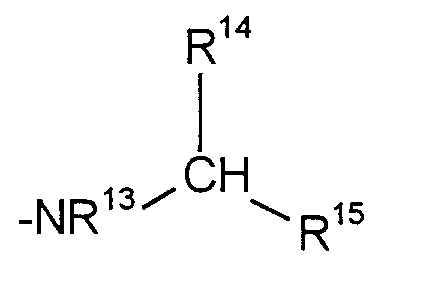
worin - R13
- Wasserstoff oder geradkettiges oder verzweigtes Alkyl mit bis zu 4 Kohlenstoffatomen bedeutet,
- R14
- Wasserstoff, Phenyl, Pyridyl, Furyl oder Thienyl bedeutet,
- R15
- Wasserstoff oder geradkettiges oder verzweigtes Alkyl mit bis zu 6 Kohlenstoffatomen bedeutet, das gegebenenfalls durch Hydroxy substituiert ist,
- Besonders bevorzugt sind Verbindungen der allgemeinen Formel (I),
in welcher - A
- für einen Rest der Formel

worin - R3, R4, R6 und R7
- gleich oder verschieden sind und
Wasserstoff, Phenyl, Cyclopropyl, Cyclopentyl oder Cyclohexyl bedeuten, oder
geradkettiges oder verzweigtes Alkyl oder Alkenyl mit jeweils bis zu 5 Kohlenstoffatomen bedeuten, die gegebenenfalls durch Fluor, Chlor, Brom, Hydroxy oder Phenyl substituiert sind, - T, V, X und Y
- gleich oder verschieden sind und
ein Sauerstoff- oder Schwefelatom bedeuten, - R5 und R8
- gleich oder verschieden sind und
Wasserstoff, Fluor, Chlor, Brom, Cyclopropyl, Cyclobutyl, Cyclopentyl, Cyclohexyl, Cycloheptyl oder für geradkettiges oder verzweigtes Alkyl oder Alkenyl mit jeweils bis zu 5 Kohlenstoffatomen bedeuten, die gegebenenfalls durch Cyclopropyl, Cyclopentyl, Cyclohexyl, Cycloheptyl, Phenyl, Pyridyl, Thienyl oder Furyl substituiert sind, die ihrerseits bis zu 2-fach gleich oder verschieden durch Phenyl, Benzyl, Fluor, Chlor, Brom, Hydroxy oder durch geradkettiges oder verzweigtes Alkyl oder Alkoxy mit jeweils bis zu 3 Kohlenstoffatomen substituiert sein können, oder
Phenyl, Pyridyl, Thienyl oder Furyl bedeuten, die gegebenenfalls bis zu 2-fach gleich oder verschieden durch Fluor, Chlor, Brom, Phenyl, Trifluormethyl, Hydroxy oder durch geradkettiges oder verzweigtes Alkyl oder Alkoxy mit jeweils bis zu 3 Kohlenstoffatomen oder durch eine Gruppe der Formel -(CO)a-NR9R10 substituiert sind,
worin - a
- eine Zahl 0 oder 1 bedeutet,
- R9 und R10
- gleich oder verschieden sind und
Wasserstoff Phenyl oder geradkettiges oder verzweigtes Alkyl oder Acyl mit jeweils bis zu 3 Kohlenstoffatomen bedeuten, - D und E
- gleich oder verschieden sind und
für Wasserstoff, Fluor, Chlor, Brom oder Trifluormethyl stehen, - R1
- für Wasserstoff, Cyclopropyl, Cyclobutyl, Cyclopentyl, Cyclohexyl, Cycloheptyl oder für geradkettiges oder verzweigtes Alkyl oder Alkenyl mit jeweils bis zu 5 Kohlenstoffatomen steht, die gegebenenfalls durch Cyclopropyl, Cyclopentyl, Cyclohexyl, Phenyl, Pyridyl oder Thienyl substituiert sind, oder
für Phenyl, Pyridyl, Furyl oder Thienyl steht, die gegebenenfalls bis zu 2-fach gleich oder verschieden durch Fluor, Chlor, Brom, Phenyl, Trifluormethyl oder geradkettiges oder verzweigtes Alkyl oder Alkoxy mit jeweils bis zu 3 Kohlenstoffatomen oder durch eine Gruppe der Formel -NR11R12 substituiert sind,
worin - R11 und R12
- die oben angegebene Bedeutung von R9 und R10 haben und mit dieser gleich oder verschieden sind,
- L
- für ein Sauerstoff- oder Schwefelatom steht,
- R2
- für Mercapto, Hydroxy, geradkettiges oder verzweigtes Alkoxy mit bis zu 5 Kohlenstoffatomen oder für die Gruppe der Formel

worin - R13
- Wasserstoff oder geradkettiges oder verzweigtes Alkyl mit bis zu 3 Kohlenstoffatomen bedeutet,
- R14
- Wasserstoff, Phenyl, Pyridyl oder Thienyl bedeutet,
- R15
- Wasserstoff oder geradkettiges oder verzweigtes Alkyl mit bis zu 3 Kohlenstoffatomen bedeutet, das gegebenenfalls durch Hydroxy substituiert ist,
- Ganz besonders bevorzugt sind Verbindungen der allgemeinen Formel (I),
in welcher - A
- für einen Rest der Formel

worin - R3, R4, R6 und R7
- Wasserstoff, geradkettiges oder verzweigtes Alkyl mit jeweils bis zu 4 Kohlenstoffatomen bedeuten,
- T, V, X und Y
- gleich oder verschieden sind und
ein Sauerstoff- oder Schwefelatom bedeuten, - R5 und R8
- gleich oder verschieden sind und
Wasserstoff, Fluor, Chlor, Brom, Cyclopropyl, Cyclopentyl, Cyclohexyl oder für geradkettiges oder verzweigtes Alkyl oder Alkenyl mit jeweils bis zu 3 Kohlenstoffatomen bedeuten, die gegebenenfalls durch Cyclopropyl, Cyclopentyl, Cyclohexyl, Phenyl, Pyridyl, Thienyl oder Furyl substituiert sind, die ihrerseits bis zu 2-fach gleich oder verschieden durch Phenyl, Benzyl, Fluor, Chlor, Brom, Hydroxy oder durch geradkettiges oder verzweigtes Alkyl oder Alkoxy mit jeweils bis zu 3 Kohlenstoffatomen substituiert sein können,
oder
Phenyl, Pyridyl, Thienyl oder Furyl bedeuten, die gegebenenfalls bis zu 2-fach gleich oder verschieden durch Fluor, Chlor, Brom, Phenyl, Trifluormethyl, Hydroxy oder durch geradkettiges oder verzweigtes Alkyl oder Alkoxy mit jeweils bis zu 3 Kohlenstoffatomen oder durch eine Gruppe der Formel -(CO)a-NR9R10 substituiert sind,
worin - a
- die Zahl 0 bedeutet,
- R9 und R10
- gleich oder verschieden sind und
Wasserstoff, oder geradkettiges oder verzweigtes Alkyl mit jeweils bis zu 3 Kohlenstoffatomen bedeuten, - D und E
- gleich oder verschieden sind und
für Wasserstoff, Fluor, Chlor, Brom oder Trifluormethyl stehen, - R1
- für Wasserstoff, Cyclopropyl, Cyclopentyl, Cyclohexyl, Cycloheptyl, Phenyl oder für geradkettiges oder verzweigtes Alkyl mit bis zu 5 Kohlenstoffatomen steht,
- L
- für ein Sauerstoffatom steht,
- R2
- für Hydroxy, geradkettiges oder verzweigtes Alkoxy mit bis zu 5 Kohlenstoffatomen oder für die Gruppe der Formel

worin - R13
- Wasserstoff oder geradkettiges oder verzweigtes Alkyl mit bis zu 3 Kohlenstoffatomen bedeutet,
- R14
- Phenyl bedeutet,
- R15
- geradkettiges oder verzweigtes Alkyl mit bis zu 3 Kohlenstoffatomen bedeutet, das gegebenenfalls durch Hydroxy substituiert ist,
- Außerdem wurde ein Verfahren zur Herstellung der erfindungsgemäßen Verbindungen der allgemeinen Formel (I) gefunden,
dadurch gekennzeichnet, daß man zunächst durch Umsetzung von
Verbindungen der allgemeinen Formel (II)
A-H (II)
in welcher - A
- die oben angegebene Bedeutung hat,
- D, E , L und R1
- die oben angegebene Bedeutung haben,
- R16
- für Hydroxy oder Halogen, vorzugsweise für Brom steht,
- R2'
- für geradkettiges oder verzweigtes Alkoxy mit bis zu 8 Kohlenstoffatomen steht,
- A, D, E, L, R1 und R2'
- die oben angegebene Bedeutung haben,
- R13, R14 und R15
- die oben angegebene Bedeutung haben,
- Das erfindungsgemäße Verfahren kann durch folgendes Formelschema beispielhaft erläutert werden:

- Als Basen für das Verfahren können im allgemeinen anorganische oder organische Basen eingesetzt werden. Hierzu gehören vorzugsweise Alkalihydroxide wie zum Beispiel Natriumhydroxid oder Kaliumhydroxid, Erdalkalihydroxide wie zum Beispiel Bariumhydroxid, Alkalicarbonate wie Natriumcarbonat oder Kaliumcarbonat, Erdalkalicarbonate wie Calciumcarbonat, oder Alkali- oder Erdalkalialkoholate wie Natrium- oder Kaliummethanolat, Natrium- oder Kaliumethanolat oder Kalium-tert.butylat, oder organische Amine (Trialkyl(C1-C6)amine) wie Triethylamin, oder Heterocyclen wie 1,4-Diazabicyclo[2.2.2]octan (DABCO), 1,8-Diazabicyclo[5.4.0]undec-7-en (DBU), Pyridin, Diaminopyridin, Methylpiperidin oder Morpholin. Es ist auch möglich als Basen Alkalimetalle wie Natrium oder deren Hydride wie Natriumhydrid einzusetzen. Bevorzugt sind Natriumhydrid, Kaliumcarbonat, Triethylamin, Pyridin und Kalium-tert.butylat, DBU oder DABCO.
- Im allgemeinen setzt man die Base in einer Menge von 0,05 mol bis 10 mol, bevorzugt von 1 mol bis 2 mol, bezogen auf 1 mol der Verbindung der Formel (II) ein.
- Die erfindungsgemäßen Verfahren werden im allgemeinen in einem Temperaturbereich von -30°C bis +100°C, bevorzugt von -10°C bis +60°C, durchgeführt.
- Die erfindungsgemäßen Verfahren werden im allgemeinen bei Normaldruck durchgeführt. Es ist aber auch möglich, die Verfahren bei Überdruck oder bei Unterdruck durchzuführen (z.B. in einem Bereich von 0,5 bis 5 bar).
- Die Verseifung der Carbonsäureester erfolgt nach üblichen Methoden, indem man die Ester in inerten Lösemitteln mit üblichen Basen behandelt.
- Als Basen eignen sich für die Verseifung die üblichen anorganischen Basen. Hierzu gehören bevorzugt Alkalihydroxide oder Erdalkalihydroxide wie beispielsweise Natriumhydroxid, Kaliumhydroxid oder Bariumhydroxid, oder Alkalicarbonate wie Natrium- oder Kaliumcarbonat oder Natriumhydrogencarbonat. Besonders bevorzugt wird Natriumhydroxid oder Kaliumhydroxid eingesetzt.
- Als Lösemittel eignen sich für die Verseifung Wasser oder die für eine Verseifung üblichen organischen Lösemittel. Hierzu gehören bevorzugt Alkohole wie Methanol, Ethanol, Propanol, Isopropanol oder Butanol, oder Ether wie Tetrahydrofuran oder Dioxan, oder Dimethylformamid oder Dimethylsulfoxid. Besonders bevorzugt werden Alkohole wie Methanol, Ethanol, Propanol oder Isopropanol verwendet. Ebenso ist es möglich, Gemische der genannten Lösemittel einzusetzen.
- Die Verseifung kann auch mit Säuren wie beispielsweise Trifluoressigsäure, Essigsäure, Chlorwasserstoffsäure, Bromwasserstoffsäure, Methansulfonsäure, Schwefelsäure oder Perchlorsäure, bevorzugt mit Trifluoressigsäure erfolgen.
- Die Verseifung wird im allgemeinen in einem Temperaturbereich von 0°C bis +100°C, bevorzugt von +20°C bis +80°C durchgeführt.
- Im allgemeinen wird die Verseifung bei Normaldruck durchgeführt. Es ist aber auch möglich, bei Unterdruck oder bei Überdruck zu arbeiten (z.B. von 0,5 bis 5 bar).
- Bei der Durchführung der Verseifung wird die Base im allgemeinen in einer Menge von 1 bis 3 Mol, bevorzugt von 1 bis 1,5 Mol bezogen auf 1 Mol des Esters eingesetzt. Besonders bevorzugt verwendet man molare Mengen der Reaktanden.
- Als Lösemittel für die Umsetzung mit Glycinolen eignen sich hierbei inerte organische Lösemittel, die sich unter den Reaktionsbedingungen nicht verändern. Hierzu gehören Ether, wie Diethylether oder Tetrahydrofuran, Halogenkohlenwasserstoffe wie Dichlormethan, Trichlormethan, Tetrachlormethan, 1,2-Dichlorethan, Trichlorethan, Tetrachlorethan, 1,2-Dichlorethylen oder Trichlorethylen, Kohenwasserstoffe wie Benzol, Xylol, Toluol, Hexan, Cyclohexan oder Erdölfraktionen, Nitromethan, Dimethylformamid, Aceton, Acetonitril oder Hexamethylphosphorsäuretriamid. Ebenso ist es möglich, Gemische der Lösemittel einzusetzen. Besonders bevorzugt ist Dichlormethan, Tetrahydrofuran, Aceton oder Dimethylformamid.
- Als Basen können hier im allgemeinen anorganische oder organische Basen eingesetzt werden. Hierzu gehören vorzugsweise Alkalihydroxide wie zum Beispiel Natriumhydroxid oder Kaliumhydroxid, Erdalkalihydroxide wie zum Beispiel Bariumhydroxid, Alkalicarbonate wie Natriumcarbonat oder Kaliumcarbonat, Erdalkalicarbonate wie Calciumcarbonat, oder Alkali- oder Erdalkalialkoholate wie Natrium- oder Kaliummethanolat, Natrium- oder Kaliumethanolat oder Kalium-tert.butylat, oder organische Amine (Trialkyl(C1-C6)amine) wie Triethylamin, oder Heterocyclen wie 1,4-Diazabicyclo[2.2.2]octan (DABCO), 1,8-Diazabicyclo[5.4.0]undec-7-en (DBU), Pyridin, Diaminopyridin, Methylpiperidin oder Morpholin. Es ist auch möglich als Basen Alkalimetalle wie Natrium und deren Hydride wie Natriumhydrid einzusetzen. Bevorzugt sind Natrium- und Kaliumcarbonat und Triethylamin.
- Die Base wird in einer Menge von 1 mol bis 5 mol, bevorzugt von 1 mol bis 3 mol, bezogen auf 1 mol der entsprechenden Carbonsäure eingesetzt.
- Die Reaktion wird im allgemeinen in einem Temperaturbereich von 0°C bis 150°C, bevorzugt von + 20°C bis + 110°C durchgeführt.
- Die Umsetzung kann bei normalen, erhöhtem oder bei erniedrigtem Druck durchgeführt werden (z.B. 0,5 bis 5 bar). Im allgemeinen arbeitet man bei Normaldruck.
- Die Umsetzung mit Phenylglycinolen kann gegebenenfalls auch über die aktivierte Stufe der Säurehalogenide, die aus den entsprechenden Säuren durch Umsetzung mit Thionylchlorid, Phosphortrichlorid, Phosphorpentachlorid, Phosphortribromid oder Oxalylchlorid hergestellt werden können, verlaufen.
- Die oben aufgeführten Basen können gegebenenfalls auch als säurebindende Hilfsmittel eingesetzt werden.
- Als Hilfsmittel eignen sich ebenso Dehydratisierungsreagenzien. Dazu gehören beispielsweise Carbodiimide wie Diisopropylcarbodiimid, Dicyclohexylcarbodiimid oder N-(3-Dimethylaminopropyl)-N'-ethylcarbodiimid-Hydrochlorid oder Carbonylverbindungen wie Carbonyldiimidazol oder 1,2-Oxazoliumverbindungen wie 2-Ethyl-5-phenyl-1,2-oxazolium-3-sulfonat oder Propanphosphonsäureanhydrid oder Iso-butylchloroformat oder Benzotriazolyloxy-tris-(dimethylamino)phosphoniumhexa-fluorophosphat oder Phosphorsäurediphenyl-esteramid oder Methan-sulfonsäurechlorid, gegebenenfalls in Anwesenheit von Basen wie Triethylamin oder N-Ethylmorpholin oder N-Methylpiperidin oder Dicyclohexylcarbodiimid und N-Hydroxysuccinimid.
- Die säurebindenden Mittel und Dehydratisierungsreagenzien werden im allgemeinen in einer Menge von 0,5 bis 3 mol, bevorzugt von 1 bis 1,5 mol, bezogen auf 1 mol der entsprechenden Carbonsäuren, eingesetzt.
- Die Verbindungen der allgemeinen Formeln (III) und (IV) sind an sich bekannt oder nach üblichen Methoden herstellbar.
- Die Verbindungen der allgemeinen Formel (II) sind bekannt oder können hergestellt werden, indem man beispielsweise die entsprechenden 1,3-substituierten Uracile mit Orthoameisensäureester, Carbonsäurechloriden und mit Aldehyden der allgemeinen Formel (V)
R17-CHO (V)
in welcher - R17
- die oben angegebene Bedeutungen von R5 und/oder R8 umfaßt,
- Für die Herstellung eignen sich die oben aufgeführten Lösemittel. Bevorzugt ist Ethanol, Dichlormethan oder Dimethylformamid.
- Die Umsetzungen werden in einem Temperaturbereich von 30°C bis 160°C, vorzugsweise bei der Siedetemperatur des jeweiligen Lösemittels und Normaldurck durchgeführt.
- Die Aldehyde der allgemeinen Formel (V) sind an sich bekannt oder nach üblichen Methoden herstellbar.
- Die Verbindungen der allgemeinen Formel (Ia) sind neu und nach dem oben beschriebenen Verfahren herstellbar.
- Die erfindungsgemäßen Verbindungen der allgemeinen Formeln (I) und (Ia) haben ein nicht vorhersehbares pharmakologisches Wirkspektrum.
- Sie können als Wirkstoffe in Arzneimitteln zur Reduzierung von Veränderungen an Gefäßwänden Verwendung finden und zur Behandlung von Koronaren Herzerkrankungen, Herzinsuffizienz, Störungen der Hirnleistung, ischämischen Gehirnerkrankungen, Apoplex, Durchblutungsstörungen, Mikrozirkulationsstörungen und Thrombosen.
- Weiterhin spielt bei der Okklusion von Gefäßen die Proliferation glatter Muskelzellen eine ausschlaggebende Rolle. Die erfindungsgemäßen Verbindungen sind geeignet, diese Proliferation zu inhibieren und damit atherosklerotische Prozesse zu verhindern.
- Die erfindungsgemäßen Verbindungen zeichnen sich durch eine Senkung der ApoB-100-assoziierten Lipoproteinen (VLDL und seiner Abbauprodukte, wie z.B. LDL), des ApoB-100, der Triglyceride und des Cholesterins aus. Damit besitzen sie wertvolle, im Vergleich zum Stand der Technik überlegene pharmakologische Eigenschaften.
- Überraschenderweise besteht die Wirkung der erfindungsgemäßen Verbindungen zunächst in einer Verminderung oder vollständigen Inhibierung der Bildung und/oder der Freisetzung von ApoB-100-assoziierten Lipoproteinen aus Leberzellen, was eine Senkung des VLDL-Plasmaspiegels zur Folge hat. Diese VLDL-Senkung muß mit einer Senkung der Plasmaspiegel von ApoB-100, LDL, Triglyceriden und von Cholesterin einhergehen; es werden also gleichzeitig mehrere der obengenannten Risikofaktoren gesenkt, die an Gefäßwandveränderungen beteiligt sind.
- Die erfindungsgemäßen Verbindungen können daher zur Präventation und Behandlung von Atherosklerose, der Fettsucht, Pankreatitis und der Obstipation eingesetzt werden.
- Der Test zum Nachweis der Hemmung der Freisetzung ApoB-100-assoziierter Liproproteine aus Leberzellen erfolgte in vitro mit kultivierten Leberzellen, bevorzugt mit Zellen der humanen Linie HepG2. Diese Zellen werden unter Standardbedingungen in Medium für die Kultur eukariontischer Zellen gezüchtet, bevorzugt in RPMI 1640 mit 10% fötalem Kälberserum. HepG2-Zellen synthetisieren und sezernieren in den Kulturüberstand ApoB-100-assoziierte Lipoproteinpartikel, die im Prinzip ähnlich aufgebaut sind wie die VLDL- bzw. LDL-Partikel, die im Plasma zu finden sind.
- Diese Partikel können mit einem Immunoassay für humanes LDL nachgewiesen werden. Dieser Immunoassay erfolgt mit Antikörpern, die im Kaninchen gegen humanes LDL unter Standardbedingungen induziert worden waren. Die anti-LDL-Antikörper (Kan-anti-LDL-Ak) wurden an einem Immunosorbens mit humanem LDL affinitätschromatographisch gereinigt. Diese gereinigten Kan-anti-LDL-Ak werden an die Oberfläche von Plastik adsorbiert. Zweckmäßigerweise erfolgt diese Adsorbtion an die Plastikoberfläche von Mikrotitierplatten mit 96 Vertiefungen, bevorzugt an MaxiSorp-Platten. Wenn im Überstand von Hep-G2-Zellen ApoB-100-assoziierte Partikel vorhanden sind, dann können diese an die insolubilisierten Kan-anti-LDL-Ak binden, und es entsteht ein Immunkomplex, der an die Plastikoberfläche gebunden ist. Nicht gebundene Proteine werden durch Waschen entfernt. Der sich an der Plastikoberfläche befindliche Immunkomplex wird mit monoklonalen Antikörpern nachgewiesen, die nach Standardbedingungen gegen humanes LDL induziert und gereinigt worden waren. Diese Antikörper wurden mit dem Enzym Peroxidase konjugiert. Peroxidase setzt das farblose Substrat TMB in Gegenwart von H2O2 in ein gefärbtes Produkt um. Nach Ansäuerung des Reaktionsgemisches mit H2SO4 wird die spezifische Lichtabsorption bei 450 nm bestimmt, die ein Maß für die Menge von ApoB-100-assoziierten Partikeln ist, die von den HepG2-Zellen in den Kulturüberstand sezerniert worden waren.
- Überraschenderweise hemmen die erfindungsgemäßen Verbindungen die Freisetzung der ApoB-100-assoziierten Partikel. Der IC50-Wert gibt an, bei welcher Substanzkonzentration die Lichtabsorption im Vergleich zur Kontrolle (Lösemittelkontrolle ohne Substanz) um 50% inhibiert ist.

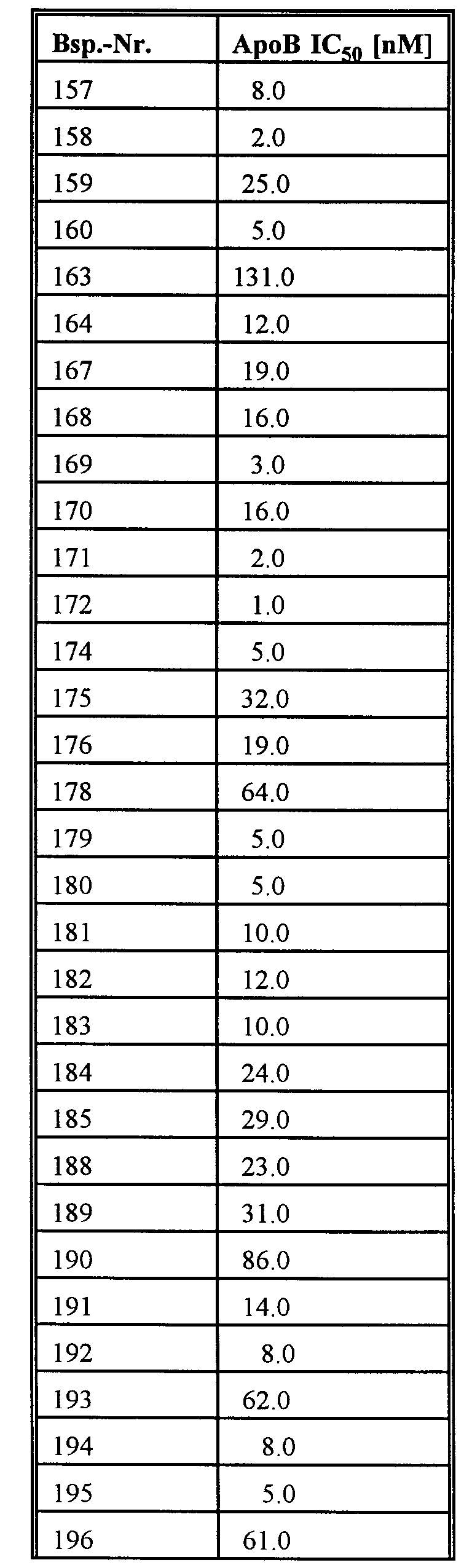

- Der Effekt der Testsubstanzen auf die VLDL-Sekretion in vivo wird am Hamster untersucht. Hierzu werden Goldhamster nach Prämedikation mit Atropin (83 mg/kg s.c.) mit Ketavet (83 mg/kg s.c.) und Nembutal (50 mg/kg i.p.) narkotisiert. Wenn die Tiere reflexfrei geworden sind, wird die V. jugularis freipräpariert und kanüliert. Anschließend werden 0,25 ml/kg einer 20%igen Lösung von Triton WR-1339 in physiologischer Kochsalzlösung appliziert. Dieses Detergens hemmt die Lipoproteinlipase und führt so zu einem Anstieg des Triglyceridspiegels aufgrund eines ausbleibenden Katabolismus von sezernierten VLDL-Partikeln. Dieser Triglyceridanstieg kann als Maß für die VLDL-Sekretionsrate herangezogen werden. Den Tieren wird vor sowie ein und zwei Stunden nach Applikation des Detergens durch Punktion des retroorbitalen Venenplexus Blut entnommen. Das Blut wird zwei Stunden bei Raumtemperatur, anschließend über Nacht bei 4°C inkubiert, um die Gerinnung vollständig abzuschließen. Danach wird 5 Minuten bei 10.000 g zentrifugiert. Im so erhaltenen Serum wird die Triglyceridkonzentration mit Hilfe eines modifizierten kommerziell erhältlichen Enzymtests bestimmt (Merckotest® Triglyceride Nr. 14354). 100 µl Serum werden mit 100 µl Testreagenz in 96-Lochplatten versetzt und 10 Minuten bei Raumtemperatur inkubiert. Anschließend wird die optische Dichte bei einer Wellenlänge von 492 nm in einem automatischen Platten-Lesegerät bestimmt (SLT-Spectra). Serumproben mit einer zu hohen Triglyceridkonzentration werden mit physiologischer Kochsalzlösung verdünnt. Die in den Proben enthaltene Triglyceridkonzentration wird mit Hilfe einer parallel gemessenen Standardkurve bestimmt. Testsubstanzen werden in diesem Modell entweder unmittelbar vor Applikation des Detergens intravenös verabreicht oder vor Einleitung der Narkose oral oder subkutan.
Tabelle 2 Bsp.-Nr. Triton-Hamster %TG Inhibition 2 h nach Substanz Triton-Hamster %CH Inhibition 2 h nach Substanz 129 25% bei 6 mg/kg i.v. 25% bei 6 mg/kg i.v. - Die Substanzen, die auf ihre triglyceridabsorptionshemmende Wirkung in vivo untersucht werden sollen, werden männlichen Wistar-Ratten mit einem Körpergewicht zwischen 170 und 230 g oral verabreicht. Zu diesem Zweck werden die Tiere 18 Stunden vor der Substanzapplikation in Gruppen zu 6 Tieren eingeteilt und anschließend wird ihnen das Futter entzogen. Trinkwasser steht den Tieren ad libitum zur Verfügung. Die Tiere der Kontrollgruppen erhalten eine wäßrige Traganth-Suspension bzw. eine Traganth-Suspension die Olivenöl enthält. Die Traganth-Olivenöl-Suspension wird mit dem Ultra-Turrax hergestellt. Die zu untersuchenden Substanzen werden in einer entsprechenden Traganth-Olivenöl-Suspension ebenfalls mit dem Ultra-Turrax, direkt vor der Substanzapplikation suspendiert.
- Jeder Ratte wird vor der Schlundsondenapplikation zur Bestimmung des basalen Serumtriglyceridgehaltes Blut durch Punktion des retroorbitalen Venenplexus entnommen. Anschließend werden die Traganth-Suspension, die Traganth-OlivenölSuspensionen ohne Substanz (Kontrolltiere), bzw. die Substanzen, suspendiert in einer entsprechenden Traganth-Olivenöl-Suspension, den nüchternen Tieren mit einer Schlundsonde verabreicht. Die weiteren Blutentnahmen zur Bestimmung des postprandialen Serumtriglyceridanstiegs erfolgen in der Regel 1, 2 und 3 Stunden nach der Schlundsondenapplikation.
- Die Blutproben werden zentrifugiert und nach Gewinnung des Serums die Triglyceride photometrisch mit einem EPOS-Analyzer 5060 (Eppendorf Gerätebau, Netheler & Hinz GmbH, Hamburg) bestimmt. Die Bestimmung der Trigylceride erfolgt vollenzymatisch mit einem handelsüblichen UV-Test.
- Der postprandiale Serumtriglyceridanstieg wird durch Subtraktion des Triglyceridvorwertes jeden Tieres von seinen korrespondierenden postprandialen Triglyceridkonzentrationen (1, 2 und 3 Stunden nach Applikation) ermittelt.
- Die Differenzen (in mmol/l) zu jedem Zeitpunkt (1, 2 und 3 Stunden) werden in den Gruppen gemittelt, und die Mittelwerte des Serumtriglyceridanstiegs (ΔTG) der substanzbehandelten Tiere mit den Tieren verglichen, die nur die Traganth-Öl-Suspension erhielten.
- Ebenso wird der Serumtriglyceridverlauf der Kontrolltiere, die nur Traganth erhielten, berechnet. Der Substanzeffekt zu jedem Zeitpunkt (1, 2 oder 3 Stunden) wird wie folgt ermittelt und in Δ% von der ölbelasteten Kontrolle angegeben.

Tabelle 3 Bsp.-Nr. Absorption ED 50 oder % Inhibition (mg/kg p.o.) 112 3 mg/kg 114 < 2 mg/kg 117 3 mg/kg 123 2 mg/kg 129 20 mg/kg 130 5 mg/kg 133 2 mg/kg 136 2 mg/kg 140 > 3 mg/kg 143 > 3 mg/kg 146 > 3 mg/kg 149 > 3 mg/kg 151 6 mg/kg 154 < 2 mg/kg 157 > 2 mg/kg 160 3 mg/kg 167 > 2 mg/kg 169 2 mg/kg 174 < 2 mg/kg 178 3 mg/kg 179 > 3 mg/kg 182 2 mg/kg 191 >> 3 mg/kg 197 3 mg/kg 201 > 3 mg/kg 227 > 6 mg/kg - Die statistische Auswertung erfolgt mit Student's t-Test nach vorheriger Überprüfung der Varianzen auf Homogenität.
- Substanzen, die zu einem Zeitpunkt den postprandialen Serumtriglyceridanstieg, verglichen mit dem der unbehandelten Kontrollgruppe, statistisch signifikant (p <0,05) um mindestens 30 % vermindern, werden als pharmakologisch wirksam angesehen.
- Die Wirkung der Testsubstanzen auf die VLDL-Sekretion wird ebenfalls an der Ratte untersucht. Dazu wird Ratten 500 mg/kg Körpergewicht (2,5 ml/kg) Triton WR-1339, gelöst in physiologischer Kochsalzlösung, intravenös in die Schwanzvene appliziert. Triton WR-1339 inhibiert die Lipoproteinlipase und führt somit durch Hemmung des VLDL-Katabolismus zu einem Anstieg des Triglycerid- und Cholsterinspiegels. Diese Anstiege können als Maß für die VLDL-Sekretionsrate herangezogen werden.
- Den Tieren wird vor sowie eine und zwei Stunden nach Applikation des Detergens durch Punktion des retroorbitalen Venenplexus Blut entnommen. Das Blut wird zur Gerinnung 1 h bei Raumtemperatur inkubiert und das Serum durch Zentrifugation mit 10 000 g für 20 s gewonnen. Anschließend werden die Triglyceride mittels eines handelsüblichen gekoppelten Enzymtests (Sigma Diagnostics®, Nr. 339) bei einer Wellenlänge von 540 nm photometrisch bestimmt. Die Messung erfolgt mit Hilfe eines ebenfalls gekoppelten Enzymtests (Boehringer Mannheim®, Nr. 1442350) bei einer Wellenlänge von 546 nm. Proben mit Triglycerid- bzw. Cholesterinkonzentrationen, die den Meßbereich der Methoden überschreiten, werden mit physiologischer Kochsalzlösung verdünnt. Die Ermittlung der jeweiligen Serumkonzentrationen erfolgt anhand parallel gemessener Standardreihen. Test-substanzen werden unmittelbar nach der Tritoninjektion oral, intravenös oder subcutan appliziert.
Tabelle 4 Bsp.-Nr. Triton Ratte % TG Inhibition (p.o.) 2 h nach Substanz 112 17.0% bei 3 mg/kg (n.s.) 114 14.1% bei 3 mg/kg (n.s.) 117 25% bei 3 mg/kg (n.s.) 130 36% bei 20 mg/kg 136 28% bei 3 mg/kg 154 (-4%) bei 3 mg/kg (n.s.) 157 11.3% bei 3 mg/kg 169 59.4% bei 10 mg/kg 169 41 % bei 5 mg/kg 169 28% bei 3 mg/kg 175 9.8% bei 3 mg/kg (n.s.) 176 6.2% bei 3 mg/kg (n.s.) 227 (-8%) bei 3 mg/kg (n.s.) - Die Erfindung betrifft außerdem die Kombination von substituierten Xanthinen der allgemeinen Formel (I) mit einem Glucosidase- und/oder Amylasehemmer zur Behandlung von familiärer Hyperlipidamien, der Fettsucht (Adipositas) und des Diabetes mellitus. Glucosidase- und/oder Amylasehemmer im Rahmen der Erfindung sind beispielsweise Acarbose, Adiposine, Voglibose, Miglitol, Emiglitate, MDL-25637, Camiglibose, MDL-73945, Tendamistat, AI-3688, Trestatin, Pradimilin-Q und Salbostatin.
- Bevorzugt ist die Kombination von Acarbose, Miglitol, Emiglitate oder Voglibose mit einer der oben aufgeführten erfindungsgemäßen Verbindungen der allgemeinen Formel (I).
- Die neuen Wirkstoffe können in bekannter Weise in die üblichen Formulierungen überführt werden, wie Tabletten, Dragees, Pillen, Granulate, Aerosole, Sirupe, Emulsionen, Suspensionen und Lösungen, unter Verwendung inerter, nicht-toxischer, pharmazeutisch geeigneter Trägerstoffe oder Lösemittel. Hierbei soll die therapeutisch wirksame Verbindung jeweils in einer Konzentration von etwa 0,5 bis 90-Gew.-% der Gesamtmischung vorhanden sein, d.h. in Mengen, die ausreichend sind, um den angegebenen Dosierungsspielraum zu erreichen.
- Die Formulierungen werden beispielsweise hergestellt durch Verstrecken der Wirkstoffe mit Lösemitteln und/oder Trägerstoffen, gegebenenfalls unter Verwendung von Emulgiermitteln und/oder Dispergiermitteln, wobei z.B. im Fall der Benutzung von Wasser als Verdünnungsmittel gegebenenfalls organische Lösemittel als Hilfslösemittel verwendet werden können.
- Die Applikation erfolgt in üblicher Weise, vorzugsweise oral oder parenteral, insbesondere perlingual oder intravenös.
- Für den Fall der parenteralen Anwendung können Lösungen des Wirkstoffs unter Verwendung geeigneter flüssiger Trägermaterialien eingesetzt werden.
- Im allgemeinen hat es sich als vorteilhaft erwiesen, bei intravenöser Applikation Mengen von etwa 0,001 bis 1 mg/kg, vorzugsweise etwa 0,01 bis 0,5 mg/kg Körpergewicht zur Erzielung wirksamer Ergebnisse zu verabreichen, und bei oraler Applikation beträgt die Dosierung etwa 0,01 bis 20 mg/kg, vorzugsweise 0,1 bis 10 mg/kg Körpergewicht.
- Trotzdem kann es gegebenenfalls erforderlich sein, von den genannten Mengen abzuweichen, und zwar in Abhängigkeit vom Körpergewicht bzw. der Art des Applikationsweges, vom individuellen Verhalten gegenüber dem Medikament, der Art von dessen Formulierung und dem Zeitpunkt bzw. Intervall, zu welchem die Verabreichung erfolgt. So kann es in einigen Fällen ausreichend sein, mit weniger als der vorgenannten Mindestmenge auszukommen, während in anderen Fällen die genannte obere Grenze überschritten werden muß. Im Falle der Applikation größerer Mengen kann es empfehlenswert sein, diese in mehreren Einzelgaben über den Tag zu verteilen.
-
- Ac
- = Acetyl
- bs
- = broad singlet
- Bn
- = Benzyl
- Bz
- = Benzoyl
- CI
- = Chemische Ionisation
- cDec
- = cyclo Decyl
- cDodec
- = cyclo Dodecyl
- cHept
- = cyclo Heptyl
- cHex
- = cyclo Hexyl
- cNon
- = cyclo Nonyl
- cOct
- = cyclo Octyl
- cPent
- = cyclo Pentyl
- cPr
- = cyclo Propyl
- cUndec
- = cyclo Undecyl
- d
- = doublet
- DCC
- = Dicyclohexylcarbodiimid
- DCCI
- = N'-(3-Dimethylaminopropyl)-N'-ethylcarbodiimid
- dd
- = doublet doublets
- DDQ
- = 2,3-Dichlor-5,6-dicyano-1,4-benzochinon
- dia
- = Diastereomer
- DMAP
- = 4-(N,N-Dimethylamino)pyridin
- DMF
- = N,N-Dimethylformamid
- DMSO
- = Dimethylsulfoxid
- EI
- = Elektronenstoß-Ionisation
- ent
- = Enantiomer
- Et
- = Ethyl
- FAB
- = Fast Atom Bombardment
- HOBT
- = 1-Hydroxy-1H-benzotriazol
- Hz
- = Hertz
- iBu
- = iso Butyl
- iPr
- = iso Propyl
- m
- = multiplet
- Me
- = Methyl
- Mes
- = Mesyl
- NBS
- = Bromsuccinimid
- nBu
- = normales Benzyl
- nPr
- = normales Propyl
- Ph
- = Phenyl
- PPA
- = Polyphosphorsäure
- pTol
- = para Tolyl
- pTos
- = para Tosyl
- rac
- = Racemat
- RT
- = Raumtemperatur
- s
- = singlet
- sBu
- = sekundär Butyl
- tBu
- = tertiär Butyl
- t
- = triplet
- TFA
- = Trifluoressigsäure
- THF
- = Tetrahydrofuran
- TMS
- = Tetramethylsilan
-
Benutzte Solvenzgemische Petrolether : Aceton = 1:1 (A) Petrolether : Essigester = 20:1 (B) Petrolether : Essigester = 10:1 (C) Petrolether : Essigester = 5:1 (D) Petrolether : Essigester = 3:1 (E) Petrolether : Essigester = 2:1 (F) Petrolether : Essigester = 1:1 (G) Petrolether : Essigester = 1:2 (H) Dichlormethan (100%) = (I) Dichlormethan : Methanol = 50:1 (J) Dichlormethan : Methanol = 20:1 (K) Dichlormethan : Methanol = 10:1 (L) Dichlormethan : Essigester = 1:1 (M) Dichlormethan : Ethanol = 50:1 (N) Essigester : Methanol = 10:1 (O) Toluol (100%) = (P) Toluol : Essigester = 1:1 (Q) Toluol : Essigester = 8:1 (R) Toluol : Essigester = 9:1 (S) Petrolether : Essigester = 4:1 (T) - Folgende Kennzeichnungen haben für alle nachfolgenen Tabellen Gültigkeit:
* = EI
# = CI -

- 8.5 g (50 mmol) 5,6-Diamino-1,3-dimethyluracil Hydrat wurden unter Rückfluß in Ethanol (180 ml) gelöst. Zu diese Lösung wurde eine Lösung von 6.0 g (50 mmol) p-Tolylaldehyd sowie 4.5 g Essigsaeure in Ethanol (50 ml) gegeben. Es wurde für 1 Std unter Rückfluß erhitzt, auf Raumtemperatur abgekühlt und abgesaugt. Die Kristalle wurden mit Diethylether nachgewaschen.
Die so erhaltenen Kristalle wurden vorgelegt und mit 36.6 g (210 mmol) Azodicarbonsaeurediethylester versetzt. Es wurde 5 Min. auf 90°C erwärmt, wobei ein Feststoff ausfiel. Die Lösung wurde auf Raumtemperatur abgekühlt und mit Ethanol (100 ml) verdünnt. Der ausgefallene Feststoff wurde abgesaugt, mit Diethylether gewaschen und i. Vak. getrocknet.
Ausbeute 10.9 g (81%);
Rf = 0.56 (Dichlormethan : Methanol, 20 : 1);
Fp = >240 oC;
Masse (berechnet) für C14H14N4O2 = 270.30, Massenspektrum (EI, rel. Intensität) 270 (100%);
1H NMR (200 MHz, Pyridin-D5) δ 8.29 (d, J = 8.62 Hz, 2 H), 7.33 (d, J = 7.89 Hz, 2 H), 4.98 (bs, 1 H), 3.72 (s, 3 H), 3.53 (s, 3 H), 2.29 (s, 3 H). -

- 11.94 g (70 mmol) 3-Chlorphenylessigsäure wurden in 100 ml Dichlormethan gelöst, mit einem Tropfen DMF versetzt und auf 0oC gekühlt. Zu dieser Lösung gab man langsam 8.74 g (73.5 mmol) Thionylchlorid und rührte bis zum Ende der Gasentwicklung (ca. 1 h), wobei man das Reaktionsgemisch auf Raumtemperatur erwärmen ließ.
11.91 g (70 mmol) 5,6-Diamino-1,3-dimethyluracil Hydrat wurden in 1M NaOH (150 ml) und Wasser (350 ml) vorgelegt und auf 45°C erwärmt bis eine homogene Lösung entstand. Man kühlte diese Lösung auf Raumtemperatur ab und gab die Säurechloridlösung (s.o.) unter kräftigem Rühren hinzu. Es wurden noch weitere 16 h bei Raumtemperatur gerührt. Der ausgefallene Feststoff wurde abgesaugt und mit Wasser gewaschen.
Dieser Feststoff wurde in Methanol (400 ml) suspendiert und mit 4 M NaOH (400 ml) 1 h unter Rückfluß erhitzt. Nach Abkühlen auf Raumtemperatur säuerte man die Lösung mit konz. HCl auf pH 3 an, wobei das gewünschte Produkt ausfiel. Der ausgefallene Feststoff wurde abgesaugt, mit Wasser und Methanol gewaschen und im Umlufttrockenschrank getrocknet.
Ausbeute 17.1 g (80%);
Rf = 0.57 (Dichlormethan : Methanol, 10 : 1);
Fp = >240 oC;
Masse (berechnet) für C14H13ClN4O2 = 304.74, Massenspektrum (EI, rel. Intensität) 304 (100%);
1H NMR (250 MHz, Trifluoressigsäure-D1) δ 7.36-7.30 (m, 3 H), 7.20 (m, 1 H), 4.50 (s, 2 H), 3.74 (s, 3 H), 3.52 (s, 3 H). -

- 5.0 g (25 mmol) 5,6-Diamino-1,3-diethyluracil und 475 mg (2.5 mmol) p-Toluolsulfonsaeure wurden in Orthoameisensaeuretrimethylester (50 ml) gelöst. Es wurde für 1 Std. zum Rückfluß gekocht, dann abgekühlt und abgesaugt. Da eine polare Verunreinigung enstanden war, wurde die Substanz durch Chromatographie an Kieselgel gereinigt:
Ausbeute 3.5 g (67%);
Rf = 0.15 (Dichlormethan : Methanol, 20 : 1);
Fp = 218-220 oC;
Masse (berechnet) für C9H12N4O2 = 208.23, Massenspektrum (EI, rel. Intensität) 208 (100%);
1H NMR (200 MHz, DMSO-D6) δ 13.55 (bs, 1 H), 8.05 (s, 1 H), 4.04 (q, J = 7.07 Hz, 2 H), 3.93 (q, J = 7.02 Hz, 2 H), 1.23 (t, J = 7.03 Hz, 3 H), 1.13 (t, J = 7.01 Hz, 3 H). - Die in der Tabelle I aufgeführten Verbindungen wurden nach den dort aufgeführten Methoden hergestellt:


-

- 21.0 g (100 mmol, Apin) 2-Phenyl-1-(4-methyl)phenyl-1-oxoethane und 38.8 g (120 mmol) Iodbenzoldiacetat wurden in 300 ml Orthoameisensaeuretrimethylester gelöst. Zu dieser Lösung wurden 19.6 g konz. Schwefelsäure gegeben, und die Lösung wurde für 6 Std auf 60°C erwärmt. Die Lösung wurde auf Raumtemperatur abgekühlt, mit Wasser (100 ml) verdünnt, und mit Diethylether extrahiert. Die vereinigten organischen Phasen wurden über Natriumsulfat getrocknet und einrotiert. Der Rückstand wurde säulenchromatographisch gereinigt.
Ausbeute 13.1 g (55%);
Rf = 0.33 (Petrolether : Essigester, 20 : 1);
Masse (berechnet) für C16H16O2 = 240.30, Massenspektrum (FAB, rel. Intensität) 241 (25%), 181 (100%);
1H NMR (200 MHz, CDCl3) δ 7.3-7.10 (m, 9 H), 4.99 (s, 1 H), 3.73 (s, 3 H), 2.31 (s, 3 H). -

- 33.5 g (0.3 mol) Kalium-tert.butylat werden in 100 ml wasserfreiem DMF bei 0°C vorgelegt, und 51.6 g (0.25 mol) 4-Methylphenyl-essigsäure-tert.butylester in 250 ml wasserfreiem DMF zugetropft. Es wird 30 min. bei 0°C gerührt und 32.2 ml (0.3 mol) Cyclopentylbromid in 150 ml wasserfreiem DMF bei 5-15°C zugetropft und 20 h bei 25°C gerührt. Nach Einengen wird der Rückstand zwischen Wasser und Diethylether verteilt, die Etherphase über Natriumsulfat getrocknet und eingeengt. Das Produkt kristallisiert aus.
Ausbeute: 67 g (97.5% d.Th.);
Festpunkt: 51-53°C. - Die Verbindungen der Tabelle II werden analog der Vorschrift des Beispiels XLVII hergestellt:
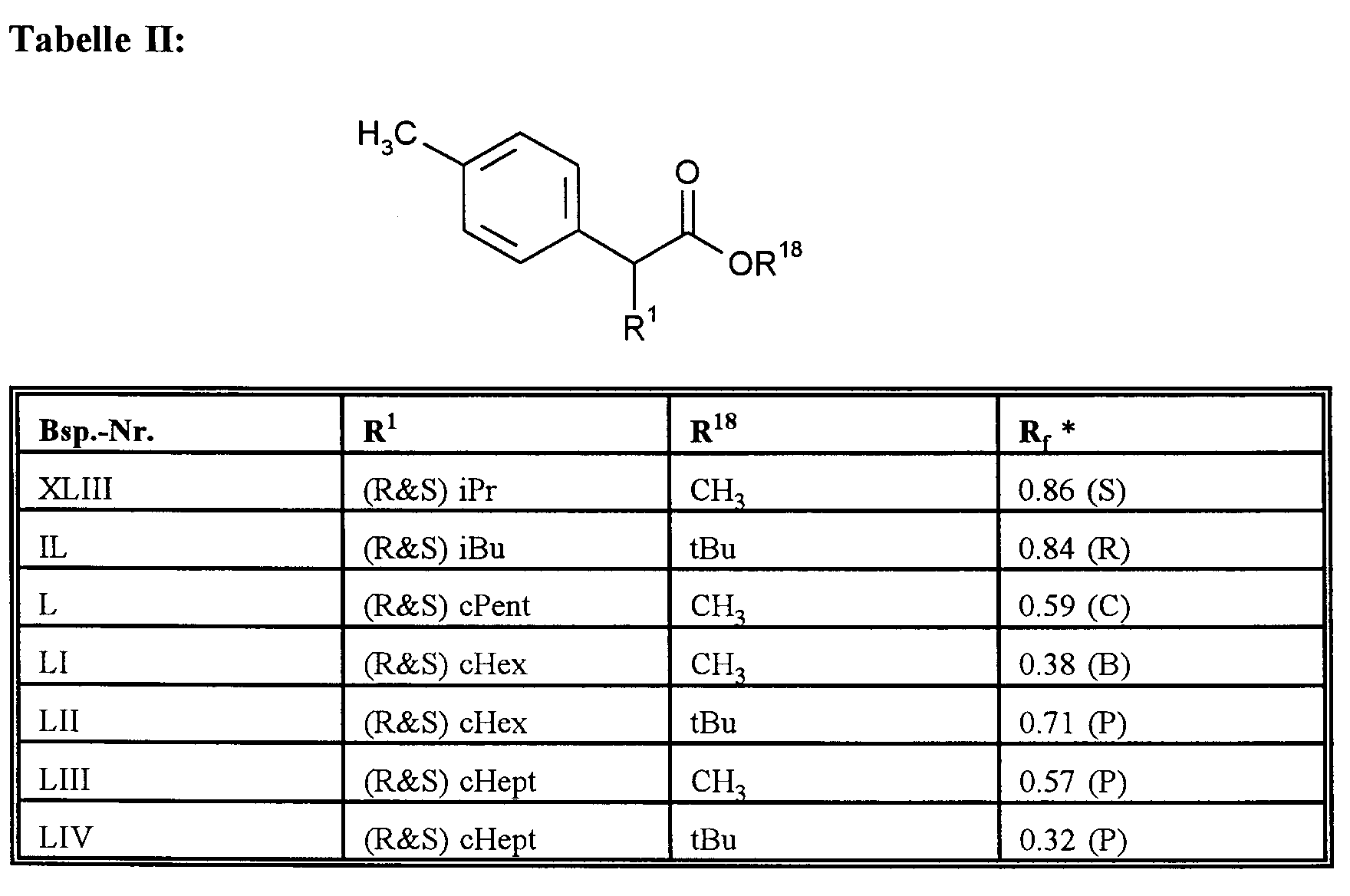
-
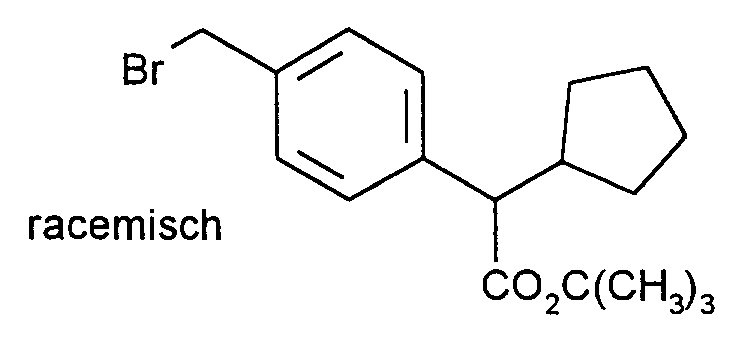
- 27.4 g (0.1 mol) der Verbindung aus Beispiel XLVII werden in 200 ml Tetrachlormethan gelöst und zum Sieden erhitzt. Nach Zugabe von 0.82 g Azobisisobutyronitril werden 18.7 g (0.105 mol) N-Bromsuccinimid portionsweise zugegeben und anschließend 1 h refluxiert, auf 0°C abgekühlt und vom Succinimid abfiltriert. Nach Einengen des Filtrats fällt das Produkt aus. Es wird mit Petrolether (40/60) gewaschen und getrocknet.
Ausbeute: 20 g (57% d.Th.);
Fp.: 73-76°C. - Die Verbindungen der Tabelle III werden analog der Vorschrift des Beispiels LV hergestellt:

-

- 5.4 g (25 mmol) der Verbindung aus Beispiel I wurden bei 22°C in DMF (100 ml) suspendiert und mit 0.8 g (60% in Paraffin, 22 mmol) NaH versetzt. Nach 30 min bei 40 oC, wurde die Lösung mit der Verbindung aus Beispiel LV versetzt. Es wurde noch weitere 16 h bei Raumtemperatur gerührt. Wasser wurde dazugegeben und der anfallende Niederschlag abgesaugt. Der mäßig feuchte Feststoff wurde mit Dichlormethan verrührt und abgesaugt.
Ausbeute 9.3 g (88%);
Rf = 0.48 (Dichlormethan : Methanol, 20 : 1);
Masse (berechnet) für C32H38N4O4 = 542.68, Massenspektrum (CI (NH3), rel. Intensität) 560 (25%, M+NH4), 543 (100%);
1H NMR (300 MHz, CDCl3) δ 7.42 (d, 2 H), 7.28-7.20 (m, 4 H), 6.95 (d, 2 H), 5.60 (s, 2 H), 3.61 (s, 3 H), 3.40 (s, 3 H), 3.10 (d, 1 H), 2.42 (m, 1 H), 2.40 (s, 3 H), 1.90 (m, 1 H), 1.70-1.20 (m, 6 H), 1.41 (s, 9 H), 0.95 (m, 1 H). - Die in den Tabellen 1, 2 und 3 aufgeführten Verbindungen werden in Analogie zur Vorschrift des Beispiels 1 hergestellt:


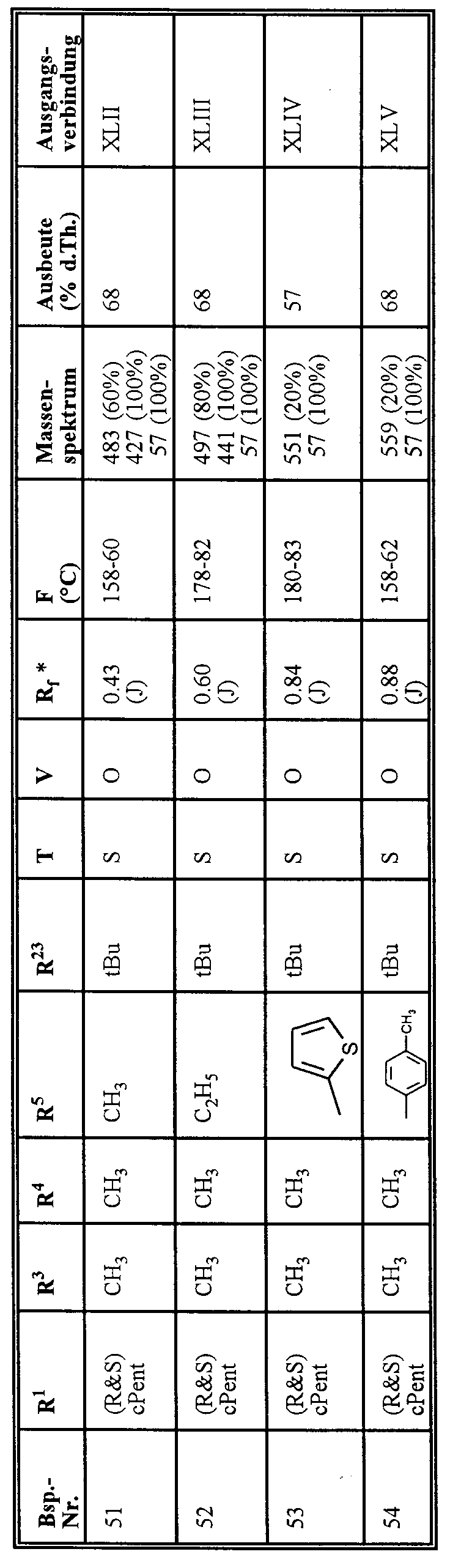
-

- Man löst 5.26 g (9.18 mmol) der Verbindung aus Beispiel 41 in 50 ml CH2Cl2 und kühlt die Lösung auf -78°C ab. Dazu tropft man 45.9 ml (45.9 mmol; 1 molar in CH2Cl2) Bortribromid langsam dazu. Das Gemisch wird 2 Stunden bei Raumtemperatur nachgerührt. Man kühlt dieses anschließend mit einem Eisbad wieder auf 0°C ab und versetzt mit 50 ml Methanol. Es wird über Nacht bei Raumtemperatur nachgerührt. Das Lösemittel wird abrotiert, der Rückstand wird in CH2Cl2 und Wasser aufgenommen und extrahiert. Die organische Phase wird über Natriumsulfat getrocknet, dabei fallen Kristalle aus, die mit Zugabe von wenig Methanol wieder in Lösung gehen. Das Natriumsulfat wird abgesaugt, die Mutterlauge wird einrotiert. Der Rückstand (Kristalle) wird in CH2Cl2 verrührt und abgesaugt.
- Ausbeute
- (36 %)
- Rf =
- 0,27 (Dichlormethan:Methanol, 20:1)
- Fp=
- 160°C
- In Analogie zur Vorschrift des Beispiels 55 werden die in Tabelle 4 aufgeführten Verbindungen hergestellt:

-

- 8.3 g (15.3 mmol) der Verbindung aus Beispiel 1 wurden in Dioxan (60 ml) gelöst, mit konzentrierter Salzsäure versetzt und 4 h beim Rückfluß gekocht. Es wurde abgekühlt und mit kaltem Wasser versetzt. Es wurde 20 Minuten nachgerührt, und die anfallende Kristalle wurden abgesaugt.
Ausbeute 7.21 g (97%);
FP >240 oC;
Rf = 0.23 (Dichlormethan : Methanol, 20 : 1);
Masse (berechnet) für C28H30N4O4 = 486.58, Massenspektrum (FAB, rel. Intensität) 487 (100%);
1H NMR (300 MHz, CDCl3) δ 7.45 (d, J = 8.19 Hz, 2 H), 7.28-7.23 (m, 4 H), 6.98 (d, J = 8.18 Hz, 2 H), 5.60 (s, 2 H), 3.64 (s, 3 H), 3.40 (s, 3 H), 3.23 (d, J = 11.08 Hz, 1 H), 2.41 (m, 1 H), 2.40 (s, 3 H), 1.92 (m, 1 H), 1.70-1.20 (m, 6 H), 0.97 (m, 1 H). - Die in den Tabellen 5, 6 und 7 aufgeführten Verbindungen werden in Analogie zur Vorschrift des Beispiels 58 hergestellt:


-

- 6.1 g (12.5 mmol) der Verbindung aus Beispiel 58, (R)-Phenylglycinol (1.71 g, 12.5 mmol), 1-Hydroxy-1-benzotriazol (1.86 g, 13.8 mmol), N-(3-Dimethylaminopropyl)-N-ethylcarbodiimid Hydrochlorid (2.76 g, 14.4 mmol) und Triethylamin (2.53 g, 25 mmol) werden nacheinander in CH2Cl2 (60 ml) gelöst und über Nacht bei Raumtemperatur gerührt. Es werden nochmal 15 ml CH2Cl2 zugegeben und mit wäßriger NH4Cl- und NaHCO3-Lösung sowie mit Wasser gewaschen. Die organische Phase wird über Natriumsulfat getrocknet und eingedampft. Der Rückstand wird säulenchromatographisch gereinigt.

Ausbeute 6.59 g (87%);
Fp 87 oC (Schaum);
Rf = 0.32 (Dichlormethan : Methanol, 20 : 1);
Masse (berechnet) für C36H39N5O4 = 605.75, Massenspektrum (FAB, rel. Intensität) 606 (100%), 105 (95%); - Die in Tabellen 8, 9 und 10 aufgeführten Verbindungen werden in Analogie zur Vorschrift des Beispiels 112 hergestellt. Entweder fallen die Verbindungen direkt als reine Diastereomere an, oder sie werden ausgehend vom Racemat nach üblichen Methoden säulenchromatographisch getrennt.

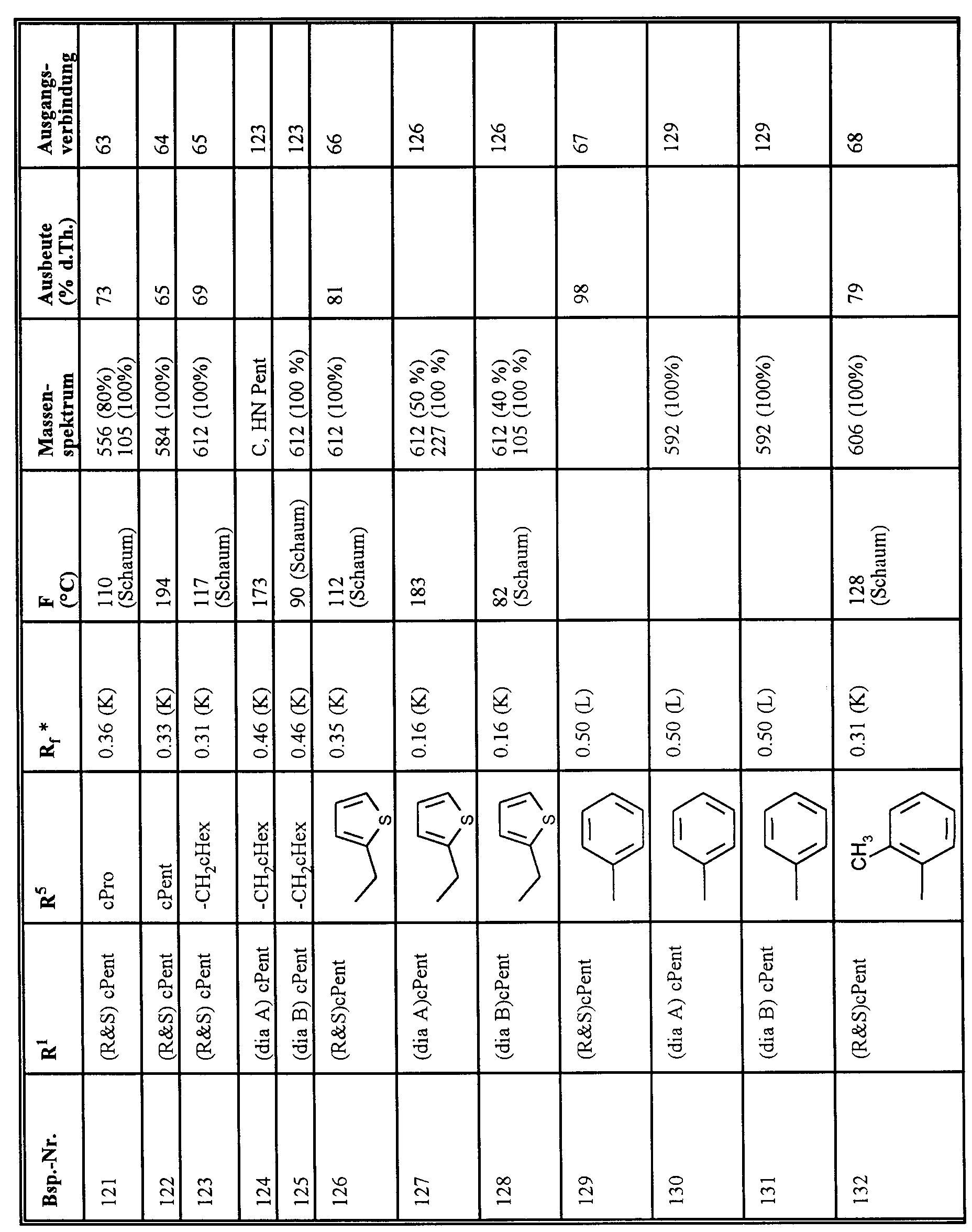


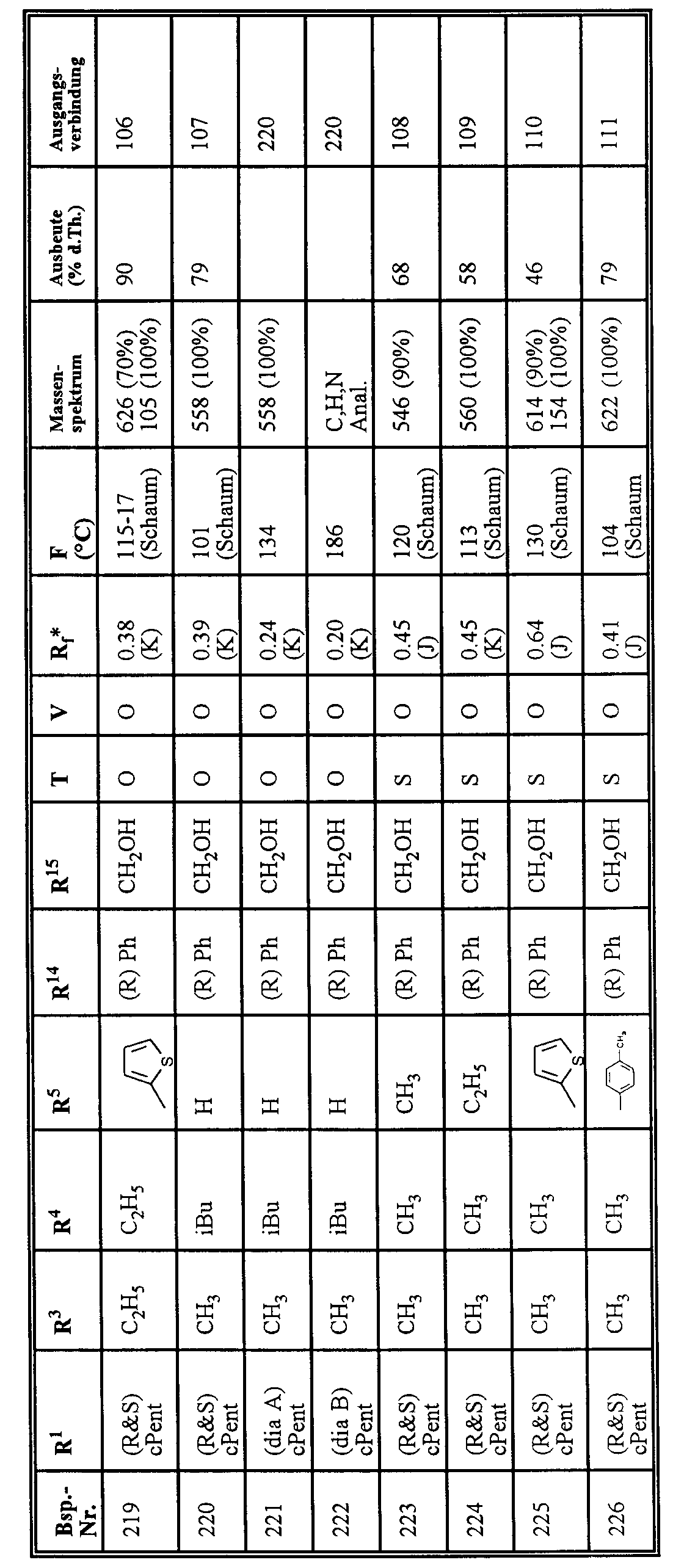
-
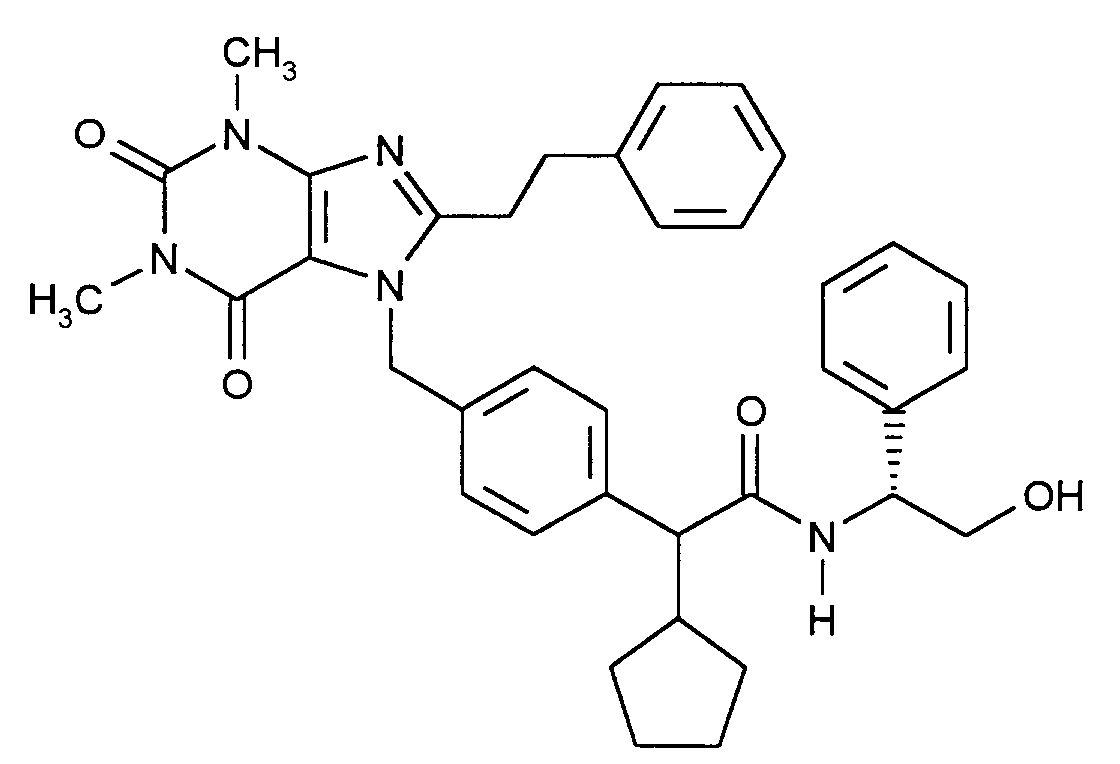
- Man löst 0.40 g (0.648 mmol) der Verbindung aus Beispiel 167 in 10 ml Methanol und 10 ml Essigsäure. Dazu gibt man eine Spatelspitze Palladium-Kohle (10%ig) und hydriert 4 Stunden unter Normaldruck. Das Gemisch wird über Celite abgesaugt und einrotiert. Der Rückstand wird in CH2Cl2 und Wasser aufgenommen, mit Natriumhydrogencarbonat auf pH 8 gestellt und extrahiert. Die organische Phase wird über Natriumsulfat getrocknet und einrotiert. Der Rückstand wird säulenchromatographisch gereinigt.
Ausbeute: 0.180 g (44.9%)
Rf = 0.16 (Dichlormethan : Methanol 20:1)
Masse (berechnet) für C37H41N5O4 = 619.77
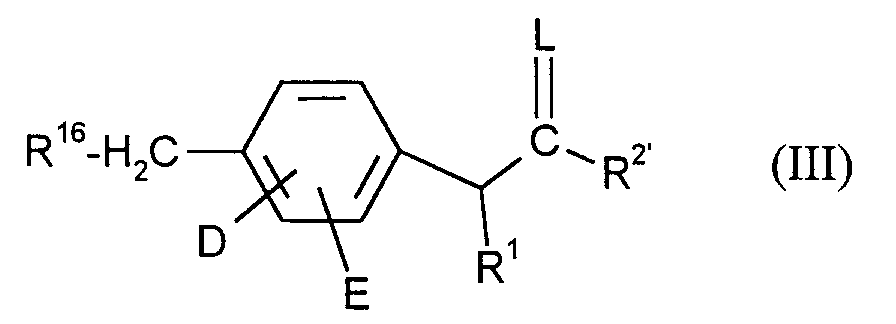

oder gegebenenfalls diese Säuren mit Glycinolen und Glycinolderivaten der allgemeinen Formel (IV)

Claims (10)
- Substituierte Xanthine der allgemeinen Formel
 A für einen Rest der Formel
worinR3, R4, R6 und R7 gleich oder verschieden sind und
Wasserstoff, Cycloalkyl mit 3 bis 7 Kohlenstoffatomen oder Aryl mit 6 bis 10 Kohlenstoffatomen bedeuten,
oder geradkettiges oder verzweigtes Alkyl oder Alkenyl mit jeweils bis zu 8 Kohlenstoffatomen bedeuten, die gegebenenfalls durch Halogen, Hydroxy oder Aryl mit 6 bis 10 Kohlenstoffatomen substituiert sind,T, V, X und Y gleich oder verschieden sind und
ein Sauerstoff- oder Schwefelatom bedeuten,R5 und R8 gleich oder verschieden sind und
Wasserstoff, Halogen, Cycloalkyl mit 3 bis 8 Kohlenstoffatomen oder geradkettiges oder verzweigtes Alkyl oder Alkenyl mit jeweils bis zu 8 Kohlenstoffatomen bedeuten, die gegebenenfalls durch Cycloalkyl mit 3 bis 8 Kohlenstoffatomen, oder durch einen 5- bis 6-gliedrigen, aromatischen, gegebenenfalls benzokondensierten Heterocyclus mit bis zu 3 Heteroatomen aus der Reihe S, N und/oder O, oder durch Aryl mit 6 bis 10 Kohlenstoffatomen substituiert sind, wobei die Cyclen ihrerseits bis zu 3-fach gleich oder verschieden durch einen 5- bis 6-gliedrigen aromatischen Heterocylcus mit bis zu 3 Heteroatomen aus der Reihe S, N und/oder O, oder durch Phenyl, Benzyl, Halogen, Hydroxy, Carboxyl oder durch geradkettiges oder verzweigtes Alkyl, Alkoxy oder Alkoxycarbonyl mit jeweils bis zu 6 Kohlenstoffatomen substituiert sein können, oder
Aryl mit 6 bis 10 Kohlenstoffatomen oder einen 5- bis 7-gliedrigen aromatischen, gegebenenfalls benzokondensierten Heterocyclus mit bis zu 3 Heteroatomen aus der Reihe S, N und/oder O bedeuten, die gegebenenfalls bis zu 3-fach gleich oder verschieden durch Halogen, Phenyl, Trifluormethyl, Hydroxy, Carboxyl oder durch geradkettiges oder verzweigtes Alkyl, Alkoxy oder Alkoxycarbonyl mit jeweils bis zu 6 Kohlenstoffatomen oder durch eine Gruppe der Formel -(CO)a-NR9R10substituiert sind,
worina eine Zahl 0 oder 1 bedeutet,R9 und R10 gleich oder verschieden sind und
Wasserstoff, Phenyl oder geradkettiges oder verzweigtes Alkyl oder Acyl mit jeweils bis zu 5 Kohlenstoffatomen bedeuten,D und E gleich oder verschieden sind und
für Wasserstoff, Halogen, Trifluormethyl, Hydroxy, Carboxyl oder für geradkettiges oder verzweigtes Alkyl, Alkoxy oder Alkoxycarbonyl mit jeweils bis zu 6 Kohlenstoffatomen stehen,R1 für Wasserstoff oder Cycloalkyl mit 3 bis 8 Kohlenstoffatomen steht, oder
für geradkettiges oder verzweigtes Alkyl oder Alkenyl mit jeweils bis zu 8 Kohlenstoffatomen steht, die gegebenenfalls durch Cycloalkyl mit 3 bis 6 Kohlenstoffatomen, Phenyl oder durch einen 5- bis 6-gliedrigen aromatischen Heterocyclus mit bis zu 3 Heteroatomen aus der Reihe S, N und/oder O substituiert sind, oder
für Phenyl oder einen 5- bis 6-gliedrigen aromatischen Heterocylcus mit bis zu 3 Heteroatomen aus der Reihe S, N und/oder O steht, wobei die Ringsysteme gegebenenfalls bis zu 3-fach gleich oder verschieden durch Halogen, Phenyl, Trifluormethyl oder geradkettiges oder verzweigtes Alkyl oder Alkoxy mit jeweils bis zu 5 Kohlenstoffatomen, Hydroxy oder durch eine Gruppe der Formel - NR11R12 substituiert sind,
worinR11 und R12 die oben angegebene Bedeutung von R9 und R10 haben und
mit dieser gleich oder verschieden sind,L für ein Sauerstoff- oder Schwefelatom steht,R2 für Mercaptyl, Hydroxy, geradkettiges oder verzweigtes Alkoxy mit bis zu 8 Kohlenstoffatomen oder für die Gruppe der Formel
worinR13 Wasserstoff oder geradkettiges oder verzweigtes Alkyl mit bis zu 4 Kohlenstoffatomen bedeutet,R14 Wasserstoff, Phenyl oder einen 5- bis 6-gliedrigen aromatischen Heterocyclus mit bis zu 3 Heteroatomen aus der Reihe S, N und/oder O bedeutet,R15 Wasserstoff oder geradkettiges oder verzweigtes Alkyl mit bis zu 8 Kohlenstoffatomen bedeutet, das gegebenenfalls durch Hydroxy substituiert ist,und deren Salze. - Substituierte Xanthine der Formel nach Anspruch 1, in welcherA für einen Rest der Formel

worinR3, R4, R6 und R7 gleich oder verschieden sind und
Wasserstoff, Phenyl, Cyclopropyl, Cyclopentyl oder Cyclohexyl bedeuten, oder
geradkettiges oder verzweigtes Alkyl oder Alkenyl mit jeweils bis zu 6 Kohlenstoffatomen bedeuten, die gegebenenfalls durch Fluor, Chlor, Brom, Hydroxy oder Phenyl substituiert sind,T, V, X und Y gleich oder verschieden sind und
ein Sauerstoff- oder Schwefelatom bedeuten,R5 und R8 gleich oder verschieden sind und
Wasserstoff, Fluor, Chlor, Brom, Cyclopropyl, Cyclobutyl, Cyclopentyl, Cyclohexyl, Cycloheptyl oder für geradkettiges oder verzweigtes Alkyl oder Alkenyl mit jeweils bis zu 6 Kohlenstoffatomen bedeuten, die gegebenenfalls durch Cyclopropyl, Cyclopentyl, Cyclohexyl, Cycloheptyl, Naphthyl, Phenyl, Pyridyl, Thienyl oder Furyl substituiert sind, die ihrerseits bis zu 2-fach gleich oder verschieden durch Phenyl, Benzyl, Fluor, Chlor, Brom, Hydroxy oder durch geradkettiges oder verzweigtes Alkyl oder Alkoxy mit jeweils bis zu 4 Kohlenstoffatomen substituiert sein können, oder
Phenyl, Pyridyl, Thienyl oder Furyl bedeuten, die gegebenenfalls bis zu 2-fach gleich oder verschieden durch Fluor, Chlor, Brom, Phenyl, Trifluormethyl, Hydroxy oder durch geradkettiges oder verzweigtes Alkyl oder Alkoxy mit jeweils bis zu 4 Kohlenstoffatomen oder durch eine Gruppe der Formel -(CO)a-NR9R10 substituiert sind,
worina eine Zahl 0 oder 1 bedeutet,R9 und R10 gleich oder verschieden sind und
Wasserstoff, Phenyl oder geradkettiges oder verzweigtes Alkyl oder Acyl mit jeweils bis zu 4 Kohlenstoffatomen bedeuten,D und E gleich oder verschieden sind und
für Wasserstoff, Fluor, Chlor, Brom, Trifluormethyl, Hydroxy oder geradkettiges oder verzweigtes Alkyl oder Alkoxy mit jeweils bis zu 4 Kohlenstofatomen stehen,R1 für Wasserstoff, Cyclopropyl, Cyclobutyl, Cyclopentyl, Cyclohexyl, Cycloheptyl oder für geradkettiges oder verzweigtes Alkyl oder Alkenyl mit jeweils bis zu 6 Kohlenstoffatomen steht, die gegebenenfalls durch Cyclopropyl, Cyclopentyl, Cyclohexyl, Phenyl, Pyridyl oder Thienyl substituiert sind, oder
für Phenyl, Pyridyl, Furyl oder Thienyl steht, die gegebenenfalls bis zu 2-fach gleich oder verschieden durch Fluor, Chlor, Brom, Phenyl, Trifluormethyl oder geradkettiges oder verzweigtes Alkyl oder Alkoxy mit jeweils bis zu 4 Kohlenstoffatomen oder durch eine Gruppe der Formel -NR11R12 substituiert sind,
worinR11 und R12 die oben angegebene Bedeutung von R9 und R10 haben und
mit dieser gleich oder verschieden sind,L für ein Sauerstoff- oder Schwefelatom steht,R2 für Mercaptyl, Hydroxy, geradkettiges oder verzweigtes Alkoxy mit bis zu 6 Kohlenstoffatomen oder für die Gruppe der Formel
worinR13 Wasserstoff oder geradkettiges oder verzweigtes Alkyl mit bis zu 4 Kohlenstoffatomen bedeutet,R14 Wasserstoff, Phenyl, Pyridyl, Furyl oder Thienyl bedeutet,R15 Wasserstoff oder geradkettiges oder verzweigtes Alkyl mit bis zu 6 Kohlenstoffatomen bedeutet, das gegebenenfalls durch Hydroxy substituiert ist,und deren Salze. - Substituierte Xanthine der Formel nach Anspruch 1, in welcherA für einen Rest der Formel

worinR3, R4, R6 und R7 gleich oder verschieden sind und
Wasserstoff, Phenyl, Cyclopropyl, Cyclopentyl oder Cyclohexyl bedeuten, oder
geradkettiges oder verzweigtes Alkyl oder Alkenyl mit jeweils bis zu 5 Kohlenstoffatomen bedeuten, die gegebenenfalls durch Fluor, Chlor, Brom, Hydroxy oder Phenyl substituiert sind,T, V, X und Y gleich oder verschieden sind und
ein Sauerstoff- oder Schwefelatom bedeuten,R5 und R8 gleich oder verschieden sind und
Wasserstoff, Fluor, Chlor, Brom, Cyclopropyl, Cyclobutyl, Cyclopentyl, Cyclohexyl, Cycloheptyl oder für geradkettiges oder verzweigtes Alkyl oder Alkenyl mit jeweils bis zu 5 Kohlenstoffatomen bedeuten, die gegebenenfalls durch Cyclopropyl, Cyclopentyl, Cyclohexyl, Cycloheptyl, Phenyl, Pyridyl, Thienyl oder Furyl substituiert sind, die ihrerseits bis zu 2-fach gleich oder verschieden durch Phenyl, Benzyl, Fluor, Chlor, Brom, Hydroxy oder durch geradkettiges oder verzweigtes Alkyl oder Alkoxy mit jeweils bis zu 3 Kohlenstoffatomen substituiert sein können, oder
Phenyl, Pyridyl, Thienyl oder Furyl bedeuten, die gegebenenfalls bis zu 2-fach gleich oder verschieden durch Fluor, Chlor, Brom, Phenyl, Trifluormethyl, Hydroxy oder durch geradkettiges oder verzweigtes Alkyl oder Alkoxy mit jeweils bis zu 3 Kohlenstoffatomen oder durch eine Gruppe der Formel -(CO)a-NR9R10 substituiert sind,
worina eine Zahl 0 oder 1 bedeutet,R9 und R10 gleich oder verschieden sind und
Wasserstoff, Phenyl oder geradkettiges oder verzweigtes Alkyl oder Acyl mit jeweils bis zu 3 Kohlenstoffatomen bedeuten,D und E gleich oder verschieden sind und
für Wasserstoff, Fluor, Chlor, Brom oder Trifluormethyl stehen,R1 für Wasserstoff, Cyclopropyl, Cyclobutyl, Cyclopentyl, Cyclohexyl, Cycloheptyl oder für geradkettiges oder verzweigtes Alkyl oder Alkenyl mit jeweils bis zu 5 Kohlenstoffatomen steht, die gegebenenfalls durch Cyclopropyl, Cyclopentyl, Cyclohexyl, Phenyl, Pyridyl oder Thienyl substituiert sind, oder
für Phenyl, Pyridyl, Furyl oder Thienyl steht, die gegebenenfalls bis zu 2-fach gleich oder verschieden durch Fluor, Chlor, Brom, Phenyl, Trifluormethyl oder geradkettiges oder verzweigtes Alkyl oder Alkoxy mit jeweils bis zu 3 Kohlenstoffatomen oder durch eine Gruppe der Formel -NR11R12 substituiert sind,
worin
R11 und R12 die oben angegebene Bedeutung von R9 und R10 haben und
mit dieser gleich oder verschieden sind,L für ein Sauerstoff- oder Schwefelatom steht,R2 für Mercaptyl, Hydroxy, geradkettiges oder verzweigtes Alkoxy mit bis zu 5 Kohlenstoffatomen oder für die Gruppe der Formel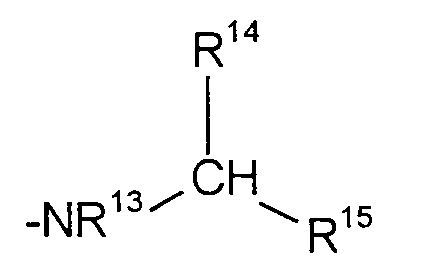
worinR13 Wasserstoff oder geradkettiges oder verzweigtes Alkyl mit bis zu 3 Kohlenstoffatomen bedeutet,R14 Wasserstoff, Phenyl, Pyridyl oder Thienyl bedeutet,R15 Wasserstoff oder geradkettiges oder verzweigtes Alkyl mit bis zu 3 Kohlenstoffatomen bedeutet, das gegebenenfalls durch Hydroxy substituiert ist,und deren Salze. - Substituierte Xanthine der Formel nach Anspruch 1, in welcherA für einen Rest der Formel
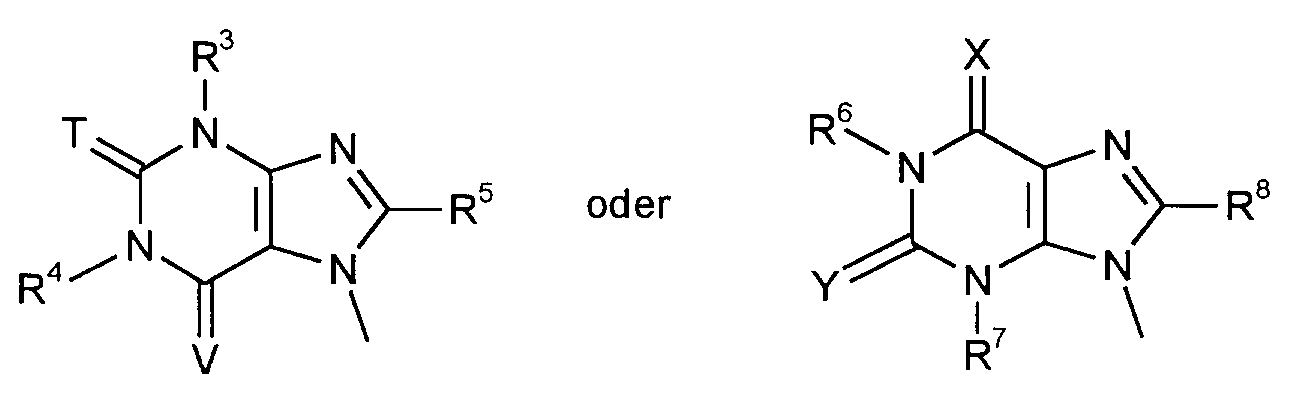
worinR3, R4, R6 und R7 Wasserstoff, geradkettiges oder verzweigtes Alkyl mit jeweils bis zu 4 Kohlenstoffatomen bedeuten,T, V, X und Y gleich oder verschieden sind und
ein Sauerstoff- oder Schwefelatom bedeuten,R5 und R8 gleich oder verschieden sind und
Wasserstoff, Fluor, Chlor, Brom, Cyclopropyl, Cyclopentyl, Cyclohexyl oder für geradkettiges oder verzweigtes Alkyl oder Alkenyl mit jeweils bis zu 3 Kohlenstoffatomen bedeuten, die gegebenenfalls durch Cyclopropyl, Cyclopentyl, Cyclohexyl, Phenyl, Pyridyl, Thienyl oder Furyl substituiert sind, die ihrerseits bis zu 2-fach gleich oder verschieden durch Phenyl, Benzyl, Fluor, Chlor, Brom, Hydroxy oder durch geradkettiges oder verzweigtes Alkyl oder Alkoxy mit jeweils bis zu 3 Kohlenstoffatomen substituiert sein können, oder
Phenyl, Pyridyl, Thienyl oder Furyl bedeuten, die gegebenenfalls bis zu 2-fach gleich oder verschieden durch Fluor, Chlor, Brom, Phenyl, Trifluormethyl, Hydroxy oder durch geradkettiges oder verzweigtes Alkyl oder Alkoxy mit jeweils bis zu 3 Kohlenstoffatomen oder durch eine Gruppe der Formel -(CO)a-NR9R10 substituiert sind,
worina die Zahl 0 bedeutet,R9 und R10 gleich oder verschieden sind und
Wasserstoff, oder geradkettiges oder verzweigtes Alkyl mit jeweils bis zu 3 Kohlenstoffatomen bedeuten,D und E gleich oder verschieden sind und
für Wasserstoff, Fluor, Chlor, Brom oder Trifluormethyl stehen,R1 für Wasserstoff, Cyclopropyl, Cyclopentyl, Cyclohexyl, Cycloheptyl, Phenyl oder für geradkettiges oder verzweigtes Alkyl mit bis zu 5 Kohlenstoffatomen steht,L für ein Sauerstoffatom steht,R2 für Hydroxy, geradkettiges oder verzweigtes Alkoxy mit bis zu 5 Kohlenstoffatomen oder für die Gruppe der Formel
worinR13 Wasserstoff oder geradkettiges oder verzweigtes Alkyl mit bis zu 3 Kohlenstoffatomen bedeutet,R14 Phenyl bedeutet,R15 geradkettiges oder verzweigtes Alkyl mit bis zu 3 Kohlenstoffatomen bedeutet, das gegebenenfalls durch Hydroxy substituiert ist,und deren Salze. - Substituierte Xanthine nach Anspruch 1 bis 4 zur therapeutischen Anwendung.
- Verfahren zur Herstellung von substituierten Xanthinen nach Anspruch 1 bis 4, dadurch gekennzeichnet, daß man zunächst durch Umsetzung von
Verbindungen der allgemeinen Formel (II)
A-H (II)
in welcherA die oben angegebene Bedeutung hat,mit Verbindungen der allgemeinen Formel (III) D, E, L und R1 die oben angegebene Bedeutung haben,R16 für Hydroxy oder Halogen, vorzugsweise für Brom steht,undR2' für geradkettiges oder verzweigtes Alkoxy mit bis zu 8 Kohlenstoffatomen steht,in inerten Lösemitteln und in Anwesenheit von Basen und/oder Hilfsmitteln in Verbindungen der allgemeinen Formel (Ia)
 A, D, E, L, R1 und R2' die oben angegebene Bedeutung haben,überführt und diese gegebenenfalls (R2 = OH) verseift,
oder gegebenenfalls diese Säuren mit Glycinolen und Glycinolderivaten der allgemeinen Formel (IV) R13, R14 und R15 die oben angegebene Bedeutung haben,in inerten Lösemitteln, gegebenenfalls in Anwesenheit von Basen und/oder Hilfsmitteln umsetzt.
 - Arzneimittel, enthaltend mindestens ein substituiertes Xanthin nach Anspruch 1 bis 4.
- Arzneimittel nach Anspruch 7 zur Behandlung von Atherosklerose.
- Verfahren zur Herstellung von Arzneimitteln nach Anspruch 7 und 8, dadurch gekennzeichnet, daß man die substituierten Xanthine gegebenenfalls mit geeigneten Hilfs- und Trägerstoffen in eine geeignete Applikationsform überführt.
- Verwendung der substituierten Xanthine nach Anspruch 1 bis 4 zur Herstellung von Arzneimitteln.
Applications Claiming Priority (2)
| Application Number | Priority Date | Filing Date | Title |
|---|---|---|---|
| DE19535504A DE19535504A1 (de) | 1995-09-25 | 1995-09-25 | Substituierte Xanthine |
| DE19535504 | 1995-09-25 |
Publications (1)
| Publication Number | Publication Date |
|---|---|
| EP0764647A1 true EP0764647A1 (de) | 1997-03-26 |
Family
ID=7773046
Family Applications (1)
| Application Number | Title | Priority Date | Filing Date |
|---|---|---|---|
| EP96114577A Ceased EP0764647A1 (de) | 1995-09-25 | 1996-09-12 | Substituierte Xanthine |
Country Status (5)
| Country | Link |
|---|---|
| US (1) | US5714494A (de) |
| EP (1) | EP0764647A1 (de) |
| JP (1) | JPH09216884A (de) |
| CA (1) | CA2186086A1 (de) |
| DE (1) | DE19535504A1 (de) |
Cited By (6)
| Publication number | Priority date | Publication date | Assignee | Title |
|---|---|---|---|---|
| WO1998022465A1 (en) * | 1996-11-19 | 1998-05-28 | Link Technology, Inc. | A1 adenosine receptor antagonists |
| WO2001097787A3 (de) * | 2000-06-21 | 2002-11-14 | Bayer Ag | Verwendung von mtp-inhibitoren zur senkung von pptrl |
| US7202252B2 (en) | 2003-02-19 | 2007-04-10 | Endacea, Inc. | A1 adenosine receptor antagonists |
| US7247639B2 (en) | 2003-06-06 | 2007-07-24 | Endacea, Inc. | A1 adenosine receptor antagonists |
| US7449473B2 (en) | 2003-10-31 | 2008-11-11 | Cv Therapeutics, Inc. | Substituted pyrrolo[3,2-d]pyrimidin-2,4-diones as A2b adenosine receptor antagonists |
| EP2222676A4 (de) * | 2007-12-21 | 2011-10-26 | Endacea Inc | A1-adenosinrezeptorantagonisten |
Families Citing this family (18)
| Publication number | Priority date | Publication date | Assignee | Title |
|---|---|---|---|---|
| US6268373B1 (en) * | 1995-06-07 | 2001-07-31 | Euro-Celtique S.A. | Trisubstituted thioxanthines |
| US6774236B1 (en) * | 1996-04-04 | 2004-08-10 | Bayer Aktiengesellschaft | Process for the preparation of enantiomerically pure cycloalkano-indol -and azaindol -and pyrimido [1,2A]indolcarbocyclic acids and their activated derivatives |
| GB9703044D0 (en) | 1997-02-14 | 1997-04-02 | Glaxo Group Ltd | Phenyl xanthine esters and amides |
| GB9817623D0 (en) * | 1998-08-13 | 1998-10-07 | Glaxo Group Ltd | Pharmaceutical compounds |
| US7439359B2 (en) * | 2000-11-02 | 2008-10-21 | Sloan-Kettering Institute For Cancer Research | Small molecule compositions for binding to hsp90 |
| ATE520694T1 (de) | 2001-11-09 | 2011-09-15 | Gilead Palo Alto Inc | A2b-adenosinrezeptorantagonisten |
| US7125993B2 (en) | 2001-11-09 | 2006-10-24 | Cv Therapeutics, Inc. | A2B adenosine receptor antagonists |
| US7317017B2 (en) * | 2002-11-08 | 2008-01-08 | Cv Therapeutics, Inc. | A2B adenosine receptor antagonists |
| US20080318983A1 (en) * | 2001-11-09 | 2008-12-25 | Rao Kalla | A2b adenosine receptor antagonists |
| US6977300B2 (en) * | 2001-11-09 | 2005-12-20 | Cv Therapeutics, Inc. | A2B adenosine receptor antagonists |
| WO2004009091A1 (en) * | 2002-06-17 | 2004-01-29 | Glaxo Group Limited | Purine derivatives as liver x receptor agonists |
| CA2524778C (en) * | 2003-05-06 | 2013-01-29 | Cv Therapeutics, Inc. | Xanthine derivatives as a2b adenosine receptor antagonists |
| AU2005230397B2 (en) * | 2004-04-09 | 2010-04-08 | Elanco Animal Health Ireland Limited | Intermittent dosing regimen for the treatment of overweight with MTP-inhibitors |
| US20060058322A1 (en) * | 2004-09-01 | 2006-03-16 | Dewan Zeng | Method of wound healing using A2B adenosine receptor antagonists |
| EP1890767A2 (de) * | 2005-05-27 | 2008-02-27 | Pfizer Products Inc. | Kombinationstherapie zur behandlung von fettleibigkeit oder aufrechterhaltung des gewichtverlusts |
| DE102011006974A1 (de) | 2011-04-07 | 2012-10-11 | Bayer Pharma Aktiengesellschaft | Substituierte 1-Benzylcycloalkylcarbonsäuren und ihre Verwendung |
| DE102010062544A1 (de) | 2010-12-07 | 2012-06-14 | Bayer Schering Pharma Aktiengesellschaft | Substituierte 1-Benzylcycloalkylcarbonsäuren und ihre Verwendung |
| PH12013501143A1 (en) | 2010-12-07 | 2013-07-08 | Bayer Ip Gmbh | Substituted 1-benzylcycloalkylcarboxlic acids and use thereof |
Citations (2)
| Publication number | Priority date | Publication date | Assignee | Title |
|---|---|---|---|---|
| EP0363320A2 (de) * | 1988-10-06 | 1990-04-11 | Ciba-Geigy Ag | Substituierte 9H-Purine |
| GB2276383A (en) * | 1993-03-19 | 1994-09-28 | Merck & Co Inc | Pharmaceutically active ring fused imidazoles |
Family Cites Families (5)
| Publication number | Priority date | Publication date | Assignee | Title |
|---|---|---|---|---|
| US4061753A (en) * | 1976-02-06 | 1977-12-06 | Interx Research Corporation | Treating psoriasis with transient pro-drug forms of xanthine derivatives |
| DE4200954A1 (de) * | 1991-04-26 | 1992-10-29 | Bayer Ag | Heterocyclisch substituierte phenylessigsaeurederivate |
| DE4208051A1 (de) * | 1992-03-13 | 1993-09-16 | Bayer Ag | Substituierte phenylessigsaeureamide |
| DE4208052A1 (de) * | 1992-03-13 | 1993-09-16 | Bayer Ag | Imidazolyl substituierte phenylessigsaeureamide |
| DE4302956A1 (de) * | 1993-02-03 | 1994-08-04 | Bayer Ag | Substituierte Imidazo(4,5-b)pyridine und Benzimidazole |
-
1995
- 1995-09-25 DE DE19535504A patent/DE19535504A1/de not_active Withdrawn
-
1996
- 1996-09-12 EP EP96114577A patent/EP0764647A1/de not_active Ceased
- 1996-09-18 US US08/710,503 patent/US5714494A/en not_active Expired - Fee Related
- 1996-09-19 JP JP8267691A patent/JPH09216884A/ja active Pending
- 1996-09-20 CA CA002186086A patent/CA2186086A1/en not_active Abandoned
Patent Citations (2)
| Publication number | Priority date | Publication date | Assignee | Title |
|---|---|---|---|---|
| EP0363320A2 (de) * | 1988-10-06 | 1990-04-11 | Ciba-Geigy Ag | Substituierte 9H-Purine |
| GB2276383A (en) * | 1993-03-19 | 1994-09-28 | Merck & Co Inc | Pharmaceutically active ring fused imidazoles |
Cited By (12)
| Publication number | Priority date | Publication date | Assignee | Title |
|---|---|---|---|---|
| WO1998022465A1 (en) * | 1996-11-19 | 1998-05-28 | Link Technology, Inc. | A1 adenosine receptor antagonists |
| US6117998A (en) * | 1996-11-19 | 2000-09-12 | Link Technology Incorporated | A1 adenosine receptor antagonists |
| US6489332B1 (en) | 1996-11-19 | 2002-12-03 | Endacea, Inc. | A1 adenosine receptor antagonists |
| US6495687B1 (en) | 1996-11-19 | 2002-12-17 | Endacea, Inc. | A1 adenosine receptor antagonists |
| EP1790651A1 (de) * | 1996-11-19 | 2007-05-30 | Endacea, Inc. | A1-Adenosin Rezeptor Antagoniste |
| WO2001097787A3 (de) * | 2000-06-21 | 2002-11-14 | Bayer Ag | Verwendung von mtp-inhibitoren zur senkung von pptrl |
| US7202252B2 (en) | 2003-02-19 | 2007-04-10 | Endacea, Inc. | A1 adenosine receptor antagonists |
| US7423041B2 (en) | 2003-02-19 | 2008-09-09 | Endacea, Inc. | A1 adenosine receptor antagonists |
| US7247639B2 (en) | 2003-06-06 | 2007-07-24 | Endacea, Inc. | A1 adenosine receptor antagonists |
| US7902360B2 (en) | 2003-06-06 | 2011-03-08 | Wilson Constance N | A1 adenosine receptor antagonists |
| US7449473B2 (en) | 2003-10-31 | 2008-11-11 | Cv Therapeutics, Inc. | Substituted pyrrolo[3,2-d]pyrimidin-2,4-diones as A2b adenosine receptor antagonists |
| EP2222676A4 (de) * | 2007-12-21 | 2011-10-26 | Endacea Inc | A1-adenosinrezeptorantagonisten |
Also Published As
| Publication number | Publication date |
|---|---|
| CA2186086A1 (en) | 1997-03-26 |
| JPH09216884A (ja) | 1997-08-19 |
| DE19535504A1 (de) | 1997-03-27 |
| US5714494A (en) | 1998-02-03 |
Similar Documents
| Publication | Publication Date | Title |
|---|---|---|
| EP0705831B1 (de) | Cycloalkano-indol- und -azaindol-derivate | |
| EP0764647A1 (de) | Substituierte Xanthine | |
| EP0779279A1 (de) | Bicyclische Heterocyclen | |
| EP0802188B1 (de) | Heteroverknüpfte Phenylglycinolamide als antitherosklerotische Arzneimittel | |
| DE69304243T2 (de) | Chinolin-Verbindungen als Angiotensin-II-Antagoniste | |
| EP0611767B1 (de) | Heterocyclisch substituierte Phenyl-cyclohexan-carbonsäurederivate als Angiotensin II Antagonisten | |
| DE4200954A1 (de) | Heterocyclisch substituierte phenylessigsaeurederivate | |
| DE4206045A1 (de) | Sulfonylbenzyl substituierte pyridone | |
| EP0569795B1 (de) | Sulfonylbenzyl-substituierte Benzo- und Pyridopyridone | |
| EP0716082B1 (de) | Bicyclisch substituierte Oxy-phenyl-(phenyl) glycinolamide mit antiatherosklerotischer Wirkung | |
| EP0802192A1 (de) | Heterocyclisch-substituierte Phenylglycinolamide mit antiatherosklerotischer Wirkung und Verfahren zu ihrer Herstellung | |
| EP0799828A2 (de) | Neue Pyrimido [1,2-a] indole | |
| EP0719763A1 (de) | 4-(Chinolin-2-yl-methoxy)-phenyl-essigsäurederivate mit antiatherosklerotischer Wirkung | |
| EP0610698B1 (de) | Substituierte Imidazo(4,5-b)pyridine und Benzimidazole als Angiotensin II Antagoniste | |
| EP0779276A1 (de) | Indolyl-substituierte Phenylessigsäurederivate | |
| EP0802198A2 (de) | Neue Pyridazino-, Pyrimido-, Pyrazino- und Triazino-indole | |
| EP0802186B1 (de) | Benzyloxy-substituierte Phenylglycinolamide als Arzneimittel | |
| EP0617035B1 (de) | Hetero-tricyclisch-substituierte Phenyl-cyclohexan-carbonsäurederivate | |
| EP0765878A1 (de) | Heterocyclische Aryl-, Alkyl- und Cycloalkylessigsäureamide als Arzneimittel | |
| DE4301900A1 (de) | 2-Oxochinolin-1-yl-methylphenylessigsäurederivate | |
| EP0630896A1 (de) | Substituierte Mono- und Bipyridylmethylderivate als Angiotensin II Antagonist | |
| EP0802197A1 (de) | Trizyklisch-Heterocyclyl substituierte Phenylessigsäureamid Derivate, deren Herstellung und deren Verwendung als Angiostensin-II-Antagonisten | |
| EP0753517A2 (de) | Amide und Sulfonamide von heterocyclisch substituierten Benzylaminen | |
| DE19619950A1 (de) | Heterocyclisch-substituierte Phenylglycinolamide | |
| DE4206042A1 (de) | Sulfonylbenzyl-substituierte imidazopyridine |
Legal Events
| Date | Code | Title | Description |
|---|---|---|---|
| PUAI | Public reference made under article 153(3) epc to a published international application that has entered the european phase |
Free format text: ORIGINAL CODE: 0009012 |
|
| AK | Designated contracting states |
Kind code of ref document: A1 Designated state(s): AT BE CH DE DK ES FI FR GB GR IE IT LI LU MC NL PT SE |
|
| 17P | Request for examination filed |
Effective date: 19970926 |
|
| 17Q | First examination report despatched |
Effective date: 19990714 |
|
| GRAG | Despatch of communication of intention to grant |
Free format text: ORIGINAL CODE: EPIDOS AGRA |
|
| RTI1 | Title (correction) |
Free format text: SUBSTITUTED XANTHINS AS MEDICAMENT AGAINST ATHERIOSCLEROSIS |
|
| STAA | Information on the status of an ep patent application or granted ep patent |
Free format text: STATUS: THE APPLICATION HAS BEEN REFUSED |
|
| 18R | Application refused |
Effective date: 20010817 |