EP0764662A2 - Polymethacrylsäureester, deren Estergruppen in alpha- und omega-Stellung von den in der Kette befindlichen Estergruppen abweichen - Google Patents
Polymethacrylsäureester, deren Estergruppen in alpha- und omega-Stellung von den in der Kette befindlichen Estergruppen abweichen Download PDFInfo
- Publication number
- EP0764662A2 EP0764662A2 EP96114353A EP96114353A EP0764662A2 EP 0764662 A2 EP0764662 A2 EP 0764662A2 EP 96114353 A EP96114353 A EP 96114353A EP 96114353 A EP96114353 A EP 96114353A EP 0764662 A2 EP0764662 A2 EP 0764662A2
- Authority
- EP
- European Patent Office
- Prior art keywords
- radical
- polymethacrylic acid
- alkyl
- acid ester
- carbon atoms
- Prior art date
- Legal status (The legal status is an assumption and is not a legal conclusion. Google has not performed a legal analysis and makes no representation as to the accuracy of the status listed.)
- Granted
Links
- 150000002148 esters Chemical class 0.000 title claims abstract description 37
- 229920002845 Poly(methacrylic acid) Polymers 0.000 title claims description 25
- 125000004185 ester group Chemical group 0.000 title description 10
- LFQSCWFLJHTTHZ-UHFFFAOYSA-N Ethanol Chemical compound CCO LFQSCWFLJHTTHZ-UHFFFAOYSA-N 0.000 claims abstract description 29
- 238000005809 transesterification reaction Methods 0.000 claims abstract description 27
- 238000000034 method Methods 0.000 claims abstract description 18
- 239000002904 solvent Substances 0.000 claims abstract description 18
- 125000000217 alkyl group Chemical group 0.000 claims abstract description 13
- 239000003054 catalyst Substances 0.000 claims abstract description 11
- 150000001298 alcohols Chemical class 0.000 claims abstract description 7
- 125000005010 perfluoroalkyl group Chemical group 0.000 claims abstract description 4
- -1 alkyl radicals Chemical class 0.000 claims description 50
- 150000003254 radicals Chemical class 0.000 claims description 33
- 125000004432 carbon atom Chemical group C* 0.000 claims description 16
- 238000002360 preparation method Methods 0.000 claims description 13
- 229910052757 nitrogen Inorganic materials 0.000 claims description 10
- 229910052739 hydrogen Inorganic materials 0.000 claims description 8
- 239000001257 hydrogen Substances 0.000 claims description 8
- 229920002125 Sokalan® Polymers 0.000 claims description 5
- 239000004584 polyacrylic acid Substances 0.000 claims description 5
- OKTJSMMVPCPJKN-UHFFFAOYSA-N Carbon Chemical group [C] OKTJSMMVPCPJKN-UHFFFAOYSA-N 0.000 claims description 4
- UFHFLCQGNIYNRP-UHFFFAOYSA-N Hydrogen Chemical compound [H][H] UFHFLCQGNIYNRP-UHFFFAOYSA-N 0.000 claims description 4
- 150000002431 hydrogen Chemical class 0.000 claims description 4
- WCYWZMWISLQXQU-UHFFFAOYSA-N methyl Chemical compound [CH3] WCYWZMWISLQXQU-UHFFFAOYSA-N 0.000 claims description 4
- 125000004433 nitrogen atom Chemical group N* 0.000 claims description 4
- 125000002877 alkyl aryl group Chemical group 0.000 claims description 3
- PXBRQCKWGAHEHS-UHFFFAOYSA-N dichlorodifluoromethane Chemical compound FC(F)(Cl)Cl PXBRQCKWGAHEHS-UHFFFAOYSA-N 0.000 claims description 3
- 235000021190 leftovers Nutrition 0.000 claims description 3
- NINIDFKCEFEMDL-UHFFFAOYSA-N Sulfur Chemical group [S] NINIDFKCEFEMDL-UHFFFAOYSA-N 0.000 claims description 2
- 125000003342 alkenyl group Chemical group 0.000 claims description 2
- QVGXLLKOCUKJST-UHFFFAOYSA-N atomic oxygen Chemical compound [O] QVGXLLKOCUKJST-UHFFFAOYSA-N 0.000 claims description 2
- 229910052760 oxygen Inorganic materials 0.000 claims description 2
- 239000001301 oxygen Substances 0.000 claims description 2
- 125000001997 phenyl group Chemical group [H]C1=C([H])C([H])=C(*)C([H])=C1[H] 0.000 claims description 2
- 229920000193 polymethacrylate Polymers 0.000 abstract description 10
- 125000003118 aryl group Chemical group 0.000 abstract 1
- 125000004985 dialkyl amino alkyl group Chemical group 0.000 abstract 1
- OKKJLVBELUTLKV-UHFFFAOYSA-N Methanol Chemical compound OC OKKJLVBELUTLKV-UHFFFAOYSA-N 0.000 description 48
- YXFVVABEGXRONW-UHFFFAOYSA-N Toluene Chemical compound CC1=CC=CC=C1 YXFVVABEGXRONW-UHFFFAOYSA-N 0.000 description 42
- 238000006243 chemical reaction Methods 0.000 description 30
- 238000005227 gel permeation chromatography Methods 0.000 description 25
- 239000000047 product Substances 0.000 description 14
- 229920000642 polymer Polymers 0.000 description 13
- IJGRMHOSHXDMSA-UHFFFAOYSA-N Atomic nitrogen Chemical compound N#N IJGRMHOSHXDMSA-UHFFFAOYSA-N 0.000 description 12
- 238000004519 manufacturing process Methods 0.000 description 12
- 229920003229 poly(methyl methacrylate) Polymers 0.000 description 12
- 239000004926 polymethyl methacrylate Substances 0.000 description 12
- 125000002887 hydroxy group Chemical group [H]O* 0.000 description 11
- MKIJJIMOAABWGF-UHFFFAOYSA-N methyl 2-sulfanylacetate Chemical compound COC(=O)CS MKIJJIMOAABWGF-UHFFFAOYSA-N 0.000 description 11
- SOGAXMICEFXMKE-UHFFFAOYSA-N Butylmethacrylate Chemical compound CCCCOC(=O)C(C)=C SOGAXMICEFXMKE-UHFFFAOYSA-N 0.000 description 10
- 239000000178 monomer Substances 0.000 description 10
- CTQNGGLPUBDAKN-UHFFFAOYSA-N O-Xylene Chemical compound CC1=CC=CC=C1C CTQNGGLPUBDAKN-UHFFFAOYSA-N 0.000 description 9
- 239000000243 solution Substances 0.000 description 9
- 239000008096 xylene Substances 0.000 description 9
- VVQNEPGJFQJSBK-UHFFFAOYSA-N Methyl methacrylate Chemical compound COC(=O)C(C)=C VVQNEPGJFQJSBK-UHFFFAOYSA-N 0.000 description 8
- 238000004458 analytical method Methods 0.000 description 7
- 239000007789 gas Substances 0.000 description 7
- 238000010526 radical polymerization reaction Methods 0.000 description 7
- VXUYXOFXAQZZMF-UHFFFAOYSA-N titanium(IV) isopropoxide Chemical compound CC(C)O[Ti](OC(C)C)(OC(C)C)OC(C)C VXUYXOFXAQZZMF-UHFFFAOYSA-N 0.000 description 7
- KFZMGEQAYNKOFK-UHFFFAOYSA-N Isopropanol Chemical compound CC(C)O KFZMGEQAYNKOFK-UHFFFAOYSA-N 0.000 description 6
- 150000001875 compounds Chemical class 0.000 description 6
- 239000000203 mixture Substances 0.000 description 6
- DGVVWUTYPXICAM-UHFFFAOYSA-N β‐Mercaptoethanol Chemical compound OCCS DGVVWUTYPXICAM-UHFFFAOYSA-N 0.000 description 6
- IAYPIBMASNFSPL-UHFFFAOYSA-N Ethylene oxide Chemical compound C1CO1 IAYPIBMASNFSPL-UHFFFAOYSA-N 0.000 description 5
- 238000009835 boiling Methods 0.000 description 5
- 229910052799 carbon Inorganic materials 0.000 description 5
- SJMYWORNLPSJQO-UHFFFAOYSA-N tert-butyl 2-methylprop-2-enoate Chemical group CC(=C)C(=O)OC(C)(C)C SJMYWORNLPSJQO-UHFFFAOYSA-N 0.000 description 5
- XLYOFNOQVPJJNP-UHFFFAOYSA-N water Substances O XLYOFNOQVPJJNP-UHFFFAOYSA-N 0.000 description 5
- OZAIFHULBGXAKX-UHFFFAOYSA-N 2-(2-cyanopropan-2-yldiazenyl)-2-methylpropanenitrile Chemical compound N#CC(C)(C)N=NC(C)(C)C#N OZAIFHULBGXAKX-UHFFFAOYSA-N 0.000 description 4
- BFSVOASYOCHEOV-UHFFFAOYSA-N 2-diethylaminoethanol Chemical compound CCN(CC)CCO BFSVOASYOCHEOV-UHFFFAOYSA-N 0.000 description 4
- VQTUBCCKSQIDNK-UHFFFAOYSA-N Isobutene Chemical compound CC(C)=C VQTUBCCKSQIDNK-UHFFFAOYSA-N 0.000 description 4
- LRHPLDYGYMQRHN-UHFFFAOYSA-N N-Butanol Chemical compound CCCCO LRHPLDYGYMQRHN-UHFFFAOYSA-N 0.000 description 4
- 239000004721 Polyphenylene oxide Substances 0.000 description 4
- PPBRXRYQALVLMV-UHFFFAOYSA-N Styrene Chemical compound C=CC1=CC=CC=C1 PPBRXRYQALVLMV-UHFFFAOYSA-N 0.000 description 4
- 238000004587 chromatography analysis Methods 0.000 description 4
- 229920001577 copolymer Polymers 0.000 description 4
- 238000004821 distillation Methods 0.000 description 4
- 229920000570 polyether Polymers 0.000 description 4
- 239000011541 reaction mixture Substances 0.000 description 4
- ZWEHNKRNPOVVGH-UHFFFAOYSA-N 2-Butanone Chemical compound CCC(C)=O ZWEHNKRNPOVVGH-UHFFFAOYSA-N 0.000 description 3
- RWSOTUBLDIXVET-UHFFFAOYSA-N Dihydrogen sulfide Chemical class S RWSOTUBLDIXVET-UHFFFAOYSA-N 0.000 description 3
- 229920003171 Poly (ethylene oxide) Polymers 0.000 description 3
- 239000004698 Polyethylene Substances 0.000 description 3
- 239000002253 acid Substances 0.000 description 3
- 230000015572 biosynthetic process Effects 0.000 description 3
- 150000001721 carbon Chemical group 0.000 description 3
- 239000012986 chain transfer agent Substances 0.000 description 3
- 239000000470 constituent Substances 0.000 description 3
- 238000005194 fractionation Methods 0.000 description 3
- 239000012299 nitrogen atmosphere Substances 0.000 description 3
- 125000005702 oxyalkylene group Chemical group 0.000 description 3
- 125000006353 oxyethylene group Chemical group 0.000 description 3
- 229920000233 poly(alkylene oxides) Polymers 0.000 description 3
- 229920000573 polyethylene Polymers 0.000 description 3
- 229920000909 polytetrahydrofuran Polymers 0.000 description 3
- BDERNNFJNOPAEC-UHFFFAOYSA-N propan-1-ol Chemical compound CCCO BDERNNFJNOPAEC-UHFFFAOYSA-N 0.000 description 3
- 239000000126 substance Substances 0.000 description 3
- 238000000214 vapour pressure osmometry Methods 0.000 description 3
- 125000003903 2-propenyl group Chemical group [H]C([*])([H])C([H])=C([H])[H] 0.000 description 2
- QTBSBXVTEAMEQO-UHFFFAOYSA-N Acetic acid Chemical compound CC(O)=O QTBSBXVTEAMEQO-UHFFFAOYSA-N 0.000 description 2
- NBIIXXVUZAFLBC-UHFFFAOYSA-N Phosphoric acid Chemical compound OP(O)(O)=O NBIIXXVUZAFLBC-UHFFFAOYSA-N 0.000 description 2
- GOOHAUXETOMSMM-UHFFFAOYSA-N Propylene oxide Chemical group CC1CO1 GOOHAUXETOMSMM-UHFFFAOYSA-N 0.000 description 2
- 125000005907 alkyl ester group Chemical group 0.000 description 2
- 125000000484 butyl group Chemical group [H]C([*])([H])C([H])([H])C([H])([H])C([H])([H])[H] 0.000 description 2
- 239000003795 chemical substances by application Substances 0.000 description 2
- NEHMKBQYUWJMIP-UHFFFAOYSA-N chloromethane Chemical compound ClC NEHMKBQYUWJMIP-UHFFFAOYSA-N 0.000 description 2
- 238000009826 distribution Methods 0.000 description 2
- UAYKGOMDUQLCJS-UHFFFAOYSA-N ethylsulfanyl acetate Chemical compound CCSOC(C)=O UAYKGOMDUQLCJS-UHFFFAOYSA-N 0.000 description 2
- 125000006038 hexenyl group Chemical group 0.000 description 2
- NWVVVBRKAWDGAB-UHFFFAOYSA-N hydroquinone methyl ether Natural products COC1=CC=C(O)C=C1 NWVVVBRKAWDGAB-UHFFFAOYSA-N 0.000 description 2
- 229920013747 hydroxypolyethylene Polymers 0.000 description 2
- 239000012442 inert solvent Substances 0.000 description 2
- 239000007788 liquid Substances 0.000 description 2
- 150000002734 metacrylic acid derivatives Chemical class 0.000 description 2
- 125000002496 methyl group Chemical group [H]C([H])([H])* 0.000 description 2
- GLDOVTGHNKAZLK-UHFFFAOYSA-N octadecan-1-ol Chemical compound CCCCCCCCCCCCCCCCCCO GLDOVTGHNKAZLK-UHFFFAOYSA-N 0.000 description 2
- 238000002103 osmometry Methods 0.000 description 2
- KJIFKLIQANRMOU-UHFFFAOYSA-N oxidanium;4-methylbenzenesulfonate Chemical compound O.CC1=CC=C(S(O)(=O)=O)C=C1 KJIFKLIQANRMOU-UHFFFAOYSA-N 0.000 description 2
- BDAWXSQJJCIFIK-UHFFFAOYSA-N potassium methoxide Chemical compound [K+].[O-]C BDAWXSQJJCIFIK-UHFFFAOYSA-N 0.000 description 2
- 230000035484 reaction time Effects 0.000 description 2
- 125000004079 stearyl group Chemical group [H]C([*])([H])C([H])([H])C([H])([H])C([H])([H])C([H])([H])C([H])([H])C([H])([H])C([H])([H])C([H])([H])C([H])([H])C([H])([H])C([H])([H])C([H])([H])C([H])([H])C([H])([H])C([H])([H])C([H])([H])C([H])([H])[H] 0.000 description 2
- 238000003756 stirring Methods 0.000 description 2
- CWERGRDVMFNCDR-UHFFFAOYSA-M thioglycolate(1-) Chemical compound [O-]C(=O)CS CWERGRDVMFNCDR-UHFFFAOYSA-M 0.000 description 2
- CNHDIAIOKMXOLK-UHFFFAOYSA-N toluquinol Chemical compound CC1=CC(O)=CC=C1O CNHDIAIOKMXOLK-UHFFFAOYSA-N 0.000 description 2
- LWIHDJKSTIGBAC-UHFFFAOYSA-K tripotassium phosphate Chemical compound [K+].[K+].[K+].[O-]P([O-])([O-])=O LWIHDJKSTIGBAC-UHFFFAOYSA-K 0.000 description 2
- 230000007306 turnover Effects 0.000 description 2
- JHPBZFOKBAGZBL-UHFFFAOYSA-N (3-hydroxy-2,2,4-trimethylpentyl) 2-methylprop-2-enoate Chemical group CC(C)C(O)C(C)(C)COC(=O)C(C)=C JHPBZFOKBAGZBL-UHFFFAOYSA-N 0.000 description 1
- ALSTYHKOOCGGFT-KTKRTIGZSA-N (9Z)-octadecen-1-ol Chemical compound CCCCCCCC\C=C/CCCCCCCCO ALSTYHKOOCGGFT-KTKRTIGZSA-N 0.000 description 1
- RYHBNJHYFVUHQT-UHFFFAOYSA-N 1,4-Dioxane Chemical compound C1COCCO1 RYHBNJHYFVUHQT-UHFFFAOYSA-N 0.000 description 1
- VEXZGXHMUGYJMC-UHFFFAOYSA-M Chloride anion Chemical compound [Cl-] VEXZGXHMUGYJMC-UHFFFAOYSA-M 0.000 description 1
- CERQOIWHTDAKMF-UHFFFAOYSA-M Methacrylate Chemical compound CC(=C)C([O-])=O CERQOIWHTDAKMF-UHFFFAOYSA-M 0.000 description 1
- LSDPWZHWYPCBBB-UHFFFAOYSA-N Methanethiol Chemical group SC LSDPWZHWYPCBBB-UHFFFAOYSA-N 0.000 description 1
- 238000005481 NMR spectroscopy Methods 0.000 description 1
- 239000002202 Polyethylene glycol Substances 0.000 description 1
- 208000034874 Product colour issue Diseases 0.000 description 1
- RTAQQCXQSZGOHL-UHFFFAOYSA-N Titanium Chemical compound [Ti] RTAQQCXQSZGOHL-UHFFFAOYSA-N 0.000 description 1
- ISKQADXMHQSTHK-UHFFFAOYSA-N [4-(aminomethyl)phenyl]methanamine Chemical compound NCC1=CC=C(CN)C=C1 ISKQADXMHQSTHK-UHFFFAOYSA-N 0.000 description 1
- UKLDJPRMSDWDSL-UHFFFAOYSA-L [dibutyl(dodecanoyloxy)stannyl] dodecanoate Chemical compound CCCCCCCCCCCC(=O)O[Sn](CCCC)(CCCC)OC(=O)CCCCCCCCCCC UKLDJPRMSDWDSL-UHFFFAOYSA-L 0.000 description 1
- 229960000583 acetic acid Drugs 0.000 description 1
- 230000001476 alcoholic effect Effects 0.000 description 1
- 229910000147 aluminium phosphate Inorganic materials 0.000 description 1
- 150000001412 amines Chemical class 0.000 description 1
- 239000007864 aqueous solution Substances 0.000 description 1
- 229920001400 block copolymer Polymers 0.000 description 1
- 239000006227 byproduct Substances 0.000 description 1
- 239000007795 chemical reaction product Substances 0.000 description 1
- NEHMKBQYUWJMIP-NJFSPNSNSA-N chloro(114C)methane Chemical compound [14CH3]Cl NEHMKBQYUWJMIP-NJFSPNSNSA-N 0.000 description 1
- 238000001816 cooling Methods 0.000 description 1
- 230000006735 deficit Effects 0.000 description 1
- CTESAYWIBGYWGR-UHFFFAOYSA-L dibutyl(chloro)stannanylium;acetate Chemical compound CCCC[Sn](Cl)(OC(C)=O)CCCC CTESAYWIBGYWGR-UHFFFAOYSA-L 0.000 description 1
- 239000012975 dibutyltin dilaurate Substances 0.000 description 1
- 125000006264 diethylaminomethyl group Chemical group [H]C([H])([H])C([H])([H])N(C([H])([H])*)C([H])([H])C([H])([H])[H] 0.000 description 1
- 230000008030 elimination Effects 0.000 description 1
- 238000003379 elimination reaction Methods 0.000 description 1
- 238000011049 filling Methods 0.000 description 1
- 238000001914 filtration Methods 0.000 description 1
- 238000011010 flushing procedure Methods 0.000 description 1
- 125000000524 functional group Chemical group 0.000 description 1
- 229920001002 functional polymer Polymers 0.000 description 1
- 239000003502 gasoline Substances 0.000 description 1
- 239000012362 glacial acetic acid Substances 0.000 description 1
- 229910052736 halogen Inorganic materials 0.000 description 1
- 125000004435 hydrogen atom Chemical group [H]* 0.000 description 1
- 230000002209 hydrophobic effect Effects 0.000 description 1
- 239000000463 material Substances 0.000 description 1
- 125000005397 methacrylic acid ester group Chemical group 0.000 description 1
- 229940050176 methyl chloride Drugs 0.000 description 1
- 238000002156 mixing Methods 0.000 description 1
- GOQYKNQRPGWPLP-UHFFFAOYSA-N n-heptadecyl alcohol Natural products CCCCCCCCCCCCCCCCCO GOQYKNQRPGWPLP-UHFFFAOYSA-N 0.000 description 1
- 229940055577 oleyl alcohol Drugs 0.000 description 1
- XMLQWXUVTXCDDL-UHFFFAOYSA-N oleyl alcohol Natural products CCCCCCC=CCCCCCCCCCCO XMLQWXUVTXCDDL-UHFFFAOYSA-N 0.000 description 1
- 125000005547 pivalate group Chemical group 0.000 description 1
- 229920001281 polyalkylene Polymers 0.000 description 1
- 229920001223 polyethylene glycol Polymers 0.000 description 1
- 238000006116 polymerization reaction Methods 0.000 description 1
- 229920001451 polypropylene glycol Polymers 0.000 description 1
- 229910000160 potassium phosphate Inorganic materials 0.000 description 1
- 235000011009 potassium phosphates Nutrition 0.000 description 1
- XPGAWFIWCWKDDL-UHFFFAOYSA-N propan-1-olate;zirconium(4+) Chemical compound [Zr+4].CCC[O-].CCC[O-].CCC[O-].CCC[O-] XPGAWFIWCWKDDL-UHFFFAOYSA-N 0.000 description 1
- 238000005956 quaternization reaction Methods 0.000 description 1
- 230000009257 reactivity Effects 0.000 description 1
- 238000010992 reflux Methods 0.000 description 1
- 239000005871 repellent Substances 0.000 description 1
- 239000007787 solid Substances 0.000 description 1
- 125000005402 stannate group Chemical group 0.000 description 1
- 239000007858 starting material Substances 0.000 description 1
- 238000003786 synthesis reaction Methods 0.000 description 1
- 125000000999 tert-butyl group Chemical group [H]C([H])([H])C(*)(C([H])([H])[H])C([H])([H])[H] 0.000 description 1
- 238000005979 thermal decomposition reaction Methods 0.000 description 1
- CWERGRDVMFNCDR-UHFFFAOYSA-N thioglycolic acid Chemical class OC(=O)CS CWERGRDVMFNCDR-UHFFFAOYSA-N 0.000 description 1
- 229910052719 titanium Inorganic materials 0.000 description 1
- 239000010936 titanium Substances 0.000 description 1
- 229920000428 triblock copolymer Polymers 0.000 description 1
- 125000004205 trifluoroethyl group Chemical group [H]C([H])(*)C(F)(F)F 0.000 description 1
- 150000003755 zirconium compounds Chemical class 0.000 description 1
Classifications
-
- C—CHEMISTRY; METALLURGY
- C08—ORGANIC MACROMOLECULAR COMPOUNDS; THEIR PREPARATION OR CHEMICAL WORKING-UP; COMPOSITIONS BASED THEREON
- C08F—MACROMOLECULAR COMPOUNDS OBTAINED BY REACTIONS ONLY INVOLVING CARBON-TO-CARBON UNSATURATED BONDS
- C08F8/00—Chemical modification by after-treatment
- C08F8/14—Esterification
-
- C—CHEMISTRY; METALLURGY
- C08—ORGANIC MACROMOLECULAR COMPOUNDS; THEIR PREPARATION OR CHEMICAL WORKING-UP; COMPOSITIONS BASED THEREON
- C08F—MACROMOLECULAR COMPOUNDS OBTAINED BY REACTIONS ONLY INVOLVING CARBON-TO-CARBON UNSATURATED BONDS
- C08F8/00—Chemical modification by after-treatment
- C08F8/30—Introducing nitrogen atoms or nitrogen-containing groups
-
- C—CHEMISTRY; METALLURGY
- C08—ORGANIC MACROMOLECULAR COMPOUNDS; THEIR PREPARATION OR CHEMICAL WORKING-UP; COMPOSITIONS BASED THEREON
- C08F—MACROMOLECULAR COMPOUNDS OBTAINED BY REACTIONS ONLY INVOLVING CARBON-TO-CARBON UNSATURATED BONDS
- C08F2810/00—Chemical modification of a polymer
- C08F2810/40—Chemical modification of a polymer taking place solely at one end or both ends of the polymer backbone, i.e. not in the side or lateral chains
Definitions
- the invention relates to novel polmethacrylic acid esters whose ester groups in the ⁇ and ⁇ position differ from the ester groups located in the chain.
- the invention further relates to a process for the preparation of these compounds by transesterification.
- Functionalized polyacrylic acid esters obtainable by transesterification of polyacrylic acid alkyl esters (alkyl radicals with 1 to 4 carbon atoms) with special alcohols, which usually have functional groups, have been described several times in recent times, such as, for example, B. in DE-PS 38 42 201.
- These transesterification products have significant advantages over the analog copolymers, such as. B. a much more uniform molecular weight distribution. They are largely free of monomeric components.
- the transesterification process enables the production of polyacrylic acid esters whose alcoholic ester component has olefinic double bonds without the formation of high molecular weight by-products. It is thus readily possible to transesterify polyacrylic acid esters with oleyl alcohol and at the same time with other compounds containing hydroxyl groups.
- the transesterification usually proceeds up to degrees of transesterification of approximately 70%, products with at least approximately statistical distribution of the alcohols introduced by the transesterification being able to be obtained along the polymer chain.
- ester end group in the ⁇ -position which is located on the only tertiary carbon atom of the chain, can, owing to its particularly high reactivity, under defined conditions (relatively low temperature, one molar equivalent of an OH-functional component, catalyst based on titanates , Zirconates or stannates) can be transesterified with high selectivity and almost quantitative yield.
- the ester end group in the ⁇ position which is in the direct vicinity of the radical R 3 originating from the chain regulator and thus on a quaternary carbon atom, is difficult to transesterify. As a rule, considerably higher temperatures (160 to 170 ° C) are required than for the only transesterification of the ester group in the ⁇ position; all the ester groups in the chain are not reacted at all under the conditions mentioned.
- polymethacrylates are used as starting compounds, as are obtained by radical polymerization of methacrylates in the presence of mercaptans as chain transfer agents.
- the radical R 1 is preferably a methyl, butyl, n or i-octyl radical.
- suitable perfluoroalkyl radicals are the trifluoroethyl, pentafluoropropyl, nonafluorohexyl and the tridecafluorooctyl radical.
- R 1 can also have the meaning of a dialkylaminoalkyl radical.
- dialkylaminoalkyl radicals are the dimethylaminoethyl and diethylaminoethyl radicals.
- the radical R 2 is derived from the alcohol R 2 OH which, in view of the transesterification reaction, must have a higher boiling point than the alcohol R 1 OH or R * OH.
- the boiling point difference should be ⁇ 10 ° C.
- R * is derived from a chain regulator of the type R * OC (O) - (CH 2 ) n -SH known per se, in which R * denotes alkyl or alkaryl radicals having 1 to 16 carbon atoms.
- a is a number that is ⁇ 4 on average. It preferably has a value of 4 to 500. This results in the invention Polymers a molecular weight range (M n ) from about 400 to 100,000.
- R 2 is preferably an alkyl radical with a larger number of carbon atoms than R 1 or an alkenyl radical.
- R 2 can preferably be an -R 4 -OH radical, where R 4 is a divalent aliphatic hydrocarbon radical with 2 to 20 carbon atoms.
- R 4 is a divalent aliphatic hydrocarbon radical with 2 to 20 carbon atoms.
- examples of such radicals -R 4 -OH are - (CH 2 ) 2 -OH, - (CH 2 ) 4 -OH or - (CH 2 ) 6 -OH.
- R 2 is a - (C n H 2n O-) b R 5 radical, where R 5 is a hydrogen, alkyl, alkaryl, alkenyl or sulfopropyl radical, n is a number from 2 to 18 and b is a number ⁇ 1.
- R 5 is methyl, butyl, stearyl, allyl, hexenyl, nonylphenyl or oleyl radicals.
- the polyether radical contains only oxyethylene units. If the value for n is> 2, the polyether residue exists from oxyethylene units and partly from oxyalkylene units, the carbon number of which is between 3 and 18. Here n can take the value of a fractional number between 2 and 18.
- the oxyalkylene block preferably consists of oxyethylene units, and optionally oxybutylene units may also be present in addition to the oxypropylene units. Oxyalkylene units with a carbon number of 4 to 18 are preferred if hydrophobic properties of the transesterification product are sought; an example of this is the oxytetramethylene residue.
- the nitrogen atom can be in protonated or quaternized form.
- the radical R 2 can also assume the meaning of a - (CH 2 ) c C d F 2d + 1 radical, where c is a number from 2 to 10 and d is a number from 1 to 12.
- Preferred examples of such radicals are - (CH 2 ) 2 -C 4 F 9 or - (CH 2 ) 2 -C 8 F 17 .
- residues examples include the ⁇ -hydroxypolystyrene, ⁇ -hydroxypoly-n- or -t-butyl methacrylate and the ⁇ -hydroxypolyvinyl pivalate residue.
- the polymethacrylic acid residue can be obtained from the ⁇ -hydroxypoly-t-butyl methacrylate residue by acid-catalyzed elimination of isobutene.
- polymethacrylic acid esters according to the invention are:
- the new polymethacrylic acid esters of the general formula I have properties which can be of great interest from an application point of view, for example by changing their compatibility with other media in the desired manner. This applies to the hydrophobicity, the hydrophilicity and the dirt-repellent properties.
- alternating block copolymers of the type (AB) n is carried out by transesterification with ⁇ , ⁇ -dihydroxy-functional polymers, such as, for. B. polyethylene glycol, polypropylene glycol or polyoxytetramethylene in molar ratios of 1: 1 to 1: ⁇ 2.
- the invention further relates to a process for the preparation of the novel polymethacrylic acid esters of the formula I according to the invention.
- the process according to the invention is characterized in that polymethacrylic acid esters of the general formula obtained by radical polymerization in the presence of ester- or carboxylic acid-functional mercaptans wherein the radicals R 1 and R * and the index a have the meaning already given, with alcohols of the formula R 2 OH at temperatures from 100 to 130 ° C, optionally in the presence of solvents, with the addition of non-basic transesterification catalysts known per se in one molar ratio of polymethacrylic acid ester: R 2 OH from 1: 1 to 1: 5, preferably 1: 1 to 1: 2 transesterified.
- Preferred transesterification catalysts are alkyl titanate, alkyl zirconate, dialkyltin acetate halide or dialkyltin dialkyl esters, which are used in amounts of 0.1 to 2% by weight, based on the polymethacrylic acid ester.
- particularly suitable catalysts are isopropyl titanate, n-propyl zirconate, dibutyltin acetate chloride, dibutyltin diacetate and dibutyltin dilaurate.
- the reaction temperature is 70 to 150 ° C, preferably 100 to 130 ° C.
- the reaction can be carried out with or without a solvent. If a solvent is used, toluene, xylene or gasoline fractions with a boiling range of 70 to 140 ° C are suitable.
- the polymer obtained has a numerical molecular weight M n (GPC) of 900 and for the weight average molecular weight M w (GPC) 1800, the non-uniformity factor (PD) is therefore 2.00 .
- M n value of 1050 is obtained from the vapor pressure osmometric molecular weight determination.
- the residual monomer content is ⁇ 0.1%.
- Example 1A The procedure is as in Example 1A, except that the molar ratios of the corresponding methacrylate monomer and methyl mercaptoacetate (monomer / regulator) as shown in Table 1.
- Example 5A a mixture of methyl methacrylate and n-butyl methacrylate (BMA) is used in Example 5A in an equimolar ratio.
- MMA methyl methacrylate
- BMA n-butyl methacrylate
- example 6A ethyl mercaptoacetate (MEEE) is used as chain transfer agent (regulator).
- M n / GPC gel permeation chromatography
- PMMA polymethyl methacrylate
- M n / Osmo. vapor pressure osmometry
- Table 1 Preparation of polymethacrylates by radical polymerization in the presence of mercaptoacetic acid esters as chain transfer agents (regulator) example Monomer Regulator Monomer / regulator (mol / mol) Mn (GPC) PD (M w / M n ) Mn (Osmo.) 1A MMA MEME 9 950 2.00 1050 2A MMA MEME 30th 2950 1.88 3100 3A BMA MEME 8th 1020 1.84 1000 4A CHMA MEME 7 1150 1.71 1350 5A MMA / BMA MEME 8th 980 1.64 1100 6A MMA MEEE 8.8 1060 1.66 1010
- the product obtained is neutralized with the aid of phosphoric acid and the water is removed by distillation and the resulting potassium phosphate is removed by filtration together with a filter aid. That from the determination of the hydroxyl number with an assumed functionality of 1, the molecular weight M n (OH number) is 1015.
- Example 1B The procedure is as in Example 1B, except that the molar ratio of ethylene oxide to methanol is changed from 27/1 (Example 1B) to 80/1.
- the catalyst concentration is 30 mol%, based on methanol.
- Example 1B The procedure is as in Example 1B with the difference that 48 g (1.5 mol) of methanol and 34 g (0.46 mol) of potassium methylate and, instead of ethylene oxide, a mixture of 4196 g (95 mol) of ethylene oxide and 739 g (12.7 mol) propylene oxide can be used.
- the molecular weight M n (OH number) determined from the determination of the hydroxyl number with an assumed functionality of 1 is 2940.
- Table 2 Chemical composition and molecular weights of some ⁇ -OH-functional polyalkylene oxides Polyether from example % EO % PO M n (OH number) 1B 100 - 1015 2 B 100 - 2890 3B 85 15 2945
- xylene 100 g of xylene are heated to 120 ° C. under a nitrogen atmosphere in a reactor provided with a stirrer.
- a mixture of 1560 g (15 mol) of styrene, 78.1 g (1 mol) of 2-mercaptoethanol, 4.1 g of azodiisobutyronitrile and 310 g of dried xylene is added over the course of 4 hours while maintaining the temperature at 120 ° C.
- a subsequent reaction takes place for about 15 minutes, after which 0.16 g of methylhydroquinone is added.
- the polymer obtained has a numerical molecular weight M n (GPC) of 870 and the weight average molecular weight M w (GPC) 1380, the non-uniformity factor is thus 1.59; a comparison of the molecular weight (M n / OH number) of 950 obtained from the hydroxyl number determination and the molecular weight (M n / osmometry) determined by vapor pressure osmometry gives a hydroxy functionality of 0.94.
- the residual monomer content is ⁇ 0.1%.
- TBMA tert-butyl methacrylate
- Example 1C The procedure is basically the same as in Example 1C, except that a reactor with a fractionation column attached is used. An additional 900 g of toluene are added to the reaction mixture as an inert solvent. Then a small part of the solvent is distilled off under normal pressure until there are no visible traces of water. Then the catalyst is added and that released methanol separated from the toluene by fractionation. After a reaction time of 6 hours, the head temperature is 110 ° C .; the reaction is then complete. The gas chromatographic analysis of the distillate shows a conversion of 97%.
- Example 2C The procedure is in principle as in Example 2C, with the exception that the polymethyl methacrylate from Example 6A, which was obtained as a chain transfer agent by the polymerization of methyl methacrylate in the presence of ethyl mercaptoacetate, is used.
- the sales in the ⁇ position (release of ethanol) and ⁇ position (release of methanol) can be tracked as a function of time.
- the analysis of the distillate at different times shows the following course of the reaction: Time / h Sales /% (ethanol) Sales /% (methanol) 1 97 32 2.5 7 28 7 - 42
- Example 1C or 2C The procedure is basically as described in Example 1C or 2C with the difference that, as indicated in Table 3, polymethacrylates of different chemical structure and different molecular weights with polyalkylene oxide homo- and copolymers of different molecular weights or other ⁇ -monohydroxy-functional compounds for the reaction to be brought.
- Table 3 Preparation of polymethacrylate (B) -ABA triblock copolymers example OH-funct.
- the solvent is removed by distillation from 250 g of the product thus obtained in toluene solution and replaced by 150 g of dioxane. 3.75 g of p-toluenesulfonic acid monohydrate are added to this solution and the mixture is heated to about 95 to 100.degree.
- the beginning splitting off of the isobutene can be recognized by a clear gas evolution. After a reaction time of about 5 hours, the evolution of gas has ended.
- the acid number of the product obtained in the solution is 390, which corresponds to a conversion of 95%.
- NMR spectroscopy (comparison of the signal intensities of the characteristic t-butyl group) also shows a conversion of 95%.
- a conversion of 95% results from the determination of the hydroxyl number.
- the product solution obtained has a yellow-brown color.
- the solvent is removed by distillation from 250 g (0.2 mol) of the product thus obtained in xylene solution and replaced by 250 g of n-propanol. While stirring, add at room temperature Add a total of 24.0 g of glacial acetic acid (0.4 mol) over a period of 1 h and stir for a further hour.
- the pH of a 10% aqueous solution of the protonated material is 7.1.
Landscapes
- Chemical & Material Sciences (AREA)
- General Chemical & Material Sciences (AREA)
- Health & Medical Sciences (AREA)
- Chemical Kinetics & Catalysis (AREA)
- Medicinal Chemistry (AREA)
- Polymers & Plastics (AREA)
- Organic Chemistry (AREA)
- Addition Polymer Or Copolymer, Post-Treatments, Or Chemical Modifications (AREA)
- Organic Low-Molecular-Weight Compounds And Preparation Thereof (AREA)
- Graft Or Block Polymers (AREA)
- Low-Molecular Organic Synthesis Reactions Using Catalysts (AREA)
Abstract

- R1
- gleich oder verschieden sind und Alkylreste mit 1 bis 8 Kohlenstoffatomen, Perfluoralkyl- oder Dialkylaminoalkylreste bedeuten und
- R2
- von einem Alkohol R2OH abgeleitete Reste sind,
- n
- eine Zahl von 1 bis 6 ist und
- a
- eine Zahl ist, die im Mittel ≥ 4 ist.
Description
- Die Erfindung betrifft neuartige Polmethacrylsäureester, deren Estergruppen in α- und ω-Stellung von den in der Kette befindlichen Estergruppen abweichen. Die Erfindung betrifft ferner ein Verfahren zur Herstellung dieser Verbindungen durch Umesterung.
- Durch Umesterung von Polyacrylsäurealkylestern (Alkylreste mit 1 bis 4 Kohlenstoffatomen) mit speziellen Alkoholen, die meist funktionelle Gruppen aufweisen, erhältliche funktionalisierte Polyacrylsäureester sind in jüngster Zeit mehrfach beschrieben worden, wie z. B. in der DE-PS 38 42 201. Diese Umesterungsprodukte haben gegenüber den analogen Copolymerisaten wesentliche Vorteile, wie z. B. eine wesentlich einheitlichere Molekulargewichtsverteilung. Sie sind weitgehend frei von monomeren Anteilen. Durch das Umesterungsverfahren gelingt überhaupt erst die Herstellung von Polyacrylsäureestern, deren alkoholische Esterkomponente olefinische Doppelbindungen aufweist, ohne Bildung von höhermolekularen Nebenprodukten. So ist es ohne weiteres möglich, Polyacrylsäureester mit Oleylalkohol und gleichzeitig mit weiteren Hydroxylgruppen aufweisenden Verbindungen umzuestern.
- Bei diesen Umesterungsverfahren verläuft die Umesterung meist bis zu Umesterungsgraden von etwa 70 %, wobei Produkte mit zumindest angenähert statistischer Verteilung der durch die Umesterung eingeführten Alkohole längs der Polymerenkette erhalten werden können.
- Diese Umesterungsverfahren lassen sich nicht ohne weiteres mit den entsprechenden Polymethacrylsäurealkylestern durchführen.
- Aus Chemical Abstracts 98 (No. 8, 54652f) ist es zwar bekannt, Polymethacrylsäureester mit einem großen Überschuß an Diethylaminoethanol bei Temperaturen von > 150 °C in Gegenwart von Titanaten als Katalysatoren umzusetzen. Hierbei werden Polymere erhalten, bei denen ein Teil der Estergruppen mit Diethylaminoethanol umgeestert worden ist. Bei dieser Temperatur werden aber verhältnismäßig uneinheitliche Produkte erhalten, wobei thermische Zersetzungsprodukte nicht vermieden werden können.
- Gemäß DE-OS 43 06 537 ist es dagegen bei Einhaltung bestimmter Strukturparameter für die umzusetzenden Polymethacrylsäureester und geeigneter Auswahl der Verfahrensbedingungen bei der Umesterung möglich, eine oder beide endständig gebundenen Estergruppen umzuestern. Dies ermöglicht die Herstellung von Polymethacrylsäureestern, deren Estergruppen in α- und ω-Stellung von den in der Kette befindlichen Estergruppen abweichen.
- Erhalten werden dabei Polymethacrylsäureester der allgemeinen Formel

- R1
- gleich oder verschieden sind und Alkylreste mit 1 bis 8 Kohlenstoffatomen, Perfluoralkyl- oder Dialkylaminoalkylreste bedeuten und
- R2
- die Bedeutung der Reste R1 haben oder von einem Alkohol R2OH abgeleitete Reste sind,
- R3
- der Rest eines an sich bekannten Mercaptan-Kettenreglers ist, wobei der Rest R3 frei von aktiven Wasserstoffatomen ist, und
- a
- eine Zahl ist, die im Mittel ≥ 4 ist,
- Bei der Herstellung dieser Verbindungen kann die Esterendgruppe in ω-Stellung, welche sich an dem einzigen tertiären Kohlenstoffatom der Kette befindet, aufgrund ihrer besonders hohen Reaktivität unter definierten Bedingungen (relativ niedrige Temperatur, ein Moläquivalent einer OH-funktionellen Komponente, Katalysator auf Basis von Titanaten, Zirkonaten oder Stannaten) mit hoher Selektivität und nahezu quantitativer Ausbeute umgeestert werden.
- Die Esterendgruppe in α-Stellung, die sich in direkter Nachbarschaft zu dem vom Kettenregler stammenden Rest R3 und damit an einem quartären Kohlenstoffatom befindet, läßt sich nur erschwert umestern. Man benötigt in der Regel erheblich höhere Temperaturen (160 bis 170 °C) als für die alleinige Umesterung der Estergruppe in ω-Stellung; alle in der Kette befindlichen Estergruppen werden unter den genannten Bedingungen überhaupt nicht zur Reaktion gebracht.
- Diese hohen Temperaturen führen darüber hinaus in Gegenwart typischer Umesterungskatalysatoren, wie beispielsweise Titan- und Zirkonverbindungen, oftmals zu unerwünschten Produktverfärbungen. Zudem können thermisch labile OH-funktionelle Verbindungen unter diesen drastischen Bedingungen nicht eingesetzt werden.
- Als Ausgangsverbindungen werden gemäß DE-OS 43 06 537 Polymethacrylate eingesetzt, wie sie durch radikalische Polymerisation von Methacrylaten in Gegenwart von Mercaptanen als Kettenübertragungsreagentien erhalten werden.
- Führt man die radikalische Polymerisation von Methacrylaten dagegen in Gegenwart von ester- oder carbonsäurefunktionellen Mercaptanen des Typs R*(H)OC(O)-(CH2)n-SH durch, erhält man Polymethacrylate der Formel

- Es wurde nun gefunden, daß bei derartigen Polymethacrylaten beide Esterendgruppen in α- und ω-Stellung unter relativ milden Bedingungen quantitativ zu den erfindungsgemäßen Polymethacrylsäurestern der Formel I umgeestert werden können

- R1
- gleich oder verschieden sind und Alklyreste mit 1 bis 8 Kohlenstoffatomen, Perfluoralkyl- oder Dialkylaminoalkylreste bedeuten,
- R*
- abgeleitet ist von einem an sich bekannten Kettenregler des Typs R*OC(O)-(CH2)n-SH, bei dem R* Alkyl- oder Alkarylreste mit 1 bis 16 Kohlenstoffatomen bedeutet,
- R2
- von einem Alkohol R2OH abgeleitete Reste sind,
- n
- eine Zahl von 1 bis 6 ist und
- a
- eine Zahl ist, die im Mittel ≥ 4 ist,
- Der Rest R1 ist vorzugsweise ein Methyl-, Butyl-, n- oder i-Octylrest. Beispiele geeigneter Perfluoralkylreste sind der Trifluorethyl-, Pentafluorpropyl-, Nonafluorhexyl- und der Tridecafluoroctylrest.
- R1 kann auch die Bedeutung eines Dialkylaminoalkylrestes haben. Beispiele besonders geeigneter Dialkylaminoalkylreste sind die Dimethylaminoethyl- und Diethylaminoethylreste.
- Der Rest R2 ist von dem Alkohol R2OH abgeleitet, der in Hinblick auf die Umesterungsreaktion einen höheren Siedepunkt als der Alkohol R1OH bzw. R*OH haben muß. Die Siedepunktdifferenz sollte ≥ 10 °C sein.
- R* ist, wie ausgeführt, abgeleitet von einem an sich bekannten Kettenregler des Typs R*OC(O)-(CH2)n-SH, bei dem R* Alkyl- oder Alkarylreste mit 1 bis 16 Kohlenstoffatomen bedeutet.
- a ist eine Zahl, die im Mittel ≥ 4 ist. Sie hat vorzugsweise einen Wert von 4 bis 500. Hieraus ergibt sich für die erfindungsgemäßen Polymeren ein Molgewichtsbereich (Mn) von etwa 400 bis 100 000.
- In den folgenden Abschnitten sind bevorzugte Bedeutungen für die Reste R2 angegeben.
- So ist R2 vorzugsweise ein Alkylrest mit einer größeren Anzahl Kohlenstoffatome als R1 oder ein Alkenylrest.
- Die Anzahl der Kohlenstoffatome kann bis zu 30 betragen. Dabei kann der Alkylrest gegebenenfalls inert, zum Beispiel durch Halogenreste, substituiert sein. R2 kann auch ein Alkenylrest, vorzugsweise der Allyl-, Hexenyl- oder Oleylrest oder ein Rest der Formel
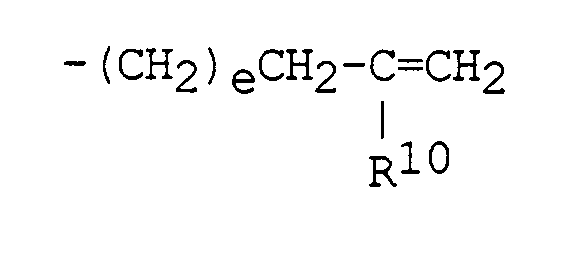
- R10
- ein Wasserstoff- oder Methylrest und
- e
- eine Zahl von 0 bis 10 ist.
- Weiter kann R2 vorzugsweise ein -R4-OH-Rest sein, wobei R4 ein zweiwertiger aliphatischer Kohlenwasserstoffrest mit 2 bis 20 Kohlenstoffatomen ist. Beispiele solcher Reste -R4-OH sind -(CH2)2-OH, -(CH2)4-OH oder -(CH2)6-OH.
- R2 ist in einer weiteren bevorzugten Form ein -(CnH2nO-)bR5-Rest, wobei R5 ein Wasserstoff-, Alkyl-, Alkaryl-, Alkenyl- oder Sulfopropylrest, n eine Zahl von 2 bis 18 und b eine Zahl ≥ 1 ist. Beispiele für die Reste R5 sind Methyl-, Butyl-, Stearyl-, Allyl-, Hexenyl-, Nonylphenyl- oder Oleylreste.
- Ist n = 2, enthält der Polyetherrest ausschließlich Oxyethyleneinheiten. Ist der Wert für n > 2, besteht der Polyetherrest aus Oxyethyleneinheiten und anteilig aus Oxyalkyleneinheiten, deren Kohlenstoffzahl zwischen 3 und 18 liegt. Dabei kann n den Wert einer gebrochenen Zahl zwischen 2 und 18 annehmen. Vorzugsweise besteht der Oxyalkylenblock aus Oxyethyleneinheiten, wobei gegebenenfalls zusätzlich zu den Oxypropylen- auch Oxybutyleneinheiten vorhanden sein können. Oxyalkyleneinheiten mit einer Kohlenstoffanzahl von 4 bis 18 sind dann bevorzugt, wenn hydrophobe Eigenschaften des Umesterungsproduktes angestrebt werden; ein Beispiel dafür ist der Oxytetramethylenrest.
- R2 kann in einer weiteren bevorzugten Form auch ein
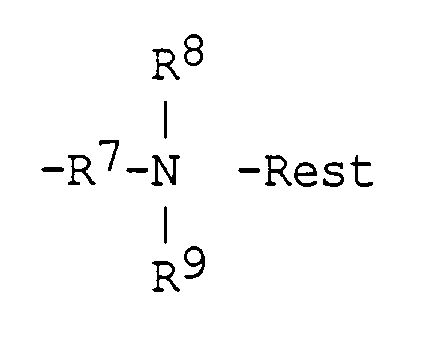

- R7
- ein zweiwertiger aliphatischer Kohlenwasserstoffrest mit 2 bis 6 Kohlenstoffatomen in der Kohlenstoffkette oder der Rest -(CnH2nO-)mCpH2p- ist, und die Indices folgende Werte aufweisen: n = 2, 3 oder 4; m = 1 bis 20; p = 2, 3 oder 4.
- R8 und R9
- sind gleich oder verschieden und bedeuten jeweils Alkylreste mit 1 bis 18 Kohlenstoffatomen.
- Das Stickstoffatom kann in protonierter oder quaternierter Form vorliegen.
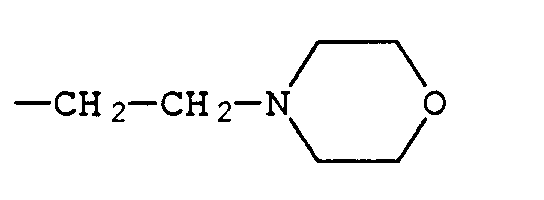
- Beispiele derartiger Reste sind

- Der Rest R2 kann auch die Bedeutung eines -(CH2)cCdF2d+1-Restes annehmen, wobei c eine Zahl von 2 bis 10 und d eine Zahl von 1 bis 12 ist. Bevorzugte Beispiele solcher Reste sind -(CH2)2-C4F9 oder -(CH2)2-C8F17.
- Der Rest R2 kann schließlich die Bedeutung des Restes

- R11
- ein Sauerstoff- oder Schwefelrest,
- R12
- ein Wasserstoff- oder Methylrest,
- R13
- ein Phenyl-,

- R14
- ein Wasserstoff-, Alkyl-, Alkylfluoralkyl- oder ein Dialkylaminoalkylrest ist, wobei das Stickstoffatom in protonierter oder quaternierter Form vorliegen kann,
- R15
- ein Alkylrest ist,
- r
- eine Zahl von 2 bis 6 und
- f
- eine Zahl von 2 bis 100 ist.
- Beispiele solcher Reste sind der ω-Hydroxypolystyrol-, ω-Hydroxypoly-n- oder -t-butylmethacrylat- und der ω-Hydroxypolyvinylpivalatrest. Aus dem ω-Hydroxypoly-t-butylmethacrylatrest läßt sich durch sauer katalysierte Abspaltung von Isobuten der Polymethacrylsäurerest erhalten.
- Beispiele erfindungsgemäßer Polymethacrylsäureester sind:


- Dem Fachmann ist klar, daß die neuen Polymethacrylsäureester der allgemeinen Formel I Eigenschaften aufweisen, die anwendungstechnisch von großem Interesse sein können, indem zum Beispiel ihre Verträglichkeit mit anderen Medien in gewünschter Weise verändert werden kann. Dies gilt für die Hydrophobie, die Hydrophilie und die schmutzabweisenden Eigenschaften. Durch geeignete Wahl der zur Umesterung verwendeten Alkohole können antistatische Eigenschaften erzielt werden. Enthalten die zur Umesterung verwendeten Alkohole zusätzliche funktionelle und weiteren Reaktionen zugängliche Gruppen, wie etwa eine weitere OH- oder -CH=CH2-Gruppe, besteht die Möglichkeit, die erfindungsgemäßen Produkte zu Blockpolymeren des Typs ABA bzw. (AB)n oder in Kammpolymeren weiter umzusetzen. Hierdurch wird die Herstellung neuartiger Blockpolymerer ermöglicht.
- Die Synthese von alternierenden Blockcopolymeren des Typs (AB)n erfolgt durch Umesterung mit α,ω-dihydroxyfunktionellen Polymeren, wie z. B. Polyethylenglykol, Polypropylenglykol oder Polyoxytetramethylen in Molverhältnissen von 1 : 1 bis 1 : ≤ 2.
- Ein weiterer Gegenstand der Erfindung ist ein Verfahren zur Herstellung der erfindungsgemäßen neuen Polymethacrylsäureester der Formel I. Das erfindungsgemäße Verfahren ist dadurch gekennzeichnet, daß man durch radikalische Polymerisation in Gegenwart von ester- oder carbonsäurefunktionellen Mercaptanen erhaltene Polymethacrylsäureester der allgemeinen Formel

- Es war überraschend, daß bei diesen Verfahrensbedingungen die Umesterung nur an beiden endständigen Methacrylsäureestergruppen stattfindet. Die in der Kette vorliegenden Methacrylsäureester werden nicht oder nur in ganz untergeordnetem, vernachlässigbarem Umfang umgeestert. Voraussetzung hierfür ist allerdings, daß keine Reaktionstemperaturen > 150 °C verwendet werden.
- Bevorzugte Umesterungskatalysatoren sind Alkyltitanat, Alkylzirkonat, Dialkylzinnacetathalogenid oder Dialkylzinndialkylester, die in Mengen von 0,1 bis 2 Gew.-%, bezogen auf Polymethacrylsäureester, verwendet werden. Beispiele besonders geeigneter Katalysatoren sind Isopropyltitanat, n-Propylzirkonat, Dibutylzinnacetatchlorid, Dibutylzinndiacetat und Dibutylzinndilaurat.
- Die Reaktionstemperatur beträgt 70 bis 150 °C, vorzugsweise 100 bis 130 °C.
- Die Reaktion kann mit oder ohne Lösungsmittel durchgeführt werden. Im Falle der Verwendung eines Lösungsmittels bieten sich Toluol, Xylol oder Benzinfraktionen mit einem Siedebereich von 70 bis 140 °C an.
- In den folgenden Beispielen wird die Herstellung der erfindungsgemäßen Verbindungen noch näher erläutert.
- Eine Lösung von 7,0 g Azodiisobuttersäurenitril und 247,7 g (2,33 Mol) Mercaptoessigsäuremethylester in 483 g Toluol und 2086 g (20,83 Mol) Methylmethacrylat (MMA) wird innerhalb von 4 h in einen mit 150 g Toluol gefüllten Reaktor gegeben; das vorgelegte Lösungsmittel hat dabei eine Temperatur von etwa 100 °C und befindet sich unter einer Stickstoffatmosphäre. Anschließend werden nochmals 4,7 g Azodiisobuttersäurenitril, gelöst in 47 g Methylethylketon, innerhalb von 1 h in gleichen Teilen nachgegeben. Schließlich wird das Reaktionsgemisch noch für 1 h bei der gleichbleibenden Temperatur von 100 °C weiter erwärmt. Nach Beendigung der Reaktion werden die Lösungsmittel und das Restmonomere bei 80 °C/1 Torr abdestilliert; es verbleibt eine farblose, viskose Flüssigkeit.
- Aus der gelpermeationschromatographischen Untersuchung (Eichung gegen PMMA-Standards) ergibt sich für das erhaltene Polymerisat ein numerisches Molekulargewicht Mn (GPC) von 900 und für das Gewichtsmittel des Molekulargewichtes Mw (GPC) 1800, der Uneinheitlichkeitsfaktor (PD) beträgt somit 2,00. Aus der dampfdruckosmometrischen Molekulargewichtsbestimmung erhält man einen Mn-Wert von 1050. Der Restmonomerengehalt beträgt < 0,1 %.
- Es wird verfahren wie in Beispiel 1A mit der Ausnahme, daß die molaren Verhältnisse des entsprechenden Methacrylatmonomeren und Mercaptoessigsäuremethylester (Monomer/Regler), wie in Tabelle 1 angegeben, verändert werden.
- Anstelle von Methylmethacrylat (MMA) wird in Beispiel 5A eine Mischung von Methylmethacrylat und n-Butylmethacrylat (BMA) in äquimolarem Verhältnis eingesetzt.
- Anstelle von Mercaptoessigsäuremethylester (MEME) wird im Beispiel 6A Mercaptoessigsäureethylester (MEEE) als Kettenübertragungsagens (Regler) verwendet. Neben den gelpermeationschromatographisch ermittelten Molekulargewichten (Mn/GPC; Eichung gegen PMMA-Standards) sind in Tabelle 1 dampfdruckosmometrisch ermittelte Molekulargewichte (Mn/Osmo.) angegeben.
Tabelle 1 Darstellung von Polymethacrylaten durch radikalische Polymerisation in Gegenwart von Mercaptoessigsäureestern als Kettenübertragungsagentien (Regler) Beispiel Monomer Regler Monomer/Regler (Mol/Mol) Mn(GPC) PD (Mw/Mn) Mn (Osmo.) 1A MMA MEME 9 950 2,00 1050 2A MMA MEME 30 2950 1,88 3100 3A BMA MEME 8 1020 1,84 1000 4A CHMA MEME 7 1150 1,71 1350 5A MMA/BMA MEME 8 980 1,64 1100 6A MMA MEEE 8,8 1060 1,66 1010 - 64 g (2 Mol) Methanol und 23 g (0,33 Mol) Kaliummethylat werden in einen Reaktor gegeben. Nach sorgfältiger Spülung mit Reinstickstoff wird auf 110 °C erhitzt, und es werden 2360 g (ca. 54 Mol) Ethylenoxid so schnell zugegeben, daß die Reaktionsinnentemperatur 120 °C und der Druck 6 bar nicht überschreiten. Nach vollständiger Einleitung des Ethylenoxids wird die Temperatur so lange auf 115 °C gehalten, bis ein konstanter Manometerdruck das Ende der Nachreaktion anzeigt. Schließlich werden bei 80 bis 90 °C die nicht umgesetzten Monomeren im Vakuum entfernt.
- Das erhaltene Produkt wird mit Hilfe von Phosphorsäure neutralisiert und das Wasser durch Destillation, das entstandene Kaliumphosphat durch Filtration zusammen mit einem Filterhilfsmittel entfernt. Das aus der Bestimmung der Hydroxylzahl bei einer angenommenen Funktionalität von 1 ermittelte Molekulargewicht Mn (OH-Zahl) beträgt 1015.
- Es wird verfahren wie in Beispiel 1B mit der Ausnahme, daß man das molare Verhältnis von Ethylenoxid zu Methanol von 27/1 (Beispiel 1B) auf 80/1 ändert. Die Katalysatorkonzentration beträgt 30 Mol-%, bezogen auf Methanol.
- Es wird verfahren wie in Beispiel 1B mit dem Unterschied, daß 48 g (1,5 Mol) Methanol und 34 g (0,46 Mol) Kaliummethylat und, anstelle von Ethylenoxid, ein Gemisch aus 4196 g (95 Mol) Ethylenoxid und 739 g (12,7 Mol) Propylenoxid eingesetzt werden.
- Das aus der Bestimmung der Hydroxylzahl bei einer angenommenen Funktionalität von 1 ermittelte Molekulargewicht Mn (OH-Zahl) beträgt 2940.
Tabelle 2 Chemische Zusammensetzung und Molekulargewichte einiger ω-OH-funktioneller Polyalkylenoxide Polyether aus Beispiel % EO % PO Mn (OH-Zahl) 1B 100 - 1015 2B 100 - 2890 3B 85 15 2945 - 100 g Xylol werden unter einer Stickstoffatmosphäre in einem mit einem Rührer versehenen Reaktor auf 120 °C erhitzt. Dazu wird innerhalb von 4 h unter Beibehaltung der Temperatur von 120 °C ein Gemisch aus 1560 g (15 Mol) Styrol, 78,1 g (1 Mol) 2-Mercaptoethanol, 4,1 g Azodiisobuttersäuredinitril und 310 g getrocknetes Xylol zugegeben. Nach Beendigung der Zugabe erfolgt eine Nachreaktion für etwa 15 min, anschließend werden 0,16 g Methylhydrochinon zugesetzt. Durch Destillation im Vakuum (60 bis 80 °C/10 Torr) werden überschüssiges Styrol, 2-Mercaptoethanol und Xylol abgetrennt. Nach Auffüllen mit Xylol wird eine farblose, viskose Lösung des erhaltenen ω-Hydroxypolystyrols mit einer Gewichtskonzentration von etwa 62 % erhalten.
- Aus der gelpermeationschromatographischen Untersuchung ergibt sich für das erhaltene Polymerisat ein numerisches Molekulargewicht Mn (GPC) von 870 und für das Gewichtsmittel des Molekulargewichtes Mw (GPC) 1380, der Uneinheitlichkeitsfaktor beträgt somit 1,59; aus dem Vergleich des aus der Hydroxylzahlbestimmung erhaltenen Molekulargewichtes (Mn/OH-Zahl) von 950 und dem dampfdruckosmometrisch ermittelten Molekulargewicht (Mn/Osmometrie) ergibt sich eine Hydroxyfunktionalität von 0,94. Der Restmonomerengehalt beträgt < 0,1 %.
- Eine Lösung von 1,47 g Azodiisobuttersäurenitril und 78,1 g (ca. 1 Mol) 2-Mercaptoethanol in 150 g Xylol und 1136,8 g (ca. 8 Mol) tert.-Butylmethacrylat (TBMA) wird innerhalb von 4 h in einen mit 150 g Xylol gefüllten Reaktor gegeben; das vorgelegte Lösungsmittel hat dabei eine Temperatur von etwa 120 °C und befindet sich unter einer Stickstoffatmosphäre. Nach Beendigung der Reaktion werden zunächst etwa 400 ppm Hydrochinonmonomethylether zugegeben und die Lösung auf etwa 40 °C abgekühlt, dann werden Lösungsmittel und das Restmonomere bei 110 °C/1 Torr abdestilliert; es verbleibt eine farblose, viskose Flüssigkeit.
- Aus der gelpermeationschromatographischen Untersuchung ergibt sich für das erhaltene Polymerisat ein numerisches Molekulargewicht Mn (GPC) von 1300 und für das Gewichtsmittel des Molekulargewichtes Mw (GPC) 2170, der Uneinheitlichkeitsfaktor beträgt somit 1,67; aus dem Vergleich des aus der Hydroxylzahlbestimmung erhaltenen Molekulargewichtes (Mn/OH-Zahl) von 1150 und dem dampfdruckosmometrisch ermittelten Molekulargewicht (Mn/Osmometrie) ergibt sich eine Hydroxyfunktionalität von 1,04. Der Restmonomerengehalt beträgt < 0,1 %.
- 525 g (ca. 0,5 Mol) des Polymethylmethacrylates aus Beispiel 1A, 1065 g (ca. 1,05 Mol) des Polyethers aus Beispiel 1B und 131 g Toluol werden unter Stickstoff in einem Reaktor auf 125 °C erwärmt und dabei das Lösungsmittel unter gleichzeitiger Entfernung von Wasserspuren abdestilliert. Bei einer Temperatur von ca. 120 °C erfolgt die Zugabe von 4,77 g Isopropyltitanat und unmittelbar danach die Einstellung eines Vakuums von etwa 2 Torr. Das bei der Reaktion freiwerdende Methanol wird dabei, neben anderen flüchtigen Bestandteilen (Toluol, Isopropanol), kontinuierlich entfernt und kondensiert. Nach ca. 7 h ist die Reaktion beendet, die niedrige Rest-OH-Zahl der Reaktionsmischung (OH-Zahl: 1,9) sowie die quantitative gaschromatographische Untersuchung des Destillats (1,01 Mol Methanol) bestätigen den quantitativen Umsatz an beiden Esterendgruppen. Aus der gelpermeationschromatographischen Untersuchung ergibt sich für das erhaltene Polymerisat ein numerisches Molekulargewicht Mn (GPC) von 3500 und für das Gewichtsmittel des Molekulargewichtes Mw (GPC) 4300, der Uneinheitlichkeitsfaktor beträgt somit 1,23.
- Es wird prinzipiell verfahren wie in Beispiel 1C mit der Ausnahme, daß ein Reaktor mit einer aufgesetzten Fraktionierkolonne benutzt wird. Zu der Reaktionsmischung werden zusätzlich 900 g Toluol als inertes Lösungsmittel gegeben. Anschließend wird ein geringer Teil des Lösungsmittels unter Normaldruck solange abdestilliert, bis sichtbar keine Wasserspuren mehr vorhanden sind. Danach wird der Katalysator hinzugefügt und das freiwerdende Methanol durch Fraktionierung vom Toluol getrennt. Nach einer Reaktionszeit von 6 h beträgt die Kopftemperatur 110 °C; die Reaktion ist dann beendet. Die gaschromatographische Analyse des Destillats ergibt einen Umsatz von 97 %.
- Das Ergebnis der gelpermeationschromatographischen Untersuchung liefert identische Mn- und Mw-Werte wie in Beispiel 1C.
- Es wird prinzipiell verfahren wie in Beispiel 2C mit der Ausnahme, daß das Polymethylmethacrylat aus Beispiel 6A, welches durch die Polymerisation von Methylmethacrylat in Gegenwart von Mercaptoessigsäureethylester als Kettenüberträger erhalten wurde, eingesetzt wird. So lassen sich die Umsätze in α-Position (Freisetzung von Ethanol) und ω-Position (Freisetzung von Methanol) als Funktion der Zeit verfolgen. Die Analyse des Destillats zu verschiedenen Zeitpunkten gibt nachfolgenden Reaktionsverlauf wieder:
Zeit/h Umsatz/% (Ethanol) Umsatz/% (Methanol) 1 97 32 2,5 7 28 7 - 42 - Aus der gelpermeationschromatographischen Untersuchung ergibt sich für das erhaltene Polymerisat ein numerisches Molekulargewicht Mn (GPC) von 3350 und für das Gewichtsmittel des Molekulargewichtes Mw (GPC) 4200, der Uneinheitlichkeitsfaktor beträgt somit 1,25.
- Identische Resultate werden erhalten, wenn die Umesterung lösungsmittelfrei durchgeführt wird.
- Es wird grundsätzlich verfahren wie in Beispiel 1C bzw. 2C beschrieben mit dem Unterschied, daß, wie in Tabelle 3 angegeben, Polymethacrylate unterschiedlicher chemischer Struktur und verschiedener Molekulargewichte mit Polyalkylenoxid-Homo- und -copolymeren verschiedener Molekulargewichte bzw. anderen ω-monohydroxyfunktionellen Verbindungen zur Reaktion gebracht werden.
Tabelle 3 Darstellung von Polymethacrylat(B)-ABA-Triblockcopolymeren Beispiel OH-funkt. Verbdg.(A) aus Beispiel Polymethacrylat (B) aus Beispiel Umsatz/OH-Zahl Umsatz/GC (Methanol o.Butanol) Mn/GPC (PMMA)/PD1 Mn/Osmom. 1C 1B 1A 100 101 3500/1,22 2700 2C 1B 1A 98 97 3450/1,24 2750 3C 1B 6A 98 103 3500/1,22 2900 4C 2B 1A 94 98 9700/1,19 6750 5C 3B 1A 92 96 9850/1,21 6900 6C 1B 2A 94 96 5200/1,44 5000 7C 1B 4A 96 101 3800/1,21 3250 8C 1B 5A 93 94 3500/1,18 3000 9C 4B 1A 94 92 3250/1,49 2850 10C 4B 3A 90 91 3650/1,52 2700 1 PD = Polydispersität = Mw/Mn - 525 g (ca. 0,5 Mol) des Polymethylmethacrylates aus Beispiel 1A und 1210 g (ca. 1,05 Mol) des hydroxyfunktionellen Poly-t-butylmethacrylates aus Beispiel 5B, gelöst in 1150 g Toluol, werden unter Stickstoff in einem Reaktor auf 115 °C erwärmt und dabei zunächst etwa 100 ml des vorliegenden Toluols unter gleichzeitiger Entfernung von Wasserspuren abdestilliert. Bei einer Temperatur von ca. 110 °C erfolgt die Zugabe von 8,68 g Isopropyltitanat. Das bei der einsetzenden Reaktion freiwerdende Methanol wird dabei, neben anderen flüchtigen Bestandteilen (Toluol, Isopropanol), kontinuierlich entfernt und kondensiert. Nach ca. 4 h werden nochmals 4,34 g Isopropyltitanat zugesetzt, Methanol entfernt und die Reaktion nach weiteren 3 h beendet. Die Hydroxylzahl des erhaltenen Produktes beträgt 4,1, was einem Umsatz von 92 % (bezogen auf die im Unterschuß eingesetzte Komponente) entspricht. Aus der gelpermeationschromatographischen Untersuchung ergibt sich für das erhaltene Polymerisat ein numerisches Molekulargewicht Mn (GPC) von 3900 und für das Gewichtsmittel des Molekulargewichtes Mw (GPC) 5600, der Uneinheitlichkeitsfaktor beträgt somit 1,43.
- Aus 250 g des so erhaltenen Produktes in toluolischer Lösung wird das Lösungsmittel durch Destillation entfernt und durch 150 g Dioxan ersetzt. Zu dieser Lösung gibt man 3,75 g p-Toluolsulfonsäuremonohydrat und erwärmt auf etwa 95 bis 100 °C. Die beginnende Abspaltung des Isobutens läßt sich an einer deutlichen Gasentwicklung erkennen. Nach einer Reaktionszeit von etwa 5 h ist die Gasentwicklung beendet. Die Säurezahl des erhaltenen Produktes in der Lösung beträgt 390, was einem Umsatz von 95 % entspricht.
- NMR-spektroskopisch (Vergleich der Signalintensitäten der charakteristischen t-Butylgruppe) ergibt sich ebenfalls ein Umsatz von 95 %.
- 1050 g (1,0 Mol) des Polymethylmethacrylats aus Beispiel 1A, 554 g (2,05 Mol) Stearylalkohol und etwa 250 g Toluol werden unter Reinstickstoff in einem Reaktor auf 115 °C erhitzt, wobei das Lösungsmittel unter gleichzeitiger Entfernung von Feuchtigkeitsspuren abdestilliert wird. Anschließend werden 5 g Isopropyltitanat hinzugegeben und nach kräftiger Durchmischung ein Vakuum von 5 Torr eingestellt. Das freiwerdende Methanol wird zusammen mit evtl. vorhandenen Lösungsmittelresten in einer Kühlfalle kondensiert.
- Nach etwa 5 h ist die Bildung von Methanol und damit die Reaktion beendet. Die gaschromatographische Bestimmung des Destillats ergibt einen Umsatz von 99 %; durch die Bestimmung der Hydroxylzahl errechnet sich ein Umsatz von 95 %.
- 1000 g (1,0 Mol) des Poly-n-butylmethacrylats aus Beispiel 3A, 234 g (2,0 Mol) Diethylaminoethanol und etwa 500 g Xylol werden unter Reinstickstoff in einem Reaktor mit aufgesetztem Rückflußkühler auf 140 °C erhitzt, wobei das Lösungsmittel solange unter Normaldruck abdestilliert wird, bis sichtbar keine Feuchtigkeitsspuren mehr vorhanden sind. Anschließend werden bei etwa 130 °C 3,7 g Isopropyltitanat hinzugegeben und verrührt. Das freiwerdende Butanol wird durch Fraktionierung von nicht umgesetztem Diethylaminoethanol getrennt und entfernt. Nach 4 h beträgt die Kopftemperatur 135 °C, die Reaktion ist beendet. Über die gaschromatographische Analyse des Destillats ermittelt sich der Umsatz zu 96 %.
- Aus der Ermittlung der Hydroxylzahl ergibt sich ein Umsatz von 95 %. Die erhaltene Lösung des Produktes weist eine gelb-braune Farbe auf.
- Aus 250 g (0,2 Mol) des so erhaltenen Produktes in xylolischer Lösung wird das Lösungsmittel durch Destillation entfernt und durch 250 g n-Propanol ersetzt. Unter Rühren gibt man bei Raumtemperatur über einen Zeitraum von 1 h insgesamt 24,0 g Eisessig (0,4 Mol) hinzu und rührt für eine weitere Stunde.
- Der pH-Wert einer 10 %igen wäßrigen Lösung des protonierten Materials beträgt 7,1.
- Zur Quaternisierung werden zunächst 250 g des in Propanol gelösten Produktes in einem Druckreaktor auf 120 °C erhitzt. Daraufhin wird soviel Methylchlorid eingeleitet, daß ein Druck von 4 bar entsteht. Dieser wird bei 120 °C über einen Zeitraum von 4 h aufrechterhalten. Nach anschließender Abkühlung auf Raumtemperatur und Entfernung des überschüssigen Methylchlorids wird ein gelbliches Produkt erhalten. Aus der Bestimmung des Chloridgehaltes und der Aminzahl ergibt sich ein Umsatz von 93 bzw. 97 % der Theorie.
- 525 g (ca. 0,5 Mol) des Polymethylmethacrylates aus Beispiel 1A, 400 g (ca. 0,4 Mol) eines Polytetramethylenetherglykols (Mn ca. 1000) und 131 g Toluol werden unter Stickstoff in einem Reaktor auf 125 °C erwärmt und dabei das Lösungsmittel unter gleichzeitiger Entfernung von Wasserspuren abdestilliert. Bei einer Temperatur von ca. 120 °C erfolgt die Zugabe von 4,77 g Isopropyltitanat und unmittelbar danach die Einstellung eines Vakuums von etwa 2 Torr. Das bei der Reaktion freiwerdende Methanol wird dabei, neben anderen flüchtigen Bestandteilen (Toluol, Isopropanol), kontinuierlich entfernt und kondensiert. Nach ca. 7 h ist die Reaktion beendet, die Hydroxylzahl der Reaktionsmischung beträgt nur noch 3,5. Die gaschromatographische Untersuchung des Destillats (0,78 Mol Methanol) bestätigt den nahezu quantitativen Umsatz des eingesetzten Polytetramethylenetherglykols. Aus der gelpermeationschromatographischen Untersuchung ergibt sich für das erhaltene Polymerisat ein numerisches Molekulargewicht Mn (GPC) von 8200 und für das Gewichtsmittel des Molekulargewichtes Mw (GPC) 13 600, der Uneinheitlichkeitsfaktor beträgt somit 1,66. Das feste Endprodukt ist gelb gefärbt.
Claims (11)
- Polymethacrylsäureester der allgemeinen Formel
 R1 gleich oder verschieden sind und Alkylreste mit 1 bis 8 Kohlenstoffatomen, Perfluoralkyl- oder Dialkylaminoalkylreste bedeuten undR2 von einem Alkohol R2OH abgeleitete Reste sind,n eine Zahl von 1 bis 6 ist unda eine Zahl ist, die im Mittel ≥ 4 ist.
 - Polymethacrylsäureester nach Anspruch 1, dadurch gekennzeichnet, daß R2 ein Alkylrest mit einer größeren Anzahl Kohlenstoffatome als der Rest R1 oder ein Alkenylrest ist.
- Polymethacrylsäureester nach Anspruch 2, dadurch gekennzeichnet, daß der Alkenylrest ein Rest der Formel
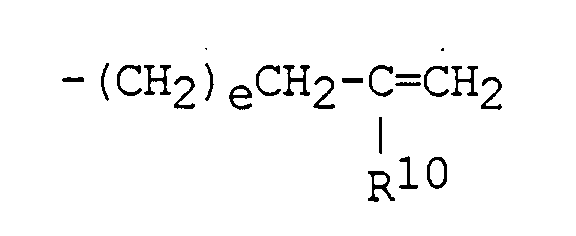 R10 ein Wasserstoff- oder Methylrest unde eine Zahl von 0 bis 10 ist.
 - Polymethacrylsäureester nach Anspruch 1, dadurch gekennzeichnet, daß der Rest R2 ein -R4-OH-Rest ist, wobei R4 ein zweiwertiger aliphatischer Kohlenwasserstoffrest mit 2 bis 20 Kohlenstoffatomen ist.
- Polymethacrylsäureester nach Anspruch 1, dadurch gekennzeichnet, daß der Rest R2 ein -(CnH2nO-)bR5-Rest ist, wobei R5 ein Wasserstoff-, Alkyl-, Alkaryl-, Alkenyl- oder Sulfopropylrest, n eine Zahl von 2 bis 18 und b eine Zahl > 1 ist.
- Polymethacrylsäureester nach Anspruch 1, dadurch gekennzeichnet, daß der Rest R2 ein

 R7 ein zweiwertiger aliphatischer Kohlenwasserstoffrest mit 2 bis 4 Kohlenstoffatomen in der Kohlenstoffkette oder der Rest -(CnH2nO-)mCpH2p- (n = 2, 3 oder 4; m = 1 bis 20; p = 2, 3 oder 4) ist,R8 und R9 gleich oder verschieden und bedeuten jeweils Alkylreste mit 1 bis 18 Kohlenstoffatomen sind, wobei das Stickstoffatom in protonierter oder quaternierter Form vorliegen kann.
 - Polymethacrylsäureester nach Anspruch 1, dadurch gekennzeichnet, daß der Rest R2 ein -(CH2)cCdF2d+1-Rest ist, wobei c eine Zahl von 2 bis 10 und d eine Zahl von 1 bis 12 ist.
- Polymethacrylsäureester nach Anspruch 1, dadurch gekennzeichnet, daß der Rest R2 ein
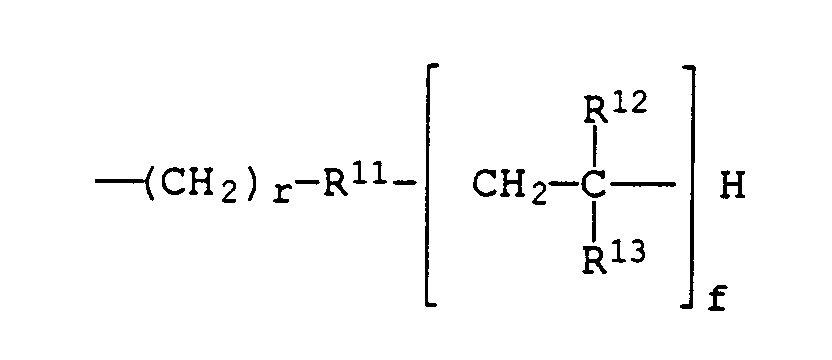 R11 ein Sauerstoff- oder Schwefelrest,R12 ein Wasserstoff- oder Methylrest,R13 ein Phenyl-,
 R14 ein Wasserstoff-, Alkyl-, Alkylfluoralkyl- oder ein Dialkylaminoalkylrest ist, wobei das Stickstoffatom in protonierter oder quaternierter Form vorliegen kann,R15 ein Alkylrest ist,r eine Zahl von 2 bis 6 undf eine Zahl von 2 bis 100 ist.
 - Verfahren zur Herstellung der Polyacrylsäureester nach einem oder mehreren der vorhergehenden Ansprüche, dadurch gekennzeichnet, daß man Polymethacrylsäureester der allgemeinen Formel
 R* abgeleitet ist von einem an sich bekannten Kettenregler des Typs R*OC(O)-(CH2)n-SH, bei dem R* Alkyl- oder Alk arylreste mit 1 bis 16 Kohlenstoffatomen bedeutet,mit Alkoholen der Formel R2OH bei Temperaturen von 70 bis 150 °C, gegebenenfalls in Gegenwart von Lösungsmitteln, unter Zusatz von an sich bekannten nichtbasischen Umesterungskatalysatoren in einem molaren Verhältnis von Polymethacrylsäureester zu Alkohol von 1 : 1 bis 1 : 5 umestert.
 - Verfahren nach Anspruch 9, dadurch gekennzeichnet, daß man die Umesterung in einem molaren Verhältnis von 1 : 1 bis 1 : 2 durchführt.
- Verfahren nach Anspruch 9 und 10, dadurch gekennzeichnet, daß man als Umesterungskatalysatoren Alkyltitanat, Alkylzirkonat, Dialkylzinnacetathalogenid oder Dialkylzinndialkylester verwendet.
Applications Claiming Priority (2)
| Application Number | Priority Date | Filing Date | Title |
|---|---|---|---|
| DE19535077 | 1995-09-21 | ||
| DE19535077 | 1995-09-21 |
Publications (3)
| Publication Number | Publication Date |
|---|---|
| EP0764662A2 true EP0764662A2 (de) | 1997-03-26 |
| EP0764662A3 EP0764662A3 (de) | 1998-11-11 |
| EP0764662B1 EP0764662B1 (de) | 2002-03-13 |
Family
ID=7772765
Family Applications (1)
| Application Number | Title | Priority Date | Filing Date |
|---|---|---|---|
| EP96114353A Expired - Lifetime EP0764662B1 (de) | 1995-09-21 | 1996-09-07 | Polymethacrylsäureester, deren Estergruppen in alpha- und omega-Stellung von den in der Kette befindlichen Estergruppen abweichen |
Country Status (5)
| Country | Link |
|---|---|
| US (1) | US5721321A (de) |
| EP (1) | EP0764662B1 (de) |
| JP (1) | JPH09110941A (de) |
| DE (1) | DE59608870D1 (de) |
| ES (1) | ES2173231T3 (de) |
Cited By (2)
| Publication number | Priority date | Publication date | Assignee | Title |
|---|---|---|---|---|
| GB2324531A (en) * | 1997-04-25 | 1998-10-28 | Goodyear Tire & Rubber | Rubbery polymer with improved properties |
| WO2001066605A1 (en) * | 2000-03-10 | 2001-09-13 | Novartis Ag | Reactive polymers |
Families Citing this family (4)
| Publication number | Priority date | Publication date | Assignee | Title |
|---|---|---|---|---|
| DE19836253C1 (de) * | 1998-08-11 | 1999-12-23 | Goldschmidt Ag Th | Endfunktionalisierte Polymethacrylsäureester und deren Verwendung als Dispergiermittel zur Herstellung wäßriger Pigmentpasten |
| US9777170B2 (en) | 2014-02-25 | 2017-10-03 | The Chemours Company Tt, Llc | Fluorinated polymer additives derived using hydrophilic chain transfer agents for architectural coatings |
| JP6587699B2 (ja) | 2016-02-03 | 2019-10-09 | 大塚化学株式会社 | Aba型ブロック共重合体、分散剤及び顔料分散組成物 |
| CN113150191A (zh) * | 2021-04-01 | 2021-07-23 | 深圳市新纶科技股份有限公司 | 改性聚甲基丙烯酸甲酯、光学薄膜材料及其制备方法、偏光片 |
Family Cites Families (8)
| Publication number | Priority date | Publication date | Assignee | Title |
|---|---|---|---|---|
| DE3842201C1 (de) * | 1988-12-15 | 1990-05-03 | Th. Goldschmidt Ag, 4300 Essen, De | |
| DE3906702A1 (de) * | 1989-03-03 | 1990-09-13 | Goldschmidt Ag Th | Polyacrylsaeureester mit langkettigen kohlenwasserstoff- und polyoxyalkylengruppen und deren verwendung als grenzflaechenaktive substanzen |
| DE4121811A1 (de) * | 1991-07-02 | 1993-01-07 | Roehm Gmbh | Verfahren zur herstellung von polyalkylmethacrylat-makromonomeren und ihre verwendung zur herstellung von kammpolymeren |
| DE4201864C2 (de) * | 1992-01-24 | 1996-02-15 | Passavant Werke | Kastenartiges Modul für einen Reaktor zur anaeroben Reinigung von Abwasser |
| DE4306537A1 (de) * | 1993-03-03 | 1994-09-08 | Goldschmidt Ag Th | Polymethacrylsäureester, deren Estergruppen in alpha- und gegebenenfalls zusätzlich in omega-Stellung von den in der Kette befindlichen Estergruppen abweichen |
| DE4314111A1 (de) * | 1993-04-29 | 1994-11-03 | Goldschmidt Ag Th | alpha,omega-Polymethacrylatdiole, Verfahren zu ihrer Herstellung und deren Verwendung zur Herstellung von Polymeren, insbesondere Polyurethanen und Polyestern |
| ES2115273T3 (es) * | 1994-01-28 | 1998-06-16 | Goldschmidt Ag Th | Copolimeros de bloques polimetacrilato-poli(acido metacrilico). |
| DE4405041C2 (de) * | 1994-02-17 | 1995-12-21 | Herberts Gmbh | Verfahren zur Herstellung von Makromonomeren und deren Verwendung als Comonomere bei Polymerisations-, Polyadditions- oder Polykondensations-Reaktionen |
-
1996
- 1996-09-07 ES ES96114353T patent/ES2173231T3/es not_active Expired - Lifetime
- 1996-09-07 DE DE59608870T patent/DE59608870D1/de not_active Expired - Fee Related
- 1996-09-07 EP EP96114353A patent/EP0764662B1/de not_active Expired - Lifetime
- 1996-09-16 US US08/714,238 patent/US5721321A/en not_active Expired - Fee Related
- 1996-09-19 JP JP8248274A patent/JPH09110941A/ja not_active Ceased
Cited By (3)
| Publication number | Priority date | Publication date | Assignee | Title |
|---|---|---|---|---|
| GB2324531A (en) * | 1997-04-25 | 1998-10-28 | Goodyear Tire & Rubber | Rubbery polymer with improved properties |
| GB2324531B (en) * | 1997-04-25 | 2000-04-12 | Goodyear Tire & Rubber | Rubbery polymer with improved properties |
| WO2001066605A1 (en) * | 2000-03-10 | 2001-09-13 | Novartis Ag | Reactive polymers |
Also Published As
| Publication number | Publication date |
|---|---|
| EP0764662A3 (de) | 1998-11-11 |
| JPH09110941A (ja) | 1997-04-28 |
| EP0764662B1 (de) | 2002-03-13 |
| US5721321A (en) | 1998-02-24 |
| DE59608870D1 (de) | 2002-04-18 |
| ES2173231T3 (es) | 2002-10-16 |
Similar Documents
| Publication | Publication Date | Title |
|---|---|---|
| EP0859028B1 (de) | Polymethacrylsäure-Polyalkylenoxid-Blockcopolymere, Verfahren zu ihrer Herstellung und ihre Verwendung als Dispergiermittel | |
| EP0386507B1 (de) | Polyacrylsäureester mit langkettigen Kohlenwasserstoff- und Polyoxyalkylengruppen und deren Verwendung als grenzflächenaktive Substanzen | |
| EP3744753B1 (de) | Verfahren zur aufreinigung von acetoxysiloxanen | |
| DE69312057T2 (de) | ABC Dreiblock-Methacrylat Polymere | |
| DE60205624T2 (de) | Methoden zur herstellung von im wesentlichen monodispersen polymermischungen mit polyethylenglykoleinheiten | |
| EP0613910B1 (de) | Polymethacrylsäureester, deren Estergruppen in alpha- und gegebenenfalls zusätzlich in omega-Stellung von den in der Kette befindlichen Estergruppen abweichen | |
| DE3887261T2 (de) | Urethanbeschichtungsharzzusammensetzung. | |
| DE69214316T2 (de) | Polyoxazolidine mit Carbonat-Gruppen, Verfahren zu ihrer Herstellung und ihre Anwendung | |
| EP0622378B1 (de) | Alpha,omega-Polymethacrylatdiole, Verfahren zu ihrer Herstellung und deren Verwendung zur Herstellung von Polymeren, insbesondere Polyurethanen und Polyestern | |
| EP4065625B1 (de) | Polyethermodifizierte polybutadiene und verfahren zu deren herstellung | |
| WO2009083083A1 (de) | Spiroverbindungen | |
| DE3009988A1 (de) | Vernetzte acrylat-acetoacetat-copolymere | |
| DE69504355T2 (de) | Strahlungshärtbare zusammensetzungen aus polyester und vinylether mit reaktivverdünner | |
| EP0522376B1 (de) | Verfahren zur Herstellung von Polyalkylmethacrylat-Macromonomeren | |
| EP0764662B1 (de) | Polymethacrylsäureester, deren Estergruppen in alpha- und omega-Stellung von den in der Kette befindlichen Estergruppen abweichen | |
| EP0665240B1 (de) | Polymethacrylat-Polymethacrylsäure-Blockcopolymere | |
| EP0679675B1 (de) | Polymethacrylsäureester-Polysiloxan-Blockmischpolymerisate, Verfahren zu ihrer Herstellung und ihre Verwendung als Modifizierungsmittel und als Lackadditive | |
| DE4006097A1 (de) | Ethylenisch ungesaettigte, fluorhaltige urethanderivate und verfahren zu ihrer herstellung | |
| EP0761696A1 (de) | Katalysatorsysteme vom Typ der Ziegler-Natta-Katalysatoren | |
| EP3360912B1 (de) | Verfahren zur herstellung hydrosilylierbarer polyoxyalkylenether | |
| DE69509360T2 (de) | Polyetherglyole und alkohole aus 3,4-epoxy-1-ruten | |
| EP0523480B1 (de) | Polyacrylsäureester mit Ammonium- und langkettigen Kohlenwasserstoffoxy-Gruppen | |
| DE3131848C2 (de) | Verfahren zur Herstellung von (Meth)acrylat-Polyalkylenoxid-Blockcopolymerisaten | |
| DE68905787T2 (de) | Methode zur Funktionalisierung von Nucleophilen. | |
| DE2301789C3 (de) | Siloxan-Polyoxyalkylen-Blockmischpolymere, Verfahren zu deren Herstellung und Verwendung |
Legal Events
| Date | Code | Title | Description |
|---|---|---|---|
| PUAI | Public reference made under article 153(3) epc to a published international application that has entered the european phase |
Free format text: ORIGINAL CODE: 0009012 |
|
| 17P | Request for examination filed |
Effective date: 19960914 |
|
| AK | Designated contracting states |
Kind code of ref document: A2 Designated state(s): BE CH DE ES FR GB IT LI NL |
|
| PUAL | Search report despatched |
Free format text: ORIGINAL CODE: 0009013 |
|
| AK | Designated contracting states |
Kind code of ref document: A3 Designated state(s): BE CH DE ES FR GB IT LI NL |
|
| RAP1 | Party data changed (applicant data changed or rights of an application transferred) |
Owner name: GOLDSCHMIDT AG |
|
| 17Q | First examination report despatched |
Effective date: 20000404 |
|
| GRAG | Despatch of communication of intention to grant |
Free format text: ORIGINAL CODE: EPIDOS AGRA |
|
| GRAG | Despatch of communication of intention to grant |
Free format text: ORIGINAL CODE: EPIDOS AGRA |
|
| GRAH | Despatch of communication of intention to grant a patent |
Free format text: ORIGINAL CODE: EPIDOS IGRA |
|
| GRAH | Despatch of communication of intention to grant a patent |
Free format text: ORIGINAL CODE: EPIDOS IGRA |
|
| REG | Reference to a national code |
Ref country code: GB Ref legal event code: IF02 |
|
| GRAA | (expected) grant |
Free format text: ORIGINAL CODE: 0009210 |
|
| AK | Designated contracting states |
Kind code of ref document: B1 Designated state(s): BE CH DE ES FR GB IT LI NL |
|
| REG | Reference to a national code |
Ref country code: CH Ref legal event code: EP |
|
| REF | Corresponds to: |
Ref document number: 59608870 Country of ref document: DE Date of ref document: 20020418 |
|
| GBT | Gb: translation of ep patent filed (gb section 77(6)(a)/1977) |
Effective date: 20020520 |
|
| ET | Fr: translation filed | ||
| PGFP | Annual fee paid to national office [announced via postgrant information from national office to epo] |
Ref country code: CH Payment date: 20020816 Year of fee payment: 7 |
|
| PGFP | Annual fee paid to national office [announced via postgrant information from national office to epo] |
Ref country code: NL Payment date: 20020827 Year of fee payment: 7 |
|
| PGFP | Annual fee paid to national office [announced via postgrant information from national office to epo] |
Ref country code: GB Payment date: 20020904 Year of fee payment: 7 |
|
| PGFP | Annual fee paid to national office [announced via postgrant information from national office to epo] |
Ref country code: DE Payment date: 20020907 Year of fee payment: 7 |
|
| PGFP | Annual fee paid to national office [announced via postgrant information from national office to epo] |
Ref country code: FR Payment date: 20020909 Year of fee payment: 7 |
|
| PGFP | Annual fee paid to national office [announced via postgrant information from national office to epo] |
Ref country code: BE Payment date: 20020913 Year of fee payment: 7 |
|
| PGFP | Annual fee paid to national office [announced via postgrant information from national office to epo] |
Ref country code: ES Payment date: 20020923 Year of fee payment: 7 |
|
| REG | Reference to a national code |
Ref country code: ES Ref legal event code: FG2A Ref document number: 2173231 Country of ref document: ES Kind code of ref document: T3 |
|
| PLBE | No opposition filed within time limit |
Free format text: ORIGINAL CODE: 0009261 |
|
| STAA | Information on the status of an ep patent application or granted ep patent |
Free format text: STATUS: NO OPPOSITION FILED WITHIN TIME LIMIT |
|
| 26N | No opposition filed |
Effective date: 20021216 |
|
| PG25 | Lapsed in a contracting state [announced via postgrant information from national office to epo] |
Ref country code: GB Free format text: LAPSE BECAUSE OF NON-PAYMENT OF DUE FEES Effective date: 20030907 |
|
| PG25 | Lapsed in a contracting state [announced via postgrant information from national office to epo] |
Ref country code: ES Free format text: LAPSE BECAUSE OF NON-PAYMENT OF DUE FEES Effective date: 20030908 |
|
| PG25 | Lapsed in a contracting state [announced via postgrant information from national office to epo] |
Ref country code: LI Free format text: LAPSE BECAUSE OF NON-PAYMENT OF DUE FEES Effective date: 20030930 Ref country code: CH Free format text: LAPSE BECAUSE OF NON-PAYMENT OF DUE FEES Effective date: 20030930 Ref country code: BE Free format text: LAPSE BECAUSE OF NON-PAYMENT OF DUE FEES Effective date: 20030930 |
|
| BERE | Be: lapsed |
Owner name: *GOLDSCHMIDT A.G. Effective date: 20030930 |
|
| PG25 | Lapsed in a contracting state [announced via postgrant information from national office to epo] |
Ref country code: NL Free format text: LAPSE BECAUSE OF NON-PAYMENT OF DUE FEES Effective date: 20040401 Ref country code: DE Free format text: LAPSE BECAUSE OF NON-PAYMENT OF DUE FEES Effective date: 20040401 |
|
| GBPC | Gb: european patent ceased through non-payment of renewal fee |
Effective date: 20030907 |
|
| REG | Reference to a national code |
Ref country code: CH Ref legal event code: PL |
|
| PG25 | Lapsed in a contracting state [announced via postgrant information from national office to epo] |
Ref country code: FR Free format text: LAPSE BECAUSE OF NON-PAYMENT OF DUE FEES Effective date: 20040528 |
|
| NLV4 | Nl: lapsed or anulled due to non-payment of the annual fee |
Effective date: 20040401 |
|
| REG | Reference to a national code |
Ref country code: FR Ref legal event code: ST |
|
| REG | Reference to a national code |
Ref country code: ES Ref legal event code: FD2A Effective date: 20030908 |
|
| PG25 | Lapsed in a contracting state [announced via postgrant information from national office to epo] |
Ref country code: IT Free format text: LAPSE BECAUSE OF NON-PAYMENT OF DUE FEES;WARNING: LAPSES OF ITALIAN PATENTS WITH EFFECTIVE DATE BEFORE 2007 MAY HAVE OCCURRED AT ANY TIME BEFORE 2007. THE CORRECT EFFECTIVE DATE MAY BE DIFFERENT FROM THE ONE RECORDED. Effective date: 20050907 |