EP0765042A2 - Zeitmultiplexfunkgerät mit reduzierter Basisbandinterferenz - Google Patents
Zeitmultiplexfunkgerät mit reduzierter Basisbandinterferenz Download PDFInfo
- Publication number
- EP0765042A2 EP0765042A2 EP96306562A EP96306562A EP0765042A2 EP 0765042 A2 EP0765042 A2 EP 0765042A2 EP 96306562 A EP96306562 A EP 96306562A EP 96306562 A EP96306562 A EP 96306562A EP 0765042 A2 EP0765042 A2 EP 0765042A2
- Authority
- EP
- European Patent Office
- Prior art keywords
- radio
- mode
- signal
- transmit
- carrier
- Prior art date
- Legal status (The legal status is an assumption and is not a legal conclusion. Google has not performed a legal analysis and makes no representation as to the accuracy of the status listed.)
- Withdrawn
Links
- 238000000034 method Methods 0.000 abstract description 6
- 230000006870 function Effects 0.000 description 8
- 238000010586 diagram Methods 0.000 description 6
- 238000004891 communication Methods 0.000 description 2
- 230000000694 effects Effects 0.000 description 2
- 238000005516 engineering process Methods 0.000 description 2
- 230000002452 interceptive effect Effects 0.000 description 2
- 235000008694 Humulus lupulus Nutrition 0.000 description 1
- 230000004075 alteration Effects 0.000 description 1
- 230000005540 biological transmission Effects 0.000 description 1
- 230000001413 cellular effect Effects 0.000 description 1
- 230000001351 cycling effect Effects 0.000 description 1
- 230000003292 diminished effect Effects 0.000 description 1
- 230000001939 inductive effect Effects 0.000 description 1
- 230000007246 mechanism Effects 0.000 description 1
- 238000010295 mobile communication Methods 0.000 description 1
- 230000004048 modification Effects 0.000 description 1
- 238000012986 modification Methods 0.000 description 1
- 230000004044 response Effects 0.000 description 1
- 238000001228 spectrum Methods 0.000 description 1
- 238000006467 substitution reaction Methods 0.000 description 1
Images


Classifications
-
- H—ELECTRICITY
- H04—ELECTRIC COMMUNICATION TECHNIQUE
- H04B—TRANSMISSION
- H04B7/00—Radio transmission systems, i.e. using radiation field
- H04B7/14—Relay systems
- H04B7/15—Active relay systems
- H04B7/204—Multiple access
- H04B7/212—Time-division multiple access [TDMA]
-
- H—ELECTRICITY
- H04—ELECTRIC COMMUNICATION TECHNIQUE
- H04B—TRANSMISSION
- H04B1/00—Details of transmission systems, not covered by a single one of groups H04B3/00 - H04B13/00; Details of transmission systems not characterised by the medium used for transmission
- H04B1/02—Transmitters
- H04B1/04—Circuits
- H04B1/0475—Circuits with means for limiting noise, interference or distortion
-
- H—ELECTRICITY
- H03—ELECTRONIC CIRCUITRY
- H03G—CONTROL OF AMPLIFICATION
- H03G3/00—Gain control in amplifiers or frequency changers
- H03G3/20—Automatic control
- H03G3/30—Automatic control in amplifiers having semiconductor devices
- H03G3/3036—Automatic control in amplifiers having semiconductor devices in high-frequency amplifiers or in frequency-changers
- H03G3/3042—Automatic control in amplifiers having semiconductor devices in high-frequency amplifiers or in frequency-changers in modulators, frequency-changers, transmitters or power amplifiers
- H03G3/3047—Automatic control in amplifiers having semiconductor devices in high-frequency amplifiers or in frequency-changers in modulators, frequency-changers, transmitters or power amplifiers for intermittent signals, e.g. burst signals
-
- H—ELECTRICITY
- H04—ELECTRIC COMMUNICATION TECHNIQUE
- H04B—TRANSMISSION
- H04B15/00—Suppression or limitation of noise or interference
- H04B15/02—Reducing interference from electric apparatus by means located at or near the interfering apparatus
- H04B15/04—Reducing interference from electric apparatus by means located at or near the interfering apparatus the interference being caused by substantially sinusoidal oscillations, e.g. in a receiver or in a tape-recorder
-
- H—ELECTRICITY
- H04—ELECTRIC COMMUNICATION TECHNIQUE
- H04B—TRANSMISSION
- H04B2215/00—Reducing interference at the transmission system level
- H04B2215/061—Reduction of burst noise, e.g. in TDMA systems
-
- H—ELECTRICITY
- H04—ELECTRIC COMMUNICATION TECHNIQUE
- H04B—TRANSMISSION
- H04B2215/00—Reducing interference at the transmission system level
- H04B2215/061—Reduction of burst noise, e.g. in TDMA systems
- H04B2215/062—Reduction of burst noise, e.g. in TDMA systems by inhibiting burst transmission
Definitions
- the present invention relates to radios in general and, more particularly, to time division radios and methods that induce reduced baseband interference.
- Time-division multiple access (“TDMA”), time-division duplexing (“TDD”), and hybrid time-division multiple access/time-division duplexing (“TDMA/TDD”) are typical of such time-division systems.
- time division technology does not include time-division multiplexing (“TDM”).
- GSM Global Systems for Mobile Communication
- IS-54 Telecommunications Industry Association Interim Standard No. 54
- JDC Japanese Digital Cellular
- CT-2 One standard that prescribes TDD
- CT-2 Two standards that prescribe TDMA/TDD include Personal Handy Phone and Digital European Cordless Telephone.
- IS-54 prescribes the operation of a typical TDMA system.
- three radios each in a different wireless terminal, time-share a frequency-delimited channel for transmitting signals to a base station.
- that channel is called the "transmit-mode channel.”
- Each TDMA radio cycles between "transmit mode" and "idle mode.”
- a TDMA radio modulates a carrier with an information-bearing signal and transmits the modulated carrier to a base station in the transmit-mode channel.
- a TDMA radio does not transmit anything so as to (1) prevent an idle radio from interfering with the appropriately radiating radio (i.e., to preclude a cacophony in the transmit-mode channel) and (2) conserve battery power.
- Figs. 1a and 1b illustrate the frequency and average RF power envelope, respectively, (as a function of time) of the first of three IS-54 compliant radios, in different wireless terminals, that time-share a single transmit-mode channel, designated f c .
- the transmit modes of the first radio occur during the time intervals t 3n+1 to t 3n+2 (where n is an integer), which coincide with the idle modes of the second and third radios.
- the idle modes of the first radio occur during the time intervals t 3n+2 to t 3n+4 .
- the rate at which a time-division radio cycles between transmit mode and idle mode is referred to as the "frame rate.”
- This cycling causes the average RF power envelope radiated by the radio to vary with time.
- an IS-54 compliant radio generates an average RF power envelope with a fundamental frequency component that is equal to the frame rate.
- a plurality of time-division radios in different wireless terminals, time-share and frequency-hop among a plurality of transmit-mode channels, as illustrated in Fig. 2a. Therefore, it is likely that a single GSM compliant radio will transmit in several frequency-delimited transmit-mode channels during the course of a single call. Like other time-division radios in the prior art, a typical GSM compliant radio ceases to radiate during idle mode. Thus, a GSM compliant radio also generates a time varying average RF power envelope that has a fundamental frequency component that is equal to the frame rate.
- TDMA/TDD radio The operation of a TDMA/TDD radio is a hybrid of both TDMA and TDD systems and, too, generates an average RF power envelope with a fundamental frequency component that is equal to the frame rate.
- a plurality of TDMA radios can radiate into the idle-mode channel at the same time, which reduces the amount of spectrum that needs to be assigned to needed to carry idle mode transmissions. For example, all a wireless service provider need do is assign one channel across the entire system to function as the idle-mode channel. Thereafter, the wireless service provider can program or remotely indicate to the TDMA wireless terminals in its system into which channel they should broadcast during their respective idle modes.
- a TDMA radio that embodies the present invention does not require any modification to the air interface of the current TDMA standards.
- Fig. 5 depicts a block diagram of an illustrative embodiment of the present invention as presented in the context of a TDMA communications system.
- TDMA radio 100 shares a frequency channel, the "transmit-mode channel," with two or more other radios (not shown).
- Each radio has (1) a transmit mode, when an information-bearing signal is radiated in the transmit-mode channel, and (2) an idle mode, when nothing is radiated in the transmit-mode channei, but something is radiated in the idle-mode channel.
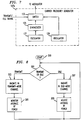
- Fig. 6 depicts a block diagram of an embodiment of carrier frequency generator 107a for use with TDMA radio 100 of Fig. 5.
- Controller 117 receives a signal that indicates whether TDMA radio 100 is in transmit or idle mode.
- controller 117 directs programmable synthesizer 119 to synthesize a carrier in the transmit-mode channel assigned to TDMA radio 100.
- controller 117 directs programmable synthesizer 119 to synthesize a carrier with a frequency corresponding to the idle-mode channel.
- Oscillator 121 provides a reference signal to programmable synthesizer 119. It will be clear to those skilled in the art how to make and use controller 117 and oscillator 121.
- embodiments of the present invention have been described in detail, it is understood that various changes, alterations and substitutions can be made hereto without departing from the spirit and scope of the present invention as defined by the appended claims.
- embodiments of the present invention can be used with TDMA systems wherein more than three users share the same transmit channel.
- teachings of the present invention are applicable to a TDMA system that uses frequency hopping (e.g., a GSM compliant wireless terminal).
- frequency hopping e.g., a GSM compliant wireless terminal.
- embodiments of the present invention can be made and used that use more than one transmit-mode channel and/or more than one idle-mode channel.
- the described embodiments may be incorporated into a wireless terminal with one or more other radios, which may be known as "dual-mode” or "tri-mode” wireless terminals.
Landscapes
- Engineering & Computer Science (AREA)
- Computer Networks & Wireless Communication (AREA)
- Signal Processing (AREA)
- Mobile Radio Communication Systems (AREA)
- Time-Division Multiplex Systems (AREA)
- Bidirectional Digital Transmission (AREA)
- Transmitters (AREA)
Applications Claiming Priority (2)
| Application Number | Priority Date | Filing Date | Title |
|---|---|---|---|
| US53068795A | 1995-09-19 | 1995-09-19 | |
| US530687 | 1995-09-19 |
Publications (2)
| Publication Number | Publication Date |
|---|---|
| EP0765042A2 true EP0765042A2 (de) | 1997-03-26 |
| EP0765042A3 EP0765042A3 (de) | 2000-01-19 |
Family
ID=24114581
Family Applications (1)
| Application Number | Title | Priority Date | Filing Date |
|---|---|---|---|
| EP96306562A Withdrawn EP0765042A3 (de) | 1995-09-19 | 1996-09-10 | Zeitmultiplexfunkgerät mit reduzierter Basisbandinterferenz |
Country Status (3)
| Country | Link |
|---|---|
| EP (1) | EP0765042A3 (de) |
| JP (1) | JPH09130353A (de) |
| KR (1) | KR970019173A (de) |
Cited By (6)
| Publication number | Priority date | Publication date | Assignee | Title |
|---|---|---|---|---|
| WO1997039537A1 (en) * | 1996-04-16 | 1997-10-23 | Qualcomm Incorporated | System and method for reducing interference generated by a digital communication device |
| US6865396B2 (en) | 1998-11-26 | 2005-03-08 | Nokia Corporation | System and method of power control using a modulated signal |
| US7787647B2 (en) | 1997-01-13 | 2010-08-31 | Micro Ear Technology, Inc. | Portable system for programming hearing aids |
| WO2010141162A3 (en) * | 2009-06-03 | 2011-01-27 | Intel Corporation | Partial dmm reception to reduce standby power |
| US8300862B2 (en) | 2006-09-18 | 2012-10-30 | Starkey Kaboratories, Inc | Wireless interface for programming hearing assistance devices |
| US9344817B2 (en) | 2000-01-20 | 2016-05-17 | Starkey Laboratories, Inc. | Hearing aid systems |
Families Citing this family (2)
| Publication number | Priority date | Publication date | Assignee | Title |
|---|---|---|---|---|
| US6449662B1 (en) | 1997-01-13 | 2002-09-10 | Micro Ear Technology, Inc. | System for programming hearing aids |
| US6424722B1 (en) | 1997-01-13 | 2002-07-23 | Micro Ear Technology, Inc. | Portable system for programming hearing aids |
Family Cites Families (2)
| Publication number | Priority date | Publication date | Assignee | Title |
|---|---|---|---|---|
| GB2238449B (en) * | 1989-11-10 | 1993-11-24 | Trade And Industry Secretary O | Improvements in or relating to TDMA systems |
| EP0632609A3 (de) * | 1993-06-30 | 1995-12-27 | At & T Corp | Verfahren und Vorrichtung zur Reduktion von elektromagnetischen Störungen. |
-
1996
- 1996-09-10 EP EP96306562A patent/EP0765042A3/de not_active Withdrawn
- 1996-09-18 KR KR1019960040510A patent/KR970019173A/ko not_active Withdrawn
- 1996-09-18 JP JP8245955A patent/JPH09130353A/ja active Pending
Cited By (11)
| Publication number | Priority date | Publication date | Assignee | Title |
|---|---|---|---|---|
| WO1997039537A1 (en) * | 1996-04-16 | 1997-10-23 | Qualcomm Incorporated | System and method for reducing interference generated by a digital communication device |
| US5917812A (en) * | 1996-04-16 | 1999-06-29 | Qualcomm Incorporated | System and method for reducing interference generated by a digital communication device |
| AU715244B2 (en) * | 1996-04-16 | 2000-01-20 | Qualcomm Incorporated | System and method for reducing interference generated by a digital communication device |
| US7787647B2 (en) | 1997-01-13 | 2010-08-31 | Micro Ear Technology, Inc. | Portable system for programming hearing aids |
| US7929723B2 (en) | 1997-01-13 | 2011-04-19 | Micro Ear Technology, Inc. | Portable system for programming hearing aids |
| US6865396B2 (en) | 1998-11-26 | 2005-03-08 | Nokia Corporation | System and method of power control using a modulated signal |
| US9344817B2 (en) | 2000-01-20 | 2016-05-17 | Starkey Laboratories, Inc. | Hearing aid systems |
| US9357317B2 (en) | 2000-01-20 | 2016-05-31 | Starkey Laboratories, Inc. | Hearing aid systems |
| US8300862B2 (en) | 2006-09-18 | 2012-10-30 | Starkey Kaboratories, Inc | Wireless interface for programming hearing assistance devices |
| WO2010141162A3 (en) * | 2009-06-03 | 2011-01-27 | Intel Corporation | Partial dmm reception to reduce standby power |
| US8743762B2 (en) | 2009-06-03 | 2014-06-03 | Intel Corporation | Partial DMM reception to reduce standby power |
Also Published As
| Publication number | Publication date |
|---|---|
| EP0765042A3 (de) | 2000-01-19 |
| JPH09130353A (ja) | 1997-05-16 |
| KR970019173A (ko) | 1997-04-30 |
Similar Documents
| Publication | Publication Date | Title |
|---|---|---|
| US5812936A (en) | Energy-efficient time-division radio that reduces the induction of baseband interference | |
| US5740165A (en) | Wireless TDMA transmitter with reduced interference | |
| FI111674B (fi) | Käyttäjäliityntä | |
| EP0894371B1 (de) | System und verfahren zur reduktion der von einem digitalen kommunikationsendgerät erzeugten interferenz | |
| US6603825B1 (en) | Automatic gain control for a receiver and method therefor | |
| JPH09503632A (ja) | 無線通信システムのトランシーバ動作を制御する方法と装置 | |
| UA44762C2 (uk) | Приймально-передавальна система радіотелефонного зв'язку і спосіб приймання рч-сигналу | |
| US6148216A (en) | System and method for wireless communications | |
| EP0765042A2 (de) | Zeitmultiplexfunkgerät mit reduzierter Basisbandinterferenz | |
| EP0632609A2 (de) | Verfahren und Vorrichtung zur Reduktion von elektromagnetischen Störungen | |
| KR100431912B1 (ko) | 기지국 송신 장치와 그것을 이용한 cdma 이동 통신시스템 | |
| Pedersen et al. | RF and ELF exposures from cellular phone handsets: TDMA and CDMA systems | |
| KR100983174B1 (ko) | 통신 시스템에서 스퓨리어스 전송을 제어하는 방법 및 장치 | |
| AU5097500A (en) | Method for cell extension in a tdma cellular telephone system | |
| GB2238449A (en) | TDMA systems | |
| EP0943188B1 (de) | Verfahren zur verbesserung der verbindungsqualität und der kapazität eines zellularen funksystems, und ein solches funksystem | |
| US20070014556A1 (en) | Communications devices including integrated digital cameras operating at different frequencies and related methods | |
| EP0878928B1 (de) | TDMA Funksender mit Interferenzbegrenzung | |
| US20040097255A1 (en) | Automatic control apparatus and method for TD-SCDMA mobile terminal | |
| CN1154019A (zh) | 一种减少基带干扰的时分无线电台 | |
| JP3321025B2 (ja) | 時分割多元アクセス送信器 | |
| EP1146654A2 (de) | Nachrichtenvorrrichtung eines mobilendgerät | |
| MXPA97006247A (en) | System to reduce the interference in electronic devices caused by radiotransmitors detransmision disconti | |
| JP2972717B1 (ja) | 無線基地局及びそれを用いた移動通信システム | |
| EP0907297B1 (de) | System, Netz, tragbares Gerät und Verfahren für Übertragung |
Legal Events
| Date | Code | Title | Description |
|---|---|---|---|
| PUAI | Public reference made under article 153(3) epc to a published international application that has entered the european phase |
Free format text: ORIGINAL CODE: 0009012 |
|
| AK | Designated contracting states |
Kind code of ref document: A2 Designated state(s): DE FR GB IT |
|
| PUAL | Search report despatched |
Free format text: ORIGINAL CODE: 0009013 |
|
| AK | Designated contracting states |
Kind code of ref document: A3 Designated state(s): DE FR GB IT |
|
| RIC1 | Information provided on ipc code assigned before grant |
Free format text: 7H 04B 1/04 A, 7H 04B 15/00 B, 7H 04B 15/02 B |
|
| STAA | Information on the status of an ep patent application or granted ep patent |
Free format text: STATUS: THE APPLICATION IS DEEMED TO BE WITHDRAWN |
|
| 18D | Application deemed to be withdrawn |
Effective date: 20000720 |