EP0765066A2 - Lautfernsprecher mit effizientem Unterdrückungssystem der akustischen Rückkopplung - Google Patents
Lautfernsprecher mit effizientem Unterdrückungssystem der akustischen Rückkopplung Download PDFInfo
- Publication number
- EP0765066A2 EP0765066A2 EP96114742A EP96114742A EP0765066A2 EP 0765066 A2 EP0765066 A2 EP 0765066A2 EP 96114742 A EP96114742 A EP 96114742A EP 96114742 A EP96114742 A EP 96114742A EP 0765066 A2 EP0765066 A2 EP 0765066A2
- Authority
- EP
- European Patent Office
- Prior art keywords
- transmit
- samples
- receive
- signals
- node
- Prior art date
- Legal status (The legal status is an assumption and is not a legal conclusion. Google has not performed a legal analysis and makes no representation as to the accuracy of the status listed.)
- Withdrawn
Links
Images

Classifications
-
- H—ELECTRICITY
- H04—ELECTRIC COMMUNICATION TECHNIQUE
- H04M—TELEPHONIC COMMUNICATION
- H04M9/00—Arrangements for interconnection not involving centralised switching
- H04M9/08—Two-way loud-speaking telephone systems with means for conditioning the signal, e.g. for suppressing echoes for one or both directions of traffic
- H04M9/082—Two-way loud-speaking telephone systems with means for conditioning the signal, e.g. for suppressing echoes for one or both directions of traffic using echo cancellers
Definitions
- the present invention relates to speakerphone technologies and, more particularly, to a speakerphone system provided with a scheme for minimizing the effects of echo and gains introduced to allow hands-free telephone operation.
- Speakerphones are widely used today. The ability to use a telephone set without occupying the user's hands, and also enable multiple parties to participate in the telephone call without requiring conference-type calling has been found to be a significant advantage over conventional hand-held telephone systems.
- a speakerphone defines a speaker telephone which includes a microphone and a loudspeaker to enable telephone communications without a conventional telephone handset.
- the microphone and loudspeaker in the speakerphone are contained in the same physical structure and are thus in close proximity to each other.
- the speakerphone electronics cannot assume that the placement of the microphone and the loudspeaker, and thus the acoustic echo path, is fixed.
- the microphone is physically separable from and independently moveable relative to the loudspeaker assembly, the user may want to move the microphone relative to the loudspeaker during the conversation.
- speakerphones are plagued with certain problems that are inherent in the simultaneous use of the microphone and loudspeaker which comprise the speakerphone.
- Significant problems with speakerphone clarity and stability, e.g., disruption of the conversation due to howling, in full-duplex speakerphones are associated with acoustic coupling between the microphone and the loudspeaker.
- simultaneous two-way communication is enabled where the local user can speak and listen to received speech simultaneously with the remote user.
- simultaneous conversation creates acoustic feedback problems which occur when the speech received by the loudspeaker at the local end is picked up by the local microphone and directed back to the remote end.
- the remote party may hear a strong echo of his or her own voice. If this acoustic cycling continues, the voice quality and conversation will be distorted and significantly degraded, causing the system to become unstable, i.e., howling will occur. Of course, if the remote end user is also using a speakerphone in a back-to-back arrangement, the acoustic feedback problems are magnified.
- the loop gain refers to the total resultant gain of the voice signal as it passes through the various components of the speakerphone.
- the gain loop typically includes any speakerphone components from the microphone to the transmit channel to the remote telephone system, back through the receive channel to the loudspeaker and acoustically coupled to the microphone.
- Some of the major internal components of the speakerphone includes echo cancellers, such as an acoustic echo canceller (AEC) and a line echo canceller (LEC), and a voice control processor.
- AEC acoustic echo canceller
- LEC line echo canceller
- AEC acoustic echo canceller
- LEC line echo canceller
- the adaptive filters are generally included in a digital signal processing (DSP) device or other programmable processor, and are defined by a variety of algorithms that affect and determine their real-time performance, i.e., the speed necessary to converge to the echo path impulse response and accuracy of the estimation process.
- DSP digital signal processing
- the algorithm coefficients are continuously adapted to represent the impulse response between the loudspeaker and microphone or the impulse response between the transmit channel and the receive channel of the network interface.
- the echo canceller impulse response accurately matches that of the echo path, the echo will be canceled.
- inaccuracy in coefficients exists, such that 100% cancellation can rarely, if ever, be achieved.
- any changes in echo path will cause the current estimated impulse response to deviate from its real one.
- the echo canceller can recognize and compensate for the change, and thus reconverge itself, a larger residue echo will be present in the system.
- AEC and LEC are typically situated adjacent each other to cancel acoustic and electrical echoes. Consequently, the AEC and the LEC must be precisely controlled so that their coefficients are adapted only in receive and transmit modes, respectively.
- the coefficient adaptation process is limited to receive and transmit modes because (1) the room impulse response is modeled only with the receive signal, and the local talker signal can disturb the process, and (2) the network interface impulse response is modeled only with the transmit signal, and the remote talker signal can disturb the process. Therefore, it is crucial to maintain awareness of the continuous changes in the voice signal and the system parameters.
- the voice control processor must consider such arrangements to maintain complete, end-to-end speakerphone performance.
- Some speakerphones are only directed to local speakerphones which communicate with remote handsets, rather than remote speakerphones. Accordingly, the voice control processor must be able to handle such situations.
- the voice control processor is the central control of the complete speakerphone system. It should include speech detectors and loop gain control.
- the speech detectors determine the communication mode which, in turn, controls the adaptation process of the echo cancellers, as mentioned above.
- Current speech detectors are not sufficiently sensitive to low level voice signals or are inadequate in speedy detection of double talk or falsely detect noise as speech.
- An example of such a speech detector uses a simple comparator to compare the transmit and receive signal levels and assert a detection signal if the receive level is greater than the transmit level. It is known that depending on the strength of acoustic coupling and the telephone line loss characteristics, the transmit level can be many times greater than the receive level during much of the conversation.
- echo cancellers also cannot always maintain the optimum cancellation performance. Consequently, some gain switching must be applied to the system to maintain system stability. Furthermore, in speakerphone systems which utilize automatic gain control, the total loop gain can change abruptly due to sharp changes in the input signal. The loop gain scheme must be capable of adequately compensate for the sudden changes in the signal as well as the echo strength. Conventional speakerphone systems, however, greatly simplify the loop gain scheme to result in unnatural voice conversation, degradation of voice level, or temporal system instability.
- the gain can be adjusted to increase the signal level by applying a multiplier greater than one to the signal.
- the signal can be decreased, or attenuated, by multiplying the signal with a gain value of less than one.
- the speaker device determines the optimum gain to apply to both the transmit channel and the receive channel via a variety of gain calculation algorithms.
- a full-duplex speakerphone system typically four different conversation modes can exist. These modes may include (1) silence mode (no conversation at local or remote ends); (2) transmit mode (local user is active, remote user is silent); (3) receive mode (local user silent, remote user active); and (4) double-talk mode (simultaneous two-way local and remote communication).
- silence mode no conversation at local or remote ends
- transmit mode local user is active, remote user is silent
- receive mode local user silent, remote user active
- double-talk mode simultaneous two-way local and remote communication
- an object of the present invention is to provide a cost-effective anti-howling system and method which enables fast detection of the presence of true double-talk and substantially eliminates undesirable howling attributable to sudden changes in the acoustic echo path between a speakerphone microphone and loudspeaker during speakerphone conversations.
- Embodiments of the invention practically solve system confusion caused by an increase in microphone signal level when the local speakerphone device is trying to differentiate between an actual local talker signal and echo increase attributable to strengthened acoustic coupling between the local loudspeaker and microphone assembly, such as when the microphone is moved closer to the loudspeaker.
- a speakerphone system in accordance with the present invention includes a delay-compensated and normalized cross-product calculation performed by a system processor having at least two memory buffers. One buffer is associated with the loudspeaker signal and the other buffer is associated with the microphone signal.
- embodiments of the present invention determine the delay-compensated cross-product of the microphone voice signal input and the loudspeaker voice signal output.
- the cross-product is normalized by energy estimates of the two signals to reduce the calculation error made by variance in the signal level. Since the average delay introduced by speakerphone hardware and software is generally fixed, embodiments of the present invention compensate for its delay using a preferred data addressing scheme in the loudspeaker signal buffer, which is the same buffer used in the AEC.
- the length of the acoustic delay depends upon a variety of factors, such as the physical distance between the loudspeaker and the microphone, the room temperature, etc. Accordingly, the length of the two buffers are at least twice as long as the acoustic delay length of direct acoustic coupling from the loudspeaker to the microphone in the targeted applications.
- FIG. 1 is a general block diagram of a speakerphone system in accordance with preferred embodiments of the present invention.
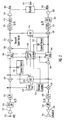
- FIG. 2 is a block diagram of a speakerphone device according to preferred embodiments of the present invention.
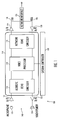
- Figure 3 shows the loudspeaker data buffer and microphone data buffer arrangement of the cross product component indicated in Figure 2.
- a speakerphone system in accordance with embodiments of the present invention is indicated generally in Figure 1.
- the full-duplex speakerphone is suitable for simultaneous two-way communications in which the local user at 140 may speak and listen simultaneously with the remote user 142.
- Preferred speakerphone embodiments include a microphone 110 to pick up the local voice signal 140, a loudspeaker 134 to allow the local user to hear the remote voice signal 142, and an analog-to-digital (A/D) converter 112 to convert the analog microphone signal into the digital domain before processing by the speakerphone electronics 114.
- a digital-to-analog (D/A) converter 132 is also implemented at the front end of the speakerphone electronics 114 to convert the processed remote voice signal back to analog format before broadcasting over the loudspeaker 134.
- the speakerphone electronics include a variety of echo cancellers 116, 120 and a processor 118 to control the communication between the remote user 142 and the local user 140.
- an acoustic echo canceller (AEC) 116 is coupled to a voice processor 118 which, in turn, is coupled to a network or line echo canceller (LEC) 120.
- the voice processor 118 is provided with the outputs of the AEC and the LEC on which the speech detection, loop gain controls, coefficient adaptation controls, and/or automatic signal gain controls in accordance with the present invention are performed.
- the speakerphone assembly may also include a system controller 130.
- the system controller 130 may be included as part of the speakerphone internal processor or may be implemented as an external controller.
- the system controller 130 provides user interface controls and other functions available to the speakerphone assembly, such as a facsimile machine.
- the speakerphone electronics 114 are coupled to a network or telephone line interface 126 via a digital-to-analog (D/A) converter 124 on the transmit line 144 and an A/D converter 128 on the receive line 146.
- the network interface 126 thus provides the central office telephone system interface between the local user 140 and the remote user 142.
- the coupling of the loudspeaker 134 to the microphone 110 defines an acoustic path.
- Embodiments of the present invention overcome problems relating to howling generated by sudden acoustic path impulse response changes between the microphone 110 and loudspeaker 134. Such changes may be generated by the movement of the microphone 110 relative to the loudspeaker 134, by a sudden increase or decrease in volume setting of the loudspeaker, or by other moving objects or people that can severely change or alter the acoustic path. For example, if the microphone is physically located a substantial distance away from the loudspeaker, the acoustic coupling of the incoming and outgoing signals is negligible. However, if the microphone is moved close to the loudspeaker, strong coupling will affect the local input voice signal directed through the microphone across the transmit line.
- Embodiments of the present invention thus provide for more efficient compensation for and cancellation of the effects of acoustic coupling, e.g., howling, by calculating the correlation strength between the microphone input signal and the remote voice signal broadcast by the loudspeaker, and enabling quick determination of the cause of the impulse response change, if any, which in turn allows the system processor to quickly and efficiently react and compensate for the particular type of signal change. If an echo path change is determined, the AEC coefficient adaptation will be continued to allow prompt reconvergence. If an actual local talker is detected, the AEC coefficients will be frozen, preventing the coefficients from drifting from the optimal state by the local talker signal.
- acoustic coupling e.g., howling
- FIG. 2 a speakerphone system implementing the antihowling scheme of the present invention is shown.
- the system processor 118 in Figure 1 will not conclude that the sudden change in the microphone signal level represents a sudden burst of speech at the local end, and consequently will not cause the microphone to pick up the input erroneous signals and transmit the signals to the remote user.
- embodiments of the present invention are particularly directed to avoiding such retransmission of the loudspeaker broadcast, i.e., echo, back to the remote user.
- the transmit and receive speech detectors 224 and 252 determine the conversation modes in which the speakerphone is operating.
- a cross-product function 218 is implemented to assist the transmit speech detector 224 to determine if the system is in a double-talk mode, i.e., simultaneous two-way communication, as compared to simply transmitting reverberant echo.
- Controller 242 provides the central control which computes the loop gain of the system to maintain system stability, and directs the coefficient adaptation of the two echo cancellers AEC 222 and LEC 254. The controller 242 thus handles the transient-state gain switching, and other system control functions. In accordance with embodiments of the present invention, by efficiently enabling the transmit speech detector 224 to determine the correct conversation mode, the controller 242 can maintain the speakerphone system in an echo-free stable state.
- Figure 2 shows a preferred speakerphone embodiment of the invention including a microphone 210 for receiving ad transmitting input local voice signals (not specified).
- the microphone 210 is coupled to an anti-aliasing low pass filter 214 which in turn is coupled to an A/D converter 216 which converts the input analog signals to digital format.
- the digital transmit signal at Node B is then directed to the cross-product box 218, where it is compared to the digital receive signal sent from the remote telephone system (not shown) across the receive channel 282 of the line interface 274.
- the output of the cross-product box 218, which will be described in more detail below, is directed to the transmit speech detector 224, together with the local signal which has been decreased with the output of the AEC 222 at Node A.
- the AEC 222 is provided to cancel the feedback echo attributable to the combination of signals at Node B. If the output of the cross-product box 218 is greater than a predetermined threshold, the controller 242 will determine that there is only one originating signal at Node C echoing in the room. Accordingly, a double-talk mode will not be asserted, and the controller 242 will continue to allow AEC 222 to adjust its coefficients to track the acoustic impulse response.
- the controller 242 provides gain determinations and coefficient adaptation controls, and acts as the primary system decision-maker. As can be seen in Figure 2, controller 242 gathers a plurality of data lines and provides appropriate control instructions to other components of the speakerphone system. For example, the controller 242 receives data from the transmit and receive AGC systems 240 and 246, and thus can respond to the particular AGC settings. The controller 242 also receives information pertaining to the volume controller 226 which indicates the volume setting of the loudspeaker 236. When the volume setting is changed, the AEC 222 coefficients can be scaled according to the change. Therefore, the AEC is instantly adjusted to the change in loudspeaker volume.
- the controller 242 receives detection information from the transmit and receive detectors 224 and 252, and can determine the correct communication mode, i.e., (1) silence mode; (2) transmit mode; (3) receive mode; and (4) double-talk mode, and is able to gauge the proper performance of the echo cancellers AEC 222 and LEC 254. With the information as to the performance of the echo cancellers, the controller 242 can determine the type of gain switching and how much gain, at what speed, should be applied at multipliers 250, 251, 248, or 228 to correctly switch the communication to the desired conversation mode. Consequently, the controller 242 can direct which adaptive filter coefficients of either the AEC 222 or LEC 254 should be adjusted or fixed as necessary to cancel or attenuate the undesired echo.
- the controller 242 can direct which adaptive filter coefficients of either the AEC 222 or LEC 254 should be adjusted or fixed as necessary to cancel or attenuate the undesired echo.
- the signal is directed to a D/A converter 256 and another low pass filter 258, amplified in hardware at 270 if necessary, and transmitted across the transmit channel 280 to the hybrid line interface 272 to be transmitted across the network line to the remote user 274.
- the remote analog voice signal is received at the receive channel 282 and input into amplifier 268 before being filtered at anti-aliasing filter 264 and converted by A/D converter 262 and summed at 260 with the output of the LEC 254.
- the resultant remote voice signal is then directed into the receive AGC 246, speech detector 252 and also fed back into the LEC 254 to be used in coefficient adaptation.
- gain factors are applied at 248 and 228 to the remote voice signal, which is then passed through D/A converter 230, filter 232, and amplifier 234, before being output at the loudspeaker 236.
- the cross-product function also estimates the local voice signal energy level at Node B and the remote voice signal energy level at Node C.
- the signal energies are calculated as integrations of their representative voice signals with the integration window aligned with a buffer length Ln.
- Figure 3 Based on the average fixed delay (DLY) from the remote signal at Node C relative to the signal which is ultimately output by the loudspeaker 236 plus the delay from the microphone 210 to the signal at Note B, the cross-product (convolution) is executed between data in a microphone signal buffer Bm 310 and loudspeaker signal buffer Bs 320 starting after DLY number of samples as shown in Figure 3, with Bm(1) and Bs(1) being the newest data in its buffer.
- the hardware delay is fixed and known, i.e., that of the converters and filters, etc., and because the software processing delay is also a known quantity which merely depends upon the software coding scheme, the only delay essential to the accuracy of the cross-product calculation is the acoustic path delay which is inherent in this test for speakerphone applications.
- the data at Node C is buffered in a number of continuous memory locations (DLY+Ln) and the data arriving at Node B is stored in Ln-address memory locations, as illustrated in Figure 3.
- DLY refers to the fixed delay of the signal passing through the hardware and the software.
- Ln refers to the microphone signal buffer length.
- the DLY sample block buffered in buffer Bs is discounted. For example, if there is a ten sample delay in the room front-end hardware and software, data addresses 1 to 160 are used in buffer Bm, then addresses 11 to 170 should be taken from buffer Bs. The convolution of the data in buffers Bm and Bs is then normalized by dividing the energy estimates of the signals at Nodes B and C. The resultant value is the delay-compensated and normalized cross-product.
- the output of the cross-product box 218 is input into the transmit speech detector 224, which determines if the cross-product represents a moving microphone or speaker, or an active local talker.
- the transmit speech detector 224 determines if the cross-product represents a moving microphone or speaker, or an active local talker.
- the cross-product value will be high, indicating that the microphone or loudspeaker has been moved.
- the cross-product value is low, the system will conclude that the signals at Node C and Node B are not closely correlated, and that any sudden changes in the microphone signal level represent the presence of an active local talker.
- the cross-product determination of the present invention enables a quick and efficient determination as to whether only one active signal is present at the local end, or if there is a second, unrelated signal.
Landscapes
- Engineering & Computer Science (AREA)
- Signal Processing (AREA)
- Cable Transmission Systems, Equalization Of Radio And Reduction Of Echo (AREA)
- Circuit For Audible Band Transducer (AREA)
- Telephone Function (AREA)
Applications Claiming Priority (2)
| Application Number | Priority Date | Filing Date | Title |
|---|---|---|---|
| US531993 | 1995-09-21 | ||
| US08/531,993 US5646990A (en) | 1995-09-21 | 1995-09-21 | Efficient speakerphone anti-howling system |
Publications (2)
| Publication Number | Publication Date |
|---|---|
| EP0765066A2 true EP0765066A2 (de) | 1997-03-26 |
| EP0765066A3 EP0765066A3 (de) | 2002-02-06 |
Family
ID=24119962
Family Applications (1)
| Application Number | Title | Priority Date | Filing Date |
|---|---|---|---|
| EP96114742A Withdrawn EP0765066A3 (de) | 1995-09-21 | 1996-09-13 | Lautfernsprecher mit effizientem Unterdrückungssystem der akustischen Rückkopplung |
Country Status (3)
| Country | Link |
|---|---|
| US (1) | US5646990A (de) |
| EP (1) | EP0765066A3 (de) |
| JP (1) | JPH09172396A (de) |
Cited By (14)
| Publication number | Priority date | Publication date | Assignee | Title |
|---|---|---|---|---|
| AU695980B1 (en) * | 1997-05-16 | 1998-08-27 | Mitsubishi Denki Kabushiki Kaisha | Hands-free telephone |
| WO1999033323A1 (en) * | 1997-12-19 | 1999-07-01 | Conexant Systems, Inc. | Method and apparatus for multi-way conference calling with a full-duplex speakerphone and a digital wireless communication terface |
| WO2000039991A1 (en) * | 1998-12-23 | 2000-07-06 | Telefonaktiebolaget Lm Ericsson (Publ) | Methods and apparatus for adaptive signal gain control in communications systems |
| GB2312600B (en) * | 1996-04-24 | 2001-01-10 | Nec Corp | Audio apparatus |
| WO2001001665A3 (en) * | 1999-06-25 | 2001-07-05 | Conexant Systems Inc | Host-based speaker phone |
| WO2000076176A3 (en) * | 1999-06-07 | 2001-07-05 | Ericsson Telefon Ab L M | Loudspeaker volume range control |
| WO2003010949A1 (en) * | 2001-07-20 | 2003-02-06 | Koninklijke Philips Electronics N.V. | Communication system having line and acoustic echo canceling means with spectral post processors |
| EP0874513A3 (de) * | 1997-04-10 | 2003-08-27 | Infineon Technologies AG | Vorrichtung zur Rückhördämpfung |
| GB2418798A (en) * | 2004-09-30 | 2006-04-05 | Toshiba Kk | Echo suppression in a telephone terminal |
| EP1261236A3 (de) * | 2001-05-21 | 2009-01-07 | Nokia Corporation | Audiodatensteuerung in einem zellularen Telekommunikationssystem |
| US7835774B1 (en) * | 2006-09-12 | 2010-11-16 | Avaya Inc. | Removal of local duplication voice on conference calls |
| GB2512413A (en) * | 2013-09-18 | 2014-10-01 | Imagination Tech Ltd | Acoustic echo cancellation |
| US9749021B2 (en) | 2012-12-18 | 2017-08-29 | Motorola Solutions, Inc. | Method and apparatus for mitigating feedback in a digital radio receiver |
| WO2018052678A1 (en) * | 2016-09-13 | 2018-03-22 | Microsemi Semiconductor (U.S.) Inc. | Full duplex voice communication system and method |
Families Citing this family (39)
| Publication number | Priority date | Publication date | Assignee | Title |
|---|---|---|---|---|
| US6760463B2 (en) * | 1995-05-08 | 2004-07-06 | Digimarc Corporation | Watermarking methods and media |
| US7095871B2 (en) * | 1995-07-27 | 2006-08-22 | Digimarc Corporation | Digital asset management and linking media signals with related data using watermarks |
| US5796818A (en) * | 1996-08-08 | 1998-08-18 | Northern Telecom Limited | Dynamic optimization of handsfree microphone gain |
| US6141415A (en) * | 1996-10-11 | 2000-10-31 | Texas Instruments Incorporated | Method and apparatus for detecting speech at a near-end of a communications system, a speaker-phone system, or the like |
| US6185195B1 (en) * | 1997-05-16 | 2001-02-06 | Qualcomm Incorporated | Methods for preventing and detecting message collisions in a half-duplex communication system |
| US6049606A (en) * | 1997-12-11 | 2000-04-11 | Nortel Networks Corporation | Circuit and method of double talk detection for use in handsfree telephony terminals |
| US6434110B1 (en) * | 1998-03-20 | 2002-08-13 | Cirrus Logic, Inc. | Full-duplex speakerphone circuit including a double-talk detector |
| US7602940B2 (en) * | 1998-04-16 | 2009-10-13 | Digimarc Corporation | Steganographic data hiding using a device clock |
| US6385176B1 (en) * | 1998-06-04 | 2002-05-07 | Lucent Technologies Inc. | Communication system based on echo canceler tap profile |
| US6542611B1 (en) * | 1998-07-31 | 2003-04-01 | Circuit Research Labs, Inc. | Multi-state echo suppressor |
| US8332478B2 (en) * | 1998-10-01 | 2012-12-11 | Digimarc Corporation | Context sensitive connected content |
| US6263078B1 (en) * | 1999-01-07 | 2001-07-17 | Signalworks, Inc. | Acoustic echo canceller with fast volume control compensation |
| US20020032734A1 (en) | 2000-07-26 | 2002-03-14 | Rhoads Geoffrey B. | Collateral data combined with user characteristics to select web site |
| US7233659B1 (en) * | 1999-09-13 | 2007-06-19 | Agere Systems Inc. | Message playback concurrent with speakerphone operation |
| US7224794B1 (en) * | 1999-09-13 | 2007-05-29 | Agere Systems Inc. | Transmitting message playback concurrent with speakerphone operation |
| US6771769B2 (en) * | 2000-12-28 | 2004-08-03 | Richard Henry Erving | Method and apparatus for active reduction of speakerphone singing |
| US6957089B2 (en) * | 2001-05-31 | 2005-10-18 | Coby Electronics Corporation | Compact hands-free adapter for use with a cellular telephone |
| US6904146B2 (en) * | 2002-05-03 | 2005-06-07 | Acoustic Technology, Inc. | Full duplex echo cancelling circuit |
| FR2841721B1 (fr) * | 2002-06-28 | 2004-08-20 | France Telecom | Dispositif de traitement d'echo pour systeme de communication de type monovoie ou multivoies |
| US10721066B2 (en) | 2002-09-30 | 2020-07-21 | Myport Ip, Inc. | Method for voice assistant, location tagging, multi-media capture, transmission, speech to text conversion, photo/video image/object recognition, creation of searchable metatags/contextual tags, storage and search retrieval |
| US6996251B2 (en) | 2002-09-30 | 2006-02-07 | Myport Technologies, Inc. | Forensic communication apparatus and method |
| US7778438B2 (en) | 2002-09-30 | 2010-08-17 | Myport Technologies, Inc. | Method for multi-media recognition, data conversion, creation of metatags, storage and search retrieval |
| US7272224B1 (en) * | 2003-03-03 | 2007-09-18 | Apple Inc. | Echo cancellation |
| US7142665B2 (en) * | 2004-07-16 | 2006-11-28 | Freescale Semiconductor, Inc. | Automatic gain control for an adaptive finite impulse response and method therefore |
| US7734034B1 (en) * | 2005-06-21 | 2010-06-08 | Avaya Inc. | Remote party speaker phone detection |
| US8295475B2 (en) * | 2006-01-13 | 2012-10-23 | Microsoft Corporation | Selective glitch detection, clock drift compensation, and anti-clipping in audio echo cancellation |
| US7773743B2 (en) * | 2006-04-28 | 2010-08-10 | Microsoft Corporation | Integration of a microphone array with acoustic echo cancellation and residual echo suppression |
| US7831035B2 (en) * | 2006-04-28 | 2010-11-09 | Microsoft Corporation | Integration of a microphone array with acoustic echo cancellation and center clipping |
| JP4274254B2 (ja) * | 2007-02-07 | 2009-06-03 | 株式会社デンソー | 車載ハンズフリー装置 |
| US8380253B2 (en) | 2008-02-15 | 2013-02-19 | Microsoft Corporation | Voice switching for voice communication on computers |
| US8369251B2 (en) * | 2008-06-20 | 2013-02-05 | Microsoft Corporation | Timestamp quality assessment for assuring acoustic echo canceller operability |
| US7760869B2 (en) * | 2008-08-28 | 2010-07-20 | Embarq Holdings Company, Llc | Method and apparatus for controlling the transmit volume level of a speakerphone |
| US20110181452A1 (en) * | 2010-01-28 | 2011-07-28 | Dsp Group, Ltd. | Usage of Speaker Microphone for Sound Enhancement |
| KR101651588B1 (ko) * | 2010-02-04 | 2016-08-26 | 삼성전자주식회사 | 입력 신호로부터 잡음 신호를 제거하는 방법 및 그 장치 |
| US8600037B2 (en) * | 2011-06-03 | 2013-12-03 | Apple Inc. | Audio quality and double talk preservation in echo control for voice communications |
| US8923508B2 (en) * | 2012-06-07 | 2014-12-30 | Lsi Corporation | Half-duplex speakerphone echo canceler |
| US9106197B2 (en) * | 2012-08-10 | 2015-08-11 | Broadcom Corporation | Systems and methods to suppress noise and idle tones |
| US9414162B2 (en) * | 2013-06-03 | 2016-08-09 | Tencent Technology (Shenzhen) Company Limited | Systems and methods for echo reduction |
| CN115442711B (zh) * | 2022-08-10 | 2024-11-15 | 星宸科技股份有限公司 | 具有回音消除机制的音频处理装置及方法 |
Family Cites Families (20)
| Publication number | Priority date | Publication date | Assignee | Title |
|---|---|---|---|---|
| JPS59193660A (ja) * | 1983-04-18 | 1984-11-02 | Nec Corp | 会議電話装置 |
| US4747132A (en) * | 1984-04-09 | 1988-05-24 | Matsushita Electric Industrial Co., Ltd. | Howling canceller |
| EP0221221B1 (de) * | 1985-10-30 | 1991-12-27 | International Business Machines Corporation | Verfahren zur Bestimmung einer flachen Echopfadverzögerung und dieses Verfahren verwendender Echokompensator |
| AT391784B (de) * | 1987-11-25 | 1990-11-26 | Siemens Ag Oesterreich | Verfahren zur adaptiven kompensation eines echos in einer kommunikationseinrichtung |
| US5016271A (en) * | 1989-05-30 | 1991-05-14 | At&T Bell Laboratories | Echo canceler-suppressor speakerphone |
| CA2001277C (en) * | 1989-10-24 | 1994-07-12 | Bruce Leigh Townsend | Hands free telecommunications apparatus and method |
| US4947425A (en) * | 1989-10-27 | 1990-08-07 | At&T Bell Laboratories | Echo measurement arrangement |
| US5305309A (en) * | 1989-12-06 | 1994-04-19 | Fujitsu Limited | Echo canceller |
| JP2518433B2 (ja) * | 1990-01-24 | 1996-07-24 | 日本電気株式会社 | ダブルト―ク検出回路 |
| US5010570A (en) * | 1990-02-20 | 1991-04-23 | Motorola, Inc. | Method for active feedback suppression |
| JPH03262939A (ja) * | 1990-03-14 | 1991-11-22 | Fujitsu Ltd | エコー経路変動検出方法およびその装置 |
| US5263019A (en) * | 1991-01-04 | 1993-11-16 | Picturetel Corporation | Method and apparatus for estimating the level of acoustic feedback between a loudspeaker and microphone |
| JP2836277B2 (ja) * | 1991-03-14 | 1998-12-14 | 国際電信電話株式会社 | エコーキャンセル装置 |
| US5206854A (en) * | 1991-09-24 | 1993-04-27 | At&T Bell Laboratories | Detecting loss of echo cancellation |
| US5526347A (en) * | 1992-11-02 | 1996-06-11 | Advanced Micro Devices, Inc. | Decorrelation controller for an adaptive echo cancellor |
| JP2508574B2 (ja) * | 1992-11-10 | 1996-06-19 | 日本電気株式会社 | 多チャンネルエコ―除去装置 |
| FI935834L (fi) * | 1993-12-23 | 1995-06-24 | Nokia Telecommunications Oy | Menetelmä kaikukohtaan sovittautumiseksi kaiunpoistajassa |
| WO1996014694A1 (en) * | 1994-11-04 | 1996-05-17 | Sierra Semiconductor Corporation | Method and apparatus for establishing full-duplex sound communication for a speakerphone system |
| IL115892A (en) * | 1994-11-10 | 1999-05-09 | British Telecomm | Interference detection system for telecommunications |
| US5495473A (en) * | 1994-12-28 | 1996-02-27 | Intel Corporation | Method and apparatus for implementing hardware independent echo cancellation in a full-duplex audio stream in a computer system |
-
1995
- 1995-09-21 US US08/531,993 patent/US5646990A/en not_active Expired - Lifetime
-
1996
- 1996-09-13 EP EP96114742A patent/EP0765066A3/de not_active Withdrawn
- 1996-09-20 JP JP8250119A patent/JPH09172396A/ja active Pending
Cited By (19)
| Publication number | Priority date | Publication date | Assignee | Title |
|---|---|---|---|---|
| GB2312600B (en) * | 1996-04-24 | 2001-01-10 | Nec Corp | Audio apparatus |
| EP0874513A3 (de) * | 1997-04-10 | 2003-08-27 | Infineon Technologies AG | Vorrichtung zur Rückhördämpfung |
| AU695980B1 (en) * | 1997-05-16 | 1998-08-27 | Mitsubishi Denki Kabushiki Kaisha | Hands-free telephone |
| WO1999033323A1 (en) * | 1997-12-19 | 1999-07-01 | Conexant Systems, Inc. | Method and apparatus for multi-way conference calling with a full-duplex speakerphone and a digital wireless communication terface |
| WO2000039991A1 (en) * | 1998-12-23 | 2000-07-06 | Telefonaktiebolaget Lm Ericsson (Publ) | Methods and apparatus for adaptive signal gain control in communications systems |
| WO2000076176A3 (en) * | 1999-06-07 | 2001-07-05 | Ericsson Telefon Ab L M | Loudspeaker volume range control |
| US7006624B1 (en) | 1999-06-07 | 2006-02-28 | Telefonaktiebolaget L M Ericsson (Publ) | Loudspeaker volume range control |
| WO2001001665A3 (en) * | 1999-06-25 | 2001-07-05 | Conexant Systems Inc | Host-based speaker phone |
| EP1261236A3 (de) * | 2001-05-21 | 2009-01-07 | Nokia Corporation | Audiodatensteuerung in einem zellularen Telekommunikationssystem |
| WO2003010949A1 (en) * | 2001-07-20 | 2003-02-06 | Koninklijke Philips Electronics N.V. | Communication system having line and acoustic echo canceling means with spectral post processors |
| GB2418798A (en) * | 2004-09-30 | 2006-04-05 | Toshiba Kk | Echo suppression in a telephone terminal |
| GB2418798B (en) * | 2004-09-30 | 2007-04-25 | Toshiba Kk | Telephone terminal, telephone system using telephone terminal and control method of telephone terminal |
| US7480262B2 (en) | 2004-09-30 | 2009-01-20 | Kabushiki Kaisha Toshiba | Telephone terminal, telephone system using telephone terminal and control method of telephone terminal |
| US7835774B1 (en) * | 2006-09-12 | 2010-11-16 | Avaya Inc. | Removal of local duplication voice on conference calls |
| US9749021B2 (en) | 2012-12-18 | 2017-08-29 | Motorola Solutions, Inc. | Method and apparatus for mitigating feedback in a digital radio receiver |
| GB2512413A (en) * | 2013-09-18 | 2014-10-01 | Imagination Tech Ltd | Acoustic echo cancellation |
| GB2512413B (en) * | 2013-09-18 | 2015-05-06 | Imagination Tech Ltd | Acoustic echo cancellation |
| US9443530B2 (en) | 2013-09-18 | 2016-09-13 | Imagination Technologies Limited | Acoustic echo cancellation |
| WO2018052678A1 (en) * | 2016-09-13 | 2018-03-22 | Microsemi Semiconductor (U.S.) Inc. | Full duplex voice communication system and method |
Also Published As
| Publication number | Publication date |
|---|---|
| JPH09172396A (ja) | 1997-06-30 |
| US5646990A (en) | 1997-07-08 |
| EP0765066A3 (de) | 2002-02-06 |
Similar Documents
| Publication | Publication Date | Title |
|---|---|---|
| US5646990A (en) | Efficient speakerphone anti-howling system | |
| US5612996A (en) | Loop gain processing system for speakerphone applications | |
| AU710394B2 (en) | Hands-free communications method | |
| EP0204718B2 (de) | Vollduplexfernsprechhörer für funk- und überlandlinien | |
| EP1324583B1 (de) | Verfahren zur Verstärkungsregelung zur Kompensation eines akustischen Echos | |
| JP2538176B2 (ja) | エコ―制御装置 | |
| US6507653B1 (en) | Desired voice detection in echo suppression | |
| US8160239B2 (en) | Echo canceller and speech processing apparatus | |
| US5390244A (en) | Method and apparatus for periodic signal detection | |
| JP4568439B2 (ja) | エコー抑圧装置 | |
| US5764753A (en) | Half-duplex controller | |
| US6381224B1 (en) | Method and apparatus for controlling a full-duplex communication system | |
| US6385176B1 (en) | Communication system based on echo canceler tap profile | |
| JP5086769B2 (ja) | 拡声通話装置 | |
| JPH11308692A (ja) | エコー除去装置および送話器 | |
| US6608897B1 (en) | Double-talk insensitive NLMS algorithm | |
| JPS6343451A (ja) | 拡声通話回路 | |
| JP3220979B2 (ja) | 音声スイッチ | |
| JPH0614101A (ja) | ハンズフリー電話機 | |
| JPS62116025A (ja) | 音響エコー消去装置 | |
| JP4900185B2 (ja) | 拡声通話装置 | |
| JP4900184B2 (ja) | 拡声通話装置 | |
| JP3903933B2 (ja) | 通話装置 | |
| JPH0648832B2 (ja) | 双方向通話装置 | |
| JP4380688B2 (ja) | 通話装置 |
Legal Events
| Date | Code | Title | Description |
|---|---|---|---|
| PUAI | Public reference made under article 153(3) epc to a published international application that has entered the european phase |
Free format text: ORIGINAL CODE: 0009012 |
|
| AK | Designated contracting states |
Kind code of ref document: A2 Designated state(s): DE FR GB |
|
| RAP1 | Party data changed (applicant data changed or rights of an application transferred) |
Owner name: CONEXANT SYSTEMS, INC. |
|
| RIC1 | Information provided on ipc code assigned before grant |
Free format text: 7H 04M 9/08 A, 7H 04M 1/60 B, 7H 04B 3/23 B, 7H 04B 1/10 B |
|
| PUAL | Search report despatched |
Free format text: ORIGINAL CODE: 0009013 |
|
| PUAF | Information related to the publication of a search report (a3 document) modified or deleted |
Free format text: ORIGINAL CODE: 0009199SEPU |
|
| AK | Designated contracting states |
Kind code of ref document: A3 Designated state(s): DE FR GB |
|
| D17D | Deferred search report published (deleted) | ||
| PUAL | Search report despatched |
Free format text: ORIGINAL CODE: 0009013 |
|
| RIC1 | Information provided on ipc code assigned before grant |
Free format text: 7H 04M 9/08 A, 7H 04B 3/23 B, 7H 04M 1/20 B |
|
| 17P | Request for examination filed |
Effective date: 20021002 |
|
| 17Q | First examination report despatched |
Effective date: 20030226 |
|
| STAA | Information on the status of an ep patent application or granted ep patent |
Free format text: STATUS: THE APPLICATION IS DEEMED TO BE WITHDRAWN |
|
| 18D | Application deemed to be withdrawn |
Effective date: 20040803 |