EP0765085A2 - Procédé et appareil pour le traitement d'images par quantification locale basée sur un modèle - Google Patents
Procédé et appareil pour le traitement d'images par quantification locale basée sur un modèle Download PDFInfo
- Publication number
- EP0765085A2 EP0765085A2 EP96306571A EP96306571A EP0765085A2 EP 0765085 A2 EP0765085 A2 EP 0765085A2 EP 96306571 A EP96306571 A EP 96306571A EP 96306571 A EP96306571 A EP 96306571A EP 0765085 A2 EP0765085 A2 EP 0765085A2
- Authority
- EP
- European Patent Office
- Prior art keywords
- blocks
- codebook
- frames
- codebooks
- encoding
- Prior art date
- Legal status (The legal status is an assumption and is not a legal conclusion. Google has not performed a legal analysis and makes no representation as to the accuracy of the status listed.)
- Withdrawn
Links
Images



Classifications
-
- G—PHYSICS
- G06—COMPUTING OR CALCULATING; COUNTING
- G06T—IMAGE DATA PROCESSING OR GENERATION, IN GENERAL
- G06T9/00—Image coding
- G06T9/008—Vector quantisation
-
- H—ELECTRICITY
- H04—ELECTRIC COMMUNICATION TECHNIQUE
- H04N—PICTORIAL COMMUNICATION, e.g. TELEVISION
- H04N19/00—Methods or arrangements for coding, decoding, compressing or decompressing digital video signals
- H04N19/60—Methods or arrangements for coding, decoding, compressing or decompressing digital video signals using transform coding
- H04N19/63—Methods or arrangements for coding, decoding, compressing or decompressing digital video signals using transform coding using sub-band based transform, e.g. wavelets
-
- H—ELECTRICITY
- H04—ELECTRIC COMMUNICATION TECHNIQUE
- H04N—PICTORIAL COMMUNICATION, e.g. TELEVISION
- H04N19/00—Methods or arrangements for coding, decoding, compressing or decompressing digital video signals
- H04N19/90—Methods or arrangements for coding, decoding, compressing or decompressing digital video signals using coding techniques not provided for in groups H04N19/10-H04N19/85, e.g. fractals
- H04N19/94—Vector quantisation
-
- H—ELECTRICITY
- H04—ELECTRIC COMMUNICATION TECHNIQUE
- H04N—PICTORIAL COMMUNICATION, e.g. TELEVISION
- H04N19/00—Methods or arrangements for coding, decoding, compressing or decompressing digital video signals
- H04N19/20—Methods or arrangements for coding, decoding, compressing or decompressing digital video signals using video object coding
Definitions
- the apparatus and method according to the present invention relates to image processing, particularly image processing which includes model-based localized vector quantization of the source image for applications such as video teleconferencing and videotelephony.
- SNR signal-to-noise ratio
- ⁇ (1,n) ⁇ h ⁇ f(1,n-1)+ ⁇ (1,n) n>1
- ⁇ (m,n) ⁇ v ⁇ (m-1,n)+ ⁇ h ⁇ v ⁇ (m-1,n-1)+ ⁇ (m,n) n>1 and m>1
- ⁇ is ⁇ v and ⁇ h are the vertical and horizontal correlation parameters.
- the general Markov process models are of limited use.
- the basic assumption does not fit many images and by its nature, does not rely on information related directly to the source image or the visual system.
- an image coding system which encodes and communicates at a bit rate which is far below the entropy, at high compression ratio, and uses information about the specific characteristics of both the source, the viewer, and the visual system to reproduce the image with minimal distortion.
- An illustrative embodiment of the present invention is a method for encoding a source signal for transmission at a compressed bit rate to a remote receiver.
- the received signals are decoded to reproduce the source signal.
- the method comprising the steps of: partitioning the source signal into a plurality of blocks, each of the blocks including a portion of the source signal; recording historical data representing said at least a portion of the source signal; generating a plurality of increasingly refined codebooks based on the historical data, the codebooks having a first codebook and a second codebook, the second codebook more refined than the first codebook; encoding at least one of the blocks with the first codebook; determining an error criterion; and further encoding the at least one of the blocks with the second codebook when the error criterion is less than a preset threshold.
- the steps of encoding may further include the step of localizing portions of the blocks having increased dynamic characteristics and adding vectors adjacent to the localized portions of the blocks for further encoding.
- the step of generating a plurality of increasingly refined codebooks is preferably by three-dimensional vector quantization.
- the step of creating the codebooks is preferably duplicated in the receiver.
- the method according to an illustrative embodiment of the invention transmits the encoded source signal over a transmission medium to the receiver at a compression ratio of greater than 1:100.
- An apparatus comprises: means for dividing at least one of the frames representing image signals into a plurality of blocks, each of the blocks including a portion of the image signals; a memory for storing historical data of at least one of the frames; means for generating a plurality of increasingly refined codebooks based on the historical data, the codebooks having a first codebook and a second codebook, the second codebook being more refined than the first codebook; and an encoder for encoding the at least one of said blocks with the first codebook, the encoder including means for determining an error criterion, and for further encoding with the second codebook when the error criterion is less than a preset threshold.
- the apparatus and method according to the present invention process image information for coding, transmission, reception and reproduction of source images at sub-entropy bit rate and at high compression ratio.
- the apparatus and method is applicable for teleconferencing and videotelephony.
- a model-based approach which includes specific properties related to the nature of teleconferencing is employed. For example, typical motions of recent history are likely to repeatedly appear in the next frames, such as in the case of "head and shoulder" sequences in teleconferencing. Different from other types of video sequences, such head and shoulder movements are likely to re-appear in the same areas of the image.
- recent localized history of prior frames or frame sequences is preferably used to model and encode present frames.
- the encoding process is preferably based on a pyramidal hierarchial approach.
- the transmitted rate can be further reduced by use of three dimensional vector quantization with an adaptive codebook.
- Figure 1 illustrates a representative sequence of frames (n+i) to (n+Kp), which is divided into a plurality of superblocks 10. Each of the superblocks is in turn processed into a set of 3 dimensional (3D) vectors (x, y, t).
- the well known pyramidal approach is generally applicable to teleconferencing, but in a conditional form. If a specific motion cannot be matched accurately according to coarse partitioning of the frame in the sense of the size of each vector, a more refined description is available to improve the presentation of those details.
- K H and K P relate to the duration of the history used to evaluate the typical motions, and to the typical length of each movement, respectively.
- K P also represents the minimum expected delay of the system.
- the spatial area of what is considered to be the extent of typical motions is designated parameter K A .
- the localization parameter relates to the size A L of areas considered as likely to contain repeated motions, during the time period defined by K H +K P .
- parameters from the neighborhood A L are introduced.
- Such a neighborhood may include a small area or the entire frame.
- the hierarchial approach introduces additional parameters, usually the factor by which the size of K A is changed between adjacent levels of the pyramidal representation.
- a factor of 2 is preferably used.
- K P is determined according to the particular purpose of communication. For example, if interactive communication is required, the maximum delay is preferably 1/10 of a second or less, which translates into three to four or less frames.
- Figure 1 shows a K P of 4 frames.
- the parameter K H is less restricted. It is the length of the history to be considered for finding recent typical movements. A history in the range of 0.5 to 2.0 seconds is found to be suitable.
- a L is the more flexible parameter of the model.
- several blocks of the coarsest size preferably 4X5 vectors are used.
- VQ vector quantization
- sparse codebooks cause poor reconstruction in the areas of the image having greater detail. If the compression rate of 100 or more is required, the size of each basic vector is very large; for example, a 4-bit codebook of 16 codewords translates to 50 pixel blocks and 400 bits for 8 bits per pixel, which are obviously too coarse for the case of small moving details of teleconferencing. On the other hand a 50 pixel block or even coarser blocks may be adequate for the static parts of the image.
- the global block size should be 2x2 pixels. For a 4 layer scheme, 16 pixels or 128 bits per block are needed. At such bit rate, it would be difficult to achieve a compression rate of 1:100, with codebooks of not more than 2 entries per book (1 bit).
- the illustrative approach according to the present invention includes coding having adaptive block sizes which are adaptive to the different sizes of the details and the activity in various areas of the image.
- the basic vector size is preferably 8x8 spatially, having a depth of 4 frames, yielding a 256-pixel vector; more refined versions may be 4x4 and 2x2 spatially, corresponding to 64 and 16 pixel vectors, respectively.
- FIG. 2 shows a block diagram of an apparatus which operates according to an illustrative embodiment of the invention.
- An image extract and partition device 210 which may include a conventional camera for capturing an image, and circuitry for processing the captured image and converting the captured frames with data signals.
- Each of the frames is divided into 3D superblocks (x, y, t), each comprising 3D vectors.
- the superblock is 40x32x4 and the vector size is 8x8x4.
- the coding scheme of the illustrative embodiment of the present invention is vector quantization (VQ). As in a general VQ approach, each frame is divided into frame portions called "superblocks".
- Each of the superblocks includes the data or signal representing a plurality of pixels.
- the individual superblocks are processed into a set of vectors.
- a codebook that best matches the data to be quantized is created. If the same codebooks are created at the remote receiver, then only an index representing each codebook, instead of the data or vector of the entire codebook, is transmitted via the transmission medium, resulting in reduced transmitted bit rate.
- a dedicated codebook is created for each superblock by vector quantizer 220, based on localized recent history of previous frames stored in frame history memory 230.
- the vector in each dedicated cookbook is 8x8x4 and the duration of the history stored, K H , is every second.
- Codebooks are created in both the transmitting circuits as shown in FIG. 2 and the receiver circuits (not shown).
- the transmission medium 260 of the illustrative apparatus may be telephone lines. Modems (not shown) are preferably used at the transmitting and the receiving ends of the medium.
- a hierarchial encoding process is performed in hierarchial encoder 240.
- An illustrative encode process is shown in FIG. 3 as follows:
- B1 to B5 represent the encoded codes output to the receiver at the respective stages and b1 to b4 represent the control bits for signifying whether the B2 to B5 codes of the next stage are to be used.
- a frame is divided into 9x9 superblocks.
- a dynamic codebook is created, based on the last 28 frames.
- the basic vector size is 8x8, resulting in 20 vectors in each superblock.
- a localized or trained set of vectors which includes vectors of adjacent superblocks, such as two additional rows or columns of neighboring vectors, is also used to generate the codebook.
- the maximum number of codewords in each codebook is 512. The actual number may be less in case the localized SNR of each codebook, in representing the vectors of the training set, is achieved with a smaller size codebook.
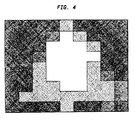
- Figure 4 illustrates the size of codebooks related to the history of the last 28 frames beginning with frame 4.
- the white blocks represent the maximum number of codewords (516) and the darker blocks represent smaller codebooks. It can be seen that larger codebooks are required where the activity is higher, such as at the areas of the face of a person having eye and mouth movements. In contrast, the background areas have little or no movement and has darker areas with small codebooks.
- Partial reconstruction is performed based on 8x8x4 vectors.
- the areas having movement such as the general areas of the face and neck are sent to the second stage of using codewords of adjacent codebooks. Those blocks found to be adequate are added to the reconstruction.
- the rest are sent to the more refined stage of image representation using 4x4x4 vectors. In this stage, most of the information is successfully represented by these smaller codewords, leaving a few areas of higher activity or increased dynamic characteristics, such as at the areas of the eyes and mouth.
- the remaining areas are further coded based on 2x2x4 vectors. After the most refined stage, only partial areas of the eyes and mouth are left. Those blocks are sent to the last stage of the scalar quantizer.
- the illustrative embodiment of the apparatus and method of the invention uses localized history of the sequence as a training set for 3D-VQ.
- This approach utilizes recent information about the sequence, thus relying on one of the most relevant source of data regarding the next frames, assuming that no major changes in the dynamics of the scene are taking place.
- the implementation of the approach can be systematically organized in parallel computing by its very nature. Even on a serial computer, the processing of many small codebooks instead of a combined one saves time and operations.
- each superblock, and there are 81 of them in the above illustration can be considered as an almost separate subsystem, creating an adaptive codebook and coding vectors accordingly, which is practically independent of all other superblocks.
- the number of vectors to be coded at each 4-frame stage is 20 vectors, which is relatively small.
- the frame stages having fine details are coded into more refined codebooks. These frame stages involve a small fraction of the basic stage. It should be noted that the available processing time for each 4-frame processing is 4/30 second, i.e., 133mSec.
- the illustrative embodiment according to the present invention replaces the global SNR with a localized version, e.g., the transition from one level of the pyramidal representation to the next, a more detailed one.
Landscapes
- Engineering & Computer Science (AREA)
- Multimedia (AREA)
- Signal Processing (AREA)
- Physics & Mathematics (AREA)
- General Physics & Mathematics (AREA)
- Theoretical Computer Science (AREA)
- Compression Or Coding Systems Of Tv Signals (AREA)
- Compression, Expansion, Code Conversion, And Decoders (AREA)
Applications Claiming Priority (2)
| Application Number | Priority Date | Filing Date | Title |
|---|---|---|---|
| US08/531,807 US5828413A (en) | 1995-09-21 | 1995-09-21 | Method and apparatus for image processing using model-based localized quantization |
| US531807 | 1995-09-21 |
Publications (1)
| Publication Number | Publication Date |
|---|---|
| EP0765085A2 true EP0765085A2 (fr) | 1997-03-26 |
Family
ID=24119127
Family Applications (1)
| Application Number | Title | Priority Date | Filing Date |
|---|---|---|---|
| EP96306571A Withdrawn EP0765085A2 (fr) | 1995-09-21 | 1996-09-10 | Procédé et appareil pour le traitement d'images par quantification locale basée sur un modèle |
Country Status (4)
| Country | Link |
|---|---|
| US (1) | US5828413A (fr) |
| EP (1) | EP0765085A2 (fr) |
| JP (1) | JPH09172378A (fr) |
| CA (1) | CA2180298A1 (fr) |
Cited By (2)
| Publication number | Priority date | Publication date | Assignee | Title |
|---|---|---|---|---|
| WO2001084849A1 (fr) * | 2000-05-03 | 2001-11-08 | Clearstream Technologies Limited | Transmission de donnees video |
| CN100455024C (zh) * | 2006-05-15 | 2009-01-21 | 西安理工大学 | 基于图像块动态划分矢量量化算法的图像压缩芯片 |
Families Citing this family (10)
| Publication number | Priority date | Publication date | Assignee | Title |
|---|---|---|---|---|
| EP1079635A1 (fr) * | 1998-04-17 | 2001-02-28 | Ultraclean Technology Research Institute, Co. Ltd | Dispositif et procede de compression de donnees, dispositif et procede d'expansion de donnees, systeme et procede de compression/expansion de donnees, procede de constitution d'une table de codage, et dispositif et procede de quantification vectorielle |
| GB2362055A (en) * | 2000-05-03 | 2001-11-07 | Clearstream Tech Ltd | Image compression using a codebook |
| US8126276B2 (en) * | 2001-02-21 | 2012-02-28 | International Business Machines Corporation | Business method for selectable semantic codec pairs for very low data-rate video transmission |
| EP1296524A1 (fr) * | 2001-09-20 | 2003-03-26 | STMicroelectronics S.r.l. | Méthode et appareil de compression de signaux vidéo numériques, et système et produit de programme d'ordinateur correspondants |
| CN101448162B (zh) * | 2001-12-17 | 2013-01-02 | 微软公司 | 处理视频图像的方法 |
| US7551785B2 (en) * | 2003-07-03 | 2009-06-23 | Canadian Space Agency | Method and system for compressing a continuous data flow in real-time using cluster successive approximation multi-stage vector quantization (SAMVQ) |
| US10554985B2 (en) | 2003-07-18 | 2020-02-04 | Microsoft Technology Licensing, Llc | DC coefficient signaling at small quantization step sizes |
| KR100634527B1 (ko) * | 2004-11-26 | 2006-10-16 | 삼성전자주식회사 | 층 기반 영상 처리 장치 및 방법 |
| GB2464447B (en) * | 2008-07-01 | 2011-02-23 | Toshiba Res Europ Ltd | Wireless communications apparatus |
| US9299167B2 (en) | 2010-10-18 | 2016-03-29 | Dolby Laboratories Licensing Corporation | Image processing methods and apparatus using localized gamut definitions |
Family Cites Families (7)
| Publication number | Priority date | Publication date | Assignee | Title |
|---|---|---|---|---|
| JP2532909B2 (ja) * | 1987-02-25 | 1996-09-11 | 富士写真フイルム株式会社 | ベクトル量子化による画像デ―タの圧縮装置 |
| JPH02170787A (ja) * | 1988-12-23 | 1990-07-02 | Matsushita Electric Ind Co Ltd | ベクトル量子化符号化器とベクトル量子化復号化器 |
| KR930004311B1 (ko) * | 1989-04-18 | 1993-05-22 | 미쯔비시덴끼 가부시끼가이샤 | 동화상 부호화 복호화장치 |
| US5172228A (en) * | 1991-11-19 | 1992-12-15 | Utah State University Foundation | Image compression method and apparatus employing distortion adaptive tree search vector quantization |
| EP0576765A1 (fr) * | 1992-06-30 | 1994-01-05 | International Business Machines Corporation | Méthode pour coder des données digitales à l'aide de techniques de quantification vectorielle et dispositif pour mettre en oeuvre cette méthode |
| US5610657A (en) * | 1993-09-14 | 1997-03-11 | Envistech Inc. | Video compression using an iterative error data coding method |
| US5592227A (en) * | 1994-09-15 | 1997-01-07 | Vcom, Inc. | Method and apparatus for compressing a digital signal using vector quantization |
-
1995
- 1995-09-21 US US08/531,807 patent/US5828413A/en not_active Expired - Lifetime
-
1996
- 1996-07-02 CA CA002180298A patent/CA2180298A1/fr not_active Abandoned
- 1996-09-10 EP EP96306571A patent/EP0765085A2/fr not_active Withdrawn
- 1996-09-20 JP JP8249792A patent/JPH09172378A/ja active Pending
Cited By (2)
| Publication number | Priority date | Publication date | Assignee | Title |
|---|---|---|---|---|
| WO2001084849A1 (fr) * | 2000-05-03 | 2001-11-08 | Clearstream Technologies Limited | Transmission de donnees video |
| CN100455024C (zh) * | 2006-05-15 | 2009-01-21 | 西安理工大学 | 基于图像块动态划分矢量量化算法的图像压缩芯片 |
Also Published As
| Publication number | Publication date |
|---|---|
| JPH09172378A (ja) | 1997-06-30 |
| US5828413A (en) | 1998-10-27 |
| CA2180298A1 (fr) | 1997-03-22 |
Similar Documents
| Publication | Publication Date | Title |
|---|---|---|
| US4851906A (en) | Data compression using orthogonal transform and vector quantization | |
| US4821119A (en) | Method and apparatus for low bit-rate interframe video coding | |
| US5812195A (en) | Video compression using an iterative correction data coding method and systems | |
| US6847735B2 (en) | Image processing system, image processing apparatus, image input apparatus, image output apparatus and method, and storage medium | |
| US6621864B1 (en) | Motion vector based frame insertion process for increasing the frame rate of moving images | |
| US5841470A (en) | Coding and decoding video signals | |
| EP0500267A2 (fr) | Système de traitement d'images | |
| US7177356B2 (en) | Spatially transcoding a video stream | |
| US5828413A (en) | Method and apparatus for image processing using model-based localized quantization | |
| US6292591B1 (en) | Image coding and decoding using mapping coefficients corresponding to class information of pixel blocks | |
| Sindhu et al. | Images and its compression techniques-A Review | |
| US5793428A (en) | Self-encoded deltas for digital video data transmission | |
| KR100359671B1 (ko) | 인코더및디코더 | |
| US5737446A (en) | Method for estimating high frequency components in digitally compressed images and encoder and decoder for carrying out same | |
| JPH099265A (ja) | 画像符号化装置及び方法 | |
| Nasrabadi et al. | A new image coding technique using transforms vector quantization | |
| EP0238254A2 (fr) | Compression de données utilisant une transformation des listes | |
| US5703647A (en) | Apparatus for encoding/decoding a video signal | |
| Tzou et al. | Bit-sliced progressive transmission and reconstruction of transformed images | |
| US7450769B2 (en) | Image processing method for facilitating data transmission | |
| US20250317605A1 (en) | Progressive generative face video compression with bandwidth intelligence | |
| KR100265133B1 (ko) | 동화상 압축 장치 및 동화상 재생 장치 | |
| Endoh et al. | Progressive facsimile coding scheme for interactive image communications | |
| KR100216600B1 (ko) | 영상 신호 벡터 양자화기를 위한 다중 부호어 전송 방법 | |
| Saito et al. | Self-organizing pattern-matching coding for picture signals |
Legal Events
| Date | Code | Title | Description |
|---|---|---|---|
| PUAI | Public reference made under article 153(3) epc to a published international application that has entered the european phase |
Free format text: ORIGINAL CODE: 0009012 |
|
| AK | Designated contracting states |
Kind code of ref document: A2 Designated state(s): DE FR GB |
|
| STAA | Information on the status of an ep patent application or granted ep patent |
Free format text: STATUS: THE APPLICATION HAS BEEN WITHDRAWN |
|
| 18W | Application withdrawn |
Withdrawal date: 19971103 |