EP0765092A2 - Procédé pour la commande d'un central de télécommunications - Google Patents
Procédé pour la commande d'un central de télécommunications Download PDFInfo
- Publication number
- EP0765092A2 EP0765092A2 EP96111041A EP96111041A EP0765092A2 EP 0765092 A2 EP0765092 A2 EP 0765092A2 EP 96111041 A EP96111041 A EP 96111041A EP 96111041 A EP96111041 A EP 96111041A EP 0765092 A2 EP0765092 A2 EP 0765092A2
- Authority
- EP
- European Patent Office
- Prior art keywords
- user
- terminal
- data processing
- telecommunications system
- telecommunications
- Prior art date
- Legal status (The legal status is an assumption and is not a legal conclusion. Google has not performed a legal analysis and makes no representation as to the accuracy of the status listed.)
- Withdrawn
Links
Images
Classifications
-
- H—ELECTRICITY
- H04—ELECTRIC COMMUNICATION TECHNIQUE
- H04Q—SELECTING
- H04Q3/00—Selecting arrangements
- H04Q3/42—Circuit arrangements for indirect selecting controlled by common circuits, e.g. register controller, marker
- H04Q3/54—Circuit arrangements for indirect selecting controlled by common circuits, e.g. register controller, marker in which the logic circuitry controlling the exchange is centralised
- H04Q3/545—Circuit arrangements for indirect selecting controlled by common circuits, e.g. register controller, marker in which the logic circuitry controlling the exchange is centralised using a stored program
- H04Q3/54541—Circuit arrangements for indirect selecting controlled by common circuits, e.g. register controller, marker in which the logic circuitry controlling the exchange is centralised using a stored program using multi-processor systems
- H04Q3/54566—Intelligent peripherals, adjunct processors
-
- H—ELECTRICITY
- H04—ELECTRIC COMMUNICATION TECHNIQUE
- H04M—TELEPHONIC COMMUNICATION
- H04M3/00—Automatic or semi-automatic exchanges
- H04M3/42—Systems providing special services or facilities to subscribers
- H04M3/42314—Systems providing special services or facilities to subscribers in private branch exchanges
- H04M3/42323—PBX's with CTI arrangements
-
- H—ELECTRICITY
- H04—ELECTRIC COMMUNICATION TECHNIQUE
- H04Q—SELECTING
- H04Q2213/00—Indexing scheme relating to selecting arrangements in general and for multiplex systems
- H04Q2213/13003—Constructional details of switching devices
-
- H—ELECTRICITY
- H04—ELECTRIC COMMUNICATION TECHNIQUE
- H04Q—SELECTING
- H04Q2213/00—Indexing scheme relating to selecting arrangements in general and for multiplex systems
- H04Q2213/1305—Software aspects
-
- H—ELECTRICITY
- H04—ELECTRIC COMMUNICATION TECHNIQUE
- H04Q—SELECTING
- H04Q2213/00—Indexing scheme relating to selecting arrangements in general and for multiplex systems
- H04Q2213/13093—Personal computer, PC
-
- H—ELECTRICITY
- H04—ELECTRIC COMMUNICATION TECHNIQUE
- H04Q—SELECTING
- H04Q2213/00—Indexing scheme relating to selecting arrangements in general and for multiplex systems
- H04Q2213/13106—Microprocessor, CPU
-
- H—ELECTRICITY
- H04—ELECTRIC COMMUNICATION TECHNIQUE
- H04Q—SELECTING
- H04Q2213/00—Indexing scheme relating to selecting arrangements in general and for multiplex systems
- H04Q2213/13152—Callback
-
- H—ELECTRICITY
- H04—ELECTRIC COMMUNICATION TECHNIQUE
- H04Q—SELECTING
- H04Q2213/00—Indexing scheme relating to selecting arrangements in general and for multiplex systems
- H04Q2213/13174—Data transmission, file transfer
-
- H—ELECTRICITY
- H04—ELECTRIC COMMUNICATION TECHNIQUE
- H04Q—SELECTING
- H04Q2213/00—Indexing scheme relating to selecting arrangements in general and for multiplex systems
- H04Q2213/13176—Common channel signaling, CCS7
-
- H—ELECTRICITY
- H04—ELECTRIC COMMUNICATION TECHNIQUE
- H04Q—SELECTING
- H04Q2213/00—Indexing scheme relating to selecting arrangements in general and for multiplex systems
- H04Q2213/13199—Modem, modulation
-
- H—ELECTRICITY
- H04—ELECTRIC COMMUNICATION TECHNIQUE
- H04Q—SELECTING
- H04Q2213/00—Indexing scheme relating to selecting arrangements in general and for multiplex systems
- H04Q2213/13209—ISDN
-
- H—ELECTRICITY
- H04—ELECTRIC COMMUNICATION TECHNIQUE
- H04Q—SELECTING
- H04Q2213/00—Indexing scheme relating to selecting arrangements in general and for multiplex systems
- H04Q2213/1322—PBX
-
- H—ELECTRICITY
- H04—ELECTRIC COMMUNICATION TECHNIQUE
- H04Q—SELECTING
- H04Q2213/00—Indexing scheme relating to selecting arrangements in general and for multiplex systems
- H04Q2213/1324—Conference call
-
- H—ELECTRICITY
- H04—ELECTRIC COMMUNICATION TECHNIQUE
- H04Q—SELECTING
- H04Q2213/00—Indexing scheme relating to selecting arrangements in general and for multiplex systems
- H04Q2213/1326—Consultation call, broker's call, call hold, toggling
-
- H—ELECTRICITY
- H04—ELECTRIC COMMUNICATION TECHNIQUE
- H04Q—SELECTING
- H04Q2213/00—Indexing scheme relating to selecting arrangements in general and for multiplex systems
- H04Q2213/13282—Call forward, follow-me, call diversion
Definitions
- Telecommunications systems can often be controlled by entering code sequences from the terminals connected to them. Due to the complex range of functions and the diverse performance features of modern telecommunications systems, the control by entering code sequences with the help of telephones is often not very convenient, because the user quickly loses the overview of the commands entered and the status of the telecommunications system. Therefore, the much more convenient control of telecommunications systems via connected data processing systems such as Personal computers are becoming increasingly important. In turn, graphical user interfaces and telephony applications developed for these user interfaces and the associated operating systems are becoming increasingly important because of the user convenience associated with them.
- Standardized programming interfaces eg TAPI, Telephony Application Programming Interface
- TAPI Telephony Application Programming Interface
- the prevailing software and hardware environment ensures the transmission of the commands transmitted by the programming interface, for example to a connected switching system (telecommunication system).
- the data are transmitted, for example, in the form of coded D-channel messages via ISDN and decoded in the switching system and processed accordingly.
- appropriate software is required for this, which maps the telephony functions to the system-specific internal functions and processes.
- first-pary services if a PC only establishes connections for itself or for a telephone connected to this PC, or if this PC activates features of a telecommunications system for itself or for the telephone connected to it, these are so-called first-party services, i.e. only actions are carried out for your own telephone, which is also physically connected to the telecommunications system via the same interface as the PC. If, however, services are to be carried out by a connected PC for a physically different subscriber to the telecommunications system (for example also for the "own" telephone standing next to the PC but not connected to the telecommunications system via it), then such functions are so-called Third party services.
- the invention has for its object to provide a method for controlling a telecommunications system using a data processing system connected to this telecommunications system, which uses the resources available in telecommunications systems in the most efficient manner and enables the implementation or use of telephony applications with minimal effort on the part of the telecommunications system.
- This object is achieved with the aid of a method according to claim 1.
- inputs from a user of the data processing system are converted into control commands of the telecommunications system by software running on the data processing system and sent to the telecommunications system.
- the method according to the invention is characterized in that the inputs of the user are first converted into commands of a standardized programming interface by a user software and these are then converted into control commands of the telecommunications system with the aid of driver software specific for the telecommunications system.
- driver software When changing the system in the telecommunications system or when changing the interface used to control the telecommunications system, only the driver software needs to be changed. Any application software that supports the standardized programming interface can also be used.
- system performance features can usually be activated using key figure procedures.
- system performance features for one's own device ie the PC or the associated telephone
- the phone can be connected to a PC ISDN card, for example, or the PC is connected to the analog phone line via a modem.
- system-specific driver software on the PC side can be used, the task of which in this simple case would only consist of implementing the telephony commands appropriately and using the transport medium used (eg ISDN, V.24, modem) as a sequence of digits or Transfer election information. No change is necessary on the system side (telecommunications system), provided the existing subscriber interfaces (a / b, S0 or U interfaces) are used as connections.
- the "conversion table" in the driver software on the PC only needs to be expanded or changed to take account of new or changed functions.
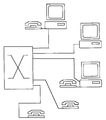
- FIG. 1 shows a telecommunications system which provides the connected terminals with analog or digital interfaces.
- a large number of telephones and various personal computers and other terminal devices are generally connected to this telecommunications system.
- Some of the phones are initially connected to a PC and connected via the telecommunications system.
- Other telephones are connected directly to the telecommunications system, but are used by a user who uses one of the connected PCs and are therefore assigned to the PC (actually the user of the PC).
- One of the PCs may be a central exchange.
- Each terminal has a subscriber number which, when the telecommunication system is selected, informs it of the terminal from which the selection was made.
- a procedure that can be activated via a code number can be implemented, which enables a selection to be made for another system subscriber, which already corresponds to a simple third-party application.
- such procedures are already available.
- the new or modified procedure according to the invention is preferably activated via an identification number from any terminal device, wherein this terminal device (terminal) can be connected via digital or analog (S0, a / b, U) interfaces.
- the system uses the number of the activating terminal (eg a PC with the internal number 70) to search for an entry for this number in a system-internal assignment table.
- the structure of the table corresponds, for example, to the following scheme, with the terminal devices PC and telephone being one of the possible combinations: Table 1 PC phone 68 11 70 15 ... ...
- the application uses defined commands (e.g. for TAPI) to activate such performance features, which are correspondingly transmitted to the telecommunications system by driver software.
- the call can also be sent to the assigned PC at the same time, if this is connected via a corresponding interface with the option of transmitting the number (e.g. ISDN).
- the number e.g. ISDN
- This enables the application to check the incoming number and e.g. a corresponding search in a database in order to be able to display any data belonging to the number directly during the call.
- a privileged subscriber for example a switching center
- activate features for any other subscriber who are unable to do this themselves, possibly because they do not have a PC have and the control of the telecommunication system over the keys of a telephone is not mastered by them.
- the subscriber number for which the feature is to be activated or a choice is to be made would be given after the code for third-party services.
- the use of this feature could, for example, only be restricted to the operator console in order to avoid unauthorized use and misuse.
- an internal assignment table can be stored for protection, which can also be used for incoming calls.
- the task of the software on the PC side in this case would be to implement the required TAPI commands appropriately and to transmit them via the transport medium used (e.g. ISDN, V.24, modem) as a sequence of digits, with each code number being the activation code for third parties -Party services is prepended.
- the transport medium used e.g. ISDN, V.24, modem
- System-specific additional performance features unknown to the application are transmitted as simple dialing information and are evaluated accordingly by the telecommunications system as service activation via the assigned subscriber.
Landscapes
- Engineering & Computer Science (AREA)
- Computer Networks & Wireless Communication (AREA)
- Signal Processing (AREA)
- Telephonic Communication Services (AREA)
- Exchange Systems With Centralized Control (AREA)
Applications Claiming Priority (2)
| Application Number | Priority Date | Filing Date | Title |
|---|---|---|---|
| DE19527812 | 1995-07-28 | ||
| DE1995127812 DE19527812C1 (de) | 1995-07-28 | 1995-07-28 | Verfahren zur Steuerung einer Telekommunikationsanlage |
Publications (2)
| Publication Number | Publication Date |
|---|---|
| EP0765092A2 true EP0765092A2 (fr) | 1997-03-26 |
| EP0765092A3 EP0765092A3 (fr) | 2000-03-22 |
Family
ID=7768132
Family Applications (1)
| Application Number | Title | Priority Date | Filing Date |
|---|---|---|---|
| EP96111041A Withdrawn EP0765092A3 (fr) | 1995-07-28 | 1996-07-09 | Procédé pour la commande d'un central de télécommunications |
Country Status (2)
| Country | Link |
|---|---|
| EP (1) | EP0765092A3 (fr) |
| DE (1) | DE19527812C1 (fr) |
Cited By (2)
| Publication number | Priority date | Publication date | Assignee | Title |
|---|---|---|---|---|
| DE19913063A1 (de) * | 1999-03-17 | 2000-09-28 | Elmeg Gmbh & Co Kg Kommunikati | TK-Anlage |
| EP1622347A1 (fr) * | 2004-07-29 | 2006-02-01 | 2K Elettrica | Central téléphonique contrôlée par ordinateur pour la gestion des positions des téléphones et/ou des postes de travail |
Families Citing this family (1)
| Publication number | Priority date | Publication date | Assignee | Title |
|---|---|---|---|---|
| DE19957231B4 (de) * | 1999-11-27 | 2005-06-16 | Deutsche Telekom Ag | Verfahren zur Datenkommunikation |
Citations (1)
| Publication number | Priority date | Publication date | Assignee | Title |
|---|---|---|---|---|
| WO1994023523A1 (fr) * | 1993-04-06 | 1994-10-13 | Nokia Telecommunications Oy | Procede et appareil de commande de fonctionnement d'un central telephonique a partir d'un raccordement d'abonne |
Family Cites Families (2)
| Publication number | Priority date | Publication date | Assignee | Title |
|---|---|---|---|---|
| US5291492A (en) * | 1991-12-18 | 1994-03-01 | Unifi Communications Corporation | Externally controlled call processing system |
| US5414762A (en) * | 1994-01-18 | 1995-05-09 | Q.Sys International, Inc. | Telephony controller with functionality command converter |
-
1995
- 1995-07-28 DE DE1995127812 patent/DE19527812C1/de not_active Expired - Fee Related
-
1996
- 1996-07-09 EP EP96111041A patent/EP0765092A3/fr not_active Withdrawn
Patent Citations (1)
| Publication number | Priority date | Publication date | Assignee | Title |
|---|---|---|---|---|
| WO1994023523A1 (fr) * | 1993-04-06 | 1994-10-13 | Nokia Telecommunications Oy | Procede et appareil de commande de fonctionnement d'un central telephonique a partir d'un raccordement d'abonne |
Cited By (2)
| Publication number | Priority date | Publication date | Assignee | Title |
|---|---|---|---|---|
| DE19913063A1 (de) * | 1999-03-17 | 2000-09-28 | Elmeg Gmbh & Co Kg Kommunikati | TK-Anlage |
| EP1622347A1 (fr) * | 2004-07-29 | 2006-02-01 | 2K Elettrica | Central téléphonique contrôlée par ordinateur pour la gestion des positions des téléphones et/ou des postes de travail |
Also Published As
| Publication number | Publication date |
|---|---|
| EP0765092A3 (fr) | 2000-03-22 |
| DE19527812C1 (de) | 1996-12-05 |
Similar Documents
| Publication | Publication Date | Title |
|---|---|---|
| EP0590334B1 (fr) | Procédé de commande des terminaux de communication par touches programmables "soft-key" | |
| EP0813330B1 (fr) | Procédé d'établissement de connexion, central de commutation, processeur de service et réseau de communication | |
| EP0655870B1 (fr) | Exécution de services dans un système de communications | |
| DE19509965A1 (de) | Verfahren zum Steuern eines Zugangsnetzes oder eines physikalischen Zugangsnetzes sowie Zugangsnetze und Vermittlungsstelle dafür | |
| EP0589248A2 (fr) | Méthode et disposition pour l'affichage de numéros d'appel aux postes téléphoniques d'un central téléphonique privé | |
| DE19527812C1 (de) | Verfahren zur Steuerung einer Telekommunikationsanlage | |
| EP1139644A2 (fr) | Commutateur controlé par ordinateur | |
| EP0535601B1 (fr) | Procédé pour l'établissement de connexions de conférence dans un système de communication à commande par processeur | |
| EP0805581B1 (fr) | Méthode et dispositif d'application pour introduire des services dans un système de communication privé à partir d'un réseau de communication public | |
| EP0529343B1 (fr) | Méthode d'établir une liaison de communication entre un terminal de communication, connectée à un central de communication, et plusieurs terminaux | |
| EP0585480A1 (fr) | Méthode et dispositif pour établir des connexions de conférence dans un central téléphonique commandé par calculation | |
| EP1404091B1 (fr) | Méthode et moyens pour le contrôle et/ou la surveillance d'une ligne MULAP | |
| EP1016311A2 (fr) | Procede de commande de surfaces de commande d'affichage de terminaux d'un systeme de communication commandes par le systeme | |
| DE2163436A1 (de) | Teilnehmerleitung-Sucheinrichtung | |
| DE10159636A1 (de) | Verfahren zur Steuerung und/oder Überwachung von Ressourcen und Verbindungen | |
| EP0602457B1 (fr) | Méthode de modification d'une procédure de signalisation par des terminaux de communication d'un système de communication | |
| EP0767997B1 (fr) | Procede permettant de realiser une installation privee automatique pour activer une configuration de connexion de nuit | |
| DE19831168C2 (de) | Verfahren zum automatischen Erfassen von Leistungsmerkmalen einer Kommunikations-Endeinrichung | |
| DE3905257A1 (de) | Verfahren zum herstellen von verbindungen bei kommunikations-vermittlungsanlagen, insbesondere fernsprechvermittlungsanlagen | |
| DE19548296A1 (de) | Bidirektionaler Datenaustausch (Protokoll) zwischen einer TK-Anlage und einer Endeinrichtung | |
| DE19948090B4 (de) | Verfahren zum Anschliessen eines Endgerätes an eine Telekommunikationsanlage sowie zugehörige elektronische Baueinheiten | |
| DE4330757A1 (de) | Verfahren und Anordnung zum Realisieren von Endgerätefunktionen durch einen mit einem Kommunikationssystem verbundenen Personal-Computer | |
| DE10138102A1 (de) | Telefonkonferenzsystem und Verfahren zum Durchführen einer Telefonkonferenz | |
| DE10138151A1 (de) | Telefonkonferenzsystem und Verfahren zum Authentifizieren eines Teilnehmers einer Telefonkonferenz | |
| DE4006048A1 (de) | Kommunikationssystem mit einer zentralen speicherprogrammierten rechnersteuerung und mit einer einander paarweise in form einer erstteilnehmerstelle und einer zweitteilnehmerstelle zugeordneten fernsprechendgeraetekonstellation |
Legal Events
| Date | Code | Title | Description |
|---|---|---|---|
| PUAI | Public reference made under article 153(3) epc to a published international application that has entered the european phase |
Free format text: ORIGINAL CODE: 0009012 |
|
| AK | Designated contracting states |
Kind code of ref document: A2 Designated state(s): AT BE CH DE FR GB IT LI |
|
| PUAL | Search report despatched |
Free format text: ORIGINAL CODE: 0009013 |
|
| AK | Designated contracting states |
Kind code of ref document: A3 Designated state(s): AT BE CH DE FR GB IT LI |
|
| 17P | Request for examination filed |
Effective date: 20000417 |
|
| 17Q | First examination report despatched |
Effective date: 20030827 |
|
| STAA | Information on the status of an ep patent application or granted ep patent |
Free format text: STATUS: THE APPLICATION IS DEEMED TO BE WITHDRAWN |
|
| 18D | Application deemed to be withdrawn |
Effective date: 20030909 |