EP0765580B1 - Systeme de communications avec un systeme de complements de service et un systeme de communications de base - Google Patents
Systeme de communications avec un systeme de complements de service et un systeme de communications de base Download PDFInfo
- Publication number
- EP0765580B1 EP0765580B1 EP95920783A EP95920783A EP0765580B1 EP 0765580 B1 EP0765580 B1 EP 0765580B1 EP 95920783 A EP95920783 A EP 95920783A EP 95920783 A EP95920783 A EP 95920783A EP 0765580 B1 EP0765580 B1 EP 0765580B1
- Authority
- EP
- European Patent Office
- Prior art keywords
- call
- basic
- control
- brs
- connection
- Prior art date
- Legal status (The legal status is an assumption and is not a legal conclusion. Google has not performed a legal analysis and makes no representation as to the accuracy of the status listed.)
- Expired - Lifetime
Links
Images


Classifications
-
- H—ELECTRICITY
- H04—ELECTRIC COMMUNICATION TECHNIQUE
- H04Q—SELECTING
- H04Q3/00—Selecting arrangements
- H04Q3/42—Circuit arrangements for indirect selecting controlled by common circuits, e.g. register controller, marker
- H04Q3/54—Circuit arrangements for indirect selecting controlled by common circuits, e.g. register controller, marker in which the logic circuitry controlling the exchange is centralised
- H04Q3/545—Circuit arrangements for indirect selecting controlled by common circuits, e.g. register controller, marker in which the logic circuitry controlling the exchange is centralised using a stored program
- H04Q3/54508—Configuration, initialisation
- H04Q3/54533—Configuration data, translation, passwords, databases
-
- H—ELECTRICITY
- H04—ELECTRIC COMMUNICATION TECHNIQUE
- H04Q—SELECTING
- H04Q3/00—Selecting arrangements
- H04Q3/42—Circuit arrangements for indirect selecting controlled by common circuits, e.g. register controller, marker
- H04Q3/54—Circuit arrangements for indirect selecting controlled by common circuits, e.g. register controller, marker in which the logic circuitry controlling the exchange is centralised
- H04Q3/545—Circuit arrangements for indirect selecting controlled by common circuits, e.g. register controller, marker in which the logic circuitry controlling the exchange is centralised using a stored program
-
- H—ELECTRICITY
- H04—ELECTRIC COMMUNICATION TECHNIQUE
- H04Q—SELECTING
- H04Q3/00—Selecting arrangements
- H04Q3/0016—Arrangements providing connection between exchanges
- H04Q3/0029—Provisions for intelligent networking
-
- H—ELECTRICITY
- H04—ELECTRIC COMMUNICATION TECHNIQUE
- H04Q—SELECTING
- H04Q3/00—Selecting arrangements
- H04Q3/42—Circuit arrangements for indirect selecting controlled by common circuits, e.g. register controller, marker
- H04Q3/54—Circuit arrangements for indirect selecting controlled by common circuits, e.g. register controller, marker in which the logic circuitry controlling the exchange is centralised
- H04Q3/545—Circuit arrangements for indirect selecting controlled by common circuits, e.g. register controller, marker in which the logic circuitry controlling the exchange is centralised using a stored program
- H04Q3/54575—Software application
- H04Q3/54583—Software development, e.g. procedural, object oriented, software generation, software testing
-
- H—ELECTRICITY
- H04—ELECTRIC COMMUNICATION TECHNIQUE
- H04Q—SELECTING
- H04Q2213/00—Indexing scheme relating to selecting arrangements in general and for multiplex systems
- H04Q2213/13057—Object-oriented software
-
- H—ELECTRICITY
- H04—ELECTRIC COMMUNICATION TECHNIQUE
- H04Q—SELECTING
- H04Q2213/00—Indexing scheme relating to selecting arrangements in general and for multiplex systems
- H04Q2213/13526—Indexing scheme relating to selecting arrangements in general and for multiplex systems resource management
Definitions
- the invention relates to a communication switching system according to the preamble of claim 1.
- a switching system consisting of a system of features and a basic switching system.
- Such a structure is shared by a switching system or the Switching software in a basic switching system and one Feature system.
- Main components of a basic switching system are a call control, a database and a Variety of feature control modules.
- the call control will focus on their basic tasks, the assembly and dismantling of connections or calls, reduced and therefore as basic call control designated.
- the feature control modules form a set of functions that are used to access the Call objects call, subscriber and connection can be accessed can be used to manipulate calls.
- the performance features themselves are in the performance feature system included that over a protocol with the basic switching system communicates.
- the basic call control of the basic switching system has Task, the establishment and dismantling of calls or their associated Make connections according to subscriber requirements. she treats a two-party call as part of their normal workflow. There are also mechanisms for reporting certain Events are provided to the feature control.
- the basic switching system can without the influence of Feature system a call between two participants control, i.e. it is related to the setting up and clearing down of two-party calls self-sufficient.
- a two-party call exists between assigned two subscriber line units each Communication terminals with one connection each the relationship between a communication terminal and the call manufactures.
- Each connection is a state machine assigned to the connection as a state machine. The connections are linked to each other via the call.
- Such incentives are subscriber / network messages or Internal messages, namely messages between the two connections of a call.
- the present invention is based on the object Communication switching system from a feature system and a basic switching system of the above Kind of name that is a simple and clear influence of the feature system on the basic switching system enables.
- both the basic call control and the performance control modules access the same database.
- information elements of the call objects that of the basic call control for handling a call are used and read from the database for this purpose are, by the feature system with the help of specially assigned Feature control modules before treatment can be manipulated by the basic call control.
- the control flow of the basic call control is in processing modules divided, the individual messages clearly assigned are. Messages are both internal messages between the connections as well as subscriber / network messages between the subscriber line units and the basic call control.
- the feature system can be used if necessary an assigned function, namely the corresponding one Feature control module of the basic switching system, according to the requirements of the corresponding performance feature certain information elements of certain call objects can manipulate a call in the database and then, if necessary also with the help of a corresponding one Purpose defined feature control module that Sending a message to the state machine of the affected Connection initiated in the basic call control. This The message then leads to a treatment of the affected call objects through the basic call control of the basic switching system.
- the basic call control can in this case Rate the message as a normal internal message and needs indistinguishable whether this internal message by the such a message usually emitting state machines a connection or through the feature system has been initiated.
- Feature control modules are for example access mechanisms to call objects. This Access mechanisms can also be one of the feature system initiated restart of the control process of the Enable basic call control.
- individual Processing modules of the control sequence of the basic call control structured in such a way that after interrupting the processing module sequence at an event generation point Feature system a continuation of the process at the Arrange the location of the corresponding event generation point can.
- processing modules are in this case again divided into appropriate submodules that are in the area of the event generation points mentioned, namely in the area of state transitions, corresponding state entry points provide.
- the event generation points are in the Processing modules of the basic call control are provided and can - usually through appropriate performance features or the feature control system - activated if necessary will. If an event generation point is activated, then when the control flow of this event generation point reached, a message about the status achieved or the need for a response as an expected event transferred to the feature system. Only after receiving the the necessary response, the control process can be continued
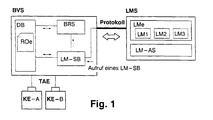
- Figure 1 shows the structure of a communication system, consisting of from a basic switching system BVS, which over a Protocol communicates with a feature system LMS and that via a subscriber / network interface, not shown and each with subscriber line units TAE Communication terminals KE-A and KE-B is connected.
- the Basic switching system BVS contains a basic call control BRS and a variety of feature control modules LM-SB.
- the basic switching system BVS also contains one Database DB, in which call objects ROe are contained.
- a call object RO can be due to a communication terminal KE-A, KE-B initiated subscriber / network request be created and manipulated as well as with the help of feature control modules LM-SB.
- FIG. 1 shows a possible structuring as an exemplary embodiment of a feature system LMS.
- a feature system LMS from a feature sequence control LM-AS and a variety of features LME, for example a first to third performance feature LM1, LM2 and LM3.
- the basic switching system BVS is from the feature system LMS detached, but can be influenced in a defined manner.
- the feature control modules form LM-SB the interface between the basic switching system BVS and the feature system LMS, through which the feature system LMS on the call objects ROe of the database DB can have both read and write access.
- Writing in this case means the entry of call objects Creation of a call or half call or changing of Information elements of the call objects ROe.
- Each feature control block LM-SB forms a complete one Function for a certain type of access.
- the feature control modules use to build and dismantle Connections of the usual control flow of the basic call control BRS, thus lead to the establishment and clearing of connections not by yourself.
- the processing of the feature control modules LM-SB can therefore only be manipulated the call objects are mapped in the database.
- the treatment the manipulated or newly created call objects ROe then goes to the basic call control BRS. This will then only supplied with the identifier of the call object RO and handles this through a normal control sequence of the two-party call.
- the basic call control BRS is required for this to structure the necessary entry points for Processing of the by the feature control modules LM-SB changed call objects to gain ROe.
- the basic call control BRS is divided into processing modules for this, who only process one message at a time. Messages in this sense are both the individual subscriber / network messages as well as the individual internal messages.
- the advantage of such a basic call control structure lies in that the creation of a new connection by creating the corresponding internal message can, which then according to the two-party call from the basic call control BRS is treated. When creating a new connection would be, for example, the I-Setup internal message with the to cause necessary parameters (see Figure 2).
- FIG. 8 shows the image of FIG State transitions of the connection to the message-oriented Structuring the basic call control using the example of the state transition from zero to ringing (end device rings).
- FIG. 2 shows the structure of a basic switching system BVS according to FIG. 1 in more detail.
- the subscriber / network signaling provides the subscriber or the communication terminal equipment KE-A with information about the status of the call and about the partner in the call via the subscriber network interface (not shown).
- the processing modules SetupReq-M and Info-M are shown in FIG. 2 as processing modules, each of which is stimulated by a TAE message of the same name.
- the state machines of the connections which are involved in a two-party call, communicate via messages, the so-called internal signals or internal messages. These are used to transport information to the partner side, that is, from the A subscriber side to the B subscriber side or vice versa, ie between the two connections. However, you can also trigger state transitions.
- an event generation point is set, certain is sufficient Information about the occurrence of the event. However, sometimes there is an intervention of the performance feature LM required in the sequence of call processing BRS. In this case, the basic call control BRS must run at the trigger point (Event generation point) EGP are stopped can. An event generation point EGP can therefore at a specific attribute is assigned to its activation. Such an attribute can either be "notification” or “Waiting for an answer”. In both cases, the event generated. With the attribute "waiting for answer", however Call control stopped until further notice.
- an event generation point EGP of different Features LM1, LM2, LM3 with different attributes can be documented, preferably has the stronger one Priority attribute, i.e. as long as at least one activation with waiting for response, this attribute applies to the Event generation point EGP.
- this information can, if the state transition due to an event generation point with the attribute "Waiting for response" is not performed retrospectively no longer get to the LMS feature control. Furthermore there is no way to catch up on this state transition. This means, for example, in the event that the action the participant's take off is that the information about the Lift off for basic call control BRS is lost.
- the state transition be carried out according to Connections. Even with a state transition from Initiated to Zero or from Connected after zero there should be no interruption in connection processing be carried out because the state is zero due to interference of the state machine can no longer be left can, i.e. the disconnection already initiated can no longer be prevented.
- trigger events that is, event messages that occur when a set event generation point is reached sent to the feature system are, as well as status events that change the Display the status of a connection unit. Possible states free, busy, not connected, for example or broken.
- EGP is preferred for each event generation point a specific event on the part of the basic switching system generated. To make the event generation point EGP unique Being able to describe must be in addition to the type of event the connection in which the state transition occurred and their direction to be known. Another important information for the feature system is whether the attribute of the event generation point "notification” or "Waiting for an answer" was. This data and possibly some more Information is used as a parameter in an event message carried and in the context of a protocol by the basic switching system Transfer BVS to the LMS feature system.
- a status event is generated when the corresponding status change and a monitor for this change of state was set.
- a Monitor for example for "free after occupied", “occupied after free "or as a continuous monitor of all status changes monitored, set.
- the model of the two-party call is shown in FIG. 7 above Form of a half call and a connection with subscribers shown.
- the call between the communication terminal KE-A and the communication terminal KE-B consists of one each Connection with associated state machines ZA-A and ZA-B, which are connected to a two-party call via the call.
- the communication terminals communicate with that in the model Basic switching system, not shown, also on the Subscriber / network interface not shown in the model.
- the state machines ZA-A and ZA-B on the A-side and B-side connection communicate via internal messages.
- the call objects RO, which make up a two-party call are represented by data, the database DB, which is also not shown in the model are filed.
- the A-subscriber shows the basic call control by lifting the handset a connection request.
- the communication terminal KE-A the message SetupReq to the basic switching system BVS broadcast.
- the connection on the part of the state machine ZA-A is created.
- the state machine ZA-A the connection is in the zero state and changes to the state Initiated.
- the basic call control BRS acknowledges this by that the participant is prompted by the message SetupAck the election information is requested.
- Subscriber A passes the dialing information info to the basic call control.
- the basic call control checks the validity the choice of information and confirms the positive review through the message InfoComplete to the A-subscriber after the transition of the state machine of the connection to the connected state.
- the internal message I-Setup is created the B-side connection.
- the B-side connection is created, i.e. the state machine ZA-B goes into state zero and the B-subscriber is the call coming from A is signaled by the message SetupReq.
- the KE-B communication terminal confirms the signaling with the message ringing (alert). Then the State machine ZA-B from zero to ringing. In addition, the internal message I-Alert on the state machines Transfer ZA-A of the A connection.
- the basic call control BRS signals this with the message Alert A subscriber that the communication terminal KE-B rings. If the B-subscriber answers, the communication terminal KE-B transmit the message ConnectReq to the basic call control.
- the state machine of the connection ZA-B goes out of the State Ringing in the Connected state and gives the Internal message from I-Connect.
- the basic call control acknowledges the A-subscriber the connection establishment with the message ConnectReq. If the A-subscriber by hanging up the handset the communication terminal KE-A wants to end the connection, the communication terminal KE-A receives the message DiscReq transmitted to the basic call control.
- the state machine ZA-A the connection goes from the connected state to the zero state and issues the internal message I-Disc.
- the state machine ZA-B of the connection goes from the connected state to the state Rejected and signaled via the message PartnerDisc the B-subscriber that the A-subscriber has hung up. After hanging up the handset on the communication terminal KE-B sends this the message DiscReq for basic call control. Thereupon the state machine ZA-B of the connection goes from the state Rejected to zero over.
- the state transition to zero when a connection is cleared is an exception when the processing operations are divided between Z i and Z i + 1 , since not only messages are sent in the subsequent state, but the connection is also deleted from the database.
- the state machine is located ZA-B of the B-side connection in state zero when the setup Request module SetupReq-M has been processed.
- a message entry point MEP provided on which the subscriber / network message can be entered.
- This message alert on Signaling that the communication terminal KE-B rings, is entered at the MEP entry point of the Alert-M alert module.
- the state machine reaches ZA-B the connection an event generation point EGP, which are activated by a feature can.
- This event generation point is activated and has the attribute "response required", so only after receipt the answer for the continuation of the process in the alert module continued. For example, the required answer an initiated by a feature control module LM-SB Command ContBCP (Basic Call Processing Continue) with the Be important to continue the basic call control process.
- the State machine ZA-B of the connection from state zero to Ringing condition.
- the internal notification I-Alert is also displayed submitted the partner site.
- Basic call control reached then a new entry point when the alert module ends, on the part in the example of FIG of the communication terminal KE-B the message Connect Request ConnectReq is expected.
- the Connect Request message will appear on Entry point of the Connect module Connect-M entered and processed within this Connect-M module.
- the invention is based on the state initiated by the state machine ZA-A of the connection in the Setup Request module SetupReq-M as a follow-up treatment from F-BH.
- the Entering the message Info is handled as input in the Info-Module Info-M I-BH processed.
- the Info-M module has two possible Output results. If the voting information info is invalid was, the subsequent state, not shown, follows "Rejected" with the associated event generation point. Was the info information valid, becomes an event generation point EGP of the subsequent state "connected" reached.
- This Event generation point EGP can have the attribute "response required ", i.e.
- Figure 3 shows the structure of the basic call control BRS using the example of the processing module Info-M, which enables both entry and state entry.
- An event generation point (not shown in FIG. 3) is located at the entrance to the subsequent treatment F-BH. If this is activated and has the attribute "Answer required", the basic call control is stopped at this point, the subsequent treatment F-BH is not carried out immediately.
- an evaluation device evaluates, on the basis of this initiation, a continuation message ContBCP to the responsible follow-up treatment submodule F-BH.
- the ContBCP message acts on the subsequent treatment module F-BH of the selected state Z i + 1 in the same way as the command Züf issued by the input treatment submodule, but without event generation taking place at the event generation point.
- the event generation point is the entry point for the ContBCP message.
- the LMS performance feature system manipulates with the help of performance feature control modules LM-SB the assembly and dismantling of Connections through the basic call control BRS. Use this the feature control modules LM-SB on the database DB to the basic call control BRS.
- Figure 4 shows the general Sequence of feature control module processing, in particular the manipulation of call objects by the basic switching system BVS. The digits indicated in the figure give the chronological order of the individual Operations.
- Figure 4 are the database DB, the feature control blocks LM-SB and the basic call control BRS with an assessment facility assessment and processing modules BM and information flow paths between these components.
- the feature control modules LM-SB provide the identification of the communication terminals KE and the connection, as well as control information that determines the type of treatment desired in the basic call control.
- the control information can assume the values delete, setup, change of state and continue. This parameter is necessary because it cannot always be clearly determined from the stored data of a connection which processing is to be carried out in the basic call control.
- steps 2 and 3 shown in FIG. 4 can be omitted, since the "delete" attribute already has sufficient significance.
- the a connection or a half call i.e. a communication terminal, creates a connection and a call without a partner
- the basic call control BRS only establish this connection when the event generation point is already active.
- the connection is only after the confirmation message of the feature control module in feature LM known. For this reason, the basic call control BRS in such a case only after setting the event generation point by calling the feature control module or the message BCPCont triggered.
- Create Half Call creates an incoming or outgoing half call.
- a new connection is created in the database created, the partner entry is "performance feature". To there is no valid partner communication terminal at this time.
- An outgoing connection is in the state Connected, one coming in state zero.
- the call control can be triggered automatically, so sends the corresponding feature control module LM-SB a trigger signal CPSync, which in addition to the parameters for the communication terminal identification and for the connection identification contains the parameter "Structure" to which Basic call control BRS. Is an initiation of the basic call control If BRS is not possible, the evaluation facility sends evaluation a signal CPSyncRej to the feature control module, which then sends out a Create Half Call Rej signal. This is the case, for example, by triggering the connection by the subscriber the connection data in the database DB have already been deleted. In conclusion the feature LM or the feature control LMS with the message Create Half Call Ack the identifiers of the generated half call and the associated connection.
- the basic call control BRS triggered automatically. Is a previous setting of event generation points EGP necessary, this can only be done after Creation of the half call in the database DB happen because before the required identifier of the connection is not known is. The structure of the half call is then explicitly over the BCPCont feature control module triggered.
- the basic call control is not interrupted for the newly created connection. However, it only exists in the database DB and cannot, since it belongs to a half call, no internal signaling receive. The participant to be integrated later or its communication terminal can also no signaling generate for this connection because the construction is still didn't start.
- Feature control modules LM-SB can be created using Initiation signals the basic call control BRS for certain connections nudge.
- trigger signals are used as parameters the identifier of the communication terminal KE-A, the Connection identifier and control information such as Construction, Deletion, change of state or resume included.
- This mechanism enables the feature control modules LM-SB using the basic call control BRS certain actions, such as building or dismantling one Call and the necessary signaling can perform. This also separates them into functional units realized inside the basic placement.
- a feature control module LM-SB gives each Tasks that are normally processed by the basic call control BRS are forwarded to the basic call control BRS.
- the feature control module LM-SB stores certain data in the database DB, e.g. creating a new connection, entering a new one Status, etc.
- the basic call control BRS is then triggered and completes the processing.
- Initiation handling only requires the connection data from the database DB for the connection passed in the parameters on. If the connection is marked as on hold this attribute is now deleted. Based on the connection data and the control information is then determined what actions to take.
- the signals are used to set up or clear a connection I-Setup or I-Disc generated. Through these signals the normal further processing initiated in the basic call control BRS.
- the trigger handling confirms the feature control module LM-SB successfully carrying out their campaigns with a message that ends with an identifier Ack for acknowledge has attached.
- a message ending in Rej for Reject indicates that the action was unsuccessful could.
- Such a reject signal is, for example then generated when the connection to be initiated is no longer exists.
Landscapes
- Engineering & Computer Science (AREA)
- Computer Networks & Wireless Communication (AREA)
- Databases & Information Systems (AREA)
- Exchange Systems With Centralized Control (AREA)
- Mobile Radio Communication Systems (AREA)
- Telephonic Communication Services (AREA)
Abstract
Claims (4)
- Système de commutation de communications, constitué d'un système de service complémentaire (LMS) et d'un système de commutation de base (BVS), le système de commutation de base (BVS) comportant une commande d'appel de base (BRS) pour la commande d'un appel entre deux abonnés à partir de deux connexions communiquant par l'intermédiaire de messages et ayant chacune un automate d'états associé, une base de données (DB) contenant des objets d'appel (RO) et plusieurs modules de commande de service complémentaire (LM-SB) côté commutation sous forme de fonctions pouvant être appelées pour influencer des objets d'appel selon les besoins,
caractérisé par le fait qu'aussi bien la commande d'appel de base (BRS) que les modules de commande de service complémentaire (LM-SB) peuvent accéder à la base de données (DB) et que, dans la séquence de commande de la commande d'appel de base (BRS), un module de traitement spécial est associé à chaque type de message pour permettre une initialisation du traitement des objets d'appel influencés (RO), en utilisant les blocs de traitement de la séquence de commande de la commande d'appel de base (BRS), par le système de service complémentaire (LMS). - Système de commutation de communications selon la revendication 1, caractérisé par une structure des modules de traitement de la séquence de commande de la commande d'appel de base (BRS) telle que, après l'interruption de l'exécution du module de traitement à un point de génération événement, le système de service complémentaire (LMS) peut initialiser la poursuite de l'exécution.
- Système de commutation de communications selon la revendication 1 ou 2, dans lequel des transitions entre états des automates d'états individuels peuvent être déclenchées par des activations côté abonné et par des messages à l'intérieur du système de commutation de base (BVS) - par exemple issus de l'automate d'états de l'autre connexion -, caractérisé par le fait que le système de service complémentaire initialise le traitement des objets d'appel influencés (RO) en déclenchant un message interne vers un des automates d'états.
- Système de commutation de communications selon la revendication 1, 2 ou 3, caractérisé par le fait que le système de service complémentaire peut accéder à l'aide de modules de commande de service complémentaire (LM-SB) à la base de données (DB) et peut initialiser le traitement des objets d'appel influencés (RO).
Applications Claiming Priority (3)
| Application Number | Priority Date | Filing Date | Title |
|---|---|---|---|
| DE4420886 | 1994-06-15 | ||
| DE4420886A DE4420886A1 (de) | 1994-06-15 | 1994-06-15 | Kommunikationsvermittlungssystem mit einem Leistungsmerkmalsystem und einem Basisvermittlungssystem |
| PCT/DE1995/000764 WO1995034999A1 (fr) | 1994-06-15 | 1995-06-14 | Systeme de communications avec un systeme de complements de service et un systeme de communications de base |
Publications (2)
| Publication Number | Publication Date |
|---|---|
| EP0765580A1 EP0765580A1 (fr) | 1997-04-02 |
| EP0765580B1 true EP0765580B1 (fr) | 1998-11-11 |
Family
ID=6520634
Family Applications (1)
| Application Number | Title | Priority Date | Filing Date |
|---|---|---|---|
| EP95920783A Expired - Lifetime EP0765580B1 (fr) | 1994-06-15 | 1995-06-14 | Systeme de communications avec un systeme de complements de service et un systeme de communications de base |
Country Status (7)
| Country | Link |
|---|---|
| US (1) | US5883952A (fr) |
| EP (1) | EP0765580B1 (fr) |
| JP (1) | JP3530192B2 (fr) |
| KR (1) | KR970704311A (fr) |
| CN (1) | CN1076939C (fr) |
| DE (2) | DE4420886A1 (fr) |
| WO (1) | WO1995034999A1 (fr) |
Families Citing this family (4)
| Publication number | Priority date | Publication date | Assignee | Title |
|---|---|---|---|---|
| DE59610494D1 (de) * | 1995-09-15 | 2003-07-10 | Siemens Ag | Verfahren zur Auswertung von leistungsmerkmalbezogenen Nachrichten in einer programmgesteuerten Kommunikationseinrichtung |
| DE19626131A1 (de) * | 1996-06-28 | 1998-01-08 | Sel Alcatel Ag | Verfahren zum Einbringen eines Telekommunikations-Dienstes sowie Dienst-Einheit, Dienstrechner, Endgerät und Kommunikationsnetz |
| US6977909B2 (en) * | 2000-01-19 | 2005-12-20 | Phonepages Of Sweden, Inc. | Method and apparatus for exchange of information in a communication network |
| US8959158B2 (en) * | 2009-10-12 | 2015-02-17 | International Business Machines Corporation | Leveraging point-in-time knowledge to respond to e-mail |
Family Cites Families (7)
| Publication number | Priority date | Publication date | Assignee | Title |
|---|---|---|---|---|
| DE3727942A1 (de) * | 1987-08-21 | 1989-03-02 | Siemens Ag | Modular strukturiertes digitales kommunikationssystem mit betriebstechnischen und sicherheitstechnischen komponenten |
| CA1301294C (fr) * | 1987-08-21 | 1992-05-19 | Klaus Kuhlmann | Systeme de communication numerique a structure modulaire |
| SE9202489L (sv) * | 1992-08-28 | 1994-03-01 | Ellemtel Utvecklings Ab | Nätstruktur och protokoll för telekommunikationsanordning |
| US5448631A (en) * | 1992-10-13 | 1995-09-05 | U S West Advanced Technologies, Inc. | Apparatus for handling features in a telephone network |
| US5455854A (en) * | 1993-10-26 | 1995-10-03 | Taligent, Inc. | Object-oriented telephony system |
| US5724406A (en) * | 1994-03-22 | 1998-03-03 | Ericsson Messaging Systems, Inc. | Call processing system and method for providing a variety of messaging services |
| US5473680A (en) * | 1994-06-14 | 1995-12-05 | Bell Communications Research, Inc. | Methods and apparatus for interfacing with application programs to manage multimedia multiparty communications |
-
1994
- 1994-06-15 DE DE4420886A patent/DE4420886A1/de not_active Withdrawn
-
1995
- 1995-06-14 US US08/750,890 patent/US5883952A/en not_active Expired - Fee Related
- 1995-06-14 KR KR1019960707266A patent/KR970704311A/ko not_active Abandoned
- 1995-06-14 WO PCT/DE1995/000764 patent/WO1995034999A1/fr not_active Ceased
- 1995-06-14 DE DE59504230T patent/DE59504230D1/de not_active Expired - Fee Related
- 1995-06-14 CN CN95194564A patent/CN1076939C/zh not_active Expired - Fee Related
- 1995-06-14 JP JP50146796A patent/JP3530192B2/ja not_active Expired - Fee Related
- 1995-06-14 EP EP95920783A patent/EP0765580B1/fr not_active Expired - Lifetime
Also Published As
| Publication number | Publication date |
|---|---|
| JPH09507979A (ja) | 1997-08-12 |
| CN1155364A (zh) | 1997-07-23 |
| JP3530192B2 (ja) | 2004-05-24 |
| US5883952A (en) | 1999-03-16 |
| KR970704311A (ko) | 1997-08-09 |
| CN1076939C (zh) | 2001-12-26 |
| DE59504230D1 (de) | 1998-12-17 |
| WO1995034999A1 (fr) | 1995-12-21 |
| EP0765580A1 (fr) | 1997-04-02 |
| DE4420886A1 (de) | 1995-12-21 |
Similar Documents
| Publication | Publication Date | Title |
|---|---|---|
| DE69024325T2 (de) | Durch einen Teilnehmer definierbare Rufweiterleitungstechnik für integrierte Sprach-/Daten-Signale | |
| DE69420293T2 (de) | Anrufzentrum mit vereinheitslichtem Steuersystem | |
| DE69017589T2 (de) | Koordinierte Anzeige von Sprache und Daten in einem Multiplex-Kommunikationssystem. | |
| DE69621128T2 (de) | Leitweglenkung von ankommenden rufen zu einer nebenstellenanlage in reaktion auf weglenkungsanfragen von einem hauptrechner | |
| DE69332632T2 (de) | Anrufverarbeitungssystem | |
| EP1117236A2 (fr) | Traitement des appels entrant pendant une session de données en ligne | |
| DE19930591A1 (de) | Verfahren und Vorrichtung zum Parken von Anrufen in Netzwerken | |
| DE3727952A1 (de) | Modular strukturiertes digitales kommunikationssystem | |
| DE10328884A1 (de) | Verfahren und Vorrichtung zur Implementierung einer Callback-Funktionalität | |
| EP0697796B1 (fr) | Système de commutation comprenant un système serveur de service et un système de base de commutation | |
| EP0810801A2 (fr) | Procédé d'établissement d'une connexion, ainsi qu'un central, un processeur de service et un réseau de communication | |
| DE69801237T2 (de) | Datenkommunikationssystem mit hierarchischem netzwerkmodel zur definition von logischen und physikalischen objekten | |
| EP0655870A2 (fr) | Exécution de services dans un système de communications | |
| DE4420886A1 (de) | Kommunikationsvermittlungssystem mit einem Leistungsmerkmalsystem und einem Basisvermittlungssystem | |
| DE60302042T2 (de) | Netzwerkwartung | |
| EP1424845A2 (fr) | Procédé pour intégrer un réseau à commutation par paquets dans un système de communication | |
| EP0774877A2 (fr) | Terminal RNIS avec extension de l'ensemble de commande activable/déactivable | |
| EP0782810B1 (fr) | Procede et dispositif pour la resolution d'interactions de caracteristiques de performance dans un systeme de communication | |
| DE19953221A1 (de) | Verfahren, Netzwerkeinrichtung und Vermittlungsstelle zur Übermittlung einer individuellen, einen Anrufer identifizierenden Nachricht an einen angerufenen Teilnehmer | |
| DE2161989A1 (de) | Fernsprechvermittlungsanlage für Gespräche mit erforderlicher Bedienungshilfe | |
| DE10241852B4 (de) | Verfahren und System zur Vermittlung eines Telekommunikationsanrufes | |
| WO1999029119A1 (fr) | Procede et dispositif pour echanger des donnees orientees specifiquement utilisation dans un reseau intelligent | |
| DE3827493A1 (de) | Verfahren und anordnung zur realisierung von datenverbindungen in einer kommunikationsvermittlungsanlage | |
| EP1225753B1 (fr) | Système distribué de distribution d'appel automatique avec mode d'urgance | |
| WO1999007130A1 (fr) | Procede pour traiter et/ou appeler des donnees d'un raccordement d'abonne |
Legal Events
| Date | Code | Title | Description |
|---|---|---|---|
| PUAI | Public reference made under article 153(3) epc to a published international application that has entered the european phase |
Free format text: ORIGINAL CODE: 0009012 |
|
| 17P | Request for examination filed |
Effective date: 19961204 |
|
| AK | Designated contracting states |
Kind code of ref document: A1 Designated state(s): CH DE FR GB IT NL SE |
|
| GRAG | Despatch of communication of intention to grant |
Free format text: ORIGINAL CODE: EPIDOS AGRA |
|
| 17Q | First examination report despatched |
Effective date: 19980212 |
|
| GRAG | Despatch of communication of intention to grant |
Free format text: ORIGINAL CODE: EPIDOS AGRA |
|
| GRAH | Despatch of communication of intention to grant a patent |
Free format text: ORIGINAL CODE: EPIDOS IGRA |
|
| GRAH | Despatch of communication of intention to grant a patent |
Free format text: ORIGINAL CODE: EPIDOS IGRA |
|
| GRAA | (expected) grant |
Free format text: ORIGINAL CODE: 0009210 |
|
| AK | Designated contracting states |
Kind code of ref document: B1 Designated state(s): CH DE FR GB IT NL SE |
|
| REG | Reference to a national code |
Ref country code: CH Ref legal event code: NV Representative=s name: SIEMENS SCHWEIZ AG Ref country code: CH Ref legal event code: EP |
|
| REF | Corresponds to: |
Ref document number: 59504230 Country of ref document: DE Date of ref document: 19981217 |
|
| ET | Fr: translation filed | ||
| ITF | It: translation for a ep patent filed | ||
| GBT | Gb: translation of ep patent filed (gb section 77(6)(a)/1977) |
Effective date: 19990119 |
|
| PLBE | No opposition filed within time limit |
Free format text: ORIGINAL CODE: 0009261 |
|
| STAA | Information on the status of an ep patent application or granted ep patent |
Free format text: STATUS: NO OPPOSITION FILED WITHIN TIME LIMIT |
|
| 26N | No opposition filed | ||
| PGFP | Annual fee paid to national office [announced via postgrant information from national office to epo] |
Ref country code: SE Payment date: 20000621 Year of fee payment: 6 |
|
| PGFP | Annual fee paid to national office [announced via postgrant information from national office to epo] |
Ref country code: NL Payment date: 20000622 Year of fee payment: 6 |
|
| PGFP | Annual fee paid to national office [announced via postgrant information from national office to epo] |
Ref country code: CH Payment date: 20000914 Year of fee payment: 6 |
|
| PG25 | Lapsed in a contracting state [announced via postgrant information from national office to epo] |
Ref country code: SE Free format text: LAPSE BECAUSE OF NON-PAYMENT OF DUE FEES Effective date: 20010615 |
|
| PG25 | Lapsed in a contracting state [announced via postgrant information from national office to epo] |
Ref country code: LI Free format text: LAPSE BECAUSE OF NON-PAYMENT OF DUE FEES Effective date: 20010630 Ref country code: CH Free format text: LAPSE BECAUSE OF NON-PAYMENT OF DUE FEES Effective date: 20010630 |
|
| PG25 | Lapsed in a contracting state [announced via postgrant information from national office to epo] |
Ref country code: NL Free format text: LAPSE BECAUSE OF NON-PAYMENT OF DUE FEES Effective date: 20020101 |
|
| REG | Reference to a national code |
Ref country code: GB Ref legal event code: IF02 |
|
| EUG | Se: european patent has lapsed |
Ref document number: 95920783.8 |
|
| REG | Reference to a national code |
Ref country code: CH Ref legal event code: PL |
|
| NLV4 | Nl: lapsed or anulled due to non-payment of the annual fee |
Effective date: 20020101 |
|
| PGFP | Annual fee paid to national office [announced via postgrant information from national office to epo] |
Ref country code: GB Payment date: 20040604 Year of fee payment: 10 |
|
| PGFP | Annual fee paid to national office [announced via postgrant information from national office to epo] |
Ref country code: FR Payment date: 20040618 Year of fee payment: 10 |
|
| PGFP | Annual fee paid to national office [announced via postgrant information from national office to epo] |
Ref country code: DE Payment date: 20040819 Year of fee payment: 10 |
|
| PG25 | Lapsed in a contracting state [announced via postgrant information from national office to epo] |
Ref country code: IT Free format text: LAPSE BECAUSE OF NON-PAYMENT OF DUE FEES;WARNING: LAPSES OF ITALIAN PATENTS WITH EFFECTIVE DATE BEFORE 2007 MAY HAVE OCCURRED AT ANY TIME BEFORE 2007. THE CORRECT EFFECTIVE DATE MAY BE DIFFERENT FROM THE ONE RECORDED. Effective date: 20050614 Ref country code: GB Free format text: LAPSE BECAUSE OF NON-PAYMENT OF DUE FEES Effective date: 20050614 |
|
| PG25 | Lapsed in a contracting state [announced via postgrant information from national office to epo] |
Ref country code: DE Free format text: LAPSE BECAUSE OF NON-PAYMENT OF DUE FEES Effective date: 20060103 |
|
| PG25 | Lapsed in a contracting state [announced via postgrant information from national office to epo] |
Ref country code: FR Free format text: LAPSE BECAUSE OF NON-PAYMENT OF DUE FEES Effective date: 20060228 |
|
| GBPC | Gb: european patent ceased through non-payment of renewal fee |
Effective date: 20050614 |
|
| REG | Reference to a national code |
Ref country code: FR Ref legal event code: ST Effective date: 20060228 |