EP0765672A2 - Stimulateur cardiaque avec détection de la réaction provoquée - Google Patents
Stimulateur cardiaque avec détection de la réaction provoquée Download PDFInfo
- Publication number
- EP0765672A2 EP0765672A2 EP96114274A EP96114274A EP0765672A2 EP 0765672 A2 EP0765672 A2 EP 0765672A2 EP 96114274 A EP96114274 A EP 96114274A EP 96114274 A EP96114274 A EP 96114274A EP 0765672 A2 EP0765672 A2 EP 0765672A2
- Authority
- EP
- European Patent Office
- Prior art keywords
- signal
- heart stimulator
- edited
- inputs
- heart
- Prior art date
- Legal status (The legal status is an assumption and is not a legal conclusion. Google has not performed a legal analysis and makes no representation as to the accuracy of the status listed.)
- Granted
Links
Images



Classifications
-
- A—HUMAN NECESSITIES
- A61—MEDICAL OR VETERINARY SCIENCE; HYGIENE
- A61N—ELECTROTHERAPY; MAGNETOTHERAPY; RADIATION THERAPY; ULTRASOUND THERAPY
- A61N1/00—Electrotherapy; Circuits therefor
- A61N1/18—Applying electric currents by contact electrodes
- A61N1/32—Applying electric currents by contact electrodes alternating or intermittent currents
- A61N1/36—Applying electric currents by contact electrodes alternating or intermittent currents for stimulation
- A61N1/362—Heart stimulators
- A61N1/37—Monitoring; Protecting
- A61N1/371—Capture, i.e. successful stimulation
-
- A—HUMAN NECESSITIES
- A61—MEDICAL OR VETERINARY SCIENCE; HYGIENE
- A61N—ELECTROTHERAPY; MAGNETOTHERAPY; RADIATION THERAPY; ULTRASOUND THERAPY
- A61N1/00—Electrotherapy; Circuits therefor
- A61N1/18—Applying electric currents by contact electrodes
- A61N1/32—Applying electric currents by contact electrodes alternating or intermittent currents
- A61N1/36—Applying electric currents by contact electrodes alternating or intermittent currents for stimulation
- A61N1/362—Heart stimulators
- A61N1/365—Heart stimulators controlled by a physiological parameter, e.g. heart potential
- A61N1/368—Heart stimulators controlled by a physiological parameter, e.g. heart potential comprising more than one electrode co-operating with different heart regions
Definitions
- the present invention is directed to a heart stimulator having two unipolar electrodes respectively arranged in the atrium and ventricle of a heart, for detecting atrial and ventricular activity and for pacing the heart at those locations.
- Pacemakers which supply pacing pulses both to the atrium and to the ventricle of a heart, as well as sensing cardiac activity in each of those chambers, and which supply pacing pulses only in the absence of a natural stimulation pulse, or widely used for treating patients with bradycardia.
- Such pacemakers are known as DDD pacemakers, and require two electrodes, respectively disposed in the atrium and ventricle, each with its own lead.
- the ability to detect an evoked response, following an artificially generated stimulation pulse permits the energy content of the pulse to be adjusted so as to be just at the capture threshold, i.e., having the minimum energy content which is necessary to evoke a pacing response in the heart. This avoids the generation of pulses having an energy which is higher than necessary to produce the desired response, thereby further contributing battery conservation.
- Detection which takes place in conventional pacemakers requires relatively complicated electronic circuitry, because such circuitry must, within a few tens of milliseconds after the delivery of an artificial pacing pulse, having an amplitude on the order of one volt, a cardiac signal on the order of one millivolt must be sensed/detected.
- Two basic approaches have been undertaken in the art to sense cardiac activity within the heart and to deliver stimulation pulses, generated by circuitry contained within an implanted pacemaker enclosure, to the heart in vivo.
- One approach has been to use two separate unipolar electrode leads, one having an electrode disposed in the atrium and the other having an electrode disposed in the ventricle. Pacing and detection than takes place between the respective electrode and the metallic pacemaker enclosure.
- the other basic approach has been to use a bipolar electrode lead, i.e., a lead carrying two electrodes or electrically active surfaces, such as an electrode ring and an electrode tip. Both the electrode ring and the electrode tip are disposed in the heart.
- bipolar electrodes are more complicated than unipolar electrodes, because of the necessity of having at least two electrical conductors therein.
- a heart stimulator is disclosed in European Patent Application No. 0,596,319. The teachings of this application are incorporated herein by reference.
- This application discloses a heart stimulator having a pulse generator and an electrode system which contains at least one bipolar electrode with one pole arranged in the atrium and one pole in the ventricle, or at least two unipolar electrodes respectively arranged in the atrium and ventricle, for detecting atrial and ventricular activity, and having an atrial measurement unit arranged to measure a signal between the two poles of the bipolar electrode, or between the two unipolar electrodes, and a ventricular measurement unit arranged to measure a signal between the ventricular pole (or electrode) and the stimulator housing.
- This application is owned by the same assignee (Pacesetter AB) as the subject matter of the present application.
- An implantable cardiac stimulator is disclosed in European Patent Application No. 0,646,390 comprising an atrial electrode for placement in the atrium of a heart and a ventricular electrode for placement in the ventricle of the heart.
- a detector is connected to both of the electrodes to measure electrical heart signals between them.
- European Patent Application No. 0,479,215 and US-patent No. 4,712,554 disclose implantable devices having arrangement for detecting electrical activity in heart.
- a cardiac pacemaker having two unipolar electrodes for sensing cardiac activity (as well as for use in delivering stimulation pulses) the electrodes being respectively disposed in the right atrium and the right ventricle of a heart, with the electrical signals corresponding to cardiac activity being differentially sensed between these electrodes and wherein the sensed signal is additionally subjected to correlation detection in order to identify which electrode is the source for the incoming signal.
- the signal which is used for correlation detection is a unipolar signal, and thus may have interference associated therewith, however, since this signal is only used as an identifier for the source of the signal which is differentially detected, the possible presence of interference does not, in most circumstances impair this function.
- the pacemaker disclosed herein has the advantage of permitting technically simple electrodes, i.e., unipolar electrode leads, to be used, but permits an evoked cardiac signal to be detected without interference arising due to the use of unipolar electrodes for sensing.
- the pacemaker disclosed herein is a dual chamber pacemaker, i.e., it can be operated so as to delivery artificial stimulation pulses both in the atrium and the ventricle of a heart. Stimulation occurs between one of the unipolar electrodes and the pacemaker metallic enclosure. Cardiac signals sensing occurs between the two unipolar electrodes, and between one of the electrodes and the pacemaker enclosure.
- the circuitry contained within the pacemaker enclosure includes a switching network for delivering a stimulation pulse with a rapid discharge of the residual polarization arising on the electrode as a result of the delivery of the stimulation pulse. For detecting the cardiac signal, amplifiers with adapted signal filters and a signal detector are provided.
- the signal detector includes a switching network for minimizing the influence from the stimulation pulse and from the residual polarization on the detection.
- the signal detectors senses signals between the two electrodes, and another signal detector, the correlation detector, senses signals between either the stimulating electrode or the other (temporarily) non-stimulating electrode, and the pacemaker enclosure.
- the signal detection which takes place in the first signal detector indicates if a stimulation pulse has actually stimulated the cardiac tissue and resulted in an evoked response.
- the stimulation energy can be regulated in order to make the next pulse more efficient, if necessary.
- the correlation detection provides a signal which identifies which of the unipolar electrodes was the source of the evoked signal.
- Pacing may be in the form of sequential stimulation both in the atrium and in the ventricle, with appropriate switching being made within the pacemaker enclosure in order to permit the signal sensing to be undertaken.
- the pacemaker can be operated to pace only in the atrium or only in the ventricle.
- FIG. 1 illustrates the connection of a pacemaker constructed in accordance with the principles of the present invention to a heart.
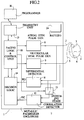
- FIG. 2 is a block circuit diagram of the basic components of a pacemaker constructed in accordance with the principles of the present invention, connected to a heart.
- FIG. 3 illustrates voltages arising on the atrial electrode and on the ventricle electrode during operation of the pacemaker shown in FIG. 2.
- FIG. 4 is a block circuit diagram of each of the differential detector and the correlation detector shown in FIG. 2.
- FIG. 5 shows the respective outputs of the differential detector and the correlation detector in the circuit of FIG. 2 in the presence of an evoked response following an artificial atrial stimulation.
- FIG. 6 shows the respective outputs of the differential detector and the correlation detector in the circuit of FIG. 2 in the case of no evoked response following an artificial atrial stimulation.
- FIG. 7 shows the respective outputs of the differential detector and the correlation detector in the circuit of FIG. 2 in the presence of an evoked response following an artificial ventricular stimulation.
- FIG. 8 shows the respective outputs of the differential detector and the correlation detector in the circuit of FIG. 2 in the case of no evoked response following an artificial ventricular stimulation.
- FIG. 9 shows the respective outputs of the differential detector and the correlation detector in the circuit of FIG. 2 in the presence of a spontaneous atrial signal.
- FIG. 10 shows the respective outputs of the differential detector and the correlation detector in the circuit of FIG. 2 following a spontaneous ventricular heart signal.
- FIG. 11 illustrates the respective outputs of the differential detector and the correlation detector in the circuit of FIG. 2 in the presence of external interference.
- FIG. 1 illustrates an implantable pacemaker 1 for stimulating and sensing cardiac activity in vivo in a (schematically illustrated) heart 4.
- the pacemaker 1 is in electrical connection with the heart 4 by means of a unipolar atrial lead 2 and a unipolar ventricular lead 5.
- the atrial lead 2 terminates in an electrode 3 disposed at a suitable location in the right atrium of the heart 4, and the ventricular lead 5 terminates in an elect rode 6 disposed at a suitable location in the right ventricle of the heart 4.
- the respective positions of the electrodes 3 and 6 within the heart 4 shown in FIG.1 are for exemplary purposes only; the electrodes 3 and 6 can be placed at any suitable locations respectively in the right atrium and the right ventricle in accordance with the physiology and pacing therapy associated with a particular patient. Moreover, only one lead and electrode may be used (active) i.e., only the atrial electrodes 3 or only the ventricular electrode 6, in the case of single-chamber pacing, although both leads and electrodes will still be present.
- the basic components of the implantable pacemaker 1 are shown in FIG. 2, in accordance with the principles of the present invention.
- the pacemaker 1 has a metallic pacemaker enclosure 7 to which the leads 2 and 5 are mechanically and electrically connected in a known manner (not shown in greater detail).
- Electrical pulses for artificially stimulating the atrium of the heart 4 are generated by an atrial stimulation pulse generator 8, connected to the atrial lead 2, and are delivered to the right atrium via the lead 2 and the electrode 3.
- ventricular stimulation pulses are generated by a ventricular stimulation pulse generator 9, and are supplied to the right ventricle of the heart 4 via the ventricular lead 5 and the electrode 6.
- the duration, energy content, rate and other standard features of the atrial and ventricular stimulation pulses are set by means of a pacing logic and control unit 10, connected to the atrial stimulation pulse generator 8 and to the ventricular stimulation pulse generator 9.
- the pacing logic and control unit 10 contains all of the necessary, known electronics, including a microprocessor and a memory, for operating a programmable implanted pacemaker.
- the atrial lead 2 is connected to a differential detector 11 and, via a switching stage 13, to a correlation detector 12.
- the ventricular lead 5 is also connected to the differential detector 11 and is also connected, via the switching stage 13, to the correlation detector 12 via the same input as the atrial lead 2.
- the other input to the correlation detector 12 is connected to the metallic pacemaker enclosures 7. Detecting therefore always takes place in the differential detector 11 between the atrial electrode 3 and the ventricular electrode 6, whereas detection in the correlation detector 12 takes place, depending on the state of the switching stage 13, between the atrial electrode 3 and the pacemaker enclosure 7, or between the ventricular electrode 6 and the pacemaker enclosure 7.
- the state of the switching stage 13 is controlled by a signal supplied from the pacing logic and control unit 10 generated as a part of the operating program.
- the switching stage 13 may, for example, be a suitable network of switching transistors.
- the output of the differential detector 11 is a heart differential signal HD and the output of the correlation detector 12 is a heart signal correlation HC.
- the signals HD and HC are both supplied to decision logic 14 which, as described in more below, not only identifies whether an evoked response has occurred following an artificial stimulation of either the ventricle or the atrium, but also identifies the source of the evoked response, i.e., whether it was detected by the atrial electrode 3 or by the ventricular electrode 6.
- Activity detected by the atrial electrode 3 is assumed to represent atrial activity, and activity detected by the ventricular electrode 6 is assumed to be ventricular activity.
- the decision logic 14 is in two-way communication with the pacing logic and control unit 10 so that the decision logic 14 is informed by the pacing logic and control unit 10 when an artificial atrial pulse or an artificial ventricular pulse has been caused to be emitted by one of the pulse generators 8 or 9, and so that the pacing logic and control unit 10 can be informed by the decision logic 14 if an evoked response has occurred.
- the pacing logic and control unit 10 contains standard circuitry for setting the energy content of the atrial and ventricular pulses respectively generated by the pulse generators 8 and 9 so as to be just enough to evoke an appropriate response upon delivery of those pulses to the heart 4, thereby conserving the power of the battery 24.
- the pacing logic and control unit 10 also includes suitable demand circuitry so that pulses are caused to be emitted by the pulse generators 8 and 9 only in the absence of natural or spontaneous atrial and/or ventricular activity.
- the pacing logic and control unit 10 can, per programmed instructions, operate the pulse generators 8 and/or 9 for single-chamber or dual-chamber pacing.
- the pacing logic and control unit 10 is also for two-way communication with a telemetry unit 15, the telemetry unit 15, in turn, being in communication with an extracorporeal programmer 16, such as by RF communication.
- the programmer 16 is used not only to program the operation of the pacemaker 1, but also to enter new or updated operating parameters into the pacing logic and control unit 10 for use in the operating program.
- the programmer 16 is also used to periodically download accumulated, stored historical information regarding the operation of the pacemaker 1, and the state of the heart 4, over an extended period of time.
- Exemplary signals appearing on the atrial electrode 2 and the ventricular electrode 6 are shown in FIG. 3 to provide a brief explanation of the manner by which the amplitude of the stimulation pulses can be adjusted so as to be set at an energy content which is just high enough to cause an evoked response in the heart 4.
- FIG. 3 it is assumed that only the pulses supplied to the atrium via the atrial electrode 2 and the atrial electrode 3 are being varied, however, the same principle applies to the pulses supplied via the ventricular lead 5 and the ventricular electrode 6.
- the atrial stimulation pulse generator 8 having a first amplitude, and this pulse results in an evoked response being detected, also via the atrial lead 2, in the manner described below.
- a ventricular stimulation pulse is caused by the pacing logic and control unit 10 to be emitted by the ventricular stimulation pulse generator 9.
- This pulse is delivered via the ventricular lead 5 and the ventricular electrode 6 to the heart 4, and this pulse also results in an evoked response being detected.
- the next atrial stimulation pulse is caused by the pacing logic and control unit 10 to be emitted by the atrial stimulation pulse generator 8.
- the atrial stimulation pulse generator 8 has been instructed by the pacing logic and control unit 10 to emit a pulse having a slightly lower amplitude, and thus a lower energy content, in comparison to the previous atrial stimulation pulse. (It will be understood that the energy content could alternatively be varied by emitting a second atrial pulse having the same amplitude, but of shorter duration.)
- the second atrial stimulation pulse does not have a sufficient energy content to evoke a response in the heart 4, and thus no evoked response signal follows the second atrial stimulation pulse.
- a third atrial stimulation pulse is thereby caused to be generated by the atrial stimulation pulse generator 8, with a larger energy content.
- this third atrial stimulation pulse again causes an evoked response, which is detected.
- a second ventricular pulse is thereby caused to be emitted.
- each of the differential detector 11 and the correlation detector 12 are shown in FIG. 4. These two detectors are identically constructed, however, for exemplary purposes, the differential detector 11 is shown in FIG. 4. As noted above, in the case of the differential detector 11, the two input signals will be signals which are respectively detected by the atrial electrode 3 and the ventricular electrode 6. In the case of the correlation detector 12, one input will always be connected to the pacemaker enclosure 7, whereas the other input will either be supplied from the atrial electrode 3 or the ventricular electrode 6, depending upon the state of the switching stage 13. The incoming signals in each of the detectors 11 and 12 are first supplied to a decoupling stage formed by switches, capacitors and resistors in a known manner.
- the switches are preferably switching transistors, which are operated by the pacing logic and control unit 10 so as to be open only during, and for a short time after, the emission of an artificial stimulation pulse, in order to avoid charging and saturation of the following input amplifier.
- the resistors and capacitors which are present in this network also afford some filtering characteristics.
- the incoming signals are then supplied to a signal filter 17, wherein remaining undesired signals can be filtered out of the incoming signal, and other suitable signal editing can also be undertaken in a known manner.
- the filtering can be undertaken with analog techniques, or by sampled digital filters.
- the output of the signal filter 17 is supplied to an amplifier 18 (although it is equally possible for amplification to take place preceding the signal filter 17). Amplification is normally needed to boost the low level incoming signals, which are on the order of a few millivolts, to a signal level on the order of one volt.
- the filtered and amplified signal is then supplied to first and second signal converters 19 and 20.
- the signal converter 19 may, for example, be a differentiator which takes the first derivative of the incoming signal, in which case the signal converter 20 will be a differentiating unit which takes the second derivative of the incoming signal.
- the signal converter 19 can be an integrator which integrates the incoming signal once, and the signal converter 20 can be an integrator which doubly integrates the incoming signal.
- the respective outputs of those converters are supplied to first and second comparator logic units.
- the comparator logic units 21 and 22 respectively emit high or low logic signals depending on whether the comparison criteria have been met.
- the comparison criterion in each comparison logic unit 21 and 22 is a threshold level, and if the signal from the respective signal converters 19 and 20 exceeds the threshold level, this is an indication tending toward the presence of an evoked response. More complicated comparison criterion may be employed, however, such as requiring the presence of a sequence of signal features which exceed a predetermined threshold or other known criteria.
- the outputs of the comparator logic units 21 and 22 are supplied to a detection logic unit 23. If only one signal converter and only one comparator logic unit are employed, then the output of the comparator logic unit becomes the output of the differential detector 11 (or correlation detector 12), and the detection logic unit 23 is not necessary. In the exemplary embodiment of FIG. 4, however, wherein two signal converters 19 and 20 and two comparison logic units 21 and 22 are employed, the detection logic unit 23 generates a high logic output if the signals at its inputs satisfy predetermined, or programmed, detection criteria, such as both inputs being high, or at least one input being high. If both inputs are low, no evoked response is assumed to have occurred. The output of the detection logic unit 23, in this case the signal HD, is then supplied to the decision logic 14.
- the detection takes place in the subject matter disclosed herein using differential signals respectively obtained via unipolar electrodes in the atrium and the ventricle, the detection is substantially free of external signal interference, because such interference, if it exists, is present in substantially the same degree in each incoming signal, and thus is substantially canceled or eliminated during the differential detection. Because the detection is differential, however, it is not possible to determine with certainty, simply by means of the differential detection, whether the incoming signal originated in the atrium or in the ventricle. The origin of the incoming signal may be inferred due to the timing of the detection, however, in order to improve the accuracy in the identification of the origin of the detected signal, the correlation detector 12 is provided.
- the only function of the correlation detector 12 is to determine from which chamber the incoming signal originated, or at least two assign an origin to the incoming signal with the highest probability.
- the detected activity may be a spontaneous heartbeat either in the atrium or in the ventricle, or an evoked heartbeat from one of the chambers, produced by an artificially generated atrial or ventricular stimulation pulse.
- Any information used by the pacing logic and control unit 10 to set the timing of the artificially generated pulses can be supplied from the pacing logic and control unit 10 to the decision logic 14 to assist in identifying the type of activity which has been detected.
- FIGS. 5-11 show various possibilities for the signals HD and HC produced by different types of cardiac activity.
- the downwardly extending pulse is a marker pulse which is generated simultaneously when the pacing logic and control unit 10 causes either the atrial stimulation pulse generator 8 to emit an atrial pulse, or the ventricular stimulation pulse generator 9 to emit a ventricular pulse.
- the generation of such as marker pulse is accomplished in a known manner, and it proceeds on the lead via which the pulse is delivered to the heart 4.
- the respective outputs of the differential detector 11 i.e. the signal HD
- the correlation detector 12 i.e., the signal HC
- a pulse produced by the differential detector 11 indicates the detection of any type of evoked response, and a pulse emitted by the correlation detector 12 is caused either by the particular chamber to which it is connected, or from interference.
- the correlation detector 12 is connected between the ventricle (i.e., the ventricular electrode 6) and the pacemaker enclosure 7.
- FIGS. 5 and 6 the presence of the marker pulse indicates that an artificial atrial stimulation pulse was generated, and FIG. 5 shows the signal HD when an evoked response occurs, and FIG. 6 shows the signal HD in the absence of an evoked response. As can be seen in FIGS. 5 and 6, an evoked response does not cause any pulse to be included in the signal HC.
- FIGS. 7 and 8 A similar situation with respect to the ventricle is shown in FIGS. 7 and 8, wherein the marker pulse indicates the delivery of an artificial ventricular stimulation pulse, and FIG. 7 shows the presence of an evoked response in the signal HD, and FIG. 8 shows the absence of an evoked response in signa HD. Since the correlation detector 12 is connected to the ventricle, the evoked ventricular response causes a pulse to be present in the HC signal, as shown in FIG. 7.
- FIG. 9 shows the signals in the case of a spontaneous atrial contraction, and thus no marker pulse is present since no artificial pulse was generated. Again, however, the atrial response results in a pulse being present in the signal HD of FIG. 9, but no such pulse is present in the signal HC.
- the signals in the case of a spontaneous ventricular contraction are shown in FIG. 10, resulting in a pulse being present in each of the signals HD and HC.
- FIG. 11 shows in example of the signals HD and HC in the presence of external interference, which may arise from external electrical sources or skeletal muscles.
- external interference will result in a pulse being generated by the correlation detector 12, which is present in the signal HC, however, the interference has no effect on the signal HD.
Landscapes
- Health & Medical Sciences (AREA)
- Cardiology (AREA)
- Heart & Thoracic Surgery (AREA)
- Life Sciences & Earth Sciences (AREA)
- Radiology & Medical Imaging (AREA)
- Nuclear Medicine, Radiotherapy & Molecular Imaging (AREA)
- Biomedical Technology (AREA)
- Engineering & Computer Science (AREA)
- Animal Behavior & Ethology (AREA)
- General Health & Medical Sciences (AREA)
- Public Health (AREA)
- Veterinary Medicine (AREA)
- Biophysics (AREA)
- Physiology (AREA)
- Electrotherapy Devices (AREA)
Applications Claiming Priority (2)
| Application Number | Priority Date | Filing Date | Title |
|---|---|---|---|
| US536453 | 1995-09-29 | ||
| US08/536,453 US5607457A (en) | 1995-09-29 | 1995-09-29 | Pacemaker with evoked response detection by using differential sensing between two unipolar electrodes |
Publications (3)
| Publication Number | Publication Date |
|---|---|
| EP0765672A2 true EP0765672A2 (fr) | 1997-04-02 |
| EP0765672A3 EP0765672A3 (fr) | 1998-10-28 |
| EP0765672B1 EP0765672B1 (fr) | 2004-06-09 |
Family
ID=24138558
Family Applications (1)
| Application Number | Title | Priority Date | Filing Date |
|---|---|---|---|
| EP96114274A Expired - Lifetime EP0765672B1 (fr) | 1995-09-29 | 1996-09-06 | Stimulateur cardiaque avec détection de la réaction provoquée |
Country Status (4)
| Country | Link |
|---|---|
| US (1) | US5607457A (fr) |
| EP (1) | EP0765672B1 (fr) |
| JP (1) | JPH09103503A (fr) |
| DE (1) | DE69632673T2 (fr) |
Families Citing this family (9)
| Publication number | Priority date | Publication date | Assignee | Title |
|---|---|---|---|---|
| US5720768A (en) * | 1996-05-22 | 1998-02-24 | Sulzer Intermedics Inc. | Dual chamber pacing with interchamber delay |
| US5697957A (en) * | 1996-08-29 | 1997-12-16 | Pacesetter Ab | Adaptive method and apparatus for extracting an evoked response component from a sensed cardiac signal by suppressing electrode polarization components |
| US5871507A (en) * | 1997-06-06 | 1999-02-16 | Pacesetter Ab | Implantable cardiac assist device having differential signal detection between unipolar atrial and ventricular leads using signal morphology analysis |
| SE9704311D0 (sv) * | 1997-11-24 | 1997-11-24 | Pacesetter Ab | A cardiac event detecting system for a heart stimulator |
| US6427085B1 (en) * | 1999-05-11 | 2002-07-30 | Cardiac Pacemakers, Inc. | Cardiac sense amplifier for capture verification |
| SE9902847D0 (sv) | 1999-08-05 | 1999-08-05 | Pacesetter Ab | A cardiac stimulating device |
| US7474922B2 (en) * | 2002-12-20 | 2009-01-06 | Biotronik Gmbh & Co. Kg | Multi chamber capture detection |
| US7089049B2 (en) * | 2003-04-25 | 2006-08-08 | Medtronic, Inc. | Removing polarization artifacts from electrical activity signals to detect cardiac evoked response |
| EP1814438B8 (fr) * | 2004-11-08 | 2009-04-01 | Koninklijke Philips Electronics N.V. | Identification et association securisees de sondes radio |
Family Cites Families (13)
| Publication number | Priority date | Publication date | Assignee | Title |
|---|---|---|---|---|
| DE3247264A1 (de) * | 1982-12-21 | 1984-06-28 | Siemens AG, 1000 Berlin und 8000 München | Bifokaler herzschrittmacher mit zwei unipolaren elektroden |
| US4712554A (en) * | 1985-04-08 | 1987-12-15 | Baylor College Of Medicine | Electronic system to distinguish between sinus and nonsinus atrial depolarizations which do not stimulate ventricular depolarizations in response to nonsinus atrial depolarizations |
| US4708144A (en) * | 1986-10-06 | 1987-11-24 | Telectronics N.V. | Automatic sensitivity control for a pacemaker |
| US4779617A (en) * | 1986-10-06 | 1988-10-25 | Telectronics N.V. | Pacemaker noise rejection system |
| IL82698A0 (en) * | 1987-05-29 | 1987-11-30 | Univ Ramot | Method and apparatus for indicating repetition intervals of a specified component of a composite electrical signal,particularly useful for displaying fetal r-waves |
| US4898182A (en) * | 1988-02-04 | 1990-02-06 | Brian Hawkins | Apparatus for evaluating heart fitness |
| US5222493A (en) * | 1990-10-01 | 1993-06-29 | Siemens Pacesetter, Inc. | Verification of capture using an indifferent electrode mounted on the pacemaker connector top |
| US5265602A (en) * | 1992-07-13 | 1993-11-30 | Medtronic, Inc. | Ring-to-ring cardiac electrogram pacemaker |
| SE9203542D0 (sv) * | 1992-11-25 | 1992-11-25 | Siemens Elema Ab | Hjaertstimulator |
| US5365932A (en) * | 1993-09-02 | 1994-11-22 | Telectronics Pacing System, Inc. | Cardiac signal sensing device having sensitivity automatically controlled in response to metabolic demand |
| US5443485A (en) * | 1993-09-08 | 1995-08-22 | Intermedics, Inc. | Apparatus and method for capture detection in a cardiac stimulator |
| SE9303121D0 (sv) * | 1993-09-24 | 1993-09-24 | Siemens Elema Ab | Hjärtstimulator |
| US5431693A (en) * | 1993-12-10 | 1995-07-11 | Intermedics, Inc. | Method of verifying capture of the heart by a pacemaker |
-
1995
- 1995-09-29 US US08/536,453 patent/US5607457A/en not_active Expired - Fee Related
-
1996
- 1996-09-06 DE DE69632673T patent/DE69632673T2/de not_active Expired - Fee Related
- 1996-09-06 EP EP96114274A patent/EP0765672B1/fr not_active Expired - Lifetime
- 1996-09-27 JP JP8256734A patent/JPH09103503A/ja active Pending
Also Published As
| Publication number | Publication date |
|---|---|
| DE69632673D1 (de) | 2004-07-15 |
| JPH09103503A (ja) | 1997-04-22 |
| DE69632673T2 (de) | 2005-06-09 |
| EP0765672A3 (fr) | 1998-10-28 |
| US5607457A (en) | 1997-03-04 |
| EP0765672B1 (fr) | 2004-06-09 |
Similar Documents
| Publication | Publication Date | Title |
|---|---|---|
| US4567892A (en) | Implantable cardiac pacemaker | |
| US5522855A (en) | Implantable cardiac stimulator | |
| EP0882469B1 (fr) | Stimulateur cardiaque implantable | |
| US5243979A (en) | Method and apparatus for implementing activity sensing in a pulse generator | |
| US5388586A (en) | Methods and apparatus for sensing intracardiac signals for an inplantable cardiac pacemaker | |
| US8509896B2 (en) | Biventricular cardiac stimulator | |
| US6427085B1 (en) | Cardiac sense amplifier for capture verification | |
| US4827934A (en) | Sensing margin detectors for implantable electromedical devices | |
| US6175766B1 (en) | Cardiac pacemaker autothreshold arrangement and method with reliable capture | |
| US6961613B2 (en) | Implantable bi-ventricular stimulation device and system, and bi-ventricular stimulation and sensing method | |
| EP0826392B1 (fr) | Appareil d'extraction d'une composante de réponse provoquée à partir d'un signal cardiaque mesuré, en supprimant les composantes de polarisation d'électrode | |
| JP2809511B2 (ja) | プログラム可能な出力パルス振幅を有する心臓ペースメーカ | |
| EP0640359B1 (fr) | Stimulateur cardiaque avec plusieurs capteurs avec petite consommation énergétique | |
| EP1594568B1 (fr) | Mesure d'impedance dans un dispositif implante | |
| EP0191404A1 (fr) | Palpeur de l'activité pour la commande des stimulateurs cardiaques | |
| EP1620177B1 (fr) | Allongement dynamique d'un intervalle d'entrainement permettant de detecter une activite ventriculaire intrinseque | |
| JPH034877A (ja) | 植え込み可能な医学装置 | |
| CA1272763A (fr) | Capteur physiologique pour le reglage automatique de l'intervalle de stimulation d'un stimulateur cardiaque | |
| JPH09507773A (ja) | 自動捕捉検出中にペースメーカを制御するための方法および装置 | |
| EP0657186A2 (fr) | Stimulateur cardiaque dont les modes de fonctionnement sont commandés par un aimant | |
| US5607457A (en) | Pacemaker with evoked response detection by using differential sensing between two unipolar electrodes | |
| US5314449A (en) | Rate-adaptive cardiac pacemaker | |
| JP2001520545A (ja) | 異所性収縮を検出するための極性検出を備えた埋込可能心臓刺激器 | |
| EP1539297B1 (fr) | Systeme de stimulation cardiaque avec marge de securite variable | |
| US7203544B2 (en) | Detection of evoked post-stimulation potentials, in particular atrial potentials in an active implantable medical device such as cardiac pacemaker, defribillator, cardiovertor or multisite device |
Legal Events
| Date | Code | Title | Description |
|---|---|---|---|
| PUAI | Public reference made under article 153(3) epc to a published international application that has entered the european phase |
Free format text: ORIGINAL CODE: 0009012 |
|
| AK | Designated contracting states |
Kind code of ref document: A2 Designated state(s): DE ES FR GB IT |
|
| PUAL | Search report despatched |
Free format text: ORIGINAL CODE: 0009013 |
|
| AK | Designated contracting states |
Kind code of ref document: A3 Designated state(s): DE ES FR GB IT |
|
| 17P | Request for examination filed |
Effective date: 19990428 |
|
| RAP1 | Party data changed (applicant data changed or rights of an application transferred) |
Owner name: ST. JUDE MEDICAL AB |
|
| 17Q | First examination report despatched |
Effective date: 20020806 |
|
| GRAP | Despatch of communication of intention to grant a patent |
Free format text: ORIGINAL CODE: EPIDOSNIGR1 |
|
| GRAS | Grant fee paid |
Free format text: ORIGINAL CODE: EPIDOSNIGR3 |
|
| GRAA | (expected) grant |
Free format text: ORIGINAL CODE: 0009210 |
|
| AK | Designated contracting states |
Kind code of ref document: B1 Designated state(s): DE ES FR GB IT |
|
| REG | Reference to a national code |
Ref country code: GB Ref legal event code: FG4D |
|
| REF | Corresponds to: |
Ref document number: 69632673 Country of ref document: DE Date of ref document: 20040715 Kind code of ref document: P |
|
| PG25 | Lapsed in a contracting state [announced via postgrant information from national office to epo] |
Ref country code: GB Free format text: LAPSE BECAUSE OF NON-PAYMENT OF DUE FEES Effective date: 20040909 |
|
| PG25 | Lapsed in a contracting state [announced via postgrant information from national office to epo] |
Ref country code: ES Free format text: LAPSE BECAUSE OF FAILURE TO SUBMIT A TRANSLATION OF THE DESCRIPTION OR TO PAY THE FEE WITHIN THE PRESCRIBED TIME-LIMIT Effective date: 20040920 |
|
| ET | Fr: translation filed | ||
| PLBE | No opposition filed within time limit |
Free format text: ORIGINAL CODE: 0009261 |
|
| STAA | Information on the status of an ep patent application or granted ep patent |
Free format text: STATUS: NO OPPOSITION FILED WITHIN TIME LIMIT |
|
| GBPC | Gb: european patent ceased through non-payment of renewal fee |
Effective date: 20040909 |
|
| 26N | No opposition filed |
Effective date: 20050310 |
|
| PGFP | Annual fee paid to national office [announced via postgrant information from national office to epo] |
Ref country code: FR Payment date: 20060831 Year of fee payment: 11 |
|
| PGFP | Annual fee paid to national office [announced via postgrant information from national office to epo] |
Ref country code: DE Payment date: 20060927 Year of fee payment: 11 |
|
| PGFP | Annual fee paid to national office [announced via postgrant information from national office to epo] |
Ref country code: IT Payment date: 20060930 Year of fee payment: 11 |
|
| PG25 | Lapsed in a contracting state [announced via postgrant information from national office to epo] |
Ref country code: DE Free format text: LAPSE BECAUSE OF NON-PAYMENT OF DUE FEES Effective date: 20080401 |
|
| REG | Reference to a national code |
Ref country code: FR Ref legal event code: ST Effective date: 20080531 |
|
| PG25 | Lapsed in a contracting state [announced via postgrant information from national office to epo] |
Ref country code: FR Free format text: LAPSE BECAUSE OF NON-PAYMENT OF DUE FEES Effective date: 20071001 |
|
| PG25 | Lapsed in a contracting state [announced via postgrant information from national office to epo] |
Ref country code: IT Free format text: LAPSE BECAUSE OF NON-PAYMENT OF DUE FEES Effective date: 20070906 |