EP0765949B1 - Alliage de tungstène-lanthane en forme d'un fil pour un filament d'une lampe résistant aux vibrations - Google Patents
Alliage de tungstène-lanthane en forme d'un fil pour un filament d'une lampe résistant aux vibrations Download PDFInfo
- Publication number
- EP0765949B1 EP0765949B1 EP96112165A EP96112165A EP0765949B1 EP 0765949 B1 EP0765949 B1 EP 0765949B1 EP 96112165 A EP96112165 A EP 96112165A EP 96112165 A EP96112165 A EP 96112165A EP 0765949 B1 EP0765949 B1 EP 0765949B1
- Authority
- EP
- European Patent Office
- Prior art keywords
- tungsten
- filament
- lanthanum
- powder
- wire
- Prior art date
- Legal status (The legal status is an assumption and is not a legal conclusion. Google has not performed a legal analysis and makes no representation as to the accuracy of the status listed.)
- Expired - Lifetime
Links
Images




Classifications
-
- H—ELECTRICITY
- H01—ELECTRIC ELEMENTS
- H01K—ELECTRIC INCANDESCENT LAMPS
- H01K1/00—Details
- H01K1/02—Incandescent bodies
- H01K1/04—Incandescent bodies characterised by the material thereof
- H01K1/10—Bodies of metal or carbon combined with other substance
-
- C—CHEMISTRY; METALLURGY
- C22—METALLURGY; FERROUS OR NON-FERROUS ALLOYS; TREATMENT OF ALLOYS OR NON-FERROUS METALS
- C22C—ALLOYS
- C22C1/00—Making non-ferrous alloys
- C22C1/04—Making non-ferrous alloys by powder metallurgy
- C22C1/05—Mixtures of metal powder with non-metallic powder
- C22C1/059—Making alloys comprising less than 5% by weight of dispersed reinforcing phases
-
- C—CHEMISTRY; METALLURGY
- C22—METALLURGY; FERROUS OR NON-FERROUS ALLOYS; TREATMENT OF ALLOYS OR NON-FERROUS METALS
- C22C—ALLOYS
- C22C1/00—Making non-ferrous alloys
- C22C1/10—Alloys containing non-metals
-
- C—CHEMISTRY; METALLURGY
- C22—METALLURGY; FERROUS OR NON-FERROUS ALLOYS; TREATMENT OF ALLOYS OR NON-FERROUS METALS
- C22F—CHANGING THE PHYSICAL STRUCTURE OF NON-FERROUS METALS AND NON-FERROUS ALLOYS
- C22F1/00—Changing the physical structure of non-ferrous metals or alloys by heat treatment or by hot or cold working
- C22F1/16—Changing the physical structure of non-ferrous metals or alloys by heat treatment or by hot or cold working of other metals or alloys based thereon
- C22F1/18—High-melting or refractory metals or alloys based thereon
Definitions
- the present invention relates to a vibration resistant filament and a method of producing same in accordance with the generic clauses of claims 1 and 5.
- a filament for an incandescent lamp with high vibration resistance must have a microstructure specifically tailored to resist fracture caused by vibration of the lamp.
- Such vibration resistant microstructures typically include a high proportion of elongated grains oriented in the longitudinal (axial) direction, with several elongated grains across the diameter of the filament wire and long segments of grain boundaries running parallel to the filament wire axis. This type of microstructure is distinct from an equiaxed microstructure, which exhibits only short segments of grain boundaries running parallel to the wire axis. The abundant long grain boundaries in the highly vibration resistant microstructure act effectively as vibration dampeners, reducing the tendency of the filament wire to fracture.
- the microstructure of a filament for a highly vibration resistant lamp is also different from that of a standard incandescent lamp.
- the standard incandescent lamp performs best when the filament during operation has a good non-sag microstructure.
- a typical non-sag microstructure is characterized by being largely free of grain boundaries, with an occasional wire segment including a long grain boundary running parallel to the wire axis. This type of non-sag microstructure is called an interlocking grain structure.
- tungsten-based wire having a degraded non-sag microstructure
- tungsten-based wire including 3 weight percent rhenium
- tungsten-thorium oxide wire a type of non-sag wire having a degraded non-sag microstructure
- the degraded non-sag wire is the most readily fabricated and least expensive of the alternatives. However, it is used only for the least severe applications, since it does not perform as well as the other alternatives.
- the tungsten-rhenium wire is used for applications where the filament temperature is the highest, and for alternating current applications where the wire diameter is finer than for typical direct current applications.
- Tungsten-thoria wire is used for most other applications because it performs well and is less expensive than the tungsten-rhenium wire.
- the thorium in the tungsten-thoria wire is a radioactive material. Because of the radioactivity of thoria, the cost of manufacturing the alloy is increased. Care must be taken at each step to limit exposure of the workers to radioactive dust. Additionally, scrap generated in the process must be disposed of as low level radioactive waste in an appropriate disposal site. Thus the disposal cost is much higher than that for non-radioactive tungsten scrap, which can be recycled.
- the invention is a vibration resistant filament for an incandescent lamp.
- the filament includes about 0.05 - 1.00 weight percent lanthanum oxide dispersed in a tungsten matrix.
- the filament is fabricated from a wire having a microstructure including stringers of fine particles of lanthanum oxide extending parallel to the filament axis. After primary recrystallization, the stringers produce a microstructure in the filament exhibiting sufficient grain boundary segments extending generally axially along the length of the filament to render the filament resistant to vibration.
- the invention is a method for producing a vibration resistant filament for an incandescent lamp.
- the method involves preparing a tungsten-based powder containing particles of a lanthanum compound reducible to lanthanum oxide.
- a sintered ingot is produced from the tungsten-based powder such that the lanthanum compound particles are converted to lanthanum oxide particles, the amount of the lanthanum compound particles in the tungsten-based powder being selected to produce about 0.05 - 1.00 weight percent lanthanum oxide particles in the sintered ingot.
- a wire is drawn from the ingot, the lanthanum oxide particles being broken up during the drawing process to form stringers of smaller particles of lanthanum oxide extending parallel to the axis of the wire.
- a filament is shaped from said wire, and is heated to the primary recrystallization temperature of the wire to produce a vibration resistant microstructure in the filament.
- the preparation of the tungsten-based powder involves homogeneously blending a tungsten powder with about 0.06 - 1.17 weight percent lanthanum hydroxide powder to form the tungsten-based powder.
- the preparation of the tungsten-based powder involves mixing tungsten blue oxide powder into a solution of a soluble lanthanum salt to form a suspension in which the tungsten blue oxide powder is thoroughly wet by the solution. The suspension is then dried to provide a tungsten blue oxide powder doped with the lanthanum salt.
- Tungsten powder containing lanthanum oxide then may be produced by heating the doped tungsten blue oxide powder in a hydrogen atmosphere at a temperature and for a time sufficient to reduce the doped tungsten blue oxide powder to a tungsten-based powder containing lanthanum oxide particles.
- the amount of lanthanum salt in the lanthanum salt solution is selected to provide sufficient lanthanum to produce at least a preselected amount of about 0.05 - 1.00 weight percent of the lanthanum oxide particles in the tungsten-based powder. If necessary, the amount of lanthanum oxide particles in the tungsten-based powder is decreased to achieve the preselected amount of said lanthanum oxide particles by mixing with the tungsten-based powder a sufficient amount of tungsten powder.
- An ingot is then pressed from the lanthanum oxide containing tungsten-based powder and sintered to form the sintered ingot.
- the lamp filament wire is fabricated from a tungsten-lanthanum oxide alloy, that is, a tungsten metal with lanthanum oxide dispersed throughout the tungsten base.
- the tungsten raw material has a purity greater than about 99.9% by weight tungsten, more preferably, greater than 99.96%.
- the matrix is essentially pure tungsten with all unavoidable impurities in solution in the tungsten matrix.
- the lanthanum oxide raw material has a purity greater than about 99.9 weight % lanthanum oxide , more preferably, greater than 99.95%, and a particle size less than about 3 ⁇ m.
- the lanthanum oxide may be present in the tungsten in an amount of 0.05 - 1.00 %, preferably 0.08 - 0.70%, most preferably 0.15 - 0.45%, all percents expressed in percent by weight.
- the lanthanum oxide is homogeneously distributed throughout the tungsten metal by processes described in more detail below, then consolidated to produce an ingot of the alloy.
- Metalworking techniques used to draw the alloy into a filament wire cause the lanthanum oxide particles to break up in such a way that the final wire product exhibits stringers of smaller oxide particles extending in the direction of deformation of the wire during the metalworking process, i.e., generally parallel to the wire axis.
- stringers as used herein, is intended to mean a line of minute oxide particles spaced slightly apart from one another in the matrix.
- Figures 1A - 1D schematically illustrate axial cross sections of typical sections of tungsten-lanthana filament wire showing how a single stringer is formed during deformation.
- Figure 1A shows shaped tungsten-lanthana rod 10a before deformation, including matrix 12a and unbroken lanthana crystal 14a.
- Figure 1B shows slightly deformed rod 10b after one or more initial rolling or swaging steps, showing deformed, elongated lanthana crystal 14b in tungsten matrix 12b.
- Figure 1C shows wire 10c, the product of further drawing steps carried out on rod 10b;
- Figure 1C shows further deformed and elongated, but still unbroken lanthana crystal 14c.
- Figure 1D shows filament wire 10c after still further drawing steps, showing that lanthana crystal 14c has broken up, forming minute lanthana particles 14d.
- Particles 14d are separated by spaces 16 and are generally axially aligned within matrix 12d to form stringer 18. Because the lanthana crystal is deformed and elongated before breaking up, the minute lanthana particles are small and uniform in size, are separated by relatively uniform small spaces, and are nearly perfectly aligned with one another in the axial direction.
- the particles of the stringers are so minute that normally they are difficult to resolve under an ordinary microscope at fine wire sizes. It is preferred that the lanthanum oxide particles in the filament wire should all be less than about 1 ⁇ m in diameter with many of the particles being ⁇ 0.5 ⁇ m in diameter.
- the oxide stringers pin grain boundaries during primary recrystallization, leaving many grain boundaries with segments parallel to the wire axis.
- the primary recrystallized microstructure is thus the desired structure for a lamp filament exhibiting excellent vibration resistance.
- the different properties of the tungsten-lanthana filament wire from the tungsten-thoria wire are largely a result of their different microstructures which are, in turn, the result of the different properties of lanthana and thoria.
- PROPERTY THORIA LANTHANA Melting point, °C 3220° 2307° Crystal structure cubic rhombohedral Density, 6/cm 3 9.86 6.51 Stability in H 2 above 3220°C below 2000°C
- Figures 2A - 2D also not drawn to scale, schematically illustrate axial cross sections of typical sections of tungsten-thoria filament wire showing, in a manner similar to that of Figures 1A - 1D, how a single stringer is formed during deformation.
- Figure 2A shows shaped tungsten-thoria rod 20a before deformation, including matrix 22a and unbroken thoria crystal 24a.
- Figure 2B shows slightly deformed rod 20b after one or more initial deformation steps, showing breaking up of thoria crystal 24a earlier in the deformation process than occurs with the lanthana crystal shown in Figures 1A - 1D.
- Thoria crystal 24a forms smaller thoria crystals 24b in tungsten matrix 22b.
- Figure 2C shows wire 20c, the product of further drawing steps carried out on rod 20b, wire 20c exhibiting further broken up, still smaller thoria crystals 24c.
- Figure 2D shows filament wire 20c after still further drawing steps, showing that thoria crystals 24c have been even further broken up, forming minute thoria particles 24d.
- Particles 24d are non-uniform in size and are separated by non-uniform spaces 26 to form stringer 28. Further, in stringer 28 particles 24d have poorer axial alignment within matrix 22d than lanthanum oxide because the thoria crystal is broken up early in the deformation process.
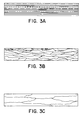
- Figures 3A - 3C illustrate the effect of another difference between the lanthana-doped and thoria-doped tungsten filament wires.
- Figure 3A shows an as-drawn filament wire of tungsten resulting from many stringers of lanthanum oxide particles similar to lanthana particle stringer 18 of Figure 1D. After primary recrystallization at about 2000°C, the microstructure of the wire is changed to that shown in Figure 3B. That is, during primary recrystallization the lanthanum oxide stringers pin grain boundaries of the tungsten, causing the tungsten to form elongated grains lying parallel to the wire axis, with many grains across the diameter of the wire.
- This filament wire is highly vibration resistant, i.e., non-brittle in shock, and fairly low in sag.
- the microstructure is transformed to that shown in Figure 3C. Grain growth has consumed the smaller elongated grains, producing a microstructure of large grains with few axial grain boundaries across the diameter of the wire. This microstructure is low in sag, but is too brittle to be resistant to vibration shock.
- the transformation of the tungsten-thoria filament wire during primary and secondary recrystallizations takes place at lower temperatures, i.e., 1800°C and 2100°C, respectively, as shown in Table II.
- the tungsten-lanthana filament wire has been found to exhibit a primary recrystallized microstructure that is stable over a wider temperature range, for use in vibration resistant lamps operating at up to about 2000°C. Additionally, the tungsten-lanthana wire is more readily shaped into filament coils for use in lamps than some other filament wire materials.
- the preferred method for preparing the tungsten-lanthanum oxide alloy utilizes a dry doping technique.
- Tungsten powder is blended with an appropriate amount of lanthanum hydroxide (La(OH) 3 ) powder in a high intensity blender (e.g., a high intensity blender manufactured by Littleton/Day of Florence, KY, Model PMK-300-D) to homogeneously mix the two components.
- a high intensity blender e.g., a high intensity blender manufactured by Littleton/Day of Florence, KY, Model PMK-300-D
- Such high intensity blending is important because it increases the tap density of the powder, which facilitates subsequent filling of the molds used for pressing green bodies.
- both the tungsten powder and the blended powder have Fisher Subsieve (FSSS) method particle sizes of about 1.50 ⁇ m.
- the amount of lanthanum hydroxide added is selected to yield the desired doping level in the sintered tungsten metal. That is, for each percent by weight of lanthanum oxide desired in the doped tungsten metal, 1.17 weight percent lanthanum hydroxide is added to the tungsten powder.
- the preferred composition for the doped tungsten metal also called tungsten-lanthana alloy, is about 0.05 - 1.00 weight percent, more preferably about 0.08 - 0.70 weight percent, most preferably about 0.15 - 0.45 weight percent lanthanum oxide in the tungsten-lanthanum oxide alloy.
- about 0.06 - 1.17 weight percent, more preferably about 0.09 - 0.82 weight percent, most preferably about 0.18 - 0.53 weight percent lanthanum hydroxide must be added to the tungsten powder.
- the tungsten-lanthanum oxide alloy may be prepared by a wet doping method.
- Tungsten blue oxide (WO 2.8 ) is mixed with a solution of a soluble lanthanum salt until the tungsten blue oxide is thoroughly wet and a slurry is formed.
- the preferred lanthanum salt is lanthanum nitrate (La(NO 3 ) 3 ⁇ 6H 2 O).
- the suspension of tungsten blue oxide is then stirred and heated until all the liquid is evaporated, resulting in a doped tungsten blue oxide.
- the amount of lanthanum salt used for doping of the tungsten blue oxide is somewhat higher than that desired in the final product, to compensate for the amount of the lanthanum salt which clings to the surfaces of the mixing vessel.
- the amount of this excess is not critical, for the reason described below, and may be determined empirically.
- the doped tungsten blue oxide is then reduced in a hydrogen atmosphere in, e.g., a standard tube furnace or calciner to produce a tungsten metal powder containing lanthanum oxide. That is, during the reduction process, the lanthanum salt, e.g. lanthanum nitrate, decomposes to produce lanthanum oxide.
- a typical temperature for this reduction process is about 900°C.
- the amount of excess lanthanum salt added to the tungsten blue oxide slurry is not critical because, after doping, the metal powder is analyzed to determine the lanthanum content. Then, if necessary, the doped powder is blended with an appropriate amount of non-doped tungsten metal powder to achieve the desired lanthanum oxide concentration. Typically, the blended tungsten powder has a particle size, determined by the FSSS method, of about 1.50 ⁇ m.
- the blended lanthanum-tungsten powder is pressed, presintered, and sintered to form an ingot using conventional techniques, e.g., those used to produce tungsten-thoria alloys.
- Filament wire is formed from the sintered tungsten-lanthanum oxide ingot using conventional metalworking techniques, i.e., rolling, swaging, and wire drawing techniques, for example, those used to produce tungsten-thoria filament wire. Annealing of the wire is used to recrystallize and stress relieve the alloy at critical points in the metalworking process.
- vibration resistant incandescent lamp 30 in accordance with one embodiment of the present invention includes lamp base 32, light transmissive lamp envelope 34, and coil 36.
- Coil 36 is shaped of the lanthanum oxide doped tungsten filament wire described above. After primary recrystallization, the oxide stringers in the as-drawn wire produce a microstructure having an abundance of long grain boundaries running parallel to the wire axis, as shown in Figure 3B. This filament wire renders lamp 30 highly vibration resistant.
- Pure lanthanum oxide (La 2 O 3 ) powder is converted to lanthanum hydroxide (La(OH) 3 ) powder by heating in a water saturated atmosphere at 60°C to 12 hours.
- the lanthanum oxide powder is exposed to the water vapor until at least 95% of the lanthana is converted to the hydroxide, as measured by the weight gain.
- the conversion is performed to break up agglomerated lanthana particles and to prevent the occurrence of volume changes in the powder after pressing, which can cause breakup of pressed and/or partially sintered doped tungsten ingots.
- Pure tungsten powder (specification given below) is blended with an appropriate amount of lanthanum hydroxide powder for producing a tungsten-0.4% lanthana alloy (weight percent). The powders were blended for 1 hour in a Littleford High Intensity Blender at a blender load of about 300 kg.
- the powder mixture was pressed at 35-45 ksi to form 6.0 kg cylindrical ingots of lanthana doped tungsten, each 914 mm long and 27 mm in diameter.
- the compaction was performed by continuously increasing the pressure to maximum pressure with no stops. The pressure was released immediately upon reaching maximum pressure, with a rapid drop to atmospheric pressure.
- the pressed ingots Prior to sintering, the pressed ingots were presintered, two at a time, for 20 min at 1300°C in a push-through muffle furnace to give the ingots added handling strength. The ingots were then sintered in either a push-through muffle furnace or a batch induction furnace.
- the sintering schedule for the samples sintered in the push-through furnace involved a slow increase in temperature, over a period of 15-20 hours, to 1800°C; holding at 1800°C for at least 8 hours; then cooling.
- a typical sintering schedule for the samples sintered in the induction furnace was slow heating, over a period of about 11 hours, to 1200°C; holding 2 hours at 1200°C; slowly increasing the temperature, over a period of 7 hours, to 1800°C, holding 6 hours at 1800°C, and cooling.
- the sintered density of all samples was 17.60-18.00 g/cm 3 .
- the sintered ingot samples produced were pure tungsten-lanthana alloy, with the lanthana content at 0.4 percent by weight.
- the sintered ingots were processed by conventional metal working methods to produce a lanthana doped tungsten filament wire for use in vibration resistant lamps.
- similar filament wire samples of a tungsten-1.00% thoria alloy were also annealed for 30 seconds at various temperatures, and the 20°C tensile strengths of the samples were measured. All percents given above are weight percents.
- Tungsten-1% thoria includes the same volume percent oxide as tungsten-0.66% lanthana.
- the results are plotted in Figure 5, which shows the tungsten-thoria alloy, line 40, as the lowest tensile strength material.
- the tungsten-thoria alloy also has the lowest primary and secondary recrystallization temperatures, shown at arrows 42 and 44, respectively.
- the W-0.25% lanthana, line 46, W-0.40% lanthana, lane 48, and W-0.66% lanthana, line 50, alloys show increasing tensile strength with lanthana content, all three tungsten-lanthana alloys exhibiting greater tensile strength at all annealing temperatures than the tungsten-thoria alloy.
- primary and secondary recrystallization temperatures for all three tungsten-lanthana alloys are significantly higher than the corresponding temperatures for the W-1.00% thoria alloy. See, for example, the primary and secondary recrystallization temperatures shown at arrows 52 and 54, respectively, for the W-0.66% lanthana alloy.
- the invention described herein presents to the art a novel tungsten-lanthanum oxide lamp filament wire having excellent vibration resistance without the problems associated with radioactive materials.
- the tungsten-lanthana alloy filament wire can be coiled more easily than the prior art tungsten-thoria wire. Additionally, the novel tungsten-lanthanum oxide filament wire exhibits greatly improved microstructure and properties over prior art filament wires.
Landscapes
- Chemical & Material Sciences (AREA)
- Engineering & Computer Science (AREA)
- Materials Engineering (AREA)
- Mechanical Engineering (AREA)
- Metallurgy (AREA)
- Organic Chemistry (AREA)
- Dispersion Chemistry (AREA)
- Physics & Mathematics (AREA)
- Thermal Sciences (AREA)
- Crystallography & Structural Chemistry (AREA)
- Powder Metallurgy (AREA)
Claims (7)
- Filament résistant aux vibrations pour une lampe à incandescence, le dit filament comprenant entre 0,05 et 1,00 % en poids d'oxyde de lanthane dispersé dans une matrice de tungstène (12),
dans lequelle dit filament est réalisé à partir d'un fil présentant une microstructure incluant des crins (18) de fines particules du dit oxyde de lanthane s'étendant parallèlement à l'axe du dit filament, etle dit filament présente une microstructure produite par les crins après recristallisation primaire présentant au moins quatre segments limites de grain s'étendant de façon générale axialement dans la longueur du dit filament pour rendre le dit filament résistant aux vibrations. - Filament résistant aux vibrations selon la revendication 1, dans lequel le diamètre des fines particules du dit oxyde de lanthane est inférieur à 1 µm environ.
- Filament selon la revendication 1 comprenant entre 0,08 et 0,70 % en poids d'oxyde de lanthane, le reste étant du tungstène.
- Filament selon la revendication 3 comprenant entre 0,15 et 0,45 % en poids d'oxyde de lanthane, le reste étant du tungstène.
- Procédé de fabrication d'un filament résistant aux vibrations pour une lampe à incandescence, le dit procédé comprenant les étapes suivantes :dans lequelon prépare une poudre à base de tungstène contenant des particules d'un composé de lanthane réductible en oxyde de lanthane ;on réalise un lingot fritté à partir de la dite poudre à base de tungstène, de telle manière que les dites particules du composé de lanthane soient converties en particules d'oxyde de lanthane, la quantité des dites particules du composé de lanthane dans la dite poudre à base de tungstène étant choisie pour produire entre 0,05 et 1,00 % en poids de particules d'oxyde de lanthane dans le dit lingot fritté ;on étire d'un fil à partir du dit lingot,les dites particules d'oxyde de lanthane étant cassées pendant la dite étape d'étirage pour former des crins de particules plus petites du dit oxyde de lanthane s'étendant parallèlement à l'axe du dit fil;on met le dit fil en forme d'un filament ; eton chauffe le. dit filament jusqu'à la température de recristallisation primaire du dit fil pour produire une microstructure résistant aux vibrations dans le dit filament.
- Procédé selon la revendication 5, dans lequel l'étape de préparation de la dite poudre à base de tungstène comporte le mélange homogène d'une poudre de tungstène comprenant entre 0,06 et 1,17 % en poids de poudre d'hydroxyde de lanthane pour former la dite poudre à base de tungstène.
- Procédé selon la revendication 6, dans lequel :
l'étape de préparation de la dite poudre à base de tungstène comprend les sous-étapes suivantes :et l'étape de production du dit lingot fritté comprend les sous-étapes suivantes :on mélange la poudre d'oxyde bleu de tungstène dans une solution d'un sel de lanthane soluble pour former une suspension dans laquelle la dite poudre d'oxyde bleu de tungstène est totalement mouillée par la dite solution ; eton sèche la dite suspension pour obtenir une poudre d'oxyde bleu de tungstène dopée avec le dit sel de lanthane ;on chauffe la poudre d'oxyde bleu de tungstène dopée dans un gaz d'hydrogène à une température et pendant un temps suffisants pour réduire la dite poudre d'oxyde bleu de tungstène dopée en une poudre à base de tungstène contenant des particules d'oxyde de lanthane, dans laquelle la quantité du dit sel de lanthane dans la dite solution de sel de lanthane est choisie pour déterminer suffisamment de lanthane pour produire au moins une quantité présélectionnée comprise entre 0,05 et 1,00 % en poids des dites particules d'oxyde de lanthane dans la dite poudre à base de lanthane,on diminue, si nécessaire, la quantité des particules d'oxyde de lanthane dans la dite poudre à base de tungstène pour atteindre la dite quantité présélectionnée des dites particules d'oxyde de lanthane, en mélangeant la dite poudre à base de tungstène avec une quantité suffisante d'une poudre de tungstène;on presse un lingot à partir du dit oxyde de lanthane contenant la poudre à base de tungstène ; eton fritte le dit lingot pour former le dit lingot fritté.
Applications Claiming Priority (2)
| Application Number | Priority Date | Filing Date | Title |
|---|---|---|---|
| US08/507,184 US5604321A (en) | 1995-07-26 | 1995-07-26 | Tungsten-lanthana alloy wire for a vibration resistant lamp filament |
| US507184 | 2003-09-29 |
Publications (2)
| Publication Number | Publication Date |
|---|---|
| EP0765949A1 EP0765949A1 (fr) | 1997-04-02 |
| EP0765949B1 true EP0765949B1 (fr) | 1999-03-17 |
Family
ID=24017589
Family Applications (1)
| Application Number | Title | Priority Date | Filing Date |
|---|---|---|---|
| EP96112165A Expired - Lifetime EP0765949B1 (fr) | 1995-07-26 | 1996-07-26 | Alliage de tungstène-lanthane en forme d'un fil pour un filament d'une lampe résistant aux vibrations |
Country Status (4)
| Country | Link |
|---|---|
| US (2) | US5604321A (fr) |
| EP (1) | EP0765949B1 (fr) |
| DE (1) | DE69601767T2 (fr) |
| HU (1) | HUP9602039A3 (fr) |
Families Citing this family (12)
| Publication number | Priority date | Publication date | Assignee | Title |
|---|---|---|---|---|
| US6190466B1 (en) * | 1997-01-15 | 2001-02-20 | General Electric Company | Non-sag tungsten wire |
| AT2017U1 (de) * | 1997-05-09 | 1998-03-25 | Plansee Ag | Verwendung einer molybdän-/wolfram-legierung in bauteilen für glasschmelzen |
| JP3320650B2 (ja) * | 1997-07-24 | 2002-09-03 | 三菱電機株式会社 | タングステンまたはモリブデンからなる金属材料、同金属材料を使用した二次製品材の製造方法およびその方法を実施するための熱処理装置 |
| US6830637B2 (en) * | 2002-05-31 | 2004-12-14 | Osram Sylvania Inc. | Large diameter tungsten-lanthana rod |
| US20050155680A1 (en) * | 2004-01-16 | 2005-07-21 | Gyorgy Nagy | High ductility, high hot tensile strength tungsten wire and method of manufacture |
| GB0422608D0 (en) * | 2004-10-12 | 2004-11-10 | Hardide Ltd | Alloyed tungsten produced by chemical vapour deposition |
| DE102007013990A1 (de) * | 2007-03-23 | 2008-09-25 | Osram Gesellschaft mit beschränkter Haftung | Material für Elektroden oder Leuchtkörper und Elektrode bzw. Leuchtkörper |
| JP2016066447A (ja) * | 2014-09-24 | 2016-04-28 | 日本タングステン株式会社 | 輸送機器用発光フィラメント |
| CN107190195A (zh) * | 2017-05-04 | 2017-09-22 | 鹤山市沃得钨钼实业有限公司 | 一种稀土钨合金坩埚及其制造方法 |
| CN113186438B (zh) * | 2021-01-20 | 2022-09-13 | 厦门虹鹭钨钼工业有限公司 | 一种合金线材及其制备方法与应用 |
| CN113913665A (zh) * | 2021-09-30 | 2022-01-11 | 中国科学院重庆绿色智能技术研究院 | 纳米氧化镧增强钨基复合材料及其制备方法 |
| CN118639045B (zh) * | 2024-08-14 | 2024-11-01 | 崇义章源钨业股份有限公司 | 一种镧元素弥散分布的钨镧合金丝及其制备方法 |
Family Cites Families (14)
| Publication number | Priority date | Publication date | Assignee | Title |
|---|---|---|---|---|
| US3086103A (en) * | 1961-03-28 | 1963-04-16 | Union Carbide Corp | Refractory electrode-inert gas shielded-arc working |
| US3159908A (en) * | 1963-02-26 | 1964-12-08 | Du Pont | Dispersion hardened metal product and process |
| US3434811A (en) * | 1965-02-26 | 1969-03-25 | Gen Electric | Tungsten-hafnium-oxygen alloys |
| US3443143A (en) * | 1967-03-29 | 1969-05-06 | Westinghouse Electric Corp | Tungsten-base alloy and filament |
| US3927989A (en) * | 1969-09-30 | 1975-12-23 | Duro Test Corp | Tungsten alloy filaments for lamps and method of making |
| JPS62224495A (ja) * | 1986-03-24 | 1987-10-02 | Toho Kinzoku Kk | タングステン電極材料 |
| JPS63171846A (ja) * | 1987-01-09 | 1988-07-15 | Tokyo Tungsten Co Ltd | 管球用タングステン線 |
| AT386612B (de) * | 1987-01-28 | 1988-09-26 | Plansee Metallwerk | Kriechfeste legierung aus hochschmelzendem metall und verfahren zu ihrer herstellung |
| DE3835328C1 (fr) * | 1988-10-17 | 1989-12-14 | Gesellschaft Fuer Wolfram-Industrie Mbh, 8220 Traunstein, De | |
| US5148080A (en) * | 1990-01-16 | 1992-09-15 | Hilux Development | Incandescent lamp filament incorporating hafnium |
| US5072147A (en) * | 1990-05-09 | 1991-12-10 | General Electric Company | Low sag tungsten filament having an elongated lead interlocking grain structure and its use in lamps |
| US5284614A (en) * | 1992-06-01 | 1994-02-08 | General Electric Company | Method of forming fine dispersion of ceria in tungsten |
| JPH06297189A (ja) * | 1993-04-14 | 1994-10-25 | Toho Kinzoku Kk | タングステン電極材料 |
| JPH0754092A (ja) * | 1993-08-11 | 1995-02-28 | Tokyo Tungsten Co Ltd | 加熱圧接用電極 |
-
1995
- 1995-07-26 US US08/507,184 patent/US5604321A/en not_active Expired - Fee Related
-
1996
- 1996-04-04 US US08/628,221 patent/US5742891A/en not_active Expired - Lifetime
- 1996-07-25 HU HU9602039A patent/HUP9602039A3/hu unknown
- 1996-07-26 DE DE69601767T patent/DE69601767T2/de not_active Expired - Fee Related
- 1996-07-26 EP EP96112165A patent/EP0765949B1/fr not_active Expired - Lifetime
Also Published As
| Publication number | Publication date |
|---|---|
| HUP9602039A3 (en) | 1998-01-28 |
| DE69601767T2 (de) | 1999-07-08 |
| DE69601767D1 (de) | 1999-04-22 |
| US5604321A (en) | 1997-02-18 |
| HU9602039D0 (en) | 1996-09-30 |
| EP0765949A1 (fr) | 1997-04-02 |
| US5742891A (en) | 1998-04-21 |
| HUP9602039A2 (en) | 1997-05-28 |
Similar Documents
| Publication | Publication Date | Title |
|---|---|---|
| US4373947A (en) | Process for the preparation of alloy powders which can be sintered and which are based on titanium | |
| EP0765949B1 (fr) | Alliage de tungstène-lanthane en forme d'un fil pour un filament d'une lampe résistant aux vibrations | |
| US5284614A (en) | Method of forming fine dispersion of ceria in tungsten | |
| US3236699A (en) | Tungsten-rhenium alloys | |
| DE19813988C1 (de) | Verfahren zur Herstellung eines aus durch feinverteilte, kleine Teilchen aus Unedelmetalloxid dispersionsverfestigtem Platinwerkstoff bestehenden, geschweißten, insbesondere mindestens eine Innenwand aufweisenden Formkörpers, isnbesondere eines Rohres | |
| JP2002371301A (ja) | タングステン焼結体およびその製造方法 | |
| US3927989A (en) | Tungsten alloy filaments for lamps and method of making | |
| EP0759478B1 (fr) | Méthode pour fabriquer un alliage de tungstène et de lanthanoxyde | |
| US20070148031A1 (en) | Method of producing a highly dense semifinished product or component | |
| US1602526A (en) | Control of crystal development in refractory metals | |
| US4322248A (en) | Doped molybdenum-tantalum wire and method for making | |
| US3136039A (en) | Tungsten alloy | |
| JP2002516919A (ja) | タンタル−ケイ素合金およびそれを含む製品およびそれを製造する方法 | |
| JP2839542B2 (ja) | 耐振性タングステン線、それを用いた電球用フィラメントおよびハロゲン電球 | |
| US6190466B1 (en) | Non-sag tungsten wire | |
| US1732326A (en) | Thorium alloy and method of preparing the same | |
| US1631493A (en) | Refractory metal product and process of making same | |
| JP2000001727A (ja) | 半導体構成素子を接続させるためのニッケル含有金合金からなる微細ワイヤ、その製造法および使用 | |
| DE3751379T2 (de) | Elektrode und Drahtmaterial aus Wolfram von zweifältiger Zusammensetzung. | |
| JPS63171846A (ja) | 管球用タングステン線 | |
| US1760367A (en) | Ductile chromium and method of producing the same | |
| Jones et al. | Application of tungsten, molybdenum, and other alloys in the electric lighting industry | |
| EP0073814B1 (fr) | Fil en alliage pour composants de lampes et lampes le comprenant | |
| JPS59177305A (ja) | モリブデン材の製造方法 | |
| JPS5980746A (ja) | タンタル・タングステン・モリブデン合金 |
Legal Events
| Date | Code | Title | Description |
|---|---|---|---|
| PUAI | Public reference made under article 153(3) epc to a published international application that has entered the european phase |
Free format text: ORIGINAL CODE: 0009012 |
|
| AK | Designated contracting states |
Kind code of ref document: A1 Designated state(s): BE DE FR GB IT NL |
|
| 17P | Request for examination filed |
Effective date: 19970513 |
|
| 17Q | First examination report despatched |
Effective date: 19970710 |
|
| GRAG | Despatch of communication of intention to grant |
Free format text: ORIGINAL CODE: EPIDOS AGRA |
|
| GRAG | Despatch of communication of intention to grant |
Free format text: ORIGINAL CODE: EPIDOS AGRA |
|
| GRAH | Despatch of communication of intention to grant a patent |
Free format text: ORIGINAL CODE: EPIDOS IGRA |
|
| GRAH | Despatch of communication of intention to grant a patent |
Free format text: ORIGINAL CODE: EPIDOS IGRA |
|
| GRAA | (expected) grant |
Free format text: ORIGINAL CODE: 0009210 |
|
| AK | Designated contracting states |
Kind code of ref document: B1 Designated state(s): BE DE FR GB IT NL |
|
| REF | Corresponds to: |
Ref document number: 69601767 Country of ref document: DE Date of ref document: 19990422 |
|
| ET | Fr: translation filed | ||
| PGFP | Annual fee paid to national office [announced via postgrant information from national office to epo] |
Ref country code: FR Payment date: 19990630 Year of fee payment: 4 |
|
| PGFP | Annual fee paid to national office [announced via postgrant information from national office to epo] |
Ref country code: DE Payment date: 19990702 Year of fee payment: 4 |
|
| PGFP | Annual fee paid to national office [announced via postgrant information from national office to epo] |
Ref country code: BE Payment date: 19990729 Year of fee payment: 4 |
|
| PLBE | No opposition filed within time limit |
Free format text: ORIGINAL CODE: 0009261 |
|
| STAA | Information on the status of an ep patent application or granted ep patent |
Free format text: STATUS: NO OPPOSITION FILED WITHIN TIME LIMIT |
|
| 26N | No opposition filed | ||
| PG25 | Lapsed in a contracting state [announced via postgrant information from national office to epo] |
Ref country code: GB Free format text: LAPSE BECAUSE OF NON-PAYMENT OF DUE FEES Effective date: 20000726 |
|
| PG25 | Lapsed in a contracting state [announced via postgrant information from national office to epo] |
Ref country code: BE Free format text: LAPSE BECAUSE OF NON-PAYMENT OF DUE FEES Effective date: 20000731 |
|
| BERE | Be: lapsed |
Owner name: OSRAM SYLVANIA INC. Effective date: 20000731 |
|
| PG25 | Lapsed in a contracting state [announced via postgrant information from national office to epo] |
Ref country code: NL Free format text: LAPSE BECAUSE OF NON-PAYMENT OF DUE FEES Effective date: 20010201 |
|
| GBPC | Gb: european patent ceased through non-payment of renewal fee |
Effective date: 20000726 |
|
| PG25 | Lapsed in a contracting state [announced via postgrant information from national office to epo] |
Ref country code: FR Free format text: LAPSE BECAUSE OF NON-PAYMENT OF DUE FEES Effective date: 20010330 |
|
| NLV4 | Nl: lapsed or anulled due to non-payment of the annual fee |
Effective date: 20010201 |
|
| REG | Reference to a national code |
Ref country code: FR Ref legal event code: ST |
|
| PG25 | Lapsed in a contracting state [announced via postgrant information from national office to epo] |
Ref country code: DE Free format text: LAPSE BECAUSE OF NON-PAYMENT OF DUE FEES Effective date: 20010501 |
|
| PG25 | Lapsed in a contracting state [announced via postgrant information from national office to epo] |
Ref country code: IT Free format text: LAPSE BECAUSE OF NON-PAYMENT OF DUE FEES Effective date: 20050726 |