EP0766409A2 - Mehrband-Abwärtsfrequenzumsetzes für digitale Empfänger - Google Patents
Mehrband-Abwärtsfrequenzumsetzes für digitale Empfänger Download PDFInfo
- Publication number
- EP0766409A2 EP0766409A2 EP96306729A EP96306729A EP0766409A2 EP 0766409 A2 EP0766409 A2 EP 0766409A2 EP 96306729 A EP96306729 A EP 96306729A EP 96306729 A EP96306729 A EP 96306729A EP 0766409 A2 EP0766409 A2 EP 0766409A2
- Authority
- EP
- European Patent Office
- Prior art keywords
- frequency
- signal
- bands
- filtered
- frequency band
- Prior art date
- Legal status (The legal status is an assumption and is not a legal conclusion. Google has not performed a legal analysis and makes no representation as to the accuracy of the status listed.)
- Granted
Links
- 238000001228 spectrum Methods 0.000 claims abstract description 79
- 238000005070 sampling Methods 0.000 claims abstract description 48
- 230000003595 spectral effect Effects 0.000 claims abstract description 23
- 238000001914 filtration Methods 0.000 claims abstract description 14
- 239000002131 composite material Substances 0.000 claims abstract description 13
- 238000012545 processing Methods 0.000 claims description 17
- 230000000737 periodic effect Effects 0.000 claims description 9
- 238000000034 method Methods 0.000 claims description 8
- 230000002238 attenuated effect Effects 0.000 description 9
- 238000000926 separation method Methods 0.000 description 5
- 238000013459 approach Methods 0.000 description 4
- 238000006243 chemical reaction Methods 0.000 description 4
- 238000012986 modification Methods 0.000 description 3
- 230000004048 modification Effects 0.000 description 3
- 230000005540 biological transmission Effects 0.000 description 1
- 230000001413 cellular effect Effects 0.000 description 1
- 238000013461 design Methods 0.000 description 1
- 238000010586 diagram Methods 0.000 description 1
- 238000002955 isolation Methods 0.000 description 1
- 230000010363 phase shift Effects 0.000 description 1
Images


Classifications
-
- H—ELECTRICITY
- H04—ELECTRIC COMMUNICATION TECHNIQUE
- H04L—TRANSMISSION OF DIGITAL INFORMATION, e.g. TELEGRAPHIC COMMUNICATION
- H04L5/00—Arrangements affording multiple use of the transmission path
- H04L5/02—Channels characterised by the type of signal
- H04L5/06—Channels characterised by the type of signal the signals being represented by different frequencies
-
- H—ELECTRICITY
- H04—ELECTRIC COMMUNICATION TECHNIQUE
- H04J—MULTIPLEX COMMUNICATION
- H04J1/00—Frequency-division multiplex systems
- H04J1/02—Details
- H04J1/04—Frequency-transposition arrangements
- H04J1/05—Frequency-transposition arrangements using digital techniques
-
- H—ELECTRICITY
- H03—ELECTRONIC CIRCUITRY
- H03D—DEMODULATION OR TRANSFERENCE OF MODULATION FROM ONE CARRIER TO ANOTHER
- H03D7/00—Transference of modulation from one carrier to another, e.g. frequency-changing
- H03D7/16—Multiple-frequency-changing
- H03D7/161—Multiple-frequency-changing all the frequency changers being connected in cascade
Definitions
- This invention relates to a radio frequency (RF) downconverter useful for down-converting electromagnetic signals within non-contiguous bands of frequencies. More specifically, it relates to such an RF down-converter in combination with an analog to digital (A/D) converter, which combination is particularly useful in wireless communications applications.
- RF radio frequency
- a given service provider is often granted two or more non-contiguous or segregated frequency bands to be used for the wireless transmission and reception of RF communications channels.
- the wider the separation between the bands the more complex the receiver typically becomes.
- a typical problem with spectrum allocation is that the segregated spectrums may be granted to a given provider with varying frequency gaps therebetween.
- an "A" band provider transmitting and receiving frequency channels within the shown A, A' and A” bands has a 10MHz discontinuity (835-845MHz) between its first frequency block (the A and A" bands) and its second frequency block (the A' band).
- a "B" band provider using the B and B' frequency bands only has a 1.5MHz separation (845-846.5MHz) therebetween.
- A/D converters are usually employed to digitize the modulated analog signals received on the communications channels.
- DSP digital signal processor
- the achievement of the above stated goal would be relatively straightforward -- simply, the A/D converter would just have to sample at slightly more than twice the bandwidth of the composite frequency bands (i.e., slightly more than the Nyquist sampling rate for the composite frequency bands). However, if the desired bands of frequencies are separated by a large gap, the A/D converter would have to sample at a high enough rate such that its Nyquist bandwidth encompasses the two bands of frequencies including the large gap. This approach is inefficient because the A/D converter is also sampling the frequency gap which contains useless information. It is therefore desirable to reduce that gap by moving the two non-contiguous bands closer together so that they will fit within a smaller Nyquist bandwidth. The Nyquist bandwidth would have some amount of margin around all sides of the two noncontiguous frequency bands to allow for filter roll-offs and interference from aliasing.
- the frequency gap is reduced by using a down-conversion stage for each of the frequency bands to down-convert and to manipulate the placement of each frequency band at intermediate frequencies (IF) such that the frequency bands are closer together.
- IF intermediate frequencies
- mixer stages i.e., two mixers and two local oscillators. Since mixer stages usually account for a substantial portion of a down-converter's cost, it would be advantageous to eliminate a mixer stage whenever possible. Also, multiple local oscillators create more difficulty in designing and laying out circuits because of the additional care which must be taken to shield and isolate the local oscillator signals.
- a system for digitizing an electromagnetic RF input signal having frequency components within at least first and second segregated RF frequency bands preferably includes a mixer stage for down-converting the RF input signal to an IF signal, and first and second bandpass filters for passing only frequency components of the IF signal substantially within down-converted first and second frequency bands. This results in a filtered signal having a spectrum with spectral components below a predetermined power level within a frequency gap between the down-converted first and second frequency bands.
- An A/D converter samples the filtered signal to provide a digitized output signal with a periodic, overlapping spectrum.
- the periodic spectrum includes the spectrum of the filtered signal at corresponding frequencies thereof, with a replica of the spectral components of one of the frequency bands appearing within the frequency gap created by the filtering.
- the replicated frequency band within the frequency gap can then be digitally processed together with the other frequency band without loss of signal information because there is no interference from the filtered portion of the unwanted spectrum. Accordingly, sampling can be performed at a lower rate than was possible in the prior art, thereby reducing the amount of data that needs to be processed.
- the sampling rate used is less than twice the Nyquist frequency of the composite bandwidth extending from the lowest frequency of the first band to the highest frequency of the second band.
- the sampling rate is not prohibitively high for the case in which a large frequency separation exists between the two segregated bands, so that a single A/D converter can be employed to sample the filtered signal.
- the system is particularly useful as part of a receiver in a wireless communications system in which a plurality of frequency channels within first and second segregated RF frequency bands are received.
- a single mixer stage is preferably utilized to down-convert the RF signals within the channels to a predetermined IF frequency range.
- the IF is then bandpass filtered at segregated IF frequency bands associated with the segregated RF bands.
- the A/D converter then converts the IF to a digitized output signal with the desired spectrum, to enable subsequent digital signal processing to extract the associated signal information of the channels. Accordingly, only a single mixer stage and A/D converter are employed to down-convert and digitize the signals within the segregated frequency bands, thereby providing a marked advantage over prior art systems which used multiple mixers and/or A/D converters.
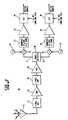
- FIG. 2 depicts a prior art receiving system 10.
- System 10 is of the dual-mixer and dual-A/D converter type and operates in the current example to isolate and digitize the frequencies of the non-contiguous A, A' and A" bands discussed previously in relation to FIG. 1.
- antenna 12 receives the modulated RF signals of the entire spectrum of 824-849MHz encompassing the A and B bands. Signals outside this spectrum are first filtered by five pole bandpass filter 13, then amplified by first low noise amplifier (LNA) 14, and filtered again by three pole bandpass filter 15. The use of the two filters 13 and 15 provides an overall filter response with a sharp rolloff at the desired band edges. The twice filtered spectrum is amplified again by LNA 16 and then split by splitter 18 between two output ports 17 and 19.
- LNA low noise amplifier
- the contiguous A and A" spectrums which will hereinafter be referred to as the A-A" spectrum, are isolated by employing mixer 20 in conjunction with local oscillator 22 to down-convert the entire 824-849MHz spectrum to a corresponding IF spectrum, and then bandpass filtering the IF spectrum associated with the A-A" bands using bandpass filter 24.
- IF amplifier 26 amplifies the filtered A-A" IF spectrum, and the amplified output is applied to A/D converter 28 where it is sampled at a sampling frequency (rate) of f SA MHz.
- the A' spectrum is analogously down-converted and filtered via the use of mixer 30, local oscillator 32 and bandpass filter 34 that has a passband corresponding to the A' band portion of the down-converted IF spectrum.
- the filtered A' IF spectrum is likewise amplified by LNA 36 and applied to a second A/D converter 38 that uses a sampling rate of f sA . MHz. Since the A' frequency band is much narrower than the A-A" band, the sampling rate f SA . may be correspondingly lower than the sampling rate f SA of the A-A" band.
- the B and B' frequency bands can analogously be down-converted, isolated and digitized using the system of FIG. 2.
- bandpass filters 24 and 34 would be designed with passbands corresponding to the down-converted B and B' spectrums, respectively, or vice versa.
- only one mixer, one A/D converter and so on may be utilized whereupon the unwanted gap frequencies would be digitized but later ignored through subsequent digital signal processing.
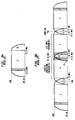
- FIG. 3A an exemplary A-A" IF spectrum passed by bandpass filter 24 is shown.
- the passband spectrum extends from 16MHz to 27MHz, with the spectrum outside the passband on each side gradually tapering off to -80dB several MHz away.
- f SA 30.72MHz (which is greater than twice the 11 MHz signal bandwidth)
- the digital domain spectrum of FIG. 3B results.
- the frequency spectrum of an A/D converter sampled waveform output is being referred to). It is seen that the input IF spectrum of FIG. 3A is periodically repeated in FIG. 3B at frequency intervals corresponding to the sampling rate.
- the periodicity of the spectral density in the digital domain is a basic property of sampled waveforms which can be predicted by computing the Fourier transform of the time sampled waveform. The higher the sampling rate, the wider will be the separation between the periodic waveforms. On the other hand, if the waveform is sampled at a rate of less than twice its signal bandwidth (the Nyquist bandwidth), an undesirable overlapping between the adjacent periodic spectrums will occur -- a well known phenomenon known as aliasing. In FIG. 3B, the sampling rate is chosen so that there is no overlap between the "B" band and the A-A" band. Digital signal processing of the A-A" band can then be performed exclusive of the B band at frequencies of 3.72-14.72MHz.
- the A band frequencies can be processed without interference from signals outside the A-A" band greater than -80dB relative to the passband level.
- the interference level from signals outside the passband is higher than -80dB.
- this interference level does not rise prohibitively high, adequate digital signal processing can still be performed. Otherwise, loss of information will begin to take place. Accordingly, it is apparent that both the sampling rate and the IF frequency band must be chosen appropriately in the prior art configuration to avoid the loss of information due to aliasing.
- the mixing and filtering is performed in the other electrical path to produce a filtered IF signal containing the A' band signals.
- the sampling rate of A/D converter 38 is chosen to avoid loss of information in a similar manner to that just described for the A-A" band.
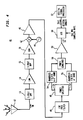
- Receiver front end 40 utilizes a single mixer 42 and single A/D converter 60 to capture and digitize the information within two non-contiguous frequency bands of interest. While receiver front end 40 will be described as operating to down-convert and digitize the aforementioned A-A" and A' non-contiguous frequency bands, it is understood that other segregated frequency bands can likewise be down-converted and digitized, and that the invention is not so limited to these bands.
- Antenna 12 receives the signals within the 824-849 MHz band to provide a frequency multiplexed signal S m at the input of five pole bandpass filter 13.
- the signals within the segregated frequency bands A-A" and A' may be modulated RF signals of a multiplicity of frequency channels spaced 30 KHz apart within each band. Each one of these modulated RF signals may have originated from a wireless terminal. Each one of the frequency channels occupying 30 KHz of spectrum could, in turn, carry several subchannels in a Time Division Multiple Access (TDMA) format.
- Modulation schemes which could be employed include analog modulation such as frequency modulation (FM), as well as digital techniques such as phase shift keying (PSK) or frequency shift keying (FSK).
- bandpass filters 13 and 15 having passbands corresponding substantially to the composite frequency range of 824-849 MHz
- the A-A", A', B and B' bands of the S m signal are passed, and amplified by the LNAs 14 and 16.
- the RF output of LNA 16 is then to down-converted to IF frequencies by means of mixer 42 and synthesized local oscillator 44. For example, if the local oscillating frequency is 803MHz, then the RF spectrum from 824-849MHz is translated to an IF frequency band of 21-46MHz.
- the IF output of mixer 42 is then amplified by low noise IF amplifier 46 and the frequencies above 46MHz are attenuated by low pass filter 48.
- Power splitter 49 then splits the low pass filtered IF between output ports 51 and 53.
- bandpass filter 54 which has a passband corresponding to the down-converted frequency range of the A-A" band --e.g., 21.0 to 32.0Mhz in the illustrative example.
- another bandpass filter 56 is coupled to output port 53 and has a passband corresponding to the down-converted frequency range of the A' band, which in the current example is from 42.0-43.5MHz.
- the filtered outputs of the bandpass filters 54 and 56 are combined by power combiner 58, and then amplified by another IF amplifier 59 to produce an A/D input signal S1.
- Signal S1 is sampled by A/D converter 60 operating at a sampling rate of f SS MHz.
- the spectrum of the A/D input signal S1 is depicted in FIG. 5A.
- frequencies outside the two passbands are attenuated to -80dB relative to the signal power within the passbands.
- the -80dB levels are reached several MHz away from each side of the passband edges, due to the non-ideal characteristics of bandpass filters 54 and 56.
- the filter responses are such that the central region of the down-converted B band --between 36.4-38.1MHz in the example shown -- has been attenuated by more than 80dB.
- the spectrum shown in FIG. 5A is only indicative of the bandpass filter response -- the actual signal power within and outside the two passbands varies in accordance with the carrier powers and modulation of the corresponding RF signals originally received.
- the passband frequencies which correspond to 0 dB power on the ordinate scale have been attenuated in the bandpass filters by 0 dB (normalized to a predetermined reference value) whereas the frequencies corresponding to -80dB have been attenuated in the filters by 80dB (normalized to the same reference value).
- the shown power spectrum of signal S1 would be a completely accurate representation if the corresponding RF power was received at uniform power levels over the entire spectrum.
- FIG. 5B there is shown an exemplary spectrum of a periodically sampled output signal S out of A/D converter 60.
- the shown spectrum is the digital domain spectrum that results from the IF spectrum of FIG. 5A being sampled at an exemplary sampling rate f SS of 40MHz.
- This sampling rate is less than twice the bandwidth between the extremes of the desired segregated frequency bands A-A" and A'. Due to recent advances in A/D converter circuitry, A/D converters that can sample at a 40MHz rate, and which exhibit sufficient dynamic range for this application, are currently available commercially from various manufacturers.
- the A/D input spectrum appears at the same frequencies at which it was applied.
- the spectrum rotates or folds periodically about itself at multiples of one half the sampling frequency or f SS /2, which includes a fold about 0Hz.
- f SS 40MHz results in the spectrum rotating or folding about 0Hz, 20MHz, 40MHz and so on.
- the frequency gap between 1.9-3.6MHz is a mirror image replica of the frequency gap between 36.4-38.1MHz. Due to the fold about 0Hz, however, the A' spectrum appears within the frequency range of 2.0-3.5MHz, within the mirror image frequency gap, which is the desired result. Digital signal processing of the A' and A-A" bands can then be performed by digital signal processor (DSP) 62 (shown in FIG. 4) without loss of signal information. A' band signal information loss would have otherwise been caused by the presence of the B band had it not been for the creation of the frequency gap replica from 1.9-3.6MHz.
- DSP digital signal processor
- the frequency gap just described between 1.9-3.6MHz is an arbitrary one which corresponds to the region attenuated by greater than 80dB in the bandpass filters. While -80dB is in practice a low enough level to avoid interference with the desired signals, it is understood that higher or lower threshold levels can be used, depending upon the application. Variation in these threshold levels will directly affect the width of the presumed frequency gap between the filtered, non-contiguous spectrums (for a given filter response).
- One factor that needs to be considered in the selection of the threshold level is the dynamic range of the channelized signals within the bands. For instance, if some of the B band signals are received at much higher power levels than the A' signals, interference can occur within the 2-3.5MHz range unless the threshold level is set low enough to account for this power level variation.
- digital signal processing can take place within DSP 62 over this frequency range to extract the individual baseband signals of the A' and A-A" bands.
- This processing will ignore the unwanted signal information carried by the frequencies between 3.5-8.0MHz corresponding to the B and B' bands.
- the digital signal processing is preferably performed at the lowest frequencies possible to extract the desired signals, it is understood that it could alternatively be performed at higher frequencies to extract the same information, such as between 21-38MHz in the current example.
- suitable digital signal processors which can be used for DSP 62 to recover the baseband signals of a plurality of 30KHz wide frequency channels within the segregated bands, are known in the art.
- U.S. Patent No. 5,289,464 to R. Wang and assigned to the assignee herein, the subject matter of which is incorporated herein by reference, discloses a digital signal processor which may be adapted to be used for DSP 62.
- the digital signal processor disclosed in that patent consists of a frequency bank analyzer which exponentially modulates the digital signal output from an A/D converter, then low pass filters and decimates such signals to yield a plurality of complex signals, each corresponding to a particular channel transmitted by an individual mobile terminal.
- the digital domain signals of the A-A" band between 8-19MHz appear as a mirror image of the original A-A" band signals, and can be digitally processed as mirror images.
- the signals of the A" portion are at the high end of the 8-19MHz range whereas originally they were at the lower end of the 824-835MHz A-A" band.
- Mirror images do not present a problem in the digital processing of these signals because they can be easily manipulated in the digital domain to produce the desired output.
- the second fold about 0Hz the spectral components of the A' spectrum between 2-3.5MHz appear in their original relative positions and are processed that way.
- the desired signal information within the segregated bands can be extracted.
- the sampling frequency f SS must be such as to place one of the segregated spectrums, in the digital domain, within the frequency gap created by filtering out the spectrum between the two non-contiguous bands. Consequently, the sampling frequency f SS and the IF frequency bands must be selected in view of one another to achieve this result.
- receiver front end 40 can be slightly modified in order to down-convert and digitize solely the B and B' band signals if so desired.
- Such modification may entail: 1) using an L.O. frequency of 812MHz in the local oscillator 44 rather than 803MHz; 2) replacing the A-A" bandpass filter 54 with a B band bandpass filter having a passband of 23-33MHz, and 3) replacing the A' bandpass filter 56 with a B' band bandpass filter having a passband of 34.5-37MHz.
- digital signal processing in the DSP 62 of the B' and B band signals can take place between 3-17MHz.
- the B' band signals would lie between 3-5.5MHz and the B band signals would lie between 7-17MHz. It is noted that because the B and B' are close to one another, this latter approach is conventional in the sense that both B and B' spectrums are fit within the Nyquist bandwidth of the composite spectrum.
Landscapes
- Engineering & Computer Science (AREA)
- Signal Processing (AREA)
- Computer Networks & Wireless Communication (AREA)
- Physics & Mathematics (AREA)
- Electromagnetism (AREA)
- Superheterodyne Receivers (AREA)
- Analogue/Digital Conversion (AREA)
Applications Claiming Priority (2)
| Application Number | Priority Date | Filing Date | Title |
|---|---|---|---|
| US534773 | 1990-06-07 | ||
| US08/534,773 US5602847A (en) | 1995-09-27 | 1995-09-27 | Segregated spectrum RF downconverter for digitization systems |
Publications (3)
| Publication Number | Publication Date |
|---|---|
| EP0766409A2 true EP0766409A2 (de) | 1997-04-02 |
| EP0766409A3 EP0766409A3 (de) | 1999-11-17 |
| EP0766409B1 EP0766409B1 (de) | 2005-11-16 |
Family
ID=24131478
Family Applications (1)
| Application Number | Title | Priority Date | Filing Date |
|---|---|---|---|
| EP96306729A Expired - Lifetime EP0766409B1 (de) | 1995-09-27 | 1996-09-17 | Mehrband-Abwärtsfrequenzumsetzes für digitale Empfänger |
Country Status (4)
| Country | Link |
|---|---|
| US (1) | US5602847A (de) |
| EP (1) | EP0766409B1 (de) |
| JP (1) | JP3168251B2 (de) |
| DE (1) | DE69635438T2 (de) |
Cited By (1)
| Publication number | Priority date | Publication date | Assignee | Title |
|---|---|---|---|---|
| SE2000156A1 (en) * | 2020-09-08 | 2022-03-09 | Anders Widman | Method to double the effective bandwith in a digital receiver system |
Families Citing this family (70)
| Publication number | Priority date | Publication date | Assignee | Title |
|---|---|---|---|---|
| US5758274A (en) * | 1996-03-13 | 1998-05-26 | Symbol Technologies, Inc. | Radio frequency receiver with automatic gain control |
| JPH09275356A (ja) * | 1996-04-08 | 1997-10-21 | Matsushita Electric Ind Co Ltd | 複数モード移動無線装置 |
| US5959660A (en) * | 1996-08-26 | 1999-09-28 | Hybrid Networks, Inc. | Subchannelization scheme for use in a broadband communications system |
| US6031869A (en) * | 1996-10-21 | 2000-02-29 | Texas Instruments Incorporated | Use of multiple sample frequencies to resolve ambiguities in band-folded digital receivers |
| US5966646A (en) * | 1997-05-13 | 1999-10-12 | Ericsson, Inc. | Dual-band radio receiver |
| US6442382B1 (en) * | 1997-06-27 | 2002-08-27 | Agere Systems Guardian Corp. | Filter switching system and method |
| US6249909B1 (en) * | 1997-06-30 | 2001-06-19 | Texas Instruments Incorporated | User configurable operating system |
| US6064665A (en) * | 1997-10-22 | 2000-05-16 | U S West, Inc. | System and method for single to two-band personal communication service base station conversion |
| US6243368B1 (en) * | 1997-12-29 | 2001-06-05 | Lucent Technologies Inc. | Digital channel selection |
| US6359940B1 (en) * | 1998-03-02 | 2002-03-19 | Qualcomm Incorporated | Method and apparatus for downconverting signals transmitted using a plurality of modulation formats to a common intermediate frequency range |
| US6804497B2 (en) | 2001-01-12 | 2004-10-12 | Silicon Laboratories, Inc. | Partitioned radio-frequency apparatus and associated methods |
| US6874161B1 (en) * | 1998-06-30 | 2005-03-29 | Webtv Networks, Inc. | Utilizing a high bandwidth communications channel for broadcasting network data during off-peak hours |
| US6061551A (en) | 1998-10-21 | 2000-05-09 | Parkervision, Inc. | Method and system for down-converting electromagnetic signals |
| US6091940A (en) | 1998-10-21 | 2000-07-18 | Parkervision, Inc. | Method and system for frequency up-conversion |
| US6694128B1 (en) | 1998-08-18 | 2004-02-17 | Parkervision, Inc. | Frequency synthesizer using universal frequency translation technology |
| US7515896B1 (en) | 1998-10-21 | 2009-04-07 | Parkervision, Inc. | Method and system for down-converting an electromagnetic signal, and transforms for same, and aperture relationships |
| US6542722B1 (en) * | 1998-10-21 | 2003-04-01 | Parkervision, Inc. | Method and system for frequency up-conversion with variety of transmitter configurations |
| US7295826B1 (en) | 1998-10-21 | 2007-11-13 | Parkervision, Inc. | Integrated frequency translation and selectivity with gain control functionality, and applications thereof |
| US6370371B1 (en) | 1998-10-21 | 2002-04-09 | Parkervision, Inc. | Applications of universal frequency translation |
| US6813485B2 (en) | 1998-10-21 | 2004-11-02 | Parkervision, Inc. | Method and system for down-converting and up-converting an electromagnetic signal, and transforms for same |
| US6560301B1 (en) | 1998-10-21 | 2003-05-06 | Parkervision, Inc. | Integrated frequency translation and selectivity with a variety of filter embodiments |
| US7039372B1 (en) * | 1998-10-21 | 2006-05-02 | Parkervision, Inc. | Method and system for frequency up-conversion with modulation embodiments |
| US7027786B1 (en) | 1998-10-21 | 2006-04-11 | Parkervision, Inc. | Carrier and clock recovery using universal frequency translation |
| US6061555A (en) | 1998-10-21 | 2000-05-09 | Parkervision, Inc. | Method and system for ensuring reception of a communications signal |
| US7236754B2 (en) | 1999-08-23 | 2007-06-26 | Parkervision, Inc. | Method and system for frequency up-conversion |
| US6049706A (en) | 1998-10-21 | 2000-04-11 | Parkervision, Inc. | Integrated frequency translation and selectivity |
| US6704549B1 (en) | 1999-03-03 | 2004-03-09 | Parkvision, Inc. | Multi-mode, multi-band communication system |
| US6704558B1 (en) | 1999-01-22 | 2004-03-09 | Parkervision, Inc. | Image-reject down-converter and embodiments thereof, such as the family radio service |
| US7006805B1 (en) | 1999-01-22 | 2006-02-28 | Parker Vision, Inc. | Aliasing communication system with multi-mode and multi-band functionality and embodiments thereof, such as the family radio service |
| EP1032136A1 (de) | 1999-02-25 | 2000-08-30 | Lucent Technologies Inc. | Frequenzumsetzung im Nyquist Band |
| US6873836B1 (en) * | 1999-03-03 | 2005-03-29 | Parkervision, Inc. | Universal platform module and methods and apparatuses relating thereto enabled by universal frequency translation technology |
| US6853690B1 (en) | 1999-04-16 | 2005-02-08 | Parkervision, Inc. | Method, system and apparatus for balanced frequency up-conversion of a baseband signal and 4-phase receiver and transceiver embodiments |
| US6879817B1 (en) | 1999-04-16 | 2005-04-12 | Parkervision, Inc. | DC offset, re-radiation, and I/Q solutions using universal frequency translation technology |
| US7110435B1 (en) | 1999-03-15 | 2006-09-19 | Parkervision, Inc. | Spread spectrum applications of universal frequency translation |
| US7110444B1 (en) | 1999-08-04 | 2006-09-19 | Parkervision, Inc. | Wireless local area network (WLAN) using universal frequency translation technology including multi-phase embodiments and circuit implementations |
| US7065162B1 (en) | 1999-04-16 | 2006-06-20 | Parkervision, Inc. | Method and system for down-converting an electromagnetic signal, and transforms for same |
| US7693230B2 (en) | 1999-04-16 | 2010-04-06 | Parkervision, Inc. | Apparatus and method of differential IQ frequency up-conversion |
| US7072390B1 (en) | 1999-08-04 | 2006-07-04 | Parkervision, Inc. | Wireless local area network (WLAN) using universal frequency translation technology including multi-phase embodiments |
| US7054296B1 (en) | 1999-08-04 | 2006-05-30 | Parkervision, Inc. | Wireless local area network (WLAN) technology and applications including techniques of universal frequency translation |
| US8295406B1 (en) | 1999-08-04 | 2012-10-23 | Parkervision, Inc. | Universal platform module for a plurality of communication protocols |
| US7082171B1 (en) | 1999-11-24 | 2006-07-25 | Parkervision, Inc. | Phase shifting applications of universal frequency translation |
| US6963734B2 (en) | 1999-12-22 | 2005-11-08 | Parkervision, Inc. | Differential frequency down-conversion using techniques of universal frequency translation technology |
| US7292835B2 (en) * | 2000-01-28 | 2007-11-06 | Parkervision, Inc. | Wireless and wired cable modem applications of universal frequency translation technology |
| US6574459B1 (en) * | 2000-04-14 | 2003-06-03 | Lucent Technologies Inc. | Multiple branch receiver system and method |
| US6678512B1 (en) * | 2000-04-14 | 2004-01-13 | Lucent Technologies Inc. | Receiver system using analog to digital conversion at radio frequency and method |
| US7010286B2 (en) * | 2000-04-14 | 2006-03-07 | Parkervision, Inc. | Apparatus, system, and method for down-converting and up-converting electromagnetic signals |
| US7554508B2 (en) | 2000-06-09 | 2009-06-30 | Parker Vision, Inc. | Phased array antenna applications on universal frequency translation |
| US7010559B2 (en) * | 2000-11-14 | 2006-03-07 | Parkervision, Inc. | Method and apparatus for a parallel correlator and applications thereof |
| US7454453B2 (en) * | 2000-11-14 | 2008-11-18 | Parkervision, Inc. | Methods, systems, and computer program products for parallel correlation and applications thereof |
| US7200377B2 (en) * | 2001-06-06 | 2007-04-03 | Visteon Corporation | Method and system for multi-channel RF digitization with analog selectivity |
| US7072427B2 (en) | 2001-11-09 | 2006-07-04 | Parkervision, Inc. | Method and apparatus for reducing DC offsets in a communication system |
| US7085335B2 (en) | 2001-11-09 | 2006-08-01 | Parkervision, Inc. | Method and apparatus for reducing DC offsets in a communication system |
| GB2405061B (en) * | 2001-12-05 | 2005-05-18 | Matsushita Electric Industrial Co Ltd | Multirate digital transceiver |
| US6975848B2 (en) | 2002-06-04 | 2005-12-13 | Parkervision, Inc. | Method and apparatus for DC offset removal in a radio frequency communication channel |
| US7321640B2 (en) | 2002-06-07 | 2008-01-22 | Parkervision, Inc. | Active polyphase inverter filter for quadrature signal generation |
| US7460584B2 (en) | 2002-07-18 | 2008-12-02 | Parkervision, Inc. | Networking methods and systems |
| US7379883B2 (en) * | 2002-07-18 | 2008-05-27 | Parkervision, Inc. | Networking methods and systems |
| US10659071B2 (en) | 2002-10-24 | 2020-05-19 | Teledyne Lecroy, Inc. | High bandwidth oscilloscope |
| US7219037B2 (en) | 2002-10-24 | 2007-05-15 | Lecroy Corporation | High bandwidth oscilloscope |
| US7711510B2 (en) | 2002-10-24 | 2010-05-04 | Lecroy Corporation | Method of crossover region phase correction when summing signals in multiple frequency bands |
| US6942660B2 (en) * | 2002-11-19 | 2005-09-13 | Conmed Corporation | Electrosurgical generator and method with multiple semi-autonomously executable functions |
| JP2006211021A (ja) * | 2005-01-25 | 2006-08-10 | Nec Electronics Corp | フィルタ回路 |
| JP2007158583A (ja) * | 2005-12-02 | 2007-06-21 | Matsushita Electric Ind Co Ltd | 受信装置 |
| US7720178B2 (en) * | 2006-08-11 | 2010-05-18 | Mediatek Inc. | Method of direct RF digitization for multiple GNSS system bands and receiver using the same |
| ES2556975T3 (es) * | 2008-05-16 | 2016-01-21 | Telefonaktiebolaget Lm Ericsson (Publ) | Método para un receptor de espectro agregado de radio único, programa informático, receptor y terminal |
| US8724664B2 (en) * | 2011-11-28 | 2014-05-13 | Dali Systems Co. Ltd | Software configurable distributed antenna system and method for bandwidth compression and transport of signals in noncontiguous frequency blocks |
| US9614629B2 (en) | 2012-08-15 | 2017-04-04 | Commscope Technologies Llc | Telecommunication system using multiple Nyquist zone operations |
| KR101390107B1 (ko) | 2012-10-31 | 2014-04-29 | 재단법인대구경북과학기술원 | 고속 획득 시간을 지원하는 신호 처리 장치 및 방법 |
| KR102844789B1 (ko) * | 2020-09-01 | 2025-08-12 | 삼성전자주식회사 | 무선 통신을 수행하는 전자 장치 및 그 방법 |
| CN114696745B (zh) * | 2020-12-31 | 2025-04-18 | 深圳市英维克信息技术有限公司 | 一种变频器隔离电路 |
Family Cites Families (6)
| Publication number | Priority date | Publication date | Assignee | Title |
|---|---|---|---|---|
| US4207532A (en) * | 1978-12-14 | 1980-06-10 | Rca Corporation | Frequency signal splitting circuit |
| US4893316A (en) * | 1985-04-04 | 1990-01-09 | Motorola, Inc. | Digital radio frequency receiver |
| US5289464A (en) * | 1992-09-21 | 1994-02-22 | At&T Bell Laboratories | Frequency-multiplexed cellular telephone cell site base station and method of operating the same |
| US5323391A (en) * | 1992-10-26 | 1994-06-21 | Motorola, Inc. | Multi-channel digital transmitter and receiver |
| DE4237692C1 (de) * | 1992-11-07 | 1994-03-03 | Grundig Emv | Empfänger für ein digitales Rundfunksignal |
| WO1997005705A1 (en) * | 1995-07-26 | 1997-02-13 | Telefonaktiebolaget Lm Ericsson (Publ) | Amps a-band single superhet |
-
1995
- 1995-09-27 US US08/534,773 patent/US5602847A/en not_active Expired - Lifetime
-
1996
- 1996-09-17 DE DE69635438T patent/DE69635438T2/de not_active Expired - Lifetime
- 1996-09-17 EP EP96306729A patent/EP0766409B1/de not_active Expired - Lifetime
- 1996-09-19 JP JP24761396A patent/JP3168251B2/ja not_active Expired - Fee Related
Cited By (2)
| Publication number | Priority date | Publication date | Assignee | Title |
|---|---|---|---|---|
| SE2000156A1 (en) * | 2020-09-08 | 2022-03-09 | Anders Widman | Method to double the effective bandwith in a digital receiver system |
| SE544242C2 (en) * | 2020-09-08 | 2022-03-15 | Anders Widman | Method to double the effective bandwith in a digital receiver system |
Also Published As
| Publication number | Publication date |
|---|---|
| DE69635438T2 (de) | 2006-08-03 |
| US5602847A (en) | 1997-02-11 |
| JPH09135188A (ja) | 1997-05-20 |
| EP0766409A3 (de) | 1999-11-17 |
| JP3168251B2 (ja) | 2001-05-21 |
| DE69635438D1 (de) | 2005-12-22 |
| EP0766409B1 (de) | 2005-11-16 |
Similar Documents
| Publication | Publication Date | Title |
|---|---|---|
| EP0766409B1 (de) | Mehrband-Abwärtsfrequenzumsetzes für digitale Empfänger | |
| US5745846A (en) | Channelized apparatus for equalizing carrier powers of multicarrier signal | |
| US6678512B1 (en) | Receiver system using analog to digital conversion at radio frequency and method | |
| US10080254B2 (en) | Adjacent channel optimized receiver | |
| CA2181809C (en) | Split frequency band signal digitizer and method | |
| FI114177B (fi) | Laajakaistasignaalin digitoija ja digitointimenetelmä | |
| EP1241779A2 (de) | Empfänger für Mehrträgersignale | |
| US20040259518A1 (en) | Multi standard transceiver architecture for wlan | |
| CN100438352C (zh) | 降低信号幅度的一种设备和方法 | |
| GB2258104A (en) | Digital receiver with multiple channels translated simultaneously into adjacentif slots | |
| CN101789922A (zh) | 从不同载波频率的多个数据信号提取数据的方法和设备 | |
| EP1113604A2 (de) | Filter-Verfahren und Vorrichtung für die Unterdrückung vom Hauptsignal in einem digitalen Hörfunksystem DAB | |
| EP1429465A2 (de) | Gerät und Verfahren zur parallelen Funksignalbearbeitung | |
| JP3639146B2 (ja) | レーダ装置 | |
| JP4594535B2 (ja) | 受信機回路 | |
| JP2003318760A (ja) | アンダーサンプリング方式を用いた受信装置 | |
| EP4391394B1 (de) | Verfahren zur demodulation eines hf-signals bei inband-harmonischen störsignalen | |
| JP2003298356A (ja) | 広帯域減衰可能なイメージリジェクションミキサ | |
| EP2393226B1 (de) | Fernsehkanalverstärkungssystem | |
| US20030069022A1 (en) | Amplitude cancellation topology for multichannel applications | |
| KR20090062740A (ko) | 3단 구조를 갖는 광대역 주파수 변환 장치 및 방법 | |
| JPH05130055A (ja) | 受信信号電力警報回路 | |
| US20120155581A1 (en) | Implementation of a high performance multi-carrier receiver using frequency selectivity and digital compensation techniques | |
| JP2002314454A (ja) | 無線通信装置 | |
| JPH05252070A (ja) | 受信装置 |
Legal Events
| Date | Code | Title | Description |
|---|---|---|---|
| PUAI | Public reference made under article 153(3) epc to a published international application that has entered the european phase |
Free format text: ORIGINAL CODE: 0009012 |
|
| AK | Designated contracting states |
Kind code of ref document: A2 Designated state(s): DE GB |
|
| PUAL | Search report despatched |
Free format text: ORIGINAL CODE: 0009013 |
|
| AK | Designated contracting states |
Kind code of ref document: A3 Designated state(s): DE GB |
|
| 17P | Request for examination filed |
Effective date: 20000505 |
|
| 17Q | First examination report despatched |
Effective date: 20040701 |
|
| GRAP | Despatch of communication of intention to grant a patent |
Free format text: ORIGINAL CODE: EPIDOSNIGR1 |
|
| GRAS | Grant fee paid |
Free format text: ORIGINAL CODE: EPIDOSNIGR3 |
|
| GRAA | (expected) grant |
Free format text: ORIGINAL CODE: 0009210 |
|
| AK | Designated contracting states |
Kind code of ref document: B1 Designated state(s): DE GB |
|
| REG | Reference to a national code |
Ref country code: GB Ref legal event code: FG4D |
|
| REF | Corresponds to: |
Ref document number: 69635438 Country of ref document: DE Date of ref document: 20051222 Kind code of ref document: P |
|
| PLBE | No opposition filed within time limit |
Free format text: ORIGINAL CODE: 0009261 |
|
| STAA | Information on the status of an ep patent application or granted ep patent |
Free format text: STATUS: NO OPPOSITION FILED WITHIN TIME LIMIT |
|
| 26N | No opposition filed |
Effective date: 20060817 |
|
| PGFP | Annual fee paid to national office [announced via postgrant information from national office to epo] |
Ref country code: DE Payment date: 20130911 Year of fee payment: 18 |
|
| PGFP | Annual fee paid to national office [announced via postgrant information from national office to epo] |
Ref country code: GB Payment date: 20130911 Year of fee payment: 18 |
|
| REG | Reference to a national code |
Ref country code: DE Ref legal event code: R082 Ref document number: 69635438 Country of ref document: DE Representative=s name: DILG HAEUSLER SCHINDELMANN PATENTANWALTSGESELL, DE |
|
| REG | Reference to a national code |
Ref country code: DE Ref legal event code: R119 Ref document number: 69635438 Country of ref document: DE |
|
| GBPC | Gb: european patent ceased through non-payment of renewal fee |
Effective date: 20140917 |
|
| PG25 | Lapsed in a contracting state [announced via postgrant information from national office to epo] |
Ref country code: GB Free format text: LAPSE BECAUSE OF NON-PAYMENT OF DUE FEES Effective date: 20140917 Ref country code: DE Free format text: LAPSE BECAUSE OF NON-PAYMENT OF DUE FEES Effective date: 20150401 |