EP0767149A2 - Verfahren zur Verklebung von Glas-Metall mittels eines vorgelierbaren Klebstoffs und Bestrahlungseinrichtung zum Erhalten der Vorgelierung - Google Patents
Verfahren zur Verklebung von Glas-Metall mittels eines vorgelierbaren Klebstoffs und Bestrahlungseinrichtung zum Erhalten der Vorgelierung Download PDFInfo
- Publication number
- EP0767149A2 EP0767149A2 EP96402615A EP96402615A EP0767149A2 EP 0767149 A2 EP0767149 A2 EP 0767149A2 EP 96402615 A EP96402615 A EP 96402615A EP 96402615 A EP96402615 A EP 96402615A EP 0767149 A2 EP0767149 A2 EP 0767149A2
- Authority
- EP
- European Patent Office
- Prior art keywords
- adhesive
- glass
- metal
- assembly
- joint
- Prior art date
- Legal status (The legal status is an assumption and is not a legal conclusion. Google has not performed a legal analysis and makes no representation as to the accuracy of the status listed.)
- Withdrawn
Links
- 239000000853 adhesive Substances 0.000 title claims abstract description 50
- 230000001070 adhesive effect Effects 0.000 title claims abstract description 49
- 229910052751 metal Inorganic materials 0.000 title claims abstract description 25
- 239000002184 metal Substances 0.000 title claims abstract description 25
- 238000000034 method Methods 0.000 title description 11
- 238000004026 adhesive bonding Methods 0.000 title description 3
- 230000001678 irradiating effect Effects 0.000 title description 2
- 230000008569 process Effects 0.000 title description 2
- 239000011521 glass Substances 0.000 claims abstract description 29
- 230000006698 induction Effects 0.000 claims abstract description 8
- 239000000758 substrate Substances 0.000 claims description 16
- 230000005855 radiation Effects 0.000 claims description 9
- 238000009826 distribution Methods 0.000 claims description 4
- 239000012948 isocyanate Substances 0.000 abstract description 3
- 150000002513 isocyanates Chemical group 0.000 abstract description 3
- NIXOWILDQLNWCW-UHFFFAOYSA-N acrylic acid group Chemical group C(C=C)(=O)O NIXOWILDQLNWCW-UHFFFAOYSA-N 0.000 abstract description 2
- -1 is typically Substances 0.000 abstract description 2
- 239000011248 coating agent Substances 0.000 abstract 1
- 238000000576 coating method Methods 0.000 abstract 1
- 229920002635 polyurethane Polymers 0.000 abstract 1
- 239000004814 polyurethane Substances 0.000 abstract 1
- 238000010438 heat treatment Methods 0.000 description 14
- 238000012360 testing method Methods 0.000 description 10
- 230000000694 effects Effects 0.000 description 5
- 241001639412 Verres Species 0.000 description 4
- 210000003298 dental enamel Anatomy 0.000 description 4
- CSCPPACGZOOCGX-UHFFFAOYSA-N Acetone Chemical compound CC(C)=O CSCPPACGZOOCGX-UHFFFAOYSA-N 0.000 description 3
- 230000032683 aging Effects 0.000 description 3
- 230000000712 assembly Effects 0.000 description 3
- 238000000429 assembly Methods 0.000 description 3
- 238000001816 cooling Methods 0.000 description 3
- 239000000498 cooling water Substances 0.000 description 3
- 239000000565 sealant Substances 0.000 description 3
- AZQWKYJCGOJGHM-UHFFFAOYSA-N 1,4-benzoquinone Chemical compound O=C1C=CC(=O)C=C1 AZQWKYJCGOJGHM-UHFFFAOYSA-N 0.000 description 2
- IJGRMHOSHXDMSA-UHFFFAOYSA-N Atomic nitrogen Chemical compound N#N IJGRMHOSHXDMSA-UHFFFAOYSA-N 0.000 description 2
- VTYYLEPIZMXCLO-UHFFFAOYSA-L Calcium carbonate Chemical compound [Ca+2].[O-]C([O-])=O VTYYLEPIZMXCLO-UHFFFAOYSA-L 0.000 description 2
- RYGMFSIKBFXOCR-UHFFFAOYSA-N Copper Chemical compound [Cu] RYGMFSIKBFXOCR-UHFFFAOYSA-N 0.000 description 2
- LYCAIKOWRPUZTN-UHFFFAOYSA-N Ethylene glycol Chemical compound OCCO LYCAIKOWRPUZTN-UHFFFAOYSA-N 0.000 description 2
- 229920001730 Moisture cure polyurethane Polymers 0.000 description 2
- 230000009471 action Effects 0.000 description 2
- TZCXTZWJZNENPQ-UHFFFAOYSA-L barium sulfate Chemical compound [Ba+2].[O-]S([O-])(=O)=O TZCXTZWJZNENPQ-UHFFFAOYSA-L 0.000 description 2
- 230000008901 benefit Effects 0.000 description 2
- 230000005672 electromagnetic field Effects 0.000 description 2
- 230000005674 electromagnetic induction Effects 0.000 description 2
- 230000006870 function Effects 0.000 description 2
- 238000001879 gelation Methods 0.000 description 2
- 230000001939 inductive effect Effects 0.000 description 2
- 238000009434 installation Methods 0.000 description 2
- 239000000203 mixture Substances 0.000 description 2
- 239000004810 polytetrafluoroethylene Substances 0.000 description 2
- 229920001343 polytetrafluoroethylene Polymers 0.000 description 2
- 239000010453 quartz Substances 0.000 description 2
- VYPSYNLAJGMNEJ-UHFFFAOYSA-N silicon dioxide Inorganic materials O=[Si]=O VYPSYNLAJGMNEJ-UHFFFAOYSA-N 0.000 description 2
- 239000005341 toughened glass Substances 0.000 description 2
- IMNIMPAHZVJRPE-UHFFFAOYSA-N triethylenediamine Chemical compound C1CN2CCN1CC2 IMNIMPAHZVJRPE-UHFFFAOYSA-N 0.000 description 2
- WJFKNYWRSNBZNX-UHFFFAOYSA-N 10H-phenothiazine Chemical compound C1=CC=C2NC3=CC=CC=C3SC2=C1 WJFKNYWRSNBZNX-UHFFFAOYSA-N 0.000 description 1
- HWSSEYVMGDIFMH-UHFFFAOYSA-N 2-[2-[2-(2-methylprop-2-enoyloxy)ethoxy]ethoxy]ethyl 2-methylprop-2-enoate Chemical compound CC(=C)C(=O)OCCOCCOCCOC(=O)C(C)=C HWSSEYVMGDIFMH-UHFFFAOYSA-N 0.000 description 1
- OMIGHNLMNHATMP-UHFFFAOYSA-N 2-hydroxyethyl prop-2-enoate Chemical compound OCCOC(=O)C=C OMIGHNLMNHATMP-UHFFFAOYSA-N 0.000 description 1
- 229910001369 Brass Inorganic materials 0.000 description 1
- 241000422252 Cales Species 0.000 description 1
- JOYRKODLDBILNP-UHFFFAOYSA-N Ethyl urethane Chemical compound CCOC(N)=O JOYRKODLDBILNP-UHFFFAOYSA-N 0.000 description 1
- 208000035126 Facies Diseases 0.000 description 1
- 239000005058 Isophorone diisocyanate Substances 0.000 description 1
- 229910000831 Steel Inorganic materials 0.000 description 1
- UKLDJPRMSDWDSL-UHFFFAOYSA-L [dibutyl(dodecanoyloxy)stannyl] dodecanoate Chemical compound CCCCCCCCCCCC(=O)O[Sn](CCCC)(CCCC)OC(=O)CCCCCCCCCCC UKLDJPRMSDWDSL-UHFFFAOYSA-L 0.000 description 1
- 238000010521 absorption reaction Methods 0.000 description 1
- 239000002313 adhesive film Substances 0.000 description 1
- 239000002390 adhesive tape Substances 0.000 description 1
- 125000003118 aryl group Chemical group 0.000 description 1
- 230000033228 biological regulation Effects 0.000 description 1
- 238000009529 body temperature measurement Methods 0.000 description 1
- 239000010951 brass Substances 0.000 description 1
- 229910000019 calcium carbonate Inorganic materials 0.000 description 1
- BRPQOXSCLDDYGP-UHFFFAOYSA-N calcium oxide Chemical compound [O-2].[Ca+2] BRPQOXSCLDDYGP-UHFFFAOYSA-N 0.000 description 1
- 239000000292 calcium oxide Substances 0.000 description 1
- ODINCKMPIJJUCX-UHFFFAOYSA-N calcium oxide Inorganic materials [Ca]=O ODINCKMPIJJUCX-UHFFFAOYSA-N 0.000 description 1
- 238000006243 chemical reaction Methods 0.000 description 1
- 230000000052 comparative effect Effects 0.000 description 1
- 150000001875 compounds Chemical class 0.000 description 1
- 239000004020 conductor Substances 0.000 description 1
- 229910052802 copper Inorganic materials 0.000 description 1
- 239000010949 copper Substances 0.000 description 1
- 238000004132 cross linking Methods 0.000 description 1
- VSSAZBXXNIABDN-UHFFFAOYSA-N cyclohexylmethanol Chemical compound OCC1CCCCC1 VSSAZBXXNIABDN-UHFFFAOYSA-N 0.000 description 1
- 239000002274 desiccant Substances 0.000 description 1
- 238000011161 development Methods 0.000 description 1
- 230000018109 developmental process Effects 0.000 description 1
- 150000002009 diols Chemical class 0.000 description 1
- 230000009977 dual effect Effects 0.000 description 1
- 238000002474 experimental method Methods 0.000 description 1
- 239000004744 fabric Substances 0.000 description 1
- 238000009472 formulation Methods 0.000 description 1
- 229910021485 fumed silica Inorganic materials 0.000 description 1
- 230000009477 glass transition Effects 0.000 description 1
- 239000003292 glue Substances 0.000 description 1
- WGCNASOHLSPBMP-UHFFFAOYSA-N hydroxyacetaldehyde Natural products OCC=O WGCNASOHLSPBMP-UHFFFAOYSA-N 0.000 description 1
- 239000012212 insulator Substances 0.000 description 1
- IQPQWNKOIGAROB-UHFFFAOYSA-N isocyanate group Chemical group [N-]=C=O IQPQWNKOIGAROB-UHFFFAOYSA-N 0.000 description 1
- NIMLQBUJDJZYEJ-UHFFFAOYSA-N isophorone diisocyanate Chemical compound CC1(C)CC(N=C=O)CC(C)(CN=C=O)C1 NIMLQBUJDJZYEJ-UHFFFAOYSA-N 0.000 description 1
- 239000007788 liquid Substances 0.000 description 1
- 238000004519 manufacturing process Methods 0.000 description 1
- 239000000463 material Substances 0.000 description 1
- 230000007246 mechanism Effects 0.000 description 1
- 239000002808 molecular sieve Substances 0.000 description 1
- 229910052757 nitrogen Inorganic materials 0.000 description 1
- 239000000615 nonconductor Substances 0.000 description 1
- 238000005457 optimization Methods 0.000 description 1
- 239000003973 paint Substances 0.000 description 1
- 229950000688 phenothiazine Drugs 0.000 description 1
- 239000004014 plasticizer Substances 0.000 description 1
- 229920000642 polymer Polymers 0.000 description 1
- 238000011417 postcuring Methods 0.000 description 1
- 238000012545 processing Methods 0.000 description 1
- 230000000135 prohibitive effect Effects 0.000 description 1
- 230000009993 protective function Effects 0.000 description 1
- 238000000197 pyrolysis Methods 0.000 description 1
- 230000001105 regulatory effect Effects 0.000 description 1
- 238000009877 rendering Methods 0.000 description 1
- FZHAPNGMFPVSLP-UHFFFAOYSA-N silanamine Chemical compound [SiH3]N FZHAPNGMFPVSLP-UHFFFAOYSA-N 0.000 description 1
- 239000012205 single-component adhesive Substances 0.000 description 1
- URGAHOPLAPQHLN-UHFFFAOYSA-N sodium aluminosilicate Chemical compound [Na+].[Al+3].[O-][Si]([O-])=O.[O-][Si]([O-])=O URGAHOPLAPQHLN-UHFFFAOYSA-N 0.000 description 1
- 238000001228 spectrum Methods 0.000 description 1
- 230000002269 spontaneous effect Effects 0.000 description 1
- 238000010025 steaming Methods 0.000 description 1
- 239000010959 steel Substances 0.000 description 1
- 230000035882 stress Effects 0.000 description 1
- 239000000126 substance Substances 0.000 description 1
- GJBRNHKUVLOCEB-UHFFFAOYSA-N tert-butyl benzenecarboperoxoate Chemical compound CC(C)(C)OOC(=O)C1=CC=CC=C1 GJBRNHKUVLOCEB-UHFFFAOYSA-N 0.000 description 1
- 210000001519 tissue Anatomy 0.000 description 1
- 238000009736 wetting Methods 0.000 description 1
Images

Classifications
-
- C—CHEMISTRY; METALLURGY
- C03—GLASS; MINERAL OR SLAG WOOL
- C03C—CHEMICAL COMPOSITION OF GLASSES, GLAZES OR VITREOUS ENAMELS; SURFACE TREATMENT OF GLASS; SURFACE TREATMENT OF FIBRES OR FILAMENTS MADE FROM GLASS, MINERALS OR SLAGS; JOINING GLASS TO GLASS OR OTHER MATERIALS
- C03C27/00—Joining pieces of glass to pieces of other inorganic material; Joining glass to glass other than by fusing
- C03C27/04—Joining glass to metal by means of an interlayer
- C03C27/048—Joining glass to metal by means of an interlayer consisting of an adhesive specially adapted for that purpose
-
- B—PERFORMING OPERATIONS; TRANSPORTING
- B60—VEHICLES IN GENERAL
- B60J—WINDOWS, WINDSCREENS, NON-FIXED ROOFS, DOORS, OR SIMILAR DEVICES FOR VEHICLES; REMOVABLE EXTERNAL PROTECTIVE COVERINGS SPECIALLY ADAPTED FOR VEHICLES
- B60J10/00—Sealing arrangements
- B60J10/70—Sealing arrangements specially adapted for windows or windscreens
Definitions
- the present invention relates to the field of bonding glass, in particular enamelled glass, on metal supports, and more precisely on sheets, painted or not.
- Glass-to-metal joints must be both flexible and tenacious in order to be able to resist the mechanical stresses which inevitably result from the difference in the coefficients of thermal expansion of the assembled materials: consequently, their elastic modulus must be sufficiently low and remain so throughout the range of their operating temperatures. They must develop sufficient adhesion, if possible with a cohesive rupture facies, both on the sheet metal and on the glass. Due to the transparency of one of the substrates, they must also resist photochemical aging. Finally, they must have processing characteristics which meet the requirements of mass production. These requirements are manifested with particular importance in the automotive industry for the installation of glued windscreens.
- the techniques currently envisaged consist in forming the glass-metal seals with single-component adhesives and in causing the development of their cohesion by means of a rapid rise in temperature.
- This rise in temperature can be obtained either by conventional heating (steaming), or by means of a rapid implementation technique such as dielectric hysteresis (PDHF), electromagnetic induction (IHF), microwaves, or else short or long infrared (IR) heating.
- PDHF dielectric hysteresis
- IHF electromagnetic induction
- IR infrared
- the choice of the implementation method depends essentially on the nature of the substrates (conductors, insulators, transparencies, opaque), their geometry, the thickness of the adhesive joint, and obviously the period within which the bonded assembly must be able to be manipulated.
- the two substrates are electrical insulators.
- the thickness of the adhesive joint and that of the substrates must be constant, and the entire bonded part of the assembly must be able to be introduced between the two electrodes of the PDHF applicator, which requires geometric restrictions on the types of assemblies achievable by this technique.
- Patent WO 8,809,712 discloses a solution for obtaining a sufficiently rapid localized heating of the adhesive joint, which requires the dissipation of microwaves focused within the adhesive joint by the set of waveguides and reflectors: but it requires on the one hand, an extremely delicate adjustment of wave projection equipment and on the other hand, a safety installation excluding any exposure of personnel to radiation leaks.
- the PDHF technique cannot be applied to the heating of glass / metal systems since one of the substrates is metallic.
- the major drawback of IHF heating is that only the metal is heated directly (Joule effect due to eddy currents developed within the metal), from which the adhesive is only heated by conduction.
- the temperature must reach 120 to 140 ° C through the 4 mm of the joint, up to the adhesive / glass interface, the glass remaining cold.
- pre-gelation can only be obtained there over a thickness of up to 2 mm; beyond this, the radiating effect of cold glass prevents the reaction from occurring on its immediate contact, which makes pregelification ineffective.
- the thickness of the joint exceeds 2 mm, pre-gelation can no longer be obtained throughout the entire thickness of the adhesive.
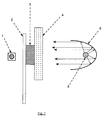
- the present invention remedies these drawbacks. It is a process for producing glass-metal assembly with a thick joint of a substance of final elastomeric consistency, which consists in preassembling a glass-adhesive-metal system and to cause the pre-gelification of the adhesive by simultaneous application of intense infrared radiation on the glass side, and of a high frequency electromagnetic field causing the metal to heat up by induction.
- the exact position of the inductor element of the applicator is not critical. However, it will preferably be placed near the assembly, on the metal side; it can however be placed on the glass side, or even all around the assembly which is then placed inside a solenoid.
- the inducing device does not come between the infrared source and the surface of the glass and on the other hand, that the part of the metal substrate which must be subjected to heating is located in an area where the electromagnetic field generated by the inducing element is sufficiently intense for the required temperature (for example 150 ° C) to be reached within the time allowed.
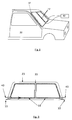
- Figure 2 On automobile assembly lines (bonding of rear quarter, rear window or windshield), there are thus (Figure 2) the inductors (12) arranged inside the body (22) and along the perimeter (32) of the adhesive joint, coupled to an assembly (42) HF generator and cooling water supply.
- a single inductor In the case of glazing of small dimensions, for example side quarter window, a single inductor is generally necessary.
- the large dimensions of a single inductor make it difficult to introduce it inside the body by the arm of a robot: we can, as shown in Figure 3, replace the single inductor by two collateral elements (33) also disposed facing the body (23) directly above the adhesive joint (33); (43) and (53) schematically represent the simultaneous supply of high frequency current and cooling water.
- FIGS. 4 and 5 the infrared heating cassettes (54-55) arranged along the perimeter of the window (44-45) facing the adhesive joint (34-35), and a power variator (7), associated if necessary with a temperature regulating device.
- the method according to the invention applies to the bonding of enamelled glasses on bare or painted sheets.
- the glass is now systematically covered with a thin layer of opaque enamel, most often black.
- this enamel layer was intended to protect, at least partially, the adhesive seal against photochemical aging.
- the adhesives commonly used in this field being of aromatic nature, are particularly sensitive to aging under the effect of sunlight.
- the opaque enamel was initially intended to partially fulfill this protective function: there is now added an aesthetic function imposed by vehicle designers which generalizes the use of these glazed glazings.
- the term "pregelling” means a partial hardening of the adhesive. It is considered that the adhesive is pregelified when the number of reactive functions which have reacted to it is such that the polymer thus obtained forms a three-dimensional network, therefore infusible and insoluble, and that in practice it has developed sufficient cohesion to ensure handling. of the joint.
- the shear strength required for the assembly can be handled obviously depends on the geometry and the weight of the assembly. However, in the majority of cases, this manipulation is ensured as soon as the shear strength is greater than about 0.3 MPa.
- One practical way, among others, to test the pregelification of the adhesive is thus to measure the shear strength of the assembly after it has been subjected to the pregelification cycle, and to ensure that it reaches or exceeds the value of, 3 MPa.
- the nature of the adhesive constituting the joint is not indifferent, since the method provides for the use of an adhesive joint capable, at first, of being very quickly pregelified by thermal action, and capable of undergoing later an evolution according to a mechanism, thermal or other, which will lead it to its final state of hardening.
- sealants based on pure polyurethane prepolymers which have been used in the examples, which are not limiting, which are presented to illustrate and better understand the invention.
- the post-curing of pre-gelled adhesives with humidity is very simple and effective: it offers the additional advantage of ensuring a minimum of final curing everywhere in the adhesive joint, even if there are areas that have escaped full pregelification. Other pre-gelable and otherwise post-polymerizable adhesives can nevertheless be used without altering the invention.
- the products are mixed and then brought to 80 ° C. under nitrogen, for approximately 2 hours, until the mass content of isocyanates is constant (4.5%).
- the prepolymer is cooled to 25 ° C. and the adhesive sealant is formulated by adding the following compounds: Tertiary butyl perbenzoate 2.10 Sterilized calcium carbonate 16.20 Calcium oxide 3.00 Barium sulphate 7.50 Molecular sieve (desiccant) 7.50 Pyrogenic silica 3.00 Triethylene glycol dimethacrylate 5.25 Tosyle isocyanate 0.30 Aminosilane 1.50 Plasticizer (hydrogenated quaterphenyls) 6.00
- the formulation is degassed under a vacuum of about 500 Pa (4 torr) and packaged in moisture-tight cartridges.
- Example 1 infrared heating test only (comparative):
- An adhesive pad of dimensions 25 X 12.5 X 4 mm is applied to the screen-printed side of a glass sterigme and covered with a metallic sterigme.
- Various successive tests are carried out in which the temperature of the adhesive joint is measured by means of a thermocouple placed in the adhesive, either in contact with the glass, or in contact with the metal.
- the assembly maintained in a horizontal position is subjected to short infrared radiation of spectrum 0.76 to 1.5 ⁇ m, with a power density of 50 kW / m 2 , for a variable duration.
- the results of the temperature measurements are collated in the table below.
- Example 2 heating test by electromagnetic induction only (comparison):
- Example 2 The same assembly as that of Example 1 is fixed near the induction coil of an HF generator.
- the generator is provided with an infrared pyrometer temperature regulation system measuring the temperature of the metal sterigme at the location. glue joint.
- the inductor is set for a bearing temperature of 160 ° C. The rise to this temperature takes 5 seconds.
- the experiment is repeated on another assembly, extending the heating time of the metal up to 180 seconds. After cooling, the assembly becomes detached under the action of its own weight. Examination of the joint shows that it has correctly pregelled over almost its entire thickness, except in immediate contact with the glass, where an adhesive film has remained liquid, rendering the pregelling inoperative, even after a period of heating. as long as 3 minutes, duration already prohibitive with regard to the rates of assembly lines.
- Example 3 heating test on unglazed glass (comparison):
- Example 1 The test of Example 1 is repeated, with the difference that the glass used is ordinary tempered glass, unglazed. After 30 seconds of infrared irradiation, the adhesive is not at all pre-gelified: the unglazed glass did not participate in the absorption of infrared radiation and did not transmitted heat by conduction to the adhesive.
- Example 4 combined infrared / induction test (according to the invention):
- Example 2 is reproduced, but by irradiating the glass sterigma with the infrared radiation of example 1.
- the infrared irradiation and the high frequency field are applied simultaneously for 30 seconds, the inductor being adjusted for a plateau temperature. 160 ° C.
- the assembly can be easily handled. Its tensile shear strength, measured using a dynamometer at a tensile speed of 2 mm / min, is 2.85 MPa.
- the adhesive correctly pre-gelled over its entire thickness but also the shear strength obtained after only 30 seconds of combined pre-gelling according to the invention is very much greater than the minimum necessary to ensure the handling of the assembly.
Landscapes
- Engineering & Computer Science (AREA)
- Chemical & Material Sciences (AREA)
- Mechanical Engineering (AREA)
- Ceramic Engineering (AREA)
- Life Sciences & Earth Sciences (AREA)
- Chemical Kinetics & Catalysis (AREA)
- General Chemical & Material Sciences (AREA)
- Geochemistry & Mineralogy (AREA)
- Materials Engineering (AREA)
- Organic Chemistry (AREA)
- Adhesives Or Adhesive Processes (AREA)
- Joining Of Glass To Other Materials (AREA)
Applications Claiming Priority (3)
| Application Number | Priority Date | Filing Date | Title |
|---|---|---|---|
| FR9215183A FR2699165B1 (fr) | 1992-12-16 | 1992-12-16 | Procédé de collage verre-métal par adhésif prégélifiable et dispositif d'irradiation pour obtenir la prégélification. |
| FR9215183 | 1992-12-16 | ||
| EP93403002A EP0603047A1 (de) | 1992-12-16 | 1993-12-13 | Verfahren zur Verklebung von Glas-Metall mittels eines vorgelierbaren Klebstoffs und Bestrahlungseinrichtung zum Erhalten der Vorgelierung |
Related Parent Applications (2)
| Application Number | Title | Priority Date | Filing Date |
|---|---|---|---|
| EP93403002A Division EP0603047A1 (de) | 1992-12-16 | 1993-12-13 | Verfahren zur Verklebung von Glas-Metall mittels eines vorgelierbaren Klebstoffs und Bestrahlungseinrichtung zum Erhalten der Vorgelierung |
| EP93403002.4 Division | 1993-12-13 |
Publications (2)
| Publication Number | Publication Date |
|---|---|
| EP0767149A2 true EP0767149A2 (de) | 1997-04-09 |
| EP0767149A3 EP0767149A3 (de) | 1998-02-11 |
Family
ID=9436679
Family Applications (2)
| Application Number | Title | Priority Date | Filing Date |
|---|---|---|---|
| EP93403002A Withdrawn EP0603047A1 (de) | 1992-12-16 | 1993-12-13 | Verfahren zur Verklebung von Glas-Metall mittels eines vorgelierbaren Klebstoffs und Bestrahlungseinrichtung zum Erhalten der Vorgelierung |
| EP96402615A Withdrawn EP0767149A3 (de) | 1992-12-16 | 1993-12-13 | Verfahren zur Verklebung von Glas-Metall mittels eines vorgelierbaren Klebstoffs und Bestrahlungseinrichtung zum Erhalten der Vorgelierung |
Family Applications Before (1)
| Application Number | Title | Priority Date | Filing Date |
|---|---|---|---|
| EP93403002A Withdrawn EP0603047A1 (de) | 1992-12-16 | 1993-12-13 | Verfahren zur Verklebung von Glas-Metall mittels eines vorgelierbaren Klebstoffs und Bestrahlungseinrichtung zum Erhalten der Vorgelierung |
Country Status (2)
| Country | Link |
|---|---|
| EP (2) | EP0603047A1 (de) |
| FR (1) | FR2699165B1 (de) |
Cited By (8)
| Publication number | Priority date | Publication date | Assignee | Title |
|---|---|---|---|---|
| EP1013492A1 (de) * | 1998-12-23 | 2000-06-28 | Oscar Marcelo Pigni | Schockbeständige Fensterscheibe für Motorfahrzeuge |
| WO2001029142A1 (en) * | 1999-10-21 | 2001-04-26 | 3M Innovative Properties Company | Adhesive bonding method and device |
| WO2001054937A1 (en) * | 2000-01-25 | 2001-08-02 | Carglass Luxembourg Sarl-Zug Branch | Bonding of glazing panels |
| WO2001085862A1 (de) * | 2000-05-09 | 2001-11-15 | Advanced Photonics Technologies Ag | Verfahren und anordnung zur herstellung einer geklebten verbundstruktur |
| DE10025176A1 (de) * | 2000-05-24 | 2001-12-06 | Heraeus Quarzglas | Verfahren für die Herstellung einer optischen Faser und Vorform für eine optische Faser |
| GB2371590A (en) * | 2001-01-25 | 2002-07-31 | Carglass Luxembourg Sarl Zug | Accelerated moisture curing of an adhesive induced by initial heating |
| WO2003000612A1 (de) * | 2001-06-20 | 2003-01-03 | Henkel Teroson Gmbh | Verfahren zum verkleben einer scheibe |
| WO2010123554A1 (en) * | 2009-04-23 | 2010-10-28 | Pilikington Group Limited | Method of adhesive bonding and vehicle glazing created thereby |
Families Citing this family (9)
| Publication number | Priority date | Publication date | Assignee | Title |
|---|---|---|---|---|
| CA2117915A1 (en) | 1993-02-12 | 1994-08-13 | Paul Halg | Thermally activatable modular construction element, its use, direct glazing process for vehicles, and adhesive |
| GB2340528B (en) * | 1998-08-11 | 2003-06-04 | Belron Internat Nv | Releasing of glazing panels |
| GB9424659D0 (en) | 1994-12-07 | 1995-02-01 | Belron Int Nv | Releasing of bonded screens |
| US6770838B1 (en) | 1994-12-07 | 2004-08-03 | Carglass Luxenbourg Sarl-Zug Branch | Releasing of glazing panels |
| US6833525B1 (en) | 1996-08-13 | 2004-12-21 | Carglass Luxembourg Sarl-Zug Branch | Releasing of glazing panels |
| DE19649762A1 (de) * | 1996-11-30 | 1998-06-04 | Fritz Richard Gmbh & Co Kg | Verfahren zum Verbinden einer Glasscheibe mit einem Bauteil und Bausatz für das Durchführen des Verfahrens |
| US6203639B1 (en) * | 1998-02-17 | 2001-03-20 | Donnelly Corporation | Vehicle assembly line-side heat activation of a “ready-to-install” window fixing adhesive for attachment of a vehicle window to a vehicle |
| US6054001A (en) * | 1998-02-17 | 2000-04-25 | Donnelly Corporation | Vehicle assembly line-side heat activation of a "ready-to-install" window fixing adhesive for attachment of a vehicle window to a vehicle |
| CN117396348A (zh) * | 2021-06-10 | 2024-01-12 | Agc株式会社 | 带金属部件的车辆用窗玻璃的制造方法 |
Citations (1)
| Publication number | Priority date | Publication date | Assignee | Title |
|---|---|---|---|---|
| WO1988009712A1 (fr) | 1987-06-12 | 1988-12-15 | Teroson Gmbh | Procede et dispositif de durcissement au moins partiel de matieres d'etancheite et d'adhesifs |
Family Cites Families (10)
| Publication number | Priority date | Publication date | Assignee | Title |
|---|---|---|---|---|
| GB846570A (en) * | 1956-08-27 | 1960-08-31 | Walther Bethge | Method of producing a durable mechanical bond between glass and another material |
| CH557868A (de) * | 1972-03-10 | 1975-01-15 | Princeton Materials Science | Verfahren zur dichtenden verbindung von materialien sowie dichtungsmaterial zur ausfuehrung des verfahrens. |
| FR2176558B1 (de) * | 1972-03-23 | 1974-08-30 | Tuboplast France | |
| LU81901A1 (fr) * | 1979-11-16 | 1981-06-04 | Bfg Glassgroup | Procede de collage d'une piece metallique sur un substrat,dispositif pour sa mise en oeuvre,ainsi que le produit obtenu |
| JPS58173619A (ja) * | 1982-04-07 | 1983-10-12 | Nissan Shatai Co Ltd | 車両の接合部の接着方法 |
| US4602139A (en) * | 1984-09-28 | 1986-07-22 | Hutton Roger L | Induction bonding method and apparatus |
| FR2608669A1 (fr) * | 1986-12-19 | 1988-06-24 | Boussois Sa | Vitrage pret a sa pose et son procede de fabrication et de fixation |
| US4950348A (en) * | 1988-10-13 | 1990-08-21 | Elva Induksjon A/S | Method for joining structural elements by heating of a binder |
| FR2641024B1 (de) * | 1988-12-23 | 1995-05-19 | Boussois Sa | |
| CA2040300C (en) * | 1990-05-30 | 1998-08-25 | Jamil Baghdachi | Polyurethane based adhesion composition and method |
-
1992
- 1992-12-16 FR FR9215183A patent/FR2699165B1/fr not_active Expired - Fee Related
-
1993
- 1993-12-13 EP EP93403002A patent/EP0603047A1/de not_active Withdrawn
- 1993-12-13 EP EP96402615A patent/EP0767149A3/de not_active Withdrawn
Patent Citations (1)
| Publication number | Priority date | Publication date | Assignee | Title |
|---|---|---|---|---|
| WO1988009712A1 (fr) | 1987-06-12 | 1988-12-15 | Teroson Gmbh | Procede et dispositif de durcissement au moins partiel de matieres d'etancheite et d'adhesifs |
Cited By (14)
| Publication number | Priority date | Publication date | Assignee | Title |
|---|---|---|---|---|
| EP1013492A1 (de) * | 1998-12-23 | 2000-06-28 | Oscar Marcelo Pigni | Schockbeständige Fensterscheibe für Motorfahrzeuge |
| US6313448B1 (en) | 1999-10-21 | 2001-11-06 | 3M Innovative Properties Company | Adhesive bonding method and device |
| WO2001029142A1 (en) * | 1999-10-21 | 2001-04-26 | 3M Innovative Properties Company | Adhesive bonding method and device |
| GB2374112B (en) * | 2000-01-25 | 2003-10-29 | Carglass Luxembourg Sarl Zug | Bonding of glazing panels |
| GB2374112A (en) * | 2000-01-25 | 2002-10-09 | Carglass Luxembourg Sarl Zug | Bonding of glazing panels |
| WO2001054937A1 (en) * | 2000-01-25 | 2001-08-02 | Carglass Luxembourg Sarl-Zug Branch | Bonding of glazing panels |
| WO2001085862A1 (de) * | 2000-05-09 | 2001-11-15 | Advanced Photonics Technologies Ag | Verfahren und anordnung zur herstellung einer geklebten verbundstruktur |
| DE10025176A1 (de) * | 2000-05-24 | 2001-12-06 | Heraeus Quarzglas | Verfahren für die Herstellung einer optischen Faser und Vorform für eine optische Faser |
| GB2371590A (en) * | 2001-01-25 | 2002-07-31 | Carglass Luxembourg Sarl Zug | Accelerated moisture curing of an adhesive induced by initial heating |
| GB2371590B (en) * | 2001-01-25 | 2004-12-15 | Carglass Luxembourg Sarl Zug | Curing of adhesive materials particularly for glazing applications |
| WO2003000612A1 (de) * | 2001-06-20 | 2003-01-03 | Henkel Teroson Gmbh | Verfahren zum verkleben einer scheibe |
| WO2010123554A1 (en) * | 2009-04-23 | 2010-10-28 | Pilikington Group Limited | Method of adhesive bonding and vehicle glazing created thereby |
| JP2012524682A (ja) * | 2009-04-23 | 2012-10-18 | ピルキントン グループ リミテッド | 接着結合方法及びそれにより作製された車両用ガラス |
| US8696844B2 (en) | 2009-04-23 | 2014-04-15 | Pilkington Group Limited | Method of adhesive bonding and vehicle glazing created thereby |
Also Published As
| Publication number | Publication date |
|---|---|
| FR2699165A1 (fr) | 1994-06-17 |
| FR2699165B1 (fr) | 1995-01-20 |
| EP0767149A3 (de) | 1998-02-11 |
| EP0603047A1 (de) | 1994-06-22 |
Similar Documents
| Publication | Publication Date | Title |
|---|---|---|
| EP0767149A2 (de) | Verfahren zur Verklebung von Glas-Metall mittels eines vorgelierbaren Klebstoffs und Bestrahlungseinrichtung zum Erhalten der Vorgelierung | |
| US6701749B2 (en) | Vacuum IG window unit with edge seal at least partially diffused at temper and completed via microwave curing, and corresponding method of making the same | |
| US6558494B1 (en) | Vacuum IG window unit with edge seal at least partially diffused at temper and completed via microwave curing, and corresponding method of making the same | |
| EP0836932B1 (de) | Verglazung mit einer activen thermische, elektrische und/oder elektrochemische Einheit | |
| US5244557A (en) | Method for forming electrochromic glazings | |
| EP0815176B1 (de) | Wässriger lack für glasscheiben | |
| KR20020075861A (ko) | 접착제 결합 방법 및 장치 | |
| JP6173921B2 (ja) | 改良フリット材料及び/又は同材料を含む真空断熱ガラスの製造方法 | |
| EP0739042A1 (de) | Herstellungsverfahren eines Solarmoduls | |
| US12017949B2 (en) | Process for obtaining a material comprising a glass sheet | |
| WO1998012148A3 (en) | Method for assembling planarization and layer transfer process for optical elements | |
| TW200934662A (en) | Method for reworking adhesively bonded liquid crystal displays | |
| EP0814957B1 (de) | Verfahren zur herstellung einer gebogenen verbundglasscheibe | |
| EP0642473A1 (de) | Verfahren zur herstellung von emaillierten verbundglasern und zusammensetzung des eingesetzten emails | |
| JP2002521307A (ja) | 縁密封のための下塗りを有するコーティング透明体 | |
| WO2007080186A1 (fr) | Vitrage comportant un motif emaille | |
| BE1015822A3 (fr) | Procede de bombage de feuilles de verre. | |
| JP7775882B2 (ja) | 金属部品付き車両用窓ガラスの製造方法 | |
| US5342690A (en) | Reticular glass surface | |
| CN1189340C (zh) | 玻璃面板的粘结 | |
| WO2019145361A1 (fr) | Procédé de traitement et d'assemblage de vitrage comprenant une couche á faible émissivité | |
| WO2021234238A1 (fr) | Procédé de fabrication d'un vitrage feuilleté imprimé | |
| MXPA97005361A (en) | Painting with aqueous base for vine leaves | |
| MXPA96002267A (en) | Method to manufacture lamina confined windows |
Legal Events
| Date | Code | Title | Description |
|---|---|---|---|
| PUAI | Public reference made under article 153(3) epc to a published international application that has entered the european phase |
Free format text: ORIGINAL CODE: 0009012 |
|
| 17P | Request for examination filed |
Effective date: 19961211 |
|
| AC | Divisional application: reference to earlier application |
Ref document number: 603047 Country of ref document: EP |
|
| AK | Designated contracting states |
Kind code of ref document: A2 Designated state(s): BE DE DK ES FR GB GR IE IT LU MC NL PT |
|
| RIN1 | Information on inventor provided before grant (corrected) |
Inventor name: CHARON, BRUNO Inventor name: CHARRIERE, BRUNO |
|
| PUAL | Search report despatched |
Free format text: ORIGINAL CODE: 0009013 |
|
| AK | Designated contracting states |
Kind code of ref document: A3 Designated state(s): BE DE DK ES FR GB GR IE IT LU MC NL PT |
|
| RHK1 | Main classification (correction) |
Ipc: C09J 5/06 |
|
| RAP1 | Party data changed (applicant data changed or rights of an application transferred) |
Owner name: ATO FINDLEY S.A. |
|
| STAA | Information on the status of an ep patent application or granted ep patent |
Free format text: STATUS: THE APPLICATION IS DEEMED TO BE WITHDRAWN |
|
| 18D | Application deemed to be withdrawn |
Effective date: 19980101 |