EP0767382A2 - Fluoreszierende Verbindungen und deren Verwendung zum Messen von Reticulozyten - Google Patents
Fluoreszierende Verbindungen und deren Verwendung zum Messen von Reticulozyten Download PDFInfo
- Publication number
- EP0767382A2 EP0767382A2 EP96610036A EP96610036A EP0767382A2 EP 0767382 A2 EP0767382 A2 EP 0767382A2 EP 96610036 A EP96610036 A EP 96610036A EP 96610036 A EP96610036 A EP 96610036A EP 0767382 A2 EP0767382 A2 EP 0767382A2
- Authority
- EP
- European Patent Office
- Prior art keywords
- reticulocytes
- reagent
- lower alkyl
- dyeing
- alkyl group
- Prior art date
- Legal status (The legal status is an assumption and is not a legal conclusion. Google has not performed a legal analysis and makes no representation as to the accuracy of the status listed.)
- Granted
Links
Images




Classifications
-
- G—PHYSICS
- G01—MEASURING; TESTING
- G01N—INVESTIGATING OR ANALYSING MATERIALS BY DETERMINING THEIR CHEMICAL OR PHYSICAL PROPERTIES
- G01N15/00—Investigating characteristics of particles; Investigating permeability, pore-volume or surface-area of porous materials
- G01N15/10—Investigating individual particles
- G01N15/14—Optical investigation techniques, e.g. flow cytometry
- G01N15/1468—Optical investigation techniques, e.g. flow cytometry with spatial resolution of the texture or inner structure of the particle
- G01N15/147—Optical investigation techniques, e.g. flow cytometry with spatial resolution of the texture or inner structure of the particle the analysis being performed on a sample stream
-
- C—CHEMISTRY; METALLURGY
- C09—DYES; PAINTS; POLISHES; NATURAL RESINS; ADHESIVES; COMPOSITIONS NOT OTHERWISE PROVIDED FOR; APPLICATIONS OF MATERIALS NOT OTHERWISE PROVIDED FOR
- C09B—ORGANIC DYES OR CLOSELY-RELATED COMPOUNDS FOR PRODUCING DYES, e.g. PIGMENTS; MORDANTS; LAKES
- C09B23/00—Methine or polymethine dyes, e.g. cyanine dyes
- C09B23/02—Methine or polymethine dyes, e.g. cyanine dyes the polymethine chain containing an odd number of >CH- or >C[alkyl]- groups
-
- G—PHYSICS
- G01—MEASURING; TESTING
- G01N—INVESTIGATING OR ANALYSING MATERIALS BY DETERMINING THEIR CHEMICAL OR PHYSICAL PROPERTIES
- G01N33/00—Investigating or analysing materials by specific methods not covered by groups G01N1/00 - G01N31/00
- G01N33/48—Biological material, e.g. blood, urine; Haemocytometers
- G01N33/50—Chemical analysis of biological material, e.g. blood, urine; Testing involving biospecific ligand binding methods; Immunological testing
- G01N33/80—Chemical analysis of biological material, e.g. blood, urine; Testing involving biospecific ligand binding methods; Immunological testing involving blood groups or blood types or red blood cells
-
- G—PHYSICS
- G01—MEASURING; TESTING
- G01N—INVESTIGATING OR ANALYSING MATERIALS BY DETERMINING THEIR CHEMICAL OR PHYSICAL PROPERTIES
- G01N15/00—Investigating characteristics of particles; Investigating permeability, pore-volume or surface-area of porous materials
- G01N15/01—Investigating characteristics of particles; Investigating permeability, pore-volume or surface-area of porous materials specially adapted for biological cells, e.g. blood cells
- G01N2015/012—Red blood cells
-
- G—PHYSICS
- G01—MEASURING; TESTING
- G01N—INVESTIGATING OR ANALYSING MATERIALS BY DETERMINING THEIR CHEMICAL OR PHYSICAL PROPERTIES
- G01N15/00—Investigating characteristics of particles; Investigating permeability, pore-volume or surface-area of porous materials
- G01N15/01—Investigating characteristics of particles; Investigating permeability, pore-volume or surface-area of porous materials specially adapted for biological cells, e.g. blood cells
- G01N2015/012—Red blood cells
- G01N2015/014—Reticulocytes
-
- G—PHYSICS
- G01—MEASURING; TESTING
- G01N—INVESTIGATING OR ANALYSING MATERIALS BY DETERMINING THEIR CHEMICAL OR PHYSICAL PROPERTIES
- G01N15/00—Investigating characteristics of particles; Investigating permeability, pore-volume or surface-area of porous materials
- G01N15/01—Investigating characteristics of particles; Investigating permeability, pore-volume or surface-area of porous materials specially adapted for biological cells, e.g. blood cells
- G01N2015/018—Platelets
-
- G—PHYSICS
- G01—MEASURING; TESTING
- G01N—INVESTIGATING OR ANALYSING MATERIALS BY DETERMINING THEIR CHEMICAL OR PHYSICAL PROPERTIES
- G01N15/00—Investigating characteristics of particles; Investigating permeability, pore-volume or surface-area of porous materials
- G01N15/10—Investigating individual particles
- G01N15/14—Optical investigation techniques, e.g. flow cytometry
- G01N2015/1477—Multiparameters
-
- G—PHYSICS
- G01—MEASURING; TESTING
- G01N—INVESTIGATING OR ANALYSING MATERIALS BY DETERMINING THEIR CHEMICAL OR PHYSICAL PROPERTIES
- G01N15/00—Investigating characteristics of particles; Investigating permeability, pore-volume or surface-area of porous materials
- G01N15/10—Investigating individual particles
- G01N15/14—Optical investigation techniques, e.g. flow cytometry
- G01N2015/1486—Counting the particles
-
- Y—GENERAL TAGGING OF NEW TECHNOLOGICAL DEVELOPMENTS; GENERAL TAGGING OF CROSS-SECTIONAL TECHNOLOGIES SPANNING OVER SEVERAL SECTIONS OF THE IPC; TECHNICAL SUBJECTS COVERED BY FORMER USPC CROSS-REFERENCE ART COLLECTIONS [XRACs] AND DIGESTS
- Y10—TECHNICAL SUBJECTS COVERED BY FORMER USPC
- Y10S—TECHNICAL SUBJECTS COVERED BY FORMER USPC CROSS-REFERENCE ART COLLECTIONS [XRACs] AND DIGESTS
- Y10S436/00—Chemistry: analytical and immunological testing
- Y10S436/80—Fluorescent dyes, e.g. rhodamine
-
- Y—GENERAL TAGGING OF NEW TECHNOLOGICAL DEVELOPMENTS; GENERAL TAGGING OF CROSS-SECTIONAL TECHNOLOGIES SPANNING OVER SEVERAL SECTIONS OF THE IPC; TECHNICAL SUBJECTS COVERED BY FORMER USPC CROSS-REFERENCE ART COLLECTIONS [XRACs] AND DIGESTS
- Y10—TECHNICAL SUBJECTS COVERED BY FORMER USPC
- Y10T—TECHNICAL SUBJECTS COVERED BY FORMER US CLASSIFICATION
- Y10T436/00—Chemistry: analytical and immunological testing
- Y10T436/10—Composition for standardization, calibration, simulation, stabilization, preparation or preservation; processes of use in preparation for chemical testing
-
- Y—GENERAL TAGGING OF NEW TECHNOLOGICAL DEVELOPMENTS; GENERAL TAGGING OF CROSS-SECTIONAL TECHNOLOGIES SPANNING OVER SEVERAL SECTIONS OF THE IPC; TECHNICAL SUBJECTS COVERED BY FORMER USPC CROSS-REFERENCE ART COLLECTIONS [XRACs] AND DIGESTS
- Y10—TECHNICAL SUBJECTS COVERED BY FORMER USPC
- Y10T—TECHNICAL SUBJECTS COVERED BY FORMER US CLASSIFICATION
- Y10T436/00—Chemistry: analytical and immunological testing
- Y10T436/10—Composition for standardization, calibration, simulation, stabilization, preparation or preservation; processes of use in preparation for chemical testing
- Y10T436/101666—Particle count or volume standard or control [e.g., platelet count standards, etc.]
-
- Y—GENERAL TAGGING OF NEW TECHNOLOGICAL DEVELOPMENTS; GENERAL TAGGING OF CROSS-SECTIONAL TECHNOLOGIES SPANNING OVER SEVERAL SECTIONS OF THE IPC; TECHNICAL SUBJECTS COVERED BY FORMER USPC CROSS-REFERENCE ART COLLECTIONS [XRACs] AND DIGESTS
- Y10—TECHNICAL SUBJECTS COVERED BY FORMER USPC
- Y10T—TECHNICAL SUBJECTS COVERED BY FORMER US CLASSIFICATION
- Y10T436/00—Chemistry: analytical and immunological testing
- Y10T436/10—Composition for standardization, calibration, simulation, stabilization, preparation or preservation; processes of use in preparation for chemical testing
- Y10T436/107497—Preparation composition [e.g., lysing or precipitation, etc.]
-
- Y—GENERAL TAGGING OF NEW TECHNOLOGICAL DEVELOPMENTS; GENERAL TAGGING OF CROSS-SECTIONAL TECHNOLOGIES SPANNING OVER SEVERAL SECTIONS OF THE IPC; TECHNICAL SUBJECTS COVERED BY FORMER USPC CROSS-REFERENCE ART COLLECTIONS [XRACs] AND DIGESTS
- Y10—TECHNICAL SUBJECTS COVERED BY FORMER USPC
- Y10T—TECHNICAL SUBJECTS COVERED BY FORMER US CLASSIFICATION
- Y10T436/00—Chemistry: analytical and immunological testing
- Y10T436/10—Composition for standardization, calibration, simulation, stabilization, preparation or preservation; processes of use in preparation for chemical testing
- Y10T436/108331—Preservative, buffer, anticoagulant or diluent
Definitions
- the present invention relates to novel fluorescent compounds and use thereof, more particularly to novel fluorescent compounds capable of being used as a fluorescent dye for detecting reticulocytes and measuring a reticulocyte maturation index in clinical test, and also to a reagent containing the compound and a method for measuring reticulocyte using the reagent.
- the reticulocytes are immature erythrocytes immediately after being released into peripheral blood from bone marrow.
- hematopoietic stem cells differentiate and mature to be erythroblastic cells, which then enucleate and are released into the peripheral blood.
- organelles such as RNA, ribosomes and mitochondria, which are not contained in mature erythrocytes, as traces of differentiation and maturity of cells.
- the classifying and counting of reticulocytes is a great important test for grasping hematopoietic activity in bone marrow of a patient.
- the reticulocytes occupies 0.5 to 2.0% of the whole erythrocytes, while the reticulocytes decrease when medullary hemopoiesis is inhibited and they increase when the medullary hemopoiesis is accelerated.
- the reticulocytes are seen to decrease in a patient suffering from aplastic anemia or treated with chemotherapy against malignant tumor and to increase in a patient suffering from hemolytic anemia.
- a blood sample is mixed with a dyeing solution containing a basic dye such as New Methylene Blue (NMB) and Brilliant Cresyl Blue (BCB) so that the above-mentioned remaining substances in reticulocytes are precipitated in reticulum, and the reticulocytes are microscopically distinguished from mature erythrocytes and counted (manual method).
- NMB New Methylene Blue
- BCB Brilliant Cresyl Blue
- the reticulocytes are also classified from the amount of precipitated reticula by conventionally known Heilmeyer classification, which is very useful for grasping hematopoietic kinetics of bone marrow.
- a method for classifying and counting reticulocytes has been proposed in which the reticulocytes are dyed with a fluorescent basic dye capable of specifically dyeing RNA in the reticulocytes, instead of the above-mentioned basic dye, forward scattered light intensity and fluorescence intensity of cells are measured by a flow cytometer, and the reticulocytes are distinguished from erythrocytes mainly based on the difference in the fluorescence intensity.
- Auramine O which is able to dye the reticulocytes substantially within 30 seconds, is generally used as the basic dye.
- Reagents and fully automated analyzers for measuring reticulocytes using Auramine O are commercially available from Toa Medical Electronics Co., as Ret Search, R series (R-1000, R-2000, R-3000). Use of such a analyzer can automate and facilitate all steps from preparing a sample to outputting data, avoid the difference in analysis depending on medical technicians, reduce the above-mentioned statistical errors and enable accurate analysis.
- the fluorescence intensity of a reticulocyte is known to be in proportion to the amount of RNA remaining in the reticulocyte, that is, in inverse proportion to the maturation of the reticulocyte. Therefore, it is possible to calculate a reticulocyte maturation index (RMI) from the fluorescence intensity.
- Fig. 10 shows a scattergram of reticulocytes measured by an analyzer of the above-mentioned R series. Referring to Fig. 10, the reticulocytes are fractionized into three grades, LFR (Low Fluorescence Ratio), MFR (Middle Fluorescence Ratio) and HFR (High Fluorescence Ratio) from the lowest to the highest in fluorescence intensity.
- a reticulocyte having a lower fluorescence intensity has a smaller amount of RNA, therefore being maturer.
- diagnostic information similar to Heilmeyer classification can be obtained.
- HFR percentage of the youngest reticulocytes
- U.S. Patent No.5,360,739 a flow cytometry for measuring reticulocytes by measuring the scattered light intensity and either absorbance or fluorescence intensity using a He-Ne laser, which is a relatively inexpensive light source, and Oxazine 750 as a dye.
- WO94/271,46 another method for measuring reticulocytes and erythrocytes wherein the erythrocytes are dyed with NMB, then hemocytes are lysed and the reticulocytes in which reticula are precipitated are distinguished from the erythrocytes mainly by the scattered light intensity.
- the present invention provides a fluorecent compound represented by the formula (I): wherein R 1 is hydrogen atom or a lower alkyl group; R 2 and R 3 are independently hydrogen atom, a lower alkyl group or a lower alkoxy group; R 4 is hydrogen atom, an acyl group or a lower alkyl group; R 5 is hydrogen atom or an optionally substituted lower alkyl group; Z is sulfur atom, oxygen atom or carbon atom substituted with a lower alkyl group; n is 1 or 2; and X - is an anion.
- R 1 is hydrogen atom or a lower alkyl group
- R 2 and R 3 are independently hydrogen atom, a lower alkyl group or a lower alkoxy group
- R 4 is hydrogen atom, an acyl group or a lower alkyl group
- R 5 is hydrogen atom or an optionally substituted lower alkyl group
- Z is sulfur atom, oxygen atom or carbon atom substituted with a lower alkyl group
- the present invention provides a reagent for dyeing reticulocytes comprising a compound represented by the formula (I), an multivalent anion for inhibiting non-specific dyeing of erythrocytes and a buffer.
- the present invention provides a method for measuring reticulocytes comprising the steps of
- the present invention provides a novel fluorescent compound enabling accurate determination of reticulocytes using red wavelength light, a reagent using the compound for dyeing reticulocytes and a method for measuring reticulocytes, in order to achieve a low-priced reticulocyte determination technique, that is to achieve a low-priced apparatus, and use of a small-sized semiconductor laser emitting red light.
- the fluorescent compounds of the present invention are those capable of dyeing the reticulocytes and being excited by red wavelength light, and can be used as fluorescent dye.
- the lower alkyl group represented by R 1 in the formula (I) is a C 1-6 straight-chain or branched chain alkyl group, including methyl, ethyl, propyl, butyl, isobutyl, sec-butyl, tert-butyl, pentyl and hexyl, among which methyl and ethyl groups are preferred.
- the lower alkyl group represented by R 2 and R 3 is the same as the above-described R 1 , and the lower alkoxy group represented by R 2 and R 3 is a C 1-6 alkoxy group, including methoxy, ethoxy and propoxy, among which methoxy and ethoxy groups are preferred. More preferably, R 2 and R 3 are hydrogen atoms.
- the acyl group represented by R 4 is preferably an acyl group derived from an aliphatic carboxylic acid, including acetyl and propionyl, among which acetyl group is preferred.
- the lower alkyl group represented by R 4 is the same as the above-described R 1 .
- the lower alkyl group represented by R 5 is the same as the above-described R 1 , the optionally substituted lower alkyl group is a lower alkyl group optionally substituted with one to three hydroxy groups, halogen atoms (e.g., fluorine, chlorine, bromine and iodine) or the like, among which methyl and ethyl groups substituted with hydroxy group are preferred.
- halogen atoms e.g., fluorine, chlorine, bromine and iodine
- the lower alkyl group in Z is the same as the above-described R 1 .
- Z is sulfur atom.
- anion represented by X - examples include a halogen ion (fluoride, chloride, bromide and iodine ions), boron halide ion (e.g., BF 4 - , BCl 4 - and BBr 4 - ), phosphorus compound ion, halogeno oxyacid ion, fluorosulfuric acid ion, methylsulfuric acid ion and tetraphenylboron compound ion having a halogen in its aromatic ring or an alkyl group having a halogen as substituent, among which bromide ion and BF 4 - are preferred.
- a halogen ion fluoride, chloride, bromide and iodine ions
- boron halide ion e.g., BF 4 - , BCl 4 - and BBr 4 -
- phosphorus compound ion e.g., BF
- the polarity thereof may be raised by introducing a polar functional group such as hydroxy, hydroxyethyl or acetyl group in its molecule. Consequently, the bonding ability thereof to the lipid bilayer of erythrocyte cell membrane or the hydrophobic region of hemoglobin which have low polarity declines, and thus the non-specific dyeing of erythrocytes is considered to be inhibited.
- a polar functional group such as hydroxy, hydroxyethyl or acetyl group
- the content of the above dye compound in the reagent according to the present invention is to be sufficient for dyeing reticulocytes and can be suitably adjusted depending on dyes and compositions of the reagent, for example, about 0.1 to 100mg/liter, preferably 0.3 to 30mg/liter.
- concentration of the dye exceeds 100mg/liter, the non-specific fluorescence of erythrocytes increases generally, though it depends on the dye. Therefore, unpreferably, it becomes difficult to distinguish reticulocytes from erythrocytes.
- the concentration of the dye is below 0.1mg/liter, unpreferably the concentration of the dye is likely to drop due to the adsorption of the dye to a container wall, the decomposition of the dye and the like, even though the reagent can still be used.
- the reagent for dyeing reticulocytes according to the present invention includes, in addition to the above compound, a multivalent anion for inhibiting erythrocytes from being dyed non-specifically and a buffer for maintaining pH.
- the reagent is further adjusted to have a physiological osmotic pressure (e.g., about 150 to 600mOsm/kg).
- the present inventors have found during their study of the composition of dyeing solution, that, when the principal ingredient of an osmotic pressure compensating agent in a conventional dyeing solution is NaCl (particularly Cl - ), the non-specific fluorescence of erythrocytes increases and the specific fluorescence of reticulocytes decreases, so that it is more difficult to distinguish the reticulocytes from the erythrocytes.
- Cl - in dyeing solution is substituted with a multivalent anion, the non-specific dyeing of erythrocytes is remarkably inhibited, so that it is easier to distinguish the reticulocytes from the erythrocytes.
- a multivalent anion is put into the reagent of the present invention.
- the multivalent anion usable for this purpose are multivalent carboxylic acid ion such as citric acid and EDTA, or phosphoric, sulfuric ion or carbonate ion.
- the content of the multivalent anion is 50% or more, preferably 70% or more, with respect to the whole anion components contained in the reagent. The mechanism is not clear, but the multivalent anion has actual effect in increasing the specific fluorescence in a content within the above-mentioned range.
- the pair ion to the multivalent ion is not particularly limited, but an alkaline metal ion is preferred.
- the buffer in the reagent of the present invention serves to maintain a constant pH in order to ensure stability in dyeing reticulocytes.
- the buffer is usually used in a concentration of above several mM to 100mM.
- the kind of the buffer is not particularly limited provided that it is usually used.
- carboxylic acids, phosphoric acid, Good's buffers, taurine or triethanolamine may be suitably chosen according to an appropriate pH.
- the pH though it varies depending on dyes, may be within the range from 6.0 to 11.0, preferably from 7.0 to 10.0, more preferably from 8.0 to 9.5. When pH is lower than 6.0 or higher than 11.0, erythrocytes are liable to be lysed, which disadvantageously prevents accurate determination.
- the multivalent anion when the pH is too high, anion groups on erythrocyte cell membrane tend to dissociate and bond to the dye, which is cationic, so that, unpreferably, the non-specific fluorescence of erythrocytes increases and the erythrocytes cannot be easily distinguished from the reticulocytes. If the above-described multivalent anion is able to adjust pH of the reagent within an appropriate range, the multivalent anion may also serve as a buffer.
- the reagent of the present invention is adjusted to have a physiological osmotic pressure in order to prevent hypotonic hemolysis of erythrocytes.
- Suitable osmotic pressure for that purpose is usually 150mOsm/kg or higher. When the osmotic pressure is too high, no specific adverse effect may be seen. However, the osmotic pressure is usually adjusted up to about 600mOsm/kg.
- an osmotic pressure compensating agent may be contained.
- the osmotic pressure compensating agent for example, an alkali metal salt of an organic acid such as propionic acid, and sugars such as glucose and mannose may be preferably used.
- alkali metal halide such as sodium chloride and alkali earth metal halide may be used unless they exceed 50% of the whole anionic components in the reagent. If the above-mentioned multivalent anion can adjust the osmotic pressure of the reagent within the appropriate range, no further osmotic pressure compensating agent is required to be added.
- a cationic surfactant may further be contained as a dyeing accelerator.
- the cationic surfactant includes a compound of the following structure: wherein R 6 is a C 8-12 alkyl group, R 7 , R 8 and R 9 are lower alkyl groups and X is at least one selected from halogens.
- the C 8-12 alkyl groups represented by R 6 include straight-chain and branched chain alkyl groups such as octyl, decyl and lauryl, among which octyl and decyl groups are preferred.
- the lower alkyl groups represented by R 7 , R 8 and R 9 include C 1-6 straight-chain and branched chain alkyl groups, among which methyl, ethyl and propyl groups are preferred.
- the halogens include fluorine, chlorine, bromine and iodine.
- the use amount of the cationic surfactant as dyeing accelerator is preferably, for example, 3000 to 20000mg/liter for OTAB, 500 to 3000mg/liter for DATB and 50 to 250mg/liter for LTAC.
- Use of the dyeing accelerator in large amount is not preferred because it lyses erythrocytes.
- the mechanism of the cationic surfactant is not clear, but it is considered that the cationic surfactant accelerates the penetration of the dye through erythrocyte cell membrane. Further, the cationic surfactant spheres erythrocytes and thus serves to converge distribution of the forward scattered light intensity of erythroid cells.
- the platelets and erythrocytes can be easily detected. Also, surprisingly, it has been found possible to distinguish normocytes which are observed after treatment for microcytosis such as iron deficiency anemia, from microcytes resulted from the disease.
- elliptocytes which appears only in a small number, can be detected.
- the convergence of the forward scattered light intensity distribution not only facilitates the determination of reticulocytes but also enables erythrocytes of abnormal shapes such as microcytes and elliptocytes to be detected.
- the reagent of the present invention may contain other components than described above, for example, a preservative such as sodium 2-pyridylthio-1-oxide and ⁇ -phenethyl alcohol.
- the compound of the present invention when the compound of the present invention is unstable in aqueous solution, the compound may be dissolved and stored in an appropriate nonaqueous solvent such as ethanol, dimethyl sulfoxide and ethylene glycol, and mixed in use with an aqueous solution containing the other components.
- an appropriate nonaqueous solvent such as ethanol, dimethyl sulfoxide and ethylene glycol
- the above reagent for dyeing reticulocytes is first mixed with a hematological sample to obtain a sample to be measured (subject sample) in step (i).
- the hematological sample here includes every kind of sample containing a blood component to be detected, for example, peripheral blood treated with anticoagulant and bone marrow fluid.
- the reagent for dyeing reticulocytes is preferably mixed and reacted with the hematological sample in a mixture ratio of 100 : 1 to 1000 : 1.
- the reaction temperature is preferably about 25 to 50°C, more preferably 35 to 45°C.
- the reaction time though it varies to some extent depending on dyes contained in the reagent, is preferably 10 seconds to 5 minutes, more preferably 20 seconds to 2 minutes, still more preferable 20 to 60 seconds.
- the subject sample as obtained above is introduced into a flowing system of the flow cytometer provided with a light source emitting red wavelength light.
- the light source emitting red wavelength light usable in the present invention is not particularly limited provided that it can emit light of a red wavelength near the excitation wavelength of a dye to be used, for example of about 600 to 680nm.
- a He-Ne laser or semiconductor laser emitting light within the red wavelength range may be used, for example.
- Fig. 9 shows an optical portion of a flow cytometer having a light source emitting such red wavelength light.
- a flow cell 1 is disposed in front of the semiconductor laser 2 with a beam-condensing lens system 3 therebetween.
- a lens for receiving the forward scattered light 4 and a photodiode 5 are disposed in front of the flow cell 1 with a beam stopper 6 therebetween.
- a band-pass filter 7 and a photoelectron multiplier 8 are disposed on the side of the flow cell 1 with a lens for receiving side fluorescence 9 therebetween.
- a conventional structure e.g. R-2000
- R-2000 provided with the optical portion shown in Fig. 9 will hereafter be referred to as modified R-2000.
- the red wavelength light is emitted to cells flowing in a sheath flow by using the above-described red wavelength light source.
- the scattered light and fluorescence from the cells are measured.
- the scattered light here may be either forward scattered light or side scattered light. Further, the forward scattered light may be either forward high-angle (6 to 20°) scattered light or forward low-angle (1 to 5°) scattered light.
- the scattered light serves as a parameter indicating the size of a cell. Another parameter to indicate the size of a cell is electrical resistance signal, which may be combined with the above-described method, if required.
- step (v) the platelets and erythroid cells are distinguished by the scattered light intensity or by the scattered light intensity and the fluorescence intensity;
- step (vi) the erythrocytes, reticulocytes and leukocytes are distinguished by the fluorescence intensity or by the fluorescence intensity and the scattered light intensity. Then, in step (vii), the individual kinds of cells are classifying and counting and the percentages thereof are calculated.
- a reagent for dyeing reticulocytes having the following composition was prepared.
- Dye Compound A 3.0mg Tricin (buffer) 1.79g Trisodium citrate dianhydride (multivalent anion) 29.4g
- Purified water 1 liter (adjusted to pH9.0 with NaOH)
- a subject sample To this reagent (2ml), blood (10 ⁇ l) treated with an anticoagulant was added and incubated at 40°C for 120 seconds to prepare a subject sample.
- the forward low-angle scattered light intensity and the fluorescence intensity of the subject sample were measured by use of a modified R-2000
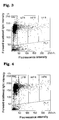
- the scattergram shown in Fig. 1 was obtained.
- the ratio of reticulocytes (RET) to the whole erythrocytes was 2.90%.
- the RET percentage measured by the conventional R-2000 was 2.70%.
- a reagent for dyeing reticulocytes having the following composition was prepared.
- the subject sample was able to be prepared in a shorter time (one-third) than in Example 5, and the forward scattered light intensity distribution was converged due to the sphered erythrocytes, so that the distinction of the erythrocytes from the platelets was facilitated.
- a reagent for dyeing reticulocytes having the following composition was prepared.
- a reagent for dyeing reticulocytes having the following composition was prepared.
- Dye Compound C 1.0mg TAPS (buffer) 2.43g Sodium dihydrogenphosphate dodecaanhydride (multivalent anion) 35.8g DTAB (cationic surfactant, dyeing accelerator) 1.00g Purified water 1 liter (adjusted to pH8.5 with NaOH)
- RET reticulocytes
- a reagent for dyeing reticulocytes having the following composition was prepared.
- Dye Compound A 3.0mg Tricin (buffer) 1.79g Trisodium citrate dianhydride (multivalent anion) 29.4g DTAB (cationic surfactant, dyeing accelerator) 1000mg Purified water 1 liter (adjusted to pH9.0 with NaOH)
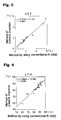
- the method of the present invention is as efficient as that using a conventional apparatus and can detect reticulocytes accurately.
- Example 9 Measured in the manner as described in Example 9 were blood samples of a normal person, a patient under medical treatment for iron deficiency anemia and a patient suffering from anemia having elliptocytes, after being treated with an anticoagulant.
- Figs. 11 to 14 show the results measured by R-2000 and Figs. 13 and 14 show the results measured by the method of the example.
- Fig. 12 and 14 show distribution diagrams of the forward scattered light intensity.
- Figs 15 to 18 show the results measured by R-2000 and Figs. 17 and 18 show the results measured by the method of the example.
- Fig. 16 and 18 show distribution diagrams of the forward scattered light intensity. Referring to Figs. 17 and 18, especially Fig. 18, microcytic, hypochromic erythrocytes resulted from the disease are clearly distinguished from normal erythrocytes resulted from the treatment. The conventional method, as shown in Figs. 15 and 16, cannot distinguish them clearly.
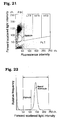
- Figs. 19 to 23 show the results measured by R-2000 and Figs. 21 and 22 show the results measured by the method of the example.
- Fig. 20 and 22 show distribution diagrams of the forward scattered light intensity.
- Fig. 23 shows an erythrocyte size distribution diagram obtained by an electric impedance detector (SE-9000 manufactured by Toa Medical Electronics Co., Ltd.). Referring to Figs. 21 and 22, especially Fig. 22, a group of elliptocytes are clearly distinguished. The conventional method shown in Figs. 19 and 20 cannot distinguish them clearly. The erythrocyte size distribution obtained by the conventional electric impedance detection shown in Fig. 23 cannot detect the presence of elliptocytes, either.
- SE-9000 electric impedance detector
- the present invention not only has realized reduction in costs of the reticulocyte determination, that is reduction in costs of apparatus by using a small-sized semiconductor red-light laser, but also has allowed accurate determination of reticulocytes by use of red wavelength light. That is to say, the present invention has enabled determination of accuracy equal to or higher than that obtained by the conventionally used apparatus, R series, which uses expensive argon lasers (and Auramine O as dye).
- the reagent of the present invention when used in combination with a cationic surfactant as dyeing accelerator, it has become possible to distinguish normacytes (normal erythrocytes) owing to medical treatment for microcytosis such as iron deficiency anemia from microcytes resulted from the disease and to detect erythrocytes of abnormal shape such as elliptocytes as well as to measure reticulocytes.
- normacytes normal erythrocytes
- erythrocytes of abnormal shape such as elliptocytes
Landscapes
- Health & Medical Sciences (AREA)
- Chemical & Material Sciences (AREA)
- Life Sciences & Earth Sciences (AREA)
- Engineering & Computer Science (AREA)
- Immunology (AREA)
- Hematology (AREA)
- Biomedical Technology (AREA)
- Pathology (AREA)
- Analytical Chemistry (AREA)
- General Physics & Mathematics (AREA)
- Molecular Biology (AREA)
- Urology & Nephrology (AREA)
- General Health & Medical Sciences (AREA)
- Biochemistry (AREA)
- Physics & Mathematics (AREA)
- Cell Biology (AREA)
- Medicinal Chemistry (AREA)
- Food Science & Technology (AREA)
- Microbiology (AREA)
- Biotechnology (AREA)
- Dispersion Chemistry (AREA)
- Organic Chemistry (AREA)
- Investigating Or Analysing Biological Materials (AREA)
- Investigating Or Analyzing Non-Biological Materials By The Use Of Chemical Means (AREA)
- Plural Heterocyclic Compounds (AREA)
- Investigating Or Analysing Materials By The Use Of Chemical Reactions (AREA)
Applications Claiming Priority (3)
| Application Number | Priority Date | Filing Date | Title |
|---|---|---|---|
| JP26034695 | 1995-10-06 | ||
| JP26034695A JP3425830B2 (ja) | 1995-10-06 | 1995-10-06 | 新規化合物とその用途 |
| JP260346/95 | 1995-10-06 |
Publications (3)
| Publication Number | Publication Date |
|---|---|
| EP0767382A2 true EP0767382A2 (de) | 1997-04-09 |
| EP0767382A3 EP0767382A3 (de) | 1998-02-25 |
| EP0767382B1 EP0767382B1 (de) | 2003-05-21 |
Family
ID=17346700
Family Applications (1)
| Application Number | Title | Priority Date | Filing Date |
|---|---|---|---|
| EP96610036A Expired - Lifetime EP0767382B1 (de) | 1995-10-06 | 1996-10-04 | Fluoreszierende Verbindungen und deren Verwendung zum Messen von Reticulozyten |
Country Status (7)
| Country | Link |
|---|---|
| US (1) | US5821127A (de) |
| EP (1) | EP0767382B1 (de) |
| JP (1) | JP3425830B2 (de) |
| KR (1) | KR100463129B1 (de) |
| CN (1) | CN1083839C (de) |
| DE (1) | DE69628257T2 (de) |
| TW (1) | TW438795B (de) |
Cited By (1)
| Publication number | Priority date | Publication date | Assignee | Title |
|---|---|---|---|---|
| EP0806664A3 (de) * | 1996-04-12 | 1998-04-08 | Toa Medical Electronics Co., Ltd. | Reagenz zum Messen von Retikulozyten und Verfahren zu deren Messung |
Families Citing this family (28)
| Publication number | Priority date | Publication date | Assignee | Title |
|---|---|---|---|---|
| JP3783808B2 (ja) * | 1997-05-19 | 2006-06-07 | シスメックス株式会社 | 白血球分類計数用試薬 |
| JP3886271B2 (ja) * | 1998-11-27 | 2007-02-28 | シスメックス株式会社 | 赤芽球の分類計数用試薬及び分類計数方法 |
| JP2001238216A (ja) * | 2000-02-23 | 2001-08-31 | Matsushita Electric Ind Co Ltd | 動画像圧縮装置および動画像圧縮方法 |
| US6368864B1 (en) * | 2000-05-05 | 2002-04-09 | Coulter International Corp. | Dyes and methods of reticulocyte enumeration |
| US7405082B2 (en) * | 2002-09-10 | 2008-07-29 | Sysmex Corporation | Methods and devices for measuring reticulocytes |
| JP4484442B2 (ja) | 2003-04-10 | 2010-06-16 | シスメックス株式会社 | 細菌測定方法と装置とプログラム |
| JP2005024472A (ja) * | 2003-07-04 | 2005-01-27 | Sysmex Corp | 幼若血小板測定装置 |
| JP4417143B2 (ja) * | 2004-03-11 | 2010-02-17 | シスメックス株式会社 | 試料分析装置、プログラムおよびそのプログラムを記録した記録媒体 |
| JP4794414B2 (ja) * | 2006-10-30 | 2011-10-19 | シスメックス株式会社 | 血小板測定用試薬、血小板測定用試薬キット並びに血小板測定方法 |
| JP4806330B2 (ja) * | 2006-10-30 | 2011-11-02 | シスメックス株式会社 | 網状赤血球及び血小板測定用試薬、網状赤血球及び血小板測定用試薬キット並びに網状赤血球及び血小板測定方法 |
| CN101231243B (zh) * | 2007-01-24 | 2011-11-16 | 深圳迈瑞生物医疗电子股份有限公司 | 网织红细胞检测试剂及检测方法 |
| CN101236158B (zh) * | 2007-01-29 | 2011-11-16 | 深圳迈瑞生物医疗电子股份有限公司 | 网织红细胞检测方法及检测装置 |
| CN101349644B (zh) | 2007-07-20 | 2012-06-27 | 深圳迈瑞生物医疗电子股份有限公司 | 一种白细胞分类试剂和其使用方法 |
| CN101475754A (zh) | 2008-01-04 | 2009-07-08 | 深圳迈瑞生物医疗电子股份有限公司 | 不对称菁类荧光染料,组合物及在生物样品染色中的用途 |
| PL2273264T3 (pl) * | 2008-02-18 | 2015-08-31 | Sysmex Corp | Reagent do oznaczania płytek krwi, zestaw reagentów do oznaczania płytek krwi i sposób oznaczania płytek krwi |
| CN101602762B (zh) | 2008-06-10 | 2013-10-16 | 深圳迈瑞生物医疗电子股份有限公司 | 不对称菁类化合物、其制备方法及应用 |
| CN101726579B (zh) | 2008-10-17 | 2014-06-18 | 深圳迈瑞生物医疗电子股份有限公司 | 血液检测试剂和方法 |
| US8367358B2 (en) | 2008-12-17 | 2013-02-05 | Shenzhen Mindray Bio-Medical Electronics Co., Ltd. | Reagent, kit and method for differentiating and counting leukocytes |
| JP5355145B2 (ja) | 2009-02-26 | 2013-11-27 | シスメックス株式会社 | 試薬調製装置、検体測定装置および試薬調製方法 |
| CN101988082B (zh) | 2009-07-31 | 2015-04-08 | 深圳迈瑞生物医疗电子股份有限公司 | 白细胞分类计数试剂、试剂盒及其制备方法和白细胞分类计数的方法 |
| JP5773644B2 (ja) * | 2010-12-28 | 2015-09-02 | 日揮触媒化成株式会社 | 水素化処理触媒の再生方法 |
| CN103385236A (zh) * | 2013-07-23 | 2013-11-13 | 山西省农业科学院果树研究所 | 一种果园中趋避黑绒鳃金龟的方法 |
| CN104749144A (zh) * | 2013-12-31 | 2015-07-01 | 深圳迈瑞生物医疗电子股份有限公司 | 血细胞检测试剂及血细胞处理方法和识别方法 |
| CN106687810B (zh) * | 2014-12-31 | 2019-10-22 | 深圳迈瑞生物医疗电子股份有限公司 | 一种非诊断目的的有核红细胞报警方法、装置及流式细胞分析仪 |
| CN111602046B (zh) * | 2018-04-28 | 2024-01-09 | 深圳迈瑞生物医疗电子股份有限公司 | 一种血液分析仪及分析方法 |
| CN108956431B (zh) * | 2018-08-09 | 2021-04-30 | 苏州叠代生物科技有限公司 | 一种单采血小板制品中残留细胞的检测方法 |
| EP3978901A1 (de) * | 2020-10-01 | 2022-04-06 | Siemens Healthcare GmbH | Reifeklassifizierung von gefärbten retikulozyten mittels optischer mikroskopie |
| CN120936860A (zh) | 2023-03-21 | 2025-11-11 | 法国比特集团 | 通过游离态荧光测量补偿荧光染料变化的方法 |
Family Cites Families (16)
| Publication number | Priority date | Publication date | Assignee | Title |
|---|---|---|---|---|
| JPS5772150A (en) * | 1980-10-23 | 1982-05-06 | Ishihara Sangyo Kaisha Ltd | Electrophotographic sensitive material |
| JPS6179163A (ja) * | 1984-09-26 | 1986-04-22 | Toa Medical Electronics Co Ltd | 血球測定用試薬 |
| US4957870A (en) * | 1985-11-01 | 1990-09-18 | Becton, Dickinson And Company | Detection of Reticulocytes, RNA and DNA |
| DE3677916D1 (de) * | 1985-11-01 | 1991-04-11 | Becton Dickinson Co | Nachweis von retikulozyten. |
| JPS62153758A (ja) * | 1985-12-27 | 1987-07-08 | Toa Medical Electronics Co Ltd | フロ−サイトメ−タによる網状赤血球測定方法 |
| JPS6361622A (ja) * | 1986-08-29 | 1988-03-17 | Nissan Shatai Co Ltd | 自動車用空調装置 |
| US4937198A (en) * | 1989-07-28 | 1990-06-26 | Becton, Dickinson And Company | Novel fluorescent dye |
| US5312921A (en) * | 1990-03-14 | 1994-05-17 | Regents Of The University Of California | Dyes designed for high sensitivity detection of double-stranded DNA |
| US5284771A (en) * | 1991-12-05 | 1994-02-08 | Miles Inc. | Reagent compositions and their use in sphering cells |
| US5360739A (en) * | 1991-12-05 | 1994-11-01 | Miles Inc. | Methods for the identification and characterization of reticulocytes in whole blood |
| US5321130A (en) * | 1992-02-10 | 1994-06-14 | Molecular Probes, Inc. | Unsymmetrical cyanine dyes with a cationic side chain |
| US5436134A (en) * | 1993-04-13 | 1995-07-25 | Molecular Probes, Inc. | Cyclic-substituted unsymmetrical cyanine dyes |
| US5534416A (en) * | 1993-04-13 | 1996-07-09 | Molecular Probes, Inc. | Fluorescent viability assay using cyclic-substituted unsymmetrical cyanine dyes |
| DE69432410T2 (de) * | 1993-05-14 | 2004-03-04 | Coulter International Corp., Miami | Retikulozyt bestimmungsverfahren und geraet, das lichtstreuungstechniken verwendet |
| US5563070A (en) * | 1993-05-28 | 1996-10-08 | Omron Corporation | Method of counting reticulocytes |
| JP3553691B2 (ja) * | 1995-04-12 | 2004-08-11 | シスメックス株式会社 | 網状赤血球測定用試薬及び測定方法 |
-
1995
- 1995-10-06 JP JP26034695A patent/JP3425830B2/ja not_active Expired - Lifetime
-
1996
- 1996-09-21 TW TW085111590A patent/TW438795B/zh not_active IP Right Cessation
- 1996-10-04 KR KR1019960043840A patent/KR100463129B1/ko not_active Expired - Lifetime
- 1996-10-04 EP EP96610036A patent/EP0767382B1/de not_active Expired - Lifetime
- 1996-10-04 CN CN96122614A patent/CN1083839C/zh not_active Expired - Lifetime
- 1996-10-04 DE DE69628257T patent/DE69628257T2/de not_active Expired - Lifetime
- 1996-10-07 US US08/726,637 patent/US5821127A/en not_active Expired - Lifetime
Cited By (2)
| Publication number | Priority date | Publication date | Assignee | Title |
|---|---|---|---|---|
| EP0806664A3 (de) * | 1996-04-12 | 1998-04-08 | Toa Medical Electronics Co., Ltd. | Reagenz zum Messen von Retikulozyten und Verfahren zu deren Messung |
| US5891731A (en) * | 1996-04-12 | 1999-04-06 | Toa Medical Electronics Co., Ltd. | Reagent for measuring reticulocytes and a method of measuring them |
Also Published As
| Publication number | Publication date |
|---|---|
| US5821127A (en) | 1998-10-13 |
| EP0767382B1 (de) | 2003-05-21 |
| DE69628257D1 (de) | 2003-06-26 |
| EP0767382A3 (de) | 1998-02-25 |
| KR970021075A (ko) | 1997-05-28 |
| DE69628257T2 (de) | 2004-01-29 |
| KR100463129B1 (ko) | 2005-07-01 |
| TW438795B (en) | 2001-06-07 |
| JPH09104683A (ja) | 1997-04-22 |
| JP3425830B2 (ja) | 2003-07-14 |
| CN1083839C (zh) | 2002-05-01 |
| CN1154966A (zh) | 1997-07-23 |
Similar Documents
| Publication | Publication Date | Title |
|---|---|---|
| EP0767382B1 (de) | Fluoreszierende Verbindungen und deren Verwendung zum Messen von Reticulozyten | |
| US6004816A (en) | Reagent and method for classification and counting of leukocytes | |
| CA2160962C (en) | Reagent for analyzing solid components in urine and method for analyzing solid components by employing the same | |
| EP1303751B1 (de) | Farbstoffe und verfahren zur erkennung von nukleinsäure in unreifen roten blutkörperchen | |
| US5891731A (en) | Reagent for measuring reticulocytes and a method of measuring them | |
| EP0513762B1 (de) | Reagenzien und Verfahren zur Zellanalyse im Harn | |
| US7923229B2 (en) | Method of classifying and counting leukocytes | |
| CN101750274B (zh) | 白细胞分类计数试剂、试剂盒以及白细胞分类计数的方法 | |
| CN101726579B (zh) | 血液检测试剂和方法 | |
| EP0483116A2 (de) | Durchflusszytometrie-Verfahren zur Klassifikation von Leukozyten und Reagenzien dafür | |
| EP2166353A1 (de) | Reagens und reagenskit zur analyse primitiver leukozyten | |
| EP0634640A1 (de) | Verfahren zum Zählen von Reticulozyten | |
| EP1918709B1 (de) | Analyseverfahren für Blutplättchen | |
| EP0259833B1 (de) | Reagenz und Verfahren zum Klassifizieren von Leukozyten durch Durchfluss-Zytometrie | |
| JP4806330B2 (ja) | 網状赤血球及び血小板測定用試薬、網状赤血球及び血小板測定用試薬キット並びに網状赤血球及び血小板測定方法 | |
| JP3485436B2 (ja) | 網状赤血球測定用試薬及び測定方法 | |
| EP4245812A1 (de) | Leukozytenklassifizierungsreagens, erythrozytenanalysereagens, kits und analyseverfahren | |
| KR19980042627A (ko) | 유약백혈구의 분류계수법 |
Legal Events
| Date | Code | Title | Description |
|---|---|---|---|
| PUAI | Public reference made under article 153(3) epc to a published international application that has entered the european phase |
Free format text: ORIGINAL CODE: 0009012 |
|
| AK | Designated contracting states |
Kind code of ref document: A2 Designated state(s): DE FR GB IT |
|
| PUAL | Search report despatched |
Free format text: ORIGINAL CODE: 0009013 |
|
| AK | Designated contracting states |
Kind code of ref document: A3 Designated state(s): DE FR GB IT |
|
| 17P | Request for examination filed |
Effective date: 19980825 |
|
| RAP1 | Party data changed (applicant data changed or rights of an application transferred) |
Owner name: SYSMEX CORPORATION |
|
| 17Q | First examination report despatched |
Effective date: 20010629 |
|
| GRAG | Despatch of communication of intention to grant |
Free format text: ORIGINAL CODE: EPIDOS AGRA |
|
| GRAG | Despatch of communication of intention to grant |
Free format text: ORIGINAL CODE: EPIDOS AGRA |
|
| GRAH | Despatch of communication of intention to grant a patent |
Free format text: ORIGINAL CODE: EPIDOS IGRA |
|
| GRAH | Despatch of communication of intention to grant a patent |
Free format text: ORIGINAL CODE: EPIDOS IGRA |
|
| GRAA | (expected) grant |
Free format text: ORIGINAL CODE: 0009210 |
|
| AK | Designated contracting states |
Designated state(s): DE FR GB IT |
|
| REG | Reference to a national code |
Ref country code: GB Ref legal event code: FG4D |
|
| REF | Corresponds to: |
Ref document number: 69628257 Country of ref document: DE Date of ref document: 20030626 Kind code of ref document: P |
|
| ET | Fr: translation filed | ||
| PLBE | No opposition filed within time limit |
Free format text: ORIGINAL CODE: 0009261 |
|
| STAA | Information on the status of an ep patent application or granted ep patent |
Free format text: STATUS: NO OPPOSITION FILED WITHIN TIME LIMIT |
|
| 26N | No opposition filed |
Effective date: 20040224 |
|
| PGFP | Annual fee paid to national office [announced via postgrant information from national office to epo] |
Ref country code: FR Payment date: 20141008 Year of fee payment: 19 Ref country code: GB Payment date: 20141001 Year of fee payment: 19 |
|
| PGFP | Annual fee paid to national office [announced via postgrant information from national office to epo] |
Ref country code: IT Payment date: 20141015 Year of fee payment: 19 |
|
| PGFP | Annual fee paid to national office [announced via postgrant information from national office to epo] |
Ref country code: DE Payment date: 20150929 Year of fee payment: 20 |
|
| GBPC | Gb: european patent ceased through non-payment of renewal fee |
Effective date: 20151004 |
|
| PG25 | Lapsed in a contracting state [announced via postgrant information from national office to epo] |
Ref country code: IT Free format text: LAPSE BECAUSE OF NON-PAYMENT OF DUE FEES Effective date: 20151004 Ref country code: GB Free format text: LAPSE BECAUSE OF NON-PAYMENT OF DUE FEES Effective date: 20151004 |
|
| REG | Reference to a national code |
Ref country code: FR Ref legal event code: ST Effective date: 20160630 |
|
| PG25 | Lapsed in a contracting state [announced via postgrant information from national office to epo] |
Ref country code: FR Free format text: LAPSE BECAUSE OF NON-PAYMENT OF DUE FEES Effective date: 20151102 |
|
| REG | Reference to a national code |
Ref country code: DE Ref legal event code: R071 Ref document number: 69628257 Country of ref document: DE |