EP0768395A2 - Feutres pour machines à papier - Google Patents
Feutres pour machines à papier Download PDFInfo
- Publication number
- EP0768395A2 EP0768395A2 EP19960120735 EP96120735A EP0768395A2 EP 0768395 A2 EP0768395 A2 EP 0768395A2 EP 19960120735 EP19960120735 EP 19960120735 EP 96120735 A EP96120735 A EP 96120735A EP 0768395 A2 EP0768395 A2 EP 0768395A2
- Authority
- EP
- European Patent Office
- Prior art keywords
- fibres
- machine
- hindered
- melting point
- polyester material
- Prior art date
- Legal status (The legal status is an assumption and is not a legal conclusion. Google has not performed a legal analysis and makes no representation as to the accuracy of the status listed.)
- Withdrawn
Links
Images


Classifications
-
- D—TEXTILES; PAPER
- D21—PAPER-MAKING; PRODUCTION OF CELLULOSE
- D21F—PAPER-MAKING MACHINES; METHODS OF PRODUCING PAPER THEREON
- D21F1/00—Wet end of machines for making continuous webs of paper
-
- D—TEXTILES; PAPER
- D21—PAPER-MAKING; PRODUCTION OF CELLULOSE
- D21F—PAPER-MAKING MACHINES; METHODS OF PRODUCING PAPER THEREON
- D21F1/00—Wet end of machines for making continuous webs of paper
- D21F1/0027—Screen-cloths
-
- D—TEXTILES; PAPER
- D01—NATURAL OR MAN-MADE THREADS OR FIBRES; SPINNING
- D01F—CHEMICAL FEATURES IN THE MANUFACTURE OF ARTIFICIAL FILAMENTS, THREADS, FIBRES, BRISTLES OR RIBBONS; APPARATUS SPECIALLY ADAPTED FOR THE MANUFACTURE OF CARBON FILAMENTS
- D01F6/00—Monocomponent artificial filaments or the like of synthetic polymers; Manufacture thereof
- D01F6/58—Monocomponent artificial filaments or the like of synthetic polymers; Manufacture thereof from homopolycondensation products
- D01F6/62—Monocomponent artificial filaments or the like of synthetic polymers; Manufacture thereof from homopolycondensation products from polyesters
-
- Y—GENERAL TAGGING OF NEW TECHNOLOGICAL DEVELOPMENTS; GENERAL TAGGING OF CROSS-SECTIONAL TECHNOLOGIES SPANNING OVER SEVERAL SECTIONS OF THE IPC; TECHNICAL SUBJECTS COVERED BY FORMER USPC CROSS-REFERENCE ART COLLECTIONS [XRACs] AND DIGESTS
- Y10—TECHNICAL SUBJECTS COVERED BY FORMER USPC
- Y10S—TECHNICAL SUBJECTS COVERED BY FORMER USPC CROSS-REFERENCE ART COLLECTIONS [XRACs] AND DIGESTS
- Y10S162/00—Paper making and fiber liberation
- Y10S162/90—Papermaking press felts
-
- Y—GENERAL TAGGING OF NEW TECHNOLOGICAL DEVELOPMENTS; GENERAL TAGGING OF CROSS-SECTIONAL TECHNOLOGIES SPANNING OVER SEVERAL SECTIONS OF THE IPC; TECHNICAL SUBJECTS COVERED BY FORMER USPC CROSS-REFERENCE ART COLLECTIONS [XRACs] AND DIGESTS
- Y10—TECHNICAL SUBJECTS COVERED BY FORMER USPC
- Y10S—TECHNICAL SUBJECTS COVERED BY FORMER USPC CROSS-REFERENCE ART COLLECTIONS [XRACs] AND DIGESTS
- Y10S162/00—Paper making and fiber liberation
- Y10S162/902—Woven fabric for papermaking drier section
-
- Y—GENERAL TAGGING OF NEW TECHNOLOGICAL DEVELOPMENTS; GENERAL TAGGING OF CROSS-SECTIONAL TECHNOLOGIES SPANNING OVER SEVERAL SECTIONS OF THE IPC; TECHNICAL SUBJECTS COVERED BY FORMER USPC CROSS-REFERENCE ART COLLECTIONS [XRACs] AND DIGESTS
- Y10—TECHNICAL SUBJECTS COVERED BY FORMER USPC
- Y10S—TECHNICAL SUBJECTS COVERED BY FORMER USPC CROSS-REFERENCE ART COLLECTIONS [XRACs] AND DIGESTS
- Y10S162/00—Paper making and fiber liberation
- Y10S162/903—Paper forming member, e.g. fourdrinier, sheet forming member
-
- Y—GENERAL TAGGING OF NEW TECHNOLOGICAL DEVELOPMENTS; GENERAL TAGGING OF CROSS-SECTIONAL TECHNOLOGIES SPANNING OVER SEVERAL SECTIONS OF THE IPC; TECHNICAL SUBJECTS COVERED BY FORMER USPC CROSS-REFERENCE ART COLLECTIONS [XRACs] AND DIGESTS
- Y10—TECHNICAL SUBJECTS COVERED BY FORMER USPC
- Y10T—TECHNICAL SUBJECTS COVERED BY FORMER US CLASSIFICATION
- Y10T428/00—Stock material or miscellaneous articles
- Y10T428/24—Structurally defined web or sheet [e.g., overall dimension, etc.]
- Y10T428/24628—Nonplanar uniform thickness material
- Y10T428/24636—Embodying mechanically interengaged strand[s], strand-portion[s] or strand-like strip[s] [e.g., weave, knit, etc.]
-
- Y—GENERAL TAGGING OF NEW TECHNOLOGICAL DEVELOPMENTS; GENERAL TAGGING OF CROSS-SECTIONAL TECHNOLOGIES SPANNING OVER SEVERAL SECTIONS OF THE IPC; TECHNICAL SUBJECTS COVERED BY FORMER USPC CROSS-REFERENCE ART COLLECTIONS [XRACs] AND DIGESTS
- Y10—TECHNICAL SUBJECTS COVERED BY FORMER USPC
- Y10T—TECHNICAL SUBJECTS COVERED BY FORMER US CLASSIFICATION
- Y10T442/00—Fabric [woven, knitted, or nonwoven textile or cloth, etc.]
- Y10T442/30—Woven fabric [i.e., woven strand or strip material]
- Y10T442/3065—Including strand which is of specific structural definition
- Y10T442/3089—Cross-sectional configuration of strand material is specified
- Y10T442/3114—Cross-sectional configuration of the strand material is other than circular
Definitions
- This invention relates to paper machine clothing suitable for use in the forming, pressing or drying sections of a paper making machine and has particular reference to paper making machine clothing used in the dryer section of a paper making machine, such as through air drying fabrics, and dryer screens.
- a slurry of paper making constituents referred to as "furnish” is deposited on a fabric or "wire" and the liquid constituent of the furnish is drawn or extracted through the fabric or wire to produce a self-cohesive sheet.
- This cohesive sheet is passed to a pressing and drying section of a paper making machine.
- the paper sheet In the pressing section of the machine, the paper sheet is transported by a felt to a pair of rollers where the felt and paper sheet are passed between the nip of the rollers to dewater and dry the paper sheet.
- the paper sheet itself may contain all types of chemical finishes and will be at the same time, subjected to an elevated temperature in order to aid the dewatering and drying thereof.
- Dryer fabrics or "dryer screens" employed in the paper making industry have, traditionally, been formed from a variety of materials such as poly(ethylene terephthalate), polyphenylene sulfide and polypropylene. Each material has different properties and pricing, which affects its relative position in the marketplace.
- An important property for any material used as a drier screen in a paper making machine is that the material should have good hydrolytic stability and good dimensional stability.
- Polypropylene is the cheapest material presently available; it has excellent hydrolytic stability, but poor dimensional stability at elevated temperature, and as a result it has only limited use.
- Poly(ethylene terephthalate) (PET) is moderately priced, has exceptional dimensional stability and reasonable hydrolytic stability.
- PET Poly(ethylene terephthalate) is the predominant material currently used in the marketplace and in most cases, the hydrolytic stability of poly(ethylene terephthalate) can be improved by the addition of carbodiimide stabilisers.
- Polyphenylene sulfide has excellent dimensional and hydrolytic stability, but suffers from the disadvantage that it is extremely highly priced, is more difficult to work, and tends to suffer from brittle fracture problems in the crystalline state due to normal flexing experienced on the paper machine.
- an article of paper making machine clothing suitable for use in the forming, pressing or drying sections of a paper making machine which article includes a fibre structure characterized in that the fibres of said structure comprise a polyester material having a hintered carboxyl group and in that said fibres have a melting point greater than 260°C.
- the fibres may have a creep extension of less than 10% at 1.1 grams per denier.
- fibre refers to a shaped polymeric body of high aspect ratio capable of being formed into two or three dimensional articles as in woven or nonwoven fabrics. Fibre further refers to staple, multifilament or monofilament forms. Melting point is defined in this context as the temperature of the highest peak on the endotherm of the plot produced via Differential Scanning Calorimetry. By way of example of how melting point is determined
- Figure 1 (hereinafter referred to) is a graph of a Differential Scanning Calorimetry response of a commercial polyester with a metling point of 255°C.
- the fibres may additionally have an initial modulus greater than 25 grams per denier, an elongation at break of greater than 15% and a tenacity of greater than 2 grams per denier.
- the fibres may have a melting point greater than 265°C and an initial modulus greater than 30 grams per denier and an elongation at break of greater than 25%, a tenacity of 2.2 grams per denier.
- a further embodiment of the present invention provides that the fibres have a melting point of greater than 280°C and an initial modulus greater than 32 grams per denier, an elongation at break greater than 30%, and a tenacity of greater than 2.3 grams per denier; preferably, the fibres also have a creep extension of less than 8% at 1.5 gram per denier.
- a further aspect of the present invention provides that the polyester material has carboxyl groups which are hindered by a moiety selected from cycloaliphatic and branched aliphatic glycol.
- the polyester may be poly(1,4-cyclohexandicarbinyl terephthalate).
- the cyclohexane ring may be substituted such that the two carbinyl groups may exist in one of two configurations, i.e. the cis- or the trans-configuration. While the precise mechanism is not entirely understood, the cis-configuration imparts a relatively low melting point of the order of 220°C while the trans-configuration has a high melting point approaching 300°C and is highly crystalline.
- the large size of the cyclohexane moiety within the polyester molecule serves to hinder a hydrolytic attack on the carboxyl group and is thought to provide improved hydrolysis resistance.
- the thermal properties of the material can be controlled by selection of the relative proportions of the cis- and trans-isomers to produce a material which is eminently suitable for use in high temperature portions of a paper making machine such, for example, as a dryer screen.
- the polyester material may include a proportion of a stabilizer.
- Typical stabilisers include carbodiimides present in an amount of 0.5 to 10%, preferably 1 to 4% by weight.
- the carbodiimide may be that of benzene-2,4-diisocyonate- 1,3,5-tris(1-methylethyl) homopolymer or it may be that of a copolymer of benzene 2,4-diisocyanato-1,3,5-tris(1-methylethyl) with 2,6-diisopropyl dissocyanate such, for example, as that commercially available under the trade name "STABAXOL P" or "STABAXOL P-100", respectively of Rhein-Chemie, of Rheinau GmbH, West Germany.
- the polyester fibres either alone or incorporating the stabilizer typically have a tensile strength of 2.4 to 4.3 grams per denier.
- the fibres of the fibre structure in accordance with the present invention may further exhibit a thermal shrinkage at 200°C of 0.2% to 20.5% with a tensile modulus within the range of 34 to 74 grams per denier.
- the polyester material may be poly(1,4-cyclohexanedicarbinyl terephthalate) and it has been found that the material commercially available under the trade name "KODAR THERMX copolyester 6761" produced by the Eastman Chemical Products Inc., is particularly suitable in this regard.
- the fibres may be monofilaments of either round or other shaped cross-sections and may extend in the machine direction and/or cross-machine direction.
- the article may comprise a support layer and a surface layer, at least one of which constitutes said fibre structure.
- the surface layer may be a felt.
- the fibre structure may be a batt.
- the present invention also relates to a method of manufacturing an article of paper machine clothing suitable for use in the forming, pressing or drying section of a papermaking machine, the method comprising producing fibres having a melting point greater than 260°C from a polyester material having a hindered carboxyl group, and forming the fibres into a fibre structure.
- the present invention further provides the use of fibres having a melting point greater than 260°C and formed from a polyester material having a hindered carboxyl group, to produce an article of paper machine clothing with improved hydrolysis resistance.
- the carboxyl groups may be hindered by a cycloaliphatic moiety, preferably a cyclohexane moiety, to provide the improved hydrolysis resistance.
- paper machine clothing in accordance with the present invention is its potential use in high temperature sections of a paper making machine, in particular dryer fabrics and dryer screen fabrics, since the material from which it is made is not readily hydrolyzed.
- materials in accordance with the present invention show an exceptional degree of stability over time when compared with conventional polyester materials currently employed and it is not uncommon for the half life of the percent retained tensile strength for articles of paper machine clothing in accordance with the present invention to be 1.5 to twice that of the current industry standard.
- the invention is concerned not only with the production of paper machine clothing (PMC) materials which may be of woven or spiral or of other suitable monofilament structures, in which monofilaments may extend in both the machine direction and the cross direction of the fabric, but also include other PMC structures.
- PMC paper machine clothing
- Such polyester may be used to produce PMC fabrics comprised of staple, multifilament, and/or monofilament fibres.
- Typical range of sizes of monofilaments used in Press Fabrics and Dryer Fabrics are 0.20mm - 1.27mm in diameter or the equivalent mass in cross-section in other cross-section shapes, e.g. square or oval.
- a polyester commercially available under the trade name "KODAR THERMX copolyester 6761" supplied by the Eastman Chemical Products Inc. was extruded in a 25mm single screw extruder having a screw with a compression ratio of 4.12 and a 40 mesh screen filtration at the end of the barrel.
- the material was spun after filtration through a 325 mesh screen supported by an 80 mesh screen through a multi-hole die with each hole having a diameter of 0.625mm (0.025”), land length of 1.9mm.
- the air gap after extrusion was 32mm and the quench water temperature was 66°C.
- the resultant extrudate was subjected to an overall draw ratio which varied from 3.0 to 4.8 thereby producing a range of denier of the monofilaments.
- Example 2 The experiment as defined in Example 1 was repeated for a proportion of the same copolyester material having various proportions of up to 5% by weight of a carbodiimide stabilizer material commercially available under the trade name "STABAXOL P-100".
- STABAXOL P-100 a carbodiimide stabilizer material commercially available under the trade name "STABAXOL P-100”.
- the properties of the monofilament as extruded and drawn are set out in Table 2.
- Figure 2 shows graphically how the hydrolysis resistance of the various stabilized and unstabilized monofilaments described in Examples 1 and 2 behave over a period of 32 days when subjected to saturated steam in an autoclave at a pressure of 2 atm absolute pressure.
- the five samples of Table 2 are illustrated together with a commercial monofilament produced from poly(ethylene terephthalate) and stabilized with a cabodiimide.
- the significant point on the graph is the period in which the retained tensile strength has been reduced to 50%.
- the extruded filament travelled through the bath for an approximate quench length of 0.8mm.
- the filament exited the bath horizontally and travelled to a first roll stand operating at a speed of 8m/min.
- the filament then passed through a hot air circulating oven operating at 121°C.
- the oven was 1.6 metres long.
- the filament exited the oven and travelled to a second roll stand operating at 28m/min.
- the filament then passed through a second oven operating at 149°C and travelled to a third roll stand operating at 39m/min.
- the second oven had a length of 1.6 metres.
- the filament then passed through a third oven operating at 177°F and passed to fourth roll stand operating at a speed of 32m/min.
- the third oven had a length of 1.6 metres.
- the oriented monofilament was then collected on a spool via a tension controlled winder.
- the product when tested had a tensile strength of 3.4 gpd, an elongation at break of 23.5%, an initial tensile modulus of 41.0 gpd and a thermal free shrinkage at 200°C of 7.6%.
- Example 3 is similar to Example 3 with the following changes in roll stand speeds.
- the speeds for the first, second, third and fourth roll stands were 8, 28, 28 and 25 m/min, respectively.
- the product which resulted had a tensile strength of 2.7 gpd, an elongation at break of 34.8%, an initial tensile modulus of 36.3 gpd and a thermal free shrinkage at 200°C of 4.6%.
- This Example is similar to Examples 3 and 4, equipment wise, but with changes in both oven temperatures and roll stand speeds.
- the oven temperatures were 177°, 204° and 500° for ovens one, two and three, respectively.
- the speeds for the first, second, third and fourth roll stands were 8, 36, 39 and 39 m/min, respectively.
- the product which resulted had a tensile strength of 4.6 gpd, an elongation at break of 7.4%, an initial tensile modulus of 74.4 gpd and a thermal free shrinkage at 200°C of 11.6%.
- Example 5 is similar to Example 5 with the following changes in roll stand speeds.
- the speeds for the first, second, third and fourth roll stands were 8, 32, 32 and 32m/min, respectively.
- the product which resulted had a tensile strength of 4.0 gpd, an elongation at break of 18.0%, an initial tensile modulus of 55.3 gpd and a thermal free shrinkage at 200°C of 5.9%.
- the filament then passed through a hot air circulating oven operating at 121°C.
- the oven was 2.7 meters long.
- the filament then passed through a second oven operating at 191°C and travelled to a third roll stand operating at 70 m/min.
- the second oven had a length of 2.4 meters.
- the filament then passed through a third oven operating at 268°C and passed to a fourth roll stand operating at a speed of 62m/min.
- the third oven had a length of 2.7 meters, The oriented monofilament was then collected on a spool via a tension controlled winder.
- the product when tested had a tensile strength of 2.5 gpd, an elongation at break of 33%, and an initial modulus of 32 gpd.
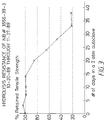
- Figure 3 shows graphically how the hydrolytic resistance of the stabilized monofilment described in Example 7 behaves over a period of 38 days when subjected to saturated steam in an autoclave at a pressure of 2 atm absolute pressure.
- the filament then passed through a hot air circulating oven at 179°C.
- the oven was 2.7 meters long.
- the filament then passed through a second oven operating at 231°C and travelled to a third roll stand operating at 58m/min.
- the second oven had a length of 2.7 meters.
- the third oven had a length of 2.7 meters.
- the oriented monofilament was then collected on a spool via a tension controlled winder.
- the product when tested had a tensile strength of 2.6 gpd, an elongation at break of 39%, and an initial modulus of 32 gpd.
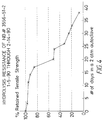
- Figure 4 shows graphically how the hydrolytic resistance of the stabilized monofilament described in Example 8 behaves over a period of 38 days when subjected to saturated steam in an autoclave at a pressure of 2 atm absolute pressure.
Landscapes
- Chemical & Material Sciences (AREA)
- Chemical Kinetics & Catalysis (AREA)
- General Chemical & Material Sciences (AREA)
- Engineering & Computer Science (AREA)
- Textile Engineering (AREA)
- Artificial Filaments (AREA)
- Paper (AREA)
- Filtering Materials (AREA)
- Photographic Developing Apparatuses (AREA)
- Diaphragms For Electromechanical Transducers (AREA)
- Woven Fabrics (AREA)
- Multicomponent Fibers (AREA)
- Nonwoven Fabrics (AREA)
- Materials For Medical Uses (AREA)
- Dental Preparations (AREA)
- Cosmetics (AREA)
- Filters For Electric Vacuum Cleaners (AREA)
- Treatment Of Fiber Materials (AREA)
- Iron Core Of Rotating Electric Machines (AREA)
Applications Claiming Priority (7)
| Application Number | Priority Date | Filing Date | Title |
|---|---|---|---|
| GB898909291A GB8909291D0 (en) | 1989-04-24 | 1989-04-24 | Paper making machine felts |
| GB8909291 | 1989-04-24 | ||
| GB898913731A GB8913731D0 (en) | 1989-06-15 | 1989-06-15 | Paper making machine fabrics |
| GB8913731 | 1989-06-15 | ||
| GB898924996A GB8924996D0 (en) | 1989-11-06 | 1989-11-06 | Improvements in and relating to monofilaments |
| GB8924996 | 1989-11-06 | ||
| EP19900907246 EP0473633B2 (fr) | 1989-04-24 | 1990-04-23 | Feutres pour machines a papier |
Related Parent Applications (2)
| Application Number | Title | Priority Date | Filing Date |
|---|---|---|---|
| EP19900907246 Division EP0473633B2 (fr) | 1989-04-24 | 1990-04-23 | Feutres pour machines a papier |
| EP90907246.4 Division | 1990-11-06 |
Publications (2)
| Publication Number | Publication Date |
|---|---|
| EP0768395A2 true EP0768395A2 (fr) | 1997-04-16 |
| EP0768395A3 EP0768395A3 (fr) | 1998-01-28 |
Family
ID=27264439
Family Applications (2)
| Application Number | Title | Priority Date | Filing Date |
|---|---|---|---|
| EP19960120735 Withdrawn EP0768395A3 (fr) | 1989-04-24 | 1990-04-23 | Feutres pour machines à papier |
| EP19900907246 Expired - Lifetime EP0473633B2 (fr) | 1989-04-24 | 1990-04-23 | Feutres pour machines a papier |
Family Applications After (1)
| Application Number | Title | Priority Date | Filing Date |
|---|---|---|---|
| EP19900907246 Expired - Lifetime EP0473633B2 (fr) | 1989-04-24 | 1990-04-23 | Feutres pour machines a papier |
Country Status (15)
| Country | Link |
|---|---|
| US (1) | US5169499B1 (fr) |
| EP (2) | EP0768395A3 (fr) |
| JP (1) | JPH04500247A (fr) |
| KR (1) | KR0171878B1 (fr) |
| AT (1) | ATE155180T1 (fr) |
| AU (1) | AU638013B2 (fr) |
| BR (1) | BR9006880A (fr) |
| CA (1) | CA2042062C (fr) |
| DE (1) | DE69031037T3 (fr) |
| DK (1) | DK0473633T3 (fr) |
| ES (1) | ES2106030T5 (fr) |
| FI (1) | FI117517B (fr) |
| NO (1) | NO178797C (fr) |
| NZ (1) | NZ233437A (fr) |
| WO (1) | WO1990012918A1 (fr) |
Families Citing this family (37)
| Publication number | Priority date | Publication date | Assignee | Title |
|---|---|---|---|---|
| GB9125889D0 (en) * | 1991-12-05 | 1992-02-05 | Albany Research Uk | Improvements in and relating to paper machine clothing |
| DE4142788A1 (de) * | 1991-12-23 | 1993-06-24 | Wuertt Filztuchfab | Materialbahn |
| CA2087477A1 (fr) * | 1992-02-03 | 1993-08-04 | Jennifer A. Gardner | Monofilaments de copolyester haute temperature avec resistance sur noeud amelioree pour toile secheuse |
| DE4307392C2 (de) * | 1993-03-10 | 2001-03-29 | Klaus Bloch | Monofil mit erhöhter Hydrolysebeständigkeit auf Basis Polyester für die Verwendung in technischen Geweben und Verfahren zu dessen Herstellung |
| DE4307394C1 (de) * | 1993-03-10 | 1994-06-16 | Klaus Bloch | Monofil mit erhöhter Hydrolysebeständigkeit auf Basis Polyester und Verfahren zu dessen Herstellung |
| US5981062A (en) * | 1993-04-26 | 1999-11-09 | Johns Manville International, Inc. | Monofilament made from a blend of a polyester having a polyhydric alcohol component of 1,4-cyclohexanedimethanol, and a polyamide |
| CA2119678A1 (fr) * | 1993-04-26 | 1994-10-27 | Herbert D. Stroud, Jr. | Monofilament fait d'un melange de polyester comprenant un composant polyhydroxyle a base de 1,4-cyclohexanedimethanol et un polyamide |
| US5407736A (en) * | 1993-08-12 | 1995-04-18 | Shakespeare Company | Polyester monofilament and paper making fabrics having improved abrasion resistance |
| US6069204A (en) * | 1993-09-09 | 2000-05-30 | Johns Manville International, Inc. | Monofilament made from a blend of a polyester having a polyhydric alcohol component of 1,4-cyclohexanedimethanol, a polyamide, and a polyolefin |
| US5464890A (en) * | 1993-11-12 | 1995-11-07 | Shakespeare Company | Polyester monofilaments extruded from a high temperature polyester resin blend with increased resistance to hydrolytic and thermal degradation and fabrics thereof |
| DE4340869A1 (de) * | 1993-12-01 | 1995-06-08 | Hoechst Ag | Multifilamentgarne für technische Einsatzgebiete aus Poly-(1,4-bis-methylen-cyclohexan-terephthalat) und Verfahren zu ihrer Herstellung |
| US5424125A (en) * | 1994-04-11 | 1995-06-13 | Shakespeare Company | Monofilaments from polymer blends and fabrics thereof |
| JPH09503562A (ja) * | 1994-08-04 | 1997-04-08 | ジェイ ダブリュ アイ リミテッド | 抄紙機乾燥機織物 |
| US5503196A (en) | 1994-12-07 | 1996-04-02 | Albany International Corp. | Papermakers fabric having a system of machine-direction yarns residing interior of the fabric surfaces |
| EP0828793B1 (fr) * | 1995-06-02 | 1999-04-28 | Eastman Chemical Company | Polyesters d'acide 2,6-naphtalenedicarboxylique presentant une stabilite hydrolitique amelioree |
| US5607757A (en) * | 1995-06-02 | 1997-03-04 | Eastman Chemical Company | Paper machine fabric |
| GB2309712A (en) * | 1996-02-05 | 1997-08-06 | Shell Int Research | Papermachine clothing woven from aliphatic polyketone fibres |
| US5656715A (en) * | 1996-06-26 | 1997-08-12 | Eastman Chemical Company | Copolyesters based on 1,4-cyclohexanedimethanol having improved stability |
| US5910363A (en) * | 1997-05-30 | 1999-06-08 | Eastman Chemical Company | Polyesters of 2,6-naphthalenedicarboxylic acid having improved hydrolytic stability |
| US6146462A (en) * | 1998-05-08 | 2000-11-14 | Astenjohnson, Inc. | Structures and components thereof having a desired surface characteristic together with methods and apparatuses for producing the same |
| DE19828517C2 (de) * | 1998-06-26 | 2000-12-28 | Johns Manville Int Inc | Monofile auf der Basis von Polyethylen-2,6-naphthalat |
| EP1304402B1 (fr) | 2000-07-14 | 2006-08-30 | Teijin Limited | Fibre en polyester |
| GB0117830D0 (en) * | 2001-07-21 | 2001-09-12 | Voith Fabrics Heidenheim Gmbh | Stabilised polyester compositions and monofilaments thereof for use in papermachine clothing and other industrial fabrics |
| US6763855B2 (en) * | 2001-10-30 | 2004-07-20 | Albany International Corp. | Through-air-drying base fabric |
| US6837275B2 (en) * | 2002-11-07 | 2005-01-04 | Albany International Corp. | Air channel dryer fabric |
| US6837276B2 (en) * | 2002-11-07 | 2005-01-04 | Albany International Corp. | Air channel dryer fabric |
| US6818293B1 (en) * | 2003-04-24 | 2004-11-16 | Eastman Chemical Company | Stabilized polyester fibers and films |
| US6989080B2 (en) * | 2003-06-19 | 2006-01-24 | Albany International Corp. | Nonwoven neutral line dryer fabric |
| US20070173585A1 (en) * | 2004-12-22 | 2007-07-26 | Sevenich Gregory J | Polyester nanocomposite filaments and fiber |
| DE502006005768D1 (de) | 2005-09-21 | 2010-02-11 | Raschig Gmbh | Hydrolysestabilisatorformulierungen |
| US7617846B2 (en) * | 2006-07-25 | 2009-11-17 | Albany International Corp. | Industrial fabric, and method of making thereof |
| US7644738B2 (en) * | 2007-03-28 | 2010-01-12 | Albany International Corp. | Through air drying fabric |
| US20120214374A1 (en) * | 2011-02-21 | 2012-08-23 | Chaitra Mahesha | Paper machine clothing having monofilaments with lower coefficient of friction |
| PT2933285T (pt) | 2014-04-15 | 2019-03-14 | Raschig Gmbh | Formulações de estabilizador de hidrólise |
| EP3115409A1 (fr) | 2015-07-10 | 2017-01-11 | Hexion Research Belgium SA | Compositions de stabilisateur de polyester inodore |
| US12281440B2 (en) | 2020-12-16 | 2025-04-22 | Huyck Licensco Inc. | Endless woven dryer fabric for papermaking machine |
| US20250034762A1 (en) | 2023-07-28 | 2025-01-30 | Albany International Corp | Structuring Fabric Having Long Warp Knuckles |
Family Cites Families (11)
| Publication number | Priority date | Publication date | Assignee | Title |
|---|---|---|---|---|
| DE1222205B (de) * | 1955-12-22 | 1966-08-04 | Eastman Kodak Co | Bestimmte Polyester zum Herstellen von Folien oder Faeden |
| DE1710620B2 (de) * | 1968-03-14 | 1974-10-31 | Farbwerke Hoechst Ag Vormals Meister Lucius & Bruening, 6000 Frankfurt | Verfahren und Vorrichtung zur Herstellung von runden Drähten aus synthetischen linearen Hochpolymeren |
| US3975329A (en) * | 1974-01-02 | 1976-08-17 | The Goodyear Tire & Rubber Company | Industrial polyester yarn |
| US4107150A (en) * | 1976-05-27 | 1978-08-15 | Phillips Petroleum Company | High impact terephthalate copolyesters using 1,4-butanediol and 1,4-cyclohexanedimethanol |
| AU502933B2 (en) * | 1978-02-02 | 1979-08-16 | The Goodyear Tire & Rubber Company | Screen for papermaking apparatus |
| JPS5823915A (ja) * | 1981-08-04 | 1983-02-12 | Toray Ind Inc | 工業用ポリエステルモノフイラメントの製造方法 |
| JPS6059360B2 (ja) * | 1981-08-05 | 1985-12-24 | 大和紡績株式会社 | 抄紙用ニ−ドルフエルトの製造方法 |
| US4374960A (en) * | 1981-09-16 | 1983-02-22 | Allied Corporation | Production of polyester fibers of improved stability |
| IT1148619B (it) * | 1981-10-09 | 1986-12-03 | Jwi Ltd | Monofilamento a basso contenuto carbossilico per l'impiego nella fabbricazione di un telo per macchine essiccatrici della carta |
| US4414263A (en) * | 1982-07-09 | 1983-11-08 | Atlanta Felt Company, Inc. | Press felt |
| FI844125L (fi) * | 1984-03-26 | 1985-09-27 | Huyck Corp | Pappersmaskintyg som bestaor av slitstarka traodar. |
-
1990
- 1990-04-23 EP EP19960120735 patent/EP0768395A3/fr not_active Withdrawn
- 1990-04-23 AT AT90907246T patent/ATE155180T1/de not_active IP Right Cessation
- 1990-04-23 BR BR9006880A patent/BR9006880A/pt not_active IP Right Cessation
- 1990-04-23 ES ES90907246T patent/ES2106030T5/es not_active Expired - Lifetime
- 1990-04-23 DK DK90907246T patent/DK0473633T3/da active
- 1990-04-23 AU AU55368/90A patent/AU638013B2/en not_active Ceased
- 1990-04-23 CA CA 2042062 patent/CA2042062C/fr not_active Expired - Lifetime
- 1990-04-23 KR KR1019910700838A patent/KR0171878B1/ko not_active Expired - Fee Related
- 1990-04-23 EP EP19900907246 patent/EP0473633B2/fr not_active Expired - Lifetime
- 1990-04-23 WO PCT/GB1990/000623 patent/WO1990012918A1/fr not_active Ceased
- 1990-04-23 DE DE1990631037 patent/DE69031037T3/de not_active Expired - Fee Related
- 1990-04-23 JP JP2506654A patent/JPH04500247A/ja active Pending
- 1990-04-24 NZ NZ233437A patent/NZ233437A/en unknown
-
1991
- 1991-04-04 US US07678292 patent/US5169499B1/en not_active Expired - Lifetime
- 1991-06-18 FI FI912969A patent/FI117517B/fi active IP Right Grant
- 1991-09-04 NO NO913471A patent/NO178797C/no not_active IP Right Cessation
Non-Patent Citations (1)
| Title |
|---|
| None |
Also Published As
| Publication number | Publication date |
|---|---|
| EP0768395A3 (fr) | 1998-01-28 |
| CA2042062A1 (fr) | 1990-10-25 |
| FI117517B (fi) | 2006-11-15 |
| DK0473633T3 (da) | 1997-08-11 |
| ATE155180T1 (de) | 1997-07-15 |
| WO1990012918A1 (fr) | 1990-11-01 |
| KR920701566A (ko) | 1992-08-12 |
| KR0171878B1 (ko) | 1999-05-01 |
| FI912969A0 (fi) | 1991-06-18 |
| DE69031037D1 (de) | 1997-08-14 |
| ES2106030T5 (es) | 2008-04-16 |
| AU638013B2 (en) | 1993-06-17 |
| JPH04500247A (ja) | 1992-01-16 |
| EP0473633A1 (fr) | 1992-03-11 |
| NO913471L (no) | 1991-09-04 |
| NO913471D0 (no) | 1991-09-04 |
| DE69031037T2 (de) | 1997-11-20 |
| EP0473633B2 (fr) | 2007-11-21 |
| NO178797C (no) | 1996-06-05 |
| NO178797B (no) | 1996-02-26 |
| AU5536890A (en) | 1990-11-16 |
| BR9006880A (pt) | 1991-08-27 |
| US5169499B1 (en) | 1994-05-10 |
| ES2106030T3 (es) | 1997-11-01 |
| CA2042062C (fr) | 1995-11-14 |
| EP0473633B1 (fr) | 1997-07-09 |
| US5169499A (en) | 1992-12-08 |
| DE69031037T3 (de) | 2008-05-21 |
| NZ233437A (en) | 1992-07-28 |
Similar Documents
| Publication | Publication Date | Title |
|---|---|---|
| EP0473633B1 (fr) | Feutres pour machines a papier | |
| US7935225B2 (en) | Papermaker's forming fabrics including monofilaments comprised of a blend of poly(ethylene naphthalate) and poly(ethylene terephthalate) | |
| AU627251B2 (en) | Paper machine felts | |
| AU635993B2 (en) | Paper machine felts | |
| AU734181B2 (en) | Polyester fiber with improved abrasion resistance | |
| JP7176850B2 (ja) | 海島型複合繊維束 | |
| US5776313A (en) | Papermachine clothing of aliphatic polyketones | |
| JP3786004B2 (ja) | 脂肪族ポリエステル樹脂組成物、成形体およびその製造方法 | |
| JP4203978B2 (ja) | 低収縮ポリ乳酸繊維およびその製造方法 | |
| KR100557271B1 (ko) | 분리가능한 중공 코폴리에스테르 섬유 및 분리된 코폴리에스테르 섬유, 이를 포함하는 직물 또는 편직물, 인조 가죽 및 부직포 | |
| JPH10204766A (ja) | 生分解性を有する繊維構造物 | |
| JP2012031525A (ja) | 湿式短繊維不織布 | |
| HK1023153B (en) | Divisible hollow copolyester fibers and divided copolyester fibers, woven or knitted fabric, artificial leather and nonwoven fabric comprising same | |
| WO2001006046A1 (fr) | Produits textiles industriels comportant des composants en polytrimethylene terephtalate |
Legal Events
| Date | Code | Title | Description |
|---|---|---|---|
| PUAI | Public reference made under article 153(3) epc to a published international application that has entered the european phase |
Free format text: ORIGINAL CODE: 0009012 |
|
| AC | Divisional application: reference to earlier application |
Ref document number: 473633 Country of ref document: EP |
|
| AK | Designated contracting states |
Kind code of ref document: A2 Designated state(s): AT BE CH DE DK ES FR GB IT LI LU NL SE |
|
| 17P | Request for examination filed |
Effective date: 19970418 |
|
| PUAL | Search report despatched |
Free format text: ORIGINAL CODE: 0009013 |
|
| RHK1 | Main classification (correction) |
Ipc: D21F 1/00 |
|
| AK | Designated contracting states |
Kind code of ref document: A3 Designated state(s): AT BE CH DE DK ES FR GB IT LI LU NL SE |
|
| 17Q | First examination report despatched |
Effective date: 19990503 |
|
| STAA | Information on the status of an ep patent application or granted ep patent |
Free format text: STATUS: THE APPLICATION IS DEEMED TO BE WITHDRAWN |
|
| 18D | Application deemed to be withdrawn |
Effective date: 20071101 |