EP0768575A2 - Méthode d'optimisation de l'arrangement d'éléments semi-conducteurs sur une plaquette semi-conductrice - Google Patents
Méthode d'optimisation de l'arrangement d'éléments semi-conducteurs sur une plaquette semi-conductrice Download PDFInfo
- Publication number
- EP0768575A2 EP0768575A2 EP96113463A EP96113463A EP0768575A2 EP 0768575 A2 EP0768575 A2 EP 0768575A2 EP 96113463 A EP96113463 A EP 96113463A EP 96113463 A EP96113463 A EP 96113463A EP 0768575 A2 EP0768575 A2 EP 0768575A2
- Authority
- EP
- European Patent Office
- Prior art keywords
- wafer
- mask
- elements
- semiconductor elements
- optimization
- Prior art date
- Legal status (The legal status is an assumption and is not a legal conclusion. Google has not performed a legal analysis and makes no representation as to the accuracy of the status listed.)
- Withdrawn
Links
Images

Classifications
-
- G—PHYSICS
- G03—PHOTOGRAPHY; CINEMATOGRAPHY; ANALOGOUS TECHNIQUES USING WAVES OTHER THAN OPTICAL WAVES; ELECTROGRAPHY; HOLOGRAPHY
- G03F—PHOTOMECHANICAL PRODUCTION OF TEXTURED OR PATTERNED SURFACES, e.g. FOR PRINTING, FOR PROCESSING OF SEMICONDUCTOR DEVICES; MATERIALS THEREFOR; ORIGINALS THEREFOR; APPARATUS SPECIALLY ADAPTED THEREFOR
- G03F7/00—Photomechanical, e.g. photolithographic, production of textured or patterned surfaces, e.g. printing surfaces; Materials therefor, e.g. comprising photoresists; Apparatus specially adapted therefor
- G03F7/70—Microphotolithographic exposure; Apparatus therefor
- G03F7/70425—Imaging strategies, e.g. for increasing throughput or resolution, printing product fields larger than the image field or compensating lithography- or non-lithography errors, e.g. proximity correction, mix-and-match, stitching or double patterning
-
- G—PHYSICS
- G03—PHOTOGRAPHY; CINEMATOGRAPHY; ANALOGOUS TECHNIQUES USING WAVES OTHER THAN OPTICAL WAVES; ELECTROGRAPHY; HOLOGRAPHY
- G03F—PHOTOMECHANICAL PRODUCTION OF TEXTURED OR PATTERNED SURFACES, e.g. FOR PRINTING, FOR PROCESSING OF SEMICONDUCTOR DEVICES; MATERIALS THEREFOR; ORIGINALS THEREFOR; APPARATUS SPECIALLY ADAPTED THEREFOR
- G03F7/00—Photomechanical, e.g. photolithographic, production of textured or patterned surfaces, e.g. printing surfaces; Materials therefor, e.g. comprising photoresists; Apparatus specially adapted therefor
- G03F7/70—Microphotolithographic exposure; Apparatus therefor
- G03F7/70425—Imaging strategies, e.g. for increasing throughput or resolution, printing product fields larger than the image field or compensating lithography- or non-lithography errors, e.g. proximity correction, mix-and-match, stitching or double patterning
- G03F7/70433—Layout for increasing efficiency or for compensating imaging errors, e.g. layout of exposure fields for reducing focus errors; Use of mask features for increasing efficiency or for compensating imaging errors
-
- G—PHYSICS
- G03—PHOTOGRAPHY; CINEMATOGRAPHY; ANALOGOUS TECHNIQUES USING WAVES OTHER THAN OPTICAL WAVES; ELECTROGRAPHY; HOLOGRAPHY
- G03F—PHOTOMECHANICAL PRODUCTION OF TEXTURED OR PATTERNED SURFACES, e.g. FOR PRINTING, FOR PROCESSING OF SEMICONDUCTOR DEVICES; MATERIALS THEREFOR; ORIGINALS THEREFOR; APPARATUS SPECIALLY ADAPTED THEREFOR
- G03F9/00—Registration or positioning of originals, masks, frames, photographic sheets or textured or patterned surfaces, e.g. automatically
- G03F9/70—Registration or positioning of originals, masks, frames, photographic sheets or textured or patterned surfaces, e.g. automatically for microlithography
Definitions
- the invention relates to a method for optimizing an arrangement of semiconductor elements, in particular IC elements, on a semiconductor wafer coated with a light-sensitive lacquer, in which the semiconductor elements are exposed on the wafer by means of a mask.
- Such a method is known from DE 32 47 141.
- This method takes into account the problem that certain surface areas on which no semiconductor elements are to be applied can be provided on a wafer.
- Such surface elements are generally used to apply test structures which are desirable on the part of the manufacturer or which are required for adjusting the exposure machine.
- the structures to be exposed i.e. the stepfields vary relative to each other so that no empty spaces remain around the areas to be kept free.
- a mask comprises a step field of semiconductor elements.
- the exposure is carried out with a stepper device, with which the stepper fields, which contain a certain number of semiconductor elements, are successively reported on the wafer using the mask.
- the varnish is developed.
- a predetermined process is then carried out, such as etching, implanting ions, etc.
- the lacquer is removed from the semiconductor wafer, after which the first structuring step of the semiconductor manufacturing process has ended.
- further structuring steps are carried out, in which the mask for generating the Stepfeld arrangement must be adjusted like the corresponding mask in the first structuring step.
- the mask used in the first structuring step is usually adjusted so that its Longitudinal axis coincides with the longitudinal axis of the semiconductor wafer and it is shifted in the direction of the longitudinal axis so that the mask areas of the wafer not to be exposed do not overlap.
- the invention has for its object to provide a method in which the manufacturing costs per semiconductor element can be reduced.
- This object is achieved by an optimization method of the generic type, in which the mask is adjusted via a reference point on the mask and a reference point on the wafer, the spatial position of which relative to one another is determined by means of a method for optimizing quantities that determine the production costs of a semiconductor element , the length of the semiconductor elements relative to one another remains fixed during the optimization.
- the mask is not adjusted on the wafer, as was previously customary, in such a way that it is aligned as symmetrically as possible to the center of the wafer. Rather, according to the invention, an optimization process is carried out before the adjustment.
- the method optimizes the sizes that determine the manufacturing costs of a semiconductor element. This optimization then determines the adjustment, so that manufacturing costs per semiconductor element can be saved by more effective exposure of the wafer.
- the method is particularly advantageous in the case of large semiconductor elements, such as IC (integrated circuit) elements.
- the optimization is carried out before the mask is manufactured.
- the shape of the mask given by the semiconductor elements to be exposed on the wafer is determined. This is advantageous if only one mask is used to expose all semiconductor elements during an exposure process. In this case, the shape of the entire mask is determined during the optimization. This is determined when the position of the mask on the wafer is determined and it is thereby determined which semiconductor elements do not fit on the areas of the wafer to be exposed and are therefore excluded from the mask.
- the mask is designed to expose a step field of semiconductor elements, wherein a step field comprises at least one semiconductor element, and the step fields are successively exposed on the wafer by means of the mask.
- the shape of the mask is fixed in this Stepfeld arrangement. It is given by the number and arrangement of the semiconductor elements.
- the step fields are then exposed one after the other in step steps onto the semiconductor wafer.
- the optimization is advantageously carried out before the first exposure with the mask.
- the position of the mask for the subsequent stepper steps is then already determined. To carry out the optimization process, the grid of the entire semiconductor elements to be arranged on the wafer is of course taken into account.
- a size is the number of semiconductor elements that can be arranged on the wafer, the maximum number of which is determined for optimization. It was found experimentally that with this optimization a significantly larger number of semiconductor elements can be applied to the wafer than is the case with a symmetrical arrangement of the mask on the wafer according to the prior art. The optimization process thus reduces the process costs per semiconductor element accordingly.
- a size is the number of stepfields, their minimum number being determined for optimization. It has been found experimentally that the number of stepping fields and thus the number of steps which the stepping device has to carry out in order to expose the wafer can be significantly reduced in comparison with the conventional symmetrical arrangement. Since the number of steps of the stepper device determines the process time and thus the process costs for the production of the wafer with the semiconductor elements, the production costs per wafer and per semiconductor element produced are significantly reduced by reducing the step steps to be carried out. This is particularly noticeable when the exposure of the semiconductor elements to the lacquer is very expensive in a certain process.
- the stepfield arrangement can be determined in that only the number of stepfields is minimized, that only the number of semiconductor elements that can be arranged on the wafer is maximized or that both parameters are optimized simultaneously.
- the person skilled in the art can determine which process saves the most costs under the given process conditions.
- boundary conditions determined by the manufacturing process. Such boundary conditions can further reduce costs. Exclusion areas to which no stepping fields are exposed, or exposure areas to which stepping fields are to be exposed in any case, or test areas to which test structures are exposed can be determined as boundary conditions on the wafer. The person skilled in the art can determine which of these boundary conditions are advantageous in a given process in individual cases. The determination of exclusion areas is advantageous if certain areas, for example for labeling, for touching the wafer, etc., are not to be used to apply semiconductor elements. Areas can also be excluded in which it is to be expected that semiconductor elements applied there are defective or of poor quality, so that they should not be used.
- One reason for this can be the poorer quality of the photosensitive lacquer applied, in particular in the peripheral areas of the wafer. If no semiconductor elements are exposed on these exclusion areas, the process time and thus the process costs are further reduced. Areas can be selected as exposure areas in which exposure is necessary, for example in order to ensure the stability of the lacquer applied to the wafer. This is particularly advantageous if there is a risk with a certain type of lacquer on a certain wafer material that the lacquer, if it is applied over a large area without structuring, will easily split off.
- the application of test areas is advantageous if test structures are required for certain processes in order to execute or control the process.
- the arrangement is advantageously chosen in which the distance between the semiconductor elements and the wafer edge is at a maximum.
- the semiconductor elements are applied to the area of the wafer where the coating conditions and thus the conditions are good functioning, error-free semiconductor elements are best.
- the method for optimization is advantageously carried out by means of a computer. This enables a very precise optimization of the Stepfeld arrangement. All possible arrangements of the semiconductor elements on the wafer or the Stepfeld arrangements can be tried out.
- a further variable for optimization can be the aspect ratio of the step fields, the semiconductor elements being grouped accordingly to step fields.
- the number of step fields can be reduced for a given number of semiconductor elements.
- the aspect ratio or the area of the semiconductor elements can be optimized as a further variable.
- the IC elements can be rotated, for example, by 90 ° C. if more IC elements can be applied to the wafer in this arrangement. By changing the area of the IC elements, their number on the wafer can also be maximized. It has been found that there are also cases where, with a larger area of the IC elements with a suitable length / aspect ratio, more IC elements can be applied to the wafer than with a smaller area.
- the arrangement of the switching blocks of an IC element can also be varied until the calculated closest aspect / aspect ratio of the IC elements is reached.
- the mask can be shifted step by step relative to the wafer by means of a computer simulation, the relative position can be determined via the relative position from reference point to reference point, which is stored depending on the size and for different positions Positions are compared. This is a reliable method for optimizing the stepfeld arrangement. The invention is explained in more detail below with reference to the figures.
- the wafer 1 shows a stepfield arrangement optimized on the wafer 1 using the method according to the invention.
- the wafer 1 comprises an exclusion area 2 which is kept free for labeling and to which no IC elements are therefore applied.
- IC elements 3, which are arranged in step fields 4, are applied to the wafer 1.
- the IC elements 3 marked with the symbol " ⁇ " are the IC elements which due to poor process conditions, i.e. here that they are too close to the edge of the wafer 1, are not used in the application after production.
- a photosensitive lacquer which is selected appropriately for the process conditions, is applied to the wafer 1 using a method known to the person skilled in the art.
- the stepfield arrangement 6 to be applied to the wafer 1 is optimized with a computer.
- the necessary boundary conditions are fed to the computer. These are the diameter of the wafer 1, length / aspect ratio of the IC elements, length / aspect ratio of the stepping fields, the exclusion region 2 to which no stepping fields 4 are to be reported, and an edge zone of the wafer 1 to which IC elements are to be exposed, but which should not be used.
- a simulation is then carried out using the computer.
- the number of IC elements 3 that can be reused on the area of the wafer 1 outside the exclusion region 2 is maximized.
- the IC elements 3 are first applied to the available wafer surface 7 in such a way that the arrangement of the IC elements 3 is symmetrical to the center of the wafer 1.
- the number of usable IC elements 6 is determined.
- the entire arrangement of the IC elements with respect to the center of the wafer 1 is shifted according to a predetermined system in both the x and y directions. In each of these positions, the number of IC elements 3 which can be used and which can be used is determined and stored.
- the position of the mask with the maximum number of such IC elements 3 is determined by comparing the number of these IC elements for the different positions.
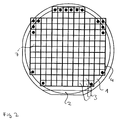
- Fig. 2 shows an arrangement which operates under the same boundary conditions, i.e. Wafer diameter, length / aspect ratio of the chip elements, length / aspect ratio of the stepping fields and exclusion area 2, was applied to the wafer by a conventional method, that is to say without optimization.
- the mask for the exposure was merely shifted in the y direction in such a way that the IC elements 6 are not exposed on the exclusion region 2.
- the arrangement of the IC elements 6 or the Stepfeld arrangement is symmetrical to the y-axis of the wafer 1 through the center of the wafer. Despite the symmetry, considerably fewer IC elements are applied to the wafer 1 in this case.
- the number of IC elements 6 that can continue to be used there is 154.
- the number of stepper steps required to expose the IC elements 6 on the wafer 1 is 43. In the example shown, about 10% more IC elements are applied to a wafer. This significantly reduces the manufacturing costs per IC element.
- the wafer 1 is gradually exposed in the specified manner by means of the stepper device.
- the necessary information in particular the position of the reference point on the mask relative to the reference point on the wafer, is fed to the stepper device before the exposure process.
- the usual manufacturing steps then follow.
- the exposed lacquer is developed, the desired process step, such as oxidation, implantation of ions etc., is carried out and the remaining lacquer is removed from the wafer.
- the further structuring steps are carried out as usual, the adjustment of the Exposure mask takes place in each case via the relative position of the reference point on the mask to the reference point on the wafer determined in the first step.
Landscapes
- Physics & Mathematics (AREA)
- General Physics & Mathematics (AREA)
- Exposure And Positioning Against Photoresist Photosensitive Materials (AREA)
- Exposure Of Semiconductors, Excluding Electron Or Ion Beam Exposure (AREA)
Priority Applications (3)
| Application Number | Priority Date | Filing Date | Title |
|---|---|---|---|
| JP8268926A JPH09190971A (ja) | 1995-10-10 | 1996-10-09 | 半導体ウエハにおけるチップパタンの最適化方法 |
| KR1019960044693A KR970023760A (ko) | 1995-10-10 | 1996-10-09 | 반도체 웨이퍼상의 칩 패턴을 최적화하는 방법 |
| US08/728,599 US5874189A (en) | 1995-10-10 | 1996-10-10 | Method of optimizing a chip pattern on a semiconductor wafer |
Applications Claiming Priority (2)
| Application Number | Priority Date | Filing Date | Title |
|---|---|---|---|
| DE19537756 | 1995-10-10 | ||
| DE19537756A DE19537756A1 (de) | 1995-10-10 | 1995-10-10 | Verfahren zum Optimieren einer Stepfeldanordnung auf einem Halbleiterwafer |
Publications (2)
| Publication Number | Publication Date |
|---|---|
| EP0768575A2 true EP0768575A2 (fr) | 1997-04-16 |
| EP0768575A3 EP0768575A3 (fr) | 1997-11-19 |
Family
ID=7774516
Family Applications (1)
| Application Number | Title | Priority Date | Filing Date |
|---|---|---|---|
| EP96113463A Withdrawn EP0768575A3 (fr) | 1995-10-10 | 1996-08-22 | Méthode d'optimisation de l'arrangement d'éléments semi-conducteurs sur une plaquette semi-conductrice |
Country Status (3)
| Country | Link |
|---|---|
| EP (1) | EP0768575A3 (fr) |
| KR (1) | KR970023760A (fr) |
| DE (1) | DE19537756A1 (fr) |
Cited By (1)
| Publication number | Priority date | Publication date | Assignee | Title |
|---|---|---|---|---|
| WO2001048553A1 (fr) * | 1999-12-28 | 2001-07-05 | Philips Semiconductors Inc. | Procede permettant de maximiser la production de puce de circuit integre. |
Families Citing this family (1)
| Publication number | Priority date | Publication date | Assignee | Title |
|---|---|---|---|---|
| KR100782460B1 (ko) * | 2006-03-28 | 2007-12-05 | 삼성에스디아이 주식회사 | 레이저 조사 장치 및 이를 이용한 유기전계발광소자의제조방법 |
Family Cites Families (7)
| Publication number | Priority date | Publication date | Assignee | Title |
|---|---|---|---|---|
| JPS58107633A (ja) * | 1981-12-21 | 1983-06-27 | Canon Inc | 特殊チツプを逃げたシヨツト配列方法 |
| JPS59101831A (ja) * | 1982-12-01 | 1984-06-12 | Canon Inc | 半導体焼付露光装置 |
| JPS59117215A (ja) * | 1982-12-24 | 1984-07-06 | Hitachi Micro Comput Eng Ltd | 半導体ウエ−ハ |
| GB8610655D0 (en) * | 1986-05-01 | 1986-06-04 | Smiths Industries Plc | Integrated circuit substrates |
| JPS63108706A (ja) * | 1986-10-27 | 1988-05-13 | Toshiba Corp | 半導体装置の製造方法 |
| JP2577507B2 (ja) * | 1990-12-19 | 1997-02-05 | 株式会社東芝 | ウェーハの描画装置 |
| JP3320262B2 (ja) * | 1995-07-07 | 2002-09-03 | キヤノン株式会社 | 走査露光装置及び方法並びにそれを用いたデバイス製造方法 |
-
1995
- 1995-10-10 DE DE19537756A patent/DE19537756A1/de not_active Withdrawn
-
1996
- 1996-08-22 EP EP96113463A patent/EP0768575A3/fr not_active Withdrawn
- 1996-10-09 KR KR1019960044693A patent/KR970023760A/ko not_active Withdrawn
Cited By (2)
| Publication number | Priority date | Publication date | Assignee | Title |
|---|---|---|---|---|
| WO2001048553A1 (fr) * | 1999-12-28 | 2001-07-05 | Philips Semiconductors Inc. | Procede permettant de maximiser la production de puce de circuit integre. |
| US6522940B1 (en) | 1999-12-28 | 2003-02-18 | Koninklijke Philips Electronics N.V. | Method and system for varying die shape to increase wafer productivity |
Also Published As
| Publication number | Publication date |
|---|---|
| DE19537756A1 (de) | 1997-04-17 |
| EP0768575A3 (fr) | 1997-11-19 |
| KR970023760A (ko) | 1997-05-30 |
Similar Documents
| Publication | Publication Date | Title |
|---|---|---|
| DE10143723B4 (de) | Verfahren zur Optimierung eines Layouts für eine Maske zur Verwendung bei der Halbleiterherstellung | |
| DE68924122T2 (de) | Herstellungsverfahren für Halbleitervorrichtungen und durchsichtige Maske für den geladenen Teilchenstrahl. | |
| DE19621753B4 (de) | Verfahren zur Bildung eines Übergangs in Fremdionengebieten einer EEPROM-Flashzelle mittels Schrägwinkel-Fremdionen-Implantation | |
| DE69213111T2 (de) | Maske und Korpuskularbestrahlungsverfahren mit dieser Maske | |
| DE3247141A1 (de) | Verfahren zum anordnen von aufnahmeflaechen bei einem aufteilungs-druckgeraet | |
| EP4014256B1 (fr) | Forme de sérigraphie destinée à être utilisée dans un procédé de sérigraphie, dispositif de sérigraphie et procédé de sérigraphie | |
| DE19931886B4 (de) | Halbleiterwafer und Halbleiterbauelement | |
| DE2922017A1 (de) | Ausrichtverfahren mit hoher aufloesung und vorrichtung dafuer | |
| DE69615642T2 (de) | Verfahren zur Herstellung einer Halbleiteranordnung | |
| DE10117291B4 (de) | Variabler Induktor | |
| DE3337300A1 (de) | Verfahren zum herstellen integrierter halbleiterschaltkreise | |
| EP0105189B1 (fr) | Procédé de fabrication d'electrodes métalliques de différentes épaisseurs pour dispositifs à semi-conducteur en particulier pour des dispositifs à semi-conducteur de puissance comme des thyristors | |
| DE10295952T5 (de) | Maske, Verfahren zum Herstellen derselben sowie Verfahren zum Herstellen eines Halbleiterbauteils | |
| DE69125653T2 (de) | Verfahren zum Herstellen einer Halbleitervorrichtung einschliesslich eines Herstellungsschrittes für ein Muster eines Fotoresistfilms | |
| EP0768575A2 (fr) | Méthode d'optimisation de l'arrangement d'éléments semi-conducteurs sur une plaquette semi-conductrice | |
| DE10137398C1 (de) | Verfahren zum Herstellen einer Lochmaske für Teilchenstrahlung | |
| WO1999053545A1 (fr) | Film utilise comme substrat de circuits integres | |
| DE10234464B4 (de) | Verfahren zum Erzeugen von Daten für die Maskenlithographie | |
| EP0003759A1 (fr) | Procédé d'irradiation d'une couche de matériau sensible à la radiation par des rayons Röntgen | |
| WO2001022164A1 (fr) | Realisation de trous de contact a l'aide de bords de saut de phase d'un seul masque de phase | |
| DE10143096A1 (de) | Elektronenstrahl-Belichtungsvorrichtung, Bauteil zur Formung eines Korpuskularstrahls und Verfahren zur Herstellung dieses Bauteils | |
| DE10127689B4 (de) | Verfahren zur Erzeugung von Streulinien in Maskenstrukturen zur Herstellung von integrierten elektrischen Schaltungen | |
| DE10243755B4 (de) | Verfahren zum Bilden einer matrixförmigen Anordnung von Belichtungsfeldern auf einem idealisierten Halbleiterwafer | |
| DE10215193B4 (de) | Verfahren zur Kompensation von Streu-/Reflexionseffekten in der Teilchenstrahllithographie | |
| DE10354112B4 (de) | Verfahren und Anordnung zur Reparatur von Speicherchips mittels Mikro-Lithographie-Verfahren |
Legal Events
| Date | Code | Title | Description |
|---|---|---|---|
| PUAI | Public reference made under article 153(3) epc to a published international application that has entered the european phase |
Free format text: ORIGINAL CODE: 0009012 |
|
| AK | Designated contracting states |
Kind code of ref document: A2 Designated state(s): DE FR GB IT NL |
|
| PUAL | Search report despatched |
Free format text: ORIGINAL CODE: 0009013 |
|
| AK | Designated contracting states |
Kind code of ref document: A3 Designated state(s): DE FR GB IT NL |
|
| RAP1 | Party data changed (applicant data changed or rights of an application transferred) |
Owner name: MICRONAS INTERMETALL GMBH |
|
| 17P | Request for examination filed |
Effective date: 19980519 |
|
| 17Q | First examination report despatched |
Effective date: 19990503 |
|
| RAP1 | Party data changed (applicant data changed or rights of an application transferred) |
Owner name: MICRONAS GMBH |
|
| STAA | Information on the status of an ep patent application or granted ep patent |
Free format text: STATUS: THE APPLICATION IS DEEMED TO BE WITHDRAWN |
|
| 18D | Application deemed to be withdrawn |
Effective date: 20010810 |