EP0768681B1 - Procédé de fabrication des câbles miniaturisés multipolar et résistant contre la propagation des flammes ayant une émission réduite des gaz toxiques et nontoxiques et câbles obtenus par ledit procédé - Google Patents
Procédé de fabrication des câbles miniaturisés multipolar et résistant contre la propagation des flammes ayant une émission réduite des gaz toxiques et nontoxiques et câbles obtenus par ledit procédé Download PDFInfo
- Publication number
- EP0768681B1 EP0768681B1 EP96115931A EP96115931A EP0768681B1 EP 0768681 B1 EP0768681 B1 EP 0768681B1 EP 96115931 A EP96115931 A EP 96115931A EP 96115931 A EP96115931 A EP 96115931A EP 0768681 B1 EP0768681 B1 EP 0768681B1
- Authority
- EP
- European Patent Office
- Prior art keywords
- conductors
- gaps
- process according
- polymeric material
- filling
- Prior art date
- Legal status (The legal status is an assumption and is not a legal conclusion. Google has not performed a legal analysis and makes no representation as to the accuracy of the status listed.)
- Expired - Lifetime
Links
- 238000000034 method Methods 0.000 title claims description 31
- 239000007789 gas Substances 0.000 title claims description 16
- 230000001473 noxious effect Effects 0.000 title claims description 8
- 231100000331 toxic Toxicity 0.000 title claims description 8
- 230000002588 toxic effect Effects 0.000 title claims description 8
- 239000004020 conductor Substances 0.000 claims description 81
- 239000000463 material Substances 0.000 claims description 67
- 238000011049 filling Methods 0.000 claims description 49
- 239000000203 mixture Substances 0.000 claims description 49
- 229920000642 polymer Polymers 0.000 claims description 34
- 239000012764 mineral filler Substances 0.000 claims description 25
- 235000011837 pasties Nutrition 0.000 claims description 23
- VTHJTEIRLNZDEV-UHFFFAOYSA-L magnesium dihydroxide Chemical compound [OH-].[OH-].[Mg+2] VTHJTEIRLNZDEV-UHFFFAOYSA-L 0.000 claims description 15
- 239000000347 magnesium hydroxide Substances 0.000 claims description 14
- 229910001862 magnesium hydroxide Inorganic materials 0.000 claims description 14
- WNROFYMDJYEPJX-UHFFFAOYSA-K aluminium hydroxide Chemical compound [OH-].[OH-].[OH-].[Al+3] WNROFYMDJYEPJX-UHFFFAOYSA-K 0.000 claims description 8
- 229910021502 aluminium hydroxide Inorganic materials 0.000 claims description 8
- 229920001296 polysiloxane Polymers 0.000 claims description 8
- 238000004132 cross linking Methods 0.000 claims description 7
- 235000013870 dimethyl polysiloxane Nutrition 0.000 claims description 6
- 229920000435 poly(dimethylsiloxane) Polymers 0.000 claims description 6
- 125000000391 vinyl group Chemical group [H]C([*])=C([H])[H] 0.000 claims description 6
- 238000010438 heat treatment Methods 0.000 claims description 5
- 239000004205 dimethyl polysiloxane Substances 0.000 claims description 4
- 239000010410 layer Substances 0.000 description 14
- 231100000419 toxicity Toxicity 0.000 description 11
- 230000001988 toxicity Effects 0.000 description 11
- 238000001125 extrusion Methods 0.000 description 9
- 239000012212 insulator Substances 0.000 description 8
- RYGMFSIKBFXOCR-UHFFFAOYSA-N Copper Chemical compound [Cu] RYGMFSIKBFXOCR-UHFFFAOYSA-N 0.000 description 7
- 238000002485 combustion reaction Methods 0.000 description 7
- RNFJDJUURJAICM-UHFFFAOYSA-N 2,2,4,4,6,6-hexaphenoxy-1,3,5-triaza-2$l^{5},4$l^{5},6$l^{5}-triphosphacyclohexa-1,3,5-triene Chemical compound N=1P(OC=2C=CC=CC=2)(OC=2C=CC=CC=2)=NP(OC=2C=CC=CC=2)(OC=2C=CC=CC=2)=NP=1(OC=1C=CC=CC=1)OC1=CC=CC=C1 RNFJDJUURJAICM-UHFFFAOYSA-N 0.000 description 6
- 239000003063 flame retardant Substances 0.000 description 6
- 239000011521 glass Substances 0.000 description 6
- 239000003365 glass fiber Substances 0.000 description 6
- 239000010949 copper Substances 0.000 description 5
- 229910052802 copper Inorganic materials 0.000 description 5
- 239000012530 fluid Substances 0.000 description 5
- ATUOYWHBWRKTHZ-UHFFFAOYSA-N Propane Chemical compound CCC ATUOYWHBWRKTHZ-UHFFFAOYSA-N 0.000 description 4
- 239000003054 catalyst Substances 0.000 description 4
- -1 polyethylene Polymers 0.000 description 4
- 239000007788 liquid Substances 0.000 description 3
- 150000003839 salts Chemical class 0.000 description 3
- 238000007789 sealing Methods 0.000 description 3
- XLYOFNOQVPJJNP-UHFFFAOYSA-N water Substances O XLYOFNOQVPJJNP-UHFFFAOYSA-N 0.000 description 3
- 239000004698 Polyethylene Substances 0.000 description 2
- 239000002253 acid Substances 0.000 description 2
- 239000001164 aluminium sulphate Substances 0.000 description 2
- 235000011128 aluminium sulphate Nutrition 0.000 description 2
- 230000015572 biosynthetic process Effects 0.000 description 2
- 125000003178 carboxy group Chemical group [H]OC(*)=O 0.000 description 2
- BUACSMWVFUNQET-UHFFFAOYSA-H dialuminum;trisulfate;hydrate Chemical compound O.[Al+3].[Al+3].[O-]S([O-])(=O)=O.[O-]S([O-])(=O)=O.[O-]S([O-])(=O)=O BUACSMWVFUNQET-UHFFFAOYSA-H 0.000 description 2
- 230000000694 effects Effects 0.000 description 2
- 239000005038 ethylene vinyl acetate Substances 0.000 description 2
- 238000009472 formulation Methods 0.000 description 2
- 229910052500 inorganic mineral Inorganic materials 0.000 description 2
- 238000011068 loading method Methods 0.000 description 2
- 239000007769 metal material Substances 0.000 description 2
- 239000011707 mineral Substances 0.000 description 2
- 238000002156 mixing Methods 0.000 description 2
- 229920003023 plastic Polymers 0.000 description 2
- 239000004033 plastic Substances 0.000 description 2
- 229920001200 poly(ethylene-vinyl acetate) Polymers 0.000 description 2
- 229920000573 polyethylene Polymers 0.000 description 2
- 229920002959 polymer blend Polymers 0.000 description 2
- 239000000843 powder Substances 0.000 description 2
- 239000001294 propane Substances 0.000 description 2
- 239000003381 stabilizer Substances 0.000 description 2
- UKRDPEFKFJNXQM-UHFFFAOYSA-N vinylsilane Chemical class [SiH3]C=C UKRDPEFKFJNXQM-UHFFFAOYSA-N 0.000 description 2
- 238000004804 winding Methods 0.000 description 2
- WKBOTKDWSSQWDR-UHFFFAOYSA-N Bromine atom Chemical compound [Br] WKBOTKDWSSQWDR-UHFFFAOYSA-N 0.000 description 1
- VGGSQFUCUMXWEO-UHFFFAOYSA-N Ethene Chemical compound C=C VGGSQFUCUMXWEO-UHFFFAOYSA-N 0.000 description 1
- 239000005977 Ethylene Substances 0.000 description 1
- VEXZGXHMUGYJMC-UHFFFAOYSA-N Hydrochloric acid Chemical compound Cl VEXZGXHMUGYJMC-UHFFFAOYSA-N 0.000 description 1
- 229920000034 Plastomer Polymers 0.000 description 1
- XUGISPSHIFXEHZ-GPJXBBLFSA-N [(3r,8s,9s,10r,13r,14s,17r)-10,13-dimethyl-17-[(2r)-6-methylheptan-2-yl]-2,3,4,7,8,9,11,12,14,15,16,17-dodecahydro-1h-cyclopenta[a]phenanthren-3-yl] acetate Chemical compound C1C=C2C[C@H](OC(C)=O)CC[C@]2(C)[C@@H]2[C@@H]1[C@@H]1CC[C@H]([C@H](C)CCCC(C)C)[C@@]1(C)CC2 XUGISPSHIFXEHZ-GPJXBBLFSA-N 0.000 description 1
- 239000000654 additive Substances 0.000 description 1
- 230000000996 additive effect Effects 0.000 description 1
- 229940037003 alum Drugs 0.000 description 1
- ADCOVFLJGNWWNZ-UHFFFAOYSA-N antimony trioxide Inorganic materials O=[Sb]O[Sb]=O ADCOVFLJGNWWNZ-UHFFFAOYSA-N 0.000 description 1
- GDTBXPJZTBHREO-UHFFFAOYSA-N bromine Substances BrBr GDTBXPJZTBHREO-UHFFFAOYSA-N 0.000 description 1
- 229910052794 bromium Inorganic materials 0.000 description 1
- 238000006243 chemical reaction Methods 0.000 description 1
- 239000011247 coating layer Substances 0.000 description 1
- 229920001577 copolymer Polymers 0.000 description 1
- 230000008878 coupling Effects 0.000 description 1
- 238000010168 coupling process Methods 0.000 description 1
- 238000005859 coupling reaction Methods 0.000 description 1
- 230000006378 damage Effects 0.000 description 1
- 238000000354 decomposition reaction Methods 0.000 description 1
- 238000003795 desorption Methods 0.000 description 1
- 238000007598 dipping method Methods 0.000 description 1
- 239000002270 dispersing agent Substances 0.000 description 1
- 229920001971 elastomer Polymers 0.000 description 1
- 239000000806 elastomer Substances 0.000 description 1
- 229920001038 ethylene copolymer Polymers 0.000 description 1
- 239000000945 filler Substances 0.000 description 1
- 238000004079 fireproofing Methods 0.000 description 1
- 239000001257 hydrogen Substances 0.000 description 1
- 229910052739 hydrogen Inorganic materials 0.000 description 1
- 229910000041 hydrogen chloride Inorganic materials 0.000 description 1
- IXCSERBJSXMMFS-UHFFFAOYSA-N hydrogen chloride Substances Cl.Cl IXCSERBJSXMMFS-UHFFFAOYSA-N 0.000 description 1
- XLYOFNOQVPJJNP-UHFFFAOYSA-M hydroxide Chemical compound [OH-] XLYOFNOQVPJJNP-UHFFFAOYSA-M 0.000 description 1
- 239000012796 inorganic flame retardant Substances 0.000 description 1
- 239000000178 monomer Substances 0.000 description 1
- 230000001459 mortal effect Effects 0.000 description 1
- 229920001707 polybutylene terephthalate Polymers 0.000 description 1
- 229920001225 polyester resin Polymers 0.000 description 1
- 239000004645 polyester resin Substances 0.000 description 1
- 229920000098 polyolefin Polymers 0.000 description 1
- 238000002360 preparation method Methods 0.000 description 1
- 238000005086 pumping Methods 0.000 description 1
- 238000010008 shearing Methods 0.000 description 1
- 239000000779 smoke Substances 0.000 description 1
- 238000003756 stirring Methods 0.000 description 1
- 229920001897 terpolymer Polymers 0.000 description 1
- 229920001169 thermoplastic Polymers 0.000 description 1
- 239000004416 thermosoftening plastic Substances 0.000 description 1
- 230000009974 thixotropic effect Effects 0.000 description 1
- 239000002341 toxic gas Substances 0.000 description 1
- HXZMNPWABMNDQI-UHFFFAOYSA-J tris(2,2-dibutyldodecanoyloxy)stannyl 2,2-dibutyldodecanoate Chemical compound [Sn+4].CCCCCCCCCCC(CCCC)(CCCC)C([O-])=O.CCCCCCCCCCC(CCCC)(CCCC)C([O-])=O.CCCCCCCCCCC(CCCC)(CCCC)C([O-])=O.CCCCCCCCCCC(CCCC)(CCCC)C([O-])=O HXZMNPWABMNDQI-UHFFFAOYSA-J 0.000 description 1
- 238000009736 wetting Methods 0.000 description 1
Images
Classifications
-
- H—ELECTRICITY
- H01—ELECTRIC ELEMENTS
- H01B—CABLES; CONDUCTORS; INSULATORS; SELECTION OF MATERIALS FOR THEIR CONDUCTIVE, INSULATING OR DIELECTRIC PROPERTIES
- H01B7/00—Insulated conductors or cables characterised by their form
- H01B7/17—Protection against damage caused by external factors, e.g. sheaths or armouring
- H01B7/29—Protection against damage caused by extremes of temperature or by flame
- H01B7/295—Protection against damage caused by extremes of temperature or by flame using material resistant to flame
-
- H—ELECTRICITY
- H01—ELECTRIC ELEMENTS
- H01B—CABLES; CONDUCTORS; INSULATORS; SELECTION OF MATERIALS FOR THEIR CONDUCTIVE, INSULATING OR DIELECTRIC PROPERTIES
- H01B13/00—Apparatus or processes specially adapted for manufacturing conductors or cables
- H01B13/32—Filling or coating with impervious material
- H01B13/322—Filling or coating with impervious material the material being a liquid, jelly-like or viscous substance
- H01B13/323—Filling or coating with impervious material the material being a liquid, jelly-like or viscous substance using a filling or coating head
-
- H—ELECTRICITY
- H01—ELECTRIC ELEMENTS
- H01B—CABLES; CONDUCTORS; INSULATORS; SELECTION OF MATERIALS FOR THEIR CONDUCTIVE, INSULATING OR DIELECTRIC PROPERTIES
- H01B3/00—Insulators or insulating bodies characterised by the insulating materials; Selection of materials for their insulating or dielectric properties
- H01B3/18—Insulators or insulating bodies characterised by the insulating materials; Selection of materials for their insulating or dielectric properties mainly consisting of organic substances
- H01B3/30—Insulators or insulating bodies characterised by the insulating materials; Selection of materials for their insulating or dielectric properties mainly consisting of organic substances plastics; resins; waxes
- H01B3/42—Insulators or insulating bodies characterised by the insulating materials; Selection of materials for their insulating or dielectric properties mainly consisting of organic substances plastics; resins; waxes polyesters; polyethers; polyacetals
- H01B3/421—Polyesters
- H01B3/422—Linear saturated polyesters derived from dicarboxylic acids and dihydroxy compounds
-
- H—ELECTRICITY
- H01—ELECTRIC ELEMENTS
- H01B—CABLES; CONDUCTORS; INSULATORS; SELECTION OF MATERIALS FOR THEIR CONDUCTIVE, INSULATING OR DIELECTRIC PROPERTIES
- H01B3/00—Insulators or insulating bodies characterised by the insulating materials; Selection of materials for their insulating or dielectric properties
- H01B3/18—Insulators or insulating bodies characterised by the insulating materials; Selection of materials for their insulating or dielectric properties mainly consisting of organic substances
- H01B3/30—Insulators or insulating bodies characterised by the insulating materials; Selection of materials for their insulating or dielectric properties mainly consisting of organic substances plastics; resins; waxes
- H01B3/44—Insulators or insulating bodies characterised by the insulating materials; Selection of materials for their insulating or dielectric properties mainly consisting of organic substances plastics; resins; waxes vinyl resins; acrylic resins
- H01B3/441—Insulators or insulating bodies characterised by the insulating materials; Selection of materials for their insulating or dielectric properties mainly consisting of organic substances plastics; resins; waxes vinyl resins; acrylic resins from alkenes
-
- H—ELECTRICITY
- H01—ELECTRIC ELEMENTS
- H01B—CABLES; CONDUCTORS; INSULATORS; SELECTION OF MATERIALS FOR THEIR CONDUCTIVE, INSULATING OR DIELECTRIC PROPERTIES
- H01B3/00—Insulators or insulating bodies characterised by the insulating materials; Selection of materials for their insulating or dielectric properties
- H01B3/18—Insulators or insulating bodies characterised by the insulating materials; Selection of materials for their insulating or dielectric properties mainly consisting of organic substances
- H01B3/30—Insulators or insulating bodies characterised by the insulating materials; Selection of materials for their insulating or dielectric properties mainly consisting of organic substances plastics; resins; waxes
- H01B3/46—Insulators or insulating bodies characterised by the insulating materials; Selection of materials for their insulating or dielectric properties mainly consisting of organic substances plastics; resins; waxes silicones
-
- Y—GENERAL TAGGING OF NEW TECHNOLOGICAL DEVELOPMENTS; GENERAL TAGGING OF CROSS-SECTIONAL TECHNOLOGIES SPANNING OVER SEVERAL SECTIONS OF THE IPC; TECHNICAL SUBJECTS COVERED BY FORMER USPC CROSS-REFERENCE ART COLLECTIONS [XRACs] AND DIGESTS
- Y10—TECHNICAL SUBJECTS COVERED BY FORMER USPC
- Y10T—TECHNICAL SUBJECTS COVERED BY FORMER US CLASSIFICATION
- Y10T428/00—Stock material or miscellaneous articles
- Y10T428/29—Coated or structually defined flake, particle, cell, strand, strand portion, rod, filament, macroscopic fiber or mass thereof
- Y10T428/2913—Rod, strand, filament or fiber
- Y10T428/2933—Coated or with bond, impregnation or core
-
- Y—GENERAL TAGGING OF NEW TECHNOLOGICAL DEVELOPMENTS; GENERAL TAGGING OF CROSS-SECTIONAL TECHNOLOGIES SPANNING OVER SEVERAL SECTIONS OF THE IPC; TECHNICAL SUBJECTS COVERED BY FORMER USPC CROSS-REFERENCE ART COLLECTIONS [XRACs] AND DIGESTS
- Y10—TECHNICAL SUBJECTS COVERED BY FORMER USPC
- Y10T—TECHNICAL SUBJECTS COVERED BY FORMER US CLASSIFICATION
- Y10T428/00—Stock material or miscellaneous articles
- Y10T428/29—Coated or structually defined flake, particle, cell, strand, strand portion, rod, filament, macroscopic fiber or mass thereof
- Y10T428/2913—Rod, strand, filament or fiber
- Y10T428/2933—Coated or with bond, impregnation or core
- Y10T428/294—Coated or with bond, impregnation or core including metal or compound thereof [excluding glass, ceramic and asbestos]
-
- Y—GENERAL TAGGING OF NEW TECHNOLOGICAL DEVELOPMENTS; GENERAL TAGGING OF CROSS-SECTIONAL TECHNOLOGIES SPANNING OVER SEVERAL SECTIONS OF THE IPC; TECHNICAL SUBJECTS COVERED BY FORMER USPC CROSS-REFERENCE ART COLLECTIONS [XRACs] AND DIGESTS
- Y10—TECHNICAL SUBJECTS COVERED BY FORMER USPC
- Y10T—TECHNICAL SUBJECTS COVERED BY FORMER US CLASSIFICATION
- Y10T428/00—Stock material or miscellaneous articles
- Y10T428/29—Coated or structually defined flake, particle, cell, strand, strand portion, rod, filament, macroscopic fiber or mass thereof
- Y10T428/2913—Rod, strand, filament or fiber
- Y10T428/2933—Coated or with bond, impregnation or core
- Y10T428/294—Coated or with bond, impregnation or core including metal or compound thereof [excluding glass, ceramic and asbestos]
- Y10T428/2942—Plural coatings
- Y10T428/2947—Synthetic resin or polymer in plural coatings, each of different type
Definitions
- the present invention relates to a process to make miniaturized multipolar flame-propagation-resistant cables having a reduced emission of toxic and noxious gases.
- miniaturized cables are intended in which the insulating layer thickness in the individual electrical conductors is included between 0.20 and 0.30 mm and the sheath thickness is included between 0.3 and 0.8 mm; examples of miniaturized cables are the object of AMT 551070 specifications.
- flame-propagation-resistant it is intended to mean that the cables assembled together to form bundles, must comply with the requirements established by CEI (Comitato Elettrotecnico Italiano, Italian Electrotechnical Committee) rules 20-22-III.
- cables are intended the individual components of which submitted to the tests established by CEI rule 20-37-II, give rise to an overall toxicity-index value of the cable, as hereinafter defined, lower than 3.5.
- Said overall toxicity index of the cable is the sum of the toxicity indices of the individual components, each of them being multiplied by the ratio of the weight that each said component has in the cable unit of length to the overall weight that all the components have in the cable unit of length.
- the present invention also refers to the cables obtained by the process in question. It is known that multipolar cables are cables provided, within one and the same sheath, of at least two and generally a plurality of electrical conductors which are individually insulated and assembled, being laid together for example.
- the known process is comprised of the steps of:
- the conductor insulators While in known non-miniaturized multipolar low-voltage cables the conductor insulators have an average thickness of 0.82 mm, in miniaturized multipolar cables the insulator thickness is included between 0.20 and 0.30 mm on an average.
- the temperature to be reached during the extrusion for making the blend fluid enough so that gaps between the conductors can be properly filled shall be about 150°C.
- the Applicant has observed that the possibility of applying fillings formed of polymeric materials containing high amounts of mineral fillers by extrusion, is limited to a minimum thickness of 0.5 mm.
- the application of a filling by extrusion is to be excluded for miniaturized multipolar cables because in said cables the filling thickness between the conductors is on the order of 0.20-0.25 mm.
- a glass rod or a glass-fibre cord be disposed into the gaps existing between the conductors combined together to form a cable.
- a glass-fibre cord is used as the filling, which cord may be optionally covered with a sheath of polymeric material, there is a risk that, due to breaking of some glass fibres in the cord, which fibres are very brittle being made of glass, said same glass fibres may project from the cord in the form of needles and consequently cause annoying injuries to the operators when they are assembling the cables with fittings such as connecting means or with appliances to be power supplied by the cable.
- section members of polymeric materials containing high amounts of mineral fillers in place of the glass rods or glass-fibre cords also involves the necessity, in addition to the complexity of the above mentioned assembling operation, to utilize section members having a very low tensile strength as compared with the tensile strength possessed by the insulated conductors, which will bring about the danger of breaking said section members while a cable is being manufactured.
- EP-A- 377314 refers to a method for the longitudinal sealing of cables consisting of a plurality of conductor wires including necessarily interstices using a sealing mass that includes a liquid capable to be gelled.
- a sealing mass that includes a liquid capable to be gelled.
- GB-A-2,157,881 relates to an electric cable coated with a polymer containing a hydrated salt charge which does not emit toxic gases or smoke on combustion.
- the hydrated salt charge comprises from 30 to 80% by weight of hydrated aluminium sulphate and, optionally, alum or a hydrated salt different from hydrated aluminium sulphate.
- GB-A-2,231,333 relates to a flame retardant polymer composition
- a flame retardant polymer composition comprising a blend of polyethylene and an ethylene-vinyl acetate copolymer having a hydrated mineral flame retardant dispersed therein.
- an oligomeric polyester resin dispersant is added to achieve a cross-linked flame retardant formulation having high tensile elongation properties even with very' high loadings of inorganic flame retardant fillers.
- EP-A-082407 relates to a thermoplastic, halogen-free, flame resistant polymer mixture, particularly for cable sheathing, having an elastomer component of ethylene copolymer or terpolymer, and a plastomer component containing internal ethylene monomer, wherein a mineral filling is dispersed.
- Carboxyl groups are introduced in the mixture by adding a polymer containing -COOH groups.
- the present invention relates to a process for making flexible miniaturized multipolar flame-propagation-resistant cables having a reduced emission of toxic and noxious gases, comprising the steps of:
- the mineral fillers are in an amount included between 40% and 70% by weight of the overall weight of the blend, and they are selected from magnesium hydroxide and aluminium hydroxide.
- the viscosity of the polymeric material at said application temperature is such that it causes the substantial filling of all gaps defined between said conductors and, preferably, said viscosity measured at 25°C by a Brookfield viscometer A:4 V:2.5 is lower than, or equal to about 1100000 mPa.sec and more preferably, lower than or equal to about 500000 mPa.sec.
- the application temperature of the polymeric material is the room temperature.
- the step of inserting the polymeric material in a pasty state into the gaps defined between the conductors is carried out making the conductors, individually covered with an insulating layer and already assembled together, pass through a chamber containing said polymeric material at the pasty state maintained at said application temperature.
- the polymeric material to be introduced into the gaps defined between the conductors consists of a blend of a first polymer and a second polymer which is subjected to cold cross-linking by polyaddition; in particular the first polymer is polydimethyl siloxane having terminal vinyl groups, whereas the second polymer is a silicone-based polymer containing Si-H groups.
- the increase in the viscosity of the polymeric material is achieved by heating to a predetermined temperature and, more preferably, said predetermined temperature is included between 170 and 180°C.
- the present invention relates to a miniaturized flexible multipolar flame-propagation-resistant cable having a reduced emission of toxic and noxious gases, which comprises:
- the first step in the process consists in combining together at least two and in general a plurality of individually-insulated conductors, that is each provided with an electrically-insulating layer. Each conductor is stored on a reel.
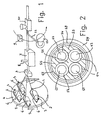
- Fig. 1 In the particular case of Fig. 1 four insulated conductors 1 are provided and they are stored on reels 2 freely rotating about their axis 3.
- Reels 2 are mounted on a rotating framework 4 the rotation of which takes place for example in the direction of arrow 5 and in addition each reel 2 is mounted on a spindle 6 imposing rotation of each reel in a direction opposite to that of the framework 4 so that the insulated conductors are not subjected to twist stresses while the cable is being manufactured.
- Fig. 1 the four insulated conductors 1 are laid together having taken a helical configuration, due to the combined action exerted by the rotating framework and the stationary assembling mould.
- the assembled conductors obtained from the first processing step are submitted to the second step consisting in inserting a pasty material, preferably of a polymeric nature, at an application temperature as below defined, into at least some of the gaps existing between the assembled conductors, which pasty material after undergoing a viscosity increase capable of giving rise to a partial hardening, will form a filling.
- a pasty material preferably of a polymeric nature
- application temperature it is intended a temperature at which the material to be applied has a sufficient flowability so that it can fill the gaps provided for filling in a substantially complete manner without causing gas emissions, in particular water vapour emissions from the mineral fillers incorporated into the material to be applied.
- the "application temperature” is the room temperature.
- the nature of said pasty material and the features of same will be set forth in more detail in the following.
- a particular embodiment of the second processing step consists, as shown in Fig. 1, in making the assembly of the conductors combined together pass through a chamber 7 filled with said pasty fluid which is at the application temperature, i.e. preferably the room temperature.
- the pasty fluid is admitted to chamber 7, by pumping for example, through a duct 8.
- the pasty fluid incorporates the assembly of the conductors laid together filling the gaps existing therebetween.
- the third step of the process takes place and it consists in performing a partial hardening of the pasty material applied to the assembly of insulated conductors laid together so as to give them a substantial stability of shape.
- substantially stability of shape it is intended that the viscosity of the material applied in a pasty state increases to such an extent that the material does not drip any longer under its own weight during the period elapsing from when it is applied to when the formation of the sheath about the cable occurs.
- a particular embodiment of the third step in question consists in heating the outer surface of the pasty material layer by a hot air blow, emitted by a fan 9 for example, so that an increase in the viscosity of said layer due to partial cross-linking and therefore a hardening of same is caused to such an extent that said material is prevented from undergoing substantial deformations and variations in the shape it has received from the gauged orifice located at the chamber 7 exit, as hereinafter defined.
- the temperature value of the air blown onto the outer surface of the applied pasty material as well as the quantity of this hot air depend on the nature of the pasty material employed and therefore a person skilled in the art, based on his knowledge on the composition, will be able to establish this value without any particular instructions.
- the assembly of the insulated conductors laid together and to which the pasty material has been applied are submitted to the fourth step of the process which consists in applying a sheath made of a plastic material for example, and obtained by means of extrusion for example by an extruder 10, as shown in Fig. 1.
- a reel not shown, on which the cable is stored, is located downstream of chamber 7.
- the fourth step can be preceded by a lapping step during which a cover tape, of plastic material for example, is applied to the assembly of insulated conductors laid together and having the partly-hardened pasty material applied thereto.
- a cover tape of plastic material for example
- This operation may be carried out for example, as shown in Fig. 1, by a lapping machine provided with a spool 11 on which a tape 12 is stored, which spool is rotated around the assembly of the conductors laid togegher.
- Another optional step to be executed between the lapping step and that involving formation of the sheath consists in applying a screen of braided copper wires.
- a screen of braided copper wires for this operation (not shown in Fig. 1) means known per se and therefore not further described is employed.
- the framework 4 is stationary and also stationary are spindles 6, whereas the assembly of the conductors combined together rotates about the longitudinal axis of same following rotation about this axis of the reel, not shown in Fig. 1, on which the produced cable is stored.
- FIG. 2 A particular cable obtained by the above described process and falling within the scope of the present invention as well, is shown in Fig. 2, in a sectional view at right angles to the axis of same.
- the cable has four electrical conductors 13 in the form of cords formed of copper wires each provided with an insulator means consisting of a layer of an extruded polymeric material as stated in AMT 551070 specification relating to miniaturized cables.
- this polymeric material fills the gaps 15 existing between the insulated conductors, preferably but not necessarily without occupying the radially innermost space 16, and forms a cylindrical envelope about the assembly of same.
- a lapping tape 17 Disposed over the external cylindrical surface of the filling material is a lapping tape 17 applied by overlapping each winding with the edge of the preceding winding.
- a screen 18 is present over the lapping tape and it consists of one or more layers formed of braided copper wires.
- a sheath of polymeric material 19 applied by extrusion is disposed over the assembly formed of the previously described elements.
- filling of the gaps 15 between the conductors is formed of a polymeric material applied thereto in a pasty state, at an application temperature that in this particular case is the room temperature, which material quickly becomes partly hard by incipient cross-linking by means of heating immediately after it has been applied, so as to increase viscosity to such a value that deformation of same is prevented, the material acquiring a stability of shape that will enable application of the external cable components to be carried out.
- the material in question is a two-polymer-based blend in which the two polymers are susceptible of cold cross-linking by polyaddition and contain mineral fillers in an amount included between 40% and 70% by weight of the overall weight of the polymer blend.
- One of these two polymers is a polydimethyl siloxane containing terminal vinyl groups, the second polymer being a silicone-based polymer containing Si-H groups and the mineral fillers are selected from magnesium hydroxide and aluminium hydroxide.
- the first polymer that is polydimethyl siloxane containing terminal vinyl groups
- the second polymer that is the silicone-based polymer containing Si-H groups
- the utilized mineral filler is magnesium hydroxide.
- the mineral filler that is magnesium hydroxide, was admixed with the first polymer by a mixer and in the mixture also a chloroplatinic-acid and divynil-tetramethyl-siloxane compound acting as a catalyst for the polyaddition reaction of the two polymers was added.
- component A For the group consisting of the first polymer, the mineral filler and the catalyst, hereinafter referred to as component A, formulations having the following compositions were prepared: first polymer parts by weigth Mg(OH) 2 parts by weight above cited catalyst ppm A1 100 50 20 A2 100 85 20 A3 100 160 20 A4 100 320 20 A5 100 400 20
- the second polymer that is the silicone-based polymer containing Si-H groups, forms component B by itself.
- components A1, A2, A3, A4, A5 and component B five blends were prepared by addition of one part by weight of component B to 10 parts by weight of each of said components A.
- the obtained blends had the following viscosities, measured with a Brookfield viscometer using a spindle RV7, the rotation speed of said spindle being 2.5 rpm: Type of blend Viscosity after 15 m from preparation (m Pa.sec) Mg(OH) 2 A1 + B 83000 30% by weight A2 * B 185000 41% " " A3 + B 307200 55% “ " A4 + B 970000 70% “ “ A5 + B 1220000 73% " "
- blend A5 that is a blend containing 73% by weight of magnesium hydroxide, it is impossible to make a cable having acceptable features in that at room temperature the viscosity of this blend is very high and does not offer the ensurance of a complete filling of the gaps between the conductors.
- an appropriate viscosity of the overall polymeric blend at the application temperature is believed to be preferably lower than or equal to 1100000 mPa.sec and, more preferably, lower than or equal to 500000 mPa.sec.
- the four cables have the same sizes and differ from each other exclusively for the different type of blend used to make the cable filling.
- the cable conductors have a section of 0.6 mm 2 and are formed of 19 copper wires with a diameter of 0.2 mm.
- the insulating layer of the conductors has a thickness of 0.25 mm.
- a polybutylene terephthalate-based blend was selected which was applied by extrusion to the conductor; the blend contained a silicone etherimide copolymer, a brominated additive having a content of 3.5% by weight of bromine, antimony(III) oxide and stabilizers of a type known per se.
- the tape used to form layer 17 of Fig. 2 is a tape of polyethylene therephthalate of a thickness of 20 ⁇ m.
- This layer is formed by wrapping a single tape and this wrapping is carried out with an overlap of 50%.
- the blends were applied to the four insulated conductors, already laid together, by mixing, at 23°C, the components (A1, A2, A3, A4 with component B) stored into separate tanks, immediately before their application, sending said components by metering pumps having volumetric counters to a mixer and directly loading the blend to the application apparatus.
- said conductors When coming out of the apparatus carrying out application of the filling, said conductors have a continous layer of a thickness of 0.25 mm formed around them at the radially outermost area thereof.
- heating of said filling is carried out by hot air.
- the hot air jet employed has a flow rate of 400-500 l/minute and the temperature of said air was such selected that the whole external surface of the applied filling could have a temperature included between 170 and 180°C for a period of some seconds.
- a copper-wire screen At a position radially external of the lapping tape there is a copper-wire screen and more particularly a screen consisting of braided copper wires of a diameter of 0.2 nn.
- This sheath Located over the copper-wire screen is the cable sheath.
- This sheath has a thickness of 0.6 mm and is formed of a base blend which is subsequently set by means of vinylsilanes.
- the base blend consists of:
- This base blend was set by means of vinylsilanes known per se in an appropriate double-screw, extruded about the cable by addition of tin dibutyl laurate as the catalyst and link-crossed by dipping the cable into water at 80°C over a period of 16 hours after sealing the cable ends.
- a fifth cable was made which differs from the others exclusively in that the filling material is absent.
- the cables in question (those containing the filling and the filling-free cable) were submitted to the flame-propagation test prescribed by rule CEI 20-20/III.
- bundles of cable lengths 3.5 m long were used in a number sufficient to form a volume of 1.5 dm 3 of non metallic material; as a result, bundles of 71 cable lengths were used for cables provided with filling and a bundle of 123 cable lengths for unfilled cable.
- Each cable bundle was disposed upright in a furnace as prescribed by the rule in question and flame was applied to the bundle base for a period of 20 minutes, which flame was obtained by combustion of air and propane, the propane flow rate being of 996 l/hour and the air flow rate of 4600 l/hour.
- Cables overcoming the flame-propagation-resistance test are then submitted to determination of the toxicity index for the gases generated during combustion.
- the non-metallic materials were removed, i.e.: conductor insulator, filling, tape wrapped around the filling, cable sheath. These materials were chopped to form powders.
- the toxicity factors were determined, that is the ratios between the real amount of the particular gases generated (specified in the following) and the reference concentration for each of said gases, i.e. the amount of gas that would be mortal for men after an exposure of 30 minutes.
- the overall toxicity indices for each cable were obtained by summing up the product of the toxicity indices of the individual components by the percent ratios by weight of said components to the total weight of the components per unit of length of the cable.
Landscapes
- Physics & Mathematics (AREA)
- Spectroscopy & Molecular Physics (AREA)
- Engineering & Computer Science (AREA)
- Manufacturing & Machinery (AREA)
- Insulated Conductors (AREA)
- Compositions Of Macromolecular Compounds (AREA)
- Processing Of Terminals (AREA)
Claims (15)
- Procédé de fabrication de câbles flexibles miniaturisés multipolaires, résistant à la propagation des flammes et émettant une quantité réduite de gaz toxiques et nocifs, comportant les étapes suivantes :combiner ensemble au moins deux conducteurs électriques (1,13), individuellement recouverts d'une couche isolante (14), des espaces (15) étant définis entre lesdits conducteurs (1,13) combinés ensemble,insérer dans les espaces (15) définis entre les conducteurs (1,13), immédiatement après avoir combinés ensemble ces derniers, à une température telle que le matériau se trouve à l'état pâteux et présente une viscosité inférieure à une valeur prédéterminée et une aptitude à l'écoulement suffisante pour qu'il puisse remplir les espaces (15) sans provoquer d'émission de gaz,former un remplissage dans les espaces (15) définis entre les conducteurs (1,13) en faisant partiellement réticuler le matériau polymère, de telle manière que la viscosité du matériau polymère augmente jusqu'à une valeur correspondant à une substantielle stabilité de forme,disposer une gaine (19) autour de l'ensemble formé par les conducteurs combinés ensemble et le remplissage inséré dans les espaces (15) définis entre les conducteurs (1, 13),achever le durcissement du matériau polymère après avoir disposé la gaine (19).
- Procédé selon la revendication 1, caractérisé en ce que les charges minérales représentent de 40 à 70 % du poids total du mélange.
- Procédé selon la revendication 1, caractérisé en ce que les charges minérales sont choisies parmi l'hydroxyde de magnésium et l'hydroxyde d'aluminium.
- Procédé selon la revendication 1, caractérisé en ce que la viscosité du matériau polymère à ladite température d'application est telle qu'elle permet le remplissage substantiel de tous les espaces (15) définis entre lesdits conducteurs (1,13).
- Procédé selon la revendication 4, caractérisé en ce que ladite viscosité, mesurée à 25 °C à l'aide d'un viscosimètre Brookfield A:4 V:2,5, est inférieure ou égale à environ 1 100 000 mPa.
- Procédé selon la revendication 4, caractérisé en ce que ladite viscosité, mesurée à 25 °C à l'aide d'un viscosimètre Brookfield A:4 V:2,5, est inférieure ou égale à environ 500 000 mPa.
- Procédé selon la revendication 1, caractérisé en ce que l'application du matériau polymère est effectuée à température ambiante.
- Procédé selon la revendication 1, caractérisé en ce qu'on effectue l'étape d'insertion du matériau polymère à l'état pâteux dans les espaces (15) définis entre les conducteurs (1,13) est effectuée en faisant passer les conducteurs (1,13), individuellement recouverts d'une couche isolante (14) et déjà assemblés, dans une chambre (7) contenant ledit matériau polymère à l'état pâteux maintenu à ladite température d'application.
- Procédé selon la revendication 1, caractérisé en ce que le matériau polymère à introduire dans les espaces (15) définis entre les conducteurs (1,13) consiste en un mélange d'un premier polymère et d'un second polymère, qui est soumis à une réticulation à froid par polyaddition.
- Procédé selon la revendication 9, caractérisé en ce que le premier polymère est un polydiméthylsiloxane à groupes vinyle terminaux, alors que le second polymère est un polymère à base de silicone contenant des groupes Si-H.
- Procédé selon la revendication 9, caractérisé en ce que les charges minérales présentes dans ledit polymère représentent de 40 à 70 % du poids total du mélange.
- Procédé selon la revendication 9, caractérisé en ce que les charges minérales sont choisies parmi l'hydroxyde de magnésium et l'hydroxyde d'aluminium.
- Procédé selon la revendication 1, caractérisé en ce que l'augmentation de la viscosité du matériau polymère est obtenue par chauffage à une température prédéterminée.
- Procédé selon la revendication 1, caractérisé en ce que ladite température prédéterminée se situe entre 170 et 180 °C.
- Câble flexible miniaturisé multipolaire résistant à la propagation des flammes et émettent une quantité réduite de gaz toxiques et nocifs, comportant :au moins deux conducteurs électriques individuellement isolés (1,13) combinés ensemble,un produit de remplissage inséré entre les espaces d'isolement (15) existant entre lesdits conducteurs isolés (1,13) combinés ensemble,et une gaine (19) entourant l'ensemble formé par les conducteurs isolés (1,13) combinés ensemble et le produit de remplissage , caractérisé en ce que le produit de remplissage inséré entre les espaces (15) existant entre les conducteurs isolés (1,13) comprend un mélange d'un premier polymère choisi parmi les polydiméthylsiloxanes à groupes vinyle terminaux, un second polymère choisi parmi des silicones contenant des groupes Si-H, et des charges minérales choisies parmi l'hydroxyde de magnésium et l'hydroxyde d'aluminium, ces dernières représentant de 40 à 70 % du poids total du mélange.
Applications Claiming Priority (2)
| Application Number | Priority Date | Filing Date | Title |
|---|---|---|---|
| ITMI952065 | 1995-10-11 | ||
| IT95MI002065A IT1276910B1 (it) | 1995-10-11 | 1995-10-11 | Procedimento per realizzare cavi multipolari miniaturizzati resistenti alla propagazione della fiamma con ridotta emissione di |
Publications (2)
| Publication Number | Publication Date |
|---|---|
| EP0768681A1 EP0768681A1 (fr) | 1997-04-16 |
| EP0768681B1 true EP0768681B1 (fr) | 2004-01-21 |
Family
ID=11372331
Family Applications (1)
| Application Number | Title | Priority Date | Filing Date |
|---|---|---|---|
| EP96115931A Expired - Lifetime EP0768681B1 (fr) | 1995-10-11 | 1996-10-04 | Procédé de fabrication des câbles miniaturisés multipolar et résistant contre la propagation des flammes ayant une émission réduite des gaz toxiques et nontoxiques et câbles obtenus par ledit procédé |
Country Status (9)
| Country | Link |
|---|---|
| US (2) | US5972138A (fr) |
| EP (1) | EP0768681B1 (fr) |
| AR (1) | AR003844A1 (fr) |
| AU (1) | AU709156B2 (fr) |
| BR (1) | BR9604388A (fr) |
| CA (1) | CA2187599C (fr) |
| ES (1) | ES2214517T3 (fr) |
| IT (1) | IT1276910B1 (fr) |
| NZ (1) | NZ299491A (fr) |
Families Citing this family (6)
| Publication number | Priority date | Publication date | Assignee | Title |
|---|---|---|---|---|
| IT1276910B1 (it) * | 1995-10-11 | 1997-11-03 | Pirelli Cavi S P A Ora Pirelli | Procedimento per realizzare cavi multipolari miniaturizzati resistenti alla propagazione della fiamma con ridotta emissione di |
| WO2002015205A1 (fr) * | 2000-08-14 | 2002-02-21 | Pirelli S.P.A. | Procede et appareil pour prechauffer les elements conducteurs de cables avec un isolant extrude, en particuliers de conducteurs comportant un renforcement par bande metallique |
| CN101369475B (zh) * | 2008-10-06 | 2010-08-18 | 北京亨通斯博通讯科技有限公司 | 填充式通信电缆复合物填充方法及设备 |
| DE102016209624A1 (de) * | 2016-06-01 | 2017-12-07 | Leoni Kabel Gmbh | Verfahren zur Ummantelung eines Kabels, Kabel und Verwendung eines Mantelmaterials zur Ummantelung eines Kabels |
| EP3629345A1 (fr) * | 2018-09-26 | 2020-04-01 | Lapp Engineering & Co. | Cable |
| CN111115391B (zh) * | 2019-12-31 | 2021-08-24 | 桐乡市富昌化纤股份有限公司 | 一种步进式包裹装置 |
Family Cites Families (17)
| Publication number | Priority date | Publication date | Assignee | Title |
|---|---|---|---|---|
| GB223133A (en) * | 1924-03-11 | 1924-10-16 | Alfred Percy Turnbull | Improvements in and relating to electric lamp shade fittings |
| US2391055A (en) * | 1938-02-23 | 1945-12-18 | Int Standard Electric Corp | Polymerized cable blocks |
| US3121038A (en) * | 1960-06-01 | 1964-02-11 | Gen Electric | Method of providing a high resistance insulation coating for a conductor in a sheath |
| GB2059140A (en) * | 1979-09-18 | 1981-04-15 | Pirelli General Cable Works | Flame retardant electric cables |
| JPS5865780A (ja) * | 1981-10-15 | 1983-04-19 | Furukawa Electric Co Ltd:The | 防火パテ状組成物 |
| DE3150798C2 (de) * | 1981-12-22 | 1989-11-23 | AEG-Telefunken Kabelwerke AG, Rheydt, 4050 Mönchengladbach | Thermoplastische, halogenfreie flammwidrige Polymermischung |
| GB8327418D0 (en) * | 1983-10-13 | 1983-11-16 | Unilever Plc | Liquid dispensing system |
| IT1176076B (it) * | 1984-04-18 | 1987-08-12 | Pirelli Cavi Spa | Cavo elettrico del tipo non propagante l'incendio |
| SU1706690A1 (ru) * | 1988-04-19 | 1992-01-23 | Всесоюзный Научно-Исследовательский Институт Технического Углерода | Пористый углеродный материал |
| DE3843932A1 (de) * | 1988-12-24 | 1990-06-28 | Minnesota Mining & Mfg | Verfahren zum laengsabdichten von kabeln |
| GB2231333B (en) * | 1989-05-11 | 1991-12-18 | Bowthorpe Hellermann Ltd | Flame retardant polymer compositions |
| JPH03203124A (ja) * | 1989-12-29 | 1991-09-04 | Hitachi Cable Ltd | 難燃性電線・ケーブル |
| US5433872A (en) * | 1990-06-22 | 1995-07-18 | Caschem, Inc. | Cable grease composition and articles incorporating same |
| JPH05258619A (ja) * | 1992-03-13 | 1993-10-08 | Hitachi Cable Ltd | 可撓性耐火電線 |
| US5357020A (en) * | 1993-09-29 | 1994-10-18 | Union Carbide Chemicals & Plastics Technology Corporation | Polysiloxane with chromanol moiety |
| US5505773A (en) * | 1994-12-09 | 1996-04-09 | Amoco Corporation | Fiber optic buffer tube compound |
| IT1276910B1 (it) * | 1995-10-11 | 1997-11-03 | Pirelli Cavi S P A Ora Pirelli | Procedimento per realizzare cavi multipolari miniaturizzati resistenti alla propagazione della fiamma con ridotta emissione di |
-
1995
- 1995-10-11 IT IT95MI002065A patent/IT1276910B1/it active IP Right Grant
-
1996
- 1996-09-26 US US08/721,695 patent/US5972138A/en not_active Expired - Fee Related
- 1996-10-02 AU AU67967/96A patent/AU709156B2/en not_active Ceased
- 1996-10-02 NZ NZ299491A patent/NZ299491A/en not_active IP Right Cessation
- 1996-10-04 EP EP96115931A patent/EP0768681B1/fr not_active Expired - Lifetime
- 1996-10-04 ES ES96115931T patent/ES2214517T3/es not_active Expired - Lifetime
- 1996-10-10 CA CA002187599A patent/CA2187599C/fr not_active Expired - Fee Related
- 1996-10-10 AR ARP960104680A patent/AR003844A1/es active IP Right Grant
- 1996-10-11 BR BR9604388A patent/BR9604388A/pt not_active IP Right Cessation
-
1999
- 1999-06-22 US US09/338,260 patent/US6162542A/en not_active Expired - Fee Related
Also Published As
| Publication number | Publication date |
|---|---|
| ES2214517T3 (es) | 2004-09-16 |
| CA2187599A1 (fr) | 1997-04-12 |
| EP0768681A1 (fr) | 1997-04-16 |
| CA2187599C (fr) | 2003-02-25 |
| ITMI952065A0 (fr) | 1995-10-11 |
| NZ299491A (en) | 1997-02-24 |
| US5972138A (en) | 1999-10-26 |
| AU709156B2 (en) | 1999-08-19 |
| IT1276910B1 (it) | 1997-11-03 |
| AU6796796A (en) | 1997-04-17 |
| ITMI952065A1 (it) | 1997-04-11 |
| AR003844A1 (es) | 1998-09-09 |
| US6162542A (en) | 2000-12-19 |
| BR9604388A (pt) | 1998-11-17 |
Similar Documents
| Publication | Publication Date | Title |
|---|---|---|
| US4547626A (en) | Fire and oil resistant cable | |
| US3775548A (en) | Filled telephone cable | |
| CN1961386B (zh) | 制造抗外部化学试剂的电缆的方法 | |
| CA1038243A (fr) | Compose pyrofuge et hydrofuge, et revetement connexe d'un element de transmission | |
| EP0768681B1 (fr) | Procédé de fabrication des câbles miniaturisés multipolar et résistant contre la propagation des flammes ayant une émission réduite des gaz toxiques et nontoxiques et câbles obtenus par ledit procédé | |
| CN101602878B (zh) | 无卤阻燃热塑性弹性体树脂组合物和其制造方法以及使用它的电线和电缆 | |
| EP0032268B1 (fr) | Procédé de fabrication d'un câble à étanchéité longitudinale à l'eau | |
| CN110993173A (zh) | 一种绝缘硅橡胶护套高温电缆及其制备方法 | |
| GB2181437A (en) | Elongated products | |
| US4164617A (en) | Long watertight cable and sleeve joint | |
| JP2000207952A (ja) | ノンハロゲン難燃被覆電線 | |
| CN101335103A (zh) | 硅橡胶护套电缆及其制造方法 | |
| CA1044866A (fr) | Construction d'un cable de telecommunication longitudinalement etanche | |
| AU5792598A (en) | Fuel resistant cables | |
| US4106961A (en) | Method of manufacturing a longitudinally watertight telecommunication cable | |
| CN105185463A (zh) | 阻燃防水抗老化应答器电缆及其绝缘单线的制作方法 | |
| CN212570509U (zh) | 一种柔性防火电缆 | |
| CN113903519A (zh) | 舰船用低烟无卤耐海水纵向水密电缆及其耐海水试验方法 | |
| RU2786188C1 (ru) | Кабель монтажный, преимущественно взрывобезопасный для высокоскоростных систем автоматики | |
| RU2797030C1 (ru) | Способ изготовления электрического кабеля и кабель, изготавливаемый данным способом | |
| EP4610041A1 (fr) | Tube thermorétractable et faisceau de câbles | |
| RU50338U1 (ru) | Кабель силовой | |
| JPH11111074A (ja) | 耐火電線 | |
| JPH09259639A (ja) | 無遮蔽対型ケーブル | |
| CN105869736A (zh) | 船用耐油耐涂漆老化对绞屏蔽仪表电缆及其制造方法 |
Legal Events
| Date | Code | Title | Description |
|---|---|---|---|
| PUAI | Public reference made under article 153(3) epc to a published international application that has entered the european phase |
Free format text: ORIGINAL CODE: 0009012 |
|
| AK | Designated contracting states |
Kind code of ref document: A1 Designated state(s): ES FR GB IT |
|
| 17P | Request for examination filed |
Effective date: 19970911 |
|
| RAP1 | Party data changed (applicant data changed or rights of an application transferred) |
Owner name: PIRELLI CAVI E SISTEMI S.P.A. |
|
| 17Q | First examination report despatched |
Effective date: 19981229 |
|
| RAP1 | Party data changed (applicant data changed or rights of an application transferred) |
Owner name: PIRELLI S.P.A. |
|
| GRAH | Despatch of communication of intention to grant a patent |
Free format text: ORIGINAL CODE: EPIDOS IGRA |
|
| GRAS | Grant fee paid |
Free format text: ORIGINAL CODE: EPIDOSNIGR3 |
|
| GRAA | (expected) grant |
Free format text: ORIGINAL CODE: 0009210 |
|
| RAP1 | Party data changed (applicant data changed or rights of an application transferred) |
Owner name: PIRELLI & C. S.P.A. |
|
| RIC1 | Information provided on ipc code assigned before grant |
Ipc: 7H 01B 13/32 A |
|
| AK | Designated contracting states |
Kind code of ref document: B1 Designated state(s): ES FR GB IT |
|
| REG | Reference to a national code |
Ref country code: GB Ref legal event code: FG4D |
|
| REG | Reference to a national code |
Ref country code: ES Ref legal event code: FG2A Ref document number: 2214517 Country of ref document: ES Kind code of ref document: T3 |
|
| ET | Fr: translation filed | ||
| PLBE | No opposition filed within time limit |
Free format text: ORIGINAL CODE: 0009261 |
|
| STAA | Information on the status of an ep patent application or granted ep patent |
Free format text: STATUS: NO OPPOSITION FILED WITHIN TIME LIMIT |
|
| 26N | No opposition filed |
Effective date: 20041022 |
|
| REG | Reference to a national code |
Ref country code: FR Ref legal event code: TP Ref country code: FR Ref legal event code: CD |
|
| REG | Reference to a national code |
Ref country code: GB Ref legal event code: 732E |
|
| REG | Reference to a national code |
Ref country code: GB Ref legal event code: 732E |
|
| PGFP | Annual fee paid to national office [announced via postgrant information from national office to epo] |
Ref country code: ES Payment date: 20091026 Year of fee payment: 14 |
|
| PGFP | Annual fee paid to national office [announced via postgrant information from national office to epo] |
Ref country code: IT Payment date: 20091027 Year of fee payment: 14 Ref country code: GB Payment date: 20091026 Year of fee payment: 14 Ref country code: FR Payment date: 20091029 Year of fee payment: 14 |
|
| GBPC | Gb: european patent ceased through non-payment of renewal fee |
Effective date: 20101004 |
|
| PG25 | Lapsed in a contracting state [announced via postgrant information from national office to epo] |
Ref country code: FR Free format text: LAPSE BECAUSE OF NON-PAYMENT OF DUE FEES Effective date: 20101102 |
|
| REG | Reference to a national code |
Ref country code: FR Ref legal event code: ST Effective date: 20110630 |
|
| PG25 | Lapsed in a contracting state [announced via postgrant information from national office to epo] |
Ref country code: GB Free format text: LAPSE BECAUSE OF NON-PAYMENT OF DUE FEES Effective date: 20101004 |
|
| REG | Reference to a national code |
Ref country code: ES Ref legal event code: FD2A Effective date: 20111118 |
|
| PG25 | Lapsed in a contracting state [announced via postgrant information from national office to epo] |
Ref country code: IT Free format text: LAPSE BECAUSE OF NON-PAYMENT OF DUE FEES Effective date: 20101004 |
|
| PG25 | Lapsed in a contracting state [announced via postgrant information from national office to epo] |
Ref country code: ES Free format text: LAPSE BECAUSE OF NON-PAYMENT OF DUE FEES Effective date: 20101005 |