EP0769740A1 - Interobjekt-Datenaustausch - Google Patents
Interobjekt-Datenaustausch Download PDFInfo
- Publication number
- EP0769740A1 EP0769740A1 EP96306704A EP96306704A EP0769740A1 EP 0769740 A1 EP0769740 A1 EP 0769740A1 EP 96306704 A EP96306704 A EP 96306704A EP 96306704 A EP96306704 A EP 96306704A EP 0769740 A1 EP0769740 A1 EP 0769740A1
- Authority
- EP
- European Patent Office
- Prior art keywords
- junction
- memory
- cell
- descriptor
- data structure
- Prior art date
- Legal status (The legal status is an assumption and is not a legal conclusion. Google has not performed a legal analysis and makes no representation as to the accuracy of the status listed.)
- Granted
Links
Images





Classifications
-
- G—PHYSICS
- G06—COMPUTING OR CALCULATING; COUNTING
- G06F—ELECTRIC DIGITAL DATA PROCESSING
- G06F9/00—Arrangements for program control, e.g. control units
- G06F9/06—Arrangements for program control, e.g. control units using stored programs, i.e. using an internal store of processing equipment to receive or retain programs
- G06F9/46—Multiprogramming arrangements
- G06F9/54—Interprogram communication
- G06F9/544—Buffers; Shared memory; Pipes
-
- G—PHYSICS
- G06—COMPUTING OR CALCULATING; COUNTING
- G06F—ELECTRIC DIGITAL DATA PROCESSING
- G06F9/00—Arrangements for program control, e.g. control units
- G06F9/06—Arrangements for program control, e.g. control units using stored programs, i.e. using an internal store of processing equipment to receive or retain programs
- G06F9/46—Multiprogramming arrangements
- G06F9/465—Distributed object oriented systems
-
- G—PHYSICS
- G06—COMPUTING OR CALCULATING; COUNTING
- G06F—ELECTRIC DIGITAL DATA PROCESSING
- G06F9/00—Arrangements for program control, e.g. control units
- G06F9/06—Arrangements for program control, e.g. control units using stored programs, i.e. using an internal store of processing equipment to receive or retain programs
- G06F9/46—Multiprogramming arrangements
- G06F9/52—Program synchronisation; Mutual exclusion, e.g. by means of semaphores
Definitions
- This invention relates generally to object oriented systems for computing, and in particular to communicating or sharing data between independent program objects in such systems.
- OMG's CORBA Communication Object Request Broker Architecture
- CORBA Common Object Request Broker Architecture
- RPCs remote procedure calls
- one program object makes a method call against another, possibly remote, program object.
- the called, possibly remote, object executes the method and returns results to the caller.
- This model is simple and eases the transition from uniprocessor to multiprocessor programming environments, but it suffers from inherent latency. Unless the calling object uses complicated, asynchronous callbacks, it must wait for the called object to perform the requested task and respond.
- U.S. Patent 5,396,630 is an example of the registry and messaging approach described above, specifically for an object request broker type of object programming communication environment. It is assumed that the reader is familiar with the technology described therein.
- N-1 messages are sent (one to each junction, excluding the junction initiating the propagation), and each junction participates in forwarding the data or message.
- the present invention provides a computer system including means for inter-object communication comprising:
- the junction descriptor data structure includes a mutual exclusion semaphore indicator and an indicator for an event semaphore, and memory space is allocated for holding an indicator for the location memory of a sentinel cell indicating the end of said junction descriptor data structure.
- the invention also provides a method of establishing inter-object communications in a computer system including a computer memory, comprising the steps of:
- the invention further provides means for establishing inter-object communications in a computer system including a computer memory comprising:
- the invention provides an inter-object communication process comprising steps executable in a computer processor having access to a computer memory, for:
- the above approach finds use in a program object to program object communication system comprising at least two program objects, for a computer system having at least one processor and memory accessible by said at least two program objects, and also in an asynchronous program object to program object communications method comprising computer-executable steps in each said object, executable in a computer processor.
- This approach further finds use in a system for data-sharing between two or more program objects in a computer system having a processor, a memory accessible by said program objects, and an operating system program for controlling operations by said processor and said objects, said operating system program including program steps executable in said processor and invocable by said program objects, and also in an asynchronous, program object to program object communication method comprising computer-executable steps invocable from the computer operating system and executable in a processor.
- the approach described herein provides an improved mechanism and process for eliminating multiple sending and exchanging of synchronization and state messages among interconnectable program objects. This permits an improved object request broker function without either the broker entity or the need for the messaging overhead associated with prior art program object request brokers.
- the junction manager eliminates the need for a separate request broker or manager and eliminates, as well, the need for each junction to propagate each state change. Instead, the state change of each program object (hereinafter simply referred to as "object") to be interconnected may be reported once by the junction manager function process either located in or used by each object desiring to do so, to a shared memory space. "Processes” in each object's junction manager (we use the term process to represent processes, threads or objects themselves) which are thus logically connected or "joined", and which may depend on one another, are then able to query the shared memory space to obtain information about the state of a junction with another object that is of interest to them.
- the junction manager function used by the object services performs each query by accessing and returning from the shared memory space the next chronologically posted state that the requesting process has not previously seen. For example, if the state of the junction has changed from S0 to S1 to S2, the current state is S2; but, if a process P has not queried the junction's state since it was S0, then the junction manager function of the requesting process P would return S1 to process P's request. S2 would be returned on the P's subsequent query.
- processes can access and read only the state changes for a queried junction that occur after the processes attach to an object's junction by accessing shared memory.
- processes can access and read only the state changes for a queried junction that occur after the processes attach to an object's junction by accessing shared memory.
- processes such as objects, can perform a number of operations when executing sub-processes to act as junction managers, as listed briefly below:
- junction manager functions described herein does not require any particular Application Programming Interface (API). Rather processes (objects) avail themselves of the junction manager functions by manipulating the junction manager's shared memory data structures directly. (Of course, it is possible to implement an API that accomplishes the data structure manipulations and make the API available to processes running anywhere in the computer system.)
- API Application Programming Interface
- junction manager function for each object uses a shared access computer memory to implement three main data constructs: a cell, a junction descriptor and a junction accessor.
- This junction manager function will be described herein as a preferred embodiment embedded in each object as sub-processes for implementing junction manager functions.
- a separate, linkable junction manager process available to all other objects through the services of a computer operating system could be employed to the same effect.
- a "cell” comprises one or many memory address spaces and holds the information or data describing one entry (state change) contained in a defined junction.
- Cells in a shared memory are accessed by junction manager sub-processes in (or available to) each object sequentially, first-in-first-out.
- Cells allocated to a junction in shared memory are "chained" by pointers in a singly-linked, logically contiguous list.
- each cell also contains a pointer to the next cell in the chain.
- the pointer in the last cell in the chain is NULL.
- Each cell also contains a reference count (refcount) that indicates the number of computer processes that have requested, but have not yet accessed (linked to), the cell. When the reference count reaches zero, the cell can be deallocated.
- a cell contains the actual data describing the state of the junction.
- junction descriptor structure in shared memory allows each object's junction manager to access the logically contiguous cells allocated to the junction.
- the junction descriptor contains a pointer to the first and last cell in the cell chain. It also contains semaphores used to control access to the junction's cells. (Use of the semaphores is described in greater detail below, but reference may be had to "An Introduction to Operating Systems” 2nd Ed., by H. M. Detel, Copyright Addison-Wesley, 1990, pp. 89-96, to see a full description of semaphores and their use in computer systems.)
- the junction descriptor also maintains a count of the number of processes currently accessing the junction.
- junction descriptor contains the memory or storage used to hold its cells. (Note that the junction descriptor could, instead, store pointers to cells in memory on any computer accessible by the junction manager process, including memory in another computer's system accessible over a communications network, LAN, or the like, as shown in Fig. 8, and still be viewed as "shared memory” in the context of its usage herein.)
- An optional component of a junction descriptor is a list of pointers back to processes that may access the junction. Using this component, when a process is linked to a junction, a "back pointer" from the junction to the process is added to the process list in the junction description. Such a list can be used to recover from process failures, for example, by ensuring that semaphores continue to perform correctly in the presence of a process failure.
- junction manager's third major data structure in shared memory is a "junction accessor.” Each time a process' junction manager subprocess links to a junction, it creates a new junction accessor. Thus, a process can own many separate multiple junction accessors, and multiple accessors can be linked to any junction.
- a junction accessor acts as an inquiring or storing process' link to a junction -- that is, a junction accessor acts as a process' handle to a junction.
- Junction accessors can be stored either in shared memory or in a process' (object's) local memory.
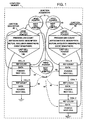
- a "junction" accessor 70 contains a pointer to a junction descriptor 60 and a pointer to the next cell 50 that the process owning (or using) the accessor process will access.
- a process queries a junction's state, it uses its junction accessor's next cell pointer to access the next cell in the logically contiguous series of cells that it has not yet accessed and obtains the junction's next state value. Note that when a process first links to a junction, the resulting created junction accessor's next-cell pointer is set to the last (or last-occurring) element in the cell chain. Thus, a process cannot access a junction's state changes that occurred prior to the time that the process linked to the junction.
- the process begins with a process P using its own junction accessor's (70) next-cell pointer to get a pointer to a cell C (50).
- Cell (50) C contains the junction's first state that has not yet been seen by P.
- P decrements the C's refcount.
- P uses C's next cell pointer to update its own next-cell pointer in its junction accessor, 70.
- P will access C's successor in the chain of cells.
- a logically contiguous chain of cells (50) is used to maintain the history of a junction's state changes.
- a junction descriptor (60) contains the status of the cell chain.
- a junction accessor (70) is a process's handle to the junction and the cell-chain for the junction.
- a cell 50 is a logically contiguous segment of computer memory or storage containing a pointer to the next cell in the junction, a "reference count" that indicates the number of processes that have linked to the cell, but have yet to access it, and data that describes the state of the junction.
- the order of presentation of a cell's contents is immaterial and any convenient arrangement of cell contents is permissible.
- this structure may be created as:
- a junction descriptor 60 is a logically contiguous segment of memory containing a count of the number of processes linked to the junction, the number of bytes in each state description, a mutual exclusion semaphore, an event semaphore, a pointer to the first cell in a logically contiguous series, a pointer to the last cell in a logically contiguous series, and a memory area from which cells are allocated.
- junction descriptor 60 contents is as follows:
- a junction accessor 70 is a logically contiguous segment of memory containing a head pointer to the junction descriptor 60 of the junction being accessed, and a pointer to the next cell that the process owning the accessor will access.
- the "next" cell is the next cell in the logically contiguous series of cells which the process has not yet accessed for storage or reading of state data.
- junction accessor example is:
- junction accessor In C-language, an implementation for a junction accessor is:
- junction manager runs on the IBM OS/2 operating system, but similar C-language constructs or constructs in any other language appropriate to other operating systems may be easily created by one of skill in this art following the general design of these preferred embodiments.
- junction manager Details of the junction manager's processes for inclusion in each object are presented below.
- a resident set of junction manager sub-processes could be installed in a computer system for access by, and use of, an object desiring to avail itself of the junction manager's services.
- each object is provided with its own sub-processes to operate as a junction manager; thus, the "junction manager" may be one object or many, and may be centrally located and accessible or distributed throughout a system of computers and memories linked via a communication network or LAN, as shown in Fig. 8.
- junction descriptor To allocate a junction descriptor to define a new junction, we first allocate a region of named shared memory (DosAllocSharedMem) to hold the junction descriptor (301). This is the junction descriptor. Out of this memory area, a subregion is carved (DosSubSetMem) that will hold the cells (302). Then, a mutual exclusion semaphore and an event semaphore (DosCreateMutexSem and DosCreateEventSem, respectively) are created (303 and 304). Out of the cell area, we allocate an initial sentinel cell (306).
- DosAllocSharedMem a region of named shared memory (DosAllocSharedMem) to hold the junction descriptor (301). This is the junction descriptor. Out of this memory area, a subregion is carved (DosSubSetMem) that will hold the cells (302). Then, a mutual exclusion semaphore and an event sem
- junction descriptor 401
- release the memory from which cells are allocated 402
- mutual exclusion and event semaphores 403 and 404
- storage used to store the junction descriptor 405
- Linking to a junction by an object means taking steps at the object for creating and initializing a junction accessor. Given an area of memory established in the linking process to hold the junction accessor and the name of the junction, we first get a pointer to the junction descriptor (DosGetNamedSharedMem) and store it in the junction accessor (501 and 502). Next, we link to the mutual exclusion semaphore (DosOpenMutexSem) and to the event semaphore (DosopenEventSem) (503 and 504) by copying into the accessor's memory space the pointers to the memory address location where these semaphores exist.
- DosOpenMutexSem the mutual exclusion semaphore
- DosopenEventSem DosopenEventSem
- junction descriptor's link reference count (505). Recalling that we obtained a pointer to the junction descriptor in step 501, we set the junction accessor's next cell pointer to the junction's tail pointer --that is, to the current value of the junction. This prevents the newly linked process from accessing states that existed before the linking occurred.
- Unlinking a process from a cell reverses the linking process.
- the reference count is zero -- thus the cell will never again be accessed -- so we deallocate it (605).
- a process When a process sets the next state stored in a junction, it accesses the junction by using the pointer to the junction stored in its junction accessor (created when the process itself links to the junction) (700). Within the junction's cell area, the process allocates a new cell (701). This new cell will act as the new sentinel cell. The process then sets the reference count for the cell to zero (702).
- the process requests the mutual exclusion semaphore and blocks (that is, waits) until the request is granted (703).
- the request copies the new state into the old sentinel cell (704) and sets the reference count for the old sentinel cell to the value stored in the junction descriptor's reference count (705). This sets the reference count for the cell to be the number of processes currently linked to the junction.
- the process sets the next pointer for the cell that was at the tail of the list, that is, the sentinel cell, to point to the new cell. This inserts the new cell's memory address at the end of the junction descriptor's list of cells, and hence makes it the new sentinel cell (706).
- the process sets the junction descriptor's tail pointer to point to the new cell (707), telling the junction that this new cell is now the sentinel cell.
- the process posts (writes to an area of memory) the event semaphore (708). This frees all processes blocked waiting for a new value of the junction -- that is, any process that had read all of the junction's states, and had asked to read the next (non-existent) state. It then resets the junction descriptor's event semaphore (709). Once the semaphore posting has occurred, the semaphore must be reset to prevent any processes from later trying to read non-existent states (710). Finally, the process releases the junction descriptor's mutual exclusion semaphore (711).
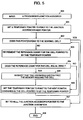
- the process To get a junction's first state not previously read by a process, the process first gets a memory address pointer to the area in memory holding the junction from the process' junction accessor (801). It next requests the junction's mutual exclusion semaphore, and blocks until the request is granted (802). Once the semaphore request has been granted, if the junction accessor's tail pointer does not equal the junction descriptor's tail pointer, that is, it does not point to the sentinel cell, there are states in the junction that the process has not read, so the process continues to step 806 at step (803).
- the process has read all states currently in the junction. If that is true, the process releases the mutual exclusion semaphore (804) allowing other processes to access the junction. It then stalls until the junction's event semaphore is posted; when the process is restarted (when a process adding a new state posts the event semaphore, as described above in step 708) it goes to step 807 at step (805).
- Step 806 is executed only if the process did not block on the event semaphore and had not released the mutual exclusion semaphore. This step releases the mutual exclusion semaphore (806).
- the process is guaranteed to be ready to access a valid state (either because it had not previously accessed all of the states, or because a new state was added and the event semaphore posted).
- the process copies the current state out of the cell pointed to by the next pointer in its junction accessor (807). It then advances that pointer (808).
- the process requests the junction descriptor's mutual exclusion semaphore, and, when the request is granted, decrements the reference count for the cell that was read (809 and 810). This indicates that one fewer process has yet to access the cell.
- the process frees the cell (811). If the junction still contains cells, there is no need to adjust the junction descriptor's head pointer, so proceed to step 814 (812). If the junction no longer contains any cells (because this process freed the last one), the process sets the head pointer to point to the sentinel cell (813). This indicates that the junction is now empty.
- junction managing process is characterized by two distinguishing features: (1) it does not require a separate active entity to manage the junctions and (2) processes using junction access only information created after they link to the junction.
- ORBs object request brokers
- the second feature distinguishes this process from shared memory systems such as the Linda programming language.
- shared memory systems a.k.a. blackboard systems
- one object can post a "note” that one or more other processes can access. The note exists until some object removes it.
- a note can be used to connect processes whose lifetimes do not overlap.
- the junction managing process differs in that viewing objects are restricted to viewing only data added to the junction after the object linked to the junction. Thus, an object needn't worry about sifting through residual data left in the junction before linking occurred.
- This process is especially suitable for building event-driven software systems.
- a computer-keyboard manager typically a "device driver” uses the junction managing process.
- the keyboard manager can create a junction called "keyboard_input,” link to it, and then deposit each keystroke into the junction as a new change of state. Any object interested in the keyboard input can then link to the "keyboard_input” junction and read the keystrokes as they are added.
- a windowing system 203 e.g., Presentation Manager
- a text-editor 204 e.g., Microsoft Word
- an auditing system 202 all link to and read from the "keyboard_input" junction.
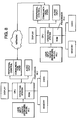
- Fig. 9 illustrates such an embodiment.
- Each of these program objects can "see” the result of the keystrokes simultaneously.
- Each of the program objects can then operate on the keystroke asynchronously - - that is, without concern for how other objects are using the keystroke.
- the keyboard manager 201 will read the keystroke, and pass it to the windowing system 203, which would pass it to the word processor 204 and the auditor 202.
- the keystroke must pass through an intermediate level -- the windowing system -- before reaching the other processes.
- the windowing system passes the strokes to its client sequentially. This reduces the opportunity for parallel execution on a multiprocessor workstation since the interested program objects must wait to receive each keystroke. (Note that multiprocessor workstations will become increasingly prevalent in the next decade.)
- any other objects interested in the keystrokes must also link to the keyboard manager, increasing complexity.
- the keyboard manager 201 creates a junction Descriptor 60, calling it "keyboard_input.”
- steps 300-308 These steps create a junction descriptor for the new junction.
- this process allocates a mutual exclusion semaphore and an event semaphore (steps 303 and 304).
- the junction descriptor will also contain the size of the entries to be contained by the junction (step 305), in this case, one byte (for 1 keystroke). Since the junction is initially empty, that is, it contains no keystrokes, the head and the tail pointers both point to the sentinel cell. Also, since no processes are linked to the junction, the reference count is zero.
- the keyboard manager 201 links to it, executing steps 500-507.
- the keyboard manager 201 sets aside local memory to hold the junction accessor 70.
- it uses the name of the junction (in this case, "keyboard_input"), and the OS/2 GetNamedSharedMem call to get a pointer to the junction.
- the keyboard manager 201 then places this pointer in its junction accessor 70.
- the process then requests that the operating system give it access to the junction descriptor's semaphores using the OS/2 calls, DosOpenMutexSem and DosOpenEventSem.
- the names of the semaphores will be the same as the name of the junction, prepended with a constant string.
- the keyboard manager 201 increments the junction descriptor's reference count to 1, since one process is now linked to the junction. Finally, the keyboard manager 201 sets its junction accessor's read pointer to the junction descriptor's 60 last pointer, which, since no cells have been added, still points to the sentinel cell.
- the keyboard manager 201 can then add cells to the junction using steps 700-710. To add a new cell, the process actually adds state data to the current sentinel cell, and then allocates a new sentinel cell. This ensures that when stalled processes wake-up, they will point to the correct cell. (This is true since stalled processes always point to the last cell, that is, the sentinel cell. Since the sentinel cell now contains the new state, the stalled process will point to the new state.) So, from within the junction descriptor 60, the keyboard manager 201 allocates a new cell, and sets its reference count to zero and next pointer to NULL. Next, it requests that the operating system give it exclusive use of the mutual exclusion semaphore (704).
- the keyboard manager 201 transforms the old sentinel cell into an active cell by setting the reference count for the cell, copying the keystroke into the data field of the cell, and linking in the new sentinel cell.
- the reference count for the cell becomes the number of processes linked to the junction (as stored in the junction descriptor). This indicates that every linked process might access the cell, but, as yet, none have done so.
- the keyboard manager 201 then informs any processes (such as Auditor 202 and window manager 203) waiting for a new state, that a new state is actually present.
- the junction managing process suspends the requesting process. It does this by requesting that the operating system stall the requesting process until a given "event semaphore" (stored in the junction descriptor) is "posted.”
- a given "event semaphore" stored in the junction descriptor
- the keyboard manager adds a new cell (keystroke)
- the keyboard manager does this by "posting" an event semaphore, thereby requesting that the operating system restart the stalled processes.
- the keyboard manager 201 then resets the event semaphore, which allows other processes to stall waiting for it to be posted.
- the keyboard manager 201 can release the mutual exclusion semaphore.
- the window manager 203 first gets the pointer to the junction descriptor 60 from its junction accessor 70, then requests the mutual exclusion semaphore, blocking (stalling) until the operating system grants the request. Recall that use of the mutual exclusion semaphore when manipulating the list of cells ensures that only one process at a time can access the list, and thus that the list is not corrupted.
- the window manager 203 checks to see if it has read all of the junction's cells. All of the cells have been read if the window manager's junction accessor's next read pointer points to the sentinel cell (that is, points to the same location pointed to by the junction descriptor's tail pointer). If all of the cells have been read, the window manager releases the mutual exclusion semaphore (allowing other processes to work with the junction), and then requests that the operating system stall the window manager (using the event semaphore stored in the junction descriptor). The operating system will restart the window manager when a new cell is added, and the event semaphore is "posted" (as described above).
- the window manager 203 knows that there is a cell in the junction that it has not read. It copies the keystroke stored in the cell pointed to by its junction accessor's next read cell pointer. At that point, it has read the junction's state. It then advances its next read cell pointer using the next pointer in the cell it read. It then requests the mutual exclusion semaphore in the junction descriptor 60, and, once the request is granted, it decrements the cell's reference count. (The count is decremented since one fewer process is left to read the cell.) If the reference count dropped to zero, no further processes can read it, and the window manager deallocates the memory holding the cell, and adjusts the junction descriptor's head pointer.
- the window manager 203 adjusts the junction descriptor's head pointer such that it points to the first cell in the junction, and releases the mutual exclusion semaphore.
- the window manager 203 and text editor or word processor 204 repeats the process beginning with step 800.
- the Auditor program, 202 operates in similar fashion to the window manager to access and read the keystroke data stored in the state cells, 50 by the keyboard manager 201.
- the keyboard manager 201 has deposited (stored) three characters, C, A, T, in three cells 50 in memory that can be accessed by all of the programs 201, 202, 203, 204 in the example. As illustrated in Fig. 9, keyboard manager 201 has not read the contents of any of the cells, 50. However, the window manager 203 and the Auditor program 202 have each read two cells ("C" and "A" characters). Thus, the new refcount for the cells holding C and A is "1", while the refcount for the cell holding the "T" is "3". The refcount in junction descriptor 60 is 4, however, because 4 programs may access the cells' contents in shared memory.
- event-driven systems are typically constructed such that objects comprising the system are only interested in events occurring after the object is created.
- the junction managing process is well-suited to the construction of such systems.
- junction manager is somewhat similar to Object Request Brokers (ORBs). Both enable interobject communication. However, the junction manager greatly reduces the communication overhead.
- the 01 For one object (01) to communicate to another (02) using an ORB, the 01 must send a message to the ORB which then forwards it to 02. If 01's initial message contained a "return address", 02 can then send directly to 01, bypassing the ORB. Furthermore, if 02's first message to 01 contains a return address, 01 can then bypass the ORB when communicating with 02.
- the junction manager eliminates virtually all of that communication overhead. For one process to communicate with an arbitrary number of other processes, it merely sets the state of a junction within the shared memory. As described above, processes access the junction data through their own junction accessor created when a process links to the junction. Using its own junction accessor (as shown in Figure 1), a process can bypass an ORB. No messages are passed. Processes interested in the state of a junction simply read it from the shared memory managed by their own junction manager; again, no messages are passed. However, if the junction manager is implemented using distributed, logically-shared memory rather than physically-shared memory, the memory management software might pass messages. However, this message passing would be shielded from the application layer.
- junction manager is, in essence, an optimal ORB, in that the junction manager provides the ORB's function without the ORB's overhead.
Landscapes
- Engineering & Computer Science (AREA)
- Software Systems (AREA)
- Theoretical Computer Science (AREA)
- Physics & Mathematics (AREA)
- General Engineering & Computer Science (AREA)
- General Physics & Mathematics (AREA)
- Information Retrieval, Db Structures And Fs Structures Therefor (AREA)
Applications Claiming Priority (2)
| Application Number | Priority Date | Filing Date | Title |
|---|---|---|---|
| US543969 | 1995-10-17 | ||
| US08/543,969 US6587889B1 (en) | 1995-10-17 | 1995-10-17 | Junction manager program object interconnection and method |
Publications (2)
| Publication Number | Publication Date |
|---|---|
| EP0769740A1 true EP0769740A1 (de) | 1997-04-23 |
| EP0769740B1 EP0769740B1 (de) | 2001-12-05 |
Family
ID=24170266
Family Applications (1)
| Application Number | Title | Priority Date | Filing Date |
|---|---|---|---|
| EP96306704A Expired - Lifetime EP0769740B1 (de) | 1995-10-17 | 1996-09-16 | Interobjekt-Datenaustausch |
Country Status (3)
| Country | Link |
|---|---|
| US (1) | US6587889B1 (de) |
| EP (1) | EP0769740B1 (de) |
| DE (1) | DE69617604T2 (de) |
Cited By (6)
| Publication number | Priority date | Publication date | Assignee | Title |
|---|---|---|---|---|
| WO2001016741A3 (en) * | 1999-08-31 | 2001-09-20 | Times N Systems Inc | Semaphore control of shared-memory |
| EP0892342A3 (de) * | 1997-07-18 | 2003-11-26 | Denso Corporation | Elektronisches Steuergerät |
| EP1187018A3 (de) * | 2000-03-02 | 2005-01-26 | Hitachi, Ltd. | Informationsverarbeitungsvorrichtung |
| GB2412755A (en) * | 2004-03-30 | 2005-10-05 | Hewlett Packard Development Co | Coordination of lifecycle state changes in software components |
| EP1022657A3 (de) * | 1999-01-20 | 2005-12-07 | Denso Corporation | Auf ein objektorientiertes Programm anwendbares elektronisches Steuerungsgerät |
| EP1020794A3 (de) * | 1999-01-13 | 2006-08-23 | Denso Corporation | Elektronische Steuereinheit mit einer objektorientierten Steueranwendung mit reduzierten Interobjekt-Nachricht Speicherbedarf |
Families Citing this family (7)
| Publication number | Priority date | Publication date | Assignee | Title |
|---|---|---|---|---|
| US7409694B2 (en) * | 1998-09-09 | 2008-08-05 | Microsoft Corporation | Highly componentized system architecture with loadable virtual memory manager |
| US8434099B2 (en) | 1998-09-09 | 2013-04-30 | Microsoft Corporation | Efficient linking and loading for late binding and platform retargeting |
| US7873907B2 (en) * | 2004-01-07 | 2011-01-18 | International Business Machines Corporation | Technique for searching for a specific object in an ISPF panel for automated testing |
| US7676791B2 (en) * | 2004-07-09 | 2010-03-09 | Microsoft Corporation | Implementation of concurrent programs in object-oriented languages |
| DE102007039920A1 (de) * | 2007-08-23 | 2009-02-26 | Siemens Ag | Verfahren zum Auslesen und/oder Schreiben von Eigenschaften oder Parametern eines an ein Bussystem angeschlossenen Installationsgerätes |
| US20110099556A1 (en) * | 2009-10-22 | 2011-04-28 | International Business Machines Corporation | Updating system for a microcontroller and associated methods |
| US9857975B2 (en) | 2015-06-26 | 2018-01-02 | International Business Machines Corporation | Non-volatile memory drive partitions within microcontrollers |
Citations (3)
| Publication number | Priority date | Publication date | Assignee | Title |
|---|---|---|---|---|
| EP0108338A2 (de) * | 1982-11-04 | 1984-05-16 | International Business Machines Corporation | Verfahren zur gleichzeitigen Verarbeitung einer Warteschlange |
| EP0514112A2 (de) * | 1991-05-16 | 1992-11-19 | International Business Machines Corporation | Verknüpfte Datenstruktur |
| US5339418A (en) * | 1989-06-29 | 1994-08-16 | Digital Equipment Corporation | Message passing method |
Family Cites Families (7)
| Publication number | Priority date | Publication date | Assignee | Title |
|---|---|---|---|---|
| US4912629A (en) * | 1986-06-26 | 1990-03-27 | The United States Of America As Represented By The Administrator Of The National Aeronautics And Space Administration | Real-time garbage collection for list processing using restructured cells for increased reference counter size |
| US5041970A (en) * | 1988-08-03 | 1991-08-20 | Intelligent Computer Engineering, Inc. | Cell processor and memory-managed computer system using same |
| US5297283A (en) * | 1989-06-29 | 1994-03-22 | Digital Equipment Corporation | Object transferring system and method in an object based computer operating system |
| JPH04251338A (ja) * | 1990-10-10 | 1992-09-07 | Fuji Xerox Co Ltd | プロセス間通信の制御方式 |
| US5434975A (en) * | 1992-09-24 | 1995-07-18 | At&T Corp. | System for interconnecting a synchronous path having semaphores and an asynchronous path having message queuing for interprocess communications |
| US5446901A (en) * | 1993-06-30 | 1995-08-29 | Digital Equipment Corporation | Fault tolerant distributed garbage collection system and method for collecting network objects |
| US5764985A (en) * | 1994-12-13 | 1998-06-09 | Microsoft Corp | Notification mechanism for coordinating software extensions |
-
1995
- 1995-10-17 US US08/543,969 patent/US6587889B1/en not_active Expired - Fee Related
-
1996
- 1996-09-16 EP EP96306704A patent/EP0769740B1/de not_active Expired - Lifetime
- 1996-09-16 DE DE69617604T patent/DE69617604T2/de not_active Expired - Lifetime
Patent Citations (3)
| Publication number | Priority date | Publication date | Assignee | Title |
|---|---|---|---|---|
| EP0108338A2 (de) * | 1982-11-04 | 1984-05-16 | International Business Machines Corporation | Verfahren zur gleichzeitigen Verarbeitung einer Warteschlange |
| US5339418A (en) * | 1989-06-29 | 1994-08-16 | Digital Equipment Corporation | Message passing method |
| EP0514112A2 (de) * | 1991-05-16 | 1992-11-19 | International Business Machines Corporation | Verknüpfte Datenstruktur |
Non-Patent Citations (3)
| Title |
|---|
| A. S. TANENBAUM: "OPERATING SYSTEMS: Design and Implementation", PRENTICE-HALL INTERNATIONAL, INC., ENGLEWOOD CLIFFS, NJ, US, XP002023005 * |
| H. W. GLASER ET AL: "Lazy Garbage Collection", SOFTWARE PRACTICE AND EXPERIENCE, vol. 17, no. 1, January 1987 (1987-01-01), CHICHESTER, SUSSEX, GB, pages 1 - 4, XP000004698 * |
| PEIYI TANG ET AL: "A Parallel Linked List for Shared-Memory Multiprocessors", SAC - THE THIRTEENTH ANNUAL INTERNATIONAL COMPUTER SOFTWARE AND APPLICATIONS CONFERENCE, 20 September 1989 (1989-09-20), ORLANDO, FL, US, pages 130 - 135, XP000091496 * |
Cited By (7)
| Publication number | Priority date | Publication date | Assignee | Title |
|---|---|---|---|---|
| EP0892342A3 (de) * | 1997-07-18 | 2003-11-26 | Denso Corporation | Elektronisches Steuergerät |
| EP1020794A3 (de) * | 1999-01-13 | 2006-08-23 | Denso Corporation | Elektronische Steuereinheit mit einer objektorientierten Steueranwendung mit reduzierten Interobjekt-Nachricht Speicherbedarf |
| EP1022657A3 (de) * | 1999-01-20 | 2005-12-07 | Denso Corporation | Auf ein objektorientiertes Programm anwendbares elektronisches Steuerungsgerät |
| WO2001016741A3 (en) * | 1999-08-31 | 2001-09-20 | Times N Systems Inc | Semaphore control of shared-memory |
| EP1187018A3 (de) * | 2000-03-02 | 2005-01-26 | Hitachi, Ltd. | Informationsverarbeitungsvorrichtung |
| US7127723B2 (en) | 2000-03-02 | 2006-10-24 | Hitachi, Ltd. | Information processing apparatus with multiple operating systems |
| GB2412755A (en) * | 2004-03-30 | 2005-10-05 | Hewlett Packard Development Co | Coordination of lifecycle state changes in software components |
Also Published As
| Publication number | Publication date |
|---|---|
| DE69617604T2 (de) | 2002-08-22 |
| US6587889B1 (en) | 2003-07-01 |
| DE69617604D1 (de) | 2002-01-17 |
| EP0769740B1 (de) | 2001-12-05 |
Similar Documents
| Publication | Publication Date | Title |
|---|---|---|
| US6629152B2 (en) | Message passing using shared memory of a computer | |
| Hamilton et al. | The Spring nucleus: A microkernel for objects | |
| US5452459A (en) | Method and apparatus for allocating server access in a distributed computing environment | |
| US6182108B1 (en) | Method and system for multi-threaded processing | |
| Lauer et al. | On the duality of operating system structures | |
| US8245207B1 (en) | Technique for dynamically restricting thread concurrency without rewriting thread code | |
| KR0170565B1 (ko) | 메모리 관리 방법, 마이크로커널 구조 데이타 프로세싱 시스템, 운영 체제 퍼스낼리티 시스템 동작 방법, 퍼스낼리티 뉴트럴 서비스 프로그램 실행 방법 및 응용 프로그램 실행방법 | |
| Gehani et al. | Concurrent c | |
| US5706515A (en) | System and method for implementing an atomic wait for notification operation | |
| US5675796A (en) | Concurrency management component for use by a computer program during the transfer of a message | |
| US4387427A (en) | Hardware scheduler/dispatcher for data processing system | |
| EP0783150B1 (de) | Vorrichtung, Verfahren, Speichermedium und computerlesbare Module zur raumeffizienten Objektverriegelung | |
| US5706505A (en) | Method and system for binding data in a computer system | |
| US5574903A (en) | Method and apparatus for handling request regarding information stored in a file system | |
| EP0769740B1 (de) | Interobjekt-Datenaustausch | |
| EP0447160A2 (de) | Aufrechterhaltung der Datenübereinstimmung in Cache-Speicheranordnungen | |
| Scott et al. | Multi-model parallel programming in Psyche | |
| JPH03161859A (ja) | リクエスト管理方法及びアクセス制御システム | |
| US20050086237A1 (en) | Shared queues in shared object space | |
| JPS63201860A (ja) | ネツトワーク管理システム | |
| US6944863B1 (en) | Queue bank repository and method for sharing limited queue banks in memory | |
| US6865741B1 (en) | Determining completion of transactions processing in a dynamically changing network | |
| US7783853B1 (en) | Memory usage techniques in middleware of a real-time data distribution system | |
| US20030200457A1 (en) | Enhancement to the MCS lock for increased functionality and improved programmability | |
| WO2025030825A1 (zh) | 一种信息同步方法及装置 |
Legal Events
| Date | Code | Title | Description |
|---|---|---|---|
| PUAI | Public reference made under article 153(3) epc to a published international application that has entered the european phase |
Free format text: ORIGINAL CODE: 0009012 |
|
| AK | Designated contracting states |
Kind code of ref document: A1 Designated state(s): DE FR GB |
|
| 17P | Request for examination filed |
Effective date: 19970930 |
|
| 17Q | First examination report despatched |
Effective date: 20000211 |
|
| GRAG | Despatch of communication of intention to grant |
Free format text: ORIGINAL CODE: EPIDOS AGRA |
|
| GRAG | Despatch of communication of intention to grant |
Free format text: ORIGINAL CODE: EPIDOS AGRA |
|
| GRAH | Despatch of communication of intention to grant a patent |
Free format text: ORIGINAL CODE: EPIDOS IGRA |
|
| GRAH | Despatch of communication of intention to grant a patent |
Free format text: ORIGINAL CODE: EPIDOS IGRA |
|
| GRAA | (expected) grant |
Free format text: ORIGINAL CODE: 0009210 |
|
| AK | Designated contracting states |
Kind code of ref document: B1 Designated state(s): DE FR GB |
|
| REG | Reference to a national code |
Ref country code: GB Ref legal event code: IF02 |
|
| REF | Corresponds to: |
Ref document number: 69617604 Country of ref document: DE Date of ref document: 20020117 |
|
| ET | Fr: translation filed | ||
| PLBE | No opposition filed within time limit |
Free format text: ORIGINAL CODE: 0009261 |
|
| STAA | Information on the status of an ep patent application or granted ep patent |
Free format text: STATUS: NO OPPOSITION FILED WITHIN TIME LIMIT |
|
| 26N | No opposition filed | ||
| REG | Reference to a national code |
Ref country code: GB Ref legal event code: 746 Effective date: 20080808 |
|
| PGFP | Annual fee paid to national office [announced via postgrant information from national office to epo] |
Ref country code: FR Payment date: 20110928 Year of fee payment: 16 |
|
| REG | Reference to a national code |
Ref country code: FR Ref legal event code: ST Effective date: 20130531 |
|
| PG25 | Lapsed in a contracting state [announced via postgrant information from national office to epo] |
Ref country code: FR Free format text: LAPSE BECAUSE OF NON-PAYMENT OF DUE FEES Effective date: 20121001 |
|
| PGFP | Annual fee paid to national office [announced via postgrant information from national office to epo] |
Ref country code: DE Payment date: 20140924 Year of fee payment: 19 |
|
| PGFP | Annual fee paid to national office [announced via postgrant information from national office to epo] |
Ref country code: GB Payment date: 20150923 Year of fee payment: 20 |
|
| REG | Reference to a national code |
Ref country code: DE Ref legal event code: R119 Ref document number: 69617604 Country of ref document: DE |
|
| PG25 | Lapsed in a contracting state [announced via postgrant information from national office to epo] |
Ref country code: DE Free format text: LAPSE BECAUSE OF NON-PAYMENT OF DUE FEES Effective date: 20160401 |
|
| REG | Reference to a national code |
Ref country code: GB Ref legal event code: PE20 Expiry date: 20160915 |
|
| PG25 | Lapsed in a contracting state [announced via postgrant information from national office to epo] |
Ref country code: GB Free format text: LAPSE BECAUSE OF EXPIRATION OF PROTECTION Effective date: 20160915 |