EP0770636B1 - Procédé de préparation de copolymères blocs de poly(diorganosiloxane)-polycarbonate - Google Patents
Procédé de préparation de copolymères blocs de poly(diorganosiloxane)-polycarbonate Download PDFInfo
- Publication number
- EP0770636B1 EP0770636B1 EP96116213A EP96116213A EP0770636B1 EP 0770636 B1 EP0770636 B1 EP 0770636B1 EP 96116213 A EP96116213 A EP 96116213A EP 96116213 A EP96116213 A EP 96116213A EP 0770636 B1 EP0770636 B1 EP 0770636B1
- Authority
- EP
- European Patent Office
- Prior art keywords
- polydiorganosiloxanes
- hydroxyphenyl
- alkyl
- process according
- formula
- Prior art date
- Legal status (The legal status is an assumption and is not a legal conclusion. Google has not performed a legal analysis and makes no representation as to the accuracy of the status listed.)
- Expired - Lifetime
Links
Images


Classifications
-
- C—CHEMISTRY; METALLURGY
- C08—ORGANIC MACROMOLECULAR COMPOUNDS; THEIR PREPARATION OR CHEMICAL WORKING-UP; COMPOSITIONS BASED THEREON
- C08G—MACROMOLECULAR COMPOUNDS OBTAINED OTHERWISE THAN BY REACTIONS ONLY INVOLVING UNSATURATED CARBON-TO-CARBON BONDS
- C08G77/00—Macromolecular compounds obtained by reactions forming a linkage containing silicon with or without sulfur, nitrogen, oxygen or carbon in the main chain of the macromolecule
- C08G77/42—Block-or graft-polymers containing polysiloxane sequences
- C08G77/448—Block-or graft-polymers containing polysiloxane sequences containing polycarbonate sequences
-
- C—CHEMISTRY; METALLURGY
- C08—ORGANIC MACROMOLECULAR COMPOUNDS; THEIR PREPARATION OR CHEMICAL WORKING-UP; COMPOSITIONS BASED THEREON
- C08G—MACROMOLECULAR COMPOUNDS OBTAINED OTHERWISE THAN BY REACTIONS ONLY INVOLVING UNSATURATED CARBON-TO-CARBON BONDS
- C08G64/00—Macromolecular compounds obtained by reactions forming a carbonic ester link in the main chain of the macromolecule
- C08G64/18—Block or graft polymers
- C08G64/186—Block or graft polymers containing polysiloxane sequences
Definitions
- the present invention relates to a process for the preparation of thermoplastic poly (diorganosiloxane) -polycarbonate block copolymers with average molecular weights M w (weight average, determined by gel chromatography) from 18,000 to 60,000, preferably 19,000 to 40,000, from aromatic Si-free Diphenols, carbonic acid diaryl esters and polydiorganosiloxanes in the presence of catalysts at temperatures between 80 ° C and 320 ° C and pressures of 1,000 mbar to 0.01 mbar, which is characterized in that quaternary ammonium compounds and / or quaternary phosphonium compounds of the formulas ( I) and / or (II) wherein R 1-4 are identical or different C 1 -C 30 alkyls, C 6 -C 10 aryls or C 5 -C 6 cycloalkyls, at least one radical of R 1-4 being a C 8 -C 30 alkyl , preferably C 12 -C 20 alky
- the polydiorganosiloxanes to be used have their degrees of polymerization Diorganosiloxane structural units "n" from 5 to 100, preferably between 5 and 80 and especially between 10 and 50.
- Si-free diphenols in the sense of the present invention are diphenols which contain no silicon atoms chemically bound.
- X - anions of (I) and (II) are, for example, tetraphenylboranate and fluoride.
- the polydiorganosiloxane-polycarbonate block copolymers obtainable according to the invention have a content of diorganosiloxane structural units between 30% by weight and 0.5% by weight, preferably between 7% by weight and 1% by weight, based on the total weight of the polydiorganosiloxane-polycarbonate block copolymers.
- the polydiorganosiloxane-polycarbonate block copolymers produced by the process according to the invention have improved demolding and flow behavior, a tough-brittle transition that shifted to lower temperatures and an improved ESC behavior. They are also solvent-free.
- polydiorganosiloxane-polycarbonate block copolymers after the melt transesterification process from bisphenol, diaryl carbonate and silanol terminated Polysiloxanes using catalysts, the application find as a binder for charge transport molecules in photoconductive layers, is described in US 5,227,449.
- the siloxane compounds used are polydiphenyl or polydimethylsiloxane telomeres with silanol end groups (from the company Petrarch System, now Hüls).
- the catalysts of the formulas (I) and (II) have already been used for the production of other polycarbonates, for example bisphenol A polycarbonates.
- the catalysts of the general formulas (I) or (II) with at least one C 8 -C 30 -alkyl radical on the N or P atom there are no particular effects compared to other ammonium or phosphonium catalysts (see comparative examples 1a and 1b).
- ⁇ , ⁇ -bishydroxyaryl polydiorganosiloxanes to be used according to the invention are known, for example, from US Pat. No. 3,419,634.
- ⁇ , ⁇ -bishydroxyalkyl polydiorganosiloxanes to be used according to the invention are known and commercially available, for example by Th. Goldschmidt, Essen.
- the ⁇ , ⁇ -bisacyl polydiorganosiloxanes to be used according to the invention are, for example known from DE-OS 33 34 782 (Le A 22 594).
- ⁇ , ⁇ -bishydroxyacyl polydiorganosiloxanes to be used according to the invention are known and commercially available, for example by Th. Goldschmidt, Essen.
- the polydiorganosiloxanes to be used according to the invention preferably have Hydroxyaryloxy, hydroxyalkoxy, hydroxyacyloxy, ⁇ -hydroxycaprolactone, or acetoxy end groups.
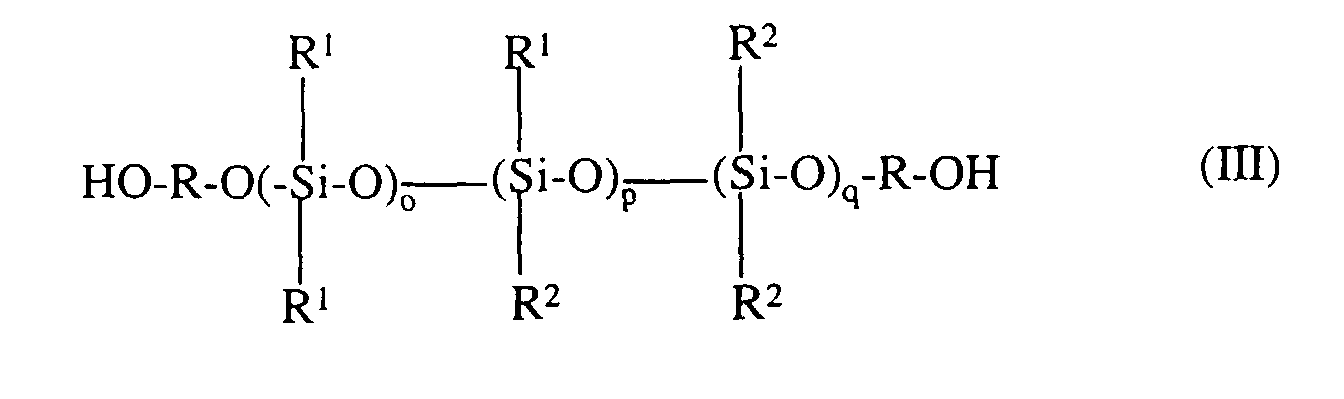
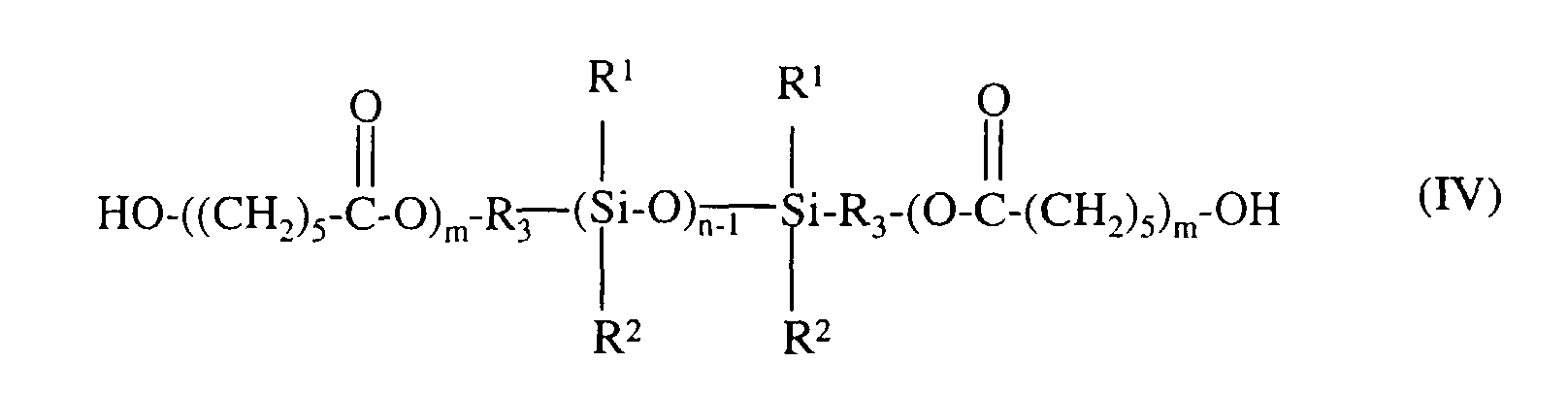
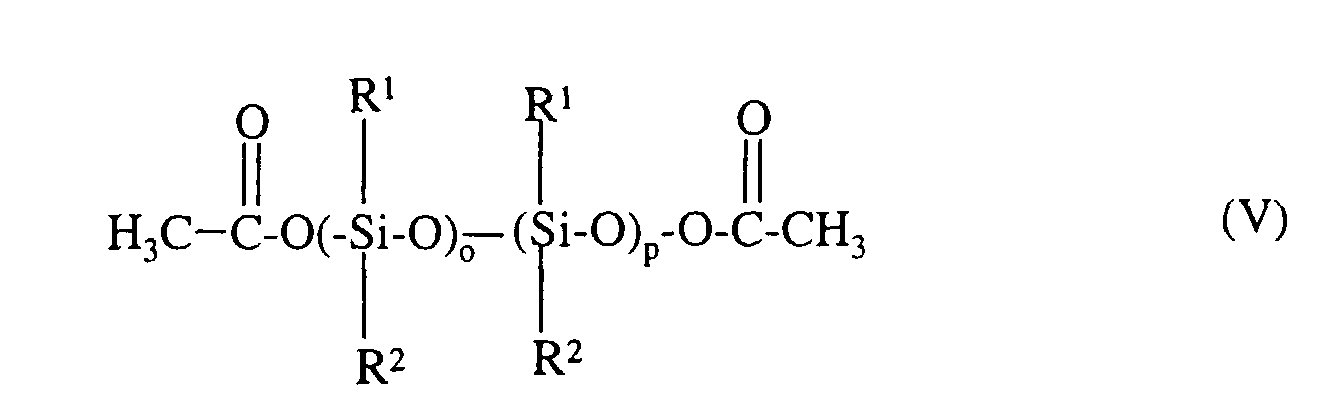
- the polydiorganosiloxanes to be used preferably correspond in particular to the formulas (III), (IV) or (V)
- R is a mononuclear or multinuclear arylene radical with 6 to 30 C atoms, preferably 6 carbon atoms or a linear or branched alkylene radical with 1 to 30 C atoms, or 3 to 30 C atoms, preferably 3 to 10 C atoms.
- Preferred radicals R are also those of the formula (VIa) wherein -X- is a C 1 -C 12 alkylidene, C 7 -C 12 aralkylidene, C 5 -C 15 cycloalkylidene, -S-, -SO 2 -, -O-, or a single bond is particularly preferred
- R 1 and R 2 are the same or different and are linear, optionally halogenated alkyl, branched, optionally halogenated alkyl, aryl or halogenated aryl, preferably methyl.
- R 3 is linear, optionally halogenated alkylene, branched, optionally halogenated alkylene or arylene, preferably linear or branched C 1 -C 16 alkylene, particularly preferably linear propylene, linear butylene, linear pentylene and linear hexylene.
- the number of diorganosiloxane units "n" for formula (III) results from “o + p + q ", for formula (IV) from” n “and for formula (V) from” o + p " between 5 and 100, preferably between 20 and 80 and in particular between 25 and 50.
- the index "m” is 1 to 30, preferably 5 to 15.
- radicals R 1 - are methyl, ethyl, propyl, butyl and phenyl.
- radicals R 2 - are also methyl, ethyl, propyl, butyl and phenyl.
- radicals -R 3 - are methylene, ethylene, i, n-propylene, i, n-butylene, i, n-pentylene and i, n-hexylene.
- Particularly preferred diphenols from the above are 2,2-bis (4-hydroxyphenyl) propane and 1,1-bis (4-hydroxyphenyl) -3,3,5-trimethylcyclohexane.
- OH group-containing oligocarbonates can also be used these diphenols can be used for the process according to the invention.
- Carbonic acid diesters for the purposes of the present invention are di-C 6 -C 20 aryl esters, preferably the diesters of phenol or alkyl-substituted phenols, ie diphenyl carbonate or, for example, dicresyl carbonate. Based on 1 mol of the sum of Si-free diphenols and polydiorganosiloxanes, the carbonic acid diesters are used in 1.01 to 1.30 mol, preferably in 1.02 to 1.15 mol.
- branching agents are 2,4-dihydroxybenzoic acid, its phenyl or Cresyl esters, trimesic acid, their phenyl or cresyl esters, cyanuric chloride and 3,3-bis (3-methyl-4-hydroxyphenyl) oxo-2,3-dihydroindole.
- the 0.05 to 3 mol% optionally to be used, based on the amount used Si-free diphenols, on branching agents, can coexist with the Si-free diphenols be used.
- the molecular weights are generally limited by the amount on carbonic acid diaryl ester and by the reaction conditions. Furthermore monophenols can also be added as chain terminators, for example Phenol or alkylphenols.
- reaction components i.e. the Si-free ones Diphenols, carbonic acid diaryl esters and the polydiorganosiloxanes free from alkali and alkaline earth ions, with amounts of less than 0.1 ppm of alkali and Alkaline earth ions can be tolerated.
- Such pure carbonic acid diaryl esters, Polydiorganosiloxanes or Si-free diphenols can be obtained by using the Carbonic acid diaryl esters, polydiorganosiloxanes or Si-free diphenols, washes or distills.
- Content of alkali and alkaline earth metal ions both in Si-free diphenol, in Polydiorganosiloxane as well as in carbonic acid diester a value of ⁇ 0.1 ppm be.
- the catalysts of the formulas (I) and (II) are known from the literature (see E.V. Dehmlov, S.S. Dehmlo V, "Phase Transfer Catalysis", 2nd edition, Verlag Chemie, 1983; Houben-Weyl, Methods of Organic Chemistry, 4th Edition, Volume XI / 2, 1958, pages 591 ff, volume XII / 1, 1963, pages 79 ff, volume XIII / 3b, 1983, pages 763 ff, and Charles M. Starks and Charles Ciotta, Phase Transfer Catalysis, Publishers Academic Press, 1978) or by methods known from the literature (see loc.cit.).
- catalysts are preferably used in amounts of 10 -2 to 10 -8 mol, based on 1 mol of Si-free diphenol.
- the catalysts can be used alone or in combination (two or more) with one another or in combination with other transesterification catalysts known for the production of polycarbonates.
- Other known transesterification catalysts are, for example, alkali or alkaline earth compounds, other ammonium or phosphonium compounds according to US Pat. No. 5,399,659 and guanidine systems according to US Pat. No. 5,319,066.
- the process according to the invention can be carried out in one step. Here proceed as follows:
- the melting of the Si-free dihydroxy compound of the polydiorganosiloxane and carbonic diester at temperatures of 80 to 250 ° C is preferred 100 to 230 ° C, particularly preferably 120 to 190 ° C under normal pressure in 0 to 5 hours, preferably 0.25 to 3 hours.
- the addition of the catalyst can before melting the components or to the melted Components are done. Then by applying vacuum and Increasing the temperature by distilling off the monophenol an oligocarbonate manufactured. Furthermore, the polycondensation is followed by further increasing the temperature to 240 to 400 ° C and lowering the pressure up to 0.01 mbar produced the polycarbonate.
- the polydiorganosiloxane also together with the catalyst to the melted others Components are added.
- the resulting polydiorganosiloxane) oligocarbonates have OH / aryl carbonate end group ratios in the range from 60:40 to 5:95, preferably from 45:55 to 10:90, which are determined by photometric determination of the OH end groups with TiCl 4 .
- the process according to the invention can, for example, continuously or discontinuously in stirred tanks, thin-film evaporators, falling film evaporators, stirred tank cascades, Extruders, kneaders, simple disc reactors and high viscosity disc reactors be performed.
- the aromatic polycarbonate block copolymers of the process according to the invention should have average molar masses M w of 18,000 to 60,000, preferably 19,000 to 40,000, determined by measuring the relative solution viscosity in dichloromethane or in mixtures of equal amounts by weight of phenol / o-dichlorobenzene, calibrated by light scattering .
- the polycarbonate block copolymers produced according to the invention have one light own color, preferably have a low OH end group content of ⁇ 1 200 ppm and are hydrolysis and thermostable.
- those produced according to the invention can be used Polycarbonate block copolymers fillers and reinforcing materials are added.
- stabilizers e.g. UV, thermal, Gamma-ray stabilizers
- antistatic agents e.g. UV, thermal, Gamma-ray stabilizers
- flow aids e.g. UV, thermal, Gamma-ray stabilizers
- mold release agents e.g. Fire retardants
- pigments e.g. Alkyl and Aryl phosphites, phosphates, phosphines, low molecular weight carboxylic acid esters, Halogen compounds, salts, chalk, quartz powder, glass and carbon fibers.
- the polycarbonate block copolymers produced according to the invention other polymers can also be added, e.g. Polyolefins, polyurethanes or polystyrene.
- poly (diorganosiloxane) polycarbonate block copolymers produced according to the invention can be used wherever the well-known aromatic So far, polycarbonates have been used and where there is also good flowability paired with improved demolding behavior and high toughness at low Temperatures is required, e.g. for the production of large automotive exterior parts, from Control boxes for outdoor use and protective helmets.
- the present invention thus also relates to the use of Poly (diorganosiloxane) polycarbonate block copolymers obtainable according to the invention for the production of large automotive exterior parts, of switch boxes for outdoor use and protective helmets.
- a solvent-free polycarbonate with a relative solution viscosity is obtained of 1.234 (dichloromethane, 25 ° C, 5 g / l).
- the phenolic OH value of the Polycarbonate is 340 ppm.
- Comparative example 1a is repeated, but using tetraphenylphosphonium tetraphenylboranate as a catalyst instead of cetyltrimethylammonium tetraphenylboranate. You also get a bright, solvent-free Polycarbonate with a relative solution viscosity of 1,254 (Dichloromethane, 25 ° C, 5 g / l). The phenolic OH value of the polycarbonate is 360 ppm.
- the relative solution viscosity is 1.280 (dichloromethane, 25 ° C., 5 g / l)
- the phenolic OH value of the block copolycarbonate is 200 ppm.
- FIG. 1 shows the TEM image of untreated ultrathin sections of the Example 1.
- the diameters of the siloxane domains range from approx. 15 nm-> 2 ⁇ m, the distribution is relatively even (HAAN177)
- a light-colored, solvent-free polycarbonate with a relatively large size is obtained Siloxane domains, see Figure 2.
- the relative solution viscosity is 1.28 (Dichloromethane, 25 ° C, 5 g / l).
- the phenolic OH value of the polycarbonate is 200 ppm.
- FIG. 2 shows the TEM image of untreated ultrathin sections of the Comparative example lc.
- the siloxane domains can be recognized as dark particles, whose diameters range from approx. 0.02 -> 2 ⁇ m (HAAN 059).
- the apparatus is activated by applying vacuum and flushing with nitrogen (3 times) freed from atmospheric oxygen and the mixture heated to 150 ° C.
- FIG. 3 shows the TEM image of untreated ultrathin sections of the Example 2.
- the diameters of the siloxane domains range from 0.02-0.7 ⁇ m.
- the Distribution of the siloxane domains is very even (HAAN 114/2).
- the apparatus is freed from atmospheric oxygen by applying a vacuum and flushing with nitrogen (3 times) and the mixture is heated to 150.degree.
- 0.13 g of cetyltrimethylammonium tetraphenylboranate, (CH 3 (CH 2 ) 15 N (CH 3 ) 3 ) B (C 6 H 5 ) 4 , (0.05 mol% based on bisphenol A) are added and the resulting phenol at 100 mbar distilled off.
- the temperature is raised to 180-190 ° C in about 50 minutes and then slowly increased to 250 ° C in a further 2 hours.
- the vacuum is gradually improved to 1 mbar and the temperature increased to 280 ° C. At this point, the majority of the phenol has been split off.
- cetyltrimethylammonium tetraphenylboranate (CH 3 (CH 2 ) 15 N (CH 3 ) 3 ) B (C 6 H 5 ) 4 , (0.05 mol% based on the phenolic end groups of the oligocarbonate) are added and the resulting phenol at 100 mbar distilled off.
- the vacuum is gradually increased to about 10 mbar in about 60 min, to 0.1 mbar in another 10 min and the temperature is increased to 280 ° C. At this point the majority of the phenol has been split off.
Landscapes
- Chemical & Material Sciences (AREA)
- Health & Medical Sciences (AREA)
- Chemical Kinetics & Catalysis (AREA)
- Medicinal Chemistry (AREA)
- Polymers & Plastics (AREA)
- Organic Chemistry (AREA)
- Polyesters Or Polycarbonates (AREA)
- Silicon Polymers (AREA)
- Other Resins Obtained By Reactions Not Involving Carbon-To-Carbon Unsaturated Bonds (AREA)
- Compositions Of Macromolecular Compounds (AREA)
- Manufacture Of Macromolecular Shaped Articles (AREA)
Claims (7)
- Procédé de préparation de copolymères séquencés thermoplastiques du type poly(diorganosiloxane)-polycarbonate à des poids moléculaires moyens Mw (moyenne en poids, déterminée par chromatographie sur gel) de 18 000 à 60 000, à partir de diphénols aromatiques exempts de silicium, de carbonates de diaryle et de polydiorganosiloxanes en présence de catalyseurs à des températures de 80 à 320°C et une pression de 1000 mbar à 0,01 mbar, caractérisé en ce que l'on utilise en tant que catalyseurs des dérivés d'ammonium quaternaire et/ou des dérivés de phosphonium quaternaire de formules (I) et/ou (II)dans lesquelles R1 à R4, ayant des significations identiques ou différentes, représentent chacun un groupe alkyle en C1-C30, aryle en C6-C10 ou cycloalkyle en C5-C6, l'un au moins des symboles R1 à R4 représentant un groupe alkyle en C8-C30, X- représente un anion pour lequel la paire acide-base correspondante H⊕ + X
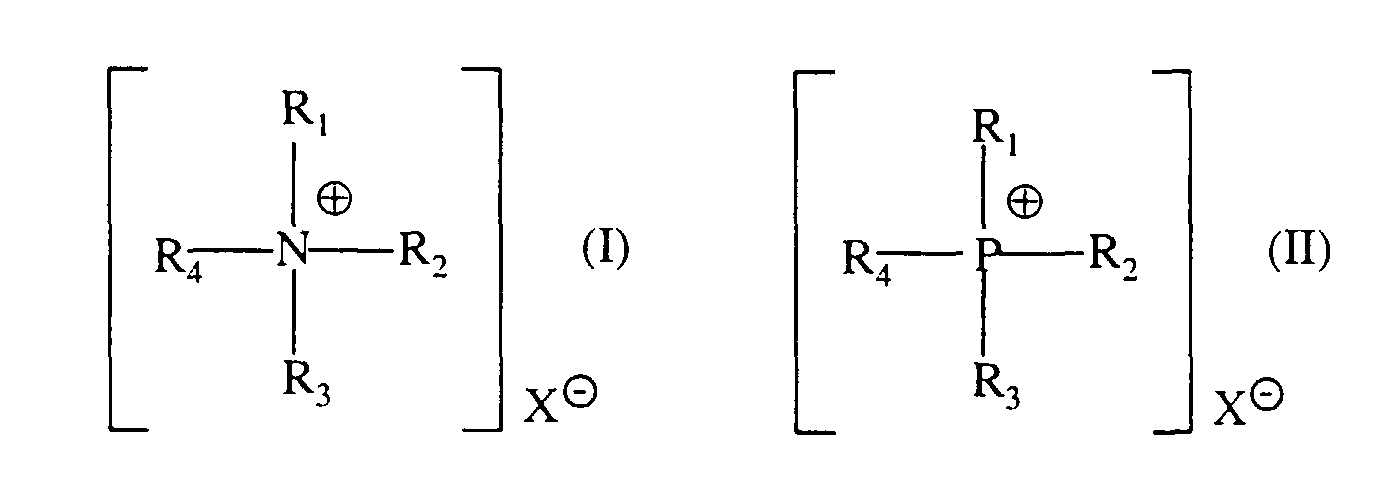
⊖ ↔ HX présente un pKb de 1 à 11, en quantités de 10-1 à 10-8 mol pour 1 mol du diphénol exempt de silicium,
et en ce que l'on utilise en tant que composants polydiorganosiloxanes des α,ω-bishydroxyaryl-, des α,ω-bishydroxyalkyl-, des α,ω-bisacyl- ou des α,ω-bishydroxyacyl-polydiorganosiloxanes, en quantités de 30 % en poids à 0,5 % en poids par rapport au poids total des diphénols exempts de silicium et des polydiorganosiloxanes,
et en ce que la teneur en ions de métaux alcalins et alcalino-terreux, aussi bien dans le diphénol exempt de silicium que dans le polydiorganosiloxane et dans le diester carbonique, est inférieure à 0,1 ppm. - Procédé selon la revendication 1, caractérisé en ce que l'un au moins des symboles R1 à R4 représente un groupe alkyle en C12-C20.
- Procédé selon la revendication 1, caractérisé en ce que l'on utilise en tant que composants polydiorganosiloxanes des α,ω-bis-hydroxyaryloxy-, des α,ω-bis-hydroxyalcoxy-, des α,ω-(bis-hydroxycaprolactone)- ou des α,ω-bis-acétoxy-polydiorganosiloxanes.
- Procédé selon la revendication 1, caractérisé en ce que l'on utilise en tant que composant polydiorganosiloxane un composé de formule (III)dans laquelle R représente un groupe arylène monocyclique ou polycyclique en C6-C30 ou un groupe alkylène linéaire ou ramifié en C1-C30 ou C3-C30, R1 et R2, ayant des significations identiques ou différentes, représentent chacun un groupe alkyle linéaire, un groupe alkyle ramifié, un groupe alkyle linéaire halogéné, un groupe alkyle ramifié halogéné, un groupe aryle ou un groupe aryle halogéné et la somme des motifs de diorganosiloxane, "n" = o + p + q, va de 5 à 100.
- Procédé selon la revendication 1, caractérisé en ce que l'on utilise en tant que composant polydiorganosiloxane un composé de formule (IV)dans laquelle R1 et R2 ont les significations indiquées dans la revendication 4 en référence à la formule (III), R3 représente un groupe alkylène linéaire, un groupe alkylène ramifié, un groupe alkylène linéaire halogéné, un groupe alkylène ramifié halogéné ou un groupe arylène, "n" va de 5 à 100 et "m" va de 1 à 10.
- Procédé selon la revendication 1, caractérisé en ce que l'on utilise en tant que composant polydiorganosiloxane un composé de formule (V)dans laquelle R1 et R2 ont les significations indiquées dans la revendication 4 en référence à la formule (III) et la somme des motif de diorganosiloxane, "n" = o + p, va de 5 à 100.
- Utilisation des copolymères séquencés du type poly(diorganosiloxane)-polycarbonate obtenus selon les revendications 1 à 6 pour la fabrication de grosses pièces extérieures de véhicules, de boítiers de distribution extérieurs et de casques de protection.
Applications Claiming Priority (2)
| Application Number | Priority Date | Filing Date | Title |
|---|---|---|---|
| DE19539290 | 1995-10-23 | ||
| DE19539290A DE19539290A1 (de) | 1995-10-23 | 1995-10-23 | Verfahren zur Herstellung von Poly-(diorganosiloxan)-Polycarbonat-Blockcopolymeren |
Publications (3)
| Publication Number | Publication Date |
|---|---|
| EP0770636A2 EP0770636A2 (fr) | 1997-05-02 |
| EP0770636A3 EP0770636A3 (fr) | 1997-11-05 |
| EP0770636B1 true EP0770636B1 (fr) | 2000-05-10 |
Family
ID=7775470
Family Applications (1)
| Application Number | Title | Priority Date | Filing Date |
|---|---|---|---|
| EP96116213A Expired - Lifetime EP0770636B1 (fr) | 1995-10-23 | 1996-10-10 | Procédé de préparation de copolymères blocs de poly(diorganosiloxane)-polycarbonate |
Country Status (5)
| Country | Link |
|---|---|
| US (1) | US5783651A (fr) |
| EP (1) | EP0770636B1 (fr) |
| JP (2) | JPH09124795A (fr) |
| DE (2) | DE19539290A1 (fr) |
| ES (1) | ES2145959T3 (fr) |
Cited By (1)
| Publication number | Priority date | Publication date | Assignee | Title |
|---|---|---|---|---|
| EP4124632A1 (fr) * | 2021-07-27 | 2023-02-01 | Covestro Deutschland AG | Procédé de production d'un copolymère séquencé polysiloxane-polycarbonate |
Families Citing this family (62)
| Publication number | Priority date | Publication date | Assignee | Title |
|---|---|---|---|---|
| DE19539290A1 (de) * | 1995-10-23 | 1997-04-24 | Bayer Ag | Verfahren zur Herstellung von Poly-(diorganosiloxan)-Polycarbonat-Blockcopolymeren |
| US6407193B1 (en) * | 1996-08-21 | 2002-06-18 | Kaneka Corporation | Process for the preparation of siloxane copolymers and resin compositions containing the siloxane copolymers prepared by the process |
| US6066700A (en) * | 1997-03-12 | 2000-05-23 | Bayer Aktiengesellschaft | Process for the production of polysiloxane/polycarbonate block co-condensation products |
| DE19710081A1 (de) * | 1997-03-12 | 1998-09-17 | Bayer Ag | Verfahren zur Herstellung von Polysiloxan-Polysiloxan-Polycarbonat-Blockcokondensaten |
| ES2308853T3 (es) * | 1998-10-13 | 2008-12-01 | Gambro Lundia Ab | Pelicula de polimero biocompatible. |
| US6252013B1 (en) | 2000-01-18 | 2001-06-26 | General Electric Company | Method for making siloxane copolycarbonates |
| DE10059454A1 (de) * | 2000-11-30 | 2002-06-20 | Goldschmidt Ag Th | Siloxan-modifizierte Polyolefine und deren Verwendung als Additive für Polymerformulierungen |
| DE10151847A1 (de) * | 2001-10-24 | 2003-05-08 | Bayer Ag | Laserabsorbierende russarme Formmassen |
| DE10231334A1 (de) * | 2002-07-11 | 2004-01-22 | Bayer Ag | Mit polymeren Phosphorigsäureestern stabilisierte Thermoplaste |
| EP1611176B1 (fr) * | 2003-02-21 | 2015-09-09 | SABIC Global Technologies B.V. | Procédé de préparation de copolymères de polycarbonate-polysiloxane transparents hautes températures |
| MY145980A (en) * | 2003-03-26 | 2012-05-31 | Sigmakalon Services B V | Process for the preparation of poly(silyl esters)s, and their uses |
| US6969745B1 (en) * | 2004-06-30 | 2005-11-29 | General Electric Company | Thermoplastic compositions |
| US7390602B2 (en) * | 2005-04-11 | 2008-06-24 | Lexmark International, Inc | Photoconductor with protective overcoat |
| US7358017B2 (en) | 2005-06-03 | 2008-04-15 | Lexmark International, Inc. | Photoconductor with ceramer overcoat |
| EP1891142B1 (fr) * | 2005-06-13 | 2014-12-03 | Ciba Holding Inc. | Oligo- et poly-carbonates se terminant par des groupes contenant du silicium utilises comme modificateurs de surface |
| DE102007061875A1 (de) * | 2007-12-19 | 2009-06-25 | Bayer Materialscience Ag | Siloxanhaltige Bindemitteldispersionen |
| DE102007061760A1 (de) | 2007-12-20 | 2009-06-25 | Bayer Materialscience Ag | Flammgeschützte schlagzähmodifizierte Polyalkylenterephthalat/Polycarbonat-Zusammensetzungen |
| DE102008016260A1 (de) | 2008-03-29 | 2009-10-01 | Bayer Materialscience Ag | Schlagzähmodifizierte Polyalkylenterephthalat/Polycarbonat-Zusammensetzungen |
| JP5684470B2 (ja) * | 2009-11-11 | 2015-03-11 | 帝人株式会社 | 熱可塑性樹脂組成物 |
| JP5805927B2 (ja) * | 2009-07-29 | 2015-11-10 | 帝人株式会社 | ポリカーボネート−ポリジオルガノシロキサン共重合体、成形品およびその製造方法 |
| WO2011013846A1 (fr) * | 2009-07-29 | 2011-02-03 | 帝人化成株式会社 | Copolymère polycarbonate/polydiorganosiloxane |
| DE102010013991A1 (de) | 2010-04-07 | 2011-10-13 | Bayer Materialscience Ag | Flammgeschützte Polycarbonat-Zusammensetzungen |
| US8829140B2 (en) | 2011-05-17 | 2014-09-09 | Momentive Performance Materials Inc. | Polysiloxane-polyorgano block copolymers |
| JP6250632B2 (ja) | 2012-04-10 | 2017-12-20 | モメンティブ パフォーマンス マテリアルズ ゲーエムベーハー | 制御された構造の官能性シロキサンを製造するためのプロセス |
| JP6026946B2 (ja) | 2013-04-19 | 2016-11-16 | 出光興産株式会社 | ポリカーボネート系樹脂組成物及び成形体 |
| KR101579618B1 (ko) * | 2013-09-17 | 2015-12-22 | 주식회사 엘지화학 | 코폴리카보네이트 수지 및 이를 포함하는 물품 |
| CN105829396B (zh) | 2013-10-08 | 2019-12-20 | 科思创德国股份有限公司 | 通过反应性挤出的方式制备含硅氧烷的嵌段共聚碳酸酯 |
| ES2638216T3 (es) | 2013-10-08 | 2017-10-19 | Covestro Deutschland Ag | Procedimiento de preparación de co-condensados de bloques de polisiloxano-policarbonato |
| US9828463B2 (en) | 2013-10-08 | 2017-11-28 | Covestro Deutschland Ag | Process for preparing polysiloxane-polycarbonate block cocondensates using a salt of a weak acid |
| CN105814127B (zh) | 2013-10-08 | 2019-07-26 | 迈图高新材料股份有限公司 | 反应性官能基硅氧烷组合物 |
| KR102270558B1 (ko) * | 2014-01-30 | 2021-06-29 | 코베스트로 도이칠란트 아게 | 개선된 레올로지 특성을 갖는 폴리실록산-폴리카르보네이트 블록 공축합물 |
| EP3164447B1 (fr) * | 2014-07-03 | 2019-10-09 | Momentive Performance Materials Inc. | Polysiloxanes à fonction ester et copolymères obtenus à partir de ceux-ci |
| KR101779188B1 (ko) | 2014-09-05 | 2017-09-15 | 주식회사 엘지화학 | 코폴리카보네이트 및 이를 포함하는 조성물 |
| EP3020752A1 (fr) | 2014-11-17 | 2016-05-18 | LANXESS Deutschland GmbH | Semi-produit à matrice de fibres ignifuge |
| KR101685665B1 (ko) | 2014-12-04 | 2016-12-12 | 주식회사 엘지화학 | 코폴리카보네이트 및 이를 포함하는 조성물 |
| KR20160067714A (ko) | 2014-12-04 | 2016-06-14 | 주식회사 엘지화학 | 코폴리카보네이트 및 이를 포함하는 물품 |
| EP3280759A1 (fr) | 2015-04-07 | 2018-02-14 | Covestro Deutschland AG | Cocondensats à blocs, composés de polysiloxanes et de (co)polycarbonates à base de dihydroxydiphénylcycloalcane |
| WO2018114901A1 (fr) | 2016-12-19 | 2018-06-28 | Covestro Deutschland Ag | Production de copolycarbonates séquencés contenant du siloxane au moyen d'agents de compatibilisation |
| EP3581605A1 (fr) | 2018-06-14 | 2019-12-18 | Covestro Deutschland AG | Procédé de commande de fonte pour la production simultanée d'au moins deux polycarbonates différents dans une installation de production |
| JP7399181B2 (ja) | 2019-03-15 | 2023-12-15 | ランクセス・ドイチュランド・ゲーエムベーハー | 高電圧用構成材料 |
| EP3792303A1 (fr) | 2019-09-10 | 2021-03-17 | LANXESS Deutschland GmbH | Composants haut voltage |
| TWI875883B (zh) | 2019-12-06 | 2025-03-11 | 日商出光興產股份有限公司 | 聚碳酸酯–聚有機矽氧烷共聚物及包含該共聚物之樹脂組合物 |
| CN114746472A (zh) | 2019-12-06 | 2022-07-12 | 出光兴产株式会社 | 聚碳酸酯-聚有机硅氧烷共聚物和包含该共聚物的树脂组合物 |
| KR20220112765A (ko) | 2019-12-06 | 2022-08-11 | 이데미쓰 고산 가부시키가이샤 | 폴리카보네이트-폴리오가노실록세인 공중합체 및 해당 공중합체를 포함하는 수지 조성물 |
| EP3868818B1 (fr) | 2020-02-19 | 2025-02-19 | Envalior Deutschland GmbH | Composants à haut voltage |
| EP3957673A1 (fr) | 2020-08-20 | 2022-02-23 | Idemitsu Kosan Co.,Ltd. | Copolymère de polycarbonate-polyorganosiloxane, son procédé de production et composition de résine comprenant le copolymère |
| EP3957672A1 (fr) | 2020-08-20 | 2022-02-23 | Idemitsu Kosan Co.,Ltd. | Copolymère de polycarbonate-polyorganosiloxane, son procédé de production et composition de résine comprenant le copolymère |
| EP3957674A1 (fr) | 2020-08-20 | 2022-02-23 | Idemitsu Kosan Co.,Ltd. | Copolymère de polycarbonate-polyorganosiloxane, son procédé de production et composition de résine comprenant le copolymère |
| EP4074718A1 (fr) | 2021-04-15 | 2022-10-19 | LANXESS Deutschland GmbH | Stabilisateurs pour polymères |
| US20240239962A1 (en) * | 2021-06-09 | 2024-07-18 | Idemitsu Kosan Co.,Ltd. | Polycarbonate resin composition and molded article |
| DE112022002967T5 (de) * | 2021-06-09 | 2024-03-21 | Idemitsu Kosan Co., Ltd. | Polycarbonat-harzzusammensetzung und formkörper |
| JPWO2022260076A1 (fr) * | 2021-06-09 | 2022-12-15 | ||
| JPWO2022260075A1 (fr) * | 2021-06-09 | 2022-12-15 | ||
| US20240294763A1 (en) * | 2021-06-09 | 2024-09-05 | Idemitsu Kosan Co., Ltd. | Polycarbonate resin composition and molded article |
| JP2024527002A (ja) | 2021-07-27 | 2024-07-19 | コベストロ、ドイチュラント、アクチエンゲゼルシャフト | 少なくとも1つの特殊縮合反応器を用いてポリシロキサン-ポリカーボネートブロックコポリマーを調製する方法 |
| CN121844000A (zh) | 2023-09-05 | 2026-04-10 | 朗盛德国有限责任公司 | 电动汽车部件 |
| WO2025003531A1 (fr) | 2023-10-25 | 2025-01-02 | Lanxess Deutschland Gmbh | Composants pour l'électromobilité |
| DE202025003072U1 (de) | 2025-10-14 | 2026-05-28 | Lanxess Deutschland Gmbh | Lebensmittelbedarfsgegenstände |
| DE202025003069U1 (de) | 2025-10-14 | 2026-05-28 | Lanxess Deutschland Gmbh | Lebensmittelbedarfsgegenstände |
| DE202025003073U1 (de) | 2025-10-14 | 2026-05-28 | Lanxess Deutschland GmbH | Lebensmittelbedarfsgegenstände |
| DE202025003067U1 (de) | 2025-10-14 | 2026-05-28 | Lanxess Deutschland GmbH | Lebensmittelbedarfsgegenstände |
| DE202025003070U1 (de) | 2025-10-14 | 2026-05-28 | Lanxess Deutschland GmbH | Lebensmittelbedarfsgegenstände |
Citations (1)
| Publication number | Priority date | Publication date | Assignee | Title |
|---|---|---|---|---|
| US5227449A (en) * | 1990-07-02 | 1993-07-13 | Xerox Corporation | Photoconductive imaging members with polycarbonate binders |
Family Cites Families (12)
| Publication number | Priority date | Publication date | Assignee | Title |
|---|---|---|---|---|
| US3419634A (en) * | 1966-01-03 | 1968-12-31 | Gen Electric | Organopolysiloxane polycarbonate block copolymers |
| DE3334782A1 (de) * | 1983-04-19 | 1984-10-25 | Bayer Ag, 5090 Leverkusen | Verfahren zur herstellung von polydiorganosiloxanen mit hydroxyaryloxy-endgruppen |
| DE3926850A1 (de) * | 1989-08-15 | 1991-02-21 | Bayer Ag | Polysiloxan-polycarbonat-blockcopolymere auf basis spezieller dihydroxydphenylcycloalkane |
| US5080987A (en) * | 1990-07-02 | 1992-01-14 | Xerox Corporation | Photoconductive imaging members with polycarbonate binders |
| US5344908A (en) * | 1993-05-04 | 1994-09-06 | General Electric Company | Process for the manufacture of polycarbonate-oligomers without solvent |
| JPH07145234A (ja) * | 1993-11-22 | 1995-06-06 | Idemitsu Kosan Co Ltd | ポリカーボネートの製造法 |
| JP3334732B2 (ja) * | 1993-12-17 | 2002-10-15 | 出光石油化学株式会社 | ポリカーボネート系樹脂、その製造方法及び樹脂組成物 |
| JP3393616B2 (ja) * | 1994-01-27 | 2003-04-07 | 出光石油化学株式会社 | ポリカーボネート−ポリオルガノシロキサントリブロック共重合体及びそれを含有する樹脂組成物 |
| DE69527163T2 (de) * | 1994-02-10 | 2003-01-09 | Teijin Ltd., Osaka | Verfahren zur Herstellung von aromatischen Polycarbonaten |
| JP3409819B2 (ja) * | 1994-03-24 | 2003-05-26 | 出光石油化学株式会社 | ポリカーボネート系樹脂、その製造方法及び樹脂組成物 |
| US5504177A (en) * | 1995-03-02 | 1996-04-02 | General Electric Company | Method for preparation of block copolysiloxanecarbonates |
| DE19539290A1 (de) * | 1995-10-23 | 1997-04-24 | Bayer Ag | Verfahren zur Herstellung von Poly-(diorganosiloxan)-Polycarbonat-Blockcopolymeren |
-
1995
- 1995-10-23 DE DE19539290A patent/DE19539290A1/de not_active Withdrawn
-
1996
- 1996-10-10 DE DE59605174T patent/DE59605174D1/de not_active Expired - Fee Related
- 1996-10-10 ES ES96116213T patent/ES2145959T3/es not_active Expired - Lifetime
- 1996-10-10 EP EP96116213A patent/EP0770636B1/fr not_active Expired - Lifetime
- 1996-10-15 US US08/730,105 patent/US5783651A/en not_active Expired - Fee Related
- 1996-10-21 JP JP8297821A patent/JPH09124795A/ja not_active Withdrawn
-
2008
- 2008-07-16 JP JP2008184902A patent/JP2008248262A/ja active Pending
Patent Citations (1)
| Publication number | Priority date | Publication date | Assignee | Title |
|---|---|---|---|---|
| US5227449A (en) * | 1990-07-02 | 1993-07-13 | Xerox Corporation | Photoconductive imaging members with polycarbonate binders |
Cited By (2)
| Publication number | Priority date | Publication date | Assignee | Title |
|---|---|---|---|---|
| EP4124632A1 (fr) * | 2021-07-27 | 2023-02-01 | Covestro Deutschland AG | Procédé de production d'un copolymère séquencé polysiloxane-polycarbonate |
| WO2023006517A1 (fr) * | 2021-07-27 | 2023-02-02 | Covestro Deutschland Ag | Procédé de préparation d'un copolymère séquencé de polysiloxane-polycarbonate |
Also Published As
| Publication number | Publication date |
|---|---|
| DE59605174D1 (de) | 2000-06-15 |
| EP0770636A2 (fr) | 1997-05-02 |
| EP0770636A3 (fr) | 1997-11-05 |
| JPH09124795A (ja) | 1997-05-13 |
| ES2145959T3 (es) | 2000-07-16 |
| DE19539290A1 (de) | 1997-04-24 |
| US5783651A (en) | 1998-07-21 |
| JP2008248262A (ja) | 2008-10-16 |
Similar Documents
| Publication | Publication Date | Title |
|---|---|---|
| EP0770636A2 (fr) | Procédé de préparation de copolymères blocs de poly(diorganosiloxane)-polycarbonate | |
| DE69512624T2 (de) | Copolycarbonat | |
| EP1203042B1 (fr) | Polycarbonate et articles moules en polycarbonate | |
| EP0864599B1 (fr) | Procédé de préparation des copolycondensats polysiloxane-polycarbonate | |
| EP3018165B1 (fr) | Composé de polyorganosiloxane, son procédé de préparation, et résine copolycarbonate le comprenant | |
| DE69228504T2 (de) | Verfahren zur Herstellung von Copolycarbonat | |
| EP0735073B1 (fr) | Procédé pour la préparation de polycarbonate thermoplastique | |
| JPH0625398A (ja) | 高屈折率低複屈折性ポリカーボネート樹脂 | |
| DE19913533A1 (de) | Hochverzweigte Polykondensate | |
| EP0006516A1 (fr) | Procédé de préparation de polycarbonates aromatiques-aliphatiques à terminaison diphénylcarbonate, les polycarbonates ainsi obtenus et leur utilisation dans un procédé de préparation de polycarbonates segmentés élastoméres et les élastomères ainsi obtenus | |
| EP0726285B1 (fr) | Procédé en deux étapes pour la préparation de polycarbonate thermoplastique | |
| DE4320156A1 (de) | Verfahren zur Herstellung von thermoplastischen Polycarbonaten | |
| EP0798329B1 (fr) | Procédé en deux étapes pour la préparation de polycarbonate thermoplastique | |
| DE4032924A1 (de) | Verfahren zur herstellung von loesungsmittelfreiem polycarbonat | |
| EP0411370B1 (fr) | Polydiorganosiloxane-polycarbonates bloc-copolycondensats | |
| DE4438545A1 (de) | Verfahren zur Herstellung von thermoplastischem Polycarbonat | |
| DE69226671T2 (de) | Verfahren zur Herstellung von Copolycarbonaten | |
| DE69519151T2 (de) | Copolycarbonat | |
| EP0738753B1 (fr) | Polycarbonates renforcés avec des fibres de verre coupées | |
| DE102004061714A1 (de) | Polycarbonate mit guter Benetzbarkeit | |
| EP0402729B1 (fr) | Polycarbonates ayant des groupes terminaux vinylaromatiques | |
| EP0703261B1 (fr) | Procédé pour la préparation de polycarbonate thermoplastique | |
| DE4217775A1 (de) | Verfahren zur Herstellung von Polycarbonaten | |
| EP0996658B1 (fr) | Procede de production de polycarbonate | |
| DE4419230A1 (de) | Verfahren zur Herstellung von thermoplastischem Polycarbonat |
Legal Events
| Date | Code | Title | Description |
|---|---|---|---|
| PUAI | Public reference made under article 153(3) epc to a published international application that has entered the european phase |
Free format text: ORIGINAL CODE: 0009012 |
|
| AK | Designated contracting states |
Kind code of ref document: A2 Designated state(s): BE DE ES FR GB IT NL |
|
| PUAL | Search report despatched |
Free format text: ORIGINAL CODE: 0009013 |
|
| AK | Designated contracting states |
Kind code of ref document: A3 Designated state(s): BE DE ES FR GB IT NL |
|
| 17P | Request for examination filed |
Effective date: 19980506 |
|
| 17Q | First examination report despatched |
Effective date: 19981001 |
|
| GRAG | Despatch of communication of intention to grant |
Free format text: ORIGINAL CODE: EPIDOS AGRA |
|
| GRAG | Despatch of communication of intention to grant |
Free format text: ORIGINAL CODE: EPIDOS AGRA |
|
| GRAH | Despatch of communication of intention to grant a patent |
Free format text: ORIGINAL CODE: EPIDOS IGRA |
|
| GRAH | Despatch of communication of intention to grant a patent |
Free format text: ORIGINAL CODE: EPIDOS IGRA |
|
| GRAA | (expected) grant |
Free format text: ORIGINAL CODE: 0009210 |
|
| AK | Designated contracting states |
Kind code of ref document: B1 Designated state(s): BE DE ES FR GB IT NL |
|
| REF | Corresponds to: |
Ref document number: 59605174 Country of ref document: DE Date of ref document: 20000615 |
|
| REG | Reference to a national code |
Ref country code: ES Ref legal event code: FG2A Ref document number: 2145959 Country of ref document: ES Kind code of ref document: T3 |
|
| ITF | It: translation for a ep patent filed | ||
| GBT | Gb: translation of ep patent filed (gb section 77(6)(a)/1977) |
Effective date: 20000728 |
|
| ET | Fr: translation filed | ||
| PGFP | Annual fee paid to national office [announced via postgrant information from national office to epo] |
Ref country code: DE Payment date: 20000914 Year of fee payment: 5 |
|
| PGFP | Annual fee paid to national office [announced via postgrant information from national office to epo] |
Ref country code: GB Payment date: 20001004 Year of fee payment: 5 |
|
| PGFP | Annual fee paid to national office [announced via postgrant information from national office to epo] |
Ref country code: FR Payment date: 20001018 Year of fee payment: 5 |
|
| PGFP | Annual fee paid to national office [announced via postgrant information from national office to epo] |
Ref country code: BE Payment date: 20001025 Year of fee payment: 5 |
|
| PLBE | No opposition filed within time limit |
Free format text: ORIGINAL CODE: 0009261 |
|
| STAA | Information on the status of an ep patent application or granted ep patent |
Free format text: STATUS: NO OPPOSITION FILED WITHIN TIME LIMIT |
|
| 26N | No opposition filed | ||
| PG25 | Lapsed in a contracting state [announced via postgrant information from national office to epo] |
Ref country code: GB Free format text: LAPSE BECAUSE OF NON-PAYMENT OF DUE FEES Effective date: 20011010 |
|
| PG25 | Lapsed in a contracting state [announced via postgrant information from national office to epo] |
Ref country code: BE Free format text: LAPSE BECAUSE OF NON-PAYMENT OF DUE FEES Effective date: 20011031 |
|
| REG | Reference to a national code |
Ref country code: GB Ref legal event code: IF02 |
|
| BERE | Be: lapsed |
Owner name: BAYER A.G. Effective date: 20011031 |
|
| GBPC | Gb: european patent ceased through non-payment of renewal fee |
Effective date: 20011010 |
|
| PG25 | Lapsed in a contracting state [announced via postgrant information from national office to epo] |
Ref country code: FR Free format text: LAPSE BECAUSE OF NON-PAYMENT OF DUE FEES Effective date: 20020628 |
|
| PG25 | Lapsed in a contracting state [announced via postgrant information from national office to epo] |
Ref country code: DE Free format text: LAPSE BECAUSE OF NON-PAYMENT OF DUE FEES Effective date: 20020702 |
|
| REG | Reference to a national code |
Ref country code: FR Ref legal event code: ST |
|
| PG25 | Lapsed in a contracting state [announced via postgrant information from national office to epo] |
Ref country code: IT Free format text: LAPSE BECAUSE OF NON-PAYMENT OF DUE FEES;WARNING: LAPSES OF ITALIAN PATENTS WITH EFFECTIVE DATE BEFORE 2007 MAY HAVE OCCURRED AT ANY TIME BEFORE 2007. THE CORRECT EFFECTIVE DATE MAY BE DIFFERENT FROM THE ONE RECORDED. Effective date: 20051010 |
|
| PGFP | Annual fee paid to national office [announced via postgrant information from national office to epo] |
Ref country code: NL Payment date: 20081005 Year of fee payment: 13 |
|
| PGFP | Annual fee paid to national office [announced via postgrant information from national office to epo] |
Ref country code: ES Payment date: 20081121 Year of fee payment: 13 |
|
| REG | Reference to a national code |
Ref country code: NL Ref legal event code: V1 Effective date: 20100501 |
|
| PG25 | Lapsed in a contracting state [announced via postgrant information from national office to epo] |
Ref country code: NL Free format text: LAPSE BECAUSE OF NON-PAYMENT OF DUE FEES Effective date: 20100501 |
|
| REG | Reference to a national code |
Ref country code: ES Ref legal event code: FD2A Effective date: 20110401 |
|
| PG25 | Lapsed in a contracting state [announced via postgrant information from national office to epo] |
Ref country code: ES Free format text: LAPSE BECAUSE OF NON-PAYMENT OF DUE FEES Effective date: 20110322 |
|
| PG25 | Lapsed in a contracting state [announced via postgrant information from national office to epo] |
Ref country code: ES Free format text: LAPSE BECAUSE OF NON-PAYMENT OF DUE FEES Effective date: 20091011 |