EP0770926A2 - Procédé pour la formation des structures fines d'un dispositif semiconducteur - Google Patents
Procédé pour la formation des structures fines d'un dispositif semiconducteur Download PDFInfo
- Publication number
- EP0770926A2 EP0770926A2 EP96302314A EP96302314A EP0770926A2 EP 0770926 A2 EP0770926 A2 EP 0770926A2 EP 96302314 A EP96302314 A EP 96302314A EP 96302314 A EP96302314 A EP 96302314A EP 0770926 A2 EP0770926 A2 EP 0770926A2
- Authority
- EP
- European Patent Office
- Prior art keywords
- mask
- pattern
- dummy
- patterns
- main
- Prior art date
- Legal status (The legal status is an assumption and is not a legal conclusion. Google has not performed a legal analysis and makes no representation as to the accuracy of the status listed.)
- Withdrawn
Links
Images
















Classifications
-
- G—PHYSICS
- G03—PHOTOGRAPHY; CINEMATOGRAPHY; ANALOGOUS TECHNIQUES USING WAVES OTHER THAN OPTICAL WAVES; ELECTROGRAPHY; HOLOGRAPHY
- G03F—PHOTOMECHANICAL PRODUCTION OF TEXTURED OR PATTERNED SURFACES, e.g. FOR PRINTING, FOR PROCESSING OF SEMICONDUCTOR DEVICES; MATERIALS THEREFOR; ORIGINALS THEREFOR; APPARATUS SPECIALLY ADAPTED THEREFOR
- G03F1/00—Originals for photomechanical production of textured or patterned surfaces, e.g., masks, photo-masks, reticles; Mask blanks or pellicles therefor; Containers specially adapted therefor; Preparation thereof
- G03F1/26—Phase shift masks [PSM]; PSM blanks; Preparation thereof
-
- H—ELECTRICITY
- H10—SEMICONDUCTOR DEVICES; ELECTRIC SOLID-STATE DEVICES NOT OTHERWISE PROVIDED FOR
- H10W—GENERIC PACKAGES, INTERCONNECTIONS, CONNECTORS OR OTHER CONSTRUCTIONAL DETAILS OF DEVICES COVERED BY CLASS H10
- H10W20/00—Interconnections in chips, wafers or substrates
- H10W20/01—Manufacture or treatment
-
- G—PHYSICS
- G03—PHOTOGRAPHY; CINEMATOGRAPHY; ANALOGOUS TECHNIQUES USING WAVES OTHER THAN OPTICAL WAVES; ELECTROGRAPHY; HOLOGRAPHY
- G03F—PHOTOMECHANICAL PRODUCTION OF TEXTURED OR PATTERNED SURFACES, e.g. FOR PRINTING, FOR PROCESSING OF SEMICONDUCTOR DEVICES; MATERIALS THEREFOR; ORIGINALS THEREFOR; APPARATUS SPECIALLY ADAPTED THEREFOR
- G03F1/00—Originals for photomechanical production of textured or patterned surfaces, e.g., masks, photo-masks, reticles; Mask blanks or pellicles therefor; Containers specially adapted therefor; Preparation thereof
- G03F1/36—Masks having proximity correction features; Preparation thereof, e.g. optical proximity correction [OPC] design processes
-
- G—PHYSICS
- G03—PHOTOGRAPHY; CINEMATOGRAPHY; ANALOGOUS TECHNIQUES USING WAVES OTHER THAN OPTICAL WAVES; ELECTROGRAPHY; HOLOGRAPHY
- G03F—PHOTOMECHANICAL PRODUCTION OF TEXTURED OR PATTERNED SURFACES, e.g. FOR PRINTING, FOR PROCESSING OF SEMICONDUCTOR DEVICES; MATERIALS THEREFOR; ORIGINALS THEREFOR; APPARATUS SPECIALLY ADAPTED THEREFOR
- G03F7/00—Photomechanical, e.g. photolithographic, production of textured or patterned surfaces, e.g. printing surfaces; Materials therefor, e.g. comprising photoresists; Apparatus specially adapted therefor
- G03F7/70—Microphotolithographic exposure; Apparatus therefor
- G03F7/70425—Imaging strategies, e.g. for increasing throughput or resolution, printing product fields larger than the image field or compensating lithography- or non-lithography errors, e.g. proximity correction, mix-and-match, stitching or double patterning
- G03F7/70433—Layout for increasing efficiency or for compensating imaging errors, e.g. layout of exposure fields for reducing focus errors; Use of mask features for increasing efficiency or for compensating imaging errors
-
- G—PHYSICS
- G03—PHOTOGRAPHY; CINEMATOGRAPHY; ANALOGOUS TECHNIQUES USING WAVES OTHER THAN OPTICAL WAVES; ELECTROGRAPHY; HOLOGRAPHY
- G03F—PHOTOMECHANICAL PRODUCTION OF TEXTURED OR PATTERNED SURFACES, e.g. FOR PRINTING, FOR PROCESSING OF SEMICONDUCTOR DEVICES; MATERIALS THEREFOR; ORIGINALS THEREFOR; APPARATUS SPECIALLY ADAPTED THEREFOR
- G03F1/00—Originals for photomechanical production of textured or patterned surfaces, e.g., masks, photo-masks, reticles; Mask blanks or pellicles therefor; Containers specially adapted therefor; Preparation thereof
- G03F1/26—Phase shift masks [PSM]; PSM blanks; Preparation thereof
- G03F1/32—Attenuating PSM [att-PSM], e.g. halftone PSM or PSM having semi-transparent phase shift portion; Preparation thereof
Definitions
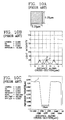
- FIGS. 1A, 1B and 1C are a layout view of patterns, a profile of light intensity, and a photoresist profile, respectively, when a conventional i-line chromium (Cr) mask is used.
- a simulation is performed with an i-line (365nm), an NA (numerical aperture) of 0.57, and a coherency of 0.6.
- a 0.35 ⁇ m ⁇ 0.33 ⁇ m contact hole which is 0.1 ⁇ m smaller than the minimum size resolvable with the i-line, is not opened in a simulation performed by a simulation tool.
- a Levenson phase shift mask is used.
- the Levenson mask relies on a phase-shift which enables exposure of a pattern of a desired size by utilizing light interference or partial light interference.
- a half-tone phase shift mask utilizes the principle that the transmissivity of a light-shielding portion is greater than zero and the other portion is phase-shifted, such that image definition is enhanced by destructive interference between light diffracted in the two adjacent transmitting zones.
- FIGS. 2A, 2B and 2C are, respectively, a layout view of patterns, a profile of light intensity, and a profile of a photoresist when a conventional half-tone phase shift mask is used.
- the transmissivity of the light blocking portion is 8% and the phase shift is 180° in the half-tone phase shift mask.
- a simulation is then performed with the following conditions: an i-line (365nm), an NA of 0.57, and a coherency of 0.6.
- a 0.38 ⁇ mx0.26 ⁇ m contact hole is simulated. In the simulation, the light intensity is weak and, using a commercially available photoresist, the contact hole is not opened.
- k 1 is generally smaller in an L/S pair than in a contact hole (for example, 0.55 for the L/S pair and 0.65 for the contact hole). Improvement for L/S pairs is easier than for contact holes.
- the contact hole is always printed to be larger on a wafer than the L/S pair, thus decreasing the layer-to-layer overlay tolerance.
- FIGS. 3A and 3B illustrate layer-to-layer overlay tolerances.
- FIG. 3A is a layout view of patterns in a computer-aided design
- FIG. 3B illustrates a photoresist image on a wafer.
- An object of the present invention is to provide a method for forming a fine pattern of a semiconductor device which can increase resolution, by using resolution enhancement with extremely small dummy lines.
- a method for optically forming a fine pattern of a semiconductor device which can improve resolution by adding a dummy pattern below a resolution limit of the imaging system to a main pattern on a mask.
- the main pattern and the dummy pattern are of the same tone.
- a half-tone phase shift mask may be used as the mask.
- the dummy pattern is preferably less than or equal to 0.42 ⁇ m and 0.3 ⁇ m when the i-line and the deep ultraviolet are used as a light source, respectively, a size that can avoid exposure of the light source.
- the main pattern of the mask is polygonal.
- a fine pattern is formed by using a curved pattern into which the polygonal main pattern is transferred onto the mask.
- the dummy patterns of the main pattern are formed in one direction or in a cross pattern. Further, the dummy patterns may be formed to connect all the sides of the main patterns.
- the dummy pattern is constituted by at least one pair.
- the pair of dummy patterns may be formed symmetrical with respect to the main pattern.
- the pair of dummy patterns are arranged in a cross pattern, centering on the main pattern.
- Each of the pair of dummy patterns may be formed at the waist of the main pattern.
- Each dummy pattern is preferably formed at the waist of the main pattern, to be inclined with respect to the main pattern. It is preferable that the dummy pattern is inclined at an angle range of 0-180° with respect to the longitudinal axis of the main pattern. More preferably, the dummy pattern is inclined at 90° with the main pattern.
- the dummy patterns are formed close to the main pattern or apart from the main pattern by a predetermined distance.
- an optical proximity effect is corrected and resolution is improved by forming a dummy pattern of a line or space of the resolution limit or below to a main pattern on a mask.
- FIGS. 4A-4C and 5A & 5B relate to a first embodiment of the present invention.
- FIGS. 4A, 4B and 4C are a layout view of patterns, a profile of light intensity, and a photoresist profile, when the i-line mask according to a first embodiment of the present invention is used.
- a simulation was performed for an i-line (365nm), an NA of 0.57 and a coherency of 0.6.
- 0.1 ⁇ m dummy spaces are used, and their size can be optimized in a range of 0.06-0.18 ⁇ m.
- a 0.35 ⁇ m ⁇ 0.33 ⁇ m contact hole smaller than the minimum size resolvable with the i-line, is observed to be opened by the addition of these dummy spaces to the patterns in the mask.
- the dummy spaces may be formed either in one direction or in a cross pattern with respect to the main pattern.
- the mask may moreover be of a positive tone or a negative tone. Whether dummy lines or dummy spaces are formed depends on the tone of the mask.
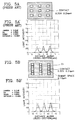
- FIGS. 5A & 5A' and 5B & 5B' illustrate, respectively, a conventional deep-ultraviolet mask, a profile of light intensity obtained therewith, a deep-ultraviolet mask according to the first embodiment of the present invention, and a profile of light intensity obtained therewith, respectively.
- a simulation in which a 0.2 ⁇ m ⁇ 0.24 ⁇ m contact hole, smaller than the minimum size resolvable with the Deep-ultraviolet (248nm) is simulated
- light intensity is increased without a phase shift by formation of 0.1 ⁇ m-wide dummy spaces in the case of the embodiment of the present invention, thus obtaining the same effect as that of a phase shift mask (see FIG. 5B').
- the conditions of the simulation are an NA of 0.5 and a coherency of 0.6.
- light intensity is increased by adding dummy spaces to main pattern on the mask, using either a i-line or a Deep-ultraviolet light source, thereby obtaining the same effect as that of a phase shift mask.
- FIGS. 6A, 6B and 6C are, respectively, a layout view of patterns, a profile of light intensity, and a photoresist profile, when a half-tone phase shift mask according to a second embodiment of the present invention is used.
- the transmissivity of the light blocking portion is 8% and the phase shift is 180°.
- a simulation was performed for an i-line (365nm), an NA of 0.57, and a coherency of 0.6.
- light intensity of the half-tone phase shift mask is increased as shown in FIG. 6B, as compared with the light intensity of the conventional half-tone phase shift mask as shown in FIGS.
- the half-tone phase shift mask may be of a negative tone or a positive tone.
- the i-line used in the embodiment can be replaced with any light source currently used for lithography including a deep-ultraviolet or argon-fluorin (193nm) light source.
- FIGS. 7A and 7B illustrate changes in a contact hole according to the energy of a light source.
- a 0.25 ⁇ m contact hole can be opened by adjusting the energy.
- FIGS. 8A, 8B and 8C are views for explaining methods for forming dummy spaces on the half-tone phase shift mask according to the second embodiment of the present invention.
- the dummy spaces are added to the contact hole at a half height thereof in FIG. 8A, to both edges of the contact hole in FIG. 8B, or to the four sides of the contact hole, thus connecting contact holes, as in FIG. 8C.
- a side lobe is reduced and the light intensity is increased, by addition of dummy spaces to a pattern of the half-tone phase shift mask such as, for example, a contact hole.
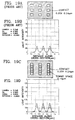
- FIGS. 9A-9C through FIGS. 11A-11C are, respectively, pattern layout views, light intensity profiles in aerial images and the final photoresist profiles of, respectively, the conventional mask, the conventional half-tone phase shift mask, and a mask according to a third embodiment of the present invention. Simulations are performed for an i-line (365nm), an NA of 0.57, and a coherency of 0.6.
- a 0.36 ⁇ m photoresist image can be obtained by a 0.4 ⁇ m ⁇ 0.4 ⁇ m contact hole in the layout of the conventional mask.
- a 0.36 ⁇ m photoresist image can be obtained by a 0.35 ⁇ m ⁇ 0.35 ⁇ m contact hole in the layout of the conventional half-tone phase shift mask.
- a contact hole of a size up to 0.28 ⁇ m can be printed on a photoresist by adding 0.1 ⁇ m ⁇ 0.14 ⁇ m dummy spaces too small to be resolved with an i-line (365nm), an NA of 0.57 and a coherency of 0.6, to a 0.34 ⁇ m ⁇ 0.22 ⁇ m rectangular contact hole on the mask.
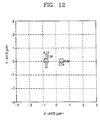
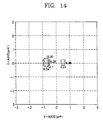
- FIGS. 12-15 illustrate the results of simulations of conventional mask patterns and mask patterns according to the third embodiment of the present invention, for an i-line (365nm) and an NA of 0.5.
- the size of pattern of the conventional mask is 0.24 ⁇ m ⁇ 0.24 ⁇ m, and a 0.12 ⁇ m ⁇ 0.3 ⁇ m dummy pattern is added to the upper and lower sides of a pattern in the mask according to the third embodiment.
- a 0.2 ⁇ m ⁇ 0.3 ⁇ m contact hole is formed with increased exposure in the embodiment of the present invention, while no contact hole is formed with the conventional mask.
- a 0.24 ⁇ m ⁇ 0.26 ⁇ m conventional mask pattern is compared with a 0.24 ⁇ m ⁇ 0.6 ⁇ m mask pattern having very small, i.e., 0.1 ⁇ m-0.26 ⁇ m, dummy patterns added thereto, in accordance with the third embodiment of the invention.
- a 0.3 ⁇ m-0.4 ⁇ m contact hole is obtained while for the conventional mask there is no trace of a contact hole.
- FIGS. 16A, 16B and 16C illustrate, respectively, a layout view of patterns, a profile of light intensity in an aerial image, and a photoresist profile when a mask according to a fourth embodiment of the present invention is used.
- 0.1 ⁇ m ⁇ 0.14 ⁇ m dummy patterns are added to a 0.22 ⁇ m ⁇ 0.38 ⁇ m rectangular contact pattern on a conventional half-tone phase shift mask.
- a contact hole can be formed with a small exposure.
- the conventional half-tone phase shift mask exhibits a low light intensity, denoted by reference numeral 6, in an aerial image, as shown in FIG.
- FIGS. 17A-17F illustrate characteristics compared for the conventional half-tone phase shift mask and for a mask according to the second embodiment of the present invention.
- FIGS. 17A, 17B and 17C show the characteristics of the conventional half-tone phase shift mask
- FIGS. 17D, 17E and 17F show the characteristics of the mask according to the second embodiment of the present invention. Simulations are performed for an i-line and an NA of 0.57. A contact hole is not opened with the conventional half-tone phase shift mask, while a contact hole of a size up to 0.3 ⁇ m is opened in use of the mask according to the second embodiment.
- FIGS. 18A-18F illustrate the results of simulations for patterns of a conventional mask and patterns of a mask according to the first embodiment of the present invention, with an i-line (365nm) and an NA of 0.57.
- FIGS. 18A, 18B and 18C show, respectively, a layout view of patterns, a profile of light intensity in an aerial image, and a photoresist profile, when a conventional mask having a 0.35 ⁇ m ⁇ 0.33 ⁇ m contact hole is used.
- 18D, 18E and 18F show, respectively, a layout view of patterns, a profile of light intensity in an aerial image, and a photoresist profile when a mask of a 0.35 ⁇ m ⁇ 0.33 ⁇ m contact hole having 0.1 ⁇ m-wide dummy spaces added thereto, according to the first embodiment of the present invention, is used.
- An aerial image and a photoresist image of excellent characteristics can be obtained reliably with the mask of the first embodiment, in comparison with the conventional mask.
- FIGS. 19A & 19B and FIGS. 19C & 19D illustrate the results of simulations of conventional mask patterns and patterns of the mask according to the first embodiment, respectively, for a deep-ultraviolet light (246nm) and an NA value of 0.5.
- the simulations are intended to allow observation of their effects for a 0.2 ⁇ m ⁇ 0.24 ⁇ m contact hole.
- the width of dummy spaces in accordance with the first embodiment is 0.1 ⁇ m. From the comparison of the light intensity profiles shown in FIGS. 19B and 19D, it can be seen that the light intensity in an aerial image of the present invention is much higher than that of the conventional mask.
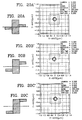
- FIGS. 20A-20C and FIGS 20A'-20C' illustrate pattern layouts and photoresist profiles of a mask according to a fifth embodiment of the present invention.
- methods for adding asymmetrically narrow dummy patterns dummy spaces for a mask of a negative tone and dummy lines for a mask of a positive tone
- a rectangular pattern for a contact hole are shown.
- the degree of distortion of the contact varies with the asymmetrical arrangement of the dummy patterns.
- formation of a small contact hole is still possible.
- the contact hole can also be formed by adding a dummy pattern inclined with respect to the longitudinal axis of the main pattern, though this is not shown here.
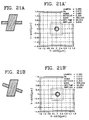
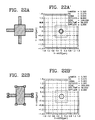
- FIGS. 22A & 22B and FIGS. 22A' and 22B' illustrate pattern layouts and photoresist profiles of a mask according to a seventh embodiment of the present invention.
- dummy patterns are added to a square or rectangular main contact pattern in a cross formation.
- further small dummy patterns are added to the corners of each pattern. An optical proximity effect is improved thereby. It is also possible in these cases to form a small contact hole.
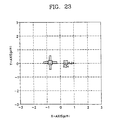
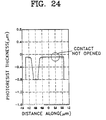
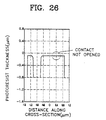
- FIGS. 23-26 illustrate the results of simulations of conventional mask patterns and patterns of the mask having dummy patterns of different lengths and widths, according to the seventh embodiment of the present invention.
- FIGS. 24 and 26 show the results for the photoresist profiles shown in FIGS. 23 and 25.
- a contact hole is not formed by the conventional mask pattern, as denoted by a dotted line, while a contact hole is formed by the mask pattern of the embodiment of the present invention.
- FIG. 27 illustrates conventional mask patterns and layout of mask patterns employed in designing.
- Reference numerals 11 and 14 denote patterns most widely used in a conventional mask pattern layout.
- Reference numeral 15 denotes a pattern having serifs added thereto to form a better contact and to have a large process tolerance.
- Reference numeral 12 denotes an actual shape into which a rectangular pattern in a design is transferred onto a mask by an electron beam or a laser beam.
- Reference numeral 13 denotes an actual shape into which a square pattern is transferred onto a mask.
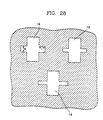
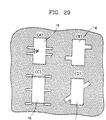
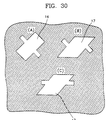
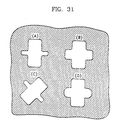
- FIGS. 28-31 illustrate mask patterns according to the third through sixth embodiments and layouts of mask patterns employed in designing.
- each pair of dummy patterns of different length 1 and width w are added to the waist of a main pattern 16, according to the third and fourth embodiments.
- main pattern 16 with dummy patterns added thereto is rotated at an angle between 0° and 360° with respect to the longitudinal axis of the main pattern.
- a pair of dummy patterns is added to a parallelogram main pattern 17, diagonally, in either an aligned or a misaligned manner.
- the angles of the parallelogram and the dummy patterns are an angle between 0° and 180° with respect to the longitudinal axis of the main pattern.
- FIG. 31 illustrate actual shapes of angular patterns in a design, after formation of mask patterns, for the third through fifth embodiments of the present invention.
- the corners of a main pattern become less rounded after formation of the actual mask patterns by addition of dummy patterns to the main pattern.
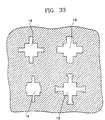
- FIGS. 32A and 32B-32D are photographs of actual mask patterns formed both by a conventional method and by methods according to the present invention.
- FIG. 32A shows an actual mask pattern having rounded corners for a pattern designed to be rectangular.
- FIGS. 32B, 32C and 32D show actual mask patterns according to embodiments of the present invention. The edges of the patterns are rectangular up to the full configuration of a mask design.
- FIGS. 32C and 32D show the configurations of contacts formed with a half-tone phase shift material, e.g., MoSiON.
- FIGS. 32A and 32B show the configurations of contacts formed with a conventional chromium mask pattern.
- FIGS. 33, 34 and 35 illustrate mask patterns according to the seventh embodiment of the present invention and layouts of mask patterns.
- dummy patterns of different configuration, lengths 1, and widths w are arranged, around in the centre main patterns 16, 18 and 19.
- such patterns may be formed even by a separate arrangement of the dummy patterns, apart from the main patterns themselves. Even though dummy patterns are arranged apart from main patterns, patterns can be formed.
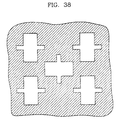
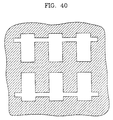
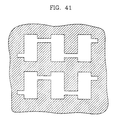
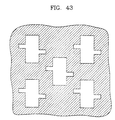
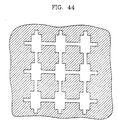
- FIGS. 36-44, and FIGS. 45A-45C illustrate mask patterns and layouts of mask patterns, according to the first through seventh embodiments of the present invention.
- dummy patterns are arranged to be connected to each other, or patterns of the same configuration can be arranged to be spaced by a distance g.
- g may be reduced to zero. Since formation of a pattern depends on the wavelength of the light source, the NA value of the exposure device and the process constant k 1 , as noted in Equation (1), designing a pattern in accordance with these conditions may allow pattern formation when g ⁇ 0.
- patterns of one embodiment in accordance with the third and fourth embodiments of the invention are arranged in a zigzag pattern.
- FIG. 38 shows the same layout of patterns as that in FIG. 37 except that one pattern is placed horizontally.
- dummy patterns are placed in the upper parts of rectangular main patterns, in accordance with the second through fourth embodiments of the invention.
- dummy patterns are placed in the upper parts of a first group of main patterns and in the lower parts of a second group of main patterns opposite to the first group, in accordance with the second through fourth embodiments of the invention.
- dummy patterns are arranged asymmetrically with respect to main patterns regularly or continuously, in accordance with the fifth embodiment of the invention.
- FIG. 44 shows a checkered layout having dummy lines arranged in a cross pattern, in accordance with the seventh embodiment of the invention.
- a hybrid arrangement is available by arranging the kind of contact patterns or a number of kinds of contact pattern, of the type shown in FIG. 45C in the cell array area, and by arranging rectangular and square patterns as shown in FIG. 45B in the peripheral area.
- a regular square or a rectangular main pattern, and a dummy pattern at a right angle with respect to the longitudinal axis of the main pattern are shown.
- the present invention can be applied to a case where a main pattern is parallelogram-shaped, and where a dummy pattern is added to the main pattern diagonally with respect to the longitudinal axis of the main pattern.
- a contact hole as small as is desired can be formed by arranging dummy spaces for a negative-toned mask or dummy lines for a positive-toned mask in a variety of shapes, thus improving an aerial image.
- the present invention can be widely applied to 256Mb and 1Gb DRAMs as well as to 64Mb DRAMs, to improve resolution.
Landscapes
- Physics & Mathematics (AREA)
- General Physics & Mathematics (AREA)
- Preparing Plates And Mask In Photomechanical Process (AREA)
- Exposure And Positioning Against Photoresist Photosensitive Materials (AREA)
- Exposure Of Semiconductors, Excluding Electron Or Ion Beam Exposure (AREA)
Applications Claiming Priority (2)
| Application Number | Priority Date | Filing Date | Title |
|---|---|---|---|
| KR1019950030677A KR0161437B1 (ko) | 1995-09-19 | 1995-09-19 | 반도체장치의 미세패턴 형성방법 |
| KR9530677 | 1995-09-19 |
Publications (2)
| Publication Number | Publication Date |
|---|---|
| EP0770926A2 true EP0770926A2 (fr) | 1997-05-02 |
| EP0770926A3 EP0770926A3 (fr) | 1997-12-29 |
Family
ID=19427194
Family Applications (1)
| Application Number | Title | Priority Date | Filing Date |
|---|---|---|---|
| EP96302314A Withdrawn EP0770926A3 (fr) | 1995-09-19 | 1996-04-01 | Procédé pour la formation des structures fines d'un dispositif semiconducteur |
Country Status (5)
| Country | Link |
|---|---|
| EP (1) | EP0770926A3 (fr) |
| JP (1) | JPH0982635A (fr) |
| KR (1) | KR0161437B1 (fr) |
| CN (1) | CN1146071A (fr) |
| TW (1) | TW308704B (fr) |
Cited By (9)
| Publication number | Priority date | Publication date | Assignee | Title |
|---|---|---|---|---|
| EP1034457A4 (fr) * | 1997-11-24 | 2001-05-02 | Asml Masktools Bv | Procede de reglage des bords de details fins a l'aide d'un masque optique en demi-teintes |
| WO2002012959A1 (fr) * | 2000-08-09 | 2002-02-14 | Infineon Technologies Ag | Masque photolithographique |
| WO2002001293A3 (fr) * | 2000-06-26 | 2002-08-15 | Infineon Technologies Corp | Masque photographique permettant d'augmenter le rapport hauteur/largeur de l'image tout en allegeant les exigences relatives a la fabrication du masque |
| EP1241525A3 (fr) * | 2001-03-14 | 2003-01-08 | ASML Masktools Netherlands B.V. | Correction de l'effet de proximité optique par l'utilisation de motifs auxiliaires infra-résolution disposés en barreaux d'échelle |
| WO2003021353A1 (fr) | 2001-08-31 | 2003-03-13 | Infineon Technologies Ag | Masque photolithographique |
| EP1465009A3 (fr) * | 2003-04-02 | 2006-01-11 | Texas Instruments Incorporated | Masques photolithographiques avec motifs auxiliaires sous forme de chenaux |
| US7183022B2 (en) | 2002-05-15 | 2007-02-27 | Infineon Technolgies Ag | Method for producing a mask set for lithography including at least one mask and methods for imaging structures of a predetermined layout into a common exposure plane |
| US7355673B2 (en) | 2003-06-30 | 2008-04-08 | Asml Masktools B.V. | Method, program product and apparatus of simultaneous optimization for NA-Sigma exposure settings and scattering bars OPC using a device layout |
| US7465522B2 (en) | 2001-08-31 | 2008-12-16 | Infineon Technologies Ag | Photolithographic mask having half tone main features and perpendicular half tone assist features |
Families Citing this family (12)
| Publication number | Priority date | Publication date | Assignee | Title |
|---|---|---|---|---|
| KR100510455B1 (ko) * | 1998-02-12 | 2005-10-24 | 삼성전자주식회사 | 고립패턴형성용마스크패턴과그제조방법및그를이용한고립패턴형성방법 |
| KR20000000592A (ko) * | 1998-06-01 | 2000-01-15 | 김영환 | 전자빔 리소그래피의 스텐실 마스크 |
| KR20010046321A (ko) * | 1999-11-11 | 2001-06-15 | 황인길 | 반도체 소자 제조 공정을 위한 테스트 패턴 |
| KR100829367B1 (ko) * | 2002-12-17 | 2008-05-13 | 동부일렉트로닉스 주식회사 | 반도체 소자의 트렌치 제조 방법 |
| KR100914281B1 (ko) * | 2006-08-25 | 2009-08-27 | 주식회사 하이닉스반도체 | 프랙처링 바이어스를 고려한 마스크 레이아웃 제작 방법 |
| KR100780775B1 (ko) | 2006-11-24 | 2007-11-30 | 주식회사 하이닉스반도체 | 자기 조립 더미 패턴이 삽입된 회로 레이아웃을 이용한반도체 소자 제조 방법 |
| JP5163016B2 (ja) * | 2007-08-30 | 2013-03-13 | 凸版印刷株式会社 | カラーフィルタの製造方法とフォトマスク |
| CN102998895B (zh) * | 2011-09-13 | 2014-05-14 | 华邦电子股份有限公司 | 光学邻近修正掩膜 |
| CN105700290B (zh) * | 2014-11-27 | 2020-02-07 | 中芯国际集成电路制造(上海)有限公司 | 光罩的制作方法 |
| CN107978598B (zh) * | 2016-10-24 | 2020-07-07 | 中芯国际集成电路制造(上海)有限公司 | 一种标准单元的版图结构及电子装置 |
| US10495979B1 (en) * | 2019-02-19 | 2019-12-03 | Applied Materials, Inc. | Half tone scheme for maskless lithography |
| US10571809B1 (en) * | 2019-02-19 | 2020-02-25 | Applied Materials, Inc. | Half tone scheme for maskless lithography |
Family Cites Families (9)
| Publication number | Priority date | Publication date | Assignee | Title |
|---|---|---|---|---|
| JPS58200238A (ja) * | 1982-05-19 | 1983-11-21 | Toshiba Corp | フオトマスク |
| US5242770A (en) * | 1992-01-16 | 1993-09-07 | Microunity Systems Engineering, Inc. | Mask for photolithography |
| JPH05224397A (ja) * | 1992-02-17 | 1993-09-03 | Fuji Xerox Co Ltd | 半導体装置の製造方法 |
| JP3411613B2 (ja) * | 1993-03-26 | 2003-06-03 | Hoya株式会社 | ハーフトーン型位相シフトマスク |
| JP2661529B2 (ja) * | 1993-11-30 | 1997-10-08 | 日本電気株式会社 | 位相シフトマスク |
| KR970009822B1 (ko) * | 1994-02-03 | 1997-06-18 | 현대전자산업 주식회사 | 하프톤형 위상반전 마스크 및 그 제조방법 |
| KR0138297B1 (ko) * | 1994-02-07 | 1998-06-01 | 김광호 | 포토 마스크 및 그 제조 방법 |
| JPH07253652A (ja) * | 1994-03-16 | 1995-10-03 | Fujitsu Ltd | ハーフ・トーン位相シフト・マスク |
| US5414580A (en) * | 1994-05-13 | 1995-05-09 | International Business Machines Corporation | Magnetic storage system using thin film magnetic recording heads using phase-shifting mask |
-
1995
- 1995-09-19 KR KR1019950030677A patent/KR0161437B1/ko not_active Expired - Fee Related
-
1996
- 1996-03-27 TW TW085103686A patent/TW308704B/zh active
- 1996-03-29 CN CN96103946A patent/CN1146071A/zh active Pending
- 1996-04-01 EP EP96302314A patent/EP0770926A3/fr not_active Withdrawn
- 1996-06-06 JP JP8168435A patent/JPH0982635A/ja active Pending
Cited By (11)
| Publication number | Priority date | Publication date | Assignee | Title |
|---|---|---|---|---|
| EP1034457A4 (fr) * | 1997-11-24 | 2001-05-02 | Asml Masktools Bv | Procede de reglage des bords de details fins a l'aide d'un masque optique en demi-teintes |
| KR100616590B1 (ko) * | 1997-11-24 | 2006-08-25 | 에이에스엠엘 마스크툴즈 비.브이. | 광학적 하프톤 마스크를 이용하여 미세한 피처 에지를 튜닝하는 방법 |
| WO2002001293A3 (fr) * | 2000-06-26 | 2002-08-15 | Infineon Technologies Corp | Masque photographique permettant d'augmenter le rapport hauteur/largeur de l'image tout en allegeant les exigences relatives a la fabrication du masque |
| WO2002012959A1 (fr) * | 2000-08-09 | 2002-02-14 | Infineon Technologies Ag | Masque photolithographique |
| EP1241525A3 (fr) * | 2001-03-14 | 2003-01-08 | ASML Masktools Netherlands B.V. | Correction de l'effet de proximité optique par l'utilisation de motifs auxiliaires infra-résolution disposés en barreaux d'échelle |
| US6881523B2 (en) | 2001-03-14 | 2005-04-19 | Asml Masktools B.V. | Optical proximity correction method utilizing ruled ladder bars as sub-resolution assist features |
| WO2003021353A1 (fr) | 2001-08-31 | 2003-03-13 | Infineon Technologies Ag | Masque photolithographique |
| US7465522B2 (en) | 2001-08-31 | 2008-12-16 | Infineon Technologies Ag | Photolithographic mask having half tone main features and perpendicular half tone assist features |
| US7183022B2 (en) | 2002-05-15 | 2007-02-27 | Infineon Technolgies Ag | Method for producing a mask set for lithography including at least one mask and methods for imaging structures of a predetermined layout into a common exposure plane |
| EP1465009A3 (fr) * | 2003-04-02 | 2006-01-11 | Texas Instruments Incorporated | Masques photolithographiques avec motifs auxiliaires sous forme de chenaux |
| US7355673B2 (en) | 2003-06-30 | 2008-04-08 | Asml Masktools B.V. | Method, program product and apparatus of simultaneous optimization for NA-Sigma exposure settings and scattering bars OPC using a device layout |
Also Published As
| Publication number | Publication date |
|---|---|
| CN1146071A (zh) | 1997-03-26 |
| JPH0982635A (ja) | 1997-03-28 |
| KR970018401A (ko) | 1997-04-30 |
| KR0161437B1 (ko) | 1999-02-01 |
| TW308704B (fr) | 1997-06-21 |
| EP0770926A3 (fr) | 1997-12-29 |
Similar Documents
| Publication | Publication Date | Title |
|---|---|---|
| EP0770926A2 (fr) | Procédé pour la formation des structures fines d'un dispositif semiconducteur | |
| US6355382B1 (en) | Photomask and exposure method using a photomask | |
| US6335130B1 (en) | System and method of providing optical proximity correction for features using phase-shifted halftone transparent/semi-transparent features | |
| US6004699A (en) | Photomask used for projection exposure with phase shifted auxiliary pattern | |
| KR101544324B1 (ko) | 표시 장치 제조용 포토마스크 및 패턴 전사 방법 | |
| JP3119217B2 (ja) | フォトマスクおよびフォトマスクを使用した露光方法 | |
| EP1408373A1 (fr) | Masque photolithographique, son procede de production et procede de formation de motif au moyen dudit masque | |
| US20020177050A1 (en) | Phase shift mask and design method therefor | |
| US20090042108A1 (en) | Pattern forming method and mask | |
| US7771892B2 (en) | Double exposure method and photomask for same | |
| US6800401B2 (en) | Method for phase shift mask design, fabrication, and use | |
| JP2002351052A (ja) | 光近接効果の補正のためのマスクとその製造方法 | |
| US20120058421A1 (en) | Phase shift mask and method for manufacturing the same, and method for manufacturing integrated circuit | |
| US6709794B2 (en) | Exposure method based on multiple exposure process | |
| US7160651B2 (en) | Manufacturable chromeless alternating phase shift mask structure with phase grating | |
| KR100731233B1 (ko) | 마스크 패턴 데이터 생성 방법, 포토마스크의 제조 방법,및 반도체 디바이스의 제조 방법 | |
| JPH0695353A (ja) | 位相シフトマスクを用いたパターン形成方法 | |
| KR20060091246A (ko) | 포토마스크, 마스크 패턴의 생성 방법, 및 반도체 장치의제조 방법 | |
| US8617797B2 (en) | Pattern forming method, semiconductor device manufacturing method and phase shift photomask having dummy gate patterns | |
| JP5068357B2 (ja) | 半導体装置の製造方法、フォトマスクのパターン設計方法およびフォトマスクの製造方法 | |
| JP2002287324A (ja) | マスク及びそれを用いたホールパターン形成方法 | |
| US7175941B2 (en) | Phase shift assignments for alternate PSM | |
| JP3322007B2 (ja) | ハーフトーン方式位相シフトマスク及びレジスト露光方法 | |
| JPH0844039A (ja) | ハーフトーン方式位相シフトマスク及びレジスト露光方法 | |
| US6617081B2 (en) | Method for improving process window in semi-dense area by using phase shifter |
Legal Events
| Date | Code | Title | Description |
|---|---|---|---|
| PUAI | Public reference made under article 153(3) epc to a published international application that has entered the european phase |
Free format text: ORIGINAL CODE: 0009012 |
|
| AK | Designated contracting states |
Kind code of ref document: A2 Designated state(s): DE FR GB IT NL |
|
| PUAL | Search report despatched |
Free format text: ORIGINAL CODE: 0009013 |
|
| 17P | Request for examination filed |
Effective date: 19971001 |
|
| AK | Designated contracting states |
Kind code of ref document: A3 Designated state(s): DE FR GB IT NL |
|
| 17Q | First examination report despatched |
Effective date: 19990119 |
|
| STAA | Information on the status of an ep patent application or granted ep patent |
Free format text: STATUS: THE APPLICATION IS DEEMED TO BE WITHDRAWN |
|
| 18D | Application deemed to be withdrawn |
Effective date: 19990601 |