EP0771820A1 - Ziegler-Natta geträgerte Katalysatore für Polyolefin-Herstellung - Google Patents
Ziegler-Natta geträgerte Katalysatore für Polyolefin-Herstellung Download PDFInfo
- Publication number
- EP0771820A1 EP0771820A1 EP95117325A EP95117325A EP0771820A1 EP 0771820 A1 EP0771820 A1 EP 0771820A1 EP 95117325 A EP95117325 A EP 95117325A EP 95117325 A EP95117325 A EP 95117325A EP 0771820 A1 EP0771820 A1 EP 0771820A1
- Authority
- EP
- European Patent Office
- Prior art keywords
- precursor composition
- compound
- precursor
- transition metal
- electron donor
- Prior art date
- Legal status (The legal status is an assumption and is not a legal conclusion. Google has not performed a legal analysis and makes no representation as to the accuracy of the status listed.)
- Ceased
Links
- 239000003054 catalyst Substances 0.000 title claims abstract description 65
- 238000004519 manufacturing process Methods 0.000 title claims abstract description 10
- 229920000098 polyolefin Polymers 0.000 title abstract description 5
- 239000000203 mixture Substances 0.000 claims abstract description 137
- 239000002243 precursor Substances 0.000 claims abstract description 100
- 239000000463 material Substances 0.000 claims abstract description 92
- 238000000034 method Methods 0.000 claims abstract description 41
- -1 polyethylene Polymers 0.000 claims abstract description 34
- 230000008569 process Effects 0.000 claims abstract description 23
- 229920001577 copolymer Polymers 0.000 claims abstract description 4
- 150000001875 compounds Chemical class 0.000 claims description 83
- 239000011777 magnesium Substances 0.000 claims description 36
- 239000012190 activator Substances 0.000 claims description 35
- 239000011148 porous material Substances 0.000 claims description 34
- 150000003623 transition metal compounds Chemical class 0.000 claims description 34
- 239000002002 slurry Substances 0.000 claims description 31
- 239000012018 catalyst precursor Substances 0.000 claims description 27
- 150000002681 magnesium compounds Chemical class 0.000 claims description 24
- 238000006116 polymerization reaction Methods 0.000 claims description 24
- 239000010936 titanium Substances 0.000 claims description 23
- 229910052723 transition metal Inorganic materials 0.000 claims description 21
- 150000003624 transition metals Chemical class 0.000 claims description 21
- FYYHWMGAXLPEAU-UHFFFAOYSA-N Magnesium Chemical compound [Mg] FYYHWMGAXLPEAU-UHFFFAOYSA-N 0.000 claims description 19
- 229910052749 magnesium Inorganic materials 0.000 claims description 19
- 239000002904 solvent Substances 0.000 claims description 19
- VGGSQFUCUMXWEO-UHFFFAOYSA-N Ethene Chemical compound C=C VGGSQFUCUMXWEO-UHFFFAOYSA-N 0.000 claims description 13
- 239000005977 Ethylene Substances 0.000 claims description 13
- 229910052719 titanium Inorganic materials 0.000 claims description 12
- 239000004215 Carbon black (E152) Substances 0.000 claims description 10
- RTAQQCXQSZGOHL-UHFFFAOYSA-N Titanium Chemical compound [Ti] RTAQQCXQSZGOHL-UHFFFAOYSA-N 0.000 claims description 10
- 229930195733 hydrocarbon Natural products 0.000 claims description 10
- 229910052720 vanadium Inorganic materials 0.000 claims description 9
- 239000007788 liquid Substances 0.000 claims description 8
- QCWXUUIWCKQGHC-UHFFFAOYSA-N Zirconium Chemical compound [Zr] QCWXUUIWCKQGHC-UHFFFAOYSA-N 0.000 claims description 7
- 125000005907 alkyl ester group Chemical group 0.000 claims description 7
- 229910052794 bromium Inorganic materials 0.000 claims description 7
- 229910052801 chlorine Inorganic materials 0.000 claims description 7
- 150000004292 cyclic ethers Chemical class 0.000 claims description 7
- 229910052735 hafnium Inorganic materials 0.000 claims description 7
- VBJZVLUMGGDVMO-UHFFFAOYSA-N hafnium atom Chemical compound [Hf] VBJZVLUMGGDVMO-UHFFFAOYSA-N 0.000 claims description 7
- 229910052740 iodine Inorganic materials 0.000 claims description 7
- GPPXJZIENCGNKB-UHFFFAOYSA-N vanadium Chemical compound [V]#[V] GPPXJZIENCGNKB-UHFFFAOYSA-N 0.000 claims description 7
- 229910052726 zirconium Inorganic materials 0.000 claims description 7
- 230000015572 biosynthetic process Effects 0.000 claims description 6
- 150000002430 hydrocarbons Chemical class 0.000 claims description 6
- 125000001931 aliphatic group Chemical group 0.000 claims description 5
- 239000003795 chemical substances by application Substances 0.000 claims description 5
- 150000002894 organic compounds Chemical class 0.000 claims description 5
- 125000004432 carbon atom Chemical group C* 0.000 claims description 4
- 238000004260 weight control Methods 0.000 claims description 4
- 230000003213 activating effect Effects 0.000 claims description 3
- 239000004711 α-olefin Substances 0.000 claims description 3
- 239000011541 reaction mixture Substances 0.000 claims description 2
- 229920005638 polyethylene monopolymer Polymers 0.000 claims 1
- 229920000573 polyethylene Polymers 0.000 abstract description 4
- 239000004698 Polyethylene Substances 0.000 abstract description 3
- 230000000694 effects Effects 0.000 abstract description 3
- 239000000243 solution Substances 0.000 description 40
- 238000005470 impregnation Methods 0.000 description 28
- WYURNTSHIVDZCO-UHFFFAOYSA-N Tetrahydrofuran Chemical compound C1CCOC1 WYURNTSHIVDZCO-UHFFFAOYSA-N 0.000 description 16
- IJGRMHOSHXDMSA-UHFFFAOYSA-N Atomic nitrogen Chemical compound N#N IJGRMHOSHXDMSA-UHFFFAOYSA-N 0.000 description 14
- TWRXJAOTZQYOKJ-UHFFFAOYSA-L Magnesium chloride Chemical compound [Mg+2].[Cl-].[Cl-] TWRXJAOTZQYOKJ-UHFFFAOYSA-L 0.000 description 14
- QWTDNUCVQCZILF-UHFFFAOYSA-N isopentane Chemical compound CCC(C)C QWTDNUCVQCZILF-UHFFFAOYSA-N 0.000 description 14
- VYPSYNLAJGMNEJ-UHFFFAOYSA-N Silicium dioxide Chemical compound O=[Si]=O VYPSYNLAJGMNEJ-UHFFFAOYSA-N 0.000 description 13
- 230000004913 activation Effects 0.000 description 12
- 238000001035 drying Methods 0.000 description 11
- 239000002245 particle Substances 0.000 description 10
- 229920000642 polymer Polymers 0.000 description 10
- 238000002360 preparation method Methods 0.000 description 10
- VLKZOEOYAKHREP-UHFFFAOYSA-N n-Hexane Chemical compound CCCCCC VLKZOEOYAKHREP-UHFFFAOYSA-N 0.000 description 9
- AFABGHUZZDYHJO-UHFFFAOYSA-N dimethyl butane Natural products CCCC(C)C AFABGHUZZDYHJO-UHFFFAOYSA-N 0.000 description 7
- 239000007789 gas Substances 0.000 description 7
- 229910001629 magnesium chloride Inorganic materials 0.000 description 7
- 229910052757 nitrogen Inorganic materials 0.000 description 7
- 238000006243 chemical reaction Methods 0.000 description 6
- 239000012530 fluid Substances 0.000 description 6
- 239000000377 silicon dioxide Substances 0.000 description 6
- 238000004458 analytical method Methods 0.000 description 5
- 230000000052 comparative effect Effects 0.000 description 5
- 239000007787 solid Substances 0.000 description 5
- YLQBMQCUIZJEEH-UHFFFAOYSA-N tetrahydrofuran Natural products C=1C=COC=1 YLQBMQCUIZJEEH-UHFFFAOYSA-N 0.000 description 5
- VOITXYVAKOUIBA-UHFFFAOYSA-N triethylaluminium Chemical compound CC[Al](CC)CC VOITXYVAKOUIBA-UHFFFAOYSA-N 0.000 description 5
- POILWHVDKZOXJZ-ARJAWSKDSA-M (z)-4-oxopent-2-en-2-olate Chemical compound C\C([O-])=C\C(C)=O POILWHVDKZOXJZ-ARJAWSKDSA-M 0.000 description 4
- 229910052782 aluminium Inorganic materials 0.000 description 4
- 239000012876 carrier material Substances 0.000 description 4
- YNLAOSYQHBDIKW-UHFFFAOYSA-M diethylaluminium chloride Chemical compound CC[Al](Cl)CC YNLAOSYQHBDIKW-UHFFFAOYSA-M 0.000 description 4
- 238000002156 mixing Methods 0.000 description 4
- 239000011347 resin Substances 0.000 description 4
- 229920005989 resin Polymers 0.000 description 4
- UHOVQNZJYSORNB-UHFFFAOYSA-N Benzene Chemical compound C1=CC=CC=C1 UHOVQNZJYSORNB-UHFFFAOYSA-N 0.000 description 3
- XEKOWRVHYACXOJ-UHFFFAOYSA-N Ethyl acetate Chemical compound CCOC(C)=O XEKOWRVHYACXOJ-UHFFFAOYSA-N 0.000 description 3
- 229910010062 TiCl3 Inorganic materials 0.000 description 3
- 239000003153 chemical reaction reagent Substances 0.000 description 3
- 238000003795 desorption Methods 0.000 description 3
- 238000009826 distribution Methods 0.000 description 3
- 238000005243 fluidization Methods 0.000 description 3
- 229910052739 hydrogen Inorganic materials 0.000 description 3
- 239000000843 powder Substances 0.000 description 3
- 238000003756 stirring Methods 0.000 description 3
- YONPGGFAJWQGJC-UHFFFAOYSA-K titanium(iii) chloride Chemical compound Cl[Ti](Cl)Cl YONPGGFAJWQGJC-UHFFFAOYSA-K 0.000 description 3
- RFONJRMUUALMBA-UHFFFAOYSA-N 2-methanidylpropane Chemical compound CC(C)[CH2-] RFONJRMUUALMBA-UHFFFAOYSA-N 0.000 description 2
- CSCPPACGZOOCGX-UHFFFAOYSA-N Acetone Chemical compound CC(C)=O CSCPPACGZOOCGX-UHFFFAOYSA-N 0.000 description 2
- CURLTUGMZLYLDI-UHFFFAOYSA-N Carbon dioxide Chemical compound O=C=O CURLTUGMZLYLDI-UHFFFAOYSA-N 0.000 description 2
- RTZKZFJDLAIYFH-UHFFFAOYSA-N Diethyl ether Chemical compound CCOCC RTZKZFJDLAIYFH-UHFFFAOYSA-N 0.000 description 2
- 229910003865 HfCl4 Inorganic materials 0.000 description 2
- ATUOYWHBWRKTHZ-UHFFFAOYSA-N Propane Chemical compound CCC ATUOYWHBWRKTHZ-UHFFFAOYSA-N 0.000 description 2
- 229910021551 Vanadium(III) chloride Inorganic materials 0.000 description 2
- 229910007928 ZrCl2 Inorganic materials 0.000 description 2
- 239000007825 activation reagent Substances 0.000 description 2
- QVGXLLKOCUKJST-UHFFFAOYSA-N atomic oxygen Chemical compound [O] QVGXLLKOCUKJST-UHFFFAOYSA-N 0.000 description 2
- 230000003197 catalytic effect Effects 0.000 description 2
- 238000002425 crystallisation Methods 0.000 description 2
- 230000008025 crystallization Effects 0.000 description 2
- 239000003085 diluting agent Substances 0.000 description 2
- 238000004090 dissolution Methods 0.000 description 2
- 150000002363 hafnium compounds Chemical class 0.000 description 2
- PDPJQWYGJJBYLF-UHFFFAOYSA-J hafnium tetrachloride Chemical compound Cl[Hf](Cl)(Cl)Cl PDPJQWYGJJBYLF-UHFFFAOYSA-J 0.000 description 2
- 229920001519 homopolymer Polymers 0.000 description 2
- 238000002955 isolation Methods 0.000 description 2
- 238000011068 loading method Methods 0.000 description 2
- 159000000003 magnesium salts Chemical class 0.000 description 2
- TZIHFWKZFHZASV-UHFFFAOYSA-N methyl formate Chemical compound COC=O TZIHFWKZFHZASV-UHFFFAOYSA-N 0.000 description 2
- 239000002480 mineral oil Substances 0.000 description 2
- 235000010446 mineral oil Nutrition 0.000 description 2
- 239000001301 oxygen Substances 0.000 description 2
- 229910052760 oxygen Inorganic materials 0.000 description 2
- 239000011236 particulate material Substances 0.000 description 2
- 150000003254 radicals Chemical class 0.000 description 2
- 229920006395 saturated elastomer Polymers 0.000 description 2
- 229930195734 saturated hydrocarbon Natural products 0.000 description 2
- 239000000126 substance Substances 0.000 description 2
- 150000003609 titanium compounds Chemical class 0.000 description 2
- XJDNKRIXUMDJCW-UHFFFAOYSA-J titanium tetrachloride Chemical compound Cl[Ti](Cl)(Cl)Cl XJDNKRIXUMDJCW-UHFFFAOYSA-J 0.000 description 2
- ORYGRKHDLWYTKX-UHFFFAOYSA-N trihexylalumane Chemical compound CCCCCC[Al](CCCCCC)CCCCCC ORYGRKHDLWYTKX-UHFFFAOYSA-N 0.000 description 2
- HQYCOEXWFMFWLR-UHFFFAOYSA-K vanadium(iii) chloride Chemical compound [Cl-].[Cl-].[Cl-].[V+3] HQYCOEXWFMFWLR-UHFFFAOYSA-K 0.000 description 2
- RYHBNJHYFVUHQT-UHFFFAOYSA-N 1,4-Dioxane Chemical compound C1COCCO1 RYHBNJHYFVUHQT-UHFFFAOYSA-N 0.000 description 1
- BPIUIOXAFBGMNB-UHFFFAOYSA-N 1-hexoxyhexane Chemical compound CCCCCCOCCCCCC BPIUIOXAFBGMNB-UHFFFAOYSA-N 0.000 description 1
- DKPFZGUDAPQIHT-UHFFFAOYSA-N Butyl acetate Natural products CCCCOC(C)=O DKPFZGUDAPQIHT-UHFFFAOYSA-N 0.000 description 1
- UGFAIRIUMAVXCW-UHFFFAOYSA-N Carbon monoxide Chemical compound [O+]#[C-] UGFAIRIUMAVXCW-UHFFFAOYSA-N 0.000 description 1
- UFHFLCQGNIYNRP-UHFFFAOYSA-N Hydrogen Chemical compound [H][H] UFHFLCQGNIYNRP-UHFFFAOYSA-N 0.000 description 1
- 239000002879 Lewis base Substances 0.000 description 1
- 229910018957 MClx Inorganic materials 0.000 description 1
- NTIZESTWPVYFNL-UHFFFAOYSA-N Methyl isobutyl ketone Chemical compound CC(C)CC(C)=O NTIZESTWPVYFNL-UHFFFAOYSA-N 0.000 description 1
- UIHCLUNTQKBZGK-UHFFFAOYSA-N Methyl isobutyl ketone Natural products CCC(C)C(C)=O UIHCLUNTQKBZGK-UHFFFAOYSA-N 0.000 description 1
- 229910003074 TiCl4 Inorganic materials 0.000 description 1
- 229910021552 Vanadium(IV) chloride Inorganic materials 0.000 description 1
- 229910007932 ZrCl4 Inorganic materials 0.000 description 1
- 238000010521 absorption reaction Methods 0.000 description 1
- 239000004480 active ingredient Substances 0.000 description 1
- 150000007933 aliphatic carboxylic acids Chemical class 0.000 description 1
- 150000001338 aliphatic hydrocarbons Chemical class 0.000 description 1
- 150000001336 alkenes Chemical class 0.000 description 1
- HSFWRNGVRCDJHI-UHFFFAOYSA-N alpha-acetylene Natural products C#C HSFWRNGVRCDJHI-UHFFFAOYSA-N 0.000 description 1
- XAGFODPZIPBFFR-UHFFFAOYSA-N aluminium Chemical compound [Al] XAGFODPZIPBFFR-UHFFFAOYSA-N 0.000 description 1
- 238000013459 approach Methods 0.000 description 1
- 239000007864 aqueous solution Substances 0.000 description 1
- 150000004945 aromatic hydrocarbons Chemical class 0.000 description 1
- 238000009835 boiling Methods 0.000 description 1
- 230000005587 bubbling Effects 0.000 description 1
- 239000001273 butane Substances 0.000 description 1
- 229910052799 carbon Inorganic materials 0.000 description 1
- 229910002092 carbon dioxide Inorganic materials 0.000 description 1
- 239000001569 carbon dioxide Substances 0.000 description 1
- 229910002091 carbon monoxide Inorganic materials 0.000 description 1
- 230000015556 catabolic process Effects 0.000 description 1
- 230000008859 change Effects 0.000 description 1
- 238000012512 characterization method Methods 0.000 description 1
- 239000000470 constituent Substances 0.000 description 1
- 125000004122 cyclic group Chemical group 0.000 description 1
- 238000006731 degradation reaction Methods 0.000 description 1
- 230000018044 dehydration Effects 0.000 description 1
- 238000006297 dehydration reaction Methods 0.000 description 1
- JGHYBJVUQGTEEB-UHFFFAOYSA-M dimethylalumanylium;chloride Chemical compound C[Al](C)Cl JGHYBJVUQGTEEB-UHFFFAOYSA-M 0.000 description 1
- 238000000921 elemental analysis Methods 0.000 description 1
- 150000002148 esters Chemical class 0.000 description 1
- 150000002170 ethers Chemical class 0.000 description 1
- 125000002534 ethynyl group Chemical group [H]C#C* 0.000 description 1
- 239000010419 fine particle Substances 0.000 description 1
- 238000012685 gas phase polymerization Methods 0.000 description 1
- 229910052736 halogen Inorganic materials 0.000 description 1
- 150000002367 halogens Chemical class 0.000 description 1
- 238000010438 heat treatment Methods 0.000 description 1
- 238000007210 heterogeneous catalysis Methods 0.000 description 1
- FUZZWVXGSFPDMH-UHFFFAOYSA-N hexanoic acid Chemical compound CCCCCC(O)=O FUZZWVXGSFPDMH-UHFFFAOYSA-N 0.000 description 1
- 239000001257 hydrogen Substances 0.000 description 1
- 125000004435 hydrogen atom Chemical class [H]* 0.000 description 1
- 239000003701 inert diluent Substances 0.000 description 1
- 239000011261 inert gas Substances 0.000 description 1
- 229910010272 inorganic material Inorganic materials 0.000 description 1
- 239000011147 inorganic material Substances 0.000 description 1
- 239000002198 insoluble material Substances 0.000 description 1
- 150000002576 ketones Chemical class 0.000 description 1
- 150000007527 lewis bases Chemical class 0.000 description 1
- OTCKOJUMXQWKQG-UHFFFAOYSA-L magnesium bromide Chemical compound [Mg+2].[Br-].[Br-] OTCKOJUMXQWKQG-UHFFFAOYSA-L 0.000 description 1
- 229910001623 magnesium bromide Inorganic materials 0.000 description 1
- BLQJIBCZHWBKSL-UHFFFAOYSA-L magnesium iodide Chemical compound [Mg+2].[I-].[I-] BLQJIBCZHWBKSL-UHFFFAOYSA-L 0.000 description 1
- 229910001641 magnesium iodide Inorganic materials 0.000 description 1
- 238000000691 measurement method Methods 0.000 description 1
- 239000000155 melt Substances 0.000 description 1
- 229910052751 metal Inorganic materials 0.000 description 1
- 239000002184 metal Substances 0.000 description 1
- 150000002739 metals Chemical class 0.000 description 1
- 125000002496 methyl group Chemical group [H]C([H])([H])* 0.000 description 1
- NRQNMMBQPIGPTB-UHFFFAOYSA-N methylaluminum Chemical compound [CH3].[Al] NRQNMMBQPIGPTB-UHFFFAOYSA-N 0.000 description 1
- 230000004048 modification Effects 0.000 description 1
- 238000012986 modification Methods 0.000 description 1
- 239000002808 molecular sieve Substances 0.000 description 1
- 239000000178 monomer Substances 0.000 description 1
- IJDNQMDRQITEOD-UHFFFAOYSA-N n-butane Chemical compound CCCC IJDNQMDRQITEOD-UHFFFAOYSA-N 0.000 description 1
- OFBQJSOFQDEBGM-UHFFFAOYSA-N n-pentane Natural products CCCCC OFBQJSOFQDEBGM-UHFFFAOYSA-N 0.000 description 1
- 239000003921 oil Substances 0.000 description 1
- 125000001997 phenyl group Chemical group [H]C1=C([H])C([H])=C(*)C([H])=C1[H] 0.000 description 1
- 239000002574 poison Substances 0.000 description 1
- 231100000614 poison Toxicity 0.000 description 1
- 238000001556 precipitation Methods 0.000 description 1
- 239000001294 propane Substances 0.000 description 1
- 238000011084 recovery Methods 0.000 description 1
- 238000010992 reflux Methods 0.000 description 1
- 229910052710 silicon Inorganic materials 0.000 description 1
- 239000010703 silicon Substances 0.000 description 1
- URGAHOPLAPQHLN-UHFFFAOYSA-N sodium aluminosilicate Chemical compound [Na+].[Al+3].[O-][Si]([O-])=O.[O-][Si]([O-])=O URGAHOPLAPQHLN-UHFFFAOYSA-N 0.000 description 1
- 238000001694 spray drying Methods 0.000 description 1
- 238000010998 test method Methods 0.000 description 1
- 238000012360 testing method Methods 0.000 description 1
- JLTRXTDYQLMHGR-UHFFFAOYSA-N trimethylaluminium Chemical compound C[Al](C)C JLTRXTDYQLMHGR-UHFFFAOYSA-N 0.000 description 1
- 150000003682 vanadium compounds Chemical class 0.000 description 1
- JTJFQBNJBPPZRI-UHFFFAOYSA-J vanadium tetrachloride Chemical compound Cl[V](Cl)(Cl)Cl JTJFQBNJBPPZRI-UHFFFAOYSA-J 0.000 description 1
- XLYOFNOQVPJJNP-UHFFFAOYSA-N water Substances O XLYOFNOQVPJJNP-UHFFFAOYSA-N 0.000 description 1
- 150000003755 zirconium compounds Chemical class 0.000 description 1
- DUNKXUFBGCUVQW-UHFFFAOYSA-J zirconium tetrachloride Chemical compound Cl[Zr](Cl)(Cl)Cl DUNKXUFBGCUVQW-UHFFFAOYSA-J 0.000 description 1
Images
Classifications
-
- C—CHEMISTRY; METALLURGY
- C08—ORGANIC MACROMOLECULAR COMPOUNDS; THEIR PREPARATION OR CHEMICAL WORKING-UP; COMPOSITIONS BASED THEREON
- C08F—MACROMOLECULAR COMPOUNDS OBTAINED BY REACTIONS ONLY INVOLVING CARBON-TO-CARBON UNSATURATED BONDS
- C08F10/00—Homopolymers and copolymers of unsaturated aliphatic hydrocarbons having only one carbon-to-carbon double bond
-
- C—CHEMISTRY; METALLURGY
- C08—ORGANIC MACROMOLECULAR COMPOUNDS; THEIR PREPARATION OR CHEMICAL WORKING-UP; COMPOSITIONS BASED THEREON
- C08F—MACROMOLECULAR COMPOUNDS OBTAINED BY REACTIONS ONLY INVOLVING CARBON-TO-CARBON UNSATURATED BONDS
- C08F210/00—Copolymers of unsaturated aliphatic hydrocarbons having only one carbon-to-carbon double bond
- C08F210/16—Copolymers of ethene with alpha-alkenes, e.g. EP rubbers
Definitions
- This invention relates to Ziegler Natta catalysts for polymerization of olefins, and more particularly, to a process for the preparation of improved catalysts for production of polyethylene.
- Catalyst precursors of composition MgCl 2 /MCl x /ED wherein x is 3 or 4 and ED represents oxygen-containing electron donors such as esters, ethers, and ketones, and M is a transition metal such as vanadium, titanium, zirconium and hafnium have found wide use in industry, particularly in gas-phase polymerizations.
- These catalyst precursors can exist in the form of particulate materials mixed with inert diluents (Wagner et al., U.S.
- Patent 4,684,703 or impregnated in an inert support (Goeke et al., U.S. Patent 4,302,565), or as spray-dried compositions (Hamer et al., U.S. Patent 4,293,673).
- the catalyst is typically made in an impregnation process by dissolving desired amounts of the magnesium and transition metal salts in a suitable solvent, slurrying this with the support material, then removing the solvent. If the level of the magnesium salt in the solution is too high, during the solvent removal step it tends to precipitate preferentially on the surface of the supporting material, causing catalyst particles to clump together and to have nonhomogeneous catalytic properties. Such materials are difficult to handle and feed into the reactor, and produce poor quality polymer if used in polymerizations.
- a related process is the technique termed dry impregnation or impregnation to incipient dryness.
- this process which is usually used with aqueous solutions, a batch of the supporting material is tumbled and sprayed with a solution of an appropriate concentration, corresponding in quantity to the total known pore volume of the support, or slightly less.
- a solution of an appropriate concentration corresponding in quantity to the total known pore volume of the support, or slightly less.
- the present invention provides an improved catalyst for polyolefin production, a process for preparing the catalyst composition, and a process for producing polyethylene using the improved catalyst.
- the improved catalyst composition of the invention comprises a supported precursor composition having the formula Mg m M(OR) n X p ⁇ ED ⁇ q wherein:
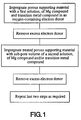
- the process for making the improved catalyst composition comprises the following steps:
- the invention also relates to a process for producing ethylene homopolymers and copolymers, comprising the following steps:
- the compounds used to form the catalyst composition comprise at least one magnesium compound, at least one transition metal compound, at least one electron donor compound, at least one activator compound, which will be discussed in the section below relating to activation of the precursor composition, and at least one porous inert supporting material, as defined below.
- M is Ti or V
- X is Cl
- a is 0, and b is 3 or 4.
- the transition metal compounds can be used individually or in combinations thereof.
- suitable titanium-containing materials are TiCl 3 , TiCl 4 , Ti(OCH 3 )Cl 3 , Ti(OC 6 H 5 )Cl 3 , Ti(OCOCH 3 )Cl 3 and Ti(OCOC 6 H 5 )Cl 3 may be used.
- TiCl 3 is preferred.
- Vanadium compounds such as VCl 3 and VCl 4 and chloroalkoxides may also be used.
- VCl 3 is preferred.
- zirconium compounds such as Zr(OEt) 2 Cl 2 , ZrCl 2 (OiPr) 2 and Zr(Acetylacetonate) 2 Cl 2 may be used.
- ZrCl 4 and ZrCl 2 (OEt) 2 and Zr(Acetylacetonate) 2 Cl 2 are preferred.
- suitable hafnium compounds are materials such as HfCl 4 , HfCl 2 (OEt) 2 , HfCl 2 (OiPr) 2 and Hf(Acetylacetonate) 2 Cl 2 .
- Preferred hafnium compounds are HfCl 4 , HfCl 2 (OEt) 2 and Hf(Acetylacetonate) 2 Cl 2 .
- the magnesium compounds have the structure MgX 2 wherein X is Cl, Br, I, or a mixture thereof. Preferably, X is Cl.
- Such magnesium compounds can be used individually or in combinations thereof, and may be such materials as MgCl 2 , MgBr 2 , and MgI 2 . Anhydrous MgCl 2 is most preferred.
- transition metal and magnesium compounds should be used in forms which will facilitate their dissolution in the electron donor compound, as described below.
- the electron donor compound used in the catalyst precursor is an organic compound which is liquid at 25 °C and in which the transition metal and magnesium compounds are soluble.
- the electron donor compounds are known, as such, or as Lewis bases.
- the electron donor compounds are such compounds as alkyl esters of aliphatic and aromatic carboxylic acids, aliphatic ethers, cyclic ethers, and aliphatic ketones.
- the preferable ones are alkyl esters of C 1 to C 4 saturated aliphatic carboxylic acids; alkyl esters of C 7 to C 8 aromatic carboxylic acids; C 2 to C 8 , and preferably C 3 to C 5 , aliphatic ethers; C 3 to C 4 cyclic ethers, and preferably C 4 cyclic mono- or di-ethers; C 3 to C 6 , and preferably C 3 to C 4 , aliphatic ketones.
- the preferred electron donor compounds include methyl formate, ethyl acetate, butyl acetate, ethyl ether, hexyl ether, tetrahydrofuran, dioxane, acetone and methyl isobutyl ketone.
- the electron donor compounds can be used individually or in combinations thereof.
- the precursor composition is impregnated into a supporting material.
- Suitable supporting materials are solid, particulate porous materials which are inert to the other components of the catalyst composition, and to the other active components of the reaction system.
- Such supporting materials include inorganic materials such as oxides of silicon and aluminum.
- the supporting materials are used in the form of dry powders having an average particle size of about 10 to 250 microns, and preferably of about 50 to 150 microns. These materials are also porous and have a surface area of at least 3, and preferably of 50 or higher, square meters per gram. Catalyst activity or productivity is apparently also improved with particles having pore sizes of at least 80 Angstrom units and preferably of at least 100 Angstrom units.
- the supporting material should be dry, that is, free of absorbed water. Drying of the supporting material is carried out by heating it at a temperature of 600°C or higher. Alternatively, in the case of silica supports, the supporting material dried at a temperature of at least 200°C may be treated with about 1 to 8 weight percent of one or more of the aluminum alkyl compounds described above. This modification of the support by the aluminum alkyl compounds provides the catalyst composition with increased activity and also improves polymer particle morphology of the resulting ethylene polymers.
- the precursor composition is formed in a multi-step procedure, as indicated in the summary above.
- a solution of a first precursor composition is prepared by dissolving at least one transition metal compound and at least one magnesium compound in at least one electron donor compound at a temperature of about 20 °C up to the boiling point of the electron donor compound. Higher temperatures may be utilized by conducting the operation under pressure.
- the transition metal compound can be added to the electron donor compound before or after addition of the magnesium compound, or concurrent therewith.
- the dissolution of the transition metal and the magnesium compounds can be facilitated by stirring, and in some instances by refluxing these compounds in the electron donor compound.
- the solution may be passed through a suitable inert filter media to remove any insoluble materials which may be present in the magnesium or titanium compounds.
- the first precursor composition may be isolated from the solution by crystallization or by precipitation with a C 5 to C 8 aliphatic or aromatic hydrocarbon such as hexane, isopentane or benzene, or by spray drying. Such isolation is not required, however. If isolated, the crystallized or precipitated first precursor composition will be in the form of fine particles having an average particle size of about 10 to 100 microns and a bulk density of about 18 to 33 pounds per cubic foot. (0.29 to 0.53 g/cc). This isolated first precursor composition may later be used in impregnation of the carrier material in either the first or subsequent impregnation steps.
- a C 5 to C 8 aliphatic or aromatic hydrocarbon such as hexane, isopentane or benzene
- the first precursor composition is not isolated and the impregnation proceeds using the steps outlined below.
- the first precursor composition is impregnated, in a weight ratio of about 0.1 to 1, and preferably about 0.2 to 0.75, parts of the first precursor composition into one part by weight of a porous carrier, hereinafter referred to as a supporting material, to afford a supported first precursor composition.
- the impregnation of the supporting material with the first precursor composition is accomplished by slurring a selected amount of supporting material with an appropriate volume of a solution of first precursor composition at an appropriate concentration in electron donor compound, and allowing the precursor composition to impregnate it.
- the solvent electron donor is then removed by drying at temperatures in the range of 25-90°C. Partial vacuum may also be used to speed removal of the excess electron donor compound.
- the volume of the solution of the first precursor composition is that which is sufficient to form a slurry with the selected amount of the supporting material.
- concentrations of magnesium compound and transition metal compound in the electron donor solution of the first precursor composition are such that the solution is not saturated with respect to any constituent. Furthermore, these concentrations are sufficiently low that the solution remains unsaturated even when its volume is reduced to a volume equal to the pore volume of the selected amount of the supporting material. Thus, a dilute slurry will contain a lower concentration of the first precursor composition than a more concentrated slurry. Satisfaction of these criteria assures that crystallization of the first precursor composition occurs primarily within the pores of the supporting material.
- the solution of first precursor material used in forming the slurry with the supporting material may be the solution in which the first precursor material was prepared, without isolation of the precursor, or it may be a solution prepared from the isolated first precursor material.
- a second solution, of at least one magnesium compound, at least one transition metal compound, or a mixture of such compounds is prepared in at least one electron donor material in the manner described above, and an amount of the above-described supported first precursor composition is mixed with a volume of this second solution, the volume of the second solution used being less than or equal to the residual pore volume of the selected amount of the supported first precursor composition.
- the electron donor material which may be the same as or different from the electron donor used in the first solution, is removed as described above, to yield catalyst precursor composition impregnated in the supporting material, in the form of a dry free-flowing material. If necessary or desired, these steps are repeated until the desired final precursor composition is achieved.
- the final catalyst precursor composition has the formula Mg m M(OR) n X p ⁇ ED ⁇ q wherein
- the level of transition metal is generally 0.15 to 0.75, preferably 0.15 to 0.5, and most preferably 0.2 to 0.5 millimoles/gram, based on the total weight of the supporting material and the catalyst precursor therein.
- the level of MgX 2 contained in the precursor composition is preferably >0.8 millimoles/gram and most preferably >0.9 millimoles/gram of precursor composition including the supporting material.
- the precursor composition is activated by treatment with sufficient activator compound to transform transition metal atoms in the precursor composition to an active state.
- the activator compounds can be used individually or in combinations thereof, and include such materials as Al(CH 3 ) 3 , Al(CH 3 ) 2 Cl, Al(C 2 H 5 ) 3 , Al(C 2 H 5 ) 2 Cl, Al(i-C 4 H 9 ) 3 , Al 2 (C 2 H 5 ) 3 Cl 3 , Al(i-C 4 H 9 ) 2 H, Al(C 6 H 13 ) 3 , Al(C 8 H 17 ) 3 , Al(C 2 H 5 ) 2 H and Al(C 2 H 5 ) 2 (OC 2 H 5 ).
- Preferred activator compounds are Al(C 2 H 5 ) 3 , Al(C 2 H 5 ) 2 Cl, and Al(C 6 H 13 ) 3 .
- the precursor composition is activated outside the polymerization reactor with enough activator compound to provide a partially activated precursor composition which has an activator compound/transition metal molar ratio of up to 10:1 and preferably of about 2:1 to 8:1.
- This partial activation reaction is preferably carried out in a hydrocarbon solvent slurry followed by drying of the resulting mixture, to remove the solvent, at temperatures between 20°C and 80°C, and preferably 50°C to 70°C.
- the resulting product is a free-flowing solid particulate material.
- complete activation occurs in the polymerization reactor.
- the precursor composition may be suspended in a slurry of an oil, such as a mineral oil or other high viscosity fluid which is inert to the catalyst and partial activation reagents, and the partial activation reagents may be added to this slurry.
- the slurry may then be used directly in the polymerization reaction by metering in suitable quantities of the partially activated precursor composition in a quantity to produce polymer at the desired rate.
- the additional activator compound may be added either to the precursor composition suspended in this fluid, or separately to the reactor. For reasons apparent to one skilled in the art, it is preferred to add the additional activator compound separately.
- the polymerization reaction is conducted by contacting ethylene or a mixture of ethylene and at least one comonomer which is an alpha olefin having 3-8 carbon atoms, a molecular weight control agent, typically hydrogen gas, and the additional activator compound, preferably in a gas phase process such as a fluid bed process, and substantially in the absence of catalyst poisons such as moisture, oxygen, carbon monoxide, carbon dioxide, and acetylene, with a catalytically effective amount of the partially activated and modified precursor composition, at a temperature and at a pressure sufficient to initiate the polymerization reaction.
- a gas phase process such as a fluid bed process
- catalyst poisons such as moisture, oxygen, carbon monoxide, carbon dioxide, and acetylene
- activation is completed with the additional activator compound which can be the same as that employed for partial activation of the precursor composition, or a different compound.
- the additional activator compound and the partially activated precursor composition are preferably fed to the reactor through separate feed lines.
- the additional activator compound may be sprayed into the reactor in the form of a solution thereof in a hydrocarbon diluent such as propane, butane, isopentane, hexane, or mineral oil.
- a hydrocarbon diluent such as propane, butane, isopentane, hexane, or mineral oil.
- Other liquid or gaseous feeds to the reactor may also be used to disperse the additional activator compound in the reactor. Materials such as ethylene, nitrogen and comonomer streams may be used.
- This solution usually contains about 2 to 30 weight percent of the activator compound.
- the additional activator compound may also be used in the absence of diluent solvent.
- the additional activator compound is added to the reactor in such amounts as to provide, in the reactor, together with the amounts of activator compound and transition metal compound fed with the partially activated precursor composition, a total Al/M molar ratio of about 10 to 400 and preferably of about 10 to 100.
- the additional amounts of activator compound added to the reactor react with, and complete the activation of, the transition metal compound in the reactor.
- discrete portions of the dry partially activated precursor composition are continuously fed to the reactor, with discrete or continuous feed of portions of additional activator compound needed to complete the activation of the partially activated precursor composition, during the continuing polymerization process in order to replace active catalyst sites that are expended during the course of the reaction and to replace catalyst which exits the reactor as product is periodically or continuously removed from the polymerization reactor.
- additional activator compound needed to complete the activation of the partially activated precursor composition, during the continuing polymerization process in order to replace active catalyst sites that are expended during the course of the reaction and to replace catalyst which exits the reactor as product is periodically or continuously removed from the polymerization reactor.
- either discrete or continuous portions of the catalyst as a slurry may be fed to the reactor, with discrete or continuous feed of additional activator compound.
- Step A Dehydration of Carrier Material:
- the carrier material Davison Grade 955 or 956 silica
- the fluidizing gas velocity is maintained between greater than 2 and less than 20 times the minimum fluidization velocity of the carrier material.
- a preferred gas velocity is approximately 10 times the minimum fluidization velocity.
- the material is held at the temperature of 600°C for a minimum of 4 hours, cooled under nitrogen and then discharged from the dehydrator for use in the next step. All subsequent steps are carried out under an inert gas (nitrogen) blanket.
- Step B Aluminum Alkyl Treatment of the Support:
- the supporting material is placed in a mix vessel equipped with a helical ribbon agitator designed for good solids mixing. Approximately 750-1000 grams of the support material is charged to the mix vessel for every 3 liters of isopentane charged to the mix vessel, sufficient to produce a slurry of the support in isopentane. Sufficient triethyl aluminum is then added to achieve a 5.8 wt% loading of triethyl aluminum based on the amount of support material added to the mix vessel.
- the methyl aluminum is used as a 10 wt% solution in isopentane or a 20 wt% solution in hexane.
- Neat TEAL may also be used.
- the solvent is evaporated off at near atmospheric pressure.
- the jacket temperature is set at approximately 70°C and the material is stripped of solvent while stirring until a dry free flowing powder is produced. The material is removed and stored under dry nitrogen for further use.
- Step C Preparation of First Precursor Composition Solution:
- Tetrahydrofuran which has been dried with molecular sieves to less than 50 ppm by volume moisture and has been deoxygenated by bubbling nitrogen through the liquid is charged to the mix vessel described above. Sufficient tetrahydrofuran, MgCl 2 and TiCl 3 are charged to the reactor to produce the solution. The mixture is heated to about 60-65°C while stirring. After 4 hours, the mixture is passed through a 10 ⁇ m filter to remove undissolved materials (typically ⁇ 1.0% of charged MgCl 2 ) and stored under dry nitrogen for use in the next step. The composition of the solution based on mass balance is given in the Table below.
- Step D Preparation of Impregnated First Precursor Composition:
- Carrier material produced in Step B is added to the mix vessel previously described.
- the solution prepared in Step C and additional small quantities of tetrahydrofuran (used to flush lines) are charged to the mix vessel.
- the slurry is agitated for approximately 30 minutes to disperse all components adequately. Drying is then begun with a jacket temperature of 60-80°C. After approximately 4-6 hours, the pressure in the vessel is reduced slowly to about 1 pound per square inch absolute (psia). Drying is continued until the temperature difference between the material temperature in the vessel and the jacket temperature approaches a steady state. Typically, the temperature difference between the vessel jacket and internal material temperature will change less than 2 C° per 1/2 hour. The material is then cooled to less than 45°C and used in the next step.
- the analyses of the materials are given in the tables below.
- Step E Preparation of Sub Pore Volume Impregnated Precursor Composition:
- a solution of magnesium chloride and/or titanium chloride in tetrahydrofuran is prepared in a manner as described in Step C except that different amounts of both the titanium chloride and magnesium chloride component may be used.
- the analysis of the solution based on mass balance is given in the table below.
- a desired amount of the precursor composition prepared in Step D is charged to the mix vessel described previously.
- a quantity of the solution prepared above is charged to the mix vessel.
- the quantity is such that the residual pore volume of the precursor composition is not exceeded.
- the residual pore volume of the precursor composition is calculated assuming that the density of the solid precursor composition impregnated in the pores of the support is 2.0 cc/gram.
- the mass of precursor contained within the pores of the support is calculated from the analysis of the first precursor composition.
- the pore volume of the support is given in the table below.
- the contents are agitated during the addition.
- the solution is added over a period of approximately 15-30 minutes. Following this, the vessel contents are agitated for another 3-6 hours, followed by drying as described in step D above.
- the final analysis of the material is given in the table below.
- the material is a dry free flowing solid with essentially no chips or agglomerates. Recovery vs theoretical yield is high.
- Step F Preparation of Partially Activated Catalyst:
- the precursor composition prepared above is contacted in the mix vessel with the partial activation agents as follows: approximately 0.5 kilograms of precursor composition are charged to the mix vessel for each 3 liters of isopentane. While stirring, diethyl aluminum chloride is charged at a defined molar ratio to the tetrahydrofuran contained in the precursor composition. After a 30 minute mix period, Tri-n-hexyl aluminum is charged at a defined molar ratio to the tetrahydrofuran contained. After a brief period of mixing, the solvent is stripped off as described in Step B above. The dry free flowing partially activated catalyst is then used in polymerization. Molar ratios of partial activation agents used are given in Table 1 below.
- Example 1 (Standard) is lower than that of the exemplary catalysts.
- Step E second impregnation
- Polymerization was carried out in a fluidized bed reactor as described in US patents 4,302,565; 4,302,566; and 4,303,771. Dry catalyst was fed to the bed. Cocatalyst solution was fed to the reactor through introduction into the recycle line below the gas distribution plate. Gas compositions were analyzed using a gas chromatograph and additional monomer, comonomer and hydrogen molecular weight control agent were added as needed to maintain the compositions as specified. Additional catalyst is added to maintain polymerization rates as product and catalyst contained therein are periodically withdrawn from the fluid bed to maintain a constant fluidized bed level. Polymerization data is given in Table 3 Table 3 Polymerization Data RUN NO.
- the catalyst of the invention yields higher productivity (on both a Ti basis and a catalyst mass basis) than catalyst prepared by the usual single impregnation, and produces polymer with no degradation of resin bulk density or particle size.
- Polymer particle size increases due to the increased catalyst productivity demonstrated by the exemplary catalysts (i.e. each catalyst particle produces essentially one polymer particle).
- other polymer properties appear to be unchanged.
Landscapes
- Chemical & Material Sciences (AREA)
- Health & Medical Sciences (AREA)
- Chemical Kinetics & Catalysis (AREA)
- Medicinal Chemistry (AREA)
- Polymers & Plastics (AREA)
- Organic Chemistry (AREA)
- Transition And Organic Metals Composition Catalysts For Addition Polymerization (AREA)
Priority Applications (1)
| Application Number | Priority Date | Filing Date | Title |
|---|---|---|---|
| EP95117325A EP0771820A1 (de) | 1995-11-03 | 1995-11-03 | Ziegler-Natta geträgerte Katalysatore für Polyolefin-Herstellung |
Applications Claiming Priority (1)
| Application Number | Priority Date | Filing Date | Title |
|---|---|---|---|
| EP95117325A EP0771820A1 (de) | 1995-11-03 | 1995-11-03 | Ziegler-Natta geträgerte Katalysatore für Polyolefin-Herstellung |
Publications (1)
| Publication Number | Publication Date |
|---|---|
| EP0771820A1 true EP0771820A1 (de) | 1997-05-07 |
Family
ID=8219775
Family Applications (1)
| Application Number | Title | Priority Date | Filing Date |
|---|---|---|---|
| EP95117325A Ceased EP0771820A1 (de) | 1995-11-03 | 1995-11-03 | Ziegler-Natta geträgerte Katalysatore für Polyolefin-Herstellung |
Country Status (1)
| Country | Link |
|---|---|
| EP (1) | EP0771820A1 (de) |
Cited By (5)
| Publication number | Priority date | Publication date | Assignee | Title |
|---|---|---|---|---|
| WO2001005845A1 (en) * | 1999-07-14 | 2001-01-25 | Union Carbide Chemicals & Plastics Technology Corporation | Process for the preparation of polyethylene |
| US7354981B2 (en) * | 2003-12-03 | 2008-04-08 | China Petroleum & Chemical Corporation | Polyethylene catalyst and a process for preparing the same |
| US7405176B2 (en) | 2003-04-29 | 2008-07-29 | China Petroleum & Chemical Corporation | Solid main catalyst component for ethylene polymerization, a process for preparing the same and a catalyst containing the same |
| EP2017303A1 (de) | 2004-05-06 | 2009-01-21 | Dow Global Technologies Inc. | Polymerspritzgusszusammensetzungen |
| WO2012030567A1 (en) | 2010-08-31 | 2012-03-08 | Dow Global Technologies Llc | Ziegler-natta type catalysts, methods of preparing same, polymers produced using the catalysts and articles produces therefrom |
Citations (2)
| Publication number | Priority date | Publication date | Assignee | Title |
|---|---|---|---|---|
| EP0043220A1 (de) * | 1980-06-30 | 1982-01-06 | Union Carbide Corporation | Mit einem Katalysator impregniertes feinverteiltes Siliciumdioxyd, Verfahren zur Herstellung und Verwendung bei der Polymerisation von Äthylen |
| EP0446989A2 (de) * | 1990-03-16 | 1991-09-18 | ENICHEM S.p.A. | Katalysator auf Träger für Ethylenpolymerisation oder -copolymerisation mit alpha-Olefinen, seine Herstellung und seine Anwendung |
-
1995
- 1995-11-03 EP EP95117325A patent/EP0771820A1/de not_active Ceased
Patent Citations (2)
| Publication number | Priority date | Publication date | Assignee | Title |
|---|---|---|---|---|
| EP0043220A1 (de) * | 1980-06-30 | 1982-01-06 | Union Carbide Corporation | Mit einem Katalysator impregniertes feinverteiltes Siliciumdioxyd, Verfahren zur Herstellung und Verwendung bei der Polymerisation von Äthylen |
| EP0446989A2 (de) * | 1990-03-16 | 1991-09-18 | ENICHEM S.p.A. | Katalysator auf Träger für Ethylenpolymerisation oder -copolymerisation mit alpha-Olefinen, seine Herstellung und seine Anwendung |
Cited By (8)
| Publication number | Priority date | Publication date | Assignee | Title |
|---|---|---|---|---|
| WO2001005845A1 (en) * | 1999-07-14 | 2001-01-25 | Union Carbide Chemicals & Plastics Technology Corporation | Process for the preparation of polyethylene |
| US6617405B1 (en) | 1999-07-14 | 2003-09-09 | Union Carbide Chemicals & Plastics Technology Corporation | Process for the preparation of polyethylene |
| US7405176B2 (en) | 2003-04-29 | 2008-07-29 | China Petroleum & Chemical Corporation | Solid main catalyst component for ethylene polymerization, a process for preparing the same and a catalyst containing the same |
| US7354981B2 (en) * | 2003-12-03 | 2008-04-08 | China Petroleum & Chemical Corporation | Polyethylene catalyst and a process for preparing the same |
| EP2017303A1 (de) | 2004-05-06 | 2009-01-21 | Dow Global Technologies Inc. | Polymerspritzgusszusammensetzungen |
| US8247497B2 (en) | 2004-05-06 | 2012-08-21 | Dow Global Technologies Llc | Polymer molding compositions |
| WO2012030567A1 (en) | 2010-08-31 | 2012-03-08 | Dow Global Technologies Llc | Ziegler-natta type catalysts, methods of preparing same, polymers produced using the catalysts and articles produces therefrom |
| US9221932B2 (en) | 2010-08-31 | 2015-12-29 | Union Carbide Chemicals & Plastics Technology Llc | Ziegler-Natta type catalysts, methods of preparing same, polymers produced using the catalysts and articles produced therefrom |
Similar Documents
| Publication | Publication Date | Title |
|---|---|---|
| EP0055605B1 (de) | Katalysatorzusammensetzung zur Äthylenpolymerisation, deren Herstellung und Polymerisationsverfahren | |
| US5290745A (en) | Process for producing ethylene polymers having reduced hexane extractable content | |
| CA1192700A (en) | Use of dialkylzinc compounds to initiate polymerization of ethylene with chromium oxide catalysts | |
| US4354009A (en) | Catalyst composition for copolymerizing ethylene | |
| EP0043220B1 (de) | Mit einem Katalysator impregniertes feinverteiltes Siliciumdioxyd, Verfahren zur Herstellung und Verwendung bei der Polymerisation von Äthylen | |
| US6818584B2 (en) | Process for preparing a Ziegler-Natta catalyst | |
| EP0012147B1 (de) | Verfahren zur Herstellung von Äthylen-Polymerisaten hoher Dichte in einem Fliessbett-Reaktor | |
| US5068489A (en) | Preparation of very low molecular weight polyethylene in a fluidized bed | |
| DE69703150T2 (de) | Geträgerte metallocene-katalysatorsysteme | |
| EP1891125B1 (de) | Katalysatorzusammensetzungen mit kleinen silika-trägermaterialien und verwendungsverfahren dafür in polymerisierungsreaktionen | |
| US4460755A (en) | Direct conversion of a polymerization reaction catalyzed by a Ziegler-type catalyst into one catalyzed by a chromium-based catalyst | |
| US5258342A (en) | Process for the preparation of a solid component of catalyst for the (co)polymerization of ethylene | |
| EP0130607B1 (de) | Verwendung von alkylaluminium- und hydroxylhaltigen Verbindungen zur Initiation der Äthylenpolymerisation mit Chromoxidkatalysatoren | |
| US5019633A (en) | Catalyst composition for polymerizing ethylene | |
| US4524141A (en) | Polymerization catalysts and methods | |
| JPH07196733A (ja) | エチレンの連続二量化法 | |
| EP0083456B1 (de) | Verfahren zur Äthylencopolymerisation | |
| JPH0380164B2 (de) | ||
| US10266618B2 (en) | Chromium-based catalyst compositions for olefin polymerization | |
| KR100522617B1 (ko) | 에틸렌 (공)중합용 담지촉매, 그 제조 방법 및 이용 방법 | |
| JPH09136913A (ja) | ポリオレフィン製造用の担持されたチーグラー−ナッタ触媒 | |
| GB2223501A (en) | Process for the dimerization of ethylene and copolymerization to polyethylene | |
| EP3223943B1 (de) | Zusammensetzung enthaltend partikeln | |
| RU2258711C2 (ru) | Нанесенный на носитель катализатор для (со)полимеризации этилена, способ его получения и способ (со)полимеризации этилена | |
| CA2162510A1 (en) | Supported ziegler-natta catalysts for polyolefin production |
Legal Events
| Date | Code | Title | Description |
|---|---|---|---|
| PUAI | Public reference made under article 153(3) epc to a published international application that has entered the european phase |
Free format text: ORIGINAL CODE: 0009012 |
|
| AK | Designated contracting states |
Kind code of ref document: A1 Designated state(s): AT BE DE ES FR GB GR IT NL PT SE |
|
| 17P | Request for examination filed |
Effective date: 19970718 |
|
| 17Q | First examination report despatched |
Effective date: 19970922 |
|
| GRAG | Despatch of communication of intention to grant |
Free format text: ORIGINAL CODE: EPIDOS AGRA |
|
| STAA | Information on the status of an ep patent application or granted ep patent |
Free format text: STATUS: THE APPLICATION HAS BEEN REFUSED |
|
| 18R | Application refused |
Effective date: 19990430 |