EP0771837A1 - Elastomerfolien mit mindestens einem chemischen Wirkstoff, Verfahren zu ihrer Herstellung und ihre Verwendung - Google Patents
Elastomerfolien mit mindestens einem chemischen Wirkstoff, Verfahren zu ihrer Herstellung und ihre Verwendung Download PDFInfo
- Publication number
- EP0771837A1 EP0771837A1 EP96402292A EP96402292A EP0771837A1 EP 0771837 A1 EP0771837 A1 EP 0771837A1 EP 96402292 A EP96402292 A EP 96402292A EP 96402292 A EP96402292 A EP 96402292A EP 0771837 A1 EP0771837 A1 EP 0771837A1
- Authority
- EP
- European Patent Office
- Prior art keywords
- phase
- gel
- elastomer
- film according
- solvent
- Prior art date
- Legal status (The legal status is an assumption and is not a legal conclusion. Google has not performed a legal analysis and makes no representation as to the accuracy of the status listed.)
- Granted
Links
- 239000000126 substance Substances 0.000 title claims abstract description 60
- 238000002360 preparation method Methods 0.000 title claims abstract description 37
- 238000000034 method Methods 0.000 title claims abstract description 23
- 230000008569 process Effects 0.000 title claims description 9
- 239000013543 active substance Substances 0.000 title description 4
- 229920001971 elastomer Polymers 0.000 claims abstract description 86
- 239000000806 elastomer Substances 0.000 claims abstract description 86
- 229920000642 polymer Polymers 0.000 claims abstract description 63
- 239000006185 dispersion Substances 0.000 claims abstract description 52
- 230000002441 reversible effect Effects 0.000 claims abstract description 43
- 239000002904 solvent Substances 0.000 claims abstract description 42
- 238000002156 mixing Methods 0.000 claims abstract description 26
- 230000007704 transition Effects 0.000 claims abstract description 25
- 239000007788 liquid Substances 0.000 claims abstract description 20
- 239000004971 Cross linker Substances 0.000 claims abstract description 19
- 239000003960 organic solvent Substances 0.000 claims abstract description 15
- 238000001704 evaporation Methods 0.000 claims abstract description 12
- 230000008020 evaporation Effects 0.000 claims abstract description 12
- 229920001195 polyisoprene Polymers 0.000 claims abstract description 12
- 229920000459 Nitrile rubber Polymers 0.000 claims abstract description 5
- 229920003048 styrene butadiene rubber Polymers 0.000 claims abstract description 5
- 229920000468 styrene butadiene styrene block copolymer Polymers 0.000 claims abstract description 5
- 239000005062 Polybutadiene Substances 0.000 claims abstract description 3
- 229920002857 polybutadiene Polymers 0.000 claims abstract description 3
- 239000000499 gel Substances 0.000 claims description 147
- 239000000203 mixture Substances 0.000 claims description 39
- LYCAIKOWRPUZTN-UHFFFAOYSA-N Ethylene glycol Chemical compound OCCO LYCAIKOWRPUZTN-UHFFFAOYSA-N 0.000 claims description 30
- 239000003431 cross linking reagent Substances 0.000 claims description 29
- 229920003171 Poly (ethylene oxide) Polymers 0.000 claims description 23
- -1 polyoxyethylenes Polymers 0.000 claims description 18
- 108010010803 Gelatin Proteins 0.000 claims description 17
- 239000008273 gelatin Substances 0.000 claims description 17
- 229920000159 gelatin Polymers 0.000 claims description 17
- 235000019322 gelatine Nutrition 0.000 claims description 17
- 235000011852 gelatine desserts Nutrition 0.000 claims description 17
- 229920002451 polyvinyl alcohol Polymers 0.000 claims description 17
- XLYOFNOQVPJJNP-UHFFFAOYSA-N water Substances O XLYOFNOQVPJJNP-UHFFFAOYSA-N 0.000 claims description 15
- 150000001875 compounds Chemical class 0.000 claims description 13
- 230000015572 biosynthetic process Effects 0.000 claims description 9
- 230000003253 viricidal effect Effects 0.000 claims description 9
- PEDCQBHIVMGVHV-UHFFFAOYSA-N Glycerine Chemical compound OCC(O)CO PEDCQBHIVMGVHV-UHFFFAOYSA-N 0.000 claims description 8
- 239000004372 Polyvinyl alcohol Substances 0.000 claims description 8
- UHOVQNZJYSORNB-UHFFFAOYSA-N Benzene Chemical compound C1=CC=CC=C1 UHOVQNZJYSORNB-UHFFFAOYSA-N 0.000 claims description 6
- YXFVVABEGXRONW-UHFFFAOYSA-N Toluene Chemical compound CC1=CC=CC=C1 YXFVVABEGXRONW-UHFFFAOYSA-N 0.000 claims description 6
- 238000004132 cross linking Methods 0.000 claims description 6
- CXWXQJXEFPUFDZ-UHFFFAOYSA-N tetralin Chemical compound C1=CC=C2CCCCC2=C1 CXWXQJXEFPUFDZ-UHFFFAOYSA-N 0.000 claims description 6
- 239000003139 biocide Substances 0.000 claims description 5
- 229910021538 borax Inorganic materials 0.000 claims description 5
- 239000000470 constituent Substances 0.000 claims description 5
- 229920001223 polyethylene glycol Polymers 0.000 claims description 5
- 239000004328 sodium tetraborate Substances 0.000 claims description 5
- 235000010339 sodium tetraborate Nutrition 0.000 claims description 5
- VSKJLJHPAFKHBX-UHFFFAOYSA-N 2-methylbuta-1,3-diene;styrene Chemical compound CC(=C)C=C.C=CC1=CC=CC=C1.C=CC1=CC=CC=C1 VSKJLJHPAFKHBX-UHFFFAOYSA-N 0.000 claims description 4
- 229920002134 Carboxymethyl cellulose Polymers 0.000 claims description 4
- XDTMQSROBMDMFD-UHFFFAOYSA-N Cyclohexane Chemical compound C1CCCCC1 XDTMQSROBMDMFD-UHFFFAOYSA-N 0.000 claims description 4
- 229920000663 Hydroxyethyl cellulose Polymers 0.000 claims description 4
- 239000004354 Hydroxyethyl cellulose Substances 0.000 claims description 4
- 229920002153 Hydroxypropyl cellulose Polymers 0.000 claims description 4
- 229920002873 Polyethylenimine Polymers 0.000 claims description 4
- 229920002125 Sokalan® Polymers 0.000 claims description 4
- 229920000615 alginic acid Polymers 0.000 claims description 4
- 235000010443 alginic acid Nutrition 0.000 claims description 4
- FACXGONDLDSNOE-UHFFFAOYSA-N buta-1,3-diene;styrene Chemical compound C=CC=C.C=CC1=CC=CC=C1.C=CC1=CC=CC=C1 FACXGONDLDSNOE-UHFFFAOYSA-N 0.000 claims description 4
- 239000001768 carboxy methyl cellulose Substances 0.000 claims description 4
- 235000010948 carboxy methyl cellulose Nutrition 0.000 claims description 4
- 239000008112 carboxymethyl-cellulose Substances 0.000 claims description 4
- 239000001913 cellulose Substances 0.000 claims description 4
- 229920002678 cellulose Polymers 0.000 claims description 4
- NNBZCPXTIHJBJL-UHFFFAOYSA-N decalin Chemical compound C1CCCC2CCCCC21 NNBZCPXTIHJBJL-UHFFFAOYSA-N 0.000 claims description 4
- 235000011187 glycerol Nutrition 0.000 claims description 4
- 229930195733 hydrocarbon Natural products 0.000 claims description 4
- 235000019447 hydroxyethyl cellulose Nutrition 0.000 claims description 4
- 239000001863 hydroxypropyl cellulose Substances 0.000 claims description 4
- 235000010977 hydroxypropyl cellulose Nutrition 0.000 claims description 4
- 229920000609 methyl cellulose Polymers 0.000 claims description 4
- 239000001923 methylcellulose Substances 0.000 claims description 4
- 235000010981 methylcellulose Nutrition 0.000 claims description 4
- 239000002736 nonionic surfactant Substances 0.000 claims description 4
- 239000001814 pectin Substances 0.000 claims description 4
- 229920001277 pectin Polymers 0.000 claims description 4
- 235000010987 pectin Nutrition 0.000 claims description 4
- 229920002432 poly(vinyl methyl ether) polymer Polymers 0.000 claims description 4
- 229920000058 polyacrylate Polymers 0.000 claims description 4
- 239000004584 polyacrylic acid Substances 0.000 claims description 4
- 229920002338 polyhydroxyethylmethacrylate Polymers 0.000 claims description 4
- 229920000193 polymethacrylate Polymers 0.000 claims description 4
- 229920005862 polyol Polymers 0.000 claims description 4
- 150000003077 polyols Chemical class 0.000 claims description 4
- 230000008859 change Effects 0.000 claims description 3
- 238000006243 chemical reaction Methods 0.000 claims description 3
- 239000011248 coating agent Substances 0.000 claims description 3
- 238000000576 coating method Methods 0.000 claims description 3
- 239000007787 solid Substances 0.000 claims description 3
- 229940123208 Biguanide Drugs 0.000 claims description 2
- OYPRJOBELJOOCE-UHFFFAOYSA-N Calcium Chemical compound [Ca] OYPRJOBELJOOCE-UHFFFAOYSA-N 0.000 claims description 2
- JGFDZZLUDWMUQH-UHFFFAOYSA-N Didecyldimethylammonium Chemical compound CCCCCCCCCC[N+](C)(C)CCCCCCCCCC JGFDZZLUDWMUQH-UHFFFAOYSA-N 0.000 claims description 2
- DGAQECJNVWCQMB-PUAWFVPOSA-M Ilexoside XXIX Chemical compound C[C@@H]1CC[C@@]2(CC[C@@]3(C(=CC[C@H]4[C@]3(CC[C@@H]5[C@@]4(CC[C@@H](C5(C)C)OS(=O)(=O)[O-])C)C)[C@@H]2[C@]1(C)O)C)C(=O)O[C@H]6[C@@H]([C@H]([C@@H]([C@H](O6)CO)O)O)O.[Na+] DGAQECJNVWCQMB-PUAWFVPOSA-M 0.000 claims description 2
- CTQNGGLPUBDAKN-UHFFFAOYSA-N O-Xylene Chemical compound CC1=CC=CC=C1C CTQNGGLPUBDAKN-UHFFFAOYSA-N 0.000 claims description 2
- 239000002174 Styrene-butadiene Substances 0.000 claims description 2
- 229920001807 Urea-formaldehyde Polymers 0.000 claims description 2
- QYKIQEUNHZKYBP-UHFFFAOYSA-N Vinyl ether Chemical class C=COC=C QYKIQEUNHZKYBP-UHFFFAOYSA-N 0.000 claims description 2
- HCHKCACWOHOZIP-UHFFFAOYSA-N Zinc Chemical compound [Zn] HCHKCACWOHOZIP-UHFFFAOYSA-N 0.000 claims description 2
- 150000001299 aldehydes Chemical class 0.000 claims description 2
- 125000001931 aliphatic group Chemical group 0.000 claims description 2
- 229910052782 aluminium Inorganic materials 0.000 claims description 2
- XAGFODPZIPBFFR-UHFFFAOYSA-N aluminium Chemical compound [Al] XAGFODPZIPBFFR-UHFFFAOYSA-N 0.000 claims description 2
- WNROFYMDJYEPJX-UHFFFAOYSA-K aluminium hydroxide Chemical class [OH-].[OH-].[OH-].[Al+3] WNROFYMDJYEPJX-UHFFFAOYSA-K 0.000 claims description 2
- PNEYBMLMFCGWSK-UHFFFAOYSA-N aluminium oxide Inorganic materials [O-2].[O-2].[O-2].[Al+3].[Al+3] PNEYBMLMFCGWSK-UHFFFAOYSA-N 0.000 claims description 2
- 125000003118 aryl group Chemical group 0.000 claims description 2
- 150000004283 biguanides Chemical class 0.000 claims description 2
- 230000003115 biocidal effect Effects 0.000 claims description 2
- KGBXLFKZBHKPEV-UHFFFAOYSA-N boric acid Chemical compound OB(O)O KGBXLFKZBHKPEV-UHFFFAOYSA-N 0.000 claims description 2
- 239000004327 boric acid Substances 0.000 claims description 2
- 150000001638 boron Chemical class 0.000 claims description 2
- 239000011575 calcium Substances 0.000 claims description 2
- 229910052791 calcium Inorganic materials 0.000 claims description 2
- 229920001577 copolymer Polymers 0.000 claims description 2
- 238000004925 denaturation Methods 0.000 claims description 2
- 230000036425 denaturation Effects 0.000 claims description 2
- 230000000694 effects Effects 0.000 claims description 2
- 229960001915 hexamidine Drugs 0.000 claims description 2
- OQLKNTOKMBVBKV-UHFFFAOYSA-N hexamidine Chemical compound C1=CC(C(=N)N)=CC=C1OCCCCCCOC1=CC=C(C(N)=N)C=C1 OQLKNTOKMBVBKV-UHFFFAOYSA-N 0.000 claims description 2
- 150000002430 hydrocarbons Chemical class 0.000 claims description 2
- 230000002209 hydrophobic effect Effects 0.000 claims description 2
- WQYVRQLZKVEZGA-UHFFFAOYSA-N hypochlorite Chemical class Cl[O-] WQYVRQLZKVEZGA-UHFFFAOYSA-N 0.000 claims description 2
- 229910052751 metal Inorganic materials 0.000 claims description 2
- 239000002184 metal Substances 0.000 claims description 2
- 150000002739 metals Chemical class 0.000 claims description 2
- WSFSSNUMVMOOMR-NJFSPNSNSA-N methanone Chemical compound O=[14CH2] WSFSSNUMVMOOMR-NJFSPNSNSA-N 0.000 claims description 2
- 239000003208 petroleum Substances 0.000 claims description 2
- ISWSIDIOOBJBQZ-UHFFFAOYSA-N phenol group Chemical group C1(=CC=CC=C1)O ISWSIDIOOBJBQZ-UHFFFAOYSA-N 0.000 claims description 2
- ZWLUXSQADUDCSB-UHFFFAOYSA-N phthalaldehyde Chemical compound O=CC1=CC=CC=C1C=O ZWLUXSQADUDCSB-UHFFFAOYSA-N 0.000 claims description 2
- 239000002798 polar solvent Substances 0.000 claims description 2
- 229920000570 polyether Polymers 0.000 claims description 2
- ODGAOXROABLFNM-UHFFFAOYSA-N polynoxylin Chemical compound O=C.NC(N)=O ODGAOXROABLFNM-UHFFFAOYSA-N 0.000 claims description 2
- 229920001289 polyvinyl ether Polymers 0.000 claims description 2
- KMUONIBRACKNSN-UHFFFAOYSA-N potassium dichromate Chemical class [K+].[K+].[O-][Cr](=O)(=O)O[Cr]([O-])(=O)=O KMUONIBRACKNSN-UHFFFAOYSA-N 0.000 claims description 2
- 108090000623 proteins and genes Proteins 0.000 claims description 2
- 102000004169 proteins and genes Human genes 0.000 claims description 2
- 125000001453 quaternary ammonium group Chemical group 0.000 claims description 2
- 229910052708 sodium Inorganic materials 0.000 claims description 2
- 239000011734 sodium Substances 0.000 claims description 2
- PXXNTAGJWPJAGM-UHFFFAOYSA-N vertaline Natural products C1C2C=3C=C(OC)C(OC)=CC=3OC(C=C3)=CC=C3CCC(=O)OC1CC1N2CCCC1 PXXNTAGJWPJAGM-UHFFFAOYSA-N 0.000 claims description 2
- 239000008096 xylene Substances 0.000 claims description 2
- 229910052725 zinc Inorganic materials 0.000 claims description 2
- 239000011701 zinc Substances 0.000 claims description 2
- 150000007974 melamines Chemical class 0.000 claims 1
- 239000004615 ingredient Substances 0.000 abstract 4
- 230000001419 dependent effect Effects 0.000 abstract 1
- 229920000346 polystyrene-polyisoprene block-polystyrene Polymers 0.000 abstract 1
- 229920001935 styrene-ethylene-butadiene-styrene Polymers 0.000 abstract 1
- 238000003756 stirring Methods 0.000 description 18
- 229920002565 Polyethylene Glycol 400 Polymers 0.000 description 9
- 239000003795 chemical substances by application Substances 0.000 description 8
- JLFNLZLINWHATN-UHFFFAOYSA-N pentaethylene glycol Chemical compound OCCOCCOCCOCCOCCO JLFNLZLINWHATN-UHFFFAOYSA-N 0.000 description 8
- 239000003094 microcapsule Substances 0.000 description 7
- 239000000463 material Substances 0.000 description 5
- 239000002245 particle Substances 0.000 description 5
- 229920001400 block copolymer Polymers 0.000 description 4
- 239000013536 elastomeric material Substances 0.000 description 4
- RARSHUDCJQSEFJ-UHFFFAOYSA-N p-Hydroxypropiophenone Chemical compound CCC(=O)C1=CC=C(O)C=C1 RARSHUDCJQSEFJ-UHFFFAOYSA-N 0.000 description 4
- GHXZTYHSJHQHIJ-UHFFFAOYSA-N Chlorhexidine Chemical compound C=1C=C(Cl)C=CC=1NC(N)=NC(N)=NCCCCCCN=C(N)N=C(N)NC1=CC=C(Cl)C=C1 GHXZTYHSJHQHIJ-UHFFFAOYSA-N 0.000 description 3
- SXRSQZLOMIGNAQ-UHFFFAOYSA-N Glutaraldehyde Chemical compound O=CCCCC=O SXRSQZLOMIGNAQ-UHFFFAOYSA-N 0.000 description 3
- 239000004480 active ingredient Substances 0.000 description 3
- 229960003260 chlorhexidine Drugs 0.000 description 3
- 238000001816 cooling Methods 0.000 description 3
- 229920000578 graft copolymer Polymers 0.000 description 3
- 229910052739 hydrogen Inorganic materials 0.000 description 3
- 239000001257 hydrogen Substances 0.000 description 3
- 229920000036 polyvinylpyrrolidone Polymers 0.000 description 3
- 239000001267 polyvinylpyrrolidone Substances 0.000 description 3
- 235000013855 polyvinylpyrrolidone Nutrition 0.000 description 3
- ZCYVEMRRCGMTRW-UHFFFAOYSA-N 7553-56-2 Chemical compound [I] ZCYVEMRRCGMTRW-UHFFFAOYSA-N 0.000 description 2
- VEXZGXHMUGYJMC-UHFFFAOYSA-N Hydrochloric acid Chemical compound Cl VEXZGXHMUGYJMC-UHFFFAOYSA-N 0.000 description 2
- 229920004890 Triton X-100 Polymers 0.000 description 2
- 239000002253 acid Substances 0.000 description 2
- 238000013019 agitation Methods 0.000 description 2
- 238000009792 diffusion process Methods 0.000 description 2
- 238000004090 dissolution Methods 0.000 description 2
- LEQAOMBKQFMDFZ-UHFFFAOYSA-N glyoxal Chemical compound O=CC=O LEQAOMBKQFMDFZ-UHFFFAOYSA-N 0.000 description 2
- 229910052740 iodine Inorganic materials 0.000 description 2
- 239000011630 iodine Substances 0.000 description 2
- 238000004519 manufacturing process Methods 0.000 description 2
- 238000010587 phase diagram Methods 0.000 description 2
- 229940068918 polyethylene glycol 400 Drugs 0.000 description 2
- 230000002829 reductive effect Effects 0.000 description 2
- 239000003381 stabilizer Substances 0.000 description 2
- 238000003860 storage Methods 0.000 description 2
- GPRLSGONYQIRFK-MNYXATJNSA-N triton Chemical compound [3H+] GPRLSGONYQIRFK-MNYXATJNSA-N 0.000 description 2
- 102000008186 Collagen Human genes 0.000 description 1
- 108010035532 Collagen Proteins 0.000 description 1
- RUPBZQFQVRMKDG-UHFFFAOYSA-M Didecyldimethylammonium chloride Chemical compound [Cl-].CCCCCCCCCC[N+](C)(C)CCCCCCCCCC RUPBZQFQVRMKDG-UHFFFAOYSA-M 0.000 description 1
- 239000002202 Polyethylene glycol Substances 0.000 description 1
- 238000010306 acid treatment Methods 0.000 description 1
- 230000009471 action Effects 0.000 description 1
- 239000008280 blood Substances 0.000 description 1
- 210000004369 blood Anatomy 0.000 description 1
- 238000009835 boiling Methods 0.000 description 1
- 230000015556 catabolic process Effects 0.000 description 1
- 239000003518 caustics Substances 0.000 description 1
- 239000000919 ceramic Substances 0.000 description 1
- 229920001436 collagen Polymers 0.000 description 1
- 238000002425 crystallisation Methods 0.000 description 1
- 230000008025 crystallization Effects 0.000 description 1
- 238000006731 degradation reaction Methods 0.000 description 1
- 238000010586 diagram Methods 0.000 description 1
- IVJISJACKSSFGE-UHFFFAOYSA-N formaldehyde;1,3,5-triazine-2,4,6-triamine Chemical class O=C.NC1=NC(N)=NC(N)=N1 IVJISJACKSSFGE-UHFFFAOYSA-N 0.000 description 1
- 239000011521 glass Substances 0.000 description 1
- 229940015043 glyoxal Drugs 0.000 description 1
- 239000007970 homogeneous dispersion Substances 0.000 description 1
- 230000007062 hydrolysis Effects 0.000 description 1
- 238000006460 hydrolysis reaction Methods 0.000 description 1
- 230000001939 inductive effect Effects 0.000 description 1
- 230000003993 interaction Effects 0.000 description 1
- 230000009878 intermolecular interaction Effects 0.000 description 1
- 150000002497 iodine compounds Chemical class 0.000 description 1
- 230000002427 irreversible effect Effects 0.000 description 1
- 239000000314 lubricant Substances 0.000 description 1
- 230000004048 modification Effects 0.000 description 1
- 238000012986 modification Methods 0.000 description 1
- 230000036961 partial effect Effects 0.000 description 1
- 230000010399 physical interaction Effects 0.000 description 1
- 229920003023 plastic Polymers 0.000 description 1
- 239000004033 plastic Substances 0.000 description 1
- 229920002959 polymer blend Polymers 0.000 description 1
- 230000001681 protective effect Effects 0.000 description 1
- 238000004062 sedimentation Methods 0.000 description 1
- 238000010008 shearing Methods 0.000 description 1
- 238000003786 synthesis reaction Methods 0.000 description 1
- 229920003051 synthetic elastomer Polymers 0.000 description 1
- 230000009466 transformation Effects 0.000 description 1
Images

Classifications
-
- C—CHEMISTRY; METALLURGY
- C08—ORGANIC MACROMOLECULAR COMPOUNDS; THEIR PREPARATION OR CHEMICAL WORKING-UP; COMPOSITIONS BASED THEREON
- C08K—Use of inorganic or non-macromolecular organic substances as compounding ingredients
- C08K5/00—Use of organic ingredients
- C08K5/0008—Organic ingredients according to more than one of the "one dot" groups of C08K5/01 - C08K5/59
-
- A—HUMAN NECESSITIES
- A61—MEDICAL OR VETERINARY SCIENCE; HYGIENE
- A61B—DIAGNOSIS; SURGERY; IDENTIFICATION
- A61B42/00—Surgical gloves; Finger-stalls specially adapted for surgery; Devices for handling or treatment thereof
- A61B42/20—Finger-stalls specially adapted for surgery
-
- A—HUMAN NECESSITIES
- A61—MEDICAL OR VETERINARY SCIENCE; HYGIENE
- A61L—METHODS OR APPARATUS FOR STERILISING MATERIALS OR OBJECTS IN GENERAL; DISINFECTION, STERILISATION OR DEODORISATION OF AIR; CHEMICAL ASPECTS OF BANDAGES, DRESSINGS, ABSORBENT PADS OR SURGICAL ARTICLES; MATERIALS FOR BANDAGES, DRESSINGS, ABSORBENT PADS OR SURGICAL ARTICLES
- A61L31/00—Materials for other surgical articles, e.g. stents, stent-grafts, shunts, surgical drapes, guide wires, materials for adhesion prevention, occluding devices, surgical gloves, tissue fixation devices
- A61L31/08—Materials for coatings
- A61L31/10—Macromolecular materials
-
- A—HUMAN NECESSITIES
- A61—MEDICAL OR VETERINARY SCIENCE; HYGIENE
- A61L—METHODS OR APPARATUS FOR STERILISING MATERIALS OR OBJECTS IN GENERAL; DISINFECTION, STERILISATION OR DEODORISATION OF AIR; CHEMICAL ASPECTS OF BANDAGES, DRESSINGS, ABSORBENT PADS OR SURGICAL ARTICLES; MATERIALS FOR BANDAGES, DRESSINGS, ABSORBENT PADS OR SURGICAL ARTICLES
- A61L31/00—Materials for other surgical articles, e.g. stents, stent-grafts, shunts, surgical drapes, guide wires, materials for adhesion prevention, occluding devices, surgical gloves, tissue fixation devices
- A61L31/14—Materials characterised by their function or physical properties, e.g. injectable or lubricating compositions, shape-memory materials, surface modified materials
- A61L31/16—Biologically active materials, e.g. therapeutic substances
-
- C—CHEMISTRY; METALLURGY
- C08—ORGANIC MACROMOLECULAR COMPOUNDS; THEIR PREPARATION OR CHEMICAL WORKING-UP; COMPOSITIONS BASED THEREON
- C08J—WORKING-UP; GENERAL PROCESSES OF COMPOUNDING; AFTER-TREATMENT NOT COVERED BY SUBCLASSES C08B, C08C, C08F, C08G or C08H
- C08J5/00—Manufacture of articles or shaped materials containing macromolecular substances
- C08J5/18—Manufacture of films or sheets
-
- A—HUMAN NECESSITIES
- A01—AGRICULTURE; FORESTRY; ANIMAL HUSBANDRY; HUNTING; TRAPPING; FISHING
- A01B—SOIL WORKING IN AGRICULTURE OR FORESTRY; PARTS, DETAILS, OR ACCESSORIES OF AGRICULTURAL MACHINES OR IMPLEMENTS, IN GENERAL
- A01B19/00—Harrows with non-rotating tools
- A01B19/02—Harrows with non-rotating tools with tools rigidly or elastically attached to a tool-frame
- A01B19/04—Harrows with non-rotating tools with tools rigidly or elastically attached to a tool-frame with two or more tool-frames
-
- A—HUMAN NECESSITIES
- A61—MEDICAL OR VETERINARY SCIENCE; HYGIENE
- A61L—METHODS OR APPARATUS FOR STERILISING MATERIALS OR OBJECTS IN GENERAL; DISINFECTION, STERILISATION OR DEODORISATION OF AIR; CHEMICAL ASPECTS OF BANDAGES, DRESSINGS, ABSORBENT PADS OR SURGICAL ARTICLES; MATERIALS FOR BANDAGES, DRESSINGS, ABSORBENT PADS OR SURGICAL ARTICLES
- A61L2300/00—Biologically active materials used in bandages, wound dressings, absorbent pads or medical devices
- A61L2300/20—Biologically active materials used in bandages, wound dressings, absorbent pads or medical devices containing or releasing organic materials
- A61L2300/204—Biologically active materials used in bandages, wound dressings, absorbent pads or medical devices containing or releasing organic materials with nitrogen-containing functional groups, e.g. aminoxides, nitriles, guanidines
- A61L2300/208—Quaternary ammonium compounds
-
- A—HUMAN NECESSITIES
- A61—MEDICAL OR VETERINARY SCIENCE; HYGIENE
- A61L—METHODS OR APPARATUS FOR STERILISING MATERIALS OR OBJECTS IN GENERAL; DISINFECTION, STERILISATION OR DEODORISATION OF AIR; CHEMICAL ASPECTS OF BANDAGES, DRESSINGS, ABSORBENT PADS OR SURGICAL ARTICLES; MATERIALS FOR BANDAGES, DRESSINGS, ABSORBENT PADS OR SURGICAL ARTICLES
- A61L2300/00—Biologically active materials used in bandages, wound dressings, absorbent pads or medical devices
- A61L2300/40—Biologically active materials used in bandages, wound dressings, absorbent pads or medical devices characterised by a specific therapeutic activity or mode of action
- A61L2300/404—Biocides, antimicrobial agents, antiseptic agents
-
- C—CHEMISTRY; METALLURGY
- C08—ORGANIC MACROMOLECULAR COMPOUNDS; THEIR PREPARATION OR CHEMICAL WORKING-UP; COMPOSITIONS BASED THEREON
- C08J—WORKING-UP; GENERAL PROCESSES OF COMPOUNDING; AFTER-TREATMENT NOT COVERED BY SUBCLASSES C08B, C08C, C08F, C08G or C08H
- C08J2321/00—Characterised by the use of unspecified rubbers
-
- Y—GENERAL TAGGING OF NEW TECHNOLOGICAL DEVELOPMENTS; GENERAL TAGGING OF CROSS-SECTIONAL TECHNOLOGIES SPANNING OVER SEVERAL SECTIONS OF THE IPC; TECHNICAL SUBJECTS COVERED BY FORMER USPC CROSS-REFERENCE ART COLLECTIONS [XRACs] AND DIGESTS
- Y10—TECHNICAL SUBJECTS COVERED BY FORMER USPC
- Y10S—TECHNICAL SUBJECTS COVERED BY FORMER USPC CROSS-REFERENCE ART COLLECTIONS [XRACs] AND DIGESTS
- Y10S524/00—Synthetic resins or natural rubbers -- part of the class 520 series
- Y10S524/916—Hydrogel compositions
Definitions
- the present invention relates to elastomer films in which are uniformly dispersed, in the form of gel inclusions, active chemical substances, such as anti-corrosives, lubricants or even biocides for medical use; it also covers the preparation processes as well as the various applications of these films.
- the present invention also relates to stable dispersions comprising a continuous phase formed of an elastomer solution in an organic solvent and a dispersed phase comprising at least one active chemical substance included in a gel, which dispersions are capable of being transformed into elastomer film, as well as their preparation process.
- the various elastomer materials can be modified, so as to be associated with chemical substances having a protective effect, when using these materials (gloves, finger cots, condoms, bands and various dressings), as illustrated in European Patent 306,389 or International Application WO 95/17453, in the name of the Applicant, which describe elastomer films incorporating at least one active chemical substance, either in the form of liquid inclusions stabilized by a block or graft copolymer (International Application WO 95/17453), either contained in microcapsules, the walls of which rupture under the action of friction or shearing forces (European Patent 306,389).
- the Applicant has now found that by incorporating active chemical molecules in a gel, the dispersion of said gel in an elastomer (solution and film) is stable, does not require the use of stabilizing agents (compatibilizing agents) such as the block or graft copolymers described in International Application WO 95/17453 and leads to the production of a flexible elastomeric material.
- stabilizing agents such as the block or graft copolymers described in International Application WO 95/17453
- the subject of the present invention is an elastomer film containing at least one active chemical substance in the form of a phase dispersed in said elastomer, which film is characterized in that said dispersed phase is in the form of a gel, reversible or non-reversible as a function of temperature, and charged with active chemical substance x .
- a gel can be defined as a polymer network corresponding to an intermediate transition state between a liquid and a solid.
- the non-reversible gels are formed chemically, that is to say by covalent crosslinking, while the reversible gels, depending on the temperature, are formed either physically, that is to say by interaction of hydrogen bond, Van der Waals or dipole-dipole type, either by formation of complex or of crystallized domains.
- Ttrans critical temperature
- the formation of a gel is easily detected by change in viscosity or elasticity of the system.
- said gel essentially consists of a structuring polymer c , a solvent d s and at least one active chemical substance x .
- said elastomer film when said gel is reversible, it has a gel-liquid transition temperature (Ttrans), between 0 ° C and 120 ° C, preferably between 20 ° C and 70 ° C.
- Ttrans gel-liquid transition temperature
- said reversible gel essentially consists of a structuring polymer c , a solvent d s and at least the active chemical substance x ; it may also contain a reversible cross-linking agent d rr .
- Crosslinking can take place either by intermolecular interaction between the chains (hydrogen bonds or dipole-dipole, partial crystallization) of the structuring polymer c , or by addition of a crosslinking agent d rr inducing the formation of physical bonds (complexes, hydrogen bonds, or force of the dipole-dipole type) between the structuring polymer chains c .
- the structuring polymer c is of hydrophilic type and immiscible with the elastomer phase.
- said structuring polymer c is selected from the group consisting either of crystallizable or partially crystallizable polymers, such as for example polyethers, preferably among polyoxyethylenes, of molecular mass between 1,500 and 10 6 Daltons and polymers based on polyoxyethylene having, in the molten state, miscibility with the solvent d s , either by polymers not organized in the solid state, such as for example polymers of natural origin such as gelatin, gums, pectins and alginates, as well as certain cellulose derivatives, such as methylcellulose, hydroxyethylcellulose, hydroxypropylcellulose and carboxymethylcellulose; it can also be optionally selected from the group consisting of synthetic compounds such as polyethyleneimine, polyacrylic acid, polyacrylates and polymethacrylates such as poly (hydroxyethylmethacrylate), polyvinyl alcohol and its derivatives, polyvinyl ethers such as poly (vinyl methyl ether).
- synthetic compounds such as polyethyleneimine, polyacrylic acid,
- the solvent d s is selected from the group consisting of polyols, preferably from ethylene glycol, glycerin and polyethylene glycols liquid at room temperature and of molecular mass between 62 (ethylene glycol) and 750 Daltons (PEG750) and water, used alone or as a mixture.
- the crosslinker d rr is selected from the group consisting of certain boron derivatives, such as boric acid or borax, of aluminum, such as hydrated alumina or certain aluminum hydroxides and certain divalent metals such as zinc or calcium; it is used as crosslinking agent for the structuring polymer c , and acts by forming physical bonds between the chains of the structuring polymer c .
- said elastomer film when said gel is of the non-reversible type and therefore does not have a Ttrans transition temperature, it essentially consists of a structuring polymer c , of a solvent d s , a crosslinker d ri , ( r crosslinker i rreversible) and at least one active chemical substance x .
- Crosslinking takes place by covalent chemical bond, that is to say irreversibly, between the chains of the structuring polymer c .
- the structuring polymer c is of hydrophilic type and immiscible with the elastomer phase.
- said structuring polymer c is selected from the group consisting of polymers of natural origin such as gelatin, gums, pectins and alginates, or certain cellulose derivatives such as methylcellulose, hydroxyethylcellulose, l '' hydroxypropylcellulose and carboxymethylcellulose and synthetic compounds such as polyethyleneimine, polyacrylic acid, polyvinyl alcohol and its derivatives, poly (vinyl ethers) such as poly (vinyl methyl ether); said synthetic compounds can also be selected from polyacrylates and polymethacrylates such as poly (hydroxyethylmethacrylate).
- the compound d s is selected from the group consisting of polyols, preferably from ethylene glycol, glycerin and more generally polyethylene glycols, liquids at room temperature and of molecular mass between 62 (ethylene glycol) and 750 Daltons (PEG750) and water, used alone or as a mixture.
- polyols preferably from ethylene glycol, glycerin and more generally polyethylene glycols, liquids at room temperature and of molecular mass between 62 (ethylene glycol) and 750 Daltons (PEG750) and water, used alone or as a mixture.
- the crosslinker d ri is selected from the group consisting of aldehydes or dialdehydes of low or high molecular weight such as for example glyoxal, but may be any other compound capable of reacting chemically with the structuring c , such as for example the urea-formaldehyde or melamine-formaldehyde derivatives.
- said active chemical substance x is selected from the compounds capable of causing an almost instantaneous denaturation of proteins by simple contact, either by chemical reaction or by physicochemical effect such as modification of surface tension.
- This family of compounds includes inter alia biocides.
- said biocide is a quaternary ammonium, preferably dimethyldidecylammonium, biguanides, phthalaldehyde, phenolic derivatives, formaldehyde, nonionic surfactants comprising at least one polyoxyethylene block, hexamidine , iodine compounds, for example the iodine complex of polyvinylpyrrolidone, nonionic surfactants with virucidal activity, sodium and potassium dichromates and hypochlorites, used alone or as a mixture.
- iodine compounds for example the iodine complex of polyvinylpyrrolidone, nonionic surfactants with virucidal activity, sodium and potassium dichromates and hypochlorites, used alone or as a mixture.
- the elastomer can be selected, and without limitation, from polybutadiene, polyisoprene, copolymers SBR (Styrene Butadiene Rubber), NBR (Nitrile Butadiene Rubber), SBS (Styrene Butadiene Styrene), SIS (Styrene Isoprene Styrene) ) or SEBS (Styrene Ethylene Butylene Styrene).
- the solvent evaporates at a temperature below Ttrans, and the elastomer film contains gel inclusions comprising the polymer c , the solvent d s , optionally the crosslinker d rr , and is loaded with active chemical substance x .
- the evaporation of the solvent takes place at a temperature, chosen as a function of the desired evaporation time, and between 0 and 120 ° C. and the elastomer film contains gel inclusions comprising polymer c , solvent d s , crosslinker d ri and is loaded with active chemical x .
- the non-polar or slightly polar solvent a is selected from aromatic, aliphatic and alicyclic hydrocarbons, for example paraffinic hydrocarbons, cyclohexane, benzene, toluene, xylene, tetralin, decalin, petroleum fractions (mainly composed of cyclic aliphatic hydrocarbons and characterized by their boiling temperature), or a mixture of these.
- aromatic, aliphatic and alicyclic hydrocarbons for example paraffinic hydrocarbons, cyclohexane, benzene, toluene, xylene, tetralin, decalin, petroleum fractions (mainly composed of cyclic aliphatic hydrocarbons and characterized by their boiling temperature), or a mixture of these.
- the structuring polymer c , the solvent d s , the crosslinking agents d rr or d ri and the active chemical substance x are as defined above.
- Such dispersions have a sedimentation stability of at least 12 hours at room temperature while the stability of the films on storage (that is to say conservation of the virucidal efficiency and of the structure) is much greater than one year.
- the present invention also relates to the various applications of the elastomer film according to the invention as a coating of supports, in particular of elastomer or plastic or of overmolding of a friction seal.
- EXAMPLE 1 Elastomer film according to the invention based on polyisoprene containing inclusions of a reversible gel comprising, as structuring polymer c , POE 5000 and not comprising a crosslinking agent d r r .
- phase A
- phase B
- Bardac® (dimethyldidecylammonium chloride) is dissolved, with stirring, in polyethylene glycol of molecular weight 400 Daltons (PEG 400), so as to obtain a 10% solution in Bardac®.
- PEG 400 polyethylene glycol of molecular weight 400 Daltons
- This solution is brought to 60 ° C. and polyoxyethylene of molecular mass 5000 Daltons (POE 5000) is added with stirring, until a clear solution containing 10% by weight in POE 5000 is obtained.
- POE 5000 polyoxyethylene of molecular mass 5000 Daltons
- the temperature of the medium corresponds to a temperature higher than the gel-liquid transition temperature (Ttrans), which is determined by the sudden change in the viscosity of the mixture at this temperature and is, in this case 45-50 ° C.
- Ttrans gel-liquid transition temperature
- phase A that is to say the solution of PI in cyclohexane
- phase B 5.52% of phase B is added at 60 ° C. with stirring (consisting of a mixture of POE 5000, PEG400 and Bardac® ) in mass compared to phase A.
- the size of the inclusions is adjustable by controlling the stirring speed and the cooling rate after dispersion.
- the organic solvent is evaporated from the dispersion previously produced at 20 ° C, at atmospheric pressure.
- An elastomeric film is obtained containing gel inclusions whose size is on average 3 to 5 ⁇ m.
- the inclusions are uniformly dispersed in the elastomer and are in the form of a gel, at room temperature.
- phase B Phase B, defined above, namely: 10% of POE 5000, 9% of Bardac® and 81% of PEG400.
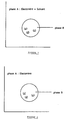
- FIG. 2 The structure of the dispersion of the gel in the film is illustrated in FIG. 2.
- EXAMPLE 2 Elastomer film according to the invention, based on SEBS, containing inclusions of a reversible gel comprising, as structuring polymer c , POE 5000 and containing no crosslinking agent d r r
- Example 2 The procedure is as in Example 1, replacing the polyisoprene with SEBS (Styrene Ethylene Butylene Styrene) of synthesis (with a total molecular mass of 53,000 Daltons and whose PS content is 29%).
- SEBS Styrene Ethylene Butylene Styrene
- SEBS is dissolved with stirring and at 30 ° C in a predominantly naphthenic solvent, so as to obtain a 15% by mass solution of SEBS.
- phase B (virucidal gel) and its dispersion in phase A defined above, are carried out according to the method described in Example 1.
- EXAMPLE 3 Elastomer film according to the invention, based on SEBS, containing inclusions of a reversible gel comprising, as structuring polymer c , POE 5000 and not comprising a crosslinking agent d r r
- the PEG400 content is reduced from 81% to 63.6% then to 45.5% compared to phase B, while the POE 5000 content is increased respectively to 27.4% then to 45.5%, the mass content of Bardac® being kept constant at 9% (also expressed as mass content compared to phase B).
- Bardac® can be used alone or as a mixture with other compounds having virucidal activity, for example chlorhexidine digluconate.
- EXAMPLE 4 Elastomer film according to the invention, based on SEBS, containing inclusions of a reversible gel comprising, as structuring polymer c , POE m , m being between 2,000 and 100,000 and not comprising crosslinking agent d r r
- Example 2 The procedure is as in Example 2, replacing the POE 5000 with another POE, of different molecular mass, that is POE m , m representing the total molecular mass and being between 2,000 and 100,000.
- the film obtained after evaporation of the solvent contains a homogeneous dispersion of gel inclusions, of size between 1 and 25 ⁇ m.
- EXAMPLE 5 Elastomer film according to the invention based on polyisoprene or SEBS, containing inclusions of a reversible gel comprising, as structuring polymer c , gelatin and comprising no crosslinking agent d r r .
- Example 2 The procedure is as in Example 1 or in Example 2, replacing the POE 5000 with gelatin, obtained by acid treatment of the collagen and of Bloom index of 175.
- phase B
- Gelatin is dissolved, with stirring at 60 ° C, in a mixture of Bardac® and ethylene glycol comprising 25% by mass of Bardac®.
- the clear solution formed contains 14.3% by mass of gelatin.
- the temperature of the medium corresponds to a temperature higher than the gel-liquid transition temperature, which is determined by abrupt variation of the viscosity of the mixture at this temperature and is, in the present case, 30-35 ° C. .
- a stable dispersion is obtained for at least 12 hours of virucidal gel, the particle size of which is on average from 1 to 10 ⁇ m.
- the elastomer film obtained by evaporation of the organic solvent at 20 ° C under atmospheric pressure, contains gel inclusions whose size is on average from 1 to 10 ⁇ m.
- Their composition is that of phase B, namely: 14.3% of gelatin, 64.3% of ethylene glycol, 21.4% of Bardac®.
- EXAMPLE 6 Elastomer film according to the invention based on polyisoprene or SEBS, containing inclusions of a reversible gel comprising, as structuring polymer c , gelatin and comprising no crosslinking agent d r r .
- Example 5 The procedure is as in Example 5, replacing the Bardac® with an iodized complex of polyvinylpyrrolidone (sold by the company Aldrich, under the reference 86.056-5).
- phase B
- Gelatin is dissolved, with stirring at 60 ° C, in a mixture containing iodized complex of polyvinylpyrrolidone, water and polyethylene glycol 400 in the following mass proportions: 14.5% gelatin, 72.7% water, 5.5% iodine complex and 7.3% polyethylene glycol 400.
- the clear blood red solution formed contains 14.5% by mass of gelatin.
- the temperature of the medium corresponds to a temperature higher than the gel-liquid transition temperature, which is determined by abrupt variation of the viscosity of the mixture at this temperature and is, in the present case, 30-35 ° C. .
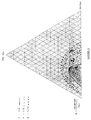
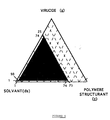
- the combinations of the mixture leading to a gel at room temperature are delimited by the phase diagram illustrated in FIG. 4, in which the shaded areas 1, 2 and 3 correspond to the claimed areas of composition: area 1, delimited by a solid line , corresponds to a gelatin / water mass ratio R of 1/4, domain 2, delimited by a broken line, corresponds to a gelatin / water mass ratio R of 1/8 and domain 3, delimited by points, corresponds to a gelatin / water mass ratio R of 1/16.
- the gel dispersion is prepared in a similar manner to that of Example 5, that is to say that 5.52% by mass of phase B thus formed is dispersed with respect to phase A; the dispersion thus produced is stable for 12 hours and the film contains inclusions of size between 1 and 25 ⁇ m.
- EXAMPLE 8 Elastomer film according to the invention based on polyisoprene or SEBS, containing inclusions of a reversible gel comprising, as structuring polymer c , polyvinyl alcohol and comprising a crosslinking agent d r r : borax.
- the structuring polymer c is polyvinyl alcohol of the Mowiol® 28-99 type, characterized by a molecular mass of 88,000 Daltons and a percentage of hydrolysis of 99%. Its viscosity in 4% solution in water is 28 mPa.s.
- phase A is analogous to that of Example 1 or of Example 2.
- phase B
- Mowiol® is dissolved with stirring and at 80 ° C. in water (solvent d s ), to obtain a 2.5% solution of Mowiol®.
- Triton X100® active chemical substance x
- phase B 5.52% by mass of phase B is added with stirring and at 30 ° C. relative to phase A.
- the gel is produced by adding borax , in mass content of 5% (expressed relative to the Mowiol® solution).
- a dispersion of virucidal gel which is stable for at least 12 hours is obtained, and the particle size of which is on average from 1 to 5 ⁇ m.
- the elastomer film obtained by evaporation of the organic solvent at 20 ° C under atmospheric pressure, contains gel inclusions whose size is on average from 1 to 5 ⁇ m.
- EXAMPLE 9 Elastomer film according to the invention based on polyisoprene or SEBS, containing inclusions of a non-reversible gel comprising, as structuring polymer c , polyvinyl alcohol and comprising a crosslinking agent d r i : glutaraldehyde.
- crosslinking agent is varied, by replacing borax with glutaraldehyde (irreversible crosslinking agent).
- phase B
- Mowiol® is dissolved with stirring and at 80 ° C. in water, to obtain a 2.5% solution of Mowiol®.
- Triton X100® To this solution is added, with stirring, Triton X100® until a clear solution containing 10% Triton® is obtained (expressed relative to the solution of Mowiol®).
- the gel is then produced by crosslinking the polyvinyl alcohol in an acid medium, by adding, with stirring, 0.475% (mass content expressed relative to the Mowiol® solution) of a 0.005% solution of glutaraldehyde (by mass ) in a water: hydrochloric acid mixture comprising 9 parts of water for one part of molar acid.
- a stable dispersion is obtained for at least 12 hours of virucidal gel, the particle size of which is on average from 1 to 5 ⁇ m.
- the elastomer film obtained by evaporation of the organic solvent at 20 ° C under atmospheric pressure, contains gel inclusions whose size is on average from 1 to 5 ⁇ m.
- EXAMPLE 10 Preparation of gloves, finger cots or condoms coated with an elastomer film according to the invention.
- the elastomeric film according to the invention is applied to a layer of elastomeric material previously shaped to the desired shape by the usual manufacturing techniques, as follows:
- At least the elastomer layer according to the invention is deposited, for example, on a ceramic, glass or similar material form defining the glove, the fingerprint or the condom to be manufactured. we proceed in particular as described in European Patent 0 306 389.
Landscapes
- Health & Medical Sciences (AREA)
- Chemical & Material Sciences (AREA)
- Life Sciences & Earth Sciences (AREA)
- Engineering & Computer Science (AREA)
- Surgery (AREA)
- Animal Behavior & Ethology (AREA)
- Veterinary Medicine (AREA)
- Medicinal Chemistry (AREA)
- Heart & Thoracic Surgery (AREA)
- Public Health (AREA)
- General Health & Medical Sciences (AREA)
- Molecular Biology (AREA)
- Manufacturing & Machinery (AREA)
- Vascular Medicine (AREA)
- Biomedical Technology (AREA)
- Epidemiology (AREA)
- Chemical Kinetics & Catalysis (AREA)
- Polymers & Plastics (AREA)
- Organic Chemistry (AREA)
- Medical Informatics (AREA)
- Materials Engineering (AREA)
- Manufacture Of Macromolecular Shaped Articles (AREA)
- Compositions Of Macromolecular Compounds (AREA)
- Apparatus For Disinfection Or Sterilisation (AREA)
- Orthopedics, Nursing, And Contraception (AREA)
- Medicinal Preparation (AREA)
Applications Claiming Priority (2)
| Application Number | Priority Date | Filing Date | Title |
|---|---|---|---|
| FR9512926A FR2740777B1 (fr) | 1995-11-02 | 1995-11-02 | Films d'elastomere contenant au moins une substance chimique active, leur procede de preparation et leurs applications |
| FR9512926 | 1995-11-02 |
Publications (2)
| Publication Number | Publication Date |
|---|---|
| EP0771837A1 true EP0771837A1 (de) | 1997-05-07 |
| EP0771837B1 EP0771837B1 (de) | 2003-03-19 |
Family
ID=9484151
Family Applications (1)
| Application Number | Title | Priority Date | Filing Date |
|---|---|---|---|
| EP96402292A Expired - Lifetime EP0771837B1 (de) | 1995-11-02 | 1996-10-29 | Elastomerfolien mit mindestens einem chemischen Wirkstoff, Verfahren zu ihrer Herstellung und ihre Verwendungen |
Country Status (5)
| Country | Link |
|---|---|
| US (1) | US5883155A (de) |
| EP (1) | EP0771837B1 (de) |
| JP (1) | JPH09208715A (de) |
| DE (1) | DE69626740D1 (de) |
| FR (1) | FR2740777B1 (de) |
Cited By (3)
| Publication number | Priority date | Publication date | Assignee | Title |
|---|---|---|---|---|
| WO1999047589A1 (fr) * | 1998-03-17 | 1999-09-23 | Hutchinson | Emulsions stables, leur procede de preparation et leurs applications |
| EP0971431A2 (de) | 1998-07-07 | 2000-01-12 | Nitto Denko Corporation | Gelartige Elektrolyt-Zusammensetzung, Verfahren zu ihrer Herstellung, und dieses gelartige Elektrolyt enthaltende Festelektrolytlaminat |
| EP1950765A1 (de) * | 2007-01-25 | 2008-07-30 | Hutchinson | Mehrschicht-Elastomermaterial verstärkt mit strahlungshemmenden Verbindungen, sein Herstellungsverfahren und seine Einsatzbereiche |
Families Citing this family (20)
| Publication number | Priority date | Publication date | Assignee | Title |
|---|---|---|---|---|
| BR0114521B1 (pt) * | 2000-10-05 | 2011-09-20 | processo para preparar uma dispersão estável, composição e formulação de espuma de poliuretano. | |
| US6916750B2 (en) | 2003-03-24 | 2005-07-12 | Kimberly-Clark Worldwide, Inc. | High performance elastic laminates made from high molecular weight styrenic tetrablock copolymer |
| US6874165B2 (en) * | 2003-05-19 | 2005-04-05 | Mao-Sheng Lee | Modified NBR gloves |
| US8012693B2 (en) * | 2003-12-16 | 2011-09-06 | 3M Innovative Properties Company | Analysis of chemically crosslinked cellular samples |
| US20060003656A1 (en) * | 2004-06-30 | 2006-01-05 | Kimberly-Clark Worldwide, Inc. | Efficient necked bonded laminates and methods of making same |
| US7651653B2 (en) * | 2004-12-22 | 2010-01-26 | Kimberly-Clark Worldwide, Inc. | Machine and cross-machine direction elastic materials and methods of making same |
| JP2006306937A (ja) * | 2005-04-26 | 2006-11-09 | Shoei Kagaku Kk | 抗菌性樹脂組成物、並びにこれを用いた樹脂成形体および管状樹脂成形体 |
| ATE548651T1 (de) * | 2005-06-16 | 2012-03-15 | 3M Innovative Properties Co | Verfahren zur klassifizierung chemisch quervernetzter zellulärer proben unter verwendung von massenspektren |
| JP6065528B2 (ja) * | 2012-02-28 | 2017-01-25 | 国立大学法人山口大学 | 遷移金属酸化物及び水溶性高分子化合物を含有する複合膜 |
| US9474768B1 (en) | 2016-05-18 | 2016-10-25 | Reoxcyn Discoveries Group, Inc. | Lubricant formulations |
| US11857674B2 (en) | 2016-05-18 | 2024-01-02 | Reoxcyn, Llc | Lubricant formulations |
| EP3978038A1 (de) | 2020-10-04 | 2022-04-06 | Elke Münch | Durch eine temperaturdifferenz betreibbare, mobile vorrichtung zur reinigung und desinfizierung von raumluft und eine testvorrichtung hierfür |
| DE102020125919B4 (de) | 2020-10-04 | 2022-06-23 | Elke Münch | Durch eine Temperaturdifferenz betreibbare, mobile Vorrichtung zur Reinigung und Desinfizierung von Raumluft und eine Testvorrichtung hierfür |
| DE102020125921B4 (de) | 2020-10-04 | 2022-05-19 | Elke Münch | Durch eine Temperaturdifferenz betreibbare, mobile Vorrichtung zur Reinigung und Desinfizierung von Raumluft |
| EP3981442A1 (de) | 2020-10-04 | 2022-04-13 | Elke Münch | Durch eine temperaturdifferenz betreibbare, mobile vorrichtung zur reinigung und desinfizierung von raumluft |
| DE102020125920B4 (de) | 2020-10-04 | 2022-05-19 | Elke Münch | Durch eine Temperaturdifferenz betreibbare, mobile Vorrichtung zur Reinigung und Desinfizierung von Raumluft |
| DE102020125922B4 (de) | 2020-10-04 | 2022-06-02 | Elke Münch | Mobile Vorrichtung zur Reinigung und Desinfizierung von Raumluft |
| DE102020006520A1 (de) | 2020-10-24 | 2022-04-28 | Magnetic Hyperthermia Solutions B.V. | Vorrichtung und Verfahren zur Attenuierung und/oderAbtötung von Mikroorganismen, Viren und Virionen |
| DE102022001868A1 (de) | 2022-05-29 | 2023-11-30 | Elke Hildegard Münch | Biozid beschichtete, retikulierte Schaumstoffe aus Kunststoff, Verfahren zu ihrer Herstellung und ihre Verwendung |
| DE102023113228A1 (de) | 2023-05-20 | 2024-11-21 | Elke Münch | Biozide und viruzide Luftfiltermaterialien, ihre Verwendung sowie Verfahren zu ihrer Herstellung und ihrer umweltfreundlichen Entsorgung |
Citations (4)
| Publication number | Priority date | Publication date | Assignee | Title |
|---|---|---|---|---|
| EP0306389A1 (de) | 1987-08-20 | 1989-03-08 | Hutchinson | Anwendung von Mikrokapseln zur Herstellung einer aus Elastomeren bestehenden Prophylaxevorrichtung, wie eines Präservativs oder dergleichen, und ihr Herstellungsverfahren |
| GB2263114A (en) * | 1991-12-19 | 1993-07-14 | Yad Hygiene Products Limited | Biocidal rubber latex products and methods of making same |
| EP0557625A1 (de) * | 1991-12-20 | 1993-09-01 | Robin Renee Thill Shlenker | Verfahren zum Herstellen von Latexgegenständen |
| WO1995017453A1 (fr) | 1993-12-23 | 1995-06-29 | Hutchinson | Film d'elastomere, son procede de preparation et ses applications |
Family Cites Families (5)
| Publication number | Priority date | Publication date | Assignee | Title |
|---|---|---|---|---|
| JPS55108428A (en) * | 1979-02-13 | 1980-08-20 | Kuraray Co Ltd | Water-containing gel substance |
| US5011875A (en) * | 1985-09-28 | 1991-04-30 | Hiroshima Kasei Ltd. | Corrosion resistant, water expandable composition |
| US5277915A (en) * | 1987-10-30 | 1994-01-11 | Fmc Corporation | Gel-in-matrix containing a fractured hydrogel |
| US4952618A (en) * | 1988-05-03 | 1990-08-28 | Minnesota Mining And Manufacturing Company | Hydrocolloid/adhesive composition |
| US5000955A (en) * | 1988-07-29 | 1991-03-19 | Tyndale Plains-Hunter Ltd. | Thermally reversible polyurethane hydrogels and cosmetic, biological and medical uses |
-
1995
- 1995-11-02 FR FR9512926A patent/FR2740777B1/fr not_active Expired - Lifetime
-
1996
- 1996-10-29 EP EP96402292A patent/EP0771837B1/de not_active Expired - Lifetime
- 1996-10-29 DE DE69626740T patent/DE69626740D1/de not_active Expired - Lifetime
- 1996-11-04 US US08/740,898 patent/US5883155A/en not_active Expired - Lifetime
- 1996-11-05 JP JP8292516A patent/JPH09208715A/ja active Pending
Patent Citations (4)
| Publication number | Priority date | Publication date | Assignee | Title |
|---|---|---|---|---|
| EP0306389A1 (de) | 1987-08-20 | 1989-03-08 | Hutchinson | Anwendung von Mikrokapseln zur Herstellung einer aus Elastomeren bestehenden Prophylaxevorrichtung, wie eines Präservativs oder dergleichen, und ihr Herstellungsverfahren |
| GB2263114A (en) * | 1991-12-19 | 1993-07-14 | Yad Hygiene Products Limited | Biocidal rubber latex products and methods of making same |
| EP0557625A1 (de) * | 1991-12-20 | 1993-09-01 | Robin Renee Thill Shlenker | Verfahren zum Herstellen von Latexgegenständen |
| WO1995017453A1 (fr) | 1993-12-23 | 1995-06-29 | Hutchinson | Film d'elastomere, son procede de preparation et ses applications |
Non-Patent Citations (1)
| Title |
|---|
| "Encyclopedia of Polymer Science and Engineering, 2nd edition", vol. 7 & SUPP, WILEY INTERSCIENCE |
Cited By (6)
| Publication number | Priority date | Publication date | Assignee | Title |
|---|---|---|---|---|
| WO1999047589A1 (fr) * | 1998-03-17 | 1999-09-23 | Hutchinson | Emulsions stables, leur procede de preparation et leurs applications |
| US6391326B1 (en) * | 1998-03-17 | 2002-05-21 | Hutchinson | Stable emulsions, preparation methods and applications |
| EP0971431A2 (de) | 1998-07-07 | 2000-01-12 | Nitto Denko Corporation | Gelartige Elektrolyt-Zusammensetzung, Verfahren zu ihrer Herstellung, und dieses gelartige Elektrolyt enthaltende Festelektrolytlaminat |
| EP0971431A3 (de) * | 1998-07-07 | 2005-03-30 | Nitto Denko Corporation | Gelartige Elektrolyt-Zusammensetzung, Verfahren zu ihrer Herstellung, und dieses gelartige Elektrolyt enthaltende Festelektrolytlaminat |
| EP1950765A1 (de) * | 2007-01-25 | 2008-07-30 | Hutchinson | Mehrschicht-Elastomermaterial verstärkt mit strahlungshemmenden Verbindungen, sein Herstellungsverfahren und seine Einsatzbereiche |
| FR2911991A1 (fr) * | 2007-01-25 | 2008-08-01 | Hutchinson Sa | Materiau elastomere multicouches charge en composes attenuateurs de radiations, son procede de preparation et ses utilisations |
Also Published As
| Publication number | Publication date |
|---|---|
| FR2740777A1 (fr) | 1997-05-09 |
| EP0771837B1 (de) | 2003-03-19 |
| FR2740777B1 (fr) | 1998-01-02 |
| DE69626740D1 (de) | 2003-04-24 |
| JPH09208715A (ja) | 1997-08-12 |
| US5883155A (en) | 1999-03-16 |
Similar Documents
| Publication | Publication Date | Title |
|---|---|---|
| EP0771837B1 (de) | Elastomerfolien mit mindestens einem chemischen Wirkstoff, Verfahren zu ihrer Herstellung und ihre Verwendungen | |
| FR2742761A1 (fr) | Film d'elastomere multicouche, son procede de preparation et ses applications | |
| EP0687283B1 (de) | Tröpfchen enthaltende elastomerfolie , ihr herstellungsverfahren und ihre verwendung | |
| FR2843069A1 (fr) | Materiau elastomere multicouches charge en substance chimique active et ses utilisations. | |
| EP0290166A2 (de) | Stabile Emulsionen | |
| EP0380428A1 (de) | Verfahren zur Herstellung von nichtklebenden Partikeln auf der Basis von einer Organopolysiloxanmischung, die durch Polyadditionsreaktionen vernetzt ist | |
| EP0981573B1 (de) | Stabile emulsionen, verfahren zu deren herstellung und ihre anwendungen | |
| FR2727416A1 (fr) | Nouveaux amorceurs cationiques thermoactivables, de polymerisation et/ou de reticulation et compositions monomeres et/ou polymeres fonctionnels les mettant en oeuvre | |
| WO2020025893A1 (fr) | Composition auto-cicatrisante | |
| LU83106A1 (fr) | Produits contenant des chaines polymeres a fonctions salines,leur preparation et leur utilisation | |
| EP0215082B1 (de) | Verfahren zur herstellung von lösungen von lignocellulosehaltigen materialien und die hergestellten lösungen | |
| EP1472315B1 (de) | Dünnfilm aus thermoplastischem elastomer, verfahren zur dessen herstellung und seine anwendungen | |
| FR2692812A1 (fr) | Microcapsules contenant au moins un principe actif, leurs applications et procédé de préparation de microcapsules renfermant au moins un principe actif. | |
| FR2743566A1 (fr) | Nouvelle resine parfumee permettant la diffusion reguliere d'une composition parfumee complexe | |
| WO2000037582A1 (fr) | Joint de valve ou de pompe | |
| FR2462184A1 (fr) | Nouvelles compositions antimousses sous forme de granules utilisables notamment dans les lessives en poudre | |
| EP0336468B1 (de) | Verfahren zur Herstellung einer Polypyrrol-Latex und Verwendung dieser Latex zur Herstellung filmförmiger Leiter | |
| EP1487569B1 (de) | Verfahren zur herstellung von bio-compatibel zusammengesetzten mikrokapseln | |
| FR2956345A1 (fr) | Procede de preparation de granules polymeres biodegradables charges en composes lipophiles actifs et produits biodegradables actifs obtenus | |
| EP1564225B1 (de) | Nicht-Gel Emulsion aus Hydroxyperoxyester | |
| EP0721327A1 (de) | Aerosol-zusammensetzung geeignet zur bildung einer vorzugsweise hydrierten membran, derart erhaltene vorzugsweise hydrierte membran und ihre anwendungen, insbesondere als verbandmaterial | |
| EP4626960A1 (de) | Verfahren zur herstellung einer mit wirkstoffen beladenen polymermatrix mittels eines gases, erzeugnis und zugehörige verwendung | |
| FR2673384A1 (fr) | Procede pour melanger un additif a un produit liquide ou pateux. | |
| OA11046A (fr) | Dispersion de microcapsules d'endosulfan | |
| BE635008A (de) |
Legal Events
| Date | Code | Title | Description |
|---|---|---|---|
| PUAI | Public reference made under article 153(3) epc to a published international application that has entered the european phase |
Free format text: ORIGINAL CODE: 0009012 |
|
| AK | Designated contracting states |
Kind code of ref document: A1 Designated state(s): BE DE ES FR GB IT LU NL SE |
|
| 17P | Request for examination filed |
Effective date: 19971027 |
|
| GRAH | Despatch of communication of intention to grant a patent |
Free format text: ORIGINAL CODE: EPIDOS IGRA |
|
| GRAH | Despatch of communication of intention to grant a patent |
Free format text: ORIGINAL CODE: EPIDOS IGRA |
|
| GRAA | (expected) grant |
Free format text: ORIGINAL CODE: 0009210 |
|
| AK | Designated contracting states |
Designated state(s): BE DE ES FR GB IT LU NL SE |
|
| PG25 | Lapsed in a contracting state [announced via postgrant information from national office to epo] |
Ref country code: NL Free format text: LAPSE BECAUSE OF FAILURE TO SUBMIT A TRANSLATION OF THE DESCRIPTION OR TO PAY THE FEE WITHIN THE PRESCRIBED TIME-LIMIT Effective date: 20030319 Ref country code: IT Free format text: LAPSE BECAUSE OF FAILURE TO SUBMIT A TRANSLATION OF THE DESCRIPTION OR TO PAY THE FEE WITHIN THE PRE;WARNING: LAPSES OF ITALIAN PATENTS WITH EFFECTIVE DATE BEFORE 2007 MAY HAVE OCCURRED AT ANY TIME BEFORE 2007. THE CORRECT EFFECTIVE DATE MAY BE DIFFERENT FROM THE ONE RECORDED.SCRIBED TIME-LIMIT Effective date: 20030319 Ref country code: GB Free format text: LAPSE BECAUSE OF FAILURE TO SUBMIT A TRANSLATION OF THE DESCRIPTION OR TO PAY THE FEE WITHIN THE PRESCRIBED TIME-LIMIT Effective date: 20030319 |
|
| REG | Reference to a national code |
Ref country code: GB Ref legal event code: FG4D Free format text: NOT ENGLISH |
|
| REF | Corresponds to: |
Ref document number: 69626740 Country of ref document: DE Date of ref document: 20030424 Kind code of ref document: P |
|
| PG25 | Lapsed in a contracting state [announced via postgrant information from national office to epo] |
Ref country code: SE Free format text: LAPSE BECAUSE OF FAILURE TO SUBMIT A TRANSLATION OF THE DESCRIPTION OR TO PAY THE FEE WITHIN THE PRESCRIBED TIME-LIMIT Effective date: 20030619 |
|
| PG25 | Lapsed in a contracting state [announced via postgrant information from national office to epo] |
Ref country code: DE Free format text: LAPSE BECAUSE OF FAILURE TO SUBMIT A TRANSLATION OF THE DESCRIPTION OR TO PAY THE FEE WITHIN THE PRESCRIBED TIME-LIMIT Effective date: 20030621 |
|
| NLV1 | Nl: lapsed or annulled due to failure to fulfill the requirements of art. 29p and 29m of the patents act | ||
| GBV | Gb: ep patent (uk) treated as always having been void in accordance with gb section 77(7)/1977 [no translation filed] |
Effective date: 20030319 |
|
| PG25 | Lapsed in a contracting state [announced via postgrant information from national office to epo] |
Ref country code: ES Free format text: LAPSE BECAUSE OF FAILURE TO SUBMIT A TRANSLATION OF THE DESCRIPTION OR TO PAY THE FEE WITHIN THE PRESCRIBED TIME-LIMIT Effective date: 20030930 |
|
| PG25 | Lapsed in a contracting state [announced via postgrant information from national office to epo] |
Ref country code: LU Free format text: LAPSE BECAUSE OF NON-PAYMENT OF DUE FEES Effective date: 20031029 |
|
| PG25 | Lapsed in a contracting state [announced via postgrant information from national office to epo] |
Ref country code: BE Free format text: LAPSE BECAUSE OF NON-PAYMENT OF DUE FEES Effective date: 20031031 |
|
| PLBE | No opposition filed within time limit |
Free format text: ORIGINAL CODE: 0009261 |
|
| STAA | Information on the status of an ep patent application or granted ep patent |
Free format text: STATUS: NO OPPOSITION FILED WITHIN TIME LIMIT |
|
| 26N | No opposition filed |
Effective date: 20031222 |
|
| BERE | Be: lapsed |
Owner name: *HUTCHINSON Effective date: 20031031 |
|
| PG25 | Lapsed in a contracting state [announced via postgrant information from national office to epo] |
Ref country code: FR Free format text: LAPSE BECAUSE OF NON-PAYMENT OF DUE FEES Effective date: 20040630 |
|
| REG | Reference to a national code |
Ref country code: FR Ref legal event code: ST |