EP0772049A2 - Procédé de fabrication de sondes - Google Patents
Procédé de fabrication de sondes Download PDFInfo
- Publication number
- EP0772049A2 EP0772049A2 EP96117329A EP96117329A EP0772049A2 EP 0772049 A2 EP0772049 A2 EP 0772049A2 EP 96117329 A EP96117329 A EP 96117329A EP 96117329 A EP96117329 A EP 96117329A EP 0772049 A2 EP0772049 A2 EP 0772049A2
- Authority
- EP
- European Patent Office
- Prior art keywords
- substrate
- flexible substrate
- probe
- rigid
- heating
- Prior art date
- Legal status (The legal status is an assumption and is not a legal conclusion. Google has not performed a legal analysis and makes no representation as to the accuracy of the status listed.)
- Withdrawn
Links
Images



Classifications
-
- G—PHYSICS
- G01—MEASURING; TESTING
- G01R—MEASURING ELECTRIC VARIABLES; MEASURING MAGNETIC VARIABLES
- G01R3/00—Apparatus or processes specially adapted for the manufacture or maintenance of measuring instruments, e.g. of probe tips
-
- G—PHYSICS
- G01—MEASURING; TESTING
- G01R—MEASURING ELECTRIC VARIABLES; MEASURING MAGNETIC VARIABLES
- G01R1/00—Details of instruments or arrangements of the types included in groups G01R5/00 - G01R13/00 and G01R31/00
- G01R1/02—General constructional details
- G01R1/06—Measuring leads; Measuring probes
- G01R1/067—Measuring probes
- G01R1/073—Multiple probes
- G01R1/07307—Multiple probes with individual probe elements, e.g. needles, cantilever beams or bump contacts, fixed in relation to each other, e.g. bed of nails fixture or probe card
- G01R1/07314—Multiple probes with individual probe elements, e.g. needles, cantilever beams or bump contacts, fixed in relation to each other, e.g. bed of nails fixture or probe card the body of the probe being perpendicular to test object, e.g. bed of nails or probe with bump contacts on a rigid support
-
- Y—GENERAL TAGGING OF NEW TECHNOLOGICAL DEVELOPMENTS; GENERAL TAGGING OF CROSS-SECTIONAL TECHNOLOGIES SPANNING OVER SEVERAL SECTIONS OF THE IPC; TECHNICAL SUBJECTS COVERED BY FORMER USPC CROSS-REFERENCE ART COLLECTIONS [XRACs] AND DIGESTS
- Y10—TECHNICAL SUBJECTS COVERED BY FORMER USPC
- Y10T—TECHNICAL SUBJECTS COVERED BY FORMER US CLASSIFICATION
- Y10T29/00—Metal working
- Y10T29/49—Method of mechanical manufacture
- Y10T29/49002—Electrical device making
- Y10T29/49117—Conductor or circuit manufacturing
-
- Y—GENERAL TAGGING OF NEW TECHNOLOGICAL DEVELOPMENTS; GENERAL TAGGING OF CROSS-SECTIONAL TECHNOLOGIES SPANNING OVER SEVERAL SECTIONS OF THE IPC; TECHNICAL SUBJECTS COVERED BY FORMER USPC CROSS-REFERENCE ART COLLECTIONS [XRACs] AND DIGESTS
- Y10—TECHNICAL SUBJECTS COVERED BY FORMER USPC
- Y10T—TECHNICAL SUBJECTS COVERED BY FORMER US CLASSIFICATION
- Y10T29/00—Metal working
- Y10T29/49—Method of mechanical manufacture
- Y10T29/49002—Electrical device making
- Y10T29/49117—Conductor or circuit manufacturing
- Y10T29/49124—On flat or curved insulated base, e.g., printed circuit, etc.
- Y10T29/49155—Manufacturing circuit on or in base
-
- Y—GENERAL TAGGING OF NEW TECHNOLOGICAL DEVELOPMENTS; GENERAL TAGGING OF CROSS-SECTIONAL TECHNOLOGIES SPANNING OVER SEVERAL SECTIONS OF THE IPC; TECHNICAL SUBJECTS COVERED BY FORMER USPC CROSS-REFERENCE ART COLLECTIONS [XRACs] AND DIGESTS
- Y10—TECHNICAL SUBJECTS COVERED BY FORMER USPC
- Y10T—TECHNICAL SUBJECTS COVERED BY FORMER US CLASSIFICATION
- Y10T29/00—Metal working
- Y10T29/49—Method of mechanical manufacture
- Y10T29/49826—Assembling or joining
- Y10T29/49863—Assembling or joining with prestressing of part
- Y10T29/49865—Assembling or joining with prestressing of part by temperature differential [e.g., shrink fit]
-
- Y—GENERAL TAGGING OF NEW TECHNOLOGICAL DEVELOPMENTS; GENERAL TAGGING OF CROSS-SECTIONAL TECHNOLOGIES SPANNING OVER SEVERAL SECTIONS OF THE IPC; TECHNICAL SUBJECTS COVERED BY FORMER USPC CROSS-REFERENCE ART COLLECTIONS [XRACs] AND DIGESTS
- Y10—TECHNICAL SUBJECTS COVERED BY FORMER USPC
- Y10T—TECHNICAL SUBJECTS COVERED BY FORMER US CLASSIFICATION
- Y10T29/00—Metal working
- Y10T29/49—Method of mechanical manufacture
- Y10T29/49826—Assembling or joining
- Y10T29/49863—Assembling or joining with prestressing of part
- Y10T29/49867—Assembling or joining with prestressing of part of skin on frame member
Definitions
- the present invention relates to a method for fabrication of sheet probe structures (hereinafter “probe”) for determination of various electric performances and circuit testing, particularly testing at high temperatures such as burn-in test, of small test objects.
- probe sheet probe structures
- semiconductor elements to be mounted thereon have been desired to be smaller in size, and the mounting area of the semiconductor element has been demanded to be minimized to the greatest possible extent.
- a bare chip mounting has been employed, wherein semiconductor elements after formation in plurality on a silicon wafer or upon parting in smaller units (hereinafter semiconductor elements in this stage are to be referred to as bare chips) are mounted without packaging. This mode of mounting is considered to prevail rapidly. Even mounting with a wafer will be practiced soon. Therefore, various quality determinations and testing of semiconductor elements, particularly testing at high temperatures such as burn-in test, should be conducted on bare chips or pre-bare chip, i.e. on-wafer, stage products.
- a sheet probe While small test objects such as bare chips and wafers contain elaborately formed contact targets such as electrodes and conductors, electric contact is most preferably made by a sheet probe.
- Such sheet probe generally contains a contact part formed on one side of an insulating flexible substrate and a circuit pattern formed on either side or inside of said flexible substrate, the two being electrically continued.
- the contact part is a point where electric contact is made with respect to its contact target, and is generally a protruding good metal conductor called a bump contact, or simply a bump.
- a probe manufactured by a conventional method When subjected to a burn-in test generally performed at about 120-150°C, sometimes at about 200°C, a probe manufactured by a conventional method is susceptible to a contact failure or checkout failure as a result of dislocation of bump contact of the probe after temperature rise, though the bump contact was originally in contact with the contact target on a test object at room temperature when the test was started, due to significantly different coefficients of linear expansion between the test object and the probe, thereby impairing the reliability of the probe as a test tool.
- the bump contact drawn for several dozens of microns while being in contact with the contact object causes flaw on the contact target and degrades its product value, or conversely, the bump contact may be damaged by the contact target to shorten its service life as a test tool.
- the fabrication method of the present invention is characterized by a step (1) for forming a structure wherein a contact part formed on one side of an insulating flexible substrate and a conductor formed on either side or inside of said flexible substrate are electrically continued, and a step (2) for joining said flexible substrate and a frame rigid substrate capable of supporting a tension in the planar direction of said flexible substrate at the outer periphery thereof, by bonding them by lamination press after heating, or by heating after lamination press, thereby applying a planar tension to the flexible substrate enclosed by the rigid substrate.
- Fig. 1(a), Fig. 1(b) and Fig. 1(c) schematically show one example of fabrication of the probe of the present invention.
- Fig. 2(a), Fig. 2(b) and Fig. 2(c) schematically show one preferable method for applying a tension as a result of contraction of the flexible substrate.
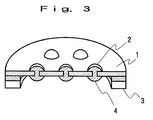
- Fig. 3 shows one example of the rigid substrate to be used in the present invention.
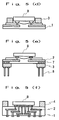
- Fig. 4(a), Fig. 4(b) and Fig. 4(c) show one example of the probe manufactured by the present invention.
- Fig. 5(d), Fig. 5(e) and Fig. 5(f) show another example of the probe manufactured by the present invention.
- an important step is to bond a rigid frame substrate to the flexible substrate by the use of heating and lamination press, thereby to apply a tension on the flexible substrate.
- This enables fabrication of a probe wherein the flexible substrate is stretched relative to the rigid frame substrate.
- the tension is generally a difference in the amount of expansion between the rigid substrate and the flexible substrate, or difference in the amount of shrinkage upon heating, as detailedly described in the following (1) and (2).
- the flexible substrate can be easily and preferably stretched relative to the rigid frame substrate.
- the flexible substrate stretched relative to the rigid frame substrate is free of noticeable dislocation of the contact part of the probe from the contact target, even under expansion at high temperatures such as in burn-in test, since variation in the amount of expansion is absorbed by variation in tension thus imparted.
- a material showing expansion at a temperature higher than 200°C or a material adapted to shrink at a temperature higher than 200°C is preferably used for both the flexible substrate and rigid substrate, and the substrates are heated and bonded by lamination press.
- the above-mentioned effect can be achieved in a burn-in test as well, wherein the temperature reaches 200°C, by preparing the substrates under the above conditions of fabrication.
- the linear expansion coefficient of the material used for the rigid substrate is suitably determined to intentionally cause relative dislocation of the contact target to a desired extent from probe contact part.
- a certain combination of the probe and test substrate results in penetration of an oxide film formed on the surface of the contact target, thus ensuring more preferable contact performance.
- Fig. 1 showing one example of the fabrication method of the present invention
- the conductor is a circuit pattern
- bump contacts are formed at the end of the fabrication process.
- This Figure shows a section of a product and only the lines visible in the section.
- Fig. (a) is a step for forming a circuit pattern 2 (conductor) on a flexible substrate 1.
- Fig. (b) is a step for joining the flexible substrate 1 and a rigid substrate 3 by heating and lamination press to apply a tension to the flexible substrate.
- an adhesive layer 5 is interposed.
- the flexible substrate and the rigid substrate are heated first to cause expansion, and then bonded by lamination press.
- the flexible substrate and the rigid substrate are bonded by lamination press before heating, and then heated to the shrinkage temperature and joined.
- Fig. 1(c) is a step for forming a bump contact 4 which becomes a contact part.
- the material used for the flexible substrate may be any as long as it has electric insulating property and flexibility and shows greater expansion or shrinkage than rigid substrate upon heating.
- the material which expands by heating include polyester resin, epoxy resin, urethane resin, polystyrene resin, polyethylene resin, polyamide resin, polyimide resin, ABS resin, polycarbonate resin, silicone resin, fluororesin and the like, which may be thermosetting or thermoplastic.
- polyimide resin which still expands even at a temperature higher than 200°C and shows superior insulating property.
- a suitable material which shrinks upon heating is, for example, a material having a glass transition temperature which is higher than atmospheric temperature, and which has undergone drawing treatment at ambient temperature. Such material shrinks by heating to the glass transition temperature as a result of the release of a stress.
- a glass transition temperature higher than 200°C can stand burn-in tests at high temperatures and is preferably used.
- a tension can be applied to a flexible substrate prepared from a thermosetting resin which shrinks with progression of curing, by maintaining the semi-cured state of the resin material, and heating, after bonding the substrate to a rigid substrate by lamination press, to a complete curing of the resin, thereby giving a tension by shrinkage.
- a resin containing a solvent is heated to a temperature higher than the boiling point of the solvent to evaporate said solvent, and the flexible substrate is allowed to shrink, thereby to apply a tension.
- the method schematically shown in Fig. 2 may be preferably used for applying a tension as a result of shrinkage of the flexible substrate.
- a polyimide precursor is applied to a plate metal foil (e.g., copper foil) 2a to be a conductor, and heated to evaporate the solvent and cure polyimide, whereby a laminate of metal foil and flexible substrate 1 is obtained.
- the flexible substrate tends to shrink with the progress of curing of polyimide, but is hindered by the metal foil and leaves a residual stress inside the flexible substrate, which stress being directed toward shrinkage.
- a rigid substrate 3 is bonded to this laminate by heating.
- an adhesive layer 5 is interposed as in Fig. 1. It is preferable that the rigid substrate be heated at a temperature higher than the glass transition temperature for bonding and the residual stress in the flexible substrate which is directed toward shrinkage be made greater.
- a bump contact is formed at a predetermined position on the flexible substrate, as shown in Fig. 2(b).
- the metal foil is partly removed and subdivided in the planar direction to form a circuit pattern, whereby obstacle for shrinking is removed and the residual stress is completely released.
- the flexible substrate shrinks and a tension is applied to the flexible substrate to give the probe of the present invention.
- the amount of shrinkage produced by the progress of curing of polyimide which is the material of the flexible substrate be greater than that produced when the metal foil is cooled after heating.
- the conductor When the conductor is a circuit pattern, the conductor is formed such that it corresponds to the position where the bump contact is to be formed, and any desired number of circuits independent from each other may be formed.
- the mode of circuit pattern is arbitrarily selected from the options comprising a circuit pattern corresponding to respective bump contacts and independent from other circuit patterns, a single conductor layer wherein the entire part is electrically continued, and the like.
- Said circuit pattern becomes a conductor to connect bump contacts with external circuits, such as a connection at the outer periphery of said probe.
- the conductor itself may become a bump contact, wherein the flexible substrate has bump contacts on both sides.
- the material thereof is preferably copper, nickel, solder, gold, silver, alloys such as alloy 42 and phosphorus-bronze, and the like.
- the circuit pattern may be formed by a known method such as subtractive method and additive method.
- the subtractive method leaves only circuit patterns by etching a laminate of substrate and conductor.
- the additive method includes directly drawing a circuit pattern on the substrate by evaporation and the like.
- a circuit pattern is formed inside of the flexible subtractive by forming a circuit pattern on a flexible substrate to be a base by the above-mentioned method, and coating same with a material having flexibility and insulating property.
- the material used for the flexible substrate to be the base and the material to be used for the coating may be the same or different.
- the rigid substrate may be any as long as it can support the tension in the planar direction (plane extending direction) to be applied to the flexible substrate.
- a linear expansion coefficient of the rigid substrate in this temperature range of 1-8 ppm provides a preferable outer frame for stretching a flexible substrate, which frame being subject to less dimensional changes relative to the test substrate.
- the linear expansion coefficient of the rigid substrate is most preferably set to the linear expansion coefficient of the test substrate.
- a material having a suitable linear expansion coefficient relative to that of the test substrate is used.
- the material of the rigid substrate is exemplified by ceramics such as alumina, silicon nitride and silicon carbide, alloys such as alloy 42, and the like.
- Fig. 3 is a perspective view showing a section of one embodiment thereof.
- a rigid circular ring substrate 3 is used as a frame and a flexible substrate 1 is stretched thereon.
- a conductor 2 and a contact part 4 are both bump contacts.
- the junction plane between the rigid frame substrate and the flexible substrate may be a continuous ring or an interrupted frame like a broken line, as long as the flexible substrate can be extended over the inner region enclosed by the frame.
- the rigid frame substrate may have a shape identical with the outer shape of the test substrate, where the test substrate is retained and positioned by the outer shape of the test substrate.
- the junction between the rigid frame substrate and the flexible substrate may be achieved by any method as long as it involves heating and lamination press.
- the method may be adhesion using an adhesive, lamination press using heat bonding, a method comprising sandwiching a flexible substrate between a pair of rigid substrates and joining them with a screw before or after heating, or other method.
- the adhesive is particularly preferably one having heat resistance to stand the high temperature of burn-in test, such as polyimide adhesives.
- the method for adhering is a general method wherein a liquid adhesive is applied onto the flexible substrate or rigid substrate before lamination press, followed by drying, or adhering an adhesive film.
- a flexible substrate having plural layers may be used and a thermoplastic polyimide is integrally laminated on the resin layer to be the base of the substrate and used as an adhesive layer, or the resin to be the base of the substrate may be formed from a thermoplastic polyimide and used as an adhesive layer.
- Lamination press includes conventional steps. For example, pressure is preferably continuously applied until the completion of the adhesion, from application of lamination heat to cooling.
- the contact part may be any as long as it can be electrically connected to the contact target of the test substrate. In general, it has a protrusion of bump contact (or simply bump) of good conductor metal.
- the contact part may not necessarily protrude from the flexible substrate surface, and may form the same plane with the flexible substrate or may be a concave depending on the shape of the mating contact part.
- the bump contact is explained in the following.
- the material of the bump contact is exemplified by gold, silver, copper, lead, chromium, zinc, aluminum, nickel, iron, platinum, palladium, rhodium, ruthenium and the like.
- the bump contact may be made from a single metal or may be a laminate of different metals. When a laminate of different metals is used, the outermost metal is preferably one having a Knoop hardness of 700-1200 Hk, such as rhodium and ruthenium.
- the bump contact and conductor in a general probe are formed at the positions in the front/reverse or surface/deep layer relations with respect to the flexible substrate where the bump contact and conductor are positioned right below each other, and electrically continued through a through-hole formed in the flexible substrate.
- One example of configuration method of a bump contact having such continuity structure is schematically explained in the following.
- a conductor 2 is formed on either side of flexible substrate 1 or inside thereof.
- a through-hole is formed at the position of the conductor (when the conductor is formed inside of the substrate, the position precisely corresponding to the position right above), and the conductor is exposed at the bottom of the inside of the through-hole.
- a good conductor metal to be the material of bump contact is deposited in the through-hole to fill the hole and allowed to deposit until it protrudes from the surface of the flexible substrate to form a bump contact 4, as shown in Fig. 1(c).
- the through-hole is formed in the flexible substrate by wet etching comprising chemical etching using chemicals and solvents, or dry etching using laser (e.g., carbon dioxide gas laser, YAG laser and eximer laser), plasma and the like.
- laser e.g., carbon dioxide gas laser, YAG laser and eximer laser
- etching using a laser is preferable.
- Fig. 1 The order of the processing steps shown in Fig. 1 is not fixed, and they may be performed in an optional order.
- the steps of Fig. 1(a) and Fig. 1(c) may be performed first to complete a general probe, and then bonding of the flexible substrate and rigid substrate of Fig. 1(b) may be done as a final step.
- the bump contact is preferably formed using the rigid substrate as a reference position.
- Fig. 4(a) has the same structure as Fig. 1 wherein a rigid substrate 3 is integrally formed on the outer periphery of the flexible substrate 1.
- B is a test substrate.
- Fig. 4(b) shows a frame formed by making a concave in the center of the rigid substrate 3. In this concave, a compliance 6 is set.
- Fig. 4(c) shows a bare chip test substrate B which is brought into contact with a solder bump contact.
- the contact target is a protrusion
- the contact part 4 on the probe side is a lead, namely, a circuit pattern 2 exposed to give a small flat contact plane.
- Fig. 5(d) shows a test substrate B which is the same as that in Fig. 4(c).
- a rigid substrate 3 is formed on the test substrate side relative to the flexible substrate 1, and the through-hole in the center of the rigid substrate has a shape capable of retaining the test substrate by holding same at its outer periphery, which shape being used as an alignment hole for positioning the test substrate.
- Fig. 5(e) shows a rigid substrate having a conductor circuit (not shown) inside of the substrate, and a connector 8 which can be connected to an outside equipment.
- a circuit pattern 2 of the flexible substrate and the conductor circuit inside the rigid substrate are connected via a conductive path 7.
- Fig. 5(f) shows an embodiment wherein a rigid substrate is formed on the test substrate side, wherein the flexible substrate is a multi-layer circuit substrate.
- a flexible substrate was made to shrink by heating the same for bonding to a rigid substrate.
- a polyimide precursor solution (solvent: NMP, N-methyl-2-pyrrolidone) was prepared by polymerization of s-biphenyltetracarboxylic dianhydride (100 moles) with 4,4'-diaminodiphenyl ether (30 moles) and p-phenylenediamine (70 moles). This solution was casted on a copper foil, dried, cured for imidation to give a flexible substrate having a conductor layer (a laminate of copper foil and polyimide film). The linear expansion coefficient of the substrate as a whole was 18 ppm, and that of polyimide film alone was 22 ppm. This polyimide film had a glass transition temperature in the vicinity of 285°C, and shrinkage was 0.6% after heating the film to 300°C.
- a photo resist was applied to the surface of the above-mentioned copper foil, and a predetermined circuit pattern was formed by exposure, developing, copper etching and resist peeling, which pattern being designed to precisely pass the position corresponding to the position where a bump contact was to be formed.
- a through-hole having an inner diameter of 80 ⁇ m was formed in the polyimide film by irradiation of carbon dioxide gas laser by a mask projection+galvanoscanning method at the position where a bump contact was to be formed, whereby the circuit pattern was exposed at the bottom of the through-hole.
- a resist membrane against plating was applied to the surface of the circuit pattern except the portion exposed at the bottom of the through-hole, and Ni was deposited in the through-hole by electroplating using the circuit pattern as a negative electrode to fill the hole.
- the electroplating was continued to form a protrusion having a height from the surface of the substrate of 20 ⁇ m, and the protrusion was plated with gold in the thickness of 1 ⁇ m, which was followed by rhodium plating in the thickness of 1 ⁇ m and peeling of the resist membrane to give a probe part.
- a ring frame (outer diameter 240 mm, inner diameter 220 mm, thickness 1 mm) was formed from ceramic and used as a rigid substrate.
- the linear expansion coefficient was 7 ppm.
- a polyimide adhesive film punched out into a frame product having the same shape with the rigid substrate was interposed between the rigid substrate and the flexible substrate and heated to 200°C.
- the laminate was bonded by lamination press in the laminating direction to give the probe of the present invention.
- the lamination conditions were 300°C ⁇ 1 hr and 50 kg/cm 2 .
- the pressure was continuously applied after heating until the completion of cooling.
- the flexible substrate of the probe thus stretched, which was enclosed by the rigid substrate, was in tension in the planar direction, and stretched uniformly relative to the rigid substrate.
- the linear expansion coefficient of the probe at room temperature - 200°C was determined with respect to the portion of the flexible substrate in tension and found to be 4 ppm.
- a 6 inch wafer as a test substrate was brought into close contact with the probe and subjected to a burn-in test at room temperature - 150°C. As a result, no trace of dislocation of bump was found at the contact part on the wafer side, and no damage was found on the bump surface.
- Example 1 the same steps were involved as in Example 1 except that the circuit pattern was formed inside the flexible substrate, and sizes and materials of respective parts were different.
- Example 2 In the same manner as in Example 1, a circuit pattern was formed on one side of a flexible substrate, and covered with a polyimide coating except an outside contact terminal.
- a through-hole having an inner diameter of 30 ⁇ m was formed in the polyimide film by irradiation of an eximer laser (wavelength 248 nm) by a mask projection method at the position where a bump contact was to be formed, whereby the circuit pattern was exposed at the bottom of the through-hole.
- a resist membrane against plating was applied to the outside contact terminal of the circuit pattern, and Ni was deposited in the through-hole to fill the hole by electroplating using the circuit pattern as a negative electrode.
- the electroplating was continued to form a protrusion having a height from the surface of the substrate of 25 ⁇ m, and the protrusion was plated with gold in the thickness of 1 ⁇ m, which was followed by rhodium plating in the thickness of 1 ⁇ m and peeling of the resist membrane to give a probe part.
- a rigid substrate made from alloy 42 and having an opening of the size of the test substrate bare chip (outer size 12 mm ⁇ 7 mm) plus 5 mm circumferential gap was prepared to give a frame of outer size 40 mm ⁇ 40 mm and thickness 0.5 mm.
- a polyimide adhesive film punched out into a frame product having the same shape with the rigid substrate was interposed between the rigid substrate and the flexible substrate, heated, and bonded by lamination press to give the probe of the present invention.
- the lamination conditions were 180°C ⁇ 1 hr and 50 kg/cm 2 .
- the pressure was continuously applied from initiation of heating to the completion of cooling.
- the flexible substrate of the probe thus obtained which was enclosed by the rigid substrate, was in tension in the planar direction, and stretched uniformly relative to the rigid substrate.
- the linear expansion coefficient of the probe at room temperature - 200°C was determined with respect to the portion of the flexible substrate in tension and found to be 6.5 ppm.
- a bare chip as a test substrate was brought into close contact with the probe and subjected to a burn-in cycle at room temperature - 125°C. As a result, no trace of dislocation of bump was found at the contact point on the bare chip side, and no damage was found on the bump surface.
- the flexible substrate was made to shrink by heating for joining the flexible substrate and the rigid substrate.
- a polyimide precursor solution (solvent: NMP, N-methyl-2-pyrrolidone) was prepared by polymerization of s-biphenyltetracarboxylic dianhydride (100 moles) with 4,4'-diaminodiphenyl ether (30 moles) and p-phenylenediamine (70 moles). This solution was casted on a copper foil, dried, cured for imidation to give a flexible substrate having a conductor layer (a laminate of copper foil and polyimide film).
- the linear expansion coefficient of the substrate was 18 ppm and the dimensional shrinkage between before and after complete removal of the copper foil was 0.1%.
- This polyimide film had a glass transition temperature in the vicinity of 285°C, and shrinkage was 0.6% after heating the film to 300°C.
- a polyimide adhesive film punched out into a frame product having the same shape with the rigid substrate was interposed between a flexible substrate and a ceramic frame formed in outer diameter 240 mm, inner diameter 220 mm and thickness 1 mm and having a linear expansion coefficient of 7 ppm, heated, and bonded by lamination press in the laminating direction to give the probe of the present invention.
- the lamination conditions were 250°C ⁇ 1 hr and 50 kg/cm 2 .
- the pressure was continuously applied after heating until the completion of cooling.
- a photo resist was applied to the copper surface of the substrate. Exposure, developing, copper etching and resist peeling gave a predetermined circuit pattern.
- a through-hole reaching the copper foil was formed in the polyimide film at the predetermined position by the irradiation of carbon dioxide gas laser by a mask projection+galvanoscanning method.
- a resist against plating was applied to the opposite side of the copper foil from the polyimide film, and Ni was deposited to fill the through-hole by electroplating.
- a protrusion having a height of 30 ⁇ m was formed, and the protrusion was plated with gold in the thickness of 1 ⁇ m, which was followed by rhodium plating in the thickness of 1 ⁇ m.
- the obtained substrate was again sandwiched between lamination presses and applied with a pressure.
- the substrate was heated to 300°C in this state, cooled to room temperature to make the flexible substrate shrink to apply a tension.
- the linear expansion coefficient of the probe at room temperature - 200°C was determined with respect to the polyimide film and found to be 4 ppm.
- a 6 inch wafer was brought into close contact with the probe and subjected to a burn-in cycle at room temperature - 150°C. As a result, no trace of dislocation of bump was found at the contact part on the wafer side, and no damage was found on the bump surface.
- the flexible substrate was prohibited from shrinking by the presence of a conductor layer, but allowed to shrink in the final step by etching the conductor.
- a polyimide precursor solution (solvent: NMP, N-methyl-2-pyrrolidone) was prepared by polymerization of pyrromellitic dianhydride with 4,4'-diaminodiphenyl ether. This solution was casted on a copper foil, dried, cured for imidation to give a flexible substrate having a conductor layer (a laminate of copper foil and polyimide film).
- the linear expansion coefficient of the substrate was 20 ppm.
- the shrinkage was 0.4% between before and after complete removal of copper foil of the substrate by etching.
- a polyimide adhesive solution was applied to one side of a ceramic frame formed in outer diameter 240 mm, inner diameter 220 mm and thickness 1 mm and having a linear expansion coefficient of 7 ppm and dried. After heating the above-mentioned flexible substrate, the frame was bonded by lamination press. The lamination conditions were 250°C ⁇ 1 hr and 20 kg/cm 2 . The pressure was continuously applied after heating until the completion of cooling.
- a through-hole reaching the copper foil was formed in the flexible substrate at the predetermined position by irradiation of an eximer laser (wavelength 248 nm) by a mask projection method.
- a resist against plating was applied to the surface of the copper foil except the inside of the through-hole, and Ni and then gold were successively plated inside the through-hole by electroplating.
- a protrusion having a height of 20 ⁇ m was formed, and the protrusion was plated with gold in the thickness of 1 ⁇ m.
- the copper foil was all removed except the circuit pattern by alkali etching to release all shrinking stress which remained inside the flexible substrate and to allow the flexible substrate to shrink, whereby a desired probe was obtained.
- the linear expansion coefficient of the probe at room temperature - 200°C was determined and found to be 7 ppm.
- a 6 inch wafer was brought into close contact with the probe and subjected to a burn-in cycle at room temperature - 150°C. As a result, no trace of dislocation of bump was found at the contact point on the wafer side, and no damage was found on the bump surface.
- Example 2 In the same manner as in Example 2 except that a glass epoxy substrate was used instead of alloy 42 as a rigid substrate, a probe was obtained.
- the flexible substrate of the obtained probe was corrugated and free of stress.
- a bare chip was brought into close contact with the probe and subjected to a burn-in cycle at room temperature - 125°C. As a result, a flaw caused by the bump which moved several dozen ⁇ m was found in the pad portion of the chip.
Landscapes
- Physics & Mathematics (AREA)
- General Physics & Mathematics (AREA)
- Measuring Leads Or Probes (AREA)
Applications Claiming Priority (2)
| Application Number | Priority Date | Filing Date | Title |
|---|---|---|---|
| JP07282067A JP3096234B2 (ja) | 1995-10-30 | 1995-10-30 | プローブ構造の製造方法 |
| JP282067/95 | 1995-10-30 |
Publications (2)
| Publication Number | Publication Date |
|---|---|
| EP0772049A2 true EP0772049A2 (fr) | 1997-05-07 |
| EP0772049A3 EP0772049A3 (fr) | 1998-02-25 |
Family
ID=17647719
Family Applications (1)
| Application Number | Title | Priority Date | Filing Date |
|---|---|---|---|
| EP96117329A Withdrawn EP0772049A3 (fr) | 1995-10-30 | 1996-10-29 | Procédé de fabrication de sondes |
Country Status (3)
| Country | Link |
|---|---|
| US (1) | US5848465A (fr) |
| EP (1) | EP0772049A3 (fr) |
| JP (1) | JP3096234B2 (fr) |
Cited By (1)
| Publication number | Priority date | Publication date | Assignee | Title |
|---|---|---|---|---|
| FR2812400A1 (fr) * | 2000-07-28 | 2002-02-01 | Mesatronic | Procede de fabrication d'une carte a pointes de contact multiple pour le test de circuits integres a microbilles, et dispositif de test utilisant la carte |
Families Citing this family (16)
| Publication number | Priority date | Publication date | Assignee | Title |
|---|---|---|---|---|
| US5949246A (en) * | 1997-01-28 | 1999-09-07 | International Business Machines | Test head for applying signals in a burn-in test of an integrated circuit |
| JP3193659B2 (ja) * | 1997-02-25 | 2001-07-30 | インターナショナル・ビジネス・マシーンズ・コーポレ−ション | プロービング方法 |
| US5942907A (en) * | 1997-05-07 | 1999-08-24 | Industrial Technology Research Institute | Method and apparatus for testing dies |
| JP3553791B2 (ja) * | 1998-04-03 | 2004-08-11 | 株式会社ルネサステクノロジ | 接続装置およびその製造方法、検査装置並びに半導体素子の製造方法 |
| JP4160665B2 (ja) * | 1998-07-22 | 2008-10-01 | Hoya株式会社 | コンタクトボード及びその構成部品 |
| JP3730428B2 (ja) * | 1998-12-22 | 2006-01-05 | 富士通株式会社 | 半導体装置試験用コンタクタの製造方法 |
| US6661244B2 (en) | 2000-03-06 | 2003-12-09 | Wentworth Laboratories, Inc. | Nickel alloy probe card frame laminate |
| JP4152574B2 (ja) * | 2000-09-25 | 2008-09-17 | 株式会社半導体エネルギー研究所 | 薄膜の成膜方法および半導体装置の製造方法 |
| KR100451627B1 (ko) * | 2001-04-18 | 2004-10-08 | 주식회사 아이씨멤즈 | 반도체 소자 테스트용 프로브 구조물 및 그 제조방법 |
| US7288950B2 (en) * | 2002-08-07 | 2007-10-30 | Hoya Corporation | Contacting component, method of producing the same, and test tool having the contacting component |
| EP1751557B1 (fr) * | 2004-03-10 | 2012-08-15 | Wentworth Laboratories, Inc. | Transformateur de l'espace de microcircuit flexible |
| JP4535494B2 (ja) * | 2004-10-20 | 2010-09-01 | ルネサスエレクトロニクス株式会社 | 薄膜プローブシートの製造方法および半導体チップの検査方法 |
| US7745912B2 (en) * | 2005-03-25 | 2010-06-29 | Intel Corporation | Stress absorption layer and cylinder solder joint method and apparatus |
| US7607227B2 (en) * | 2006-02-08 | 2009-10-27 | Eastman Kodak Company | Method of forming a printhead |
| US7750651B2 (en) * | 2008-03-07 | 2010-07-06 | Taiwan Semiconductor Manufacturing Co., Ltd. | Wafer level test probe card |
| TWI583962B (zh) * | 2015-07-06 | 2017-05-21 | Mpi Corp | Space conversion module and its manufacturing method |
Citations (1)
| Publication number | Priority date | Publication date | Assignee | Title |
|---|---|---|---|---|
| EP0230348A2 (fr) * | 1986-01-07 | 1987-07-29 | Hewlett-Packard Company | Sonde de test |
Family Cites Families (7)
| Publication number | Priority date | Publication date | Assignee | Title |
|---|---|---|---|---|
| US4647851A (en) * | 1980-02-28 | 1987-03-03 | General Dynamics, Pomona Division | Fine line circuitry probes and method of manufacture |
| MY103847A (en) * | 1988-03-15 | 1993-09-30 | Yamaichi Electric Mfg | Laminated board for testing electronic components |
| US5030318A (en) * | 1989-09-28 | 1991-07-09 | Polycon Corporation | Method of making electrical probe diaphragms |
| US5148103A (en) * | 1990-10-31 | 1992-09-15 | Hughes Aircraft Company | Apparatus for testing integrated circuits |
| US5225037A (en) * | 1991-06-04 | 1993-07-06 | Texas Instruments Incorporated | Method for fabrication of probe card for testing of semiconductor devices |
| FI99169C (fi) * | 1991-09-16 | 1997-10-10 | Picopak Oy | Menetelmä puolijohdepiirin testauksessa käytettävän apuvälineen valmistamiseksi |
| JP2828410B2 (ja) * | 1993-12-21 | 1998-11-25 | 松下電器産業株式会社 | プローブカード及び半導体チップの検査方法 |
-
1995
- 1995-10-30 JP JP07282067A patent/JP3096234B2/ja not_active Expired - Fee Related
-
1996
- 1996-10-29 EP EP96117329A patent/EP0772049A3/fr not_active Withdrawn
- 1996-10-29 US US08/740,385 patent/US5848465A/en not_active Expired - Fee Related
Patent Citations (1)
| Publication number | Priority date | Publication date | Assignee | Title |
|---|---|---|---|---|
| EP0230348A2 (fr) * | 1986-01-07 | 1987-07-29 | Hewlett-Packard Company | Sonde de test |
Cited By (4)
| Publication number | Priority date | Publication date | Assignee | Title |
|---|---|---|---|---|
| FR2812400A1 (fr) * | 2000-07-28 | 2002-02-01 | Mesatronic | Procede de fabrication d'une carte a pointes de contact multiple pour le test de circuits integres a microbilles, et dispositif de test utilisant la carte |
| WO2002010779A1 (fr) * | 2000-07-28 | 2002-02-07 | Mesatronic | Procede de fabrication d'une carte a pointes de contact multiple pour le test de circuits integres a microbilles, et dispositif de test utilisant la carte |
| US6873145B2 (en) | 2000-07-28 | 2005-03-29 | Mesatronic | Method for making a card with multiple contact tips for testing microsphere integrated circuits, and testing device using said card |
| KR100798669B1 (ko) * | 2000-07-28 | 2008-01-28 | 메사트로닉 | 마이크로스피어 집적 회로를 테스팅하기 위한 다수의 접촉팁들을 가진 카드를 제조하는 방법 및 이 카드를 사용하여장치를 테스트하는 방법 |
Also Published As
| Publication number | Publication date |
|---|---|
| EP0772049A3 (fr) | 1998-02-25 |
| JPH09127157A (ja) | 1997-05-16 |
| JP3096234B2 (ja) | 2000-10-10 |
| US5848465A (en) | 1998-12-15 |
Similar Documents
| Publication | Publication Date | Title |
|---|---|---|
| US5848465A (en) | Method for fabrication of probe | |
| US5776824A (en) | Method for producing laminated film/metal structures for known good die ("KG") applications | |
| US4048438A (en) | Conductor patterned substrate providing stress release during direct attachment of integrated circuit chips | |
| US6643923B1 (en) | Processes for manufacturing flexible wiring boards | |
| KR100688826B1 (ko) | 리지드-플렉시블 인쇄회로기판 제조방법 | |
| US20010052647A1 (en) | Laminated integrated circuit package | |
| US9502340B2 (en) | Method for manufacturing wiring board | |
| WO2004040953A1 (fr) | Gabarit de maintien/transfert et procede correspondant | |
| US20240230717A1 (en) | Probe sheet with contact tip on stacked multi-layer and method of manufacturing the same | |
| KR100741030B1 (ko) | 전자 부재 및 그 제조 방법 | |
| US20020025668A1 (en) | Wiring pattern formation method and original substrate used for the method | |
| JP2004119730A (ja) | 回路装置の製造方法 | |
| JP3178417B2 (ja) | 半導体キャリアおよびその製造方法 | |
| JP3833084B2 (ja) | 電子部品実装用フィルムキャリアテープの製造方法 | |
| JP2619164B2 (ja) | プリント配線板の製造方法 | |
| JPH0425142A (ja) | 半導体素子の実装方法 | |
| JP2919672B2 (ja) | 両面回路基板およびその製造方法 | |
| JP4452964B2 (ja) | 半導体搭載用基板の製造法並びに半導体パッケージの製造法 | |
| JP2000323605A (ja) | 半導体装置とその製造方法、およびこれを用いた電子機器 | |
| JP2002093950A (ja) | 電子部品の実装方法および電子部品実装体 | |
| JP3836002B2 (ja) | 電子部品実装用フィルムキャリアテープの製造方法及び製造装置 | |
| JP4507424B2 (ja) | 半導体装置の製造方法 | |
| KR100682578B1 (ko) | 프로브카드용 인쇄회로기판의 제조방법 | |
| KR101475080B1 (ko) | 인쇄회로 기판 조립체 및 그 제조 방법 | |
| JP2852976B2 (ja) | 半導体素子のための検査用回路基板の使用方法 |
Legal Events
| Date | Code | Title | Description |
|---|---|---|---|
| PUAI | Public reference made under article 153(3) epc to a published international application that has entered the european phase |
Free format text: ORIGINAL CODE: 0009012 |
|
| AK | Designated contracting states |
Kind code of ref document: A2 Designated state(s): DE FR GB IT NL |
|
| PUAL | Search report despatched |
Free format text: ORIGINAL CODE: 0009013 |
|
| AK | Designated contracting states |
Kind code of ref document: A3 Designated state(s): DE FR GB IT NL |
|
| 17P | Request for examination filed |
Effective date: 19980324 |
|
| 17Q | First examination report despatched |
Effective date: 20030901 |
|
| STAA | Information on the status of an ep patent application or granted ep patent |
Free format text: STATUS: THE APPLICATION IS DEEMED TO BE WITHDRAWN |
|
| 18D | Application deemed to be withdrawn |
Effective date: 20040113 |