EP0772077A2 - Projektionsanzeigevorrichtung - Google Patents
Projektionsanzeigevorrichtung Download PDFInfo
- Publication number
- EP0772077A2 EP0772077A2 EP96307710A EP96307710A EP0772077A2 EP 0772077 A2 EP0772077 A2 EP 0772077A2 EP 96307710 A EP96307710 A EP 96307710A EP 96307710 A EP96307710 A EP 96307710A EP 0772077 A2 EP0772077 A2 EP 0772077A2
- Authority
- EP
- European Patent Office
- Prior art keywords
- fresnel lens
- lens sheet
- image
- centre
- projection
- Prior art date
- Legal status (The legal status is an assumption and is not a legal conclusion. Google has not performed a legal analysis and makes no representation as to the accuracy of the status listed.)
- Withdrawn
Links
Images





Classifications
-
- H—ELECTRICITY
- H04—ELECTRIC COMMUNICATION TECHNIQUE
- H04N—PICTORIAL COMMUNICATION, e.g. TELEVISION
- H04N5/00—Details of television systems
- H04N5/74—Projection arrangements for image reproduction, e.g. using eidophor
-
- H—ELECTRICITY
- H04—ELECTRIC COMMUNICATION TECHNIQUE
- H04N—PICTORIAL COMMUNICATION, e.g. TELEVISION
- H04N5/00—Details of television systems
- H04N5/74—Projection arrangements for image reproduction, e.g. using eidophor
- H04N5/7408—Direct viewing projectors, e.g. an image displayed on a video CRT or LCD display being projected on a screen
-
- G—PHYSICS
- G03—PHOTOGRAPHY; CINEMATOGRAPHY; ANALOGOUS TECHNIQUES USING WAVES OTHER THAN OPTICAL WAVES; ELECTROGRAPHY; HOLOGRAPHY
- G03B—APPARATUS OR ARRANGEMENTS FOR TAKING PHOTOGRAPHS OR FOR PROJECTING OR VIEWING THEM; APPARATUS OR ARRANGEMENTS EMPLOYING ANALOGOUS TECHNIQUES USING WAVES OTHER THAN OPTICAL WAVES; ACCESSORIES THEREFOR
- G03B21/00—Projectors or projection-type viewers; Accessories therefor
- G03B21/54—Accessories
- G03B21/56—Projection screens
- G03B21/60—Projection screens characterised by the nature of the surface
- G03B21/62—Translucent screens
- G03B21/625—Lenticular translucent screens
Definitions
- the present invention relates to a rear-projection system display device for reproducing an image formed by, for example, a Cathode Ray Tube (hereinafter referred to as ⁇ CRT ⁇ ) or a liquid crystal panel on a transmission screen, and more particularly relates to a projection-type display device configured so as to have a short projection distance from projection lens to screen.
- ⁇ CRT ⁇ Cathode Ray Tube
- a projection-type display device configured so as to have a short projection distance from projection lens to screen.
- projection-type display devices such as projection televisions which facilitate the enjoyment of big screen viewing by projecting an image on a screen.
- Devices in which a rear-projection system is used to project image light rays from the back of the transmission screen comprising the display unit for viewing the image on the screen are well known as such projection-type display devices.
- FIG.1 of the accompanying shows a schematic configuration of a rear-projection system display device.
- a CRT 22 as an image source for projecting the image light rays for each of the primary colours red (R), green (G) and blue (B) (actually three CRTs 22R, 22G and 22B having a predetermined angle for projecting each of the primary colours R, G and B, are placed side by side) is housed in the bottom of the main body of the display device.
- the RGB image light rays are combined to form a colour image on the transmission screen 25 which the viewer sees from the front.
- a transparent panel 33 made of an acrylic resin such as, for example, methacrylic resin is placed on the front of the transmission screen 25 to protect the transmission screen 25 and enhance the luster of the displayed image.
- Figure 2 is an enlarged view of a disassembled portion of the transmission screen 25 and transparent panel 33.
- the transmission screen 25 comprises, for example, a Fresnel lens sheet 26 made of an acrylic resin such as methacrylic resin and a lenticular sheet 31 for receiving incident RGB image light rays from the direction indicated by arrow A.
- the Fresnel lens sheet 26 is configured to prevent divergence of the image light rays projected from the projection lens 23 shown in Figure 1 and to condense this light for the viewer.
- the lens unit consists of many arcuate lens elements arranged concentrically about the centre of the lens. This enables a thin lens of large diameter to be constructed.
- the lenticular sheet 31 placed behind the Fresnel lens sheet 26 is formed mainly to enable a wider horizontal viewing angle through the horizontal dispersal and emission of the image.
- Vertical black stripes 32 are formed at prescribed intervals on the emission side of the lenticular sheet 31 to alleviate the reduction in contrast caused by extraneous light.
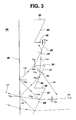
- Figure 3 is a view showing a cross section of an area of the Fresnel lens sheet 26 about 220 mm below the centre of the Fresnel lens sheet 26 and the path of a beam of light falling upon the Fresnel lens sheet 26 in this place and in this example, taking the distance from the projection lens 23 to the Fresnel lens sheet 26 to be 950 mm, the condensing length of the Fresnel lens sheet 26 to be 6000 mm and the refractive index to be 1.552.
- the lens elements 27 comprising the Fresnel lens sheet 26 are taken to have an angle of inclination T0a of 26.1° and a rise angle T1a of 1°.
- part of the image light ray La1 is reflected by the lens surface 29 and is returned to the plane of incidence 28 as reflected light beams La3 and La4.
- Figure 4 shows an example of a case where the distance from the projection lens 23 to the Fresnel lens sheet 26 is shortened to 700 mm and the condensing length and refractive index of the Fresnel lens sheet 26 are the same as the case described in Figure 3.
- the lens units 27b of the Fresnel lens sheet 26b are taken to have an angle of inclination T0b of, for example, 32.7° which is larger than T0a and with the rise angle Tlb being unchanged at, for example, 1°.
- the beam spacing d becomes, for example, about 5.6 mm and double imaging becomes noticeable in the normal image at a spacing of about, for example, 5.6 mm. Therefore, the drop in picture quality becomes particularly noticeable when telops or movie sub-titles are displayed at the bottom of the picture.
- Figure 4 dealt with the description of a case of noticeable double imaging below the centre of the Fresnel lens sheet 26b.
- the shape of the lens is symmetrical in relation to the centre and similar double imaging will also therefore be noticed from the centre in the upper area.
- This double imaging is not a particular problem with respect to the areas to the left and right because of absorption by the black stripes 32 formed on the emission side of the lenticular sheet 31 in the stage following the Fresnel lens sheet 26b.
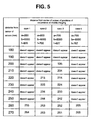
- Figure 5 shows a table of cases of measured positions of double imaging (outgoing beams Lb5 and Lb6) for various distances "a" (mm) from the projection lens 23 to the Fresnel lens sheet 26, condensing length "b” (mm) on the viewing side and focal lengths "f” (mm) of the Fresnel lens sheet 26.
- the thickness of the Fresnel lens sheet 26 was 2 mm and the refractive index was 1.552.
- Figure 6 is a graph showing of the outgoing angles of light beams from the projection lens 23 emerging from various points on the Fresnel lens sheet 26 in directions towards the centre with regards to Case 3 in Figure 5.
- Figure 7 applies to Case 4 and is a graph showing the outgoing angles of light beams from the projection lens 23 emerging from various points on the Fresnel lens sheet 26.
- the vertical axes show the outgoing angles (deg) and the horizontal axes show distances (mm) from the centre of the Fresnel lens sheet 26.
- the image light ray is concentrated in the direction of the observer but, on the other hand, double imaging occurs at a position 2/3 of the distance from the centre of the picture. If the angle of inclination of the lens elements 27 of the Fresnel lens sheet 26 is made small in order to suppress this, the luminance in the peripheral parts of the image is reduced and it therefore becomes difficult to obtain a good image.
- a projection-type display device comprises an image projector and a screen.
- the image projector is for projecting image light rays.
- the screen is disposed on a side to which the image light rays are projected and comprises a Fresnel lens sheet with one side thereof facing the image projector and a lenticular sheet disposed on the other side of the Fresnel lens sheet for transmitting the image light rays that are formed into a picture on the screen.
- the Fresnel lens sheet has a fixed focal length in a region from the centre of the Fresnel lens sheet to a prescribed distance and focal lengths gradually decreasing toward the outer periphery of the Fresnel lens sheet in a region exceeding the prescribed distance.
- the prescribed distance is at least one of a distance from the centre of the Fresnel lens sheet to a point corresponding to an upper edge of a projected image on the Fresnel lens sheet and a distance from said centre of the Fresnel lens sheet to a point corresponding to a lower edge of the projected image on the Fresnel lens sheet.
- the Fresnel lens sheet can also be made to have focal lengths gradually decreasing from its centre toward its outer periphery depending on the conditions of the Fresnel lens sheet or the characteristics of the projection system.
- a projection apparatus comprises a housing, a screen, a reflector, an image source and a projection lens.
- the screen comprises a Fresnel lens sheet and a lenticular sheet and is disposed at a front of the housing.
- the reflector is disposed at the inside rear of the housing.
- the Fresnel lens sheet has a fixed focal length in a region from the centre of the Fresnel lens sheet to a prescribed distance and focal lengths gradually decreasing toward the outer periphery of the Fresnel lens sheet in a region exceeding the prescribed distance.
- the prescribed distance is at least one of a distance from the centre of the Fresnel lens sheet to a point corresponding to an upper edge of a projected image on the Fresnel lens sheet and a distance from the centre of the Fresnel lens sheet to a point corresponding to a lower edge of the projected image on the Fresnel lens sheet.
- the Fresnel lens sheet can also be made to have focal lengths gradually decreasing from its centre toward its outer periphery depending on the conditions of the Fresnel lens sheet or the characteristics of the projection system.
- the image source can comprise a cathode ray tube or three cathode ray tubes respectively corresponding to a red signal, a green signal and a blue signal.
- the image source can also comprise a liquid crystal panel or three liquid crystal panels respectively corresponding to a red signal, a green signal and a blue signal.
- the lenticular sheet can be made to have vertical black stripes thereon at a prescribed interval.
- the present invention is able to suppress double imaging appearing towards the periphery of the picture and suppress drops in luminance at the periphery, a better image can be provided than in the related art.
- Figure 8 is an outline side-view of a configuration of a projector taken as the embodiment.
- a projector 1 of the embodiment houses a CRT 3 as an image source for projecting image light rays for each of the primary colours red (R), green (G) and blue (B) (actually three CRTs 3R, 3G and 3B corresponding to each of the primary colours R, G and B having a predetermined angle are placed side by side) in the bottom of a housing 2.
- Three primary colour light images output from the CRTs 3 (R, G and B), enlarged by projection lenses 4 (R, G and B) corresponding to each of the primary colours placed in front of the CRTs, are reflected by a reflector 5 onto the back of a transmission screen 6.
- the transmission screen 6 consists of a Fresnel lens sheet 7 and a lenticular sheet 8 configured to form an image from image light rays inputted for each of the primary colours from the CRTs (R, G and B) via the reflector 5.
- the focal lengths of the lens elements comprising Fresnel lens sheet 7 are arranged to change gradually in accordance with distance from the centre.
- the lenticular sheet 8 has black stripes similar to the conventional example shown in Figure 2.
- the Fresnel lens sheet 7 causes the light reflected by the reflector 5 to converge, the light becomes incident to the lenticular sheet 8, and is then dispersed horizontally and emitted by the lenticular sheet 8. In this way, the RGB light images are combined to form a colour image on the transmission screen 6 which the viewer sees from in front of the screen 6.
- a transparent panel 9 made of an acrylic resin such as methacrylic resin for example is placed on the front of the transmission screen 6 to protect the transmission screen 6 and enhance the luster of displayed images.
- Figure 9 is a plan view of the Fresnel lens sheet 7.
- Concentric lens elements 7a, 7b, 7c, 7d... are formed at this Fresnel lens sheet 7 (although intermediate portions of these lens elements are omitted by only being shown by broken lines, in reality, a large number of concentric rings of lens elements are also shown at the broken line portions).
- the focal length of each lens element is set to a constant value from lens element 7a at the centre to lens element 7b (200 mm from the centre for instance) and to a gradually shorter value from lens element 7b to lens element 7d, i.e. to the outside of the Fresnel lens sheet 7. A detailed description of setting these focal lengths is given below in Figure 10.
- Figure 10 is a graph showing the relationship between the distance from the centre of the Fresnel lens sheet 7 and the focal length of the lens element in relation to this distance, the horizontal axis showing the distance (mm) from the centre and the vertical axis showing the focal length.
- the distance of the Fresnel lens sheet 7 from the projection lenses 4 is 700 mm and the refractive index of each lens element of the Fresnel lens sheet 7 is 1.55.
- the focal length f for each lens element as shown by the solid line is arranged to be almost constant from the centre to 200 or 250 mm and to become gradually shorter towards the outer edge.
- the focal length f of each of the lens elements can be made gradually shorter and the decreased luminance in the peripheral parts of the image can be suppressed by setting the focal length f so that the condensing length b becomes, for example, 6m beyond the region about 200 to 250 mm from the centre of the Fresnel lens sheet 7.
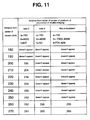
- Figure 11 is a table showing an example of measured values of double imaging using the Fresnel lens sheet 7 of this embodiment and measured values occurring in Case 3 and Case 4 previously shown in Figure 6.
- the condensing length b varies between -7300 mm and 6064 mm from the centre towards the periphery and the focal distance f of each of the lens elements is also set to vary accordingly between 774 mm and 628 mm.
- double imaging does not appear up to 250 mm from the centre of Fresnel lens sheet 7 and is hardly ever observed in the displayed image.
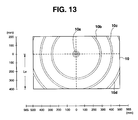
- focal lengths from the centre of the Fresnel lens sheet 10 to the upper or lower edge of the picture, whichever is the more distal according to the direction in which the centre of the picture is offset, that is to say as far as radius Lv, are made constant so that double imaging does not occur, with the outer focal lengths being made gradually shorter.
- lens elements 10a and 10b to 10c are set to have a constant focal length and lens elements from 10c to 10d... which make up the periphery are set to have gradually shorter focal lengths.
- Fresnel lens sheets 7 and 10 may be set progressively shorter from the centres as shown by the dashed and two-dotted line in Figure 10.
- the image source is a projector using three CRTs for each of the background colours R, G and B but the present invention is not restricted to this.
- the present invention can also be applied to a liquid crystal projector device having an optical system with a single projection lens for the enlarged projection of an image optically modulated with three liquid crystal panels corresponding to R, G and B and then composed, or to an optical system with a single projection lens for enlarged projection of an image optically modulated by a single liquid crystal panel having or not having RGB colour filters.
- the projection-type display device of the present invention enables light projected outwards from within the Fresnel lens sheet which constitutes the transmission screen showing the projection image to be obtained at the periphery to go in the direction of the centre by setting the focal length long from the centre where double imaging appears almost to the upper or lower edge of the picture and gradually shorter thereafter, even if the projection-type display device is made more compact, reduced picture quality due to double imaging and reduced luminance at the periphery of the Fresnel lens sheet can be suppressed and an improved image can be obtained over the entire picture.
Landscapes
- Engineering & Computer Science (AREA)
- Multimedia (AREA)
- Signal Processing (AREA)
- Physics & Mathematics (AREA)
- General Physics & Mathematics (AREA)
- Overhead Projectors And Projection Screens (AREA)
- Projection Apparatus (AREA)
- Transforming Electric Information Into Light Information (AREA)
- Liquid Crystal (AREA)
Applications Claiming Priority (2)
| Application Number | Priority Date | Filing Date | Title |
|---|---|---|---|
| JP30335495A JP3371654B2 (ja) | 1995-10-30 | 1995-10-30 | 投射型ディスプレイ装置 |
| JP303354/95 | 1995-10-30 |
Publications (2)
| Publication Number | Publication Date |
|---|---|
| EP0772077A2 true EP0772077A2 (de) | 1997-05-07 |
| EP0772077A3 EP0772077A3 (de) | 1998-06-10 |
Family
ID=17919974
Family Applications (1)
| Application Number | Title | Priority Date | Filing Date |
|---|---|---|---|
| EP96307710A Withdrawn EP0772077A3 (de) | 1995-10-30 | 1996-10-24 | Projektionsanzeigevorrichtung |
Country Status (5)
| Country | Link |
|---|---|
| US (1) | US5803567A (de) |
| EP (1) | EP0772077A3 (de) |
| JP (1) | JP3371654B2 (de) |
| KR (1) | KR100454725B1 (de) |
| CN (1) | CN1114315C (de) |
Cited By (6)
| Publication number | Priority date | Publication date | Assignee | Title |
|---|---|---|---|---|
| EP0819973A1 (de) * | 1996-07-15 | 1998-01-21 | Dai Nippon Printing Co., Ltd. | Fresnellinsen-Folie für einen Durchlicht-Projektionsschirm |
| EP0896244A1 (de) * | 1997-08-08 | 1999-02-10 | Kuraray Co., Ltd. | Bildanzeigevorrichtung vom Durchprojektions-Typ |
| WO2004004325A1 (en) * | 2002-06-27 | 2004-01-08 | Koninklijke Philips Electronics N.V. | Offset projection for slim rear projection displays |
| EP1006399B1 (de) * | 1998-12-02 | 2006-04-12 | Kuraray Co., Ltd. | Fresnellinsen-Folie |
| US9464784B2 (en) | 2012-02-03 | 2016-10-11 | GE Lighting Solutions, LLC | Optical system and lighting device comprised thereof |
| EP3248049A4 (de) * | 2015-01-21 | 2018-10-31 | Tesseland LLC | An die auflösung des menschlichen auges adaptierte bildgebungsoptik |
Families Citing this family (8)
| Publication number | Priority date | Publication date | Assignee | Title |
|---|---|---|---|---|
| JP2001318430A (ja) * | 2000-05-10 | 2001-11-16 | Kuraray Co Ltd | 背面投射型スクリーン |
| JP2003143621A (ja) * | 2001-11-01 | 2003-05-16 | Nec Viewtechnology Ltd | 色むら及び輝度むら補正回路付プロジェクタ |
| US20080151198A1 (en) * | 2006-12-22 | 2008-06-26 | Texas Instruments Incorporated | System and method for slim projection displays |
| JP5342326B2 (ja) * | 2009-05-28 | 2013-11-13 | 株式会社クラレ | フレネルレンズシート、その製造方法およびそれに用いるスタンパの製造方法並びにフレネルレンズシートを含む太陽光発電装置 |
| EP2646868A1 (de) * | 2010-12-01 | 2013-10-09 | Lemoptix SA | Verfahren zur projektion eines bildes |
| JP6028829B1 (ja) * | 2015-04-09 | 2016-11-24 | 大日本印刷株式会社 | 反射型スクリーン、映像表示システム |
| KR102300158B1 (ko) * | 2017-04-26 | 2021-09-10 | 도요 가라스 가부시키가이샤 | 용기 검사장치 및 용기 검사방법 |
| WO2022242303A1 (zh) * | 2021-05-19 | 2022-11-24 | 成都菲斯特科技有限公司 | 一种投影屏幕及投影屏幕汇聚点变化拟合方法 |
Family Cites Families (12)
| Publication number | Priority date | Publication date | Assignee | Title |
|---|---|---|---|---|
| JPS57144502A (en) * | 1981-03-02 | 1982-09-07 | Akira Nadaguchi | Composite fresnel condenser |
| JPH077179B2 (ja) * | 1984-06-13 | 1995-01-30 | 株式会社日立製作所 | 画像投写装置 |
| JPS63287901A (ja) * | 1987-05-21 | 1988-11-25 | Sony Corp | フレネルレンズ |
| US4773731A (en) * | 1987-08-28 | 1988-09-27 | North American Philips Corp. | One-piece projection screen |
| JP2731169B2 (ja) * | 1988-07-18 | 1998-03-25 | 株式会社日立製作所 | 近距離観視用投写形ディスプレイ装置 |
| US5208620A (en) * | 1988-10-04 | 1993-05-04 | Canon Kabushiki Kaisha | Display apparatus |
| DK687288A (da) * | 1988-12-09 | 1990-06-10 | Dainippon Printing Co Ltd | Baglysprojektionsskaerm |
| JPH0463334A (ja) * | 1990-07-03 | 1992-02-28 | Matsushita Electric Ind Co Ltd | 透過型スクリーン |
| JPH04316010A (ja) * | 1991-04-16 | 1992-11-06 | Seiko Epson Corp | 集光用フレネルレンズ |
| KR960015507B1 (ko) * | 1991-12-24 | 1996-11-14 | 가부시끼가이샤 히다찌세이사꾸쇼 | 배면투사형화상표시장치및배면투과형스크린 |
| JPH06273852A (ja) * | 1993-03-19 | 1994-09-30 | Matsushita Electric Ind Co Ltd | 透過型キャビネットスクリーンとその製造法 |
| JP3390790B2 (ja) * | 1993-08-31 | 2003-03-31 | 大日本印刷株式会社 | プロジェクションスクリーン |
-
1995
- 1995-10-30 JP JP30335495A patent/JP3371654B2/ja not_active Expired - Lifetime
-
1996
- 1996-10-18 US US08/733,925 patent/US5803567A/en not_active Expired - Lifetime
- 1996-10-24 EP EP96307710A patent/EP0772077A3/de not_active Withdrawn
- 1996-10-29 KR KR1019960049772A patent/KR100454725B1/ko not_active Expired - Lifetime
- 1996-10-30 CN CN96121699A patent/CN1114315C/zh not_active Expired - Lifetime
Non-Patent Citations (1)
| Title |
|---|
| None |
Cited By (9)
| Publication number | Priority date | Publication date | Assignee | Title |
|---|---|---|---|---|
| EP0819973A1 (de) * | 1996-07-15 | 1998-01-21 | Dai Nippon Printing Co., Ltd. | Fresnellinsen-Folie für einen Durchlicht-Projektionsschirm |
| US6052226A (en) * | 1996-07-15 | 2000-04-18 | Dai Nippon Printing Co., Ltd. | Fresnel lens sheet for rear projection screen |
| EP0896244A1 (de) * | 1997-08-08 | 1999-02-10 | Kuraray Co., Ltd. | Bildanzeigevorrichtung vom Durchprojektions-Typ |
| EP1006399B1 (de) * | 1998-12-02 | 2006-04-12 | Kuraray Co., Ltd. | Fresnellinsen-Folie |
| WO2004004325A1 (en) * | 2002-06-27 | 2004-01-08 | Koninklijke Philips Electronics N.V. | Offset projection for slim rear projection displays |
| US6857750B2 (en) | 2002-06-27 | 2005-02-22 | Koninklijke Philips Electronics N.V. | Offset projection for slim rear projection displays |
| US9464784B2 (en) | 2012-02-03 | 2016-10-11 | GE Lighting Solutions, LLC | Optical system and lighting device comprised thereof |
| EP3248049A4 (de) * | 2015-01-21 | 2018-10-31 | Tesseland LLC | An die auflösung des menschlichen auges adaptierte bildgebungsoptik |
| US10690813B2 (en) | 2015-01-21 | 2020-06-23 | Tesseland Llc | Imaging optics adapted to the human eye resolution |
Also Published As
| Publication number | Publication date |
|---|---|
| JP3371654B2 (ja) | 2003-01-27 |
| KR970025090A (ko) | 1997-05-30 |
| CN1158049A (zh) | 1997-08-27 |
| KR100454725B1 (ko) | 2005-01-13 |
| CN1114315C (zh) | 2003-07-09 |
| EP0772077A3 (de) | 1998-06-10 |
| US5803567A (en) | 1998-09-08 |
| JPH09127606A (ja) | 1997-05-16 |
Similar Documents
| Publication | Publication Date | Title |
|---|---|---|
| US5555035A (en) | Very high resolution light valve writing system based on tilting lower resolution flat panels | |
| US5442484A (en) | Retro-focus type lens and projection-type display apparatus | |
| US5803567A (en) | Protection-type display device | |
| US4452509A (en) | Projection television screen having a selected audience envelope | |
| EP0051976A2 (de) | Optischer Refraktor zur Lichtstreuung | |
| EP0240045A1 (de) | Kompaktes Durchsichtprotektionssystem mit schief einfallendem Lichtbündel | |
| US6256145B1 (en) | Method for improving image contrast with lessened scintillation in a rear projection display apparatus | |
| JPH10239777A (ja) | 背面投写型映像表示装置 | |
| US6304379B1 (en) | Rear projection screen | |
| EP0471478B1 (de) | Grossbildschirmanzeigevorrichtung | |
| US5264941A (en) | Large screen display apparatus utilizing a transparent plate to display an image over an entire surface of a diffusing surface | |
| JPS6373782A (ja) | プロジエクタ | |
| JPH04195030A (ja) | プロジェクタ | |
| JPS6352585A (ja) | ビデオプロジエクタ−装置 | |
| EP0896244B1 (de) | Bildanzeigevorrichtung vom Durchprojektions-Typ | |
| JP2956149B2 (ja) | 投射型表示装置 | |
| JPH06130497A (ja) | 透過型投写スクリーンとそれを用いた透過型プロジェクションテレビ | |
| JPH04362623A (ja) | 背面投射形画像表示装置 | |
| RU2082206C1 (ru) | Цветное проекционное устройство (варианты) | |
| JP3133051B2 (ja) | 投射表示装置 | |
| JPH0345987A (ja) | 背面投射型表示装置 | |
| JPH0336149Y2 (de) | ||
| JPH02153338A (ja) | 背面投射型スクリーン及びそれを用いた背面投射型画像表示装置 | |
| KR100188216B1 (ko) | 리어프로젝션tv용 배면투사스크린 | |
| KR930010608A (ko) | 카 메 라 |
Legal Events
| Date | Code | Title | Description |
|---|---|---|---|
| PUAI | Public reference made under article 153(3) epc to a published international application that has entered the european phase |
Free format text: ORIGINAL CODE: 0009012 |
|
| AK | Designated contracting states |
Kind code of ref document: A2 Designated state(s): DE ES FR GB |
|
| PUAL | Search report despatched |
Free format text: ORIGINAL CODE: 0009013 |
|
| AK | Designated contracting states |
Kind code of ref document: A3 Designated state(s): DE ES FR GB |
|
| 17P | Request for examination filed |
Effective date: 19981116 |
|
| GRAH | Despatch of communication of intention to grant a patent |
Free format text: ORIGINAL CODE: EPIDOS IGRA |
|
| STAA | Information on the status of an ep patent application or granted ep patent |
Free format text: STATUS: THE APPLICATION IS DEEMED TO BE WITHDRAWN |
|
| 18D | Application deemed to be withdrawn |
Effective date: 20030401 |