EP0773533A1 - Verfahren zur Synthetisierung eines Sprachsignal-Blocks in einem CELP-Koder - Google Patents
Verfahren zur Synthetisierung eines Sprachsignal-Blocks in einem CELP-Koder Download PDFInfo
- Publication number
- EP0773533A1 EP0773533A1 EP95117720A EP95117720A EP0773533A1 EP 0773533 A1 EP0773533 A1 EP 0773533A1 EP 95117720 A EP95117720 A EP 95117720A EP 95117720 A EP95117720 A EP 95117720A EP 0773533 A1 EP0773533 A1 EP 0773533A1
- Authority
- EP
- European Patent Office
- Prior art keywords
- pulse
- codebook
- excitation
- rpe
- sequence
- Prior art date
- Legal status (The legal status is an assumption and is not a legal conclusion. Google has not performed a legal analysis and makes no representation as to the accuracy of the status listed.)
- Granted
Links
- 238000000034 method Methods 0.000 title claims abstract description 24
- 230000002194 synthesizing effect Effects 0.000 title claims description 7
- 239000013598 vector Substances 0.000 claims abstract description 65
- 230000005284 excitation Effects 0.000 claims abstract description 62
- 230000004044 response Effects 0.000 claims abstract description 9
- 230000003044 adaptive effect Effects 0.000 claims description 14
- 238000012549 training Methods 0.000 claims description 4
- 238000010606 normalization Methods 0.000 claims description 2
- 238000003786 synthesis reaction Methods 0.000 abstract description 15
- 230000015572 biosynthetic process Effects 0.000 abstract description 14
- 239000011159 matrix material Substances 0.000 description 12
- 238000013459 approach Methods 0.000 description 6
- 238000009795 derivation Methods 0.000 description 3
- 230000003595 spectral effect Effects 0.000 description 3
- 230000015556 catabolic process Effects 0.000 description 2
- 238000006731 degradation reaction Methods 0.000 description 2
- 238000010586 diagram Methods 0.000 description 2
- 238000001914 filtration Methods 0.000 description 2
- 230000007774 longterm Effects 0.000 description 2
- 238000012545 processing Methods 0.000 description 2
- 238000013461 design Methods 0.000 description 1
- 230000000694 effects Effects 0.000 description 1
- 238000005516 engineering process Methods 0.000 description 1
- 229940050561 matrix product Drugs 0.000 description 1
- 230000008447 perception Effects 0.000 description 1
- 238000012805 post-processing Methods 0.000 description 1
- 230000000717 retained effect Effects 0.000 description 1
- 238000001228 spectrum Methods 0.000 description 1
Images



Classifications
-
- G—PHYSICS
- G10—MUSICAL INSTRUMENTS; ACOUSTICS
- G10L—SPEECH ANALYSIS TECHNIQUES OR SPEECH SYNTHESIS; SPEECH RECOGNITION; SPEECH OR VOICE PROCESSING TECHNIQUES; SPEECH OR AUDIO CODING OR DECODING
- G10L19/00—Speech or audio signals analysis-synthesis techniques for redundancy reduction, e.g. in vocoders; Coding or decoding of speech or audio signals, using source filter models or psychoacoustic analysis
- G10L19/04—Speech or audio signals analysis-synthesis techniques for redundancy reduction, e.g. in vocoders; Coding or decoding of speech or audio signals, using source filter models or psychoacoustic analysis using predictive techniques
- G10L19/08—Determination or coding of the excitation function; Determination or coding of the long-term prediction parameters
- G10L19/10—Determination or coding of the excitation function; Determination or coding of the long-term prediction parameters the excitation function being a multipulse excitation
- G10L19/113—Regular pulse excitation
-
- G—PHYSICS
- G10—MUSICAL INSTRUMENTS; ACOUSTICS
- G10L—SPEECH ANALYSIS TECHNIQUES OR SPEECH SYNTHESIS; SPEECH RECOGNITION; SPEECH OR VOICE PROCESSING TECHNIQUES; SPEECH OR AUDIO CODING OR DECODING
- G10L19/00—Speech or audio signals analysis-synthesis techniques for redundancy reduction, e.g. in vocoders; Coding or decoding of speech or audio signals, using source filter models or psychoacoustic analysis
- G10L2019/0001—Codebooks
- G10L2019/0013—Codebook search algorithms
Definitions
- This invention relates to speech coding, particularly to a method of synthesizing a block of a speech signal in a CELP-type ( C ode E xcited L inear P redictive) coder, the method comprising the steps of applying an excitation vector to a synthesizer filter of the coder, said excitation vector consisting of two gain normalized components derived, on the one hand, from an adaptive codebook and from a stochastic codebook, on the other hand.
- CELP-type C ode E xcited L inear P redictive
- CELP Code Excited Linear Prediction
- CELP-type codecs use simplified structures for the codebooks as already indirectly suggested by Schroeder/Atal in the said basic article. Such methods cause some degradations in speech quality. It is known that the speech quality is strongly related to the "quality" of the stochastic codebook (s) which give (s) the innovation sequence for the speech signal to be synthesized.
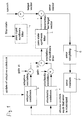
- Fig. 1 shows the typical structure of an "analysis-by-synthesis-loop" of a CELP-type speech codec.
- a common scheme is that the synthesis filter, i.e. blocks 1 and 2, providing the spectral envelope of the speech signal to be coded is excited with two different excitation parts. One of them is called “adaptive excitation”. The other excitation part is called “stochastic excitation”. The first excitation part is taken from a buffer where old excitation samples of the synthesis filter are stored. Its task is to insert the harmonic structure of speech. The second excitation part is a so-called stochastic excitation which rebuilds the noisy components of the signal. Both excitation parts are taken from “codebooks”, i.e.
- the adaptive codebook 3 is time variant and updated each time a new excitation of the synthesis filter has been found.
- the stochastic codebook 4 is fixed.
- a synthetic speech signal is generated already in the speech encoder by a process called "analysis-by-synthesis”.
- Codebooks 3, 4 are searched for the vectors which scaled and filtered versions (gains g1, g2) give the "best” approximation of the signal to be transmitted as "reconstructed target vector”.
- the "best" excitation vectors are chosen according to an error measure (block 5) which is computed from the perceptual weighted error vector in block 6.
- the approximation of the target vector can be performed quite well in terms of perception even at relatively low bit rates.
- there are limitations namely, as already mentioned, the time required to perform the codebook search and the memory needed to store the codebooks. Therefore, only suboptimal search procedures can be applied to keep the complexity low.
- the codebooks 3,4 are searched for the "best" code vector sequentially and each single codebook search is performed also suboptimal to some extent. These limitations can cause a perceptible decrease in speech quality. Therefore, a lot of work has been done in the past to find the excitation with reasonable effort while retaining high speech quality.
- One approach for simplifying the search procedures is described in EP-A-0 515 138.
- CELP codecs are driven by the stochastic excitation, since the adaptive codebook 3 only depends on vectors previously chosen from the stochastic codebook 4. For this reason, the content of the stochastic code book 4 is not only important for rebuilding noisy components of speech but also for the reproduction of the harmonic parts. Therfore, most CELP-type codecs mainly differ in the stochastic excitation part. The other parts are often quite similar.
- RPE Regular Pulse Excitation
- a method for synthesizing a block of a speech signal in a CELP-type coder comprises the step of applying an excitation vector to a synthesizing filter of the coder, said excitation vector consisting of two gain normalized components derived, on the one hand from an adaptive codebook and from a stochastic codebook, on the other hand, said method being characterized in that for limiting the computational effort of the stochastic codebook components search, an ideal regular pulse excitation sequence is computed from a target vector derived from a weighted speech sample signal and the impulse response of the synthesis filter followed by determination of four parameters therefrom, namely
- RPE Regular Pulse Excitation
- RPE means, that the spacing between adjacent nonzero pulses is constant. If for example every second excitation pulse has nonzero amplitude, there are two possibilities to place N/2 nonzero pulses in a vector of the length N. The first, third, fifth, ... pulse is nonzero or the second, fourth, sixth, ... pulse is nonzero.
- the impulse response matrix H looks like
- M is structured as shown below for the first and second possibility to place pulses, respectively.
- each row of M has just a single element being 1, the other elements are zero.
- the n-th row gives the position of the n-th pulse. If there are m possibilities to place L pulses as RPE sequence, there are m different versions of the matrix M. With m different matrixes M, there are also m different sets of amplitudes. The set which provides the smallest error E is denoted as "ideal" RPE sequence.
- This method applied here may be called “hybrid” since the preselection of codevectors to be tested in the "analysis-by-synthesis-loop" is done outside of said loop.
- the part of the codebook to which those loop search is applied is determined before the analysis-by-synthesis-loop is entered.
- the maximum pulse position of an "ideal" RPE sequence is used as preselection measure to limit the closed loop codebook search to a "small" number of candidate vectors.
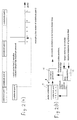
- Fig. 2(b) shows as example for codebook part 2, how the preselection procedure works and a code vector is constructed.
- the "ideal" RPE sequence is computed as depicted in keywords in Fig. 2(a) and Fig. 2(b).
- the position of the first nonzero pulse, the maximum pulse position and the overall sign are taken from the "ideal" RPE. If the maximum pulse is negative, the overall sign is negative. Otherwise the overall sign is positive.
- the overall sign is required since the pulse codebook 4a contains only codevectors with positive maximum pulse.
- Fig. 3 shows the derivation of the "position of a first nonzero pulse", the "maximum pulse position” and the “overall sign” from an example RPE sequence.
- Fig. 4 gives an example how the excitation generator 14 of Fig. 2(b) works. If the ideal RPE's maximum pulse is negative, all pulses of the pulse vector to be tested are multiplied by - 1. If the n-th nonzero sample of the ideal RPE sequence has maximum amount, the n-th part of the pulse codebook is searched for the best candidate vector. That means that as a significant advantage of the invention, the codebook search is applied to just (100/(L))% of all candidate vectors.
- the speech codec in which the above described scheme shall be introduced is run with a sufficient set of training speech data in order to derive the pulse codebook described before. To generate the stochastic excitation during the training process, the following is done:
- the ideal RPE sequence is computed from the target vector to be rebuild and the impulse response of the synthesis filter.
- the position of the first nonzero pulse, the maximum pulse position and the overall sign are taken from the ideal RPE as given above.
- the normalized RPE sequence is stored in the n-th database.
- the normalization is performed in two steps. In the first step, the RPE sequence is normalized such that the maximum pulse has positive value. In the second step, the sequence obtained after the first step is divided by the energy of the target vector to which the RPE sequence belongs. This is done to remove the influence of the loudness of the signal from the codebook entries. In this way, L databases are obtained.
- the databases contain "normalized waveforms”. Therefore, also the codebooks trained based on the databases contain "normalized waveforms".
- codebook training is performed separately according to the LBG-algorithm.
- LBG-algorithm For details see description in Y. Linde, A. Buzo, R.M. Gray: “An Algorithm for Vector Quantizer Design", IEEE Transactions on Communications, January 1980).
- the different codebooks are joined together such that the n-th part of the overall codebook contains candidate vectors where the n-th sample has maximum amount.
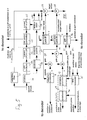
- the synthesis filter shown in Fig. 5 gives the spectral envelope of the signal. Another interpretation is that the short term correlation of the signal is given by this filter.
- This filter is excited by vectors taken from codebooks which contain a reasonably large number of candidate vectors. One vector is taken from the adapted codebook 2 where old excitation vectors are stored. This excitation part rebuilds the harmonic structure of speech (or the long term correlation of the speech signal) and is called the "adaptive excitation". The second part of the excitation is taken from the stochastic codebook 4. This codebook introduces the noisy parts of the synthesized speech signal or the innovation of the signal which cannot be provided by linear prediction.
- a speech frame consists of N frame speech samples.
- the codec delay is N frame times the sample period.
- Each frame has k subframes of the length N frame /k samples.
- Parameters which are computed once per frame are called "frame parameters”.
- Parameters which are computed for each subframe are called "subframe parameters”.
- the frame parameters are computed. These parameters are
- the LPC's out of block 28 describe the spectral envelope and the loudness value gives the loudness of the signal in the current speech frame.
- the excitation of this synthesis filter is calculated for each subframe. The excitation is described by the subframe parameters
- LPC-analysis 22 is performed via LEVINSON-DUR-BIN recursion.
- the LPC's are transformed into LSF's ( L ine S pectrum F requencies) in block 23 and vector-quantized in block 24.
- the quantized LSF's are converted into quantized LPC's in block 25.
- the LPC's are interpolated with the LPC's of the previous speech frame in block 28.
- a loudness value is computed from the windowed speech frame in block 26, quantized in block 27 and interpolated with the loudness value of the previous frame in block 28.
- Each speech subframe is weighted in block 20 to enhance the perceptual speech quality.
- the zero input response of the synthesis filter 1 is subtracted in a first substractor 29.
- the resulting signal is called "target vector”. This target vector has to be rebuild by the "analysis-by-synthesis-loop”. The following computations are done for each subframe.
- the adaptive excitation is taken from the adaptive codebook 3. It is scaled by the optimal gain g1 and substracted from the target vector in a second subtractor 30.
- the remaining signal is to be rebuild by the stochastic excitation.
- the ideal RPE sequence is computed from the remaining signal to be rebuild and the impulse response of the synthesis filter.
- the position of the first nonzero pulse, the maximum pulse position and the overall sign are taken from the ideal RPE as described above.
- the RPE sequence is computed once before the closed loop codebook search is started. If the n-th nonzero sample of the ideal RPE has maximum amount, the codebook part n is searched closed-loop for the best excitation vector in blocks 4a via 14. Finally, the excitation of the synthesis filter is computed from the stochastic and adaptive excitations and the respective gains g1, g2 and the adaptive codebook 3 is updated.
- Fig. 6(a) and 6(b) show in block diagrams essential parts of the decoder. As in most analysis-by-synthesis-codecs the operations to be performed (except post processing) are quite similar to those ones already performed in the corresponding encoder stages. Accordingly, a detailed description of the schemes of Fig. 6(a) and 6(b) is omitted. To decode the transmitted parameters just a few table look-ups are required to obtain the filter coefficients for loudness and excitation of the synthesis filter.
- the price to pay for the save of bit rate needed to transmit the speech signal is that it cannot be reconstructed completely.
- noisy components coding noise
- post filtering is employed. The target is to suppress the coding noise while retaining the naturalness of the speech signal.
- a post filter 70 including long term and short term filtering is employed to increase the perceptual speech quality.
- a hybrid search technique is used. After computation of the ideal RPE sequence, firstly the position of first nonzero pulse and the position of the maximum pulse are computed in the "ideal" pulse vector. Second, the codebook search is performed. Since there is one pulse vector codebook for each position of the maximum pulse, only the pulse vector codebook belonging to this position has to be searched for the "best" codevector. This technique according to the invention reduces the computational requirements for finding the "best" stochastic excitation drastically compared with applying the codebook search to all pulse vector codebooks.
Landscapes
- Engineering & Computer Science (AREA)
- Computational Linguistics (AREA)
- Signal Processing (AREA)
- Health & Medical Sciences (AREA)
- Audiology, Speech & Language Pathology (AREA)
- Human Computer Interaction (AREA)
- Physics & Mathematics (AREA)
- Acoustics & Sound (AREA)
- Multimedia (AREA)
- Compression, Expansion, Code Conversion, And Decoders (AREA)
- Transmission Systems Not Characterized By The Medium Used For Transmission (AREA)
Priority Applications (4)
| Application Number | Priority Date | Filing Date | Title |
|---|---|---|---|
| EP95117720A EP0773533B1 (de) | 1995-11-09 | 1995-11-09 | Verfahren zur Synthetisierung eines Sprachsignalblocks in einem CELP-Kodierer |
| DE69516522T DE69516522T2 (de) | 1995-11-09 | 1995-11-09 | Verfahren zur Synthetisierung eines Sprachsignalblocks in einem CELP-Kodierer |
| AT95117720T ATE192259T1 (de) | 1995-11-09 | 1995-11-09 | Verfahren zur synthetisierung eines sprachsignalblocks in einem celp-kodierer |
| US08/744,683 US5893061A (en) | 1995-11-09 | 1996-11-06 | Method of synthesizing a block of a speech signal in a celp-type coder |
Applications Claiming Priority (1)
| Application Number | Priority Date | Filing Date | Title |
|---|---|---|---|
| EP95117720A EP0773533B1 (de) | 1995-11-09 | 1995-11-09 | Verfahren zur Synthetisierung eines Sprachsignalblocks in einem CELP-Kodierer |
Publications (2)
| Publication Number | Publication Date |
|---|---|
| EP0773533A1 true EP0773533A1 (de) | 1997-05-14 |
| EP0773533B1 EP0773533B1 (de) | 2000-04-26 |
Family
ID=8219802
Family Applications (1)
| Application Number | Title | Priority Date | Filing Date |
|---|---|---|---|
| EP95117720A Expired - Lifetime EP0773533B1 (de) | 1995-11-09 | 1995-11-09 | Verfahren zur Synthetisierung eines Sprachsignalblocks in einem CELP-Kodierer |
Country Status (4)
| Country | Link |
|---|---|
| US (1) | US5893061A (de) |
| EP (1) | EP0773533B1 (de) |
| AT (1) | ATE192259T1 (de) |
| DE (1) | DE69516522T2 (de) |
Cited By (3)
| Publication number | Priority date | Publication date | Assignee | Title |
|---|---|---|---|---|
| FR2776447A1 (fr) * | 1998-03-23 | 1999-09-24 | Comsis | Codage source-canal conjoint en blocs |
| WO2001022676A1 (fr) * | 1999-09-21 | 2001-03-29 | Comsis | Codage source-canal conjoint en blocs |
| US9852740B2 (en) | 1997-12-24 | 2017-12-26 | Blackberry Limited | Method for speech coding, method for speech decoding and their apparatuses |
Families Citing this family (18)
| Publication number | Priority date | Publication date | Assignee | Title |
|---|---|---|---|---|
| TW317051B (de) * | 1996-02-15 | 1997-10-01 | Philips Electronics Nv | |
| DE19641619C1 (de) * | 1996-10-09 | 1997-06-26 | Nokia Mobile Phones Ltd | Verfahren zur Synthese eines Rahmens eines Sprachsignals |
| FI112894B (fi) | 1997-04-10 | 2004-01-30 | Nokia Corp | Menetelmä kehysvirhetodennäköisyyden pienentämiseksi tietokehysmuotoisessa tiedonsiirrossa |
| FI105634B (fi) | 1998-04-30 | 2000-09-15 | Nokia Mobile Phones Ltd | Menetelmä videokuvien siirtämiseksi, tiedonsiirtojärjestelmä ja multimediapäätelaite |
| FI981508A7 (fi) | 1998-06-30 | 1999-12-31 | Nokia Corp | Menetelmä, laite ja järjestelmä käyttäjän tilan arvioimiseksi |
| GB9817292D0 (en) | 1998-08-07 | 1998-10-07 | Nokia Mobile Phones Ltd | Digital video coding |
| FI105635B (fi) | 1998-09-01 | 2000-09-15 | Nokia Mobile Phones Ltd | Menetelmä taustakohinainformaation lähettämiseksi tietokehysmuotoisessa tiedonsiirrossa |
| US6490443B1 (en) * | 1999-09-02 | 2002-12-03 | Automated Business Companies | Communication and proximity authorization systems |
| US6847929B2 (en) * | 2000-10-12 | 2005-01-25 | Texas Instruments Incorporated | Algebraic codebook system and method |
| US7698132B2 (en) * | 2002-12-17 | 2010-04-13 | Qualcomm Incorporated | Sub-sampled excitation waveform codebooks |
| EP1513137A1 (de) * | 2003-08-22 | 2005-03-09 | MicronasNIT LCC, Novi Sad Institute of Information Technologies | Sprachverarbeitungssystem und -verfahren mit Multipuls-Anregung |
| KR100647290B1 (ko) * | 2004-09-22 | 2006-11-23 | 삼성전자주식회사 | 합성된 음성의 특성을 이용하여 양자화/역양자화를선택하는 음성 부호화/복호화 장치 및 그 방법 |
| US20090164211A1 (en) * | 2006-05-10 | 2009-06-25 | Panasonic Corporation | Speech encoding apparatus and speech encoding method |
| CN101115124B (zh) | 2006-07-26 | 2012-04-18 | 日电(中国)有限公司 | 基于音频水印识别媒体节目的方法和装置 |
| WO2009033288A1 (en) * | 2007-09-11 | 2009-03-19 | Voiceage Corporation | Method and device for fast algebraic codebook search in speech and audio coding |
| WO2010075377A1 (en) * | 2008-12-24 | 2010-07-01 | Dolby Laboratories Licensing Corporation | Audio signal loudness determination and modification in the frequency domain |
| CN102623012B (zh) * | 2011-01-26 | 2014-08-20 | 华为技术有限公司 | 矢量联合编解码方法及编解码器 |
| US10212009B2 (en) * | 2017-03-06 | 2019-02-19 | Blackberry Limited | Modulation for a data bit stream |
Family Cites Families (14)
| Publication number | Priority date | Publication date | Assignee | Title |
|---|---|---|---|---|
| US4868867A (en) * | 1987-04-06 | 1989-09-19 | Voicecraft Inc. | Vector excitation speech or audio coder for transmission or storage |
| US5060269A (en) * | 1989-05-18 | 1991-10-22 | General Electric Company | Hybrid switched multi-pulse/stochastic speech coding technique |
| US5701392A (en) * | 1990-02-23 | 1997-12-23 | Universite De Sherbrooke | Depth-first algebraic-codebook search for fast coding of speech |
| CA2010830C (en) * | 1990-02-23 | 1996-06-25 | Jean-Pierre Adoul | Dynamic codebook for efficient speech coding based on algebraic codes |
| US5396576A (en) * | 1991-05-22 | 1995-03-07 | Nippon Telegraph And Telephone Corporation | Speech coding and decoding methods using adaptive and random code books |
| US5233660A (en) * | 1991-09-10 | 1993-08-03 | At&T Bell Laboratories | Method and apparatus for low-delay celp speech coding and decoding |
| ES2115646T3 (es) * | 1991-10-25 | 1998-07-01 | At & T Corp | Metodo y aparato generalizados de codificacion vocal mediante analisis por sintesis. |
| US5295203A (en) * | 1992-03-26 | 1994-03-15 | General Instrument Corporation | Method and apparatus for vector coding of video transform coefficients |
| US5327520A (en) * | 1992-06-04 | 1994-07-05 | At&T Bell Laboratories | Method of use of voice message coder/decoder |
| FI91345C (fi) * | 1992-06-24 | 1994-06-10 | Nokia Mobile Phones Ltd | Menetelmä kanavanvaihdon tehostamiseksi |
| US5602961A (en) * | 1994-05-31 | 1997-02-11 | Alaris, Inc. | Method and apparatus for speech compression using multi-mode code excited linear predictive coding |
| FR2732148B1 (fr) * | 1995-03-24 | 1997-06-13 | Sgs Thomson Microelectronics | Determination d'un vecteur d'excitation dans un codeur celp |
| US5732389A (en) * | 1995-06-07 | 1998-03-24 | Lucent Technologies Inc. | Voiced/unvoiced classification of speech for excitation codebook selection in celp speech decoding during frame erasures |
| US5664055A (en) * | 1995-06-07 | 1997-09-02 | Lucent Technologies Inc. | CS-ACELP speech compression system with adaptive pitch prediction filter gain based on a measure of periodicity |
-
1995
- 1995-11-09 AT AT95117720T patent/ATE192259T1/de not_active IP Right Cessation
- 1995-11-09 EP EP95117720A patent/EP0773533B1/de not_active Expired - Lifetime
- 1995-11-09 DE DE69516522T patent/DE69516522T2/de not_active Expired - Fee Related
-
1996
- 1996-11-06 US US08/744,683 patent/US5893061A/en not_active Expired - Fee Related
Non-Patent Citations (4)
| Title |
|---|
| DELPRAT M ET AL: "17 A 6 KBPS REGULAR PULSE CELP CODER FOR MOBILE RADIO COMMUNICATIONS", ADVANCES IN SPEECH CODING, VANCOUVER, SEPT. 5 - 8, 1989, no. -, 1 January 1991 (1991-01-01), ATAL B S;CUPERMAN V; GERSHO A, pages 179 - 188, XP000419273 * |
| KLEIJN W B ET AL: "FAST METHODS FOR THE CELP SPEECH CODING ALGORITHM", IEEE TRANSACTIONS ON ACOUSTICS,SPEECH AND SIGNAL PROCESSING, vol. 38, no. 8, 1 August 1990 (1990-08-01), pages 1330 - 1341, XP000148377 * |
| LEVER M ET AL: "RPCELP: A HIGH QUALITY AND LOW COMPLEXITY SCHEME FOR NARROW BAND CODING OF SPEECH", AREA COMMUNICATION, STOCKHOLM, JUNE 13 - 17, 1988, no. CONF. 8, 13 June 1988 (1988-06-13), INSTITUTE OF ELECTRICAL AND ELECTRONICS ENGINEERS, pages 24 - 27, XP000133164 * |
| SATORU IAI AND KAZUNARI IRIE: "8 kbits/s Speech Coder with Pitch Adaptive Vector Quantizer", ICASSP 86, PROCEEDINGS, vol. 3, 7 April 1986 (1986-04-07) - 11 April 1986 (1986-04-11), TOKYO, JAPAN, pages 1697 - 1700, XP002004206 * |
Cited By (3)
| Publication number | Priority date | Publication date | Assignee | Title |
|---|---|---|---|---|
| US9852740B2 (en) | 1997-12-24 | 2017-12-26 | Blackberry Limited | Method for speech coding, method for speech decoding and their apparatuses |
| FR2776447A1 (fr) * | 1998-03-23 | 1999-09-24 | Comsis | Codage source-canal conjoint en blocs |
| WO2001022676A1 (fr) * | 1999-09-21 | 2001-03-29 | Comsis | Codage source-canal conjoint en blocs |
Also Published As
| Publication number | Publication date |
|---|---|
| EP0773533B1 (de) | 2000-04-26 |
| DE69516522T2 (de) | 2001-03-08 |
| ATE192259T1 (de) | 2000-05-15 |
| US5893061A (en) | 1999-04-06 |
| DE69516522D1 (de) | 2000-05-31 |
Similar Documents
| Publication | Publication Date | Title |
|---|---|---|
| EP0773533B1 (de) | Verfahren zur Synthetisierung eines Sprachsignalblocks in einem CELP-Kodierer | |
| US7359855B2 (en) | LPAS speech coder using vector quantized, multi-codebook, multi-tap pitch predictor | |
| EP0967594B1 (de) | Audiokodierer und -dekodierer | |
| JP3481251B2 (ja) | 代数的符号励振線形予測音声符号化方法 | |
| US8538747B2 (en) | Method and apparatus for speech coding | |
| JPH0990995A (ja) | 音声符号化装置 | |
| US7047188B2 (en) | Method and apparatus for improvement coding of the subframe gain in a speech coding system | |
| JP2000163096A (ja) | 音声符号化方法及び音声符号化装置 | |
| US7337110B2 (en) | Structured VSELP codebook for low complexity search | |
| JP3095133B2 (ja) | 音響信号符号化方法 | |
| US6751585B2 (en) | Speech coder for high quality at low bit rates | |
| JP3174733B2 (ja) | Celp型音声復号化装置、およびcelp型音声復号化方法 | |
| Akamine et al. | CELP coding with an adaptive density pulse excitation model | |
| JP3174780B2 (ja) | 拡散音源ベクトル生成装置及び拡散音源ベクトル生成方法 | |
| JP3174781B2 (ja) | 拡散音源ベクトル生成装置及び拡散音源ベクトル生成方法 | |
| CA2598870C (en) | Multi-stage vector quantization apparatus and method for speech encoding | |
| JP3174783B2 (ja) | Celp型音声符号化装置及びcelp型音声符号化方法 | |
| JP2000347700A (ja) | Celp型音声復号化装置及びcelp型音声復号化方法 | |
| JP2000347699A (ja) | 拡散音源ベクトル生成装置及び拡散音源ベクトル生成方法 | |
| JP2000148195A (ja) | 音声符号化装置 |
Legal Events
| Date | Code | Title | Description |
|---|---|---|---|
| PUAI | Public reference made under article 153(3) epc to a published international application that has entered the european phase |
Free format text: ORIGINAL CODE: 0009012 |
|
| AK | Designated contracting states |
Kind code of ref document: A1 Designated state(s): AT DE FR GB IT NL SE |
|
| 17P | Request for examination filed |
Effective date: 19970619 |
|
| GRAG | Despatch of communication of intention to grant |
Free format text: ORIGINAL CODE: EPIDOS AGRA |
|
| 17Q | First examination report despatched |
Effective date: 19990604 |
|
| GRAG | Despatch of communication of intention to grant |
Free format text: ORIGINAL CODE: EPIDOS AGRA |
|
| GRAH | Despatch of communication of intention to grant a patent |
Free format text: ORIGINAL CODE: EPIDOS IGRA |
|
| GRAH | Despatch of communication of intention to grant a patent |
Free format text: ORIGINAL CODE: EPIDOS IGRA |
|
| GRAA | (expected) grant |
Free format text: ORIGINAL CODE: 0009210 |
|
| AK | Designated contracting states |
Kind code of ref document: B1 Designated state(s): AT DE FR GB IT NL SE |
|
| PG25 | Lapsed in a contracting state [announced via postgrant information from national office to epo] |
Ref country code: NL Free format text: LAPSE BECAUSE OF FAILURE TO SUBMIT A TRANSLATION OF THE DESCRIPTION OR TO PAY THE FEE WITHIN THE PRESCRIBED TIME-LIMIT Effective date: 20000426 Ref country code: AT Free format text: LAPSE BECAUSE OF FAILURE TO SUBMIT A TRANSLATION OF THE DESCRIPTION OR TO PAY THE FEE WITHIN THE PRESCRIBED TIME-LIMIT Effective date: 20000426 |
|
| REF | Corresponds to: |
Ref document number: 192259 Country of ref document: AT Date of ref document: 20000515 Kind code of ref document: T |
|
| RIC1 | Information provided on ipc code assigned before grant |
Free format text: 7G 10L 19/10 A |
|
| REF | Corresponds to: |
Ref document number: 69516522 Country of ref document: DE Date of ref document: 20000531 |
|
| ET | Fr: translation filed | ||
| ITF | It: translation for a ep patent filed | ||
| PG25 | Lapsed in a contracting state [announced via postgrant information from national office to epo] |
Ref country code: SE Free format text: LAPSE BECAUSE OF FAILURE TO SUBMIT A TRANSLATION OF THE DESCRIPTION OR TO PAY THE FEE WITHIN THE PRESCRIBED TIME-LIMIT Effective date: 20000726 |
|
| NLV1 | Nl: lapsed or annulled due to failure to fulfill the requirements of art. 29p and 29m of the patents act | ||
| PLBE | No opposition filed within time limit |
Free format text: ORIGINAL CODE: 0009261 |
|
| STAA | Information on the status of an ep patent application or granted ep patent |
Free format text: STATUS: NO OPPOSITION FILED WITHIN TIME LIMIT |
|
| 26N | No opposition filed | ||
| REG | Reference to a national code |
Ref country code: GB Ref legal event code: IF02 |
|
| REG | Reference to a national code |
Ref country code: GB Ref legal event code: 732E |
|
| PGFP | Annual fee paid to national office [announced via postgrant information from national office to epo] |
Ref country code: GB Payment date: 20021106 Year of fee payment: 8 |
|
| PGFP | Annual fee paid to national office [announced via postgrant information from national office to epo] |
Ref country code: FR Payment date: 20021108 Year of fee payment: 8 |
|
| PGFP | Annual fee paid to national office [announced via postgrant information from national office to epo] |
Ref country code: DE Payment date: 20021114 Year of fee payment: 8 |
|
| PG25 | Lapsed in a contracting state [announced via postgrant information from national office to epo] |
Ref country code: GB Free format text: LAPSE BECAUSE OF NON-PAYMENT OF DUE FEES Effective date: 20031109 |
|
| PG25 | Lapsed in a contracting state [announced via postgrant information from national office to epo] |
Ref country code: DE Free format text: LAPSE BECAUSE OF NON-PAYMENT OF DUE FEES Effective date: 20040602 |
|
| GBPC | Gb: european patent ceased through non-payment of renewal fee |
Effective date: 20031109 |
|
| PG25 | Lapsed in a contracting state [announced via postgrant information from national office to epo] |
Ref country code: FR Free format text: LAPSE BECAUSE OF NON-PAYMENT OF DUE FEES Effective date: 20040730 |
|
| REG | Reference to a national code |
Ref country code: FR Ref legal event code: ST |
|
| PG25 | Lapsed in a contracting state [announced via postgrant information from national office to epo] |
Ref country code: IT Free format text: LAPSE BECAUSE OF NON-PAYMENT OF DUE FEES Effective date: 20051109 |