EP0773651B1 - Système de communication radio par paquet capable d'éviter une collision de transmission - Google Patents
Système de communication radio par paquet capable d'éviter une collision de transmission Download PDFInfo
- Publication number
- EP0773651B1 EP0773651B1 EP19960117931 EP96117931A EP0773651B1 EP 0773651 B1 EP0773651 B1 EP 0773651B1 EP 19960117931 EP19960117931 EP 19960117931 EP 96117931 A EP96117931 A EP 96117931A EP 0773651 B1 EP0773651 B1 EP 0773651B1
- Authority
- EP
- European Patent Office
- Prior art keywords
- value
- slave stations
- transmission data
- amount
- switching
- Prior art date
- Legal status (The legal status is an assumption and is not a legal conclusion. Google has not performed a legal analysis and makes no representation as to the accuracy of the status listed.)
- Expired - Lifetime
Links
- 230000005540 biological transmission Effects 0.000 title claims description 80
- 238000010586 diagram Methods 0.000 description 8
- 244000145845 chattering Species 0.000 description 3
- 230000003044 adaptive effect Effects 0.000 description 1
- 230000003466 anti-cipated effect Effects 0.000 description 1
- 230000002747 voluntary effect Effects 0.000 description 1
Images





Classifications
-
- H—ELECTRICITY
- H04—ELECTRIC COMMUNICATION TECHNIQUE
- H04W—WIRELESS COMMUNICATION NETWORKS
- H04W74/00—Wireless channel access
- H04W74/02—Hybrid access
-
- H—ELECTRICITY
- H04—ELECTRIC COMMUNICATION TECHNIQUE
- H04L—TRANSMISSION OF DIGITAL INFORMATION, e.g. TELEGRAPHIC COMMUNICATION
- H04L12/00—Data switching networks
- H04L12/28—Data switching networks characterised by path configuration, e.g. LAN [Local Area Networks] or WAN [Wide Area Networks]
- H04L12/40—Bus networks
- H04L12/403—Bus networks with centralised control, e.g. polling
-
- H—ELECTRICITY
- H04—ELECTRIC COMMUNICATION TECHNIQUE
- H04L—TRANSMISSION OF DIGITAL INFORMATION, e.g. TELEGRAPHIC COMMUNICATION
- H04L12/00—Data switching networks
- H04L12/28—Data switching networks characterised by path configuration, e.g. LAN [Local Area Networks] or WAN [Wide Area Networks]
- H04L12/40—Bus networks
- H04L12/407—Bus networks with decentralised control
- H04L12/413—Bus networks with decentralised control with random access, e.g. carrier-sense multiple-access with collision detection [CSMA-CD]
- H04L12/4135—Bus networks with decentralised control with random access, e.g. carrier-sense multiple-access with collision detection [CSMA-CD] using bit-wise arbitration
Definitions
- the present invention relates to a radio packet communication system between a master station and slave stations, and more particularly, to a radio packet communication system capable of avoiding transmission collision of packets transmitted by the slave stations.
- a slave station having a transmission request transmits a reservation signal for requesting a transmission to a master station at a voluntary timing, and as a result, the master station gives an exclusive transmission right to the slave station in accordance with the reservation signal.
- the transmission can begin immediately without having to wait.
- transmission collision between reservation signals may occur, so that a time required for obtaining the exclusive transmission right may become invalid.
- a transmission right for a reservation signal is sequentially allocated from the master station to all the slave stations. Therefore, there is no collision between transmission data from the slave stations.
- a transmission right for a reservation signal is allocated to slave stations having no transmission requests, a wait time may be required until slave stations having transmission requests obtain transmission rights, and also, an invalid time period for data transmission may occur.
- the contention mode is switched to the polling mode or vice versa in accordance with the occurrence of transmission collision between the slaves (see JP-A-5-48610).
- WO 91/16775 discloses a communication system with adaptive media access control, in which a switching unit of the system switches between a contention protocol and a polling protocol depending upon the number of users attempting to transmit data.
- the object of the present invention is achieved with the features of the claims.
- a contention mode is switched to a polling mode or vice versa in accordance with the amount of transmission.data reserved by the slave stations to the master station.
- the contention mode since the occurrence of transmission collision is anticipated in advance by the reserved transmission data, the contention mode can be smoothly switched to the polling mode.
- the polling mode if the reserved transmission data is small, the polling mode can be switched to the contention mode.
- reference numeral 1 designates a master station including a central processing unit (CPU) and a transceiver, and 2-1, 2-2, 2-3, ⁇ designate slave stations each including a CPU and a transceiver.
- CPU central processing unit
- Fig. 2 The operation of the CPU of the master station 1 is shown in Fig. 2. That is, at step 201, it is determined whether or not a flag F is "0". The calculation of the flag F will be explained later in detail.
- step 202 carries out a contention mode.
- step 203 carries out a polling mode.
- the contention mode and the polling mode will also be explained later in detail.
- control at steps 202 and 203 returns to step 201.
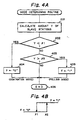
- the flag F at step 201 of Fig. 2 is determined by one of the flowcharts of Figs. 3A, 4A and 5A, the operation shown therein being started by a timing when an amount of reservation signals transmitted by the slave stations 2-1, 2-2, 2-3, ⁇ reaches a predetermined value.
- an amount X of transmission data reserved by the slave stations 2-1, 2-2, 2-3, ⁇ is calculated.
- the polling mode is switched to the contention mode. Also, when the reserved transmission data amount X reaches ⁇ 2, the contention mode is switched to the polling mode.
- an amount Y of slave stations having an amount of reserved transmission data larger than a predetermined value is calculated.
- the polling mode is switched to the contention mode. Also, when the slave station amount Y reaches ⁇ 2, the contention mode is switched to the polling mode.
- step 501 slave stations having an amount of reserved transmission data larger than a predetermined value are selected. Then, the average amount Z of reserved transmission data for the selected slave stations is calculated.
- the polling mode is switched to the contention mode. Also, when the average reserved transmission data amount Z reaches ⁇ 2, the contention mode is switched to the polling mode.
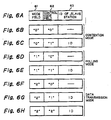
- Figs. 6A through 6H are diagrams of formats of access signals from the master station 1 to the slave stations 2-1, 2-2, 2-3, ⁇ . That is, a mode field 61, a control code field 62 and a slave station identification (ID) field 63 are provided. If the mode field 61 stores "0" as shown in Figs. 6B and 6C, the control mode is the contention mode; if the mode field 61 stores "1" as shown in Figs. 6D and 6E, the control mode is the polling mode; and if the mode field 61 stores "2" as shown in Figs. 6F, 6G and 6H, the control mode is a data transmission mode.
- ID slave station identification
- Figs. 7A, 7B and 7C are diagrams of formats of access signals from the slave station 2-1, 2-2, 2-3, to the master station 1, in which a control code field 71, a slave station ID field 72 and a data field 73 are provided. If the control field 71 is "0" as shown in Fig. 7B, this means a transmission reservation request, and if the control field 71 is "1" as shown in Fig. 7C, this means an actual data transmission.
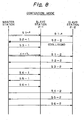
- Fig. 2 The contention mode of Fig. 2 is explained next with reference to Fig. 8.
- Fig. 8 only the slave stations 2-1 and 2-2 are illustrated and the other slave stations are omitted for simplifying the description.
- the master station 1 generates a reservation permission signal S1-1 as shown in Fig. 6B and transmits it to the slave stations 2-1 and 2-2.
- the slave stations 2-1 and.2-2 generate transmission reservation request signals S2-1 and S2-2, respectively, associated with the bytes of transmitting data, as shown in Fig. 7B, and transmit them to the master station 1.
- the transmission reservation request signal S2-1 collides with the transmission reservation request signal S2-2, and therefore, only one of the signals such as S2-1 is received by the master station 1.
- the master station 1 generates an acknowledgement signal S3-1 of the transmission reservation request signal S2-1 as shown in Fig. 6C, and transmits it to the slave station 2-1.
- the master station 1 After a predetermined time has passed, the master station 1 again generates a reservation permission signal S1-2 as shown in Fig. 6B and transmits it to the slave stations 2-1 and 2-2. As a result, the slave station 2-2 generates a transmission reservation request signal S2-2, associated with the bytes of transmitting data as shown in Fig. 7B, and transmits it to the master station 1. Then, the master station 1 generates an acknowledgement signal S3-2 of the transmission reservation request signal S2-2 as shown in Fig. 6C, and transmits it to the slave station 2-2.
- the master station 1 After a predetermined time has passed, the master station 1 generates a data transmission permission signal S4-1 as shown in Fig. 6G and transmits it to the slave station 2-1. Then, the slave station 2-1 generates a transmission data signal S5-1 as shown in Fig. 7C and transmits it to the master station 1. Finally, the master station 1 generates an acknowledgement signal S6-1 as shown in Fig. 6H and transmits it to the slave station 2-1.
- the master station 1 generates a data transmission permission signal S4-2 as shown in Fig. 6G and transmits it to the slave station 2-2.
- the slave station 2-2 generates a transmission data signal S5-2 as shown in Fig. 7C and transmits it to the master station 1.
- the master station 1 generates an acknowledgement signal S6-2 as shown in Fig. 6H and transmits it to the slave station 2-2.
- transmission right is sequentially allocated to the slave stations whose transmission reservation request signals are already received by the master station 1.
- Fig. 2 The polling mode of Fig. 2 is explained next with reference to Fig. 9. Also, in Fig. 9, only the slave stations 2-1 and 2-2 are illustrated and the other slave stations are omitted for simplifying the description.
- the master station 1 generates a reservation permission signal, i.e., a polling signal S1'-1 as shown in Fig. 6D and transmits it to the slave station 2-1.
- a reservation permission signal i.e., a polling signal S1'-1 as shown in Fig. 6D
- the slave station 2-1 if the slave station 2-1 has data to be transmitted to the master station 1, the slave station 2-1 generates a transmission reservation request signal S2'-1 associated with the bytes of transmitting data, as shown in Fig. 7B, and transmits it to the master station 1.
- the master station 1 generates a polling signal S1'-2 as shown in Fig. 6D and transmits it to the slave station 2-2.
- the slave station 2-2 if the slave station 2-2 has data to be transmitted to the master station 1, the slave station 2-2 generates a transmission reservation request signal S2'-2 associated with the bytes of transmitting data, as shown in Fig. 7B, and transmits it to the master station 1. Subsequently, the master station 1 performs the same polling operation upon the other slave stations.
- the master station 1 generates a data transmission permission signal S4-1 as shown in Fig. 6G and transmits it to the slave station 2-1.
- the slave station 2-1 generates a transmission data signal S5-1 as shown in Fig. 7C and transmits it to the master station 1.
- the master station 1 generates an acknowledgement signal S6-1 as shown in Fig. 6H and transmits it to the slave station 2-1.
- the master station 1 generates a data transmission permission signal S4-2 as shown in Fig. 6G and transmits it to the slave station 2-2. Then, the slave station 2-2 generates a transmission data signal S5-2 as shown in Fig. 7C and transmits it to the master station 1. Finally, the master station 1 generates an acknowledgement signal S6-2 as shown in Fig. 6H and transmits it to the slave station 2-2.
- the master station 1 performs the same data transmission operation upon the other slave stations.
- transmission right is sequentially allocated to all the slave stations.
Landscapes
- Engineering & Computer Science (AREA)
- Computer Networks & Wireless Communication (AREA)
- Signal Processing (AREA)
- Mobile Radio Communication Systems (AREA)
- Small-Scale Networks (AREA)
Claims (4)
- Station maîtresse pour exécuter une opération de contention/interrogation sur une pluralité de stations esclaves (2-1, 2-2, 2-3) chacune desdites stations esclaves générant un signal de demande de réservation de transmission dans un mode de contention et générant une quantité de données de transmission lors de la réception d'un signal de droit de transmission exclusif en provenance de ladite station maîtresse dans ledit mode de contention et dans un mode d'interrogation,
ladite station maîtresse (1) comportant :des moyens d'activation de mode de contention (202) pour exécuter ledit mode de contention sur lesdites stations esclaves,des moyens d'activation de mode d'interrogation (203) pour exécuter ledit mode d'interrogation sur lesdites stations esclaves, etdes moyens de commutation (201) pour commuter entre lesdits moyens d'activation de mode de contention et lesdits moyens d'activation de mode d'interrogation conformément à une valeur représentative représentant la quantité de données de transmission réservée par lesdites stations esclaves en vue d'une transmission à ladite station maîtresse, lesdits moyens de commutation commutant en ledit mode de contention si ladite valeur représentative est inférieure à une première valeur (α1, β1, γ1) et commutant en ledit mode d'interrogation si ladite valeur représentative est supérieure à une seconde valeur (α2, β2, γ2), la seconde valeur étant supérieure à la première valeur. - Station maîtresse selon la revendication 1, dans laquelle ladite valeur représentative représente la quantité (X) de données de transmission réservée par lesdites stations esclaves en vue d'une transmission à ladite station maîtresse, lesdits moyens de commutation comportant :des moyens pour calculer la quantité (X) de données de transmission réservée par lesdites stations esclaves dans ladite station maîtresse à chaque fois qu'un nombre de réservations par lesdites stations esclaves atteint une valeur prédéterminée,des moyens pour déterminer si oui ou non la quantité de données de transmission est inférieure à la première valeur (α1), etdes moyens pour déterminer si oui ou non la quantité de données de transmission est supérieure à la seconde valeur (α2),lesdits moyens de commutation commutant lesdits moyens d'activation de mode d'interrogation en lesdits moyens d'activation de mode de contention lorsque la quantité de données de transmission est inférieure à la première valeur,
lesdits moyens de commutation commutant lesdits moyens d'activation de mode de contention en lesdits moyens d'activation de mode d'interrogation lorsque la quantité de données de transmission est supérieure à la seconde valeur. - Station maîtresse selon la revendication 1, dans laquelle ladite valeur représentative représente un nombre (Y) de stations esclaves ayant une quantité de données de transmission supérieure à une première valeur prédéterminée,
lesdits moyens de commutation comportant :des moyens pour calculer le nombre (Y) de stations esclaves ayant une quantité de données de transmission supérieure à la première valeur prédéterminée à chaque fois qu'un nombre de réservations par lesdites stations esclaves atteint une seconde valeur prédéterminée,des moyens pour déterminer si oui ou non le nombre de stations esclaves est inférieur à la première valeur (β1), etdes moyens pour déterminer si oui ou non le nombre de stations esclaves est supérieur à la seconde valeur (β2),lesdits moyens de commutation commutant lesdits moyens d'activation de mode d'interrogation en lesdits moyens d'activation de mode de contention lorsque la quantité de données de transmission est inférieure à la première valeur,
lesdits moyens de commutation commutant lesdits moyens d'activation de mode de contention en lesdits moyens d'activation de mode d'interrogation lorsque la quantité de données de transmission est supérieure à la seconde valeur. - Station maîtresse selon la revendication 1, dans laquelle ladite valeur représentative représente une quantité moyenne (Z) de données de transmission pour certaines stations esclaves,
lesdits moyens de commutation comportant :des moyens pour sélectionner des stations esclaves ayant une quantité de données de transmission supérieure à une première valeur prédéterminée à chaque fois qu'un nombre de réservations par lesdites stations esclaves atteint une seconde valeur prédéterminée,des moyens pour calculer une quantité moyenne (Z) de données de transmission pour lesdites stations esclaves sélectionnées,des moyens pour déterminer si oui ou non la quantité moyenne de données de transmission est inférieure à la première valeur (γ1), etdes moyens pour déterminer si oui ou non la quantité moyenne de données de transmission est supérieure à la seconde valeur (γ2),lesdits moyens de commutation commutant lesdits moyens d'activation de mode d'interrogation en lesdits moyens d'activation de mode de contention lorsque la quantité moyenne de données de transmission est inférieure à la première valeur,
lesdits moyens de commutation commutant lesdits moyens d'activation de mode de contention en lesdits moyens d'activation de mode d'interrogation lorsque la quantité moyenne de données de transmission est supérieure à la seconde valeur.
Applications Claiming Priority (2)
| Application Number | Priority Date | Filing Date | Title |
|---|---|---|---|
| JP29285795A JP2705677B2 (ja) | 1995-11-10 | 1995-11-10 | 無線パケット通信システム |
| JP292857/95 | 1995-11-10 |
Publications (2)
| Publication Number | Publication Date |
|---|---|
| EP0773651A1 EP0773651A1 (fr) | 1997-05-14 |
| EP0773651B1 true EP0773651B1 (fr) | 2006-10-25 |
Family
ID=17787277
Family Applications (1)
| Application Number | Title | Priority Date | Filing Date |
|---|---|---|---|
| EP19960117931 Expired - Lifetime EP0773651B1 (fr) | 1995-11-10 | 1996-11-08 | Système de communication radio par paquet capable d'éviter une collision de transmission |
Country Status (4)
| Country | Link |
|---|---|
| US (1) | US6091741A (fr) |
| EP (1) | EP0773651B1 (fr) |
| JP (1) | JP2705677B2 (fr) |
| DE (1) | DE69636650T2 (fr) |
Families Citing this family (23)
| Publication number | Priority date | Publication date | Assignee | Title |
|---|---|---|---|---|
| US6198728B1 (en) * | 1996-12-19 | 2001-03-06 | Phillips Electronics North America Corp. | Medium access control (MAC) protocol for wireless ATM |
| EP0939569A1 (fr) * | 1998-02-19 | 1999-09-01 | ICO Services Ltd. | Distribution des informations de contrÔle dans un système de communication mobile AMRT |
| FR2775545B1 (fr) * | 1998-02-27 | 2000-06-02 | Canon Kk | Methode hybride adaptative d'acces a un canal de transmission |
| GB2339113B (en) * | 1998-06-30 | 2003-05-21 | Nokia Mobile Phones Ltd | Data transmission in tdma system |
| KR20000032728A (ko) * | 1998-11-17 | 2000-06-15 | 서평원 | 광대역무선멀티미디어통신시스템에서데이터통신시채널할당방법 |
| JP4374725B2 (ja) | 1999-09-22 | 2009-12-02 | パナソニック株式会社 | 通信方法及び通信局 |
| JP2001313656A (ja) * | 2000-04-28 | 2001-11-09 | Sony Corp | 基地局装置、端末装置、無線通信システム及び無線通信方法 |
| US7170904B1 (en) | 2000-08-28 | 2007-01-30 | Avaya Technology Corp. | Adaptive cell scheduling algorithm for wireless asynchronous transfer mode (ATM) systems |
| US7009960B2 (en) * | 2000-09-15 | 2006-03-07 | Texas Instruments Incorporated | Medium access control protocol for high rate wireless personal area network |
| JP2007527631A (ja) * | 2003-06-10 | 2007-09-27 | ノキア コーポレイション | 自律送信とスケジュール送信間での移動局の切替えを行う方法及び装置 |
| WO2006052943A2 (fr) * | 2004-11-08 | 2006-05-18 | Toyota Technical Center Usa, Inc. | Systeme et procede de communication sans fil automobile |
| US8054868B2 (en) | 2005-12-19 | 2011-11-08 | Panasonic Corporation | UWB transmitting/receiving apparatus, UWB transmitting/receiving terminal apparatus, and UWB transmitting/receiving system |
| US8630239B2 (en) * | 2006-09-20 | 2014-01-14 | Lg Electronics Inc. | Station and access point for EDCA communication, system thereof and communication method thereof |
| US8457553B2 (en) * | 2007-03-22 | 2013-06-04 | Qualcomm Incorporated | Removal of ambiguities in forming new piconet controller (PNC) when the current PNC controller is suddenly unavailable |
| US8139599B2 (en) * | 2007-04-19 | 2012-03-20 | Freescale Semiconductor, Inc. | System and method for operating a communications system |
| JP5571296B2 (ja) | 2008-07-15 | 2014-08-13 | 富士通株式会社 | 通信制御装置 |
| JP5062290B2 (ja) * | 2010-05-10 | 2012-10-31 | 富士通株式会社 | 移動通信システム並びに同システムにおける通信方法,基地局及び移動局 |
| JP5225345B2 (ja) * | 2010-09-16 | 2013-07-03 | 株式会社日立製作所 | 無線通信システム、親局無線通信装置、及び子局無線通信装置、並びに、通信方法 |
| US8780961B2 (en) * | 2010-10-29 | 2014-07-15 | Broadcom Corporation | Mixed-mode wireless device operation |
| US8731002B2 (en) * | 2011-03-25 | 2014-05-20 | Invensense, Inc. | Synchronization, re-synchronization, addressing, and serialized signal processing for daisy-chained communication devices |
| JP2013232800A (ja) * | 2012-04-27 | 2013-11-14 | Panasonic Corp | 通信システム |
| JP2014030168A (ja) * | 2012-06-27 | 2014-02-13 | Murata Mach Ltd | 中継通信システム、及び中継通信装置 |
| JP6989577B2 (ja) * | 2019-10-16 | 2022-01-05 | ソフトバンク株式会社 | 通信システム、情報処理装置、無線端末、情報処理装置の制御方法、無線端末の制御方法、および、プログラム |
Family Cites Families (8)
| Publication number | Priority date | Publication date | Assignee | Title |
|---|---|---|---|---|
| JPS5744353A (en) * | 1980-08-30 | 1982-03-12 | Matsushita Electric Ind Co Ltd | Information collection system |
| JPS60208138A (ja) * | 1984-03-30 | 1985-10-19 | Nec Corp | デ−タ通信方式 |
| GB2165127B (en) * | 1984-09-26 | 1988-04-07 | Philips Electronic Associated | Multiple access communications system |
| JPS61253944A (ja) * | 1985-05-07 | 1986-11-11 | Hitachi Ltd | ネツトワ−ク回線制御方法 |
| JPH063927B2 (ja) * | 1987-04-10 | 1994-01-12 | 富士通株式会社 | 最適化ブロツクポ−リング方式 |
| US5012469A (en) * | 1988-07-29 | 1991-04-30 | Karamvir Sardana | Adaptive hybrid multiple access protocols |
| WO1991016775A1 (fr) * | 1990-04-25 | 1991-10-31 | Telxon Corporation | Systeme de communication a commande adaptative d'acces aux supports |
| JPH0548610A (ja) | 1991-08-14 | 1993-02-26 | Tokyo Electric Co Ltd | 無線通信システム |
-
1995
- 1995-11-10 JP JP29285795A patent/JP2705677B2/ja not_active Expired - Fee Related
-
1996
- 1996-11-08 EP EP19960117931 patent/EP0773651B1/fr not_active Expired - Lifetime
- 1996-11-08 DE DE1996636650 patent/DE69636650T2/de not_active Expired - Lifetime
- 1996-11-08 US US08/747,038 patent/US6091741A/en not_active Expired - Lifetime
Also Published As
| Publication number | Publication date |
|---|---|
| DE69636650T2 (de) | 2007-10-04 |
| EP0773651A1 (fr) | 1997-05-14 |
| DE69636650D1 (de) | 2006-12-07 |
| JPH09135248A (ja) | 1997-05-20 |
| JP2705677B2 (ja) | 1998-01-28 |
| US6091741A (en) | 2000-07-18 |
Similar Documents
| Publication | Publication Date | Title |
|---|---|---|
| EP0773651B1 (fr) | Système de communication radio par paquet capable d'éviter une collision de transmission | |
| Tindell et al. | Calculating controller area network (CAN) message response times | |
| JP3164209B2 (ja) | 無線通信システム | |
| Lee et al. | A wireless token ring protocol for intelligent transportation systems | |
| US20050190784A1 (en) | Access protocol for wireless ad hoc networks using synchronous collision resolution | |
| HUT69354A (en) | Method for controlling the scheduling of multiple acces to communication resourches | |
| US6114968A (en) | Hybrid contention/polling access method | |
| KR20040089273A (ko) | 블루투스 시스템에서 7개 이상의 단말과의 효과적인통신방법 및 장치 | |
| EP0786181A1 (fr) | Procede de commande de transmission entre une pluralite de postes et des postes et systemes de communication correspondants | |
| Nett et al. | Reliable real-time communication in cooperative mobile applications | |
| Li et al. | SCMAC: A slotted-contention-based media access control protocol for cooperative safety in VANETs | |
| US5689503A (en) | Random access system of a mobile communication system | |
| Kim et al. | Performance Analysis of a MAC Protocol Consisting of EDCA on the CCH and a Reservation on the SCHs for the IEEE 802.11 p/1609.4 WAVE | |
| WO1996025811A1 (fr) | Technique permettant de venir a bout d'un encombrement de supports dans des liaisons de radiocommunication | |
| CA2493021C (fr) | Architecture et procede de commande centralisee d'evenements se produisant en liaison avec des dispositifs electroniques peripheriques eloignes | |
| CN101902381B (zh) | 将无线数据总线网络的用户分配给时隙的方法 | |
| Kutlu et al. | Performance analysis of MAC protocols for wireless control area network | |
| KR101982928B1 (ko) | 차량 환경용 무선 접속을 위한 차량 통신 방법 및 장치 | |
| Bartolomeu et al. | Enforcing flexibility in real-time wireless communications: A bandjacking enabled protocol | |
| JP3298811B2 (ja) | データ通信無線回線選択方法 | |
| Dabbous et al. | Prometheus: Vehicle to vehicle communications | |
| Hughes | Hard real-time communication for mobile ad hoc networks | |
| Andersson et al. | Static-priority scheduling of sporadic messages on a wireless channel | |
| CN101836375B (zh) | 无线电通信系统、协调器设备和通信终端设备 | |
| JPH07312602A (ja) | 無線lanシステムおよび送信権制御装置 |
Legal Events
| Date | Code | Title | Description |
|---|---|---|---|
| PUAI | Public reference made under article 153(3) epc to a published international application that has entered the european phase |
Free format text: ORIGINAL CODE: 0009012 |
|
| 17P | Request for examination filed |
Effective date: 19970224 |
|
| AK | Designated contracting states |
Kind code of ref document: A1 Designated state(s): DE GB |
|
| 17Q | First examination report despatched |
Effective date: 20020305 |
|
| GRAP | Despatch of communication of intention to grant a patent |
Free format text: ORIGINAL CODE: EPIDOSNIGR1 |
|
| GRAS | Grant fee paid |
Free format text: ORIGINAL CODE: EPIDOSNIGR3 |
|
| GRAA | (expected) grant |
Free format text: ORIGINAL CODE: 0009210 |
|
| AK | Designated contracting states |
Kind code of ref document: B1 Designated state(s): DE GB |
|
| REG | Reference to a national code |
Ref country code: GB Ref legal event code: FG4D |
|
| REF | Corresponds to: |
Ref document number: 69636650 Country of ref document: DE Date of ref document: 20061207 Kind code of ref document: P |
|
| PLBE | No opposition filed within time limit |
Free format text: ORIGINAL CODE: 0009261 |
|
| STAA | Information on the status of an ep patent application or granted ep patent |
Free format text: STATUS: NO OPPOSITION FILED WITHIN TIME LIMIT |
|
| 26N | No opposition filed |
Effective date: 20070726 |
|
| REG | Reference to a national code |
Ref country code: GB Ref legal event code: 732E Free format text: REGISTERED BETWEEN 20141023 AND 20141029 |
|
| PGFP | Annual fee paid to national office [announced via postgrant information from national office to epo] |
Ref country code: DE Payment date: 20141105 Year of fee payment: 19 Ref country code: GB Payment date: 20141105 Year of fee payment: 19 |
|
| REG | Reference to a national code |
Ref country code: DE Ref legal event code: R119 Ref document number: 69636650 Country of ref document: DE |
|
| GBPC | Gb: european patent ceased through non-payment of renewal fee |
Effective date: 20151108 |
|
| PG25 | Lapsed in a contracting state [announced via postgrant information from national office to epo] |
Ref country code: DE Free format text: LAPSE BECAUSE OF NON-PAYMENT OF DUE FEES Effective date: 20160601 Ref country code: GB Free format text: LAPSE BECAUSE OF NON-PAYMENT OF DUE FEES Effective date: 20151108 |