EP0775906A1 - Procédé et dispositif de fabrication d'échantillons amorphes - Google Patents
Procédé et dispositif de fabrication d'échantillons amorphes Download PDFInfo
- Publication number
- EP0775906A1 EP0775906A1 EP96850199A EP96850199A EP0775906A1 EP 0775906 A1 EP0775906 A1 EP 0775906A1 EP 96850199 A EP96850199 A EP 96850199A EP 96850199 A EP96850199 A EP 96850199A EP 0775906 A1 EP0775906 A1 EP 0775906A1
- Authority
- EP
- European Patent Office
- Prior art keywords
- crucible
- sample
- mixture
- analysis
- sample bodies
- Prior art date
- Legal status (The legal status is an assumption and is not a legal conclusion. Google has not performed a legal analysis and makes no representation as to the accuracy of the status listed.)
- Withdrawn
Links
- 238000000034 method Methods 0.000 title claims abstract description 34
- 238000002360 preparation method Methods 0.000 title description 12
- 238000004458 analytical method Methods 0.000 claims abstract description 27
- 239000000203 mixture Substances 0.000 claims abstract description 25
- 238000003723 Smelting Methods 0.000 claims abstract description 18
- 239000000463 material Substances 0.000 claims abstract description 17
- 241001062472 Stokellia anisodon Species 0.000 claims abstract description 14
- 230000004907 flux Effects 0.000 claims abstract description 13
- 239000012768 molten material Substances 0.000 claims abstract description 10
- 238000005266 casting Methods 0.000 claims abstract description 9
- 238000010183 spectrum analysis Methods 0.000 claims abstract description 9
- CWYNVVGOOAEACU-UHFFFAOYSA-N Fe2+ Chemical compound [Fe+2] CWYNVVGOOAEACU-UHFFFAOYSA-N 0.000 claims abstract description 6
- 238000004519 manufacturing process Methods 0.000 claims abstract description 6
- 230000003287 optical effect Effects 0.000 claims abstract description 5
- 238000012360 testing method Methods 0.000 claims abstract description 4
- 238000002844 melting Methods 0.000 claims description 6
- 230000008018 melting Effects 0.000 claims description 6
- 229910052582 BN Inorganic materials 0.000 claims description 5
- PZNSFCLAULLKQX-UHFFFAOYSA-N Boron nitride Chemical compound N#B PZNSFCLAULLKQX-UHFFFAOYSA-N 0.000 claims description 5
- 239000000919 ceramic Substances 0.000 claims description 4
- 230000007613 environmental effect Effects 0.000 claims description 2
- 239000007770 graphite material Substances 0.000 claims 1
- 239000000523 sample Substances 0.000 description 64
- BASFCYQUMIYNBI-UHFFFAOYSA-N platinum Chemical compound [Pt] BASFCYQUMIYNBI-UHFFFAOYSA-N 0.000 description 14
- 229910052697 platinum Inorganic materials 0.000 description 7
- 238000011109 contamination Methods 0.000 description 4
- 239000011521 glass Substances 0.000 description 4
- 238000005464 sample preparation method Methods 0.000 description 4
- VWDWKYIASSYTQR-UHFFFAOYSA-N sodium nitrate Chemical compound [Na+].[O-][N+]([O-])=O VWDWKYIASSYTQR-UHFFFAOYSA-N 0.000 description 4
- NINIDFKCEFEMDL-UHFFFAOYSA-N Sulfur Chemical compound [S] NINIDFKCEFEMDL-UHFFFAOYSA-N 0.000 description 3
- 239000005864 Sulphur Substances 0.000 description 3
- 229910052785 arsenic Inorganic materials 0.000 description 3
- 229910052802 copper Inorganic materials 0.000 description 3
- 239000010949 copper Substances 0.000 description 3
- 229910052751 metal Inorganic materials 0.000 description 3
- 239000002184 metal Substances 0.000 description 3
- 238000000465 moulding Methods 0.000 description 3
- 239000000047 product Substances 0.000 description 3
- RYGMFSIKBFXOCR-UHFFFAOYSA-N Copper Chemical compound [Cu] RYGMFSIKBFXOCR-UHFFFAOYSA-N 0.000 description 2
- VYPSYNLAJGMNEJ-UHFFFAOYSA-N Silicium dioxide Chemical compound O=[Si]=O VYPSYNLAJGMNEJ-UHFFFAOYSA-N 0.000 description 2
- 238000002441 X-ray diffraction Methods 0.000 description 2
- 238000000441 X-ray spectroscopy Methods 0.000 description 2
- 238000005275 alloying Methods 0.000 description 2
- 229910010293 ceramic material Inorganic materials 0.000 description 2
- 239000012141 concentrate Substances 0.000 description 2
- 238000011161 development Methods 0.000 description 2
- PSHMSSXLYVAENJ-UHFFFAOYSA-N dilithium;[oxido(oxoboranyloxy)boranyl]oxy-oxoboranyloxyborinate Chemical compound [Li+].[Li+].O=BOB([O-])OB([O-])OB=O PSHMSSXLYVAENJ-UHFFFAOYSA-N 0.000 description 2
- 239000012478 homogenous sample Substances 0.000 description 2
- 229910052500 inorganic mineral Inorganic materials 0.000 description 2
- MRELNEQAGSRDBK-UHFFFAOYSA-N lanthanum(3+);oxygen(2-) Chemical compound [O-2].[O-2].[O-2].[La+3].[La+3] MRELNEQAGSRDBK-UHFFFAOYSA-N 0.000 description 2
- HZRMTWQRDMYLNW-UHFFFAOYSA-N lithium metaborate Chemical compound [Li+].[O-]B=O HZRMTWQRDMYLNW-UHFFFAOYSA-N 0.000 description 2
- IIPYXGDZVMZOAP-UHFFFAOYSA-N lithium nitrate Chemical compound [Li+].[O-][N+]([O-])=O IIPYXGDZVMZOAP-UHFFFAOYSA-N 0.000 description 2
- 239000007769 metal material Substances 0.000 description 2
- 239000011707 mineral Substances 0.000 description 2
- 238000002156 mixing Methods 0.000 description 2
- 230000003647 oxidation Effects 0.000 description 2
- 238000007254 oxidation reaction Methods 0.000 description 2
- 239000007787 solid Substances 0.000 description 2
- 229910052717 sulfur Inorganic materials 0.000 description 2
- 239000004484 Briquette Substances 0.000 description 1
- OKTJSMMVPCPJKN-UHFFFAOYSA-N Carbon Chemical compound [C] OKTJSMMVPCPJKN-UHFFFAOYSA-N 0.000 description 1
- 229910002651 NO3 Inorganic materials 0.000 description 1
- ZLMJMSJWJFRBEC-UHFFFAOYSA-N Potassium Chemical compound [K] ZLMJMSJWJFRBEC-UHFFFAOYSA-N 0.000 description 1
- UCKMPCXJQFINFW-UHFFFAOYSA-N Sulphide Chemical compound [S-2] UCKMPCXJQFINFW-UHFFFAOYSA-N 0.000 description 1
- 229910001361 White metal Inorganic materials 0.000 description 1
- HCHKCACWOHOZIP-UHFFFAOYSA-N Zinc Chemical compound [Zn] HCHKCACWOHOZIP-UHFFFAOYSA-N 0.000 description 1
- 239000000654 additive Substances 0.000 description 1
- 229910045601 alloy Inorganic materials 0.000 description 1
- 239000000956 alloy Substances 0.000 description 1
- RQNWIZPPADIBDY-UHFFFAOYSA-N arsenic atom Chemical compound [As] RQNWIZPPADIBDY-UHFFFAOYSA-N 0.000 description 1
- 238000003556 assay Methods 0.000 description 1
- 230000002238 attenuated effect Effects 0.000 description 1
- 230000015572 biosynthetic process Effects 0.000 description 1
- 239000005385 borate glass Substances 0.000 description 1
- 150000001642 boronic acid derivatives Chemical class 0.000 description 1
- 239000003795 chemical substances by application Substances 0.000 description 1
- 229910052681 coesite Inorganic materials 0.000 description 1
- 239000000470 constituent Substances 0.000 description 1
- 229910052906 cristobalite Inorganic materials 0.000 description 1
- 238000010790 dilution Methods 0.000 description 1
- 239000012895 dilution Substances 0.000 description 1
- 238000004090 dissolution Methods 0.000 description 1
- 230000000694 effects Effects 0.000 description 1
- 238000005755 formation reaction Methods 0.000 description 1
- 239000010439 graphite Substances 0.000 description 1
- 229910002804 graphite Inorganic materials 0.000 description 1
- 238000000227 grinding Methods 0.000 description 1
- 229910001385 heavy metal Inorganic materials 0.000 description 1
- 229910010272 inorganic material Inorganic materials 0.000 description 1
- 239000011147 inorganic material Substances 0.000 description 1
- 239000013067 intermediate product Substances 0.000 description 1
- 229910052742 iron Inorganic materials 0.000 description 1
- 238000005259 measurement Methods 0.000 description 1
- 150000002739 metals Chemical class 0.000 description 1
- 238000012986 modification Methods 0.000 description 1
- 230000004048 modification Effects 0.000 description 1
- 229910052759 nickel Inorganic materials 0.000 description 1
- 239000002245 particle Substances 0.000 description 1
- 229910052700 potassium Inorganic materials 0.000 description 1
- 239000011591 potassium Substances 0.000 description 1
- 239000000843 powder Substances 0.000 description 1
- 239000010970 precious metal Substances 0.000 description 1
- 238000003825 pressing Methods 0.000 description 1
- 239000011435 rock Substances 0.000 description 1
- 239000013049 sediment Substances 0.000 description 1
- 239000000377 silicon dioxide Substances 0.000 description 1
- 239000011734 sodium Substances 0.000 description 1
- 235000010344 sodium nitrate Nutrition 0.000 description 1
- 239000004317 sodium nitrate Substances 0.000 description 1
- 239000000243 solution Substances 0.000 description 1
- 241000894007 species Species 0.000 description 1
- 229910052682 stishovite Inorganic materials 0.000 description 1
- 230000003319 supportive effect Effects 0.000 description 1
- 150000003568 thioethers Chemical class 0.000 description 1
- 229910052905 tridymite Inorganic materials 0.000 description 1
- RIUWBIIVUYSTCN-UHFFFAOYSA-N trilithium borate Chemical class [Li+].[Li+].[Li+].[O-]B([O-])[O-] RIUWBIIVUYSTCN-UHFFFAOYSA-N 0.000 description 1
- MGMXGCZJYUCMGY-UHFFFAOYSA-N tris(4-nonylphenyl) phosphite Chemical compound C1=CC(CCCCCCCCC)=CC=C1OP(OC=1C=CC(CCCCCCCCC)=CC=1)OC1=CC=C(CCCCCCCCC)C=C1 MGMXGCZJYUCMGY-UHFFFAOYSA-N 0.000 description 1
- 239000010969 white metal Substances 0.000 description 1
- 229910052725 zinc Inorganic materials 0.000 description 1
- 239000011701 zinc Substances 0.000 description 1
Images
Classifications
-
- C—CHEMISTRY; METALLURGY
- C03—GLASS; MINERAL OR SLAG WOOL
- C03B—MANUFACTURE, SHAPING, OR SUPPLEMENTARY PROCESSES
- C03B5/00—Melting in furnaces; Furnaces so far as specially adapted for glass manufacture
- C03B5/12—Melting in furnaces; Furnaces so far as specially adapted for glass manufacture in shaft furnaces
-
- C—CHEMISTRY; METALLURGY
- C03—GLASS; MINERAL OR SLAG WOOL
- C03B—MANUFACTURE, SHAPING, OR SUPPLEMENTARY PROCESSES
- C03B19/00—Other methods of shaping glass
- C03B19/02—Other methods of shaping glass by casting molten glass, e.g. injection moulding
-
- C—CHEMISTRY; METALLURGY
- C03—GLASS; MINERAL OR SLAG WOOL
- C03B—MANUFACTURE, SHAPING, OR SUPPLEMENTARY PROCESSES
- C03B5/00—Melting in furnaces; Furnaces so far as specially adapted for glass manufacture
- C03B5/06—Melting in furnaces; Furnaces so far as specially adapted for glass manufacture in pot furnaces
- C03B5/08—Glass-melting pots
-
- G—PHYSICS
- G01—MEASURING; TESTING
- G01N—INVESTIGATING OR ANALYSING MATERIALS BY DETERMINING THEIR CHEMICAL OR PHYSICAL PROPERTIES
- G01N1/00—Sampling; Preparing specimens for investigation
- G01N1/28—Preparing specimens for investigation including physical details of (bio-)chemical methods covered elsewhere, e.g. G01N33/50, C12Q
- G01N1/44—Sample treatment involving radiation, e.g. heat
-
- G—PHYSICS
- G01—MEASURING; TESTING
- G01N—INVESTIGATING OR ANALYSING MATERIALS BY DETERMINING THEIR CHEMICAL OR PHYSICAL PROPERTIES
- G01N2223/00—Investigating materials by wave or particle radiation
- G01N2223/07—Investigating materials by wave or particle radiation secondary emission
- G01N2223/076—X-ray fluorescence
Definitions
- the present invention is concerned with a method relating to the preparation of amorphous sample bodies that can be used for optical spectral analysis and X-ray spectral analysis, by batch-wise melting in a crucible a mixture comprising an analysis sample and a flux.
- the invention also relates to means for preparing the sample and for practicing the method.
- Difficulties are experienced in preparing homogenous sample bodies in the case of many materials, for instance materials which contain high concentrations of basic oxides, sulphides or which have high metal contents. In such cases, crystalline formations frequently occur which, in practice, make it impossible to analyze sample bodies of many different types of inorganic material, for instance geological samples, environmental samples, sulfidic and/or oxidic products that contain different intermediate products from ferrous and non-ferrous manufacturing processes.
- the method has been developed with the intention of solving sample preparation problems in respect of particularly troublesome rock species and minerals, for instance lamproites and kimberlites, these minerals having been formed under high pressures and temperatures.
- the flux used is a mixture comprising 20% lithium tetraborate and 80% lithium metaborate.
- An oxidation agent is also added, for instance one of the following: NH 4 NO 3 , LiNO 3 , and NaNO 3
- the oxidizable constituents are oxidized during smelting of the sample-flux mixture.
- X-ray Spectrometry Vol. 19, pp. 67-71 (1990) describes a smelting method used at Mount Isa Mines for many years in the preparation of geological sample bodies and different smelter products. A short pre-oxidation process with sodium nitrate at 70°C has been included in this method to enable the preparation of sulphide-containing sample bodies.
- the additives used in other respects comprise a conventional flux consisting of different lithium borates.
- Each crucible can only be used for a limited number of analyses, partly because of the wear to which the crucibles are subjected during the smelting processes, and partly, and mainly, as a result of contamination by readily alloying elements, such as Co, Ni, Cu and noble or precious metals included in the sample, which naturally also jeopardizes subsequent analysis of these elements.
- the personnel preparing the sample must be very adroit when handling crucibles and crucible tongs, so as to ensure that nothing will be spilt from the crucible as it is placed into and removed from the furnace, and while moulding the sample bodies.
- sample preparation methods so as to enable amorphous, homogenous sample bodies to be prepared from all of the materials that can be made the subject of analysis in, e.g., the laboratory of a smelting plant.
- One reason in this respect is the need to keep analysis costs low, for instance by rationalizing sample preparation so that all materials to be analyzed can be prepared in one and the same way and preferably with solely one single sample preparation. Neither is it possible to lower the accuracy to which the analyses are carried out, and consequently particularly high and very specific requirements must be placed on the sample preparation method applied.
- amorphous sample bodies can be improved so as to enable cheaper materials to be used and so that manual handling in conjunction with the moulding of sample bodies can be made easier and more effective, but primarily so that analyses of elements that are able to alloy with platinum can be carried out with greater precision.
- the object of the present invention is to provide a method in which the aforesaid drawbacks associated with the preparation of amorphous sample bodies are essentially fully eliminated.
- the invention is characterized to this end by the steps and features set forth in associated Claims.
- Smelting of the mixture containing an analysis sample and flux is carried out whilst casting sample bodies at the same time.
- the molten material runs down in a controlled flow onto a horizontal underlying surface where the smelt is collected and permitted to solidify into solid, amorphous sample bodies.
- the smelting process is suitably effected in a crucible provided with a hole and constructed so that the mixture will not leave the crucible through the hole prior to melting, and so as to facilitate running of the smelt from the crucible.
- the flow of smelt running from the crucible is controlled by appropriately adapting the diameter of the hole.
- Smelting is suitably carried out in a temperature range of 800-1300°C, for instance at a temperature of about 1000°C, which has been found to provide amorphous sample bodies of sufficient homogeneity when sulphur-containing sample bodies are to be prepared, and which afford the requisite analysis accuracy.
- the inventive arrangement for preparing amorphous sample bodies by batch-wise melting of a mixture of a sample intended for analysis and a flux includes a smelt crucible which is provided with an opening in its lower part and at least inside designed tapering downwards in order to prevent the mixture from coming out, but to facilitate flowing of molten material through said opening.
- the crucibles may be modified smelt crucibles conventionally used for analysis purposes, for instance platinum crucibles, wherein the modification comprises a hole in the bottom of the crucible and optionally the use of an insert, for instance a ceramic insert, which facilitates running of the molten material from the crucible.
- the invention also enables special, non-conventional crucibles shapes to be used, for instance tapering or conical shapes.
- the method enables the use of platinum crucibles and the like, wherein the effective useful life of the crucibles is extended because the time in which the molten material is in contact with the metal wall of the crucible is shorter than in the case of conventional smelting processes.
- the aforementioned alloying problem still remains to a large extent, i.e. the take-up of certain metals in the crucibles, and consequently it is preferred to use instead smelt crucibles that are made of non-metallic materials.
- the novel method allows the use of non-metallic materials that have earlier been unusable, probably because it was not earlier possible to reduce the smelt-crucible contact time sufficiently to eliminate contamination. This contamination is caused partly by dissolution of the crucible material in the smelt and partly by smelt being alloyed in the crucible wall.
- the inventive method thus enables the use of much cheaper smelt crucibles than was earlier possible and also enables sample bodies to be prepared in the absence of any appreciable risk of any contamination that may cause wear on crucibles and also present analysis problems.
- a suitable ceramic crucible material is boron nitride.
- the crucibles may be produced entirely from boron nitride, by pressing or pyrolytically, although it is also possible to use a less expensive ceramic material for the actual crucible and thereafter coat at least the internal surfaces of the crucible with boron nitride.
- sample bodies may be moulded or cast directly on an existing horizontal underlying surface over which the crucible has been placed, although it is preferred that the arrangement will also include a separate casting plate or mould placed horizontally beneath the crucible.
- the plate or mould will preferably be placed at a distance of 1-20 mm from the exit orifice of the hole in the bottom of the crucible.
- the crucibles may advantageously be made of ceramic material, for instance refractory casting material of commercial quality, for instance from Höganäs or Silikaverken, both of which providing such qualities, which can withstand temperatures in excess of 1300°C.
- Graphite crucibles can also be used in some cases.
- the crucible may have different, downwardly narrowing shapes, at least internally, provided that the mixture will not leave the crucible through said opening prior to melting of the mixture.
- a conical crucible has been found to be best from both the aspect of manufacture and of use.
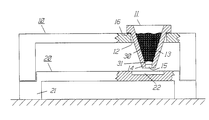
- a crucible rack 10 which accommodates sample smelt crucibles 11, of which only one is shown in the Figure.
- the rack includes a plurality of crucible receiving holes 12 whose sizes are adapted to chosen crucible sizes.
- Each crucible 11 has a conical, downwardly tapering part 13, and a bottom 14 in which an opening 15 is provided.
- the upper part of the crucible 11 has a horizontal rim or edge 16 adapted to the size of holes 12.
- a suitable crucible will have a height of about 45 mm, an outer diameter of the same size, and a hole diameter of about 4 mm.
- the crucible rack 10 is placed on a mould rack 20 having legs 21 which rest on an existing horizontal supportive surface, for instance on the bottom of the furnace.
- the mould rack 20 has moulds 22 formed beneath each hole 12 in the crucible rack 10.
- the diameter and depth of respective moulds can be adapted to the nature of the sample bodies to be produced, but will suitably have a diameter of about 30-35 mm and a depth of about 5 mm.
- Amorphous sample bodies are prepared in accordance with the invention by mixing a weighed sample quantity with flux.
- the mixture is transferred to a crucible 11 placed in the rack 10. Because of the conical configuration of the crucible 11 and the intrinsic internal friction of the fine-grain mixture, the sample mixture will form a bridge 31 at the bottom of the crucible.
- the crucible rack and the mould rack 20 are placed in a furnace chamber, with the crucible rack 10 placed over the mould rack 20 as shown in the Figure.
- the mixture 30 begins to melt, molten material will run down in the crucible 11 and gradually melt the bridge 31 and therewith penetrate the bridge and pass out through the opening 15 and down into the mould 22.
- the crucible rack 10 When all moulds 22 have been filled, the crucible rack 10, the mould rack 20 and the moulded sample bodies are allowed to cool. When these process stages have been completed, the used crucibles 11 and moulds 22 are removed from their respective racks 10 and 20 and replaced with fresh crucibles and moulds for continued sample preparation.
- the chosen sample was an arsenic concentrate having high concentrations of SiO 2 , S, Fe and As, i.e. also volatile elements as S and As.
- Table 2 also discloses concentrations for the standard, ASS, concentrations calculated with our evaluation program (TNPP) for a number of different ASS sample bodies produced with the described apparatus and measured sample intensities.
- the first sample, ASSORG was produced conventionally in platinum crucibles.
- the second sample, ASSPTI was prepared in a hot-pressed BN crucible (boron nitride) in accordance with the aforedescribed apparatus.
- the ASSPYK sample was produced in and with the aid of a pyrolytically produced BN cone, whereas the DGPT9A sample was oxidized and smelted in a BN-slurried ceramic crucible in accordance with the invention.
Landscapes
- Chemical & Material Sciences (AREA)
- Engineering & Computer Science (AREA)
- Organic Chemistry (AREA)
- Materials Engineering (AREA)
- Analytical Chemistry (AREA)
- Manufacturing & Machinery (AREA)
- General Health & Medical Sciences (AREA)
- General Physics & Mathematics (AREA)
- Immunology (AREA)
- Pathology (AREA)
- Physics & Mathematics (AREA)
- Biochemistry (AREA)
- Life Sciences & Earth Sciences (AREA)
- Health & Medical Sciences (AREA)
- Analysing Materials By The Use Of Radiation (AREA)
- Sampling And Sample Adjustment (AREA)
- Investigating Or Analyzing Materials Using Thermal Means (AREA)
- Crystals, And After-Treatments Of Crystals (AREA)
Applications Claiming Priority (2)
| Application Number | Priority Date | Filing Date | Title |
|---|---|---|---|
| SE9504180 | 1995-11-23 | ||
| SE9504180A SE513825C2 (sv) | 1995-11-23 | 1995-11-23 | Förfarande för framställning av amorfa provkroppar, anordning för framställning därav samt användning av anordningen och förfarandet |
Publications (1)
| Publication Number | Publication Date |
|---|---|
| EP0775906A1 true EP0775906A1 (fr) | 1997-05-28 |
Family
ID=20400326
Family Applications (1)
| Application Number | Title | Priority Date | Filing Date |
|---|---|---|---|
| EP96850199A Withdrawn EP0775906A1 (fr) | 1995-11-23 | 1996-11-22 | Procédé et dispositif de fabrication d'échantillons amorphes |
Country Status (6)
| Country | Link |
|---|---|
| EP (1) | EP0775906A1 (fr) |
| AU (1) | AU713552B2 (fr) |
| CA (1) | CA2190073C (fr) |
| NO (1) | NO964977L (fr) |
| SE (1) | SE513825C2 (fr) |
| ZA (1) | ZA969164B (fr) |
Cited By (4)
| Publication number | Priority date | Publication date | Assignee | Title |
|---|---|---|---|---|
| WO2004069758A1 (fr) * | 2003-01-06 | 2004-08-19 | Lang, G | Fondant pour la realisation de perles destinees a l'analyse par fluorescence x, et procede de preparation du dit fondant |
| EP1509067A3 (fr) * | 2003-08-20 | 2010-02-03 | Shin-Etsu Chemical Co., Ltd. | Containeur pour le prétraitement d'analyses élémentaires, procédé d'analyse d'éléments, torche à plasma à couplage inductif et dispositif pour analyses élémentaires |
| WO2014048780A1 (fr) * | 2012-09-28 | 2014-04-03 | Fluxana GmbH & Co. KG | Dispositif et procédé pour la production d'échantillons pour analyse |
| CN115047019A (zh) * | 2022-08-17 | 2022-09-13 | 天津海关动植物与食品检测中心 | 一种基于x射线荧光光谱的食品重金属检测装置和方法 |
Citations (2)
| Publication number | Priority date | Publication date | Assignee | Title |
|---|---|---|---|---|
| DE2242056B2 (fr) * | 1972-04-13 | 1975-04-10 | Italcementi Fabbriche Riunite Cemento S.P.A., Bergamo (Italien) | |
| EP0517685A1 (fr) * | 1991-05-30 | 1992-12-09 | Boliden Mineral AB | Procédé pour la fabrication d'éprouvettes amorphes |
Family Cites Families (1)
| Publication number | Priority date | Publication date | Assignee | Title |
|---|---|---|---|---|
| CA1011556A (en) * | 1974-09-09 | 1977-06-07 | Fernand Claisse | Fusion and casting machine |
-
1995
- 1995-11-23 SE SE9504180A patent/SE513825C2/sv not_active IP Right Cessation
-
1996
- 1996-10-29 AU AU70452/96A patent/AU713552B2/en not_active Ceased
- 1996-10-31 ZA ZA969164A patent/ZA969164B/xx unknown
- 1996-11-12 CA CA002190073A patent/CA2190073C/fr not_active Expired - Fee Related
- 1996-11-22 NO NO964977A patent/NO964977L/no not_active Application Discontinuation
- 1996-11-22 EP EP96850199A patent/EP0775906A1/fr not_active Withdrawn
Patent Citations (2)
| Publication number | Priority date | Publication date | Assignee | Title |
|---|---|---|---|---|
| DE2242056B2 (fr) * | 1972-04-13 | 1975-04-10 | Italcementi Fabbriche Riunite Cemento S.P.A., Bergamo (Italien) | |
| EP0517685A1 (fr) * | 1991-05-30 | 1992-12-09 | Boliden Mineral AB | Procédé pour la fabrication d'éprouvettes amorphes |
Non-Patent Citations (2)
| Title |
|---|
| X-RAY SPECTROMETRY., vol. 19, 1990, pages 3 - 14 |
| X-RAY SPECTROMETRY., vol. 19, 1990, pages 67 - 71 |
Cited By (5)
| Publication number | Priority date | Publication date | Assignee | Title |
|---|---|---|---|---|
| WO2004069758A1 (fr) * | 2003-01-06 | 2004-08-19 | Lang, G | Fondant pour la realisation de perles destinees a l'analyse par fluorescence x, et procede de preparation du dit fondant |
| EP1509067A3 (fr) * | 2003-08-20 | 2010-02-03 | Shin-Etsu Chemical Co., Ltd. | Containeur pour le prétraitement d'analyses élémentaires, procédé d'analyse d'éléments, torche à plasma à couplage inductif et dispositif pour analyses élémentaires |
| WO2014048780A1 (fr) * | 2012-09-28 | 2014-04-03 | Fluxana GmbH & Co. KG | Dispositif et procédé pour la production d'échantillons pour analyse |
| US9651463B2 (en) | 2012-09-28 | 2017-05-16 | Fluxana GmbH & Co. KG | Apparatus and method for producing analysis samples |
| CN115047019A (zh) * | 2022-08-17 | 2022-09-13 | 天津海关动植物与食品检测中心 | 一种基于x射线荧光光谱的食品重金属检测装置和方法 |
Also Published As
| Publication number | Publication date |
|---|---|
| NO964977D0 (no) | 1996-11-22 |
| NO964977L (no) | 1997-05-26 |
| ZA969164B (en) | 1997-06-18 |
| SE9504180D0 (sv) | 1995-11-23 |
| SE513825C2 (sv) | 2000-11-13 |
| CA2190073A1 (fr) | 1997-05-24 |
| SE9504180L (sv) | 1997-05-24 |
| CA2190073C (fr) | 2000-08-29 |
| AU713552B2 (en) | 1999-12-02 |
| AU7045296A (en) | 1997-05-29 |
Similar Documents
| Publication | Publication Date | Title |
|---|---|---|
| CA2190123A1 (fr) | Appareil d'evaluation de la proprete d'un metal et methode d'utilisation | |
| CN102854045A (zh) | 铅黄铜光谱标准样品及其制备 | |
| Norrish et al. | XRS analysis of sulphides by fusion methods | |
| US5762675A (en) | Method relating to the preparation of amorphous samples and means therefor | |
| EP0775906A1 (fr) | Procédé et dispositif de fabrication d'échantillons amorphes | |
| EP0529074B1 (fr) | Procede d'evaluation de l'equivalent-carbone, de la teneur en carbone et de la teneur en silicium de fonte de fer et d'evaluation de ses proprietes physiques et mecaniques, ainsi que godet de mesure de la courbe de refroidissement utilise pour mettre en oeuvre ce procede | |
| CA1198573A (fr) | Procede de coulage en continu d'un acier a l'aluminium desoxyde | |
| CA2068560C (fr) | Methode pour la production de corps d'essai amorphes | |
| KR20040027087A (ko) | 합금철의 형광엑스선 분석용 시료 조제방법 및 그 시료의전처리방법 | |
| US5082044A (en) | Method and apparatus for controlling the composition of a molten metal bath | |
| DE112006002407T5 (de) | Brandprobenschmelzmittelzusammensetzung für die Analyse von PGM und Gold aufweisenden Mineralproben | |
| CA1133037A (fr) | Methode de determination sur place su poids d'un metal en fusion | |
| CN114182119A (zh) | 一种锡合金标准样品的制备方法 | |
| JPS6362695B2 (fr) | ||
| KR100402028B1 (ko) | 합금철 정량분석용 몰드형 시료의 제조방법 | |
| CN120558674B (zh) | 银中杂质系列质控样品及其制备方法 | |
| CN110669953B (zh) | 一种铜合金标准样品的快速制备方法 | |
| Schriner | Experimental investigation of fundamental viscosity, density, and leaching characteristics of sodium-iron-silicate slags | |
| SU1732245A1 (ru) | Способ подготовки образцов дл рентгеноспектрального определени серебра в материалах | |
| Srinivasan et al. | Study of the recycling potential of returnable material during pressure casting of thick-walled castings ZP0410 | |
| JPH0225169Y2 (fr) | ||
| Brownsword et al. | X-ray fluorescence analysis of non-ferrous archaeological metalwork. Part 2: archaeological applications | |
| DE2632993A1 (de) | Verfahren und vorrichtung zur entnahme von proben aus metallschmelzen und schmelzmittel hierfuer | |
| Gerber Jr | Direct Synthesis of Spectrochemical Standards by Powder Metallurgy: Preliminary Report | |
| KR960006923B1 (ko) | 모합금(母合金)용 그레인 제조방법 |
Legal Events
| Date | Code | Title | Description |
|---|---|---|---|
| PUAI | Public reference made under article 153(3) epc to a published international application that has entered the european phase |
Free format text: ORIGINAL CODE: 0009012 |
|
| AK | Designated contracting states |
Kind code of ref document: A1 Designated state(s): AT BE CH DE DK ES FI FR GB GR IE IT LI LU MC NL PT SE |
|
| AX | Request for extension of the european patent |
Free format text: AL;LT;LV;RO;SI |
|
| 17P | Request for examination filed |
Effective date: 19971114 |
|
| 17Q | First examination report despatched |
Effective date: 20020214 |
|
| GRAH | Despatch of communication of intention to grant a patent |
Free format text: ORIGINAL CODE: EPIDOS IGRA |
|
| STAA | Information on the status of an ep patent application or granted ep patent |
Free format text: STATUS: THE APPLICATION IS DEEMED TO BE WITHDRAWN |
|
| 18D | Application deemed to be withdrawn |
Effective date: 20030206 |