EP0776130A2 - Kamerakontrollsystem mit variabler Bildrate - Google Patents
Kamerakontrollsystem mit variabler Bildrate Download PDFInfo
- Publication number
- EP0776130A2 EP0776130A2 EP96118903A EP96118903A EP0776130A2 EP 0776130 A2 EP0776130 A2 EP 0776130A2 EP 96118903 A EP96118903 A EP 96118903A EP 96118903 A EP96118903 A EP 96118903A EP 0776130 A2 EP0776130 A2 EP 0776130A2
- Authority
- EP
- European Patent Office
- Prior art keywords
- camera
- control
- frame rate
- image data
- data
- Prior art date
- Legal status (The legal status is an assumption and is not a legal conclusion. Google has not performed a legal analysis and makes no representation as to the accuracy of the status listed.)
- Withdrawn
Links
Images





Classifications
-
- G—PHYSICS
- G08—SIGNALLING
- G08B—SIGNALLING SYSTEMS, e.g. PERSONAL CALLING SYSTEMS; ORDER TELEGRAPHS; ALARM SYSTEMS
- G08B13/00—Burglar, theft or intruder alarms
- G08B13/18—Actuation by interference with heat, light, or radiation of shorter wavelength; Actuation by intruding sources of heat, light, or radiation of shorter wavelength
- G08B13/189—Actuation by interference with heat, light, or radiation of shorter wavelength; Actuation by intruding sources of heat, light, or radiation of shorter wavelength using passive radiation detection systems
- G08B13/194—Actuation by interference with heat, light, or radiation of shorter wavelength; Actuation by intruding sources of heat, light, or radiation of shorter wavelength using passive radiation detection systems using image scanning and comparing systems
- G08B13/196—Actuation by interference with heat, light, or radiation of shorter wavelength; Actuation by intruding sources of heat, light, or radiation of shorter wavelength using passive radiation detection systems using image scanning and comparing systems using television cameras
- G08B13/19665—Details related to the storage of video surveillance data
- G08B13/19667—Details realated to data compression, encryption or encoding, e.g. resolution modes for reducing data volume to lower transmission bandwidth or memory requirements
-
- H—ELECTRICITY
- H04—ELECTRIC COMMUNICATION TECHNIQUE
- H04N—PICTORIAL COMMUNICATION, e.g. TELEVISION
- H04N23/00—Cameras or camera modules comprising electronic image sensors; Control thereof
- H04N23/60—Control of cameras or camera modules
- H04N23/63—Control of cameras or camera modules by using electronic viewfinders
-
- G—PHYSICS
- G08—SIGNALLING
- G08B—SIGNALLING SYSTEMS, e.g. PERSONAL CALLING SYSTEMS; ORDER TELEGRAPHS; ALARM SYSTEMS
- G08B13/00—Burglar, theft or intruder alarms
- G08B13/18—Actuation by interference with heat, light, or radiation of shorter wavelength; Actuation by intruding sources of heat, light, or radiation of shorter wavelength
- G08B13/189—Actuation by interference with heat, light, or radiation of shorter wavelength; Actuation by intruding sources of heat, light, or radiation of shorter wavelength using passive radiation detection systems
- G08B13/194—Actuation by interference with heat, light, or radiation of shorter wavelength; Actuation by intruding sources of heat, light, or radiation of shorter wavelength using passive radiation detection systems using image scanning and comparing systems
- G08B13/196—Actuation by interference with heat, light, or radiation of shorter wavelength; Actuation by intruding sources of heat, light, or radiation of shorter wavelength using passive radiation detection systems using image scanning and comparing systems using television cameras
- G08B13/19654—Details concerning communication with a camera
- G08B13/19656—Network used to communicate with a camera, e.g. WAN, LAN, Internet
-
- G—PHYSICS
- G08—SIGNALLING
- G08B—SIGNALLING SYSTEMS, e.g. PERSONAL CALLING SYSTEMS; ORDER TELEGRAPHS; ALARM SYSTEMS
- G08B13/00—Burglar, theft or intruder alarms
- G08B13/18—Actuation by interference with heat, light, or radiation of shorter wavelength; Actuation by intruding sources of heat, light, or radiation of shorter wavelength
- G08B13/189—Actuation by interference with heat, light, or radiation of shorter wavelength; Actuation by intruding sources of heat, light, or radiation of shorter wavelength using passive radiation detection systems
- G08B13/194—Actuation by interference with heat, light, or radiation of shorter wavelength; Actuation by intruding sources of heat, light, or radiation of shorter wavelength using passive radiation detection systems using image scanning and comparing systems
- G08B13/196—Actuation by interference with heat, light, or radiation of shorter wavelength; Actuation by intruding sources of heat, light, or radiation of shorter wavelength using passive radiation detection systems using image scanning and comparing systems using television cameras
- G08B13/19678—User interface
- G08B13/19682—Graphic User Interface [GUI] presenting system data to the user, e.g. information on a screen helping a user interacting with an alarm system
-
- G—PHYSICS
- G08—SIGNALLING
- G08B—SIGNALLING SYSTEMS, e.g. PERSONAL CALLING SYSTEMS; ORDER TELEGRAPHS; ALARM SYSTEMS
- G08B13/00—Burglar, theft or intruder alarms
- G08B13/18—Actuation by interference with heat, light, or radiation of shorter wavelength; Actuation by intruding sources of heat, light, or radiation of shorter wavelength
- G08B13/189—Actuation by interference with heat, light, or radiation of shorter wavelength; Actuation by intruding sources of heat, light, or radiation of shorter wavelength using passive radiation detection systems
- G08B13/194—Actuation by interference with heat, light, or radiation of shorter wavelength; Actuation by intruding sources of heat, light, or radiation of shorter wavelength using passive radiation detection systems using image scanning and comparing systems
- G08B13/196—Actuation by interference with heat, light, or radiation of shorter wavelength; Actuation by intruding sources of heat, light, or radiation of shorter wavelength using passive radiation detection systems using image scanning and comparing systems using television cameras
- G08B13/19678—User interface
- G08B13/19689—Remote control of cameras, e.g. remote orientation or image zooming control for a PTZ camera
-
- H—ELECTRICITY
- H04—ELECTRIC COMMUNICATION TECHNIQUE
- H04N—PICTORIAL COMMUNICATION, e.g. TELEVISION
- H04N19/00—Methods or arrangements for coding, decoding, compressing or decompressing digital video signals
- H04N19/10—Methods or arrangements for coding, decoding, compressing or decompressing digital video signals using adaptive coding
- H04N19/102—Methods or arrangements for coding, decoding, compressing or decompressing digital video signals using adaptive coding characterised by the element, parameter or selection affected or controlled by the adaptive coding
- H04N19/132—Sampling, masking or truncation of coding units, e.g. adaptive resampling, frame skipping, frame interpolation or high-frequency transform coefficient masking
-
- H—ELECTRICITY
- H04—ELECTRIC COMMUNICATION TECHNIQUE
- H04N—PICTORIAL COMMUNICATION, e.g. TELEVISION
- H04N19/00—Methods or arrangements for coding, decoding, compressing or decompressing digital video signals
- H04N19/50—Methods or arrangements for coding, decoding, compressing or decompressing digital video signals using predictive coding
- H04N19/587—Methods or arrangements for coding, decoding, compressing or decompressing digital video signals using predictive coding involving temporal sub-sampling or interpolation, e.g. decimation or subsequent interpolation of pictures in a video sequence
-
- H—ELECTRICITY
- H04—ELECTRIC COMMUNICATION TECHNIQUE
- H04N—PICTORIAL COMMUNICATION, e.g. TELEVISION
- H04N7/00—Television systems
- H04N7/14—Systems for two-way working
- H04N7/15—Conference systems
Definitions
- This invention relates to a camera control system and, more particularly, to a camera control system in which any camera of one or more cameras is remotely controlled.
- a conventional camera control system a plurality of camera each having pan, tilt and zoom functions are placed at respective locations, the plurality of cameras are connected to a control center or to a control unit at any location by means of communication lines and any camera is capable of being remotely controlled.
- control signal lines for transmitting camera control and status signals are required in addition to cables for transmitting audio and video signals.
- a camera control system capable of controlling any camera by establishing a communication path for video/audio and control signals when this is necessary is employed in video conferencing implemented on a computer network such as a LAN (local area network).
- video/audio and various control information entered at an individual terminal can be transmitted to all other terminals via the same network, and the camera of any communicating party can be remotely controlled.
- a camera control system in which special-purpose cables for video/audio are laid is effective in a case where the number of cameras to be remotely controlled is small, a case where location of installation is seldom changed and a case where remote control is effected from a fixed location.
- convenience diminishes when any of these requirements is not satisfied.
- Laying the video/audio cables requires great expenditure and changing the location of installation is very troublesome. For example, the re-laying of a video/audio cable attendant upon the change in the location of a camera is very troublesome and is not feasible under certain circumstances. If there are N-number of cameras and M-number of controllers which remotely control these cameras, then N ⁇ M video/audio cables must be laid.
- the cameras capable of being remotely controlled are the small number of cameras connected to the terminals of the participants in the conference. This does not satisfy the requirement that video (and audio) from a camera at any location been seen and heard freely when desired.
- a system be established in which the control unit for remotely controlling the camera and the plurality of cameras are connected to a network such as a LAN, with the video/audio and various control information being transmitted via the network.
- a network such as a LAN
- the video/audio and various control information being transmitted via the network.
- frame rate namely the number of frames capable of being transmitted from a camera to the control unit every second.
- Remote control by a control unit as described above includes control for panning, tilting, zoom-in and zoom-out.
- the operator on the side of the control unit makes settings to obtain the desired video while observing the video from the camera.
- the frame rate as mentioned above, and the transmission of video to the control unit cannot satisfactorily follow up motion of the camera resulting from camera control, the operator cannot ascertain a change in the set state of the camera and there is a marked decline in operability.
- an object of the present invention is to provide a camera control system in which a plurality of cameras can be remotely controlled freely by any of a plurality of control means.
- Another object of the present invention is to provide a camera control system in which a camera can be controlled smoothly while its motion is verified by the camera image.
- Still another object of the present invention is to provide a camera control system in which a plurality of cameras and one or more control means are interconnected by a data network so that any camera can be remotely controlled from any one of the control means.
- a camera control system having one or more camera management units for managing one or more cameras whose image-capture orientation and magnification are freely externally controlled, and one or more camera controllers for controlling the cameras via the camera management units, characterized by having frame-rate altering means by which the frame rate of an image obtained from a camera when the camera is controlled by a camera controller is made larger than a frame rate which prevails when the camera is not controlled.
- the frame-rate altering means enlarges the frame rate by lowering the resolution of the image.
- the frame rate is enlarged by lowering resolution of an image when the image is subjected to compressive coding.
- the frame-rate altering means comprises frame-rate alteration designating means for designating alteration of frame rate, and frame-rate alteration management means for managing alteration of frame rate.
- the frame-rate alteration designating means is provided in the camera controller, and the frame-rate alteration management means is provided in the camera management unit.
- means are provided for adding data, which are for camera control, onto at least one of video data and audio data.
- means are provided for separating data, which are for camera control, that have been added onto one of at least video data and audio data.
- Fig. 1 is a block diagram showing the general configuration of the first embodiment.
- a LAN 10 comprising an Ethernet has a plurality of camera management units 12, 14 connected thereto.
- Video cameras (referred to as “cameras” below) 16, 18 are connected to the camera management units 12, 14.
- Each of the cameras 16, 18 has a microphone for audio input.
- Also connected to the LAN 10 are a plurality of camera controllers 20, 22 for remotely controlling the cameras 16, 18.
- the camera management units 12, 14 control the orientation (in at least one direction of panning and tilting directions) and zoom magnification of the cameras 16, 18 under management in accordance with camera control signals from the camera controllers 20, 22, and transfer video data obtained from the cameras 16 18 to the source of the control signals.
- the cameras 16, 18 have been fitted with a microphone, audio data are also transferred to the source of the control signals.
- the camera management unit 12 has a communication control unit 30, a memory device 32, a camera control unit 34, a data compression unit 35 and an interface 36.
- the communication control unit 30 controls the connection and data communication with the camera controllers 20, 22 via the LAN 10.
- the memory device 32 which is constituted by a memory such as a RAM or by an HDD (hard-disk drive), stores various data inclusive of video/audio data to be transferred.
- the camera control unit 34 controls orientation and zoom magnification of the camera 16 and supplies video/audio data from the camera 16 to the communication control unit 30 via the memory device 32.
- the data compression unit 35 compresses video data that has been stored in the memory device 32 and supplies the compressed data to the communication control unit 30.
- the interface 36 connects the camera 16 to the camera control unit 34.
- the camera management unit 14 has a construction identical with that of the camera management unit 12.
- the functions of the blocks constituting the camera management units 12, 14 can be implemented by having a CPU execute a predetermined program, and the camera management units 12, 14 can be realized by a personal computer or work station.
- the camera controller 20 comprises a communication control unit 40, a memory device 42, a camera selecting unit 44, an operation unit 46, an operation management unit 48, a display monitor 50 and a speaker 52.
- the communication control unit 40 controls the connection and data communication with either of the camera management units 12, 14 via the LAN 10.
- the memory device 42 which is constituted by a memory such as a RAM or by an HDD, stores various data inclusive of video/audio data to be transferred.
- the camera selecting unit 44 provides a user interface for selecting a camera to be controlled.
- the operation unit 46 provides a user interface for controlling the panning, tilting and zooming of one camera selected by the camera selecting unit 44.
- the operation management unit 48 manages the selection state of the camera by the camera selecting unit 44 and the control designation by the operation unit 46 and transmits control information back and forth between the camera management units 12, 14 which manage the camera to be controlled.
- the monitor 50 displays received video, and the speaker 52 outputs received audio.
- the camera controller 22 has the same construction as the camera controller 20.
- Each of the camera controllers 20, 22 actually comprises a personal computer or a work station.
- the section composed of the camera selecting unit 44, control unit 46 and control management unit 48 is implemented in the computer by graphical user interfaces such as image elements or a selection menu displayed on the monitor 50, a pointing device such as a mouse for operating or selecting the graphic user interface, and program software for displaying the graphical user interface and implementing the operation of the pointing devices or the selection operation.
- FIG. 1 Although two camera management units 12, 14 and two camera controllers 20, 22 are illustrated in Fig. 1, it should be obvious that three or more camera management units can be connected to the LAN 10 as well as three or more camera controllers. In the description below, an example will be described in which the camera 16 is controlled by the camera controller 20 via the camera management unit 12.
- Fig. 2 shows a camera control screen presented by the operation unit 46 in Fig. 1.
- the camera control screen, indicated at 60 is displayed on the monitor 50.
- the camera control screen 60 is provided with control buttons, namely pan buttons 62, 64 which designate rotation of the camera 16 in the panning (horizontal) direction, tilt buttons 66, 68 which designate rotation of the camera 16 in the tilting direction (up and down), a home button 70 for returning the direction of the camera 16 to the front direction, a telephoto button 72 which instructs the camera 16 to zoom in for telephoto and a wide-angle button 74 which instructs the camera to zoom out for wide angle.
- control buttons namely pan buttons 62, 64 which designate rotation of the camera 16 in the panning (horizontal) direction
- tilt buttons 66, 68 which designate rotation of the camera 16 in the tilting direction (up and down)
- a home button 70 for returning the direction of the camera 16 to the front direction
- a telephoto button 72 which instructs the camera 16 to zoom in
- a rectangular frame 76 indicates the largest possible area of photography obtained by maximizing the angle of view of the camera under control and panning and tilting the camera to the maximum extent.
- a rectangular frame 78 indicates the present area of photography, which is based upon the present prevailing panning angle, tilt angle and zoom value, at a relative position within the frame 76.
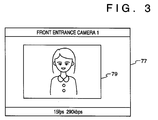
- Fig. 3 illustrates an image display window 77 displayed on the screen of the monitor 50 alongside the camera control screen 60.
- An image window 79 provided inside the image display window 77 displays the image obtained by the camera 16. The operator controls the camera 16 while confirming motion by way of the image displayed in the display window 79. It is also possible to provide the image window 79 inside the rectangular frame 78 (see Fig. 2). In such case the frame of the image display window 77 may be made to coincide with the rectangular frame 76.
- “Front Entrance Camera 1” which is displayed at the top of the image display window 77, indicates the camera that is currently acquiring the image being displayed in the image window 79, namely the camera currently being selected. Further, "15 fps" being displayed at the bottom indicates the current frame rate. In this case, the frame rate is 15 frames per second. Furthermore, “290 kbps” indicates the current data transfer rate. In this case, the data transfer rate is 290 kilobits per second. This display of information improves operability.
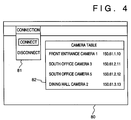
- Fig. 4 illustrates a camera selection window 80, which is produced by the camera selecting unit 44 of Fig. 1, for selecting the camera to be controlled.
- the camera selection window also is displayed on the monitor 50.
- a "CONNECTION" pull-down menu 81 has connect and disconnect items. When the "CONNECTION" menu is selected by a mouse cursor (not shown), the pull-down menu 81 is displayed. With display of the pull-down menu 81, or in response to selection of a display menu (not shown) of a camera list, a camera table 82 indicating a list of all selectable cameras is displayed.
- the camera table 82 displays sets of names and identification information.
- the names indicate individual cameras in easily understandable form, and the identification information uniquely identifies the camera management units 12, 14 of the connected parties. Since the camera management units 12, 14 and camera controllers 20, 22 are connected via the LAN 10 in this embodiment, IP addresses are adopted as the identification information.
- the camera names and the IP addresses of the camera management units thereof are stored beforehand in the storage device 42.
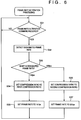
- Fig. 5 is a flowchart illustrating the operation of the camera controller 20.
- the operation management unit 48 determines whether any camera has been connected (step S11). If a connection has not yet been made ("NO” at step S11), a display to this effect is presented on the monitor 50 and processing ends (step S12). If a connection has already been made ("YES” at step S11), first the current video frame rate (number of frames displayed per second, e.g., 15 frames per second) is displayed in the memory device 42 (S13). In this example the case described is one in which the camera 16 is already connected.
- the operation management unit 48 transmits a frame-rage alteration command to the connected camera management unit 12 via a communication channel that has been established by the communication control units 30, 40 (S14).
- the camera control unit 34 in the camera management unit 12 interprets the frame-rate alteration command and transmits the video data, which have been stored temporarily in the memory device 32, to the communication control unit 30 upon altering (enlarging) the frame rate.
- the operation management unit 48 functions as frame-rate alteration designating means
- the camera control unit 34 functions as frame-rate alteration management means.
- These frame-rate alteration designating means and frame-rate alteration management means constitute frame-rate alteration means.
- the camera control command corresponding to the clicked control button is sent to the camera management unit 12 in the same manner as the frame-rate alteration command (S15).
- the operation management unit 48 of the camera controller 20 acquires the status parameters of the controlled camera after the operation thereof from the camera management unit 12 (S16) and updates the frame 78 of photographic area on the camera control screen 60 (S17).
- the operation management unit 48 determines whether camera control is still being continued (i.e., whether the operating to hold down the control button) (S18). If camera operation is still in progress ("YES" at S18), the program returns to S15. If operation has ended (“NO" at S18), the operation management unit 48 transmits the frame-rate alteration command to the camera management unit 12 (S19) in such a manner that the video frame rate is restored to the original value stored previously at S13. Processing is then terminated.
- the image from the camera under control continues being displayed in the image window 79 at the set frame rate. That is, the camera management unit 12 immediately alters the frame rate of the transmitted image by means of the communication control unit 30 in accordance with the frame-rate alteration command.
- FIG. 6 is a flowchart showing the control procedure of the camera management unit 12 executed in response to the frame-rate alteration command. This processing is implemented by having the CPU (not shown) in the camera management unit 12 execute a control program.
- step S31 When the communication control unit 30 determines at step S31 that a frame-rate alteration command has been received from the camera controller 20, the program proceeds to step S32.
- the specified frame rate attached to this frame-rate alteration command is detected at step S32. In this example, it is assumed that the frame rate is either 15 or 30 fps.
- step S33 the compression ratio of the video data compressed by the data compression unit 35 is made a first compression ratio and the transfer frame rate of the communication control unit 30 is set at 15 fps.
- step S34 the compression ratio of the video data compressed by the data compression unit 35 is made a first compression ratio and the transfer frame rate of the communication control unit 30 is set at 15 fps.
- step S36 the compression ratio in the data compression unit 35 is set to a compression ratio (a second compression ratio) higher than the first compression ratio in order to prevent the amount of video data transmitted from increasing owing to an increase in the frame rate.
- the frame rate in the communication control unit 30 is then set at 30 fps at step S37.
- the data compression unit 35 compresses the video data, which has been stored in the memory device 32, at the set compression ratio (first or second compression ratio).
- the communication control unit 30 attaches a tag, which indicates the set frame rate, to the compressed data that have been obtained, and then transmits the data to the camera controller 20 at this frame rate.
- the transmitted video data are displayed on the camera controller 20 in accordance with the frame rate indicated by the tag attached to the video data.
- the time delay up to the moment the operator is capable of confirming the results of camera operation by motion of the image is lengthened. Consequently, the operator may hold the control buttons 62 ⁇ 74 depressed more than necessary, thereby causing excessive operation and making it difficult to perform zooming smoothly.
- the video frame rate cannot be increased sufficiently owing to limitations upon the traffic in LAN 10 or limitations upon the video display capability of the monitor 50.
- the resolution of the image is lowered or the image quality of the image at the compressive encoding thereof is diminished, i.e., the compression ratio is enlarged, as in the flowchart of Fig. 6, to thereby make possible an increase in the frame rate without enlarging the amount of communication data or the amount of display data.
- Fig. 7 is a flowchart showing the operation of the camera management unit 12 in response to a camera control command. If a camera control command is sent from the camera controller 20, the camera control unit 34 transfers this command to the camera 16 via the camera interface 36 (S51), whereby the camera 16 is driven to attain the state designated. In a case where the response from the camera 16 contains status parameters that are the result of control of the camera, these parameters are saved in the memory device 32. Otherwise, a status-parameter request command is sent to the camera 16 and is saved in the memory device 32 (S52). After the camera control command is executed, notification of end of command execution is sent back to the camera controller 20 along with status parameters stored in the memory device 32 (step S53).
- the camera controller 20 sends the camera management unit 12 a camera control command adapted to the control command system of the camera 16 to be controlled.
- the control command system differs depending upon the camera article and, in general, different camera articles are connected to the network.
- the camera controller 20 would send the camera management unit 12 an abstracted or normalized control command and the camera control unit 34 of each camera management unit 12 would translate or convert this control command to one conforming to the camera connected thereto.
- a video/audio signal is transmitted over the LAN 10 upon being compressed and encoded. More specifically, the camera management unit 12 compresses and encodes a video/audio signal to be transmitted and outputs the compressed signal to the LAN 10. The camera controllers 20 decompresses the compressed video/audio signal from the LAN 10 and applies the decompressed signal to the monitor 50 and speaker 12.
- the camera management units 12, 14 and camera controllers 20, 22 are interconnected by the Ethernet LAN.
- an ISDN or public telephone line may be used instead.
- telephone numbers can be used as the information uniquely defining the camera management units 12, 14.
- the camera management unit 12 and camera controller 20 are described as being separate devices. However, it should be obvious that these can be incorporated in a single personal computer or work station. In such case there would be no need to rely upon a LAN. If the video camera is connected to the input/output interface, e.g., to a serial port, of the personal computer or work station, then the input/output interface may be opened and assigned as a logical communication channel, thereby allowing operation to be performed in the same manner as when a connection is made via the LAN.
- the input/output interface e.g., to a serial port
- a frame-rate alteration command which request a change in frame rate is outputted by the camera controller 20 and frame rate in the camera management unit 12 is changed on the basis of this command.
- this does not impose a limitation upon the invention.
- an arrangement may be adopted in which when designation of panning, tilting or zooming of the camera by the camera control command is detected in the camera management unit 12, the frame rate during the time of the operation corresponding to the command is raised. In this case, the frame-rate alteration command is unnecessary.
- Fig. 8 is a flowchart showing a procedure for changing frame rate based upon a control command.
- the communication control unit 30 determined at step S51 whether a control command has been received. If the command has been received ("YES" at step S51), the program proceeds to step S52 and the control command is analyzed. If the result of analysis is that a camera operation accompanied by alteration of camera panning, tilting or zooming has been commanded, then the program proceeds from step S53 to step S54 so that the frame rate in the communication control unit 30 is changed to 30 fps. The data compression ratio of the data compression unit 35 is then raised at step S55.
- step S56 it is determined at step S56 whether the command indicating camera operation is still in effect. Specifically, whether a control command accompanying camera control has entered within a predetermined period of time is checked and it is determined whether control of the camera is continuing. If it is judged that camera control has ended, the program proceeds to step S57. Here the frame rate in the communication control unit 30 is restored to the original 15 fps. This is followed by step S58, at which the compression ratio of the data compression unit 35 is restored to the original compression ratio (first compression ratio). The alteration of the compression ratio at step S55 is unnecessary if the LAN 10 will allow the traffic.
- the rectangular frame 76 on the display (Fig. 2) presented by the operation unit 46 in the foregoing embodiment is assumed to be photographic area of the camera when the angle of view is maximized.
- the rectangular area 78 decreases in size as the camera is zoomed toward the telephoto side. This is inconvenient in a case where the rectangular frame 78 is used as the image window 79 (Fig. 3).
- the rectangular frame 76 is made the photographic area of the camera at the current angle of view.
- the size of the rectangular area 78 will not change and the area 78 will be convenient for use as the image window 79.
- the tilting angle and the panning angle of the camera are controlled by the control buttons 62, 64, 66 and 68.
- the rectangular frame 78 is designated by the mouse cursor (not shown) and the tilting and panning angles are controlled by performing a dragging operation in the rectangular frame 76.
- the panning angle and tilting angle would be acquired from the positional relationship between the center of the rectangular frame 76 and the center of the rectangular frame 78, and these would be transmitted to the camera management unit as control commands.
- the decision at step S18 (Fig. 5) as to whether camera control is in progress may be rendered based upon whether the mouse is currently being dragged.
- Fig. 9 is a block diagram schematically showing such a modification.
- a camera management unit 112 is connected to the LAN 10 and manages two video cameras 114, 116.
- the camera management unit 112 has a communication control unit 120 and a memory device 122 similar to the communication control unit 30 and memory device 32, respectively, as well as a camera control unit 24 having the ability to control two or more cameras, and camera interfaces 126, 128 for connecting the cameras 114, 116, respectively, to the camera control unit 124.
- Other elements identical with those shown in Fig. 1 are designated by like reference characters.
- the communication control unit 120 of the camera management unit 112 is capable of establishing logical communication channels the number of which is equal to the number of cameras 114, 116, connect requests from a plurality of camera controllers to different cameras can be dealt with simultaneously.
- One method of compensating for this inconvenience is to use a protocol one step of which is stipulation of re-transmission of data for the purpose of camera control.
- a protocol one step of which is stipulation of re-transmission of data for the purpose of camera control.
- data for camera control directed from the camera management unit 12 to the camera controller 20 are transmitted upon being added onto the video or audio data or both in the communication control unit 30 of the camera management unit 12, as shown in Fig. 10.
- the data for camera control mentioned here are data which include an answer command or an error command in response to an operation instruction command issued by the camera controller 20, and either position data regarding the panning and tilting direction of the camera 16 or lens zoom values. These data shall be referred to collectively as "control-related data".
- control-related data are added on only if the control-related data are to be communicated.
- the control-related data that have been added on are separated from the video or audio data in the communication control unit 40 of the camera controller 20.
- Blocks 210, 220 and 230 are a control-related data block, a video data block and an audio data block respectively.
- the control-related data described above are stored in an area 210a of the control-related data block 210
- video data that have been subjected to compressive encoding by an image processing circuit (or software), not shown are stored in an area 220a of the video data block 220
- audio data that have been compressively encoded by a video processing circuit (or software), not shown are stored in an area 230a of the audio data block 230.
- Identifiers of the types of blocks, block size and data such as check sums for testing the accuracy of the block data are stored in areas 210b, 220b and 230b.
- the separation of the control-related data in the communication control unit 40 is carried out while reference is made to the block-type identifiers that have been stored in the areas 210b, 220b and 230c.
- these data are divided into packets of prescribed number of bits and are sent from the camera management unit 12 to the camera controller 20 in conformity with a transmission timing that is based upon the set video frame rate.
- a transmission timing that is based upon the set video frame rate.
- control-related data In many cases more reliability is required of the control-related data than of the video or audio data. Accordingly, the adding on of these data is effective in a case where video or audio data are sent by a protocol having a step which stipulates re-transmission or in a case where packet loss is sensed by both the camera management unit 12 and camera controller 20 and re-transmission of video and audio data is carried out.
- the reason for this is that since the control-related data are transmitted upon being added to at least one of the audio and video data, the control-related data are transmitted together with the video or audio data even when the video and audio data are re-transmitted, and therefore communication of the control-related data is not hindered by these video or audio data.
- the present invention is also applicable to a case where the invention is implemented by supplying a system or apparatus with a program.
- a storage medium storing a program according to the invention constitutes the present invention.
- the system or apparatus can be made to operate in a predetermined manner.
- a system in which a plurality of remotely controllable cameras and at least one camera controller are connected via a communication line, wherein any camera can be selected and controlled by a simple operation. It is also possible to control a camera smoothly while verifying motion of the image.
- a camera control system for remotely controlling a camera has one or more camera management units for managing one or more cameras whose image-capture orientation and magnification are freely externally controlled, and one or more camera controllers for controlling the cameras via the camera management units.
- a frame-rate alteration request is issued by the camera controller.
- the camera management unit Upon receiving the frame-rate alteration request, the camera management unit enlarges the frame rate of video obtained from the camera and transfers the image data to the camera controller.
Landscapes
- Engineering & Computer Science (AREA)
- Multimedia (AREA)
- Signal Processing (AREA)
- Physics & Mathematics (AREA)
- General Physics & Mathematics (AREA)
- Human Computer Interaction (AREA)
- Studio Devices (AREA)
- Closed-Circuit Television Systems (AREA)
Applications Claiming Priority (4)
| Application Number | Priority Date | Filing Date | Title |
|---|---|---|---|
| JP30730495 | 1995-11-27 | ||
| JP307304/95 | 1995-11-27 | ||
| JP10935/96 | 1996-01-25 | ||
| JP1093596 | 1996-01-25 |
Publications (2)
| Publication Number | Publication Date |
|---|---|
| EP0776130A2 true EP0776130A2 (de) | 1997-05-28 |
| EP0776130A3 EP0776130A3 (de) | 1998-03-04 |
Family
ID=26346303
Family Applications (1)
| Application Number | Title | Priority Date | Filing Date |
|---|---|---|---|
| EP96118903A Withdrawn EP0776130A3 (de) | 1995-11-27 | 1996-11-26 | Kamerakontrollsystem mit variabler Bildrate |
Country Status (1)
| Country | Link |
|---|---|
| EP (1) | EP0776130A3 (de) |
Cited By (13)
| Publication number | Priority date | Publication date | Assignee | Title |
|---|---|---|---|---|
| WO1998049835A1 (en) * | 1997-04-30 | 1998-11-05 | Winnov, L., P. | Video and audio interface for a computer |
| WO2000001151A1 (en) * | 1998-06-26 | 2000-01-06 | Sarnoff Corporation | Apparatus and method for dynamically controlling the frame rate of video streams |
| WO2000048155A1 (en) * | 1999-02-11 | 2000-08-17 | Cardax International Limited | Improvements in or relating to control and/or monitoring systems |
| DE10053683A1 (de) * | 2000-10-28 | 2002-05-08 | Alcatel Sa | Bild-Überwachung |
| ES2174724A1 (es) * | 2000-09-21 | 2002-11-01 | Movetech S L | Sistema para el control remoto de camaras de television. |
| US6707947B1 (en) | 1999-09-22 | 2004-03-16 | Matsushita Electric Industrial Co., Ltd. | Frame switcher and method of switching, digital camera, and monitoring system |
| FR2852473A1 (fr) * | 2003-03-13 | 2004-09-17 | France Telecom | Procede et systeme de controle d'une chaine video distante |
| EP0971547A3 (de) * | 1998-07-10 | 2005-07-20 | Matsushita Electric Industrial Co., Ltd. | BBilderfassungs- und übertragungssystem |
| US20100066836A1 (en) * | 2007-02-19 | 2010-03-18 | Panasonic Corporation | Video display apparatus and video display method |
| KR101386145B1 (ko) * | 2008-01-22 | 2014-04-18 | 삼성전자주식회사 | 카메라의 프레임 수 조절 방법 및 이를 이용하는 단말기 |
| US9374523B2 (en) | 2002-09-25 | 2016-06-21 | Sony Corporation | Imaging apparatus and imaging method |
| RU2656361C1 (ru) * | 2017-07-31 | 2018-06-05 | Акционерное общество "Калужский научно-исследовательский институт телемеханических устройств" | Способ позиционирования подвижного объекта |
| US11153472B2 (en) | 2005-10-17 | 2021-10-19 | Cutting Edge Vision, LLC | Automatic upload of pictures from a camera |
Family Cites Families (2)
| Publication number | Priority date | Publication date | Assignee | Title |
|---|---|---|---|---|
| GB2265733A (en) * | 1992-03-26 | 1993-10-06 | Ibm | Buffering and computer display of video signals. |
| JP3431953B2 (ja) * | 1993-07-27 | 2003-07-28 | キヤノン株式会社 | カメラ制御装置及び方法 |
-
1996
- 1996-11-26 EP EP96118903A patent/EP0776130A3/de not_active Withdrawn
Non-Patent Citations (1)
| Title |
|---|
| None |
Cited By (25)
| Publication number | Priority date | Publication date | Assignee | Title |
|---|---|---|---|---|
| WO1998049835A1 (en) * | 1997-04-30 | 1998-11-05 | Winnov, L., P. | Video and audio interface for a computer |
| US6850564B1 (en) | 1998-06-26 | 2005-02-01 | Sarnoff Corporation | Apparatus and method for dynamically controlling the frame rate of video streams |
| WO2000001151A1 (en) * | 1998-06-26 | 2000-01-06 | Sarnoff Corporation | Apparatus and method for dynamically controlling the frame rate of video streams |
| US7239663B2 (en) | 1998-07-10 | 2007-07-03 | Matsushita Electric Industrial Co., Ltd. | Image capture and transmission system |
| EP0971547A3 (de) * | 1998-07-10 | 2005-07-20 | Matsushita Electric Industrial Co., Ltd. | BBilderfassungs- und übertragungssystem |
| WO2000048155A1 (en) * | 1999-02-11 | 2000-08-17 | Cardax International Limited | Improvements in or relating to control and/or monitoring systems |
| EP1087620A3 (de) * | 1999-09-22 | 2004-05-12 | Matsushita Electric Industrial Co., Ltd. | Bildschalter und Schalterfahren, digitale Kamera und Überwachungssystem |
| US6707947B1 (en) | 1999-09-22 | 2004-03-16 | Matsushita Electric Industrial Co., Ltd. | Frame switcher and method of switching, digital camera, and monitoring system |
| ES2174724A1 (es) * | 2000-09-21 | 2002-11-01 | Movetech S L | Sistema para el control remoto de camaras de television. |
| DE10053683A1 (de) * | 2000-10-28 | 2002-05-08 | Alcatel Sa | Bild-Überwachung |
| US10375297B2 (en) | 2002-09-25 | 2019-08-06 | Sony Corporation | Imaging apparatus and imaging method |
| EP3435656A1 (de) * | 2002-09-25 | 2019-01-30 | Sony Corporation | Bildgebungsvorrichtung und abbildungsverfahren |
| US9374523B2 (en) | 2002-09-25 | 2016-06-21 | Sony Corporation | Imaging apparatus and imaging method |
| EP1549053B1 (de) * | 2002-09-25 | 2018-11-07 | Sony Corporation | Bilderfassungseinrichtung und verfahren |
| US10091413B2 (en) | 2002-09-25 | 2018-10-02 | Sony Corporation | Imaging apparatus and imaging method |
| US7557840B2 (en) | 2003-03-13 | 2009-07-07 | France Telecom | Control method and system for a remote video chain |
| KR100989660B1 (ko) | 2003-03-13 | 2010-10-26 | 프랑스 텔레콤 | 원격 비디오 체인의 제어 방법 및 시스템 |
| EP1465425A1 (de) * | 2003-03-13 | 2004-10-06 | France Telecom | Steuerungserfahren und -system für entfernten Videokanal |
| FR2852473A1 (fr) * | 2003-03-13 | 2004-09-17 | France Telecom | Procede et systeme de controle d'une chaine video distante |
| US11153472B2 (en) | 2005-10-17 | 2021-10-19 | Cutting Edge Vision, LLC | Automatic upload of pictures from a camera |
| US11818458B2 (en) | 2005-10-17 | 2023-11-14 | Cutting Edge Vision, LLC | Camera touchpad |
| US8934016B2 (en) * | 2007-02-19 | 2015-01-13 | Panasonic Corporation | Video display apparatus and video display method |
| US20100066836A1 (en) * | 2007-02-19 | 2010-03-18 | Panasonic Corporation | Video display apparatus and video display method |
| KR101386145B1 (ko) * | 2008-01-22 | 2014-04-18 | 삼성전자주식회사 | 카메라의 프레임 수 조절 방법 및 이를 이용하는 단말기 |
| RU2656361C1 (ru) * | 2017-07-31 | 2018-06-05 | Акционерное общество "Калужский научно-исследовательский институт телемеханических устройств" | Способ позиционирования подвижного объекта |
Also Published As
| Publication number | Publication date |
|---|---|
| EP0776130A3 (de) | 1998-03-04 |
Similar Documents
| Publication | Publication Date | Title |
|---|---|---|
| EP0738076B1 (de) | Kamerakontrollsystem und Kontrollmethode davon | |
| AU718845B2 (en) | Camera control system | |
| JP3862315B2 (ja) | 画像表示装置及びその制御方法 | |
| US7079177B2 (en) | Remote control system and access control method for information input apparatus with limitation by user for image access and camemremote control | |
| US6646677B2 (en) | Image sensing control method and apparatus, image transmission control method, apparatus, and system, and storage means storing program that implements the method | |
| US6580451B2 (en) | Communication apparatus, image processing apparatus, communication method, and image processing method | |
| US6002995A (en) | Apparatus and method for displaying control information of cameras connected to a network | |
| US6380972B1 (en) | Video system including a camera controlled by a control apparatus through communication means | |
| US5872922A (en) | Method and apparatus for a video conference user interface | |
| US6856346B1 (en) | Camera operation apparatus | |
| JPH09506217A (ja) | 適応型テレビ会議システム | |
| EP0893919B1 (de) | Kamerasteuersystem | |
| US6911999B2 (en) | Camera control system | |
| EP0637168A1 (de) | Steuergerät für Bildeingabevorrichtung | |
| JP3604766B2 (ja) | カメラ制御装置及びカメラ制御装置の制御方法 | |
| JPH10136246A (ja) | カメラ制御システム、及び該システムにおけるカメラ管理装置及び方法、及びカメラ操作装置及び方法、及び記憶媒体 | |
| JPH09266548A (ja) | カメラ制御システムおよび装置、およびカメラ制御方法およびメモリ | |
| JP3774521B2 (ja) | カメラ制御システム、カメラサーバ、カメラ操作装置、及びカメラ操作情報の表示制御方法 | |
| JPH08181958A (ja) | 通信会議システム、通信端末装置及びカメラ操作装置 | |
| US20060098091A1 (en) | Surveillance system for remotely controlling camera through monitor and method thereof | |
| JP4227922B2 (ja) | 通信システムおよび音声パスと画像パスの接続・切断方法 | |
| HK1012144B (en) | Camera control system and method of controlling same | |
| JP2003023621A (ja) | フィールド機器制御システム | |
| JPH09181952A (ja) | カメラ制御システムおよび画像入力装置 |
Legal Events
| Date | Code | Title | Description |
|---|---|---|---|
| PUAI | Public reference made under article 153(3) epc to a published international application that has entered the european phase |
Free format text: ORIGINAL CODE: 0009012 |
|
| AK | Designated contracting states |
Kind code of ref document: A2 Designated state(s): DE FR GB |
|
| PUAL | Search report despatched |
Free format text: ORIGINAL CODE: 0009013 |
|
| AK | Designated contracting states |
Kind code of ref document: A3 Designated state(s): DE FR GB |
|
| 17P | Request for examination filed |
Effective date: 19980721 |
|
| 17Q | First examination report despatched |
Effective date: 20010528 |
|
| STAA | Information on the status of an ep patent application or granted ep patent |
Free format text: STATUS: THE APPLICATION IS DEEMED TO BE WITHDRAWN |
|
| 18D | Application deemed to be withdrawn |
Effective date: 20011008 |