EP0776351B1 - Laminat zum genauen anbringen von bildern auf einem substrat - Google Patents
Laminat zum genauen anbringen von bildern auf einem substrat Download PDFInfo
- Publication number
- EP0776351B1 EP0776351B1 EP95925589A EP95925589A EP0776351B1 EP 0776351 B1 EP0776351 B1 EP 0776351B1 EP 95925589 A EP95925589 A EP 95925589A EP 95925589 A EP95925589 A EP 95925589A EP 0776351 B1 EP0776351 B1 EP 0776351B1
- Authority
- EP
- European Patent Office
- Prior art keywords
- graphics
- laminate
- sensitive adhesive
- cover sheet
- substrate
- Prior art date
- Legal status (The legal status is an assumption and is not a legal conclusion. Google has not performed a legal analysis and makes no representation as to the accuracy of the status listed.)
- Expired - Lifetime
Links
- 239000000758 substrate Substances 0.000 title claims description 26
- 239000004820 Pressure-sensitive adhesive Substances 0.000 claims abstract description 39
- 239000011521 glass Substances 0.000 claims abstract description 28
- 239000003599 detergent Substances 0.000 claims abstract description 10
- XLYOFNOQVPJJNP-UHFFFAOYSA-N water Substances O XLYOFNOQVPJJNP-UHFFFAOYSA-N 0.000 claims abstract description 10
- LFQSCWFLJHTTHZ-UHFFFAOYSA-N Ethanol Chemical compound CCO LFQSCWFLJHTTHZ-UHFFFAOYSA-N 0.000 claims abstract description 8
- 239000000853 adhesive Substances 0.000 claims description 23
- 230000001070 adhesive effect Effects 0.000 claims description 23
- 229920006266 Vinyl film Polymers 0.000 claims description 18
- 230000000694 effects Effects 0.000 claims description 13
- -1 poly(vinyl chloride) Polymers 0.000 claims description 13
- 239000011248 coating agent Substances 0.000 claims description 6
- 238000000576 coating method Methods 0.000 claims description 6
- 238000005520 cutting process Methods 0.000 claims description 6
- 238000004519 manufacturing process Methods 0.000 claims description 5
- 238000000034 method Methods 0.000 claims description 5
- 229920000915 polyvinyl chloride Polymers 0.000 claims description 5
- 239000004800 polyvinyl chloride Substances 0.000 claims description 5
- 241000196324 Embryophyta Species 0.000 claims description 4
- 239000003795 chemical substances by application Substances 0.000 claims description 3
- 239000002131 composite material Substances 0.000 claims description 3
- 238000009736 wetting Methods 0.000 claims description 2
- 239000000463 material Substances 0.000 claims 2
- 125000000391 vinyl group Chemical group [H]C([*])=C([H])[H] 0.000 claims 1
- 229920002554 vinyl polymer Polymers 0.000 claims 1
- 239000010410 layer Substances 0.000 description 7
- KFZMGEQAYNKOFK-UHFFFAOYSA-N Isopropanol Chemical compound CC(C)O KFZMGEQAYNKOFK-UHFFFAOYSA-N 0.000 description 4
- 239000004005 microsphere Substances 0.000 description 4
- 239000013078 crystal Substances 0.000 description 3
- 238000005259 measurement Methods 0.000 description 3
- 239000004743 Polypropylene Substances 0.000 description 2
- 230000000052 comparative effect Effects 0.000 description 2
- 230000002950 deficient Effects 0.000 description 2
- 229920003023 plastic Polymers 0.000 description 2
- 239000004033 plastic Substances 0.000 description 2
- 229920001155 polypropylene Polymers 0.000 description 2
- 238000012360 testing method Methods 0.000 description 2
- 230000000007 visual effect Effects 0.000 description 2
- SMZOUWXMTYCWNB-UHFFFAOYSA-N 2-(2-methoxy-5-methylphenyl)ethanamine Chemical compound COC1=CC=C(C)C=C1CCN SMZOUWXMTYCWNB-UHFFFAOYSA-N 0.000 description 1
- NIXOWILDQLNWCW-UHFFFAOYSA-N 2-Propenoic acid Natural products OC(=O)C=C NIXOWILDQLNWCW-UHFFFAOYSA-N 0.000 description 1
- DXPPIEDUBFUSEZ-UHFFFAOYSA-N 6-methylheptyl prop-2-enoate Chemical compound CC(C)CCCCCOC(=O)C=C DXPPIEDUBFUSEZ-UHFFFAOYSA-N 0.000 description 1
- 150000001242 acetic acid derivatives Chemical class 0.000 description 1
- 239000012790 adhesive layer Substances 0.000 description 1
- 230000002411 adverse Effects 0.000 description 1
- 230000003679 aging effect Effects 0.000 description 1
- 238000010276 construction Methods 0.000 description 1
- 229920001577 copolymer Polymers 0.000 description 1
- 238000005034 decoration Methods 0.000 description 1
- 238000004851 dishwashing Methods 0.000 description 1
- 230000007613 environmental effect Effects 0.000 description 1
- 238000005530 etching Methods 0.000 description 1
- 239000012634 fragment Substances 0.000 description 1
- 238000003754 machining Methods 0.000 description 1
- 229920000728 polyester Polymers 0.000 description 1
- 229920006267 polyester film Polymers 0.000 description 1
- 229920000139 polyethylene terephthalate Polymers 0.000 description 1
- 239000005020 polyethylene terephthalate Substances 0.000 description 1
- 229920000642 polymer Polymers 0.000 description 1
- 229920000098 polyolefin Polymers 0.000 description 1
- 229920001296 polysiloxane Polymers 0.000 description 1
- 238000005488 sandblasting Methods 0.000 description 1
- 229910052709 silver Inorganic materials 0.000 description 1
- 239000004332 silver Substances 0.000 description 1
- 239000007787 solid Substances 0.000 description 1
- 238000005507 spraying Methods 0.000 description 1
- 238000003860 storage Methods 0.000 description 1
- 239000003981 vehicle Substances 0.000 description 1
- 238000011179 visual inspection Methods 0.000 description 1
Images
Classifications
-
- C—CHEMISTRY; METALLURGY
- C09—DYES; PAINTS; POLISHES; NATURAL RESINS; ADHESIVES; COMPOSITIONS NOT OTHERWISE PROVIDED FOR; APPLICATIONS OF MATERIALS NOT OTHERWISE PROVIDED FOR
- C09J—ADHESIVES; NON-MECHANICAL ASPECTS OF ADHESIVE PROCESSES IN GENERAL; ADHESIVE PROCESSES NOT PROVIDED FOR ELSEWHERE; USE OF MATERIALS AS ADHESIVES
- C09J7/00—Adhesives in the form of films or foils
- C09J7/20—Adhesives in the form of films or foils characterised by their carriers
- C09J7/22—Plastics; Metallised plastics
Definitions
- the invention is primarily concerned with the application of designs and other graphics to smooth substrates and is particularly concerned with forming graphics on glass panes, which graphics appear to have been etched or sand-blasted into the glass.
- Each of these special effects vinyl films bears a layer of aggressive pressure-sensitive adhesive and a low-adhesion carrier web that protects the adhesive.
- the pressure-sensitive adhesive is selected to form strong bonds to glass.
- graphics are cut into the special effects vinyl film without cutting through the carrier web, and the adhesive-bearing weed is peeled from the carrier web and discarded.
- a piece of paper that bears a removable pressure-sensitive adhesive (here called a "premask”) is temporarily adhered by that adhesive to the exposed faces of the graphics.
- the low-adhesion carrier web is removed to expose remaining areas of aggressive pressure-sensitive adhesive.
- Both the adhesive side of the paper-covered graphics and a glass panel are wet with a solution of non-creamy dish detergent and rubbing alcohol in water.
- the wet, aggressive pressure-sensitive adhesive covering the graphics is pressed against the wet panel, and the detergent/alcohol/water solution is allowed to evaporate until the graphics have become bonded to the panel.
- the premask is then peeled off to expose the graphics.
- the detergent/alcohol/water solution has two functions. First, when using a squeegee, the solution aids in eliminating air from the interface between the graphics and the glass panel. Second, the solution permits the graphics to be repositioned to a desired location, based on measurements made before the solution is applied. Such measurements are necessary because the graphics cannot be seen through the sheet of paper. Because the difficulty of making and using those measurements, the special effects vinyl films have been marketed primarily for application by skilled artisans.
- the outer sheet that covers the graphics-forming layer is transparent or translucent, e.g., a polypropylene film.
- SCTT-10 application tape manufactured by the company to which this application is assigned.
- the laminate of the present invention makes it easy to apply graphics with precision.
- the novel laminate should make it feasible for the do-it-yourself market to apply graphics that give an etched or sand-blasted appearance to glass panes.
- the ease with which they can be applied should allow skilled artisans to apply graphics more quickly and with less risk of mispositioning, as compared to applying prior special effects films.
- the laminate of the present invention includes:
- a flexible low-adhesion carrier web which is coextensive with the vented cover sheet can protect the aggressive pressure-sensitive adhesive and areas of the removable pressure-sensitive adhesive that otherwise would be exposed.
- the decorative graphics-forming polymeric film can be a vinyl film which gives the appearance of etched or sand-blasted glass like the Scotchcal TM Series 7725 special effects films.
- graphics are cut into the decorative polymeric film and its aggressive pressure-sensitive adhesive without cutting through the low-adhesion carrier web, and the adhesive-bearing weed is peeled from the flexible carrier web and discarded.
- the peeling step promptly follows the cutting step, before the aggressive pressure-sensitive adhesive can flow back across the cuts.
- a vented transparent cover sheet is adhered by the removable adhesive to the graphics as well as to exposed areas of the low-adhesion carrier web to complete the novel laminate.
- the removable pressure-sensitive adhesive is selected to form a bond to the graphics that both (a) permits the low-adhesion carrier web to be peeled away without disrupting that bond and (b) permits the vented cover sheet to be peeled cleanly from the graphics without disrupting the adhesive bond between the graphics and a glass pane or other substrate to which the graphics are being applied.
- the wet adhesive areas can be pressed against a wet substrate and a squeegee can be used to eliminate any air between the graphics and the substrate.
- a squeegee can be used to eliminate any air between the graphics and the substrate.
- the cover sheet is peeled off with its removable adhesive, thus exposing the graphics.
- vents should be closely and uniformly spaced over substantially the full area of the transparent polymeric cover sheet. They preferably are of uniform size and shape, ideally circular perforations, from 0.02 to 0.1 inch (0.5 to 2.5 mm) in diameter, and separated by lands of from 0.04 to 0.4 inch (1 to 10 mm). The vents preferably occupy from 1.0 to 20% of the area of the cover sheet. Toward the higher end of that range, the solution can evaporate more quickly. On the other hand, vented cover sheets near or above the higher end of that range might be hard to handle, both in the manufacture of the novel laminate and when removing the vented cover sheet after the laminate has been applied to a substrate.
- vents provide avenues of escape for air that a squeegee may bring to the edges of the graphics.
- the vented transparent polymeric cover sheet provides two unanticipated benefits.
- Each of these effects provides a visual indication to the user that the vented cover sheet can be peeled away without disturbing the graphics.
- each is plasticized poly(vinyl chloride) which is inexpensive, reasonably durable, and easy to handle in manufacture.
- polypropylene, polyolefins, acetates, and polyesters such as biaxially oriented poly(ethyleneterephthalate) film. Because the latter is quite strong, it would permit the vented cover sheet to be as thin as about 0.5 mil (12.5 ⁇ m).
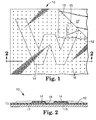
- a laminate 10 that comprises, in order, a vented transparent polymeric cover sheet 12, a layer of removable pressure-sensitive adhesive 13, decorative polymeric film graphics 14 (one letter is shown), and a layer of aggressive pressure-sensitive adhesive 15 that is coextensive with each of the graphics.
- a flexible low-adhesion carrier web 17 that is coextensive with the vented cover sheet protects the aggressive pressure-sensitive adhesive 15 and areas of the removable pressure-sensitive adhesive between the graphics.
- the vents of the transparent cover sheet 12 are circular perforations 18 in a rectangular grid.
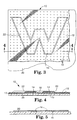
- the adhesive face of the laminate is wet (by blotting or spraying) with a detergent/alcohol/water solution, as is a substrate 20 (see Figures 3 and 4).
- the adhesive face is placed against the wet substrate 20, and a squeegee such as a piece of plastic can be used to push solution and air bubbles from beneath each of the graphics.
- the laminate 10 has a cloudy appearance.
- a clear border 22 appears at the edges of the graphics 14 as shown in Figure 3. The appearance of these borders indicates that the vented transparent cover sheet 12 can be peeled away without disturbing the graphics 14, leaving the graphics 14 on the substrate 20 as is illustrated in Figure 5.
- a laminate 10 as shown in FIG. 1 has been made, using as the vented transparent polymeric cover sheet 12 plasticized poly(vinyl chloride) film having a thickness of 4 mils (100 ⁇ m).
- the decorative polymeric film from which the graphics 14 were formed was identical to the special effects vinyl film of the above-cited Scotchcal TM 7725-314 Frosted Crystal Film. More specifically, the decorative vinyl film was plasticized poly(vinyl chloride) that had been filled with light-diffusing agents, including flecks of aluminum-vapor-coated polyester film, to afford a frosted appearance.
- the perforations 18, which had been formed by laser machining, were circular, 0.04 inch (1 mm) in diameter, and provided a rectangular grid. The perforations were separated by lands of about 3/16 inch (4.8 mm). Mechanical perforations would probably be formed more economically in production.
- the graphics 14 had been cut out by a computer-controlled knife from the decorative vinyl film when it was coextensive with the vented cover sheet 12. In production, it probably would be more economical to form the graphics with a die cutter. After cutting the graphics, the adhesive-bearing weed was peeled off and discarded from the laminate 10.
- the removable pressure-sensitive adhesive 13 comprised hollow tacky microspheres as disclosed in the above-cited Delgado patent and had a coating weight of 7 grains/24 in 2 (29 g/m 2 ). Such a removable pressure-sensitive adhesive is preferred, because it has good aging properties and good adhesion to the vented transparent polymeric cover sheet while releasing cleanly from special effects vinyl films. This combination of properties is not reliably achieved, to the best of my knowledge, in any pressure-sensitive adhesive other than those that are based on tacky microspheres.
- the aggressive pressure-sensitive adhesive 15 was a copolymer of isooctyl acrylate and acrylic acid as disclosed in U.S. Pat. No. Re. 24,906 (Ulrich) and had a coating weight of 9.6 grains/24 in 2 (40 g/m 2 ).
- the carrier web 17 was a silicone-release paper liner.
- both the adhesive face of the laminate and a clear glass panel 4 inches (10 cm) square were wet with a solution of (by weight) 80 parts water, 19.7 parts of isopropyl alcohol, and 0.3 part of Joy TM dish-washing detergent.
- the adhesive face was placed against the glass panel 20, and a piece of plastic was used to push solution and air bubbles from beneath each element of the graphics 14.
- a clear border 22 appeared at the edges of the graphics 14 (see FIG. 4), and the vented transparent cover sheet 12 was peeled off, carrying with it the entire removable adhesive layer 13.
- the graphics were thus firmly bonded to the glass 20 and had the appearance of sand-blasted glass. Close visual inspection revealed no air bubbles at the interfaces between the graphics 14 and the glass panel 20.
- Examples 2 and 3 A series of laminates were made in the same way as in Example 1 except having perforations of other diameters and land widths. Each was tested in the same manner as was the laminate of Example 1. As soon as a clear border appeared, the perforated transparent polymeric cover sheet was peeled off without disturbing the graphics. The test results are noted in Table I which also includes Example 1 plus results of testing a Comparative Laminate that was made in the same way as in Example 1 except that the transparent polymeric cover sheet was imperforate.
Landscapes
- Chemical & Material Sciences (AREA)
- Organic Chemistry (AREA)
- Laminated Bodies (AREA)
- Adhesive Tapes (AREA)
- Adhesives Or Adhesive Processes (AREA)
Claims (18)
- Laminat, durch das Graphiken genau auf ein Substrat aufgebracht werden können, wobei das Laminat in dieser Reihenfolge umfaßt:1) eine transparente polymere Deckfolie, die Luftlöcher aufweist, die in Abständen über ihre ganze Fläche verteilt sind;2) eine Schicht eines entfernbaren Haftklebers, die sich genauso weit wie die mit Luftlöchern versehene Deckfolie erstreckt;3) Graphiken in Form einer Polymerfolie; sowie4) eine Schicht eines Haftklebers, die sich genauso weit wie jede der Graphiken erstreckt.
- Laminat gemäß Anspruch 1, wobei die Luftlöcher in gleichmäßigen Abständen über im wesentlichen die volle Fläche der Deckfolie verteilt sind und 1,0 bis 20% der Fläche der Deckfolie einnehmen.
- Laminat gemäß Anspruch 2, wobei die Luftlöcher kreisförmige Perforationen mit im wesentlichem gleichmäßigem Durchmesser im Bereich von 0,5 bis 2,5 mm sind.
- Laminat gemäß Anspruch 3, wobei die Perforationen durch Stege von 1 bis 10 mm voneinander getrennt sind.
- Laminat gemäß Anspruch 1, wobei die Luftlöcher der mit Luftlöchern versehenen Deckfolie ein regelmäßiges Muster bilden.
- Laminat gemäß Anspruch 5, wobei das regelmäßige Muster ein rechteckiges Gitter ist.
- Laminat gemäß Anspruch 1, wobei die Polymerfolie eine Spezialeffekt-Vinylfolie umfaßt, die den Graphiken ein geätztes oder sandgestrahltes Aussehen verleiht, wenn sie durch den aggressiven Haftkleber an eine Glasscheibe geklebt werden.
- Laminat gemäß Anspruch 1, wobei eine flexible Trägerbahn mit geringer Haftung den aggressiven Haftkleber und Bereiche des entfernbaren Haftklebers zwischen den Graphiken schützt.
- Laminat gemäß Anspruch 8, wobei der entfernbare Kleber so ausgewählt ist, daß er (a) eine Bindung zu den Graphiken bildet, die es ermöglicht, die Trägerbahn mit geringer Haftung abzuziehen, ohne diese Bindung zu zerstören, und (b) es ermöglicht, die mit Luftlöchern versehene Deckfolie sauber von den Graphiken abzuziehen, ohne die Klebeverbindung zwischen den Graphiken und einem Substrat, das die Graphiken aufnehmen soll, zu zerstören.
- Laminat gemäß Anspruch 1, wobei die Polymerfolie eine mit lichtstreuenden Mitteln gefüllte Vinylfolie umfaßt.
- Laminat gemäß Anspruch 1, wobei die mit Luftlöchern versehene Deckfolie eine Vinylfolie umfaßt.
- Laminat gemäß Anspruch 10, wobei die Vinylfolie 50 bis 150 µm dick ist.
- Laminat gemäß Anspruch 1, wobei die mit Luftlöchern versehene Deckfolie und die Graphiken in Form einer Polymerfolie im wesentlichen aus demselben polymeren Material hergestellt sind.
- Laminat gemäß Anspruch 13, wobei das polymere Material weichgemachtes Polyvinylchlorid umfaßt.
- Verbundstoff, durch den Graphiken genau auf ein Substrat aufgebracht werden können, wobei der Verbundstoff ein Laminat, das in dieser Reihenfolge:umfaßt, sowie eine flexible Trägerbahn mit geringer Haftung, die eine gute Formbeständigkeit aufweist und sich genauso weit wie die perforierte Deckfolie erstreckt und den aggressiven Haftkleber und Bereiche des entfernbaren Haftklebers zwischen den Graphiken schützt, umfaßt.1) eine transparente Deckfolie aus weichgemachtem Vinyl, die 25 bis 100 µm dick ist und mit kreisförmigen Perforationen gebildet ist, die a) in gleichmäßigen Abständen über im wesentlichen die volle Fläche der Deckfolie verteilt sind, b) 1,0 bis 20% der Fläche der Deckfolie einnehmen, c) einen Durchmesser von 0,5 bis 2,5 mm haben und d) durch Stege von 1 bis 10 mm voneinander getrennt sind;2) eine Schicht eines entfernbaren Haftklebers, die sich genauso weit wie die Deckfolie erstreckt und ein Beschichtungsgewicht von 10 bis 50 g/m2 hat;3) eine Dekorfolie aus weichgemachtem Vinyl, die a) Graphiken bildet, b) mit lichtstreuenden Mitteln gefüllt ist, die den Graphiken auf einer Glasscheibe ein geätztes oder sandgestrahltes Aussehen verleihen können, und c) 25 bis 100 µm dick ist; sowie4) eine Schicht eines aggressiven Haftklebers, die sich genauso weit wie jede der Graphiken erstreckt und ein Beschichtungsgewicht von 10 bis 50 g/m2 hat;
- Verfahren zur Herstellung eines Laminats, durch das Graphiken genau auf ein Substrat aufgebracht werden können, wobei das Verfahren die Schritte umfaßt:1) Auftragen einer Schicht von aggressivem Haftkleber auf eine flexible Trägerbahn mit geringer Haftung;2) Auftragen einer polymeren Dekorfolie auf die Schicht des aggressiven Haftklebers;3) Schneiden von Graphiken in die polymere Dekorfolie und den aggressiven Haftkleber, ohne durch die Trägerbahn zu schneiden;4) Entfernen und Verwerfen des klebstofftragenden Abfalls zwischen den Graphiken;5) Auftragen einer Schicht von entfernbarem Haftkleber auf eine transparente Polymerfolie, die auf ihrer gesamten Fläche mit Luftlöchern versehen ist; und6) Kleben der mit Luftlöchern versehenen transparenten Polymerfolie auf die freiliegenden Flächen der Graphiken durch die Schicht des entfernbaren Haftklebers.
- Verfahren zum Auftragen von Graphiken auf ein Substrat, wobei das Verfahren das Durchführen der sechs Schritte von Anspruch 16 und anschließend der folgenden Schritte umfaßt:7) Entfernen der Trägerbahn, so daß der aggressive Haftkleber freigelegt wird;8) Benetzen der freiliegenden Kleberflächen und des Substrats mit einer Detergens/Alkohol/Wasser-Lösung;9) Plazieren der nassen Kleberflächen auf dem nassen Substrat;10) Verdampfenlassen der Lösung durch die Luftlöcher der transparenten Polymerfolie; und, wenn eine klare Grenzlinie an den Rändern der Graphiken erscheint,11) Abziehen der klebstofftragenden, mit Luftlöchern versehenen Polymerfolie, so daß die Graphiken freiliegen.
- Verfahren zum Auftragen von Graphiken auf ein Substrat gemäß Anspruch 17, das weiterhin den Schritt des Repositionierens von Graphiken auf dem Substrat im Anschluß an Schritt 9) umfaßt.
Applications Claiming Priority (3)
| Application Number | Priority Date | Filing Date | Title |
|---|---|---|---|
| US29035594A | 1994-08-15 | 1994-08-15 | |
| US290355 | 1994-08-15 | ||
| PCT/US1995/008611 WO1996005262A1 (en) | 1994-08-15 | 1995-07-10 | Laminate for precise application of graphics to a substrate |
Publications (2)
| Publication Number | Publication Date |
|---|---|
| EP0776351A1 EP0776351A1 (de) | 1997-06-04 |
| EP0776351B1 true EP0776351B1 (de) | 1998-10-14 |
Family
ID=23115613
Family Applications (1)
| Application Number | Title | Priority Date | Filing Date |
|---|---|---|---|
| EP95925589A Expired - Lifetime EP0776351B1 (de) | 1994-08-15 | 1995-07-10 | Laminat zum genauen anbringen von bildern auf einem substrat |
Country Status (6)
| Country | Link |
|---|---|
| EP (1) | EP0776351B1 (de) |
| JP (1) | JP3828930B2 (de) |
| CA (1) | CA2195544C (de) |
| DE (1) | DE69505401T2 (de) |
| MX (1) | MX9701061A (de) |
| WO (1) | WO1996005262A1 (de) |
Families Citing this family (6)
| Publication number | Priority date | Publication date | Assignee | Title |
|---|---|---|---|---|
| EP3007664B1 (de) | 2013-06-13 | 2018-04-18 | 3M Innovative Properties Company | Befestigungsband und mechanischer verschluss mit einem mikroporösen film |
| CN105283161B (zh) | 2013-06-13 | 2019-10-15 | 3M创新有限公司 | 个人卫生制品及其容器 |
| JP6329750B2 (ja) * | 2013-11-01 | 2018-05-23 | ニチレイマグネット株式会社 | 機能性シート及び機能性シートの製造方法 |
| KR101800994B1 (ko) | 2014-04-10 | 2017-11-23 | 쓰리엠 이노베이티브 프로퍼티즈 컴파니 | 섬유 및 그를 포함하는 물품 |
| US20190031923A1 (en) | 2017-07-26 | 2019-01-31 | 3M Innovative Properties Company | Backing for adhesive tape with thermal resistance |
| WO2019155358A1 (en) * | 2018-02-06 | 2019-08-15 | 3M Innovative Properties Company | Surface impression resistant film constructions and methods |
Family Cites Families (6)
| Publication number | Priority date | Publication date | Assignee | Title |
|---|---|---|---|---|
| JPS6345353Y2 (de) * | 1984-09-04 | 1988-11-24 | ||
| JPS61261381A (ja) * | 1985-05-14 | 1986-11-19 | Nichiban Co Ltd | 粘着性微小球 |
| US4814212A (en) * | 1988-05-05 | 1989-03-21 | Donald Spector | Automobile air freshener unit |
| US4968562A (en) * | 1990-02-27 | 1990-11-06 | Minnesota Mining And Manufacturing Company | Hollow acid-free acrylate polymeric microspheres having multiple small voids |
| TW338043B (en) * | 1992-12-11 | 1998-08-11 | Minnesota Mining & Mfg | Tacky microspheres having pendant hydrophilic polymeric or oligomeric moieties |
| JP3497519B2 (ja) * | 1992-12-18 | 2004-02-16 | ミネソタ マイニング アンド マニュファクチャリング カンパニー | 多層発泡状感圧接着テープ及びその製造方法 |
-
1995
- 1995-07-10 JP JP50731096A patent/JP3828930B2/ja not_active Expired - Fee Related
- 1995-07-10 DE DE69505401T patent/DE69505401T2/de not_active Expired - Fee Related
- 1995-07-10 WO PCT/US1995/008611 patent/WO1996005262A1/en not_active Ceased
- 1995-07-10 MX MX9701061A patent/MX9701061A/es unknown
- 1995-07-10 CA CA002195544A patent/CA2195544C/en not_active Expired - Fee Related
- 1995-07-10 EP EP95925589A patent/EP0776351B1/de not_active Expired - Lifetime
Also Published As
| Publication number | Publication date |
|---|---|
| DE69505401T2 (de) | 1999-06-10 |
| DE69505401D1 (de) | 1998-11-19 |
| EP0776351A1 (de) | 1997-06-04 |
| JPH10504344A (ja) | 1998-04-28 |
| CA2195544A1 (en) | 1996-02-22 |
| JP3828930B2 (ja) | 2006-10-04 |
| CA2195544C (en) | 2005-12-13 |
| WO1996005262A1 (en) | 1996-02-22 |
| MX9701061A (es) | 1997-05-31 |
Similar Documents
| Publication | Publication Date | Title |
|---|---|---|
| US5749994A (en) | Laminate for precise application of graphics to a substrate | |
| US3936567A (en) | Light-reflective adhesive label | |
| US5246757A (en) | Architectural signs with raised graphics | |
| JP2006070273A (ja) | 微細エンボスパターンを有する剥離ライナー | |
| JPH06322328A (ja) | 標識作成機用接着シート材料 | |
| US4268117A (en) | Sheet assembly for forming imaged retroreflective sheeting | |
| EP0776351B1 (de) | Laminat zum genauen anbringen von bildern auf einem substrat | |
| AU2005217262A1 (en) | Pressure-sensitive adhesive sheet | |
| US3506528A (en) | Composite contrast color embossed displays | |
| US5429700A (en) | Waterproof art | |
| US6805932B2 (en) | Method for applying designs to a substrate | |
| US6811848B2 (en) | Assemblage of laminants for forming a graphic | |
| EP0693993B1 (de) | Vorrichtung zum ausrichten von graphiken sowie verfahren zu deren herstellung | |
| CN116080247A (zh) | 贴合工艺 | |
| JPS5824908Y2 (ja) | 窓ガラス用断熱シ−ト | |
| JP2000230155A (ja) | 糊付きフイルム | |
| JP2003171628A (ja) | 感熱性粘着剤層を有する発泡体シート | |
| JP2000054591A (ja) | 化粧ボードの固定方法 | |
| JPH0820752A (ja) | アプリケーションシート付き粘着シート | |
| JPH02233299A (ja) | 貼着パネル | |
| CN1035612A (zh) | 图画贴片 | |
| GB2391513A (en) | Decorative applique laminate | |
| JPH07210088A (ja) | 粘着シートの製造方法 | |
| JP2001089720A (ja) | 粘着パッド | |
| JP2003171627A (ja) | 感熱性粘着剤層を有する発泡体シート |
Legal Events
| Date | Code | Title | Description |
|---|---|---|---|
| PUAI | Public reference made under article 153(3) epc to a published international application that has entered the european phase |
Free format text: ORIGINAL CODE: 0009012 |
|
| 17P | Request for examination filed |
Effective date: 19970118 |
|
| AK | Designated contracting states |
Kind code of ref document: A1 Designated state(s): BE CH DE FR GB LI SE |
|
| GRAG | Despatch of communication of intention to grant |
Free format text: ORIGINAL CODE: EPIDOS AGRA |
|
| 17Q | First examination report despatched |
Effective date: 19970825 |
|
| GRAG | Despatch of communication of intention to grant |
Free format text: ORIGINAL CODE: EPIDOS AGRA |
|
| GRAH | Despatch of communication of intention to grant a patent |
Free format text: ORIGINAL CODE: EPIDOS IGRA |
|
| GRAH | Despatch of communication of intention to grant a patent |
Free format text: ORIGINAL CODE: EPIDOS IGRA |
|
| GRAA | (expected) grant |
Free format text: ORIGINAL CODE: 0009210 |
|
| AK | Designated contracting states |
Kind code of ref document: B1 Designated state(s): BE CH DE FR GB LI SE |
|
| REG | Reference to a national code |
Ref country code: CH Ref legal event code: EP |
|
| REF | Corresponds to: |
Ref document number: 69505401 Country of ref document: DE Date of ref document: 19981119 |
|
| ET | Fr: translation filed | ||
| REG | Reference to a national code |
Ref country code: CH Ref legal event code: NV Representative=s name: E. BLUM & CO. PATENTANWAELTE |
|
| PLBE | No opposition filed within time limit |
Free format text: ORIGINAL CODE: 0009261 |
|
| STAA | Information on the status of an ep patent application or granted ep patent |
Free format text: STATUS: NO OPPOSITION FILED WITHIN TIME LIMIT |
|
| 26N | No opposition filed | ||
| PGFP | Annual fee paid to national office [announced via postgrant information from national office to epo] |
Ref country code: SE Payment date: 20000620 Year of fee payment: 6 |
|
| PGFP | Annual fee paid to national office [announced via postgrant information from national office to epo] |
Ref country code: CH Payment date: 20000621 Year of fee payment: 6 |
|
| PGFP | Annual fee paid to national office [announced via postgrant information from national office to epo] |
Ref country code: BE Payment date: 20000713 Year of fee payment: 6 |
|
| PG25 | Lapsed in a contracting state [announced via postgrant information from national office to epo] |
Ref country code: SE Free format text: LAPSE BECAUSE OF NON-PAYMENT OF DUE FEES Effective date: 20010711 |
|
| PG25 | Lapsed in a contracting state [announced via postgrant information from national office to epo] |
Ref country code: LI Free format text: LAPSE BECAUSE OF NON-PAYMENT OF DUE FEES Effective date: 20010731 Ref country code: CH Free format text: LAPSE BECAUSE OF NON-PAYMENT OF DUE FEES Effective date: 20010731 Ref country code: BE Free format text: LAPSE BECAUSE OF NON-PAYMENT OF DUE FEES Effective date: 20010731 |
|
| REG | Reference to a national code |
Ref country code: GB Ref legal event code: IF02 |
|
| BERE | Be: lapsed |
Owner name: MINNESOTA MINING AND MFG CY Effective date: 20010731 |
|
| EUG | Se: european patent has lapsed |
Ref document number: 95925589.4 |
|
| REG | Reference to a national code |
Ref country code: CH Ref legal event code: PL |
|
| PGFP | Annual fee paid to national office [announced via postgrant information from national office to epo] |
Ref country code: DE Payment date: 20070831 Year of fee payment: 13 |
|
| PGFP | Annual fee paid to national office [announced via postgrant information from national office to epo] |
Ref country code: GB Payment date: 20070727 Year of fee payment: 13 |
|
| PGFP | Annual fee paid to national office [announced via postgrant information from national office to epo] |
Ref country code: FR Payment date: 20070717 Year of fee payment: 13 |
|
| GBPC | Gb: european patent ceased through non-payment of renewal fee |
Effective date: 20080710 |
|
| PG25 | Lapsed in a contracting state [announced via postgrant information from national office to epo] |
Ref country code: DE Free format text: LAPSE BECAUSE OF NON-PAYMENT OF DUE FEES Effective date: 20090203 |
|
| REG | Reference to a national code |
Ref country code: FR Ref legal event code: ST Effective date: 20090331 |
|
| PG25 | Lapsed in a contracting state [announced via postgrant information from national office to epo] |
Ref country code: GB Free format text: LAPSE BECAUSE OF NON-PAYMENT OF DUE FEES Effective date: 20080710 |
|
| PG25 | Lapsed in a contracting state [announced via postgrant information from national office to epo] |
Ref country code: FR Free format text: LAPSE BECAUSE OF NON-PAYMENT OF DUE FEES Effective date: 20080731 |