EP0777104A2 - Procédé et dispositif d'évaluation d'images vidéo tridimensionnelles - Google Patents
Procédé et dispositif d'évaluation d'images vidéo tridimensionnelles Download PDFInfo
- Publication number
- EP0777104A2 EP0777104A2 EP96118941A EP96118941A EP0777104A2 EP 0777104 A2 EP0777104 A2 EP 0777104A2 EP 96118941 A EP96118941 A EP 96118941A EP 96118941 A EP96118941 A EP 96118941A EP 0777104 A2 EP0777104 A2 EP 0777104A2
- Authority
- EP
- European Patent Office
- Prior art keywords
- image
- video
- light source
- dimensional
- screen
- Prior art date
- Legal status (The legal status is an assumption and is not a legal conclusion. Google has not performed a legal analysis and makes no representation as to the accuracy of the status listed.)
- Ceased
Links
Images

Classifications
-
- G—PHYSICS
- G01—MEASURING; TESTING
- G01C—MEASURING DISTANCES, LEVELS OR BEARINGS; SURVEYING; NAVIGATION; GYROSCOPIC INSTRUMENTS; PHOTOGRAMMETRY OR VIDEOGRAMMETRY
- G01C11/00—Photogrammetry or videogrammetry, e.g. stereogrammetry; Photographic surveying
- G01C11/04—Interpretation of pictures
- G01C11/06—Interpretation of pictures by comparison of two or more pictures of the same area
-
- H—ELECTRICITY
- H04—ELECTRIC COMMUNICATION TECHNIQUE
- H04N—PICTORIAL COMMUNICATION, e.g. TELEVISION
- H04N13/00—Stereoscopic video systems; Multi-view video systems; Details thereof
- H04N13/10—Processing, recording or transmission of stereoscopic or multi-view image signals
- H04N13/106—Processing image signals
- H04N13/161—Encoding, multiplexing or demultiplexing different image signal components
-
- H—ELECTRICITY
- H04—ELECTRIC COMMUNICATION TECHNIQUE
- H04N—PICTORIAL COMMUNICATION, e.g. TELEVISION
- H04N13/00—Stereoscopic video systems; Multi-view video systems; Details thereof
- H04N13/20—Image signal generators
- H04N13/204—Image signal generators using stereoscopic image cameras
- H04N13/239—Image signal generators using stereoscopic image cameras using two two-dimensional [2D] image sensors having a relative position equal to or related to the interocular distance
-
- H—ELECTRICITY
- H04—ELECTRIC COMMUNICATION TECHNIQUE
- H04N—PICTORIAL COMMUNICATION, e.g. TELEVISION
- H04N13/00—Stereoscopic video systems; Multi-view video systems; Details thereof
- H04N13/20—Image signal generators
- H04N13/296—Synchronisation thereof; Control thereof
-
- H—ELECTRICITY
- H04—ELECTRIC COMMUNICATION TECHNIQUE
- H04N—PICTORIAL COMMUNICATION, e.g. TELEVISION
- H04N13/00—Stereoscopic video systems; Multi-view video systems; Details thereof
- H04N13/30—Image reproducers
- H04N13/332—Displays for viewing with the aid of special glasses or head-mounted displays [HMD]
- H04N13/341—Displays for viewing with the aid of special glasses or head-mounted displays [HMD] using temporal multiplexing
-
- H—ELECTRICITY
- H04—ELECTRIC COMMUNICATION TECHNIQUE
- H04N—PICTORIAL COMMUNICATION, e.g. TELEVISION
- H04N13/00—Stereoscopic video systems; Multi-view video systems; Details thereof
- H04N13/30—Image reproducers
- H04N13/398—Synchronisation thereof; Control thereof
-
- H—ELECTRICITY
- H04—ELECTRIC COMMUNICATION TECHNIQUE
- H04N—PICTORIAL COMMUNICATION, e.g. TELEVISION
- H04N13/00—Stereoscopic video systems; Multi-view video systems; Details thereof
- H04N13/10—Processing, recording or transmission of stereoscopic or multi-view image signals
- H04N13/106—Processing image signals
- H04N13/15—Processing image signals for colour aspects of image signals
-
- H—ELECTRICITY
- H04—ELECTRIC COMMUNICATION TECHNIQUE
- H04N—PICTORIAL COMMUNICATION, e.g. TELEVISION
- H04N13/00—Stereoscopic video systems; Multi-view video systems; Details thereof
- H04N13/10—Processing, recording or transmission of stereoscopic or multi-view image signals
- H04N13/189—Recording image signals; Reproducing recorded image signals
-
- H—ELECTRICITY
- H04—ELECTRIC COMMUNICATION TECHNIQUE
- H04N—PICTORIAL COMMUNICATION, e.g. TELEVISION
- H04N13/00—Stereoscopic video systems; Multi-view video systems; Details thereof
- H04N13/30—Image reproducers
- H04N13/324—Colour aspects
-
- H—ELECTRICITY
- H04—ELECTRIC COMMUNICATION TECHNIQUE
- H04N—PICTORIAL COMMUNICATION, e.g. TELEVISION
- H04N13/00—Stereoscopic video systems; Multi-view video systems; Details thereof
- H04N13/30—Image reproducers
- H04N13/332—Displays for viewing with the aid of special glasses or head-mounted displays [HMD]
- H04N13/337—Displays for viewing with the aid of special glasses or head-mounted displays [HMD] using polarisation multiplexing
-
- H—ELECTRICITY
- H04—ELECTRIC COMMUNICATION TECHNIQUE
- H04N—PICTORIAL COMMUNICATION, e.g. TELEVISION
- H04N19/00—Methods or arrangements for coding, decoding, compressing or decompressing digital video signals
- H04N19/50—Methods or arrangements for coding, decoding, compressing or decompressing digital video signals using predictive coding
- H04N19/597—Methods or arrangements for coding, decoding, compressing or decompressing digital video signals using predictive coding specially adapted for multi-view video sequence encoding
-
- H—ELECTRICITY
- H04—ELECTRIC COMMUNICATION TECHNIQUE
- H04N—PICTORIAL COMMUNICATION, e.g. TELEVISION
- H04N13/00—Stereoscopic video systems; Multi-view video systems; Details thereof
- H04N2013/0074—Stereoscopic image analysis
- H04N2013/0081—Depth or disparity estimation from stereoscopic image signals
Definitions
- the invention relates to a method and an arrangement for three-dimensional video image evaluation, with the features of the preambles of claims 1 and 2.
- the invention relates to a method and an arrangement for the production and measurement of three-dimensional video recordings of rigid and moving objects, which are then available both as a single image and as a film sequence, for example for evaluating accident location recordings, for taking stock of gaps and for expanding facilities and plants on the one hand and for the evaluation of such motion sequences as robot movements, flow processes and the like.
- the measurement process is normalized by evaluating the spatial position of individual object points to known fixed points in the spatial object.
- a virtual 3-D image is generated by slide projection behind a projection screen that is partially transparent to light.
- the virtual image behind the projection screen is measured using a traversing device.
- Such a method is known, for example, from the industrial patent DD 0 153 221.
- the same basic distinction as with the photos can also be made here.
- Either the two stereoscopically recorded video images are read into a computer one after the other and the depth is converted from the image differences. Because of the digital storage of the images in the computer, there is the disadvantage that the images to be examined must be preselected and, depending on the resolution, film sequences can only have a very limited length.
- the stereoscopically recorded video images are alternately read into the digital memory of a 100 Hz television set and displayed alternately on the screen at 50 Hz.
- the applicant's M70-781 IDTV color television set is suitable for this purpose.
- An infrared transmitter and shutter glasses ensure that the glass in front of the left eye is darkened when the image from the right camera appears on the screen and vice versa.
- the polarity of a porarization filter arranged in front of the screen can also be changed with the same frequency.
- the assignment to the respective eye is then carried out using polarizing glasses.
- a disadvantage of the known representation of 3-D recordings is that it is only used for the reproduction of spatial images or films extending backwards from the screen. Because of the creation of the virtual spatial image behind the screen, the known devices for displaying spatial images from video images are not suitable for measuring the resulting virtual images.
- the object of the present invention is therefore to provide a method and an arrangement which enable the evaluation, in particular the measurement, of spatial images generated by means of video images.
- the object is achieved in that a 3-D video film is produced from the object to be examined by means of known 3-D video technology, which is either in online mode in the television set by playing the last image memory contents is frozen "in order to obtain a still image that can be evaluated or by playing back a magnetic tape recording at a selected point in time.
- a virtual 3-D image is generated on the television screen so that it is off the screen extends forward into the room, which is achieved in that the optical axes of the two video cameras intersect when the picture is taken in the rear area of the subject.
- a three-dimensionally adjustable pointer is brought into line by an observer with the pixels of interest and to be measured, and the coordinates of this pointer are determined. To determine the image scale, it must be ensured when taking the picture that several fixed points with known distances from one another are present in the image.
- the method according to the invention has the advantage over the other methods that the viewer of the virtual 3-D image to be measured is immediately given an overall impression of the three-dimensional object and can also evaluate fast movement sequences without errors. Since it is possible to measure only the pixels of interest, there is no large amount of data.
- two video cameras 2 with their camera control devices 3, which are used, among other things, for image synchronization, are placed on an object 1 to be measured in such a way that the optical axes of the two video cameras 2 intersect in the rear area of the object 1.
- the video images are fed into a television set 5 via two video signal processing devices 4 equipped with separate image memories, which are explained in more detail below.
- the virtual 3-D image 6 is generated in front of the television set 5.
- the left or right eye of an observer 9 is assigned to the corresponding camera image via a shutter control 7 with infrared transmitter and shutter glasses 8.
- a traversing device 10 is used with a light guide cable 11 used as a pointer, the tip of which is bent at 90 ° to the observer 9 and enables the evaluation, as described in the economic patent DD 0 153 221 mentioned at the beginning.
- the video recordings are recorded via two synchronized video recorders 12 or a video recorder with sufficient recording capacity, for example a video recorder with a second video signal track.
- the two video signal processing devices 4 are in turn used during playback.
- the use of analog video recording makes it possible to save recordings that are very long in time and to evaluate them at a later time.
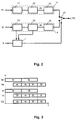
- FIG. 2 shows the video signal processing devices 4, which each consist of an analog / digital converter 21 and 24 with a digital color decoder, a field memory 22 and 25 and a digital / analog converter 23 and 26.
- the output signals of the digital / analog converter 23 and 26 are switched over for playback on the TV screen 5 of the television set 5 via a switch 27.
- the switch 27 is controlled by the shutter control 7 in such a way that first the first field of the right and left camera, and then the second field of the right and left camera is shown.
- Corresponding control signals S are emitted to control the shutter glasses. Since the image generation of the cameras 2 is synchronized by the camera control units 3, the evaluation of the control signals of one of the two video signal processing devices 4 is sufficient.
- FIG. 3 shows the time sequences.
- the first and second fields Ar and Br of the right camera Kr are read into the semiconductor memory 22 and read out at twice the frequency and are available at the output Hr.
- the first and second fields A1 and B1 of the left camera K1 are read into the semiconductor memory 25 and output at the output H1 at twice the frequency.
- the display sequence Ar, Al, Br, Bl etc. is then shown on the TV screen.
Landscapes
- Engineering & Computer Science (AREA)
- Multimedia (AREA)
- Signal Processing (AREA)
- Physics & Mathematics (AREA)
- General Physics & Mathematics (AREA)
- Radar, Positioning & Navigation (AREA)
- Remote Sensing (AREA)
- Testing, Inspecting, Measuring Of Stereoscopic Televisions And Televisions (AREA)
Applications Claiming Priority (2)
| Application Number | Priority Date | Filing Date | Title |
|---|---|---|---|
| DE19544811 | 1995-12-01 | ||
| DE19544811A DE19544811C1 (de) | 1995-12-01 | 1995-12-01 | Verfahren und Anordnung zur dreidimensionalen Videobildauswertung |
Publications (2)
| Publication Number | Publication Date |
|---|---|
| EP0777104A2 true EP0777104A2 (fr) | 1997-06-04 |
| EP0777104A3 EP0777104A3 (fr) | 1999-05-12 |
Family
ID=7778911
Family Applications (1)
| Application Number | Title | Priority Date | Filing Date |
|---|---|---|---|
| EP96118941A Ceased EP0777104A3 (fr) | 1995-12-01 | 1996-11-27 | Procédé et dispositif d'évaluation d'images vidéo tridimensionnelles |
Country Status (2)
| Country | Link |
|---|---|
| EP (1) | EP0777104A3 (fr) |
| DE (1) | DE19544811C1 (fr) |
Families Citing this family (2)
| Publication number | Priority date | Publication date | Assignee | Title |
|---|---|---|---|---|
| DE10044032A1 (de) | 2000-09-06 | 2002-03-14 | Deutsche Telekom Ag | 3-D Sehen |
| DE10151983A1 (de) * | 2001-10-22 | 2003-04-30 | Ibeo Automobile Sensor Gmbh | Verfahren zur Dokumentation einer Unfallsituation |
Citations (2)
| Publication number | Priority date | Publication date | Assignee | Title |
|---|---|---|---|---|
| DD153221A1 (de) | 1980-08-28 | 1981-12-30 | Bernd Wunderlich | Verfahren zur ermittlung der raeumlichen lage von objektpunkten |
| DE3808969C1 (en) | 1988-03-17 | 1989-10-19 | Kernforschungszentrum Karlsruhe Gmbh, 7500 Karlsruhe, De | Device for reproducing three-dimensional pictures |
Family Cites Families (4)
| Publication number | Priority date | Publication date | Assignee | Title |
|---|---|---|---|---|
| US4808979A (en) * | 1987-04-02 | 1989-02-28 | Tektronix, Inc. | Cursor for use in 3-D imaging systems |
| US5175616A (en) * | 1989-08-04 | 1992-12-29 | Her Majesty The Queen In Right Of Canada, As Represented By The Minister Of National Defence Of Canada | Stereoscopic video-graphic coordinate specification system |
| DE4138893C1 (fr) * | 1991-11-27 | 1992-10-22 | Los Laser Optik System Gmbh & Co. Kg, 6500 Mainz, De | |
| WO1995018511A1 (fr) * | 1993-12-29 | 1995-07-06 | Leica Ag | Procede et dispositif d'enregistrement et de restitution d'images video stereoscopiques |
-
1995
- 1995-12-01 DE DE19544811A patent/DE19544811C1/de not_active Expired - Lifetime
-
1996
- 1996-11-27 EP EP96118941A patent/EP0777104A3/fr not_active Ceased
Patent Citations (2)
| Publication number | Priority date | Publication date | Assignee | Title |
|---|---|---|---|---|
| DD153221A1 (de) | 1980-08-28 | 1981-12-30 | Bernd Wunderlich | Verfahren zur ermittlung der raeumlichen lage von objektpunkten |
| DE3808969C1 (en) | 1988-03-17 | 1989-10-19 | Kernforschungszentrum Karlsruhe Gmbh, 7500 Karlsruhe, De | Device for reproducing three-dimensional pictures |
Also Published As
| Publication number | Publication date |
|---|---|
| DE19544811C1 (de) | 1996-08-01 |
| EP0777104A3 (fr) | 1999-05-12 |
Similar Documents
| Publication | Publication Date | Title |
|---|---|---|
| DE69030911T2 (de) | Stereoskopisches bilderzeugendes System | |
| DE69511617T2 (de) | Verfahren und Vorrichtung zur Anzeige von Videobildern | |
| EP0095660B1 (fr) | Procédé pour prise de vue et interprétation stéréophotogrammétrique | |
| DE69120499T2 (de) | Bildverbesserung in Videosichtgeräten | |
| DE69228299T2 (de) | Anzeigetechniken für zeitlich erfasste Bildersequenzen | |
| DE3922652A1 (de) | Vorrichtung zum dreidimensionalen messen | |
| EP0836332A2 (fr) | Moniteur autostéréoscopique, adaptant la position d'un observateur (PAM) | |
| EP0722256A2 (fr) | Ecran d'affichage autostéreoscopique avec obturateur et adaptable aux spectateurs | |
| DE4228111C1 (fr) | ||
| DE3427260A1 (de) | Stereoskopische bildwiedergabeanordnung | |
| DE3837049A1 (de) | Verfahren und anordnung zur erzeugung/betrachtung dreidimensionaler bilder | |
| DE4207284C2 (de) | Räumliche Bilddarbietung | |
| DE3144050C2 (de) | Verfahren zur Übertragung und Wiedergabe von Videoszenen, insbesondere Luftbildszenen, mit reduzierter Bildfolgefrequenz | |
| DE3855077T2 (de) | Setzbildapparat | |
| DE3214021A1 (de) | Vorrichtung zur erzeugung und darstellung dreidimensionaler bilder | |
| DE19544811C1 (de) | Verfahren und Anordnung zur dreidimensionalen Videobildauswertung | |
| DE102005048232B4 (de) | Rückfahrkamerasystem und Verfahren zum Anzeigen von Informationen zu einer rückwärtigen Sicht aus einem Fahrzeug | |
| DE3006749C2 (de) | Röntgenstereoeinbrichtung | |
| DE3707300A1 (de) | Verfahren zur positionierung eines bildfeldes in einer mikrofichesucheinrichtung | |
| DE4433058A1 (de) | Personenbezogener autostereoskoper Bildschirm | |
| DE3121840A1 (de) | Anordnung zur erzeugung eines stereobildes | |
| DE3018329C2 (de) | Verfahren zur Übertragung und Wiedergabe von Videoszenen, insbesondere Luftbildszenen, mit reduzierter Bildfolgefrequenz | |
| DE2725364C3 (de) | Verfahren zur gleichzeitig sichtbaren Darstellung mehrerer unterschiedlicher Einzelbilder | |
| DE3520917C2 (de) | Röntgenstereoeinrichtung | |
| EP0614595B1 (fr) | Procede et dispositif pour la reproduction d'images tridimensionnelles |
Legal Events
| Date | Code | Title | Description |
|---|---|---|---|
| PUAI | Public reference made under article 153(3) epc to a published international application that has entered the european phase |
Free format text: ORIGINAL CODE: 0009012 |
|
| AK | Designated contracting states |
Kind code of ref document: A2 Designated state(s): AT DE FR GB |
|
| PUAL | Search report despatched |
Free format text: ORIGINAL CODE: 0009013 |
|
| AK | Designated contracting states |
Kind code of ref document: A3 Designated state(s): AT DE FR GB |
|
| 17P | Request for examination filed |
Effective date: 19991022 |
|
| RAP1 | Party data changed (applicant data changed or rights of an application transferred) |
Owner name: GRUNDIG AKTIENGESELLSCHAFT |
|
| 17Q | First examination report despatched |
Effective date: 20020916 |
|
| STAA | Information on the status of an ep patent application or granted ep patent |
Free format text: STATUS: THE APPLICATION HAS BEEN REFUSED |
|
| 18R | Application refused |
Effective date: 20040625 |