EP0777997B1 - Procédé pour la fabrication d'un dispositif d'essuyage jetable - Google Patents
Procédé pour la fabrication d'un dispositif d'essuyage jetable Download PDFInfo
- Publication number
- EP0777997B1 EP0777997B1 EP96870152A EP96870152A EP0777997B1 EP 0777997 B1 EP0777997 B1 EP 0777997B1 EP 96870152 A EP96870152 A EP 96870152A EP 96870152 A EP96870152 A EP 96870152A EP 0777997 B1 EP0777997 B1 EP 0777997B1
- Authority
- EP
- European Patent Office
- Prior art keywords
- web
- heat
- brushy
- pieces
- basic sheet
- Prior art date
- Legal status (The legal status is an assumption and is not a legal conclusion. Google has not performed a legal analysis and makes no representation as to the accuracy of the status listed.)
- Expired - Lifetime
Links
- 238000000034 method Methods 0.000 title claims description 20
- IQVNEKKDSLOHHK-FNCQTZNRSA-N (E,E)-hydramethylnon Chemical compound N1CC(C)(C)CNC1=NN=C(/C=C/C=1C=CC(=CC=1)C(F)(F)F)\C=C\C1=CC=C(C(F)(F)F)C=C1 IQVNEKKDSLOHHK-FNCQTZNRSA-N 0.000 title claims description 18
- 239000000463 material Substances 0.000 claims description 5
- 239000002131 composite material Substances 0.000 claims description 4
- 239000004745 nonwoven fabric Substances 0.000 claims description 4
- 239000002985 plastic film Substances 0.000 claims description 3
- 229920006255 plastic film Polymers 0.000 claims description 3
- 238000004519 manufacturing process Methods 0.000 description 7
- 238000010586 diagram Methods 0.000 description 4
- 229920003002 synthetic resin Polymers 0.000 description 4
- 239000000057 synthetic resin Substances 0.000 description 4
- 229920001169 thermoplastic Polymers 0.000 description 4
- 239000004416 thermosoftening plastic Substances 0.000 description 4
- 238000004873 anchoring Methods 0.000 description 3
- 239000000428 dust Substances 0.000 description 3
- 238000010438 heat treatment Methods 0.000 description 2
- 230000003252 repetitive effect Effects 0.000 description 2
- 239000004743 Polypropylene Substances 0.000 description 1
- 229920000297 Rayon Polymers 0.000 description 1
- 230000015572 biosynthetic process Effects 0.000 description 1
- 239000003795 chemical substances by application Substances 0.000 description 1
- 229920000728 polyester Polymers 0.000 description 1
- -1 polypropylene Polymers 0.000 description 1
- 229920001155 polypropylene Polymers 0.000 description 1
- 239000002964 rayon Substances 0.000 description 1
- 239000004094 surface-active agent Substances 0.000 description 1
Images


Classifications
-
- A—HUMAN NECESSITIES
- A47—FURNITURE; DOMESTIC ARTICLES OR APPLIANCES; COFFEE MILLS; SPICE MILLS; SUCTION CLEANERS IN GENERAL
- A47L—DOMESTIC WASHING OR CLEANING; SUCTION CLEANERS IN GENERAL
- A47L13/00—Implements for cleaning floors, carpets, furniture, walls, or wall coverings
- A47L13/10—Scrubbing; Scouring; Cleaning; Polishing
- A47L13/20—Mops
-
- B—PERFORMING OPERATIONS; TRANSPORTING
- B32—LAYERED PRODUCTS
- B32B—LAYERED PRODUCTS, i.e. PRODUCTS BUILT-UP OF STRATA OF FLAT OR NON-FLAT, e.g. CELLULAR OR HONEYCOMB, FORM
- B32B5/00—Layered products characterised by the non- homogeneity or physical structure, i.e. comprising a fibrous, filamentary, particulate or foam layer; Layered products characterised by having a layer differing constitutionally or physically in different parts
- B32B5/22—Layered products characterised by the non- homogeneity or physical structure, i.e. comprising a fibrous, filamentary, particulate or foam layer; Layered products characterised by having a layer differing constitutionally or physically in different parts characterised by the presence of two or more layers which are next to each other and are fibrous, filamentary, formed of particles or foamed
- B32B5/24—Layered products characterised by the non- homogeneity or physical structure, i.e. comprising a fibrous, filamentary, particulate or foam layer; Layered products characterised by having a layer differing constitutionally or physically in different parts characterised by the presence of two or more layers which are next to each other and are fibrous, filamentary, formed of particles or foamed one layer being a fibrous or filamentary layer
- B32B5/26—Layered products characterised by the non- homogeneity or physical structure, i.e. comprising a fibrous, filamentary, particulate or foam layer; Layered products characterised by having a layer differing constitutionally or physically in different parts characterised by the presence of two or more layers which are next to each other and are fibrous, filamentary, formed of particles or foamed one layer being a fibrous or filamentary layer another layer next to it also being fibrous or filamentary
-
- B—PERFORMING OPERATIONS; TRANSPORTING
- B29—WORKING OF PLASTICS; WORKING OF SUBSTANCES IN A PLASTIC STATE IN GENERAL
- B29C—SHAPING OR JOINING OF PLASTICS; SHAPING OF MATERIAL IN A PLASTIC STATE, NOT OTHERWISE PROVIDED FOR; AFTER-TREATMENT OF THE SHAPED PRODUCTS, e.g. REPAIRING
- B29C65/00—Joining or sealing of preformed parts, e.g. welding of plastics materials; Apparatus therefor
- B29C65/02—Joining or sealing of preformed parts, e.g. welding of plastics materials; Apparatus therefor by heating, with or without pressure
-
- B—PERFORMING OPERATIONS; TRANSPORTING
- B29—WORKING OF PLASTICS; WORKING OF SUBSTANCES IN A PLASTIC STATE IN GENERAL
- B29C—SHAPING OR JOINING OF PLASTICS; SHAPING OF MATERIAL IN A PLASTIC STATE, NOT OTHERWISE PROVIDED FOR; AFTER-TREATMENT OF THE SHAPED PRODUCTS, e.g. REPAIRING
- B29C65/00—Joining or sealing of preformed parts, e.g. welding of plastics materials; Apparatus therefor
- B29C65/78—Means for handling the parts to be joined, e.g. for making containers or hollow articles, e.g. means for handling sheets, plates, web-like materials, tubular articles, hollow articles or elements to be joined therewith; Means for discharging the joined articles from the joining apparatus
- B29C65/7858—Means for handling the parts to be joined, e.g. for making containers or hollow articles, e.g. means for handling sheets, plates, web-like materials, tubular articles, hollow articles or elements to be joined therewith; Means for discharging the joined articles from the joining apparatus characterised by the feeding movement of the parts to be joined
- B29C65/7888—Means for handling of moving sheets or webs
- B29C65/7891—Means for handling of moving sheets or webs of discontinuously moving sheets or webs
-
- B—PERFORMING OPERATIONS; TRANSPORTING
- B29—WORKING OF PLASTICS; WORKING OF SUBSTANCES IN A PLASTIC STATE IN GENERAL
- B29C—SHAPING OR JOINING OF PLASTICS; SHAPING OF MATERIAL IN A PLASTIC STATE, NOT OTHERWISE PROVIDED FOR; AFTER-TREATMENT OF THE SHAPED PRODUCTS, e.g. REPAIRING
- B29C66/00—General aspects of processes or apparatus for joining preformed parts
- B29C66/01—General aspects dealing with the joint area or with the area to be joined
- B29C66/05—Particular design of joint configurations
- B29C66/10—Particular design of joint configurations particular design of the joint cross-sections
- B29C66/11—Joint cross-sections comprising a single joint-segment, i.e. one of the parts to be joined comprising a single joint-segment in the joint cross-section
- B29C66/112—Single lapped joints
- B29C66/1122—Single lap to lap joints, i.e. overlap joints
-
- B—PERFORMING OPERATIONS; TRANSPORTING
- B29—WORKING OF PLASTICS; WORKING OF SUBSTANCES IN A PLASTIC STATE IN GENERAL
- B29C—SHAPING OR JOINING OF PLASTICS; SHAPING OF MATERIAL IN A PLASTIC STATE, NOT OTHERWISE PROVIDED FOR; AFTER-TREATMENT OF THE SHAPED PRODUCTS, e.g. REPAIRING
- B29C66/00—General aspects of processes or apparatus for joining preformed parts
- B29C66/40—General aspects of joining substantially flat articles, e.g. plates, sheets or web-like materials; Making flat seams in tubular or hollow articles; Joining single elements to substantially flat surfaces
- B29C66/47—Joining single elements to sheets, plates or other substantially flat surfaces
-
- B—PERFORMING OPERATIONS; TRANSPORTING
- B29—WORKING OF PLASTICS; WORKING OF SUBSTANCES IN A PLASTIC STATE IN GENERAL
- B29C—SHAPING OR JOINING OF PLASTICS; SHAPING OF MATERIAL IN A PLASTIC STATE, NOT OTHERWISE PROVIDED FOR; AFTER-TREATMENT OF THE SHAPED PRODUCTS, e.g. REPAIRING
- B29C66/00—General aspects of processes or apparatus for joining preformed parts
- B29C66/69—General aspects of joining filaments
-
- B—PERFORMING OPERATIONS; TRANSPORTING
- B29—WORKING OF PLASTICS; WORKING OF SUBSTANCES IN A PLASTIC STATE IN GENERAL
- B29C—SHAPING OR JOINING OF PLASTICS; SHAPING OF MATERIAL IN A PLASTIC STATE, NOT OTHERWISE PROVIDED FOR; AFTER-TREATMENT OF THE SHAPED PRODUCTS, e.g. REPAIRING
- B29C66/00—General aspects of processes or apparatus for joining preformed parts
- B29C66/80—General aspects of machine operations or constructions and parts thereof
- B29C66/83—General aspects of machine operations or constructions and parts thereof characterised by the movement of the joining or pressing tools
- B29C66/832—Reciprocating joining or pressing tools
- B29C66/8322—Joining or pressing tools reciprocating along one axis
-
- B—PERFORMING OPERATIONS; TRANSPORTING
- B32—LAYERED PRODUCTS
- B32B—LAYERED PRODUCTS, i.e. PRODUCTS BUILT-UP OF STRATA OF FLAT OR NON-FLAT, e.g. CELLULAR OR HONEYCOMB, FORM
- B32B27/00—Layered products comprising a layer of synthetic resin
- B32B27/12—Layered products comprising a layer of synthetic resin next to a fibrous or filamentary layer
-
- B—PERFORMING OPERATIONS; TRANSPORTING
- B32—LAYERED PRODUCTS
- B32B—LAYERED PRODUCTS, i.e. PRODUCTS BUILT-UP OF STRATA OF FLAT OR NON-FLAT, e.g. CELLULAR OR HONEYCOMB, FORM
- B32B5/00—Layered products characterised by the non- homogeneity or physical structure, i.e. comprising a fibrous, filamentary, particulate or foam layer; Layered products characterised by having a layer differing constitutionally or physically in different parts
- B32B5/02—Layered products characterised by the non- homogeneity or physical structure, i.e. comprising a fibrous, filamentary, particulate or foam layer; Layered products characterised by having a layer differing constitutionally or physically in different parts characterised by structural features of a fibrous or filamentary layer
- B32B5/022—Non-woven fabric
-
- B—PERFORMING OPERATIONS; TRANSPORTING
- B32—LAYERED PRODUCTS
- B32B—LAYERED PRODUCTS, i.e. PRODUCTS BUILT-UP OF STRATA OF FLAT OR NON-FLAT, e.g. CELLULAR OR HONEYCOMB, FORM
- B32B5/00—Layered products characterised by the non- homogeneity or physical structure, i.e. comprising a fibrous, filamentary, particulate or foam layer; Layered products characterised by having a layer differing constitutionally or physically in different parts
- B32B5/02—Layered products characterised by the non- homogeneity or physical structure, i.e. comprising a fibrous, filamentary, particulate or foam layer; Layered products characterised by having a layer differing constitutionally or physically in different parts characterised by structural features of a fibrous or filamentary layer
- B32B5/08—Layered products characterised by the non- homogeneity or physical structure, i.e. comprising a fibrous, filamentary, particulate or foam layer; Layered products characterised by having a layer differing constitutionally or physically in different parts characterised by structural features of a fibrous or filamentary layer the fibres or filaments of a layer being of different substances, e.g. conjugate fibres, mixture of different fibres
-
- D—TEXTILES; PAPER
- D04—BRAIDING; LACE-MAKING; KNITTING; TRIMMINGS; NON-WOVEN FABRICS
- D04H—MAKING TEXTILE FABRICS, e.g. FROM FIBRES OR FILAMENTARY MATERIAL; FABRICS MADE BY SUCH PROCESSES OR APPARATUS, e.g. FELTS, NON-WOVEN FABRICS; COTTON-WOOL; WADDING ; NON-WOVEN FABRICS FROM STAPLE FIBRES, FILAMENTS OR YARNS, BONDED WITH AT LEAST ONE WEB-LIKE MATERIAL DURING THEIR CONSOLIDATION
- D04H1/00—Non-woven fabrics formed wholly or mainly of staple fibres or like relatively short fibres
- D04H1/40—Non-woven fabrics formed wholly or mainly of staple fibres or like relatively short fibres from fleeces or layers composed of fibres without existing or potential cohesive properties
- D04H1/54—Non-woven fabrics formed wholly or mainly of staple fibres or like relatively short fibres from fleeces or layers composed of fibres without existing or potential cohesive properties by welding together the fibres, e.g. by partially melting or dissolving
- D04H1/559—Non-woven fabrics formed wholly or mainly of staple fibres or like relatively short fibres from fleeces or layers composed of fibres without existing or potential cohesive properties by welding together the fibres, e.g. by partially melting or dissolving the fibres being within layered webs
-
- D—TEXTILES; PAPER
- D04—BRAIDING; LACE-MAKING; KNITTING; TRIMMINGS; NON-WOVEN FABRICS
- D04H—MAKING TEXTILE FABRICS, e.g. FROM FIBRES OR FILAMENTARY MATERIAL; FABRICS MADE BY SUCH PROCESSES OR APPARATUS, e.g. FELTS, NON-WOVEN FABRICS; COTTON-WOOL; WADDING ; NON-WOVEN FABRICS FROM STAPLE FIBRES, FILAMENTS OR YARNS, BONDED WITH AT LEAST ONE WEB-LIKE MATERIAL DURING THEIR CONSOLIDATION
- D04H11/00—Non-woven pile fabrics
-
- B—PERFORMING OPERATIONS; TRANSPORTING
- B29—WORKING OF PLASTICS; WORKING OF SUBSTANCES IN A PLASTIC STATE IN GENERAL
- B29C—SHAPING OR JOINING OF PLASTICS; SHAPING OF MATERIAL IN A PLASTIC STATE, NOT OTHERWISE PROVIDED FOR; AFTER-TREATMENT OF THE SHAPED PRODUCTS, e.g. REPAIRING
- B29C2793/00—Shaping techniques involving a cutting or machining operation
- B29C2793/009—Shaping techniques involving a cutting or machining operation after shaping
-
- B—PERFORMING OPERATIONS; TRANSPORTING
- B29—WORKING OF PLASTICS; WORKING OF SUBSTANCES IN A PLASTIC STATE IN GENERAL
- B29C—SHAPING OR JOINING OF PLASTICS; SHAPING OF MATERIAL IN A PLASTIC STATE, NOT OTHERWISE PROVIDED FOR; AFTER-TREATMENT OF THE SHAPED PRODUCTS, e.g. REPAIRING
- B29C66/00—General aspects of processes or apparatus for joining preformed parts
- B29C66/01—General aspects dealing with the joint area or with the area to be joined
- B29C66/05—Particular design of joint configurations
- B29C66/20—Particular design of joint configurations particular design of the joint lines, e.g. of the weld lines
- B29C66/21—Particular design of joint configurations particular design of the joint lines, e.g. of the weld lines said joint lines being formed by a single dot or dash or by several dots or dashes, i.e. spot joining or spot welding
-
- B—PERFORMING OPERATIONS; TRANSPORTING
- B29—WORKING OF PLASTICS; WORKING OF SUBSTANCES IN A PLASTIC STATE IN GENERAL
- B29C—SHAPING OR JOINING OF PLASTICS; SHAPING OF MATERIAL IN A PLASTIC STATE, NOT OTHERWISE PROVIDED FOR; AFTER-TREATMENT OF THE SHAPED PRODUCTS, e.g. REPAIRING
- B29C66/00—General aspects of processes or apparatus for joining preformed parts
- B29C66/40—General aspects of joining substantially flat articles, e.g. plates, sheets or web-like materials; Making flat seams in tubular or hollow articles; Joining single elements to substantially flat surfaces
- B29C66/47—Joining single elements to sheets, plates or other substantially flat surfaces
- B29C66/474—Joining single elements to sheets, plates or other substantially flat surfaces said single elements being substantially non-flat
-
- B—PERFORMING OPERATIONS; TRANSPORTING
- B29—WORKING OF PLASTICS; WORKING OF SUBSTANCES IN A PLASTIC STATE IN GENERAL
- B29C—SHAPING OR JOINING OF PLASTICS; SHAPING OF MATERIAL IN A PLASTIC STATE, NOT OTHERWISE PROVIDED FOR; AFTER-TREATMENT OF THE SHAPED PRODUCTS, e.g. REPAIRING
- B29C66/00—General aspects of processes or apparatus for joining preformed parts
- B29C66/70—General aspects of processes or apparatus for joining preformed parts characterised by the composition, physical properties or the structure of the material of the parts to be joined; Joining with non-plastics material
- B29C66/71—General aspects of processes or apparatus for joining preformed parts characterised by the composition, physical properties or the structure of the material of the parts to be joined; Joining with non-plastics material characterised by the composition of the plastics material of the parts to be joined
- B29C66/712—General aspects of processes or apparatus for joining preformed parts characterised by the composition, physical properties or the structure of the material of the parts to be joined; Joining with non-plastics material characterised by the composition of the plastics material of the parts to be joined the composition of one of the parts to be joined being different from the composition of the other part
-
- B—PERFORMING OPERATIONS; TRANSPORTING
- B29—WORKING OF PLASTICS; WORKING OF SUBSTANCES IN A PLASTIC STATE IN GENERAL
- B29C—SHAPING OR JOINING OF PLASTICS; SHAPING OF MATERIAL IN A PLASTIC STATE, NOT OTHERWISE PROVIDED FOR; AFTER-TREATMENT OF THE SHAPED PRODUCTS, e.g. REPAIRING
- B29C66/00—General aspects of processes or apparatus for joining preformed parts
- B29C66/80—General aspects of machine operations or constructions and parts thereof
- B29C66/81—General aspects of the pressing elements, i.e. the elements applying pressure on the parts to be joined in the area to be joined, e.g. the welding jaws or clamps
- B29C66/814—General aspects of the pressing elements, i.e. the elements applying pressure on the parts to be joined in the area to be joined, e.g. the welding jaws or clamps characterised by the design of the pressing elements, e.g. of the welding jaws or clamps
- B29C66/8141—General aspects of the pressing elements, i.e. the elements applying pressure on the parts to be joined in the area to be joined, e.g. the welding jaws or clamps characterised by the design of the pressing elements, e.g. of the welding jaws or clamps characterised by the surface geometry of the part of the pressing elements, e.g. welding jaws or clamps, coming into contact with the parts to be joined
- B29C66/81411—General aspects of the pressing elements, i.e. the elements applying pressure on the parts to be joined in the area to be joined, e.g. the welding jaws or clamps characterised by the design of the pressing elements, e.g. of the welding jaws or clamps characterised by the surface geometry of the part of the pressing elements, e.g. welding jaws or clamps, coming into contact with the parts to be joined characterised by its cross-section, e.g. transversal or longitudinal, being non-flat
- B29C66/81415—General aspects of the pressing elements, i.e. the elements applying pressure on the parts to be joined in the area to be joined, e.g. the welding jaws or clamps characterised by the design of the pressing elements, e.g. of the welding jaws or clamps characterised by the surface geometry of the part of the pressing elements, e.g. welding jaws or clamps, coming into contact with the parts to be joined characterised by its cross-section, e.g. transversal or longitudinal, being non-flat being bevelled
- B29C66/81417—General aspects of the pressing elements, i.e. the elements applying pressure on the parts to be joined in the area to be joined, e.g. the welding jaws or clamps characterised by the design of the pressing elements, e.g. of the welding jaws or clamps characterised by the surface geometry of the part of the pressing elements, e.g. welding jaws or clamps, coming into contact with the parts to be joined characterised by its cross-section, e.g. transversal or longitudinal, being non-flat being bevelled being V-shaped
-
- B—PERFORMING OPERATIONS; TRANSPORTING
- B29—WORKING OF PLASTICS; WORKING OF SUBSTANCES IN A PLASTIC STATE IN GENERAL
- B29C—SHAPING OR JOINING OF PLASTICS; SHAPING OF MATERIAL IN A PLASTIC STATE, NOT OTHERWISE PROVIDED FOR; AFTER-TREATMENT OF THE SHAPED PRODUCTS, e.g. REPAIRING
- B29C66/00—General aspects of processes or apparatus for joining preformed parts
- B29C66/80—General aspects of machine operations or constructions and parts thereof
- B29C66/81—General aspects of the pressing elements, i.e. the elements applying pressure on the parts to be joined in the area to be joined, e.g. the welding jaws or clamps
- B29C66/814—General aspects of the pressing elements, i.e. the elements applying pressure on the parts to be joined in the area to be joined, e.g. the welding jaws or clamps characterised by the design of the pressing elements, e.g. of the welding jaws or clamps
- B29C66/8141—General aspects of the pressing elements, i.e. the elements applying pressure on the parts to be joined in the area to be joined, e.g. the welding jaws or clamps characterised by the design of the pressing elements, e.g. of the welding jaws or clamps characterised by the surface geometry of the part of the pressing elements, e.g. welding jaws or clamps, coming into contact with the parts to be joined
- B29C66/81411—General aspects of the pressing elements, i.e. the elements applying pressure on the parts to be joined in the area to be joined, e.g. the welding jaws or clamps characterised by the design of the pressing elements, e.g. of the welding jaws or clamps characterised by the surface geometry of the part of the pressing elements, e.g. welding jaws or clamps, coming into contact with the parts to be joined characterised by its cross-section, e.g. transversal or longitudinal, being non-flat
- B29C66/81421—General aspects of the pressing elements, i.e. the elements applying pressure on the parts to be joined in the area to be joined, e.g. the welding jaws or clamps characterised by the design of the pressing elements, e.g. of the welding jaws or clamps characterised by the surface geometry of the part of the pressing elements, e.g. welding jaws or clamps, coming into contact with the parts to be joined characterised by its cross-section, e.g. transversal or longitudinal, being non-flat being convex or concave
- B29C66/81422—General aspects of the pressing elements, i.e. the elements applying pressure on the parts to be joined in the area to be joined, e.g. the welding jaws or clamps characterised by the design of the pressing elements, e.g. of the welding jaws or clamps characterised by the surface geometry of the part of the pressing elements, e.g. welding jaws or clamps, coming into contact with the parts to be joined characterised by its cross-section, e.g. transversal or longitudinal, being non-flat being convex or concave being convex
-
- B—PERFORMING OPERATIONS; TRANSPORTING
- B29—WORKING OF PLASTICS; WORKING OF SUBSTANCES IN A PLASTIC STATE IN GENERAL
- B29C—SHAPING OR JOINING OF PLASTICS; SHAPING OF MATERIAL IN A PLASTIC STATE, NOT OTHERWISE PROVIDED FOR; AFTER-TREATMENT OF THE SHAPED PRODUCTS, e.g. REPAIRING
- B29C66/00—General aspects of processes or apparatus for joining preformed parts
- B29C66/80—General aspects of machine operations or constructions and parts thereof
- B29C66/83—General aspects of machine operations or constructions and parts thereof characterised by the movement of the joining or pressing tools
- B29C66/834—General aspects of machine operations or constructions and parts thereof characterised by the movement of the joining or pressing tools moving with the parts to be joined
- B29C66/8341—Roller, cylinder or drum types; Band or belt types; Ball types
- B29C66/83411—Roller, cylinder or drum types
-
- B—PERFORMING OPERATIONS; TRANSPORTING
- B32—LAYERED PRODUCTS
- B32B—LAYERED PRODUCTS, i.e. PRODUCTS BUILT-UP OF STRATA OF FLAT OR NON-FLAT, e.g. CELLULAR OR HONEYCOMB, FORM
- B32B2307/00—Properties of the layers or laminate
- B32B2307/30—Properties of the layers or laminate having particular thermal properties
- B32B2307/31—Heat sealable
-
- B—PERFORMING OPERATIONS; TRANSPORTING
- B32—LAYERED PRODUCTS
- B32B—LAYERED PRODUCTS, i.e. PRODUCTS BUILT-UP OF STRATA OF FLAT OR NON-FLAT, e.g. CELLULAR OR HONEYCOMB, FORM
- B32B2432/00—Cleaning articles, e.g. mops or wipes
Definitions
- the present invention relates to a method for making a disposable wipe-out device suitable to be directly used as a floorcloth or an attachment to a separate device such as a mop stick in order to wipe out dust and dirt particularly from a floor.
- wipe-out devices comprising a basic sheet and a plurality of brushy pieces made of nonwoven fabric or plastic film hanging down from one surface of the basic sheet so that free ends of the brushy pieces may serve for desired function of a wiping-out and the basic sheet may be detachably attached to a separate device such as a mop stick or holder in its actual use.
- the wiping device comprises a rectangular support member, onto which a row of looped yarns is stitched, which extend from both longitudinal edges of the support member, so as to acquire a device suitable for the gathering of dust on floors or walls.
- the device described in said document has only a limited number of strands hanging downward from the support member. To increase the density of said strands, a multiple number of rows of yarns has to be stitched to the support member, leading to a repetitive action and therefore a time consuming and expensive fabrication process.
- Document DE-A-8901641 describes a wiping device comprising a carrier, onto which a number of brushy parts are attached. The document does not, however, refer to a method of fabricating said wiping device.
- Document US-A-528730 describes a brush, comprising fibres which are attached to a back carrier, e.g. of rectangular shape. Said fibres are arranged, in parallel relation, preferably the full width of the brush. Said fibres are then looped and secured to the back by stitching. The loops are subsequently cut through forming tufts or bristles.
- a problem of this method is that it is time-consuming due to the repetitive looping and stitching of the fibres to the carrier.
- a method of making a disposable wipe-out device comprising a basic sheet and a plurality of brushy pieces hanging down from at least one surface of the basic sheet, the method comprising the steps of:
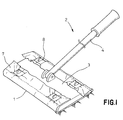
- Fig. 1 is a perspective view showing a holder 2 utilizing a disposable wipe-out device 1.
- the holder 2 comprises a mount plate 3 for the wipe-out device 1 and a stick 4.
- a marginal region 7 of the wipe-out device 1 covering a lower surface of the mount plate 3 is folded back onto an upper surface of the mount plate 3 and fastened thereto by clips 8 provided on the mount plate 3.
- the holder 2 is used with the stick 4 held by the user' hand so that the device 1 may gently rub a floor or wall.
- the device 1 shown by Fig. 2 in a perspective view comprises a basic sheet 10 formed by film or nonwoven fabric made of thermoplastic synthetic resin and a plurality of brushy pieces 11 hanging from one surface of the basic sheet 10 and used to wipe out dust and dirt from the floor or the wall.
- a basic sheet 10 formed by film or nonwoven fabric made of thermoplastic synthetic resin
- a plurality of brushy pieces 11 hanging from one surface of the basic sheet 10 and used to wipe out dust and dirt from the floor or the wall.
- the marginal region 7 is shown by Fig.1 in its folded back state but it is shown by Fig. 2 in its unfolded state.
- Each brushy pieces 11 comprises a desired length of thermoplastic synthetic resin continuous filament 15 having its anchoring portion 16 heat-sealed to the basic sheet 10 and its remainder hanging down from the basic sheet 10 so as to form a pair of wipe-out elements 17.
- Fig. 3 is a diagram illustrating a process of making the device 1.
- a continuous first web 310 made of polypropylene having a width of 210mm and a basis weight of 30g/m 2 is continuously fed from left to right as viewed in the diagram.
- a tow 312 comprising a bundle of 2,000 - 100,000 polyester continuous filaments 315 each of 2 - 30 deniers is continuously fed from left to right as viewed in the diagram.
- the tow 312 is opened or fibrillated by a set of expanding rolls 311 to form a continuous second web having a desired width and thereafter placed upon the first web 310.
- the first web 310 and the second web 312 are transported to a heating emboss machine 320 in which they are compressed together under heating and integrally heat-sealed along thereby formed heat-seal lines 316 transversely extending to form a continuous composite third web 321.
- the heat-seal lines 316 are provided so as to be spaced apart one from another by a distance d as measured longitudinally of the third web, i.e., intermittently arranged longitudinally of the third web 321.
- the second web 312 is cut by a first cutter 325 along a middle line extending parallel to and between each pair of adjacent heat-seal lines 316 in two.
- the first web 310 is cut by a second cutter 326 into a desired length.
- the individual wipe-out devices 1 are obtained from the third web 321.
- the individual basic sheets 10 are obtained from the first web 310
- the brushy pieces 11 are obtained from the second web 312
- the individual filaments 15 of the brushy pieces 11 are obtained from the continuous filaments 315
- the anchoring portions 16 are provided by the heat-seal lines 316.
- each of the heat-seal lines 316 has a width of 2 - 10mm and is spaced apart from the adjacent heat-seal line by a distance d of 20 - 200mm.
- the brushy pieces 11 or the second web or the tow 312 prior to formation of these brushy pieces 11 may be immersed with surfactant or the other agent at an appropriate step of the process.
- a distance D between each pair of adjacent heat-seal lines 316 may be dimensioned to be longer than the distance d to obtain a relatively large marginal region 7 facilitating the wipe-out device 1 to be mounted on the holder 2.
- the section defined between two adjacent heat-seal lines spaced from each other by the distance D necessarily provides relatively long brushy pieces 11 and these brushy pieces 11 must be cut to a length in conformity of the remainder brushy pieces 11. According to the process illustrated, a length of each filament 15 hanging down from the anchoring portion 16 corresponds to 1/2 of the distance d.
- a length of the second web 312 fed on the section of the first web 310 defined between each pair of adjacent heat-seal lines 316 may be dimensioned to be longer than the distance d in order to obtain the filaments 15 longer than 1/2 of the distance d.
- thermoplastic synthetic resin as the materials for these components.
- the first web 310 and the second web 312 made of thermoplastic synthetic resin may be mixed with non-heat-sealable filaments such as rayon unless they exceed 20% by weight. Such non-heat-sealable filaments will be embedded in the material heat-sealed along the respective heat-seal lines 316 and fixed thereto.
- continuous plastic film may be employed for nonwoven fabric as the first web 310.
- the inventive method for making the wipe-out device allows the density of the brushy pieces planted on the basic sheet to be easily improved merely by increasing the number of filaments constituting the tow or web, since the tow or web comprising the heat-sealable filaments and the basic sheet of the heat-sealable nature are heat-sealed together followed by transversely cutting the tow or web to form the brushy pieces of said wipe-out device.
Landscapes
- Engineering & Computer Science (AREA)
- Mechanical Engineering (AREA)
- Textile Engineering (AREA)
- Cleaning Implements For Floors, Carpets, Furniture, Walls, And The Like (AREA)
- Treatment Of Fiber Materials (AREA)
- Making Paper Articles (AREA)
- Sanitary Thin Papers (AREA)
Claims (5)
- Procédé pour la fabrication d'un dispositif de nettoyage jetable (1) comprenant une feuille de base (10) et une pluralité d'éléments de brossage (11) accrochés à au moins une surface de la feuille de base (10), caractérisé en ce que ledit procédé comprend les étapes consistant à:a. alimenter en continu une première bande (310) pour la feuille de base constituée en un matériau thermosoudable;b. alimenter en continu une deuxième bande (312) comprenant des filaments continus thermosoudables (315) dans une direction longitudinale de celle-ci sur la première bande (310);c. munir la première bande (310) et la deuxième bande (312) de lignes de thermosoudage (316) s'étendant transversalement à celles-ci et prévues à intervalles longitudinalement à celles-ci de manière à obtenir une troisième bande composite continue (321) intégrant la première bande (310) et la deuxième bande (312).d. couper la deuxième bande (312) transversalement à celle-ci le long d'une ligne centrale s'étendant parallèlement à et entre chaque paire de lignes de thermosoudage adjacentes (316) de telle sorte que la longueur de la deuxième bande correspondant à la moitié de la longueur entre chaque paire de lignes de coupe adjacentes définisse les éléments de brossage (11); ete. couper la troisième bande composite (321) à une longueur désirée pour obtenir des feuilles de base individuelles.
- Procédé suivant la revendication 1, dans lequel l'étape consistant à alimenter en continu la deuxième bande inclut une étape consistant à ouvrir un écheveau (312) comprenant les filaments continus (315) à une largeur désirée.
- Procédé suivant la revendication 2, dans lequel l'écheveau (312) comprend un faisceau de 2000-100000 filaments continus (315) chacun de 2-30 deniers.
- Procédé suivant la revendication 1, dans lequel la première bande (310) est constituée en un tissu non tissé ou en un film en matière plastique.
- Procédé suivant la revendication 1, dans lequel chacune des lignes de thermosoudage (316) a une largeur de 2-10 mm et est espacée de la ligne de thermosoudage adjacente d'une distance de 20-200 mm.
Applications Claiming Priority (3)
| Application Number | Priority Date | Filing Date | Title |
|---|---|---|---|
| JP07314310A JP3124478B2 (ja) | 1995-12-01 | 1995-12-01 | 使い捨て拭き取り用具の製造方法 |
| JP314310/95 | 1995-12-01 | ||
| JP31431095 | 1995-12-01 |
Publications (3)
| Publication Number | Publication Date |
|---|---|
| EP0777997A2 EP0777997A2 (fr) | 1997-06-11 |
| EP0777997A3 EP0777997A3 (fr) | 1998-01-07 |
| EP0777997B1 true EP0777997B1 (fr) | 2001-07-18 |
Family
ID=18051819
Family Applications (1)
| Application Number | Title | Priority Date | Filing Date |
|---|---|---|---|
| EP96870152A Expired - Lifetime EP0777997B1 (fr) | 1995-12-01 | 1996-11-26 | Procédé pour la fabrication d'un dispositif d'essuyage jetable |
Country Status (8)
| Country | Link |
|---|---|
| EP (1) | EP0777997B1 (fr) |
| JP (1) | JP3124478B2 (fr) |
| CN (1) | CN1103571C (fr) |
| CA (1) | CA2191659C (fr) |
| DE (1) | DE69613946T2 (fr) |
| ES (1) | ES2160224T3 (fr) |
| MY (1) | MY116692A (fr) |
| TW (1) | TW311086B (fr) |
Cited By (1)
| Publication number | Priority date | Publication date | Assignee | Title |
|---|---|---|---|---|
| US7691760B2 (en) | 2002-03-08 | 2010-04-06 | 3M Innovative Properties Company | Wipe |
Families Citing this family (39)
| Publication number | Priority date | Publication date | Assignee | Title |
|---|---|---|---|---|
| US6143393A (en) * | 1997-12-16 | 2000-11-07 | Uni-Charm Corporation | Cleaning product and production process therefor |
| TW394679B (en) * | 1997-12-16 | 2000-06-21 | Uni Charm Corp | Cleaning article and its manufacturing method |
| JP3558892B2 (ja) | 1998-09-24 | 2004-08-25 | ユニ・チャーム株式会社 | 清掃用シート |
| TR200101720T2 (tr) * | 1998-12-16 | 2002-01-21 | Uni-Charm Corporation | Temizlik ürünü ve buna mahsus üretim yöntemi. |
| CN1103281C (zh) * | 1999-03-05 | 2003-03-19 | 尤妮佳股份有限公司 | 复合片及制造这种复合片的方法 |
| JP2000296084A (ja) | 1999-04-13 | 2000-10-24 | Uni Charm Corp | 使い捨て拭き取り用具およびその製造方法 |
| JP2000296085A (ja) * | 1999-04-13 | 2000-10-24 | Uni Charm Corp | 使い捨ての汚れ拭き取り用具およびその製造方法 |
| JP3943753B2 (ja) * | 1999-04-13 | 2007-07-11 | ユニ・チャーム株式会社 | 使い捨ての汚れ拭き取り用具の製造方法 |
| MXPA02001517A (es) * | 1999-08-11 | 2003-07-21 | Procter & Gamble | Hojas de limpieza para minimizar el residuo que se deja sobre superficies. |
| CN1184922C (zh) | 2000-07-10 | 2005-01-19 | 尤妮佳股份有限公司 | 清扫物品 |
| US20030028988A1 (en) * | 2001-06-25 | 2003-02-13 | The Procter & Gamble Company | Cleaning implement and joint therefor |
| JP4338982B2 (ja) | 2003-01-27 | 2009-10-07 | ユニ・チャーム株式会社 | ロータリーカッターおよびこれを用いた繊維製品の製造方法 |
| US7870635B2 (en) | 2004-04-01 | 2011-01-18 | Kikuo Yamada | Cleaning tool sheet and cleaning tool |
| WO2005099549A1 (fr) * | 2004-04-01 | 2005-10-27 | Yamada, Chiyoe | Feuille d'outil de nettoyage et outil de nettoyage |
| US7389559B2 (en) | 2004-06-10 | 2008-06-24 | Contec, Inc. | Mop head including contoured tubular fluid retaining strand elements |
| JP4785369B2 (ja) | 2004-11-16 | 2011-10-05 | ユニ・チャーム株式会社 | 清掃用物品 |
| US7891898B2 (en) | 2005-01-28 | 2011-02-22 | S.C. Johnson & Son, Inc. | Cleaning pad for wet, damp or dry cleaning |
| US7566671B2 (en) | 2005-01-28 | 2009-07-28 | S.C. Johnson & Son, Inc. | Cleaning or dusting pad |
| US7976235B2 (en) | 2005-01-28 | 2011-07-12 | S.C. Johnson & Son, Inc. | Cleaning kit including duster and spray |
| US7740412B2 (en) | 2005-01-28 | 2010-06-22 | S.C. Johnson & Son, Inc. | Method of cleaning using a device with a liquid reservoir and replaceable non-woven pad |
| US20070136967A1 (en) * | 2005-12-20 | 2007-06-21 | 3M Innovative Properties Company | Adhesive wipe |
| JP5235478B2 (ja) * | 2007-04-27 | 2013-07-10 | 花王株式会社 | 清掃用シート |
| JP2008272147A (ja) * | 2007-04-27 | 2008-11-13 | Kao Corp | 清掃用シート及びその製造方法 |
| JP5007219B2 (ja) * | 2007-12-27 | 2012-08-22 | 花王株式会社 | 清掃用シート |
| JP5007218B2 (ja) * | 2007-12-27 | 2012-08-22 | 花王株式会社 | 清掃用シート |
| US8793832B2 (en) | 2007-12-28 | 2014-08-05 | Kikuo Yamada | Cleaning sheet |
| US8225453B2 (en) | 2007-12-28 | 2012-07-24 | Kikuo Yamada | Cleaning sheet |
| MY175164A (en) | 2008-04-16 | 2020-06-11 | Kao Corp | Cleaning sheet and process for producing the same |
| JP5475426B2 (ja) * | 2008-12-19 | 2014-04-16 | 花王株式会社 | 清掃シート |
| US8752232B2 (en) | 2009-02-13 | 2014-06-17 | Kao Corporation | Cleaning sheet |
| CN101627855B (zh) * | 2009-08-04 | 2011-03-30 | 桐乡市永鑫制刷机械厂 | 条刷机 |
| TW201114399A (en) * | 2009-10-21 | 2011-05-01 | Ya-Jing Yang | Improved long-staple mop cloth |
| JP5513873B2 (ja) * | 2009-12-18 | 2014-06-04 | 花王株式会社 | 清掃シート |
| JP5421765B2 (ja) * | 2009-12-28 | 2014-02-19 | 花王株式会社 | 清掃シート |
| USD642759S1 (en) | 2010-06-18 | 2011-08-02 | Kao Corporation | Cleaning sheet |
| USD642758S1 (en) | 2010-06-18 | 2011-08-02 | Kao Corporation | Cleaning sheet |
| JP5836194B2 (ja) * | 2012-05-21 | 2015-12-24 | ユニ・チャーム株式会社 | トウを含む複数の繊維を有する連続ウエブの切断装置、及び切断方法 |
| JP5871711B2 (ja) * | 2012-05-21 | 2016-03-01 | ユニ・チャーム株式会社 | トウを含む複数の繊維を有するウエブ部材の切断装置、及び切断方法 |
| CN109094148B (zh) * | 2018-06-15 | 2020-08-25 | 阿斯福特纺织(漳州)有限公司 | 一种高性能可防污针织布的成型工艺 |
Family Cites Families (3)
| Publication number | Priority date | Publication date | Assignee | Title |
|---|---|---|---|---|
| US3962743A (en) * | 1974-06-27 | 1976-06-15 | Moss Theron V | Mop and method of making same |
| DE8901641U1 (de) * | 1988-03-19 | 1989-04-20 | Henkel KGaA, 4000 Düsseldorf | Feuchtwischbezug für die Fußbodenpflege |
| DE4025646A1 (de) * | 1990-08-14 | 1992-02-20 | Henkel Kgaa | Wischbezug mit haltereinfuehrhilfe |
-
1995
- 1995-12-01 JP JP07314310A patent/JP3124478B2/ja not_active Expired - Lifetime
-
1996
- 1996-11-19 TW TW085114168A patent/TW311086B/zh not_active IP Right Cessation
- 1996-11-26 DE DE69613946T patent/DE69613946T2/de not_active Expired - Lifetime
- 1996-11-26 EP EP96870152A patent/EP0777997B1/fr not_active Expired - Lifetime
- 1996-11-26 ES ES96870152T patent/ES2160224T3/es not_active Expired - Lifetime
- 1996-11-27 MY MYPI96004972A patent/MY116692A/en unknown
- 1996-11-29 CA CA002191659A patent/CA2191659C/fr not_active Expired - Lifetime
- 1996-12-02 CN CN96120963A patent/CN1103571C/zh not_active Expired - Lifetime
Cited By (1)
| Publication number | Priority date | Publication date | Assignee | Title |
|---|---|---|---|---|
| US7691760B2 (en) | 2002-03-08 | 2010-04-06 | 3M Innovative Properties Company | Wipe |
Also Published As
| Publication number | Publication date |
|---|---|
| DE69613946T2 (de) | 2002-04-04 |
| JPH09149873A (ja) | 1997-06-10 |
| CA2191659A1 (fr) | 1997-06-02 |
| DE69613946D1 (de) | 2001-08-23 |
| EP0777997A3 (fr) | 1998-01-07 |
| JP3124478B2 (ja) | 2001-01-15 |
| CA2191659C (fr) | 2002-02-19 |
| TW311086B (fr) | 1997-07-21 |
| MY116692A (en) | 2004-03-31 |
| CN1158231A (zh) | 1997-09-03 |
| CN1103571C (zh) | 2003-03-26 |
| ES2160224T3 (es) | 2001-11-01 |
| EP0777997A2 (fr) | 1997-06-11 |
Similar Documents
| Publication | Publication Date | Title |
|---|---|---|
| CA2191659C (fr) | Methode de fabrication de dispositif de balayage jetable | |
| US6329308B1 (en) | Disposable wipe-off article | |
| EP0923902B1 (fr) | Produit de nettoyage et son procédé de fabrication | |
| KR101290228B1 (ko) | 청소체 및 청소용구 | |
| US6241835B1 (en) | Cleaning product and production process therefor | |
| EP1212972B1 (fr) | Feuille de nettoyage pour nettoyer des surfaces veloutées | |
| EP2140794B1 (fr) | Feuille de nettoyage | |
| KR101290227B1 (ko) | 청소체 및 청소용구 | |
| AU2009237048B2 (en) | Cleaning sheet and process for producing the same | |
| US8973204B2 (en) | Cleaning element and cleaning tool | |
| CA2265298C (fr) | Feuille de nettoyage jetable | |
| JP3100578B2 (ja) | 清掃用物品及びその製造方法 | |
| MXPA06004120A (es) | Implemento de limpieza desechable. | |
| JPH11276402A (ja) | 清掃用モップ | |
| US4441228A (en) | Dust mop | |
| JP3313786B2 (ja) | 湿式清掃用シート及びその製造方法 | |
| JP4033645B2 (ja) | 清掃用シート | |
| MX2008015366A (es) | Elemento limpiador y herramienta limpiadora. | |
| RU2233609C2 (ru) | Изделие для чистки и способ его изготовления | |
| EP2415381B1 (fr) | Dispositif de nettoyage et corps de nettoyage | |
| KR100457147B1 (ko) | 일회용닦아내기용구의제조방법 | |
| JPH1147069A (ja) | タフトマット | |
| MXPA01006159A (en) | Cleaning product and production process therefor |
Legal Events
| Date | Code | Title | Description |
|---|---|---|---|
| PUAI | Public reference made under article 153(3) epc to a published international application that has entered the european phase |
Free format text: ORIGINAL CODE: 0009012 |
|
| 17P | Request for examination filed |
Effective date: 19961206 |
|
| AK | Designated contracting states |
Kind code of ref document: A2 Designated state(s): BE DE ES FR GB IT NL SE |
|
| PUAL | Search report despatched |
Free format text: ORIGINAL CODE: 0009013 |
|
| AK | Designated contracting states |
Kind code of ref document: A3 Designated state(s): BE DE ES FR GB IT NL SE |
|
| 17Q | First examination report despatched |
Effective date: 19991007 |
|
| GRAG | Despatch of communication of intention to grant |
Free format text: ORIGINAL CODE: EPIDOS AGRA |
|
| GRAG | Despatch of communication of intention to grant |
Free format text: ORIGINAL CODE: EPIDOS AGRA |
|
| GRAH | Despatch of communication of intention to grant a patent |
Free format text: ORIGINAL CODE: EPIDOS IGRA |
|
| GRAH | Despatch of communication of intention to grant a patent |
Free format text: ORIGINAL CODE: EPIDOS IGRA |
|
| GRAA | (expected) grant |
Free format text: ORIGINAL CODE: 0009210 |
|
| AK | Designated contracting states |
Kind code of ref document: B1 Designated state(s): BE DE ES FR GB IT NL SE |
|
| REF | Corresponds to: |
Ref document number: 69613946 Country of ref document: DE Date of ref document: 20010823 |
|
| ITF | It: translation for a ep patent filed | ||
| REG | Reference to a national code |
Ref country code: ES Ref legal event code: FG2A Ref document number: 2160224 Country of ref document: ES Kind code of ref document: T3 |
|
| EN | Fr: translation not filed | ||
| REG | Reference to a national code |
Ref country code: GB Ref legal event code: IF02 |
|
| EN | Fr: translation not filed |
Free format text: BO 01/51 PAGES: 265, IL Y A LIEU DE SUPPRIMER: LA MENTION DE LA NON REMISE. LA REMISE EST PUBLIEE DANS LE PRESENT BOPI. |
|
| ET | Fr: translation filed | ||
| PLBE | No opposition filed within time limit |
Free format text: ORIGINAL CODE: 0009261 |
|
| STAA | Information on the status of an ep patent application or granted ep patent |
Free format text: STATUS: NO OPPOSITION FILED WITHIN TIME LIMIT |
|
| 26N | No opposition filed | ||
| REG | Reference to a national code |
Ref country code: FR Ref legal event code: PLFP Year of fee payment: 20 |
|
| PGFP | Annual fee paid to national office [announced via postgrant information from national office to epo] |
Ref country code: DE Payment date: 20151118 Year of fee payment: 20 Ref country code: IT Payment date: 20151124 Year of fee payment: 20 Ref country code: GB Payment date: 20151125 Year of fee payment: 20 |
|
| PGFP | Annual fee paid to national office [announced via postgrant information from national office to epo] |
Ref country code: BE Payment date: 20151111 Year of fee payment: 20 Ref country code: FR Payment date: 20151008 Year of fee payment: 20 Ref country code: SE Payment date: 20151111 Year of fee payment: 20 Ref country code: NL Payment date: 20151012 Year of fee payment: 20 Ref country code: ES Payment date: 20151014 Year of fee payment: 20 |
|
| REG | Reference to a national code |
Ref country code: DE Ref legal event code: R071 Ref document number: 69613946 Country of ref document: DE |
|
| REG | Reference to a national code |
Ref country code: NL Ref legal event code: MK Effective date: 20161125 |
|
| REG | Reference to a national code |
Ref country code: GB Ref legal event code: PE20 Expiry date: 20161125 |
|
| PG25 | Lapsed in a contracting state [announced via postgrant information from national office to epo] |
Ref country code: GB Free format text: LAPSE BECAUSE OF EXPIRATION OF PROTECTION Effective date: 20161125 |
|
| REG | Reference to a national code |
Ref country code: ES Ref legal event code: FD2A Effective date: 20170303 |
|
| PG25 | Lapsed in a contracting state [announced via postgrant information from national office to epo] |
Ref country code: ES Free format text: LAPSE BECAUSE OF EXPIRATION OF PROTECTION Effective date: 20161127 |