EP0779660A2 - Micromatrice de cellules solaires intégrée monolithique et méthode de fabrication - Google Patents
Micromatrice de cellules solaires intégrée monolithique et méthode de fabrication Download PDFInfo
- Publication number
- EP0779660A2 EP0779660A2 EP96119659A EP96119659A EP0779660A2 EP 0779660 A2 EP0779660 A2 EP 0779660A2 EP 96119659 A EP96119659 A EP 96119659A EP 96119659 A EP96119659 A EP 96119659A EP 0779660 A2 EP0779660 A2 EP 0779660A2
- Authority
- EP
- European Patent Office
- Prior art keywords
- base
- emitter
- solar cells
- layer
- microarray
- Prior art date
- Legal status (The legal status is an assumption and is not a legal conclusion. Google has not performed a legal analysis and makes no representation as to the accuracy of the status listed.)
- Withdrawn
Links
- 238000002493 microarray Methods 0.000 title claims abstract description 61
- 238000000034 method Methods 0.000 title claims abstract description 25
- 238000004519 manufacturing process Methods 0.000 title claims description 13
- 239000000758 substrate Substances 0.000 claims abstract description 38
- 238000002955 isolation Methods 0.000 claims abstract description 33
- 239000004065 semiconductor Substances 0.000 claims description 11
- 238000000059 patterning Methods 0.000 claims 2
- 238000005530 etching Methods 0.000 abstract description 8
- 238000005476 soldering Methods 0.000 abstract description 6
- JBRZTFJDHDCESZ-UHFFFAOYSA-N AsGa Chemical compound [As]#[Ga] JBRZTFJDHDCESZ-UHFFFAOYSA-N 0.000 description 19
- 229910001218 Gallium arsenide Inorganic materials 0.000 description 18
- 235000012431 wafers Nutrition 0.000 description 12
- 229910000980 Aluminium gallium arsenide Inorganic materials 0.000 description 5
- 239000011248 coating agent Substances 0.000 description 5
- 238000000576 coating method Methods 0.000 description 5
- 239000000463 material Substances 0.000 description 5
- 238000001465 metallisation Methods 0.000 description 5
- 229910045601 alloy Inorganic materials 0.000 description 4
- 239000000956 alloy Substances 0.000 description 4
- 239000002800 charge carrier Substances 0.000 description 4
- 229920002120 photoresistant polymer Polymers 0.000 description 4
- 229910001092 metal group alloy Inorganic materials 0.000 description 3
- 230000005540 biological transmission Effects 0.000 description 2
- 239000002131 composite material Substances 0.000 description 2
- 230000031700 light absorption Effects 0.000 description 2
- 230000000873 masking effect Effects 0.000 description 2
- 229910052751 metal Inorganic materials 0.000 description 2
- 239000002184 metal Substances 0.000 description 2
- TWNQGVIAIRXVLR-UHFFFAOYSA-N oxo(oxoalumanyloxy)alumane Chemical compound O=[Al]O[Al]=O TWNQGVIAIRXVLR-UHFFFAOYSA-N 0.000 description 2
- BPUBBGLMJRNUCC-UHFFFAOYSA-N oxygen(2-);tantalum(5+) Chemical compound [O-2].[O-2].[O-2].[O-2].[O-2].[Ta+5].[Ta+5] BPUBBGLMJRNUCC-UHFFFAOYSA-N 0.000 description 2
- 229910000679 solder Inorganic materials 0.000 description 2
- PBCFLUZVCVVTBY-UHFFFAOYSA-N tantalum pentoxide Inorganic materials O=[Ta](=O)O[Ta](=O)=O PBCFLUZVCVVTBY-UHFFFAOYSA-N 0.000 description 2
- 229910000530 Gallium indium arsenide Inorganic materials 0.000 description 1
- 230000009286 beneficial effect Effects 0.000 description 1
- 238000006243 chemical reaction Methods 0.000 description 1
- 238000005229 chemical vapour deposition Methods 0.000 description 1
- 238000011109 contamination Methods 0.000 description 1
- 239000013078 crystal Substances 0.000 description 1
- 230000000694 effects Effects 0.000 description 1
- 229910052732 germanium Inorganic materials 0.000 description 1
- GNPVGFCGXDBREM-UHFFFAOYSA-N germanium atom Chemical compound [Ge] GNPVGFCGXDBREM-UHFFFAOYSA-N 0.000 description 1
- 230000010354 integration Effects 0.000 description 1
- 230000001678 irradiating effect Effects 0.000 description 1
- 238000012538 light obscuration Methods 0.000 description 1
- 150000002739 metals Chemical class 0.000 description 1
Images



Classifications
-
- H—ELECTRICITY
- H10—SEMICONDUCTOR DEVICES; ELECTRIC SOLID-STATE DEVICES NOT OTHERWISE PROVIDED FOR
- H10F—INORGANIC SEMICONDUCTOR DEVICES SENSITIVE TO INFRARED RADIATION, LIGHT, ELECTROMAGNETIC RADIATION OF SHORTER WAVELENGTH OR CORPUSCULAR RADIATION
- H10F19/00—Integrated devices, or assemblies of multiple devices, comprising at least one photovoltaic cell covered by group H10F10/00, e.g. photovoltaic modules
- H10F19/20—Integrated devices, or assemblies of multiple devices, comprising at least one photovoltaic cell covered by group H10F10/00, e.g. photovoltaic modules comprising photovoltaic cells in arrays in or on a single semiconductor substrate, the photovoltaic cells having planar junctions
-
- H—ELECTRICITY
- H10—SEMICONDUCTOR DEVICES; ELECTRIC SOLID-STATE DEVICES NOT OTHERWISE PROVIDED FOR
- H10F—INORGANIC SEMICONDUCTOR DEVICES SENSITIVE TO INFRARED RADIATION, LIGHT, ELECTROMAGNETIC RADIATION OF SHORTER WAVELENGTH OR CORPUSCULAR RADIATION
- H10F19/00—Integrated devices, or assemblies of multiple devices, comprising at least one photovoltaic cell covered by group H10F10/00, e.g. photovoltaic modules
- H10F19/30—Integrated devices, or assemblies of multiple devices, comprising at least one photovoltaic cell covered by group H10F10/00, e.g. photovoltaic modules comprising thin-film photovoltaic cells
- H10F19/31—Integrated devices, or assemblies of multiple devices, comprising at least one photovoltaic cell covered by group H10F10/00, e.g. photovoltaic modules comprising thin-film photovoltaic cells having multiple laterally adjacent thin-film photovoltaic cells deposited on the same substrate
- H10F19/33—Patterning processes to connect the photovoltaic cells, e.g. laser cutting of conductive or active layers
-
- H—ELECTRICITY
- H10—SEMICONDUCTOR DEVICES; ELECTRIC SOLID-STATE DEVICES NOT OTHERWISE PROVIDED FOR
- H10F—INORGANIC SEMICONDUCTOR DEVICES SENSITIVE TO INFRARED RADIATION, LIGHT, ELECTROMAGNETIC RADIATION OF SHORTER WAVELENGTH OR CORPUSCULAR RADIATION
- H10F19/00—Integrated devices, or assemblies of multiple devices, comprising at least one photovoltaic cell covered by group H10F10/00, e.g. photovoltaic modules
- H10F19/30—Integrated devices, or assemblies of multiple devices, comprising at least one photovoltaic cell covered by group H10F10/00, e.g. photovoltaic modules comprising thin-film photovoltaic cells
- H10F19/31—Integrated devices, or assemblies of multiple devices, comprising at least one photovoltaic cell covered by group H10F10/00, e.g. photovoltaic modules comprising thin-film photovoltaic cells having multiple laterally adjacent thin-film photovoltaic cells deposited on the same substrate
- H10F19/35—Structures for the connecting of adjacent photovoltaic cells, e.g. interconnections or insulating spacers
-
- H—ELECTRICITY
- H10—SEMICONDUCTOR DEVICES; ELECTRIC SOLID-STATE DEVICES NOT OTHERWISE PROVIDED FOR
- H10F—INORGANIC SEMICONDUCTOR DEVICES SENSITIVE TO INFRARED RADIATION, LIGHT, ELECTROMAGNETIC RADIATION OF SHORTER WAVELENGTH OR CORPUSCULAR RADIATION
- H10F77/00—Constructional details of devices covered by this subclass
- H10F77/10—Semiconductor bodies
- H10F77/14—Shape of semiconductor bodies; Shapes, relative sizes or dispositions of semiconductor regions within semiconductor bodies
-
- Y—GENERAL TAGGING OF NEW TECHNOLOGICAL DEVELOPMENTS; GENERAL TAGGING OF CROSS-SECTIONAL TECHNOLOGIES SPANNING OVER SEVERAL SECTIONS OF THE IPC; TECHNICAL SUBJECTS COVERED BY FORMER USPC CROSS-REFERENCE ART COLLECTIONS [XRACs] AND DIGESTS
- Y02—TECHNOLOGIES OR APPLICATIONS FOR MITIGATION OR ADAPTATION AGAINST CLIMATE CHANGE
- Y02E—REDUCTION OF GREENHOUSE GAS [GHG] EMISSIONS, RELATED TO ENERGY GENERATION, TRANSMISSION OR DISTRIBUTION
- Y02E10/00—Energy generation through renewable energy sources
- Y02E10/50—Photovoltaic [PV] energy
-
- Y—GENERAL TAGGING OF NEW TECHNOLOGICAL DEVELOPMENTS; GENERAL TAGGING OF CROSS-SECTIONAL TECHNOLOGIES SPANNING OVER SEVERAL SECTIONS OF THE IPC; TECHNICAL SUBJECTS COVERED BY FORMER USPC CROSS-REFERENCE ART COLLECTIONS [XRACs] AND DIGESTS
- Y10—TECHNICAL SUBJECTS COVERED BY FORMER USPC
- Y10S—TECHNICAL SUBJECTS COVERED BY FORMER USPC CROSS-REFERENCE ART COLLECTIONS [XRACs] AND DIGESTS
- Y10S438/00—Semiconductor device manufacturing: process
- Y10S438/933—Germanium or silicon or Ge-Si on III-V
Definitions
- the present invention generally relates to solar cell microarrays, and more specifically to a monolithically integrated solar cell microarray and a method for photolithographically isolating the individual solar cells and defining series interconnects therebetween.
- Microarrays which may include a hundred or more solar cells are used to provide electrical power for a variety of applications such as spacecraft.
- Existing microarrays are formed by growing p and n type semiconductor layers such as gallium-arsenide (GaAs) on a germanium (Ge) wafer to form an active p/n junction. The wafer is cut or "diced” into unit sized solar cells. Dicing limits the solar cells to rectangular shapes, damages the solar cells and takes approximately 30 minutes per microarray.
- GaAs gallium-arsenide
- Ge germanium
- each solar cell Irradiating the microarray with light causes each solar cell to produce a voltage potential and a current.
- the discrete solar cells are interconnected in series/parallel combinations to sum the individual cell voltages and currents, respectively, to supply a desired array voltage and current.
- the solder interconnects increase the microarray's weight, obscure the solar cells' active area thereby reducing efficiency, increase manufacturing costs and provide inferior electro-mechanical interconnects.
- the cell-to-cell spacing must be at least 100 microns.
- FIG. 1 is a sectional view of a portion of a known solar cell microarray 10 bonded to a carrier 12.
- the microarray 10 includes a plurality of discrete single junction GaAs solar cells 14 formed on respective Ge substrates 16.
- Single and multi-junction GaAs cells produce potentials of approximately 1V and 2.5V, respectively, and supply a cell current of approximately 30 milliamperes/cm 2 and 16 milliamperes/cm 2 , respectively .
- the solar cells use electrically conductive interconnects 18 in a parallel/series circuit to produce a power supply with a desired voltage and current for a given application.
- Each solar cell 14 includes an n-type GaAs base layer 20, suitably 5 microns thick, grown on substrate 16.
- the substrates 16 are 200 micron Ge single crystal substrates which are suitable for Metalorganic Chemical Vapor Deposition (MOCVD) of GaAs solar cells.
- MOCVD Metalorganic Chemical Vapor Deposition
- the Ge substrates match the thermal and lattice properties of the base and emitter layers 20 and 22, respectively. This match is important to avoid cracks in the solar cells 14.
- the window layer 26 passivates the surface 28 of the emitter layer 22 to protect the solar cell from contamination and to increase the conversion efficiency.
- the window layer 26 has a band gap in excess of 2 eV so that incident light is transmitted through the window to the solar cell 14.
- a base contact region 30 is formed through the window and emitter layers into base layer 20.
- a base contact 32 suitably a AuGeNiAg alloy, is formed in contact region 30 to adhere to the n-type GaAs base layer 20. In most known microarrays, the base contact 32 is formed on the backside of the solar cell as parallel grid lines.
- a p-type GaAs emitter contact pad 34 or "cap” layer is formed on window layer 26 in electrical communication with the emitter layer 22.
- An emitter contact 36 suitably a AuZnAg alloy, is formed on the p-type contact pad 34.
- the base and emitter contacts are formed from different metal alloys because they must adhere to n and p-type GaAs, respectively.
- the microarray's active surface 37 and back or “shadowed” surface 38 are coated with an antireflection (AR) coating 39 that enhances light transmission, thereby increasing the array's power efficiency.
- AR antireflection
- the absorption of light causes liberation of charge carriers including electrons and holes in the region of the p/n junction 24, which migrate towards the top surface 28 of the emitter layer and the bottom surface 40 of the base layer, depending upon their polarity.
- the opposite charge carriers are collected at the base contact 32 and emitter contact 36. This generates a potential of approximately 1V across the solar cell 14 and supplies a current of 30 milliamperes/cm 2 .
- the microarray 10 is manufactured generically, without interconnects 18, so that the manufacturer or user can configure the solar cells 14 for a particular application.
- the generic microarray is fabricated by first growing an 200 micron Ge wafer. Ge wafers are limited to much smaller sizes than Si wafers, typically 10.2 cm in diameter, and are more expensive than Si. However, even though much research has been done to grow GaAs solar cells directly on Si substrates those efforts have largely failed. The mismatch in lattice and thermal properties of Si and GaAs results in cracks in the solar cells.
- the base, emitter, window and cap layers are grown with an epitaxial process onto the wafer.
- the structure is then chemically etched to define all of the base contact regions 30 in parallel.
- the cap layer is etched to define all of the emitter contact pads 34 in parallel.
- the discrete base and emitter contacts 32 and 34 are formed in respective lift-off metalization steps.
- the wafer is then sawed or diced to define the discrete solar cells and associated substrates.
- Dicing is a serial process that is limited to linear cuts of the wafer. As a result, dicing an entire wafer is a very slow and expensive process, taking up to about 30 minutes. The process can also damage the edge of the solar cells and reduce their output. Furthermore, the solar cells are limited to rectangular shapes. In known microarrays, each of the solar cells conforms to a reference size and shape.
- the discrete solar cells 14 and their affixed substrates 16 are bonded to the carrier 12 in physical and electrical isolation from each other.
- the solar cells 14 are connected together by manually soldering interconnects 18 between contacts on adjacent solar cells along the surface of carrier 12.
- the connections depend upon the power supply specifications: supply voltage and supply current. These values are specified as integer multiples of the cell voltage and current so that a number of cells can be connected in parallel to provide the desired supply current and connected in series to provide the supply voltage. For example, a 5v supply would be provided by soldering five solar cells in series.
- the completed structure (microarray and carrier) is then bonded to the spacecraft's solar panel.
- soldered interconnects 18 have a line width of approximately 125 microns which obscure a significant portion of the incident light and increases the overall weight of the microarray.
- a solar cell of this general type is disclosed in U.S. Patent No. 5,330,585 "GaAS/AlGaAs Photocell including Environmentally Sealed Ohmic Contact Grid Interface and Method of Fabricating the Cell," to Hughes Aircraft Company the assignee of the present invention.
- the present invention seeks to provide a light weight and efficient solar cell microarray and a cost effective method for manufacturing the microarray.
- the trench is photolithographically etched into the microarray, and thus can be formed much quicker and with less damage to the cells than conventional dicing techniques. The etch is controlled to scale the individual solar cells to produce the desired output current, thus eliminating the prior need to connect the cells in parallel.
- Base contacts and integral emitter contact/interconnects are formed using a photolithographic liftoff process to connect a number of the scaled solar cells in series to sum their voltages and thereby supply the desired output voltage and current.
- the photolithographic liftoff process is much quicker and less expensive than known soldering methods and provides substantially narrower line widths, reducing obscuration and weight.
- a monolithically integrated solar cell microarray is designed and fabricated in accordance with power supply specifications for a particular application.
- the solar cell microarray is fabricated on a single monolithic substrate by providing an isolation layer between the substrate and the solar cell base and emitter layers, and by etching those layers to expose the isolation layer. Taken together the isolation layer and etch define the electrically isolated solar cells.
- the solar cells are thus defined simultaneously, which greatly reduces manufacturing time and cost.
- the etching process allows arbitrarily shaped and sized solar cells and does not damage the solar cells.
- the parallel interconnections required in the known microarrays to sum the cell currents are eliminated by directly scaling the solar cells' active areas to provide the desired supply current.
- the series interconnects can be formed using a photolithographic lift-off or etching process. This has several beneficial results.
- the interconnects can be formed in parallel at the same time as the emitter contacts. This adds no time to the fabrication of the microarray and saves 1/2 to 2 hours compared to the existing method.
- the line width of the interconnects is reduced from 125 microns to approximately 5 microns. This reduces obscuration by 10-15% and reduces the weight of the metallization by a factor of approximately twenty-five.
- Third, integrating the interconnects with the emitter contacts improves the quality of the contact.
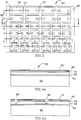
- FIG. 2 is a sectional view of a portion of a monolithically integrated solar cell microarray 50 in accordance with the present invention.
- Microarray 50 includes a plurality of solar cells 52 formed on a monolithic substrate 54.
- the invention is described in conjunction with single junction GaAs solar cells 52 and a 200 micron n-type Ge substrate 54, but is applicable to multijunction solar cells and is not limited to the specific conductivities or materials shown.
- the solar cells can be formed from InGaAsP, InGaAs, or InP.
- the invention allows larger GaAs microarrays to be fabricated on a large Si substrate.
- the microarray 50 includes n and p-type GaAs base and emitter layers 56 and 58, respectively, that define a p/n junction 60 having a band gap of approximately 1.4 eV at their interface.
- the base and emitter layers are suitably 5 microns and 0.5 microns thick, respectively.
- a patterned trench 62 in the base and emitter layers and an isolation layer 64 between the base layer 56 and the substrate 54 together define the individual solar cells 52.
- the patterned trench 62 exposes the isolation layer 64, thereby spacing the solar cells 52 apart by approximately 50 microns.
- the trench is preferably formed to expose the top surface of isolation layer 64. Alternately the trench can be formed into or through the isolation layer 64 into the substrate 54.
- the trench 62 can be patterned so that the solar cells have the conventional rectangular shape, or other non-rectangular shapes such as triangles. Furthermore the trench can be patterned to scale the sizes of the solar cells by varying amounts to produce the desired supply currents. This eliminates the need to connect multiple cells in parallel, thereby reducing the weight of the microarray and the cost of production.
- the isolation layer 64 electrically isolates the individual solar cells 52 from the substrate 54, thereby breaking the current leakage path between the cells through the substrate. This electrically isolates the solar cells 52 from each other.
- the isolation layer 64 is preferably a semiconductor material having the opposite conductivity type of the substrate 54 and base layer 56 and doped to have a high resistance. In the embodiment discussed, isolation layer 64 is suitably a 1 micron layer of p-type AlGaAs doped to have a band gap of approximately 2eV. Alternately, other III-V materials could be used to form the isolation layer. Further, multiple isolation layers such as a p-n-p composite may also be used to reduce the electrical conductivity between the solar cells and the substrate.
- the semiconductor material selected for the isolation layer 64 must also have thermal and lattice constant properties that are compatible with those of the substrate 54 and base layer 56.
- the material can be selected to have properties between those of GaAs solar cells and Ge substrates.
- a p-type AlGaAs window layer 66 suitably 0.05 microns thick, passivates emitter layer 58.
- the window layer 66 is doped to have a band gap in excess of 2 eV so that incident light is transmitted through the window to the solar cells 52.
- a base contact region 68 is formed through the window and emitter layers into base layer 56.
- a base contact 70 suitably a AuGeNiAg alloy, is formed in contact region 68 to adhere to the n-type GaAs base layer 56.
- a p-type GaAs emitter contact pad 72 or "cap” layer is formed on top of window layer 66 in electrical communication with the emitter layer 58.
- An integrated emitter contact/interconnect 74 connects the p-type contact pad 72 of one cell 52 to the base contact 70 of another solar cell 52.
- the interconnect portion of contact/interconnect 74 has a line width of at most 25 microns and preferably approximately 5 microns, which reduces obscuration by 5-10% and reduces the overall metallization weight by a factor of approximately twenty-five.
- the base and emitter/interconnect contacts are preferably formed from different metal alloys to improve their adherence to n and p-type GaAs base and emitter layers, respectively.
- the interconnect could be formed integrally with the base contact instead of the emitter contact.
- the emitter and base contacts and interconnect can be formed as a single integral contact. Integration of the contacts improves their quality and simplifies the manufacturing process.
- AR antireflection
- the absorption of light causes a liberation of charge carriers, including electrons and holes, in the region of the p/n junction 60, which migrate towards the top surface 82 of the emitter layer and the bottom surface 84 of the base layer, depending upon their polarities.
- the opposite charge carriers are collected at the base contact 70 and emitter contact 72. This generates a potential of approximately 1V across the solar cell 52 and supplies a current in the range of 1 to 5 milliamps, depending upon the size of the p/n junction's active area.
- the light penetrates only approximately 3 microns into the solar cell, and thus the p/n junction formed between the isolation layer 64 and substrate 54 is inactive.
- the microarray 50 is designed and fabricated to provide one or more power supplies with desired voltage and current levels for a given application.
- the trench 62 is patterned to scale the solar cells relative to a reference cell, typically 1.2 cm by 0.3 cm, to provide the desired current levels.
- the emitter contact/interconnects 74 connect the solar cells in to series strings to sum their voltages and produce the desired voltage levels.
- microarray 50 provides three supplies: nominally an 8V 3 milliamp supply, a 12V 2 milliamp supply, and a 24V 1 milliamp supply.
- the base contact of the first solar cell 52 in each string is connected to an external ground and the emitter contact 74 of the last solar cell 52 in each string is connected to an external voltage terminal 86.
- the trench 62 could be patterned to provide unit sized solar cells which are then connected in parallel to provide the desired current levels.
- the monolithically integrated solar cell microarray 50 of FIGs. 2 and 3 is fabricated entirely with a photolithographic process which does not require sawing the wafer to isolate the individual cells or manually soldering the electrically conductive interconnects. Furthermore, the solar cells and interconnects are fabricated to provide a power supply(s) for a specific application.
- the Ge wafer 54 has been grown and the isolation, base, emitter, window and cap layers 64, 56, 58, 66 and 72, respectively, have been epitaxially formed thereon with thickness of 200 microns, 1 micron, 5 microns, 0.5 microns, 0.05 microns and 0.5 microns, respectively.
- base contact regions 68 have been formed through the cap, window and emitter layers and into the base layer 56. This is preferably done by masking the active surface 76 of the microarray 50 and then chemically etching the exposed portions to a depth of approximately 3 to 4 microns.
- trench 62 has been patterned through the cap, window, emitter and base layers to expose the isolation layer 64. This is preferably done by masking the active surface 76 of the microarray 50 and then chemically etching the exposed portions to a depth of approximately 6.5 microns.
- the cap layer has been etched with a similar process to defined the emitter contact pad 72. The ordering of the fabrication steps shown in FIGs. 4b through 4d can be interchanged.
- the AR coating 80 has been formed over both the microarray's shadowed and active surfaces.
- the active surface is masked so that the AR coating does not cover the bottom of base contact regions 68 and emitter contact pad 72.
- the base contacts 70 and emitter contact/interconnect 74 have been deposited on the active surface 76 to configure the solar cells to provide the desired power supplies.
- the base contacts and emitter contact/interconnects are fabricated in respective photolithographic liftoff steps to accommodate the different metal alloys.
- Each liftoff step includes forming a photoresist layer over the microarray, etching the photoresist to expose the base contact region or emitter contact pad, forming the appropriate metallization layer over the patterned photoresist so that it adheres to the base layer or the emitter contact pad, and lifting off the photoresist to remove the remaining metallization.
- the metal contacts can be formed by etching.
- the photolithographic process used to fabricate the microarray has several advantages over the known fabrication techniques.
- the trench etch is accomplished in a single parallel step which can be much quicker and cheaper than conventional dicing.
- the parallel trench etch does not damage the solar cells and reduces the spacing between cells, which improves the microarray's overall efficiency.
- the solar cells are not limited to rectangular shapes.
- the photolithographic liftoff process forms the interconnects at the same time and integral with the emitter contacts. This reduces fabrication time and cost and improves the quality of the contacts.
- the photolithographically defined interconnects have a much narrow line width than prior solder interconnects, and thus reduce light obscuration and weight.
- FIG. 5 shows an alternate embodiment of a microarray 88, in which the spacecraft requires a triangularly shaped microarray.
- the trench mask is designed to provide a triangularly patterned trench 90 that defines triangularly shaped solar cells 92.
- FIG. 6 is a sectional view of a microarray 94 that includes multijunction solar cells 96 formed on a monolithic substrate 98.
- An isolation layer 100 suitably p-type AlGaAs, separates the solar cells 96 from the substrate 98. Alternately, the isolation layer could be a composite p-n-p type layer.
- the multijunction solar cell 96 includes three pair of base-emitter layers 102, 104 and 106 formed from Ge, GaAs, and GaInP 2 with band gaps of approximately 0.6, 1.4 and 1.9 eV, respectively.
- a window layer 108, emitter contact pad 110 and AR coating 112 are formed similarly to the single junction solar cells.
- a base contact region 114 is etched through to the base layer in the bottom most pair 102 and the trench etch 116 is etched from the three layer pairs to expose the isolation layer 100.
- Base contacts 118 and emitter contact/interconnects 120 are formed in and on the base contact region 114 and emitter contact pad 110, respectively. Light incident on the microarray penetrates to all three p/n junctions, thereby producing a potential of approximately 2.5V.
Landscapes
- Photovoltaic Devices (AREA)
Applications Claiming Priority (2)
| Application Number | Priority Date | Filing Date | Title |
|---|---|---|---|
| US572257 | 1995-12-13 | ||
| US08/572,257 US5716459A (en) | 1995-12-13 | 1995-12-13 | Monolithically integrated solar cell microarray and fabrication method |
Publications (2)
| Publication Number | Publication Date |
|---|---|
| EP0779660A2 true EP0779660A2 (fr) | 1997-06-18 |
| EP0779660A3 EP0779660A3 (fr) | 1998-11-04 |
Family
ID=24287011
Family Applications (1)
| Application Number | Title | Priority Date | Filing Date |
|---|---|---|---|
| EP96119659A Withdrawn EP0779660A3 (fr) | 1995-12-13 | 1996-12-07 | Micromatrice de cellules solaires intégrée monolithique et méthode de fabrication |
Country Status (2)
| Country | Link |
|---|---|
| US (1) | US5716459A (fr) |
| EP (1) | EP0779660A3 (fr) |
Cited By (2)
| Publication number | Priority date | Publication date | Assignee | Title |
|---|---|---|---|---|
| WO2000038216A3 (fr) * | 1998-12-10 | 2000-11-09 | Univ California | Convertisseur de puissance photovoltaique a haute tension |
| EP1309010A3 (fr) * | 2001-10-30 | 2005-02-23 | Sumitomo Chemical Company, Limited | Semi-conducteur composé III-V et dispositif semi-conducteur |
Families Citing this family (32)
| Publication number | Priority date | Publication date | Assignee | Title |
|---|---|---|---|---|
| US5928437A (en) * | 1995-02-09 | 1999-07-27 | The Boeing Company | Microarray for efficient energy generation for satellites |
| US6239354B1 (en) * | 1998-10-09 | 2001-05-29 | Midwest Research Institute | Electrical isolation of component cells in monolithically interconnected modules |
| DE19934560B4 (de) * | 1999-07-22 | 2005-12-22 | Zentrum für Sonnenenergie- und Wasserstoff-Forschung Baden-Württemberg | Photovoltaikmodul mit integriert serienverschalteten Zellen und Herstellungsverfahren hierfür |
| CN1137999C (zh) * | 2000-07-04 | 2004-02-11 | 清华大学 | 集成式微阵列装置 |
| US6787693B2 (en) * | 2001-12-06 | 2004-09-07 | International Rectifier Corporation | Fast turn on/off photovoltaic generator for photovoltaic relay |
| US8173891B2 (en) * | 2002-05-21 | 2012-05-08 | Alliance For Sustainable Energy, Llc | Monolithic, multi-bandgap, tandem, ultra-thin, strain-counterbalanced, photovoltaic energy converters with optimal subcell bandgaps |
| US20060162768A1 (en) | 2002-05-21 | 2006-07-27 | Wanlass Mark W | Low bandgap, monolithic, multi-bandgap, optoelectronic devices |
| AU2002305659A1 (en) * | 2002-05-21 | 2003-12-12 | Midwest Research Institute | Low-bandgap, monolithic, multi-bandgap, optoelectronic devices |
| US8067687B2 (en) * | 2002-05-21 | 2011-11-29 | Alliance For Sustainable Energy, Llc | High-efficiency, monolithic, multi-bandgap, tandem photovoltaic energy converters |
| EP1682805A1 (fr) * | 2003-11-03 | 2006-07-26 | Swagelok Company | Raccord pour tuyau metallique et tube |
| NO20040756L (no) * | 2004-02-20 | 2005-08-22 | Renewable Energy Corp | Fremgangsmate og system for a etablere samsvar og sporbarhet mellom vaffere og solceller |
| CN100440444C (zh) * | 2004-07-22 | 2008-12-03 | 株式会社瑞萨科技 | 半导体器件的制造方法 |
| US7732706B1 (en) * | 2004-09-17 | 2010-06-08 | The United States Of America As Represented By The Administrator Of The National Aeronautics And Space Administration | Solar cell circuit and method for manufacturing solar cells |
| US8772628B2 (en) | 2004-12-30 | 2014-07-08 | Alliance For Sustainable Energy, Llc | High performance, high bandgap, lattice-mismatched, GaInP solar cells |
| US7759158B2 (en) * | 2005-03-22 | 2010-07-20 | Applied Materials, Inc. | Scalable photovoltaic cell and solar panel manufacturing with improved wiring |
| DE102006015495A1 (de) * | 2006-04-03 | 2007-10-04 | Hammud, Adnan | Solarzellenmodul |
| US20100229913A1 (en) * | 2009-01-29 | 2010-09-16 | Emcore Solar Power, Inc. | Contact Layout and String Interconnection of Inverted Metamorphic Multijunction Solar Cells |
| US8716591B2 (en) | 2007-06-20 | 2014-05-06 | Ascent Solar Technologies, Inc. | Array of monolithically integrated thin film photovoltaic cells and associated methods |
| US20090104342A1 (en) * | 2007-10-22 | 2009-04-23 | Applied Materials, Inc. | Photovoltaic fabrication process monitoring and control using diagnostic devices |
| US20100037943A1 (en) * | 2008-08-14 | 2010-02-18 | Sater Bernard L | Vertical multijunction cell with textured surface |
| US8293079B2 (en) * | 2008-08-28 | 2012-10-23 | Mh Solar Co., Ltd. | Electrolysis via vertical multi-junction photovoltaic cell |
| US20100037937A1 (en) * | 2008-08-15 | 2010-02-18 | Sater Bernard L | Photovoltaic cell with patterned contacts |
| US8106293B2 (en) * | 2008-08-14 | 2012-01-31 | Mh Solar Co., Ltd. | Photovoltaic cell with buffer zone |
| RU2391744C1 (ru) * | 2008-12-30 | 2010-06-10 | Учреждение Российской академии наук Физико-технический институт им. А.Ф. Иоффе РАН | Способ изготовления чипов фотоэлектрических преобразователей |
| US20110073887A1 (en) * | 2009-09-25 | 2011-03-31 | Alliance For Sustainable Energy, Llc | Optoelectronic devices having a direct-band-gap base and an indirect-band-gap emitter |
| US20110124135A1 (en) * | 2009-11-24 | 2011-05-26 | International Business Machines Corporation | Solar Cell Module and Method for Assembling a Solar Cell Module |
| EP2628183A4 (fr) | 2010-10-12 | 2014-04-02 | Alliance Sustainable Energy | Alliages iii-v à bande interdite importante pour composants optoélectroniques de grande efficacité |
| US9590131B2 (en) | 2013-03-27 | 2017-03-07 | Alliance For Sustainable Energy, Llc | Systems and methods for advanced ultra-high-performance InP solar cells |
| JP6326871B2 (ja) * | 2014-03-06 | 2018-05-23 | セイコーエプソン株式会社 | 発電装置、時計および発電装置の製造方法 |
| NL2014040B1 (en) * | 2014-12-23 | 2016-10-12 | Stichting Energieonderzoek Centrum Nederland | Method of making a curent collecting grid for solar cells. |
| DE102019006091B4 (de) * | 2019-08-29 | 2022-03-17 | Azur Space Solar Power Gmbh | Mehrfachsolarzelle mit rückseitenkontaktierter Vorderseite |
| DE102019008106B4 (de) * | 2019-11-21 | 2022-06-09 | Azur Space Solar Power Gmbh | Stapelförmige Mehrfachsolarzelle und Herstellungsverfahren |
Citations (1)
| Publication number | Priority date | Publication date | Assignee | Title |
|---|---|---|---|---|
| US5330585A (en) | 1992-10-30 | 1994-07-19 | Spectrolab, Inc. | Gallium arsenide/aluminum gallium arsenide photocell including environmentally sealed ohmic contact grid interface and method of fabricating the cell |
Family Cites Families (6)
| Publication number | Priority date | Publication date | Assignee | Title |
|---|---|---|---|---|
| US4156309A (en) * | 1977-12-23 | 1979-05-29 | The United States Of America As Represented By The Administrator Of The National Aeronautics And Space Administration | Method of construction of a multi-cell solar array |
| US4173496A (en) * | 1978-05-30 | 1979-11-06 | Texas Instruments Incorporated | Integrated solar cell array |
| US4278473A (en) * | 1979-08-24 | 1981-07-14 | Varian Associates, Inc. | Monolithic series-connected solar cell |
| JPS59121982A (ja) * | 1982-12-28 | 1984-07-14 | Matsushita Electric Works Ltd | 太陽電池装置 |
| US5342451A (en) * | 1990-06-07 | 1994-08-30 | Varian Associates, Inc. | Semiconductor optical power receiver |
| US5330918A (en) * | 1992-08-31 | 1994-07-19 | The United States Of America As Represented By The Secretary Of The Navy | Method of forming a high voltage silicon-on-sapphire photocell array |
-
1995
- 1995-12-13 US US08/572,257 patent/US5716459A/en not_active Expired - Lifetime
-
1996
- 1996-12-07 EP EP96119659A patent/EP0779660A3/fr not_active Withdrawn
Patent Citations (1)
| Publication number | Priority date | Publication date | Assignee | Title |
|---|---|---|---|---|
| US5330585A (en) | 1992-10-30 | 1994-07-19 | Spectrolab, Inc. | Gallium arsenide/aluminum gallium arsenide photocell including environmentally sealed ohmic contact grid interface and method of fabricating the cell |
Cited By (3)
| Publication number | Priority date | Publication date | Assignee | Title |
|---|---|---|---|---|
| WO2000038216A3 (fr) * | 1998-12-10 | 2000-11-09 | Univ California | Convertisseur de puissance photovoltaique a haute tension |
| US6265653B1 (en) | 1998-12-10 | 2001-07-24 | The Regents Of The University Of California | High voltage photovoltaic power converter |
| EP1309010A3 (fr) * | 2001-10-30 | 2005-02-23 | Sumitomo Chemical Company, Limited | Semi-conducteur composé III-V et dispositif semi-conducteur |
Also Published As
| Publication number | Publication date |
|---|---|
| EP0779660A3 (fr) | 1998-11-04 |
| US5716459A (en) | 1998-02-10 |
Similar Documents
| Publication | Publication Date | Title |
|---|---|---|
| US5716459A (en) | Monolithically integrated solar cell microarray and fabrication method | |
| US7449630B2 (en) | Solar cell having an integral monolithically grown bypass diode | |
| JP3661941B2 (ja) | モノリシックバイパスダイオードおよび太陽電池ストリング装置 | |
| US8263853B2 (en) | Wafer level interconnection of inverted metamorphic multijunction solar cells | |
| US4897123A (en) | Solar cells and method for producing solar cells | |
| US8987042B2 (en) | Ohmic N-contact formed at low temperature in inverted metamorphic multijunction solar cells | |
| US5616185A (en) | Solar cell with integrated bypass diode and method | |
| US7846759B2 (en) | Multi-junction solar cells and methods of making same using layer transfer and bonding techniques | |
| US20200091364A1 (en) | Metamorphic layers in multijunction solar cells | |
| CN101207078B (zh) | 具有旁路二极管的反向变质太阳能电池 | |
| US7785989B2 (en) | Growth substrates for inverted metamorphic multijunction solar cells | |
| US4612408A (en) | Electrically isolated semiconductor integrated photodiode circuits and method | |
| US5075763A (en) | High temperature metallization system for contacting semiconductor materials | |
| US8187907B1 (en) | Solder structures for fabrication of inverted metamorphic multijunction solar cells | |
| EP1008188B1 (fr) | Cellule solaire comportant une diode intégrale en parallèle a croissance monolithique | |
| WO1999062125A1 (fr) | Cellule solaire comportant une diode integrale en parallele a croissance monolithique | |
| JP2878031B2 (ja) | 薄形ソーラセルおよび製造法 | |
| EP1428267B1 (fr) | Cellule solaire comportant une diode en parallele de protection contre les polarisations inverses | |
| JP4606959B2 (ja) | バイパスダイオードを有する太陽電池 | |
| JPH0548134A (ja) | 太陽電池とその製造方法 |
Legal Events
| Date | Code | Title | Description |
|---|---|---|---|
| PUAI | Public reference made under article 153(3) epc to a published international application that has entered the european phase |
Free format text: ORIGINAL CODE: 0009012 |
|
| AK | Designated contracting states |
Kind code of ref document: A2 Designated state(s): BE DE FR GB IT NL |
|
| PUAL | Search report despatched |
Free format text: ORIGINAL CODE: 0009013 |
|
| AK | Designated contracting states |
Kind code of ref document: A3 Designated state(s): BE DE FR GB IT NL |
|
| 17P | Request for examination filed |
Effective date: 19990424 |
|
| 17Q | First examination report despatched |
Effective date: 20050524 |
|
| STAA | Information on the status of an ep patent application or granted ep patent |
Free format text: STATUS: THE APPLICATION IS DEEMED TO BE WITHDRAWN |
|
| 18D | Application deemed to be withdrawn |
Effective date: 20091013 |