EP0780064B1 - Coussin hydrodynamique pour chaussure et chaussure équipée d'un tel coussin - Google Patents
Coussin hydrodynamique pour chaussure et chaussure équipée d'un tel coussin Download PDFInfo
- Publication number
- EP0780064B1 EP0780064B1 EP96120680A EP96120680A EP0780064B1 EP 0780064 B1 EP0780064 B1 EP 0780064B1 EP 96120680 A EP96120680 A EP 96120680A EP 96120680 A EP96120680 A EP 96120680A EP 0780064 B1 EP0780064 B1 EP 0780064B1
- Authority
- EP
- European Patent Office
- Prior art keywords
- bladder
- fluid
- inner bladder
- heel
- hydrodynamic pad
- Prior art date
- Legal status (The legal status is an assumption and is not a legal conclusion. Google has not performed a legal analysis and makes no representation as to the accuracy of the status listed.)
- Expired - Lifetime
Links
- 239000012530 fluid Substances 0.000 claims abstract description 80
- 238000009826 distribution Methods 0.000 claims abstract description 3
- 239000000463 material Substances 0.000 claims description 14
- 210000000988 bone and bone Anatomy 0.000 claims description 7
- 230000006835 compression Effects 0.000 claims description 7
- 238000007906 compression Methods 0.000 claims description 7
- 238000003780 insertion Methods 0.000 claims description 3
- 230000037431 insertion Effects 0.000 claims description 3
- 239000007788 liquid Substances 0.000 claims description 3
- 239000000203 mixture Substances 0.000 claims description 2
- 230000005465 channeling Effects 0.000 claims 5
- 230000000087 stabilizing effect Effects 0.000 abstract description 5
- 238000006073 displacement reaction Methods 0.000 abstract description 4
- 210000002683 foot Anatomy 0.000 description 22
- 238000006243 chemical reaction Methods 0.000 description 6
- 230000005021 gait Effects 0.000 description 6
- 208000004067 Flatfoot Diseases 0.000 description 5
- 239000004814 polyurethane Substances 0.000 description 5
- 230000000694 effects Effects 0.000 description 4
- 210000004744 fore-foot Anatomy 0.000 description 4
- 230000037396 body weight Effects 0.000 description 3
- 230000009969 flowable effect Effects 0.000 description 3
- -1 polyethylene Polymers 0.000 description 3
- PEDCQBHIVMGVHV-UHFFFAOYSA-N Glycerine Chemical compound OCC(O)CO PEDCQBHIVMGVHV-UHFFFAOYSA-N 0.000 description 2
- VYPSYNLAJGMNEJ-UHFFFAOYSA-N Silicium dioxide Chemical compound O=[Si]=O VYPSYNLAJGMNEJ-UHFFFAOYSA-N 0.000 description 2
- 230000000386 athletic effect Effects 0.000 description 2
- 230000015556 catabolic process Effects 0.000 description 2
- 238000004519 manufacturing process Methods 0.000 description 2
- 210000001872 metatarsal bone Anatomy 0.000 description 2
- 238000000034 method Methods 0.000 description 2
- 229920002635 polyurethane Polymers 0.000 description 2
- 230000002459 sustained effect Effects 0.000 description 2
- QTBSBXVTEAMEQO-UHFFFAOYSA-M Acetate Chemical compound CC([O-])=O QTBSBXVTEAMEQO-UHFFFAOYSA-M 0.000 description 1
- 229920001817 Agar Polymers 0.000 description 1
- 244000007835 Cyamopsis tetragonoloba Species 0.000 description 1
- 239000004698 Polyethylene Substances 0.000 description 1
- 239000004743 Polypropylene Substances 0.000 description 1
- 239000004793 Polystyrene Substances 0.000 description 1
- XUIMIQQOPSSXEZ-UHFFFAOYSA-N Silicon Chemical compound [Si] XUIMIQQOPSSXEZ-UHFFFAOYSA-N 0.000 description 1
- 238000010521 absorption reaction Methods 0.000 description 1
- 229920006397 acrylic thermoplastic Polymers 0.000 description 1
- 230000009471 action Effects 0.000 description 1
- 239000008272 agar Substances 0.000 description 1
- 210000004712 air sac Anatomy 0.000 description 1
- 230000002238 attenuated effect Effects 0.000 description 1
- 230000015572 biosynthetic process Effects 0.000 description 1
- 239000001913 cellulose Substances 0.000 description 1
- 229920002678 cellulose Polymers 0.000 description 1
- 239000003795 chemical substances by application Substances 0.000 description 1
- 230000003292 diminished effect Effects 0.000 description 1
- 239000013013 elastic material Substances 0.000 description 1
- 238000005538 encapsulation Methods 0.000 description 1
- BFMKFCLXZSUVPI-UHFFFAOYSA-N ethyl but-3-enoate Chemical compound CCOC(=O)CC=C BFMKFCLXZSUVPI-UHFFFAOYSA-N 0.000 description 1
- 239000006260 foam Substances 0.000 description 1
- 239000006261 foam material Substances 0.000 description 1
- 239000000499 gel Substances 0.000 description 1
- 235000011187 glycerol Nutrition 0.000 description 1
- 238000005304 joining Methods 0.000 description 1
- 230000007246 mechanism Effects 0.000 description 1
- 239000006083 mineral thickener Substances 0.000 description 1
- 238000012986 modification Methods 0.000 description 1
- 230000004048 modification Effects 0.000 description 1
- 229920001778 nylon Polymers 0.000 description 1
- 239000003921 oil Substances 0.000 description 1
- 230000037361 pathway Effects 0.000 description 1
- 229920003229 poly(methyl methacrylate) Polymers 0.000 description 1
- 229920001748 polybutylene Polymers 0.000 description 1
- 229920000515 polycarbonate Polymers 0.000 description 1
- 239000004417 polycarbonate Substances 0.000 description 1
- 229920000728 polyester Polymers 0.000 description 1
- 229920000573 polyethylene Polymers 0.000 description 1
- 229920001155 polypropylene Polymers 0.000 description 1
- 229920002223 polystyrene Polymers 0.000 description 1
- 230000001105 regulatory effect Effects 0.000 description 1
- 230000003252 repetitive effect Effects 0.000 description 1
- 238000007789 sealing Methods 0.000 description 1
- 229910052710 silicon Inorganic materials 0.000 description 1
- 239000010703 silicon Substances 0.000 description 1
- 239000000377 silicon dioxide Substances 0.000 description 1
- 230000003019 stabilising effect Effects 0.000 description 1
- 239000000126 substance Substances 0.000 description 1
- ISXSCDLOGDJUNJ-UHFFFAOYSA-N tert-butyl prop-2-enoate Chemical compound CC(C)(C)OC(=O)C=C ISXSCDLOGDJUNJ-UHFFFAOYSA-N 0.000 description 1
- 238000012360 testing method Methods 0.000 description 1
- 229920002554 vinyl polymer Polymers 0.000 description 1
- 239000003190 viscoelastic substance Substances 0.000 description 1
- XLYOFNOQVPJJNP-UHFFFAOYSA-N water Substances O XLYOFNOQVPJJNP-UHFFFAOYSA-N 0.000 description 1
Images

Classifications
-
- A—HUMAN NECESSITIES
- A43—FOOTWEAR
- A43B—CHARACTERISTIC FEATURES OF FOOTWEAR; PARTS OF FOOTWEAR
- A43B17/00—Insoles for insertion, e.g. footbeds or inlays, for attachment to the shoe after the upper has been joined
- A43B17/02—Insoles for insertion, e.g. footbeds or inlays, for attachment to the shoe after the upper has been joined wedge-like or resilient
- A43B17/03—Insoles for insertion, e.g. footbeds or inlays, for attachment to the shoe after the upper has been joined wedge-like or resilient filled with a gas, e.g. air
-
- A—HUMAN NECESSITIES
- A43—FOOTWEAR
- A43B—CHARACTERISTIC FEATURES OF FOOTWEAR; PARTS OF FOOTWEAR
- A43B13/00—Soles; Sole-and-heel integral units
- A43B13/14—Soles; Sole-and-heel integral units characterised by the constructive form
- A43B13/18—Resilient soles
- A43B13/189—Resilient soles filled with a non-compressible fluid, e.g. gel, water
-
- A—HUMAN NECESSITIES
- A43—FOOTWEAR
- A43B—CHARACTERISTIC FEATURES OF FOOTWEAR; PARTS OF FOOTWEAR
- A43B13/00—Soles; Sole-and-heel integral units
- A43B13/14—Soles; Sole-and-heel integral units characterised by the constructive form
- A43B13/18—Resilient soles
- A43B13/20—Pneumatic soles filled with a compressible fluid, e.g. air, gas
- A43B13/206—Pneumatic soles filled with a compressible fluid, e.g. air, gas provided with tubes or pipes or tubular shaped cushioning members
Definitions
- the present invention relates to shoes and components thereof, and more particularly to stabilizing and cushioning systems for shoes.
- ground reaction forces associated with foot strike while walking are typically between one and one-and-one-half an individual's body weight.
- Runners impact the ground with vertical forces as high as three to four times their body weight, depending upon their speed.
- impact forces as high as five to six times an athlete's body weight have been recorded.
- the heel strike phase begins with the initial contact at the lateral or outer portion of the heel, and lasts until the rest of the foot or shoe contacts the ground, known as the flat foot phase.
- the flat foot phase lasts until the runner's heel lifts, thereby beginning the toe off phase.
- the runner's foot typically pronates or supinates, and such pronation or supination will result in lateral movement of the runner's heel if the heel is not adequately stabilized.
- the typical running shoe attempts to stabilize the runner's heel by providing a generally rigid heel cup that is shaped to snugly receive the runner's heel.
- the heel cups are padded for comfort, and the padding is compressible. Accordingly, the runner's heel experiences a degree of lateral movement relative to the heel cup as the heel is moved against the padding and the padding is compressed.
- the ground reaction forces experienced as the runner's foot is in contact with the ground are partially attenuated through a complex natural three-dimensional motion of the foot at the subtalar, metatarsal, other joint areas, and the calcaneous bone. Those areas of focused impact are generally concentrated in the heel and metatarsal regions of the foot. Accordingly, it is desirable to dissipate the impact forces and to limit joint motion beyond the natural motion of the foot.
- EVA and PU are lightweight and stable foam materials which possess viscous and elastic qualities.
- the density or durometer, i.e., hardness, of EVA and PU can be altered by adjusting the manufacturing technique to provide differing degrees of cushioning.
- Viscoelastic foam midsoles suffer a breakdown of their resiliency, or elasticity, when subjected to the repetitive compression resulting from foot impact. Thus, the cushioning provided by the "spring" of such viscoelastic midsoles is diminished or depleted over time by the repeated compression of wear.
- Recent commercial embodiments of shoes for cushioning impact include the use of a gel in the shoe soles by one manufacturer, and of a pressurized air bladder in the shoe soles by another manufacturer. Although devices do effect certain impact cushioning, tests show that the impact absorption of such devices still exhibits sharp peak impact loads considered undesirably high, particularly during sustained activity. Moreover, these commercial embodiments have the materials encapsulated under pressure and confined to a finite space; this encapsulation under pressure does not sufficiently accommodate different impact forces from persons of different weight or running at different speeds.
- Athletic shoes have been designed to accommodate impact loads of faster gaits while maintaining a sufficient combination of stiffness and cushioning to comfortably accommodate impact loads during a slow gait.
- the athletic shoes utilise fluid-filled bladders wherein the controlled flow of fluid between a rearward and forward chamber, as discussed in U.S. Patent Nos. 4,934,072 and 5,097,607, provides a cushioning system which dissipates impact loads in accordance to an individual runner's weight and gait.
- a self-reinitializing padding device having at least two fluid connected chambers which contain flowable material for use in applications in which it is desirable to initialize the padding device for subsequent use in absorbing and/ or distributing impact force, is known from WO 92/03070.
- One application for which the padding device is particularly well suited is as a foot padding device in footwear.
- the impact force of the user's foot deforms a primary chamber, thereby forcing some of the flowable material contained therein to flow into plurality of secondary chambers.
- the rate of the formation of the primary chamber exceeds the flow rate into the secondary chamber, thereby providing a cushioning effect.
- the portion of the footwear coinciding with the primary chamber loses contact with the ground, the force is removed from the primary chamber, thereby allowing the secondary chamber to contract and force some of the flowable material contained therein back into the primary chamber to reinitialize the padding device.
- the present invention provides a hydrodynamic pad for a shoe which stabilises and cushions the foot of a wearer, thereby advantageously addressing problems associated with prior art cushioning constructs.
- the hydrodynamic pad of a preferred embodiment of the present invention achieves this stabilising and cushioning by displacement of fluid between an inner bladder and an outer bladder.
- the inner bladder is adapted to be located in a shoe midsole at the center of pressure distribution generated by the compression generated during heel strike.
- the outer bladder is configured to coincide with the bottom periphery of the heel of the wearer, and the displacement of the fluid to the outer bladder causes the outer bladder to expand, thereby seating and stabilizing the wearer's heel during heel strike.
- the fluid displacement and the seating of the heel on the hydrodynamic pad maximizes cushioning and support of the wearer's heel.
- the hydrodynamic pad of a preferred embodiment is for insertion in the midsole of a shoe.
- the hydrodynamic pad includes an inner bladder having an anterior portion, a posterior portion, and two longitudinal side portions extending between the anterior and posterior portions.
- the outer bladder is positioned outwardly from at least the longitudinal side portions and the posterior portion of the inner bladder.
- Fluid channels extend between the inner bladder and the outer bladder so as to provide a fluid pathway therebetween, such that the fluid is movable between the inner and outer bladders.
- the outer bladder is a resilient bladder, and the expanded outer bladder is capable of forcing at least a portion of the fluid to return to the inner bladder when at least a portion of the compressive force is removed from the inner bladder.
- the outer bladder forces the fluid through the fluid channels such that the displaced fluid returns to the inner bladder and the outer bladder returns to an initial position.
- a single, continuous outer bladder is spaced away from the anterior portion, longitudinal side portions and posterior portion of the inner bladder, and the inner and outer bladders are connected by the fluid channels.
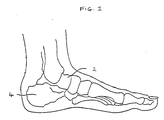
- Figure 1 is a schematic side view of the bones of a wearer's foot.
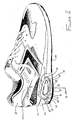
- Figure 2 is a partially cut-away, bottom isometric view of a shoe with a hydrodynamic pad in accordance with a preferred embodiment of the present invention.
- Figure 3 is a plan view of the hydrodynamic pad of Figure 2.
- Figure 4 is a cross-sectional view of the hydrodynamic pad of Figure 3 taken substantially along line 4-4 of Figure 3 showing the outer bladder in an initial position.
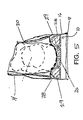
- Figure 5 is a cross-sectional view taken substantially along line 5-5 of Figure 2, illustrating the correspondence between the hydrodynamic pad and the heel of the foot, shown in phantom lines when the outer bladder is in an expanded position.
- Figure 2 illustrates a hydrodynamic pad 10 in accordance with a preferred embodiment of the present invention.
- the hydrodynamic pad is located in the heel portion 12 of the midsole 16 of the shoe 14. This midsole is sandwiched between a shoe outsole 18 that contacts the ground and a shoe upper portion 20 that is shaped and sized to receive the wearer's foot.
- the hydrodynamic pad 10 is positioned in the midsole to be under the heel of the wearer's foot when the shoe is worn.
- the hydrodynamic pad is constructed to dissipate ground reaction forces transmitted through the shoe to the wearer's heel during the heel strike phase of the wearer's gait cycle.
- the hydrodynamic pad 10 is also constructed to seat the wearer's heel so as to stabilize the heel from lateral motion relative to the shoe's upper portion 20 during the heel strike phase and the flat foot phase.
- the hydrodynamic pad 10 of the illustrated embodiment has a generally teardrop shape that extends forwardly relative to the midsole 16 (Figure 2) from a wide, rounded rear side 22 to a narrower rounded front side or apex 24 that points toward the toe of the shoe 14 ( Figure 2) when the hydrodynamic pad 10 is positioned within the midsole.
- the hydrodynamic pad 10 is shaped and sized to coincide with the shape of the heel and calcaneous bone 4 (Figure 1) of the wearer's foot, with the periphery of the rounded rear side 22 being sized to extend around the sides and rear periphery of the wearer's heel.
- the rounded apex 24 is preferably positioned to be under the wearer's foot just forward of the calcaneous bone 4 ( Figure 1).
- the hydrodynamic pad 10 includes an inner bladder 26 that is connected by a plurality of fluid channels 27 to an outer bladder 28 positioned outwardly of the inner bladder.
- the inner bladder 26 has an anterior portion 30, two longitudinal side portions 32, and a posterior portion 34 that are interconnected, such that the inner bladder has a shape that generally corresponds to the shape of the wearer's heel and the calcaneous bone 4 ( Figure 4). Accordingly, the inner bladder 26 is positioned under the wearer's heel below the calcaneous bone 4 ( Figure 1), so as to absorb and dissipate impact forces generated during the heel strike phase.
- the outer bladder 28 extends around and abuts the inner bladder 26, such that an anterior portion 36 of the outer bladder is forwardly adjacent to the inner bladder's anterior portion 30, a posterior portion 38 of the outer bladder is rearwardly adjacent to the inner bladder's posterior portion 34, and side portions 40 of the outer bladder are outwardly adjacent to the inner bladder's longitudinal side portions 32.
- the inner bladder 26 is separated from the outer bladder 28 by a common bladder wall 42, such the bladder wall defines the outer periphery of the inner bladder and the inner periphery of the outer bladder.
- the plurality of fluid channels 27 are formed in the bladder wall 42 and extend between the inner and outer bladders 26 and 28. The fluid channels 27 allow the fluid 29 contained in the inner and outer bladders 26 and 28 to move between the inner and outer bladders.
- the compression impact force causes the inner bladder to compress, thereby forcing a portion of the fluid 29 from the inner bladder, through the fluid channels 27, and into the outer bladder 28.
- the impact forces during heel strike are dissipated, thereby minimizing the forces transmitted to the wearer.
- the fluid channels 27 are shaped and sized to provide a controlled and restricted flow of the fluid 29 between the inner and outer bladders 26 and 28, respectively, so as to accommodate different impact forces resulting from different weights of runners or different speeds of running. Accordingly, the flow of the fluid 29 between the inner and outer bladders 26 and 28 is regulated by the fluid channels 27 and the force applied to the inner bladder. When force is applied to the inner bladder 26 causing it to compress, fluid flow from the inner bladder to the outer bladder 28 will continue until either the force is removed, or pressure equilibrium between the inner and outer bladders is reached, or the fluid 46 is substantially emptied from the inner bladder.
- the inner and outer bladders 26 and 28 are constructed of resilient, elastic, puncture-resistant material, which allows the inner bladder to move from an initial position illustrated in Figure 4, to a compressed position, illustrated in Figure 5, when the compressive impact force is exerted on the inner bladder during the heel strike phase.
- the inner bladder 26 moves to the compressed position, at least a portion of the fluid 29 is forced out of the inner bladder, through the fluid channels 27, and into the outer bladder 28.
- the outer bladder expands from an initial position, illustrated in Figure 4, to an expanded position, illustrated in Figure 5.
- the outer bladder 28 expands upwardly around the periphery of the wearer's heel, as the heel sinks downwardly and the inner bladder 26 compresses, as shown in Figure 5. Accordingly, the outer bladder 28 seats the wearer's heel and resists lateral movement of the heel relative to the hydroflow pad 10 and the shoe 14, thereby stabilizing the heel, particularly during the heel strike and the flat foot phases.
- the resilient elastic material forming the outer bladder is biased toward the initial condition, such that the expanded outer bladder forces the return of at least a portion of the fluid 29 from the outer bladder, through the fluid channels 27, and into the inner bladder 26, when the compressive force exerted on the inner bladder is reduced or removed.
- the wearer's heel lifts relative to the ground such that the compressive force on the inner bladder 26 is substantially removed, and the fluid 29 is forced inwardly through the fluid channels 27 and the outer bladder 28 moves from the expanded condition to the initial condition.
- the inner bladder 26 moves from the compressed condition to the initial condition, such that the hydroflow pad 10 is reinitialized and is ready to absorb and dissipate impact forces during heel strike while stabilizing the wearer's heel from lateral motion relative to the shoe 14.
- the inner and outer bladders 26 and 28, and the fluid channels 27 are constructed of polyurethane to provide an elastic, puncture-resistant material.
- suitable materials include polymethane or polyvinyl compositions, acetate, acrylics, cellulosics, fluorocarbons, nylons, polycarbonates, polyethylene, polybutylenes, polypropylenes, polystyrenes, or polyesters.
- the elastic, puncture-resistant material has a thickness of between 0.2-0.5 millimeters to provide sufficient resistance to punctures. The thickness of the material can be greater or less than 0.2-0.5 millimeters as needed for different designs to ensure puncture resistance of the hydrodynamic pad 10.
- the preferred embodiment of the hydrodynamic pad 10 is constructed by joining together upper and lower layers of the elastic puncture-resistant material by heat sealing techniques so as to form the inner and outer bladder 26 and 28, the bladder wall 42, and the fluid channels 27 therein.
- a filling port 48 is connected to the posterior portion 38 of the outer bladder to allow the fluid 29 to be inserted into the inner and outer bladders 26 and 28 during manufacturing of the hydrodynamic pad 10. After the desired amount of fluid is added to the inner and outer bladders 26 and 28, the filling port 48 is permanently sealed to prevent fluid leakage after being inserted into the midsole.
- the hydrodynamic pad 10 of the preferred embodiment is illustrated as a rounded teardrop or egg shape, and is typically between about 30-40 millimeters along its broadest transverse axis and between about 40-60 millimeters along its longest longitudinal axis.
- the inner bladder 26 and outer bladder 28 are between about 3-10 millimeters thick when they contain the fluid 29.
- the hydrodynamic pad 10 is filled with the fluid 29 to a volume comprising between about 40 percent and about 90 percent of the capacity of the hydrodynamic pad.
- the fluid 29 is a 1000 Centistoke silicon based fluid that fills between about 60 percent and about 80 percent of the volumetric capacity of hydrodynamic pad 10.
- Fluids suitable for use in the hydrodynamic pad 10 include any liquid or gaseous substance. Examples of other suitable fluids include water, glycerin, and oils, which may be combined with agents which increase viscosity of the fluid, such as, for example, guar, agar, cellulose materials, mineral thickeners, or silica.
- the inner bladder 26 ( Figure 3) has a generally tear-drop shape.
- the inner bladder has different shapes, such as an oval or a triangular shape, the outer bladder is positioned outward of the inner bladder so as to seat the wearer's heel, and stabilize the heel during the heel strike phase.
Landscapes
- Footwear And Its Accessory, Manufacturing Method And Apparatuses (AREA)
- Orthopedics, Nursing, And Contraception (AREA)
Claims (18)
- Coussinet hydrodynamique (10) destiné à être inséré dans une chaussure (14) qui est conçue pour recevoir un pied d'un utilisateur, le pied ayant un talon, comprenant :caractérisé en ce queun réservoir intérieur (26) comportant une partie antérieure (30), une partie postérieure (34) et des parties latérales (32) qui s'étendent entre lesdites parties antérieure et postérieure (30, 34), ledit réservoir intérieur (26) pouvant être comprimé d'une condition initiale à une condition comprimée ;un réservoir extérieur (28) adjacent, sur l'extérieur, auxdites parties latérales (32) dudit réservoir intérieur (26), ledit réservoir extérieur (28) comportant une partie arrière arrondie (22) qui s'étend autour de ladite partie postérieure (34) dudit réservoir intérieur (26) ;des canaux (27) pour fluide qui s'étendent entre ledit réservoir intérieur (26) et ledit réservoir extérieur (28) ; etun fluide (29) dans lesdits réservoirs intérieur et extérieur (26, 28), ledit fluide (29) pouvant se déplacer entre lesdits réservoirs intérieur et extérieur (26, 28) à travers lesdits canaux (27) pour fluide, ledit fluide se déplaçant dudit réservoir intérieur (26) audit réservoir extérieur (28) et dilatant ledit réservoir extérieur (28) de ladite première condition à ladite seconde condition dilatée lorsque ledit réservoir intérieur (26) est comprimé de ladite condition initiale à ladite condition comprimée,
ledit réservoir extérieur (28) comporte une partie avant arrondie (24) qui s'étend autour de ladite partie antérieure (30) du réservoir intérieur (26), ladite partie arrière arrondie (22) définit un premier arc ayant un premier rayon, et ladite partie avant arrondie (24) définit un second arc ayant un second rayon qui est inférieur au premier rayon, le réservoir extérieur (28) servant d'appui intégral au talon lorsque ledit réservoir extérieur (28) se trouve dans ladite seconde condition dilatée. - Coussinet hydrodynamique (10) selon la revendication 1, dans lequel ledit réservoir extérieur (28) s'étend autour de ladite partie antérieure (30), de ladite partie postérieure (34) et desdites parties latérales (32) dudit réservoir intérieur (26).
- Coussinet hydrodynamique (10) selon la revendication 1, dans lequel ledit réservoir intérieur (26) et ledit réservoir extérieur (28) sont séparés par une paroi intermédiaire de réservoir (42) et lesdits canaux (27) pour fluide s'étendent à travers ladite paroi intermédiaire de réservoir (42).
- Coussinet hydrodynamique (10) selon la revendication 1, dans lequel ledit réservoir extérieur (28) présente une forme sensiblement en goutte d'eau en comportant une partie arrière arrondie qui est adjacente à ladite partie postérieure (34) dudit réservoir intérieur (26).
- Coussinet hydrodynamique (10) selon la revendication 1, dans lequel ledit réservoir extérieur (28) inclut des première et seconde parties de réservoir sur des côtés opposés dudit réservoir intérieur (26).
- Coussinet hydrodynamique (10) selon la revendication 1, dans lequel ledit réservoir extérieur (28) définit un réservoir à trajet de fluide continu qui s'étend autour dudit réservoir intérieur (26).
- Coussinet hydrodynamique (10) selon la revendication 1, dans lequel ledit réservoir extérieur (28) se situe, radialement, à l'extérieur dudit réservoir intérieur (26), et lesdits canaux (27) pour fluide s'étendent, radialement, à l'extérieur dudit réservoir intérieur (26) audit réservoir extérieur (28).
- Coussinet hydrodynamique (10) selon la revendication 1, dans lequel lesdits canaux (27) pour fluide incluent une pluralité de canaux qui sont sensiblement répartis autour dudit réservoir intérieur (26).
- Coussinet hydrodynamique (10) selon la revendication 1, dans lequel ledit réservoir intérieur (26) peut être soumis à une charge de compression qui s'exerce sur lui, et ledit réservoir intérieur (26) peut être déplacé de ladite condition initiale à ladite condition comprimée lorsque la charge de compression est exercée sur ledit réservoir intérieur (26), ledit réservoir extérieur (28) est un élément élastique qui est sollicité en direction de la première condition, le réservoir extérieur (28) étant suffisamment élastique pour forcer une partie dudit fluide à travers au moins un desdits canaux (27) pour fluide jusqu'audit réservoir intérieur (26) lorsque ledit réservoir extérieur (28) se trouve dans ladite seconde condition dilatée et que ladite charge de compression est retirée dudit réservoir intérieur (26).
- Coussinet hydrodynamique (10) selon la revendication 1, dans lequel ledit fluide est un mélange de liquide visqueux et de gaz remplissant lesdits réservoirs intérieur et extérieur (26, 28).
- Coussinet hydrodynamique (10) destiné à être inséré dans une semelle intermédiaire (16) d'une chaussure (14), comprenant :un réservoir intérieur (26) comportant une partie antérieure (30), deux parties latérales longitudinales (32) et une partie postérieure (34),un réservoir extérieur (28) positionné, radialement, à l'extérieur des parties latérales longitudinales (32), de la partie antérieure (30) et de la partie postérieure (34) du réservoir intérieur (26),des moyens (27) destinés à canaliser un fluide entre le réservoir intérieur (26) et le réservoir extérieur (28), etun fluide (29) contenu dans le coussinet hydrodynamique (10), dans lequel, lors de l'application d'une force de compression sur le réservoir intérieur (26), le fluide est déplacé du réservoir intérieur (26) au réservoir extérieur (28), dilatant le réservoir extérieur (28), et amenant le réservoir extérieur (28) à former appui pour le talon, le réservoir extérieur (28) étant apte à forcer le retour d'au moins une partie du fluide vers le réservoir intérieur (26) lorsqu'au moins une partie de la force de compression est retirée du réservoir intérieur (26), caractérisé en ce queledit réservoir extérieur (28) présente une configuration ressemblant à une goutte d'eau et comporte une partie arrière arrondie (22) ayant un premier rayon et une partie avant arrondie (24) ayant un second rayon qui est inférieur au premier rayon.
- Coussinet hydrodynamique (10) selon la revendication 11, dans lequel le réservoir extérieur (28) vient en butée contre le réservoir intérieur (26).
- Coussinet hydrodynamique (10) selon la revendication 11, dans lequel les moyens de canalisation (27) comprennent une pluralité de conduits qui sont positionnés, radialement, à l'extérieur des parties latérales longitudinales (32) du réservoir intérieur (26).
- Coussinet hydrodynamique (10) selon la revendication 11, dans lequel le coussinet est fabriqué en un matériau élastique et résistant à la perforation.
- Chaussure (14), comprenant :un composant supérieur (20) dont la forme et la taille lui permettent de recevoir un pied d'un utilisateur ;un composant de semelle intermédiaire (16) mis en adhésion sur au moins une partie du composant supérieur (20),un coussinet hydrodynamique (10) inséré dans la semelle intermédiaire (16), dans laquelle le coussinet hydrodynamique (10) comprend un réservoir intérieur (26) et un réservoir extérieur (28) positionné, radialement, sur l'extérieur du réservoir intérieur (26), des moyens (27) destinés à canaliser un fluide entre le réservoir intérieur (26) et le réservoir extérieur (28), et un fluide (29) contenu dans le coussinet hydrodynamique (10), le fluide (29) étant apte à s'écouler vers l'extérieur du réservoir intérieur (26) au réservoir extérieur (28) à travers les moyens (27) destinés à canaliser un fluide lorsqu'un choc de talon génère un centre de répartition qui rayonne depuis le réservoir intérieur (26), et dans laquelle le coussinet hydrodynamique (10) est positionné dans la semelle intermédiaire (16) d'une manière selon laquelle le réservoir extérieur (28) forme appui pour le talon lorsque le réservoir extérieur (28) est dilaté par l'écoulement, vers l'extérieur de fluide causé par un choc de talon, et dans laquelle le réservoir extérieur (28) est apte à forcer le retour d'au moins une partie du fluide (29) vers le réservoir intérieur (26) lorsqu'au moins une partie de la force de compression est retirée du coussinet hydrodynamique (10), etune semelle extérieure (18) mise en adhésion sur au moins une partie d'une face inférieure de la semelle intermédiaire (16), caractérisée en ce quele réservoir extérieur (28) présente une configuration ressemblant à une goutte d'eau et comporte une partie arrière arrondie (22) ayant un premier rayon et une partie avant arrondie (24) ayant un second rayon qui est inférieur au premier rayon, le réservoir extérieur (28) coïncidant approximativement avec une périphérie inférieure d'un talon d'un utilisateur et la partie avant arrondie (24) étant positionnée pour s'étendre au-dessous de l'avant du calcanéum du talon du pied de l'utilisateur.
- Chaussure selon la revendication 15, dans laquelle le réservoir extérieur (28) vient en butée contre le réservoir intérieur (26).
- Chaussure selon la revendication 15, dans laquelle les moyens de canalisation (27) comprennent une pluralité de conduits qui sont positionnés, radialement, à l'extérieur d'au moins les parties latérales longitudinales (32) du réservoir intérieur (26).
- Chaussure selon la revendication 15, dans laquelle le coussinet hydrodynamique (10) est fabriqué en un matériau élastique et résistant à la perforation.
Applications Claiming Priority (2)
| Application Number | Priority Date | Filing Date | Title |
|---|---|---|---|
| US08/576,958 US5704137A (en) | 1995-12-22 | 1995-12-22 | Shoe having hydrodynamic pad |
| US576958 | 1995-12-22 |
Publications (3)
| Publication Number | Publication Date |
|---|---|
| EP0780064A2 EP0780064A2 (fr) | 1997-06-25 |
| EP0780064A3 EP0780064A3 (fr) | 1998-05-13 |
| EP0780064B1 true EP0780064B1 (fr) | 2001-11-28 |
Family
ID=24306704
Family Applications (1)
| Application Number | Title | Priority Date | Filing Date |
|---|---|---|---|
| EP96120680A Expired - Lifetime EP0780064B1 (fr) | 1995-12-22 | 1996-12-20 | Coussin hydrodynamique pour chaussure et chaussure équipée d'un tel coussin |
Country Status (9)
| Country | Link |
|---|---|
| US (1) | US5704137A (fr) |
| EP (1) | EP0780064B1 (fr) |
| JP (1) | JPH105006A (fr) |
| AT (1) | ATE209452T1 (fr) |
| CA (1) | CA2193601C (fr) |
| DE (1) | DE69617375T2 (fr) |
| DK (1) | DK0780064T3 (fr) |
| ES (1) | ES2167507T3 (fr) |
| PT (1) | PT780064E (fr) |
Cited By (6)
| Publication number | Priority date | Publication date | Assignee | Title |
|---|---|---|---|---|
| US6374514B1 (en) | 2000-03-16 | 2002-04-23 | Nike, Inc. | Footwear having a bladder with support members |
| US6385864B1 (en) | 2000-03-16 | 2002-05-14 | Nike, Inc. | Footwear bladder with controlled flex tensile member |
| US6402879B1 (en) | 2000-03-16 | 2002-06-11 | Nike, Inc. | Method of making bladder with inverted edge seam |
| US6457262B1 (en) | 2000-03-16 | 2002-10-01 | Nike, Inc. | Article of footwear with a motion control device |
| US6571490B2 (en) | 2000-03-16 | 2003-06-03 | Nike, Inc. | Bladder with multi-stage regionalized cushioning |
| WO2003094645A1 (fr) * | 2002-05-09 | 2003-11-20 | Nike Inc. | Semelle de chaussure dotee d'une seule cavite etanche |
Families Citing this family (95)
| Publication number | Priority date | Publication date | Assignee | Title |
|---|---|---|---|---|
| US6230501B1 (en) | 1994-04-14 | 2001-05-15 | Promxd Technology, Inc. | Ergonomic systems and methods providing intelligent adaptive surfaces and temperature control |
| KR19980025330A (ko) * | 1998-04-14 | 1998-07-06 | 전정효 | 신발용 충격흡수시스템 |
| US6237256B1 (en) | 1998-08-12 | 2001-05-29 | Sunnybrook And Women's College Health Sciences Centre | Balance-enhanced insert for footwear |
| US6115944A (en) * | 1998-11-09 | 2000-09-12 | Lain; Cheng Kung | Dynamic dual density heel bag |
| AUPP905599A0 (en) * | 1999-03-05 | 1999-03-25 | Footfridge Pty Ltd | An inner sole |
| US6367167B1 (en) | 1999-04-14 | 2002-04-09 | Nike, Inc. | Durable outsole for article of footwear |
| US6342544B1 (en) * | 1999-04-14 | 2002-01-29 | Nike, Inc. | Durable outsole for article of footwear |
| US7219449B1 (en) | 1999-05-03 | 2007-05-22 | Promdx Technology, Inc. | Adaptively controlled footwear |
| US6449878B1 (en) | 2000-03-10 | 2002-09-17 | Robert M. Lyden | Article of footwear having a spring element and selectively removable components |
| US7107235B2 (en) | 2000-03-10 | 2006-09-12 | Lyden Robert M | Method of conducting business including making and selling a custom article of footwear |
| US7752775B2 (en) * | 2000-03-10 | 2010-07-13 | Lyden Robert M | Footwear with removable lasting board and cleats |
| US6601042B1 (en) | 2000-03-10 | 2003-07-29 | Robert M. Lyden | Customized article of footwear and method of conducting retail and internet business |
| US7016867B2 (en) | 2000-03-10 | 2006-03-21 | Lyden Robert M | Method of conducting business including making and selling a custom article of footwear |
| US6430843B1 (en) | 2000-04-18 | 2002-08-13 | Nike, Inc. | Dynamically-controlled cushioning system for an article of footwear |
| US6948264B1 (en) | 2000-04-26 | 2005-09-27 | Lyden Robert M | Non-clogging sole for article of footwear |
| AU2001291639A1 (en) | 2000-10-06 | 2002-04-15 | Soren Vindriis | Shock absorbing and pressure reducing insole |
| JP3445250B2 (ja) | 2001-02-20 | 2003-09-08 | ゼット株式会社 | 靴 底 |
| US6879885B2 (en) * | 2001-11-16 | 2005-04-12 | Goodrich Pump & Engine Control Systems, Inc. | Rotor torque predictor |
| US6767264B2 (en) | 2002-01-03 | 2004-07-27 | Oam, Llc | Sport board foot pad |
| ATE536754T1 (de) * | 2002-01-04 | 2011-12-15 | New Balance Athletic Shoe Inc | Schuhsohle und polster für eine schuhsohle |
| US6971193B1 (en) | 2002-03-06 | 2005-12-06 | Nike, Inc. | Bladder with high pressure replenishment reservoir |
| US7426792B2 (en) * | 2002-05-09 | 2008-09-23 | Nike, Inc. | Footwear sole component with an insert |
| US20060265907A1 (en) * | 2003-02-14 | 2006-11-30 | Sommer Roland W | Reversed kinetic system for shoe sole |
| US7080467B2 (en) * | 2003-06-27 | 2006-07-25 | Reebok International Ltd. | Cushioning sole for an article of footwear |
| US7000335B2 (en) * | 2003-07-16 | 2006-02-21 | Nike, Inc. | Footwear with a sole structure incorporating a lobed fluid-filled chamber |
| US7707744B2 (en) * | 2003-07-16 | 2010-05-04 | Nike, Inc. | Footwear with a sole structure incorporating a lobed fluid-filled chamber |
| US7707745B2 (en) * | 2003-07-16 | 2010-05-04 | Nike, Inc. | Footwear with a sole structure incorporating a lobed fluid-filled chamber |
| US7051456B2 (en) * | 2003-07-29 | 2006-05-30 | Nike, Inc. | Article of footwear incorporating an inflatable chamber |
| US6931764B2 (en) * | 2003-08-04 | 2005-08-23 | Nike, Inc. | Footwear sole structure incorporating a cushioning component |
| US7020988B1 (en) * | 2003-08-29 | 2006-04-04 | Pierre Andre Senizergues | Footwear with enhanced impact protection |
| DE20315356U1 (de) * | 2003-10-07 | 2004-02-26 | Brand Factory Swiss Gmbh | Socke |
| US7353625B2 (en) * | 2003-11-03 | 2008-04-08 | Reebok International, Ltd. | Resilient cushioning device for the heel portion of a sole |
| US7086179B2 (en) * | 2003-12-23 | 2006-08-08 | Nike, Inc. | Article of footwear having a fluid-filled bladder with a reinforcing structure |
| US7556846B2 (en) * | 2003-12-23 | 2009-07-07 | Nike, Inc. | Fluid-filled bladder with a reinforcing structure |
| US7562469B2 (en) * | 2003-12-23 | 2009-07-21 | Nike, Inc. | Footwear with fluid-filled bladder and a reinforcing structure |
| US7513066B2 (en) | 2005-04-14 | 2009-04-07 | Nike, Inc. | Fluid-filled bladder for footwear and other applications |
| US7401369B2 (en) * | 2005-04-14 | 2008-07-22 | Nike, Inc. | Fluid-filled bladder for footwear and other applications |
| US7622014B2 (en) * | 2005-07-01 | 2009-11-24 | Reebok International Ltd. | Method for manufacturing inflatable footwear or bladders for use in inflatable articles |
| WO2007030569A2 (fr) * | 2005-09-07 | 2007-03-15 | Surfco Hawaii | Plaque de traction pour planche nautique personnelle |
| US7451554B2 (en) * | 2005-10-19 | 2008-11-18 | Nike, Inc. | Fluid system having an expandable pump chamber |
| US7409779B2 (en) * | 2005-10-19 | 2008-08-12 | Nike, Inc. | Fluid system having multiple pump chambers |
| JP4698381B2 (ja) * | 2005-10-20 | 2011-06-08 | 日本軌道工業株式会社 | レール底部把持式部材支持構造、軌道舗装構造、列車逸脱防止型軌道構造、レール底部を利用する部材支持方法、軌道近傍の舗装方法、及び列車逸脱防止方法 |
| WO2008063690A2 (fr) * | 2006-04-13 | 2008-05-29 | Massachusetts Institute Of Technology | Revêtement de sécurité contenant un fluide |
| US7757409B2 (en) * | 2006-04-27 | 2010-07-20 | The Rockport Company, Llc | Cushioning member |
| US7810255B2 (en) * | 2007-02-06 | 2010-10-12 | Nike, Inc. | Interlocking fluid-filled chambers for an article of footwear |
| US20100095553A1 (en) * | 2007-02-13 | 2010-04-22 | Alexander Elnekaveh | Resilient sports shoe |
| US20080189986A1 (en) * | 2007-02-13 | 2008-08-14 | Alexander Elnekaveh | Ventilated and resilient shoe apparatus and system |
| GB2447644B (en) * | 2007-03-16 | 2010-04-28 | Univ Plymouth | Foot orthosis apparatus |
| US7950169B2 (en) * | 2007-05-10 | 2011-05-31 | Nike, Inc. | Contoured fluid-filled chamber |
| US8178022B2 (en) * | 2007-12-17 | 2012-05-15 | Nike, Inc. | Method of manufacturing an article of footwear with a fluid-filled chamber |
| US20090152774A1 (en) * | 2007-12-17 | 2009-06-18 | Nike, Inc. | Method For Molding A Fluid-Filled Structure |
| US8863408B2 (en) * | 2007-12-17 | 2014-10-21 | Nike, Inc. | Article of footwear having a sole structure with a fluid-filled chamber |
| US8241450B2 (en) * | 2007-12-17 | 2012-08-14 | Nike, Inc. | Method for inflating a fluid-filled chamber |
| US8572867B2 (en) | 2008-01-16 | 2013-11-05 | Nike, Inc. | Fluid-filled chamber with a reinforcing element |
| US8341857B2 (en) | 2008-01-16 | 2013-01-01 | Nike, Inc. | Fluid-filled chamber with a reinforced surface |
| US8209885B2 (en) | 2009-05-11 | 2012-07-03 | Brooks Sports, Inc. | Shoe assembly with non-linear viscous liquid |
| US8650775B2 (en) * | 2009-06-25 | 2014-02-18 | Nike, Inc. | Article of footwear having a sole structure with perimeter and central elements |
| NL2003367C2 (en) | 2009-08-20 | 2011-02-22 | Sara Lee De Nv | Cushioning element, footwear, insole, deformable filling, and envelope. |
| US20110072684A1 (en) * | 2009-09-25 | 2011-03-31 | Aci International | Support structures in footwear |
| US9119439B2 (en) * | 2009-12-03 | 2015-09-01 | Nike, Inc. | Fluid-filled structure |
| US20110179669A1 (en) * | 2010-01-28 | 2011-07-28 | Brown Shoe Company, Inc. | Cushioning and shock absorbing midsole |
| US8991072B2 (en) * | 2010-02-22 | 2015-03-31 | Nike, Inc. | Fluid-filled chamber incorporating a flexible plate |
| US8572786B2 (en) | 2010-10-12 | 2013-11-05 | Reebok International Limited | Method for manufacturing inflatable bladders for use in footwear and other articles of manufacture |
| US8914994B2 (en) | 2012-03-02 | 2014-12-23 | Nike, Inc. | Guitar-shaped bladder for footwear |
| US10631593B2 (en) | 2012-08-21 | 2020-04-28 | Levi J. Patton | Fluid-filled chamber with a stabilization structure |
| US20140137437A1 (en) * | 2012-11-20 | 2014-05-22 | Wolverine World Wide, Inc. | Adjustable footwear sole with bladder |
| US9380832B2 (en) | 2012-12-20 | 2016-07-05 | Nike, Inc. | Article of footwear with fluid-filled chamber lacking an inflation channel and method for making the same |
| JP2016512131A (ja) * | 2013-03-15 | 2016-04-25 | バックジョイ・オーソティックス・リミテッド・ライアビリティ・カンパニーBackjoy Orthotics, Llc | 履物のための中立姿勢方向付け中敷システム |
| US9538813B1 (en) * | 2014-08-20 | 2017-01-10 | Akervall Technologies, Inc. | Energy absorbing elements for footwear and method of use |
| US10076436B2 (en) | 2014-12-10 | 2018-09-18 | Apolla Performace Wear LLC | Wearable foot garment |
| USD740528S1 (en) * | 2015-03-17 | 2015-10-13 | Nike, Inc. | Shoe |
| US10238175B2 (en) | 2015-04-08 | 2019-03-26 | Nike, Inc. | Article with a cushioning assembly having inner and outer bladder elements with interfitting features and method of manufacturing an article |
| US10791795B2 (en) | 2015-04-08 | 2020-10-06 | Nike, Inc. | Article with a cushioning assembly having inner and outer bladder elements and a reinforcement element and method of manufacturing an article |
| CN107405851B (zh) | 2015-04-21 | 2019-10-22 | 耐克创新有限合伙公司 | 由三个片材形成的囊状元件和制造囊状元件的方法 |
| EP3370559B1 (fr) * | 2015-11-03 | 2022-11-30 | Nike Innovate C.V. | Structure de semelle pour un article de chaussure comportant un élément de vessie avec des tubes s'étendant latéralement et procédé de fabrication d'une structure de semelle |
| USD878739S1 (en) | 2015-12-10 | 2020-03-24 | Apolla Performance Wear LLC | Wearable foot garment |
| KR102328385B1 (ko) | 2017-05-23 | 2021-11-18 | 나이키 이노베이트 씨.브이. | 등급화된 응답을 갖는 중창 시스템 |
| WO2018217560A1 (fr) | 2017-05-23 | 2018-11-29 | Nike, Inc. | Semelle intercalaire à réponse progressive |
| KR102360537B1 (ko) | 2017-05-23 | 2022-02-09 | 나이키 이노베이트 씨.브이. | 단계화된 압축 강도를 갖는 돔형 중창 |
| IT201700089835A1 (it) | 2017-08-03 | 2019-02-03 | Base Prot S R L | Sistema attivo a geometria variabile con funzioni di ammortizzazione, dissipazione di energia e stabilizzazione, integrabile nelle suole delle calzature |
| USD849371S1 (en) * | 2017-11-03 | 2019-05-28 | Brooks Sports, Inc. | Shoe upper |
| USD849372S1 (en) * | 2017-11-03 | 2019-05-28 | Brooks Sports, Inc. | Shoe upper |
| CN108741402A (zh) * | 2018-06-28 | 2018-11-06 | 三六度童装有限公司 | 鞋底减震部件、减震鞋底和减震鞋 |
| TWI738103B (zh) * | 2018-11-20 | 2021-09-01 | 荷蘭商耐克創新有限合夥公司 | 鞋件的囊袋系統 |
| US11291271B2 (en) | 2019-09-25 | 2022-04-05 | Nike, Inc. | Sole structure for an article of footwear |
| US11666117B2 (en) * | 2019-11-19 | 2023-06-06 | Nike, Inc. | Sole structure for article of footwear |
| US11666118B2 (en) * | 2019-11-19 | 2023-06-06 | Nike, Inc. | Bladder and sole structure for article of footwear |
| JP7234971B2 (ja) | 2020-02-21 | 2023-03-08 | トヨタ自動車株式会社 | 脚装具 |
| USD963308S1 (en) * | 2020-03-26 | 2022-09-13 | Brooks Sports, Inc. | Shoe upper portion and mid-portion |
| USD960548S1 (en) * | 2020-03-26 | 2022-08-16 | Brooks Sports, Inc. | Shoe upper |
| US20220225731A1 (en) * | 2020-08-03 | 2022-07-21 | Hafia Salum Mkumba | Footwear midsole comprising a support and one or more internal bladders |
| USD959809S1 (en) * | 2020-10-12 | 2022-08-09 | Brooks Sports, Inc. | Shoe upper |
| USD963309S1 (en) * | 2020-10-12 | 2022-09-13 | Brooks Sports, Inc. | Shoe upper |
| USD959810S1 (en) * | 2020-10-22 | 2022-08-09 | Brooks Sports, Inc. | Shoe |
| CN112602987B (zh) * | 2020-12-16 | 2022-06-21 | 国家康复辅具研究中心 | 一种缓冲结构和缓冲鞋 |
Family Cites Families (20)
| Publication number | Priority date | Publication date | Assignee | Title |
|---|---|---|---|---|
| US2917843A (en) * | 1956-09-13 | 1959-12-22 | William M Scholl | Foot cushioning device with secured pad |
| US3331146A (en) * | 1966-05-02 | 1967-07-18 | Karras Elias | Air circulating member for a shoe |
| BE766530A (fr) * | 1970-05-05 | 1971-09-16 | Dall Ava Yvan A | Semelle interieure a coussin d'air |
| US3754339A (en) * | 1972-04-19 | 1973-08-28 | S Terasaki | Athlete{40 s foots preventive device |
| US4115934A (en) * | 1977-02-11 | 1978-09-26 | Hall John M | Liquid shoe innersole |
| JPS6343925Y2 (fr) * | 1986-04-11 | 1988-11-16 | ||
| DE3613153A1 (de) * | 1986-04-18 | 1987-10-22 | Polus Michael | Sportschuh mit pneumatischer ladevorrichtung |
| US4878300A (en) * | 1988-07-15 | 1989-11-07 | Tretorn Ab | Athletic shoe |
| BR8806281A (pt) * | 1988-11-25 | 1990-07-24 | Sao Paulo Alpargatas | Sistema de amortecimento de impactos aplicavel em sapatos esportivos |
| US4934072A (en) * | 1989-04-14 | 1990-06-19 | Wolverine World Wide, Inc. | Fluid dynamic shoe |
| US5097607A (en) * | 1990-05-07 | 1992-03-24 | Wolverine World Wide, Inc. | Fluid forefoot footware |
| US5131174A (en) * | 1990-08-27 | 1992-07-21 | Alden Laboratories, Inc. | Self-reinitializing padding device |
| US5155927A (en) * | 1991-02-20 | 1992-10-20 | Asics Corporation | Shoe comprising liquid cushioning element |
| US5167999A (en) * | 1991-06-18 | 1992-12-01 | Wang Sui Mu | Liquid cushioning means |
| US5175946A (en) * | 1991-09-11 | 1993-01-05 | Tsai Ming En | Insole with replaceable pneumatic buffer |
| JP2651434B2 (ja) * | 1991-09-27 | 1997-09-10 | コンバース インコーポレイテッド | クッション作用・安定化装置 |
| KR940005510Y1 (ko) * | 1991-12-19 | 1994-08-18 | 이균철 | 공기자동조절기를 장착한 일방 통풍펌프신발 |
| US5313717A (en) * | 1991-12-20 | 1994-05-24 | Converse Inc. | Reactive energy fluid filled apparatus providing cushioning, support, stability and a custom fit in a shoe |
| US5545463A (en) * | 1992-12-18 | 1996-08-13 | Energaire Corporation | Heel/metatarsal structure having premolded bulges |
| TW234081B (fr) * | 1993-02-04 | 1994-11-11 | Converse Inc |
-
1995
- 1995-12-22 US US08/576,958 patent/US5704137A/en not_active Expired - Fee Related
-
1996
- 1996-12-20 EP EP96120680A patent/EP0780064B1/fr not_active Expired - Lifetime
- 1996-12-20 PT PT96120680T patent/PT780064E/pt unknown
- 1996-12-20 AT AT96120680T patent/ATE209452T1/de active
- 1996-12-20 DK DK96120680T patent/DK0780064T3/da active
- 1996-12-20 DE DE69617375T patent/DE69617375T2/de not_active Expired - Lifetime
- 1996-12-20 ES ES96120680T patent/ES2167507T3/es not_active Expired - Lifetime
- 1996-12-20 CA CA002193601A patent/CA2193601C/fr not_active Expired - Fee Related
- 1996-12-24 JP JP8359778A patent/JPH105006A/ja active Pending
Cited By (7)
| Publication number | Priority date | Publication date | Assignee | Title |
|---|---|---|---|---|
| US6374514B1 (en) | 2000-03-16 | 2002-04-23 | Nike, Inc. | Footwear having a bladder with support members |
| US6385864B1 (en) | 2000-03-16 | 2002-05-14 | Nike, Inc. | Footwear bladder with controlled flex tensile member |
| US6402879B1 (en) | 2000-03-16 | 2002-06-11 | Nike, Inc. | Method of making bladder with inverted edge seam |
| US6457262B1 (en) | 2000-03-16 | 2002-10-01 | Nike, Inc. | Article of footwear with a motion control device |
| US6571490B2 (en) | 2000-03-16 | 2003-06-03 | Nike, Inc. | Bladder with multi-stage regionalized cushioning |
| WO2003094645A1 (fr) * | 2002-05-09 | 2003-11-20 | Nike Inc. | Semelle de chaussure dotee d'une seule cavite etanche |
| EP1803365A1 (fr) * | 2002-05-09 | 2007-07-04 | Nike International Ltd | Semelle de chaussure dotée d'une seule cavité étanche |
Also Published As
| Publication number | Publication date |
|---|---|
| ES2167507T3 (es) | 2002-05-16 |
| DE69617375D1 (de) | 2002-01-10 |
| DE69617375T2 (de) | 2002-05-08 |
| CA2193601A1 (fr) | 1997-06-23 |
| ATE209452T1 (de) | 2001-12-15 |
| PT780064E (pt) | 2002-03-28 |
| EP0780064A2 (fr) | 1997-06-25 |
| US5704137A (en) | 1998-01-06 |
| DK0780064T3 (da) | 2002-02-25 |
| EP0780064A3 (fr) | 1998-05-13 |
| CA2193601C (fr) | 2007-04-10 |
| JPH105006A (ja) | 1998-01-13 |
Similar Documents
| Publication | Publication Date | Title |
|---|---|---|
| US5704137A (en) | Shoe having hydrodynamic pad | |
| US20220218067A1 (en) | Article of footwear having cushioning system | |
| CA2162192C (fr) | Chaussure comportant plusieurs chambres a fluide | |
| AU728402B2 (en) | Support and cushioning system for footwear | |
| US7181867B2 (en) | Support and cushioning system for an article of footwear | |
| US5718063A (en) | Midsole cushioning system | |
| US6457262B1 (en) | Article of footwear with a motion control device | |
| EP0699035B1 (fr) | Amortisseur pour un article chaussant | |
| US6505420B1 (en) | Cushioning member for an article of footwear | |
| US7080467B2 (en) | Cushioning sole for an article of footwear | |
| EP2929791B1 (fr) | Article chaussant ayant une structure de semelle à plaque surélevée | |
| US20060021251A1 (en) | Footwear sole component with an insert | |
| US20030101619A1 (en) | Cushioning member for an article of footwear | |
| EP2019604B1 (fr) | Organe de matelassage | |
| RU2766289C1 (ru) | Устройство, выполненное с возможностью встраивания в подошву обуви и действующее как средство амортизации, рассеивания энергии и стабилизации |
Legal Events
| Date | Code | Title | Description |
|---|---|---|---|
| PUAI | Public reference made under article 153(3) epc to a published international application that has entered the european phase |
Free format text: ORIGINAL CODE: 0009012 |
|
| AK | Designated contracting states |
Kind code of ref document: A2 Designated state(s): AT BE CH DE DK ES FI FR GB GR IE IT LI LU MC NL PT SE |
|
| PUAL | Search report despatched |
Free format text: ORIGINAL CODE: 0009013 |
|
| AK | Designated contracting states |
Kind code of ref document: A3 Designated state(s): AT BE CH DE DK ES FI FR GB GR IE IT LI LU MC NL PT SE |
|
| 17P | Request for examination filed |
Effective date: 19981105 |
|
| 17Q | First examination report despatched |
Effective date: 19991013 |
|
| RTI1 | Title (correction) |
Free format text: HYDRODYNAMIC SHOE-PAD AND SHOE PROVIDED THEREWITH |
|
| GRAG | Despatch of communication of intention to grant |
Free format text: ORIGINAL CODE: EPIDOS AGRA |
|
| RTI1 | Title (correction) |
Free format text: HYDRODYNAMIC SHOE-PAD AND SHOE PROVIDED THEREWITH |
|
| GRAG | Despatch of communication of intention to grant |
Free format text: ORIGINAL CODE: EPIDOS AGRA |
|
| GRAH | Despatch of communication of intention to grant a patent |
Free format text: ORIGINAL CODE: EPIDOS IGRA |
|
| GRAH | Despatch of communication of intention to grant a patent |
Free format text: ORIGINAL CODE: EPIDOS IGRA |
|
| GRAA | (expected) grant |
Free format text: ORIGINAL CODE: 0009210 |
|
| AK | Designated contracting states |
Kind code of ref document: B1 Designated state(s): AT BE CH DE DK ES FI FR GB GR IE IT LI LU MC NL PT SE |
|
| REF | Corresponds to: |
Ref document number: 209452 Country of ref document: AT Date of ref document: 20011215 Kind code of ref document: T |
|
| REG | Reference to a national code |
Ref country code: CH Ref legal event code: EP |
|
| REG | Reference to a national code |
Ref country code: CH Ref legal event code: NV Representative=s name: BOVARD AG PATENTANWAELTE |
|
| REG | Reference to a national code |
Ref country code: IE Ref legal event code: FG4D |
|
| REG | Reference to a national code |
Ref country code: GB Ref legal event code: IF02 |
|
| REF | Corresponds to: |
Ref document number: 69617375 Country of ref document: DE Date of ref document: 20020110 |
|
| REG | Reference to a national code |
Ref country code: DK Ref legal event code: T3 |
|
| REG | Reference to a national code |
Ref country code: PT Ref legal event code: SC4A Free format text: AVAILABILITY OF NATIONAL TRANSLATION Effective date: 20011217 |
|
| REG | Reference to a national code |
Ref country code: ES Ref legal event code: FG2A Ref document number: 2167507 Country of ref document: ES Kind code of ref document: T3 |
|
| REG | Reference to a national code |
Ref country code: GR Ref legal event code: EP Ref document number: 20020400726 Country of ref document: GR |
|
| PLBE | No opposition filed within time limit |
Free format text: ORIGINAL CODE: 0009261 |
|
| STAA | Information on the status of an ep patent application or granted ep patent |
Free format text: STATUS: NO OPPOSITION FILED WITHIN TIME LIMIT |
|
| 26N | No opposition filed | ||
| REG | Reference to a national code |
Ref country code: CH Ref legal event code: PFA Owner name: BROOKS SPORTS INC. Free format text: BROOKS SPORTS INC.#11720 NORTH CREEK PARKWAY N.#BOTHELL WA 98011 (US) -TRANSFER TO- BROOKS SPORTS INC.#11720 NORTH CREEK PARKWAY N.#BOTHELL WA 98011 (US) |
|
| PGFP | Annual fee paid to national office [announced via postgrant information from national office to epo] |
Ref country code: DK Payment date: 20141218 Year of fee payment: 19 Ref country code: CH Payment date: 20141218 Year of fee payment: 19 Ref country code: LU Payment date: 20141218 Year of fee payment: 19 Ref country code: GB Payment date: 20141218 Year of fee payment: 19 Ref country code: ES Payment date: 20141203 Year of fee payment: 19 Ref country code: FI Payment date: 20141222 Year of fee payment: 19 Ref country code: MC Payment date: 20141223 Year of fee payment: 19 Ref country code: SE Payment date: 20141218 Year of fee payment: 19 Ref country code: GR Payment date: 20141224 Year of fee payment: 19 Ref country code: IE Payment date: 20141218 Year of fee payment: 19 |
|
| PGFP | Annual fee paid to national office [announced via postgrant information from national office to epo] |
Ref country code: AT Payment date: 20141222 Year of fee payment: 19 Ref country code: FR Payment date: 20141218 Year of fee payment: 19 Ref country code: NL Payment date: 20141218 Year of fee payment: 19 Ref country code: PT Payment date: 20141125 Year of fee payment: 19 |
|
| PGFP | Annual fee paid to national office [announced via postgrant information from national office to epo] |
Ref country code: IT Payment date: 20141218 Year of fee payment: 19 |
|
| PGFP | Annual fee paid to national office [announced via postgrant information from national office to epo] |
Ref country code: DE Payment date: 20141223 Year of fee payment: 19 |
|
| PGFP | Annual fee paid to national office [announced via postgrant information from national office to epo] |
Ref country code: BE Payment date: 20141218 Year of fee payment: 19 |
|
| PG25 | Lapsed in a contracting state [announced via postgrant information from national office to epo] |
Ref country code: BE Free format text: LAPSE BECAUSE OF NON-PAYMENT OF DUE FEES Effective date: 20151231 |
|
| REG | Reference to a national code |
Ref country code: PT Ref legal event code: MM4A Free format text: LAPSE DUE TO NON-PAYMENT OF FEES Effective date: 20160620 |
|
| REG | Reference to a national code |
Ref country code: DE Ref legal event code: R119 Ref document number: 69617375 Country of ref document: DE |
|
| REG | Reference to a national code |
Ref country code: DK Ref legal event code: EBP Effective date: 20151231 |
|
| PG25 | Lapsed in a contracting state [announced via postgrant information from national office to epo] |
Ref country code: LU Free format text: LAPSE BECAUSE OF NON-PAYMENT OF DUE FEES Effective date: 20151220 Ref country code: MC Free format text: LAPSE BECAUSE OF NON-PAYMENT OF DUE FEES Effective date: 20151231 |
|
| REG | Reference to a national code |
Ref country code: CH Ref legal event code: PL |
|
| REG | Reference to a national code |
Ref country code: SE Ref legal event code: EUG |
|
| REG | Reference to a national code |
Ref country code: AT Ref legal event code: MM01 Ref document number: 209452 Country of ref document: AT Kind code of ref document: T Effective date: 20151220 |
|
| GBPC | Gb: european patent ceased through non-payment of renewal fee |
Effective date: 20151220 |
|
| PG25 | Lapsed in a contracting state [announced via postgrant information from national office to epo] |
Ref country code: SE Free format text: LAPSE BECAUSE OF NON-PAYMENT OF DUE FEES Effective date: 20151221 Ref country code: PT Free format text: LAPSE BECAUSE OF NON-PAYMENT OF DUE FEES Effective date: 20160620 |
|
| REG | Reference to a national code |
Ref country code: NL Ref legal event code: MM Effective date: 20160101 |
|
| REG | Reference to a national code |
Ref country code: IE Ref legal event code: MM4A |
|
| REG | Reference to a national code |
Ref country code: FR Ref legal event code: ST Effective date: 20160831 |
|
| REG | Reference to a national code |
Ref country code: GR Ref legal event code: ML Ref document number: 20020400726 Country of ref document: GR Effective date: 20160707 |
|
| PG25 | Lapsed in a contracting state [announced via postgrant information from national office to epo] |
Ref country code: NL Free format text: LAPSE BECAUSE OF NON-PAYMENT OF DUE FEES Effective date: 20160101 Ref country code: DE Free format text: LAPSE BECAUSE OF NON-PAYMENT OF DUE FEES Effective date: 20160701 Ref country code: GB Free format text: LAPSE BECAUSE OF NON-PAYMENT OF DUE FEES Effective date: 20151220 Ref country code: LI Free format text: LAPSE BECAUSE OF NON-PAYMENT OF DUE FEES Effective date: 20151231 Ref country code: IE Free format text: LAPSE BECAUSE OF NON-PAYMENT OF DUE FEES Effective date: 20151220 Ref country code: CH Free format text: LAPSE BECAUSE OF NON-PAYMENT OF DUE FEES Effective date: 20151231 |
|
| PG25 | Lapsed in a contracting state [announced via postgrant information from national office to epo] |
Ref country code: FR Free format text: LAPSE BECAUSE OF NON-PAYMENT OF DUE FEES Effective date: 20151231 Ref country code: AT Free format text: LAPSE BECAUSE OF NON-PAYMENT OF DUE FEES Effective date: 20151220 Ref country code: GR Free format text: LAPSE BECAUSE OF NON-PAYMENT OF DUE FEES Effective date: 20160707 |
|
| PG25 | Lapsed in a contracting state [announced via postgrant information from national office to epo] |
Ref country code: IT Free format text: LAPSE BECAUSE OF NON-PAYMENT OF DUE FEES Effective date: 20151220 |
|
| PG25 | Lapsed in a contracting state [announced via postgrant information from national office to epo] |
Ref country code: DK Free format text: LAPSE BECAUSE OF NON-PAYMENT OF DUE FEES Effective date: 20151231 |
|
| PG25 | Lapsed in a contracting state [announced via postgrant information from national office to epo] |
Ref country code: PT Free format text: LAPSE BECAUSE OF EXPIRATION OF PROTECTION Effective date: 20161228 |
|
| PG25 | Lapsed in a contracting state [announced via postgrant information from national office to epo] |
Ref country code: ES Free format text: LAPSE BECAUSE OF NON-PAYMENT OF DUE FEES Effective date: 20151221 |
|
| PG25 | Lapsed in a contracting state [announced via postgrant information from national office to epo] |
Ref country code: FI Free format text: LAPSE BECAUSE OF NON-PAYMENT OF DUE FEES Effective date: 20151220 Ref country code: PT Free format text: LAPSE BECAUSE OF EXPIRATION OF PROTECTION Effective date: 20160628 |
|
| REG | Reference to a national code |
Ref country code: ES Ref legal event code: FD2A Effective date: 20180507 |