EP0780821A2 - Système radio commandé pour l'essai de blocs d'éclairage de sécurité - Google Patents
Système radio commandé pour l'essai de blocs d'éclairage de sécurité Download PDFInfo
- Publication number
- EP0780821A2 EP0780821A2 EP96309237A EP96309237A EP0780821A2 EP 0780821 A2 EP0780821 A2 EP 0780821A2 EP 96309237 A EP96309237 A EP 96309237A EP 96309237 A EP96309237 A EP 96309237A EP 0780821 A2 EP0780821 A2 EP 0780821A2
- Authority
- EP
- European Patent Office
- Prior art keywords
- lamp
- switch
- battery
- power source
- emergency lighting
- Prior art date
- Legal status (The legal status is an assumption and is not a legal conclusion. Google has not performed a legal analysis and makes no representation as to the accuracy of the status listed.)
- Withdrawn
Links
Images


Classifications
-
- G—PHYSICS
- G08—SIGNALLING
- G08B—SIGNALLING SYSTEMS, e.g. PERSONAL CALLING SYSTEMS; ORDER TELEGRAPHS; ALARM SYSTEMS
- G08B29/00—Checking or monitoring of signalling or alarm systems; Prevention or correction of operating errors, e.g. preventing unauthorised operation
- G08B29/12—Checking intermittently signalling or alarm systems
- G08B29/126—Checking intermittently signalling or alarm systems of annunciator circuits
Definitions
- the invention relates to a system for remotely controlling the switching of a battery in an emergency lighting unit between a primary power source and a lamp.
- ELUs Emergency lighting units
- Most ELUs are connected to an alternating current (AC) line power source during normal operation, and charge a battery to power the lighting unit when AC line power is interrupted for a significant period of time.
- AC alternating current
- These units are typically tested on a periodic basis to ensure that the battery is being sufficiently charged and that the ELU will operate during AC power failure.
- Testing generally entails activating a test instrument on the housing containing the emergency lighting fixture. This presents difficulties for human operators because the ELUs are generally located in inaccessible areas such as on the walls and ceilings of residential and commercial buildings. Thus, testing can be an arduous, time-consuming task for human operators, particularly when a large number of ELUs is present in an installation such as a warehouse.
- U.S. patent 5,148,158 discloses an ELU having a remote testing capability.
- the lighting fixture is provided in a housing which is mounted on a ceiling, for example, and which encloses circuitry for receiving radio frequency control signals from a hand-held transmitter.
- the remote test function commences when a button on the transmitter unit is depressed by an operator.
- the transmitter unit generates first and second radio frequency (RF) signals which, when received by the receiver circuitry, cause a bi-stable relay in the housing to interrupt and continue, respectively, the supply of line power to the lighting fixture.
- RF radio frequency
- the generation of a momentary RF signal initiates the test function, that is, disconnects the lighting fixture from the line power source for a predetermined period of time, and operates the lighting unit from a battery, before connecting the line power source once again.
- U.S. patent 5,154,504 discloses an emergency lighting system comprising a portable control unit which communicates with each of several lighting units via a two-way, infrared communications link.
- the portable control unit comprises Start Test and Stop Test buttons to start and stop a test function, respectively, whereby the lighting unit is disconnected from a primary power source and operated from an alternate source.
- the present invention provides an ELU that is advantageous because it does not require two transmitted signals to commence and interrupt an ELU test function, nor does it limit the test function to a predetermined period of operation. In addition, it uses a minimal number of test instruments or control buttons, among other advantages.
- the present invention also provides an ELU that is advantageous because it is capable of operating a lighting fixture from an auxiliary power supply for a continuous and variable amount of time.
- the variable amount of time depends on the amount of time an operator activates a push button switch on a portable transmitter unit which is designed to communicate with a remote lamp control receiver unit.
- an emergency lighting system for testing emergency lighting units comprising a lamp, a primary power source, a battery for supplying power to the lamp during primary power source interruption, a lamp control circuit connected to the lamp and battery, and a transmitter comprising a control switch that is operable remotely from the lamp control circuit to generate and transmit a control signal thereto.
- the duration of the control signal corresponds to the amount of time the transmitter control switch is activated.
- the lamp control circuit comprises a receiver operable to receive the control signal and transfer circuitry to switch the lamp to the battery.
- the lamp control circuit switches the battery from the primary power source to the lamp in response to receipt of the control signal, and switches the battery from the lamp to the primary power source for charging after a period of time has elapsed.
- the period of time corresponds to the duration of the control signal.
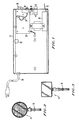
- Fig. 1 is a front view of an emergency lighting unit (ELU) 10 having the front cover (not shown) removed to reveal the contents of the unit housing 12.
- An incandescent or halogen lamp such as those depicted at 14 and 14' in Figs. 2 and 3, is mounted in a conventional manner on the top, front or sides of the housing 12 and the wires 16 are placed through an aperture 18 in the housing 12 in order to be connected to a charger board 20.
- the housing 12 encloses a battery 22 which is connected to a charger board 20 via battery wires 24.
- the battery 22 is an alternate power source when current from an AC power source is not available on the AC line 26, or AC power has been interrupted intentionally to test the ELU, as will be described below.
- the charger board 20 carries light emitting diodes (LEDs) 28 which extend outside the housing 12 to indicate that the AC supply is present for the ELU, whether the ELU is in the battery backup mode (i.e., emergency operation mode) and to indicate the status of the battery (i.e., high or low charge).
- the housing 12 allows for mounting of an optional voltmeter 30 and an ammeter 32 that can be connected to the charger board 20.
- a TEST push button 34 is provided on the housing. When an operator depresses the button 34, the charger board 20 switches the lamp 14 from AC line to battery power.
- the ELU 10 can also be tested using a receiver 36, which is mounted in the ELU fixture housing 12, in conjunction with a hand-held transmitter depicted in Figs. 6 and 7.
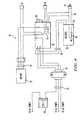
- the charger board 20 is connected to a primary power source via a transformer 44 and AC lines 26, to an alternate or auxiliary power source such as a battery 22, to a TEST button 34 and to a receiver 36.
- the charger board 20 can also be connected to an optional voltmeter 30, an ammeter 32 and to a time delay device 40.
- the charger board 20 is preferably a low voltage, low wattage Economy #703069 charger printed circuit board (PCB) manufactured by Hubbell Lighting Incorporated, Christiansburg, Virginia, which switches the lamp output on the negative lead of the battery, as shown in Fig. 5.
- the ELU 10 is preferably in a model PE612 or HE625 ELU, also manufactured by Hubbell Lighting Incorporated.
- ELUs can be used in accordance with the present invention.
- other battery and charging assemblies can be used in accordance with the present invention such as the Hubbell low voltage, high wattage, #703067 emergency charger manufactured by Hubbell Lighting Incorporated, which switches the lamp output on the positive lead of the battery.
- the charger board 20 is of a conventional type and includes DC rectifying and voltage regulating and transfer control circuitry 21 for maintaining the battery 22 in a fully charged condition.
- the charger board 20 has four output terminals designated B+, B-, L+ and L-.
- the B+ and B- terminals are the battery terminals of the charger board and are connected to the positive and negative terminals of the battery 22, respectively.
- the L+ and L- terminals are the lamp output terminals of the charger board 20 and are connected to the lamp 14 or 14'.
- the B- terminal is also electrically connected to the lamp 14 or 14' via the PCB 20.
- the charger board 20 comprises transfer control circuitry 21 and a transfer relay and transistor (indicated generally at 42).
- the transfer control circuitry 21 operates the transfer relay and transistor 42 to selectively switch the lamp(s) to the battery power source in response to open circuit conditions due to activation of normally closed relays 35 and 80 by the TEST push button 34 and the receiver 36, respectively, or the condition of the loss of the primary AC power source.
- the transfer relay 43 has a coil 45 which is coupled to the transfer control circuitry 21. When AC power is available, the relay contacts of relay 43 are in an unswitched position to prevent the lamp polarities from being electrically connected to the battery output terminals B+ and B-.
- This condition allows for the charging and transfer circuit 21 to maintain the battery in a fully charged condition during the standby mode.
- the transfer control circuitry 21 energizes the coil 45 and allows the relay 43 to go to a switched position.
- the lamp terminals are therefore electrically connected to the battery terminals.
- the isolation between the lamp terminals and the battery terminals can also be accomplished using a power transistor.
- the relay 43 or a power transistor operates as a transfer switch for automatically initiating emergency or test mode operation in the event of a power supply interruption, and for automatically returning the ELU 10 to standby operation once power has been restored.
- the ELU 10 also comprises a transformer 44 for stepping down the voltage from the primary power source (e.g., a 120 VAC power supply) to a reduced input voltage (e.g., an input voltage range of 10 VAC minimum and 35 VAC maximum).
- the input voltage is used to power the receiver 36, as indicated by lines 46, and is used to charge the battery when the ELU is not in an emergency or test mode.
- the TEST button 34 and the receiver 36 each include a normally closed contact switch and are connected in series with each other, as well as with the power supply input transfer control circuitry 21 of charger board 20.
- the TEST button 34 e.g., a momentary push button
- the receiver 36 is activated and opens its normally closed switch, the supply of input current from the primary power source is interrupted.
- the transfer control circuitry of the charger board 20 detects an open circuit condition on the serial line 48 and, accordingly, switches the transfer relay transistor to operate the lamp from the battery.
- the receiver 36 is activated by a transmitted radio frequency (RF) signal generated by the hand-held transmitter 50 depicted in Figs. 6 and 7.
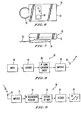
- the transmitter preferably comprises a plastic-molded housing 52 having a belt clip 54 and a key ring 56.
- the transmitter housing 52 encloses a battery and a transmitter control circuit as described below in connection with Figs. 8 and 10.
- a momentary push button switch 58 is provided such that when it is activated by a user, the transmitter generates a RF control signal via an antenna 60 (Fig. 8) for transmission to the receiver 36 for essentially as long as the user activates the switch 58.
- An LED 62 or other indicator is provided to indicate when the transmitter 50 is generating and transmitting a control signal to the receiver 36.
- the transmitter 50 comprises an encoder 64 for generating an encoded signal for as long as the button 58 is depressed by a user.
- the encoder 64 is connected to a RF signal generating circuit 66 for combining the encoded signal with a RF carrier signal.
- the encoded RF signal is amplified by an amplifier 68 and broadcast to the lamp control circuit via the antenna 60.
- the RF signal generating circuit 66, amplifier 68, and antenna 60 can be an LC oscillator 92 as described in connection with Fig. 10. It is to be understood that other wireless for communicating with the lamp control unit can be used.
- the transmitter can be provided with circuitry for modulating the encoded output signal from the encoder into an infrared signal or ultrasonic signal.
- the receiver in the lamp control unit can be provided with corresponding circuitry for receiving encoded infrared or ultrasonic signals.
- the receiver 36 comprises an antenna 70 for receiving encoded RF signals from the transmitter 50.
- the RF signals are processed by an amplifier 72 and then demodulated into digital signals by a RF regenerative detector 74, which is tuned to the transmitter frequency, and digitizing operational amplifiers 76.
- the digital signals are decoded by a decoder 78, which opens the normally closed relay 80 to interrupt the primary power supply if the decoded signals are recognized as valid control signals from the transmitter 50.
- the charger board 20 in turn energizes the transfer relay and transistor 42, thus connecting the lamp 14 or 14' to the battery.
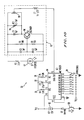
- the transmitter 50 comprises a battery 82 which supplies a voltage Vcc to the encoder 64 as long as the switch 58 is closed.
- the switch BT1 58 can be a push button-type switch that must be pressed and held to remain closed.
- Enable pin 14 on the encoder 64 is tied to ground such that the encoder is enabled as long as it is receiving a supply voltage.
- the encoder 64 comprises nine pins (i.e., A1 through A9) and is configured to generate one of three different output signals on pin 15 depending on which the nine pins are tied to Vcc, to ground, or are left floating, respectively.
- the encoder 64 can be configured to generate two wide pulses for each pin connected to Vcc, one wide pulse and one narrow pulse for each pin connected to ground, and two narrow pulses for each pin left floating to create an encoded output signal of eighteen, serial pulses.
- a three-position switch or jumper 84 can be used to set each pin to a Vcc, ground or floating state.
- the switch settings can be varied among several transmitters and, correspondingly, among receivers configured to recognize a particular pattern of eighteen, wide and narrow pulses in a received signal. Varying the switch settings reduces the likelihood of unintended reception of transmitted signals by the wrong ELU or other wireless device (e.g., a security device or automatic door in the vicinity of the ELU 10).
- the resistors 86 and 88 and the capacitor 90 connected to the encoder 64 are selected to establish a predetermined rate of pulses output on pin 15.
- an LC oscillator 92 begins oscillating at a tuned frequency (e.g., 318 MHz) for the duration of the wide or narrow pulse.
- the tuned frequency is preferably selected from a range of frequencies between 286 and 370 MHz and tuning is performed by varactor 94.
- the transistor 96 turns the coil 98 off until the next wide or narrow pulse appears at the pin 15.
- the encoder 64 After eighteen pulses appear on the pin 15, the encoder 64 generates six synchronization pulses before generating the next sequence of eighteen pulses.
- the LED 62 is illuminated each time a RF pulse is transmitted.
- the LED 62 becomes dim as battery charge decreases and therefore functions as an indicator to replace the transmitter battery 82.
- a conventional power supply is provided within the receiver 36 for converting the voltage from the secondary of the transformer 44.
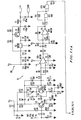
- the receiver 36 comprises an antenna 70 and an amplifier (i.e., transistor 102) for amplifying a received RF pulse in an encoded signal.
- the RF regenerative detector 74 i.e., a tuner comprising capacitors 104 and 106, inductor 108, varactor 110, and transistor 112
- the regenerative detector 74 changes the amplitude of its oscillating output signal such that the signal can be converted to a square wave, digital signal by the operational amplifiers 114 and 116.
- the digital signal at the output of the operational amplifier 116 is provided to the decoder 78.
- the decoder 78 compares the input digital signal at pin 9 with switch data at pins A1 through A9, which are configured in a manner identical to the transmitter using three-position switches or jumpers 118, as described above.
- the decoder 78 detects two identical encoded signals of eighteen pulses, which are separated by a synchronization signal of six pulses, the decoder generates a high output signal at pin 11.
- the pin 11 remains high, as long as valid encoded signals are detected by the decoder 78.
- the decoder output signal is provided to the relay 80 via gates 120 and 122 and transistor 124. A high output signal causes the transistor 124 to conduct and operate the relay coil 126 to open a normally closed contact.
- the charger board 20 switches the lamp 14 or 14' to the battery 22 to operate the ELU 10 in a test mode.
- the transistor 124 turns off, and the relay closes.
- the charger board 20 disconnects the lamp 14 or 14' from the battery 22.
- the relay 80 When valid encoded data is being received, the relay 80 remains open until encoded pulse signals are no longer detected by the decoder 78, even if there is a momentary loss of data (e.g., the transmitter user unintentionally breaks contact of switch S1 for an instant). Protection against momentary, unintentional loss of encoded data is provided by the second gate 122. Since the output signal from the second gate 122 is required at one input of the first gate 120, gate 122 establishes a minimum time for providing an output signal from the decoder 78 to the first gate 120 that has not changed state (i.e., changed from high to low, or low to high).
- Capacitor 128 and resistor 130 are selected to set the predetermined minimum time for providing a signal to the first gate without changing state to a desired value (e.g., two seconds). Conversely, if the button 58 on the transmitter 50 is depressed for only a brief period of time (e.g., one second), the test feature is engaged (i.e., a high decoder output signal is generated to open the relay 80) for the minimum time of two seconds.
- the present invention is advantageous because, among other reasons, it does not require two transmitted signals to commence and interrupt, respectively, an ELU 10 test function.
- An emergency lighting system is provided, in accordance with an embodiment of the present invention, with a receiver 36 connected to an ELU 10 and a portable transmitter 50 operable remotely with respect to the ELU.
- the transmitter 50 is configured to generate and transmit a single encoded signal to the receiver 36 as long as a switch 58 on the transmitter is activated by the user.
- the switch 58 can be of the type which must be depressed and held to continue generation of the encoded signal, or of the type which is depressed once to commence encoded signal generation and depressed once more to terminate encoded signal generation.
- the receiver 36 receives and decodes the transmitted signal and opens a normally closed relay 80 as long as the signals are being received.
- the battery 22 in turn is disconnected from the primary power source and connected to the lamp 14 or 14'.
- the receiver closes the normally closed switch 80.
- the battery 22 in turn is reconnected to the primary power source for recharging.
- the emergency lighting control system therefore can remotely control the normally closed switch 80 and, therefore, the switching of the battery between the primary power source and the lamp 14 or 14' using only one transmitted signal and one switch 58 on the transmitter, thereby reducing the complexity of the transmitter and the receiver.
- the time during which the lamp is operating from an auxiliary power source can be continuous and variable depending on how a user operates the switch 58 on the transmitter 50.
- the test mode therefore, is not limited to a predetermined period of time, as in some systems for testing ELUs wherein a momentary RF signal initiates a test function using an auxiliary power source such as a battery to power a lamp for a predetermined period of time before reconnecting the battery to the primary power source.
- the charging board 20, test button 34 and receiver 36 can be designed such that the lamp is switched from a primary power source to an auxiliary power source such as the battery 22 when a normally open switch is closed in response to the test button being activated or a transmitter signal is received.
Landscapes
- Engineering & Computer Science (AREA)
- Computer Security & Cryptography (AREA)
- Physics & Mathematics (AREA)
- General Physics & Mathematics (AREA)
- Circuit Arrangement For Electric Light Sources In General (AREA)
- Alarm Systems (AREA)
- Circuit Arrangements For Discharge Lamps (AREA)
- Stand-By Power Supply Arrangements (AREA)
Applications Claiming Priority (2)
| Application Number | Priority Date | Filing Date | Title |
|---|---|---|---|
| US08/576,558 US5929781A (en) | 1995-12-21 | 1995-12-21 | Radio frequency controlled system for testing emergency lighting units |
| US576558 | 1995-12-21 |
Publications (2)
| Publication Number | Publication Date |
|---|---|
| EP0780821A2 true EP0780821A2 (fr) | 1997-06-25 |
| EP0780821A3 EP0780821A3 (fr) | 1998-04-08 |
Family
ID=24304929
Family Applications (1)
| Application Number | Title | Priority Date | Filing Date |
|---|---|---|---|
| EP96309237A Withdrawn EP0780821A3 (fr) | 1995-12-21 | 1996-12-18 | Système radio commandé pour l'essai de blocs d'éclairage de sécurité |
Country Status (3)
| Country | Link |
|---|---|
| US (1) | US5929781A (fr) |
| EP (1) | EP0780821A3 (fr) |
| CA (1) | CA2191688A1 (fr) |
Families Citing this family (20)
| Publication number | Priority date | Publication date | Assignee | Title |
|---|---|---|---|---|
| DE10006408A1 (de) * | 2000-02-14 | 2001-08-16 | Zumtobel Staff Gmbh | Beleuchtungssystem |
| US6353391B1 (en) * | 2000-09-15 | 2002-03-05 | Kenneth N. Shearer | Baby bottle locating system |
| AU2003224289A1 (en) * | 2002-04-24 | 2003-11-10 | Stephen Capon | Consumer unit |
| US20040160781A1 (en) * | 2003-02-13 | 2004-08-19 | Edmund Farmer | Method and apparatus for providing an improved light |
| US7336003B2 (en) * | 2005-04-05 | 2008-02-26 | Eaton Corporation | Transfer switch and power system including the same |
| US7218056B1 (en) * | 2006-03-13 | 2007-05-15 | Ronald Paul Harwood | Lighting device with multiple power sources and multiple modes of operation |
| US20080298242A1 (en) * | 2007-05-30 | 2008-12-04 | Yi Fan | Systems and methods for transmission and reception of data including processing and buffering features |
| US20080298232A1 (en) * | 2007-05-30 | 2008-12-04 | Silicon Storage Technology, Inc. | Systems and methods for wireless transmission and reception of data including processing and buffering features |
| US8258705B2 (en) * | 2009-04-29 | 2012-09-04 | Hubbell Incorporated | Scotopically enhanced emergency light and control thereof |
| US9098390B2 (en) * | 2010-11-15 | 2015-08-04 | Lifesafety Power, Inc. | Apparatus and method for a networked power management system with one-click remote battery discharge testing |
| US9966791B2 (en) * | 2011-02-28 | 2018-05-08 | Preston Palmer | Central battery interconnected smoke detector system with single wire AC and DC pass-through relay |
| US9965935B2 (en) * | 2011-02-28 | 2018-05-08 | Preston Palmer | Alarm device system with simultaneous AC/DC power source |
| US10431055B2 (en) | 2011-02-28 | 2019-10-01 | Vireo Tech, Llc | Battery interconnected alert device system with vibrational alert |
| US10922955B2 (en) * | 2011-02-28 | 2021-02-16 | Vireo Tech, Llc | Battery interconnected smoke detector system |
| US9752739B2 (en) | 2011-08-29 | 2017-09-05 | Hubbell Incorporated | Emergency lighting assembly having heat conducting member |
| US9386665B2 (en) | 2013-03-14 | 2016-07-05 | Honeywell International Inc. | System for integrated lighting control, configuration, and metric tracking from multiple locations |
| US9791117B2 (en) * | 2013-04-02 | 2017-10-17 | Thomas & Betts International Llc | Emergency lighting fixture with remote control |
| US10985600B2 (en) * | 2017-07-24 | 2021-04-20 | Magtech Industries Corporation | Emergency lighting system with integrated testing and reporting functionality |
| US10819140B1 (en) * | 2018-07-11 | 2020-10-27 | Maalouf Mark A | Systems and methods for remote monitoring and control of emergency electrical generating systems |
| US11149912B2 (en) * | 2020-02-05 | 2021-10-19 | Litetronics International, Inc. | Emergency high bay light |
Citations (2)
| Publication number | Priority date | Publication date | Assignee | Title |
|---|---|---|---|---|
| US5148158A (en) | 1988-03-24 | 1992-09-15 | Teledyne Industries, Inc. | Emergency lighting unit having remote test capability |
| US5154504A (en) | 1989-08-31 | 1992-10-13 | Minitronics Pty Limited | Communications and testing for emergency systems |
Family Cites Families (8)
| Publication number | Priority date | Publication date | Assignee | Title |
|---|---|---|---|---|
| GB1567506A (en) * | 1978-01-25 | 1980-05-14 | Sunbeam Lamps & Lighting Ltd | Emergency lighting units and installations |
| US4725827A (en) * | 1986-06-23 | 1988-02-16 | Pulsar Manufacturing, Inc. | Hand held remote control device |
| US4908604A (en) * | 1987-09-21 | 1990-03-13 | Dimango Products Corporation | Remotely controlled security system |
| EP0332783B1 (fr) * | 1988-03-09 | 1992-06-03 | Pulsar Light Of Cambridge Ltd | Système de contrôle pour un projecteur |
| FR2631754B1 (fr) * | 1988-05-20 | 1993-07-30 | Accumulateurs Fixes | Appareil de test d'autonomie pour bloc d'eclairage de securite |
| US4908602A (en) * | 1989-03-31 | 1990-03-13 | Lifeline Systems, Inc. | Apparatus and method of testing a portable held button for emergency response system |
| US4977353A (en) * | 1989-08-31 | 1990-12-11 | Minitronics Pty Limited | Communication system for single point emergency lighting |
| US5365145A (en) * | 1993-08-09 | 1994-11-15 | Gael, Inc. | Emergency lighting system |
-
1995
- 1995-12-21 US US08/576,558 patent/US5929781A/en not_active Expired - Fee Related
-
1996
- 1996-11-29 CA CA002191688A patent/CA2191688A1/fr not_active Abandoned
- 1996-12-18 EP EP96309237A patent/EP0780821A3/fr not_active Withdrawn
Patent Citations (2)
| Publication number | Priority date | Publication date | Assignee | Title |
|---|---|---|---|---|
| US5148158A (en) | 1988-03-24 | 1992-09-15 | Teledyne Industries, Inc. | Emergency lighting unit having remote test capability |
| US5154504A (en) | 1989-08-31 | 1992-10-13 | Minitronics Pty Limited | Communications and testing for emergency systems |
Also Published As
| Publication number | Publication date |
|---|---|
| US5929781A (en) | 1999-07-27 |
| CA2191688A1 (fr) | 1997-06-22 |
| EP0780821A3 (fr) | 1998-04-08 |
Similar Documents
| Publication | Publication Date | Title |
|---|---|---|
| US5929781A (en) | Radio frequency controlled system for testing emergency lighting units | |
| US5895985A (en) | Switch remoting system | |
| US4355309A (en) | Radio frequency controlled light system | |
| US6630800B2 (en) | Remote-control device of lamp series control box | |
| US6759966B1 (en) | Wireless remote control bulb device | |
| US6414589B1 (en) | Apparatus for remotely controlling auxiliary doorbell chime from doorbell push button | |
| US8242640B2 (en) | Power system with light-controlled function and the control method thereof | |
| US20020009296A1 (en) | Transceiver units and a transceiver system for the remote control of electronic equipment | |
| US4780910A (en) | Display for a remote receiver in an electrical utility load management system | |
| EP1729171B1 (fr) | Contrôle radio à distance de l'équipement photographique | |
| US5157271A (en) | Apparatus for controlling a power supply of an electric machine in a vehicle | |
| GB2308910A (en) | Lighting control | |
| WO1997029560A8 (fr) | Telecommande et telesurveillance de l'etat d'appareillages electroniques | |
| US6256479B1 (en) | Wireless door intercom | |
| EP1501059B1 (fr) | Transmetteur à distance pour sonnette de porte | |
| GB2230163A (en) | Controlling home appliances by audio tones transmitted over a telephone line or generated locally | |
| GB2259172A (en) | Wireless remote control transmitter and receiver for electrical appliances | |
| JP2015228665A (ja) | 遠隔制御電源装置 | |
| US4959647A (en) | Wireless power controller for a machine device | |
| EP3266088A1 (fr) | Système de commande de prise | |
| US20040100151A1 (en) | Wireless in-line low-voltage controller | |
| GB2068614A (en) | Remote mains switching means | |
| KR200251373Y1 (ko) | 가로등 원격 감시 시스템 | |
| KR100427950B1 (ko) | 가로등 원격 감시 시스템 | |
| JPH1092586A (ja) | リモコン機能付き照明器具 |
Legal Events
| Date | Code | Title | Description |
|---|---|---|---|
| PUAI | Public reference made under article 153(3) epc to a published international application that has entered the european phase |
Free format text: ORIGINAL CODE: 0009012 |
|
| AK | Designated contracting states |
Kind code of ref document: A2 Designated state(s): DE GB NL |
|
| PUAL | Search report despatched |
Free format text: ORIGINAL CODE: 0009013 |
|
| AK | Designated contracting states |
Kind code of ref document: A3 Designated state(s): DE GB NL |
|
| 17P | Request for examination filed |
Effective date: 19980929 |
|
| 17Q | First examination report despatched |
Effective date: 20020212 |
|
| GRAH | Despatch of communication of intention to grant a patent |
Free format text: ORIGINAL CODE: EPIDOS IGRA |
|
| STAA | Information on the status of an ep patent application or granted ep patent |
Free format text: STATUS: THE APPLICATION IS DEEMED TO BE WITHDRAWN |
|
| 18D | Application deemed to be withdrawn |
Effective date: 20030104 |