EP0780832A2 - Vorrichtung zur Abschätzung der Abweichung des Leistungsverlaufs eines synthetischen Signals von einem Eingangssignal in einem Sprachkodierer - Google Patents
Vorrichtung zur Abschätzung der Abweichung des Leistungsverlaufs eines synthetischen Signals von einem Eingangssignal in einem Sprachkodierer Download PDFInfo
- Publication number
- EP0780832A2 EP0780832A2 EP96309062A EP96309062A EP0780832A2 EP 0780832 A2 EP0780832 A2 EP 0780832A2 EP 96309062 A EP96309062 A EP 96309062A EP 96309062 A EP96309062 A EP 96309062A EP 0780832 A2 EP0780832 A2 EP 0780832A2
- Authority
- EP
- European Patent Office
- Prior art keywords
- signal
- speech
- error
- speech signal
- synthetic
- Prior art date
- Legal status (The legal status is an assumption and is not a legal conclusion. Google has not performed a legal analysis and makes no representation as to the accuracy of the status listed.)
- Granted
Links
Images


Classifications
-
- G—PHYSICS
- G10—MUSICAL INSTRUMENTS; ACOUSTICS
- G10L—SPEECH ANALYSIS TECHNIQUES OR SPEECH SYNTHESIS; SPEECH RECOGNITION; SPEECH OR VOICE PROCESSING TECHNIQUES; SPEECH OR AUDIO CODING OR DECODING
- G10L19/00—Speech or audio signals analysis-synthesis techniques for redundancy reduction, e.g. in vocoders; Coding or decoding of speech or audio signals, using source filter models or psychoacoustic analysis
- G10L19/04—Speech or audio signals analysis-synthesis techniques for redundancy reduction, e.g. in vocoders; Coding or decoding of speech or audio signals, using source filter models or psychoacoustic analysis using predictive techniques
- G10L19/08—Determination or coding of the excitation function; Determination or coding of the long-term prediction parameters
-
- G—PHYSICS
- G10—MUSICAL INSTRUMENTS; ACOUSTICS
- G10L—SPEECH ANALYSIS TECHNIQUES OR SPEECH SYNTHESIS; SPEECH RECOGNITION; SPEECH OR VOICE PROCESSING TECHNIQUES; SPEECH OR AUDIO CODING OR DECODING
- G10L25/00—Speech or voice analysis techniques not restricted to a single one of groups G10L15/00 - G10L21/00
- G10L25/03—Speech or voice analysis techniques not restricted to a single one of groups G10L15/00 - G10L21/00 characterised by the type of extracted parameters
- G10L25/15—Speech or voice analysis techniques not restricted to a single one of groups G10L15/00 - G10L21/00 characterised by the type of extracted parameters the extracted parameters being formant information
Definitions
- the present invention relates to a speech coding device advantageously applicable to a CELP (Code Excited Linear Prediction) coding system or an MPE (Multi-Pulse Excitation) linear prediction coding system.
- CELP Code Excited Linear Prediction
- MPE Multi-Pulse Excitation
- an AbS (Analysis by Synthesis) system e.g., a CELP coding system or an MPE linear prediction coding system is available for the low bit rate coding and decoding of speeches and predominant over the other systems.
- the AbS system is one of solutions to such a problem and causes the parameter to vary in a certain range, actually synthesize speeches, and then selects one of the synthetic speeches having the smallest distance to an input speech.
- This kind of coding and decoding scheme is taught in, e.g., B.S.
- the AbS system synthesizes speech signals in response to an input speech signal, and generates error signals representative of the differences between the synthetic speech signals and the input speech signal. Subsequently, the system computes square sums of the error signals, and then selects one of the synthetic speech signals having the smallest square sum.
- the synthetic speech signals a plurality of excitation signals prepared beforehand are used.
- the CELP system and MPE system use random Gaussian noise and a pulse sequence, respectively.
- the problem with the AbS system is that the square sums of the error signals used for the evaluation of the excitation signals cannot render the synthetic speech signal sufficiently natural alone in the human auditory perception aspect. For example, an unnatural waveform absent in the original speech signal is apt to appear in the synthetic speech signal. Under these circumstances, there is an increasing demand for a speech coding device capable of producing, without deteriorating perceptual naturalness, a synthetic speech signal faithfully representing an input speech signal.
- a speech coding device for coding an input speech with an AbS system and one of a forward type and a backward type configuration includes a vocal tract prediction coefficient generating circuit for producing a vocal tract prediction coefficient from one of an input speech signal and a locally reproduced synthetic speech signal.
- a speech synthesizing circuit produces a synthetic speech signal by using codes stored in an excitation codebook in one-to-one correspondence with indexes, and the vocal tract prediction coefficient.
- a comparing circuit compares the synthetic speech signal and input speech signal to thereby output an error signal.
- a perceptual weighting circuit perceptually weights the error signal to thereby output a perceptually weighted signal.
- a codebook index selecting circuit selects an optimal index for the excitation codebook out of at least the perceptually weighted signal, and feeds the optimal index to the excitation codebook.
- a power envelope estimating circuit produces a first power envelope signal from the synthetic speech signal, produces a second power envelope signal from the input speech signal, and compares the first and second power envelope signals to thereby estimate an error signal representative of a difference between the first and second envelope signals.
- the codebook index selecting circuit selects the optimal index on the basis of the error signal and perceptually weighted signal.
- the AbS system includes a synthesis filter 101, a subtracter 102, a perceptual weighting filter 103, and a square sum computation 104.
- the subtracter 102 computes differences between an input speech signal S and the synthetic speech signals Swi and outputs the resulting error signals ei.
- the perceptual weighting filter 103 perceptually weights each of the error signals ei so as to produce a corresponding weighted error signal ewi.
- the square sum computation 104 produces the square sums of the weighted error signals ewi. As a result, the synthetic speech signal Swi having the smallest distance to the input speech signal S is selected.
- This conventional AbS scheme has the previously discussed problem left unsolved.
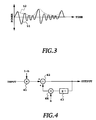
- FIG. 3 shows a specific curve 51 representative of the power of a speech signal, and a specific power envelope 52 enveloping the curve 51.
- the embodiments pertain to an analytic speech coding system which produces error signals representative of differences between an input speech signal and synthetic speech signals, perceptually weights them, outputs the square sums of the weighted error signals, and then selects one excitation signal having the smallest distance to the input speech signal, i.e., the smallest waveform error evaluation value.
- an envelope signal is produced with each of the input speech signal and synthetic speech signals. The envelope signals are compared in order to compute envelope error evaluation values. These values are used for the selection of the optimal excitation signal in addition to the waveform error evaluation values.
- a speech coding device embodying the present invention has a CELP type configuration.
- the device has a vocal tract analyzer 201, a vocal tract prediction coefficient quantizer/dequantizer 202, an excitation codebook 203, a multiplier 204, a gain table 205, a synthesis filter 206, a subtracter 207, a perceptual weighting filter 208, a square error computation 209, an envelope error computation 210, a total error computation 211, and a multiplexer 212.
- An original speech vector signal So is input to the device via an input terminal 200 as a frame-by-frame vector signal.
- Coded speech data are output via an output terminal 213 as a total code signal W.
- the vocal tract analyzer 201 receives the original speech vector signal So and determines a vocal tract prediction coefficient or LPC (Linear Prediction Coding) coefficient a frame by frame.
- the LPC coefficient is fed from the analyzer 201 to the vocal tract prediction quantizer/dequantizer 202.
- the quantizer/dequantizer 202 quantizes the input LSP coefficient a , generates a vocal tract prediction coefficient index L corresponding to the quantized value, and feeds the index L to the multiplexer 212.
- the quantizer/dequantizer 202 produces a dequantized value aq and delivers it to the synthesis filter 206.
- the multiplier 204 multiplies the excitation vector Ci by the gain information gj and outputs the resulting product vector signal Cgij.
- the product vector signal Cgij is fed to the synthesis filter 206.
- the synthesis filter 206 is implemented as, e.g., a cyclic digital filter and receives the dequantized value aq (meaning the LPC coefficient) output from the quantizer/dequantizer 202 and the product vector signal Cgij output from the multiplier 204.
- the filter 206 outputs a synthetic speech vector Sij based on the value aq and signal Cgij and delivers it to the subtracter 207 and envelope error computation 210.
- the subtracter 207 produces a difference eij between the original speech vector signal So input via the input terminal 200 and the synthetic speech vector Sij.
- the difference vector signal eij is applied to the perceptual weighting filter 208.
- the perceptual weighting filter 208 weights the difference vector signal eij with respect to frequency. Stated another way, the weighting filter 208 weights the difference vector signal eij in accordance with the human auditory perception characteristic. A weighted signal wij output from the weighting filter 208 is fed to the square error computation 209. Generally, as for the speech formant or the pitch harmonics, quantization noise lying in the frequency range of great power sounds low to the ear due to the auditory masking effect. Conversely, quantization noise lying in the frequency of small power sounds as it is without being masked. The above terms “perceptual weighting" therefore refer to frequency weighting which enhances quantization noise lying in the frequency range of great power while suppressing quantization noise lying in the frequency range of small power.
- the human auditory sense has a so-called masking characteristic; if a certain frequency component is loud, frequencies around it are difficult to hear. Therefore, the difference between the original speech and the synthetic speech with respect to human auditory perception, i.e., how much a synthetic speech sounds distorted does not always correspond to the Euclid distance. This is why the difference between the original speech and the synthetic speech is passed through the perceptual weighting filter 208.
- the resulting output of the weighting filter 208 is used as a distance scale.
- the weighting filter 208 reduces the distortion of loud portions on the frequency axis while increasing that of low portions.
- the square error computation 209 produces a square sum Eij with the individual component of the weighted vector signal wij.
- the square sum is delivered to the total error computation 211.
- the envelope error computation 210 produces an envelope vector Vo for the original speech vector signal So, and an envelope vector Vij for the synthetic speech vector Sij received from the synthesis filter 206.
- a specific envelope is shown in FIG. 3, as stated earlier.
- the envelope vectors Vo and Vij can be produced if the absolute values of the components of the original speech vector signal So and synthetic speech vector signal Sij are processed by a digital low-pass filter.
- the digital low-pass filter may be represented by a transfer function formula: (1 - b)/(1 - b ⁇ Z -1 ) 0 ⁇ b ⁇ 1
- FIG. 4 shows a specific configuration of the above digital low-pass filter.
- the filter is made up of a multiplier 41, an adder 42, a delay circuit (Z -1 ) 43 and a multiplier 44 which are connected together, as illustrated.
- the multiplier 41 multiplies the input signal by a coefficient (1 - b) included in the above formula (1) and feeds the resulting product to the adder 42.
- the adder 42 adds the product and an output of the multiplier 44 and delivers the resulting sum to the delay 43.
- the delay 43 delays the output of the adder 42 and feeds its output to the multiplier 44.
- the multiplier 44 multiplies the output of the delay circuit 43 by a coefficient b .
- the envelope error computation 210 produces a vector signal representative of a difference between the envelope vectors Vo and Vij. Then, the computation 210 determines a square sum vector signal Rij with the individual component of such a difference vector signal, and feeds it to the total error computation 211. With this envelope error computation, the embodiment can bring the synthetic speech vector signal Sij close to the original speech vector signal So with fidelity.
- the total error computation 211 outputs a total error vector signal Tij on the basis of the square sum vector signal Eij output from the square error computation 209 and the square sum vector signal Rij output from the envelope error computation 210.
- the total error computation 211 searches for an i and j combination minimizing the total error vector signal Tij, and outputs the determined i and j as optimal indexes I and J, respectively.
- the optimal indexes I and J are fed to the excitation codebook 203 and gain table 205, respectively.
- the optimal indexes I and J are applied to the multiplexer 212. With the optimal indexes I and J, it is possible to bring the power variation of the synthetic speech vector signal Sij close to that of the original speech vector signal So.
- the multiplexer 212 multiplexes the vocal tract prediction coefficient index L output from the quantizer/dequantizer 202 and the optimal indexes I and J output from the total error computation 211 to thereby output a total code signal W.
- the total code signal W is sent from the speech coding device to a speech decoding device, not shown, via the output terminal 213.
- the vocal tract analyzer 201 produces a vocal tract prediction coefficient (LPC coefficients) a from an input original speech vector signal So.
- the vocal tract prediction coefficient quantizer/dequantizer 202 quantizes the prediction coefficient a and generates a corresponding prediction coefficient index L.
- the index L is applied to the multiplexer 212.
- quantizer/dequantizer 202 outputs a dequantized value aq associated with the quantized value.
- the dequantized value aq is fed to the synthesis filter 206.
- the excitation codebook 203 initially reads out any one of the excitation vectors Ci. Likewise, the gain table 205 initially reads out any one of the gain information gj.
- the multiplier 204 multiplies the excitation vector Ci and gain information gj and feeds the resulting product vector signal Cgij to the synthesis filter 206.
- the synthesis filter 206 digitally filters the product vector signal Cgij and dequantized value aq and thereby outputs a synthetic speech vector signal Sij.
- the subtracter 207 produces a difference between the synthetic speech vector signal Sij and the original speech vector signal. So, i.e., a difference vector signal eij.
- the perceptual weighting filter 208 weights the difference vector signal eij in accordance with the human auditory perception characteristic and feeds the resulting perceptually weighted vector signal wij to the square error computation 209.
- the computation 209 outputs a square sum vector signal Eij with the individual component of the vector signal wij and applies it to the total error computation 211.
- the envelope error computation 210 produces the absolute values of the components of the envelope vector Vo and synthetic speech vector Sij. With the digital low-pass filter represented by the formula (1), the computation 210 determines an envelope vector Vij. Then, the computation 210 produces a difference vector signal representative of a difference between the two envelope vectors Vo and Vij. Further, the computation 210 determines a square sum vector signal Rij with each component of the difference vector signal. This signal Rij and the square sum vector signal Eij output from the square error computation 209 are fed to the total error computation 211.
- the total error computation 211 produces a total error vector signal Tij on the basis of the vector signals Rij and Eij and by use of the formula (2). Subsequently, the computation 211 determines an i and j combination minimizing the vector signal Tij, and outputs the determined values i and j as optimal indexes I and J.
- the optimal indexes I and J are applied to the excitation codebook 203 and gain table 205, respectively. Also, the optical indexes I and J are applied to the multiplexer 212.
- the excitation codebook 203 reads out an excitation vector Ci whose index matches the optimal index I, and again delivers it to the multiplier 204.
- the gain table 205 reads out gain information gj whose index matches the optimal index J, and again delivers it to the multiplier 204.
- the multiplexer 212 multiplexes the optimal indexes I and J and vocal tract prediction coefficient index L and outputs a total code signal W.
- the total code signal W is output via the output terminal 213.
- the illustrative embodiment uses envelope information in addition to square sum information at the time of selection of an optimal excitation signal. This allows a synthetic speech signal to be generated without losing perceptual naturalness.
- the power envelope signal of a synthetic speech signal and that of an input original speech signal are compared to produce their difference or error.
- An optimal index is selected on the basis of a signal representative of the above error and a perceptually weighted signal.
- a code read out of a codebook is optimally corrected by the optimal index signal.
- the resulting power envelope of the synthetic speech signal is extremely close to the power envelope of the original speech signal.
- the envelopes are brought into coincidence, even the auditory perception can be matched to the original speech. Therefore, codes and index information capable of matching original speech signals to an utmost degree are achievable.
- a speech decoding device receiving such information and vocal tract prediction coefficients, is capable of reproducing speeches far more faithfully than conventional.
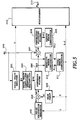
- FIG. 5 an alternative embodiment of the present invention will be described.
- this embodiment is identical with the previous embodiment except that it has an MPE type configuration, i.e., a pulse excitation generator 303 is substituted for the excitation codebook 203.
- the multiplier multiplies the pulse excitation vector PCi fed from the pulse excitation generator 303 by gain information gj, as stated earlier.
- the total error computation 211 delivers the optimal index I to the generator 303.
- the generator 303 reads a pulse excitation vector PCi whose index matches the optimal index I.
- the rest of the construction and operation of this embodiment is the same as in the previous embodiment.
- the present invention is readily applicable even to a backward type speech coding device using the AbS system. This can be done with the configuration shown in FIG. 2 only if the synthetic speech vector signal Sij output from the synthesis filter 206 is fed to the vocal tract analyzer 201 in place of the input speech vector signal So. This is also true with the configuration of FIG. 5. Further, the present invention is applicable to a VSELP (Vector Sum Excited Linear Prediction) system, LD-CELP system, CS-CELP system, or PSI (Pitch Synchronous Innovation)-CELP system, as desired.
- VSELP Vector Sum Excited Linear Prediction
- LD-CELP system LD-CELP system
- CS-CELP system CS-CELP system
- PSI Pitch Synchronous Innovation
- the excitation codebook 203 should preferably be implemented as adaptive codes, statistical codes, or noise-based codes.
- a speech decoding device for use with the present invention may have a construction taught in any one of, e.g., Japanese patent laid-open publication Nos. 73099/1993, 130995/1994, 130998/1994, 134600/1995, and 130996/1994 if it is slightly modified.
Landscapes
- Engineering & Computer Science (AREA)
- Computational Linguistics (AREA)
- Signal Processing (AREA)
- Health & Medical Sciences (AREA)
- Audiology, Speech & Language Pathology (AREA)
- Human Computer Interaction (AREA)
- Physics & Mathematics (AREA)
- Acoustics & Sound (AREA)
- Multimedia (AREA)
- Compression, Expansion, Code Conversion, And Decoders (AREA)
- Transmission Systems Not Characterized By The Medium Used For Transmission (AREA)
Applications Claiming Priority (3)
| Application Number | Priority Date | Filing Date | Title |
|---|---|---|---|
| JP32850595 | 1995-12-18 | ||
| JP32850595A JP3481027B2 (ja) | 1995-12-18 | 1995-12-18 | 音声符号化装置 |
| JP328505/95 | 1995-12-18 |
Publications (3)
| Publication Number | Publication Date |
|---|---|
| EP0780832A2 true EP0780832A2 (de) | 1997-06-25 |
| EP0780832A3 EP0780832A3 (de) | 1998-09-09 |
| EP0780832B1 EP0780832B1 (de) | 2002-10-09 |
Family
ID=18211030
Family Applications (1)
| Application Number | Title | Priority Date | Filing Date |
|---|---|---|---|
| EP96309062A Expired - Lifetime EP0780832B1 (de) | 1995-12-18 | 1996-12-12 | Sprachkodierer mit Vorrichtung zur Abschätzung der Abweichung des Leistungsverlaufs eines synthetischen Signals von einem Eingangssignal |
Country Status (5)
| Country | Link |
|---|---|
| US (1) | US5905970A (de) |
| EP (1) | EP0780832B1 (de) |
| JP (1) | JP3481027B2 (de) |
| CN (1) | CN1159044A (de) |
| DE (1) | DE69624207T2 (de) |
Families Citing this family (5)
| Publication number | Priority date | Publication date | Assignee | Title |
|---|---|---|---|---|
| FI114248B (fi) * | 1997-03-14 | 2004-09-15 | Nokia Corp | Menetelmä ja laite audiokoodaukseen ja audiodekoodaukseen |
| WO2006041055A1 (ja) * | 2004-10-13 | 2006-04-20 | Matsushita Electric Industrial Co., Ltd. | スケーラブル符号化装置、スケーラブル復号装置及びスケーラブル符号化方法 |
| KR20060067016A (ko) * | 2004-12-14 | 2006-06-19 | 엘지전자 주식회사 | 음성 부호화 장치 및 방법 |
| CN105007094B (zh) * | 2015-07-16 | 2017-05-31 | 北京中宸泓昌科技有限公司 | 一种指数对扩频编码解码方法 |
| KR102615154B1 (ko) * | 2019-02-28 | 2023-12-18 | 삼성전자주식회사 | 전자 장치 및 전자 장치의 제어 방법 |
Family Cites Families (9)
| Publication number | Priority date | Publication date | Assignee | Title |
|---|---|---|---|---|
| US5396576A (en) * | 1991-05-22 | 1995-03-07 | Nippon Telegraph And Telephone Corporation | Speech coding and decoding methods using adaptive and random code books |
| JP3073283B2 (ja) * | 1991-09-17 | 2000-08-07 | 沖電気工業株式会社 | 励振コードベクトル出力回路 |
| JPH06130995A (ja) * | 1992-10-16 | 1994-05-13 | Oki Electric Ind Co Ltd | 統計コードブック及びその作成方法 |
| JP3088204B2 (ja) * | 1992-10-16 | 2000-09-18 | 沖電気工業株式会社 | コード励振線形予測符号化装置及び復号化装置 |
| JPH06130998A (ja) * | 1992-10-22 | 1994-05-13 | Oki Electric Ind Co Ltd | 圧縮音声復号化装置 |
| FI96247C (fi) * | 1993-02-12 | 1996-05-27 | Nokia Telecommunications Oy | Menetelmä puheen muuntamiseksi |
| EP0654909A4 (de) * | 1993-06-10 | 1997-09-10 | Oki Electric Ind Co Ltd | Celp kodierer und dekodierer. |
| JP3262652B2 (ja) * | 1993-11-10 | 2002-03-04 | 沖電気工業株式会社 | 音声符号化装置及び音声復号化装置 |
| US5602959A (en) * | 1994-12-05 | 1997-02-11 | Motorola, Inc. | Method and apparatus for characterization and reconstruction of speech excitation waveforms |
-
1995
- 1995-12-18 JP JP32850595A patent/JP3481027B2/ja not_active Expired - Fee Related
-
1996
- 1996-12-11 US US08/763,439 patent/US5905970A/en not_active Expired - Fee Related
- 1996-12-12 DE DE69624207T patent/DE69624207T2/de not_active Expired - Lifetime
- 1996-12-12 EP EP96309062A patent/EP0780832B1/de not_active Expired - Lifetime
- 1996-12-18 CN CN96123139A patent/CN1159044A/zh active Pending
Also Published As
| Publication number | Publication date |
|---|---|
| JP3481027B2 (ja) | 2003-12-22 |
| US5905970A (en) | 1999-05-18 |
| CN1159044A (zh) | 1997-09-10 |
| EP0780832A3 (de) | 1998-09-09 |
| JPH09167000A (ja) | 1997-06-24 |
| DE69624207D1 (de) | 2002-11-14 |
| DE69624207T2 (de) | 2003-07-31 |
| EP0780832B1 (de) | 2002-10-09 |
Similar Documents
| Publication | Publication Date | Title |
|---|---|---|
| EP0409239B1 (de) | Verfahren zur Sprachkodierung und -dekodierung | |
| US4360708A (en) | Speech processor having speech analyzer and synthesizer | |
| US5915234A (en) | Method and apparatus for CELP coding an audio signal while distinguishing speech periods and non-speech periods | |
| EP0443548B1 (de) | Sprachcodierer | |
| US5305421A (en) | Low bit rate speech coding system and compression | |
| US6594626B2 (en) | Voice encoding and voice decoding using an adaptive codebook and an algebraic codebook | |
| US6681204B2 (en) | Apparatus and method for encoding a signal as well as apparatus and method for decoding a signal | |
| US6385577B2 (en) | Multiple impulse excitation speech encoder and decoder | |
| US6249758B1 (en) | Apparatus and method for coding speech signals by making use of voice/unvoiced characteristics of the speech signals | |
| EP0342687B1 (de) | Überträgungssystem für codierte Sprache mit Codebüchern zur Synthetisierung von Komponenten mit niedriger Amplitude | |
| EP0477960B1 (de) | Sprachcodierung durch lineare Prädiktion mit Anhebung der Hochfrequenzen | |
| US5826221A (en) | Vocal tract prediction coefficient coding and decoding circuitry capable of adaptively selecting quantized values and interpolation values | |
| JP3357795B2 (ja) | 音声符号化方法および装置 | |
| US5027405A (en) | Communication system capable of improving a speech quality by a pair of pulse producing units | |
| US5526464A (en) | Reducing search complexity for code-excited linear prediction (CELP) coding | |
| EP0849724A2 (de) | Vorrichtung und Verfahren hoher Qualität zur Kodierung von Sprache | |
| EP0557940B1 (de) | Sprachkodierungsystem | |
| EP0500095A2 (de) | System zur Sprachkodierung mit adaptiver Reduktion von nichtperiodischen Bestandteilen in der periodischen Signalanregungsquelle | |
| EP0780832B1 (de) | Sprachkodierer mit Vorrichtung zur Abschätzung der Abweichung des Leistungsverlaufs eines synthetischen Signals von einem Eingangssignal | |
| US7251598B2 (en) | Speech coder/decoder | |
| EP0361432A2 (de) | Verfahren und Einrichtung zur Codierung und Decodierung von Sprachsignalen unter Anwendung von Multipuls-Anregung | |
| JP3192051B2 (ja) | 音声符号化装置 | |
| JP3089967B2 (ja) | 音声符号化装置 | |
| JP2853170B2 (ja) | 音声符号化復号化方式 | |
| JP3071800B2 (ja) | 適応ポストフィルタ |
Legal Events
| Date | Code | Title | Description |
|---|---|---|---|
| PUAI | Public reference made under article 153(3) epc to a published international application that has entered the european phase |
Free format text: ORIGINAL CODE: 0009012 |
|
| AK | Designated contracting states |
Kind code of ref document: A2 Designated state(s): DE FR GB |
|
| PUAL | Search report despatched |
Free format text: ORIGINAL CODE: 0009013 |
|
| AK | Designated contracting states |
Kind code of ref document: A3 Designated state(s): DE FR GB |
|
| 17P | Request for examination filed |
Effective date: 19990210 |
|
| GRAG | Despatch of communication of intention to grant |
Free format text: ORIGINAL CODE: EPIDOS AGRA |
|
| RIC1 | Information provided on ipc code assigned before grant |
Free format text: 7G 10L 19/10 A, 7G 10L 19/12 B |
|
| RTI1 | Title (correction) |
Free format text: SPEECH CODING DEVICE UTILIZING THE ESTIMATION AN ERROR OF POWER ENVELOPES OF SYNTHETIC AND INPUT SPEECH SIGNALS |
|
| RIC1 | Information provided on ipc code assigned before grant |
Free format text: 7G 10L 19/10 A, 7G 10L 19/12 B |
|
| RTI1 | Title (correction) |
Free format text: SPEECH CODING DEVICE UTILIZING THE ESTIMATION AN ERROR OF POWER ENVELOPES OF SYNTHETIC AND INPUT SPEECH SIGNALS |
|
| GRAG | Despatch of communication of intention to grant |
Free format text: ORIGINAL CODE: EPIDOS AGRA |
|
| 17Q | First examination report despatched |
Effective date: 20020228 |
|
| GRAG | Despatch of communication of intention to grant |
Free format text: ORIGINAL CODE: EPIDOS AGRA |
|
| GRAH | Despatch of communication of intention to grant a patent |
Free format text: ORIGINAL CODE: EPIDOS IGRA |
|
| RIN1 | Information on inventor provided before grant (corrected) |
Inventor name: AOYAGI, HIROMI, C/O OKI ELECTRIC INDUSTRY CO., LTD |
|
| RTI1 | Title (correction) |
Free format text: SPEECH CODING DEVICE FOR ESTIMATING AN ERROR IN THE POWER ENVELOPES OF SYNTHETIC AND INPUT SPEECH SIGNALS |
|
| GRAA | (expected) grant |
Free format text: ORIGINAL CODE: 0009210 |
|
| GRAH | Despatch of communication of intention to grant a patent |
Free format text: ORIGINAL CODE: EPIDOS IGRA |
|
| AK | Designated contracting states |
Kind code of ref document: B1 Designated state(s): DE FR GB |
|
| REG | Reference to a national code |
Ref country code: GB Ref legal event code: FG4D |
|
| REF | Corresponds to: |
Ref document number: 69624207 Country of ref document: DE Date of ref document: 20021114 |
|
| ET | Fr: translation filed | ||
| PLBE | No opposition filed within time limit |
Free format text: ORIGINAL CODE: 0009261 |
|
| STAA | Information on the status of an ep patent application or granted ep patent |
Free format text: STATUS: NO OPPOSITION FILED WITHIN TIME LIMIT |
|
| 26N | No opposition filed |
Effective date: 20030710 |
|
| PGFP | Annual fee paid to national office [announced via postgrant information from national office to epo] |
Ref country code: GB Payment date: 20091209 Year of fee payment: 14 Ref country code: FR Payment date: 20091221 Year of fee payment: 14 |
|
| PGFP | Annual fee paid to national office [announced via postgrant information from national office to epo] |
Ref country code: DE Payment date: 20091222 Year of fee payment: 14 |
|
| GBPC | Gb: european patent ceased through non-payment of renewal fee |
Effective date: 20101212 |
|
| REG | Reference to a national code |
Ref country code: FR Ref legal event code: ST Effective date: 20110831 |
|
| PG25 | Lapsed in a contracting state [announced via postgrant information from national office to epo] |
Ref country code: FR Free format text: LAPSE BECAUSE OF NON-PAYMENT OF DUE FEES Effective date: 20110103 |
|
| REG | Reference to a national code |
Ref country code: DE Ref legal event code: R119 Ref document number: 69624207 Country of ref document: DE Effective date: 20110701 |
|
| PG25 | Lapsed in a contracting state [announced via postgrant information from national office to epo] |
Ref country code: DE Free format text: LAPSE BECAUSE OF NON-PAYMENT OF DUE FEES Effective date: 20110701 Ref country code: GB Free format text: LAPSE BECAUSE OF NON-PAYMENT OF DUE FEES Effective date: 20101212 |