EP0780914A1 - Verfahren zur Herstellung einer pyroelektrischen Mischung - Google Patents
Verfahren zur Herstellung einer pyroelektrischen Mischung Download PDFInfo
- Publication number
- EP0780914A1 EP0780914A1 EP96117996A EP96117996A EP0780914A1 EP 0780914 A1 EP0780914 A1 EP 0780914A1 EP 96117996 A EP96117996 A EP 96117996A EP 96117996 A EP96117996 A EP 96117996A EP 0780914 A1 EP0780914 A1 EP 0780914A1
- Authority
- EP
- European Patent Office
- Prior art keywords
- mixture
- pyroelectric
- monomer
- polymer
- copolymer
- Prior art date
- Legal status (The legal status is an assumption and is not a legal conclusion. Google has not performed a legal analysis and makes no representation as to the accuracy of the status listed.)
- Granted
Links
- 239000000203 mixture Substances 0.000 title claims abstract description 69
- 238000004519 manufacturing process Methods 0.000 title claims description 6
- 239000000178 monomer Substances 0.000 claims abstract description 43
- 150000001875 compounds Chemical class 0.000 claims abstract description 16
- 230000005684 electric field Effects 0.000 claims abstract description 16
- 229920001577 copolymer Polymers 0.000 claims abstract description 9
- 238000001816 cooling Methods 0.000 claims abstract description 5
- 238000010438 heat treatment Methods 0.000 claims abstract description 5
- 238000002156 mixing Methods 0.000 claims abstract description 4
- 229920000642 polymer Polymers 0.000 claims description 23
- 238000000034 method Methods 0.000 claims description 19
- 239000011521 glass Substances 0.000 claims description 17
- 229920000106 Liquid crystal polymer Polymers 0.000 claims description 7
- 239000007787 solid Substances 0.000 claims description 5
- 125000002887 hydroxy group Chemical group [H]O* 0.000 claims description 4
- 125000001424 substituent group Chemical group 0.000 claims description 4
- 239000007788 liquid Substances 0.000 claims description 2
- 229910052739 hydrogen Inorganic materials 0.000 abstract description 3
- 239000001257 hydrogen Substances 0.000 abstract 2
- 230000009477 glass transition Effects 0.000 abstract 1
- 230000010287 polarization Effects 0.000 description 22
- 239000000126 substance Substances 0.000 description 8
- 239000002033 PVDF binder Substances 0.000 description 6
- 229920002981 polyvinylidene fluoride Polymers 0.000 description 6
- 230000002269 spontaneous effect Effects 0.000 description 6
- 239000004973 liquid crystal related substance Substances 0.000 description 5
- 239000000463 material Substances 0.000 description 5
- 239000013078 crystal Substances 0.000 description 4
- 230000005686 electrostatic field Effects 0.000 description 4
- 230000005621 ferroelectricity Effects 0.000 description 4
- 238000006116 polymerization reaction Methods 0.000 description 4
- 239000004990 Smectic liquid crystal Substances 0.000 description 3
- 230000009257 reactivity Effects 0.000 description 3
- GZXOHHPYODFEGO-UHFFFAOYSA-N triglycine sulfate Chemical compound NCC(O)=O.NCC(O)=O.NCC(O)=O.OS(O)(=O)=O GZXOHHPYODFEGO-UHFFFAOYSA-N 0.000 description 3
- 239000004202 carbamide Substances 0.000 description 2
- 239000005262 ferroelectric liquid crystals (FLCs) Substances 0.000 description 2
- 108010067216 glycyl-glycyl-glycine Proteins 0.000 description 2
- 229920006254 polymer film Polymers 0.000 description 2
- 230000035945 sensitivity Effects 0.000 description 2
- 239000005266 side chain polymer Substances 0.000 description 2
- KRHYYFGTRYWZRS-UHFFFAOYSA-M Fluoride anion Chemical compound [F-] KRHYYFGTRYWZRS-UHFFFAOYSA-M 0.000 description 1
- 229920002396 Polyurea Polymers 0.000 description 1
- 239000004809 Teflon Substances 0.000 description 1
- 229920006362 Teflon® Polymers 0.000 description 1
- XSQUKJJJFZCRTK-UHFFFAOYSA-N Urea Chemical compound NC(N)=O XSQUKJJJFZCRTK-UHFFFAOYSA-N 0.000 description 1
- 125000003118 aryl group Chemical group 0.000 description 1
- 230000015572 biosynthetic process Effects 0.000 description 1
- 244000309464 bull Species 0.000 description 1
- 239000003990 capacitor Substances 0.000 description 1
- 229910010293 ceramic material Inorganic materials 0.000 description 1
- 230000008859 change Effects 0.000 description 1
- 239000002178 crystalline material Substances 0.000 description 1
- 230000001419 dependent effect Effects 0.000 description 1
- 238000001514 detection method Methods 0.000 description 1
- 238000011161 development Methods 0.000 description 1
- 230000018109 developmental process Effects 0.000 description 1
- NKZSPGSOXYXWQA-UHFFFAOYSA-N dioxido(oxo)titanium;lead(2+) Chemical compound [Pb+2].[O-][Ti]([O-])=O NKZSPGSOXYXWQA-UHFFFAOYSA-N 0.000 description 1
- 230000000694 effects Effects 0.000 description 1
- 238000005516 engineering process Methods 0.000 description 1
- 238000011049 filling Methods 0.000 description 1
- 239000012530 fluid Substances 0.000 description 1
- 230000006698 induction Effects 0.000 description 1
- 229910003480 inorganic solid Inorganic materials 0.000 description 1
- GQYHUHYESMUTHG-UHFFFAOYSA-N lithium niobate Chemical compound [Li+].[O-][Nb](=O)=O GQYHUHYESMUTHG-UHFFFAOYSA-N 0.000 description 1
- 229920002521 macromolecule Polymers 0.000 description 1
- 239000011159 matrix material Substances 0.000 description 1
- 238000005259 measurement Methods 0.000 description 1
- 238000012986 modification Methods 0.000 description 1
- 230000004048 modification Effects 0.000 description 1
- 238000012856 packing Methods 0.000 description 1
- 230000035515 penetration Effects 0.000 description 1
- 229920006112 polar polymer Polymers 0.000 description 1
- 229920000058 polyacrylate Polymers 0.000 description 1
- 229920001721 polyimide Polymers 0.000 description 1
- 229920000193 polymethacrylate Polymers 0.000 description 1
- 238000002360 preparation method Methods 0.000 description 1
- 230000008569 process Effects 0.000 description 1
- 230000005855 radiation Effects 0.000 description 1
- 230000004044 response Effects 0.000 description 1
- 238000005096 rolling process Methods 0.000 description 1
- 125000006850 spacer group Chemical group 0.000 description 1
- 238000004528 spin coating Methods 0.000 description 1
- 239000000758 substrate Substances 0.000 description 1
- 238000003786 synthesis reaction Methods 0.000 description 1
- 230000007704 transition Effects 0.000 description 1
- 238000001771 vacuum deposition Methods 0.000 description 1
- 238000007740 vapor deposition Methods 0.000 description 1
Images


Classifications
-
- H—ELECTRICITY
- H10—SEMICONDUCTOR DEVICES; ELECTRIC SOLID-STATE DEVICES NOT OTHERWISE PROVIDED FOR
- H10N—ELECTRIC SOLID-STATE DEVICES NOT OTHERWISE PROVIDED FOR
- H10N30/00—Piezoelectric or electrostrictive devices
- H10N30/80—Constructional details
- H10N30/85—Piezoelectric or electrostrictive active materials
- H10N30/857—Macromolecular compositions
-
- H—ELECTRICITY
- H10—SEMICONDUCTOR DEVICES; ELECTRIC SOLID-STATE DEVICES NOT OTHERWISE PROVIDED FOR
- H10N—ELECTRIC SOLID-STATE DEVICES NOT OTHERWISE PROVIDED FOR
- H10N15/00—Thermoelectric devices without a junction of dissimilar materials; Thermomagnetic devices, e.g. using the Nernst-Ettingshausen effect
- H10N15/10—Thermoelectric devices using thermal change of the dielectric constant, e.g. working above and below the Curie point
-
- Y—GENERAL TAGGING OF NEW TECHNOLOGICAL DEVELOPMENTS; GENERAL TAGGING OF CROSS-SECTIONAL TECHNOLOGIES SPANNING OVER SEVERAL SECTIONS OF THE IPC; TECHNICAL SUBJECTS COVERED BY FORMER USPC CROSS-REFERENCE ART COLLECTIONS [XRACs] AND DIGESTS
- Y10—TECHNICAL SUBJECTS COVERED BY FORMER USPC
- Y10S—TECHNICAL SUBJECTS COVERED BY FORMER USPC CROSS-REFERENCE ART COLLECTIONS [XRACs] AND DIGESTS
- Y10S310/00—Electrical generator or motor structure
- Y10S310/80—Piezoelectric polymers, e.g. PVDF
Definitions
- the invention relates to a method for producing a pyroelectric mixture, in particular for pyroelectric and piezoelectric elements, according to claim 1.
- infrared intensity detectors based on the pyroelectric effect contain infrared sensitive elements made of crystalline or polycrystalline material with pyroelectric properties, e.g. Lithium niobate, glycine sulfate, lead titanate etc. Components of this type should have the fastest possible reactivity and a high sensitivity. For this purpose, the sensitive components must advantageously be thinner than 20 ⁇ m.
- dielectric crystalline materials have a high hardness and also a high cleavability, it is currently not possible from a practical point of view to produce infrared-sensitive elements with the desired large geometric shape.
- ferroelectric materials are known from which sensitive pyroelectric and piezoelectric elements can be produced. It is known to use pyroelectric and piezoelectric films made of polymeric ferroelectrics. Kawai reports in the article "The piezoelectricity of poly (vinilidene fluoride)", Jpn. J. Appl. Phys. 8, 975 (1969) that the ferroelectric polymer polyvinylidene fluoride (PVDF) has the highest piezoelectric coefficient in comparison to all other known polymers. E. Yamaka, entitled “Infrared intensity detector using a pyroelectric polymer" in U.S.
- Patent 3,707,695,226 discloses that the pyroelectric coefficient of PVDF is so great that PVDF can be used as an infrared sensitive film.
- PVDF forms a series of molecular and crystal structures, which depend on the manufacturing conditions of the samples.
- the crystal form that shows ferroelectricity is called the I-form or the ⁇ -form.
- the mechanical and electrical properties vary significantly depending on the molecular conformation and the chain packing in the unit cell.
- the crystalline modifications can be reversibly or irreversibly converted into one another under suitable external conditions.
- PVDF films are usually subjected to a special treatment (such as pulling and unrolling) in order to increase the proportion of the crystalline ⁇ -form. The films are then poled with a very high electric field to obtain films with high pyroelectric and piezoelectric coefficients.
- ferroelectricity is achieved by stretching, rolling out and poling the polymer film, i.e. the ferroelectricity is not a property of the untreated sample, spontaneous polarization occurs in liquid-crystalline polymers with the intrinsic (low) symmetry C 2 .
- the occurrence of ferroelectricity in liquid crystals was described by Meyer et al. in the essay "A material with ferroelectric chiral smectic C and H phases", Contribution to the 5th Int. Liquid Crystal Conference, Swiss (1974) postulated on the basis of symmetry arguments.
- the authors predicted the occurrence of spontaneous polarization in any lamellar system for tilted chiral molecules with a non-zero dipole moment, which is perpendicular to the longitudinal molecular axis. According to this The first ferroelectric side chain polymer was predicted by Shibaev et al. synthesized (see the article "Chiral smectic C * with spontaneous polarization", Polymer Bull. 12, 229 (1984).
- a known variation of the known method consists in photo-polymerizing reactive molecules in the ferroelectric smectic C * phase by an applied DC voltage field.
- Hikmet was able to produce highly transparent oriented networks with dipolar orientation using this method (see his article "Piezoelectric networks obtained by photopolymerization of liquid crystal molecules", Macromolecules, 25, 5759 (1992).
- the known ferroelectric liquid-crystalline polymers in the glass state only have low piezoelectric and pyroelectric coefficients.
- ferroelectric polymers are characterized by a low thermal conductivity, good formability and low production costs, they have a significantly lower sensitivity to inorganic solids.
- the pyroelectric reactivity and detection ability of ferroelectric polymers is significantly lower than that of detectors containing triglycine sulfate (TGS) single crystals or PbTiO 3 ceramic materials.
- the invention is therefore based on the object of providing a method which enables simple preparation of a pyroelectric mixture which is distinguished by a high pyroelectric reactivity, a high figure of merit and a large pyroelectric coefficient.
- the invention solves this technical problem in that at least two compounds are mixed in a predetermined mixing ratio.
- One compound is polymerizable monomers and the other compound is a polymer or a copolymer, each compound containing hydrogen-bonding substituents.
- the mixture is over the specific glass point heated.
- An electrical, preferably a DC voltage field is then applied in such a way that the polymerizable monomer is polymerized with the aid of the electrical field and the mixture is polarized.
- the mixture is then cooled below the specific glass point with an electric field applied.
- the result is a solid, polar, and polymeric blend that has a pyroelectric coefficient at least as high as that of a PVDF-type pyroelectric element.
- Achiral liquid-crystalline monomers and / or an achiral liquid-crystalline polymer or copolymer are advantageously used.
- the use of chiral monomers and chiral polymers is also conceivable.
- the periodically recurring structural unit of the polymer or at least one structural unit of the structural units forming the copolymer expediently bears at least one hydroxyl group.
- the monomer also carries at least one hydroxyl group.
- Azomething groups can advantageously be used as the hydrogen-bonding substituent.
- Both the polymer or the copolymer and the momomer used have a paraelectric state.
- the mixture according to the invention for example, pyroelectric radiation detectors, vidicon disks or piezoelectric transducers can be built.
- a thin sample is formed from the mixture before the application of the electric field, for example by filling the mixture into a flat capillary or using the spin coating technique is applied. By cooling down afterwards a solid, polar polymeric film is formed in the mixture.
- the maximum pyroelectric coefficient is achieved when the polymer-to-monomer ratio or the copolymer-to-monomer ratio is 2: 1.
- FIG. 3 shows a cell 10 in which, for example, a thin, solid, polar and polymeric film can be produced by the method according to the invention.
- the cell 10 has two ITO-coated glass plates 20 functioning as electrodes, which are held at a distance of, for example, 10 ⁇ m from one another by spacers 30, for example made of Teflon.
- the two ITO-coated glass plates 20 together form a plate capacitor in which an electrostatic field can be built up.
- the monomers contained in a mixture 50 from which the film is formed are polymerized and the mixture is polarized.
- the commercially available ITO-coated glass plates 20 advantageously have an electrode resistance of 100 ⁇ / cm 2 . The exact distance between the electrodes can vary, but it is only a few ⁇ m on average.
- the mixture 50 containing liquid-crystalline substances is filled into the cell 10.
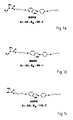
- Mixture 50 is composed, for example, of two compounds. One compound can be polymerizable liquid-crystalline monomers, for which three exemplary chemical structures are shown in FIG. 1.
- the second compound is a polymer, for which three different chemical structures are given by way of example in FIG. 2.
- the liquid-crystalline polymer used in this example has a degree of polymerization of about 140.
- the mixture 50 containing liquid-crystalline substances is at higher temperatures in the isotropic or the fluid liquid-crystalline phase.
- a direct voltage is applied to the connections 60 which are connected to the glass plates 20 which act as electrodes.
- the electrostatic field established between the ITO-coated glass plates 20 causes the monomers to be electropolymerized and the mixture 50 to be polarized.
- the mixture is then cooled from the liquid-crystalline state to the glass state in the presence of an electrostatic field.
- the result is the thin, solid, polar and polymeric film with a macroscopic polarization and a pyroelectric coefficient that is at least as high as that of PVDF-type pyroelectric elements.
- the pyroelectric coefficient of the invention Mixture 50 produced was determined by pyroelectric pulse technology (LM Blinov, VA Baikolov, MI Barnik, LA Beresnev, EP Pozhidayev, SV Yablonsky, Liq. Cryst., 2, 1987, 121).
- T C represents the transition temperature to the paraelectric phase.
- ⁇ p is the applied sound pressure, V the piezoelectric response (voltage) to the sound frequency, L the penetration length and R the radius of the sample.
- the first example relates to a mixture 50 which contains the liquid-crystalline side chain polymer polymethacrylate PM6R8 shown in FIG. 2A in its chemical structure and the associated monomers M6R8 shown in FIG. 1A.
- Fig. 4 shows five curves that show the temperature dependence of the pyroelectric coefficient for five different concentrations of the Monomers M6R8 show. The five curves were recorded at a monomer concentration of 26%, 33%, 40%, 51% and 72%, respectively. The information relates to the monomer concentration in percent by weight. All experimental values were obtained by cooling the mixture from the isotropic phase to room temperature with an applied DC voltage field with a field strength of 12 V / ⁇ m.
- FIGS. 4 and 5 show five curves with the macroscopic polarization for the mixture mentioned as a function of the temperature with the monomer concentration as a parameter. It can be seen from the curves in FIGS. 4 and 5 that the pyroelectric coefficient and the macroscopic polarization have their maximum value with a 33% monomer content in the mixture. 6 and 7 each show four curves for the pyroelectric coefficients and the spontaneous polarization for differently polarized mixtures of the polymer PM6R8 and its monomer M6R8 as a function of the temperature with the monomer concentration as parameters. The measurement data were obtained during the heating of the mixture from room temperature to the clearing point.
- the mixture with the greatest values for the pyroelectric coefficient and the macroscopic polarization is again obtained at a monomer concentration of 33 percent by weight.
- the pyroelectric coefficient has a value of 2.3-2.5 nC / cm 2 K.
- the pyroelectric coefficient or the macroscopic polarization of the mixture of PM6R8 and M6R8 shown depending on the monomer concentration.
- the characteristic maximum of the mixture is set for a polymer-monomer ratio of 2: 1.
- FIG. 10 shows four typical antiferroelectric hysteresis curves for the dependence of the pyroelectric coefficient on the DC field for differently concentrated mixtures of the polymer and the monomer.
- FIGS. 2b and 1b show the chemical structures of which are shown in FIGS. 2b and 1b.
- 12 and 13 show the pyroelectric coefficients and the macroscopic polarization for the mixture mentioned as a function of the temperature.
- Curves 1 in FIGS. 12 and 13 were recorded while the mixture was cooled with a field strength of 12 V / ⁇ m when a DC voltage field was applied.
- Curves 2 in Figures 12 and 13 were taken while the mixture was heating in the absence of an electric field.
- 14 shows the antiferroelectric hysteresis for the mixture described. For complete reorientation of the macroscopic polarization, a switching time of 10 s and an electric field strength of 20 V / ⁇ m were required.
- the 15 and 16 each show a curve for the temperature dependence of the pyroelectric coefficient or the macroscopic polarization for the mixture mentioned, which were recorded when the mixture was cooled with a DC field applied at the same time with an electrical field strength of 12 V / ⁇ m.
- the permittivity of the respective polymer was determined at 1 kHz and room temperature.
- the invention it is possible to produce polar polymer films with excellent antiferroelectric properties.
- the polymer films produced according to the invention are used, for example, as sensitive elements in piezoelectric and pyroelectric detectors.
- Another aspect of the invention is the controlled induction of a polar order in liquid crystals based on an appropriate change in the monomer concentration in the polymer matrix.
Landscapes
- Physics & Mathematics (AREA)
- Spectroscopy & Molecular Physics (AREA)
- Photometry And Measurement Of Optical Pulse Characteristics (AREA)
- Addition Polymer Or Copolymer, Post-Treatments, Or Chemical Modifications (AREA)
- Liquid Crystal Substances (AREA)
- Polymerisation Methods In General (AREA)
- Compositions Of Macromolecular Compounds (AREA)
- Radiation Pyrometers (AREA)
- Inorganic Insulating Materials (AREA)
Abstract
Description
- Die Erfindung betrifft ein Verfahren zur Herstellung einer pyroelektrischen Mischung, insbesondere für pyroelektrische und piezoelektrische Elemente, nach Anspruch 1.
- Es sind zahlreiche Methoden bekannt, Bauelemente mit piezoelektrischen und pyroelektrischen Eigenschaften herzustellen. Konventionelle Intensitätsdetektoren für den Infrarotbereich, die auf dem pyroelektrischen Effekt beruhen, enthalten infrarotempfindliche Elemente, die aus kristallinem oder polykristallinem Material mit pyroelektrischen Eigenschaften bestehen, wie z.B. Lithiumniobat, Glycinsulfat, Bleititanat usw. Derartige Bauelemente sollten eine möglichst schnelle Reaktionsfähigkeit und eine hohe Empfindlichkeit aufweisen. Dazu müssen die empfindlichen Bauelemente vorteilhafterweise dünner als 20 µm sein. Da jedoch dielektrische kristalline Materialien eine große Härte und außerdem eine hohe Spaltbarkeit besitzen, ist es zur Zeit aus praktischen Gesichtspunkten nicht möglich, infrarotempfindliche Elemente mit der gewünschten großen geometrischen Form herzustellen.
- Darüber hinaus sind ferroelektrische Materialien bekannt, aus denen empfindliche pyroelektrische und piezoelektrische Elemente herstellbar sind. Es ist bekannt, aus polymeren Ferroelektrika bestehende pyroelektrische und piezoelektrische Filme zu benutzen. Kawai berichtet in dem Aufsatz "The piezoelectricity of poly(vinilidene fluoride)", Jpn. J. Appl. Phys. 8, 975 (1969), daß das ferroelektrische Polymer Polyvinylidenfluorid (PVDF) den höchsten piezoelektrischen Koeffizienten im Vergleich zu allen anderen bekannten Polymeren besitzt. E. Yamaka offenbart unter dem Titel "Infrared intensity detector using a pyroelctric polymer" in dem U.S. Patent 3 707 695 26 (December 1972), daß der pyroelektrische Koeffizient von PVDF so groß ist, daß PVDF als infrarotempfindlicher Film eingesetzt werden kann. PVDF bildet eine Reihe von Molekül- und Kristallstrukturen aus, die von den Herstellungsbedingungen der Proben abhängig sind. Die Kristallform, die Ferroelektrizität zeigt, wird als I-Form oder β-Form bezeichnet. Die mechanischen und elektrischen Eigenschaften variieren in Abhängigkeit von der molekularen Konformation und der Kettenpackung in der Elementarzelle signifikant. Die kristallinen Modifikationen können unter geeigneten äußeren Bedingungen reversibel oder irreversibel ineinander umgewandelt werden. PVDF-Filme werden üblicherweise einer speziellen Behandlung (wie z.B. Ziehen und Ausrollen) unterworfen, um den Anteil an der kristallinen β-Form zu erhöhen. Danach werden die Filme unter Anlegen eines sehr hohen elektrischen Feldes gepolt, um Filme mit hohen pyroelektrischen und piezoelektrischen Koeffizienten zu erhalten.
- Während in Polymeren vom PVDF-Typ die Ferroelektrizität durch das Strecken, Ausrollen und Polen des Polymerfilms erreicht wird, die Ferroelektrizität also nicht eine Eigenschaft der unbehandelten Probe ist, tritt eine spontane Polarisation in flüssigkristallinen Polymeren mit der intrinsischen (niedrigen) Symmetrie C2 auf. Das Auftreten der Ferroelektrizität in flüssigen Kristallen wurde von Meyer et al. in dem Aufsatz "A material with ferroelectric chiral smectic C and H phases", Contribution to the 5th Int. Liquid Crystal Conference, Stockholm (1974) auf der Grundlage von Symmetrieargumenten postuliert. Die Autoren sagten das Auftreten von spontaner Polarisation in beliebigen lamellaren Systemen für getiltete chirale Moleküle mit einem von Null verschiedenen Dipolmoment voraus, welches senkrecht auf der molekularen Längsachse steht. Entsprechend dieser Voraussage wurde das erste ferroelektrische Seitenkettenpolymer durch Shibaev et al. synthetisiert (siehe den Aufsatz "Chiral smectic C* with spontaneous polarization", Polymer Bull. 12, 229 (1984) synthetisiert. Im Vergleich zu niedermolekularen ferroelektrischen Flüssigkristallen, die unterhalb der flüssigkristallinen Phase meist als Kristall vorliegen, tritt bei den polymeren ferroelektrischen Flüssigkristallen unterhalb des flüssigkristallinen Zustands häufig der Glaszustand auf. Deshalb ist es möglich, eine durch ein elektrisches Feld induzierte polare Orientierung unterhalb der Glastemperatur einzugefrieren. Dazu wird das chirale ferroelektrische flüssigkristalline Polymer über die Glastemperatur erhitzt, im elektrischen Feld orientiert und bei Anliegen eines Gleichspannungsfeldes unter die Glastemperatur (den Glaspunkt) abgekühlt.
- Eine bekannte Variation der bekannten Methode besteht darin, reaktive Moleküle in der ferroelektrischen smektischen C*-Phase durch ein angelegtes Gleichspannungfeld photoinduziert zu polymerisieren. Nach diesem Verfahren konnten hochtransparente orientierte Netzwerke mit dipolarer Orientierung von Hikmet hergestellt werden (siehe dazu seinen Aufsatz "Piezoelectric networks obtained by photopolymerization of liquid crystal molecules", Macromolecules, 25, 5759 (1992). Allerdings besitzen die bekannten ferroelektrischen flüssigkristallinen Polymere im Glaszustand nur niedrige piezoelektrische und pyroelektrische Koeffizienten.
- Die Herstellung von dünnen ferroelektrischen Filmen aus Polyharnstoff mittels einer Polymerisation auf der Grundlage einer Abscheidung aus der Dampfphase (vapor deposition polymerization) wurde von Y. Takahashi et al. in dem Aufsatz "Synthesis of aromatic polyimide film by vacuum deposition polymerization", J. Vacuum Sci. Technol. A5, 2253 (1987) beschrieben. Die Momomere wurden aus dem Dampfzustand heraus auf dem Substrat abgeschieden. Sie reagieren miteinander, indem sie die Harnstoff-Bindung ausbilden. Danach setzte eine spezifische Polungsprozedur ein, bei der ein elektrisches Feld angelegt, die Temperatur auf etwa 200° C erhöht und anschließend bei anliegendem Feld stufenweise erniedrigt wurde. Polymere auf der Harnstoff-Basis zeigen mittlere piezo- und pyroelektrische Koeffizientenwerte, und zwar nur bei erhöhten Temperaturen.
- Obwohl ferroelektrische Polymere sich durch eine niedrige Temperaturleitzahl, eine gute Formbarkeit und geringe Herstellungskosten auszeichnen, weisen sie gegenüber anorganischen Festkörpern eine deutlich niedrigere Empfindlichkeit aus. Die pyroelektrische Reaktionsfähigkeit und Detektionsfähigkeit von ferroelektrischen Polymeren ist deutlich geringer als bei Detektoren, die Triglycinsulfat (TGS)-Einkristalle oder PbTiO3-Keramikmaterialien enthalten.
- Der Erfindung liegt daher die Aufgabe zugrunde, ein Verfahren zur Verfügung zu stellen, das eine einfache Herstellung einer pyroelektrischen Mischung ermöglicht, die sich durch eine hohe pyroelektrische Reaktionsfähigkeit, eine hohe Gütezahl und einen großen pyroelektrischen Koeffizienten auszeichnet.
- Das technische Problem löst die Erfindung mit den Merkmalen des Anspruchs 1.
Vorteilhafte Weiterbildungen sind in den Unteransprüchen angegeben. - Die Erfindung löst dieses technische Problem dadurch, daß wenigstens zwei Verbindungen in einem vorbestimmten Mischungsverhältnis gemischt werden. Bei der einen Verbindung handelt es sich um polymerisationsfähige Monomere und bei der anderen Verbindung um ein Polymer oder ein Copolymer, wobei jede Verbindung wasserstoffbrückenbildende Substituenten enthält. Die Mischung wird über den spezifischen Glaspunkt erwärmt. Danach wird ein elektrisches, vorzugsweise ein Gleichspannungsfeld derart angelegt, daß mit Hilfe des elektrischen Feldes das polyermisationsfähige Monomer polymerisiert und die Mischung gepolt wird. Danach wird die Mischung bei angelegtem elektrischen Feld unter den spezifischen Glaspunkt abgekühlt. Das Ergebnis ist eine feste, polare und polymere Mischung, die einen pyroelektrischen Koeffizienten aufweist, der mindestens so hoch ist wie der eines pyroelektrischen Elementes vom PVDF-Typ.
- Vorteilhafterweise werden achirale flüssigkristalline Monomere und/oder ein achirales flüssigkristallines Polymer oder Copolymer verwendet. Denkbar ist allerdings auch der Einsatz von chiralen Monomeren und chiralen Polymeren.
- Zweckmäßigerweise trägt die periodisch wiederkehrende Struktureinheit des Polymers oder wenigstens eine Struktureinheit der das Copolymer bildenden Struktureinheiten wenigstens eine Hydroxygruppe. Auch das Monomer trägt wenigsten eine Hydroxygruppe.
- Als wasserstoffbrückenbildende Substituenten können vorteilhafterweise Azomethingruppen verwendet werden.
- Sowohl das Polymer oder das Copolymer als auch das verwendete Momomer weisen einen paraelektrischen Zustand auf.
Mit der erfindungsgemäßen Mischung können beispielsweise pyroelektrische Strahlungsdetektoren, Vidikon-Scheiben oder piezoelektrische Wandler gebaut werden.
Um ein sehr dünnes pyroelektrisches Element mit einer Dicke von weniger als 20 µm herstellen zu können, wird vor dem Anlegen des elektrischen Feldes eine dünne Probe aus der Mischung geformt, indem die Mischung beispielsweise in eine flache Kapillare eingefüllt oder mit ihr die Spin Coating-Technik angewandt wird. Durch ein nachträgliches Abkühlen der Mischung wird ein fester, polarer polymerer Film gebildet.
Den maximalen pyroelektrischen Koeffizienten erreicht man, wenn das Polymer-zu-Monomer Verhältnis oder das Copolymer-zu-Monomer-Verhältnis 2:1 beträgt. - Die Erfindung wird nachfolgend anhand der Ausführungsbeipiele in Verbindung mit den beiliegenden Zeichnungen näher erläutert. Es zeigen:
- Fig. 1a-c
- Beispiele für die chemische Struktur jeweils eines flüssigkristallinen Monomers, das Bestandteil der erfindungsgemäß hergestellten Mischung sein kann,
- Fig. 2a-c
- Beispiele für die chemische Struktur jeweils eines flüssigkristallinen Polymers, das ebenfalls Bestandteil der erfindungsgemäß hergestellten Mischung sein kann,
- Fig. 3
- eine schematische Zelle, in der ein dünnes pyroelektrisches Element erfindungsgemäß herstellbar ist,
- Fig. 4
- die graphische Darstellung des pyroelektrischen Koeffizienten in Abhängigkeit von der Temperatur für eine Mischung aus PM6R8 und M6R8 bei fünf verschiedenen Monomer-Konzentrationen,
- Fig. 5
- die graphische Darstellung der makroskopischen Polarisation in Abhängigkeit von der Temperatur für die Mischung von PM6R8 und M6R8 bei fünf verschiedenen Monomer-Konzentrationen,
- Fig. 6
- eine graphische Darstellung des pyroelektrischen Koeffizienten als Funktion der Temperatur für die Mischungen aus PM6R8 und M6R8 bei vier verschiedenen Monomerkonzentrationen,
- Fig. 7
- die graphische Darstellung der makroskopischen Polarisation als Funktion der Temperatur für die Mischungen aus PM6R8 und M6R8 bei vier verschiedenen Monomerkonzentrationen,
- Fig. 8
- eine Kurve, die den maximalen pyroelektrischen Koeffizienten für die Mischung aus PM6R8 und M6R8 in Abhängigkeit von der Monomerkonzentration darstellt,
- Fig. 9
- eine Kurve, die die maximale makroskopische Polarisation bei Raumtemperatur für die Mischung aus PM6R8 und M6R8 in Abhängigkeit von der Monomerkonzentration darstellt,
- Fig. 10
- den Verlauf der antiferroelektrischen Hysterese bei einer Abhängigkeit des pyroelektrischen Koeffizienten von einer angelegten Gleichspannung für vier verschieden konzentrierte Mischungen aus PM6R8 und M6R8,
- Fig. 11
- die graphische Darstellung des piezoelektrischen Koeffizienten d31 in Abhängigkeit von der Temperatur für die Mischung aus 74% PM6R8 und 26% M6R8 mit der Spannung als Parameter,
- Fig. 12
- die graphische Darstellung des pyroelektrischen Koeffizienten in Abhängigkeit von der Temperatur für die Mischung aus 74% PM6R8 und 26% M6R8,
- Fig. 13
- den graphischen Verlauf der makroskopischen Polarisation in Abhängigkeit von der Temperatur für die Mischung aus 74% PM6R8 und 26% M6R8,
- Fig. 14
- die antiferroelektrische Hysteresekurve für eine Mischung aus 67% PM6R6 und 33% M6R6,
- Fig. 15
- die Kurve für den pyroelektrischen Koeffizienten in Abhängigkeit von der Temperatur für eine Mischung aus 67% PA6R8 und 33% A6R8 und
- Fig. 16
- die Kurve für die makroskopische Polarisation in Abhängigkeit von der Temperatur für die Mischung aus 67% PA6R6 und 33% A6R8.
- In Fig. 3 ist eine Zelle 10 dargestellt, in der beispielsweise ein dünner fester, polarer und polymerer Film nach dem erfindungsgemäßen Verfahren hergestellt werden kann. Die Zelle 10 weist zwei als Elektroden fungierende ITO-beschichtete Glasplatten 20 auf, die durch Abstandshalter 30, beispielsweise aus Teflon, in einem Abstand von beispielsweise 10 µm zueinander gehalten werden.
- Die beiden ITO-beschichteten Glasplatten 20 bilden zusammen einen Plattenkondensator, in dem ein elektrostatisches Feld aufgebaut werden kann. Wie noch erklärt wird, werden mit Hilfe des elektrostatischen Feldes die in einer Mischung 50, aus der der Film gebildet wird, enthaltenen Monomere polymerisiert und die Mischung gepolt. Die kommerziell erhältlichen ITO-beschichteten Glasplatten 20 weisen vorteilhafterweise einen Elektrodenwiderstand von 100 Ω/cm2 auf. Der genaue Abstand zwischen den Elektroden kann zwar variieren, er beträgt aber durchschnittlich nur einige µm. In die Zelle 10 ist die flüssigkristalline Substanzen enthaltene Mischung 50 eingefüllt. Die Mischung 50 setzt sich beispielsweise aus zwei Verbindungen zusammen. Die eine Verbindung können polymerisationsfähige flüssigkristalline Monomere sein, für die in Fig. 1 drei beispielhafte chemische Strukturen dargestellt sind. Bei der zweiten Verbindung handelt es sich um ein Polymer, für das in Fig. 2 beispielhaft drei verschiedene chemische Strukturen angegeben sind. Das in diesem Beispiel verwendete flüssigkristalline Polymer hat einen Polymerisationsgrad von etwa 140. Die flüssigkristalline Substanzen enthaltende Mischung 50 befindet sich bei höheren Temperaturen in der isotropen oder der fluiden flüssigkristallinen Phase. Nachdem die Mischung 50 in der Zelle 10 über ihren spezifischen Glaspunkt erwärmt worden ist, wird an die Anschlüsse 60, die mit den als Elektroden wirkenden Glasplatten 20 verbunden sind, eine Gleichspannung angelegt. Das zwischen den ITO-beschichteten Glasplatten 20 aufgebaute elektrostatische Feld bewirkt eine Elektropolymerisation der Monomere und eine Polung der Mischung 50. Anschließend wird die Mischung bei bestehendem elektrostatischen Feld aus dem flüssigkristallinen Zustand in den Glaszustand abgekühlt. Das Ergebnis ist der dünne, feste, polare und polymere Film mit einer makroskopischen Polarisierung und einem pyroelektrischen Koeffizienten, die wenigstens so hoch sind wie die bei pyroelektrischen Elementen vom PVDF-Typ. Der pyroelektrische Koeffizient der erfindungsgemäß hergestellten Mischung 50 wurde durch die pyroelektrische Pulstechnik (L.M. Blinov, V.A. Baikolov, M.I. Barnik, L.A. Beresnev, E.P. Pozhidayev, S.V. Yablonsky, Liq. Cryst., 2, 1987, 121) bestimmt. Die Temperaturabhängigkeit der makroskopischen Polarisation wurde durch Integration des pyroelektrischen Koeffizienten über die Temperatur gemäß der Gleichung


- Dabei sind Δp der anliegende Schalldruck, V die piezoelektrische Antwort (Spannung) auf die Schallfrequenz, L die Penetrationslänge und R der Radius der Probe.
- Es werden nunmehr für das erfindungsgemäße Verfahren geeignete Mischungen aus geeigneten Verbindungen sowie deren antiferroelektrische Eigenschaften beispielhaft beschrieben.
- Das erste Beispiel betrifft eine Mischung 50, die das in Fig. 2A in seiner chemischen Struktur dargestellte flüssigkristalline Seitenkettenpolymer Polymethacrylat PM6R8 und die dazugehörenden, in Fig. 1A dargestellten Monomere M6R8 enthält. In Abb. 4 sind fünf Kurven dargestellt, die die Temperaturabhängigkeit des pyroelektrischen Koeffizienten für fünf verschiedene Konzentrationen des Monomers M6R8 zeigen. Die fünf Kurven wurden bei einer Monomer-Konzentration von 26%, 33%, 40%, 51% bzw. 72% aufgenommen. Die Angaben beziehen sich dabei auf die Monomer-Konzentration in Gewichtsprozenten. Alle experimentellen Werte wurden bei Abkühlung der Mischung aus der isotropen Phase auf Raumtemperatur bei einem angelegten elektrischen Gleichspannungsfeld mit einer Feldstärke von 12 V/µm erhalten. Fig. 5 zeigt fünf Kurven mit der makroskopischen Polarisation für die genannte Mischung in Abhängigkeit von der Temperatur mit der Monomer-Konzentration als Parameter. Aus den in Fig. 4 und 5 dargestellten Kurven erkennt man, daß der pyroelektrische Koeffizient und die makroskopische Polarisation seinen bzw. ihren Maximalwert bei einem 33%igen Monomeranteil in der Mischung besitzen. In Fig. 6 und 7 sind jeweils vier Kurven für die pyroelektrischen Koeffizienten bzw. die spontane Polarisation für verschieden gepolte Mischungen aus dem Polymer PM6R8 und seinem Monomer M6R8 in Abhängigkeit von der Temperatur mit der Monomer-Konzentration als Parameter dargestellt. Die Meßdaten wurden während des Aufheizens der Mischung von der Raumtemperatur bis zum Klärpunkt erhalten. Die Mischung mit den größten Werten für den pyroelektrischen Koeffizienten und die makroskopische Polarisation erhält man wiederum bei einer Monomer-Konzentration von 33 Gewichtsprozenten. Im Bereich zwischen der Raumtemperatur und dem spezifischen Glaspunkt bei 65°C besitzt der pyroelektrische Koeffizient einen Wert von 2.3-2.5 nC/cm2K. In Fig. 8 und 9 ist der pyroelektrische Koeffizient bzw. die makroskopische Polarisation der Mischung aus PM6R8 und M6R8 in Abhängigkeit von der Monomer-Konzentration dargestellt. Das charakteristische Maximum der Mischung stellt sich für ein Polymer-Monomer-Verhältnis von 2:1 ein. In Fig. 10 sind vier typische antiferroelektrische Hysteresekurven für die Abhängigkeit des pyroelektrischen Koeffizienten vom Gleichspannungsfeld für verschieden konzentrierte Mischungen aus dem Polymer und dem Monomer dargestellt. Aus der Pfeilrichtung ist die Behandlung der Mischung durch das elektrische Feld und deren resultierende Eigenschaften zu erkennen. Ein Umschalten der Polarität der angelegten Gleichspannung ändert dabei das Vorzeichen des pyroelektrischen Signals. Für eine vollständige Reorientierung der makroskopischen Polarisation war eine Schaltzeit von τ = 10 s und eine elektrische Feldstärke von 10 V/µm erforderlich. Fig. 11 zeigt die Kurvenverläufe des piezoelektrischen Koeffizienten d31 in Abhängigkeit von der Temperatur für eine Mischung aus 74% PM6R8 und 26% M6R8 mit der angelegten Gleichspannung als Parameter. Die Mischungen wurden mit Hilfe des angelegten elektrischen Gleichspannungsfeldes gepolt. Obwohl das angelegte Feld die Mischung nicht in die Sättigung führte, wurde bei Raumtemperatur ein piezoelektrischer Koeffizient d31 von 1 pC/N erreicht.
- In einem weiteren Beispiel wurde eine Mischung aus 67% PM6R6 und 33 % M6R6 untersucht, deren chemische Strukturen in Fig. 2b bzw. 1b dargestellt sind. Fig. 12 und 13 zeigen die pyroelektrischen Koeffizienten und die makroskopische Polarisation für die genannte Mischung in Abhängigkeit von der Temperatur. Die Kurven 1 in Fig. 12 und 13 wurden aufgenommen, während die Mischung bei anliegendem Gleichspannungsfeld mit einer Feldstärke 12 V/µm abgekühlt wurde. Die Kurven 2 in den Fig. 12 und 13 wurden während des Erhitzens der Mischung bei Fehlen eines elektrischen Feldes aufgenommen. In Fig. 14 ist die antiferroelektrische Hysterese für die beschriebene Mischung dargestellt. Zur vollständigen Reorientierung der makroskopischen Polarisation waren eine Schaltzeit von 10 s und eine elektrische Feldstärke von 20 V/µm erforderlich.
- In dem dritten Beispiel wurde eine Mischung aus flüssigkristallinen Polyacrylat mit mesogenen Seitenketten PA6R8, das in Fig. 2c dargestellt ist, und seinen Monomeren A6R8, deren Struktur in Fig. 1c dargestellt ist, mit einem Polymer-Monomer-Verhältnis von 67% zu 33 % untersucht. Die Fig. 15 und 16 zeigt jeweils eine Kurve für die Temperaturabhängigkeit des pyroelektrischen Koeffizienten bzw. der makroskopischen Polarisation für die genannte Mischung, die bei Abkühlen der Mischung bei gleichzeitig angelegtem Gleichspannungsfeld mit einer elektrischen Feldstärke von 12 V/µm aufgenommen worden sind.
- Weitere untersuchte Mischungen aus polymerisationsfähigen Monomeren und Polymeren, die allesamt Wasserstoffbrückenbildende Substituenten enthalten, sowie deren pyroelektrischer Koeffizient, deren spontane Polarisation und Gütezahl sind in der nachfolgenden Tabelle 1 aufgeführt.
Tabelle 1 Materialien Pyroelektrischer Koeffizient, γ [nC/cm2K] Spontane Polarisation PS [nC/cm2] Gütezahl, γ/cηε' [Vcm2/J] PM6R8+33%M6R8 2.36 395 4820 PM6R8+26%M6R8 0.67 130 3229 PM6R8+40%M6R8 0.11 110 224 PM6R8+51%M6R8 0.04 72 82 PM6R6+33%M6R6 0.97 70 1980 PM6R8+33%A6R8 1.45 315 2960 ε'=2.3ε0, CP=2.3 J/cm3 - Die Permittivität des jeweiligen Polymers wurde bei 1 kHz und Raumtemperatur ermittelt. Zur Berechnung der Gütezahl der untersuchten Materialien wurden die Werte der Permittivität ε'=2.4 ε0 und der Wärmekapazität CP=2.37 J/cm3 verwendet.
- Dank der Erfindung ist es möglich, polare Polymerfilme mit hervorragenden antiferroelektrischen Eigenschaften herzustellen. Die erfindungsgemäß hergestellten Polymerfilme finden beispielsweise Anwendung als empfindliche Elemente in piezoelektrischen und pyroelektrischen Detektoren. Ein weiterer Gesichtspunkt der Erfindung liegt in der kontrollierten Induzierung einer polaren Ordnung in Flüssigkristallen, die auf einer geeigneten Änderung der Monomer-Konzentration in der Polymermatrix basiert.
Claims (11)
- Verfahren zur Herstellung einer pyroelektrischen Mischung, insbesondere für pyroelektrische und piezoelektrische Elemente, mit folgenden Schritten:a) Mischen von wenigstens zwei Verbindungen in einem vorbestimmten Mischungsverhältnis, wobei eine Verbindung polymerisationsfähige Monomere enthält und die andere Verbindung ein Polymer oder ein Copolymer ist, und jede Verbindung wasserstoffbrückenbildende Substituenten enthält,b) Erwärmen der Mischung über den spezifischen Glaspunkt,c) Anlegen eines elektrischen Feldes, mit dessen Hilfe das polymerisationsfähige Momomer polymerisiert und die Mischung gepolt wird, undd) Abkühlen der Mischung unterhalb des Glaspunktes bei angelegtem elektrischen Feld.
- Verfahren nach Anspruch 1,
dadurch gekennzeichnet, daß achirale oder chirale Verbindungen verwendet werden. - Verfahren nach Anspruch 1 oder 2,
dadurch gekennzeichnet, daß ein flüssigkristallines Momomer und/oder ein flüssigkristallines Polymer verwendet wird. - Verfahren nach einem der Ansprüche 1-3,
dadurch gekennzeichnet, daß die periodisch wiederkehrende Struktureinheit des Polymers oder wenigstens eine der Struktureinheiten des Copolymers wenigstens eine Hydroxygruppe trägt. - Verfahren nach einem der Ansprüche 1-4,
dadurch gekennzeichnet, daß das Monomer wenigstens eine Hydroxygruppe trägt. - Verfahren nach einem der Ansprüche 1-5,
dadurch gekennzeichnet, daß wenigstens die beiden Verbindungen Azomethingruppen tragen. - Verfahren nach einem der Ansprüche 1-6,
dadurch gekennzeichnet, daß ein paraelektrisches Polymer oder Copolymer verwendet wird. - Verfahren nach einem der Ansprüche 1-7,
dadurch gekennzeichnet, daß ein paraelektrisches Monomer verwendet wird. - Verfahren nach einem der Ansprüche 1-8,
dadurch gekennzeichnet, daß vor dem Anlegen des elektrischen Feldes eine dünne Probe aus der Mischung geformt wird. - Verfahren nach einem der Ansprüche 1-9,
dadurch gekennzeichnet, daß durch das Abkühlen der Mischung eine feste, polare, polymere Mischung gebildet wird. - Verfahren nach einem der Ansprüche 1-10,
dadurch gekennzeichnet, daß ein Polymer-zu-Monomer- oder Copolymer-zu-Monomer-Verhältnis von etwa 2:1 verwendet wird.
Applications Claiming Priority (2)
| Application Number | Priority Date | Filing Date | Title |
|---|---|---|---|
| DE19547934 | 1995-12-22 | ||
| DE19547934A DE19547934A1 (de) | 1995-12-22 | 1995-12-22 | Verfahren zur Herstellung einer pyroelektrischen Mischung |
Publications (2)
| Publication Number | Publication Date |
|---|---|
| EP0780914A1 true EP0780914A1 (de) | 1997-06-25 |
| EP0780914B1 EP0780914B1 (de) | 2000-05-17 |
Family
ID=7780880
Family Applications (1)
| Application Number | Title | Priority Date | Filing Date |
|---|---|---|---|
| EP96117996A Expired - Lifetime EP0780914B1 (de) | 1995-12-22 | 1996-11-09 | Verfahren zur Herstellung einer pyroelektrischen Mischung |
Country Status (6)
| Country | Link |
|---|---|
| US (1) | US5833833A (de) |
| EP (1) | EP0780914B1 (de) |
| JP (1) | JPH09237921A (de) |
| AT (1) | ATE193158T1 (de) |
| CA (1) | CA2193563C (de) |
| DE (2) | DE19547934A1 (de) |
Families Citing this family (5)
| Publication number | Priority date | Publication date | Assignee | Title |
|---|---|---|---|---|
| KR20070036243A (ko) * | 2005-09-29 | 2007-04-03 | 서울시립대학교 산학협력단 | 강유전체 반도체장치를 위한 유기물 |
| JP5206367B2 (ja) * | 2008-11-27 | 2013-06-12 | コニカミノルタエムジー株式会社 | ウレア化合物を含む有機圧電材料 |
| CL2011000198A1 (es) * | 2011-01-31 | 2013-04-01 | Univ Chile | Procedimiento de polimerizacion para obtener un aparato electro-optico donde se produce la polimerizacion de un compuesto polimerizable in situ, dicho poliemro obtenido in situ; el aparato electro-optico que contiene a dicho polimero; y usos del aparato. |
| TWI448381B (zh) * | 2012-01-10 | 2014-08-11 | 私立中原大學 | Process Method and System of PVDF Piezoelectric Film without Metallization Electrode |
| JP6264525B2 (ja) * | 2013-03-25 | 2018-01-24 | セイコーエプソン株式会社 | 赤外線センサー、熱検知素子及びそれを用いた熱検知方法 |
Citations (6)
| Publication number | Priority date | Publication date | Assignee | Title |
|---|---|---|---|---|
| US3707695A (en) | 1970-10-20 | 1972-12-26 | Matsushita Electric Industrial Co Ltd | Infrared intensity detector using a pyroelectric polymer |
| EP0044702A1 (de) * | 1980-07-23 | 1982-01-27 | Minnesota Mining And Manufacturing Company | Pyroelektrische und isotrope piezoelektrische Polymermischung |
| EP0093038A1 (de) * | 1982-04-27 | 1983-11-02 | Thomson-Csf | Piezoelektrische polymerische Stoffe |
| EP0473224A1 (de) * | 1990-08-30 | 1992-03-04 | SOLVAY (Société Anonyme) | Mischungen aus polaren Polymeren und elektrisch fähigen dedopierten Polymeren, Verfahren zur Herstellung dieser Mischungen und Verwendung dieser Mischungen in elektronischen optoelektrischen elektrotechnischen und elektromechanischen Gegenständen |
| EP0562681A2 (de) * | 1992-03-27 | 1993-09-29 | Koninklijke Philips Electronics N.V. | Piezoelektrisches Material mit einem polymeren Netzwerk |
| JPH07115230A (ja) * | 1993-10-18 | 1995-05-02 | Asahi Glass Co Ltd | 圧電焦電体装置およびその製造法 |
Family Cites Families (7)
| Publication number | Priority date | Publication date | Assignee | Title |
|---|---|---|---|---|
| CA992738A (en) * | 1971-04-08 | 1976-07-13 | Naohiro Murayama | Pyroelectric element of polymer film |
| US4692285A (en) * | 1985-07-01 | 1987-09-08 | Pennwalt Corporation | Process of preparing nonfibrous, piezoelectric polymer sheet of improved activity |
| FR2610422A1 (fr) * | 1987-02-04 | 1988-08-05 | Commissariat Energie Atomique | Procede pour modifier la polarite d'un polymere comportant des groupements polaires, utilisable notamment dans une cellule a cristal liquide |
| JPS63233340A (ja) * | 1987-03-20 | 1988-09-29 | Kureha Chem Ind Co Ltd | 焦電型赤外線センサ− |
| JPH01296216A (ja) * | 1988-05-24 | 1989-11-29 | Idemitsu Kosan Co Ltd | 液晶焦圧電素子、その製造方法及び赤外線検出器 |
| US5035917A (en) * | 1989-06-22 | 1991-07-30 | Siemens Aktiengesellschaft | Method of preparing layers of vinylidene fluoride polymers and vinylidene fluoride/trifluoroethylene copolymers on a substrate |
| US5100589A (en) * | 1989-12-04 | 1992-03-31 | Lockheed Missiles & Space Company, Inc. | Optical method for altering molecular alignment in selected regions of a non-linear optical polymeric structure |
-
1995
- 1995-12-22 DE DE19547934A patent/DE19547934A1/de not_active Withdrawn
-
1996
- 1996-11-09 AT AT96117996T patent/ATE193158T1/de not_active IP Right Cessation
- 1996-11-09 DE DE59605240T patent/DE59605240D1/de not_active Expired - Lifetime
- 1996-11-09 EP EP96117996A patent/EP0780914B1/de not_active Expired - Lifetime
- 1996-12-13 JP JP33405996A patent/JPH09237921A/ja not_active Ceased
- 1996-12-20 US US08/772,203 patent/US5833833A/en not_active Expired - Lifetime
- 1996-12-20 CA CA002193563A patent/CA2193563C/en not_active Expired - Fee Related
Patent Citations (6)
| Publication number | Priority date | Publication date | Assignee | Title |
|---|---|---|---|---|
| US3707695A (en) | 1970-10-20 | 1972-12-26 | Matsushita Electric Industrial Co Ltd | Infrared intensity detector using a pyroelectric polymer |
| EP0044702A1 (de) * | 1980-07-23 | 1982-01-27 | Minnesota Mining And Manufacturing Company | Pyroelektrische und isotrope piezoelektrische Polymermischung |
| EP0093038A1 (de) * | 1982-04-27 | 1983-11-02 | Thomson-Csf | Piezoelektrische polymerische Stoffe |
| EP0473224A1 (de) * | 1990-08-30 | 1992-03-04 | SOLVAY (Société Anonyme) | Mischungen aus polaren Polymeren und elektrisch fähigen dedopierten Polymeren, Verfahren zur Herstellung dieser Mischungen und Verwendung dieser Mischungen in elektronischen optoelektrischen elektrotechnischen und elektromechanischen Gegenständen |
| EP0562681A2 (de) * | 1992-03-27 | 1993-09-29 | Koninklijke Philips Electronics N.V. | Piezoelektrisches Material mit einem polymeren Netzwerk |
| JPH07115230A (ja) * | 1993-10-18 | 1995-05-02 | Asahi Glass Co Ltd | 圧電焦電体装置およびその製造法 |
Non-Patent Citations (5)
| Title |
|---|
| "Piezoelectric networks obtained by photopolymerization of liquid crystal molecules.", MACROMOLECULES., vol. 25, 1992, pages 5759 |
| "The Piezoelectricity of poly(vinilidene fluoride).", JPN. J. APPL. PHYS., vol. 8, 1969, pages 975 |
| PATENT ABSTRACTS OF JAPAN vol. 095, no. 008 29 September 1995 (1995-09-29) * |
| SHIBAEV ET AL.: "Chiral smectic C' with spontaneous polarization.", POLYMER BULL., vol. 12, 1984, pages 229 |
| TAKAHASHI Y. ET AL.: "Synthesis of aromatic polyimide film by vacuum deposition polymerization.", J. VACUUM SCI. TECHNOL., vol. A5, 1987, pages 2253 |
Also Published As
| Publication number | Publication date |
|---|---|
| DE59605240D1 (de) | 2000-06-21 |
| CA2193563C (en) | 2003-04-22 |
| US5833833A (en) | 1998-11-10 |
| DE19547934A1 (de) | 1997-06-26 |
| CA2193563A1 (en) | 1997-06-23 |
| EP0780914B1 (de) | 2000-05-17 |
| ATE193158T1 (de) | 2000-06-15 |
| JPH09237921A (ja) | 1997-09-09 |
Similar Documents
| Publication | Publication Date | Title |
|---|---|---|
| DE69128156T2 (de) | Homogene elektrorheologische Flüssigkeit | |
| DE69707117T2 (de) | Verbesserte piezoelektrische keramik-polymer-zusammensetzung | |
| DE3502160C2 (de) | ||
| DE69230786T2 (de) | Ferroelektrische Flüssigkristall-Anzeigevorrichtung und Verfahren zu ihrer Herstellung | |
| DE69519270T2 (de) | Ferroelektrisches Polymermaterial in Form von einer einkristallinen Faser oder einem einkristallinen Film | |
| DE102008021827B4 (de) | Keramischer Werkstoff, Verfahren zur Herstellung des keramischen Werkstoffs, Bauelement mit dem keramischen Werkstoff und seine Verwendung | |
| DE69512186T2 (de) | Ferroelektrische Dünnschicht, Substrat bedeckt mit einer ferroelektrischen Dünnschicht und Verfahren zur Herstellung einer ferroelektrischen Dünnschicht | |
| DE69320073T2 (de) | Verfahren zur Behandlung einer chiralen smektischen Flüssigkristallvorrichtung | |
| DE68919044T2 (de) | Ferroelektrische Flüssigkristallzelle. | |
| DE2135101B2 (de) | Detektormaterial für einen pyroelektrisch arbeitenden Strahlungsdetektor | |
| DE69308049T2 (de) | Piezoelektrisches Material mit einem polymeren Netzwerk | |
| DE3630012A1 (de) | Ferroelektrische fluessigkristallvorrichtung | |
| DE3787218T2 (de) | Flüssigkristallvorrichtungen. | |
| DE3789909T2 (de) | Vorrichtung mit einem ferroelektrischen Film. | |
| DE69320076T2 (de) | Verfahren zur Ansteuerung einer Flüssigkristall- Anzeigevorrichtung | |
| DE60103048T2 (de) | Verfahren zur herstellung von ultradünnen polymerfolien | |
| DE4007144A1 (de) | Verfahren zur orientierung fluessigkristalliner polymere und ihr einsatz als orientierungsschicht in fluessigkristall-, schalt- und -anzeigevorrichtungen | |
| DE4237552C2 (de) | Flüssigkristallvorrichtung mit einem ferroelektrischen Flüssigkristall und einem Ausrichtungsfilm aus einem Polyimid | |
| DE3434767C2 (de) | Verfahren zur Herstellung eines polymeren Elektret-Elements | |
| EP0780914B1 (de) | Verfahren zur Herstellung einer pyroelektrischen Mischung | |
| DE3884833T2 (de) | Pyroelektrischer Infrarotfühler. | |
| DE2147892B2 (de) | Verfahren zur herstellung von piezoelektrischen polyvinylidenfluorid-folien | |
| DE69917664T2 (de) | Tristabile flüssigkristallanzeigevorrichtung | |
| DE3524803C2 (de) | ||
| DE69427386T2 (de) | Flüssigkristall-Anzeigevorrichtung |
Legal Events
| Date | Code | Title | Description |
|---|---|---|---|
| PUAI | Public reference made under article 153(3) epc to a published international application that has entered the european phase |
Free format text: ORIGINAL CODE: 0009012 |
|
| AK | Designated contracting states |
Kind code of ref document: A1 Designated state(s): AT BE CH DE DK ES FI FR GB GR IE IT LI LU MC NL PT SE |
|
| 17P | Request for examination filed |
Effective date: 19971229 |
|
| GRAG | Despatch of communication of intention to grant |
Free format text: ORIGINAL CODE: EPIDOS AGRA |
|
| GRAH | Despatch of communication of intention to grant a patent |
Free format text: ORIGINAL CODE: EPIDOS IGRA |
|
| 17Q | First examination report despatched |
Effective date: 19990823 |
|
| GRAH | Despatch of communication of intention to grant a patent |
Free format text: ORIGINAL CODE: EPIDOS IGRA |
|
| GRAA | (expected) grant |
Free format text: ORIGINAL CODE: 0009210 |
|
| AK | Designated contracting states |
Kind code of ref document: B1 Designated state(s): AT BE CH DE DK ES FI FR GB GR IE IT LI LU MC NL PT SE |
|
| PG25 | Lapsed in a contracting state [announced via postgrant information from national office to epo] |
Ref country code: NL Free format text: LAPSE BECAUSE OF FAILURE TO SUBMIT A TRANSLATION OF THE DESCRIPTION OR TO PAY THE FEE WITHIN THE PRESCRIBED TIME-LIMIT Effective date: 20000517 Ref country code: IT Free format text: LAPSE BECAUSE OF FAILURE TO SUBMIT A TRANSLATION OF THE DESCRIPTION OR TO PAY THE FEE WITHIN THE PRE;WARNING: LAPSES OF ITALIAN PATENTS WITH EFFECTIVE DATE BEFORE 2007 MAY HAVE OCCURRED AT ANY TIME BEFORE 2007. THE CORRECT EFFECTIVE DATE MAY BE DIFFERENT FROM THE ONE RECORDED.SCRIBED TIME-LIMIT Effective date: 20000517 Ref country code: GR Free format text: LAPSE BECAUSE OF NON-PAYMENT OF DUE FEES Effective date: 20000517 Ref country code: FI Free format text: LAPSE BECAUSE OF FAILURE TO SUBMIT A TRANSLATION OF THE DESCRIPTION OR TO PAY THE FEE WITHIN THE PRESCRIBED TIME-LIMIT Effective date: 20000517 Ref country code: ES Free format text: THE PATENT HAS BEEN ANNULLED BY A DECISION OF A NATIONAL AUTHORITY Effective date: 20000517 |
|
| REF | Corresponds to: |
Ref document number: 193158 Country of ref document: AT Date of ref document: 20000615 Kind code of ref document: T |
|
| REG | Reference to a national code |
Ref country code: IE Ref legal event code: FG4D Free format text: GERMAN Ref country code: CH Ref legal event code: EP |
|
| REF | Corresponds to: |
Ref document number: 59605240 Country of ref document: DE Date of ref document: 20000621 |
|
| PG25 | Lapsed in a contracting state [announced via postgrant information from national office to epo] |
Ref country code: SE Free format text: LAPSE BECAUSE OF FAILURE TO SUBMIT A TRANSLATION OF THE DESCRIPTION OR TO PAY THE FEE WITHIN THE PRESCRIBED TIME-LIMIT Effective date: 20000817 Ref country code: PT Free format text: LAPSE BECAUSE OF FAILURE TO SUBMIT A TRANSLATION OF THE DESCRIPTION OR TO PAY THE FEE WITHIN THE PRESCRIBED TIME-LIMIT Effective date: 20000817 Ref country code: DK Free format text: LAPSE BECAUSE OF FAILURE TO SUBMIT A TRANSLATION OF THE DESCRIPTION OR TO PAY THE FEE WITHIN THE PRESCRIBED TIME-LIMIT Effective date: 20000817 |
|
| GBT | Gb: translation of ep patent filed (gb section 77(6)(a)/1977) |
Effective date: 20000803 |
|
| ET | Fr: translation filed | ||
| NLV1 | Nl: lapsed or annulled due to failure to fulfill the requirements of art. 29p and 29m of the patents act | ||
| PG25 | Lapsed in a contracting state [announced via postgrant information from national office to epo] |
Ref country code: LU Free format text: LAPSE BECAUSE OF NON-PAYMENT OF DUE FEES Effective date: 20001109 Ref country code: AT Free format text: LAPSE BECAUSE OF NON-PAYMENT OF DUE FEES Effective date: 20001109 |
|
| PG25 | Lapsed in a contracting state [announced via postgrant information from national office to epo] |
Ref country code: MC Free format text: THE PATENT HAS BEEN ANNULLED BY A DECISION OF A NATIONAL AUTHORITY Effective date: 20001130 Ref country code: LI Free format text: LAPSE BECAUSE OF NON-PAYMENT OF DUE FEES Effective date: 20001130 Ref country code: CH Free format text: LAPSE BECAUSE OF NON-PAYMENT OF DUE FEES Effective date: 20001130 Ref country code: BE Free format text: LAPSE BECAUSE OF NON-PAYMENT OF DUE FEES Effective date: 20001130 |
|
| PG25 | Lapsed in a contracting state [announced via postgrant information from national office to epo] |
Ref country code: IE Free format text: LAPSE BECAUSE OF NON-PAYMENT OF DUE FEES Effective date: 20010205 |
|
| REG | Reference to a national code |
Ref country code: IE Ref legal event code: FD4D |
|
| PLBE | No opposition filed within time limit |
Free format text: ORIGINAL CODE: 0009261 |
|
| STAA | Information on the status of an ep patent application or granted ep patent |
Free format text: STATUS: NO OPPOSITION FILED WITHIN TIME LIMIT |
|
| 26N | No opposition filed | ||
| BERE | Be: lapsed |
Owner name: DEUTSCHE TELEKOM A.G. Effective date: 20001130 |
|
| REG | Reference to a national code |
Ref country code: CH Ref legal event code: PL |
|
| REG | Reference to a national code |
Ref country code: GB Ref legal event code: IF02 |
|
| PGFP | Annual fee paid to national office [announced via postgrant information from national office to epo] |
Ref country code: GB Payment date: 20101123 Year of fee payment: 15 |
|
| PGFP | Annual fee paid to national office [announced via postgrant information from national office to epo] |
Ref country code: FR Payment date: 20111125 Year of fee payment: 16 |
|
| PGFP | Annual fee paid to national office [announced via postgrant information from national office to epo] |
Ref country code: DE Payment date: 20120125 Year of fee payment: 16 |
|
| GBPC | Gb: european patent ceased through non-payment of renewal fee |
Effective date: 20121109 |
|
| REG | Reference to a national code |
Ref country code: FR Ref legal event code: ST Effective date: 20130731 |
|
| REG | Reference to a national code |
Ref country code: DE Ref legal event code: R119 Ref document number: 59605240 Country of ref document: DE Effective date: 20130601 |
|
| PG25 | Lapsed in a contracting state [announced via postgrant information from national office to epo] |
Ref country code: DE Free format text: LAPSE BECAUSE OF NON-PAYMENT OF DUE FEES Effective date: 20130601 |
|
| PG25 | Lapsed in a contracting state [announced via postgrant information from national office to epo] |
Ref country code: FR Free format text: LAPSE BECAUSE OF NON-PAYMENT OF DUE FEES Effective date: 20121130 Ref country code: GB Free format text: LAPSE BECAUSE OF NON-PAYMENT OF DUE FEES Effective date: 20121109 |