EP0781061A2 - Equipements, systèmes et méthodes pour associer un abonné à un terminal dans un système de communication intelligent - Google Patents
Equipements, systèmes et méthodes pour associer un abonné à un terminal dans un système de communication intelligent Download PDFInfo
- Publication number
- EP0781061A2 EP0781061A2 EP96118784A EP96118784A EP0781061A2 EP 0781061 A2 EP0781061 A2 EP 0781061A2 EP 96118784 A EP96118784 A EP 96118784A EP 96118784 A EP96118784 A EP 96118784A EP 0781061 A2 EP0781061 A2 EP 0781061A2
- Authority
- EP
- European Patent Office
- Prior art keywords
- portable device
- indicia
- signal
- operative
- communication system
- Prior art date
- Legal status (The legal status is an assumption and is not a legal conclusion. Google has not performed a legal analysis and makes no representation as to the accuracy of the status listed.)
- Withdrawn
Links
Images


Classifications
-
- H—ELECTRICITY
- H04—ELECTRIC COMMUNICATION TECHNIQUE
- H04W—WIRELESS COMMUNICATION NETWORKS
- H04W4/00—Services specially adapted for wireless communication networks; Facilities therefor
- H04W4/16—Communication-related supplementary services, e.g. call-transfer or call-hold
-
- H—ELECTRICITY
- H04—ELECTRIC COMMUNICATION TECHNIQUE
- H04W—WIRELESS COMMUNICATION NETWORKS
- H04W8/00—Network data management
- H04W8/18—Processing of user or subscriber data, e.g. subscribed services, user preferences or user profiles; Transfer of user or subscriber data
Definitions
- the present invention relates generally to the field of telephony, and more particularly, to devices, systems and methods that associate a party with a terminal in an intelligent communication system.
- PCA personal communications assistant
- a PCA is a device, possibly a communications terminal, used to enter scheduling information into a suitable communication system, i.e., an intelligent communication system.
- the scheduling information may include an urgency level associated with an out going call or an availability level associated with a particular party.
- the availability level indicates the party's availability to receive a call.
- PCAs are more fully disclosed in United States Patent Application Serial No. 08/533,045, Attorney Docket No. Aykin 1-4-1-3-3-2-2, which was incorporated by reference hereinabove.
- the intelligent communication system in response to the scheduling information, establishes a data link at an optimum time for both the calling and called parties thereby enabling communication therebetween.
- PCAs are not portable. The PCA user may only avail himself to the benefits of this technology while at a particular location, such as at home or the office. If the PCA is portable, the user is required to modify his scheduling information continuously. Modifications may include, for example, entering scheduling information, such as "at the office,” “at a pay telephone,” “in the car with a wireless telephone,” “in the car with a wireless message pager,” or the like. Worse, the portable PCA user, may wish to change his availability depending upon whether he is near a pay telephone, in the car, etc.
- the inability of conventional solutions to integrate the advantages of the PCA into a portable and less obtrusive device is a dominant obstacle to producing cost-effective and more commercially desirable products.
- the present invention is directed to portable devices, methods and communication systems that associate a party with a terminal of a communication system.
- Communications involves the transmission of voice or data signals between two or more terminals, or nodes, in the communication system.
- Representative communication media include air, wire, fiber optic cable and the like, and representative communication systems and devices include wired, wireless and video telephony, message pagers, voice mail and e-mail systems, and the like.
- the present invention provides communication management functionality that requires a minimum of user control. Conversations between users may be enabled automatically and in a manner that chooses one or more optimum communication resources and may avoid unnecessary and annoying interruptions.
- a preferred exemplary portable device in accordance with the principles of the present invention may suitably be used with a communication system having a plurality of terminals and which is operative to selectively provide data links between ones of the terminals.
- the portable device includes a memory and processing circuitry.
- the memory is operative to store a set of records associated with a user of the portable device, the set of records includes identification indicia identifying the user and availability indicia representing the availability of the user to respond to calling signals initiated by a calling terminal of the communication system.
- the processing circuitry which is associated with the memory, is operative to broadcast a location signal including the identification and availability indicia and to establish a communication link between the portable device and a curtent terminal thereby enabling a current calling signal directed to the user to be communicated from the calling terminal to the current terminal as a function of, at least in part, the identification and availability indicia.
- the processing circuitry is further operative to rebroadcast the location signal
- the portable device further includes an interface, associated with the processing circuitry, operative to broadcast the location signal
- the interface is further operative to receive an acknowledgment signal from the current terminal in response to the broadcast location signal
- the communication link is a wireless communication channel
- the set of data records further includes urgency indicia associated with an outgoing calling signal transmitted from the current terminal to the communication system
- the portable device further includes an interface, associated with the processing circuitry, operative to receive a scheduling signal directing the processing circuitry to modify the set of data records as a function of the same
- the portable device further including means for indicating reception of the communication signal
- the current terminal is associated with a cradle and the portable device further includes a mating interface, the mating interface couplable the said cradle.
- a preferred exemplary method in accordance with the principles of the present invention concerns associating a portable device with a current terminal of a communication system, wherein the communication system includes a plurality of terminals and is operative to selectively provide data links between ones of the terminals.
- the method includes the steps of: (1) storing a set of records in a memory, the set of records associated with a user of the portable device, the set of records including identification indicia identifying the user and availability indicia representing the availability of the user to respond to calling signals initiated by a calling terminal of the communication system, (2) broadcasting a location signal including the identification and availability indicia, and (3) establishing a communication link between the portable device and the current terminal thereby enabling a current calling signal directed to the user to be communicated from the calling terminal to the current terminal as a function of the identification and availability indicia.
- the method further includes the steps of: (1) rebroadcasting the location signal, (2) transmitting an acknowledgment signal between the portable device and the current terminal in response to the broadcast location signal, (3) receiving a scheduling signal, (4) modifying the set of data records in response to the received scheduling signal, (5) storing urgency indicia within said set of data records and associating the same with an outgoing calling signal communicated from the current terminal to the communication system, (6) indicating reception of the current calling signal, and (7) coupling a mating interface associated with the portable device with a cradle associated with the current terminal.
- the software embodiment includes a plurality of processing instructions which are stored to a conventional storage medium.
- the instructions are readable and executable by one or more processing systems having one or more processing circuits.
- the instructions upon execution, operate to associate a party with a terminal of a communication system.
- Preferred storage media include magnetic, optic and semiconductor, as well as suitably arranged combinations of the same.
- a preferred exemplary communication system in accordance with the principles of the present invention includes a plurality of terminals, a portable device and means, associated with at least one of the terminals and the portable device, for establishing a communication link between the terminal and the portable device.
- the terminals are preferably interconnected by an infrastructure, the infrastructure is operative to selectively provide data links between ones of the plurality of terminals.
- the data links are capable of communicating signals therebetween.
- the portable device which is associable with at least one of the plurality of terminals, includes a memory operative to store a set of records associated with a user of the portable device, the set of records including identification indicia and availability indicia.
- the identification indicia identifies the user and the availability indicia represents the availability of the user to respond to calling signals initiated by a calling terminal of the communication system.
- the establishing means establishes the communication link to enable a current calling signal directed to the user to be communicated from the calling terminal through the infrastructure to the terminal as a function, at least in part, of the identification and availability indicia.
- At least one of the terminals or the portable device is operative to broadcast a location signal
- the location signal includes the identification and availability indicator
- at least one of the terminals or the portable device is operative to transmit an acknowledgment signal in response to the location signal
- at least two of the terminals receive the broadcast location signal and the infrastructure is operative to select one of the two terminals as a function of a heuristic
- the portable device further includes an interface operative to receive a scheduling signal
- the portable device further includes circuitry, associated with the memory and the interface, operative to modify the set of data records in response to the received scheduling signal.
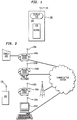
- FIGURES 1 and 2 illustrate an exemplary portable device 100 that may suitably operate in accordance with the principles of the present invention.
- Portable device 100 when in operative communication with one or more of a plurality of terminals of a suitably arranged communication system, is capable of associating its user with at least one terminal.
- Terminal as the term is used herein, includes without limitation any junction, end or connection point, apparatus, node, station or the like that is capable of communicating information in a communication system in accordance with the present invention.
- the communicated information is transferred in the form of signals.
- the communicated signals may suitably be transmitted in an analog or digital format, and may suitably include voice and data signals, including video information.
- Conventional communication systems are more fully discussed in The Irwin Handbook of Telecommunications, by James H. Green, Irwin Professional Publishing Co. (2nd ed. 1992), which is incorporated herein by reference.
- Exemplary device 100 includes a housing 105, a keypad 110, a display 115 and an antenna 120.
- Keypad 110 includes a set of keys or control levers having a systematic arrangement used to operate portable device 100.
- Display 115 operates to provide an information representation presented in a visible graphical or character form.
- antenna 120 portable device 100 is operative to broadcast or receive one or more location signals to one or more suitably arranged terminals.
- Broadcast as the term is used herein, means to communicate, convey, direct, dispatch, issue, send, telecast, transmit or the like. At least a portion of one of the one or more broadcasted signals identifies the party currently associated with portable device 100.
- location signals may suitably be initiated by portable device 100 or, alternatively, portable device 100 may broadcast one or more location signals in response to a first signal received from a suitable communication system, possibly by one or more terminals.
- Keypad 110 is also preferably operative to provide an interface through which one or more scheduling signals may suitably be received from the associated party.
- the set of data records may suitably include at least one of identification, availability, urgency, or other indicia.
- the availability indicia indicates the importance of the activity currently undertaken by the user of portable device 100.
- the urgency indicia indicates the urgency of a particular call initiated by the user.
- portable device 100 may suitably be implemented in a compact and light embodiment capable of being continuously worn by the user.
- portable device 100 may suitably be integral to a wireless telephone, message paging device or the like.
- device 100 is associated with a suitable portable power supply (not shown).
- FIGURE 2 illustrates a conceptual block diagram showing portable device 100 in wireless communication with ones of a plurality of terminals 200a to 200n.
- "Wireless,” as used herein, includes without limitation any transmission via airwaves, such as packet radio, spread spectrum, infrared, cellular, microwave, satellite or the like.
- Exemplary terminals 200a to 200n illustrate a wired telephone, a public pay telephone, a wireless telephone and a processing system node, respectively.
- Processing system node 200n may suitably include video telephony.
- Each one of exemplary terminals 200 is presented for illustrative purposes only, the foregoing group is neither inclusive nor exclusive.
- Terminals 200a to 200n each include a suitable antenna 120a to 120n, respectively.
- Antenna 120 of portable device 100 and ones of the antennas 120a to 120n are operative to establish a wireless communication link between portable device 100 and one or more of terminals 200.
- a "communication link,” as used herein, includes without limitation any suitable hardware, firmware or software configuration that enables portable device 100 to communicate with at least one terminal 200.
- a portion of the location signal broadcast between portable device 100 and the one or more terminals 200 identifies the user currently associated with portable device 100.
- Establishment of the communication link is preferably under the control of at least one of portable device 100 or the one or more terminals 200, and is effectuated as a function of the broadcast location signal.
- the communication link operates to associate the user with one or more of terminals 200 thereby allowing a signal directed to the party to be communicated from a suitable communication system to one or more of terminals 200.
- Exemplary terminal 200a is associated with a cradle 205.
- Cradle 205 is operative to provide a suitable framework or support structure to mate with or receive portable device 100.
- FIGURE 3 there is illustrated an exemplary mating interface 300 that is suitably coupled with housing 105 of portable device 100.
- Exemplary mating interface 300 facilitates - at least one of wired communication or providing a suitable arrangement to charge the power supply associated with portable device 100.
- a "mating interface,” as the term is used herein, includes without limitation plugs, sockets, cables, wires and the like.
- FIGURE 4 illustrates a block diagram of one exemplary microprocessing circuit 400 that may suitably be used in conjunction with any of portable devices 100 of FIGURES 1 to 3.
- Microprocessing circuit 400 includes a single processor 405 coupled via data bus 410 with a single memory storage device 415.
- Memory storage device 415 is suitably operative to store data or one or more instructions that processor 405 is operative to retrieve and execute.
- Memory storage device 415 may be any suitable memory storage device or plurality thereof.
- Processor 405 includes a control unit 420, an arithmetic and logic unit (“ALU") 425 and a local memory storage device 430 (e.g., stackable cache, a plurality of registers, etc.).
- Control unit 420 is operative to fetch processing system instructions from memory storage device 415.
- ALU 425 is operative to perform a plurality of operations, including addition and Boolean AND, needed to carry out those instructions.
- Local memory storage device 430 is operative to provide local high speed storage used for storing temporary results and control information.
- microprocessing circuit 400 may suitably be replaced by, or combined with, without limitation, programmable logic devices, such as PALs (programmable array logic) and PLAs (programmable logic arrays), DSPs (digital signal processors), FPGAs (field programmable gate arrays), ASICs (application specific integrated circuits), VLSIs (very large scale integrated circuits) or the like.
- PALs programmable array logic
- PLAs programmable logic arrays
- DSPs digital signal processors
- FPGAs field programmable gate arrays
- ASICs application specific integrated circuits
- VLSIs very large scale integrated circuits
- FIGURE 5 illustrates a block diagram of an exemplary communication system 500 in accordance with the principles of the present invention.
- System 500 includes an infrastructure 505, portable device 100 and terminals 200a to 200n.
- Infrastructure 505 is operative to provide one or more data links between ones of terminals 200 for the communication of signals therebetween.
- Intelligent includes without limitation any underlying structure, architecture, design or the like of a communication system, including any hardware, firmware, software, access methods or protocols used, as well as, system control for connectivity with other communication systems or networks.
- Data link includes without limitation any suitable hardware, firmware or software configuration that enables two or more terminals 200 to communicate, such as a wired or wireless communication channel, for example.
- Infrastructure 505 includes without limitation a plurality of interfaces, or input ports, 510a to 510n, circuitry 515 and at least one memory 520.
- Interfaces 510 are operative to transmit and receive signals between their associated terminals and at least one of circuitry 515 and memory 520.
- Circuitry 515 and memory 520 are preferably operative to provide intelligent communication, and more particularly, communication session scheduling as is described in United States Patent Application Serial No. 08/533,045, Attorney Docket No. Aykin 1-4-1-3-3-2-2.
- circuitry 515 is operative to establish a data link between two or more terminals. The data link is established as a function of urgency indicia associated with a particular calling signal from a calling terminal 200 to a called terminal 200.
- circuitry 515 if the associated urgency indicia equals or exceeds availability indicia associated with the party associated with the called terminal, circuitry 515 establishes a data link therebetween. Establishment of the data link allows the coupled terminals 200 to suitably transmit voice or data signals therebetween.
- circuitry 515 is operative to defer response to the calling signal until an optimum time.
- the caller may suitably be given an option to leave a message with a voice mail, e-mail system or message paging system, respectively.
- either infrastructure 505 or the called terminal may suitably be operative to transmit a responsive calling signal to the calling terminal. At least a portion of the responsive calling signal is associated with urgency indicia, i.e., the urgency with which the responsive call must be responded to by the first terminal 200. plurality of processing systems.
- the processing systems may suitably be in operative communication with one another via a communication network.
- Conventional processing system architecture is more fully discussed in Computer Organization and Architecture, by William Stallings, MacMillan Publishing Co. (3rd ed. 1993), which is incorporated herein by reference.
- Circuitry 515 may suitably be combined with or replaced by, without limitation, programmable logic devices, as discussed with reference to FIGURE 4.
- Particular terminals may suitably be combined with or coupled with a single processing system, or with a plurality of processing systems.
- each processing system may suitably be coupled with a single terminal or a plurality of terminals, such as a public switched telephone network (“PSTN”) switching office, for example.
- PSTN public switched telephone network
- Device 100 may suitably be associated with one or more of terminals 200.
- Device 100 preferably includes a memory, such as at least one of memory storage device 415 or local memory storage device 430, for example.
- the memory is operative to store identification indicia associating a user with device 100.
- FIGURE 6 there is illustrated one exemplary storage location that may suitably be configured with in a conventional memory.
- the party using device 100 is associated with at least one terminal 200 through the establishment of a communication link between device 100 and the one or more terminals 200.
- the communication link is established as a function of a broadcast location signal, and that the broadcast location signal includes at least identification and availability indicia.
- At least one of the one or more associated terminals 200 is operative to transmit the same to infrastructure 505.
- Infrastructure 505 uses the identification indicia to identify the user associated with device 100, and the availability indicia to associate device 100 with one or more of terminals 200. In the illustrated embodiment, this may suitably be accomplished by modifying one or more associated records in memory 520.
- Infrastructure 505 preferably enables a calling signal directed to the user of device 100 to be routed automatically from a calling terminal 200 to one or more of the associated terminals 200.
- FIGURE 7 illustrates a flow diagram of an exemplary method for operating communication system 500, and more particularly for associating a particular party using portable device 100 with one or more terminals 200 of communication system 500. Each terminal 200 is preferably operative to communicate with one or more other terminals 200 via communication system 500. For illustrative purposes, the flow diagram of FIGURE 7 is discussed with reference to FIGURE 5.
- At least one location signal is broadcast between device 100 and one or more terminals 200 (input/output block 705).
- the one or more location signals may suitably be initiated by device 100 or, alternatively, device 100 may broadcast the one or more location signals in response to a first signal received from one or more terminals 200. It should be noted that any suitable conventional means may be used to transmit signals between device 100 and ones of terminals 200.
- device 100 may suitably operate to rebroadcast the location signal.
- An acknowledgment signal is preferably transmitted between device 100 and at least one terminal 200 in response to the location signal broadcast therebetween (input/output block 710).
- At least one of the one or more terminals 200 that received the broadcast location signal is operative to transmit at least a portion of the same to infrastructure 505 (input/output block 715).
- Infrastructure 505 uses the portion to identify the party using device 100 (process block 720).
- a communication link is established between device 100 and at least one terminal 200 as a function of the broadcast location signal thereby associating the user of device 100 with at least one terminal 200 (process block 725).
- infrastructure 505 receives a calling signal that is directed to the user of device 100
- infrastructure 505 is operative to enable the calling signal to be communicated from a calling terminal 200 to the one or more terminals with which the party using device 100 is now associated (process block 730).
- Infrastructure 505 therefore enables a calling signal directed to the party to be routed automatically from a calling terminal to one or more of the associated terminals 200.
- the communication link is preferably monitored to determine if the party using device 100 has moved away from the one or more terminals with which he is associated.
- this monitoring feature may suitably be suspended if device 100 is cradled, such as in cradle 205.
- FIGURE 8 illustrates a flow diagram of an exemplary method for communicating a calling signal through infrastructure 505 in accordance with the present invention.
- at least one of portable device 100 or infrastructure 505 is operative to store a set of data records including identification indicia and availability indicia associated with the party using device 100.
- An input port or other interface, such as keypad 110, of device 100 is monitored (process block 805).
- at least one of portable device 100 or infrastructure 505 is operative to modify the set of data records in response to the received scheduling signal (decisional block 815).
- infrastructure 505 is operative to determine if the party is available to respond to the call (decisional block 825).
- the calling signal includes urgency indicia, however, if it does not, either a default value is associated with the calling signal or the caller is prompted to indicate an urgency level.
- the urgency indicia, or indicator is suitably compared with the data representing the party's availability, and in response thereto either defers response to the call (process block 830) or establishes a data link thereby enabling the calling signal to be communicated from the calling terminal to at least one terminal with which the party using device 100 is presently associated (process block 835).
Landscapes
- Engineering & Computer Science (AREA)
- Computer Networks & Wireless Communication (AREA)
- Signal Processing (AREA)
- Mobile Radio Communication Systems (AREA)
Applications Claiming Priority (2)
| Application Number | Priority Date | Filing Date | Title |
|---|---|---|---|
| US57643095A | 1995-12-21 | 1995-12-21 | |
| US576430 | 1995-12-21 |
Publications (1)
| Publication Number | Publication Date |
|---|---|
| EP0781061A2 true EP0781061A2 (fr) | 1997-06-25 |
Family
ID=24304393
Family Applications (1)
| Application Number | Title | Priority Date | Filing Date |
|---|---|---|---|
| EP96118784A Withdrawn EP0781061A2 (fr) | 1995-12-21 | 1996-11-22 | Equipements, systèmes et méthodes pour associer un abonné à un terminal dans un système de communication intelligent |
Country Status (5)
| Country | Link |
|---|---|
| EP (1) | EP0781061A2 (fr) |
| JP (1) | JPH09233530A (fr) |
| CN (1) | CN1158069A (fr) |
| BR (1) | BR9605339A (fr) |
| SG (1) | SG50780A1 (fr) |
Cited By (1)
| Publication number | Priority date | Publication date | Assignee | Title |
|---|---|---|---|---|
| CN1306847C (zh) * | 2003-09-02 | 2007-03-21 | 乐金电子(中国)研究开发中心有限公司 | 一种移动通信终端的接入控制方法及接入控制系统 |
-
1996
- 1996-10-29 BR BR9605339A patent/BR9605339A/pt active Search and Examination
- 1996-11-22 EP EP96118784A patent/EP0781061A2/fr not_active Withdrawn
- 1996-12-10 CN CN 96121610 patent/CN1158069A/zh active Pending
- 1996-12-16 JP JP33538796A patent/JPH09233530A/ja active Pending
- 1996-12-18 SG SG1996011784A patent/SG50780A1/en unknown
Non-Patent Citations (1)
| Title |
|---|
| WILLIAM STALLINGS: "Computer Organization and Architecture", 1993, MACMILLAN PUBLISHING CO. |
Cited By (1)
| Publication number | Priority date | Publication date | Assignee | Title |
|---|---|---|---|---|
| CN1306847C (zh) * | 2003-09-02 | 2007-03-21 | 乐金电子(中国)研究开发中心有限公司 | 一种移动通信终端的接入控制方法及接入控制系统 |
Also Published As
| Publication number | Publication date |
|---|---|
| JPH09233530A (ja) | 1997-09-05 |
| BR9605339A (pt) | 1998-07-28 |
| SG50780A1 (en) | 1998-07-20 |
| CN1158069A (zh) | 1997-08-27 |
Similar Documents
| Publication | Publication Date | Title |
|---|---|---|
| US5787162A (en) | Apparatus and method for scheduling urgent communication sessions | |
| US7020488B1 (en) | Communications unit, system and methods for providing multiple access to a wireless transceiver | |
| US5570413A (en) | Cellular telephone and associated method for opening a voice channel with a source telephone without establishing voice communications therewith | |
| US5930702A (en) | Personal mobility communication system | |
| US20060128376A1 (en) | Communication systems and methods | |
| JP2000513527A (ja) | 音声―ポケットベルシステム | |
| US7957724B2 (en) | Method and apparatus for indicating to a wireless network the operational mode of a wireless communicator | |
| US20030072421A1 (en) | Information terminal apparatus, communications method, and storage medium storing program therefor | |
| KR20010026476A (ko) | 이동통신 시스템에서 발신자정보 등록 및 서비스방법 | |
| EP0781061A2 (fr) | Equipements, systèmes et méthodes pour associer un abonné à un terminal dans un système de communication intelligent | |
| JP3398278B2 (ja) | 通信方法および通信システム | |
| KR0153013B1 (ko) | 유무선 복합 형식의 호처리 가능한 제2세대 사설 무선 교환기 시스템 및 그 방법 | |
| GB2365257A (en) | Telephone status/availability network | |
| JP3097787B2 (ja) | 無線電話装置制御方式 | |
| JP3187312B2 (ja) | 移動体通信機 | |
| US6148214A (en) | Telephone using service messages for identification signals | |
| KR100651937B1 (ko) | 두 개의 발신번호를 갖는 이동통신 단말기 | |
| KR100574656B1 (ko) | 그룹 착신 기능이 구비된 이동통신단말기시스템 및 그 제어방법 | |
| KR100525367B1 (ko) | 디지털 셀룰라폰 교환장치 | |
| KR19990060596A (ko) | 교환시스템에서 무조건 착신전환방법 | |
| JPH09139769A (ja) | 通信システムで資源割当を提供するための回路、システム、および方法 | |
| KR100241779B1 (ko) | 씨티-2 단말기에서 직접통화 서비스 접속방법 | |
| JPH02264550A (ja) | メッセージ連続呼出制御方式 | |
| JP3058154B2 (ja) | 無線通信装置 | |
| JPH0393393A (ja) | 加入者集線通信方式 |
Legal Events
| Date | Code | Title | Description |
|---|---|---|---|
| PUAI | Public reference made under article 153(3) epc to a published international application that has entered the european phase |
Free format text: ORIGINAL CODE: 0009012 |
|
| AK | Designated contracting states |
Kind code of ref document: A2 Designated state(s): DE ES FR GB IT |
|
| RIN1 | Information on inventor provided before grant (corrected) |
Inventor name: ROESLER, MARINA L. Inventor name: NEAL, DAVID NICHOLAS Inventor name: MILEWSKI, ALLEN E. Inventor name: MANE, AMIR M. Inventor name: LEWIS, STEVEN H. Inventor name: AYKIN, NURAY Inventor name: ISENBERG, DAVID SAUL |
|
| STAA | Information on the status of an ep patent application or granted ep patent |
Free format text: STATUS: THE APPLICATION HAS BEEN WITHDRAWN |
|
| 18W | Application withdrawn |
Withdrawal date: 19981030 |