EP0781762A1 - Verfahren zur Herstellung von Glycin-N.N.-diesigsäure-Derivaten - Google Patents
Verfahren zur Herstellung von Glycin-N.N.-diesigsäure-Derivaten Download PDFInfo
- Publication number
- EP0781762A1 EP0781762A1 EP97101598A EP97101598A EP0781762A1 EP 0781762 A1 EP0781762 A1 EP 0781762A1 EP 97101598 A EP97101598 A EP 97101598A EP 97101598 A EP97101598 A EP 97101598A EP 0781762 A1 EP0781762 A1 EP 0781762A1
- Authority
- EP
- European Patent Office
- Prior art keywords
- glycine
- weight
- diacetic acid
- alkyl
- bis
- Prior art date
- Legal status (The legal status is an assumption and is not a legal conclusion. Google has not performed a legal analysis and makes no representation as to the accuracy of the status listed.)
- Granted
Links
Classifications
-
- G—PHYSICS
- G03—PHOTOGRAPHY; CINEMATOGRAPHY; ANALOGOUS TECHNIQUES USING WAVES OTHER THAN OPTICAL WAVES; ELECTROGRAPHY; HOLOGRAPHY
- G03C—PHOTOSENSITIVE MATERIALS FOR PHOTOGRAPHIC PURPOSES; PHOTOGRAPHIC PROCESSES, e.g. CINE, X-RAY, COLOUR, STEREO-PHOTOGRAPHIC PROCESSES; AUXILIARY PROCESSES IN PHOTOGRAPHY
- G03C7/00—Multicolour photographic processes or agents therefor; Regeneration of such processing agents; Photosensitive materials for multicolour processes
- G03C7/30—Colour processes using colour-coupling substances; Materials therefor; Preparing or processing such materials
- G03C7/42—Bleach-fixing or agents therefor ; Desilvering processes
-
- A—HUMAN NECESSITIES
- A23—FOODS OR FOODSTUFFS; TREATMENT THEREOF, NOT COVERED BY OTHER CLASSES
- A23C—DAIRY PRODUCTS, e.g. MILK, BUTTER OR CHEESE; MILK OR CHEESE SUBSTITUTES; PREPARATION THEREOF
- A23C7/00—Other dairy technology
- A23C7/02—Chemical cleaning of dairy apparatus; Use of sterilisation methods therefor
-
- A—HUMAN NECESSITIES
- A61—MEDICAL OR VETERINARY SCIENCE; HYGIENE
- A61K—PREPARATIONS FOR MEDICAL, DENTAL OR TOILETRY PURPOSES
- A61K8/00—Cosmetics or similar toiletry preparations
- A61K8/18—Cosmetics or similar toiletry preparations characterised by the composition
- A61K8/30—Cosmetics or similar toiletry preparations characterised by the composition containing organic compounds
- A61K8/40—Cosmetics or similar toiletry preparations characterised by the composition containing organic compounds containing nitrogen
- A61K8/44—Aminocarboxylic acids or derivatives thereof, e.g. aminocarboxylic acids containing sulfur; Salts; Esters or N-acylated derivatives thereof
-
- A—HUMAN NECESSITIES
- A61—MEDICAL OR VETERINARY SCIENCE; HYGIENE
- A61Q—SPECIFIC USE OF COSMETICS OR SIMILAR TOILETRY PREPARATIONS
- A61Q11/00—Preparations for care of the teeth, of the oral cavity or of dentures; Dentifrices, e.g. toothpastes; Mouth rinses
-
- C—CHEMISTRY; METALLURGY
- C07—ORGANIC CHEMISTRY
- C07C—ACYCLIC OR CARBOCYCLIC COMPOUNDS
- C07C227/00—Preparation of compounds containing amino and carboxyl groups bound to the same carbon skeleton
- C07C227/14—Preparation of compounds containing amino and carboxyl groups bound to the same carbon skeleton from compounds containing already amino and carboxyl groups or derivatives thereof
- C07C227/18—Preparation of compounds containing amino and carboxyl groups bound to the same carbon skeleton from compounds containing already amino and carboxyl groups or derivatives thereof by reactions involving amino or carboxyl groups, e.g. hydrolysis of esters or amides, by formation of halides, salts or esters
-
- C—CHEMISTRY; METALLURGY
- C07—ORGANIC CHEMISTRY
- C07C—ACYCLIC OR CARBOCYCLIC COMPOUNDS
- C07C227/00—Preparation of compounds containing amino and carboxyl groups bound to the same carbon skeleton
- C07C227/26—Preparation of compounds containing amino and carboxyl groups bound to the same carbon skeleton from compounds containing carboxyl groups by reaction with HCN, or a salt thereof, and amines, or from aminonitriles
-
- C—CHEMISTRY; METALLURGY
- C07—ORGANIC CHEMISTRY
- C07C—ACYCLIC OR CARBOCYCLIC COMPOUNDS
- C07C229/00—Compounds containing amino and carboxyl groups bound to the same carbon skeleton
- C07C229/02—Compounds containing amino and carboxyl groups bound to the same carbon skeleton having amino and carboxyl groups bound to acyclic carbon atoms of the same carbon skeleton
- C07C229/04—Compounds containing amino and carboxyl groups bound to the same carbon skeleton having amino and carboxyl groups bound to acyclic carbon atoms of the same carbon skeleton the carbon skeleton being acyclic and saturated
- C07C229/06—Compounds containing amino and carboxyl groups bound to the same carbon skeleton having amino and carboxyl groups bound to acyclic carbon atoms of the same carbon skeleton the carbon skeleton being acyclic and saturated having only one amino and one carboxyl group bound to the carbon skeleton
- C07C229/10—Compounds containing amino and carboxyl groups bound to the same carbon skeleton having amino and carboxyl groups bound to acyclic carbon atoms of the same carbon skeleton the carbon skeleton being acyclic and saturated having only one amino and one carboxyl group bound to the carbon skeleton the nitrogen atom of the amino group being further bound to acyclic carbon atoms or to carbon atoms of rings other than six-membered aromatic rings
- C07C229/16—Compounds containing amino and carboxyl groups bound to the same carbon skeleton having amino and carboxyl groups bound to acyclic carbon atoms of the same carbon skeleton the carbon skeleton being acyclic and saturated having only one amino and one carboxyl group bound to the carbon skeleton the nitrogen atom of the amino group being further bound to acyclic carbon atoms or to carbon atoms of rings other than six-membered aromatic rings to carbon atoms of hydrocarbon radicals substituted by amino or carboxyl groups, e.g. ethylenediamine-tetra-acetic acid, iminodiacetic acids
-
- C—CHEMISTRY; METALLURGY
- C07—ORGANIC CHEMISTRY
- C07C—ACYCLIC OR CARBOCYCLIC COMPOUNDS
- C07C229/00—Compounds containing amino and carboxyl groups bound to the same carbon skeleton
- C07C229/02—Compounds containing amino and carboxyl groups bound to the same carbon skeleton having amino and carboxyl groups bound to acyclic carbon atoms of the same carbon skeleton
- C07C229/04—Compounds containing amino and carboxyl groups bound to the same carbon skeleton having amino and carboxyl groups bound to acyclic carbon atoms of the same carbon skeleton the carbon skeleton being acyclic and saturated
- C07C229/26—Compounds containing amino and carboxyl groups bound to the same carbon skeleton having amino and carboxyl groups bound to acyclic carbon atoms of the same carbon skeleton the carbon skeleton being acyclic and saturated having more than one amino group bound to the carbon skeleton, e.g. lysine
-
- C—CHEMISTRY; METALLURGY
- C07—ORGANIC CHEMISTRY
- C07C—ACYCLIC OR CARBOCYCLIC COMPOUNDS
- C07C255/00—Carboxylic acid nitriles
- C07C255/01—Carboxylic acid nitriles having cyano groups bound to acyclic carbon atoms
- C07C255/24—Carboxylic acid nitriles having cyano groups bound to acyclic carbon atoms containing cyano groups and singly-bound nitrogen atoms, not being further bound to other hetero atoms, bound to the same saturated acyclic carbon skeleton
- C07C255/25—Aminoacetonitriles
-
- C—CHEMISTRY; METALLURGY
- C11—ANIMAL OR VEGETABLE OILS, FATS, FATTY SUBSTANCES OR WAXES; FATTY ACIDS THEREFROM; DETERGENTS; CANDLES
- C11D—DETERGENT COMPOSITIONS; USE OF SINGLE SUBSTANCES AS DETERGENTS; SOAP OR SOAP-MAKING; RESIN SOAPS; RECOVERY OF GLYCEROL
- C11D17/00—Detergent materials or soaps characterised by their shape or physical properties
- C11D17/06—Powder; Flakes; Free-flowing mixtures; Sheets
- C11D17/065—High-density particulate detergent compositions
-
- C—CHEMISTRY; METALLURGY
- C11—ANIMAL OR VEGETABLE OILS, FATS, FATTY SUBSTANCES OR WAXES; FATTY ACIDS THEREFROM; DETERGENTS; CANDLES
- C11D—DETERGENT COMPOSITIONS; USE OF SINGLE SUBSTANCES AS DETERGENTS; SOAP OR SOAP-MAKING; RESIN SOAPS; RECOVERY OF GLYCEROL
- C11D3/00—Other compounding ingredients of detergent compositions covered in group C11D1/00
- C11D3/16—Organic compounds
- C11D3/26—Organic compounds containing nitrogen
- C11D3/33—Amino carboxylic acids
-
- D—TEXTILES; PAPER
- D06—TREATMENT OF TEXTILES OR THE LIKE; LAUNDERING; FLEXIBLE MATERIALS NOT OTHERWISE PROVIDED FOR
- D06L—DRY-CLEANING, WASHING OR BLEACHING FIBRES, FILAMENTS, THREADS, YARNS, FABRICS, FEATHERS OR MADE-UP FIBROUS GOODS; BLEACHING LEATHER OR FURS
- D06L4/00—Bleaching fibres, filaments, threads, yarns, fabrics, feathers or made-up fibrous goods; Bleaching leather or furs
- D06L4/10—Bleaching fibres, filaments, threads, yarns, fabrics, feathers or made-up fibrous goods; Bleaching leather or furs using agents which develop oxygen
- D06L4/12—Bleaching fibres, filaments, threads, yarns, fabrics, feathers or made-up fibrous goods; Bleaching leather or furs using agents which develop oxygen combined with specific additives
-
- D—TEXTILES; PAPER
- D06—TREATMENT OF TEXTILES OR THE LIKE; LAUNDERING; FLEXIBLE MATERIALS NOT OTHERWISE PROVIDED FOR
- D06L—DRY-CLEANING, WASHING OR BLEACHING FIBRES, FILAMENTS, THREADS, YARNS, FABRICS, FEATHERS OR MADE-UP FIBROUS GOODS; BLEACHING LEATHER OR FURS
- D06L4/00—Bleaching fibres, filaments, threads, yarns, fabrics, feathers or made-up fibrous goods; Bleaching leather or furs
- D06L4/30—Bleaching fibres, filaments, threads, yarns, fabrics, feathers or made-up fibrous goods; Bleaching leather or furs using reducing agents
-
- D—TEXTILES; PAPER
- D21—PAPER-MAKING; PRODUCTION OF CELLULOSE
- D21C—PRODUCTION OF CELLULOSE BY REMOVING NON-CELLULOSE SUBSTANCES FROM CELLULOSE-CONTAINING MATERIALS; REGENERATION OF PULPING LIQUORS; APPARATUS THEREFOR
- D21C9/00—After-treatment of cellulose pulp, e.g. of wood pulp, or cotton linters ; Treatment of dilute or dewatered pulp or process improvement taking place after obtaining the raw cellulosic material and not provided for elsewhere
- D21C9/10—Bleaching ; Apparatus therefor
- D21C9/1026—Other features in bleaching processes
- D21C9/1042—Use of chelating agents
-
- G—PHYSICS
- G03—PHOTOGRAPHY; CINEMATOGRAPHY; ANALOGOUS TECHNIQUES USING WAVES OTHER THAN OPTICAL WAVES; ELECTROGRAPHY; HOLOGRAPHY
- G03C—PHOTOSENSITIVE MATERIALS FOR PHOTOGRAPHIC PURPOSES; PHOTOGRAPHIC PROCESSES, e.g. CINE, X-RAY, COLOUR, STEREO-PHOTOGRAPHIC PROCESSES; AUXILIARY PROCESSES IN PHOTOGRAPHY
- G03C5/00—Photographic processes or agents therefor; Regeneration of such processing agents
- G03C5/26—Processes using silver-salt-containing photosensitive materials or agents therefor
- G03C5/29—Development processes or agents therefor
- G03C5/305—Additives other than developers
- G03C5/3053—Tensio-active agents or sequestering agents, e.g. water-softening or wetting agents
-
- G—PHYSICS
- G03—PHOTOGRAPHY; CINEMATOGRAPHY; ANALOGOUS TECHNIQUES USING WAVES OTHER THAN OPTICAL WAVES; ELECTROGRAPHY; HOLOGRAPHY
- G03C—PHOTOSENSITIVE MATERIALS FOR PHOTOGRAPHIC PURPOSES; PHOTOGRAPHIC PROCESSES, e.g. CINE, X-RAY, COLOUR, STEREO-PHOTOGRAPHIC PROCESSES; AUXILIARY PROCESSES IN PHOTOGRAPHY
- G03C5/00—Photographic processes or agents therefor; Regeneration of such processing agents
- G03C5/26—Processes using silver-salt-containing photosensitive materials or agents therefor
- G03C5/38—Fixing; Developing-fixing; Hardening-fixing
-
- G—PHYSICS
- G03—PHOTOGRAPHY; CINEMATOGRAPHY; ANALOGOUS TECHNIQUES USING WAVES OTHER THAN OPTICAL WAVES; ELECTROGRAPHY; HOLOGRAPHY
- G03C—PHOTOSENSITIVE MATERIALS FOR PHOTOGRAPHIC PURPOSES; PHOTOGRAPHIC PROCESSES, e.g. CINE, X-RAY, COLOUR, STEREO-PHOTOGRAPHIC PROCESSES; AUXILIARY PROCESSES IN PHOTOGRAPHY
- G03C5/00—Photographic processes or agents therefor; Regeneration of such processing agents
- G03C5/26—Processes using silver-salt-containing photosensitive materials or agents therefor
- G03C5/40—Chemically transforming developed images
- G03C5/44—Bleaching; Bleach-fixing
-
- A—HUMAN NECESSITIES
- A61—MEDICAL OR VETERINARY SCIENCE; HYGIENE
- A61K—PREPARATIONS FOR MEDICAL, DENTAL OR TOILETRY PURPOSES
- A61K2800/00—Properties of cosmetic compositions or active ingredients thereof or formulation aids used therein and process related aspects
- A61K2800/40—Chemical, physico-chemical or functional or structural properties of particular ingredients
- A61K2800/51—Chelating agents
-
- C—CHEMISTRY; METALLURGY
- C11—ANIMAL OR VEGETABLE OILS, FATS, FATTY SUBSTANCES OR WAXES; FATTY ACIDS THEREFROM; DETERGENTS; CANDLES
- C11D—DETERGENT COMPOSITIONS; USE OF SINGLE SUBSTANCES AS DETERGENTS; SOAP OR SOAP-MAKING; RESIN SOAPS; RECOVERY OF GLYCEROL
- C11D2111/00—Cleaning compositions characterised by the objects to be cleaned; Cleaning compositions characterised by non-standard cleaning or washing processes
- C11D2111/10—Objects to be cleaned
- C11D2111/14—Hard surfaces
-
- C—CHEMISTRY; METALLURGY
- C11—ANIMAL OR VEGETABLE OILS, FATS, FATTY SUBSTANCES OR WAXES; FATTY ACIDS THEREFROM; DETERGENTS; CANDLES
- C11D—DETERGENT COMPOSITIONS; USE OF SINGLE SUBSTANCES AS DETERGENTS; SOAP OR SOAP-MAKING; RESIN SOAPS; RECOVERY OF GLYCEROL
- C11D2111/00—Cleaning compositions characterised by the objects to be cleaned; Cleaning compositions characterised by non-standard cleaning or washing processes
- C11D2111/10—Objects to be cleaned
- C11D2111/14—Hard surfaces
- C11D2111/20—Industrial or commercial equipment, e.g. reactors, tubes or engines
Definitions
- the present invention relates to a process for the preparation of glycine-N, N-diacetic acid derivatives and intermediates occurring in this process.
- EP-A 089 136 (3) relates to oral hygiene products which, among other things, are used as calcium sequestrants. Contain ⁇ -alanine-N, N-diacetic acid. These serve to control the amount of calcium fluoride that is added to the tooth enamel for caries protection.
- the object of the present invention was therefore to provide complexing agents which no longer have the disadvantages of the prior art.
- the compounds I used are those in which R is C 1 -C 20 -alkyl, C 2 -C 20 -alkenyl or a radical of the formula stands.
- Particularly suitable salts of this type are the sodium, potassium and ammonium salts, in particular the trisodium, tripotassium and triammonium salt, and also organic triamine salts with a tertiary nitrogen atom.
- the bases on which the organic amine salts are based are, in particular, tertiary amines, such as trialkylamines having 1 to 4 carbon atoms in the alkyl, such as trimethyl and triethylamine, and trialkanolamines having 2 or 3 carbon atoms in the alkanol radical, preferably triethanolamine, tri-n-propanolamine or Triisopropanolamine.
- tertiary amines such as trialkylamines having 1 to 4 carbon atoms in the alkyl, such as trimethyl and triethylamine
- trialkanolamines having 2 or 3 carbon atoms in the alkanol radical preferably triethanolamine, tri-n-propanolamine or Triisopropanolamine.
- the calcium and magnesium salts are used as alkaline earth metal salts.
- alk (en) yl radicals in particular C 2 - to C 17 -alkyl and alkenyl, in particular straight-chain radicals derived from saturated or unsaturated fatty acids, are suitable for the radical R.
- R examples of individual radicals R are: ethyl, n-propyl, iso-propyl, n-butyl, iso-butyl, sec-butyl, tert-butyl, n-pentyl, iso-pentyl, tert-pentyl, neopentyl, n-hexyl, n-heptyl, 3-heptyl (derived from 2-ethylhexanoic acid), n-octyl, iso-octyl (derived from iso-nonanoic acid), n-nonyl, n-decyl, n-undecyl, n-dodecyl, iso-dodecyl (derived from ios-tridecanoic acid), n-tridecyl, n-tetradecyl, n-pentadecyl, n-hexadecy
- the C 1 - to C 12 -alkylene bridges A are primarily polymethylene groups of the formula - (CH 2 ) k -, in which k denotes a number from 2 to 12, in particular from 2 to 8, ie 1,2-ethylene, 1 , 3-propylene, 1,4-butylene, pentamethylene, hexamethylene, heptamethylene, Octamethylene, nonamethylene, decamethylene, undecamethylene and dodecamethylene. Hexamethylene, octamethylene, 1,2-ethylene and 1,4-butylene are particularly preferred here.
- branched C 1 - to C 12 -alkylene groups can also occur, for. B. ⁇ CH 2 CH (CH 3 ) CH 2 -, ⁇ CH 2 C (CH 3 ) 2 CH 2 -, ⁇ CH 2 CH (C 2 H 5 ) - or ⁇ CH 2 CH (CH 3 ) -.
- the C 1 to C 30 alkyl and C 2 to C 30 alkenyl groups can have up to 5, in particular up to 3, additional substituents of the type mentioned and can be interrupted by up to 5, in particular up to 3, non-adjacent oxygen atoms.
- Examples of such substituted alk (en) yl groups are ⁇ CH 2 OH, ⁇ CH 2 CH 2 OH, ⁇ CH 2 CH 2 -O-CH 3 , ⁇ CH 2 CH 2 ⁇ O ⁇ CH 2 CH 2 ⁇ O ⁇ CH 3 , ⁇ CH 2 ⁇ O ⁇ CH 2 CH 3 , ⁇ CH 2 ⁇ O ⁇ CH 2 CH 2 ⁇ OH, ⁇ CH 2 ⁇ CHO, ⁇ CH 2 ⁇ OPh, ⁇ CH 2 -COOCH 3 or ⁇ CH 2 CH 2 - COOCH 3 .
- Suitable alkoxylate groups are in particular those in which m and n each represent numbers from 0 to 30, especially from 0 to 15.
- a 1 and A 2 mean groups derived from butylene oxide and especially from propylene oxide and from ethylene oxide. Pure ethoxylates and pure propoxylates are of particular interest, but ethylene oxide-propylene oxide block structures can also occur.
- NH groups in the heterocyclic rings mentioned should, if possible, be in a derivatized form, for example as an N-alkyl group.
- substitution on the phenyl nuclei or the heterocyclic rings preferably two (identical or different) or in particular a single substituent occur.
- phenylalkyl groups and heterocyclic rings-bearing alkyl groups for R are benzyl, 2-phenylethyl, 3-phenylpropyl, 4-phenylbutyl, o-, m- or p-hydroxylbenzyl, o-, m- or p-carboxylbenzyl, o-, m- or p-sulfobenzyl, o-, m- or p-methoxy or -ethoxycarbonylbenzyl, 2-furylmethyl, N-methylpiperidin-4-ylmethyl or 2-, 3- or 4-pyridinylmethyl.
- water-solubilizing groups such as hydroxyl groups, carboxyl groups or sulfo groups preferably occur.
- a preferred use is in technical cleaning agent formulations for hard surfaces made of metal, plastic, lacquer or glass.
- these detergent formulations contain 0.1 to 30% by weight of glycine-N, N-diacetic acid derivatives I or their salts.
- Formulations customary for the individual fields of use are known in principle to the person skilled in the art.
- such formulations contain, in addition to the complexing agents, 1 to 35% by weight of surfactants of an anionic or preferably nonionic nature, which are foaming or low-foaming depending on the intended use, and, if desired, further complexing agents, builders, foam suppressants, emulsifiers, corrosion inhibitors, reducing agents, as further auxiliaries, Solubilizers, dispersants and preservatives in the usual concentrations.
- surfactants of an anionic or preferably nonionic nature
- further complexing agents builders, foam suppressants, emulsifiers, corrosion inhibitors, reducing agents, as further auxiliaries, Solubilizers, dispersants and preservatives in the usual concentrations.
- Organic solvents can largely be dispensed with in the formulations described.
- glycine-N, N-diacetic acid derivatives I and their salts is in alkaline detergent formulations for the beverage and food industry, in particular for bottle cleaning in the beverage industry and for cleaning equipment in dairies, in breweries, in the Canned food, baked goods, sugar, fat processing and meat processing industries.
- the present alkaline detergent formulations generally have pH values from 8 to 14, preferably from 9 to 13, in particular from 10 to 12.
- a preferred area of application for the detergent formulations described is bottle cleaning in the beverage industry, in particular with automatic bottle dishwashers with hourly outputs of up to typically 30,000 to 70,000 bottles.
- the dirty bottles contained, for example, beer, milk, soft drinks, fruit juices, sweet must or mineral water.
- Another preferred area of application for the detergent formulations described is apparatus cleaning in dairies. They can be used with a beneficial effect when cleaning butter makers, where degreasing is most important. In particular, however, where residues or deposits from calcium phosphate, other calcium salts, mostly organic acids and casein ("milk stone") are to be removed.
- Another preferred area of application for the detergent formulations described is apparatus cleaning in breweries. Above all, residues or deposits from calcium oxalate, hop resins and protein compounds ("beer stone”) are to be removed, for example from fermentation tanks, storage tanks or beer lines.
- Another preferred area of application for the detergent formulations described is apparatus cleaning in the canning industry.
- cleaning agents When heating the food-filled and closed tin cans, usually in an autoclave, or when cleaning cans, e.g. B. in a continuous spraying machine, cleaning agents must be used who wash off the remains of the bottled goods without attacking the tinplate or its paint.
- the cleaning agent is intended to prevent scale deposits on the cans or in the apparatus.
- Another preferred area of application for the detergent formulations described is apparatus cleaning in the bakery industry, in particular the cleaning of baking and dough forms which are contaminated with burnt-on shortening and dough residues.
- the cleaning is usually done by boiling with the alkaline cleaning solutions or by washing in continuous spray systems.
- Another preferred area of application for the detergent formulations described is apparatus cleaning in the sugar industry.
- sucrose is obtained from sugar beet or sugar cane
- impurities or residues containing calcium salts are obtained, for the removal of which the described formulations containing glycine-N, N-diacetic acid derivatives I or their salts are outstandingly suitable.
- Another preferred area of application for the detergent formulations described is apparatus cleaning in the fat-processing industry, which mainly contains lard, tallow, edible oils or fats or fatty oils hardened by catalytic hydrogenation from fats of animal or vegetable origin.
- such products also represent important raw materials for the manufacture of products for textile finishing, paints, leather care products, cosmetic preparations, candles, soaps, surfactants, lubricants, plasticizers, cement and asphalt additives and plastics.
- Another preferred area of application for the detergent formulations described is apparatus cleaning in the meat processing industry.
- water stone-preventing cleaning agents must be used, e.g. B. in the so-called.
- Steam jet cleaning devices in which a hot steam-liquid mixture is blasted onto the apparatus and equipment to be cleaned.
- the described glycine-N, N-diacetic acid derivatives I or their alkaline detergent formulations containing their salts can be used largely free of organic solvents. A possible environmental impact is largely excluded.
- Sodium and potassium hydroxide are particularly suitable as component (ii), but also sodium and potassium carbonate; Mixtures of the alkalis mentioned can also be used.
- surfactants iii
- alkyl sulfates, alkyl sulfonates, fatty alcohol alkoxylates, oxo alcohol alkoxylates, alkyl polyglucosides and fatty amine alkoxylates are particularly suitable.
- This composition represents a basic formulation for all of the above-mentioned fields of application.
- the composition within this basic formulation differs from one another due to the different types of food and beverage soiling, the different amounts of alkaline earth metal ions in these residues and deposits, and the differently sensitive materials of the containers to be cleaned and explain equipment in the various areas of application.
- the alkaline cleaning agent formulations described which contain glycine-N, N-diacetic acid derivatives I or their salts, as a rule do not cause any corrosion, even with sensitive apparatus materials.
- the basic formulation from components (i) to (iii) described above can also contain conventional auxiliaries in the concentrations customary here, for example disinfectants to achieve the desired degree of bacteriological purity, wetting agents, solubilizers, corrosion inhibitors or preservatives.
- glycine-N, N-diacetic acid derivatives I and their salts is in dishwashing detergent formulations, in particular in phosphate-free agents for machine dishwashing in domestic dishwashers or in commercial establishments, for. B. commercial kitchens or restaurants.
- glycine-N, N-diacetic acid derivatives I and their salts are used here for reductive bleaching, e.g. B. with sodium dithionite, or in the oxidative bleaching, for. B. with hydrogen peroxide, needed to the effectiveness of the bleaching process, d. H. to increase the whiteness of the wooden ship.
- the complexing agents thus serve to eliminate heavy metal cations, mainly iron, copper and in particular manganese, which also have a disruptive effect on resin sizing with alum and sodium resinate due to the formation of insoluble salts.
- the deposition of iron on paper leads to "hot spots" where the oxidative catalytic destruction of cellulose begins.
- a typical formulation of such an aqueous reductive bleaching bath in the paper industry for ground wood contains 0.05 to 0.1% by weight of complexing agent I and approx. 1% by weight of sodium dithionite, in each case based on the ground wood.
- the bath temperature is approx. 60
- the bleaching time is usually 1 hour
- the pH is approx. 5.8.
- a typical formulation of such an aqueous oxidative bleach bath in the paper industry for ground wood contains 0.05 to 0.15% by weight of complexing agent I, approx. 2% by weight of water glass, approx. 0.75%. -% NaOH and approx. 1% by weight H 2 O 2 , each based on the wood pulp.
- the bath temperature is approx. 50 ° C and the bleaching time is normally 2 hours.
- Another preferred use for glycine-N, N-diacetic acid derivatives I and their salts is in photographic bleaching and bleach-fixing baths. In the photographic industry, these compounds can be used in such baths that are prepared with hard water to prevent the precipitation of poorly soluble calcium and magnesium salts.
- iron IIII complexing agent solutions they can advantageously be used in bleach-fixing baths, where they can replace the hexacyanoferrate solutions which are of ecological concern.
- a typical aqueous photographic bleach or bleach-fix bath formulation of this type looks as follows: Iron (III) complex with complexing agent I 0.04 to 0.4 mol / l free complexing agent I up to 1.3 mol / l Sodium thiosulfate 0.2 to 2.0 mol / l Sodium sulfite 0.2 to 0.3 mol / l
- the pH of such a bath is usually 4 to 8.
- glycine-N, N-diacetic acid derivatives I and their salts is in pretreatment and bleaching baths in the textile industry.
- Pretreatment baths are to be understood in particular as desizing baths and alkaline pretreatment or mercerization baths.
- these compounds can thus be used to remove traces of heavy metals during the manufacturing process of natural and synthetic fibers such as cotton, wool or polyester. This prevents many faults such as dirt stains and stripes on the textile, loss of gloss, poor wettability, uneven dyeing and color errors.
- glycine-N, N-diacetic acid derivatives I and their salts are in electroplating baths for masking contaminating heavy metal cations. They serve as a substitute for the highly toxic cyanides.
- This bath is usually adjusted to pH 13 with sodium hydroxide solution; it can also contain conventional stabilizers such as amines or sodium cyanide.
- copper, iron, manganese and zinc complexes of the compounds I are used in plant nutrition to correct heavy metal deficits.
- the heavy metals are added as chelates to prevent precipitation as biologically inactive, insoluble salts.
- glycine-N, N-diacetic acid derivatives I and their salts can advantageously be used wherever precipitation of calcium, magnesium and heavy metal salts is to be disrupted and prevented in industrial processes, for example to prevent deposits and incrustations in Boilers, pipes, on spray nozzles or generally on smooth surfaces.
- They can be used to stabilize phosphates in alkaline degreasing baths and to prevent lime soaps from precipitating, thereby preventing "tarnishing" of non-ferrous surfaces and extending the service life of alkaline cleaning baths.
- the cooling water treatment with the compounds I prevents deposits or dissolves existing ones.
- One advantage is the general applicability in alkaline medium and thus the elimination of corrosion problems.
- the compounds I can be used as complexing agents or as builders. Such use as a builder is already known for ⁇ -alanine-N, N-diacetic acid.
- a builder is already known for ⁇ -alanine-N, N-diacetic acid.
- compact detergent formulations are known to have a higher content of detergent (surfactants) than conventional powder detergents, Builders (e.g. zeolites), bleaches and polymers.
- the compounds I are usually active in amounts of 0.1 to 25% by weight, in particular 1 to 15% by weight.
- the compounds I can be used as complexing agents in an amount of 0.05 to 20% by weight, based on the total weight of the detergent formulation.
- the compounds I can also be used as preservatives, advantageously in an amount of 0.05 to 1% by weight, based on the total weight of the detergent formulation.
- Further applications include, for example, applications in pharmaceuticals, cosmetics and foodstuffs in order, for. B. to prevent the metal-catalyzed oxidation of olefinic double bonds and thus the rancidity of the products.
- flue gas scrubbing namely the removal of NO x from flue gases, H 2 S oxidation, metal extraction and use as catalysts for organic syntheses, for.
- B the air oxidation of paraffins or the hydroformylation of olefins to alcohols.
- glycine-N, N-diacetic acid derivatives I or their salts is bleach stabilization, for example in the bleaching of textiles, pulp or paper stock.
- Traces of heavy metals such as iron, copper and manganese occur in the components of the bleaching bath itself, in the water and in the material to be bleached and catalyze the decomposition of the bleaching agent.
- the complexing agents I bind these metal ions and prevent the undesired decomposition of the bleaching system during storage and during use. This increases the efficiency of the bleaching system and damages to the goods to be bleached are suppressed.
- a further advantageous effect of the glycine-N, N-diacetic acid derivatives I or their salts is the strong bleach-activating effect of complexes of the compounds I with manganese, in particular manganese of oxidation levels II and IV.
- Such complexes can be used as a substitute for conventional bleach activators Use in textile detergent formulations as bleaching catalysts in amounts in the ppm range.
- Glycine-N, N-diacetic acid derivatives I and their salts are particularly suitable for the described purposes because they are extremely effective complexing agents for alkaline earth metal ions and for heavy metal ions, especially for calcium and manganese. Their calcium and manganese binding capacity is exceptionally high.
- the detergent formulations containing the compounds I can usually be used largely free of organic solvents. A possible environmental impact is thus largely excluded.
- the two above-mentioned embodiments A and B represent examples of the "Strecker synthesis” in which aldehydes are generally reacted with ammonia or amines and hydrocyanic acid ("acid” variant) or cyanides (“alical” variant) to give amino acids or derivatives thereof.
- the "acidic" variant of the Strecker synthesis is known for example from DE-A 20 27 972 (5). There, the production of carboxymethyliminodiacetonitrile starting from glycine, formaldehyde and hydrocyanic acid is described in an acidic medium. It is recommended to add additional acid to keep the pH below 7.
- the reaction according to A or B is preferably carried out in water, but also in an organic solvent or in mixtures thereof.
- Organic solvents which are preferably used are those which are partially or completely miscible with water, for. B. methanol, ethanol, n-propanol, iso-propanol, tert-butanol, dioxane or tetrahydrofuran. Solubilizers can also be used.
- 2 to 2.6 mol of formaldehyde preferably in the form of its aqueous approx. 30% by weight solution, or 2 to 2.6 mol of aldehyde, in anhydrous form or as an aqueous solution, are advantageously used per mol of amino compound, and 2 to 2.3 mol of hydrogen cyanide or alkali metal cyanide, for example sodium or potassium cyanide.
- the reaction is normally carried out in the case of anhydrous hydrogen cyanide at temperatures from 0 to 120 ° C., in particular 15 to 80 ° C., and in the case of alkali metal cyanides at 40 to 110 ° C., in particular 70 to 100 ° C.
- a pH range from 0 to 11, in particular from 1 to 9 is generally suitable for the reaction with anhydrous hydrogen cyanide, when reacting with alkali metal cyanides one usually works at pH 10 to 14, in particular 11 to 13.
- This reaction is followed by hydrolysis of nitrile groups still present to carboxyl groups, which in a manner known per se in an aqueous reaction medium in the presence of bases such as sodium or potassium hydroxide solution or of acids such as sulfuric or hydrochloric acid at temperatures of 20 to 110 ° C., in particular 40 to 100 ° C is carried out.
- the glycine and glycine nitrile derivatives used as starting amino compounds can be used both as racemates and as enantiomerically pure D or L compounds.
- the glycine-N, N-diacetic acid derivatives I are obtained as a free carboxylic acid or, for example, as an alkali metal salt.
- the desired salts can be prepared from the free acid by neutralization with the appropriate bases, for example amine bases, without difficulty.
- the glycine-N, N-diacetic acid derivatives I and their salts can easily be isolated from their solutions in pure form. Spray or freeze drying, crystallization and precipitation are particularly suitable for this. It can be advantageous to supply the solution obtained in the production directly for technical use.
- the present invention also relates to the glycine-N, N-diacetonitrile and glycine nitrile-N, N-diacetonitrile, which are not yet known in the 2-position by the radical R, and in which R is C 1 -C 30 -alkyl or C 2 - to C 30 -alkenyl, which additionally carry up to 5 hydroxyl groups, formyl groups, C 1 - to C 4 -alkoxy groups, phenoxy groups or C 1 - to C 4 -alkoxycarbonyl groups and are interrupted by up to 5 non-adjacent oxygen atoms can be alkoxylate groupings of the formula - (CH 2 ) k ⁇ O ⁇ (A 1 O) m - (A 2 O) n ⁇ Y, in which A 1 and A 2 independently of one another 1,2-alkylene groups with 2 to 4 denotes carbon atoms, Y denotes hydrogen, C 1 - to C 12 -alkyl,
- reaction product is obtained in high yield in a sufficiently pure form.
- content of by-products is low.
- Further advantages of the production method according to the invention are the salt-free procedure and the readily available starting materials.
- the ⁇ -D, L-alanine nitrile-N, N-diacetonitrile obtained was introduced into 440 g of 25% strength by weight aqueous sodium hydroxide solution at 50 ° C., and the mixture was then stirred for a further 2 hours at this temperature. The mixture was then heated to 95 ° C. for 10 hours. Towards the end of the reaction, the reaction mixture was diluted with water.
- This solution was added dropwise at 40 ° C. to 130 g of 50% strength by weight aqueous sodium hydroxide solution. After 2 hours at 60 ° C. and 2 hours at 95 ° C., 385 g of a solution of L-tyrosine-N, N-diacetic acid trisodium salt with an iron binding capacity of 0.543 mmol / g (corresponding to 89% of the theoretical yield) were obtained.
- the invention also relates to these new substances.
- the precipitate was then introduced into 4430 g of a 17% strength by weight aqueous sodium hydroxide solution at 60 ° C. and stirred for 3 hours at 60 ° C. and 10 hours at 95 ° C. and finally diluted with water. This gave 5275 g of a solution of D, L-ethylglycon-N, N-diacetic acid trisodium salt with an iron binding capacity of 0.985 mmol / g (corresponding to 89% yield of theory).
- the inhibitory effect of complexing agents or dispersing agents on the precipitation of calcium carbonate is determined by turbidity titration.
- the substance to be examined is presented and titrated with calcium acetate solution in the presence of sodium carbonate. The end point is indicated by the formation of the calcium carbonate precipitation.
- the change in light transmittance is monitored using an optical fiber photometer.
- a light beam directed into the solution via glass fibers is reflected on a mirror and the intensity of the reflecting light is measured.
- Amount mg CaCO 3 / g WS consumption of Ca (OAc) 2 solution in ml x 25.
- the 1st breakpoint of the titration curve is the end point.
- the hydrogen peroxide responsible for the bleaching effect in detergent formulations containing sodium is catalytically decomposed by heavy metal ions (Fe, Cu, Mn). This can be prevented by complexing the heavy metal ions.
- the peroxide-stabilizing effect of the complexing agents is checked via the residual peroxide content after warm storage of a wash liquor containing heavy metals. The hydrogen peroxide content was determined before and after storage by titration with potassium permanganate in acid solution.
- Table 1 shows the results of the determinations.
- Table 1 Complexing agent Calcium carbonate dispersing capacity mg Perborate Stabilization [%] formulation CaCO 3 / g WS CaCO 3 / mol WS 1 2nd RT 80 ° C RT 80 ° C pH 11 pH 10 pH 11 pH 10 ⁇ -ADA-Na 3 from Example No.
- Table 2 shows the results of the determinations.
- Table 2 Complexing agent mg Mn 2+ / g complexing agent mol Mn 2+ / mol complexing agent ⁇ -ADA-Na 3 from Example No. 2 209 0.86 for comparison: EDTA-Na 4 192 1.02
Landscapes
- Chemical & Material Sciences (AREA)
- Organic Chemistry (AREA)
- Life Sciences & Earth Sciences (AREA)
- Engineering & Computer Science (AREA)
- Chemical Kinetics & Catalysis (AREA)
- Health & Medical Sciences (AREA)
- General Physics & Mathematics (AREA)
- Physics & Mathematics (AREA)
- Wood Science & Technology (AREA)
- Textile Engineering (AREA)
- Oil, Petroleum & Natural Gas (AREA)
- Animal Behavior & Ethology (AREA)
- Veterinary Medicine (AREA)
- Public Health (AREA)
- General Health & Medical Sciences (AREA)
- Food Science & Technology (AREA)
- Polymers & Plastics (AREA)
- Oral & Maxillofacial Surgery (AREA)
- Birds (AREA)
- Epidemiology (AREA)
- Organic Low-Molecular-Weight Compounds And Preparation Thereof (AREA)
- Detergent Compositions (AREA)
- Furan Compounds (AREA)
- Low-Molecular Organic Synthesis Reactions Using Catalysts (AREA)
Abstract
Description
- Die vorliegende Erfindung betrifft ein Verfahren zur Herstellung von Glycin-N,N-diessigsäure-Derivaten und bei diesem Verfahren auftretende Zwischenprodukte.
- Aus den japanischen Offenlegungsschriften 80/157 695 (1) und 80/160 099 (2) , zitiert in Chem. Abstr. 95 (1981), 9123 m bzw. 9124 n, ist bekannt, Alanin-N,N-diessigsäure in Form des Natriumsalzes als Builder in pulverförmig formulierten Textilwaschmitteln einzusetzen, wobei insbesondere für Baumwolltextilien eine Waschkraftverstärkung zu beobachten ist.
- Die EP-A 089 136 (3) betrifft Mundhygieneprodukte, die als Calciumsequestriermittel u.a. α-Alanin-N,N-diessigsäure enthalten. Diese dienen dazu, die Menge an Calciumfluorid, welche dem Zahnschmelz zum Kariesschutz zugeführt wird, zu kontrollieren.
- Als Komplexbildner für Erdalkali- und Schwermetallionen auf den verschiedensten technischen Gebieten mit ihren teilweise stark voneinander abweichenden Anforderungs- und Problemfeldern werden üblicherweise immer noch altbekannte und bewährte Systeme wie Polyphosphate, Nitrilotriessigsäure oder Ethylendiamintetraessigsäure eingesetzt. Diese Mittel zeigen allerdings gewisse Nachteile, prinzipielle Schwachpunkte sind insbesondere ihr noch verbesserungsbedürftiges Calcium- und Mangan-Bindevermögen, ihre noch nicht optimale stabilisierende Wirkung in Bleichbädern und Bleichsystemen sowie ihre meist unzureichende biologische Abbaubarkeit bzw. Eliminierbarkeit.
- Aufgabe der vorliegenden Erfindung war es daher, Komplexbildner bereitzustellen, welche die Nachteile des Standes der Technik nicht mehr aufweisen.
- Demgemäß wurde die Verwendung von Glycin-N,N-diessigsäure-Derivaten der allgemeinen Formel I

- R
- für C1- bis C30-Alkyl oder C2- bis C30-Alkenyl, welche zusätzlich als Substituenten bis zu 5 Hydroxylgruppen, Formylgruppen, C1- bis C4-Alkoxygruppen, Phenoxygruppen oder C1- bis C4-Alkoxycarbonylgruppen tragen und durch bis zu 5 nicht benachbarte Sauerstoffatome unterbrochen sein können, Alkoxylat-Gruppierungen der Formel ―(CH2)k―O―(A1O)m― (A2O)n―Y, in der A1 und A2 unabhängig voneinander 1,2-Alkylengruppen mit 2 bis 4 C-Atomen bezeichnen, Y Wasserstoff, C1- bis C12-Alkyl, Phenyl oder C1- bis C4-Alkoxycarbonyl bedeutet und k für die Zahl 1, 2 oder 3 sowie m und n jeweils für Zahlen von 0 bis 50 stehen, wobei die Summe aus m + n mindestens 4 betragen muß, Phenylalkylgruppen mit 1 bis 20 C-Atomen im Alkyl, einen fünf- oder sechsgliedrigen ungesättigten oder gesättigten heterocyclischen Ring mit bis zu drei Heteroatomen aus der Gruppe Stickstoff, Sauerstoff und Schwefel, welcher zusätzlich benzanelliert sein kann, tragende C1- bis C20-Alkylgruppen, wobei alle bei den Bedeutungen für R genannten Phenylkerne und heterocyclischen Ringe noch zusätzlich als Substituenten bis zu drei C1- bis C4-Alkylgruppen, Hydroxylgruppen, Carboxylgruppen, Sulfogruppen oder C1- bis C4-Alkoxycarbonylgruppen tragen können, oder einen Rest der Formel

- M
- Wasserstoff, Alkalimetall, Erdalkalimetall-, Ammonium oder substituiertes Ammonium in den entsprechenden stöchiometrischen Mengen bedeutet,
- In einer bevorzugten Ausführungsform werden als Verbindungen I solche eingesetzt, bei denen R für C1- bis C20-Alkyl, C2- bis C20-Alkenyl oder einen Rest der Formel

- In einer besonders bevorzugten Ausführungsform werden als Verbindung I α-Alanin-N,N-diessigsäure (R=CH3) und ihre Alkalimetall-, Ammonium- und substituierten Ammoniumsalze eingesetzt.
- Als derartige Salze eignen sich vor allem die Natrium-, Kalium- und Ammoniumsalze, insbesondere das Trinatrium-, Trikalium- und Triammoniumsalz sowie organische Triaminsalze mit einem tertiären Stickstoffatom.
- Als den organischen Aminsalzen zugrundeliegende Basen kommen insbesondere tertiäre Amine, wie Trialkylamine mit 1 bis 4 C-Atomen im Alkyl, wie Trimethyl- und Triethylamin, und Trialkanolamine mit 2 oder 3 C-Atomen im Alkanolrest, bevorzugt Triethanolamin, Tri-n-propanolamin oder Triisopropanolamin, in Betracht.
- Als Erdalkalimetallsalze werden insbesondere die Calcium- und Magnesiumsalze eingesetzt.
- Neben Methyl kommen für den Rest R als geradkettige oder verzweigte Alk(en)ylreste vor allem C2- bis C17-Alkyl und -Alkenyl, hierbei insbesondere geradkettige, von gesättigten oder ungesättigten Fettsäuren abgeleitete Reste, in Betracht. Beispiele für einzelne Reste R sind: Ethyl, n-Propyl, iso-Propyl, n-Butyl, iso-Butyl, sec.-Butyl, tert.-Butyl, n-Pentyl, iso-Pentyl, tert.-Pentyl, Neopentyl, n-Hexyl, n-Heptyl, 3-Heptyl (abgeleitet von 2-Ethylhexansäure), n-Octyl, iso-Octyl (abgeleitet von iso-Nonansäure), n-Nonyl, n-Decyl, n-Undecyl, n-Dodecyl, iso-Dodecyl (abgeleitet von ios-Tridecansäure), n-Tridecyl, n-Tetradecyl, n-Pentadecyl, n-Hexadecyl, n-Heptadecyl, n-Octadecyl, n-Nonadecyl, n-Eicosyl und n-Heptadecenyl (abgeleitet von Ölsäure). Es können für R auch Gemische auftreten, insbesondere solche, die sich von natürlich vorkommenden Fettsäuren und von synthetisch erzeugten technischen Säuren, beispielsweise durch Oxosynthese, ableiten.
- Als C1- bis C12-Alkylen-Brücken A dienen vor allem Polymethylengruppierungen der Formel ―(CH2)k―, worin k eine Zahl von 2 bis 12, insbesondere von 2 bis 8 bezeichnet, d. h. 1,2-Ethylen, 1,3-Propylen, 1,4-Butylen, Pentamethylen, Hexamethylen, Heptamethylen, Octamethylen, Nonamethylen, Decamethylen, Undecamethylen und Dodecamethylen. Hexamethylen, Octamethylen, 1,2-Ethylen und 1,4-Butylen werden hierbei besonders bevorzugt. Daneben können aber auch verzweigte C1- bis C12-Alkylengruppen auftreten, z. B. ―CH2CH(CH3)CH2―, ―CH2C(CH3)2CH2―, ―CH2CH(C2H5)― oder ―CH2CH(CH3)―.
- Die C1- bis C30-Alkyl- und C2- bis C30-Alkenylgruppen können bis zu 5, insbesondere bis zu 3 zusätzliche Substituenten der genannten Art tragen und durch bis zu 5, insbesondere bis zu 3 nicht benachbarte Sauerstoffatome unterbrochen sein. Beispiele für solche substituierten Alk(en)ylgruppen sind ―CH2OH, ―CH2CH2OH, ―CH2CH2-O-CH3, ―CH2CH2―O―CH2CH2―O―CH3, ―CH2―O―CH2CH3, ―CH2―O―CH2CH2―OH, ―CH2―CHO, ―CH2―OPh, ―CH2-COOCH3 oder ―CH2CH2―COOCH3.
- Als Alkoxylat-Gruppierungen kommen insbesondere solche in Betracht, bei denen m und n jeweils für Zahlen von 0 bis 30, vor allem von 0 bis 15 stehen. A1 und A2 bedeuten von Butylenoxid und vor allem von Propylenoxid und von Ethylenoxid abgeleitete Gruppen. Von besonderem Interesse sind reine Ethoxylate und reine Propoxylate, aber auch Ethylenoxid-Propylenoxid-Blockstrukturen können auftreten.
- Als fünf- oder sechsgliedrige ungesättigte oder gesättigte heterocyclische Ringe mit bis zu drei Heteroatomen aus der Gruppe Stickstoff, Sauerstoff und Schwefel, welche zusätzlich benzanelliert und durch die bezeichneten Reste substituiert sein können, kommen in Betracht:
- Tetrahydrofuran, Furan, Tetrahydrothiophen, Thiophen, 2,5-Dimethylthiophen, Pyrrolidin, Pyrrolin, Pyrrol, Isoxazol, Oxazol, Thiazol, Pyrazol, Imidazolin, Imidazol, 1,2,3-Triazolidin, 1,2,3- und 1,2,4-Triazol, 1,2,3- , 1,2,4- und 1,2,5-Oxadiazol, Tetrahydropyran, Dihydropyran, 2H- und 4H-Pyran, Piperidin, 1,3- und 1,4-Dioxan, Morpholin, Pyrazan, Pyridin, α-, β- und γ-Picolin, α- und γ-Piperidon, Pyrimidin, Pyridazin, Pyrazin, 1,2,5-Oxathiazin, 1,3,5-, 1,2,3- und 1,2,4-Triazin, Benzofuran, Thionaphthen, Indolin, Indol, Isoindolin, Benzoxazol, Indazol, Benzimidazol, Chroman, Isochroman, 2H- und 4H-Chromen, Chinolin, Isochinolin, 1,2,3,4-Tetrahydroisochinolin, Cinnolin, Chinazolin, Chinoxalin, Phthalazin und Benzo-1,2,3-triazin.
- N-H-Gruppierungen in den genannten heterocyclischen Ringen sollten möglichst in derivatisierter Form, etwa als N-Alkyl-Gruppierung, vorliegen.
- Bei Substitution an den Phenylkernen oder den heterocyclischen Ringen treten vorzugsweise zwei (gleiche oder verschiedene) oder insbesondere ein einzelner Substituent auf.
- Beispiele für gegebenenfalls substituierte Phenylalkylgruppen und heterocyclische Ringe tragende Alkylgruppen für R sind Benzyl, 2-Phenylethyl, 3-Phenylpropyl, 4-Phenylbutyl, o-, m- oder p-Hydroxylbenzyl, o-, m- oder p-Carboxylbenzyl, o-, m- oder p-Sulfobenzyl, o-, m- oder p-Methoxy oder -Ethoxycarbonylbenzyl, 2-Furylmethyl, N-Methylpiperidin-4-ylmethyl oder 2-, 3- oder 4-Pyridinylmethyl.
- Bei Substitution an Phenylkernen und auch an heterocyclischen Ringen treten bevorzugt wasserlöslich machende Gruppen wie Hydroxylgruppen, Carboxylgruppen oder Sulfogruppen auf.
- Als Beispiele für die genannten C1- bis C4-, C1- bis C12- und C1- bis C20-Alkylgruppen sind auch die entsprechenden oben aufgeführten Reste für R zu verstehen.
- Eine bevorzugte Verwendung liegt in technischen Reinigungsmittelformulierungen für harte Oberflächen aus Metall, Kunststoff, Lack oder Glas.
- Für die Reinigung von harten Oberflächen wurden technische Reinigungsmittelformulierungen insbesondere mit verbesserten Eigenschaften bei der Schmutzentfernung gesucht. Zur Verringerung der Abwasserbelastung ist es außerdem wünschenswert, ganz auf hierbei üblicherweise mitverwendete organische Lösungsmittel zu verzichten.
- Als Einsatzgebiete für die Glycin-N,N-diessigsäure-Derivate I oder ihre Salze enthaltenden technischen Reinigungsmittelformulierungen kommen vor allem in Betracht:
- Alkalische Entroster
- Alkalische Tauchentfetter
- Allzweckreiniger
- Autowaschmittel für Bürsten- und Hochdruckwäsche
- Dampfstrahlreiniger
- Elektrolytische Entfetter, insbesondere für Stahl
- Elektrolytische Entroster
- Elektrolytische Entzunderer
- Hochalkalische Reiniger
- Hochdruckreiniger
- Kettengleitmittel für die Transportbänder von Flaschenbefüllungs- und Reinigungsanlagen
- Passivierungsmittel für Stahl
- Spritzentfetter
- Wäßrige Kaltreiniger
- In der Regel enthalten diese Reinigungsmittelformulierungen 0,1 bis 30 Gew.-% Glycin-N,N-diessigsäure-Derivate I oder deren Salze.
- Für die einzelnen Einsatzgebiete übliche Formulierungen sind dem Fachmann im Prinzip bekannt. In der Regel enthalten solche Formulierungen neben den Komplexbildnern 1 bis 35 Gew.-% Tenside anionischer oder vorzugsweise nichtionischer Natur, welche je nach Einsatzzwecke schäumend oder schaumarm sind, sowie gewünschtenfalls als weitere Hilfsmittel weitere Komplexbildner, Gerüststoffe, Schaumdämpfer, Emulgatoren, Korrosionsinhibitoren, Reduktionsmittel, Lösevermittler, Dispergiermittel und Konservierungsmittel in den hierfür üblichen Konzentrationen. Je nach Einsatzzweck können auch noch andere Komponenten mit spezieller Wirkung hinzukommen. Auf organische Lösungsmittel kann bei den beschriebenen Formulierungen weitgehend verzichtet werden.
- Rezeptvorschläge für derartige technische Reinigungsformulierungen finden sich beispielsweise in der Technischen Information "Technische Reinigungsmittel" TI/ES 1167d vom Januar 1991 der BASF Aktiengesellschaft; die dort angegebenen Komplexbildner des Standes der Technik sind durch Glycin-N,N-diessigsäure-Derivate I bzw. ihre Salze zu ersetzen.
- Eine weitere bevorzugte Verwendung für Glycin-N,N-diessigsäure-Derivate I und ihre Salze liegt in alkalischen Reinigungsmittelformulierungen für die Getränke- und Nahrungsmittelindustrie, insbesondere für die Flaschenreinigung in der Getränkeindustrie sowie die Apparatereinigung in Molkereien, in Brauereien, in der Konserven-, der Backwaren-, der Zucker-, der fettverarbeitenden und der fleischverarbeitenden Industrie.
- Für die Reinigung von Behältnissen und Apparaturen in der Getränke- und Nahrungsmittelindustrie wurden Formulierungen insbesondere mit verbesserten Eigenschaften bei der Schmutzentfernung gesucht. Zur Verringerung der Abwasserbelastung ist es außerdem wünschenswert, ganz auf organische Lösungsmittel in derartigen Formulierungen zu verzichten.
- Die vorliegenden alkalischen Reinigungsmittelformulierungen weisen in der Regel pH-Werte von 8 bis 14, vorzugsweise von 9 bis 13, insbesondere von 10 bis 12, auf.
- Ein bevorzugtes Einsatzgebiet für die beschriebenen Reinigungsmittelformulierungen ist die Flaschenreinigung in der Getränkeindustrie, insbesondere mit automatischen Flaschenspülmaschinen mit Stundenleistungen bis zu üblicherweise 30.000 bis 70.000 Flaschen. Die verschmutzten Flaschen enthielten beispielsweise Bier, Milch, Erfrischungsgetränke, Fruchtsäfte, Süßmost oder Mineralwasser.
- Ein weiteres bevorzugtes Einsatzgebiet für die beschriebenen Reinigungsmittelformulierungen ist die Apparatereinigung in Molkereien. Bei der Reinigung von Butterfertigern, bei der es hauptsächlich auf die Entfettung ankommt, können sie mit vorteilhafter Wirkung eingesetzt werden. Insbesondere jedoch dort, wo Rückstände oder Beläge aus Calciumphosphat, anderen Calciumsalzen zumeist organischer Säuren und Casein ("Milchstein") zu entfernen sind, also z. B. bei Milch-Plattenerhitzern, Tellereinsätzen von Milchzentrifugen oder Lager- und Transport-Tanks für Milch, eignen sich Glycin-N,N-diessigsäure-Derivate I bzw. ihre Salze enthaltende Reinigungsmittel in hervorragender Weise.
- Ein weiteres bevorzugtes Einsatzgebiet für die beschriebenen Reinigungsmittelformulierungen ist die Apparatereinigung in Brauereien. Hier sind vor allem Rückstände oder Beläge aus Calciumoxalat, Hopfenharzen und Eiweißverbindungen ("Bierstein") zu entfernen, beispielsweise aus Gärtanks, Lagertanks oder Bierleitungen.
- Ein weiteres bevorzugtes Einsatzgebiet für die beschriebenen Reinigungsmittelformulierungen ist die Apparatereinigung in der Konservenindustrie. Beim Erhitzen der mit Nahrungsmitteln gefüllten und geschlossenen Blechdosen, üblicherweise in einem Autoklaven, oder bei der Endreinigung von Dosen, z. B. in einer Durchlaufspritzmaschine, müssen Reinigungsmittel mitverwendet werden, die die Reste des Abfüllgutes abwaschen, ohne das Weißblech oder dessen Lackierung anzugreifen. Außerdem soll das Reinigungsmittel verhindern, daß sich Wassersteinbeläge auf den Dosen oder in den Apparaten abscheiden.
- Ein weiteres bevorzugtes Einsatzgebiet für die beschriebenen Reinigungsmittelformulierungen ist die Apparatereinigung in der Backwarenindustrie, insbesondere die Reinigung von Back- und Teigformen, welche mit angebrannten Backfett- und Teigresten verunreinigt sind. Die Reinigung geschieht üblicherweise durch Abkochen mit den alkalischen Reinigungslösungen oder durch Waschen in Durchlaufspritzanlagen.
- Ein weiteres bevorzugtes Einsatzgebiet für die beschriebenen Reinigungsmittelformulierungen ist die Apparatereinigung in der Zuckerindustrie. Bei der Gewinnung von Saccharose aus Zuckerrüben oder Zuckerrohr fallen Calciumsalze enthaltende Verunreinigungen oder Rückstände an, für deren Entfernung sich die Glycin-N,N-diessigsäure-Derivate I bzw. ihre Salze enthaltenden beschriebenen Formulierungen in hervorragender Weise eignen.
- Ein weiteres bevorzugtes Einsatzgebiet für die beschriebenen Reinigungsmittelformulierungen ist die Apparatereinigung in der fettverarbeitenden Industrie, die aus Fetten tierischen oder pflanzlichen Ursprungs vor allem Schmalz, Talg, Speiseöle oder durch katalytische Hydrierung gehärtete Fette oder fette Öle, z. B. Margarine, erzeugt. Derartige Produkte stellen neben ihrer Bedeutung auf dem Nahrungsmittelbereich auch wichtige Rohstoffe für die Herstellung von Produkten zur Textilveredlung, von Anstrichmitteln, Lederpflegemitteln, kosmetischen Präparaten, Kerzen, Seifen, Tensiden, Schmierstoffen, Weichmachern, Zement- und Asphaltzusätzen sowie von Kunststoffen dar.
- Ein weiteres bevorzugtes Einsatzgebiet für die beschriebenen Reinigungsmittelformulierungen ist die Apparatereinigung in der fleischverarbeitenden Industrie. Hier müssen insbesondere wassersteinverhütende Reinigungsmittel eingesetzt werden, z. B. in den sog. Dampfstrahl-Reinigungsgeräten, bei denen ein heißes Dampf-Flüssigkeits-Gemisch auf die zu reinigenden Apparate und Geräte gestrahlt wird.
- Die beschriebenen Glycin-N,N-diessigsäure-Derivate I bzw. ihre Salze enthaltenden alkalischen Reinigungsmittelformulierungen können weitgehend frei von organischen Lösungsmitteln zum Einsatz gebracht werden. Somit wird eine mögliche Umweltbelastung weitgehend ausgeschlossen.
- Eine für die aufgezählten Einsatzgebiete der Getränke- und Nahrungsmittelindustrie übliche wäßrige Reinigungsmittelformulierung enthält
- (i) 0,05 bis 30 Gew.-%, vorzugsweise 0,1 bis 25 Gew.-%, insbesondere 0,5 bis 15 Gew.-% Glycin-N,N-diessigsäure-Derivate I oder Alkalimetall-, Ammonium- oder substituierte Ammoniumsalze hiervon,
- (ii) 2 bis 50 Gew.-%, vorzugsweise 5 bis 40 Gew.-%, insbesondere 8 bis 25 Gew.-% Alkalimetallhydroxid, -carbonat, -silicat oder einer Mischung hieraus und
- (iii) 1 bis 30 Gew.-%, vorzugsweise 2 bis 25 Gew.-%, insbesondere 3 bis 20 Gew.-% Tenside.
- Hierbei eignen sich als Komponente (ii) vor allem Natrium- und Kaliumhydroxid, daneben aber auch Natrium- und Kaliumcarbonat; es können auch Mischungen der genannten Alkalien eingesetzt werden.
- Als Tenside (iii) können alle üblichen anionischen oder nichtionischen Tenside oder Mischungen hieraus verwendet werden, vor allem eignen sich jedoch Alkylsulfate, Alkylsulfonate, Fettalkoholalkoxylate, Oxoalkoholalkoxylate, Alkylpolyglucoside und Fettaminalkoxylate.
- Diese Zusammensetzung stellt eine Grundformulierung für alle genannten Anwendungsgebiete dar. Im einzelnen innerhalb dieser Grundformulierung voneinander abweichende Zusammensetzung sind durch die verschiedenen Arten von Nahrungsmittel- und Getränkeverschmutzungen, die unterschiedlichen Mengen an Erdalkalimetallionen in diesen Rückständen und Belägen sowie durch die unterschiedlich empfindlichen Materialien der zu reinigenden Behältnissen und Apparaturen bei den verschiedenen Anwendungsgebieten zu erklären. In diesem Zusammenhang ist auch erwähnenswert, daß die beschriebenen alkalischen Reinigungsmittelformulierungen, welche Glycin-N,N-diessigsäure-Derivate I oder ihre Salze enthalten, in der Regel keine Korrosionen, auch bei empfindlichen Apparatematerialien, hervorrufen.
- Die oben beschriebene Grundformulierung aus den Komponenten (i) bis (iii) kann noch übliche Hilfsmittel in den hierbei üblichen Konzentrationen enthalten, beispielsweise Desinfektionsmittel zur Erzielung des angestrebten bakteriologischen Reinheitsgrades, Netzmittel, Lösevermittler, Korrosionsinhibitoren oder Konservierungsmittel.
- Eine weitere bevorzugte Verwendung für Glycin-N,N-diessigsäure-Derivate I und ihre Salze liegt in Geschirreinigungsmittelformulierungen, insbesondere in phosphatfreien Mitteln für das maschinelle Geschirreinigen in Geschirrspülmaschinen im Haushalt oder in Gewerbebetrieben, z. B. Großküchen oder Restaurants.
- Eine weitere bevorzugte Verwendung für Glycin-N,N-diessigsäure-Derivate I und ihre Salze liegt in Bleichbädern in der Papierindustrie. Hier werden Komplexbildner bei der reduktiven Bleiche, z. B. mit Natriumdithionit, oder bei der oxidativen Bleiche, z. B. mit Wasserstoffperoxid, benötigt, um die Effektivität des Bleichprozesses, d. h. den Weißgrad des Holzschiffes zu erhöhen. Die Komplexbildner dienen so zur Eliminierung von Schwermetallkationen, hauptsächlich von Eisen, Kupfer und insbesondere Mangan, die auch bei der Harzleimung mit Alaun und Natriumresinat störend durch die Bildung unlöslicher Salze wirken. Die Ablagerung von Eisen auf Papier führt zu "heißen Flecken", an denen die oxidative katalytische Zerstörung der Zellulose beginnt.
- Ein typische Formulierung eines derartigen wäßrigen reduktiven Bleichbades in der Papierindustrie für Holzschliff (beispielsweise 4 % Stoffdichte) enthält 0,05 bis 0,1 Gew.-% Komplexbildner I und ca. 1 Gew.-% Natriumdithionit, jeweils bezogen auf den Holzschliff. Die Badtemperatur beträgt ca. 60, die Bleichzeit normalerweise 1 Stunde und der pH-Wert ca. 5,8.
- Eine typische Formulierung eines derartigen wäßrigen oxidativen Bleichbades in der Papierindustrie für Holzschliff (beispielsweise 20 % Stoffdichte) enthält 0,05 bis 0,15 Gew.-% Komplexbildner I, ca. 2 Gew.-% Wasserglas, ca. 0,75 Gew.-% NaOH und ca. 1 Gew.-% H2O2, jeweils bezogen auf den Holzschliff. Die Badtemperatur beträgt ca. 50°C und die Bleichzeit normalerweise 2 Stunden.
Eine weitere bevorzugte Verwendung für Glycin-N,N-diessigsäure-Derivate I und ihre Salze liegt in photographischen Bleich- und Bleichfixierbädern. In der photographischen Industrie kann man diese Verbindungen in solchen Bädern, die mit hartem Wasser angesetzt werden, verwenden, um die Ausfällung schwerlöslicher Calcium- und Magnesiumsalze zu verhindern. Die Ausfällungen führen zu Grauschleiern auf Filmen und Bildern sowie Ablagerungen in den Tanks, die somit vorteilhaft vermieden werden können. Als Eisen-IIII-Komplexbildnerlösungen können sie vorteilhaft in Bleichfixierbädern eingesetzt werden, wo sie die aus ökologischen Gründen bedenklichen Hexacyanoferratlösungen ersetzen können. - Eine typische derartige wäßrige photographische Bleich- bzw. Bleichfixierbadformulierung sieht folgendermaßen aus:
Eisen (III) -Komplex mit Komplexbildner I 0,04 bis 0,4 mol/l freier Komplexbildner I bis 1,3 mol/l Natriumthiosulfat 0,2 bis 2,0 mol/l Natriumsulfit 0,2 bis 0,3 mol/l - Der pH-Wert eines solchen Bades liegt normalerweise bei 4 bis 8.
- Eine weitere bevorzugte Verwendung für Glycin-N,N-diessigsäure-Derivate I und ihre Salze liegt in Vorbehandlungs- und Bleichbädern in der Textilindustrie. Unter Vorbehandlungsbädern sind insbesondere Entschlichtungsbäder und alkalische Vorbehandlungs- oder Mercerisierungsbäder zu verstehen. In der Textilindustrie können diese Verbindungen somit zur Entfernung von Schwermetallspuren während des Herstellungsprozesses von natürlichen und synthetischen Fasern wie Baumwolle, Wolle oder Polyester dienen. Dadurch werden viele Störungen wie Schmutzflecken und Streifen auf dem Textilgut, Verlust des Glanzes, schlechte Benetzbarkeit, unegale Färbungen und Farbfehler verhindert.
- Ein typisches derartiges wäßriges Vorbehandlungsbad bei der Textilherstellung enthält:
- 0,1 bis 10 Gew.-%
- des Komplexbildners I,
- 0,5 bis 20 Gew.-%
- üblicher Netz- oder Emulgiermittel,
- 0 bis 10 Gew.-%
- eines Reduktionsmittels wie Natriumdithionit,
- 0 bis 5 Gew.-%
- eines Puffergemisches zur Einstellung eines pH-Wertes zwischen 5 und 10
- Eine weitere bevorzugte Verwendung für Glycin-N,N-diessigsäure-Derivate I und ihre Salze liegt in galvanischen Bädern zur Maskierung von verunreinigenden Schwermetallkationen. Sie dienen hier als Ersatz für die hochtoxischen Cyanide.
- Als typische Zusammensetzung eines derartigen wäßrigen galvanischen Bades zur Abscheidung von beispielsweise Kupfer, Nickel, Zink oder Gold sei das folgende Kupferbad angeführt:
- ca. 10 g/l
- Kupfer(II)-sulfat-Pentahydrat
- 10 bis 12 g/l
- Formaldehyd
- 12 bis 15 g/l
- Komplexbildner I
- 1 bis 2 g/l
- eines C13/C15-Oxoalkohols, welcher mit 12 mol Ethylenoxid und 6 mol Propylenoxid umgesetzt wurde, als Netzmittel
- Dieses Bad wird üblicherweise mit Natronlauge auf pH 13 eingestellt; es kann noch übliche Stabilisierungsmittel wie Amine oder Natriumcyanid enthalten.
- Als weitere bevorzugte Verwendung werden in der Pflanzenernährung zur Behebung von Schwermetalldefiziten Kupfer-, Eisen-, Mangan- und Zink-Komplexe der Verbindungen I eingesetzt. Die Schwermetalle werden so als Chelate zugegeben, um die Ausfällung als biologisch inaktive, unlösliche Salze zu verhindern.
- Generell können Glycin-N,N-diessigsäure-Derivate I und ihre Salze in vorteilhafter Weise überall dort eingesetzt werden, wo bei technischen Verfahren Ausfällungen von Calcium-, Magnesium- und Schwermetallsalzen stören und verhindert werden sollen, beispielsweise zur Verhinderung von Ablagerungen und Verkrustungen in Kesseln, Rohrleitungen, an Sprühdüsen oder allgemein an glatten Oberflächen.
- Sie können zur Stabilisierung von Phosphaten in alkalischen Entfettungsbädern und Verhinderung der Ausfällung von Kalkseifen dienen und verhindern dadurch das "Anlaufen" von Nichteisenoberflächen und verlängern die Standzeiten von alkalischen Reinigerbädern.
- Die Kühlwasserbehandlung mit den Verbindungen I verhindert Ablagerungen bzw. löst bereits vorhandene wieder auf. Ein Vorteil ist die generelle Anwendbarkeit in alkalischem Medium und damit die Beseitigung von Korrosionsproblemen.
- Bei der Polymerisation von Kautschuk können sie zur Herstellung der dabei verwendeten Redoxkatalysatoren verwendet werden. Sie verhindern zusätzlich das Ausfällen von Eisenhydroxid im alkalischen Polymerisationsmilieu.
- In Pulverwaschmittelformulierungen für die Textilwäsche können die Verbindungen I als Komplexbildner oder als Gerüststoff (Builder) eingesetzt werden. Von α-Alanin-N,N-diessigsäure ist eine derartige Verwendung als Builder schon bekannt. Neben den herkömmlichen Formulierungen (Schüttdichte ca. 450 g/l) gewinnen dabei immer mehr Kompakt- und Ultra-Kompaktwaschmittel (Schüttdichte > 700 g/l) an Bedeutung. Kompaktwaschmittelformulierungen haben gegenüber herkömmlichen Pulverwaschmitteln bekanntermaßen einen höheren Gehalt an waschaktiver Substanz (Tensiden), Buildern (z.B. Zeolithen), Bleichmitteln und Polymeren. Die Verbindungen I sind in solchen Kompaktwaschmittelformulierungen üblicherweise in Mengen von 0,1 bis 25 Gew.-%, insbesondere 1 bis 15 Gew.-%, wirksam.
- In flüssigen Waschmittelformulierungen für die Textilwäsche können die Verbindungen I als Komplexbildner in einer Menge von 0,05 bis 20 Gew.-%, bezogen auf das Gesamtgewicht der Waschmittelformulierung, eingesetzt werden.
- In flüssigen Waschmittelformulierungen können die Verbindungen I weiterhin auch als Konservierungsmittel, zweckmäßigerweise in einer Menge von 0,05 bis 1 Gew.-%, bezogen auf das Gesamtgewicht der Waschmittelformulierung, eingesetzt werden.
- In Seifen verhindern sie metallkatalysierte oxidative Zersetzungen.
- Als weitere Anwendungen kommen beispielsweise Anwendungen in Pharmazeutika, Kosmetika und Nahrungsmitteln in Betracht, um z. B. die metallkatalysierte Oxidation von olefinischen Doppelbindungen und damit das Ranzigwerden der Erzeugnisse zu verhindern.
- Weitere Anwendungsgebiete für die Verbindungen I sind die Rauchgaswäsche, und zwar die Entfernung von NOx aus Rauchgasen, die H2S-Oxidation, die Metallextraktion sowie die Anwendung als Katalysatoren für organische Synthesen, z. B. die Luftoxidation von Paraffinen oder die Hydroformylierung von Olefinen zu Alkoholen.
- Eine vorteilhafte Wirkung der Glycin-N,N-diessigsäure-Derivate I bzw. ihrer Salze liegt der Bleichmittelstabilisierung, beispielsweise bei der Bleiche von Textilien, Zellstoff oder Papierstoff. Spuren von Schwermetallen wie Eisen, Kupfer und Mangan kommen in den Komponenten des Bleichbades selbst, im Wasser und im zu bleichenden Gut vor und katalysieren die Zersetzung des Bleichmittels. Die Komplexbildner I binden diese Metallionen und verhindern die unerwünschte Zersetzung des Bleichsystems während der Lagerung und bei der Anwendung. Dadurch erhöht sich die Effizienz des Bleichsystems und Schädigungen des zu bleichenden Gutes werden zurückgedrängt.
- Eine weitere vorteilhafte Wirkung der Glycin-N,N-diessigsäure-Derivate I bzw. ihrer Salze liegt in der starken bleichaktivierenden Wirkung von Komplexen der Verbindungen I mit Mangan, insbesondere Mangan der Oxidationsstufe II und IV. Solche Komplexe lassen sich als Ersatz für übliche Bleichaktivatoren in Textilwaschmittel-Formulierungen als Bleichkatalysatoren in Mengen im ppm-Bereich verwenden.
- Glycin-N,N-diessigsäure-Derivate I und ihre Salze eignen sich vor allem deshalb so gut für die beschriebenen Anwendungszwecke, weil sie außerordentlich effektive Komplexbildner für Erdalkalimetallionen und für Schwermetallionen, insbesondere für Calcium und Mangan, darstellen. Ihr Calcium- und ihr Mangan-Bindevermögen sind außergewöhnlich hoch.
- Weitere Vorteile sind ihr sehr geringes Toxizitätspotential und ihre gute biologische Abbaubarkeit. So zeigt α-Alanin-N,N-diessigsäure im Zahn-Wellens-Test unter Standardbedingungen eine biologische Abbaubarkeit > 90 % (28-Tage-Wert), wogegen beispielsweise Ethylendiamintetraessigsäure unter gleichen Bedingungen einen Wert von < 10 % ergibt.
- Im Zusammenhang mit ihrer guten biologischen Abbaubarkeit ist es auch sehr vorteilhaft, daß die die Verbindungen I enthaltenden Reinigungsmittelformulierungen meist weitgehend frei von organischen Lösungsmitteln zum Einsatz gebracht werden können. Somit wird eine mögliche Umweltbelastung noch weitgehender ausgeschlossen.
- Gegenstand der vorliegenden Erfindung ist auch ein Verfahren zur Herstellung von Glycin-N,N-diessigsäure-Derivaten I und ihren Alkalimetall-, Erdalkalimetall-, Ammonium- und substituierten Ammoniumsalzen, welches dadurch gekennzeichnet ist, daß man
- A) entsprechende 2-substituierte Glycine oder 2-substituierte Glycinnitrile oder verdoppelte Glycine der Formel


- B) Iminodiessigsäure oder Iminodiacetonitril mit entsprechenden Monoaldehyden oder Dialdehyden der Formel OHC-A-CHO und Cyanwasserstoff oder Alkalimetallcyanid
- Die beiden geannten Ausführungsformen A und B stellen Beispiele für die "Strecker-Synthese" dar, bei der allgemein Aldehyde mit Ammoniak oder Aminen und Blausäure ("saure" Variante) oder Cyaniden ("alikalische" Variante) zu Aminosäuren oder Derivate hiervon umgesetzt werden.
- Die "alkalische" Variante der Strecker-Synthese wird beispielsweise in der US-A 3 733 355 (4) in allgemeiner Form dargestellt. Die dort aufgeführten Beispiele zeigen jedoch, daß immer ein hoher Anteil an Nebenprodukten, vor allem an unerwünschter Glykolsäure, auftritt; dies läßt sich aus den Umsätzen von nur maximal ca. 89 % schließen.
- Die "saure" Variante der Strecker-Synthese ist beispielsweise aus der DE-A 20 27 972 (5) bekannt. Dort wird die Herstellung von Carboxymethyliminodiacetonitril ausgehend von Glycin, Formaldehyd und Blausäure in saurem Medium beschrieben. Hierbei wird empfohlen, zusätzliche Säure zuzugeben, um den pH-Wert im Bereich unterhalb von 7 zu halten.
- Aufgabe der vorliegenden Erfindung war es auch, ein effektiveres und wirtschaftlicheres Verfahren zur Herstellung von Glycin-N,N-diessigsäure-Derivaten I bereitzustellen, das insbesondere die Bildung von unerwünschten Nebenprodukten unterdrückt und auf zusätzliche Hilfsstoffe, beispielsweise zur pH-Wert-Regulierung, verzichten kann.
- Demgemäß wurde das oben definierte Verfahren gefunden.
- Als besonders vorteilhaft haben sich die Varianten herausgestellt, bei denen mit Cyanwasserstoff ("saure" Variante) gearbeitet wird. Zweckmäßigerweise setzt man wasserfreien Cyanwasserstoff ein, der großtechnisch üblicherweise in dieser Form gehandhabt wird. Ganz besonders vorteilhaft sind hierbei Umsetzungen, die von 2-substituierten Glycinen oder verdoppelten Glycinen der Formel

- Die Umsetzung gemäß A oder B wird bevorzugt in Wasser, aber auch in einem organischen Lösungsmittel oder in Mischungen hieraus durchgeführt. Als organische Lösungsmittel kommen vorzugsweise solche zum Einsatz, die mit Wasser teilweise oder vollständig mischbar sind, z. B. Methanol, Ethanol, n-Propanol, iso-Propanol, tert.-Butanol, Dioxan oder Tetrahydrofuran. Auch Lösungsvermittler können verwendet werden.
- Man setzt bei Ausführungsform A zweckmäßigerweise pro Mol Aminoverbindung 2 bis 2,6 mol Formaldehyd, vorzugsweise in Form seiner wäßrigen ca. 30 gew.-%igen Lösung, bzw. 2 bis 2,6 mol Aldehyd, in wasserfreier Form oder als wäßrige Lösung, und 2 bis 2,3 mol Cyanwasserstoff oder Alkalimetallcyanid, beispielsweise Natrium- oder Kaliumcyanid, ein. Die Umsetzung wird normalerweise im Falle von wasserfreiem Cyanwasserstoff bei Temperaturen von 0 bis 120°C, insbesondere 15 bis 80°C, und im Falle von Alkalimetallcyaniden bei 40 bis 110°C, insbesondere 70 bis 100°C, vorgenommen. Für die Umsetzung mit wasserfreiem Cyanwasserstoff kommt bei Mitverwendung von Mineralsäuren wie Schwefel-, Salz- oder ortho-Phosphorsäure bei Ausführungsform B in der Regel ein pH-Bereich von 0 bis 11, insbesondere von 1 bis 9, in Betracht, bei der Umsetzung mit Alkalimetallcyaniden arbeitet man üblicherweise bei pH 10 bis 14, insbesondere 11 bis 13.
An diese Umsetzung schließt sich eine Hydrolyse noch vorhandener Nitrilgruppen zu Carboxylgruppen an, welche in an sich bekannter Weise in wäßrigem Reaktionsmedium in Gegenwart von Basen wie Natron- oder Kalilauge oder von Säuren wie Schwefel- oder Salzsäure bei Temperaturen von 20 bis 110°C, insbesondere 40 bis 100°C, durchgeführt wird. - Die als Ausgangs-Aminoverbindungen verwendeten Glycin- und Glycinnitril-Derivate können sowohl als Racemate als auch als enantiomerenreine D- oder L-Verbindungen eingesetzt werden.
- Entsprechend den Reaktionsbedingungen erhält man die Glycin-N,N-diessigsäure-Derivate I als freie Carbonsäure oder beispielsweise als Alkalimetallsalz. Aus der freien Säure können durch Neutralisation mit den entsprechenden Basen, beispielsweise Aminbasen, die gewünschten Salze ohne Schwierigkeit hergestellt werden.
- Die Glycin-N,N-diessigsäure-Derivate I und ihre Salze lassen sich aus ihren Lösungen problemlos in reiner Form isolieren. Hierfür bieten sich insbesondere Sprüh- oder Gefriertrocknung, Kristallisation und Fällung an. Es kann vorteilhaft sein, die bei der Herstellung angefallene Lösung direkt einer technischen Verwendung zuzuführen.
- Gegenstand der vorliegenden Erfindung sind auch die in der Literatur noch nicht bekannten in 2-Position durch den Rest R substituierten Glycin-N,N-diacetonitrile und Glycinnitril-N,N-diacetonitrile, bei denen R für C1- bis C30-Alkyl oder C2- bis C30-Alkenyl, welche zusätzlich als Substituenten bis zu 5 Hydroxylgruppen, Formylgruppen, C1- bis C4-Alkoxygruppen, Phenoxygruppen oder C1- bis C4-Alkoxycarbonylgruppen tragen und durch bis zu 5 nicht benachbarte Sauerstoffatome unterbrochen sein können, Alkoxylat-Gruppierungen der Formel ―(CH2)k―O―(A1O)m― (A2O)n―Y, in der A1 und A2 unabhängig voneinander 1,2-Alkylengruppen mit 2 bis 4 C-Atomen bezeichnen, Y Wasserstoff, C1- bis C12-Alkyl, Phenyl oder C1- bis C4-Alkoxycarbonyl bedeutet und k für die Zahl 1, 2 oder 3 sowie m und n jeweils für Zahlen von 0 bis 50 stehen, wobei die Summe aus m + n mindestens 4 betragen muß, Phenylalkylgruppen mit 1 bis 20 C-Atomen im Alkyl, einen fünf- oder sechsgliedrigen ungesättigten oder gesättigten heterocyclischen Ring mit bis zu drei Heteroatomen aus der Gruppe Stickstoff, Sauerstoff und Schwefel, welcher zusätzlich benzanelliert sein kann, tragende C1- bis C20-Alkylgruppen, wobei alle bei den Bedeutungen für R genannten Phenylkerne und heterocyclischen Ringe noch zusätzlich als Substituenten bis zu drei C1- bis C4-Alkylgruppen, Hydroxylgruppen, Carboxylgruppen, Sulfogruppen oder C1- bis C4-Alkoxycarbonylgruppen tragen können, steht, beispielsweise die Verbindungen α-Alanin-N,N-diacetonitril und α-Alaninnitril-N,N-diacetonitril, sowie verdoppelte Glycin-N,N-diacetonitrile und verdoppelte Glycinnitril-N,N-diacetonitrile der Formel

- Beim erfindungsgemäßen Verfahren läßt sich bei der "sauren" Variante bei Ausführungsform A mit in der 2-Position substituierten Glycinen oder verdoppelten Glycinen der Formel

- Generell erhält man das Umsetzungsprodukt in hoher Ausbeute in ausreichend reiner Form. Der Gehalt an Nebenprodukten ist gering. Weitere Vorteile des erfindungsgemäßen Herstellungsverfahrens sind die salzfreie Fahrweise und die leicht verfügbaren Einsatzstoffe.
- Gegenstand der vorliegenden Erfindung sind auch die in der Literatur noch nicht beschriebenen Glycin-N,N-diessigsäure-Derivate der allgemeinen Formel Ia

- R'
- für C4- bis C30-Alkyl, insbesondere C5- bis C30-Alkyl, oder C2- bis C30-Alkenyl, welche zusätzlich als Substituenten bis zu 5 Hydroxylgruppen, Formylgruppen, C1- bis C4-Alkoxygruppen, Phenoxygruppen oder C1- bis C4-Alkoxycarbonylgruppen tragen und durch bis zu 5 nicht benachbarte Sauerstoffatome unterbrochen sein können, Alkoxylat-Gruppierungen der Formel ―(CH2)k―O― (A1O)m―(A2O)n―Y, in der A1 und A2 unabhängig voneinander 1,2-Alkylengruppen mit 2 bis 4 C-Atomen bezeichnen, Y Wasserstoff, C1- bis C12-Alkyl, Phenyl oder C1- bis C4-Alkoxycarbonyl bedeutet und k für die Zahl 1, 2 oder 3 sowie m und n jeweils für Zahlen von 0 bis 50 stehen, wobei die Summe aus m + n mindestens 4 betragen muß, Phenylalkylgruppen mit 1 bis 20 C-Atomen im Alkyl, einen fünf- oder sechsgliedrigen ungesättigten oder gesättigten heterocyclischen Ring mit bis zu drei Heteroatomen aus der Gruppe Stickstoff, Sauerstoff und Schwefel, welcher zusätzlich benzanelliert sein kann, tragende C1- bis C20-Alkylgruppen, wobei alle bei den Bedeutungen für R genannten Phenylkerne und heterocyclischen Ringe noch zusätzlich als Substituenten bis zu drei C1- bis C4-Alkylgruppen, Hydroxylgruppen, Carboxylgruppen, Sulfogruppen oder C1- bis C4-Alkoxycarbonylgruppen tragen können, oder einen Rest der Formel

- M
- Wasserstoff, Alkalimetall, Erdalkalimetall-, Ammonium oder substituiertes Ammonium in den entsprechenden stöchiometrischen Mengen bedeutet.
- Die Verbindungen I mit R = C1- bis C3-Alkyl sind bereits aus der Literaturstelle Chem. zvesti 28(3), 332-335 (1974) bekannt.
- Zu einer Suspension von 95 g Iminodiacetonitril (100 gew.-%ig) in 500 ml Wasser wurden nacheinander bei 35 bis 50°C 14 g Schwefelsäure (100 gew.-%ig), 27 g wasserfreie Blausäure und 44 g Acetaldehyd (100 gew.-%ig) gegeben. Man rührte solange, bis bei der Titration des Blausäuregehaltes keine Änderung mehr festzustellen war. Nach Abkühlen auf 10°C wurde der Niederschlag abfiltriert und getrocknet. Es resultierten 123,4 g α-D,L-Alaninnitril-N,N-diacetonitril (entsprechend 83 % der Theorie) vom Schmelzpunkt 82°C.
- Das erhaltene α-D,L-Alaninnitril-N,N-diacetonitril wurde bei 50°C in 440 g 25 gew.-%iger wäßriger Natronlauge eingetragen, es wurde anschließend noch 2 Stunden bei dieser Temperatur nachgerührt. Danach wurde für 10 Stunden auf 95°C erwärmt. Gegen Ende der Umsetzung wurde das Reaktionsgemisch mit Wasser verdünnt. Man erhielt so 610 g einer wäßrigen Lösung von α-D,L-Alanin-N,N-diessigsäure-Trinatriumsalz mit einem Eisen-Bindevermögen von 1,285 mmol/g (entsprechend 94 % der Theorie, bez. auf eingesetztes α-D,L-Alaninnitril-N,N-diacetonitril).
- Zu einer Suspension von 44 g D,L-Alanin (> 99 gew.-%ig) in 200 g Wasser gab man bei 30°C gleichzeitig 105 g Formaldehyd (30 gew.-%ig) und 31,7 g Blausäure (89,5 gew.-%ig). Es wurde noch 3 Stunden bei 30°C nachgerührt. Die Blausäure-Abnahme entsprach einem Umsatz von > 97 % der Theorie.
- Die so erhaltene wäßrige Lösung von α-D,L-Alanin-N,N-diacetonitril wurde bei 30°C zu 132 g 50 gew.-%iger Natronlauge getropft. Nach 8-stündigem Rühren bei 30°C wurde die Temperatur auf 95 bis 102°C erhöht. Nach weiteren 4 Stunden war die Umsetzung praktisch vollständig. Man erhielt 352,5 g einer Lösung, die gemäß ihrem Eisen-Bindevermögen 37,4 Gew.-% α-D,L-Alanin-N,N-diessigsäure-Trinatriumsalz enthielt (entsprechend einer Ausbeute von 97,4 % der Theorie über beide Stufen).
- 45,8 g Tyrosin wurden in 200 ml Wasser suspendiert und 7,5 g HCN (90 gew.-%ig) und 25 g Formaldehyd (30 Gew.-%) in wäßriger Lösung zugegeben. Nach 2,5 h bei 40°C war der Umsatz an Blausäure maximal und es wurden weitere 12,0 g HCN (90 gew.-%ig) und 40,0 g Formaldehyd (30 Gew.-%) in wäßriger Lösung bei pH 1 zugegeben. Nach weiteren 5 h bei 35°C und 4 h bei 80°C erhielt man eine Lösung von L-Tyrosin-N,N-diacetonitril in 94 % Ausbeute der Theorie.
- Diese Lösung wurde bei 40°C zu 130 g 50 gew.-%iger wäßriger Natronlauge getropft. Nach 2 h bei 60°C und 2 h bei 95°C wurden 385 g einer Lösung von L-Tyrosin-N,N-diessigsäure-Trinatriumsalz mit einem Eisenbindevermögen von 0,543 mmol/g (entsprechend 89 % der theoretischen Ausbeute) erhalten.
- Da ein Teil der Glycin-N,N-diessigsäure-Derivate neue Stoffe darstellt, betrifft die Erfindung auch diese neuen Stoffe.
- In eine Suspension von 570 g Iminodiacetonitril in 2070 g Wasser wurden nacheinander 41 g Schwefelsäure (96 gew.-%), 180 g Cyanwasserstoff (99 Gew.-%) und 385 g Propionaldehyd (99,5 Gew.-%) zugetropft und solange bei 35°C gerührt, bis durch Titration keine Änderung des Blausäuregehaltes mehr feststellbar war. Nach Abkühlen auf 10°C wurden 977 g (97 % Ausbeute der Theorie) D,L-Ethylglycinnitril-N,N-diacetonitril als Niederschlag durch Filtration mit einer Reinheit von 96,8 Gew.-% erhalten.
- Der Niederschlag wurde dann in 4430 g einer 17 gew.-%igen wäßrigen Natronlauge bei 60°C eingetragen und 3 h bei 60°C und 10 h bei 95°C nachgerührt und am Ende mit Wasser verdünnt. Man erhielt dadurch 5275 g einer Lösung von D,L-Ethylglycon-N,N-diessigsäure-Trinatriumsalz mit einem Eisenbindevermögen von 0,985 mmol/g (entsprechend 89 % Ausbeute der Theorie).
- In eine Suspension von 95 g Iminodiacetonitril in 550 g Wasser wurden nacheinander 14 g Schwefelsäure (96 Gew.-%), 26,9 g Cyanwasserstoff (99,3 %) und 79,3 g Butyraldehyd zugetropft und 4 h bei 35°C gerührt, bis durch Titration keine Änderung des Blausäuregehaltes mehr feststellbar war. Nach Abkühlen auf 10°C wurden 165 g (94 % Ausbeute der Theorie) D,L-n-Propylglycinnitril-N,N-diacetonitril durch Phasentrennung erhalten.
- Von diesem Öl wurden dann 70,4 g in 350 g einer 15 gew.-%igen wäßrigen Natronlauge bei 40°C eingetragen und 2 h bei 95°C nachgerührt und anschließend mit Wasser verdünnt. Man erhielt dadurch 600 g einer Lösung von D,L-n-Propylglycin-N,N-diessigsäure-Trinatriumsalz mit einem Eisenbindevermögen von 0,573 mmol/g (entsprechend 86 % Ausbeute der Theorie).
- In eine Suspension von 95 g Iminodiacetonitril in 350 g Wasser wurden nacheinander 6 g Schwefelsäure (96 Gew.-%), 30 g Cyanwasserstoff (99,4 Gew.-%) und 103,2 g 2-Methylbutyraldehyd zugetropft und 2 h bei 35°C und 25 h bei 55°C gerührt, bis durch Titration keine Änderung des Blausäuregehaltes mehr feststellbar war. Nach Abkühlen auf 10°C wurden 167 g (88 % Ausbeute der Theorie) D,L-1-Methylpropylglycinnitril-N,N-diacetonitril durch Phasentrennung erhalten.
- Von diesem Öl wurden dann 143 g in 600 g einer 18 gew.-%igen wäßrigen Natronlauge bei 40°C eingetragen und 20 h bei 95°h nachgerührt und anschließend mit Wasser verdünnt. Man erhielt dadurch 960 g einer Lösung von D,L-1-Methylpropylglycin-N,N-diessigsäure-Trinatriumsalz mit einem Eisenbindevermögen von 0,619 mmol/g (entsprechend 79 % Ausbeute der Theorie).
- In eine Suspension von 95 g Iminodiacetonitril in 350 g Wasser wurden nacheinander 7 g Schwefelsäure (96 Gew.-%), 30 g Cyanwasserstoff (98,3 Gew.-%) und 103,4 g 3-Methylbutyraldehyd zugetropft und 2 h bei 35°C und 3 h bei 50°C gerührt, bis durch Titration keine Änderung des Blausäuregehaltes mehr feststellbar war. Nach Abkühlen auf 10°C wurden 175 g (92 % Ausbeute der Theorie) D,L-2-Methylpropylglycinnitril-N,N-diacetonitril durch Phasentrennung erhalten.
- Das erhaltene Öl wurde dann in 860 g einer 14 gew.-%igen wäßrigen Natronlauge bei 40°C eingetragen und 3 h bei 60°C und 5 h bei 95°C nachgerührt. Man erhielt dadurch 1070 g einer Lösung von D,L-2-Methylpropylglycin-N,N-diessigsäure-Trinatriumsalz mit einem Eisenbindevermögen von 0,775 mmol/g (entsprechend 90 % Ausbeute der Theorie).
- In eine Suspension von 95 g Iminodiacetonitril in 500 g Wasser wurden nacheinander 14 g Schwefelsäure (96 Gew.-%), 30,2 g Cyanwasserstoff (98,4 Gew.-%) und 172 g n-Decanal getropft und 17 h bei 60°C und 2 h bei 80°C gerührt, bis durch Titration keine Änderung des Blausäuregehaltes mehr feststellbar war. Nach Abkühlen auf 10°C wurde die Wasserphase abgetrennt und das verbleibende Öl zweimal mit 500 ml Wasser ausgeschüttelt, aus der organischen Phase wurden 205 g (79 % Ausbeute der Theorie) D,L-n-Nonylglycinnitril-N,N-diacetonitril erhalten.
- Von diesem Öl wurden dann 205 g in 600 g einer 18 gew.-%igen wäßrigen Natronlauge zusammen mit 600 ml n-Butanol bei 40°C eingetragen und 30 h bei 95°C nachgerührt. Anschließend wurden die flüchtigen Anteile abdestilliert und der Rückstand in Wasser aufgenommen, mit HCl auf pH 1 gestellt und der sich bildende Niederschlag durch Filtration isoliert. Man erhielt dadurch 209 g D,L-n-Nonylglycin-N,N-diessigsäure mit einem Eisenbindevermögen von 2,57 mmol/g (entsprechend 68 % Ausbeute der Theorie).
- In eine Suspension von 95 g Iminodiacetonitril in 500 g Wasser wurden nacheinander 14 g Schwefelsäure (96 Gew.-%), 30,2 g Cyanwasserstoff (98,4 Gew.-%) und 234 g n-Tetradecanal getropft und 17 h bei 60°C und 2 h bei 80°C gerührt, bis durch Titration keine Änderung des Blausäuregehaltes mehr feststellbar war. Nach Abkühlen auf 10°C wurde die Wasserphase abgetrennt und das verbleibende Öl zweimal mit 500 ml Wasser ausgeschüttelt, aus der organischen Phase wurden 259 g (82 % Ausbeute der Theorie) D,L-n-Tridecylglycinnitril-N,N-diacetonitril erhalten.
- Von diesem Öl wurden dann 259 g in 600 g einer 18 gew.-%igen wäßrigen Natronlauge zusammen mit 600 ml n-Butanol bei 40°C eingetragen und 30 h bei 95°C nachgerührt. Anschließend wurden die flüchtigen Anteile abdestilliert und der Rückstand in Wasser aufgenommen, mit HCl auf pH 1 gestellt und der sich bildende wachsartige Niederschlag durch Filtration isoliert. Man erhielt dadurch 252 g D,L-n-Tetradecylglycin-N,N-diessigsäure mit einem Eisenbindevermögen von 2,14 mmol/g (entsprechend 66 % Ausbeute der Theorie).
- In eine Suspension von 23,8 g Iminodiacetonitril in 125 g Methanol wurden nacheinander 3,5 g Schwefelsäure (96 Gew.-%), 8,0 g Cyanwasserstoff (98,3 Gew.-%) und 35,2 g 3-Phenylpropionaldehyd zugetropft und 50 h bei 50°C gerührt, nach dieser Zeit war der Umsatz nach Blausäuregehalt 95,5 % der Theorie.
- Von der unbehandelten Lösung von D,L-(2-Phenylethylen)glycinnitril-N,N-diacetonitril in Methanol wurden dann 190 g in 186 g einer 19 gew.-%igen wäßrigen Natronlauge bei 40°C eingetragen und 3 h bei 60°C und weitere 22 h bei 95°C nachgerührt, wobei abdestillierendes Methanol durch Wasser ersetzt wurde. Man erhielt dadurch 510 g einer Lösung von D,L-(2-Phenylethylen)-glycin-N,N-diessigsäure-Trinatriumsalz mit einem Eisenbindevermögen von 0,368 mmol/g (entsprechend 75 % Ausbeute der Theorie). Durch Ansäuern auf pH 1,5, Absaugen des gebildeten Niederschlages und Waschen mit Methanol bei 40°C erhielt man die entsprechende freie Säure in 96 gew.-%iger Reinheit.
- In eine Suspension von 47,5 g Iminodiacetonitril in 200 g Wasser wurden nacheinander 4,8 g Schwefelsäure (96 Gew.-%), 16,5 g Cyanwasserstoff (90,2 Gew.-%) und 52,9 g Furfural getropft und 6 h bei 60°C und 8 h bei 85°C gerührt, bis durch Titration keine Änderung des Blausäuregehaltes mehr feststellbar war. Die Mischung wurde mit Natriumchlorid gesättigt und dreimal mit Methyl-tert.-butylether ausgeschüttelt, die vereinigten organischen Phasen wurden auf -20°C gekühlt und der gebildete Niederschlag wurde isoliert. Es resultierten 95 g (89 % Ausbeute der Theorie) D,L-2-Furylmethylenglycinnitril-N-N-diacetonitril.
- Von diesem Kristallisat wurden dann 46 g in 130 g einer 22 gew.-%igen wäßrigen Natronlauge bei 40°C eingetragen und 3 h bei 40°C und 4 h bei 95°C nachgerührt. Anschließend wurde mit HCl auf pH 1,5 gestellt und der sich bildende Niederschlag durch Filtration isoliert und mit Wasser gewaschen. Man erhielt dadurch 47 g D,L-2-Furylmethylenglycin-N,N-diessigsäure mit einem Eisenbindevermögen von 3,61 mmol/g (entsprechend 79 % Ausbeute der Theorie).
- In eine Suspension von 95 g Iminodiacetonitril in 410 g Wasser wurden nacheinander 14 g Schwefelsäure (96 Gew.-%), 33,1 g Cyanwasserstoff (89,8 Gew.-%) und 220 g Glutardialdehyd (25 Gew.-% in Wasser) getropft und 2 h bei 35°C und 6 h bei 70°C gerührt, bis durch Titration keine Änderung des Blausäuregehaltes mehr feststellbar war (99,1 % Umsatz der Theorie). Nach Abkühlen auf 10°C wurde die Wasserphase abgetrennt und das verbleibende Öl zweimal mit 500 ml Wasser ausgeschüttelt, aus der organischen Phase wurden 149 g (97 % Ausbeute der Theorie) 1,3-Propylen-bis(D,L-glycinnitril-N,N-diacetonitril) erhalten.
- Von diesem Öl wurden dann 149 g in 744 g einer 19 gew.-%igen wäßrigen Natronlauge bei 30°C eingetragen, 12 h bei 70°C und 11 h bei 100°C nachgerührt. Man erhielt 572 g einer Lösung von 1,3-Propylen-bis(D,L-glycin-N,N-diessigsäure)-Hexanatriumsalz mit einem Eisenbindevermögen von 0,829 mmol/g (entsprechend 99 % der theoretischen Ausbeute). Durch Zusatz von Methanol zu der Lösung gelang die Reinisolierung des Produktes.
- Die inhibierende Wirkung von Komplexbildnern oder Dispergiermitteln auf die Ausfällung von Calciumcarbonat wird durch Trübungstitration bestimmt. Es wird die zu untersuchende Substanz vorgelegt und in Gegenwart von Natriumcarbonat mit Calciumacetatlösung titriert. Der Endpunkt wird durch Bildung des Calciumcarbonat-Niederschlages angezeigt. Durch Verwendung einer ausreichenden Menge an Natriumcarbonat wird sichergestellt, daß die Messung auch dann ein korrektes Ergebnis liefert, wenn die Wirkung nicht nur auf einer Komplexierung der Calciumionen beruht, sondern auf der Dispergierung von Calciumcarbonat. Werden nämlich zu kleine Natriumcarbonatmengen eingesetzt, besteht die Gefahr, daß das Dispergiervermögen des Produktes nicht ausgeschöpft wird; in diesem Fall wird der Titrationsendpunkt durch die Fällung des Calcium-Salzes der untersuchten Verbindung bestimmt.
- Während der Titration wird die Änderung der Lichtdurchlässigkeit mit Hilfe eines Lichtleiterphotometers verfolgt. Bei letzterem wird ein über Glasfaser in die Lösung geleiteter Lichtstrahl an einem Spiegel reflektiert und die Intensität des reflektierenden Lichts gemessen.
-
- 0,25 m Ca(OAc)2-Lösung
- 10 gew.-%ige Na2CO3-Lösung
- 1 n NaOH-Lösung
- 1 gew.-%ige Salzsäure
- 1 g Wirksubstanz (W.S.) in Form des Trinatriumsalzes wird in 100 ml destilliertem H2O gelöst. Anschließend werden 10 ml 10 gew.%ige Na2CO3-Lösung zugegeben. Bei Raumtemperatur (RT) und einem während der Titration konstant gehaltenen pH-Wert von 11 und bei 80°C mit einem pH-Wert von 10 wird mit 0,25 m Ca(OAc)2-Lösung kontinuierlich mit 0,2 ml/min automatisch titriert.
- Menge mg CaCO3/g W.S. = Verbrauch an Ca(OAc)2-Lösung in ml x 25. Bei der automatischen Titration ist der 1. Knickpunkt der Titrationskurve der Endpunkt.
- Weiterhin wurde die Perborat-Stabilisierung der Reinigungsmittelformulierungen 1 und 2 der unten bezeichneten Zusammensetzungen bestimmt
- Das für die Bleichwirkung in natriumperborathaltigen Waschmittelformulierungen verantwortliche Wasserstoffperoxid wird durch Schwermetallionen (Fe, Cu, Mn) katalytisch zersetzt. Durch Komplexierung der Schwermetallionen läßt sich dies verhindern. Die peroxidstabilisierende Wirkung der Komplexbildner wird über den Restperoxidgehalt nach Warmlagerung einer schwermetallhaltigen Waschflotte geprüft.
Der Gehalt an Wasserstoffperoxid wurde vor und nach der Lagerung durch eine Titration mit Kaliumpermanganat in saurer Lösung bestimmt. - Zur Prüfung auf Perboratstabilisierung werden zwei Waschmittelformulierungen benutzt, wobei die Zersetzung bei der Warmlagerung durch Zugabe von Schwermetallkatalysatoren (2,5 ppm Mischung aus 2 ppm Fe3+, 0,25 ppm Cu2+, 0,25 ppm Mn2+) erfolgt.
- 1. Phosphathaltige Formulierung
Zusammensetzung (in Gew.-%):- 19,3 %
- Natrium-C12-Alkylbenzolsulfonat (50 gew.-%ige wäßrige Lösung)
- 15,4 %
- Natriumperborat · 4 H2O
- 30,8 %
- Natriumtriphosphat
- 2,6 %
- Copolymer aus Maleinsäure und Acrylsäure (Gew.-Verhältnis 50:50, mittleres Molekulargewicht 50.000)
- 31,0 %
- Natriumsulfat, wasserfrei
- 0,9 %
- erfindungsgemäßer Komplexbildner oder Vergleichsverbindung
Die Waschmittelkonzentration betrug 6,5 g/l unter Verwendung von Wasser mit 25°dH. Die Lagerung erfolgte bei 80°C 2 Stunden lang. - 2. Phosphatreduzierte Formulierung
Zusammensetzung (in Gew.-%):- 15 %
- Natrium-C12-Alkylbenzolsulfonat (50 gew.-%ige wäßrige Lösung)
- 5 %
- Anlagerungsprodukt von 11 Mol Ethylenoxid an 1 Mol Talgfettalkohol
- 20 %
- Natriumperborat · 4 H2O
- 6 %
- Natrium-metasilikat · 5 H2O
- 1,25 %
- Magnesiumsilikat
- 20 %
- Natriumtriphosphat
- 31,75 %
- Natriumsulfat, wasserfrei
- 1 %
- erfindungsgemäßer Komplexbildner oder Vergleichsverbindung
Die Waschmittelkonzentration betrug 8 g/l unter Verwendung von Wasser mit 25°dH. Die Lagerung erfolgte bei 60°C 1 Stunde lang. - Die folgende Tabelle 1 zeigt die Ergebnisse der Bestimmungen.
Tabelle 1 Komplexbildner Calciumcarbonat-Dispergier-Kapazität mg Perborat-Stabilisierung [%] Formulierung CaCO3/g W.S. CaCO3/mol W.S. 1 2 RT 80°C RT 80°C pH 11 pH 10 pH 11 pH 10 α-ADA-Na3 aus Bsp. Nr. 2 370 330 1,00 0,89 32,4 40,8 zum Vergleich: Pentanatriumtriphosphat 215 150 0,79 0,55 - - NTA-Na3 350 250 0,90 0,64 24,5 32,5 EDTA-Na4 275 240 1,04 0,91 20,0 34,0 α-ADA-Na3 = α-Alanin-N,N-diessigsäure-Trinatriumsalz
NTA-Na3 = Nitrilotriessigsäure-Trinatriumsalz
EDTA-Na4 = Ethylendiamintetraessigsäure-Tetranatriumsalz - 10,0 ml 0,005 m MnSO4·H2O-Lösung werden mit 50 ml destilliertem Wasser, 10 Tropfen 5 gew.-%iger Kaliumnatriumtartratlösung, ca. 3 ml einer Pufferlösung, ca. 30 mg Ascorbinsäure und einer Spatelspitze Indikator (1 Gew.-Teil Eriochromschwarz T mit 400 Gew.-Teilen NaCl verrieben) versetzt und auf 75°C erwärmt. Diese Lösung wird mit einer 0,001 m Lösung des Komplexbildners (K.B.) bis zum bleibenden Umschlag nach blau titriert.
-

- Die folgende Tabelle 2 zeigt die Ergebnisse der Bestimmungen.
Tabelle 2 Komplexbildner mg Mn2+/g Komplexbildner mol Mn2+/mol Komplexbildner α-ADA-Na3 aus Bsp. Nr. 2 209 0,86 zum Vergleich: EDTA-Na4 192 1,02 - Eine Mischung aus
- 40 Gew.-Teilen
- 50 gew.-%iger Natronlauge,
- 20 Gew.-Teilen
- einer 30 gew.-%igen wäßrigen Lösung von α-D,L-Alanin-N,N-diessigsäure-Trinatriumsalz aus Bsp. Nr. 2,
- 4 Gew.-Teilen
- eines C10-Oxoalkoholethoxylates mit einem Ethoxylierungsgrad von ca. 4,
- 4 Gew.-Teilen
- einer handelsüblichen Alkylcarbonsäure-Mischung als Lösevermittler,
- 7 Gew.-Teilen
- Natriumgluconat zum Abbau der Wasserhärte und
- 25 Gew.-Teilen
- Wasser
- Eine Mischung aus
- 40 Gew.-Teilen
- 50 gew.-%iger Kalilauge,
- 20 Gew.-Teilen
- einer 30 gew.-%igen wäßrigen Lösung von α-D,L-Alanin-N,N-diessigsäure-Trinatriumsalz aus Bsp. Nr. 2,
- 3 Gew.-Teilen
- eines C10-Oxoalkoholethoxylates mit einem Ethoxylierungsgrad von ca. 3,
- 3 Gew.-Teilen
- einer handelsüblichen Alkylcarbonsäure-Mischung als Lösevermittler und
- 34 Gew.-Teilen
- Wasser
Claims (6)
- Verfahren zur Herstellung von Glycin-N,N-diessigsäure-Derivaten der allgemeinen Formel I
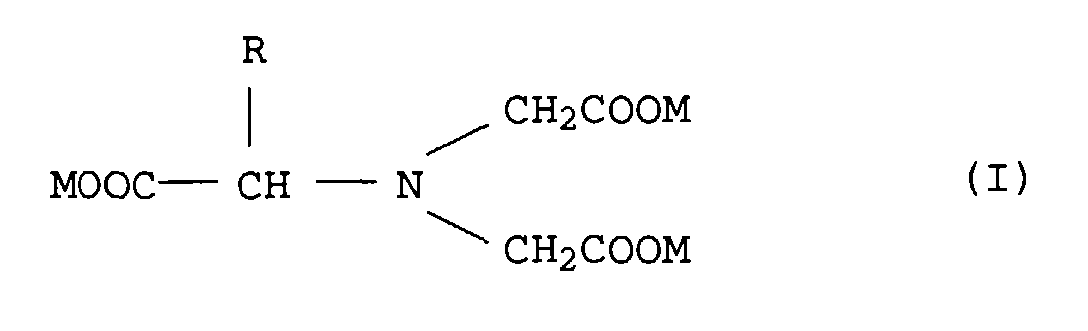 R für C1- bis C30-Alkyl oder C2- bis C30-Alkenyl steht undM Wasserstoff, Alkalimetall, Erdalkalimetall, Ammonium oder substituiertes Ammonium in den entsprechenden stöchiometrischen Mengen bedeutet,umsetzt und anschließend noch vorhandene Nitrilgruppen zu Carboxylgruppen hydrolysiert.
dadurch gekennzeichnet, daß manA) entsprechende 2-substituierte Glycine oder 2-substituierte Glycinnitrile mit Formaldehyd und Cyanwasserstoff oder Alkalimetallcyanid oderB) Iminodiessigsäure oder Iminodiacetonitril mit entsprechenden Monoaldehyden und Cyanwasserstoff oder Alkalimetallcyanid - Verfahren zur Herstellung von Glycin-N,N-diessigsäure-Derivaten 1 nach Anspruch 1, bei denen R für geradkettiges C1- bis C17-Alkyl oder geradkettiges C2- bis C17-Alkenyl steht.
- Verfahren zur Herstellung von α-Alanin-N,N-diessigsäure und ihren Alkalimetall-, Ammonium- und substituierten Ammoniumsalzen nach Anspruch 1.
- Verfahren zur Herstellung von Glycin-N,N-diessigsäure-Derivaten I nach Anspruch 1, dadurch gekennzeichnet, daß man bei Ausführungsform A auf die Mitverwendung zusätzlicher Säure verzichtet.
- Verfahren zur Herstellung von Glycin-N,N-diessigsäure-Derivaten I nach Anspruch 1, dadurch gekennzeichnet, daß man bei Ausführungsform B im pH-Bereich von 0 bis 11 arbeitet.
- In 2-Position durch den Rest R substituierte Glycin-N,N-diacetonitrile und Glycinnitril-N,N-diacetonitrile, bei denen R für C1- bis C30-Alkyl oder C2- bis C30-Alkenyl steht, als Zwischenprodukte.
Priority Applications (1)
| Application Number | Priority Date | Filing Date | Title |
|---|---|---|---|
| EP03008611A EP1334961A1 (de) | 1993-06-16 | 1994-06-07 | Verfahren zur Herstellung von Glycin-N,N-diessigsäure-Derivaten |
Applications Claiming Priority (3)
| Application Number | Priority Date | Filing Date | Title |
|---|---|---|---|
| DE4319935A DE4319935A1 (de) | 1993-06-16 | 1993-06-16 | Verwendung von Glycin-N,N-diessigsäure-Derivaten als Komplexbildner für Erdalkali- und Schwermetallionen |
| DE4319935 | 1993-06-16 | ||
| EP94920434A EP0703971B1 (de) | 1993-06-16 | 1994-06-07 | Verwendung von alpha-alanin-n,n-diessigsäure und ihren salzen als biologisch abbaubare komplexbildner für erdalkali- und schwermetallionen in reinigungsformulierungen für die geschirreinigung |
Related Parent Applications (2)
| Application Number | Title | Priority Date | Filing Date |
|---|---|---|---|
| EP94920434A Division EP0703971B1 (de) | 1993-06-16 | 1994-06-07 | Verwendung von alpha-alanin-n,n-diessigsäure und ihren salzen als biologisch abbaubare komplexbildner für erdalkali- und schwermetallionen in reinigungsformulierungen für die geschirreinigung |
| EP94920434.1 Division | 1994-12-22 |
Related Child Applications (1)
| Application Number | Title | Priority Date | Filing Date |
|---|---|---|---|
| EP03008611A Division EP1334961A1 (de) | 1993-06-16 | 1994-06-07 | Verfahren zur Herstellung von Glycin-N,N-diessigsäure-Derivaten |
Publications (2)
| Publication Number | Publication Date |
|---|---|
| EP0781762A1 true EP0781762A1 (de) | 1997-07-02 |
| EP0781762B1 EP0781762B1 (de) | 2004-01-07 |
Family
ID=6490454
Family Applications (5)
| Application Number | Title | Priority Date | Filing Date |
|---|---|---|---|
| EP97122735A Expired - Lifetime EP0846753B1 (de) | 1993-06-16 | 1994-06-07 | Verwendung von alpha-Alanin-N,N-diessigsäure und ihren Salzen als biologisch abbaubare Komplexbildner für Erdalkali und Schwermetallionen in alkalischen Reinigungsformulierungen für Reinigungsprozesse in der Getränke- und Nahrungsmittelindustrie |
| EP97101598A Expired - Lifetime EP0781762B1 (de) | 1993-06-16 | 1994-06-07 | Verfahren zur Herstellung von Glycin-N.N.-diesigsäure-Derivaten |
| EP94920434A Expired - Lifetime EP0703971B1 (de) | 1993-06-16 | 1994-06-07 | Verwendung von alpha-alanin-n,n-diessigsäure und ihren salzen als biologisch abbaubare komplexbildner für erdalkali- und schwermetallionen in reinigungsformulierungen für die geschirreinigung |
| EP03008611A Withdrawn EP1334961A1 (de) | 1993-06-16 | 1994-06-07 | Verfahren zur Herstellung von Glycin-N,N-diessigsäure-Derivaten |
| EP99111836A Withdrawn EP0976818A1 (de) | 1993-06-16 | 1994-06-07 | Verwendung von Glycin-N,N-diessigsäure-Derivaten als biologisch abbaubare Komplexbildner für Erdalkali- und Schwermetallionen in pulverförmigen Kompakt- und Ultra-Kompakt-Waschmittelformulierungen und in flüssigen Waschmittelformulierungen |
Family Applications Before (1)
| Application Number | Title | Priority Date | Filing Date |
|---|---|---|---|
| EP97122735A Expired - Lifetime EP0846753B1 (de) | 1993-06-16 | 1994-06-07 | Verwendung von alpha-Alanin-N,N-diessigsäure und ihren Salzen als biologisch abbaubare Komplexbildner für Erdalkali und Schwermetallionen in alkalischen Reinigungsformulierungen für Reinigungsprozesse in der Getränke- und Nahrungsmittelindustrie |
Family Applications After (3)
| Application Number | Title | Priority Date | Filing Date |
|---|---|---|---|
| EP94920434A Expired - Lifetime EP0703971B1 (de) | 1993-06-16 | 1994-06-07 | Verwendung von alpha-alanin-n,n-diessigsäure und ihren salzen als biologisch abbaubare komplexbildner für erdalkali- und schwermetallionen in reinigungsformulierungen für die geschirreinigung |
| EP03008611A Withdrawn EP1334961A1 (de) | 1993-06-16 | 1994-06-07 | Verfahren zur Herstellung von Glycin-N,N-diessigsäure-Derivaten |
| EP99111836A Withdrawn EP0976818A1 (de) | 1993-06-16 | 1994-06-07 | Verwendung von Glycin-N,N-diessigsäure-Derivaten als biologisch abbaubare Komplexbildner für Erdalkali- und Schwermetallionen in pulverförmigen Kompakt- und Ultra-Kompakt-Waschmittelformulierungen und in flüssigen Waschmittelformulierungen |
Country Status (9)
| Country | Link |
|---|---|
| US (3) | US5786313A (de) |
| EP (5) | EP0846753B1 (de) |
| JP (4) | JP3615546B2 (de) |
| AT (3) | ATE257466T1 (de) |
| CA (1) | CA2162122C (de) |
| DE (4) | DE4319935A1 (de) |
| DK (3) | DK0781762T3 (de) |
| ES (3) | ES2214562T3 (de) |
| WO (1) | WO1994029421A1 (de) |
Cited By (1)
| Publication number | Priority date | Publication date | Assignee | Title |
|---|---|---|---|---|
| WO2021052768A1 (de) | 2019-09-17 | 2021-03-25 | Zschimmer & Schwarz Mohsdorf GmbH & Co. KG | Phosphonsäurederivate und verfahren zu deren herstellung |
Families Citing this family (116)
| Publication number | Priority date | Publication date | Assignee | Title |
|---|---|---|---|---|
| DE4319935A1 (de) * | 1993-06-16 | 1994-12-22 | Basf Ag | Verwendung von Glycin-N,N-diessigsäure-Derivaten als Komplexbildner für Erdalkali- und Schwermetallionen |
| DE4444349A1 (de) * | 1994-12-14 | 1996-06-20 | Basf Ag | Verwendung von Glycin-N,N-diessigsäure-Derivaten als biologisch abbaubare Komplexbildner für Erdalkali- und Schwermetallionen in Färbebädern und Färbenachbehandlungsbädern in der Textilindustrie |
| DE4444347A1 (de) * | 1994-12-14 | 1996-06-20 | Basf Ag | Verwendung von Glycin-N,N-diessigsäure-Derivaten als Komplexbildner für Erdalkali- und Schwermetallionen bei der Förderung und beim Transport von Erdöl und Erdgas |
| US5481018A (en) * | 1995-03-31 | 1996-01-02 | The Dow Chemical Company | Amino nitrile intermediate for the preparation of alanine diacetic acid |
| DE19518986A1 (de) * | 1995-05-29 | 1996-12-05 | Basf Ag | Verfahren zur Herstellung von Glycin-N,N-diessigsäure-Derivaten durch Umsetzung von Glycinderivaten oder deren Vorstufen mit Formaldehyd und Cyanwasserstoff oder von Iminodiacetonitril oder Imindodiessigsäure mit entsprechenden Aldehyden und Cyanwasserstoff in wäßrig-saurem Medium |
| DE19518987A1 (de) * | 1995-05-29 | 1996-12-05 | Basf Ag | Verfahren zur Herstellung von Glycin-N,N-diessigsäure-Derivaten durch Umsetzung von Glycinderivaten oder deren Vorstufen mit Formaldehyd und Alkalimetallcyanid in wäßrig-alkalischem Medium |
| DE19543162A1 (de) * | 1995-11-18 | 1997-05-22 | Basf Ag | Feste Textilwaschmittel-Formulierung aus anorganischen Buildern, Glycin-N,N-diessigsäure-Derivaten als organische Cobuilder sowie anionischen und nichtionischen Tensiden |
| EP0866844B1 (de) * | 1995-12-11 | 1999-07-28 | Unilever N.V. | Reinigung einer komplettanlage |
| EP0783034B1 (de) * | 1995-12-22 | 2010-08-18 | Mitsubishi Rayon Co., Ltd. | Chelatbildendes Mittel und dieses enthaltendes Waschmittel |
| JP3810854B2 (ja) * | 1996-01-22 | 2006-08-16 | 花王株式会社 | 高密度粉末洗剤組成物 |
| JP3810847B2 (ja) * | 1996-01-22 | 2006-08-16 | 花王株式会社 | 高密度粉末洗剤組成物 |
| JP3221830B2 (ja) * | 1996-01-22 | 2001-10-22 | 花王株式会社 | 高密度粒状洗剤組成物 |
| JP3221831B2 (ja) * | 1996-01-22 | 2001-10-22 | 花王株式会社 | 非イオン性高密度粒状洗剤組成物 |
| DE19607800A1 (de) * | 1996-03-01 | 1997-09-04 | Henkel Ecolab Gmbh & Co Ohg | Reinigungsmittel für Anlagen der Lebensmittelindustrie, seine Verwendung und Verfahren zum Reinigen dieser Anlagen |
| GB2311541A (en) * | 1996-03-29 | 1997-10-01 | Procter & Gamble | Oxygen-releasing bleach composition |
| GB2311542A (en) * | 1996-03-29 | 1997-10-01 | Procter & Gamble | Percarbonate bleach composition |
| US6172036B1 (en) * | 1996-03-29 | 2001-01-09 | The Procter & Gamble Company | Rinsing compositions containing an amino tricarboxylic acid and an organic polymer |
| US6159922A (en) * | 1996-03-29 | 2000-12-12 | The Procter & Gamble Company | Bleaching composition |
| GB2311535A (en) * | 1996-03-29 | 1997-10-01 | Procter & Gamble | Detergent compositions |
| GB2311538A (en) * | 1996-03-29 | 1997-10-01 | Procter & Gamble | Detergent compositions |
| GB2311537A (en) * | 1996-03-29 | 1997-10-01 | Procter & Gamble | Rinse composition for dishwashers |
| GB2311536A (en) * | 1996-03-29 | 1997-10-01 | Procter & Gamble | Dishwashing and laundry detergents |
| JPH09310091A (ja) * | 1996-05-22 | 1997-12-02 | Kao Corp | 硬質表面用洗浄剤組成物 |
| WO1997048773A1 (en) * | 1996-06-19 | 1997-12-24 | Unilever N.V. | Floor treating composition |
| CA2258218A1 (en) * | 1996-06-21 | 1997-12-31 | Benckiser N.V. | Low-alkaline mgda-containing dishwasher rinsing agent |
| DE19649681A1 (de) * | 1996-11-29 | 1998-06-04 | Basf Ag | Verfahren zur Herstellung eines kristallinen Feststoffes aus Glycin-N,N-diessigsäure-Derivaten mit hinreichend geringer Hygroskopizität |
| US6162259A (en) * | 1997-03-25 | 2000-12-19 | The Procter & Gamble Company | Machine dishwashing and laundry compositions |
| JP4033955B2 (ja) * | 1997-05-19 | 2008-01-16 | 花王株式会社 | 漂白剤含有洗剤組成物 |
| EP0991745A1 (de) * | 1997-06-24 | 2000-04-12 | Unilever N.V. | Reinigungszusätze, reinigungsmittel enthaltend einen solchen zusatz, und verwendung dieser mittel zur reinigung von flaschen |
| JP3290382B2 (ja) * | 1997-07-18 | 2002-06-10 | 花王株式会社 | 粉末洗剤組成物 |
| DE59810854D1 (de) * | 1997-07-30 | 2004-04-01 | Basf Ag | Feste textilwaschmittel-formulierung auf basis von glycin-n,n-diessigsäure-derivaten mit stark reduziertem anteil an weiteren anionischen tensiden |
| US6235704B1 (en) | 1997-07-30 | 2001-05-22 | Basf Aktiengesellschaft | Solid textile detergent formulation based on glycin-N and N-Diacetic acid derivatives |
| DE19736476A1 (de) * | 1997-08-21 | 1999-02-25 | Basf Ag | Verfahren zur Herstellung von langkettigen Glycin-N,N-diessigsäure-Derivaten |
| US6367030B1 (en) * | 1997-10-09 | 2002-04-02 | Matsushita Electric Industrial Co., Ltd. | Address conversion circuit and address conversion system with redundancy decision circuitry |
| JPH11158498A (ja) * | 1997-12-01 | 1999-06-15 | Showa Denko Kk | 車両用洗浄剤組成物 |
| JP3779062B2 (ja) * | 1998-05-11 | 2006-05-24 | 麒麟麦酒株式会社 | ビールディスペンサ洗浄用組成物および洗浄方法 |
| US6197736B1 (en) * | 1998-12-22 | 2001-03-06 | The Boeing Company | Alkaline cleaning solution |
| US6346217B1 (en) | 1999-06-02 | 2002-02-12 | Water Whole International, Inc. | Composition and method for cleaning drink water tanks |
| US6240935B1 (en) * | 2000-03-30 | 2001-06-05 | The Boeing Company | Boelube R dissolving alkaline cleaning solution |
| JP3857082B2 (ja) * | 2001-07-24 | 2006-12-13 | 花王株式会社 | 衣料用洗濯前処理剤組成物 |
| JP3637005B2 (ja) * | 2001-07-24 | 2005-04-06 | 花王株式会社 | 洗濯前処理用物品 |
| US7003228B2 (en) * | 2001-09-11 | 2006-02-21 | Vitesse Semiconductor Corporation | Method and apparatus for improved high-speed adaptive equalization |
| JP4030831B2 (ja) * | 2002-08-14 | 2008-01-09 | 花王株式会社 | 洗濯前処理用組成物 |
| US20050011017A1 (en) * | 2003-03-25 | 2005-01-20 | L'oreal S.A. | Oxidizing composition comprising hydroxycarboxylic acids and salts thereof as complexing agents for dyeing, bleaching or permanently reshaping keratin fibres |
| US20050039270A1 (en) * | 2003-03-25 | 2005-02-24 | L'oreal S.A. | Use of polycarboxylic acids and salts thereof as complexing agents in oxidizing compositions for dyeing, bleaching or permanently reshaping keratin fibres |
| US20050036970A1 (en) * | 2003-03-25 | 2005-02-17 | L'oreal S.A. | Reducing compositions for bleaching or permanently reshaping keratin fibres comprising polycarboxylic acids and salts thereof as complexing agents |
| FR2852838B1 (fr) * | 2003-03-25 | 2008-01-18 | Oreal | Utilisation d'acides polycarboxyliques et leurs sels comme agents complexants dans des compositions oxydantes pour la coloration, la decoloration ou la deformation permanente de fibres keratiniques |
| US7303588B2 (en) * | 2003-03-25 | 2007-12-04 | L'oreal S.A. | Composition for dyeing keratinous fibers, comprising at least one polycarboxylic acid or a salt, ready-to-use composition comprising it, implementation process and device |
| FR2852836B1 (fr) * | 2003-03-25 | 2008-02-15 | Oreal | Utilisation d'acides hydroxycarboxyliques et de leurs sels comme agents complexants dans des compositions reductrices pour la decoloration ou la deformation permanente de fibres keratiniques |
| FR2852832B1 (fr) | 2003-03-25 | 2008-06-27 | Oreal | Composition de coloration pour fibres keratiniques comprenant un acide hydroxycarboxilique ou un sel, composition prete a l'emploi la comprenant, procede de mise en oeuvre et dispositif |
| US7038875B2 (en) * | 2003-07-31 | 2006-05-02 | Seagate Technology Llc | Dynamic measurement of head media spacing modulation |
| DE102004038991A1 (de) * | 2004-08-10 | 2006-02-23 | Henkel Kgaa | Alkalisierungsmittel-haltiges Mittel zum Aufhellen und/oder Färben von keratinhaltigen Fasern, insbesondere Blondiermittel für menschliche Haare |
| TW200619368A (en) * | 2004-10-28 | 2006-06-16 | Nissan Chemical Ind Ltd | Polishing composition for silicon wafer |
| DE102005021055A1 (de) * | 2005-05-06 | 2006-11-09 | Basf Ag | Verfahren zur Herstellung von nebenproduktarmen Methylglycin-N,N-diessigsäure-Trialkalimetallsalzen |
| DE102005021056A1 (de) | 2005-05-06 | 2006-11-09 | Basf Ag | Verfahren zur Isolierung von Methylglycinnitril-N,N-diacetonitrilen aus einem wässrigen Rohgemisch |
| DE102005041349A1 (de) * | 2005-08-31 | 2007-03-01 | Basf Ag | Reinigungsformulierungen für die maschinelle Geschirrreinigung enthaltend hydrophil modifizierte Polycarboxylate |
| DE102005041347A1 (de) * | 2005-08-31 | 2007-03-01 | Basf Ag | Reinigungsformulierungen für die maschinelle Geschirrreinigung enthaltend hydrophil modifizierte Polycarboxylate |
| GB0522658D0 (en) | 2005-11-07 | 2005-12-14 | Reckitt Benckiser Nv | Composition |
| US8567504B2 (en) * | 2006-08-04 | 2013-10-29 | Halliburton Energy Services, Inc. | Composition and method relating to the prevention and remediation of surfactant gel damage |
| US8567503B2 (en) * | 2006-08-04 | 2013-10-29 | Halliburton Energy Services, Inc. | Composition and method relating to the prevention and remediation of surfactant gel damage |
| US9120964B2 (en) * | 2006-08-04 | 2015-09-01 | Halliburton Energy Services, Inc. | Treatment fluids containing biodegradable chelating agents and methods for use thereof |
| US9127194B2 (en) | 2006-08-04 | 2015-09-08 | Halliburton Energy Services, Inc. | Treatment fluids containing a boron trifluoride complex and methods for use thereof |
| US9027647B2 (en) | 2006-08-04 | 2015-05-12 | Halliburton Energy Services, Inc. | Treatment fluids containing a biodegradable chelating agent and methods for use thereof |
| WO2008076055A1 (en) * | 2006-12-19 | 2008-06-26 | Akzo Nobel N.V. | Process of pulping |
| US8889048B2 (en) | 2007-10-18 | 2014-11-18 | Ecolab Inc. | Pressed, self-solidifying, solid cleaning compositions and methods of making them |
| US20100190676A1 (en) * | 2008-07-22 | 2010-07-29 | Ecolab Inc. | Composition for enhanced removal of blood soils |
| GB0901207D0 (en) | 2009-01-26 | 2009-03-11 | Innospec Ltd | Chelating agents and methods relating thereto |
| JP5745507B2 (ja) * | 2009-05-20 | 2015-07-08 | ビーエーエスエフ ソシエタス・ヨーロピアBasf Se | グリシン−n,n−二酢酸の1種以上の誘導体および/またはグルタミン−n,n−二酢酸の1種以上の誘導体を含む粉末ならびにメチルグリシン−n,n−二酢酸三ナトリウム塩粉末の調製方法 |
| SG178076A1 (en) | 2009-05-20 | 2012-03-29 | Basf Se | Process for the preparation of a spray powder comprising one or more glycine-n,n-diacetic acid derivatives and use of the spray powder for producing compression agglomerates |
| US20110009299A1 (en) * | 2009-07-10 | 2011-01-13 | Van Zanten Ryan | Emulsion stabilizing agents for drilling and completion fluids |
| DE102009038951A1 (de) | 2009-08-26 | 2011-03-03 | Inprotec Ag | Verfahren zur Herstellung eines kristallinen Feststoffes aus Glycin-N,N-diessigsäure-Derivaten mit hinreichend geringer Hygroskopizität |
| EP2308834A1 (de) | 2009-10-05 | 2011-04-13 | Basf Se | Verfahren zur Isolierung von Methylglycinnitril-N,N-diacetonitril |
| CA2776570A1 (en) | 2009-10-12 | 2011-04-21 | Basf Se | Process for the preparation of a powder comprising one or more complexing agent salts |
| EP2504417A1 (de) * | 2009-11-25 | 2012-10-03 | Basf Se | Biologisch abbaubare reinigungszusammensetzung |
| JP2013518984A (ja) | 2010-02-09 | 2013-05-23 | ビーエーエスエフ ソシエタス・ヨーロピア | ビルダー組成物 |
| MX2012009162A (es) | 2010-02-09 | 2012-10-03 | Basf Se | Composicion detergente. |
| ES2682051T3 (es) * | 2010-04-23 | 2018-09-18 | The Procter & Gamble Company | Composición detergente |
| EP2383329A1 (de) | 2010-04-23 | 2011-11-02 | The Procter & Gamble Company | Partikel |
| EP2380962B1 (de) * | 2010-04-23 | 2016-03-30 | The Procter and Gamble Company | Partikel |
| US8754026B2 (en) | 2010-09-27 | 2014-06-17 | Basf Se | Process for producing granules comprising one or more complexing agent salts |
| PL2621892T3 (pl) | 2010-09-27 | 2015-12-31 | Basf Se | Sposób wytwarzania granulatu zawierającego jedną lub większą liczbę soli kompleksotwórczych |
| US8802894B2 (en) | 2011-04-04 | 2014-08-12 | Basf Se | Process for the preparation of aqueous solutions of methylglycine-N,N-diacetic acid trialkali metal salts |
| BR112013023846A2 (pt) * | 2011-04-04 | 2020-11-10 | Basf Se | processo para a preparação de soluções aquosas de sais de tri-metal-alcalino de ácido metilglicina-n,n-diacético |
| CA2833150C (en) | 2011-04-14 | 2020-10-06 | Basf Se | A method of dissolving and/or inhibiting the deposition of scale on a surface of a system |
| US9227915B2 (en) | 2011-05-03 | 2016-01-05 | Basf Se | Process for the preparation of a crystalline L-MGDA trialkali metal salt |
| ES2660773T5 (es) | 2011-05-03 | 2021-11-25 | Basf Se | Procedimiento para la preparación de una sal cristalina trialcalino-metálica de L-MGDA |
| US8881823B2 (en) | 2011-05-03 | 2014-11-11 | Halliburton Energy Services, Inc. | Environmentally friendly low temperature breaker systems and related methods |
| GB2491619B (en) * | 2011-06-09 | 2014-10-01 | Pq Silicas Bv | Builder granules and process for their preparation |
| JP2014522451A (ja) * | 2011-06-13 | 2014-09-04 | アクゾ ノーベル ケミカルズ インターナショナル ベスローテン フエンノートシャップ | クロム含有機器装置においてキレート化剤を使用して改善された耐食性 |
| BR112013032876A2 (pt) | 2011-06-29 | 2017-01-24 | Basf Se | uso de formulações, e, método para fertilizar plantas |
| US9403731B2 (en) | 2011-06-29 | 2016-08-02 | Basf Se | Modified aminocarboxylates with improved storage stability and processability |
| DE102012102859A1 (de) * | 2012-04-02 | 2013-11-14 | Osram Opto Semiconductors Gmbh | Optoelektronisches Bauelement umfassend eine Konverterträgerschicht, und Verfahren zur Herstellung eines optoelektronischen Bauelements umfassend eine Konverterträgerschicht |
| US9334716B2 (en) | 2012-04-12 | 2016-05-10 | Halliburton Energy Services, Inc. | Treatment fluids comprising a hydroxypyridinecarboxylic acid and methods for use thereof |
| US8772527B2 (en) | 2012-04-27 | 2014-07-08 | Basf Se | Process for isomerization of cis-2-pentenenitrile to 3-pentenenitriles |
| JP6063829B2 (ja) * | 2012-06-28 | 2017-01-18 | ライオン株式会社 | 繊維製品用の液体洗浄剤 |
| US9850512B2 (en) | 2013-03-15 | 2017-12-26 | The Research Foundation For The State University Of New York | Hydrolysis of cellulosic fines in primary clarified sludge of paper mills and the addition of a surfactant to increase the yield |
| US9670399B2 (en) | 2013-03-15 | 2017-06-06 | Halliburton Energy Services, Inc. | Methods for acidizing a subterranean formation using a stabilized microemulsion carrier fluid |
| RU2531914C1 (ru) * | 2013-03-18 | 2014-10-27 | Федеральное государственное бюджетное образовательное учреждение высшего профессионального образования "Российский государственный аграрный университет-МСХА имени К.А. Тимирязева" (ФГБОУ ВПО РГАУ-МСХА имени К.А. Тимирязева) | Способ санитарной обработки доильного оборудования |
| ES2646288T3 (es) * | 2013-09-13 | 2017-12-13 | Basf Se | Mezclas de enantiómeros y procedimiento para elaborar dichas mezclas |
| CN105814016A (zh) * | 2013-12-11 | 2016-07-27 | 巴斯夫欧洲公司 | N,n-二(2-氨基烷基)-1,2-烷基二胺衍生物 |
| MY193287A (en) | 2013-12-13 | 2022-09-30 | Basf Se | Recombinant microorganism for improved production of fine chemicals |
| SI2902544T1 (sl) * | 2014-01-30 | 2017-09-29 | Archroma France Sas | Vodni sestavek, ki obsega polivalentno kovino, ki tvori komplekse s kabonatnimi ligandi in ligandi karboksilne kisline, ter njegova uporaba |
| US9951363B2 (en) | 2014-03-14 | 2018-04-24 | The Research Foundation for the State University of New York College of Environmental Science and Forestry | Enzymatic hydrolysis of old corrugated cardboard (OCC) fines from recycled linerboard mill waste rejects |
| WO2016058875A1 (en) * | 2014-10-17 | 2016-04-21 | Basf Se | Solutions of trialkali metal salts of aminocarboxylic acids, their manufacture and use |
| CA2970432A1 (en) | 2014-12-23 | 2016-06-30 | Akzo Nobel Chemicals International B.V. | Crystals of alanine n-acetic acid precursors, process to prepare them and their use |
| KR20170127493A (ko) * | 2015-03-11 | 2017-11-21 | 바스프 에스이 | 킬레이트제의 혼합물, 및 이러한 혼합물의 제조 방법 |
| US10717998B2 (en) | 2015-03-18 | 2020-07-21 | Basf Se | Recombinant microorganism for improved production of fine chemicals |
| EP3294702B1 (de) * | 2015-05-13 | 2020-12-02 | Basf Se | Verfahren zur herstellung von mischungen von chelatbildnern |
| WO2016193351A2 (en) | 2015-06-04 | 2016-12-08 | Basf Se | Recombinant microorganism for improved production of fine chemicals |
| MX386450B (es) | 2015-06-12 | 2025-03-12 | Basf Se | Microorganismo recombinante para la producción mejorada de productos químicos finos. |
| CN108368029A (zh) * | 2015-12-17 | 2018-08-03 | 巴斯夫欧洲公司 | 制备络合剂的结晶碱金属盐的方法和结晶络合剂 |
| US11713435B2 (en) | 2018-01-30 | 2023-08-01 | Eastman Chemical Company | Aminocarboxylate chelating agents and detergent compositions containing them |
| PL3822335T3 (pl) | 2019-11-15 | 2023-03-13 | Basf Se | Kompozycje czyszczące i ich zastosowanie |
| CN116419915A (zh) | 2021-01-15 | 2023-07-11 | 巴斯夫欧洲公司 | 制备羧酸的方法 |
| WO2023278688A1 (en) | 2021-06-30 | 2023-01-05 | Ascend Performance Materials Operations Llc | Process for preparing nitrile intermediates for nitrogen-containing chelators |
| CN118812379B (zh) * | 2024-06-14 | 2026-04-07 | 万华化学集团股份有限公司 | 一种制备甲基甘氨酸-n,n-二乙酸三碱金属盐的方法 |
Citations (6)
| Publication number | Priority date | Publication date | Assignee | Title |
|---|---|---|---|---|
| DE2027972A1 (de) | 1969-08-26 | 1971-04-15 | W R Grace & Cc , New York, N Y (VStA) | Verfahren zur Herstellung von eckige Klammer auf ,N Bis(cyanmethyl)glycin eckige Klammer zu |
| DE1643415A1 (de) * | 1966-10-20 | 1971-06-03 | Hooker Chemical Corp | Verfahren zur Herstellung von Nitrilotriessigsaeure und ihren Analogen |
| US3733355A (en) | 1970-07-28 | 1973-05-15 | Hooker Chemical Corp | Production of nitrilotriacetic acid and the analogs therefor |
| EP0008136A1 (de) | 1978-08-08 | 1980-02-20 | International Standard Electric Corporation | Ablenkjochhalterung |
| DE3712329A1 (de) * | 1987-04-11 | 1988-10-20 | Basf Ag | Verfahren zur herstellung von serin-n,n-diessigsaeure und derivaten, ihre verwendung insbesondere als komplexbildner und diese enthaltende wasch- und reinigungsmittel |
| DE4211713A1 (de) * | 1992-04-08 | 1993-10-14 | Basf Ag | Verfahren zur Herstellung von Aminodicarbonsäure-N,N-diessigsäuren |
Family Cites Families (27)
| Publication number | Priority date | Publication date | Assignee | Title |
|---|---|---|---|---|
| US2500019A (en) * | 1946-10-08 | 1950-03-07 | Frederick C Bersworth | Method of producing polycarboxylic amino acids |
| DE1643238C3 (de) * | 1967-08-16 | 1974-09-05 | Basf Ag, 6700 Ludwigshafen | Verfahren zur kontinuierlichen Herstellung von Alkalisalzen der Nitrilotriessigsäure |
| FR2051931A5 (de) * | 1969-07-02 | 1971-04-09 | Pechiney Saint Gobain | |
| US3969257A (en) * | 1971-07-23 | 1976-07-13 | Colgate-Palmolive Company | Washing and bleaching composition containing bleach, activator and a nitrilotricarboxylic acid compound |
| US3961932A (en) * | 1974-01-07 | 1976-06-08 | Ciba-Geigy Corporation | Process for coating granular fertilizers with chelated micronutrients |
| US4001133A (en) * | 1974-11-04 | 1977-01-04 | Basf Wyandotte Corporation | Method of washing glassware and inhibited cleaning solution and additive composition useful therein |
| US4066517A (en) * | 1976-03-11 | 1978-01-03 | Oxy Metal Industries Corporation | Electrodeposition of palladium |
| JPS5346915A (en) * | 1976-10-09 | 1978-04-27 | Nitto Chem Ind Co Ltd | Preparation of alkali salt of aminopolyacetic acid |
| JPS55157695A (en) * | 1979-05-18 | 1980-12-08 | Kureha Chemical Ind Co Ltd | Detergent composition |
| JPS55160099A (en) * | 1979-05-18 | 1980-12-12 | Kureha Chemical Ind Co Ltd | Detergent composition |
| US4287080A (en) * | 1979-09-17 | 1981-09-01 | The Procter & Gamble Company | Detergent compositions which contain certain tertiary alcohols |
| JPS5851994B2 (ja) * | 1979-12-05 | 1983-11-19 | 呉羽化学工業株式会社 | 無リン洗剤組成物 |
| EP0089136A3 (de) * | 1982-03-10 | 1984-05-30 | The Procter & Gamble Company | Orale Hygieneprodukte |
| US4769168A (en) * | 1985-08-05 | 1988-09-06 | Colgate-Palmolive Company | Low phosphate or phosphate free nonaqueous liquid nonionic laundry detergent composition and method of use |
| DE3531563A1 (de) * | 1985-09-04 | 1987-03-05 | Benckiser Knapsack Gmbh | Holzstoffbleiche |
| US4806263A (en) * | 1986-01-02 | 1989-02-21 | Ppg Industries, Inc. | Fungicidal and algicidal detergent compositions |
| DE3706823A1 (de) * | 1986-03-04 | 1987-09-10 | Fuji Photo Film Co Ltd | Verfahren zur ausbildung eines farbbildes |
| DE3829847A1 (de) * | 1988-09-02 | 1990-03-15 | Basf Ag | Wasch- und reinigungsmittel |
| DE3838093A1 (de) * | 1988-11-10 | 1990-05-17 | Basf Ag | Verwendung von copolymerisaten als zusatz zu fluessigwaschmitteln |
| DE3914980A1 (de) * | 1989-05-06 | 1990-12-06 | Basf Ag | 2-methyl- und 2-hydroxymethyl-serin-n,n-diessigsaeure und ihre derivate |
| CA2027518A1 (en) * | 1990-10-03 | 1992-04-04 | Richard L. Tadsen | Process for preparing high density detergent compositions containing particulate ph sensitive surfactant |
| US5177243A (en) * | 1991-12-12 | 1993-01-05 | W. R. Grace & Co.-Conn. | N,N'-diacetic acid-N'-cyanomethyl, salts thereof, and their preparation |
| EP0553569B1 (de) * | 1991-12-27 | 1996-12-04 | Konica Corporation | Verfahren zur Behandlung von farbphotografischen lichtempfindlichen Silberhalogenidmaterialien |
| CZ280593B6 (cs) * | 1992-01-17 | 1996-02-14 | Unilever Nv | Částicové detergenční směsi |
| DE4319935A1 (de) * | 1993-06-16 | 1994-12-22 | Basf Ag | Verwendung von Glycin-N,N-diessigsäure-Derivaten als Komplexbildner für Erdalkali- und Schwermetallionen |
| US5481018A (en) * | 1995-03-31 | 1996-01-02 | The Dow Chemical Company | Amino nitrile intermediate for the preparation of alanine diacetic acid |
| DE19518986A1 (de) * | 1995-05-29 | 1996-12-05 | Basf Ag | Verfahren zur Herstellung von Glycin-N,N-diessigsäure-Derivaten durch Umsetzung von Glycinderivaten oder deren Vorstufen mit Formaldehyd und Cyanwasserstoff oder von Iminodiacetonitril oder Imindodiessigsäure mit entsprechenden Aldehyden und Cyanwasserstoff in wäßrig-saurem Medium |
-
1993
- 1993-06-16 DE DE4319935A patent/DE4319935A1/de not_active Withdrawn
-
1994
- 1994-06-07 DE DE59409549T patent/DE59409549D1/de not_active Expired - Lifetime
- 1994-06-07 AT AT97101598T patent/ATE257466T1/de active
- 1994-06-07 EP EP97122735A patent/EP0846753B1/de not_active Expired - Lifetime
- 1994-06-07 ES ES97101598T patent/ES2214562T3/es not_active Expired - Lifetime
- 1994-06-07 DK DK97101598T patent/DK0781762T3/da active
- 1994-06-07 EP EP97101598A patent/EP0781762B1/de not_active Expired - Lifetime
- 1994-06-07 JP JP50130695A patent/JP3615546B2/ja not_active Expired - Lifetime
- 1994-06-07 US US08/545,768 patent/US5786313A/en not_active Expired - Lifetime
- 1994-06-07 EP EP94920434A patent/EP0703971B1/de not_active Expired - Lifetime
- 1994-06-07 EP EP03008611A patent/EP1334961A1/de not_active Withdrawn
- 1994-06-07 AT AT97122735T patent/ATE226241T1/de active
- 1994-06-07 DE DE59410198T patent/DE59410198D1/de not_active Expired - Lifetime
- 1994-06-07 DK DK97122735T patent/DK0846753T3/da active
- 1994-06-07 CA CA002162122A patent/CA2162122C/en not_active Expired - Lifetime
- 1994-06-07 EP EP99111836A patent/EP0976818A1/de not_active Withdrawn
- 1994-06-07 WO PCT/EP1994/001838 patent/WO1994029421A1/de not_active Ceased
- 1994-06-07 ES ES97122735T patent/ES2184955T3/es not_active Expired - Lifetime
- 1994-06-07 DK DK94920434T patent/DK0703971T3/da active
- 1994-06-07 DE DE59410351T patent/DE59410351D1/de not_active Expired - Lifetime
- 1994-06-07 AT AT94920434T patent/ATE196921T1/de active
- 1994-06-07 ES ES94920434T patent/ES2151551T3/es not_active Expired - Lifetime
-
1998
- 1998-05-06 US US09/073,243 patent/US6005141A/en not_active Expired - Lifetime
- 1998-05-06 US US09/073,244 patent/US6008176A/en not_active Expired - Lifetime
-
2004
- 2004-07-12 JP JP2004204856A patent/JP4243225B2/ja not_active Expired - Lifetime
-
2008
- 2008-03-10 JP JP2008059565A patent/JP4741622B2/ja not_active Expired - Lifetime
-
2011
- 2011-02-18 JP JP2011033296A patent/JP2011148802A/ja active Pending
Patent Citations (6)
| Publication number | Priority date | Publication date | Assignee | Title |
|---|---|---|---|---|
| DE1643415A1 (de) * | 1966-10-20 | 1971-06-03 | Hooker Chemical Corp | Verfahren zur Herstellung von Nitrilotriessigsaeure und ihren Analogen |
| DE2027972A1 (de) | 1969-08-26 | 1971-04-15 | W R Grace & Cc , New York, N Y (VStA) | Verfahren zur Herstellung von eckige Klammer auf ,N Bis(cyanmethyl)glycin eckige Klammer zu |
| US3733355A (en) | 1970-07-28 | 1973-05-15 | Hooker Chemical Corp | Production of nitrilotriacetic acid and the analogs therefor |
| EP0008136A1 (de) | 1978-08-08 | 1980-02-20 | International Standard Electric Corporation | Ablenkjochhalterung |
| DE3712329A1 (de) * | 1987-04-11 | 1988-10-20 | Basf Ag | Verfahren zur herstellung von serin-n,n-diessigsaeure und derivaten, ihre verwendung insbesondere als komplexbildner und diese enthaltende wasch- und reinigungsmittel |
| DE4211713A1 (de) * | 1992-04-08 | 1993-10-14 | Basf Ag | Verfahren zur Herstellung von Aminodicarbonsäure-N,N-diessigsäuren |
Non-Patent Citations (2)
| Title |
|---|
| CHEMICAL ABSTRACTS, vol. 106, no. 18, 4 May 1987, Columbus, Ohio, US; abstract no. 140140c, S. LUEBKEOVA ET AL: "Surfactants from monoamine complexons." page 103; XP002902849 * |
| CZECH. CS 199,072 * |
Cited By (2)
| Publication number | Priority date | Publication date | Assignee | Title |
|---|---|---|---|---|
| WO2021052768A1 (de) | 2019-09-17 | 2021-03-25 | Zschimmer & Schwarz Mohsdorf GmbH & Co. KG | Phosphonsäurederivate und verfahren zu deren herstellung |
| DE102019124958B4 (de) | 2019-09-17 | 2023-03-23 | Zschimmer & Schwarz Mohsdorf GmbH & Co. KG. | Phosphonsäurederivate und Verfahren zu deren Herstellung |
Also Published As
| Publication number | Publication date |
|---|---|
| ES2214562T3 (es) | 2004-09-16 |
| DK0781762T3 (da) | 2004-03-08 |
| JP4741622B2 (ja) | 2011-08-03 |
| DE59409549D1 (de) | 2000-11-16 |
| EP0781762B1 (de) | 2004-01-07 |
| JP2011148802A (ja) | 2011-08-04 |
| ATE257466T1 (de) | 2004-01-15 |
| EP0846753A1 (de) | 1998-06-10 |
| EP0703971A1 (de) | 1996-04-03 |
| DK0703971T3 (da) | 2000-11-13 |
| US5786313A (en) | 1998-07-28 |
| JPH08511255A (ja) | 1996-11-26 |
| JP2004323533A (ja) | 2004-11-18 |
| DK0846753T3 (da) | 2002-11-04 |
| EP0976818A1 (de) | 2000-02-02 |
| DE59410198D1 (de) | 2002-11-21 |
| JP2008247902A (ja) | 2008-10-16 |
| EP1334961A1 (de) | 2003-08-13 |
| JP3615546B2 (ja) | 2005-02-02 |
| ATE196921T1 (de) | 2000-10-15 |
| US6005141A (en) | 1999-12-21 |
| ES2151551T3 (es) | 2001-01-01 |
| US6008176A (en) | 1999-12-28 |
| JP4243225B2 (ja) | 2009-03-25 |
| DE4319935A1 (de) | 1994-12-22 |
| WO1994029421A1 (de) | 1994-12-22 |
| CA2162122C (en) | 2005-11-22 |
| ES2184955T3 (es) | 2003-04-16 |
| CA2162122A1 (en) | 1994-12-22 |
| EP0846753B1 (de) | 2002-10-16 |
| EP0703971B1 (de) | 2000-10-11 |
| ATE226241T1 (de) | 2002-11-15 |
| DE59410351D1 (de) | 2004-02-12 |
Similar Documents
| Publication | Publication Date | Title |
|---|---|---|
| EP0781762A1 (de) | Verfahren zur Herstellung von Glycin-N.N.-diesigsäure-Derivaten | |
| EP0287885B1 (de) | Verfahren zur Herstellung von Serin-N,N-diessigsäure und Derivaten | |
| DE69915115T2 (de) | Bleichen mit polyoxometallaten und luft oder sauerstoff | |
| DE69516182T2 (de) | Aminonitrile zwischenprodukte zur herstellung von alamindiessigsaüre | |
| EP0287846B1 (de) | 2-Hydroxy-3-amino-propionsäure-N,N-diessigsäure und ihre Derivate, ihre Herstellung und Verwendung insbesondere als Komplexbildner und diese enthaltende Wasch- und Reinigungsmittel | |
| DE2057258A1 (de) | Wasch- und Reinigungsmittel | |
| EP0874802A1 (de) | Fettsäurederivate und ihre verwendung als tenside in wasch- und reinigungsmitteln | |
| DE4211713A1 (de) | Verfahren zur Herstellung von Aminodicarbonsäure-N,N-diessigsäuren | |
| EP0695289B1 (de) | Hydroxamsäuren und hydroxamsäureether sowie ihre verwendung als komplexbildner | |
| EP0396999B1 (de) | 2-Methyl- und 2-Hydroxymethyl-serin-N,N-diessigsäure und ihre Derivate | |
| EP0541614A1 (de) | Derivat der aminobernsteinsäure als komplexierungsmittel | |
| DE3739610A1 (de) | Nitrilo-di-aepfel-mono-essigsaeuren, verfahren zu ihrer herstellung und ihre verwendung | |
| EP0411436B1 (de) | Verwendung von 2-Hydroxy-3-aminopropionsäure-Derivaten als Komplex-bildner, Bleichmittelstabilisatoren und Gerüststoffe in Wasch- und Reinigungsmitteln | |
| DE69635422T2 (de) | Aminonitril-Zwischenprodukte zur Herstellung von 2-Hydroxyethyliminodiessigsäure | |
| DE19809359A1 (de) | Gleichzeitiges Waschen und Bleichen nativer Fasern und textiler Erzeugnisse daraus | |
| EP0715645A1 (de) | Verwendung von phenolischen komplexbildnern | |
| DE10216816A1 (de) | Verwendung von Aminomethylenderivaten und Aminomethylenderivate sowie Verfahren zur Herstellung derselben |
Legal Events
| Date | Code | Title | Description |
|---|---|---|---|
| PUAI | Public reference made under article 153(3) epc to a published international application that has entered the european phase |
Free format text: ORIGINAL CODE: 0009012 |
|
| 17P | Request for examination filed |
Effective date: 19970203 |
|
| AC | Divisional application: reference to earlier application |
Ref document number: 703971 Country of ref document: EP |
|
| AK | Designated contracting states |
Kind code of ref document: A1 Designated state(s): AT BE CH DE DK ES FR GB IT LI NL SE |
|
| 17Q | First examination report despatched |
Effective date: 20020502 |
|
| GRAH | Despatch of communication of intention to grant a patent |
Free format text: ORIGINAL CODE: EPIDOS IGRA |
|
| GRAS | Grant fee paid |
Free format text: ORIGINAL CODE: EPIDOSNIGR3 |
|
| GRAA | (expected) grant |
Free format text: ORIGINAL CODE: 0009210 |
|
| AC | Divisional application: reference to earlier application |
Ref document number: 0703971 Country of ref document: EP Kind code of ref document: P |
|
| AK | Designated contracting states |
Kind code of ref document: B1 Designated state(s): AT BE CH DE DK ES FR GB IT LI NL SE |
|
| REG | Reference to a national code |
Ref country code: GB Ref legal event code: FG4D Free format text: NOT ENGLISH |
|
| REG | Reference to a national code |
Ref country code: CH Ref legal event code: EP |
|
| REF | Corresponds to: |
Ref document number: 59410351 Country of ref document: DE Date of ref document: 20040212 Kind code of ref document: P |
|
| GBT | Gb: translation of ep patent filed (gb section 77(6)(a)/1977) |
Effective date: 20040205 |
|
| REG | Reference to a national code |
Ref country code: DK Ref legal event code: T3 |
|
| REG | Reference to a national code |
Ref country code: SE Ref legal event code: TRGR |
|
| REG | Reference to a national code |
Ref country code: ES Ref legal event code: FG2A Ref document number: 2214562 Country of ref document: ES Kind code of ref document: T3 |
|
| ET | Fr: translation filed | ||
| PLBE | No opposition filed within time limit |
Free format text: ORIGINAL CODE: 0009261 |
|
| STAA | Information on the status of an ep patent application or granted ep patent |
Free format text: STATUS: NO OPPOSITION FILED WITHIN TIME LIMIT |
|
| 26N | No opposition filed |
Effective date: 20041008 |
|
| PGFP | Annual fee paid to national office [announced via postgrant information from national office to epo] |
Ref country code: AT Payment date: 20120626 Year of fee payment: 19 |
|
| PGFP | Annual fee paid to national office [announced via postgrant information from national office to epo] |
Ref country code: CH Payment date: 20130628 Year of fee payment: 20 Ref country code: DK Payment date: 20130625 Year of fee payment: 20 Ref country code: SE Payment date: 20130625 Year of fee payment: 20 |
|
| PGFP | Annual fee paid to national office [announced via postgrant information from national office to epo] |
Ref country code: IT Payment date: 20130626 Year of fee payment: 20 |
|
| PGFP | Annual fee paid to national office [announced via postgrant information from national office to epo] |
Ref country code: DE Payment date: 20130902 Year of fee payment: 20 Ref country code: BE Payment date: 20130731 Year of fee payment: 20 Ref country code: ES Payment date: 20130724 Year of fee payment: 20 Ref country code: NL Payment date: 20130626 Year of fee payment: 20 |
|
| PGFP | Annual fee paid to national office [announced via postgrant information from national office to epo] |
Ref country code: GB Payment date: 20130701 Year of fee payment: 20 Ref country code: FR Payment date: 20130722 Year of fee payment: 20 |
|
| REG | Reference to a national code |
Ref country code: DK Ref legal event code: EUP Effective date: 20140607 |
|
| REG | Reference to a national code |
Ref country code: DE Ref legal event code: R071 Ref document number: 59410351 Country of ref document: DE |
|
| REG | Reference to a national code |
Ref country code: CH Ref legal event code: PL |
|
| REG | Reference to a national code |
Ref country code: NL Ref legal event code: V4 Effective date: 20140607 |
|
| BE20 | Be: patent expired |
Owner name: *BASF A.G. Effective date: 20140607 |
|
| REG | Reference to a national code |
Ref country code: GB Ref legal event code: PE20 Expiry date: 20140606 |
|
| REG | Reference to a national code |
Ref country code: AT Ref legal event code: MK07 Ref document number: 257466 Country of ref document: AT Kind code of ref document: T Effective date: 20140607 |
|
| REG | Reference to a national code |
Ref country code: SE Ref legal event code: EUG |
|
| PG25 | Lapsed in a contracting state [announced via postgrant information from national office to epo] |
Ref country code: GB Free format text: LAPSE BECAUSE OF EXPIRATION OF PROTECTION Effective date: 20140606 |
|
| PG25 | Lapsed in a contracting state [announced via postgrant information from national office to epo] |
Ref country code: DE Free format text: LAPSE BECAUSE OF EXPIRATION OF PROTECTION Effective date: 20140611 |
|
| REG | Reference to a national code |
Ref country code: ES Ref legal event code: FD2A Effective date: 20140926 |
|
| PG25 | Lapsed in a contracting state [announced via postgrant information from national office to epo] |
Ref country code: ES Free format text: LAPSE BECAUSE OF EXPIRATION OF PROTECTION Effective date: 20140608 |