EP0782011B1 - Corriger les effets de différences de couplage dans les mesures seismiques - Google Patents
Corriger les effets de différences de couplage dans les mesures seismiques Download PDFInfo
- Publication number
- EP0782011B1 EP0782011B1 EP96308644A EP96308644A EP0782011B1 EP 0782011 B1 EP0782011 B1 EP 0782011B1 EP 96308644 A EP96308644 A EP 96308644A EP 96308644 A EP96308644 A EP 96308644A EP 0782011 B1 EP0782011 B1 EP 0782011B1
- Authority
- EP
- European Patent Office
- Prior art keywords
- traces
- signal
- sensor
- coupling mechanism
- geophone
- Prior art date
- Legal status (The legal status is an assumption and is not a legal conclusion. Google has not performed a legal analysis and makes no representation as to the accuracy of the status listed.)
- Expired - Lifetime
Links
- 230000008878 coupling Effects 0.000 title claims description 77
- 238000010168 coupling process Methods 0.000 title claims description 77
- 238000005859 coupling reaction Methods 0.000 title claims description 77
- 230000000694 effects Effects 0.000 title claims description 15
- 230000007246 mechanism Effects 0.000 claims description 64
- 238000000034 method Methods 0.000 claims description 44
- 238000012546 transfer Methods 0.000 claims description 26
- 238000013016 damping Methods 0.000 claims description 24
- XLYOFNOQVPJJNP-UHFFFAOYSA-N water Substances O XLYOFNOQVPJJNP-UHFFFAOYSA-N 0.000 claims description 22
- 238000012545 processing Methods 0.000 claims description 7
- 238000012937 correction Methods 0.000 claims description 5
- 238000004364 calculation method Methods 0.000 claims description 2
- 238000012935 Averaging Methods 0.000 claims 2
- 230000009977 dual effect Effects 0.000 description 26
- 230000015572 biosynthetic process Effects 0.000 description 11
- 238000005755 formation reaction Methods 0.000 description 11
- 230000003287 optical effect Effects 0.000 description 9
- 230000004044 response Effects 0.000 description 9
- 239000002245 particle Substances 0.000 description 5
- 238000010586 diagram Methods 0.000 description 4
- 238000001914 filtration Methods 0.000 description 4
- 238000004873 anchoring Methods 0.000 description 2
- 230000006872 improvement Effects 0.000 description 2
- 230000009467 reduction Effects 0.000 description 2
- 230000003068 static effect Effects 0.000 description 2
- 241000364021 Tulsa Species 0.000 description 1
- 230000001133 acceleration Effects 0.000 description 1
- 238000004458 analytical method Methods 0.000 description 1
- 238000003491 array Methods 0.000 description 1
- 238000010420 art technique Methods 0.000 description 1
- 230000001010 compromised effect Effects 0.000 description 1
- 238000004590 computer program Methods 0.000 description 1
- 230000001419 dependent effect Effects 0.000 description 1
- 230000005484 gravity Effects 0.000 description 1
- 238000011545 laboratory measurement Methods 0.000 description 1
- 238000004519 manufacturing process Methods 0.000 description 1
- 238000005259 measurement Methods 0.000 description 1
- 239000002184 metal Substances 0.000 description 1
- 230000000704 physical effect Effects 0.000 description 1
- 229910052704 radon Inorganic materials 0.000 description 1
- SYUHGPGVQRZVTB-UHFFFAOYSA-N radon atom Chemical compound [Rn] SYUHGPGVQRZVTB-UHFFFAOYSA-N 0.000 description 1
- 239000011435 rock Substances 0.000 description 1
- 230000035939 shock Effects 0.000 description 1
- 239000007787 solid Substances 0.000 description 1
- 238000012360 testing method Methods 0.000 description 1
Images


Classifications
-
- G—PHYSICS
- G01—MEASURING; TESTING
- G01V—GEOPHYSICS; GRAVITATIONAL MEASUREMENTS; DETECTING MASSES OR OBJECTS; TAGS
- G01V1/00—Seismology; Seismic or acoustic prospecting or detecting
- G01V1/38—Seismology; Seismic or acoustic prospecting or detecting specially adapted for water-covered areas
- G01V1/3808—Seismic data acquisition, e.g. survey design
Definitions
- the present invention relates generally to correcting the effects of coupling differences in seismic surveying.
- Marine seismic surveying is a method for determining the structure of subterranean formations located beneath bodies of water.
- Marine seismic surveying typically employs survey ships, which are equipped with energy sources, and receiving ships, which are equipped with seismic receivers.
- the energy sources produce compressional seismic waves which propagate through the water and into the subterranean formations below.
- Different formation layers typically have different acoustic impedances, since the impedance is the product of varying rock density and wave velocity. Thus a portion of the waves will reflect up from the interfaces between adjacent formation layers. The reflected waves propagate back up through the earth and through the overlying water.
- the seismic receivers in the water convert the passing reflected waves into electrical or optical signals which are typically recorded and then processed into information about the structure of the subterranean formations.
- the reflected waves continue upward and a portion may continue to reflect back and forth between the water surface and the earth below. These additional reflections are also detected by the seismic receivers and cause noise that obscures the desired data. These unwanted reflections between the top and bottom of the water layer are called water-column reverberations.
- Air guns discharge air quickly under very high pressure into the water. The discharged air forms a seismic shock wave which contains frequencies within the seismic range.
- Marine vibrators actuate an acoustic piston to vibrate at a selected range of seismic frequencies. Both air guns and marine vibrators produce seismic waves of pressure differentials which propagate through the water and into the subterranean formations below.
- Seismic receivers commonly used in marine seismic surveying are pressure sensors and motion sensors.
- Pressure sensors such as hydrophones, convert pressure changes which accompany compressional seismic waves into electrical or optical signals which are recorded for analog or digital processing.
- Hydrophones typically employ a piezoelectric element to convert the pressure changes into electrical or optical signals.
- Motion sensors such as geophones, convert particle velocities which accompany compressional seismic waves into electrical or optical signals.
- Geophones typically employ an electrical coil suspended relative to a magnet to convert vertical movement into electrical or optical signals.
- accelerometers Accelerometers convert particle accelerations which accompany compressional waves into electrical or optical signals.
- the ocean bottom cable method uses seismic sensor units which are attached to cables and deployed from seismic survey boats to rest on the marine bottom and record seismic data.
- the ocean bottom cable method is employed in relatively shallow water where nearby obstructions preclude the use of a towed streamer cable.
- the Dual Sensor method uses seismic sensor units which each contain both a pressure sensor and a motion sensor, usually a hydrophone and a geophone, respectively.
- the seismic signals from the hydrophone and the geophone are combined during processing to attenuate the effect of water-column reverberations.
- hydrophones are typically used in marine operations, geophones are normally used in land operations. On land the geophones are anchored to the ground by metal spikes to ensure fidelity of geophone motion to land motion.
- anchoring keeps the geophones oriented closer to vertical, which ensures a better measuring of vertical motion.
- anchoring the geophones to the solid earth of the ocean bottom with spikes is economically impractical.
- the geophones are normally mounted in gimbal mechanisms in the sensor units, which are attached to the bottom cable.
- the seismic survey ship deploys the bottom cable onto the ocean bottom, where the geophones lie suspended within the gimbal mechanisms inside the sensor units.
- the gimbal mechanisms orient the geophones vertically for proper operation.
- the seismic signals from the hydrophone and the geophone in the Dual Sensor unit are typically combined during processing to attenuate the effect of water-column reverberations.
- the mechanical and electrical response of each type of receiver should match.
- a matching response would ensure that differences between the respective signals were due to differences in the physical properties being measured rather than to differences in the sensors.
- the response of the two sensors in a bottom cable operation do differ.
- One reason for the difference in sensor response is the difference in how the two types of sensors are coupled to the medium in which the physical changes being measured by the sensors take place.
- Hydrophones are sensitive to pressure changes in the water in which the hydrophones are immersed. Thus hydrophones are well coupled to the environment. The signals detected with hydrophones substantially correspond to the pressure being measured.
- geophones are imperfectly coupled to the environment.
- the signals received from geophones do not always closely correspond to the vertical particle motion being measured.
- the imperfect coupling mechanism of the geophone must be corrected to match the response of the geophone to the response of the hydrophone for proper combining to attenuate water-column reverberations.
- G.M. Hoover et al. The Influence of the Planted Geophone on Seismic Land Data, Geophysics, 45, 1239-1253, 1980, describes the physics of geophone ground coupling and some laboratory measurements of ground coupling with land geophones.
- C.E. Krohn Geophone Ground Coupling, Geophysics, 49, 722-731, 1984, expands upon the Hoover et al. article and describes laboratory and field test measurements of ground coupling with land geophones.
- U.S. Patent No. 5, 163, 028 and U.S. Patent No. 5,235,554 describe a method of using information from a separate seismic data set called calibration shooting to determine the geophone coupling filter, along with other response differences between hydrophones and geophones.
- FIG. 1 shows a view of marine seismic surveying utilizing the Dual Sensor ocean bottom cable method.
- the bottom cable method employs a seismic survey ship 10 adapted for towing a seismic energy source 12 through a body of water 14 .
- the seismic energy source 12 is an acoustic wave generating source, preferably an air gun.
- the bottom cable method typically also includes a receiving ship 16 , preferably anchored in the body of water 14.
- the receiving ship 16 deploys a bottom cable 18 or a plurality of bottom cables 18 on the marine bottom 20.
- Each bottom cable 18 carries at least one Dual Sensor unit 22 , but preferably carries a plurality of Dual Sensor units 22 .
- Each Dual Sensor unit 22 contains a pressure sensor, preferably a hydrophone, and a motion sensor, preferably a geophone.
- the receiving ship 16 or a separate cable handling ship positions the bottom cable 18 with Dual Sensor units 22 on the marine bottom 20.
- the survey ship 10 typically moves at a constant speed along a predetermined path, such as a swath of parallel lines.
- the survey ship 10 generates seismic waves with the energy source 12 at predetermined locations along the path.
- the receiving ship 16 or a separate cable handling ship retrieves the bottom cable 18 from the marine bottom 20 .
- the receiving ship 16 or separate cable handling ship redeploys the bottom cable 18 at a new location, such as a line spaced from and parallel to the previous location of the bottom cable 18.
- the survey ship 10 then traverses another path, generating seismic waves with the energy source 12 at a new set of predetermined locations.
- the signals from the arrays of hydrophones and geophones are continuously recorded while the survey ship 10 fires the seismic energy source 12 at predetermined locations.
- the seismic energy source 12 As the seismic energy source 12 generates seismic waves, a portion of the waves travel downward, as indicated by rays 30. A portion of the downward-traveling seismic waves are reflected up from interfaces between layers in the subterranean earth formations 40 , such as interface 42 between layers 44 and 46 , as illustrated. The reflected waves travel upwardly, as illustrated by rays 32.
- the sensors in the Dual Sensor units 22 in the bottom cable 18 detect the reflected waves as the waves travel upward past the locations of the Dual Sensor units 22 on rays 32 .
- the pressure and motion sensors in the Dual Sensor Units 22 generate electrical or optical signals representative of pressure and particle velocity changes in the wave field and transmit the generated electrical or optical signals back to the receiving ship 16 via the cable 18 .
- the recording equipment (not shown) within the receiving ship 16 records the electrical or optical signals so that the signals can be processed to map the subterranean formations 40 .
- the upward-travelling reflected waves reach the surface 24 of the body of water 14 , where a portion of the waves are reflected back downward, as illustrated by rays 34 .
- Each of the sensors in the Dual Sensor units 22 again detects the reflected waves as the waves travel downward past the locations of the Dual Sensor units 22 on rays 34 .
- the reflected waves may continue to reverberate back and forth between the water bottom 20 or subterranean formations 40 below and the water surface 24 above.
- the multiply-reflected waves reverberating through the water layer will be detected by the sensors in the Dual Sensor units 22 at each pass, but carry no useful information about the subterranean formations 40. Rather, the reverberating waves act as noise, obscuring the information-carrying signals from the first reflections off the formation 40 interfaces.
- the noise-generating waves are called water-column reverberations.
- FIG. 2 shows a diagrammatic view of a geophone 70 and the coupling mechanism 72 of the geophone 70 to the ground 20.
- the geophone 70 comprises a geophone coil 74 of mass m g suspended from a spring 76 inside a geophone case 80 of mass m c .
- the geophone coil 74 acts as a classical damped harmonic oscillator, coupled to the geophone case 80 by a spring 76 with spring constant K g and a dashpot 78 with damping coefficient B g .
- the imperfect coupling 72 of the geophone 70 to the ground 20 acts as a filter on the seismic signal from the geophone 70.
- the filtering effect of the imperfect geophone coupling mechanism 72 is a damped, second-order system, as shown in C.E.
- the coupling mechanism 72 is a classical damped harmonic oscillator.
- the geophone case 80 acts as a damped harmonic oscillator coupled to the ground 20 by an additional spring 82 with spring constant K c and an additional dashpot 84 with damping coefficient B c .
- the response of the geophone coupling mechanism 72 as a harmonic oscillator depends upon the natural resonance frequency f c and damping coefficient ⁇ c of the geophone coupling mechanism 72.
- the two variables f c and ⁇ c are functions of the elastic constants of the ground 20 and the total mass of the Dual Sensor unit containing the geophone 70.
- the mass of the Dual Sensor unit is typically much greater than the mass of a land geophone 70 because of the additional mass of both the gimbal mounting mechanism and the hydrophone contained within the Dual Sensor unit.
- the gimbal mechanism is required to orient the geophone 70 vertically when the Dual Sensor unit comes to rest on the ocean bottom 20 .
- the increased mass of the Dual Sensor unit and the lack of a spike to anchor the geophone 70 to the ground 20 cause the natural resonance frequency of the geophone coupling mechanism 72 to be much lower than the range measured by C.E. Krohn, Geophone Ground Coupling , Geophysics, 49, 722-731, 1984, for land geophones 70.
- the filtering effect on the reflection wavelets is even greater for geophones 70 in marine operations than in land operations.
- the particle velocity manifestation accompanying the seismic waves causes the Dual Sensor unit and, therefore, the geophone case 80 , to move in a vertical direction.
- the vertical component of the motion of the geophone case 80 is detected by the geophone 70 and results in a voltage wavelet which is digitized and recorded.
- the wavelet recorded from the geophone 70 is different from the wavelet recorded from the hydrophone because of the filtering effect of the geophone coupling mechanism 72 .
- Let x indicate the true movement of the marine bottom 20, x c the movement of the geophone case 80 relative to the marine bottom 20, and x g the movement of the geophone coil 74 relative to the geophone case 80.
- the geophone 70 does not directly measure the true motion velocity (dx/dt) of the marine bottom 20. Instead, the geophone 70 measures the velocity (d[x c -x g ]/dt) of the geophone case 80 relative to the geophone coil 74, as altered by the geophone coupling mechanism 72.
- the total transfer function relating the geophone output voltage signal, V out , to the true ground velocity, (dx/dt), is derived here.
- Newton's second law applied to the balance of forces on two masses, the geophone coil 74 and geophone case 80 yields the following two equations, Eq. (1) states that the sum of the forces acting on the geophone coil 74 is zero.
- Eq. (2) states that the sum of the forces acting on the geophone case 80 is zero.
- X, X c , and X g be the Laplace transforms, respectively, of the variables x, x c , and x g . Then the Laplace transforms of Eqs.
- (1) and (2) are, respectively, Multiplying through and regrouping the negative terms in Eqs. (3) and (4) yields the following corresponding equations, Factoring out the X, X c and X g variables in Eqs. (5) and (6) yields the following corresponding equations, Solving Eqs. (7) and (8) for X g and X c , respectively, yields
- V out The output voltage, V out , of the geophone is proportional to the difference in velocity between the geophone coil 74 and the geophone case 80 .
- V out s(X c -X g ) .
- V out s B c s + K c X m c s 2 + B c s + k c - s B g s + K g B c s + K c X m g s 2 + B g s + K g m c s 2 + B c s + K c .
- V out sX B c s + K c m g s 2 + B g s + K g - B g s + K g B c s + K c m g s 2 + B g s + K g m c s 2 + B c s + K c .
- a similar expression for the hydrophone 60 transfer function may be derived as
- f h and ⁇ h represent the natural frequency and damping coefficient, respectively, for the hydrophone 60
- f m and ⁇ m represent the natural frequency and damping coefficient, respectively, for the hydrophone coupling mechanism.
- the hydrophone 60 is well coupled to the water.
- it is preferable to use an high value, such as f m 2000 Hz, for the natural frequency of the hydrophone coupling mechanism in Eq. (31).
- ⁇ m 0.7, for the damping coefficient of the hydrophone coupling mechanism in Eq. (31).
- FIG. 3 shows a schematic diagram of a method embodying the present invention.
- Common-receiver-point (CRP) trace gathers are recorded, as shown in Block 100 .
- a middle range of source-receiver offsets is selected for the seismic survey area, as shown in Block 102.
- the range of offsets in Block 102 is selected to yield approximately 10 to 20 traces in each CRP gather from Block 100 having first-breaks refracted from a common subsurface horizon.
- Ten to 20 traces provide a sufficient number of traces to combine into a slant-stacked trace yielding a better signal-to-noise ratio than the individual traces, as will be discussed later.
- the traces in the hydrophone CRP gather falling in the range of offsets from Block 102 are selected, generating the hydrophone traces subset, as shown in Block 104.
- the traces in the geophone CRP gather which correspond to the traces in the hydrophone traces subset from Block 104 are selected, generating the geophone traces subset, as shown in Block 106 .
- the first-break peaks of the traces in the hydrophone traces subset from Block 104 are selected, generating the set of first-break picks, as shown in Block 108 .
- a least-mean-squared-error straight line in the x-t plane is fitted to the set of first-break picks from Block 108 , generating the best-fit line, as shown in Block 110 .
- Any nonzero DC offset is removed from both the hydrophone traces subset from Block 104, as shown in Block 112, and from the geophone traces subset from Block 106 , as shown in Block 114.
- the DC offset is the average of all the time sample values in each recorded seismic trace.
- Each of the hydrophone and geophone traces subsets is scanned for the respective highest-amplitude first-break peak.
- the traces in both the hydrophone and geophone traces subsets are scaled to equalize all the first-break peak amplitudes, as shown in Block 116 and Block 118, respectively.
- the signal-to-noise ratio of the individual traces can be improved by combining the traces in the traces subsets using a tau-p transform for a single value of p, i.e., a single slant.
- the tau-p transform is a Radon transform using straight lines, which generates a slant-stacked trace called a p-trace.
- a hydrophone p-trace is generated from the scaled hydrophone traces subset from Block 116, as shown in Block 120.
- a geophone p-trace is generated from the scaled geophone traces subset from Block 118 , as shown in Block 122 .
- the static deviations are indicated by the time offset between the set of first-break peaks for the hydrophone traces subset from Block 108 and the best-fit line from Block 110.
- the Dual Sensor method combines hydrophone and geophone signals to attenuate the effects of water-column reverberation.
- This embodiment corrects for the imperfect geophone coupling mechanism to make the hydrophone and geophone signals similar enough for effective combination.
- Generating hydrophone and geophone p-traces yields traces representative of the hydrophone and geophone signals, but with better signal-to-noise ratios than the individual hydrophone and geophone traces.
- analysis of several data sets from various locations around the world reveals that the hydrophone and geophone p-traces generated in Blocks 120 and 122 are extremely dissimilar in the time period shortly after the first-break peaks from Block 108 .
- the time at which the dissimilarity becomes extreme is typically 10 to 20 milliseconds after the first trough and the following peak in the amplitude of the first-breaks in the hydrophone traces.
- the dissimilarity between the hydrophone and geophone p-traces is greater than can be attributed to the effect of imperfect geophone coupling mechanism alone.
- a window function is applied to limit the combining of the geophone and hydrophone signals to the time period in which the two signals are sufficiently similar after correction for the imperfect geophone coupling mechanism.
- t 1 be the time of the zero crossing between the first trough and the following peak on the hydrophone or geophone p-trace, whichever occurs later.
- t 2 be the time of the next zero crossing after time t 1 on the hydrophone or geophone p-trace, whichever occurs later.
- the preferred window function can be defined by
- the alternative window function can be defined by The geophone p-trace from Block 122 is multiplied by the preferred window function of Eq. (33), as shown in Block 124 .
- the geophone p-trace from Block 122 could be multiplied by the alternative window function of Eq. (34).
- the ratio of geophone to hydrophone transfer functions derived earlier and given by Eq. (32) is applied to the non-windowed hydrophone p-trace from Block 120 , as shown in Block 126 .
- the same window function used in Block 124 is applied to the hydrophone p-trace from Block 126 , as shown in Block 128 .
- An iterative, multi-variable search for the geophone coupling mechanism filter which minimizes the mean-squared error between the geophone p-trace from Block 124 and the hydrophone p-trace from Block 128 is performed.
- the parameters varied in the search are the natural frequency f c and damping coefficient ⁇ c of the geophone coupling mechanism.
- the search generates an optimum geophone coupling mechanism filter, as shown in Block 130.
- a multi-dimensional downhill simplex method is preferably used to implement the search.
- a computer program for the downhill simplex method can be found in W. H. Press et al., Numerical Recipes in C, Cambridge University Press, 1992.
- the optimum geophone coupling mechanism filter found in Block 130 is inverted and applied to all the traces in the original geophone CRP gather of Block 100 , as shown in Block 132 .
- the optimum geophone coupling mechanism filter found in Block 130 can be directly applied to all the traces in the original hydrophone CRP gather of Block 100.
- FIG. 4 shows a schematic diagram of an alternative method embodying the present invention.
- Commonreceiver-point (CRP) trace gathers are recorded, as shown in Block 150.
- CRP Commonreceiver-point
- a hydrophone trace in the hydrophone CRP gather is selected, generating the hydrophone trace, as shown in Block 152 .
- the corresponding trace in the geophone CRP gather is selected, generating the geophone trace, as shown in Block 154.
- the first-break peak of the hydrophone trace from Block 152 is selected, generating the first-break, as shown in Block 156 .
- Nonzero DC offset is removed from both the hydrophone trace from Block 152 , as shown in Block 158, and from the geophone trace from Block 154, as shown in Block 160.
- the geophone trace from Block 160 is multiplied by the preferred window function of Eq. (33), as shown in Block 162 .
- the geophone trace from Block 160 can be multiplied by the alternative window function of Eq. (34).
- the ratio of geophone to hydrophone transfer functions given by Eq. (32) is applied to the non-windowed hydrophone trace from Block 158, as shown in Block 164.
- the same window function used in Block 162 is applied to the hydrophone trace from Block 164 , as shown in Block 166.
- An iterative, multi-variable search for the geophone coupling mechanism filter which minimizes the mean-squared error between the geophone trace from Block 162 and the hydrophone trace from Block 166 is performed.
- the parameters varied in the search are the natural frequency f c and damping coefficient ⁇ c of the geophone coupling mechanism.
- the search generates an optimum geophone coupling mechanism filter, as shown in Block 168.
- the optimum geophone coupling mechanism filter found in Block 168 is inverted and applied to all the traces in the original geophone CRP gather of Block 150 , as shown in Block 170 .
- the optimum geophone coupling mechanism filter found in Block 168 can be directly applied to all the traces in the original hydrophone CRP gather of Block 150.
- Fig. 5 shows the series of p-traces generated by a method embodying the present invention for the Gulf of Mexico data.
- Trace 201 is the hydrophone p-trace constructed from the hydrophone traces subset.
- Trace 202 is the geophone p-trace constructed from the corresponding geophone traces subset.
- Trace 203 is the hydrophone p-trace 201 minus the geophone p-trace 202 .
- Trace 204 and trace 205 are the hydrophone p-trace 201 and the geophone p-trace 202 , respectively, with the preferred window function of Eq. (33) applied.
- Trace 206 is the windowed hydrophone p-trace 204 minus the windowed geophone p-trace 205. Trace 206 indicates the degree to which the attenuation of water-column reverberations by the Dual Sensor method is compromised by the filtering effect of imperfect geophone coupling, even after trace scaling.
- Trace 207 is the hydrophone p-trace 201 after application of the optimum geophone coupling mechanism filter followed by application of the preferred window function of Eq. (33).
- Trace 208 is a repeat of the windowed geophone p-trace 205 .
- Trace 209 is the windowed, filtered hydrophone p-trace 207 minus the windowed geophone p-trace 208 .
- Trace 210 is a repeat of the windowed hydrophone p-trace 206 .
- Trace 211 is the geophone p-trace 202 after application of the inverse of the optimum geophone coupling mechanism filter followed by the preferred window function of Eq. (33).
- Trace 212 is the windowed hydrophone p-trace 210 minus the windowed, inversely filtered geophone p-trace 211 .
- the amplitude of trace 212 is reduced from the amplitude of trace 206 by over 14 dB.
- FIG. 6 shows the same series of p-traces as FIG. 5 for data from a common-receiver-gather from a survey offshore Gabon.
- the improvement in Dual Sensor reverberation attenuation from use of the present invention is indicated by the reduction in amplitude of over 12 dB from trace 312 to trace 306 .
- FIG. 7 shows the same series of p-traces as FIGS. 5 and 6 for a common-receiver-gather from a survey in Lake Maracaibo, Venezuela.
- the improvement in Dual Sensor reverberation attenuation from use of the present invention is indicated by the reduction in amplitude of almost 7 dB from trace 412 to trace 406 .
Landscapes
- Life Sciences & Earth Sciences (AREA)
- Physics & Mathematics (AREA)
- Oceanography (AREA)
- Engineering & Computer Science (AREA)
- Acoustics & Sound (AREA)
- Environmental & Geological Engineering (AREA)
- Geology (AREA)
- Remote Sensing (AREA)
- General Life Sciences & Earth Sciences (AREA)
- General Physics & Mathematics (AREA)
- Geophysics (AREA)
- Geophysics And Detection Of Objects (AREA)
Claims (17)
- Un procédé de traitement de données séismiques en mer obtenues en enregistrant, à l'aide d'une premier capteur (22), un premier signal indicatif de pression et à l'aide d'un second capteur (22) un second signal indicatif de mouvement, lesdits capteurs (22) étant déployés sur un fond marin (20), le procédé comprenant les étapes consistant à :dans lequel le calcul du filtre de mécanisme de couplage comprend les étapes consistant à :calculer un filtre de mécanisme de couplage pour ledit second capteur, filtre de mécanisme de couplage qui est prévu pour pratiquement corriger un couplage imparfait duclit second capteur audit fond marin ; etappliquer, à au moins un desdits signaux, un filtre de correction sur la base dudit filtre de mécanisme de couplage,caractérisé en ce que ladite première fonction de transfert est donnée en fonction de la fréquence f parcalculer une première fonction de transfert pour ledit premier signal ;calculer une seconde fonction de transfert pour ledit second signal ;prendre le rapport de ladite seconde fonction de transfert à ladite première fonction de transfert ;appliquer ledit rapport audit premier signal, en produisant ainsi un troisième signal ; etoptimiser ledit filtre de mécanisme de couplage afin de minimiser la différence entre ledit second signal et ledit troisième signal,où
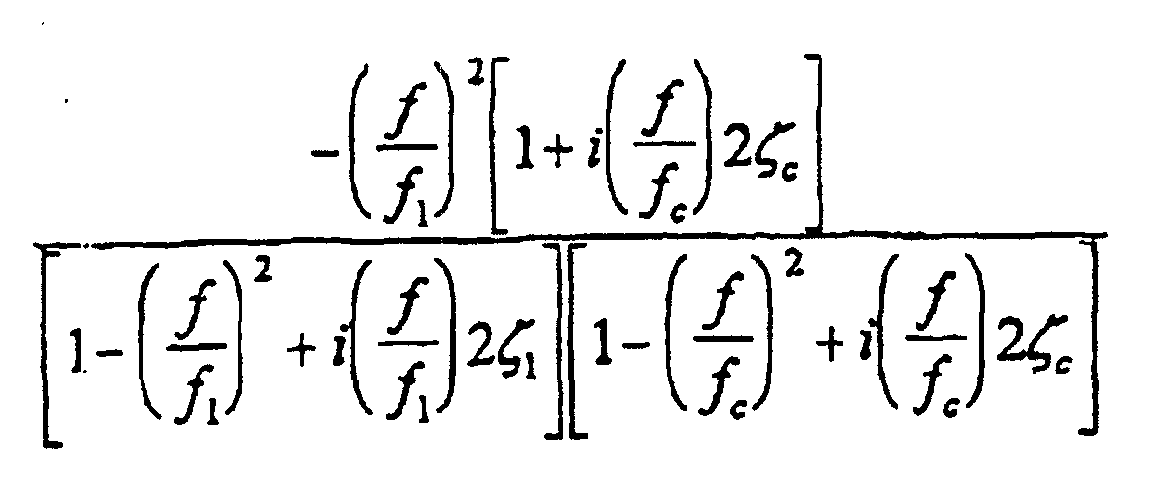 f1 = fréquence propre dudit premier capteur,fc = fréquence propre dudit mécanisme de couplage dudit premier capteur,ζ1 = coefficient d'amortissement dudit premier capteur,ζc = coefficient d'amortissement dudit mécanisme de couplage dudit premier capteur.
 - Un procédé tel que revendiqué à la revendication 1, dans lequel le filtre de correction a l'effet de l'inverse du filtre de mécanisme de couplage et est appliqué audit second signal.
- Un procédé tel que revendiqué à la revendication 1, dans lequel le filtre de correction a l'effet du filtre de mécanisme de couplage et est appliqué audit premier signal.
- Un procédé tel que revendiqué à la revendication 1, 2 ou 3, dans lequel l'étape d'optimisation comprend l'étape consistant à :
effectuer une recherche itérative et multivariable pour minimiser l'erreur quadratique moyenne entre ledit second signal et ledit troisième signal. - Un procédé tel que revendiqué à la revendication 4, dans lequel les variables amenées à varier dans ladite recherche sont la fréquence propre fc et le coefficient d'amortissement ζc de ladite seconde fonction de transfert.
- Un procédé tel que revendiqué à la revendication 4 ou 5, dans lequel ladite recherche est effectuée à l'aide d'un procédé simplex descendant multidimensionnel.
- Un procédé tel que revendiqué dans une quelconque des revendications précédentes, dans lequel ladite seconde fonction de transfert est donnée en fonction de la fréquence f paroù
 f2 = fréquence propre dudit second capteur,fc = fréquence propre dudit mécanisme de couplage du second capteur,ζ2 = coefficient d'amortissement dudit second capteur,ζc = coefficient d'amortissement dudit mécanisme de couplage dudit second capteur.
 - Un procédé tel que revendiqué dans une quelconque des revendications précédentes, dans lequel ladite fréquence propre fc dudit mécanisme de couplage dudit premier capteur est de 2000 Hz et ledit coefficient d'amortissernent ζc dudit mécanisme de couplage dudit premicr captcur est de 0,7.
- Un procédé tel que revendiqué dans une quelconque des revendications précédentes, comprenant en outre les étapes consistant à :appliquer une fonction de fenêtre audit second signal avant de calculer ladite seconde fonction de transfert ; etappliquer ladite fonction de fenêtre audit troisième signal avant de calculer ladite première fonction de transfert.
- Un procédé tel que revendiqué à la revendication 9, dans lequel ladite fonction de transfert est donnée paroù
 t = temps, ett2 = temps du dernier des passages par zéro qui suit immédiatement le passage par zéro entre le premier creux et le pic suivant dudit premier signal ou dudit second signal.
 - Un procédé tel que revendiqué à la revendication 9, dans lequel ladite fonction de fenêtre est donnée paroù
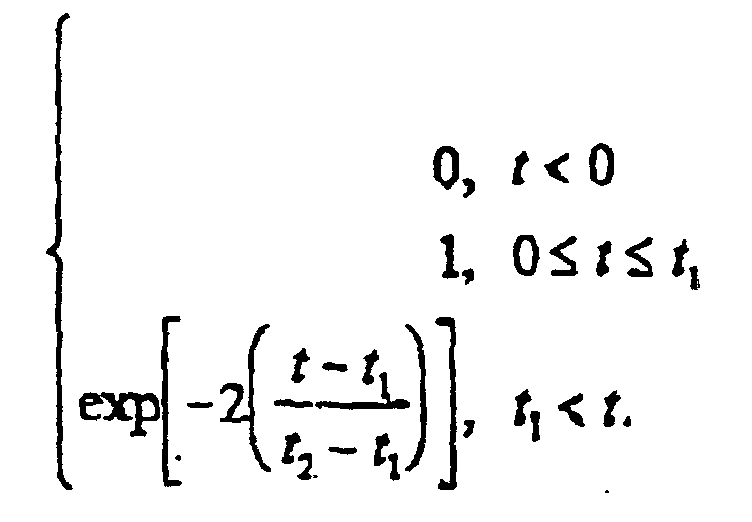 t = temps,t1 = temps du dernier des passages par zéro entre le premier creux et le pic suivant dudit premier signal ou dudit second signal, ett2 = le temps du dernier des passages suivant par zéro sur ledit premier signal ou ledit second signal après ledit temps t1.
 - Un procédé tel que revendiqué à la revendication 1, comprenant en outre les étapes consistant à :produire un premier sous-ensemble du traces en 6électionnant une pluralité de traces du premier capteur issues dudit premier signal ;produire un second sous-ensemble de traces en sélectionnant les traces du second capteur issues dudit second signal correspondant auxdites traces sélectionnées du premier capteur,sélectionner des pics de premières ruptures dudit premier sous-ensemble de traces ;ajuster une ligne droite de l'erreur chromatique moyenne dans le plan × t auxdits pics de premières ruptures desdits premiers sous-ensembles de traces ;éliminer, desdits premier et second sous-ensembles de traces, tout décalage de courant continu ;explorer chacun desdits premier et second sous-ensembles de traces pour l'amplitude la plus élevée des pics desdites premières ruptures ;cadrer des traces de chacun desdits premier et second sous-ensembles de traces pour égaliser ladite amplitude desdits pics de premières ruptures ;produire une trace unique d'empilage incliné à partir de chacun desdits premier et second sous-ensembles de traces en utilisant la pente de ladite ligne droite de l'erreur quadratique moyenne ; etutiliser lesdites traces d'empilage incliné comme étant lesdits premier et second signaux dans ladite étape consistant à calculer un filtre de mécanisme de couplage.
- Un procédé tel que revendiqué à la revendication 12, dans lequel ladite étape consistant à produire le premier sous-ensemble de traces comprend les étapes consistant à :sélectionner une gamme médiane de décalages de récepteurs de source dans la zone de mesure avec approximativement 10 à 20 traces dans chaque ensemble de traces de points de récepteurs communs présentant de premières ruptures réfractées à partir d'un horizon souterrain commun ; etproduire ledit premier sous-ensemble de traces en sélectionnant les traces dudit premier capteur à partir dudit ensemble de traces de points de récepteurs communs tombant dans ladite gamme décalée.
- Un procédé tel que revendiqué à la revendication 12 ou 13, dans lequel ladite étape consistant à produire une trace unique d'empilage incliné comprend l'étape consistant à :prendre des échantillons de données issus de chacune des traces desdits premier et second sous-ensembles de traces au niveau des points où les traces coupent une ligne présentant la même pente que la pente de ladite ligne droite de l'erreur quadratique moyenne ;effectuer la moyenne des valeurs desdites traces au niveau desdits échantillons de données : etrépéter lesdites opérations consistant à prendre et à effectuer la moyenne pour une pluralité desdites lignes présentant la même pente que la pente de ladite ligne droite de l'erreur quadratique moyenne.
- Un procédé tel que revendiqué à la revendication 1, comprenant en outre les étapes consistant à :sélectionner une première trace issue dudit premier signal ;produire une seconde trace en sélectionnant la trace Issue dudit second signal correspondant à ladite première trace sélectionnée ;sélectionner une première rupture de ladite première trace ;éliminer, desdites première et seconde traces, tout décalage de courant continu ; etutiliser lesdites première et seconde traces comme étant lesdits premier et second signaux dans ladite étape consistant à calculer un filtre de mécanisme de couplage.
- Un procédé de mesure séismique, comprenant les étapes consistant à :enregistrer, à l'aide d'un premier capteur, un premier signal indicatif de pression et, à l'aide d'un second capteur, un second signal indicatif de mouvement, lesdits capteurs étant déployés sur un fond marin ; ettraiter les premier et second signaux conformément au procédé de l'une quelconque des revendications précédentes.
- Un procédé tel que revendiqué à la revendication 16, dans lequel ladite étape consistant à enregistrer comprend les étapes consistant à :déployer un câble sous-marin sur le fond d'une masse d'eau ;déployer, sur ledit câble sous-marin, un premier capteur produisant un premier signal indicatif de la pression de ladite eau et un second capteur produisant un second signal indicatif du mouvement vertical dudit fond et influencé par un couplage imparfait dudit second capteur avec ledit fond, où ledit second capteur trouve à proximité étroite dudit premier capteur ;produire un signal séismique dans ladite masse d'eau ;détecter ledit signal séismique à l'alde desdits premier et second capteurs ; etproduire, à l'aide desdits premier et second capteurs, des signaux indicatifs dudit signal séismique.
Applications Claiming Priority (2)
| Application Number | Priority Date | Filing Date | Title |
|---|---|---|---|
| US08/580,634 US5724306A (en) | 1995-12-29 | 1995-12-29 | Method for correcting dual sensor data for imperfect geophone coupling using production seismic data |
| US580634 | 1995-12-29 |
Publications (3)
| Publication Number | Publication Date |
|---|---|
| EP0782011A2 EP0782011A2 (fr) | 1997-07-02 |
| EP0782011A3 EP0782011A3 (fr) | 1999-01-07 |
| EP0782011B1 true EP0782011B1 (fr) | 2001-07-25 |
Family
ID=24321889
Family Applications (1)
| Application Number | Title | Priority Date | Filing Date |
|---|---|---|---|
| EP96308644A Expired - Lifetime EP0782011B1 (fr) | 1995-12-29 | 1996-11-29 | Corriger les effets de différences de couplage dans les mesures seismiques |
Country Status (6)
| Country | Link |
|---|---|
| US (1) | US5724306A (fr) |
| EP (1) | EP0782011B1 (fr) |
| AU (1) | AU711341B2 (fr) |
| CA (1) | CA2192009C (fr) |
| DE (1) | DE69614078D1 (fr) |
| NO (1) | NO324643B1 (fr) |
Families Citing this family (25)
| Publication number | Priority date | Publication date | Assignee | Title |
|---|---|---|---|---|
| US6021090A (en) * | 1997-10-22 | 2000-02-01 | Western Atlas International, Inc. | Horizontal and vertical receiver-consistent deconvolution for an ocean bottom cable |
| GB9920593D0 (en) * | 1999-09-02 | 1999-11-03 | Geco Prakla Uk Ltd | A method of seismic surveying, a marine vibrator arrangement, and a method of calculating the depths of seismic sources |
| US6512980B1 (en) * | 1999-10-19 | 2003-01-28 | Westerngeco Llc | Noise reference sensor for use in a dual sensor towed streamer |
| GB2358247B (en) * | 2000-01-14 | 2004-02-11 | Geco Prakla | Geophone coupling |
| US6906981B2 (en) | 2002-07-17 | 2005-06-14 | Pgs Americas, Inc. | Method and system for acquiring marine seismic data using multiple seismic sources |
| US7239577B2 (en) | 2002-08-30 | 2007-07-03 | Pgs Americas, Inc. | Apparatus and methods for multicomponent marine geophysical data gathering |
| GB2415258B8 (en) * | 2002-08-30 | 2007-06-07 | Pgs Americas Inc | Method for multicomponent marine geophysical data gathering |
| US6704244B1 (en) | 2002-10-08 | 2004-03-09 | Pgs Americas, Inc. | Method for acquiring and processing seismic survey data using ocean bottom cables and streamers |
| GB2395273A (en) * | 2002-11-15 | 2004-05-19 | Westerngeco Seismic Holdings | Seismic cable with continuous stress member and sensor modules |
| GB2404736B (en) * | 2003-08-01 | 2006-01-04 | Westerngeco Seismic Holdings | Determination of geophone coupling |
| FR2861469B1 (fr) * | 2003-10-23 | 2006-02-03 | Geophysique Cie Gle | Procede de traitement de donnees sismiques acquises au moyen de capteurs multicomposantes |
| NO20041565L (no) * | 2004-04-16 | 2005-10-17 | Selantic | Seismisk havbunnskilde og metode for 4-komponent seismik |
| US7225662B2 (en) * | 2004-08-27 | 2007-06-05 | Schlumberger Technology Corporation | Geophone calibration technique |
| US7660206B2 (en) * | 2004-12-21 | 2010-02-09 | Optoplan As | Ocean bottom seismic station |
| US20080253226A1 (en) * | 2007-04-11 | 2008-10-16 | Stig Rune Lennart Tenghamn | System and method for marine seismic surveying |
| GB2456313B (en) * | 2008-01-10 | 2010-05-12 | Westerngeco Seismic Holdings | Sensor devices |
| US8274858B2 (en) * | 2009-11-12 | 2012-09-25 | Pgs Geophysical As | Method for full-bandwidth deghosting of marine seismic streamer data |
| US9025413B2 (en) * | 2009-12-07 | 2015-05-05 | Pgs Geophysical As | Method for full-bandwidth source deghosting of marine seismic streamer data |
| US8990022B2 (en) * | 2009-12-23 | 2015-03-24 | Pgs Geophysical As | Direct velocity seismic sensing |
| AU2014375214B2 (en) * | 2013-12-30 | 2020-01-30 | Pgs Geophysical As | Control system for marine vibrators |
| US10605941B2 (en) * | 2014-12-18 | 2020-03-31 | Conocophillips Company | Methods for simultaneous source separation |
| CA2999920A1 (fr) | 2015-09-28 | 2017-04-06 | Conocophillips Company | Acquisition sismique en 3d |
| US10809402B2 (en) | 2017-05-16 | 2020-10-20 | Conocophillips Company | Non-uniform optimal survey design principles |
| WO2019100068A1 (fr) | 2017-11-20 | 2019-05-23 | Conocophillips Company | Application en mer d'une conception d'étude d'échantillonnage optimale non uniforme |
| US11481677B2 (en) | 2018-09-30 | 2022-10-25 | Shearwater Geoservices Software Inc. | Machine learning based signal recovery |
Family Cites Families (5)
| Publication number | Priority date | Publication date | Assignee | Title |
|---|---|---|---|---|
| US4253164A (en) * | 1978-10-30 | 1981-02-24 | Western Geophysical Co. Of America | Multi-purpose seismic transducer |
| EG19158A (en) | 1989-08-25 | 1996-02-29 | Halliburton Geophys Service | System for attenuation of water-column reverberation |
| US5235554A (en) | 1991-03-11 | 1993-08-10 | Halliburton Geophysical Services, Inc. | Method for correcting impulse response differences of hydrophones and geophones as well as geophone coupling to the water-bottom in dual-sensor, bottom-cable seismic operations |
| US5163028A (en) | 1991-09-27 | 1992-11-10 | Halliburton Geophysical Services, Inc. | Method for correcting impulse response differences of hydrophones and geophones as well as geophone coupling to the water-bottom in dual-sensor, bottom-cable seismic operations |
| US5365492A (en) * | 1993-08-04 | 1994-11-15 | Western Atlas International, Inc. | Method for reverberation suppression |
-
1995
- 1995-12-29 US US08/580,634 patent/US5724306A/en not_active Expired - Lifetime
-
1996
- 1996-11-29 EP EP96308644A patent/EP0782011B1/fr not_active Expired - Lifetime
- 1996-11-29 DE DE69614078T patent/DE69614078D1/de not_active Expired - Lifetime
- 1996-12-03 AU AU74128/96A patent/AU711341B2/en not_active Ceased
- 1996-12-04 CA CA002192009A patent/CA2192009C/fr not_active Expired - Fee Related
- 1996-12-11 NO NO19965289A patent/NO324643B1/no not_active IP Right Cessation
Also Published As
| Publication number | Publication date |
|---|---|
| AU7412896A (en) | 1997-07-03 |
| EP0782011A3 (fr) | 1999-01-07 |
| DE69614078D1 (de) | 2001-08-30 |
| CA2192009A1 (fr) | 1997-06-30 |
| NO324643B1 (no) | 2007-11-26 |
| NO965289L (no) | 1997-06-30 |
| US5724306A (en) | 1998-03-03 |
| EP0782011A2 (fr) | 1997-07-02 |
| NO965289D0 (no) | 1996-12-11 |
| AU711341B2 (en) | 1999-10-14 |
| CA2192009C (fr) | 2001-02-27 |
Similar Documents
| Publication | Publication Date | Title |
|---|---|---|
| US5724306A (en) | Method for correcting dual sensor data for imperfect geophone coupling using production seismic data | |
| US10989825B2 (en) | Method and system for determining source signatures after source ghost removal | |
| US7957906B2 (en) | Method for attenuating low frequency noise in a dual-sensor seismic streamer | |
| CA2491340C (fr) | Systeme de combinaison de signaux de capteurs de pression et de capteurs de mouvement de particules dans des flutes sismiques marines | |
| AU2002324926B2 (en) | Method for attenuating noise in seismic data | |
| US8239135B2 (en) | Method for calculation of seismic attributes from seismic signals | |
| US8174926B2 (en) | Method for wavefield separation for dual-sensor data using kirchhoff-type datuming and migration | |
| EP0089700A2 (fr) | Procédé et dispositif de sismique marin | |
| US8089825B2 (en) | Method of summing dual-sensor towed streamer signals using cross-ghosting analysis | |
| EP0911648A2 (fr) | Traitement des données d'exploration sismique | |
| US20130114375A1 (en) | Seismic Acquisition Method for Mode Separation | |
| US8811113B2 (en) | Method of summing dual-sensor towed streamer signals using seismic reflection velocities | |
| US8600680B2 (en) | Method for eliminating spectral constraints of acquisition system and earth filtering effects | |
| Ziolkowski | Simplified wavelet estimation using source-signature measurements | |
| Gaiser et al. | Vertical component coupling of OBC data | |
| AU2009245480B2 (en) | Method for attenuating low frequency noise in a dual-sensor seismic streamer |
Legal Events
| Date | Code | Title | Description |
|---|---|---|---|
| PUAI | Public reference made under article 153(3) epc to a published international application that has entered the european phase |
Free format text: ORIGINAL CODE: 0009012 |
|
| AK | Designated contracting states |
Kind code of ref document: A2 Designated state(s): DE DK FR GB IT NL |
|
| PUAL | Search report despatched |
Free format text: ORIGINAL CODE: 0009013 |
|
| AK | Designated contracting states |
Kind code of ref document: A3 Designated state(s): DE DK FR GB IT NL |
|
| 17P | Request for examination filed |
Effective date: 19990421 |
|
| 17Q | First examination report despatched |
Effective date: 20000215 |
|
| GRAG | Despatch of communication of intention to grant |
Free format text: ORIGINAL CODE: EPIDOS AGRA |
|
| GRAG | Despatch of communication of intention to grant |
Free format text: ORIGINAL CODE: EPIDOS AGRA |
|
| GRAH | Despatch of communication of intention to grant a patent |
Free format text: ORIGINAL CODE: EPIDOS IGRA |
|
| GRAH | Despatch of communication of intention to grant a patent |
Free format text: ORIGINAL CODE: EPIDOS IGRA |
|
| GRAA | (expected) grant |
Free format text: ORIGINAL CODE: 0009210 |
|
| AK | Designated contracting states |
Kind code of ref document: B1 Designated state(s): DE DK FR GB IT NL |
|
| PG25 | Lapsed in a contracting state [announced via postgrant information from national office to epo] |
Ref country code: NL Free format text: LAPSE BECAUSE OF FAILURE TO SUBMIT A TRANSLATION OF THE DESCRIPTION OR TO PAY THE FEE WITHIN THE PRESCRIBED TIME-LIMIT Effective date: 20010725 Ref country code: IT Free format text: LAPSE BECAUSE OF FAILURE TO SUBMIT A TRANSLATION OF THE DESCRIPTION OR TO PAY THE FEE WITHIN THE PRE;WARNING: LAPSES OF ITALIAN PATENTS WITH EFFECTIVE DATE BEFORE 2007 MAY HAVE OCCURRED AT ANY TIME BEFORE 2007. THE CORRECT EFFECTIVE DATE MAY BE DIFFERENT FROM THE ONE RECORDED.SCRIBED TIME-LIMIT Effective date: 20010725 Ref country code: FR Free format text: LAPSE BECAUSE OF FAILURE TO SUBMIT A TRANSLATION OF THE DESCRIPTION OR TO PAY THE FEE WITHIN THE PRESCRIBED TIME-LIMIT Effective date: 20010725 |
|
| REF | Corresponds to: |
Ref document number: 69614078 Country of ref document: DE Date of ref document: 20010830 |
|
| PG25 | Lapsed in a contracting state [announced via postgrant information from national office to epo] |
Ref country code: DK Free format text: LAPSE BECAUSE OF FAILURE TO SUBMIT A TRANSLATION OF THE DESCRIPTION OR TO PAY THE FEE WITHIN THE PRESCRIBED TIME-LIMIT Effective date: 20011025 |
|
| PG25 | Lapsed in a contracting state [announced via postgrant information from national office to epo] |
Ref country code: DE Free format text: LAPSE BECAUSE OF FAILURE TO SUBMIT A TRANSLATION OF THE DESCRIPTION OR TO PAY THE FEE WITHIN THE PRESCRIBED TIME-LIMIT Effective date: 20011026 |
|
| EN | Fr: translation not filed | ||
| REG | Reference to a national code |
Ref country code: GB Ref legal event code: IF02 |
|
| NLV1 | Nl: lapsed or annulled due to failure to fulfill the requirements of art. 29p and 29m of the patents act | ||
| PLBE | No opposition filed within time limit |
Free format text: ORIGINAL CODE: 0009261 |
|
| STAA | Information on the status of an ep patent application or granted ep patent |
Free format text: STATUS: NO OPPOSITION FILED WITHIN TIME LIMIT |
|
| 26N | No opposition filed | ||
| PGFP | Annual fee paid to national office [announced via postgrant information from national office to epo] |
Ref country code: GB Payment date: 20031125 Year of fee payment: 8 |
|
| PG25 | Lapsed in a contracting state [announced via postgrant information from national office to epo] |
Ref country code: GB Free format text: LAPSE BECAUSE OF NON-PAYMENT OF DUE FEES Effective date: 20041129 |
|
| REG | Reference to a national code |
Ref country code: GB Ref legal event code: 732E |
|
| GBPC | Gb: european patent ceased through non-payment of renewal fee |
Effective date: 20041129 |