EP0782341A2 - Bilddatenkomprimierungssystem - Google Patents
Bilddatenkomprimierungssystem Download PDFInfo
- Publication number
- EP0782341A2 EP0782341A2 EP96402897A EP96402897A EP0782341A2 EP 0782341 A2 EP0782341 A2 EP 0782341A2 EP 96402897 A EP96402897 A EP 96402897A EP 96402897 A EP96402897 A EP 96402897A EP 0782341 A2 EP0782341 A2 EP 0782341A2
- Authority
- EP
- European Patent Office
- Prior art keywords
- compression
- data
- compressor
- variable
- network
- Prior art date
- Legal status (The legal status is an assumption and is not a legal conclusion. Google has not performed a legal analysis and makes no representation as to the accuracy of the status listed.)
- Withdrawn
Links
- 238000013144 data compression Methods 0.000 title claims abstract description 21
- 238000007906 compression Methods 0.000 claims abstract description 115
- 230000006835 compression Effects 0.000 claims abstract description 114
- 238000000034 method Methods 0.000 claims description 17
- 230000001747 exhibiting effect Effects 0.000 claims 5
- 230000008569 process Effects 0.000 description 10
- 238000013139 quantization Methods 0.000 description 9
- 230000011664 signaling Effects 0.000 description 5
- 230000006837 decompression Effects 0.000 description 4
- 230000003111 delayed effect Effects 0.000 description 4
- 230000003044 adaptive effect Effects 0.000 description 3
- 230000006870 function Effects 0.000 description 3
- 230000001934 delay Effects 0.000 description 2
- 238000011161 development Methods 0.000 description 2
- 230000018109 developmental process Effects 0.000 description 2
- 230000009467 reduction Effects 0.000 description 2
- 230000009286 beneficial effect Effects 0.000 description 1
- 230000008901 benefit Effects 0.000 description 1
- 230000005540 biological transmission Effects 0.000 description 1
- 230000008859 change Effects 0.000 description 1
- 238000010586 diagram Methods 0.000 description 1
- 230000009977 dual effect Effects 0.000 description 1
Images


Classifications
-
- H—ELECTRICITY
- H04—ELECTRIC COMMUNICATION TECHNIQUE
- H04N—PICTORIAL COMMUNICATION, e.g. TELEVISION
- H04N19/00—Methods or arrangements for coding, decoding, compressing or decompressing digital video signals
- H04N19/42—Methods or arrangements for coding, decoding, compressing or decompressing digital video signals characterised by implementation details or hardware specially adapted for video compression or decompression, e.g. dedicated software implementation
- H04N19/436—Methods or arrangements for coding, decoding, compressing or decompressing digital video signals characterised by implementation details or hardware specially adapted for video compression or decompression, e.g. dedicated software implementation using parallelised computational arrangements
-
- H—ELECTRICITY
- H04—ELECTRIC COMMUNICATION TECHNIQUE
- H04N—PICTORIAL COMMUNICATION, e.g. TELEVISION
- H04N19/00—Methods or arrangements for coding, decoding, compressing or decompressing digital video signals
- H04N19/50—Methods or arrangements for coding, decoding, compressing or decompressing digital video signals using predictive coding
- H04N19/593—Methods or arrangements for coding, decoding, compressing or decompressing digital video signals using predictive coding involving spatial prediction techniques
-
- H—ELECTRICITY
- H04—ELECTRIC COMMUNICATION TECHNIQUE
- H04N—PICTORIAL COMMUNICATION, e.g. TELEVISION
- H04N19/00—Methods or arrangements for coding, decoding, compressing or decompressing digital video signals
- H04N19/10—Methods or arrangements for coding, decoding, compressing or decompressing digital video signals using adaptive coding
- H04N19/102—Methods or arrangements for coding, decoding, compressing or decompressing digital video signals using adaptive coding characterised by the element, parameter or selection affected or controlled by the adaptive coding
- H04N19/124—Quantisation
-
- H—ELECTRICITY
- H04—ELECTRIC COMMUNICATION TECHNIQUE
- H04N—PICTORIAL COMMUNICATION, e.g. TELEVISION
- H04N19/00—Methods or arrangements for coding, decoding, compressing or decompressing digital video signals
- H04N19/10—Methods or arrangements for coding, decoding, compressing or decompressing digital video signals using adaptive coding
- H04N19/169—Methods or arrangements for coding, decoding, compressing or decompressing digital video signals using adaptive coding characterised by the coding unit, i.e. the structural portion or semantic portion of the video signal being the object or the subject of the adaptive coding
- H04N19/17—Methods or arrangements for coding, decoding, compressing or decompressing digital video signals using adaptive coding characterised by the coding unit, i.e. the structural portion or semantic portion of the video signal being the object or the subject of the adaptive coding the unit being an image region, e.g. an object
- H04N19/176—Methods or arrangements for coding, decoding, compressing or decompressing digital video signals using adaptive coding characterised by the coding unit, i.e. the structural portion or semantic portion of the video signal being the object or the subject of the adaptive coding the unit being an image region, e.g. an object the region being a block, e.g. a macroblock
-
- H—ELECTRICITY
- H04—ELECTRIC COMMUNICATION TECHNIQUE
- H04N—PICTORIAL COMMUNICATION, e.g. TELEVISION
- H04N19/00—Methods or arrangements for coding, decoding, compressing or decompressing digital video signals
- H04N19/42—Methods or arrangements for coding, decoding, compressing or decompressing digital video signals characterised by implementation details or hardware specially adapted for video compression or decompression, e.g. dedicated software implementation
- H04N19/423—Methods or arrangements for coding, decoding, compressing or decompressing digital video signals characterised by implementation details or hardware specially adapted for video compression or decompression, e.g. dedicated software implementation characterised by memory arrangements
-
- H—ELECTRICITY
- H04—ELECTRIC COMMUNICATION TECHNIQUE
- H04N—PICTORIAL COMMUNICATION, e.g. TELEVISION
- H04N19/00—Methods or arrangements for coding, decoding, compressing or decompressing digital video signals
- H04N19/10—Methods or arrangements for coding, decoding, compressing or decompressing digital video signals using adaptive coding
- H04N19/102—Methods or arrangements for coding, decoding, compressing or decompressing digital video signals using adaptive coding characterised by the element, parameter or selection affected or controlled by the adaptive coding
- H04N19/13—Adaptive entropy coding, e.g. adaptive variable length coding [AVLC] or context adaptive binary arithmetic coding [CABAC]
-
- H—ELECTRICITY
- H04—ELECTRIC COMMUNICATION TECHNIQUE
- H04N—PICTORIAL COMMUNICATION, e.g. TELEVISION
- H04N19/00—Methods or arrangements for coding, decoding, compressing or decompressing digital video signals
- H04N19/30—Methods or arrangements for coding, decoding, compressing or decompressing digital video signals using hierarchical techniques, e.g. scalability
-
- H—ELECTRICITY
- H04—ELECTRIC COMMUNICATION TECHNIQUE
- H04N—PICTORIAL COMMUNICATION, e.g. TELEVISION
- H04N19/00—Methods or arrangements for coding, decoding, compressing or decompressing digital video signals
- H04N19/60—Methods or arrangements for coding, decoding, compressing or decompressing digital video signals using transform coding
-
- H—ELECTRICITY
- H04—ELECTRIC COMMUNICATION TECHNIQUE
- H04N—PICTORIAL COMMUNICATION, e.g. TELEVISION
- H04N19/00—Methods or arrangements for coding, decoding, compressing or decompressing digital video signals
- H04N19/90—Methods or arrangements for coding, decoding, compressing or decompressing digital video signals using coding techniques not provided for in groups H04N19/10-H04N19/85, e.g. fractals
- H04N19/91—Entropy coding, e.g. variable length coding [VLC] or arithmetic coding
Definitions
- This present invention concerns a data compression network for use in a digital signal processing system.
- the invention concerns a data compression network for an image signal processor such as may be employed in a television system.
- Sophisticated digital signal processing systems with associated large memory requirements are becoming increasingly common.
- the need to limit memory requirements, particularly in consumer products such as video and television systems, is important to keep to costs of such products at a reasonable level.
- a data compression system using two different compression networks. Compressed data from one or the other of these networks is chosen to obtain satisfactory image quality and a desired compression factor.
- one network provides fixed data compression
- the other network provides variable data compression.
- the data compression is block-based, and the two data compression networks operate concurrently in parallel.
- the output of the fixed compression network is used if it is determined that the output of the variable compression network does not achieve the desired compression factor.
- FIG. 1 is a block diagram of a portion of an image data processing system including a data compression network in accordance with the principles of the present invention.
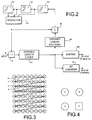
- Figure 2 shows the variable lenth compressor of Figure 1 in greater detail.
- Figure 3 depicts an image block pixel scanning pattern for a predictive coding process.
- Figure 4 illustrates a group of pixels helpful in understanding the operation of a portion of the predictive coding process.
- Figure 5 shows the fixed length compressor of Figure 1 in greater detail.
- Figure 6 depicts an alternative dual path compression network.
- the compression system to be described uses a variable compression network in parallel with a fixed compression network.
- the compression networks operate concurrently on the same pixel block.
- the variable compression network has the advantage of being lossless or substantially lossless, and is the preferred compression network. If the variable compression network in not successful in achieving a predetermined desired amount of data compression, the output of the fixed compression network is used instead. While the fixed compression network can obtain the desired amount of compression, this network has the disadvantage of being lossy.
- a source of image representative data from a source 10 is applied to an input terminal 12 of a data compression network including parallel independent data compression paths 14 and 20.
- Path 14 is a substantially lossless path and includes a variable compression processor 16 which provides compressed data to one of the signal inputs of a multiplexer (MUX) 25, and a bit counter 18.
- MUX multiplexer
- Counter 18 monitors the bit count of each data block compressed by unit 16, and provides a switching control signal to a control input of MUX 25. Additional details of compression path 14 are shown and will be discussed inconnection with Figure 2.
- Path 20 is a lossy path which includes a fixed compression processor 22 as shown in greater detail in Figure 5. Compressed output data from unit 22 is provided to another signal input of MUX 25.
- MUX 25 provides either the compressed data from path 14 or the compressed data from path 20 to an output terminal 28 of the compression network as will be explained in greater detail below.
- the output compressed data is provided to a memory 30.
- Output data from memory 30 is decompressed by unit 34 before being provided to a display processor 35.
- Processor 35 is essentially a sink of video data, and may comprise a motion compensation processor within an MPEG decoding loop, or other types of video processor requiring data from a frame storage element such as memory 30.
- source 10 provides output data representating a raster scanned image display, with the data being provided in the form of a succession of blocks of pixels (picture elements), eg., 8 x 8 pixel blocks. This is accomplished in a well known manner, such as by using a buffer memory with suitably controlled read/write functions. Each pixel value is defined by an 8-bit word.
- Block based compression network 14, 20 compresses each pixel block independently and essentially guarantees that each block will be compressed by a predetermined compression factor or more.
- the output of either compression path 14 or path 20 is chosen for use by utilization network 30, 34, 35 so as to provide satisfactory image quality and the desired compression factor.
- the compression factor indicates the amount of memory space that will be saved when storing a pixel block. For example, a compression factor of 50% results in a compressed block that is 50% of its original size, and will occupy 50% less memory space compared to the original block. Compression factors greater than 50% also may be used. However, it has been determined that compression factors not exceeding 50% produce good results.
- a compression factor of 25% is essentially transparent compared to conventional decoder processing without such compression. At 50% compression the results are less transparent, but the results are acceptable and are not considered to be significantly different than conventional decoder processing without memory reduction.
- Variable compression path 14 exhibits lossless or near-lossless compression, but the number of output bits provided by path 14 is variable.
- the number of compressed block output bits from path 14 is monitored by counter 18. If the number of compressed block bits 14 is equal to or less than a predetermined target bit count associate with the predetermined compression factor, the compressed data output from path 14 is selected by MUX 25 and conveyed to memory 30. Otherwise, the compressed block output from fixed compressor 22 is used.
- fixed compressor 22 uses a lossy compression routine with quantization to produce a fixed target bit output.
- each compression network inserts signalling information into the datastream to indicate the type of compression that was performed on the block.
- the signalling information could be one or more bits inserted at the beginning of each compressed data block, eg., in a header.
- the signalling bits are sensed by decompression networks 34 which perform the inverse of the compression that was used to compress the block associated with the given signalling bits.
- the header may contain other control information, such as quantization control information for example.
- Variable compression is preferably used in smooth areas of an image to avoid annoying contouring artifacts.
- Image quality is essentially guaranteed to be high over such areas because variable compressor 16 uses little or no quantization, which is a substantially lossless process.
- fixed compressor 22 may be used in image areas containing significant detail information. Since quantization noise in such areas is not likely to introduce much perceptible error, the perceived quality of an image area subjected to fixed compression in path 20 will very likely be good. However, it is not necessary to selectively use variable and fixed compression in this manner, although in many systems it will be beneficial to do so.
- the choice of which of the two compressed blocks to use is simply based on the bit count of the compressed block from variable compressor 16. If the bit indicates that compressor 16 has achieved the desired compression, it is used. Compressor 16 is the preferred compressor because it is lossless. Otherwise, compressor 22 is used.
- the block based compression performed by compression network 14, 20, and the independent compression of every block allows a decoder to decode every block without needing information concerning any other block. Since each block is compressed by a predetermined compression factor, the memory address of the first pixel of each block is known in advance. Thus each block can be accessed from memory without information concerning any other block. In this regard it is noted that areas are reserved in memory for each block. In the case of 50% compression, each reserved area is the size of half the original block. Thus each compressed block will fit in the memory area reserved for it due to the fact that bits are counted and the output of compressor 22 is used if necessary.
- compressor 16 If preferred compressor 16 is successful in achieving greater than the target compression amount, the output of compressor 16 is used, and some of the reserved memory space is not used by the compressed block data. That is, such compressed block begins to fill its reserved memory area beginning with a predetermined starting address and continuing to an address less than the last address reserved for that block.
- each field based pixel block is scanned in a raster manner as shown in Figure 3, from left to right in a downward direction. This scanning is done in both units 16 and 22 using delay elements 52, 54 and 56.
- the variable compression network is shown in Figure 2. This network uses a DPCM loop with adaptive prediction to produce a difference signal (residual) using known techniques. This difference is variable length coded, and the resulting number of coded difference bits is monitored to indicate whether or not the desired compression factor was achieved for the current block.
- the architecture of Figure 2 is a classic predictive coding network resembling an MPEG compression loop.
- differencing network 42 produces an output representing the difference (residual) between input pixel values applied to a non-inverting input (+) of unit 42 and predicted pixel values applied to an inverting input (-) of unit 42, respectively.
- the predicted value is obtained using a DPCM processing loop including differencer 42, variable length coder 44 and a variable length decoder 46 which performs the inverse of the coding operation performed by unit 44.
- the variable length coder can include an optional high resolution quantizer and an entropy coder (eg., a Huffman coder) for lossless or near lossless compression.
- the variable length decoder includes an inverse quantizer an entropy decoder.
- the inversely decoded output from unit 46 is summed in a unit 48 with an output from a prediction network including a predictor 50 and associated pixel delay elements 52, 54 and 56. These elements provide delays of one, seven and one pixels, respectively.
- a predicted pixel value output from unit 50 is applied to inputs of adder 48 and differencer 42.
- Figure 4 shows an exemplary arrangement of a group of four pixels A, B, C and X (the pixel to be predicted) associated with the predictive processing and coding operation of the DPCM network.
- This group of pixels is also referenced in the pixel block shown in Figure 3.
- pixel B is delayed by a one pixel interval relative to pixel C
- pixel A is delayed by a seven pixel interval relative to pixel B
- pixel X is delayed one pixel interval relative to pixel A.
- the DPCM prediction process is well-known and will be discussed subsequently.
- Compressed pixel data from the output of variable length coder 44 are buffered by a unit 60 before being provided to MUX 25 of Figure 1.
- Buffer 60 stores the output of the variable compression process until the entire block has been processed, at which time it can be determined whether or not the target compression factor has been reached.
- bit counter 18 The bit count of each compressed block output from coder 44 is monitored by bit counter 18, which may be implemented by any of several known techniques. After each pixel block has been variably compressed, counter 18 provides a Control output signal if the compressed bit count is at or below a predetermined threshold, indicating that the desired amount of compression has been reached or exceeded by the variable compressor. This Control signal is applied to the switching control input of MUX 25 for causing MUX 25 to convey the output from the variable length compressor to the utilization network. Otherwise, the compressed block output (for the same pixel block) from the fixed length compressor is conveyed to the utilization network.
- the fixed compression network is shown in Figure 5.
- This network also uses a DPCM loop with adaptive prediction, as in the case of the variable compressor.
- elements 48, 50, 52, 52, 54 and 56 perform the same functions as correspondingly labelled elements in Figure 2.
- Differencing network 42 also serves the same purpose as unit 42 in Figure 2 for producing a residual pixel value, but in a slightly different context as discussed below.
- the fixed compression network uses non-linear quantizing of the difference (residual) pixel values provided at the output of unit 42 as a result of DPCM processing.
- a non-inverting input (+) of unit 42 receives input pixel values delayed 64 pixel intervals by a 64-pixel delay element 55.
- the inverting input (-) of unit 42 receives predicted pixel values from predictor 50.
- the residual pixel value output from unit 42 is subjected to quantization and inverse quantization by units 56 and 58 respectively.
- the quantization provided by unit 56 is fixed and guarantees a desired fixed amount of data compression. For example, to achieve 25% compression of an 8-bit data word, unit 56 removes the last two least significant bits.
- the amount of fixed compression is not less than the desired amount of compression.
- Units 56 and 58 operate under control of a Min/Max comparison network 60 which determines the minimum and maximum pixel values for each pixel block.
- Quantizer 56 could also be arranged to use a fixed quantizer rule. However, it is more efficient to adapt the quantizer rule according to the minimum and maximum pixel values associated with the block being processed. Min/Max comparison unit 60 determines these values. Element 55 provides the time delay needed for the minimum and maximum values of all 64 pixels of a given block to be examined before the first pixel of the block is processed.
- compressor 22 has no inherent delay, but the combination of the min/max comparison and delay element 55 ( Figure 5) causes compressor 22 to exhibit a one block delay, which matches the one block delay exhibited by the variable compression path.
- the fixed length compression network evaluates each of the 64 pixel values of each 8x8 pixel block twice to determine the minimum and maximum pixel values of that block. This process is facilitated by the 64 pixel (one block) delay provided by element 55.
- the minimum and maximum values are used to adaptively select between non-linear quantizing rules to be used for each block being processed.
- the two pass approach needed to evaluate each block twice does not add additional latency to the system because of the one block latency exhibited by buffer 60 of the variable compression path when determining if the variable compressor has achieved the desired compression.
- compressors 16 and 22 are arranged in parallel and fixed compressor employs min/max comparison, there is a one block delay in compressor 22.
- Variable compressor 16 does not have an inherent one block delay, so bit buffer 60 holds the bits one block time longer in order to wait for the output of compressor 22. If fixed compressor 22 did not use min/max comparison, then compressor 22 would not exhibit a one block delay.
- Variable compressor 16 does not exhibit an inherent one block delay due to buffer 60.
- Buffer 460 stores the bits of compressor 16 before a decision is made regarding which of the variable or fixed compression outputs to use.
- Bit counter 18 determines which output to use when the variable and fixed compression networks are arranged in parallel.
- compressors 16 and 22 need not be arranged in parallel, as shown in Figure 6.
- compressor 16 processes a pixel block first, and at the same time Min/Max comparison unit 60 ( Figure 5) determines the minimum and maximum pixel values for the block, as explained previously.
- Min/Max comparison unit 60 Figure 5
- After a one block delay it will be known whether or not compressor 16 has achieved the target compression, and thereby whether or not fixed compressor 22 needs to process the block. If variable compressor 16 has achieved the target compression factor, it will output the variable-compressed block to the frame memory. Otherwise, unit 22 will compress the block. Since compressors 16 and 22 may contain similar architecture and functional elements, this implementation advantageously allows such similar elements used for variable compression in unit 16 to be used again for fixed length compression in unit 22.
- the quantizer may be considered as a form of look-up table, with output bits from unit 42 representing addresses.
- Quantizer 56 outputs 4-bit data in the case of 50% compression.
- the output of quantizer 56 is an index that is used by unit 58 to approximate the output of unit 42. This is where a loss may occur, since if the input to unit 58 is only 4-bit data, only 16 data combinations are possible, while unit 42 can provide up to 256 possible outputs.
- the fixed compression network of Figure 5 does not require an output buffer.
- the same DPCM predictive coding process is employed by the compression networks of Figures 2 and 5.
- the current pixel being coded is predicted by using previously coded pixels, which are known to decompressor 34.
- the prediction process can be explained with reference to Figure 4, where pixel X is the pixel value to be predictively coded. Pixels A, B and C have been predictively coded previously and are known to the decompression section.
- a prediction of X, X pred uses the values of A, B and C in accordance with the following pseudo code, which describes the algorithm to be used: Values e1 and e2 are constants representing predetermined thresholds . This algorithm is used only for pixels not located in the first row or the first column of the block being processed.
- the first pixel in a block is coded very finely without reference to any other pixel, pixels in the first row use pixel value A as the predictor, and pixels in the first column use pixel value B as the predictor.
- this algorithm attempts to detect an edge.
- a vertical edge is suggested between pixels C and B and between pixels A and X.
- B is the best predictor.
- the second case suggests a horizontal edge between A and C and between B and X.
- A is the best predictor.
- no obvious edge is found. In this case both A and B are equally good predictors, so their average value is used.
- the disclosed block based data compression network can be advantageously used to process MPEG compatible datawords.
- the network exhibits nearly lossless compression for reducing the amount of memory needed to store 8x8 luminance data or 4x4 U,V (chrominance) data.
- the amount of compression is selectable and may be 25% or 50%, for example.
- Low contrast , low detail image blocks are usually losslessly compressed, while high contrast, high detail data blocks may experience some acceptable loss, particularly in the case of 50% data compression.
- decompressed pixel blocks may exhibit differences compared to original pixel blocks, the disclosed compression system is preferred over horizontal detail reduction for reducing memory requirements.
- the disclosed compression system can be applied to all Profiles and all Levels of the MPEG specification, as well as to other digital data processing schemes.
- the disclosed compression system may be advantageously used in consumer image processing products such as standard definition and high definition televison systems.
- image sequences of 1920 x 1088 pixels in size are encoded using the MPEG standard.
- the corresponding decoder at a television receiver requires at least 71.72 Mbits of memory for storing decoded frames. Since the cost of memory can be a significant cost of any system, particularly a frame-based decoding system, any means which can reduce the memory requirements can significantly reduce the cost of the decoding system.
Landscapes
- Engineering & Computer Science (AREA)
- Multimedia (AREA)
- Signal Processing (AREA)
- Computing Systems (AREA)
- Theoretical Computer Science (AREA)
- Compression Or Coding Systems Of Tv Signals (AREA)
- Compression, Expansion, Code Conversion, And Decoders (AREA)
- Compression Of Band Width Or Redundancy In Fax (AREA)
Applications Claiming Priority (2)
| Application Number | Priority Date | Filing Date | Title |
|---|---|---|---|
| US57919395A | 1995-12-27 | 1995-12-27 | |
| US579193 | 1995-12-27 |
Publications (2)
| Publication Number | Publication Date |
|---|---|
| EP0782341A2 true EP0782341A2 (de) | 1997-07-02 |
| EP0782341A3 EP0782341A3 (de) | 1999-05-26 |
Family
ID=24315945
Family Applications (1)
| Application Number | Title | Priority Date | Filing Date |
|---|---|---|---|
| EP96402897A Withdrawn EP0782341A3 (de) | 1995-12-27 | 1996-12-26 | Bilddatenkomprimierungssystem |
Country Status (4)
| Country | Link |
|---|---|
| EP (1) | EP0782341A3 (de) |
| JP (1) | JPH09200741A (de) |
| KR (1) | KR970057916A (de) |
| CN (1) | CN1158050A (de) |
Cited By (12)
| Publication number | Priority date | Publication date | Assignee | Title |
|---|---|---|---|---|
| WO2002096115A1 (en) * | 2001-05-25 | 2002-11-28 | Centre For Signal Processing, Nanyang Technological University | A fine granularity scalability scheme |
| WO2004040911A1 (en) * | 2002-10-30 | 2004-05-13 | Koninklijke Philips Electronics N.V. | Adaptive watermarking |
| WO2006108465A1 (en) * | 2005-04-13 | 2006-10-19 | Fraunhofer-Gesellschaft zur Förderung der angewandten Forschung e.V. | Lossless encoding of information with guaranteed maximum bitrate |
| US7158571B2 (en) * | 2000-12-11 | 2007-01-02 | Sony Corporation | System and method for balancing video encoding tasks between multiple processors |
| EP1565993A4 (de) * | 2002-11-26 | 2010-01-20 | Qualcomm Inc | System und verfahren zur optimierung der multimedia-komprimierung durch verwendung mehrerer codierer |
| US7788106B2 (en) | 2005-04-13 | 2010-08-31 | Fraunhofer-Gesellschaft Zur Foerderung Der Angewandten Forschung E.V. | Entropy coding with compact codebooks |
| US7991610B2 (en) | 2005-04-13 | 2011-08-02 | Fraunhofer-Gesellschaft Zur Foerderung Der Angewandten Forschung E.V. | Adaptive grouping of parameters for enhanced coding efficiency |
| US8229235B2 (en) | 2005-10-06 | 2012-07-24 | Samsung Electronics Co., Ltd. | Hybrid image data processing system and method |
| CN102685368A (zh) * | 2011-12-12 | 2012-09-19 | 苏州科雷芯电子科技有限公司 | 以子列为单位的扫描方法 |
| EP2566160A3 (de) * | 2005-10-14 | 2013-08-21 | NEC Corporation | Gerät und Verfahren zur Entropiekodierung mit Ratensteuerung |
| US9299166B2 (en) | 2012-12-13 | 2016-03-29 | Qualcomm Incorporated | Image compression method and apparatus for bandwidth saving |
| GB2550965A (en) * | 2016-06-03 | 2017-12-06 | Advanced Risc Mach Ltd | Encoding and decoding arrays of data elements |
Families Citing this family (4)
| Publication number | Priority date | Publication date | Assignee | Title |
|---|---|---|---|---|
| JP4508490B2 (ja) * | 2000-09-11 | 2010-07-21 | パナソニック株式会社 | 符号化装置および復号化装置 |
| JP2008005163A (ja) * | 2006-06-21 | 2008-01-10 | Matsushita Electric Ind Co Ltd | 画像符号化装置および画像符号化方法 |
| CN106993191A (zh) * | 2016-01-21 | 2017-07-28 | 晨星半导体股份有限公司 | 视频串流解码方法及视频串流解码系统 |
| US11513732B2 (en) | 2020-08-13 | 2022-11-29 | Raytheon Company | Fast data compression for systems with large dynamic ranges or other systems |
Family Cites Families (7)
| Publication number | Priority date | Publication date | Assignee | Title |
|---|---|---|---|---|
| JPS5411614A (en) * | 1977-06-27 | 1979-01-27 | Nec Corp | Code conversion unit for digital signal |
| JP2925157B2 (ja) * | 1989-02-28 | 1999-07-28 | キヤノン株式会社 | データ記憶装置 |
| EP0390421B1 (de) * | 1989-03-30 | 1994-07-06 | Canon Kabushiki Kaisha | Stehbild-Videokamera |
| JPH0772839A (ja) * | 1990-03-01 | 1995-03-17 | Ricoh Co Ltd | カラービデオディスプレイ装置 |
| US5249053A (en) * | 1991-02-05 | 1993-09-28 | Dycam Inc. | Filmless digital camera with selective image compression |
| EP0687111B1 (de) * | 1994-06-06 | 2003-08-06 | sci worx GmbH | Verfahren zur Codierung/Decodierung eines Datenstroms |
| US5847762A (en) * | 1995-12-27 | 1998-12-08 | Thomson Consumer Electronics, Inc. | MPEG system which decompresses and then recompresses MPEG video data before storing said recompressed MPEG video data into memory |
-
1996
- 1996-12-20 CN CN96123252A patent/CN1158050A/zh active Pending
- 1996-12-26 EP EP96402897A patent/EP0782341A3/de not_active Withdrawn
- 1996-12-27 JP JP8351503A patent/JPH09200741A/ja active Pending
- 1996-12-27 KR KR1019960082421A patent/KR970057916A/ko not_active Withdrawn
Non-Patent Citations (1)
| Title |
|---|
| None |
Cited By (20)
| Publication number | Priority date | Publication date | Assignee | Title |
|---|---|---|---|---|
| US7158571B2 (en) * | 2000-12-11 | 2007-01-02 | Sony Corporation | System and method for balancing video encoding tasks between multiple processors |
| WO2002096115A1 (en) * | 2001-05-25 | 2002-11-28 | Centre For Signal Processing, Nanyang Technological University | A fine granularity scalability scheme |
| WO2004040911A1 (en) * | 2002-10-30 | 2004-05-13 | Koninklijke Philips Electronics N.V. | Adaptive watermarking |
| US7260220B2 (en) | 2002-10-30 | 2007-08-21 | Koninklijke Philips Electronics N.V. | Adaptive watermarking |
| EP1565993A4 (de) * | 2002-11-26 | 2010-01-20 | Qualcomm Inc | System und verfahren zur optimierung der multimedia-komprimierung durch verwendung mehrerer codierer |
| US7720999B2 (en) | 2002-11-26 | 2010-05-18 | Qualcomm Incorporated | System and method for optimizing multimedia compression using plural encoders |
| US7991610B2 (en) | 2005-04-13 | 2011-08-02 | Fraunhofer-Gesellschaft Zur Foerderung Der Angewandten Forschung E.V. | Adaptive grouping of parameters for enhanced coding efficiency |
| NO340397B1 (no) * | 2005-04-13 | 2017-04-10 | Fraunhofer Ges Forschung | Tapsfri koding og dekoding av informasjon med garantert maksimal bit-hastighet |
| AU2006233513B2 (en) * | 2005-04-13 | 2009-03-05 | Fraunhofer-Gesellschaft Zur Foerderung Der Angewandten Forschung E.V. | Lossless encoding of information with guaranteed maximum bitrate |
| US7788106B2 (en) | 2005-04-13 | 2010-08-31 | Fraunhofer-Gesellschaft Zur Foerderung Der Angewandten Forschung E.V. | Entropy coding with compact codebooks |
| WO2006108465A1 (en) * | 2005-04-13 | 2006-10-19 | Fraunhofer-Gesellschaft zur Förderung der angewandten Forschung e.V. | Lossless encoding of information with guaranteed maximum bitrate |
| RU2367087C2 (ru) * | 2005-04-13 | 2009-09-10 | Фраунхофер-Гезелльшафт Цур Фердерунг Дер Ангевандтен Форшунг Е.Ф. | Кодирование информации без потерь с гарантированной максимальной битовой скоростью |
| US9043200B2 (en) | 2005-04-13 | 2015-05-26 | Fraunhofer-Gesellschaft Zur Foerderung Der Angewandten Forschung E.V. | Adaptive grouping of parameters for enhanced coding efficiency |
| US8229235B2 (en) | 2005-10-06 | 2012-07-24 | Samsung Electronics Co., Ltd. | Hybrid image data processing system and method |
| EP2566160A3 (de) * | 2005-10-14 | 2013-08-21 | NEC Corporation | Gerät und Verfahren zur Entropiekodierung mit Ratensteuerung |
| CN102685368A (zh) * | 2011-12-12 | 2012-09-19 | 苏州科雷芯电子科技有限公司 | 以子列为单位的扫描方法 |
| US9299166B2 (en) | 2012-12-13 | 2016-03-29 | Qualcomm Incorporated | Image compression method and apparatus for bandwidth saving |
| GB2550965A (en) * | 2016-06-03 | 2017-12-06 | Advanced Risc Mach Ltd | Encoding and decoding arrays of data elements |
| US10395394B2 (en) | 2016-06-03 | 2019-08-27 | Arm Limited | Encoding and decoding arrays of data elements |
| GB2550965B (en) * | 2016-06-03 | 2019-11-20 | Advanced Risc Mach Ltd | Encoding and decoding arrays of data elements |
Also Published As
| Publication number | Publication date |
|---|---|
| KR970057916A (ko) | 1997-07-31 |
| JPH09200741A (ja) | 1997-07-31 |
| EP0782341A3 (de) | 1999-05-26 |
| CN1158050A (zh) | 1997-08-27 |
Similar Documents
| Publication | Publication Date | Title |
|---|---|---|
| EP0782345B1 (de) | Speicherverwaltung in einem Videodekodierer | |
| JP4216341B2 (ja) | イメージ処理システムにおけるピクセルブロック圧縮装置 | |
| KR100598467B1 (ko) | 영상정보처리시스템 | |
| CA2452550C (en) | An apparatus and method for encoding digital image data in a lossless manner | |
| US6198773B1 (en) | Video memory management for MPEG video decode and display system | |
| EP0814616A2 (de) | Speicherverwaltungssystem für einen Fernsehempfänger | |
| US20040136457A1 (en) | Method and system for supercompression of compressed digital video | |
| EP0782341A2 (de) | Bilddatenkomprimierungssystem | |
| US20190068981A1 (en) | Storing and retrieving lossy-compressed high bit depth image data | |
| US8811493B2 (en) | Method of decoding a digital video sequence and related apparatus | |
| KR20040098631A (ko) | 디지털 비디오 컨텐트를 위한 적응적 범용 가변 길이코드워드 코딩 | |
| US6298087B1 (en) | System and method for decoding a variable length code digital signal | |
| KR100531259B1 (ko) | 영상 처리 시스템에서 메모리 효율적인 압축 방법 및 장치 | |
| KR100549208B1 (ko) | 메모리 효율적인 이미지 처리 시스템에서의 오버헤드 데이터 프로세서 및 처리 방법 | |
| KR100277953B1 (ko) | 디지털 티브이 수신 장치 | |
| EP1142345A1 (de) | Videospeicherverwaltung für mpeg-videodekodierungs- und -anzeigesystem | |
| MXPA96006644A (en) | Ima data compression system | |
| HK1001634B (en) | Memory management for an image signal processor | |
| EP1758403A2 (de) | Videospeicherverwaltung für MPEG-Videodekodierungs- und -Anzeigesystem | |
| MXPA99005602A (en) | Pixel block compression apparatus in an image processing system | |
| HK1067953B (en) | A system and method for decoding digital image and audio data in a lossless manner | |
| HK1067953A1 (zh) | 以無損方式對數字圖像和音頻數據解碼的系統和方法 |
Legal Events
| Date | Code | Title | Description |
|---|---|---|---|
| PUAI | Public reference made under article 153(3) epc to a published international application that has entered the european phase |
Free format text: ORIGINAL CODE: 0009012 |
|
| AK | Designated contracting states |
Kind code of ref document: A2 Designated state(s): DE FR GB IT |
|
| PUAL | Search report despatched |
Free format text: ORIGINAL CODE: 0009013 |
|
| AK | Designated contracting states |
Kind code of ref document: A3 Designated state(s): DE FR GB IT |
|
| STAA | Information on the status of an ep patent application or granted ep patent |
Free format text: STATUS: THE APPLICATION IS DEEMED TO BE WITHDRAWN |
|
| 18D | Application deemed to be withdrawn |
Effective date: 19990701 |