EP0782875A1 - Zum Verschliessen eines Luftballons dienende Vorrichtung - Google Patents
Zum Verschliessen eines Luftballons dienende Vorrichtung Download PDFInfo
- Publication number
- EP0782875A1 EP0782875A1 EP96810830A EP96810830A EP0782875A1 EP 0782875 A1 EP0782875 A1 EP 0782875A1 EP 96810830 A EP96810830 A EP 96810830A EP 96810830 A EP96810830 A EP 96810830A EP 0782875 A1 EP0782875 A1 EP 0782875A1
- Authority
- EP
- European Patent Office
- Prior art keywords
- balloon
- loop
- opening
- closure element
- closure
- Prior art date
- Legal status (The legal status is an assumption and is not a legal conclusion. Google has not performed a legal analysis and makes no representation as to the accuracy of the status listed.)
- Granted
Links
- 238000007789 sealing Methods 0.000 title 1
- 239000011111 cardboard Substances 0.000 claims description 4
- 210000000707 wrist Anatomy 0.000 abstract description 15
- 239000000463 material Substances 0.000 abstract description 6
- 229920000742 Cotton Polymers 0.000 description 3
- 238000000034 method Methods 0.000 description 2
- 239000011087 paperboard Substances 0.000 description 2
- 241000673677 Viburnum lantana Species 0.000 description 1
- 230000001419 dependent effect Effects 0.000 description 1
- 238000004519 manufacturing process Methods 0.000 description 1
- 210000002105 tongue Anatomy 0.000 description 1
Images
Classifications
-
- A—HUMAN NECESSITIES
- A63—SPORTS; GAMES; AMUSEMENTS
- A63H—TOYS, e.g. TOPS, DOLLS, HOOPS OR BUILDING BLOCKS
- A63H27/00—Toy aircraft; Other flying toys
- A63H27/10—Balloons
-
- A—HUMAN NECESSITIES
- A63—SPORTS; GAMES; AMUSEMENTS
- A63H—TOYS, e.g. TOPS, DOLLS, HOOPS OR BUILDING BLOCKS
- A63H27/00—Toy aircraft; Other flying toys
- A63H27/10—Balloons
- A63H2027/1041—Holding or sealing means, e.g. handling rods, clamps or plugs
-
- Y—GENERAL TAGGING OF NEW TECHNOLOGICAL DEVELOPMENTS; GENERAL TAGGING OF CROSS-SECTIONAL TECHNOLOGIES SPANNING OVER SEVERAL SECTIONS OF THE IPC; TECHNICAL SUBJECTS COVERED BY FORMER USPC CROSS-REFERENCE ART COLLECTIONS [XRACs] AND DIGESTS
- Y10—TECHNICAL SUBJECTS COVERED BY FORMER USPC
- Y10T—TECHNICAL SUBJECTS COVERED BY FORMER US CLASSIFICATION
- Y10T24/00—Buckles, buttons, clasps, etc.
- Y10T24/13—Article holder attachable to apparel or body
- Y10T24/1368—Arm or leg carried holder
-
- Y—GENERAL TAGGING OF NEW TECHNOLOGICAL DEVELOPMENTS; GENERAL TAGGING OF CROSS-SECTIONAL TECHNOLOGIES SPANNING OVER SEVERAL SECTIONS OF THE IPC; TECHNICAL SUBJECTS COVERED BY FORMER USPC CROSS-REFERENCE ART COLLECTIONS [XRACs] AND DIGESTS
- Y10—TECHNICAL SUBJECTS COVERED BY FORMER USPC
- Y10T—TECHNICAL SUBJECTS COVERED BY FORMER US CLASSIFICATION
- Y10T24/00—Buckles, buttons, clasps, etc.
- Y10T24/15—Bag fasteners
- Y10T24/155—Resilient slot bag tie
-
- Y—GENERAL TAGGING OF NEW TECHNOLOGICAL DEVELOPMENTS; GENERAL TAGGING OF CROSS-SECTIONAL TECHNOLOGIES SPANNING OVER SEVERAL SECTIONS OF THE IPC; TECHNICAL SUBJECTS COVERED BY FORMER USPC CROSS-REFERENCE ART COLLECTIONS [XRACs] AND DIGESTS
- Y10—TECHNICAL SUBJECTS COVERED BY FORMER USPC
- Y10T—TECHNICAL SUBJECTS COVERED BY FORMER US CLASSIFICATION
- Y10T24/00—Buckles, buttons, clasps, etc.
- Y10T24/15—Bag fasteners
- Y10T24/158—Slides to lock bag end within housing
-
- Y—GENERAL TAGGING OF NEW TECHNOLOGICAL DEVELOPMENTS; GENERAL TAGGING OF CROSS-SECTIONAL TECHNOLOGIES SPANNING OVER SEVERAL SECTIONS OF THE IPC; TECHNICAL SUBJECTS COVERED BY FORMER USPC CROSS-REFERENCE ART COLLECTIONS [XRACs] AND DIGESTS
- Y10—TECHNICAL SUBJECTS COVERED BY FORMER USPC
- Y10T—TECHNICAL SUBJECTS COVERED BY FORMER US CLASSIFICATION
- Y10T24/00—Buckles, buttons, clasps, etc.
- Y10T24/39—Cord and rope holders
- Y10T24/3916—One-piece
- Y10T24/3924—Sheet material
Definitions
- Known balloon closures are at least partially made of non-degradable or non-recyclable materials and mostly consist of a closure element made of plastic and a thread. The latter is used to attach the balloon with one thread end to the closure element and with the other thread end to an object.
- the two free ends of the thread get tangled very often, even before a balloon can be closed with it.
- the known balloon closures are therefore often difficult to handle.
- the threads of the balloon closures stored in a bag or box must be detached from one another before they are used, which results in time-consuming, unnecessary work.
- the present invention is based on the object of proposing a device for closing a balloon which does not have the aforementioned disadvantages of the known balloon closures.
- Balloon closure devices of the present invention have a closure member having a small opening, an endless loop of thread or ribbon drawn through that opening, and a shield releasable from the closure member.
- the latter is used as a roll on which the thread or tape is rolled up in the manufacture of the device.
- a major advantage of the invention is that it is very small and compact. Due to the fact that the thread or ribbon loop is wound tightly on the above-mentioned label, the device according to the invention - also referred to below as a balloon closure - is ideally suited for the dispatch of goods. This does not lead to tangling of the threads or bands of balloon closures packed with one another, as is the case with known balloon closures.
- the closure element is preferably flat and round. It consists of a one-piece body together with the sign, also referred to below as the roll-up part, which is essentially flat and rectangular. Closure element and roll-up part are preferably punched from thick paper or cardboard in one operation.
- the user places a small loop protruding from the closure element on one side around the balloon neck of the inflated balloon. The user then breaks the Roll up part and pulls the balloon neck with the loop mentioned through the opening of the closure element. Then the roll-up part can be released, whereupon the thread or the band, for example the cotton thread, automatically rolls off.
- the balloon can be attached to various objects by passing the end of the second, now exposed, large loop around the corresponding object and pulling the balloon through the loop formed in this way.
- the balloon can be detached from the object in reverse order. If the balloon is to be attached to a wrist, one folds the end of the second, longer loop back and pulls the already attached balloon through the loop formed. Then the loop is placed around the wrist and tightened slightly. With a little pull on the noose, the balloon can be easily detached from the wrist.
- the thread or ribbon can of course also be attached to the wrist before the balloon is attached to the closure element.
- the user first breaks off the roll-up part, folds the end of the second, longer loop back, pulls the rest of the thread or ribbon together with the closure element through the loop formed in this way and puts it around the wrist. Subsequently, the small loop protruding from the closure element on one side is placed around the balloon neck of the gas-filled balloon and is used to pull the balloon neck through the opening of the closure element.
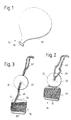
- FIG. 1 shows a perspective view of an inflated but not yet closed balloon 50 with a balloon body 52 intended for receiving gas and a balloon opening 56.
- the balloon closure shown in FIGS. 2 and 3 and designated as a whole by 10 has a loop 40 (for example a loop made of a cotton thread, a cotton band or a loop made of another material) which passes through an opening 22 of the closure element 20, which is preferably designed as a slot is drawn.
- the closure element 20 divides the loop 40 into a small loop 42 protruding from the closure element 20 and a large loop 44 wound around the shield 30.
- the large loop 44 lies For space-saving storage, safe transport and for proper use and handling, rolled up tightly on the label 30.
- the loop 44 was wound up from the inside out, that is to say from the section adjacent to the closure part 20, to the outside.
- FIG. 3 shows the balloon closure 10 with the roll-up part 30 broken off.
- a perforation 24 is preferably provided between the closure element 20 and the roll-up part 30, so that these two parts can be easily separated from one another. If the closure element 20 and the roll-up part 30 are separated from one another, the roll-up part 30 can serve as a handle in order to pull the balloon neck 54 with the loop 42 into the closure opening 22.
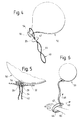
- FIG. 4 shows the balloon 50 with a loop 42 placed around the balloon neck 54.
- the closure element 20 is separated from the roll-up part 30 along the perforation 24, after which the loop 44 is unrolled. Then, as already mentioned, the user places the loop 42 around the balloon neck 54 and pulls the loop 44 through the opening 22 with the closure element 20 held in place, as is shown in FIG. 5.
- the opening 22 of the closure element 20 is preferably formed from a pair of intersecting slots of the same length.
- the maximum width of the opening 22 is smaller than the length of the slots and larger than the thread or tape thickness of the loop 40.
- Such closure openings allow the loop 40 to be easily pulled through the closure opening 22.
- the drawn closure opening 22 has the advantage that, when the balloon neck 54 is pulled through the opening 22, pliers 29 are formed which prevent the balloon neck 54 from sliding back (four small tongues form).
- the material of the balloon closure 10 is selected such that no pliers 29 with sharp corners are formed when the balloon opening 56 is closed, which could injure the balloon neck 54 after attachment.
- FIG. 6 shows how easily an inflated and closed balloon 50 can be attached to a wrist 90 or another object and detached again.
- the loop 40 consists of the two loops 42 and 44, ie one loop on each side of the closure opening 22, before closing. After closing the balloon opening 56 with the loop 42, the loop 40 only has that Loop 44 on.
- the sealed balloon 50 can then be attached to an object, for example on the wrist 90, simply by inserting the balloon 50 in the direction 46, that is to say through the loop 47. To detach the balloon 50, pull on the loop 44 in the direction of 49.
- the balloon 50 can also be held on a wrist by the user passing his wrist through the loop 44 and then gripping it, like a skier comprises a ski pole provided with a strap. Both fastening methods are simpler and faster than all previous methods and in particular can be released again in a simple manner.
- the balloon seal 10 is preferably made of 100% degradable or recyclable material. Therefore, closure element 20 and roll-up part 30 are preferably punched out of paper or cardboard or another product that has the same rigidity. Of course, the closure element and roll-up part can also be made from recycled material, such as old cardboard or a plastic.
Landscapes
- Toys (AREA)
- Ultra Sonic Daignosis Equipment (AREA)
- Telephone Function (AREA)
Abstract
Description
- Bekannte Ballonverschlüsse werden mindestens zum Teil aus nicht abbaubaren oder nicht wiederverwertbaren Materialien hergestellt und bestehen meistens aus einem Verschlusselement aus Kunststoff und einem Faden. Letzterer dient dabei dazu, den Ballon mit dem einen Fadenende am Verschlusselement und mit dem anderen Fadenende an einem Gegenstand zu befestigen.
- Die beiden freien Enden des Fadens verheddern sich sehr oft, und zwar noch bevor ein Ballon mit diesem verschlossen werden kann. Die bekannten Ballonverschlüsse sind daher oft schwer zu handhaben. So sind die Fäden der in einem Beutel oder einer Schachtel aufbewahrten Ballonverschlüsse noch vor deren Verwendung voneinander zu lösen bzw. zu entwirren, was einen zeitraubenden, unnötigen Arbeitsaufwand zur Folge hat.
- Um die bekannten Ballonverschlüsse an einem Handgelenk zu befestigen ist es zudem nötig, mindestens ein loses Ende des Fadens um das Handgelenk zu knoten. Wenn lediglich ein loses Ende des Fadens um das Handgelenk gebunden wird, bleibt immer noch das zweite lose Ende frei, welches sich irgendwo verheddern oder sonst störend verwickeln kann. Einmal angebunden, ist es schliesslich sehr oft schwierig, den Ballonverschluss wieder vom Handgelenk zu lösen.
- Der vorliegenden Erfindung liegt nun die Aufgabe zugrunde, eine zum Verschliessen eines Luftballons dienende Vorrichtung vorzuschlagen, welche die vorgenannten Nachteile der bekannten Ballonverschlüsse nicht aufweist.
- Diese Aufqabe wird erfindungsgemäss durch eine Vorrichtung mit den Merkmalen des Patentanspruchs 1 gelöst.
- Vorteilhafte Ausgestaltungen der Vorrichtung sind Gegenstand der abhängigen Ansprüche.
- Vorrichtungen zum Verschliessen eines Luftballons der vorliegenden Erfindung besitzen ein Verschlusselement mit einer kleinen Öffnung, eine durch diese Öffnung hindurchgezogene endlose Faden- oder Band-Schlinge und ein vom Verschlusselement lösbares Schild. Letzteres wird als Rolle benutzt, auf das der Faden oder das Band bei der Herstellung der Vorrichtung aufgerollt wird.
- Ein wesentlicher Vorteil der Erfindung liegt nun darin, dass diese sehr klein und kompakt ist. Dadurch dass die Faden- oder Band-Schlinge straff auf dem genannten Schild aufgewickelt ist, eignet sich die - nachfolgend auch als Ballonverschluss bezeichnete - erfindungsgemässe Vorrichtung bestens für den Warenversand. Hierbei kommt es nicht zu einem Verheddern der Fäden oder Bänder von miteinander verpackten Ballonverschlüssen, so wie das bei bekannten Ballonverschlüssen der Fall ist.
- Das Verschlusselement ist vorzugsweise flach und rund. Es besteht zusammen mit dem nachfolgend auch als Aufrollteil bezeichneten Schild, welches im wesentlichen flach und rechtekkig ausgebildet ist, aus einem einstückigen Körper. Verschlusselement und Aufrollteil werden vorzugsweise in einem Arbeitsgang aus dickem Papier oder Karton gestanzt.
- Um einen mit Gas gefüllten Ballon zu verschliessen, legt der Benutzer eine auf der einen Seite aus dem Verschlusselement herausragende kleine Schleife um den Ballonhals des aufgeblasenen Ballons. Anschliessend bricht der Benutzer den Aufrollteil ab und zieht den Ballonhals mit der genannten Schleife durch die Öffnung des Verschlusselementes. Dann kann der Aufrollteil losgelassen werden, worauf sich der Faden oder das Band, beispielsweise der Baumwollfaden, automatisch abrollt.
- Einmal verschlossen, kann der Ballon an verschiedene Objekte befestigt werden, indem das Ende der zweiten, jetzt freiliegenden grossen Schleife um den entsprechenden Gegenstand geführt und der Ballon durch die so gebildete Schlaufe gezogen wird. In umgekehrter Reihenfolge kann der Ballon vom Gegenstand wieder losgelöst werden. Soll der Ballon an einem Handgelenk befestigt werden, faltete man das Ende der zweiten, längeren Schleife zurück und zieht den bereits befestigten Ballon durch die gebildete Schlaufe. Dann wird die Schlaufe um das Handgelenk gelegt und leicht festgezogen. Mit einem kleinen Zug an der Schlinge kann der Ballon ohne weiteres wieder vom Handgelenk losgelöst werden. Das Befestigen von Faden oder Band am Handgelenk kann selbstverständlich auch vor der Befestigung des Ballons am Verschlusselement erfolgen. Hierzu bricht der Benutzer als erstes den Aufrollteil ab, faltet das Ende der zweiten, längeren Schleife zurück, zieht den Rest des Fadens oder Bandes zusammen mit dem Verschlusselement durch die so gebildete Schlaufe und legt diese um das Handgelenk. Anschliessend legt man die auf der einen Seite aus dem Verschlusselement herausragende kleine Schleife um den Ballonhals des mit Gas gefüllten Ballons und zieht mit dieser den Ballonhals durch die Öffnung des Verschlusselementes.
- Nachfolgend wird nun anhand der Zeichnung die Erfindung näher erläutert.
- In der Zeichnung zeigt
- die Figur 1 eine Ansicht eines aufgeblasenen, aber unverschlossenen Ballons,
- die Figur 2 einen erfindungsgemässen Ballonverschluss mit einer um den Aufrollteil gewickelten Fadenschlinge,
- die Figur 3 den Ballonverschluss der Figur 3 mit vom Verschlusselement abgebrochenem Aufrollteil,
- die Figur 4 eine Ansicht eines aufgeblasenen, noch nicht verschlossenen Ballons, mit um den Ballonhals gelegter Schlinge,
- die Figur 5 eine vergrösserte Ansicht eines durch die Öffnung des Verschlusselementes gezogenen Ballonhalses, und
- die Figur 6 eine Ansicht eines mittels der erfindungsgemässen Vorrichtung lösbar an einem Handgelenk befestigten Ballons.
- Die Figur 1 zeigt eine perspektivische Ansicht eines aufgeblasenen, aber noch nicht verschlossenen Ballons 50 mit einem zum Aufnehmen von Gas bestimmten Ballonkörper 52 und einer Ballonöffnung 56.
- Der in den Figuren 2 und 3 dargestellte und als ganzes mit 10 bezeichnete Ballonverschluss besitzt eine Schlinge 40 (z.B. eine Schlinge aus einem Baumwollfaden, einem Baumwollband oder eine Schlinge aus einem anderen Material), welche durch eine vorzugsweise als Schlitz ausgebildete Öffnung 22 des Verschlusselementes 20 gezogen ist. Das Verschlusselement 20 unterteilt dabei die Schlinge 40 in eine aus dem Verschlusselement 20 herausragende kleine Schleife 42 und eine um das Schild 30 gewickelte grosse Schleife 44. Wie speziell aus der Figur 2 ersichtlich ist, liegt die grosse Schleife 44 zum platzsparenden Lagern, sicheren Transportieren und zur einwandfreien Verwendung und Handhabung straff aufgerollt auf dem Schild 30. Hierzu wurde die Schleife 44 von innen nach aussen, dass heisst vom am Verschlussteil 20 anliegenden Abschnitt nach aussen, aufgewickelt.
- Die Figur 3 zeigt den Ballonverschluss 10 mit abgebrochenem Aufrollteil 30. Zwischen Verschlusselement 20 und Aufrollteil 30 ist vorzugsweise eine Perforation 24 vorgesehen, so dass diese beiden Teile einfach voneinander getrennt werden können. Wenn das Verschlusselement 20 und der Aufrollteil 30 voneinander getrennt sind, kann der Aufrollteil 30 als Griff dienen, um den Ballonhals 54 mit der Schleife 42 in die Verschlussöffnung 22 zu ziehen.
- Die Figur 4 zeigt den Ballon 50 mit um den Ballonhals 54 gelegter Schleife 42. Um den Ballon 50 zu verschliessen wird das Verschlusselement 20 entlang der Perforation 24 vom Aufrollteil 30 getrennt, worauf die Schleife 44 abgerollt wird. Dann legt - wie bereits erwähnt - der Anwender die Schleife 42 um den Ballonhals 54 und zieht bei festgehaltenem Verschlusselement 20 die Schleife 44 durch die Öffnung 22, so wie das in der Figur 5 dargestellt ist.
- Die Öffnung 22 des Verschlusselementes 20 ist vorzugsweise aus einem Paar sich kreuzender Schlitze gleicher Länge gebildet. Die maximale Weite der Öffnung 22 ist dabei kleiner als die Länge der Schlitze und grösser als die Faden- oder Bandstärke der Schlinge 40. Derartige Verschlussöffnungen erlauben, dass die Schlinge 40 einfach durch die Verschlussöffnung 22 gezogen werden kann. Als Alternative zur Verschlussöffnung 22 kann auch nur ein waagrechter Schlitz mit einer kleinen Öffnung in der Mitte des Schlitzes, oder eine runde, viereckige oder ovale Öffnung in der Mitte des Verschlusselementes vorgesehen sein. Alle Typen von Verschlussöffnungen müssen aber in jedem Fall klein genug sein, um die Aufblasöffnung des Ballonhalses sicher zu verschliessen.
- Die gezeichnete Verschlussöffnung 22 hat den Vorteil, dass sich beim Hindurchziehen des Ballonhalses 54 durch die Öffnung 22 Zangen 29 bildet, welche das Zurückgleiten des Ballonhalses 54 verhindert (es bilden sich vier kleine Zakken).
- Selbstverständlich ist das Material des Ballonverschlusses 10 so gewählt, dass sich beim Verschliessen der Ballonöffnung 56 keine Zangen 29 mit scharfen Ecken bilden, die den Ballonhals 54 nach der Befestigung verletzen könnten.
- Die Figur 6 zeigt schliesslich wie einfach ein aufgeblasener und verschlossener Ballon 50 an einem Handgelenk 90 oder einem anderen Gegentand befestigt und wieder losgelöst werden kann. Wie die Figur 4 zeigt, besteht die Schlinge 40 vor dem Verschliessen aus den zwei Schleifen 42 und 44, also aus je einer Schleife auf jeder Seite der Verschlussöffnung 22. Nach dem Verschliessen der Ballonöffnung 56 mit der Schleife 42 weist die Schlinge 40 nur noch die Schleife 44 auf. Der verschlossene Ballon 50 kann dann durch einfaches Einführen des Ballons 50 in Richtung 46, also durch die Schlaufe 47 an einem Gegenstand, beispielsweise am Handgelenk 90 befestigt werden. Um den Ballon 50 loszulösen, zieht man an der Schleife 44 in Richtung 49. Der Ballon 50 kann aber auch so an einem Handgelenk festgehalten werden, indem der Benutzer sein Handgelenk durch die Schleife 44 hindurchführt und diese dann ergreift, also etwa so wie ein Skifahrer einen mit einem Halteriemen versehenen Skistock umfasst. Beide Befestigungsmethoden sind einfacher und schneller als alle bisherigen Methoden und insbesondere auf einfache Art und Weise wieder lösbar.
- Der Ballonverschluss 10 besteht vorzugsweise aus 100% abbaubarem oder wiederverwertbarem Material. Daher werden Verschlusselement 20 und Aufrollteil 30 vorzugsweise aus Papier oder Karton oder einem anderen Produkt gestanzt, das die gleiche Steifheit besitzt. Selbstverständlich können Verschlusselement und Aufrollteil auch aus Recycling-Material, etwa Alt-Karton oder einem Kunststoff, hergestellt werden.
Claims (6)
- Zum Verschliessen eines Luftballons dienende Vorrichtung mit einem Verschlusselement (20) und einem durch eine Öffnung (22) des Verschlusselementes (20) hindurchgeführten Befestigungsfaden oder Befestigungsband, dadurch gekennzeichnet, dass sie eine endlose Faden- oder Band-Schlinge (40) und ein vom Verschlusselement (20) lösbares Schild (30) aufweist, dass die endlose Faden- oder Band-Schlinge (40) durch die genannte Öffnung hindurchgezogen ist und eine Schleife (42) bildet, um den Ballonhals (54) zu umgreifen und mindestens zum Teil durch die Öffnung (22) zu ziehen, und dass auf dem Schild (30) der restliche Teil der Schlinge (40) aufgerollt ist.
- Vorrichtung nach Anspruch 1, dadurch gekennzeichnet, dass das Verschlusselement (20) und das Schild (30) aus Karton gebildet sind.
- Vorrichtung nach einem der Ansprüche 1 oder 2, gekennzeichnet durch eine Perforation (24) zwischen dem Verschlusselement (20) und dem Schild (30).
- Vorrichtung nach einem der Ansprüche 1 bis 3 , dadurch gekennzeichnet, dass die Öffnung (22) ein Schlitz ist.
- Vorrichtung nach einem der Ansprüche 1 bis 3, dadurch gekennzeichnet, dass die Öffnung (22) symmetrisch in der Mitte des Verschlusselementes (20) angeordnet ist.
- Vorrichtung nach Anspruch 4 oder 5, dadurch gekennzeichnet, dass die Verschlussöffnung (22) eine minimale Öffnungsweite hat, welche kleiner ist als die Länge des Schlitzes und mindestens so lange ist wie die Faden- oder Bandstärke der Schlinge (40).
Applications Claiming Priority (3)
| Application Number | Priority Date | Filing Date | Title |
|---|---|---|---|
| CH3296 | 1996-01-05 | ||
| CH32/96 | 1996-01-05 | ||
| CH3296 | 1996-01-05 |
Publications (2)
| Publication Number | Publication Date |
|---|---|
| EP0782875A1 true EP0782875A1 (de) | 1997-07-09 |
| EP0782875B1 EP0782875B1 (de) | 2001-07-11 |
Family
ID=4177808
Family Applications (1)
| Application Number | Title | Priority Date | Filing Date |
|---|---|---|---|
| EP96810830A Expired - Lifetime EP0782875B1 (de) | 1996-01-05 | 1996-11-28 | Zum Verschliessen eines Luftballons dienende Vorrichtung |
Country Status (4)
| Country | Link |
|---|---|
| US (1) | US5628091A (de) |
| EP (1) | EP0782875B1 (de) |
| AT (1) | ATE202947T1 (de) |
| DE (1) | DE59607270D1 (de) |
Cited By (1)
| Publication number | Priority date | Publication date | Assignee | Title |
|---|---|---|---|---|
| WO2013182781A1 (fr) | 2012-06-08 | 2013-12-12 | IFP Energies Nouvelles | Procede de commande d'un onduleur triphasé par modulation vectorielle aléatoire discontinue evolutive |
Families Citing this family (28)
| Publication number | Priority date | Publication date | Assignee | Title |
|---|---|---|---|---|
| US5799377A (en) * | 1996-11-12 | 1998-09-01 | Maxim, Inc. | Balloon neck closure and decoration apparatus |
| AU3491797A (en) * | 1997-03-24 | 1998-10-20 | Edward M. Burke | Balloon mooring system |
| US5989093A (en) * | 1997-04-18 | 1999-11-23 | David C. Nelson | Balloon weight and ribbon assembly |
| US6007403A (en) * | 1997-11-17 | 1999-12-28 | Urspringer; Steven E. | Flexible constrictor for inflatable bodies |
| US6019660A (en) * | 1998-10-21 | 2000-02-01 | Luciano; Ismael | Balloon for interlocking with another balloon |
| FR2788440B1 (fr) * | 1999-01-19 | 2001-02-23 | Pierre Billon | Ballon de baudruche |
| FI110355B (fi) * | 2000-04-27 | 2002-12-31 | Juhani Turjanmaa | Ilmapallon kiinnitin |
| US6273479B1 (en) | 2000-10-27 | 2001-08-14 | Leland R. Carlson | Unit for tying a balloon and securing a ribbon to the balloon |
| US6458007B1 (en) | 2001-04-19 | 2002-10-01 | Larry Verner | Balloon holder |
| US6527615B1 (en) | 2002-01-16 | 2003-03-04 | Ray Boehler | Balloon closure device |
| US7178754B2 (en) | 2002-04-17 | 2007-02-20 | Cti Industries Corporation | Balloon anchor |
| US6716083B1 (en) | 2002-12-09 | 2004-04-06 | Antonio L. Castro | Balloon weight |
| US7311132B2 (en) * | 2004-01-17 | 2007-12-25 | Comfortex Corporation | Self-equalizing corded window covering and breakaway coupling member for same |
| US7674152B2 (en) * | 2005-03-03 | 2010-03-09 | Cti Industries, Inc. | Enhanced balloon weight system |
| USD536746S1 (en) * | 2005-12-30 | 2007-02-13 | Murray Robert H | Toy balloon seal with tether |
| USD542360S1 (en) * | 2006-04-06 | 2007-05-08 | Murray Robert H | Toy balloon seal with non-circular tether coil |
| US20080085656A1 (en) * | 2006-10-09 | 2008-04-10 | Wayne Scott Boise | Method, system, and kit package for balloon weights and balloon stompers |
| US20090050834A1 (en) * | 2007-08-25 | 2009-02-26 | Wayne Scott Boise | Nozzles and Decorations or Ornamental-Functional Features |
| US20090050835A1 (en) * | 2007-08-25 | 2009-02-26 | Wayne Scott Boise | Nozzles and Decorations or Ornamental-Functional Features |
| US20110302748A1 (en) * | 2010-06-11 | 2011-12-15 | Raymond Michael Avelar | Skateboarder's shoelace clamp and methods of use |
| US9011195B2 (en) | 2011-12-23 | 2015-04-21 | Maximum Visibility Solutions, Llc | Collapsible balloon cup with attachable inflation air tube |
| US8568190B2 (en) * | 2012-02-01 | 2013-10-29 | Premium Balloon Accessories, Inc. | Balloon sealing and displaying device |
| US9051066B1 (en) | 2014-02-07 | 2015-06-09 | Tinnus Enterprises, Llc | System and method for filling containers with fluids |
| US10493370B2 (en) | 2016-06-21 | 2019-12-03 | Tinnus Enterprises, Llc | System and method for filling containers with fluids and sealing the filled containers |
| US10242602B2 (en) * | 2017-06-30 | 2019-03-26 | Bedford Industries, Inc. | Merchandise marking tag |
| US10914330B1 (en) | 2017-08-18 | 2021-02-09 | Jacqueline B. Jolly | Fastener for inflatable articles |
| WO2020008164A1 (en) * | 2018-07-06 | 2020-01-09 | B-Loony Ltd | A balloon holder and blank for forming a balloon holder |
| USD951905S1 (en) * | 2021-04-07 | 2022-05-17 | Xiqing Gao | Earphone clip |
Citations (3)
| Publication number | Priority date | Publication date | Assignee | Title |
|---|---|---|---|---|
| US5104160A (en) * | 1991-09-27 | 1992-04-14 | Cheng Peter S C | Balloon tying device and method |
| DE9403752U1 (de) * | 1994-03-03 | 1994-05-19 | Reisemann, Peter, 13595 Berlin | Verschluß für Luftballons |
| DE29515981U1 (de) * | 1995-09-29 | 1995-12-07 | Reisemann, Peter, 13595 Berlin | Abgerundeter Verschlußschlitz für Luftballon-Verschlußscheiben |
Family Cites Families (17)
| Publication number | Priority date | Publication date | Assignee | Title |
|---|---|---|---|---|
| US1680318A (en) * | 1927-06-25 | 1928-08-14 | Pioneer Rubber Company | Assembly disk for elastic material |
| US2112477A (en) * | 1934-02-28 | 1938-03-29 | Brownfield George Washington | Package and closure for the same |
| US2396906A (en) * | 1945-02-06 | 1946-03-19 | Antoine E Windson | Balloon sealing device |
| US3154050A (en) * | 1962-07-06 | 1964-10-27 | Chris A Hanson | Emergency signal apparatus |
| US3783551A (en) * | 1971-04-12 | 1974-01-08 | Mtl Inc | Balloon and sealing means therefor |
| US3720991A (en) * | 1971-04-12 | 1973-03-20 | Mtl Inc | Machine for sealing balloons and the like |
| US3780419A (en) * | 1971-04-12 | 1973-12-25 | Mtl Inc | Method for sealing balloons and the like |
| US3820200A (en) * | 1973-01-03 | 1974-06-28 | R Myers | Bag closure |
| US4292714A (en) * | 1980-01-14 | 1981-10-06 | Walker Robert J | Easy opening and secure closing closure |
| GB2093709A (en) * | 1981-02-24 | 1982-09-08 | Delasson Jean | Closing balloons |
| FR2521433A1 (fr) * | 1982-02-17 | 1983-08-19 | Delasson Jean | Dispositif de fermeture automatique et de prehension de ballons |
| FR2588478B2 (fr) * | 1982-02-17 | 1989-05-26 | Delasson Jean | Dispositif de fermeture automatique et de prehension de ballons |
| US4729749A (en) * | 1986-12-10 | 1988-03-08 | Cti Industries Corporation | Balloon stem connector |
| US4837059A (en) * | 1988-02-10 | 1989-06-06 | Cti Industries | Support structure for an ornament |
| US4936532A (en) * | 1989-07-10 | 1990-06-26 | Jesse Williams | Balloon closure and hanger device |
| US5210911A (en) * | 1992-07-21 | 1993-05-18 | Zel Products Inc. | Wrapping device |
| US5547413A (en) * | 1995-05-25 | 1996-08-20 | Murray; Robert H. | Heat-staked tether for toy balloons |
-
1996
- 1996-01-11 US US08/585,270 patent/US5628091A/en not_active Expired - Fee Related
- 1996-11-28 AT AT96810830T patent/ATE202947T1/de not_active IP Right Cessation
- 1996-11-28 DE DE59607270T patent/DE59607270D1/de not_active Expired - Fee Related
- 1996-11-28 EP EP96810830A patent/EP0782875B1/de not_active Expired - Lifetime
Patent Citations (3)
| Publication number | Priority date | Publication date | Assignee | Title |
|---|---|---|---|---|
| US5104160A (en) * | 1991-09-27 | 1992-04-14 | Cheng Peter S C | Balloon tying device and method |
| DE9403752U1 (de) * | 1994-03-03 | 1994-05-19 | Reisemann, Peter, 13595 Berlin | Verschluß für Luftballons |
| DE29515981U1 (de) * | 1995-09-29 | 1995-12-07 | Reisemann, Peter, 13595 Berlin | Abgerundeter Verschlußschlitz für Luftballon-Verschlußscheiben |
Cited By (1)
| Publication number | Priority date | Publication date | Assignee | Title |
|---|---|---|---|---|
| WO2013182781A1 (fr) | 2012-06-08 | 2013-12-12 | IFP Energies Nouvelles | Procede de commande d'un onduleur triphasé par modulation vectorielle aléatoire discontinue evolutive |
Also Published As
| Publication number | Publication date |
|---|---|
| ATE202947T1 (de) | 2001-07-15 |
| EP0782875B1 (de) | 2001-07-11 |
| US5628091A (en) | 1997-05-13 |
| DE59607270D1 (de) | 2001-08-16 |
Similar Documents
| Publication | Publication Date | Title |
|---|---|---|
| EP0782875B1 (de) | Zum Verschliessen eines Luftballons dienende Vorrichtung | |
| DE60105026T2 (de) | Eine aus einer hitzeschrumpfenden plastikhülle bestehende umhüllung zum verpacken zumindest eines objekts | |
| DE2654867C3 (de) | Verpackter Aufgußbeutel, insbe-, sondere für Tee | |
| DE69003795T2 (de) | Tragetasche aus Kunststoffolie. | |
| EP0233541A1 (de) | Vorratsmagazin für in einer lichtdichten Umhüllung befindliche Blattfilmstapel und in dem Vorratsmagazin verwendbare Umhüllung | |
| DE3013036A1 (de) | Aufgussbeutel und verfahren zu dessen herstellung | |
| DE69004976T2 (de) | Behälter zur Aufnahme und Abgabe schnurförmiger Gegenstände. | |
| DE4020945C2 (de) | Verpackung für einen oder mehrere quaderförmige Magnetband-Behälter | |
| DE815321C (de) | Klammerstreifen zum Verschliessen von Verpackungsbeuteln | |
| CH571436A5 (en) | Box convertible into stand - tear-off portions in sidewalls allow bending of base into arch | |
| DE8802205U1 (de) | Einwegschutzpackung | |
| DE2811143A1 (de) | Sack, beutel o.dgl. | |
| EP0082218B1 (de) | Trägervorrichtung für chirurgisches Nahtmaterial | |
| DE1492280B1 (de) | Verpackung fuer chirurgische Naehfaeden mit daran befestigten Nadeln | |
| DE895423C (de) | Verpackung fuer Reissverschluesse | |
| CH652089A5 (en) | Apparatus for dispensing and detaching self-adhesive blanks | |
| EP0711706A2 (de) | Zeitungstasche | |
| DE966227C (de) | Staubdichter Beutelverschluss mit Sicherung gegen unbemerktes OEffnen | |
| DE1278930B (de) | Aus einer Kunststoffolie gebildeter Beutel | |
| DE69701333T2 (de) | Weichpackung mit Aufhängevorrichtung | |
| DE1906693U (de) | Vorrichtung zur ausgabe von struempfen od. dgl. | |
| DE7916934U1 (de) | Beutel aus Kunststoff-Folie | |
| CH385724A (de) | Bandförmiges Befestigungs- oder Verschlussmittel aus Kunststoff oder Kautschuk | |
| DE202021102848U1 (de) | Vorrichtung zum Aufwickeln, Abwickeln und/oder Lagern eines band- oder streifenförmigen Wickelguts | |
| AT240783B (de) | Verpackungsbehälter für gerolltes, bandförmiges Material |
Legal Events
| Date | Code | Title | Description |
|---|---|---|---|
| PUAI | Public reference made under article 153(3) epc to a published international application that has entered the european phase |
Free format text: ORIGINAL CODE: 0009012 |
|
| AK | Designated contracting states |
Kind code of ref document: A1 Designated state(s): AT CH DE ES FR GB IT LI |
|
| 17P | Request for examination filed |
Effective date: 19971229 |
|
| RAP1 | Party data changed (applicant data changed or rights of an application transferred) |
Owner name: ZIBI BALLOON ACCESSOIRES AG |
|
| 17Q | First examination report despatched |
Effective date: 19991201 |
|
| GRAG | Despatch of communication of intention to grant |
Free format text: ORIGINAL CODE: EPIDOS AGRA |
|
| GRAG | Despatch of communication of intention to grant |
Free format text: ORIGINAL CODE: EPIDOS AGRA |
|
| GRAH | Despatch of communication of intention to grant a patent |
Free format text: ORIGINAL CODE: EPIDOS IGRA |
|
| GRAH | Despatch of communication of intention to grant a patent |
Free format text: ORIGINAL CODE: EPIDOS IGRA |
|
| GRAA | (expected) grant |
Free format text: ORIGINAL CODE: 0009210 |
|
| AK | Designated contracting states |
Kind code of ref document: B1 Designated state(s): AT CH DE ES FR GB IT LI |
|
| REF | Corresponds to: |
Ref document number: 202947 Country of ref document: AT Date of ref document: 20010715 Kind code of ref document: T |
|
| REG | Reference to a national code |
Ref country code: CH Ref legal event code: NV Representative=s name: PATENTANWALTSBUERO EDER AG Ref country code: CH Ref legal event code: EP |
|
| REF | Corresponds to: |
Ref document number: 59607270 Country of ref document: DE Date of ref document: 20010816 |
|
| GBT | Gb: translation of ep patent filed (gb section 77(6)(a)/1977) |
Effective date: 20010831 |
|
| ITF | It: translation for a ep patent filed | ||
| ET | Fr: translation filed | ||
| REG | Reference to a national code |
Ref country code: GB Ref legal event code: IF02 |
|
| PG25 | Lapsed in a contracting state [announced via postgrant information from national office to epo] |
Ref country code: ES Free format text: LAPSE BECAUSE OF FAILURE TO SUBMIT A TRANSLATION OF THE DESCRIPTION OR TO PAY THE FEE WITHIN THE PRESCRIBED TIME-LIMIT Effective date: 20020131 |
|
| PLBE | No opposition filed within time limit |
Free format text: ORIGINAL CODE: 0009261 |
|
| STAA | Information on the status of an ep patent application or granted ep patent |
Free format text: STATUS: NO OPPOSITION FILED WITHIN TIME LIMIT |
|
| 26N | No opposition filed | ||
| PGFP | Annual fee paid to national office [announced via postgrant information from national office to epo] |
Ref country code: GB Payment date: 20061129 Year of fee payment: 11 |
|
| PGFP | Annual fee paid to national office [announced via postgrant information from national office to epo] |
Ref country code: IT Payment date: 20061130 Year of fee payment: 11 Ref country code: FR Payment date: 20061130 Year of fee payment: 11 Ref country code: DE Payment date: 20061130 Year of fee payment: 11 |
|
| PGFP | Annual fee paid to national office [announced via postgrant information from national office to epo] |
Ref country code: CH Payment date: 20061213 Year of fee payment: 11 Ref country code: AT Payment date: 20061213 Year of fee payment: 11 |
|
| GBPC | Gb: european patent ceased through non-payment of renewal fee |
Effective date: 20071128 |
|
| PG25 | Lapsed in a contracting state [announced via postgrant information from national office to epo] |
Ref country code: LI Free format text: LAPSE BECAUSE OF NON-PAYMENT OF DUE FEES Effective date: 20071130 Ref country code: CH Free format text: LAPSE BECAUSE OF NON-PAYMENT OF DUE FEES Effective date: 20071130 |
|
| REG | Reference to a national code |
Ref country code: CH Ref legal event code: PL |
|
| PG25 | Lapsed in a contracting state [announced via postgrant information from national office to epo] |
Ref country code: AT Free format text: LAPSE BECAUSE OF NON-PAYMENT OF DUE FEES Effective date: 20071128 |
|
| PG25 | Lapsed in a contracting state [announced via postgrant information from national office to epo] |
Ref country code: DE Free format text: LAPSE BECAUSE OF NON-PAYMENT OF DUE FEES Effective date: 20080603 |
|
| REG | Reference to a national code |
Ref country code: FR Ref legal event code: ST Effective date: 20080930 |
|
| PG25 | Lapsed in a contracting state [announced via postgrant information from national office to epo] |
Ref country code: GB Free format text: LAPSE BECAUSE OF NON-PAYMENT OF DUE FEES Effective date: 20071128 |
|
| PG25 | Lapsed in a contracting state [announced via postgrant information from national office to epo] |
Ref country code: FR Free format text: LAPSE BECAUSE OF NON-PAYMENT OF DUE FEES Effective date: 20071130 |
|
| PG25 | Lapsed in a contracting state [announced via postgrant information from national office to epo] |
Ref country code: IT Free format text: LAPSE BECAUSE OF NON-PAYMENT OF DUE FEES Effective date: 20071128 |