EP0782941A1 - Verfahren und Vorrichtung zur Regelung der elektrischen Energieverteilung in einem Kraftfahrzeug, insbesondere mit Hybridantrieb - Google Patents
Verfahren und Vorrichtung zur Regelung der elektrischen Energieverteilung in einem Kraftfahrzeug, insbesondere mit Hybridantrieb Download PDFInfo
- Publication number
- EP0782941A1 EP0782941A1 EP96120329A EP96120329A EP0782941A1 EP 0782941 A1 EP0782941 A1 EP 0782941A1 EP 96120329 A EP96120329 A EP 96120329A EP 96120329 A EP96120329 A EP 96120329A EP 0782941 A1 EP0782941 A1 EP 0782941A1
- Authority
- EP
- European Patent Office
- Prior art keywords
- power
- battery
- voltage
- supply circuit
- charge
- Prior art date
- Legal status (The legal status is an assumption and is not a legal conclusion. Google has not performed a legal analysis and makes no representation as to the accuracy of the status listed.)
- Granted
Links
Images



Classifications
-
- B—PERFORMING OPERATIONS; TRANSPORTING
- B60—VEHICLES IN GENERAL
- B60W—CONJOINT CONTROL OF VEHICLE SUB-UNITS OF DIFFERENT TYPE OR DIFFERENT FUNCTION; CONTROL SYSTEMS SPECIALLY ADAPTED FOR HYBRID VEHICLES; ROAD VEHICLE DRIVE CONTROL SYSTEMS FOR PURPOSES NOT RELATED TO THE CONTROL OF A PARTICULAR SUB-UNIT
- B60W10/00—Conjoint control of vehicle sub-units of different type or different function
- B60W10/24—Conjoint control of vehicle sub-units of different type or different function including control of energy storage means
- B60W10/26—Conjoint control of vehicle sub-units of different type or different function including control of energy storage means for electrical energy, e.g. batteries or capacitors
-
- B—PERFORMING OPERATIONS; TRANSPORTING
- B60—VEHICLES IN GENERAL
- B60K—ARRANGEMENT OR MOUNTING OF PROPULSION UNITS OR OF TRANSMISSIONS IN VEHICLES; ARRANGEMENT OR MOUNTING OF PLURAL DIVERSE PRIME-MOVERS IN VEHICLES; AUXILIARY DRIVES FOR VEHICLES; INSTRUMENTATION OR DASHBOARDS FOR VEHICLES; ARRANGEMENTS IN CONNECTION WITH COOLING, AIR INTAKE, GAS EXHAUST OR FUEL SUPPLY OF PROPULSION UNITS IN VEHICLES
- B60K6/00—Arrangement or mounting of plural diverse prime-movers for mutual or common propulsion, e.g. hybrid propulsion systems comprising electric motors and internal combustion engines
- B60K6/20—Arrangement or mounting of plural diverse prime-movers for mutual or common propulsion, e.g. hybrid propulsion systems comprising electric motors and internal combustion engines the prime-movers consisting of electric motors and internal combustion engines, e.g. HEVs
- B60K6/42—Arrangement or mounting of plural diverse prime-movers for mutual or common propulsion, e.g. hybrid propulsion systems comprising electric motors and internal combustion engines the prime-movers consisting of electric motors and internal combustion engines, e.g. HEVs characterised by the architecture of the hybrid electric vehicle
- B60K6/46—Series type
-
- B—PERFORMING OPERATIONS; TRANSPORTING
- B60—VEHICLES IN GENERAL
- B60L—PROPULSION OF ELECTRICALLY-PROPELLED VEHICLES; SUPPLYING ELECTRIC POWER FOR AUXILIARY EQUIPMENT OF ELECTRICALLY-PROPELLED VEHICLES; ELECTRODYNAMIC BRAKE SYSTEMS FOR VEHICLES IN GENERAL; MAGNETIC SUSPENSION OR LEVITATION FOR VEHICLES; MONITORING OPERATING VARIABLES OF ELECTRICALLY-PROPELLED VEHICLES; ELECTRIC SAFETY DEVICES FOR ELECTRICALLY-PROPELLED VEHICLES
- B60L15/00—Methods, circuits, or devices for controlling the traction-motor speed of electrically-propelled vehicles
- B60L15/20—Methods, circuits, or devices for controlling the traction-motor speed of electrically-propelled vehicles for control of the vehicle or its driving motor to achieve a desired performance, e.g. speed, torque, programmed variation of speed
- B60L15/2045—Methods, circuits, or devices for controlling the traction-motor speed of electrically-propelled vehicles for control of the vehicle or its driving motor to achieve a desired performance, e.g. speed, torque, programmed variation of speed for optimising the use of energy
-
- B—PERFORMING OPERATIONS; TRANSPORTING
- B60—VEHICLES IN GENERAL
- B60L—PROPULSION OF ELECTRICALLY-PROPELLED VEHICLES; SUPPLYING ELECTRIC POWER FOR AUXILIARY EQUIPMENT OF ELECTRICALLY-PROPELLED VEHICLES; ELECTRODYNAMIC BRAKE SYSTEMS FOR VEHICLES IN GENERAL; MAGNETIC SUSPENSION OR LEVITATION FOR VEHICLES; MONITORING OPERATING VARIABLES OF ELECTRICALLY-PROPELLED VEHICLES; ELECTRIC SAFETY DEVICES FOR ELECTRICALLY-PROPELLED VEHICLES
- B60L50/00—Electric propulsion with power supplied within the vehicle
- B60L50/10—Electric propulsion with power supplied within the vehicle using propulsion power supplied by engine-driven generators, e.g. generators driven by combustion engines
- B60L50/13—Electric propulsion with power supplied within the vehicle using propulsion power supplied by engine-driven generators, e.g. generators driven by combustion engines using AC generators and AC motors
-
- B—PERFORMING OPERATIONS; TRANSPORTING
- B60—VEHICLES IN GENERAL
- B60L—PROPULSION OF ELECTRICALLY-PROPELLED VEHICLES; SUPPLYING ELECTRIC POWER FOR AUXILIARY EQUIPMENT OF ELECTRICALLY-PROPELLED VEHICLES; ELECTRODYNAMIC BRAKE SYSTEMS FOR VEHICLES IN GENERAL; MAGNETIC SUSPENSION OR LEVITATION FOR VEHICLES; MONITORING OPERATING VARIABLES OF ELECTRICALLY-PROPELLED VEHICLES; ELECTRIC SAFETY DEVICES FOR ELECTRICALLY-PROPELLED VEHICLES
- B60L50/00—Electric propulsion with power supplied within the vehicle
- B60L50/50—Electric propulsion with power supplied within the vehicle using propulsion power supplied by batteries or fuel cells
- B60L50/51—Electric propulsion with power supplied within the vehicle using propulsion power supplied by batteries or fuel cells characterised by AC-motors
-
- B—PERFORMING OPERATIONS; TRANSPORTING
- B60—VEHICLES IN GENERAL
- B60L—PROPULSION OF ELECTRICALLY-PROPELLED VEHICLES; SUPPLYING ELECTRIC POWER FOR AUXILIARY EQUIPMENT OF ELECTRICALLY-PROPELLED VEHICLES; ELECTRODYNAMIC BRAKE SYSTEMS FOR VEHICLES IN GENERAL; MAGNETIC SUSPENSION OR LEVITATION FOR VEHICLES; MONITORING OPERATING VARIABLES OF ELECTRICALLY-PROPELLED VEHICLES; ELECTRIC SAFETY DEVICES FOR ELECTRICALLY-PROPELLED VEHICLES
- B60L50/00—Electric propulsion with power supplied within the vehicle
- B60L50/50—Electric propulsion with power supplied within the vehicle using propulsion power supplied by batteries or fuel cells
- B60L50/60—Electric propulsion with power supplied within the vehicle using propulsion power supplied by batteries or fuel cells using power supplied by batteries
- B60L50/61—Electric propulsion with power supplied within the vehicle using propulsion power supplied by batteries or fuel cells using power supplied by batteries by batteries charged by engine-driven generators, e.g. series hybrid electric vehicles
-
- B—PERFORMING OPERATIONS; TRANSPORTING
- B60—VEHICLES IN GENERAL
- B60L—PROPULSION OF ELECTRICALLY-PROPELLED VEHICLES; SUPPLYING ELECTRIC POWER FOR AUXILIARY EQUIPMENT OF ELECTRICALLY-PROPELLED VEHICLES; ELECTRODYNAMIC BRAKE SYSTEMS FOR VEHICLES IN GENERAL; MAGNETIC SUSPENSION OR LEVITATION FOR VEHICLES; MONITORING OPERATING VARIABLES OF ELECTRICALLY-PROPELLED VEHICLES; ELECTRIC SAFETY DEVICES FOR ELECTRICALLY-PROPELLED VEHICLES
- B60L58/00—Methods or circuit arrangements for monitoring or controlling batteries or fuel cells, specially adapted for electric vehicles
- B60L58/10—Methods or circuit arrangements for monitoring or controlling batteries or fuel cells, specially adapted for electric vehicles for monitoring or controlling batteries
- B60L58/12—Methods or circuit arrangements for monitoring or controlling batteries or fuel cells, specially adapted for electric vehicles for monitoring or controlling batteries responding to state of charge [SoC]
-
- B—PERFORMING OPERATIONS; TRANSPORTING
- B60—VEHICLES IN GENERAL
- B60L—PROPULSION OF ELECTRICALLY-PROPELLED VEHICLES; SUPPLYING ELECTRIC POWER FOR AUXILIARY EQUIPMENT OF ELECTRICALLY-PROPELLED VEHICLES; ELECTRODYNAMIC BRAKE SYSTEMS FOR VEHICLES IN GENERAL; MAGNETIC SUSPENSION OR LEVITATION FOR VEHICLES; MONITORING OPERATING VARIABLES OF ELECTRICALLY-PROPELLED VEHICLES; ELECTRIC SAFETY DEVICES FOR ELECTRICALLY-PROPELLED VEHICLES
- B60L2200/00—Type of vehicles
- B60L2200/26—Rail vehicles
-
- B—PERFORMING OPERATIONS; TRANSPORTING
- B60—VEHICLES IN GENERAL
- B60L—PROPULSION OF ELECTRICALLY-PROPELLED VEHICLES; SUPPLYING ELECTRIC POWER FOR AUXILIARY EQUIPMENT OF ELECTRICALLY-PROPELLED VEHICLES; ELECTRODYNAMIC BRAKE SYSTEMS FOR VEHICLES IN GENERAL; MAGNETIC SUSPENSION OR LEVITATION FOR VEHICLES; MONITORING OPERATING VARIABLES OF ELECTRICALLY-PROPELLED VEHICLES; ELECTRIC SAFETY DEVICES FOR ELECTRICALLY-PROPELLED VEHICLES
- B60L2210/00—Converter types
- B60L2210/30—AC to DC converters
-
- B—PERFORMING OPERATIONS; TRANSPORTING
- B60—VEHICLES IN GENERAL
- B60L—PROPULSION OF ELECTRICALLY-PROPELLED VEHICLES; SUPPLYING ELECTRIC POWER FOR AUXILIARY EQUIPMENT OF ELECTRICALLY-PROPELLED VEHICLES; ELECTRODYNAMIC BRAKE SYSTEMS FOR VEHICLES IN GENERAL; MAGNETIC SUSPENSION OR LEVITATION FOR VEHICLES; MONITORING OPERATING VARIABLES OF ELECTRICALLY-PROPELLED VEHICLES; ELECTRIC SAFETY DEVICES FOR ELECTRICALLY-PROPELLED VEHICLES
- B60L2240/00—Control parameters of input or output; Target parameters
- B60L2240/40—Drive Train control parameters
-
- B—PERFORMING OPERATIONS; TRANSPORTING
- B60—VEHICLES IN GENERAL
- B60L—PROPULSION OF ELECTRICALLY-PROPELLED VEHICLES; SUPPLYING ELECTRIC POWER FOR AUXILIARY EQUIPMENT OF ELECTRICALLY-PROPELLED VEHICLES; ELECTRODYNAMIC BRAKE SYSTEMS FOR VEHICLES IN GENERAL; MAGNETIC SUSPENSION OR LEVITATION FOR VEHICLES; MONITORING OPERATING VARIABLES OF ELECTRICALLY-PROPELLED VEHICLES; ELECTRIC SAFETY DEVICES FOR ELECTRICALLY-PROPELLED VEHICLES
- B60L2240/00—Control parameters of input or output; Target parameters
- B60L2240/40—Drive Train control parameters
- B60L2240/42—Drive Train control parameters related to electric machines
- B60L2240/421—Speed
-
- B—PERFORMING OPERATIONS; TRANSPORTING
- B60—VEHICLES IN GENERAL
- B60L—PROPULSION OF ELECTRICALLY-PROPELLED VEHICLES; SUPPLYING ELECTRIC POWER FOR AUXILIARY EQUIPMENT OF ELECTRICALLY-PROPELLED VEHICLES; ELECTRODYNAMIC BRAKE SYSTEMS FOR VEHICLES IN GENERAL; MAGNETIC SUSPENSION OR LEVITATION FOR VEHICLES; MONITORING OPERATING VARIABLES OF ELECTRICALLY-PROPELLED VEHICLES; ELECTRIC SAFETY DEVICES FOR ELECTRICALLY-PROPELLED VEHICLES
- B60L2240/00—Control parameters of input or output; Target parameters
- B60L2240/40—Drive Train control parameters
- B60L2240/52—Drive Train control parameters related to converters
- B60L2240/527—Voltage
-
- B—PERFORMING OPERATIONS; TRANSPORTING
- B60—VEHICLES IN GENERAL
- B60L—PROPULSION OF ELECTRICALLY-PROPELLED VEHICLES; SUPPLYING ELECTRIC POWER FOR AUXILIARY EQUIPMENT OF ELECTRICALLY-PROPELLED VEHICLES; ELECTRODYNAMIC BRAKE SYSTEMS FOR VEHICLES IN GENERAL; MAGNETIC SUSPENSION OR LEVITATION FOR VEHICLES; MONITORING OPERATING VARIABLES OF ELECTRICALLY-PROPELLED VEHICLES; ELECTRIC SAFETY DEVICES FOR ELECTRICALLY-PROPELLED VEHICLES
- B60L2250/00—Driver interactions
- B60L2250/26—Driver interactions by pedal actuation
-
- B—PERFORMING OPERATIONS; TRANSPORTING
- B60—VEHICLES IN GENERAL
- B60W—CONJOINT CONTROL OF VEHICLE SUB-UNITS OF DIFFERENT TYPE OR DIFFERENT FUNCTION; CONTROL SYSTEMS SPECIALLY ADAPTED FOR HYBRID VEHICLES; ROAD VEHICLE DRIVE CONTROL SYSTEMS FOR PURPOSES NOT RELATED TO THE CONTROL OF A PARTICULAR SUB-UNIT
- B60W2710/00—Output or target parameters relating to a particular sub-units
- B60W2710/08—Electric propulsion units
- B60W2710/086—Power
-
- Y—GENERAL TAGGING OF NEW TECHNOLOGICAL DEVELOPMENTS; GENERAL TAGGING OF CROSS-SECTIONAL TECHNOLOGIES SPANNING OVER SEVERAL SECTIONS OF THE IPC; TECHNICAL SUBJECTS COVERED BY FORMER USPC CROSS-REFERENCE ART COLLECTIONS [XRACs] AND DIGESTS
- Y02—TECHNOLOGIES OR APPLICATIONS FOR MITIGATION OR ADAPTATION AGAINST CLIMATE CHANGE
- Y02T—CLIMATE CHANGE MITIGATION TECHNOLOGIES RELATED TO TRANSPORTATION
- Y02T10/00—Road transport of goods or passengers
- Y02T10/60—Other road transportation technologies with climate change mitigation effect
- Y02T10/62—Hybrid vehicles
-
- Y—GENERAL TAGGING OF NEW TECHNOLOGICAL DEVELOPMENTS; GENERAL TAGGING OF CROSS-SECTIONAL TECHNOLOGIES SPANNING OVER SEVERAL SECTIONS OF THE IPC; TECHNICAL SUBJECTS COVERED BY FORMER USPC CROSS-REFERENCE ART COLLECTIONS [XRACs] AND DIGESTS
- Y02—TECHNOLOGIES OR APPLICATIONS FOR MITIGATION OR ADAPTATION AGAINST CLIMATE CHANGE
- Y02T—CLIMATE CHANGE MITIGATION TECHNOLOGIES RELATED TO TRANSPORTATION
- Y02T10/00—Road transport of goods or passengers
- Y02T10/60—Other road transportation technologies with climate change mitigation effect
- Y02T10/64—Electric machine technologies in electromobility
-
- Y—GENERAL TAGGING OF NEW TECHNOLOGICAL DEVELOPMENTS; GENERAL TAGGING OF CROSS-SECTIONAL TECHNOLOGIES SPANNING OVER SEVERAL SECTIONS OF THE IPC; TECHNICAL SUBJECTS COVERED BY FORMER USPC CROSS-REFERENCE ART COLLECTIONS [XRACs] AND DIGESTS
- Y02—TECHNOLOGIES OR APPLICATIONS FOR MITIGATION OR ADAPTATION AGAINST CLIMATE CHANGE
- Y02T—CLIMATE CHANGE MITIGATION TECHNOLOGIES RELATED TO TRANSPORTATION
- Y02T10/00—Road transport of goods or passengers
- Y02T10/60—Other road transportation technologies with climate change mitigation effect
- Y02T10/70—Energy storage systems for electromobility, e.g. batteries
-
- Y—GENERAL TAGGING OF NEW TECHNOLOGICAL DEVELOPMENTS; GENERAL TAGGING OF CROSS-SECTIONAL TECHNOLOGIES SPANNING OVER SEVERAL SECTIONS OF THE IPC; TECHNICAL SUBJECTS COVERED BY FORMER USPC CROSS-REFERENCE ART COLLECTIONS [XRACs] AND DIGESTS
- Y02—TECHNOLOGIES OR APPLICATIONS FOR MITIGATION OR ADAPTATION AGAINST CLIMATE CHANGE
- Y02T—CLIMATE CHANGE MITIGATION TECHNOLOGIES RELATED TO TRANSPORTATION
- Y02T10/00—Road transport of goods or passengers
- Y02T10/60—Other road transportation technologies with climate change mitigation effect
- Y02T10/7072—Electromobility specific charging systems or methods for batteries, ultracapacitors, supercapacitors or double-layer capacitors
-
- Y—GENERAL TAGGING OF NEW TECHNOLOGICAL DEVELOPMENTS; GENERAL TAGGING OF CROSS-SECTIONAL TECHNOLOGIES SPANNING OVER SEVERAL SECTIONS OF THE IPC; TECHNICAL SUBJECTS COVERED BY FORMER USPC CROSS-REFERENCE ART COLLECTIONS [XRACs] AND DIGESTS
- Y02—TECHNOLOGIES OR APPLICATIONS FOR MITIGATION OR ADAPTATION AGAINST CLIMATE CHANGE
- Y02T—CLIMATE CHANGE MITIGATION TECHNOLOGIES RELATED TO TRANSPORTATION
- Y02T10/00—Road transport of goods or passengers
- Y02T10/60—Other road transportation technologies with climate change mitigation effect
- Y02T10/72—Electric energy management in electromobility
-
- Y—GENERAL TAGGING OF NEW TECHNOLOGICAL DEVELOPMENTS; GENERAL TAGGING OF CROSS-SECTIONAL TECHNOLOGIES SPANNING OVER SEVERAL SECTIONS OF THE IPC; TECHNICAL SUBJECTS COVERED BY FORMER USPC CROSS-REFERENCE ART COLLECTIONS [XRACs] AND DIGESTS
- Y10—TECHNICAL SUBJECTS COVERED BY FORMER USPC
- Y10S—TECHNICAL SUBJECTS COVERED BY FORMER USPC CROSS-REFERENCE ART COLLECTIONS [XRACs] AND DIGESTS
- Y10S903/00—Hybrid electric vehicles, HEVS
- Y10S903/902—Prime movers comprising electrical and internal combustion motors
- Y10S903/903—Prime movers comprising electrical and internal combustion motors having energy storing means, e.g. battery, capacitor
Definitions
- the present invention relates to a method for regulating the distribution of electrical power in a DC voltage supply circuit in a motor vehicle comprising several electrical components capable of consuming and / or producing power on the supply circuit, the one of said electrical members being an electric propellant assembly capable of driving at least one driving wheel of the vehicle.
- the invention also relates to a drive system capable of applying such a method.
- the invention applies in particular to vehicles with hybrid propulsion of the series type, provided with a generator group which comprises a heat engine driving an electric generator, but it is also applicable to vehicles with hybrid parallel or mixed series-parallel propulsion , as well as in purely electric vehicles, where the electric energy necessary for traction is supplied by a source other than a generator group, for example a storage battery, a fuel cell or photovoltaic cells.
- a source other than a generator group for example a storage battery, a fuel cell or photovoltaic cells.
- a motor vehicle with hybrid propulsion of the series type comprises a generator group with thermal engine coupled to an electric generator, which supplies electricity to a supply circuit, generally with direct voltage so that a storage battery can be connected to this circuit.
- a propulsion unit comprising one or more electric motors is supplied by the supply circuit to drive the driving wheels of the vehicle.
- the power unit can also perform regenerative electric braking, thereby supplying electrical power to the supply circuit.
- This energy can be consumed by other organs connected to the supply circuit, for example it can be stored in chemical form in an accumulator battery, or be stored in a kinetic energy accumulator, or even be dissipated thermally in a safety device intended to absorb any excess energy.
- the DC voltage supply circuit exchanges various power flows at each instant with the members which are connected to it. These fluxes vary considerably over time, due to the preponderance of transient states in automobile drive systems. As the algebraic sum of these flows must be zero at all times, apart from the losses in the circuit itself, it is necessary to adjust one or more of these flows so as to achieve equilibrium while obtaining at least approximately the traction or braking power desired by the driver of the vehicle.
- the traditional method for managing power flows uses exact knowledge of the powers produced and consumed by all elements of the system. This method requires calculating what is the power that each organ must produce or consume in order to obtain the balance of the circuit. It is then necessary to know precisely the adjustment method of each component of the system to achieve correct adjustment of the assembly. Even if an organ consumes a power which is not important in the functioning of the system, it is necessary to know it, and this in a precise way. Consequently, the application of this method to manage a system where N organs are connected to the supply circuit requires the use of at least N-1 current sensors. However, these sensors generally do not offer good accuracy over a wide measurement range, which introduces margins of error in the adjustment and often requires additional adjustments to ensure stability. When a battery is connected to the power circuit, it may be necessary to give priority in the adjustment process, because it does not withstand current fluctuations very well, it is fragile and relatively expensive. The implementation of such a priority in the adjustment process represents an additional complication.
- document EP-A-0 543 390 describes a drive control device in a series hybrid vehicle provided with a generator group comprising a heat engine and a direct current generator connected to the supply circuit.
- This circuit supplies a propulsion unit which includes a DC / AC converter and a three-phase electric motor.
- This engine drives two drive wheels via a differential.
- a battery directly connected to the power circuit allows three modes of powering the powertrain depending on the power requested from it, namely supply only by the battery in a low power range, supply only by the generator set in a medium power range, corresponding to a range of good efficiency of the heat engine , and the power supply by the generator and the battery in a high power range.
- the regulation of the assembly is ensured by an electronic unit which receives the setpoint signals from the driver and signals representing the state of the system, namely the current produced by the DC generator, the current entering or leaving the battery. , the voltage of the supply circuit and the speed of the electric motor.
- the regulation unit determines the different power flows by acting on the fuel supply to the heat engine, on the excitation current of the generator to obtain a determined voltage of the supply circuit, and on the DC / AC converter of the power unit.
- it simultaneously controls the electric power produced by the generator group and the electric power consumed by the propellant assembly, and it adjusts the balance of the three power flows concerned by monitoring two of them, at the terminals of the battery and generator output terminals.
- the present invention aims to avoid the aforementioned drawbacks of the prior art, by means of a method making it possible to adjust the power flows between the different elements of the system in a simple, reliable and economical manner, which advantageously applies to different configurations of the drive system, in particular with or without battery, and with or without a safety device connected to the supply circuit, without requiring radical changes to the basic settings to go from one system to another.
- Another object consists in obtaining a stable and reliable adjustment of the system, in particular by avoiding as much as possible the use of current sensors.
- Another object is to be able to control the operation of a battery while avoiding ripples of the current at the terminals thereof, in order to increase its lifespan.
- the process should offer maximum flexibility in the adjustment of power flows, that is to say allow a wide range of combinations to obtain optimal system performance, as well as interesting ergonomics of the vehicle.
- the invention relates to a method of the kind indicated in the preamble, characterized in that one of said electrical members is defined as a power balancing member, which exchanges a regulated power with the supply circuit, in what we determine a tension of the supply circuit setpoint, in that an effective voltage of the supply circuit is continuously monitored and in that said regulated power of the balancing member is adjusted so as to maintain said effective voltage at the level of said set voltage.
- the balancing member is preferably the propellant assembly, but other choices are possible, as will be described later.
- One of said electrical members can be a generator group capable of exchanging a first power on command with the supply circuit, while the balancing member is another of said electrical members.
- control means can determine said first power to be supplied by the generator group essentially on the basis of a power or torque request given by the driver, without having to adjust this power in real time on the basis of the distribution of flows of electrical power in the supply circuit.
- the adjustment to be made by an electronic unit essentially consists in monitoring the voltage of the supply circuit, which will increase if the consumption is insufficient or decrease if the consumption is too high, compare this effective voltage with a set value and, in in case of deviation, adjust the power of the balancing device so as to bring the voltage back to the set value. In traction mode, it is easy to make this adjustment on the power unit, because it is often the main consumer and in most cases it includes a DC / AC converter offering wide adjustment possibilities.
- the choice of the supply circuit voltage as an essential setting parameter is advantageous for several reasons. This is a parameter common to all the components connected to the circuit, regardless of the number and nature of these. This voltage varies in a small range and can be measured accurately.
- the control unit defines the reference voltage as a function of a desired distribution of the power flows, and then the adjustment can be carried out without measuring these flows, therefore without using current sensors.
- the voltage-based adjustment is especially advantageous because the set voltage can be chosen according to the characteristics of the battery and in particular its state of charge, and this choice allows you to predetermine the power taken from or absorbed by the battery. In particular, it allows the current across the battery terminals to be easily stabilized at a zero value, as will be explained below.
- the method according to the invention also has the advantage of being applied in the same way, if necessary, to the electric braking mode as to the traction mode, also with different configurations of the drive system.
- EP-A-0 645 278 describes a method for controlling a series hybrid vehicle having a buffer battery connected to the supply circuit, where an electronic control unit monitors the voltage and the state of charge. of the battery to manage the flows of electric power.
- the adjustment by this method is much less simple and stable than that of the present invention, because it requires calculating the effective power of the propellant assembly from measurements of its torque and its speed, or of the current. and the voltage of the electric motor and then to feed back on the generator group according to this power and the state of charge of the battery to keep it between certain limits. It is therefore the battery that ensures the precise balance of power flows, almost constantly undergoing charge and discharge cycles.
- the present invention also relates to a drive system for a motor vehicle, in particular for implementing the method according to the invention, said system comprising several electrical members capable of consuming and / or producing power on the supply circuit, one of said members being an adjustable electric propeller assembly capable of driving at least one driving wheel of the vehicle, and control means arranged to control the power of one of said electric members, defined as a power balancing member, which exchanges a second power with the supply circuit, the control means being arranged to continuously monitor an effective voltage of the supply circuit, characterized in that the control means comprise an electronic adjustment unit associated with the member d balancing and arranged to regulate the power thereof on the basis of a voltage of setpoint defined by the control means, so as to maintain said effective voltage at said setpoint voltage.
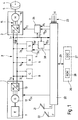
- the example described here relates to the drive system of a motor vehicle with hybrid propulsion of the series type, comprising a generator group 1 arranged to deliver a direct electric current I G with direct voltage U 0 on a two-wire supply circuit 2.
- This circuit supplies a propellant assembly 3 which drives at least one driving wheel 4 of the vehicle by a shaft 5 or by means of any other mechanical transmission means.
- the vehicle generally comprises several driving wheels, driven either by a common electric motor, or by individual electric motors.
- the supply circuit 2 is also connected to a storage battery 6 serving as a buffer, to a safety device 7 intended to absorb excess power, and to one or more other consuming devices 8 , for example a vehicle interior heating and air conditioning unit.
- a storage battery 6 serving as a buffer
- a safety device 7 intended to absorb excess power
- one or more other consuming devices 8 for example a vehicle interior heating and air conditioning unit.
- the generator group 1 comprises in a known manner a heat engine 11, for example of the Otto, Diesel or gas turbine type, driving a three-phase generator 12, for example of the asynchronous or brushless type, and a AC / DC converter 13 which delivers the direct current I G to the supply circuit 2.
- the generator group 1 could comprise a direct current generator or be constituted by any other on-board source with adjustable power, such as '' a fuel cell, photovoltaic cells associated with a DC / DC converter, etc.
- the propulsion unit 3 shown diagrammatically in FIG. 1 comprises an electronic DC / AC converter 14 which is coupled by a three-phase network 15 to one or more electrical machines 16, for example of the asynchronous or brushless type.
- each electric machine 16 is coupled to a single drive wheel 4 by its shaft 5, and it can operate both as a motor for traction and as a generator for regenerative electric braking, then supplying power to the circuit d supply 2 through the common converter 14.
- the operation of the drive system is managed by an electronic control unit 20 as a function of the state of the system and as a function of the commands given by the driver, which are represented schematically here by an accelerator pedal 21 delivering a command to traction T and a brake pedal 22 delivering a electric braking control F.
- the control signals T and F each have a variable amplitude representing a performance desired by the driver.
- the two signals T and F could come from the same pedal.
- the control unit 20 receives signals delivered by sensors which are not shown, in order to simplify the presentation.
- the main of these signals represents the effective voltage U 0 of the supply circuit 2, that is to say the quantity which plays the essential role in the method according to the invention.
- the other status signals 23 received by the unit 20 are represented diagrammatically in the figure by a signal V, indicating the speed of the shaft 5 of the electric traction machine 16, and a group of signals X capable of indicating , for example, the presence of the safety device 7, the on or off state of the consumer 8, etc.
- the unit 20 controls the drive system by at least two setpoint signals P Gc and U 0c .
- the signal P Gc continuously indicates to the generator group 1 the electrical power which it must supply to the supply circuit 2.
- the group 1 comprises an electronic management unit which regulates the output power of the group, in particular the current I G , acting in this case on the air and fuel supply to the engine 11 and to the generator 12 to adjust its resisting torque.
- the signal U 0c acts only on the propellant assembly 3. In the present example, it is transmitted to an electronic adjustment unit 24 which also receives the signal representative of the effective voltage U 0 of the supply circuit 2.
- the unit adjustment 24 compares the value U 0 with the value U 0c and, according to the result of this comparison, adjusts the traction converter 14 by means of a signal S T which corresponds to an increase or decrease in the electric power of the converter 14, so also to a variation of the mechanical power of the electric machine 16 operating as a motor or generator.
- the adjustment of the converter 14 can vary the voltage, the current and / or the supply frequency on the three-phase network 15.
- control unit 20 can also deliver a braking torque setpoint F c to the adjustment unit 24 to modify the action accordingly. of the propulsion unit 3, as will be described later.
- the unit 20 can control this member by means of a signal S c , as will be described below.
- control unit 20 is associated or combined with a battery management unit 26 comprising in particular a block 27, which monitors the state of charge (SOC) of the battery 6 and provides a corresponding signal, and a block 28 such as a read only memory (ROM) or a fuzzy logic device, which contains data characteristic of this battery.
- SOC state of charge
- ROM read only memory
- fuzzy logic device which contains data characteristic of this battery.
- a current measurement is preferably avoided in the method according to the invention, it is not excluded in all cases and can be used in particular for security checks or to calculate the state of charge of the battery. .
- methods for determining the state of charge without the use of current sensors are known.
- the generator group 1 which is the main power supplier in traction mode is controlled directly as a function of the setpoint T (or F) given by the driver, without undergoing any feedback from the power unit 3.
- the electrical power introduced into the circuit by the generator group is determined a priori, and the circuit is balanced by adjusting one of the consuming members so as to maintain the effective voltage U 0 at the level of the setpoint voltage U 0c .
- control unit 20 determines this setpoint voltage as a function of the state of the system and of the commands given by the driver.
- electric braking mode a similar method is applicable, but possibly in a different way since the power supplied then comes from the propulsion unit 3. This is explained below for different configurations and different operating modes of the system. drive, with reference to Figures 2 to 10.
- the drive system represented in FIG. 1 does not include any of the elements 6, 7 and 8.
- the electric power produced by the generator group 1 must be entirely consumed by the assembly. propellant 3.
- the signals F c , U c and Sc, as well as the battery management unit 26, do not exist in this case.
- Figure 2 shows the simplified block diagram of the control unit 20 for such a configuration.
- the unit 20 includes a load calculation unit 30 which receives the instructions T and F given by the driver and delivers the power reference signal P Gc to the generator group 1.
- the unit 30 also receives at least one signal representative of the state of the propulsion unit, for example the signal V, in order to be able to limit the electric power in order to avoid excessive intensities in the propellant unit when the electric machine 16 rotates relatively slowly.
- the unit 20 includes a voltage reference unit 31 which supplies a signal U 0c defining a reference voltage which can be constant.
- the unit 31 can then be produced for example in the form of a wired circuit.
- the reference voltage U 0c has a variable value, chosen so that the efficiency of the chain is optimal. The characteristics and the state of the drive system will then be taken into account, for example to obtain speeds where the heat engine has a good efficiency and pollutes little.
- the unit 31 can then contain a range of values of U 0c in a read-only memory, in which it will choose an appropriate value according to the current state of the signals T, F, V and possibly other signals that it could to receive.
- the simple configuration described above also makes it possible to electrically brake the vehicle, that is to say to slow it down by using the driving machine 16 as a generator and the "generator" 12 as a motor, to drive the heat engine 11 operating in Engine brake.
- the generator group 1 will then consume an electrical power determined by the signal P Gc , while the propulsion unit 3 will automatically adjust to this power by maintaining U 0 at the level of U 0c , as described above.
- the voltage U 0 directly depends on the voltage characteristics of the battery.
- account is taken of these characteristics of the battery to control power flows in the system by appropriately choosing the setpoint voltage U 0c .
- Figure 3 is a schematic diagram showing the current I B (or power P B ) as a function of the voltage U B at the terminals of battery 6 for different SOC charge states of this battery.
- the current has a positive sign if it enters the battery and negative if it leaves it.
- the battery has a no-load voltage U B0 which varies with the state of charge SOC.
- SOC 60%
- an operating point P 1 has been shown where the battery supplies a current I B1 at a voltage U B1
- another operating point P 2 where the battery absorbs a current I B2 under a voltage U B2 .
- the bundle of curves in FIG. 3 can, for example, be stored in an electronic unit in the form of a three-dimensional table.
- This table can be updated periodically, in particular to take account of aging or other parameters of the battery.
- Another known method consists, by knowing a point of one of the curves, in calculating another point of this curve using an appropriate algorithm.
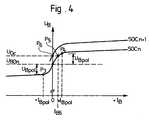
- FIG. 4 schematically represents, in a greatly enlarged manner, any of the curves of FIG. 3 in the vicinity of the vertical axis U B , that is to say in the vicinity of the no-load voltage U B0 for a SOC n charge state.
- a bias voltage U Bpol For a positive or negative current I B to be established at the terminals of the battery, a bias voltage U Bpol must be added or subtracted from the no- load voltage U B0 respectively . Therefore, the curve has a very steep slope between a point P 3 , corresponding to a voltage U B0 -U Bpol and a current -I Bpol , and a point P 4 corresponding to a voltage U B0 + U Bpol and a current + I Bpol . It will be noted that the values ⁇ I Bpol are close to zero, the scale of FIG. 4 being greatly enlarged compared to that of FIG. 3.
- this characteristic is especially useful for stabilizing the distribution of electrical powers when it is desired to cancel the battery current I B by an appropriate choice of the reference voltage U 0c .
- the state of charge being SOC n
- U 0c U B0n .
- the chosen setpoint voltage U 0c is for example slightly greater than U B0n .
- This then results in the operating point P 5 , corresponding to a current I B5 which enters the battery. As this current is less than I Bpol , it is very low and practically does not affect the desired distribution of power flows.
- the method according to the invention allows a particularly precise and stable adjustment when it is desired to maintain low or zero values of the current of the battery 6.
- FIG. 5 shows the arrangement of the control unit 20 for applying the method described above, by managing the operation of the battery 6.
- the unit 31 of FIG. 2 is replaced by a unit for distributing the fluxes of power 32, which receives the signal P c and exchanges with the battery management unit 26 the set of signals 29 represented in FIG. 1.
- the signals delivered by the unit 26 include a signal SOC constantly indicating the current state of charge of the battery 6, two signals P charge and P discharge constantly indicating the limits of the operating window of the battery in this state of charge, namely the maximum power admissible respectively for charging and discharging the battery, and a signal U B which responds to a requested power signal P Bdem transmitted by the unit 32. This power is positive for charge the battery, negative to discharge it or zero if you want to maintain the current state of charge.
- the signal U B indicates the voltage corresponding to the requested power P Bdem , as explained above.
- the unit 32 calculates the signal P Bdem as a function of the signal P c , indicating the desired traction or braking power as in the case of FIG. 2, and of a choice of an optimal distribution of the power between the members connected to the supply circuit 2. This calculation takes SOC, P B charge and P B discharge into account .
- the unit 32 then fixes the setpoint voltage U 0c at the value U B supplied by the unit 26, and it delivers to the generator group 1 its power setpoint P Gc .
- the battery 6 will absorb or supply the power indicated by P Bdem , while the propellant assembly will maintain its power at a value equal to P Gc -P Bdem .
- FIG. 6 shows an improved variant of the diagram of FIG. 5, in which the power distribution unit 32 also receives Rend and Dyn signals enabling it to optimize the power distribution in real time, depending on the state of current operation of various vehicle components.
- the control unit 20 then comprises a vehicle performance management unit 33 and a vehicle dynamics management unit 34.
- the unit 33 receives signals 35 indicating current state or performance parameters of the members concerned , and it calculates the signal Rend on the basis of these signals and of functions or algorithms to define a preferable distribution of power which corresponds to an optimal overall yield.
- the unit 34 receives signals 36 indicating current dynamic parameters of the vehicle and it calculates the signal Dyn accordingly, to allow the unit 32 to anticipate the future state of the system when choosing the optimal distribution of the power.
- FIG. 7 illustrate the evolution of certain parameters as a function of time t in the system having the configuration according to FIG. 5, when the action of the driver on the accelerator pedal 21 commands an increase in traction power which can be fully covered by generator group 1.
- Diagram (a) shows that the power P T desired by the driver and consumed by the propellant assembly rises from P T1 to P T2 at time t 1 when the driver presses the accelerator.
- the electric power P G supplied by the generator group 1 in accordance with the reference signal P Gc then gradually increases to a value equal to P T2 at time t 2 , then it remains at this value.
- the unit 32 temporarily lowers the voltage U 0 of the supply circuit by imposing a corresponding set value U 0c , as shown in diagram (c).
- the diagrams (a), (b) and (c) of FIG. 8 correspond to those of FIG. 7, but for a case where the power P G of the generator group cannot exceed a value P G3 less than P T2 .
- FIG. 9 illustrates a case of electrical braking in accordance with the present invention in a drive system which comprises, in accordance with FIG. 1, a battery 6 and a safety device 7 and which is controlled in accordance with the diagram in FIG. 5.
- Diagrams (a), (b), (e) and (f) represent the evolution of parameters already described above.
- Diagram (c) represents the setpoint signal S c controlling the safety device 7, and diagram (d) represents the power P S absorbed by this device.
- a braking signal F appears produced by an additional release of the accelerator or by the actuation of the brake pedal.
- the control unit 20 then raises the setpoint voltage U 0c , from its value U 01 which corresponded to a zero battery current, until it reaches a value U 02 corresponding to a maximum power of charge P B charge (or less power) of the battery at time t 2 . Beyond this, the additional braking power will be absorbed by the safety device 7 controlled by the signal S c to reach a determined power P S. The balance of electrical powers continues to be ensured by the battery 6 operating in the vicinity of its maximum charging power.
- the control unit 20 will take account of this engagement in the calculation of the distribution of the powers, by increasing the power to be supplied by the generator group 1 or the battery 6 in the traction, or by reducing the power to be absorbed by the battery 6 or the safety device 7 in braking mode.
- one of the signals X represented in FIG. 1 may indicate to the unit 20 the nominal power engaged of the consumer member 8, without it being necessary to measure the precise power absorbed by this member.
- Figure 10 is a representation similar to that of Figure 9, but illustrates another embodiment of the method according to the invention in electric braking mode by means of the battery 6 and the safety device 7.
- the balancing of the electrical powers by adjusting the voltage U 0 is not carried out on the propulsion unit 3, but on the safety member 7.
- a second is then provided electronic adjustment device 38 which controls the power of the safety member 7 in braking mode as does the adjustment unit 24 on the propulsion unit 3 in traction mode.
- the unit 24 In braking mode, the unit 24 no longer receives the voltage setpoint U 0c but a braking torque setpoint F c . It then "forgets" its voltage setting and it controls the negative power P T of the propulsion unit directly as a function of F c .
- the control unit 20 then delivers the voltage setpoint U 0c to the adjustment unit 38, which also receives the value U0 and consequently controls an increase or decrease in the power of the safety device 7 by a signal S F.
- Figure 10 shows the time evolution of the system parameters under the same circumstances as for Figure 9.
- Diagrams (a), (b), (d), (e) and (f) are identical to those in Figure 9.
- Diagram (c) represents the evolution of the torque setpoint of braking F c , producing an evolution comparable to the braking power P T.
- the parameters shown vary as in Figure 9. From this moment, as the setpoint U 0c can no longer increase so as not to overcharge the battery 6, the increase in the power of electrical braking P T tends to raise the voltage U 0 of the supply circuit, so that the adjustment circuit 38 reacts and increases the power P S of the safety device 7 so as to automatically stabilize the voltage at the value U 0c .
- the braking setpoint F having disappeared, the system returns to the setting in traction mode, U 0c resuming its initial value.
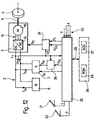
- FIG. 11 illustrates an example of a drive system of a parallel hybrid vehicle according to the invention, where the effect of the generator group 1 is replaced by that of a heat engine 11 mechanically driving the drive wheels by means of its output shaft 40, a gearbox 41 and a transmission shaft 42, in parallel with the electric propulsion unit 3.
- the power of the engine 11 is controlled by the setpoint signal P Gc coming from the control unit 20.
- the power of this assembly can be adjusted by adjusting the supply voltage U 0 can be carried out exactly as described above.
- the same applies in a mixed propulsion system for example, if one added to the system of FIG. 1 a mechanical drive link between the motor shaft 11 and the shaft 5 driving the drive wheel 4.
- the method according to the invention can also be used in a vehicle whose drive system is entirely electric and powered by the battery 6 in traction mode, as shown in Figure 12. Compared to the system shown in Figure 1, this amounts to removing the generator group 1 and the corresponding signal P Gc .
- This group could also be replaced by another adjustable electrical energy source such as a fuel cell, the power of which would be controlled by the signal P Gc .
Landscapes
- Engineering & Computer Science (AREA)
- Mechanical Engineering (AREA)
- Transportation (AREA)
- Power Engineering (AREA)
- Life Sciences & Earth Sciences (AREA)
- Sustainable Development (AREA)
- Sustainable Energy (AREA)
- Combustion & Propulsion (AREA)
- Chemical & Material Sciences (AREA)
- Electric Propulsion And Braking For Vehicles (AREA)
- Hybrid Electric Vehicles (AREA)
- Charge And Discharge Circuits For Batteries Or The Like (AREA)
- Control Of Eletrric Generators (AREA)
- Arrangement And Driving Of Transmission Devices (AREA)
Applications Claiming Priority (2)
| Application Number | Priority Date | Filing Date | Title |
|---|---|---|---|
| FR9600093 | 1996-01-05 | ||
| FR9600093A FR2743342B1 (fr) | 1996-01-05 | 1996-01-05 | Procede et dispositif pour regler la repartition de la puissance electrique dans un vehicule automobile, notamment la propulsion hybride |
Publications (2)
| Publication Number | Publication Date |
|---|---|
| EP0782941A1 true EP0782941A1 (de) | 1997-07-09 |
| EP0782941B1 EP0782941B1 (de) | 2003-03-19 |
Family
ID=9487917
Family Applications (1)
| Application Number | Title | Priority Date | Filing Date |
|---|---|---|---|
| EP96120329A Expired - Lifetime EP0782941B1 (de) | 1996-01-05 | 1996-12-18 | Verfahren und Vorrichtung zur Regelung der elektrischen Energieverteilung in einem Kraftfahrzeug, insbesondere mit Hybridantrieb |
Country Status (11)
| Country | Link |
|---|---|
| US (1) | US5847520A (de) |
| EP (1) | EP0782941B1 (de) |
| JP (1) | JP3969548B2 (de) |
| KR (1) | KR970058982A (de) |
| CN (1) | CN1051044C (de) |
| AT (1) | ATE234747T1 (de) |
| AU (1) | AU7650696A (de) |
| BR (1) | BR9700010A (de) |
| CA (1) | CA2194319A1 (de) |
| DE (1) | DE69626771T2 (de) |
| FR (1) | FR2743342B1 (de) |
Cited By (10)
| Publication number | Priority date | Publication date | Assignee | Title |
|---|---|---|---|---|
| EP0917981A1 (de) | 1997-11-21 | 1999-05-26 | Lockheed Martin Corporation | Elektrisches Fahrzeug mit vom Ladungszustand der Batterie abhängigen regenerativen Bremsen von variablem Wirkungsgrad |
| EP0917982A1 (de) * | 1997-11-21 | 1999-05-26 | Lockheed Martin Corporation | Elektrisches Hybridfahrzeug mit vom Ladezustand der Batterie abhängigen Antrieb durch einen Antriebsmotor, der zwischen Batterie und Hilfsquelle angeordnet ist |
| WO1999065725A1 (de) * | 1998-06-15 | 1999-12-23 | Siemens Aktiengesellschaft | Steuerungssystem für ein aus mindestens einem energiespeicher und einer energiequelle bestehendes hybridsystem |
| FR2809998A1 (fr) * | 2000-06-07 | 2001-12-14 | Renault | Procede de commande d'un vehicule hybride a transmission electrique |
| WO2002051663A3 (de) * | 2000-12-22 | 2002-09-06 | Magnet Motor Gmbh | Verfahren zum betreiben eines nichtschienengebundenen land-kraftfahrzeugs mit verbrennungsmotor-generator-einheit und antriebs-elektromotor, und derartiges kraftfahrzeug_____________________ |
| EP1142749A3 (de) * | 2000-04-06 | 2004-01-14 | Nissan Motor Co., Ltd. | Fahrzeugsteuerung |
| EP1241042A3 (de) * | 2001-03-15 | 2004-01-14 | Nissan Motor Co., Ltd. | Motorgeneratorsteuerung in einem Hybridfahrzeug |
| WO2007087803A3 (de) * | 2006-02-03 | 2008-09-12 | Veit Wilhelm | Vorrichtung zur erzeugung von strom, sowie kraftfahrzeug mit elektroantrieb und solcher vorrichtung |
| FR3002905A1 (fr) * | 2013-03-05 | 2014-09-12 | Peugeot Citroen Automobiles Sa | Procede de pilotage d'une machine electrique d'un vehicule automobile hybride |
| EP3599140A1 (de) | 2018-07-25 | 2020-01-29 | Airbus Helicopters | Verfahren und vorrichtung zur verwaltung der energie einer hybrid-triebwerksanlage eines multirotor-luftfahrzeugs |
Families Citing this family (83)
| Publication number | Priority date | Publication date | Assignee | Title |
|---|---|---|---|---|
| JP3608017B2 (ja) * | 1996-07-22 | 2005-01-05 | トヨタ自動車株式会社 | 電源システム |
| JP4049833B2 (ja) * | 1996-07-26 | 2008-02-20 | トヨタ自動車株式会社 | 電源装置および電気自動車 |
| JP4372235B2 (ja) * | 1996-08-29 | 2009-11-25 | トヨタ自動車株式会社 | 燃料電池システムおよび電気自動車 |
| DE19731642C1 (de) * | 1997-07-23 | 1999-02-18 | Dbb Fuel Cell Engines Gmbh | Brennstoffzellenfahrzeug |
| US6885920B2 (en) * | 1999-07-30 | 2005-04-26 | Oshkosh Truck Corporation | Control system and method for electric vehicle |
| US6757597B2 (en) | 2001-01-31 | 2004-06-29 | Oshkosh Truck | A/C bus assembly for electronic traction vehicle |
| EP1132251A4 (de) * | 1999-08-27 | 2011-08-31 | Yamaha Motor Co Ltd | Hybrides antriebssystem. |
| US6196344B1 (en) | 1999-09-10 | 2001-03-06 | Ford Global Technologies, Inc. | Control system and method for a hybrid electric vehicle |
| CA2320003C (en) * | 1999-09-22 | 2006-03-21 | Honda Giken Kogyo Kabushiki Kaisha | Control apparatus for hybrid vehicles |
| US6242873B1 (en) * | 2000-01-31 | 2001-06-05 | Azure Dynamics Inc. | Method and apparatus for adaptive hybrid vehicle control |
| JP3513085B2 (ja) * | 2000-06-27 | 2004-03-31 | 三菱電機株式会社 | 車両用発電機の電圧制御装置 |
| JP4070401B2 (ja) * | 2000-10-31 | 2008-04-02 | 日産ディーゼル工業株式会社 | 車両のハイブリッドシステム |
| US6452352B1 (en) | 2000-11-02 | 2002-09-17 | Ballard Power Systems Corporation | Method of current interaction in an electric motor drive system having a load-dependent current generating system |
| US20040174125A1 (en) * | 2000-12-27 | 2004-09-09 | Transportation Techniques Llc | Method and apparatus for adaptive control of hybrid electric vehicle components |
| US7338335B1 (en) * | 2001-01-23 | 2008-03-04 | Frank Messano | Hybrid electric heavy-duty vehicle drive system |
| US7277782B2 (en) * | 2001-01-31 | 2007-10-02 | Oshkosh Truck Corporation | Control system and method for electric vehicle |
| US7379797B2 (en) | 2001-01-31 | 2008-05-27 | Oshkosh Truck Corporation | System and method for braking in an electric vehicle |
| DE10137908A1 (de) * | 2001-08-02 | 2003-02-27 | Siemens Ag | Hybridantriebssystem und Verfahren zur Regelung des Hybridantriebssystems |
| US6959777B2 (en) * | 2001-10-05 | 2005-11-01 | Ford Global Technologies, Llc | High voltage energy regulated conversion circuit |
| US7302320B2 (en) | 2001-12-21 | 2007-11-27 | Oshkosh Truck Corporation | Failure mode operation for an electric vehicle |
| US7254468B2 (en) | 2001-12-21 | 2007-08-07 | Oshkosh Truck Corporation | Multi-network control system for a vehicle |
| US7520354B2 (en) | 2002-05-02 | 2009-04-21 | Oshkosh Truck Corporation | Hybrid vehicle with combustion engine/electric motor drive |
| FR2848602B1 (fr) * | 2002-12-12 | 2008-01-04 | Irisbus France | Systeme de motorisation pour equipement auxiliaire de vehicule |
| US8025115B2 (en) | 2003-06-02 | 2011-09-27 | General Electric Company | Hybrid vehicle power control systems and methods |
| KR100588500B1 (ko) * | 2003-09-24 | 2006-06-13 | 현대자동차주식회사 | 모터를 이용한 사륜구동 장치 및 그 제어방법 |
| US7100362B2 (en) * | 2004-07-30 | 2006-09-05 | Ford Global Technologies, Llc | Vehicle and method for operating a vehicle to reduce exhaust emissions |
| US7439711B2 (en) | 2004-09-27 | 2008-10-21 | Oshkosh Corporation | Energy storage device including a status indicator |
| DE102004051530A1 (de) * | 2004-10-22 | 2006-05-04 | Audi Ag | Kraftfahrzeug mit einem Rekuperationsgenerator |
| US7444944B2 (en) * | 2005-06-15 | 2008-11-04 | General Electric Company | Multiple engine hybrid locomotive |
| CN101309810B (zh) * | 2005-09-23 | 2012-07-04 | Afs三一电力公司 | 插电式混合动力车辆系统及其电子装置的控制方法 |
| JP2007137299A (ja) * | 2005-11-21 | 2007-06-07 | Toyota Motor Corp | 電源供給制御装置 |
| US8947531B2 (en) | 2006-06-19 | 2015-02-03 | Oshkosh Corporation | Vehicle diagnostics based on information communicated between vehicles |
| US8139109B2 (en) | 2006-06-19 | 2012-03-20 | Oshkosh Corporation | Vision system for an autonomous vehicle |
| US7436081B2 (en) * | 2007-01-31 | 2008-10-14 | Caterpillar Inc. | System for controlling a hybrid energy system |
| US12083933B2 (en) | 2007-05-10 | 2024-09-10 | Auckland Uniservices Limited | Systems and methods for battery charging |
| KR20150140398A (ko) * | 2007-05-10 | 2015-12-15 | 오클랜드 유니서비시즈 리미티드 | 멀티 전력을 공급받는 전기 자동차 |
| US8248984B2 (en) * | 2007-06-20 | 2012-08-21 | I Squared Llc | System and method for interfacing devices |
| JP4363478B2 (ja) * | 2007-10-29 | 2009-11-11 | トヨタ自動車株式会社 | 燃料電池の出力制御装置 |
| JP4462366B2 (ja) * | 2008-04-01 | 2010-05-12 | トヨタ自動車株式会社 | 動力出力装置およびこれを備える車両並びに動力出力装置の制御方法 |
| US20100108417A1 (en) * | 2008-10-31 | 2010-05-06 | Curt Douglas Gilmore | Parallel power supplies for hev applications |
| DE102008061956A1 (de) * | 2008-12-12 | 2009-09-17 | Daimler Ag | Verfahren und Anordnung zur Regelung einer Generatorspannung in einem Kraftfahrzeug |
| DE202009015026U1 (de) * | 2009-11-04 | 2010-03-04 | Fischer Panda Gmbh | Vorrichtung zum Antrieb eines Fahrzeugs, insbesondere eines Wasserfahrzeugs |
| DE202009015027U1 (de) * | 2009-11-04 | 2010-02-18 | Fischer Panda Gmbh | Vorrichtung zum Steuern eines Fahrzeugs |
| US8337352B2 (en) | 2010-06-22 | 2012-12-25 | Oshkosh Corporation | Electromechanical variable transmission |
| JP5911513B2 (ja) * | 2011-12-14 | 2016-04-27 | 三菱電機株式会社 | ハイブリッド車両の発電機制御装置 |
| DE102011088973B4 (de) * | 2011-12-19 | 2024-08-08 | Seg Automotive Germany Gmbh | Verfahren und Vorrichtung zum Anpassen einer Spannungsgrenze in einem Bordnetz |
| DE102012222343A1 (de) | 2012-12-05 | 2014-06-05 | Robert Bosch Gmbh | Verfahren zum Bereitstellen einer Versorgungsspannung und elektrisches Antriebssystem |
| US9132736B1 (en) | 2013-03-14 | 2015-09-15 | Oshkosh Defense, Llc | Methods, systems, and vehicles with electromechanical variable transmission |
| US9719477B2 (en) | 2013-12-09 | 2017-08-01 | Textron Inc. | Using a DC or AC generator as a starter with fault detection |
| US9272628B2 (en) * | 2013-12-09 | 2016-03-01 | Textron Inc. | Using AC induction motor as a generator in a utility vehicle |
| DE102014202103B4 (de) * | 2014-02-05 | 2023-11-16 | Bayerische Motoren Werke Aktiengesellschaft | Verfahren und Steuervorrichtung zum Betrieb eines straßengekoppelten Hybridfahrzeuges |
| US20150283908A1 (en) * | 2014-04-02 | 2015-10-08 | Hamilton Sundstrand Corporation | Systems utilizing a controllable voltage ac generator system |
| US9193273B1 (en) * | 2014-06-15 | 2015-11-24 | Efficient Drivetrains, Inc. | Vehicle with AC-to-DC inverter system for vehicle-to-grid power integration |
| CN105281624B (zh) * | 2014-06-17 | 2021-04-06 | 松下知识产权经营株式会社 | 热动力发电装置和热动力发电系统 |
| JP6350012B2 (ja) * | 2014-06-23 | 2018-07-04 | 三菱自動車工業株式会社 | 車両の回生制御装置 |
| JP2016032977A (ja) * | 2014-07-31 | 2016-03-10 | 株式会社デンソー | 電動パワーステアリングシステムおよび車両制御システム |
| US9878632B2 (en) * | 2014-08-19 | 2018-01-30 | General Electric Company | Vehicle propulsion system having an energy storage system and optimized method of controlling operation thereof |
| EP3017995A1 (de) * | 2014-11-05 | 2016-05-11 | ABB Technology Oy | Einstellungsverfahren für drehzahlgeregelten elektronischen Antrieb und Vorrichtung zur Implementierung davon |
| US12078231B2 (en) | 2015-02-17 | 2024-09-03 | Oshkosh Corporation | Inline electromechanical variable transmission system |
| US10578195B2 (en) | 2015-02-17 | 2020-03-03 | Oshkosh Corporation | Inline electromechanical variable transmission system |
| US9650032B2 (en) | 2015-02-17 | 2017-05-16 | Oshkosh Corporation | Multi-mode electromechanical variable transmission |
| US10982736B2 (en) | 2015-02-17 | 2021-04-20 | Oshkosh Corporation | Multi-mode electromechanical variable transmission |
| US9651120B2 (en) | 2015-02-17 | 2017-05-16 | Oshkosh Corporation | Multi-mode electromechanical variable transmission |
| US10584775B2 (en) | 2015-02-17 | 2020-03-10 | Oshkosh Corporation | Inline electromechanical variable transmission system |
| US9656659B2 (en) | 2015-02-17 | 2017-05-23 | Oshkosh Corporation | Multi-mode electromechanical variable transmission |
| US10421350B2 (en) | 2015-10-20 | 2019-09-24 | Oshkosh Corporation | Inline electromechanical variable transmission system |
| US11701959B2 (en) | 2015-02-17 | 2023-07-18 | Oshkosh Corporation | Inline electromechanical variable transmission system |
| DE102016208455A1 (de) * | 2016-05-17 | 2017-11-23 | Bayerische Motoren Werke Aktiengesellschaft | Verfahren und Steuereinheit zur Reduzierung der Zyklisierung eines Energiespeichers |
| CN106129507B (zh) * | 2016-09-05 | 2018-09-21 | 北京新能源汽车股份有限公司 | 一种电动汽车电池充电的控制方法、装置和电动汽车 |
| CN107499259B (zh) * | 2017-09-20 | 2024-04-16 | 中国重汽集团济南动力有限公司 | 一种多轴轮驱电动汽车用分布式控制电配电系统 |
| US11396388B2 (en) | 2018-12-20 | 2022-07-26 | The Boeing Company | Optimized power balanced variable thrust transfer orbits to minimize an electric orbit raising duration |
| US11753188B2 (en) | 2018-12-20 | 2023-09-12 | The Boeing Company | Optimized power balanced low thrust transfer orbits utilizing split thruster execution |
| US11401053B2 (en) * | 2018-12-20 | 2022-08-02 | The Boeing Company | Autonomous control of electric power supplied to a thruster during electric orbit raising |
| US11817811B2 (en) | 2019-03-12 | 2023-11-14 | Allegro Microsystems, Llc | Motor controller with power feedback loop |
| WO2020250017A1 (en) * | 2019-06-11 | 2020-12-17 | Smh Technologies S.R.L. | Apparatus for the programming of electronic devices |
| DE102019209952A1 (de) * | 2019-07-05 | 2021-01-07 | Zf Friedrichshafen Ag | Verfahren zum Betreiben eines Fahrmischers |
| DE102019121277A1 (de) * | 2019-08-07 | 2021-02-11 | Bayerische Motoren Werke Aktiengesellschaft | Mehrspannungs-Speichersystem für ein zumindest teilweise elektrisch angetriebenes Fahrzeug |
| US11803164B2 (en) * | 2020-12-01 | 2023-10-31 | DemandQ, Inc. | Controlling power distribution serving an aggregate of electrical loads behind a meter |
| FR3122642B1 (fr) * | 2021-05-10 | 2024-01-19 | Ascendance Flight Tech | Système de gestion d'énergie pour aéronef à source d'énergie hybride comprenant au moins une source d'électricité rechargeable et une source de génération d'électricité |
| FR3123324B1 (fr) * | 2021-05-31 | 2023-04-21 | Airbus Helicopters | Procédé d’aide au pilotage d’un giravion en hautes altitudes grâce à l’apport d’une puissance mécanique provenant d’une installation motrice électrique |
| CN113561792B (zh) * | 2021-06-30 | 2023-04-25 | 东风汽车集团股份有限公司 | 混合动力汽车功率平衡控制方法、计算机设备及存储介质 |
| CN113968136B (zh) * | 2021-10-29 | 2023-11-10 | 华人运通(江苏)技术有限公司 | 一种电动汽车的低压能量控制方法、系统、设备及介质 |
| CN120792615B (zh) * | 2025-09-12 | 2026-03-13 | 宁德时代润智软件科技有限公司 | 动力系统及电池均衡方法、电动汽车、存储介质 |
Citations (6)
| Publication number | Priority date | Publication date | Assignee | Title |
|---|---|---|---|---|
| DE4116899A1 (de) | 1990-05-23 | 1991-11-28 | Nissan Motor | Elektrofahrzeug |
| EP0460850A2 (de) | 1990-06-02 | 1991-12-11 | Jaguar Cars Limited | Kraftfahrzeuge |
| WO1993007022A1 (de) | 1991-10-04 | 1993-04-15 | Mannesmann Aktiengesellschaft | Antriebsanordnung für ein kraftfahrzeug |
| EP0543390A1 (de) | 1991-11-22 | 1993-05-26 | Toyota Jidosha Kabushiki Kaisha | Antriebsregelvorrichtung für ein in Folge geschaltetes Hybridfahrzeug |
| DE4344053A1 (de) * | 1993-01-08 | 1994-07-14 | Volkswagen Ag | Verfahren zum Betrieb eines Hybridfahrzeugs und Vorrichtung zum Durchführen des Verfahrens |
| EP0645278A1 (de) | 1993-09-24 | 1995-03-29 | Toyota Jidosha Kabushiki Kaisha | Generatorregler und Regelverfahren für ein Hybridfahrzeug |
Family Cites Families (4)
| Publication number | Priority date | Publication date | Assignee | Title |
|---|---|---|---|---|
| US5359308A (en) * | 1993-10-27 | 1994-10-25 | Ael Defense Corp. | Vehicle energy management system using superconducting magnetic energy storage |
| US5345761A (en) * | 1993-12-02 | 1994-09-13 | Ford Motor Company | Energy management system for hybrid vehicle |
| JP3336777B2 (ja) * | 1994-10-25 | 2002-10-21 | 株式会社エクォス・リサーチ | ハイブリッド車両及びハイブリッド車両の制御方法 |
| US5765656A (en) * | 1996-01-18 | 1998-06-16 | Weaver; Winstead B. | Hybrid electric motor vehicle drive |
-
1996
- 1996-01-05 FR FR9600093A patent/FR2743342B1/fr not_active Expired - Lifetime
- 1996-12-18 DE DE69626771T patent/DE69626771T2/de not_active Expired - Lifetime
- 1996-12-18 AT AT96120329T patent/ATE234747T1/de active
- 1996-12-18 EP EP96120329A patent/EP0782941B1/de not_active Expired - Lifetime
- 1996-12-24 AU AU76506/96A patent/AU7650696A/en not_active Abandoned
-
1997
- 1997-01-03 BR BR9700010A patent/BR9700010A/pt active Search and Examination
- 1997-01-03 KR KR1019970000006A patent/KR970058982A/ko not_active Withdrawn
- 1997-01-03 CA CA002194319A patent/CA2194319A1/fr not_active Abandoned
- 1997-01-03 US US08/774,729 patent/US5847520A/en not_active Expired - Lifetime
- 1997-01-04 CN CN97102923A patent/CN1051044C/zh not_active Expired - Fee Related
- 1997-01-06 JP JP1008797A patent/JP3969548B2/ja not_active Expired - Fee Related
Patent Citations (6)
| Publication number | Priority date | Publication date | Assignee | Title |
|---|---|---|---|---|
| DE4116899A1 (de) | 1990-05-23 | 1991-11-28 | Nissan Motor | Elektrofahrzeug |
| EP0460850A2 (de) | 1990-06-02 | 1991-12-11 | Jaguar Cars Limited | Kraftfahrzeuge |
| WO1993007022A1 (de) | 1991-10-04 | 1993-04-15 | Mannesmann Aktiengesellschaft | Antriebsanordnung für ein kraftfahrzeug |
| EP0543390A1 (de) | 1991-11-22 | 1993-05-26 | Toyota Jidosha Kabushiki Kaisha | Antriebsregelvorrichtung für ein in Folge geschaltetes Hybridfahrzeug |
| DE4344053A1 (de) * | 1993-01-08 | 1994-07-14 | Volkswagen Ag | Verfahren zum Betrieb eines Hybridfahrzeugs und Vorrichtung zum Durchführen des Verfahrens |
| EP0645278A1 (de) | 1993-09-24 | 1995-03-29 | Toyota Jidosha Kabushiki Kaisha | Generatorregler und Regelverfahren für ein Hybridfahrzeug |
Non-Patent Citations (1)
| Title |
|---|
| O. VITTONE: "FIAT CONCEPTUAL APPROACH TO HYBRID CARS DESIGN", 12TH INTERNATIONAL ELECTRIC VEHICLE SYMPOSIUM, 5 December 1994 (1994-12-05) - 7 December 1994 (1994-12-07), ANAHEIM US, pages 458 - 469, XP000488445 * |
Cited By (16)
| Publication number | Priority date | Publication date | Assignee | Title |
|---|---|---|---|---|
| EP0917981A1 (de) | 1997-11-21 | 1999-05-26 | Lockheed Martin Corporation | Elektrisches Fahrzeug mit vom Ladungszustand der Batterie abhängigen regenerativen Bremsen von variablem Wirkungsgrad |
| EP0917982A1 (de) * | 1997-11-21 | 1999-05-26 | Lockheed Martin Corporation | Elektrisches Hybridfahrzeug mit vom Ladezustand der Batterie abhängigen Antrieb durch einen Antriebsmotor, der zwischen Batterie und Hilfsquelle angeordnet ist |
| RU2223183C2 (ru) * | 1997-11-21 | 2004-02-10 | Бае Системс Контролс, Инк. | Способ работы комбинированного электрического транспортного средства (варианты) |
| US6424115B1 (en) | 1998-06-15 | 2002-07-23 | Eugen Holl | Control system for a hybrid system consisting of at least one energy accumulator and one energy source |
| WO1999065725A1 (de) * | 1998-06-15 | 1999-12-23 | Siemens Aktiengesellschaft | Steuerungssystem für ein aus mindestens einem energiespeicher und einer energiequelle bestehendes hybridsystem |
| EP1142749A3 (de) * | 2000-04-06 | 2004-01-14 | Nissan Motor Co., Ltd. | Fahrzeugsteuerung |
| FR2809998A1 (fr) * | 2000-06-07 | 2001-12-14 | Renault | Procede de commande d'un vehicule hybride a transmission electrique |
| WO2002051663A3 (de) * | 2000-12-22 | 2002-09-06 | Magnet Motor Gmbh | Verfahren zum betreiben eines nichtschienengebundenen land-kraftfahrzeugs mit verbrennungsmotor-generator-einheit und antriebs-elektromotor, und derartiges kraftfahrzeug_____________________ |
| US7163071B2 (en) | 2000-12-22 | 2007-01-16 | Magnet-Motor Gesellschaft Fur Magnetmotorische Technik Mbh | Method for operating a non-railbound land vehicle with a combustion engine-generator unit and an electric drive motor and corresponding vehicle |
| EP1241042A3 (de) * | 2001-03-15 | 2004-01-14 | Nissan Motor Co., Ltd. | Motorgeneratorsteuerung in einem Hybridfahrzeug |
| US6819006B2 (en) | 2001-03-15 | 2004-11-16 | Nissan Motor Co., Ltd. | Vehicle control system and vehicle control method |
| WO2007087803A3 (de) * | 2006-02-03 | 2008-09-12 | Veit Wilhelm | Vorrichtung zur erzeugung von strom, sowie kraftfahrzeug mit elektroantrieb und solcher vorrichtung |
| FR3002905A1 (fr) * | 2013-03-05 | 2014-09-12 | Peugeot Citroen Automobiles Sa | Procede de pilotage d'une machine electrique d'un vehicule automobile hybride |
| EP3599140A1 (de) | 2018-07-25 | 2020-01-29 | Airbus Helicopters | Verfahren und vorrichtung zur verwaltung der energie einer hybrid-triebwerksanlage eines multirotor-luftfahrzeugs |
| FR3084318A1 (fr) | 2018-07-25 | 2020-01-31 | Airbus Helicopters | Procede et dispositif de gestion de l'energie d'une installation motrice hybride d'un aeronef multirotor |
| US11273920B2 (en) | 2018-07-25 | 2022-03-15 | Airbus Helicopters | Method and a device for managing the energy of a hybrid power plant of a multi-rotor aircraft |
Also Published As
| Publication number | Publication date |
|---|---|
| JP3969548B2 (ja) | 2007-09-05 |
| FR2743342B1 (fr) | 1998-02-13 |
| FR2743342A1 (fr) | 1997-07-11 |
| JPH09331601A (ja) | 1997-12-22 |
| DE69626771T2 (de) | 2004-03-25 |
| CA2194319A1 (fr) | 1997-07-06 |
| ATE234747T1 (de) | 2003-04-15 |
| EP0782941B1 (de) | 2003-03-19 |
| AU7650696A (en) | 1997-07-10 |
| US5847520A (en) | 1998-12-08 |
| BR9700010A (pt) | 1998-11-10 |
| CN1051044C (zh) | 2000-04-05 |
| CN1174790A (zh) | 1998-03-04 |
| KR970058982A (ko) | 1997-08-12 |
| DE69626771D1 (de) | 2003-04-24 |
Similar Documents
| Publication | Publication Date | Title |
|---|---|---|
| EP0782941B1 (de) | Verfahren und Vorrichtung zur Regelung der elektrischen Energieverteilung in einem Kraftfahrzeug, insbesondere mit Hybridantrieb | |
| EP4029105B1 (de) | Verfahren zur steuerung einer batterie, geeignet zum einstellen eines homogenen stroms über die zellen eines strompfades | |
| FR2851516A1 (fr) | Procede de commande de systeme electrique de vehicule | |
| FR2898742A1 (fr) | Dispositif de commande permettant une commande economique et fiable d'un generateur electrique. | |
| EP1428712B1 (de) | Serieller Hybridantriebsstrang und Steuerungsverfahren dafür | |
| EP2504195A2 (de) | Wechselrichter für den antrieb eines elektromotors mit integriertem regler | |
| FR2994546A1 (fr) | Procede de limitation de couple d'une machine electrique de vehicule hybride comportant un systeme de controle de vitesse | |
| CA2194320A1 (fr) | Systeme d'entrainement pour vehicule automobile a propulsion hybride et son procede de commande | |
| EP2073371B1 (de) | Verfahren zur steuerung einer lichtmaschine eines kraftfahrzeugs | |
| EP1224092B1 (de) | Regelungsverfahren für ein hybridfahrzeug | |
| CA3193847A1 (fr) | Procede de determination d'au moins une limite de puissance d'une chaine propulsive hybride pour vehicule de transport, en particulier, un aeronef | |
| WO2021043682A1 (fr) | Procédé de gestion de la répartition de couple dans un véhicule hybride | |
| CA3110428A1 (fr) | Procede de commande d'un equipement d'alimentation electrique d'un systeme electrique | |
| EP2707247A2 (de) | Einheit mit einer elektrischen stromquelle mit mindestens zwei elementen verschiedener technologien und einem wechselrichter zur steuerung eines wechselstrommotors | |
| EP1452383B1 (de) | Regelsystem für ein Kraftfahrzeuggetriebe | |
| FR2894728A1 (fr) | Dispositif et procede de gestion d'une batterie alimentant une machine electrique, comme un moteur de traction pour un vehicule | |
| FR2801253A1 (fr) | Procede de recuperation d'energie sur un vehicule en deceleration | |
| EP4331073B1 (de) | Steuerung der zielladespannung einer wiederaufladbaren elektrischen batterie für kraftfahrzeuge | |
| FR3092210A1 (fr) | Procede de gestion de l’alimentation de deux reseaux electriques d’un vehicule automobile connectes entre eux | |
| FR3092212A1 (fr) | Procede et systeme de gestion de l’alimentation d’un reseau de bord d’un vehicule automobile | |
| FR3099972A1 (fr) | Procédé de gestion d’un couple à fournir par un moteur électrique | |
| FR2691019A1 (fr) | Système d'interface entre une batterie d'accumulateurs et des récepteurs consommateurs d'électricité. | |
| EP1454786A2 (de) | Steuerung eines elektrischen Maschine in einem seriellen hybrid Fahrzeug | |
| EP1447256A1 (de) | Verfahren zur Steuerung der Motoreinheit eines Hybridfahrzeuges | |
| EP1791712B1 (de) | Steuerungsverfahren für eine übertragungsvorrichtung zwischen einer wärmekraftmaschine und einer achswelle eines fahrzeugs |
Legal Events
| Date | Code | Title | Description |
|---|---|---|---|
| PUAI | Public reference made under article 153(3) epc to a published international application that has entered the european phase |
Free format text: ORIGINAL CODE: 0009012 |
|
| AK | Designated contracting states |
Kind code of ref document: A1 Designated state(s): AT BE CH DE ES GB IT LI NL SE |
|
| 17P | Request for examination filed |
Effective date: 19980109 |
|
| RAP1 | Party data changed (applicant data changed or rights of an application transferred) |
Owner name: THE SWATCH GROUP MANAGEMENT SERVICES AG |
|
| 17Q | First examination report despatched |
Effective date: 19990721 |
|
| GRAG | Despatch of communication of intention to grant |
Free format text: ORIGINAL CODE: EPIDOS AGRA |
|
| GRAG | Despatch of communication of intention to grant |
Free format text: ORIGINAL CODE: EPIDOS AGRA |
|
| GRAH | Despatch of communication of intention to grant a patent |
Free format text: ORIGINAL CODE: EPIDOS IGRA |
|
| GRAH | Despatch of communication of intention to grant a patent |
Free format text: ORIGINAL CODE: EPIDOS IGRA |
|
| GRAA | (expected) grant |
Free format text: ORIGINAL CODE: 0009210 |
|
| AK | Designated contracting states |
Designated state(s): AT BE CH DE ES GB IT LI NL SE |
|
| PG25 | Lapsed in a contracting state [announced via postgrant information from national office to epo] |
Ref country code: NL Free format text: LAPSE BECAUSE OF FAILURE TO SUBMIT A TRANSLATION OF THE DESCRIPTION OR TO PAY THE FEE WITHIN THE PRESCRIBED TIME-LIMIT Effective date: 20030319 Ref country code: GB Free format text: LAPSE BECAUSE OF FAILURE TO SUBMIT A TRANSLATION OF THE DESCRIPTION OR TO PAY THE FEE WITHIN THE PRESCRIBED TIME-LIMIT Effective date: 20030319 |
|
| REG | Reference to a national code |
Ref country code: GB Ref legal event code: FG4D Free format text: NOT ENGLISH |
|
| REG | Reference to a national code |
Ref country code: CH Ref legal event code: EP |
|
| REF | Corresponds to: |
Ref document number: 69626771 Country of ref document: DE Date of ref document: 20030424 Kind code of ref document: P |
|
| PG25 | Lapsed in a contracting state [announced via postgrant information from national office to epo] |
Ref country code: SE Free format text: LAPSE BECAUSE OF FAILURE TO SUBMIT A TRANSLATION OF THE DESCRIPTION OR TO PAY THE FEE WITHIN THE PRESCRIBED TIME-LIMIT Effective date: 20030619 |
|
| REG | Reference to a national code |
Ref country code: CH Ref legal event code: NV Representative=s name: HEPP, WENGER & RYFFEL AG |
|
| NLV1 | Nl: lapsed or annulled due to failure to fulfill the requirements of art. 29p and 29m of the patents act | ||
| GBV | Gb: ep patent (uk) treated as always having been void in accordance with gb section 77(7)/1977 [no translation filed] |
Effective date: 20030319 |
|
| PG25 | Lapsed in a contracting state [announced via postgrant information from national office to epo] |
Ref country code: ES Free format text: LAPSE BECAUSE OF FAILURE TO SUBMIT A TRANSLATION OF THE DESCRIPTION OR TO PAY THE FEE WITHIN THE PRESCRIBED TIME-LIMIT Effective date: 20030930 |
|
| PG25 | Lapsed in a contracting state [announced via postgrant information from national office to epo] |
Ref country code: BE Free format text: LAPSE BECAUSE OF NON-PAYMENT OF DUE FEES Effective date: 20031231 |
|
| PLBE | No opposition filed within time limit |
Free format text: ORIGINAL CODE: 0009261 |
|
| STAA | Information on the status of an ep patent application or granted ep patent |
Free format text: STATUS: NO OPPOSITION FILED WITHIN TIME LIMIT |
|
| 26N | No opposition filed |
Effective date: 20031222 |
|
| BERE | Be: lapsed |
Owner name: THE *SWATCH GROUP MANAGEMENT SERVICES A.G. Effective date: 20031231 |
|
| PGFP | Annual fee paid to national office [announced via postgrant information from national office to epo] |
Ref country code: DE Payment date: 20141121 Year of fee payment: 19 Ref country code: CH Payment date: 20141126 Year of fee payment: 19 |
|
| PGFP | Annual fee paid to national office [announced via postgrant information from national office to epo] |
Ref country code: AT Payment date: 20141124 Year of fee payment: 19 |
|
| PGFP | Annual fee paid to national office [announced via postgrant information from national office to epo] |
Ref country code: IT Payment date: 20141128 Year of fee payment: 19 |
|
| REG | Reference to a national code |
Ref country code: DE Ref legal event code: R119 Ref document number: 69626771 Country of ref document: DE |
|
| REG | Reference to a national code |
Ref country code: CH Ref legal event code: PL |
|
| REG | Reference to a national code |
Ref country code: AT Ref legal event code: MM01 Ref document number: 234747 Country of ref document: AT Kind code of ref document: T Effective date: 20151218 |
|
| PG25 | Lapsed in a contracting state [announced via postgrant information from national office to epo] |
Ref country code: LI Free format text: LAPSE BECAUSE OF NON-PAYMENT OF DUE FEES Effective date: 20151231 Ref country code: CH Free format text: LAPSE BECAUSE OF NON-PAYMENT OF DUE FEES Effective date: 20151231 Ref country code: DE Free format text: LAPSE BECAUSE OF NON-PAYMENT OF DUE FEES Effective date: 20160701 |
|
| PG25 | Lapsed in a contracting state [announced via postgrant information from national office to epo] |
Ref country code: AT Free format text: LAPSE BECAUSE OF NON-PAYMENT OF DUE FEES Effective date: 20151218 |
|
| PG25 | Lapsed in a contracting state [announced via postgrant information from national office to epo] |
Ref country code: IT Free format text: LAPSE BECAUSE OF NON-PAYMENT OF DUE FEES Effective date: 20151218 |