EP0782995B1 - Optically active Bis-methyldioxan derivatives and their use for electro-optical displays - Google Patents
Optically active Bis-methyldioxan derivatives and their use for electro-optical displays Download PDFInfo
- Publication number
- EP0782995B1 EP0782995B1 EP96120713A EP96120713A EP0782995B1 EP 0782995 B1 EP0782995 B1 EP 0782995B1 EP 96120713 A EP96120713 A EP 96120713A EP 96120713 A EP96120713 A EP 96120713A EP 0782995 B1 EP0782995 B1 EP 0782995B1
- Authority
- EP
- European Patent Office
- Prior art keywords
- dioxan
- methyl
- octyl
- ooc
- coo
- Prior art date
- Legal status (The legal status is an assumption and is not a legal conclusion. Google has not performed a legal analysis and makes no representation as to the accuracy of the status listed.)
- Expired - Lifetime
Links
- HGRVTNYKVLTPAB-UHFFFAOYSA-N 2,2-dimethyl-1,4-dioxane Chemical class CC1(C)COCCO1 HGRVTNYKVLTPAB-UHFFFAOYSA-N 0.000 title description 2
- 150000001875 compounds Chemical class 0.000 claims description 54
- 239000000203 mixture Substances 0.000 claims description 43
- -1 pyridine-2,5-diyl Chemical group 0.000 claims description 43
- 125000000217 alkyl group Chemical group 0.000 claims description 20
- 125000003342 alkenyl group Chemical group 0.000 claims description 18
- PXGOKWXKJXAPGV-UHFFFAOYSA-N Fluorine Chemical compound FF PXGOKWXKJXAPGV-UHFFFAOYSA-N 0.000 claims description 16
- 125000004432 carbon atom Chemical group C* 0.000 claims description 15
- 229910052731 fluorine Inorganic materials 0.000 claims description 14
- UFHFLCQGNIYNRP-UHFFFAOYSA-N Hydrogen Chemical compound [H][H] UFHFLCQGNIYNRP-UHFFFAOYSA-N 0.000 claims description 13
- 239000011737 fluorine Substances 0.000 claims description 12
- 125000001570 methylene group Chemical group [H]C([H])([*:1])[*:2] 0.000 claims description 11
- 239000007788 liquid Substances 0.000 claims description 10
- 239000001257 hydrogen Substances 0.000 claims description 9
- 229910052739 hydrogen Inorganic materials 0.000 claims description 9
- 125000001424 substituent group Chemical group 0.000 claims description 9
- 125000001140 1,4-phenylene group Chemical group [H]C1=C([H])C([*:2])=C([H])C([H])=C1[*:1] 0.000 claims description 8
- 125000000532 dioxanyl group Chemical group 0.000 claims description 6
- 125000004093 cyano group Chemical group *C#N 0.000 claims description 5
- 125000001153 fluoro group Chemical group F* 0.000 claims description 5
- ZAMOUSCENKQFHK-UHFFFAOYSA-N Chlorine atom Chemical compound [Cl] ZAMOUSCENKQFHK-UHFFFAOYSA-N 0.000 claims description 4
- 125000004430 oxygen atom Chemical group O* 0.000 claims description 4
- 125000003118 aryl group Chemical group 0.000 claims description 3
- 239000000460 chlorine Substances 0.000 claims description 3
- 229910052801 chlorine Inorganic materials 0.000 claims description 3
- 125000004435 hydrogen atom Chemical group [H]* 0.000 claims description 3
- 125000005407 trans-1,4-cyclohexylene group Chemical group [H]C1([H])C([H])([H])[C@]([H])([*:2])C([H])([H])C([H])([H])[C@@]1([H])[*:1] 0.000 claims description 2
- UHOVQNZJYSORNB-UHFFFAOYSA-N Benzene Chemical compound C1=CC=CC=C1 UHOVQNZJYSORNB-UHFFFAOYSA-N 0.000 description 48
- ZUOUZKKEUPVFJK-UHFFFAOYSA-N diphenyl Chemical compound C1=CC=CC=C1C1=CC=CC=C1 ZUOUZKKEUPVFJK-UHFFFAOYSA-N 0.000 description 41
- 125000001997 phenyl group Chemical group [H]C1=C([H])C([H])=C(*)C([H])=C1[H] 0.000 description 33
- 125000000113 cyclohexyl group Chemical group [H]C1([H])C([H])([H])C([H])([H])C([H])(*)C([H])([H])C1([H])[H] 0.000 description 31
- 235000010290 biphenyl Nutrition 0.000 description 22
- 239000004305 biphenyl Substances 0.000 description 22
- RTZKZFJDLAIYFH-UHFFFAOYSA-N Diethyl ether Chemical compound CCOCC RTZKZFJDLAIYFH-UHFFFAOYSA-N 0.000 description 21
- YXFVVABEGXRONW-UHFFFAOYSA-N Toluene Chemical compound CC1=CC=CC=C1 YXFVVABEGXRONW-UHFFFAOYSA-N 0.000 description 21
- 239000012071 phase Substances 0.000 description 21
- 0 CC1OC(N)OCC1* Chemical compound CC1OC(N)OCC1* 0.000 description 16
- VLKZOEOYAKHREP-UHFFFAOYSA-N n-Hexane Chemical compound CCCCCC VLKZOEOYAKHREP-UHFFFAOYSA-N 0.000 description 15
- 239000004990 Smectic liquid crystal Substances 0.000 description 14
- 239000002019 doping agent Substances 0.000 description 14
- CSNNHWWHGAXBCP-UHFFFAOYSA-L Magnesium sulfate Chemical compound [Mg+2].[O-][S+2]([O-])([O-])[O-] CSNNHWWHGAXBCP-UHFFFAOYSA-L 0.000 description 11
- 125000001495 ethyl group Chemical group [H]C([H])([H])C([H])([H])* 0.000 description 11
- 239000004973 liquid crystal related substance Substances 0.000 description 11
- 229910052799 carbon Inorganic materials 0.000 description 10
- XEKOWRVHYACXOJ-UHFFFAOYSA-N Ethyl acetate Chemical compound CCOC(C)=O XEKOWRVHYACXOJ-UHFFFAOYSA-N 0.000 description 9
- ZMANZCXQSJIPKH-UHFFFAOYSA-N Triethylamine Chemical compound CCN(CC)CC ZMANZCXQSJIPKH-UHFFFAOYSA-N 0.000 description 9
- 239000000706 filtrate Substances 0.000 description 8
- ILYSAKHOYBPSPC-UHFFFAOYSA-N 2-phenylbenzoic acid Chemical compound OC(=O)C1=CC=CC=C1C1=CC=CC=C1 ILYSAKHOYBPSPC-UHFFFAOYSA-N 0.000 description 7
- CDBYLPFSWZWCQE-UHFFFAOYSA-L Sodium Carbonate Chemical compound [Na+].[Na+].[O-]C([O-])=O CDBYLPFSWZWCQE-UHFFFAOYSA-L 0.000 description 7
- 230000015572 biosynthetic process Effects 0.000 description 7
- YMWUJEATGCHHMB-UHFFFAOYSA-N Dichloromethane Chemical compound ClCCl YMWUJEATGCHHMB-UHFFFAOYSA-N 0.000 description 6
- VYPSYNLAJGMNEJ-UHFFFAOYSA-N Silicium dioxide Chemical compound O=[Si]=O VYPSYNLAJGMNEJ-UHFFFAOYSA-N 0.000 description 6
- UIIMBOGNXHQVGW-UHFFFAOYSA-M Sodium bicarbonate Chemical compound [Na+].OC([O-])=O UIIMBOGNXHQVGW-UHFFFAOYSA-M 0.000 description 6
- QAOWNCQODCNURD-UHFFFAOYSA-N Sulfuric acid Chemical compound OS(O)(=O)=O QAOWNCQODCNURD-UHFFFAOYSA-N 0.000 description 6
- 230000010287 polarization Effects 0.000 description 6
- 230000002269 spontaneous effect Effects 0.000 description 6
- XLYOFNOQVPJJNP-UHFFFAOYSA-N water Substances O XLYOFNOQVPJJNP-UHFFFAOYSA-N 0.000 description 6
- 125000005449 2-fluoro-1,4-phenylene group Chemical group [H]C1=C([*:2])C([H])=C(F)C([*:1])=C1[H] 0.000 description 5
- 229910052943 magnesium sulfate Inorganic materials 0.000 description 5
- 235000019341 magnesium sulphate Nutrition 0.000 description 5
- 230000003287 optical effect Effects 0.000 description 5
- 239000012074 organic phase Substances 0.000 description 5
- 238000000819 phase cycle Methods 0.000 description 5
- 238000002360 preparation method Methods 0.000 description 5
- 239000000741 silica gel Substances 0.000 description 5
- 229910002027 silica gel Inorganic materials 0.000 description 5
- 125000005450 2,3-difluoro-1,4-phenylene group Chemical group [H]C1=C([*:2])C(F)=C(F)C([*:1])=C1[H] 0.000 description 4
- 125000005451 3-fluoro-1,4-phenylene group Chemical group [H]C1=C([*:1])C([H])=C(F)C([*:2])=C1[H] 0.000 description 4
- 239000005711 Benzoic acid Substances 0.000 description 4
- WPYMKLBDIGXBTP-UHFFFAOYSA-N Benzoic acid Natural products OC(=O)C1=CC=CC=C1 WPYMKLBDIGXBTP-UHFFFAOYSA-N 0.000 description 4
- 125000003302 alkenyloxy group Chemical group 0.000 description 4
- 125000003545 alkoxy group Chemical group 0.000 description 4
- 235000010233 benzoic acid Nutrition 0.000 description 4
- 230000003098 cholesteric effect Effects 0.000 description 4
- 238000005259 measurement Methods 0.000 description 4
- RBTIUNWIVGUVGZ-NWDGAFQWSA-N (2r,3s)-2-octylbutane-1,3-diol Chemical compound CCCCCCCC[C@H](CO)[C@H](C)O RBTIUNWIVGUVGZ-NWDGAFQWSA-N 0.000 description 3
- 150000001299 aldehydes Chemical class 0.000 description 3
- 125000004183 alkoxy alkyl group Chemical group 0.000 description 3
- SIPUZPBQZHNSDW-UHFFFAOYSA-N bis(2-methylpropyl)aluminum Chemical compound CC(C)C[Al]CC(C)C SIPUZPBQZHNSDW-UHFFFAOYSA-N 0.000 description 3
- 125000000484 butyl group Chemical group [H]C([*])([H])C([H])([H])C([H])([H])C([H])([H])[H] 0.000 description 3
- 239000012876 carrier material Substances 0.000 description 3
- 238000004587 chromatography analysis Methods 0.000 description 3
- 230000000052 comparative effect Effects 0.000 description 3
- 230000008878 coupling Effects 0.000 description 3
- 238000010168 coupling process Methods 0.000 description 3
- 238000005859 coupling reaction Methods 0.000 description 3
- 239000013078 crystal Substances 0.000 description 3
- 150000002009 diols Chemical class 0.000 description 3
- 230000000694 effects Effects 0.000 description 3
- 150000002148 esters Chemical class 0.000 description 3
- 239000005262 ferroelectric liquid crystals (FLCs) Substances 0.000 description 3
- 239000000463 material Substances 0.000 description 3
- 125000002496 methyl group Chemical group [H]C([H])([H])* 0.000 description 3
- 125000001436 propyl group Chemical group [H]C([*])([H])C([H])([H])C([H])([H])[H] 0.000 description 3
- 239000011541 reaction mixture Substances 0.000 description 3
- 238000010992 reflux Methods 0.000 description 3
- 125000002914 sec-butyl group Chemical group [H]C([H])([H])C([H])([H])C([H])(*)C([H])([H])[H] 0.000 description 3
- 229910000030 sodium bicarbonate Inorganic materials 0.000 description 3
- 235000017557 sodium bicarbonate Nutrition 0.000 description 3
- 229910000029 sodium carbonate Inorganic materials 0.000 description 3
- 229910052717 sulfur Inorganic materials 0.000 description 3
- 238000003786 synthesis reaction Methods 0.000 description 3
- YQQXBCJQEGWHRW-UHFFFAOYSA-N 2-(4-hexoxyphenyl)-5-nonylpyrimidine Chemical compound N1=CC(CCCCCCCCC)=CN=C1C1=CC=C(OCCCCCC)C=C1 YQQXBCJQEGWHRW-UHFFFAOYSA-N 0.000 description 2
- GTPJWQZJAGFLRR-UHFFFAOYSA-N 2-(4-nonoxyphenyl)-5-nonylpyrimidine Chemical compound C1=CC(OCCCCCCCCC)=CC=C1C1=NC=C(CCCCCCCCC)C=N1 GTPJWQZJAGFLRR-UHFFFAOYSA-N 0.000 description 2
- NLXLAEXVIDQMFP-UHFFFAOYSA-N Ammonia chloride Chemical compound [NH4+].[Cl-] NLXLAEXVIDQMFP-UHFFFAOYSA-N 0.000 description 2
- IJGRMHOSHXDMSA-UHFFFAOYSA-N Atomic nitrogen Chemical compound N#N IJGRMHOSHXDMSA-UHFFFAOYSA-N 0.000 description 2
- QOSSAOTZNIDXMA-UHFFFAOYSA-N Dicylcohexylcarbodiimide Chemical compound C1CCCCC1N=C=NC1CCCCC1 QOSSAOTZNIDXMA-UHFFFAOYSA-N 0.000 description 2
- LFQSCWFLJHTTHZ-UHFFFAOYSA-N Ethanol Chemical compound CCO LFQSCWFLJHTTHZ-UHFFFAOYSA-N 0.000 description 2
- VEXZGXHMUGYJMC-UHFFFAOYSA-N Hydrochloric acid Chemical compound Cl VEXZGXHMUGYJMC-UHFFFAOYSA-N 0.000 description 2
- KDLHZDBZIXYQEI-UHFFFAOYSA-N Palladium Chemical compound [Pd] KDLHZDBZIXYQEI-UHFFFAOYSA-N 0.000 description 2
- 125000004423 acyloxy group Chemical group 0.000 description 2
- 125000005092 alkenyloxycarbonyl group Chemical group 0.000 description 2
- 125000005083 alkoxyalkoxy group Chemical group 0.000 description 2
- 125000004453 alkoxycarbonyl group Chemical group 0.000 description 2
- 238000006243 chemical reaction Methods 0.000 description 2
- 238000002425 crystallisation Methods 0.000 description 2
- 230000008025 crystallization Effects 0.000 description 2
- 150000002012 dioxanes Chemical class 0.000 description 2
- 125000004185 ester group Chemical group 0.000 description 2
- 230000032050 esterification Effects 0.000 description 2
- 238000005886 esterification reaction Methods 0.000 description 2
- 125000001449 isopropyl group Chemical group [H]C([H])([H])C([H])(*)C([H])([H])[H] 0.000 description 2
- 238000004519 manufacturing process Methods 0.000 description 2
- 150000002825 nitriles Chemical class 0.000 description 2
- 230000009467 reduction Effects 0.000 description 2
- 239000007787 solid Substances 0.000 description 2
- 239000007858 starting material Substances 0.000 description 2
- 230000007704 transition Effects 0.000 description 2
- WNXJIVFYUVYPPR-UHFFFAOYSA-N 1,3-dioxolane Chemical group C1COCO1 WNXJIVFYUVYPPR-UHFFFAOYSA-N 0.000 description 1
- RYHBNJHYFVUHQT-UHFFFAOYSA-N 1,4-Dioxane Chemical compound C1COCCO1 RYHBNJHYFVUHQT-UHFFFAOYSA-N 0.000 description 1
- KYRNTHKNFSQKQB-NSOVKSMOSA-N 1,4-bis[4-[(2s)-octan-2-yl]oxyphenyl]benzene Chemical compound C1=CC(O[C@@H](C)CCCCCC)=CC=C1C1=CC=C(C=2C=CC(O[C@@H](C)CCCCCC)=CC=2)C=C1 KYRNTHKNFSQKQB-NSOVKSMOSA-N 0.000 description 1
- FXVZVRJSKGJMQF-ACCUITESSA-N 2-(4-heptylphenyl)-5-[(e)-oct-2-enoxy]pyrimidine Chemical compound C1=CC(CCCCCCC)=CC=C1C1=NC=C(OC\C=C\CCCCC)C=N1 FXVZVRJSKGJMQF-ACCUITESSA-N 0.000 description 1
- ATZLPEPWPJQANQ-UHFFFAOYSA-N 2-(4-hexoxyphenyl)-5-octylpyrimidine Chemical compound N1=CC(CCCCCCCC)=CN=C1C1=CC=C(OCCCCCC)C=C1 ATZLPEPWPJQANQ-UHFFFAOYSA-N 0.000 description 1
- IIHGJAFTWCKKLA-UHFFFAOYSA-N 2-(4-octoxyphenyl)-5-(5-octyl-1,3-dioxan-2-yl)pyridine Chemical compound C1=CC(OCCCCCCCC)=CC=C1C1=CC=C(C2OCC(CCCCCCCC)CO2)C=N1 IIHGJAFTWCKKLA-UHFFFAOYSA-N 0.000 description 1
- 125000004975 3-butenyl group Chemical group C(CC=C)* 0.000 description 1
- VHYFNPMBLIVWCW-UHFFFAOYSA-N 4-Dimethylaminopyridine Chemical compound CN(C)C1=CC=NC=C1 VHYFNPMBLIVWCW-UHFFFAOYSA-N 0.000 description 1
- ZRYZBQLXDKPBDU-UHFFFAOYSA-N 4-bromobenzaldehyde Chemical compound BrC1=CC=C(C=O)C=C1 ZRYZBQLXDKPBDU-UHFFFAOYSA-N 0.000 description 1
- XXGVHXVEEOCOTA-UHFFFAOYSA-N 5-(5-decyl-1,3-dioxan-2-yl)-2-(4-octylphenyl)pyridine Chemical compound O1CC(CCCCCCCCCC)COC1C1=CC=C(C=2C=CC(CCCCCCCC)=CC=2)N=C1 XXGVHXVEEOCOTA-UHFFFAOYSA-N 0.000 description 1
- VKUJAMFCWFPOAI-UHFFFAOYSA-N 5-(5-heptyl-1,3-dioxan-2-yl)-2-(4-octoxyphenyl)pyridine Chemical compound C1=CC(OCCCCCCCC)=CC=C1C1=CC=C(C2OCC(CCCCCCC)CO2)C=N1 VKUJAMFCWFPOAI-UHFFFAOYSA-N 0.000 description 1
- VLJJKDDNKBVZPX-UHFFFAOYSA-N 5-heptyl-2-(4-octoxyphenyl)pyrimidine Chemical compound C1=CC(OCCCCCCCC)=CC=C1C1=NC=C(CCCCCCC)C=N1 VLJJKDDNKBVZPX-UHFFFAOYSA-N 0.000 description 1
- 125000006043 5-hexenyl group Chemical group 0.000 description 1
- ZETHHMPKDUSZQQ-UHFFFAOYSA-N Betulafolienepentol Natural products C1C=C(C)CCC(C(C)CCC=C(C)C)C2C(OC)OC(OC)C2=C1 ZETHHMPKDUSZQQ-UHFFFAOYSA-N 0.000 description 1
- KOSOEDPXKDZNOX-WXUXXXNLSA-N C(CCCC)[C@@H]1CC[C@H](CC1)CCC1=CC=C(C=C1)C1=C(C(=O)O)C=CC(=C1)OCCCCCCCCCC Chemical compound C(CCCC)[C@@H]1CC[C@H](CC1)CCC1=CC=C(C=C1)C1=C(C(=O)O)C=CC(=C1)OCCCCCCCCCC KOSOEDPXKDZNOX-WXUXXXNLSA-N 0.000 description 1
- KVBOWEMCMPCXRD-UEOVJWFCSA-N C(CCCC)[C@@H]1CC[C@H](CC1)CCC1=CC=C(C=C1)C1=C(C(=O)O)C=CC(=C1)OCCCCCCCCCCCC Chemical compound C(CCCC)[C@@H]1CC[C@H](CC1)CCC1=CC=C(C=C1)C1=C(C(=O)O)C=CC(=C1)OCCCCCCCCCCCC KVBOWEMCMPCXRD-UEOVJWFCSA-N 0.000 description 1
- JZMIYACBNVSCFO-SAABIXHNSA-N C1C[C@@H](C=O)CC[C@@H]1C1=CC=C(C=2C=CC(=CC=2)C#N)C=C1 Chemical group C1C[C@@H](C=O)CC[C@@H]1C1=CC=C(C=2C=CC(=CC=2)C#N)C=C1 JZMIYACBNVSCFO-SAABIXHNSA-N 0.000 description 1
- 239000004986 Cholesteric liquid crystals (ChLC) Substances 0.000 description 1
- SNRUBQQJIBEYMU-UHFFFAOYSA-N Dodecane Natural products CCCCCCCCCCCC SNRUBQQJIBEYMU-UHFFFAOYSA-N 0.000 description 1
- 239000004988 Nematic liquid crystal Substances 0.000 description 1
- ISWSIDIOOBJBQZ-UHFFFAOYSA-N Phenol Chemical compound OC1=CC=CC=C1 ISWSIDIOOBJBQZ-UHFFFAOYSA-N 0.000 description 1
- PCSMJKASWLYICJ-UHFFFAOYSA-N Succinic aldehyde Chemical compound O=CCCC=O PCSMJKASWLYICJ-UHFFFAOYSA-N 0.000 description 1
- XYOLWSDSZYDDTP-CSKARUKUSA-N [2-(4-octoxyphenyl)pyrimidin-5-yl] (e)-oct-4-enoate Chemical compound C1=CC(OCCCCCCCC)=CC=C1C1=NC=C(OC(=O)CC\C=C\CCC)C=N1 XYOLWSDSZYDDTP-CSKARUKUSA-N 0.000 description 1
- WVOYJXWMFSXMHX-UHFFFAOYSA-N [4-(5-octylpyridin-2-yl)phenyl] octanoate Chemical compound N1=CC(CCCCCCCC)=CC=C1C1=CC=C(OC(=O)CCCCCCC)C=C1 WVOYJXWMFSXMHX-UHFFFAOYSA-N 0.000 description 1
- 238000006359 acetalization reaction Methods 0.000 description 1
- 125000005452 alkenyloxyalkyl group Chemical group 0.000 description 1
- 125000005078 alkoxycarbonylalkyl group Chemical group 0.000 description 1
- 125000005197 alkyl carbonyloxy alkyl group Chemical group 0.000 description 1
- 125000002947 alkylene group Chemical group 0.000 description 1
- 235000019270 ammonium chloride Nutrition 0.000 description 1
- 239000008346 aqueous phase Substances 0.000 description 1
- 150000001543 aryl boronic acids Chemical class 0.000 description 1
- 125000005620 boronic acid group Chemical class 0.000 description 1
- 239000003054 catalyst Substances 0.000 description 1
- 230000008859 change Effects 0.000 description 1
- 125000004965 chloroalkyl group Chemical group 0.000 description 1
- 125000004966 cyanoalkyl group Chemical group 0.000 description 1
- 125000002704 decyl group Chemical group [H]C([H])([H])C([H])([H])C([H])([H])C([H])([H])C([H])([H])C([H])([H])C([H])([H])C([H])([H])C([H])([H])C([H])([H])* 0.000 description 1
- HEOKFDGOFROELJ-UHFFFAOYSA-N diacetal Natural products COc1ccc(C=C/c2cc(O)cc(OC3OC(COC(=O)c4cc(O)c(O)c(O)c4)C(O)C(O)C3O)c2)cc1O HEOKFDGOFROELJ-UHFFFAOYSA-N 0.000 description 1
- 239000003989 dielectric material Substances 0.000 description 1
- 125000003438 dodecyl group Chemical group [H]C([H])([H])C([H])([H])C([H])([H])C([H])([H])C([H])([H])C([H])([H])C([H])([H])C([H])([H])C([H])([H])C([H])([H])C([H])([H])C([H])([H])* 0.000 description 1
- 125000001033 ether group Chemical group 0.000 description 1
- 238000006266 etherification reaction Methods 0.000 description 1
- 125000005448 ethoxyethyl group Chemical group [H]C([H])([H])C([H])([H])OC([H])([H])C([H])([H])* 0.000 description 1
- 125000003709 fluoroalkyl group Chemical group 0.000 description 1
- 125000003187 heptyl group Chemical group [H]C([*])([H])C([H])([H])C([H])([H])C([H])([H])C([H])([H])C([H])([H])C([H])([H])[H] 0.000 description 1
- 125000004051 hexyl group Chemical group [H]C([H])([H])C([H])([H])C([H])([H])C([H])([H])C([H])([H])C([H])([H])* 0.000 description 1
- 239000000543 intermediate Substances 0.000 description 1
- 229910052757 nitrogen Inorganic materials 0.000 description 1
- 125000001400 nonyl group Chemical group [H]C([*])([H])C([H])([H])C([H])([H])C([H])([H])C([H])([H])C([H])([H])C([H])([H])C([H])([H])C([H])([H])[H] 0.000 description 1
- 125000002347 octyl group Chemical group [H]C([*])([H])C([H])([H])C([H])([H])C([H])([H])C([H])([H])C([H])([H])C([H])([H])C([H])([H])[H] 0.000 description 1
- 125000001147 pentyl group Chemical group C(CCCC)* 0.000 description 1
- 239000000047 product Substances 0.000 description 1
- 125000006239 protecting group Chemical group 0.000 description 1
- 238000001953 recrystallisation Methods 0.000 description 1
- 230000004044 response Effects 0.000 description 1
- 238000010561 standard procedure Methods 0.000 description 1
- 238000003756 stirring Methods 0.000 description 1
- 239000000126 substance Substances 0.000 description 1
- 239000000758 substrate Substances 0.000 description 1
- BDHFUVZGWQCTTF-UHFFFAOYSA-M sulfonate Chemical class [O-]S(=O)=O BDHFUVZGWQCTTF-UHFFFAOYSA-M 0.000 description 1
- 125000000999 tert-butyl group Chemical group [H]C([H])([H])C(*)(C([H])([H])[H])C([H])([H])[H] 0.000 description 1
- 239000010409 thin film Substances 0.000 description 1
- 125000004950 trifluoroalkyl group Chemical group 0.000 description 1
- 125000002948 undecyl group Chemical group [H]C([*])([H])C([H])([H])C([H])([H])C([H])([H])C([H])([H])C([H])([H])C([H])([H])C([H])([H])C([H])([H])C([H])([H])C([H])([H])[H] 0.000 description 1
Classifications
-
- C—CHEMISTRY; METALLURGY
- C07—ORGANIC CHEMISTRY
- C07D—HETEROCYCLIC COMPOUNDS
- C07D319/00—Heterocyclic compounds containing six-membered rings having two oxygen atoms as the only ring hetero atoms
- C07D319/04—1,3-Dioxanes; Hydrogenated 1,3-dioxanes
- C07D319/06—1,3-Dioxanes; Hydrogenated 1,3-dioxanes not condensed with other rings
-
- C—CHEMISTRY; METALLURGY
- C09—DYES; PAINTS; POLISHES; NATURAL RESINS; ADHESIVES; COMPOSITIONS NOT OTHERWISE PROVIDED FOR; APPLICATIONS OF MATERIALS NOT OTHERWISE PROVIDED FOR
- C09K—MATERIALS FOR MISCELLANEOUS APPLICATIONS, NOT PROVIDED FOR ELSEWHERE
- C09K19/00—Liquid crystal materials
- C09K19/04—Liquid crystal materials characterised by the chemical structure of the liquid crystal components, e.g. by a specific unit
- C09K19/06—Non-steroidal liquid crystal compounds
- C09K19/34—Non-steroidal liquid crystal compounds containing at least one heterocyclic ring
- C09K19/3402—Non-steroidal liquid crystal compounds containing at least one heterocyclic ring having oxygen as hetero atom
-
- C—CHEMISTRY; METALLURGY
- C09—DYES; PAINTS; POLISHES; NATURAL RESINS; ADHESIVES; COMPOSITIONS NOT OTHERWISE PROVIDED FOR; APPLICATIONS OF MATERIALS NOT OTHERWISE PROVIDED FOR
- C09K—MATERIALS FOR MISCELLANEOUS APPLICATIONS, NOT PROVIDED FOR ELSEWHERE
- C09K19/00—Liquid crystal materials
- C09K19/04—Liquid crystal materials characterised by the chemical structure of the liquid crystal components, e.g. by a specific unit
- C09K19/42—Mixtures of liquid crystal compounds covered by two or more of the preceding groups C09K19/06 - C09K19/40
-
- C—CHEMISTRY; METALLURGY
- C09—DYES; PAINTS; POLISHES; NATURAL RESINS; ADHESIVES; COMPOSITIONS NOT OTHERWISE PROVIDED FOR; APPLICATIONS OF MATERIALS NOT OTHERWISE PROVIDED FOR
- C09K—MATERIALS FOR MISCELLANEOUS APPLICATIONS, NOT PROVIDED FOR ELSEWHERE
- C09K19/00—Liquid crystal materials
- C09K19/04—Liquid crystal materials characterised by the chemical structure of the liquid crystal components, e.g. by a specific unit
- C09K19/42—Mixtures of liquid crystal compounds covered by two or more of the preceding groups C09K19/06 - C09K19/40
- C09K19/46—Mixtures of liquid crystal compounds covered by two or more of the preceding groups C09K19/06 - C09K19/40 containing esters
-
- C—CHEMISTRY; METALLURGY
- C09—DYES; PAINTS; POLISHES; NATURAL RESINS; ADHESIVES; COMPOSITIONS NOT OTHERWISE PROVIDED FOR; APPLICATIONS OF MATERIALS NOT OTHERWISE PROVIDED FOR
- C09K—MATERIALS FOR MISCELLANEOUS APPLICATIONS, NOT PROVIDED FOR ELSEWHERE
- C09K19/00—Liquid crystal materials
- C09K19/52—Liquid crystal materials characterised by components which are not liquid crystals, e.g. additives with special physical aspect: solvents, solid particles
- C09K19/58—Dopants or charge transfer agents
- C09K19/586—Optically active dopants; chiral dopants
- C09K19/588—Heterocyclic compounds
-
- C—CHEMISTRY; METALLURGY
- C09—DYES; PAINTS; POLISHES; NATURAL RESINS; ADHESIVES; COMPOSITIONS NOT OTHERWISE PROVIDED FOR; APPLICATIONS OF MATERIALS NOT OTHERWISE PROVIDED FOR
- C09K—MATERIALS FOR MISCELLANEOUS APPLICATIONS, NOT PROVIDED FOR ELSEWHERE
- C09K19/00—Liquid crystal materials
- C09K19/04—Liquid crystal materials characterised by the chemical structure of the liquid crystal components, e.g. by a specific unit
- C09K19/06—Non-steroidal liquid crystal compounds
- C09K19/34—Non-steroidal liquid crystal compounds containing at least one heterocyclic ring
- C09K19/3402—Non-steroidal liquid crystal compounds containing at least one heterocyclic ring having oxygen as hetero atom
- C09K2019/3422—Non-steroidal liquid crystal compounds containing at least one heterocyclic ring having oxygen as hetero atom the heterocyclic ring being a six-membered ring
Definitions
- the present invention relates to new liquid-crystalline, optically active bis-methyldioxanes, and liquid-crystalline mixtures which contain such compounds included the use of such compounds and mixtures for optical and electro-optical devices, and electro-optical devices containing them Links.
- Liquid crystals are mainly used as dielectrics in display devices, since the optical properties of such substances can be influenced by an applied voltage.
- Electro-optical devices based on liquid crystals are well known to the person skilled in the art and can be based on various effects. Such devices are, for example, cells with dynamic scattering, DAP cells (deformation of aligned phases), guest / host cells, TN cells with a twisted nematic ("twisted nematic”) structure, STN cells (“super twisted nematic”), SBE Cells ("super birefringence effect”) and OMI cells ("optical mode interference").
- TFT cells thin film transistor
- TFT cells thin film transistor
- SSF cells surface stabilized ferroelectric
- SBF cells short-pitch bistable ferroelectric
- DHF cells deformed helix ferroelectric
- the materials for display devices based on chirally tilted smectic phases can preferably consist of a material with tilted smectic phase, usually an S C phase, and one or more optically active dopants.
- the use of such chiral dopants in ferroelectric liquid crystals primarily serves to generate or change a twist of the tilted smectic phase and to induce spontaneous polarization.
- the chiral dopants should have sufficient thermal and photochemical stability, be well compatible with the tilted smectic liquid crystal, have the lowest possible viscosity and should not restrict the mesophase range too much.
- the highest possible spontaneous polarization and, depending on the cell type a rather small (SSF cells) or the highest possible twisting capacity (SBF, DHF cells) is desired.
- compounds are also suitable as chiral dopants, which themselves have no tilted phase or no mesophase at all. This is particularly common with dopants with a very high twist ability the case.
- dopants usually have the disadvantage that they have Reduce the tilted phase range of the host mixture to which they are added.
- dioxane derivatives for electro-optical uses. So from Molecular Crystals and Liquid Crystals, Vol 204, 1.7.1991, pages 37 - 42, dioxane derivatives known to manufacture according to the information provided by the authors ferroelectric liquid crystals are suitable. This pre-release however, only discloses achiral compounds without ferroelectric liquid crystal properties. In addition, this publication also gives no indication that such as the disclosed compounds for producing chiral products with ferroelectric Properties can be modified.
- the invention is based on the object of providing new connections, which have ferroelectric properties or those in liquid crystalline Mixtures containing the compounds induce and the aforementioned Do not have disadvantages or only to a small extent.
- the compounds according to the invention which are distinguished by a high twisting capacity and are characterized by a comparatively high spontaneous polarization, usually show smectic mesophases, sometimes even Sc * phases in comparison high temperatures. They lead in a mixture with Sc base mixtures none or only a relatively small reduction in the Sc * phase.
- her Basic structure consisting of five rings, they are surprising in basic Sc mixtures readily soluble. Because of these properties, they are considered dopants for the Excellent use in ferroelectric cells, especially in DHF cells suitable.
- they are also for cholesteric mixtures, in particular can be used in applications as cholesteric filters or as polarizers.
- alkyl or alkenyl, in which one or two non-adjacent methylene groups are optionally replaced by -O-, -COO- and / or -OOC- and / or one or more hydrogen atoms are replaced by fluorine, chlorine or cyano includes straight-chain ones and branched (optionally chiral) radicals such as alkyl, 2-alkenyl, 3-alkenyl, 4-alkenyl, alkenyl with a double bond, alkoxyalkyl, alkenyloxyalkyl, alkylcarbonyloxyalkyl, alkoxycarbonylalkyl, fluoroalkyl, difluoroalkyl, trifluoroalkyl, chloroalkyl, cyanoalkyl, 1-methylalkyl, 2 -Methylalkyl and the like, each with at most 16 carbon atoms, preferably at most 12 carbon atoms.
- radicals are methyl, ethyl, propyl, butyl, pentyl, hexyl, heptyl, octyl, nonyl, decyl, undecyl, dodecyl, 1-methylpropyl, 1-methylheptyl, 2Z-pentenyl, 2Z-hexenyl, 2Z-heptenyl, 2Z- Octenyl 3E-pentenyl, 3E-hexenyl, 3E-heptenyl, 3E-octenyl, 5E-octenyl, 3-butenyl, 4-pentenyl, 5-hexenyl, 6-heptenyl, 7-octenyl, methoxyethyl, methoxypropyl, methoxybutyl, ethoxyethyl, propyloxyethyl , 2-fluoropropyl, 2-fluoropentyl, 2-fluoroctyl
- 1,4-phenylene optionally substituted with 1 or 2 fluorine atoms means 1,4-phenylene, 2- or 3-fluoro-1,4-phenylene, 2,3-difluoro-1,4-phenylene, 2 , 6- or 3,5-difluoro-1,4-phenylene.
- Preferred fluorine-substituted rings are 2- or 3-fluoro-1,4-phenylene or 2,3-difluoro-1,4-phenylene.
- Particularly preferred compounds of the formula I are those in which Z 1 and Z 4 are preferably a single bond, -CH 2 CH 2 -, -CH 2 O- or -OCH 2 -; and Z 2 and Z 3 are preferably a single bond, -CH 2 CH 2 -, -CH 2 O-, -OCH 2 -, -COO- or -OOC-, with an oxygen atom present in the groups Z 1 to Z 4 preferably is linked with an aromatic ring. In very particularly preferred compounds, at most two of the groups Z 1 to Z 4 are different from a single bond.
- An aldehyde of the general formula II which is a second group Q, which can easily be converted into an aldehyde, initially with a diol of the general formula III to a monoacetal of the general Formula IV implemented. After that, for example, by reduction with diisobutyl aluminum hydride (DIBAH) the nitrile or the ester of the general Formula IV converted into an aldehyde of formula V by a second acetalization with a diol of the general formula VI Diacetal of the general formula I results.
- DIBAH diisobutyl aluminum hydride
- esterification will preferably only take place after the formation of the dioxane rings. Furthermore, if R 1 and / or R 2 have ether groups, the etherification can, if desired, also take place after the formation of the dioxane rings.
- the starting materials required for the synthesis of the compounds of the formula I are known or analogs of known compounds.
- numerous nitriles or esters of the formula II have been described as intermediates in the synthesis of liquid crystals, for example in EP-A-0 122 389.
- the preparation of the diols of the formula III is also known from the literature, for example from Mol Cryst. Liq. Cryst 213 , 159 (1992)
- Analogs of starting materials of formulas VII or VIII, for example compounds with achiral dioxane or dioxolane ring, the Usually used as a protective group are also from the literature known.
- Linking reactions of are known to the person skilled in the art Wrestling through ester formation, ether formation or through direct aromatic Couplings via boronic acids, such as in Tetrahedron Letters, 35, 3277 (1994). These reactions are standard methods in the synthesis of liquid crystals and are therefore the Expert very familiar.
- the compounds according to the invention are suitable as chiral Dopants for liquid crystalline mixtures.
- the invention therefore relates to also liquid crystalline mixtures with at least 2 components, which are characterized in that at least one of the Components is an optically active compound of formula I.
- the mixtures according to the invention preferably contain one liquid crystalline single compound or a liquid crystalline mixture as Carrier material and one or more optically active compounds Formula I.
- liquid crystal materials are suitable, which has a twistable liquid crystal phase with a have adequate mesophase range.
- the liquid crystalline carrier material can, as mentioned, be a single compound or a mixture and preferably has a clearing point of at least about 60 ° C.
- the compounds of formula I are particularly suitable as chiral Dopants for carrier materials with nematic, cholesteric or tilted smectic phase, especially for substrates with an achiral or chiral smectic C phase.
- Suitable liquid crystal components are known in large numbers to the person skilled in the art, e.g. from D.
- the proportion of chiral dopant of the formula I is largely through the twist, the spontaneous polarization and the desired Pitch determined.
- the proportion of chiral dopant can therefore vary Applications vary widely, for example, about 0.1-40 % By weight.
- optically active dopants of the formula I are preferred.
- the compounds of the formulas XV to XIX are optically active dopants, which, depending on the desired effect, in addition to one or more Compounds of formula I in one of the two enantiomeric forms in the mixture may be present.
- the substituents R 3 to R 8 each have at most 18 carbon atoms, preferably 5-12 carbon atoms. They can be straight-chain or branched, but preferably straight-chain.
- the present invention also relates to electro-optical Devices containing one or more compounds of formula I.
- the production of the liquid crystalline mixtures and the electro-optical Device can be done in a manner known per se.
- test mixtures were each prepared with the two basic mixtures GM-I and GM-II.
- GM-I is an achiral (undoped) mixture and was used to determine the phase sequence, in particular the height of the S C * phase transition, and the spontaneous polarization (Ps).
- GM-II is a chiral-doped mixture and was used to measure the wavelength of the selective reflection ( ⁇ sel ). This is a measure of the pitch of the helix, ie the smaller the measured value for ⁇ sel, the smaller the pitch (pitch) and the stronger the twisting power of the dopant.
- Two comparative mixtures were also prepared for comparison purposes. For this purpose, the two basic mixtures GM-I and GM-II were each doped with a tetranuclear chiral bismethyldioxane.
- the measurements were carried out under the following conditions: Ps measurements at a cell thickness of approximately 8 m ⁇ and a triangular voltage of 10 Hz and 5 V / ⁇ . Measurements of ⁇ sel. With homeotropic orientation. A temperature of 25 ° C was maintained for all measurements.
Landscapes
- Chemical & Material Sciences (AREA)
- Organic Chemistry (AREA)
- Crystallography & Structural Chemistry (AREA)
- Engineering & Computer Science (AREA)
- Materials Engineering (AREA)
- Organic Low-Molecular-Weight Compounds And Preparation Thereof (AREA)
- Liquid Crystal Substances (AREA)
- Plural Heterocyclic Compounds (AREA)
- Devices For Indicating Variable Information By Combining Individual Elements (AREA)
- Heterocyclic Compounds That Contain Two Or More Ring Oxygen Atoms (AREA)
Description
Die vorliegende Erfindung betrifft neue flüssigkristalline, optisch aktive Bis-Methyldioxane, sowie flüssigkristalline Mischungen, welche solche Verbindungen enthalten, die Verwendung solcher Verbindungen und Mischungen für optische und elektro-optische Vorrichtungen, und elektro-optische Vorrichtungen enthaltend solche Verbindungen.The present invention relates to new liquid-crystalline, optically active bis-methyldioxanes, and liquid-crystalline mixtures which contain such compounds included the use of such compounds and mixtures for optical and electro-optical devices, and electro-optical devices containing them Links.
Flüssige Kristalle werden vor allem als Dielektrika in Anzeigevorrichtungen verwendet, da die optischen Eigenschaften solcher Substanzen durch eine angelegte Spannung beeinflusst werden können. Elektro-optische Vorrichtungen auf der Basis von Flüssigkristallen sind dem Fachmann bestens bekannt und können auf verschiedenen Effekten beruhen. Derartige Vorrichtungen sind beispielsweise Zellen mit dynamischer Streuung, DAP-Zellen (Deformation aufgerichteter Phasen), Gast/Wirt-Zellen, TN-Zellen mit verdrillt nematischer ("twisted nematic") Struktur, STN-Zellen ("super twisted nematic"), SBE-Zellen ("super birefringence effect") und OMI-Zellen ("optical mode interference"). Für Displays mit hohem Informationsgehalt sind in letzter Zeit neben den passiv angesteuerten, multiplexierten Zellen, besonders die aktiv angesteuerten Zellen, z.B. TFT-Zellen ("thin film transistor") wichtig geworden. Neben den genannten Zelltypen, welche auf der Verwendung von nematischen oder cholesterischen Flüssigkristallen beruhen, sind in letzter Zeit Zelltypen, welche auf dem Prinzip von chiral getilteten smektischen Phasen beruhen, bekannt geworden. Dazu gehören, SSF-Zellen (surface stabilized ferroelectric), SBF-Zellen (short-pitch bistable ferroelectric) oder DHF-Zellen (deformed helix ferroelectric). Für diese Zelltypen werden als getiltete smektische Phasen im allgemeinen chirale smektische C (SC*) Phasen bevorzugt, welche besonders grosse Ansprechgeschwindigkeiten ermöglichen.Liquid crystals are mainly used as dielectrics in display devices, since the optical properties of such substances can be influenced by an applied voltage. Electro-optical devices based on liquid crystals are well known to the person skilled in the art and can be based on various effects. Such devices are, for example, cells with dynamic scattering, DAP cells (deformation of aligned phases), guest / host cells, TN cells with a twisted nematic ("twisted nematic") structure, STN cells ("super twisted nematic"), SBE Cells ("super birefringence effect") and OMI cells ("optical mode interference"). For displays with a high information content, in addition to the passively controlled, multiplexed cells, especially the actively controlled cells, for example TFT cells ("thin film transistor") have become important. In addition to the cell types mentioned, which are based on the use of nematic or cholesteric liquid crystals, cell types which are based on the principle of chirally tilted smectic phases have recently become known. These include SSF cells (surface stabilized ferroelectric), SBF cells (short-pitch bistable ferroelectric) or DHF cells (deformed helix ferroelectric). For these cell types, chiral smectic C (S C *) phases which allow particularly high response speeds are generally preferred as tilted smectic phases.
Die Materialien für Anzeigevorrichtungen auf der Basis von chiral getilteten smektischen Phasen können vorzugsweise aus einem Material mit getilteter smektischer Phase, meist einer SC Phase, und einem oder mehreren optisch aktiven Dotierstoffen bestehen. Die Verwendung solcher chiraler Dotierstoffe in ferroelektrischen Flüssigkristallen dient vor allem zur Erzeugung oder Veränderung einer Verdrillung der getilteten smektischen Phase und zur Induzierung einer spontanen Polarisation. Die chiralen Dotierstoffe sollten eine ausreichende thermische und photochemische Stabilität besitzen, mit dem getilteten smektischen Flüssigkristall gut kompatibel sein, eine möglichst niedrige Viskosität aufweisen und den Mesophasenbereich nicht zu stark einschränken. Ferner ist eine möglichst hohe spontane Polarisation und je nach Zellentyp ein eher kleines (SSF-Zellen) oder ein möglichst hohes Verdrillungsvermögen (SBF-, DHF-Zellen) erwünscht.The materials for display devices based on chirally tilted smectic phases can preferably consist of a material with tilted smectic phase, usually an S C phase, and one or more optically active dopants. The use of such chiral dopants in ferroelectric liquid crystals primarily serves to generate or change a twist of the tilted smectic phase and to induce spontaneous polarization. The chiral dopants should have sufficient thermal and photochemical stability, be well compatible with the tilted smectic liquid crystal, have the lowest possible viscosity and should not restrict the mesophase range too much. Furthermore, the highest possible spontaneous polarization and, depending on the cell type, a rather small (SSF cells) or the highest possible twisting capacity (SBF, DHF cells) is desired.
Als chirale Dotierstoffe kommen im Prinzip auch Verbindungen in Frage, welche selbst keine getiltete Phase oder überhaupt keine Mesophase aufweisen. Dies ist besonders häufig bei Dotierstoffen mit einem sehr hohen Verdrillungsvermögen der Fall. Solche Dotierstoffe haben jedoch meist den Nachteil, dass sie den getilteten Phasenbereich der Wirtsmischung, der sie zugefügt werden, stark verkleinern.In principle, compounds are also suitable as chiral dopants, which themselves have no tilted phase or no mesophase at all. This is particularly common with dopants with a very high twist ability the case. However, such dopants usually have the disadvantage that they have Reduce the tilted phase range of the host mixture to which they are added.
Es ist bekannt, Dioxan-Derivate für elektro-optische Verwendungen einzusetzen. So sind aus Molecular Crystals and Liquid Crystals, Bd 204, 1.7.1991, Seiten 37 - 42, Dioxan-Derivate bekannt, die gemäss den Angaben der Autoren zur Herstellung ferroelektrischer Flüssigkristalle geeignet sind. Diese Vorveröffentlichung offenbart jedoch nur achirale Verbindungen ohne ferroelektrischen Flüssigkristalleigenschaften. Darüber hinaus gibt diese Publikation auch keinen Hinweis darauf, wie die offenbarten Verbindungen zur Herstellung chiraler Produkte mit ferroelektrischen Eigenschaften modifiziert werden können. Weitere Bis-Dioxan-Derivate für elektro-optische Anwendungen sind in DE-A 37 15 029 und EP-A 0 732 330 beschrieben, wobei die in der DE-A 37 15 029 offenbarten Verbindungen je einen endständigen Cyano-Substituenten und die aus der EP-A 0 732 330 bekannten Verbindungen je eine die beiden Dioxan-Ringe miteinander verbindende Alkylengruppe besitzen. Die in diesen beiden Vorveröffentlichungen offenbarten Verbindungen zeigen ebenfalls keine ferroelektrischen Eigenschaften, wobei die Verbindungen aus der EP-A 0 732 330 noch zusätzlich nur in einem engen Anwendungsbereich einsetzbar sind und wobei Mischungen enthaltend solche Verbindungen einen verhältnismässig niedrigen Klärpunkt besitzen. It is known to use dioxane derivatives for electro-optical uses. So from Molecular Crystals and Liquid Crystals, Vol 204, 1.7.1991, pages 37 - 42, dioxane derivatives known to manufacture according to the information provided by the authors ferroelectric liquid crystals are suitable. This pre-release however, only discloses achiral compounds without ferroelectric liquid crystal properties. In addition, this publication also gives no indication that such as the disclosed compounds for producing chiral products with ferroelectric Properties can be modified. Other bis-dioxane derivatives for electro-optical applications are in DE-A 37 15 029 and EP-A 0 732 330 described, the compounds disclosed in DE-A 37 15 029 each one terminal cyano substituents and the compounds known from EP-A 0 732 330 each an alkylene group connecting the two dioxane rings have. The compounds disclosed in these two prior publications also show no ferroelectric properties, the compounds from EP-A 0 732 330 additionally only in a narrow field of application can be used and where mixtures containing such compounds are proportionate have a low clearing point.
Der Erfindung liegt nun die Aufgabe zu Grunde, neue Verbindungen bereitzustellen, welche ferroelektrische Eigenschaften besitzen oder solche in flüssigkristallinen Mischungen, die die Verbindungen enthalten, induzieren, und die vorgenannten Nachteile nicht oder nur in geringem Masse aufweisen.The invention is based on the object of providing new connections, which have ferroelectric properties or those in liquid crystalline Mixtures containing the compounds induce and the aforementioned Do not have disadvantages or only to a small extent.
Die erfindungsgemässen Verbindungen, welche sich durch ein hohes Verdrillungsvermögen und eine vergleichsweise hohe spontane Polarisation auszeichnen, weisen meist smektische Mesophasen, teilweise sogar Sc*-Phasen bei vergleichsweise hohen Temperaturen auf. Sie führen im Gemisch mit Sc-Basismischungen zu keiner oder nur zu einer relativ kleinen Absenkung der Sc*-Phase. Trotz ihrer Grundstruktur, bestehend aus fünf Ringen, sind sie in Sc-Grundmischungen überraschend gut löslich. Aufgrund dieser Eigenschaften sind sie als Dotierstoffe für die Anwendung in ferroelektrischen Zellen, insbesondere in DHF-Zellen, hervorragend geeignet. Daneben sind sie aber auch für cholesterische Mischungen, insbesondere bei Anwendungen als cholesterische Filter oder als Polarisatoren, einsetzbar.The compounds according to the invention, which are distinguished by a high twisting capacity and are characterized by a comparatively high spontaneous polarization, usually show smectic mesophases, sometimes even Sc * phases in comparison high temperatures. They lead in a mixture with Sc base mixtures none or only a relatively small reduction in the Sc * phase. Despite her Basic structure consisting of five rings, they are surprising in basic Sc mixtures readily soluble. Because of these properties, they are considered dopants for the Excellent use in ferroelectric cells, especially in DHF cells suitable. In addition, they are also for cholesteric mixtures, in particular can be used in applications as cholesteric filters or as polarizers.
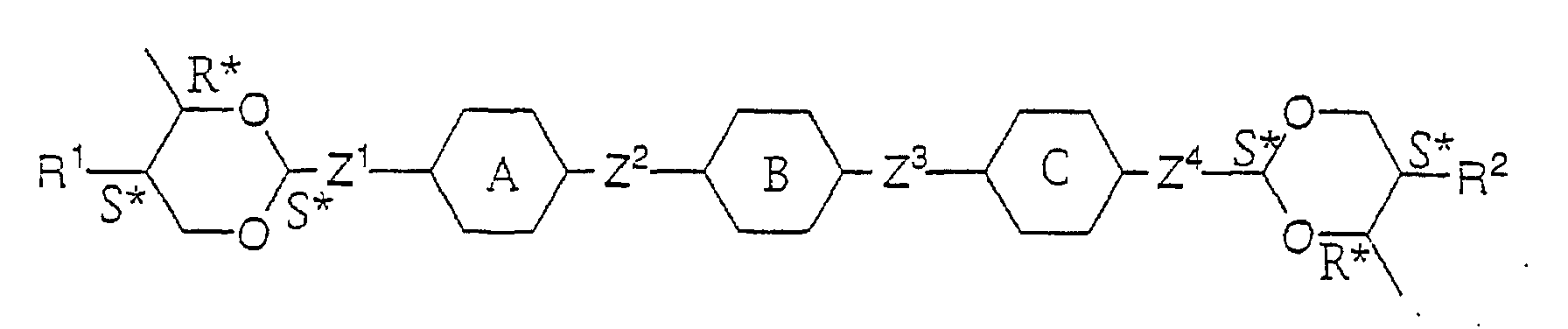
Es sind dies Verbindungen der allgemeinen Formel

- R1 und R2
- unabhängig von einander Alkyl oder Alkenyl, in welchen gegebenenfalls eine oder zwei nicht benachbarte Methylengruppen durch -O-, -COO-und/oder -OOC- ersetzt sind und/oder eines oder mehrere Wasserstoffatome durch Fluor, Chlor oder Cvano ersetzt sind. bedeuten: einer der Ringe
- A, B und C
- ein gegebenenfalls mit 1 oder 2 Fluoratomen substituiertes 1,4-Phenylen, Pyridin-2,5-diyl oder Pyrimidin-2,5-diyl, und die beiden anderen Ringe unabhängig voneinander gegebenfalls mit 1 oder 2 Fluoratomen substituiertes 1,4-Phenylen oder trans-1,4-Cyclohexylen bedeuten;
- Z1 und Z4
- unabhängig voneinander eine Einfachbindung, -CH2CH2-, -CH2O-, -OCH2-, -C≡C-, -(CH2)4-, -(CH2)3O-, -O(CH2)3-, -CH=CH-CH2O-, -OCH2-CH=CH-, -CH=CH-(CH2)2- oder -(CH2)2CH=CH-, mit der Massgabe, dass das Sauerstoffatom nicht direkt mit dem chiralen Dioxanring verknüpft ist, bedeuten;
- Z2 und Z3
- unabhängig voneinander eine Einfachbindung, -CH2-CH2-, -O-CH2-, -CH2-O-, -COO-, -OOC-, -C≡C-, -(CH2)4-, -O(CH2)3-, -(CH2)3O-,-CH=CH-CH2O-, -OCH2-CH=CH-, -(CH2)2-CH=CH- oder -CH=CH-(CH2)2- bedeuten; und
- R* und S*
- die relativen Konfigurationen der chiralen Kohlenstoffatome bedeuten.
- R 1 and R 2
- independently of one another alkyl or alkenyl, in which one or two non-adjacent methylene groups are optionally replaced by -O-, -COO- and / or -OOC- and / or one or more hydrogen atoms are replaced by fluorine, chlorine or cvano. mean: one of the rings
- A, B and C
- a 1,4-phenylene, pyridine-2,5-diyl or pyrimidine-2,5-diyl optionally substituted with 1 or 2 fluorine atoms, and the two other rings independently of one another optionally substituted with 1 or 2 fluorine atoms or 1,4-phenylene or mean trans-1,4-cyclohexylene;
- Z 1 and Z 4
- independently of one another a single bond, -CH 2 CH 2 -, -CH 2 O-, -OCH 2 -, -C≡C-, - (CH 2 ) 4 -, - (CH 2 ) 3 O-, -O (CH 2 ) 3 -, -CH = CH-CH 2 O-, -OCH 2 -CH = CH-, -CH = CH- (CH 2 ) 2 - or - (CH 2 ) 2 CH = CH-, with the proviso mean that the oxygen atom is not directly linked to the chiral dioxane ring;
- Z 2 and Z 3
- independently of one another a single bond, -CH 2 -CH 2 -, -O-CH 2 -, -CH 2 -O-, -COO-, -OOC-, -C≡C-, - (CH 2 ) 4 -, - O (CH 2 ) 3 -, - (CH 2 ) 3 O -, - CH = CH-CH 2 O-, -OCH 2 -CH = CH-, - (CH 2 ) 2 -CH = CH- or -CH = CH- (CH 2 ) 2 - mean; and
- R * and S *
- mean the relative configurations of the chiral carbon atoms.
Die in den Definitionen verwendeten Ausdrücke werden im folgenden
erläutert:
Der Ausdruck "Alkyl oder Alkenyl, in welchen gegebenenfalls eine oder
zwei nicht benachbarte Methylengruppen durch -O-, -COO- und/oder -OOC-ersetzt
sind und/oder eines oder mehrere Wasserstoffatome durch Fluor,
Chlor oder Cyano ersetzt sind" umfasst geradkettige und verzweigte
(gegebenenfalls chirale) Reste wie Alkyl, 2-Alkenyl, 3-Alkenyl, 4-Alkenyl,
Alkenyl mit endständiger Doppelbindung, Alkoxyalkyl, Alkenyloxyalkyl,
Alkylcarbonyloxyalkyl, Alkoxycarbonylalkyl, Fluoralkyl, Difluoralkyl,
Trifluoralkyl, Chloralkyl, Cyanoalkyl, 1-Methylalkyl, 2-Methylalkyl und
dergleichen, jeweils mit höchstens 16 Kohlenstoffatomen, vorzugsweise
höchstens 12 Kohlenstoffatome.
Beispiele bevorzugter Reste sind Methyl, Ethyl, Propyl, Butyl, Pentyl, Hexyl,
Heptyl, Octyl, Nonyl, Decyl, Undecyl, Dodecyl, 1-Methylpropyl, 1-Methylheptyl,
2Z-Pentenyl, 2Z-Hexenyl, 2Z-Heptenyl, 2Z-Octenyl 3E-Pentenyl,
3E-Hexenyl, 3E-Heptenyl, 3E-Octenyl, 5E-Octenyl, 3-Butenyl, 4-Pentenyl, 5-Hexenyl,
6-Heptenyl, 7-Octenyl, Methoxyethyl, Methoxypropyl,
Methoxybutyl, Ethoxyethyl, Propyloxyethyl, 2-Fluorpropyl, 2-Fluorpentyl, 2-Fluoroctyl,
2-Chlorhexyl, 2-Chloroctyl und dergleichen.
Der Ausdruck "gegebenenfalls mit 1 oder 2 Fluoratomen substituiertes 1,4-Phenylen"
bedeutet 1,4-Phenylen, 2- bzw. 3-Fluor-1,4-phenylen, 2,3-Difluor-1,4-phenylen,
2,6- bzw. 3,5-Difluor-1,4-phenylen. Bevorzugte Fluor-substiuierte
Ringe sind 2- bzw. 3-Fluor-1,4-phenylen oder 2,3-Difluor-1,4-phenylen.The terms used in the definitions are explained below:
The expression "alkyl or alkenyl, in which one or two non-adjacent methylene groups are optionally replaced by -O-, -COO- and / or -OOC- and / or one or more hydrogen atoms are replaced by fluorine, chlorine or cyano" includes straight-chain ones and branched (optionally chiral) radicals such as alkyl, 2-alkenyl, 3-alkenyl, 4-alkenyl, alkenyl with a double bond, alkoxyalkyl, alkenyloxyalkyl, alkylcarbonyloxyalkyl, alkoxycarbonylalkyl, fluoroalkyl, difluoroalkyl, trifluoroalkyl, chloroalkyl, cyanoalkyl, 1-methylalkyl, 2 -Methylalkyl and the like, each with at most 16 carbon atoms, preferably at most 12 carbon atoms.
Examples of preferred radicals are methyl, ethyl, propyl, butyl, pentyl, hexyl, heptyl, octyl, nonyl, decyl, undecyl, dodecyl, 1-methylpropyl, 1-methylheptyl, 2Z-pentenyl, 2Z-hexenyl, 2Z-heptenyl, 2Z- Octenyl 3E-pentenyl, 3E-hexenyl, 3E-heptenyl, 3E-octenyl, 5E-octenyl, 3-butenyl, 4-pentenyl, 5-hexenyl, 6-heptenyl, 7-octenyl, methoxyethyl, methoxypropyl, methoxybutyl, ethoxyethyl, propyloxyethyl , 2-fluoropropyl, 2-fluoropentyl, 2-fluoroctyl, 2-chlorohexyl, 2-chloroctyl and the like.
The expression “1,4-phenylene optionally substituted with 1 or 2 fluorine atoms” means 1,4-phenylene, 2- or 3-fluoro-1,4-phenylene, 2,3-difluoro-1,4-phenylene, 2 , 6- or 3,5-difluoro-1,4-phenylene. Preferred fluorine-substituted rings are 2- or 3-fluoro-1,4-phenylene or 2,3-difluoro-1,4-phenylene.
Besonders bevorzugte Verbindungen der Formel I sind diejenigen, worin Z1 und Z4 vorzugsweise eine Einfachbindung, -CH2CH2-, -CH2O- oder -OCH2-; und Z2 und Z3 vorzugsweise eine Einfachbindung, -CH2CH2-, -CH2O-, -OCH2-, -COO- oder -OOC- bedeuten, wobei ein in den Gruppen Z1 bis Z4 vorhandenes Sauerstoffatom vorzugsweise mit einem aromatischen Ring verknüpft ist. In ganz besonders bevorzugten Verbindungen sind höchstens zwei der Gruppen Z1 bis Z4 verschieden von einer Einfachbindung.Particularly preferred compounds of the formula I are those in which Z 1 and Z 4 are preferably a single bond, -CH 2 CH 2 -, -CH 2 O- or -OCH 2 -; and Z 2 and Z 3 are preferably a single bond, -CH 2 CH 2 -, -CH 2 O-, -OCH 2 -, -COO- or -OOC-, with an oxygen atom present in the groups Z 1 to Z 4 preferably is linked with an aromatic ring. In very particularly preferred compounds, at most two of the groups Z 1 to Z 4 are different from a single bond.
Besonders bevorzugt sind Verbindungen der Formel I, worin die Ringe A, B und C unabhängig voneinander 1,4-Phenylen, 2- bzw. 3-Fluor-1,4-phenylen oder 2,3-Difluor-1,4-phenylen bedeuten; oder einer der Ringe A, B und C 1,4-Phenylen, 2- bzw. 3-Fluor-1,4-phenylen oder 2,3-Difluor-1,4-phenylen und die beiden anderen Ringe unabhängig voneinander 1,4-trans-Cyclohexylen, 1,4-Phenylen, 2- bzw. 3-Fluor-1,4-phenylen oder 2,3-Difluor-1,4-phenylen bedeuten.Compounds of the formula I in which the rings are particularly preferred A, B and C independently of one another 1,4-phenylene, 2- or 3-fluoro-1,4-phenylene or 2,3-difluoro-1,4-phenylene; or one of the rings A, B and C 1,4-phenylene, 2- or 3-fluoro-1,4-phenylene or 2,3-difluoro-1,4-phenylene and the other two rings independently 1,4-trans-cyclohexylene, 1,4-phenylene, 2- or 3-fluoro-1,4-phenylene or 2,3-difluoro-1,4-phenylene mean.
Ganz besonders bevorzugte Verbindungen sind die Verbindungen der
allgemeinen Formeln




- R11 und R21
- unabhängig voneinander Alkyl oder Alkenyl mit höchstens 12 Kohlenstoffatomen, in welchen gegebenenfalls eine Methylengruppe durch -O-, -COO-oder -OOC- ersetzt ist;
- Z11, Z33 und Z41
- unabhängig voneinander eine Einfachbindung oder -CH2CH2-;
- Z21, Z31
- eine Einfachbindung, -COO- oder -OOC-;
- Z22,Z32
- unabhängig voneinander eine Einfachbindung, -CH2CH2- oder -OCH2-;
- Z23
- eine Einfachbindung, -CH2CH2- oder -CH2O-; und die Substituenten
- X1 bis X4
- unabhängig voneinander Wasserstoff oder Fluor bedeuten.
- R 11 and R 21
- independently of one another alkyl or alkenyl having at most 12 carbon atoms, in which a methylene group is optionally replaced by -O-, -COO-or -OOC-;
- Z 11 , Z 33 and Z 41
- independently of one another a single bond or -CH 2 CH 2 -;
- Z 21 , Z 31
- a single bond, -COO- or -OOC-;
- Z 22 , Z 32
- independently of one another a single bond, -CH 2 CH 2 - or -OCH 2 -;
- Z 23
- a single bond, -CH 2 CH 2 - or -CH 2 O-; and the substituents
- X 1 to X 4
- are independently hydrogen or fluorine.
Die in Formel I und den folgenden Formeln mit (S*) und (R*) bezeichneten relativen Konfigurationen der chiralen Kohlenstoffatome bedeuten, dass die bezeichneten Kohlenstoffatome wie angegeben die (S)-oder (R)-Konfiguration aufweisen oder, dass alle bezeichneten Kohlenstoffatome die spiegelbildliche Konfiguration aufweisen. Die Formeln umfassen somit jeweils das Diastereoisomer, worin (S*) für die (S)-Konfiguration und (R*) für die (R)-Konfiguration steht, sowie dessen optischen Antipoden, worin (S*) für die (R)-Konfiguration und (R*) für die (S)-Konfiguration steht.The in formula I and the following formulas with (S *) and (R *) designated relative configurations of the chiral carbon atoms mean that the designated carbon atoms as indicated are the (S) -or Have (R) configuration or that all designated carbon atoms have the mirror image configuration. The formulas thus each comprise the diastereoisomer, wherein (S *) for the (S) configuration and (R *) stands for the (R) configuration, as well as its optical antipodes, wherein (S *) for the (R) configuration and (R *) for the (S) configuration is available.
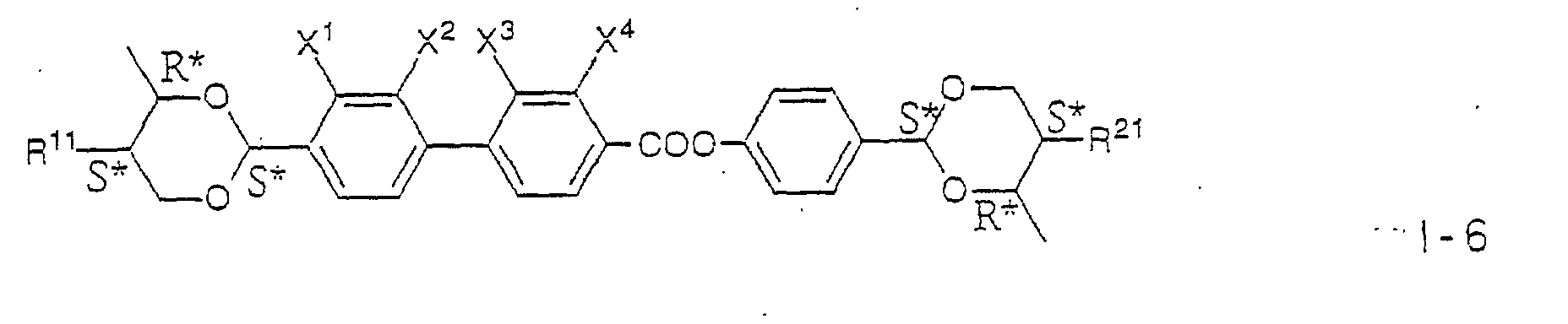
Insbesondere werden die Verbindungen der folgenden allgemeinen
Formeln bevorzugt:











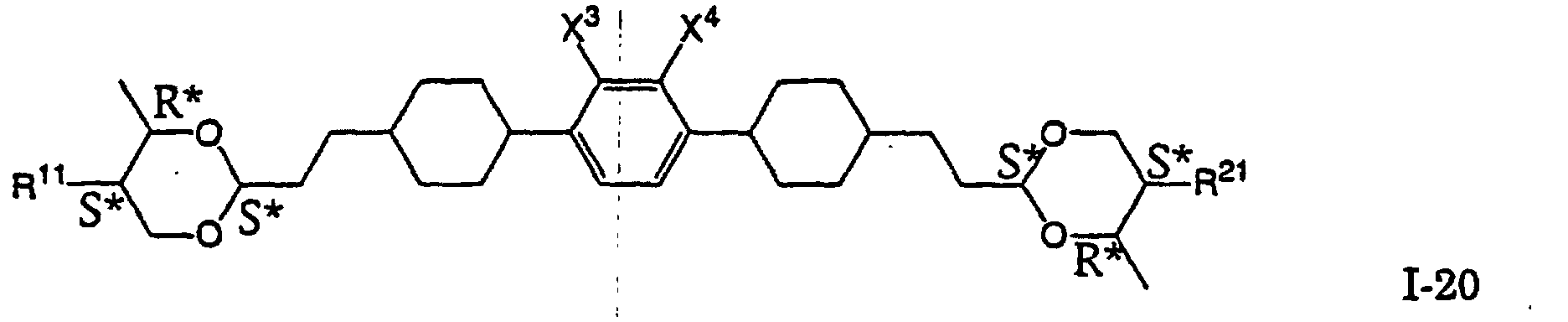
- R11 und R21
- die oben angegebene Bedeutung haben; und die Substituenten
- X1 bis X4
- Wasserstoff oder Fluor bedeuten; vorzugsweise sind jeweils höchstens einer oder zwei der Substituenten X1 bis X4 von Wasserstoff verschieden.
- R 11 and R 21
- have the meaning given above; and the substituents
- X 1 to X 4
- Is hydrogen or fluorine; preferably at most one or two of the substituents X 1 to X 4 are different from hydrogen.
Die Verbindungen der allgemeinen Formel I können in an sich
bekannter Weise, beispielsweise gemäss Schema 1, hergestellt werden.

- Q
- -CN oder -COOR bedeutet;
- R
- niederes Alkyl, wie Methyl, Ethyl, Propyl, i-Propyl,
Butyl, 2-Butyl oder tert.-Butyl bedeutet;
und die übrigen Symbole obige Bedeutung haben.
- Q
- Means -CN or -COOR;
- R
- lower alkyl, such as methyl, ethyl, propyl, i-propyl, butyl, 2-butyl or tert-butyl;
and the other symbols have the above meaning.
Dabei wird ein Aldehyd der allgemeinen Formel II, welcher eine zweite, leicht in einen Aldehyd überführbare Gruppe Q enthält, zunächst mit einem Diol der allgemeinen Formel III zu einem Monoacetal der allgemeinen Formel IV umgesetzt. Danach wird durch Reduktion beispielsweise mit Diisobutylaluminiumhydrid (DIBAH) das Nitril oder der Ester der allgemeinen Formel IV in einen Aldehyd der Formel V übergeführt, der durch eine zweite Acetalisierung mit einem Diol der allgemeinen Formel VI das Diacetal der allgemeinen Formel I ergibt. An aldehyde of the general formula II, which is a second group Q, which can easily be converted into an aldehyde, initially with a diol of the general formula III to a monoacetal of the general Formula IV implemented. After that, for example, by reduction with diisobutyl aluminum hydride (DIBAH) the nitrile or the ester of the general Formula IV converted into an aldehyde of formula V by a second acetalization with a diol of the general formula VI Diacetal of the general formula I results.
Wenn in R1 und/oder R2 Estergruppen vorhanden sind, wird vorzugsweise die Veresterung erst nach der Bildung der Dioxanringe erfolgen. Ferner kann, wenn R1 und/oder R2 Ethergruppen aufweisen, gewünschtenfalls auch die Veretherung nach der Bildung der Dioxanringe erfolgen.If ester groups are present in R 1 and / or R 2 , the esterification will preferably only take place after the formation of the dioxane rings. Furthermore, if R 1 and / or R 2 have ether groups, the etherification can, if desired, also take place after the formation of the dioxane rings.
Verbindungen der Formel I, worin Z2 und/oder Z3 eine Estergruppe bedeuten, werden bevorzugt durch Veresterung von entsprechenden Teilstrukturen mit vorgeformten Dioxanringen hergestellt.Compounds of the formula I in which Z 2 and / or Z 3 represent an ester group are preferably prepared by esterification of corresponding partial structures with preformed dioxane rings.
Des weiteren können diejenigen Verbindungen der allgemeinen
Formel I, welche zwei benachbarte, direkt verknüpfte Phenylringe
enthalten, durch Palladium katalysierte Kupplung beispielsweise eines
geeignet substituierten aromatischen Halogenids oder Sulfonates der
allgemeinen Formel VII mit einer geeignet substituierten Arylboronsäure
der allgemeinen Formel VIII hergestellt werden (s. Schema 2). Solche
Kupplungen sind mehrmals beschrieben worden, so zum Beispiel in
Tetrahedron Letters 35, 3277 (1994)

- Y
- Br, I oder -OSO2CF3 bedeutet; und
die übrigen Symbole obige Bedeutung haben.
- Y
- Br, I or -OSO 2 CF 3 ; and
the other symbols have the above meaning.
Die zur Synthese der Verbindungen der Formel I benötigten Ausgangsmaterialien sind bekannt oder Analoga bekannter Verbindungen. So sind beispielsweise zahlreiche Nitrile oder Ester der Formel II als Zwischenstufen bei der Synthese von Flüssigkristallen beschrieben worden, beispielsweise in EP-A-0 122 389. Auch die Herstellung der Diole der Formel III ist aus der Literatur bekannt, beispielsweise aus Mol Cryst. Liq. Cryst 213, 159 (1992)The starting materials required for the synthesis of the compounds of the formula I are known or analogs of known compounds. For example, numerous nitriles or esters of the formula II have been described as intermediates in the synthesis of liquid crystals, for example in EP-A-0 122 389. The preparation of the diols of the formula III is also known from the literature, for example from Mol Cryst. Liq. Cryst 213 , 159 (1992)
Die Analoga der Ausgangsmaterialien der Formeln VII oder VIII, beispielsweise Verbindungen mit achiralem Dioxan- oder Dioxolanring, der üblicherweise als Schutzgruppe dient, sind ebenfalls aus der Literatur bekannt. Bekannt sind dem Fachmann Verknüpfungsreaktionen von Ringen durch Esterbildung, Etherbildung oder durch direkte aromatische Kupplungen via Boronsäuren, wie beispielsweise in Tetrahedron Letters, 35, 3277 (1994) beschrieben. Diese Reaktionen gehören zu den Standardmethoden bei der Synthese von Flüssigkristallen und sind daher dem Fachmann bestens vertraut.Analogs of starting materials of formulas VII or VIII, for example compounds with achiral dioxane or dioxolane ring, the Usually used as a protective group are also from the literature known. Linking reactions of are known to the person skilled in the art Wrestling through ester formation, ether formation or through direct aromatic Couplings via boronic acids, such as in Tetrahedron Letters, 35, 3277 (1994). These reactions are standard methods in the synthesis of liquid crystals and are therefore the Expert very familiar.
Die erfindungsgemässen Verbindungen eignen sich als chirale Dotierstoffe für flüssigkristalline Gemische. Die Erfindung betrifft daher ebenfalls flüssigkristalline Gemische mit mindestens 2 Komponenten, welche dadurch gekennzeichnet sind, dass mindestens eine der Komponenten eine optisch aktive Verbindung der Formel I ist.The compounds according to the invention are suitable as chiral Dopants for liquid crystalline mixtures. The invention therefore relates to also liquid crystalline mixtures with at least 2 components, which are characterized in that at least one of the Components is an optically active compound of formula I.
Vorzugsweise enthalten die erfindungsgemässen Gemische eine flüssigkristalline Einzelverbindung oder ein flüssigkristallines Gemisch als Trägermaterial und eine oder mehrere optisch aktive Verbindungen der Formel I. Als Trägermaterial eignen sich grundsätzlich alle Flüssigkristallmaterialien, welche eine verdrillbare Flüssigkristallphase mit einem adäquaten Mesophasenbereich aufweisen. Das flüssigkristalline Trägermaterial kann, wie erwähnt, eine Einzelverbindung oder ein Gemisch sein und besitzt vorzugsweise einen Klärpunkt von mindestens etwa 60°C. Besonders geeignet sind die Verbindungen der Formel I als chirale Dotierstoffe für Trägermaterialien mit nematischer, cholesterischer oder getilteter smektischer Phase, ganz besonders für Trägermaterialien mit einer achiralen oder chiralen smektisch C Phase. Geeignete Flüssigkristallkomponenten sind dem Fachmann in grosser Zahl bekannt, z.B. aus D. Demus et al., Flüssige Kristalle in Tabellen, VEB Deutscher Verlag für Grundstoffindustrie, Leipzig, Bände I und II, oder aus Landolt-Börnstein, Liquid Crystals, Bände IV 7a-d, viele davon sind zudem im Handel erhältlich. The mixtures according to the invention preferably contain one liquid crystalline single compound or a liquid crystalline mixture as Carrier material and one or more optically active compounds Formula I. Basically all liquid crystal materials are suitable, which has a twistable liquid crystal phase with a have adequate mesophase range. The liquid crystalline carrier material can, as mentioned, be a single compound or a mixture and preferably has a clearing point of at least about 60 ° C. The compounds of formula I are particularly suitable as chiral Dopants for carrier materials with nematic, cholesteric or tilted smectic phase, especially for substrates with an achiral or chiral smectic C phase. Suitable liquid crystal components are known in large numbers to the person skilled in the art, e.g. from D. Demus et al., Liquid crystals in tables, VEB German publisher for Basic industry, Leipzig, Volumes I and II, or from Landolt-Börnstein, Liquid Crystals, Volumes IV 7a-d, many of which are also on the market available.
Der Anteil an chiralem Dotierstoff der Formel I ist weitgehend durch das Verdrillungsvermögen, die spontane Polarisation und die gewünschte Ganghöhe bestimmt. Der Anteil an chiralem Dotierstoff kann daher je nach Anwendung in einem breiten Bereich variieren und beispielsweise etwa 0,1-40 Gew.-% betragen. Für Anzeigevorrichtungen auf der Basis von Flüssigkristallen mit getilteten smektischen Phasen ist im allgemeinen ein Anteil von etwa 1-30 Gew.-%, insbesondere von etwa 3-25 Gew.-%, an optisch aktiven Dotierstoffen der Formel I bevorzugt.The proportion of chiral dopant of the formula I is largely through the twist, the spontaneous polarization and the desired Pitch determined. The proportion of chiral dopant can therefore vary Applications vary widely, for example, about 0.1-40 % By weight. For display devices based on liquid crystals with tilted smectic phases is generally a part from about 1-30% by weight, in particular from about 3-25% by weight, optically active dopants of the formula I are preferred.
Vorzugsweise enthalten die erfindungsgemässen Gemische neben
einer oder mehreren Verbindungen der Formel I eine oder mehrere Verbindungen
aus der Gruppe der Verbindungen der allgemeinen Formeln






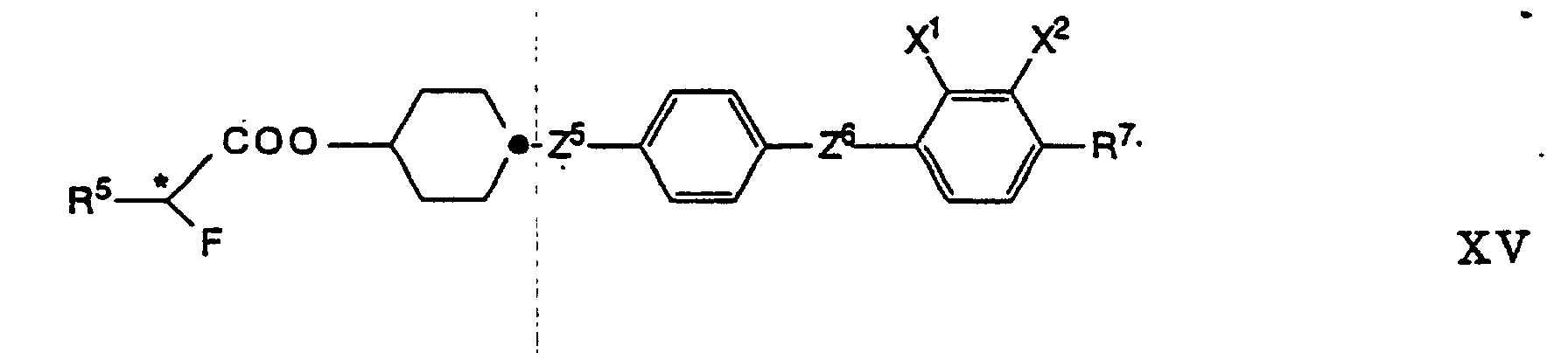




- p
- 0 oder 1,
- q und r
- unabhängig voneinander 1 oder 2, wobei q + r = 2 oder 3;
- R3 und R4
- unabhängig voneinander Alkyl, Alkenyl, Alkoxy, Alkenyloxy, Alkoxyalkyl, Alkoxyalkoxy, Alkanoyloxy, Alkenoyloxy, Alkoxycarbonyl, Alkenyloxycarbonyl;
- R5 und R8
- unabhängig voneinander Alkyl oder Alkenyl;
- R6 und R7
- unabhängig voneinander Alkyl, Alkenyl, Alkoxy und/oder Alkenyloxy;
- Z5, Z6 und Z7
- unabhängig voneinander eine Einfachbindung, -CH2CH2- oder -CH2O-, und Z6 auch -OCH2-, -COO-oder -OOC-;
- E und F
- unabhängig voneinander Phenylen-1,4-diyl oder trans-Cyclohexylen-1,4-diyl;
- X1 und X2
- unabhängig voneinander Wasserstoff oder Fluor; und
- (R*) und (S*)
- die relativen Konfigurationen bedeuten.
- p
- 0 or 1,
- q and r
- independently 1 or 2, where q + r = 2 or 3;
- R 3 and R 4
- independently of one another alkyl, alkenyl, alkoxy, alkenyloxy, alkoxyalkyl, alkoxyalkoxy, alkanoyloxy, alkenoyloxy, alkoxycarbonyl, alkenyloxycarbonyl;
- R 5 and R 8
- independently of one another alkyl or alkenyl;
- R 6 and R 7
- independently of one another alkyl, alkenyl, alkoxy and / or alkenyloxy;
- Z 5 , Z 6 and Z 7
- independently of one another a single bond, -CH 2 CH 2 - or -CH 2 O-, and Z 6 also -OCH 2 -, -COO-or -OOC-;
- E and F
- independently of one another phenylene-1,4-diyl or trans-cyclohexylene-1,4-diyl;
- X 1 and X 2
- independently of one another hydrogen or fluorine; and
- (R *) and (S *)
- the relative configurations mean.
Die Verbindungen der Formeln XV bis XIX sind optisch aktive Dotierstoffe, welche, je nach gewünschtem Effekt neben einer oder mehreren Verbindungen der Formel I in einer der beiden enantiomeren Formen in der Mischung vorhanden sein können.The compounds of the formulas XV to XIX are optically active dopants, which, depending on the desired effect, in addition to one or more Compounds of formula I in one of the two enantiomeric forms in the mixture may be present.
Die Substituenten R3 bis R8 besitzen höchstens je 18 Kohlenstoffatome, vorzugsweise 5-12 Kohlenstoffatome. Sie können geradkettig oder verzweigt sein, bevorzugt jedoch geradkettig.The substituents R 3 to R 8 each have at most 18 carbon atoms, preferably 5-12 carbon atoms. They can be straight-chain or branched, but preferably straight-chain.
Ebenfalls Gegenstand der vorliegenden Erfindung sind elektro-optische Vorrichtungen enthaltend eine oder mehrere Verbindungen der Formel I. Die Herstellung der flüssigkristallinen Gemische und der elektro-optischen Vorrichtung kann in an sich bekannter Weise erfolgen.The present invention also relates to electro-optical Devices containing one or more compounds of formula I. The production of the liquid crystalline mixtures and the electro-optical Device can be done in a manner known per se.
Die Herstellung der Verbindungen der Formel I sowie flüssigkristalliner Gemische enthaltend diese Verbindungen werden durch die folgenden Beispiele weiter veranschaulicht. Optische Antipoden der Verbindungen der Formel I besitzen jeweils die gleichen Phasenumwandlungstemperaturen und induzieren die gleichen Absolutwerte der spontanen Polarisation und der Verdrillung aber mit entgegengesetztem Vorzeichen. Die zur Charakterisierung der Phasenumwandlungen verwendeten Abkürzungen haben folgende Bedeutungen:
- C
- kristallin,
- s
- smektisch,
- SA, SB, SC usw.
- smektisch A, B, C usw.,
- SA*, SF* usw.
- chiral smektisch C, F usw.
- N
- nematisch,
- N*
- cholesterisch, und
- I
- isotrop.
- C.
- crystalline,
- s
- smectic,
- S A , S B , S C etc.
- smectic A, B, C etc.,
- S A *, S F * etc.
- chiral smectic C, F etc.
- N
- nematic,
- N *
- cholesteric, and
- I.
- isotropic.
Auf analoge Weise können die folgenden Verbindungen hergestellt werden:
Auf analoge Weise können die folgenden Verbindungen hergestellt werden:
Zu einer Lösung von 2,05 g 4-{4-[(2R, 3S, 5R)-5-Octyl-4-methyl-1,3-dioxan-2-yl]phenyl}benzoesäure, 1,4 g 4-[(2R, 3S, 5R)-5-Octyl-4-methyl-1,3-dioxan-2-yl]phenol und 0,1 g 4-(Dimethylamino)pyridin in 250 ml Dichlormethan werden innert 10 Min. unter Rühren portionenweise 1,2 g N,N'-Dicyclohexylcarbodiimid gegeben. Das Gemisch wird über Nacht bei Raumtemperatur gerührt und dann filtriert. Das Filtrat wird mit Dichlormethan verdünnt, zweimal mit je 50 ml gesättigter Natriumcarbonat-Lösung und dann mit Wasser gewaschen, über Magnesiumsulfat getrocknet, filtriert und das Filtrat eingeengt. Chromatographie des Rückstandes an Kieselgel mit Toluol und Umkristallisation aus Hexan ergibt 4'-[(2R, 3S, 5R)-5-Octyl-4-methyl-1,3-dioxan-2-yl]biphenylcarbonsäure-4-[(2R, 3S, 5R)-5-octyl-4-methyl-1,3-dioxan-2-yl]phenylester: Smp. (C/SA): 95.6°C, SA/N* 106.6°C; Klp. (N*/I) 234°C.To a solution of 2.05 g of 4- {4 - [(2R, 3S, 5R) -5-octyl-4-methyl-1,3-dioxan-2-yl] phenyl} benzoic acid, 1.4 g of 4- [(2R, 3S, 5R) -5-octyl-4-methyl-1,3-dioxan-2-yl] phenol and 0.1 g of 4- (dimethylamino) pyridine in 250 ml of dichloromethane are stirred within 10 minutes portions of 1.2 g of N, N'-dicyclohexylcarbodiimide. The mixture is stirred at room temperature overnight and then filtered. The filtrate is diluted with dichloromethane, washed twice with 50 ml of saturated sodium carbonate solution and then with water, dried over magnesium sulfate, filtered and the filtrate is concentrated. Chromatography of the residue on silica gel with toluene and recrystallization from hexane gives 4 '- [(2R, 3S, 5R) -5-octyl-4-methyl-1,3-dioxan-2-yl] biphenylcarboxylic acid 4 - [(2R, 3S, 5R) -5-octyl-4-methyl-1,3-dioxan-2-yl] phenyl ester: mp (C / S A ): 95.6 ° C, S A / N * 106.6 ° C; Klp. (N * / I) 234 ° C.
Auf analoge Weise können die folgenden Verbindungen hergestellt
werden:
Zur Untersuchung der Eigenschaften der Verbindungen der Formel I in Gemischen wurden Testmischungen je mit den beiden Grundmischungen GM-I und GM-II hergestellt. GM-I ist eine achirale (undotierte) Mischung und diente zur Ermittlung der Phasenfolge, insbesondere der Höhe des SC*-Phasenüberganges, sowie der spontanen Polarisation (Ps). GM-II ist eine chiral dotierte Mischung und diente der Messung der Wellenlänge der selektiven Reflexion (λsel). Diese ist ein Mass für die Ganghöhe der Helix, d.h. je kleiner der Messwert für λsel desto kleiner ist die Ganghöhe (Pitch) und desto stärker das Verdrillungsvermögen des Dotierstoffes. Zu Vergleichszwecken wurden zudem zwei Vergleichsmischungen hergestellt. Dazu wurden die beiden Grundmischungen GM-I und GM-II je mit einem vierkernigen chiralen Bismethyldioxan dotiert.To investigate the properties of the compounds of the formula I in mixtures, test mixtures were each prepared with the two basic mixtures GM-I and GM-II. GM-I is an achiral (undoped) mixture and was used to determine the phase sequence, in particular the height of the S C * phase transition, and the spontaneous polarization (Ps). GM-II is a chiral-doped mixture and was used to measure the wavelength of the selective reflection (λ sel ). This is a measure of the pitch of the helix, ie the smaller the measured value for λ sel, the smaller the pitch (pitch) and the stronger the twisting power of the dopant. Two comparative mixtures were also prepared for comparison purposes. For this purpose, the two basic mixtures GM-I and GM-II were each doped with a tetranuclear chiral bismethyldioxane.
Die Messungen wurden unter den folgenden Bedingungen durchgeführt:
Ps- Messungen bei ca. 8 mµ Zelldicke und einer Dreieckspannung
von 10 Hz und 5 V/µ. Messungen von λsel. bei homöotroper Orientierung.
Für alle Messung wurde eine Temperatur von 25 °C eingehalten.
Claims (15)
- Compounds of the general formulawherein
- R1 and R2
- each independently signify alkyl or alkenyl in which optionally one methylene group or two non-adjacent methylene groups is/are replaced by -0-, -COO- and/or -OOC-and/or one or more hydrogen atoms is/are replaced by fluorine, chlorine or cyano; one of rings
- A, B and C
- signifies a 1,4-phenylene optionally substituted with 1 or 2 fluorine atoms, pyridine-2,5-diyl or pyrimidine-2,5-diyl and the other two rings each independently signify 1,4-phenylene optionally substituted with 1 or 2 fluorine atoms or trans-1,4-cyclohexylene;
- Z1 and Z4
- each independently signify a single bond, -CH2CH2-, -CH2O-, -OCH2-, -C≡C-, -(CH2)4-, -(CH2)3O-, -O(CH2)3-, -CH=CH-CH2O-, -OCH2-CH=CH-, -CH=CH-(CH2)2- or -(CH2)2CH=CH-, with the proviso that the oxygen atom is not linked directly with the chiral dioxane ring;
- Z2 and Z3
- each independently signify a single bond, -CH2-CH2-, -O-CH2-, -CH2-O-, -COO-, -OOC-, -C≡C-, -(CH2)4-, -O(CH2)3-, -(CH2)3O-, -CH=CH-CH2O-, -OCH2-CH=CH-, -(CH2)2-CH=CH- or -CH=CH-(CH2)2-; and
- R*.and S*
- signify the relative configurations of the chiral carbon atoms.
- Compounds according to claim 1, wherein Z1 and Z4 signify a single bond, -CH2CH2-, -CH2O- or -OCH2-; and Z2 and Z3 signify a single bond, -CH2CH2-, -CH2O-, -OCH2-, -COO- or -OOC-, with an oxygen atom present in groups Z1 to Z4 preferably being linked with an aromatic ring.
- Compounds according to claim 1 or claim 2, wherein a maximum of two of groups Z1 to Z4 are other than a single bond.
- Compounds according to any one of claims 1 to 3 of the general formulae


 wherein
- R11 and R21
- each independently signify alkyl or alkenyl with a maximum of 12 carbon atoms in which optionally one methylene group is replaced by -O-, -COO- or -OOC-;
- Z11,Z33 and Z41
- each independently signify a single bond, or -CH2CH2-;
- Z21 and Z31
- each independently signify a single bond, -COO- or -OOC-;
- Z22 and Z32
- each independently signify a single bond, -CH2CH2- or -OCH2-;
- Z23
- signifies a single bond, -CH2CH2- or -CH2O-; and the substituents
- X1 to X4
- each independently signify hydrogen or fluorine.
- Compounds according to claim 4 of the formulae





 wherein
- R11 and R21
- each independently signify alkyl or alkenyl with a maximum of 12 carbon atoms in which optionally one methylene group is replaced by -O-, -COO- or -OOC-; and the substituents
- X1 to X4
- each independently signify hydrogen or fluorine.
- Compounds according to claim 4 of the formulae



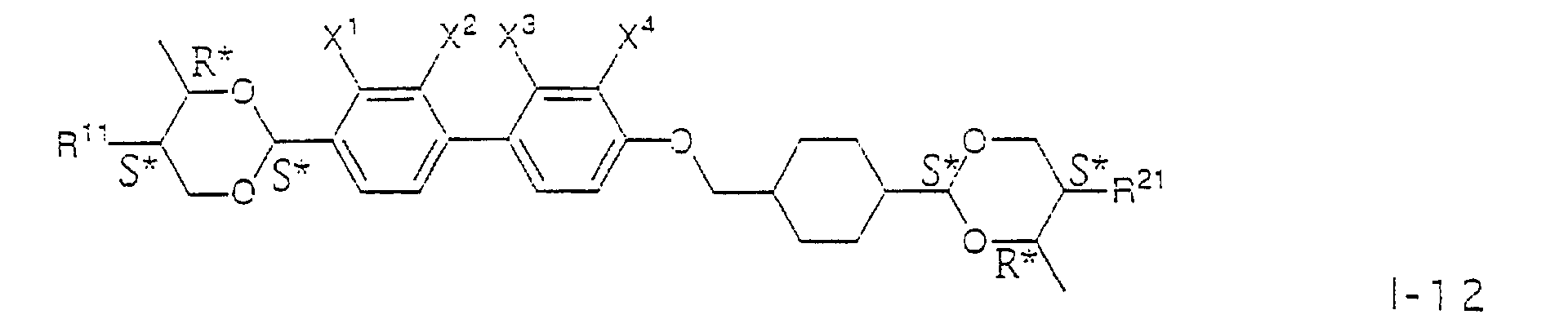
 wherein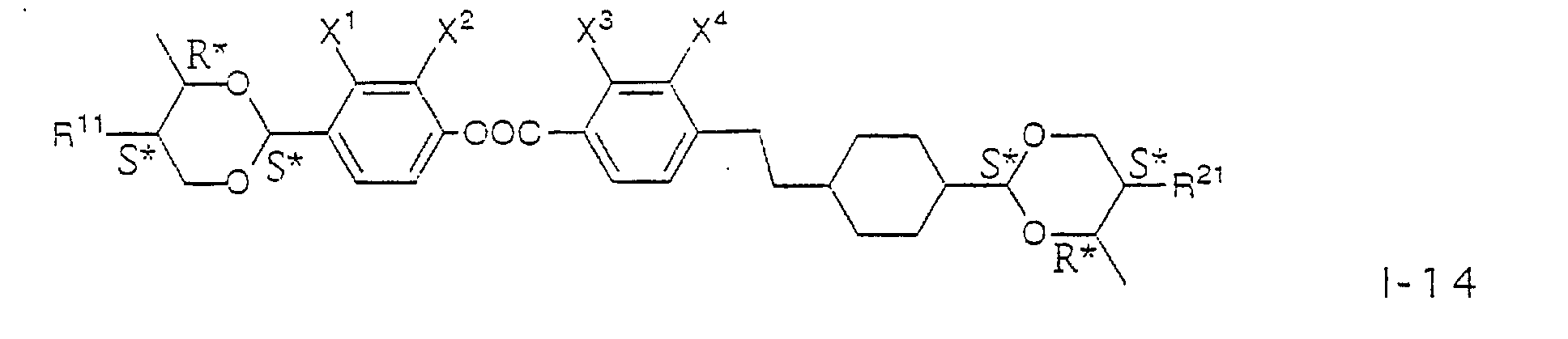
- R11 and R21
- each independently signify alkyl or alkenyl with a maximum of 12 carbon atoms in which optionally one methylene group is replaced by -O-, -COO- or -OOC-; and the substituents
- X1 to X4
- each independently signify hydrogen or fluorine.
- Compounds according to claim 4 of the formulae

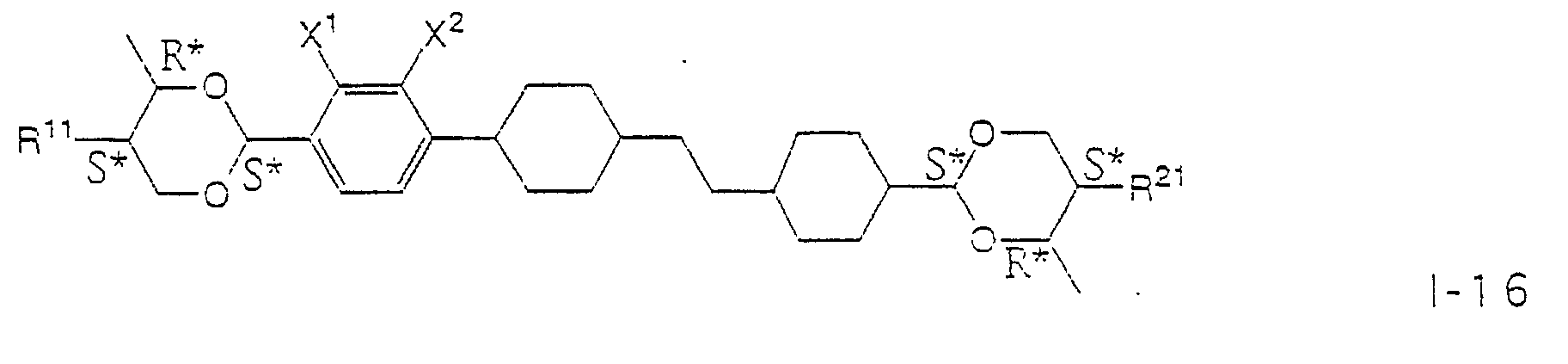
 wherein
- R11 and R21
- each independently signify alkyl or alkenyl with a maximum of 12 carbon atoms in which optionally one methylene group is replaced by -0-, -COO- or -OOC-; and the substituents
- X1 to X4
- each independently signify hydrogen or fluorine.
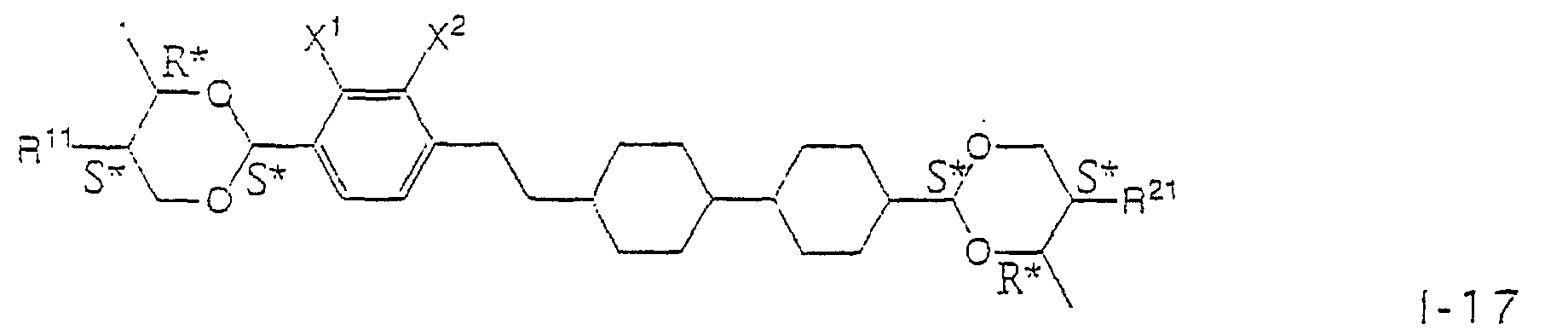
- Compounds according to claim 4 of the formulae
 wherein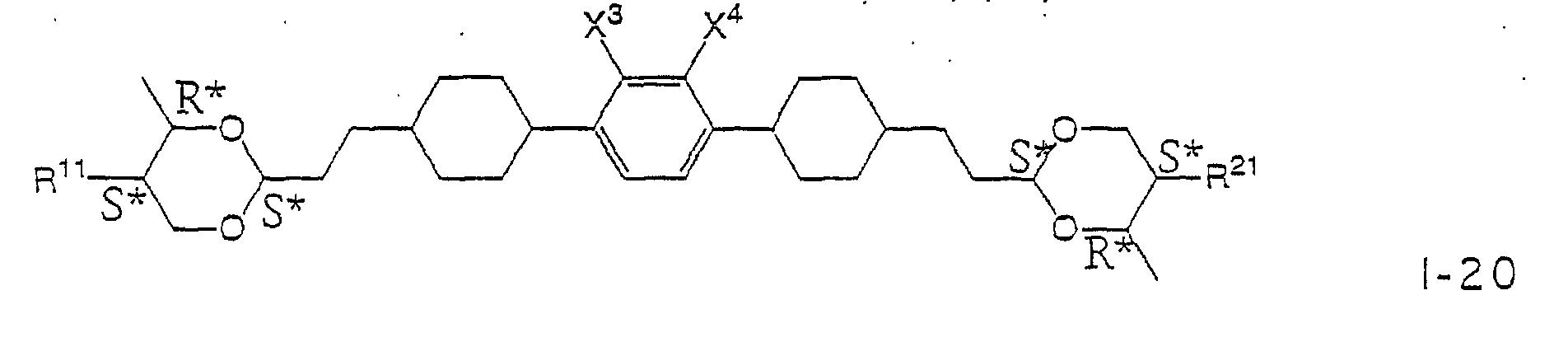
- R11 and R21
- each independently signify alkyl or alkenyl with a maximum of 12 carbon atoms in which optionally one methylene group is replaced by -O-, -COO- or -OOC-; and the substituents
- X1 to X4
- each independently signify hydrogen or fluorine.
- Compounds according to any one of claims 4 to 8, wherein a maximum of two of groups X1 to X4 signify fluorine.
- Liquid crystalline mixtures containing at least two components, wherein at least one component is an optically active compound of formula I defined in anyone of claims 1 to 9.
- Liquid crystalline mixtures in accordance with claim 10, wherein the content of optically active compounds defined in anyone of claims 1 to 9 is 1-30 wt%.
- The use of the compounds defined in anyone of claims 1 to 9 for electro-optical purposes.
- The use of liquid crystalline mixtures in accordance with claim 10 or claim 11 for electro-optical purposes.
- An electro-optical device containing a compound according to any one of claims 1 to 9.
- An electro-optical device containing a mixture according to claim 10 or claim 11.
Applications Claiming Priority (3)
| Application Number | Priority Date | Filing Date | Title |
|---|---|---|---|
| CH396 | 1996-01-02 | ||
| CH3/96 | 1996-01-02 | ||
| CH396 | 1996-01-02 |
Publications (3)
| Publication Number | Publication Date |
|---|---|
| EP0782995A2 EP0782995A2 (en) | 1997-07-09 |
| EP0782995A3 EP0782995A3 (en) | 1997-07-16 |
| EP0782995B1 true EP0782995B1 (en) | 2001-08-16 |
Family
ID=4177219
Family Applications (1)
| Application Number | Title | Priority Date | Filing Date |
|---|---|---|---|
| EP96120713A Expired - Lifetime EP0782995B1 (en) | 1996-01-02 | 1996-12-21 | Optically active Bis-methyldioxan derivatives and their use for electro-optical displays |
Country Status (7)
| Country | Link |
|---|---|
| US (1) | US6225479B1 (en) |
| EP (1) | EP0782995B1 (en) |
| JP (1) | JPH09202782A (en) |
| KR (1) | KR970059171A (en) |
| CN (1) | CN1077105C (en) |
| DE (1) | DE59607499D1 (en) |
| SG (1) | SG85088A1 (en) |
Families Citing this family (5)
| Publication number | Priority date | Publication date | Assignee | Title |
|---|---|---|---|---|
| DE10013507A1 (en) * | 2000-03-20 | 2001-09-27 | Basf Ag | New chiral 2,4,5-tri-substituted 1,3-dioxane compounds with mesogenic groups are used as chiral dopants for liquid crystal systems, e.g. for display, and polymerizable compositions for printing, coating or making e.g. pigment |
| US6824707B2 (en) * | 2001-10-23 | 2004-11-30 | Clariant International Ltd. | Active matrix liquid crystal device and smectic liquid crystal mixture |
| CN102770580A (en) * | 2010-02-25 | 2012-11-07 | 应用材料公司 | Ultra-low dielectric materials formed by plasma-enhanced chemical vapor deposition using hybrid precursors containing organofunctional silicon |
| DE102011122559A1 (en) * | 2011-01-25 | 2012-07-26 | Merck Patent Gmbh | Liquid crystalline compounds and liquid crystalline media |
| WO2014065293A1 (en) * | 2012-10-23 | 2014-05-01 | Jnc株式会社 | Liquid-crystal compound, liquid-crystalline medium and optical element |
Family Cites Families (11)
| Publication number | Priority date | Publication date | Assignee | Title |
|---|---|---|---|---|
| DE3465192D1 (en) | 1983-03-16 | 1987-09-10 | Hoffmann La Roche | Liquid crystal components having an alkenyl chain |
| DE3405914A1 (en) | 1984-02-18 | 1985-08-22 | Merck Patent Gmbh, 6100 Darmstadt | LIQUID CRYSTAL LINKS |
| DE3437935A1 (en) | 1984-10-17 | 1986-04-24 | Merck Patent Gmbh, 6100 Darmstadt | HETEROCYCLIC COMPOUNDS |
| CH676466A5 (en) | 1986-05-20 | 1991-01-31 | Werk Fernsehelektronik Veb | |
| EP0315014B1 (en) | 1987-11-06 | 1994-01-12 | F. Hoffmann-La Roche Ag | Halogenated benzene derivatives |
| US5494606A (en) | 1990-04-26 | 1996-02-27 | Merck Patent Gesellscaft Mit Beschrankter Haftung | 1,3-dioxane derivatives, and liquid-crystalline medium |
| WO1991016321A1 (en) | 1990-04-26 | 1991-10-31 | MERCK Patent Gesellschaft mit beschränkter Haftung | 1,3-dioxane derivates and liquid crystal medium |
| EP0457105B1 (en) | 1990-05-15 | 1995-07-26 | F. Hoffmann-La Roche Ag | Chiral dioxanes as components of liquid crystal mixtures |
| US5547605A (en) | 1993-12-15 | 1996-08-20 | Hoechst Aktiengesellschaft | 2-Aryloxytetrafluoropropionic esters, process for their preparation, and their use in liquid-crystalline mixtures |
| EP0677565B1 (en) * | 1994-04-14 | 2000-10-18 | Canon Kabushiki Kaisha | Liquid crystal composition, liquid crystal device using the composition, liquid crystal apparatus and display method |
| US5667721A (en) | 1995-03-16 | 1997-09-16 | Rolic Ag | Liquid crystalline di-1,3-dioxane derivatives |
-
1996
- 1996-12-02 US US08/756,925 patent/US6225479B1/en not_active Expired - Fee Related
- 1996-12-18 JP JP8338378A patent/JPH09202782A/en not_active Withdrawn
- 1996-12-21 DE DE59607499T patent/DE59607499D1/en not_active Expired - Fee Related
- 1996-12-21 EP EP96120713A patent/EP0782995B1/en not_active Expired - Lifetime
- 1996-12-25 CN CN96117953A patent/CN1077105C/en not_active Expired - Fee Related
- 1996-12-31 KR KR1019960081296A patent/KR970059171A/en not_active Abandoned
- 1996-12-31 SG SG9611951A patent/SG85088A1/en unknown
Also Published As
| Publication number | Publication date |
|---|---|
| CN1165139A (en) | 1997-11-19 |
| JPH09202782A (en) | 1997-08-05 |
| SG85088A1 (en) | 2001-12-19 |
| CN1077105C (en) | 2002-01-02 |
| DE59607499D1 (en) | 2001-09-20 |
| US6225479B1 (en) | 2001-05-01 |
| HK1001130A1 (en) | 1998-05-29 |
| EP0782995A3 (en) | 1997-07-16 |
| KR970059171A (en) | 1997-08-12 |
| EP0782995A2 (en) | 1997-07-09 |
Similar Documents
| Publication | Publication Date | Title |
|---|---|---|
| EP0264435B1 (en) | Smectic liquid crystal phases | |
| EP0224579B1 (en) | Smectic liquid crystalline phases | |
| EP0215800B1 (en) | Pyrimidines | |
| DE3807872A1 (en) | DIFLUORBENZENE DERIVATIVES | |
| DE3533333A1 (en) | Smectic liquid crystal phases | |
| EP0158137B1 (en) | Pyrimidines | |
| EP0234437B1 (en) | Chiralic reaction products of mesogene molecular structures and bifunctional reactive derivatives of tartaric acid, method for their production and their use as a doping material in liquid crystal phases | |
| EP0391203B1 (en) | 2-Phenyl pyridins | |
| EP0418362B1 (en) | Trifluoromethylcyclohexane derivatives | |
| EP0248335A2 (en) | Chiral esters of alpha-substituted carboxylic acids and mesogeneous pyrimidine-5-yl-phenols, and their use as dopants in liquid-crystal phases | |
| EP0441213B1 (en) | Chiral dioxolanes | |
| EP0732330B1 (en) | Di-1,3-dioxane derivatives useful as liquid crystals | |
| EP0464648B1 (en) | 4-Cyano-3-fluorophenyl esters | |
| EP0534258B1 (en) | Chiral oxazolines as dopants for liquid crystals mixtures | |
| EP0782995A2 (en) | Optically active Bis-methyldioxan derivatives and their use for electro-optical displays | |
| EP0883618B1 (en) | Difluorophenyl pyrimidyl pyridine derivatives and the use thereof in liquid crystal mixtures | |
| EP0428665B1 (en) | Fluorophenyl pyrimidines | |
| EP0457105B1 (en) | Chiral dioxanes as components of liquid crystal mixtures | |
| DE4227772A1 (en) | 2-Fluoro-perfluoroalkyl-cyclohexane derivs. - useful as components of liq. crystal media for electro optical display elements | |
| EP0821049B1 (en) | Cyclopentyl compounds | |
| WO1989008688A1 (en) | Derivatives of 2,3-difluorobenzoic acid | |
| EP0755929B1 (en) | Photocrosslinkable liquid crystalline 1,4-dioxane-2,3-diyl derivatives | |
| WO1991003468A1 (en) | Difluorobenzonitriles and liquid-crystal medium | |
| EP0440771A1 (en) | 5-oxy-2-phenylazines and mesomorphous medium | |
| EP0729952A1 (en) | 1-Fluorocyclohexene-dioxane derivative |
Legal Events
| Date | Code | Title | Description |
|---|---|---|---|
| PUAI | Public reference made under article 153(3) epc to a published international application that has entered the european phase |
Free format text: ORIGINAL CODE: 0009012 |
|
| PUAL | Search report despatched |
Free format text: ORIGINAL CODE: 0009013 |
|
| 17P | Request for examination filed |
Effective date: 19961221 |
|
| AK | Designated contracting states |
Kind code of ref document: A2 Designated state(s): CH DE FR GB IT LI NL |
|
| AK | Designated contracting states |
Kind code of ref document: A3 Designated state(s): CH DE FR GB IT LI NL |
|
| RAP1 | Party data changed (applicant data changed or rights of an application transferred) |
Owner name: ROLIC AG |
|
| 17Q | First examination report despatched |
Effective date: 19991014 |
|
| RAP1 | Party data changed (applicant data changed or rights of an application transferred) |
Owner name: ROLIC AG |
|
| GRAG | Despatch of communication of intention to grant |
Free format text: ORIGINAL CODE: EPIDOS AGRA |
|
| GRAG | Despatch of communication of intention to grant |
Free format text: ORIGINAL CODE: EPIDOS AGRA |
|
| GRAH | Despatch of communication of intention to grant a patent |
Free format text: ORIGINAL CODE: EPIDOS IGRA |
|
| GRAH | Despatch of communication of intention to grant a patent |
Free format text: ORIGINAL CODE: EPIDOS IGRA |
|
| GRAA | (expected) grant |
Free format text: ORIGINAL CODE: 0009210 |
|
| AK | Designated contracting states |
Kind code of ref document: B1 Designated state(s): CH DE FR GB IT LI NL |
|
| REG | Reference to a national code |
Ref country code: CH Ref legal event code: EP |
|
| REG | Reference to a national code |
Ref country code: CH Ref legal event code: NV Representative=s name: ISLER & PEDRAZZINI AG |
|
| REF | Corresponds to: |
Ref document number: 59607499 Country of ref document: DE Date of ref document: 20010920 |
|
| GBT | Gb: translation of ep patent filed (gb section 77(6)(a)/1977) |
Effective date: 20011003 |
|
| REG | Reference to a national code |
Ref country code: GB Ref legal event code: IF02 |
|
| ET | Fr: translation filed | ||
| PLBE | No opposition filed within time limit |
Free format text: ORIGINAL CODE: 0009261 |
|
| STAA | Information on the status of an ep patent application or granted ep patent |
Free format text: STATUS: NO OPPOSITION FILED WITHIN TIME LIMIT |
|
| 26N | No opposition filed | ||
| PGFP | Annual fee paid to national office [announced via postgrant information from national office to epo] |
Ref country code: CH Payment date: 20021017 Year of fee payment: 7 |
|
| PGFP | Annual fee paid to national office [announced via postgrant information from national office to epo] |
Ref country code: FR Payment date: 20021111 Year of fee payment: 7 |
|
| PGFP | Annual fee paid to national office [announced via postgrant information from national office to epo] |
Ref country code: GB Payment date: 20021115 Year of fee payment: 7 |
|
| PGFP | Annual fee paid to national office [announced via postgrant information from national office to epo] |
Ref country code: DE Payment date: 20021119 Year of fee payment: 7 |
|
| PGFP | Annual fee paid to national office [announced via postgrant information from national office to epo] |
Ref country code: NL Payment date: 20021121 Year of fee payment: 7 |
|
| PG25 | Lapsed in a contracting state [announced via postgrant information from national office to epo] |
Ref country code: GB Free format text: LAPSE BECAUSE OF NON-PAYMENT OF DUE FEES Effective date: 20031221 |
|
| PG25 | Lapsed in a contracting state [announced via postgrant information from national office to epo] |
Ref country code: LI Free format text: LAPSE BECAUSE OF NON-PAYMENT OF DUE FEES Effective date: 20031231 Ref country code: CH Free format text: LAPSE BECAUSE OF NON-PAYMENT OF DUE FEES Effective date: 20031231 |
|
| PG25 | Lapsed in a contracting state [announced via postgrant information from national office to epo] |
Ref country code: NL Free format text: LAPSE BECAUSE OF NON-PAYMENT OF DUE FEES Effective date: 20040701 Ref country code: DE Free format text: LAPSE BECAUSE OF NON-PAYMENT OF DUE FEES Effective date: 20040701 |
|
| GBPC | Gb: european patent ceased through non-payment of renewal fee |
Effective date: 20031221 |
|
| REG | Reference to a national code |
Ref country code: CH Ref legal event code: PL |
|
| PG25 | Lapsed in a contracting state [announced via postgrant information from national office to epo] |
Ref country code: FR Free format text: LAPSE BECAUSE OF NON-PAYMENT OF DUE FEES Effective date: 20040831 |
|
| NLV4 | Nl: lapsed or anulled due to non-payment of the annual fee |
Effective date: 20040701 |
|
| REG | Reference to a national code |
Ref country code: FR Ref legal event code: ST |
|
| PG25 | Lapsed in a contracting state [announced via postgrant information from national office to epo] |
Ref country code: IT Free format text: LAPSE BECAUSE OF NON-PAYMENT OF DUE FEES;WARNING: LAPSES OF ITALIAN PATENTS WITH EFFECTIVE DATE BEFORE 2007 MAY HAVE OCCURRED AT ANY TIME BEFORE 2007. THE CORRECT EFFECTIVE DATE MAY BE DIFFERENT FROM THE ONE RECORDED. Effective date: 20051221 |